John 6:36

Greek (Tischendorf 8th ed.) John 6:36 appears in the Greek New Testament. The text above is from the Tischendorf 8th edition. Each word links to its Strong’s number and a concise gloss. Click any word for its full Thayer’s Greek Lexicon entry.
Download image
Cite this verse

John 6:36 (World English Bible). Public Domain. Lemma interlinear Bible study tool, https://lemma.gebible.app/v/john/6/36.

Show BibTeX & RIS
BibTeX
RIS
English Translation
But I told you that you have seen me, and yet you don't believe.
World English Bible · Public Domain
Download a study sheet

One document with this verse’s original text, its word-by-word gloss line, the meaning frame, cross-references with their text, attributed commentary, and full source and license credits — printable, and it pastes into notes with its structure intact.

This verse Autodidact and up

Study sheet (.html) Plain text (.txt)

A passage Seminary Student

Up to 50 verses in one chapter. A passage sheet keeps up to 6 commentary sources and 12 cross-references per verse, in the order this page ranks them, and says so on the sheet whenever that leaves anything out. Ask for a single verse and you get the Autodidact verse sheet above.

Everything on this page stays free to read, with no account — the sheet is a download of what is already on screen, not access to it.

Want to remove ads? Support Godless Engineer
Compare translations 3

The same verse in 3 English versions, stacked beneath the original-language interlinear above. Click any original word for its lexicon entry.

Each is an independent rendering of the whole verse — the interlinear is not word-aligned to these translations.

Highlighted words mark where these versions differ — a whole-verse word diff, not a word-by-word alignment.

  • World English Bible Public Domain
    But I told you that you have seen me, and yet you don't believe.
  • King James Version Public Domain
    But I said unto you, That ye also have seen me, and believe not.
  • unfoldingWord Literal Text CC BY-SA 4.0
    But I told you that you have both seen me and do not believe.

unfoldingWord Literal Text — © unfoldingWord, licensed CC BY-SA 4.0. Word-aligned USFM3 via Door43 (git.door43.org/unfoldingWord/en_ult).

Versions to compare (up to 4)

3 of 4 selected

Show all 19 translations

Every available English version of this verse, each an independent rendering of the whole verse.

  • World English Bible Public Domain
    But I told you that you have seen me, and yet you don't believe.
  • Berean Standard Bible Public Domain
    But as I stated, you have seen Me and still you do not believe.
  • Majority Standard Bible Public Domain
    But as I stated, you have seen Me and still you do not believe.
  • King James Version Public Domain
    But I said unto you, That ye also have seen me, and believe not.
  • American Standard Version (1901) Public Domain
    But I said unto you, that ye have seen me, and yet believe not.
  • Revised Version (1885) Public Domain
    But I said unto you, that ye have seen me, and yet believe not.
  • Geneva Bible (1599) Public Domain
    But I said vnto you, that ye also haue seene me, and beleeue not.
  • Douay-Rheims (1899) Public Domain
    But I said unto you, that you also have seen me, and you believe not.
  • Young's Literal Translation Public Domain
    but I said to you, that ye also have seen me, and ye believe not;
  • Literal Standard Version CC BY-SA 4.0
    but I said to you that you also have seen Me, and you do not believe;
  • Unlocked Literal Bible CC BY-SA 4.0
    But I told you that indeed you have seen me, and you do not believe.
  • unfoldingWord Literal Text CC BY-SA 4.0
    But I told you that you have both seen me and do not believe.
  • Darby Bible Public Domain
    But I have said to you, that ye have also seen me and do not believe.
  • World Messianic Bible Public Domain
    But I told you that you have seen me, and yet you don’t believe.
  • Webster's Bible Public Domain
    But I said to you, That ye also have seen me, and believe not.
  • Free Bible Version CC BY-SA 4.0
    But as I explained to you before, you have seen me, but you still don't trust me.
  • Bible in Basic English Public Domain
    But it is as I said to you: you have seen me, and still you have no faith.
  • Text-Critical English NT CC BY 4.0
    But as I told you, you have seen me and still you do not believe.
  • Tyndale New Testament (1534) Public Domain
    But I sayed vnto you: that ye have sene me and yet beleve not.

Literal Standard Version (2020), Covenant Press — licensed CC BY-SA 4.0. Text via the HelloAO Bible API (eBible.org). Unlocked Literal Bible (unfoldingWord) — licensed CC BY-SA 4.0. Text via the HelloAO Bible API (eBible.org). unfoldingWord Literal Text — © unfoldingWord, licensed CC BY-SA 4.0. Word-aligned USFM3 via Door43 (git.door43.org/unfoldingWord/en_ult). Free Bible Version, Dr. Jonathan Gallagher — licensed CC BY-SA 4.0. Text via the HelloAO Bible API (eBible.org).

Word by word

More ways to search: Search by grammar → Find every occurrence → Compare this word →

Practice this passage: Drill this verse → Learn its vocabulary →

πιστεύετε
pisteúō
G4100
“to believe”
Verb, Present, Active, Indicative, 2nd person, Plural
Part of Speech
Verb
Tense
Present
Voice
Active
Mood
Indicative
Person
2nd person
Number
Plural
Full Thayer's Definition

Origin: from G4102

TDNT: 08:54,8

1. to think to be true, to be persuaded of, to credit, place confidence in a. of the thing believed 1. to credit, have confidence b. in a moral or religious reference 1. used in the NT of the conviction and trust to which a man is impelled by a certain inner and higher prerogative and law of soul 2. to trust in Jesus or God as able to aid either in obtaining or in doing something: saving faith 1bc) mere acknowledgment of some fact or event: intellectual faith 2. to entrust a thing to one, i.e. his fidelity a. to be intrusted with a thing
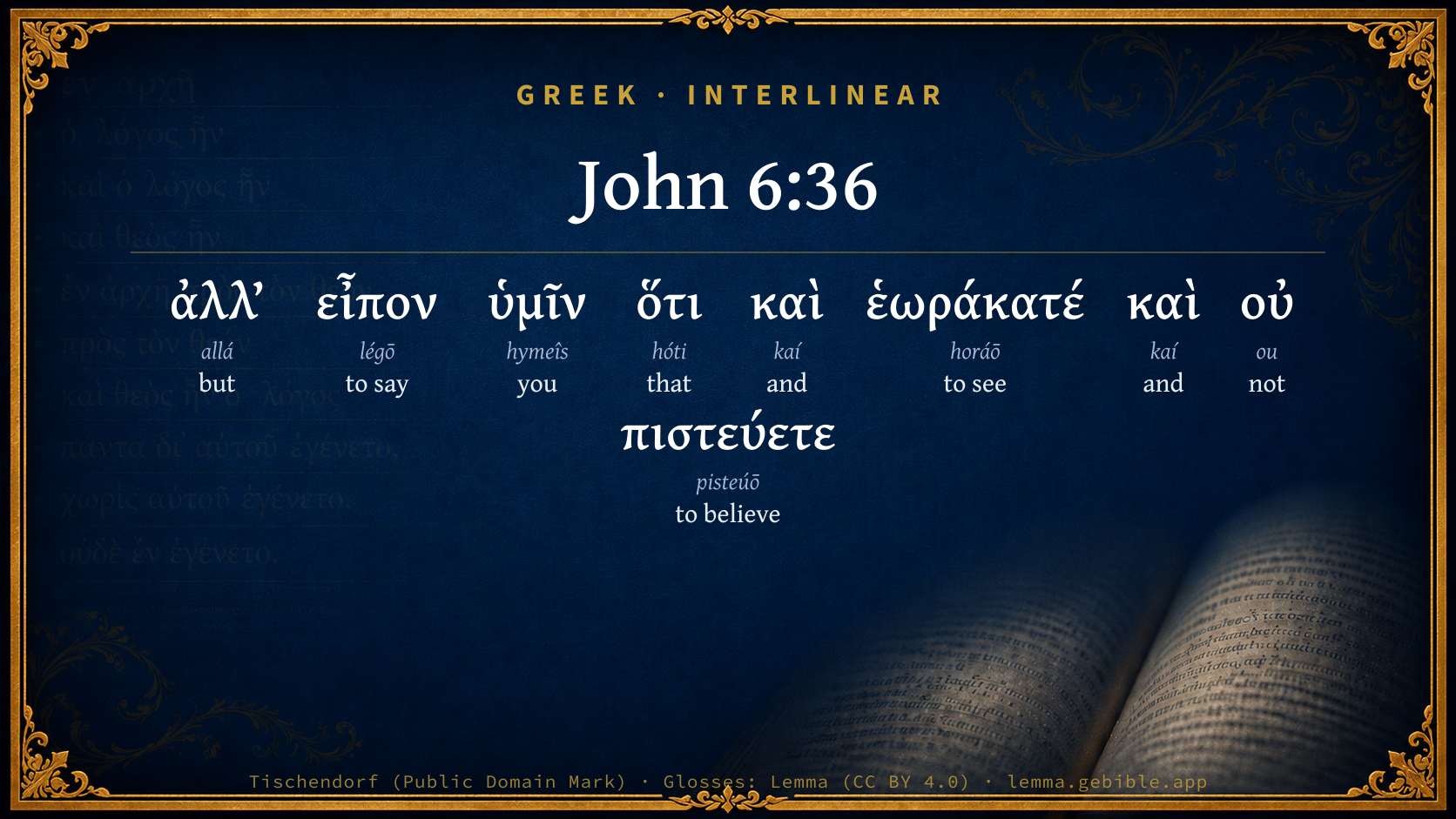
  1. ἀλλ’ allá G235 “but” Conjunction
  2. εἶπον légō G3004 “to say” Verb, Aorist, Active, Indicative, 1st person, Singular
  3. ὑμῖν hymeîs G5210 “you” Personal pronoun, 2nd person, Dative, Plural
  4. ὅτι hóti G3754 “that” Conjunction
  5. καὶ kaí G2532 “and” Conjunction
  6. ἑωράκατέ horáō G3708 “to see” Verb, Perfect, Active, Indicative, 2nd person, Plural, Attic form
  7. καὶ kaí G2532 “and” Conjunction
  8. οὐ ou G3756 “not” Particle, Negative

About this verse

These counts appear in no published source. They are computed here, from the morphology-tagged text and Lemma’s own curated glosses. What Lemma adds →

9
words
8
distinct lemmas
Gospels
section

Repetition

A word recurs within this verse:

Cross-references

8

Topical passages linked to John 6:36 in the Treasury of Scripture Knowledge — connected by theme and wording, ordered by reader-vote popularity; previews shown in the World English Bible.

  • 1 Peter 1:8–9 whom not having known you love; in whom, though now you don't see him, yet believing, you rejoice greatly with joy unspeakable and full of glory--
  • Luke 16:31 "He said to him, 'If they don't listen to Moses and the prophets, neither will they be persuaded if one rises from the dead.'"
  • John 6:26 Jesus answered them, "Most assuredly I tell you, you seek me, not because you saw signs, but because you ate of the loaves, and were filled.
  • John 12:37 But though he had done so many signs before them, yet they didn't believe in him,
  • John 6:30 They said therefore to him, "What then do you do for a sign, that we may see, and believe you? What work do you do?
  • John 6:40 This is the will of the one who sent me, that everyone who sees the Son, and believes in him, should have eternal life; and I will raise him up at the last day."
  • John 6:64 But there are some of you who don't believe." For Jesus knew from the beginning who they were who didn't believe, and who it was who would betray him.
  • John 15:24 If I hadn't done among them the works which no one else did, they wouldn't have had sin. But now have they seen and also hated both me and my Father.

Cross-references courtesy of OpenBible.info (CC BY 4.0).

Commentary

Notes on John 6:36 from classic Christian and Jewish commentators (each source and its license shown beneath its notes). The classic Christian expositions comment on the surrounding passage and are grouped to its opening verse, so a note may address several verses; the Jewish commentaries on the Tanakh (Rashi and others) are per-verse, so they appear only where the commentator wrote on this verse.

Lemma curates 59 commentaries, every one of them public domain or Creative Commons licensed, each selected and text-cleaned for this edition rather than reprinted as found. About our sources →

The Biblical Illustrator

Joseph S. Exell

Joh_6:36

Ye also have seen Me and believe not

The reason of faith

1.

The grand distinction of Christianity is that it makes its appeal to faith, and upon that rests the promise of salvation.

2. But this is the scandal of men. If we hold any truth by reason, perception, or on evidence what need of holding by faith? And if we hold it without such evidence what is belief, but a surrender of our proper intelligence?

3. It is proposed to show how it is that we, as intelligent beings, are called to believe, and how, as sinners, we can in the nature of things, be saved only as we believe. This text sets us at the point when seeing and believing are brought together as not united; in Joh_6:40 they are united.

4. It stands on the face of the language

(1) That faith is not sight but something so different that we may see and not believe;

(2) That sight does not include faith or supersede the necessity of it, for after sight faith is expected;

(3) That sight is supposed to furnish a ground for faith, and involving guilt when faith is not exercised. Let us look at three kinds of faith.

I. Take the case of SIGHT. It has been a great question how it is we perceive objects. Berkeley denied that we saw them at all. The persons who saw Christ had only certain pictures cast in the back of the eye which were mere subjective impressions. How then do we bridge the gulf between sensations and their objects; how it is that having a true picture in the back of the eye we make it a tree. Some deny the possibility of any solution; but the best solutions conceive the soul to take these forms as more than objects perceived, that we complete sensation or issue it in perception by assigning reality to the distant object. What is this but the exercise of a sense faith. We thus see by faith.

II. Take that FAITH WHICH, after perception is completed, ASSIGNS TRUTH TO THE THINGS SEEN, and takes them to be historic verities. Thus after Christ had been seen in the facts of His life, it became a question what to make of those facts--whether there could have been conspiracy or self-imposition in the miracles. The mere seeing of a wonder never concludes the mind of the spectator. How many testify to having seen the most fantastic wonders, and yet they very commonly conclude by saying they know not what to make of them, doubting whether sleight of hand, ventriloquism, etc., may not account for them. The evidence to one who saw Christ was as perfect as it could be; but all that can be said is that a given impression has been made, and that impression is practically nought till an act of intellectual assent is added. Then the impression becomes to the mind a real and historical fact, a sentence of credit passed.

III. We come now to CHRISTIAN FAITH. This begins just where the last-named faith ends. That decided the greatest fact of history, viz., that Christ actually was. But what is now wanted and justified and even required by the facts of His life is a faith that goes beyond the mere evidence of proportional verities, viz., the faith of a transaction; and Christian faith is the act of trust by which one being, a sinner, commits herself to another Being, a Saviour. In this faith

1. Everything is presupposed that makes the act intelligent and rational. That Christ was what He declared Himself to be and can do what He offered to do, and that we can commit ourselves to Him.

2. The matters included in this act are the surrender of our mere self care, the ceasing to live from our own point of separated will, a complete admission of the mind of Christ, a consenting to live as infolded in His spirit.

3. Great results will follow.

(1) The believer will be as one possessed by Christ, created anew in Christ Jesus.

(2) New evidence will be created. As in trying a physician new evidence is obtained from the successful management of the disease, so the soul that trusts itself to Christ knows Him with a new kind of knowledge; has the witness in himself.

Lessons.

1. The mistake is here corrected that the gospel is a theorem to be thought out and not a new premiss of fact communicated by God to be received of men in all the threefold gradations of faith.

2. We discover that the requirement of faith, as a condition of salvation, is not arbitrary but essential for deliverance from sin. What we want is God, to be united to Him and thus to be quickened, raised, made partakers of the Divine Nature.

3. We perceive that mere impressions can never amount to faith, inasmuch as it is the commitment of our being to the Being of Christ our Saviour.

4. It is plain that what is wanted in the Christian world is more faith. We dabble too much in reason. We shall never recover the true apostolic energy without it. (H. Bushnell, D. D.)

Christ the true bread must be both seen and appropriated

Christians grow weak because they let their meat and drink stand by them. It is not the flesh in the pot, but the flesh in the stomach, that gives nourishment. It is not the drink in the vessel, but the drink taken down, that revives. Stir up spiritual hunger, and that will make you feed heartily on Christ. Eat and drink Christ by meditation, eat and drink Him by application. Let your faith draw in Christ in every ordinance. Keep your spiritual meals as constantly as you do your other meals. Your eating will help you to a stomach. Satisfaction and hunger are mutual helps one to another. Eating and drinking other meat takes away the appetite, but it increaseth the spiritual appetite. Fixed times of spiritual feeding every day are marvellous profitable. When you have prayed, call your heart to account what it hath taken in of Christ. When you have been reading, ask it what nourishment it hath received from the word. When the Lords Supper is over, inquire what refreshment is received. Put yourselves forward to frequent, constant, actual feeding. It is a pity such precious meat and drink should stand in corners when the soul hath so much need of it. (Ralph Robinson.)

Christian faith

If a man comes to a banker with a letter of credit from some other banker, that letter may be read and seen to be a real letter. The signature also may be approved, and the credit of the drawing party honoured by the other, as being wholly reliable. So far what is done is merely opinionative or notional, and there is no transactional faith. And yet there is a good preparation for this; just that is done which makes it intelligent. When the receiving party, therefore, accepts the letter, and entrust himself actually to the drawing party in so much money, there is the real act of faith, an act which answers to the operative, or transactional faith of the disciple. Another and perhaps better illustration may be taken from the patient or sick person as related to his physician. He sends for a physician, just because he has been led to have a certain favourable opinion of his faithfulness and capacity. But the suffering him to feel his pulse, investigate his symptoms, and tell the diagnosis of his disease, imports nothing. It is only the committing of his being and life to this other being, consenting to receive and take his medicines, that imports a real faith, the faith of a transaction. In the same manner Christian faith is the faith of a transaction. It is not the committing of ones thought, in assent to any proposition, but the trusting of ones being to a being, there to be rested, kept, guided, moulded, governed, and possessed for ever. (H. Bushnell, D. D.)

The Biblical Illustrator, edited by Joseph S. Exell (c. 1880s–1900s) — public domain. Text from a community e-Sword module.

Joseph Benson's Commentary

Joh 6:36-37. But I said, &c. — But valuable as these blessings of my grace are, you are little disposed to pursue and accept them. For ye also have seen me, and believe not — You have seen a manifestation of my true character, in my life and conversation, and have been eye-witnesses of the ample proofs which I had given of my divine mission, in the miracles which I have already performed; signs certainly sufficient to convince you that I am the Messiah: nevertheless, you do not believe that I am he, but reject me as an impostor. Therefore, your infidelity proceeds not from want of evidence, as you pretend, (Joh 6:30,) but from the perverseness of your own disposition. All that the Father giveth me shall come to me — Nevertheless, though you reject me, yet I shall not be universally rejected, nor shall the purposes of my mission be entirely frustrated; for all that hearken to the teaching of my Father, and in consequence thereof see themselves to be in a lost estate, guilty, depraved, weak, and wretched, and therefore follow the drawings of his grace, (see Joh 6:44-45, where our Lord’s meaning is explained,) will come to me — By faith: such as these the Father in a peculiar manner giveth to the Son. And him that cometh to me — Being thus convinced of sin, humbled, and penitent; I will in no wise cast out — I will give him pardon, holiness, and happiness, and even heaven, if he continue in the faith, and be not moved away from the hope of the gospel. Thus our Lord encouraged his disciples, who had already believed on him; and at the same time invited those who were disposed to believe, from the consideration that he would not reject them, however low their circumstances might be, however vile they might appear in their own eyes, or however much they might have formerly injured him, by speaking evil of him and opposing him. “The expression, ου μη εκβαλω εξω, is extremely beautiful and emphatical. It represents an humble supplicant, as coming into the house of some prince, or other great person, to cast himself at his feet, and to commit himself to his protection and care. He might fear his petition would be rejected, and he be thrust out of doors: but our Lord assures him to the contrary. His house and heart are large enough to receive, shelter, and supply all the indigent and distressed.” — Doddridge.

Joseph Benson's Commentary on the Old and New Testaments (1811–1818) — public domain. Text from a community e-Sword module.

Bengel's Gnomon

Johann Albrecht Bengel

Joh 6:36. Εἶπον ὑμῖν, I said unto you) He said so, Joh 6:26, “Verily, verily, I say unto you, ye seek Me, not because ye saw the miracles, but because ye did eat of the loaves.” As I said that you were, saith He, such ye still are: Ye [also] both have seen Me, (and have not believed: ye see,) and (yet) believe not. Hereby is refuted what they had said at Joh 6:30: Do [some sign] that we may see it, and we will believe.

Bengel's Gnomon of the New Testament — English translation (T&T Clark, Edinburgh, 1860) — public domain. Text from a community e-Sword module.

Expositor's Greek Testament

ed. W. Robertson Nicoll

Joh 6:36 . But although God and this perfect satisfaction were brought so near them, they did not believe: ἀλλʼ εἶπον … πιστεύετε . Beza, Grotius, Bengel, Godet, Weiss, etc., understand that εἶπον refers to Joh 6:26 . Euthymius, preferably, says εἰκὸς τοῦτο ῥηθῆναι μὲν , μὴ γραφῆναι δέ . Lampe gives the alternatives without determining. Undoubtedly, although the reference may not be directly to Joh 6:26 , the ἑωράκατε means seeing Jesus in the exercise of His Messianic functions, doing the works given Him by the Father to do. But seeing is not in this case believing. It was found very possible to be in His company and to eat the provision He miraculously provided, and yet disbelieve. If so, what could produce belief? Might not His entire manifestation fail to accomplish its purpose?

The Expositor's Greek Testament, edited by W. Robertson Nicoll (1897–1910) — public domain. Text from a community e-Sword module.

Jamieson, Fausset & Brown

Robert Jamieson, A. R. Fausset & David Brown

But . . . ye have seen me, and believe not--seen Him not in His mere bodily presence, but in all the majesty of His life, His teaching, His works.

Jamieson, Fausset & Brown — Commentary Critical and Explanatory on the Whole Bible (1871) — public domain (CC PDM 1.0). Text via the HelloAO Bible API.

John Calvin's Commentaries

36. But I have told you. He now reproves them for wickedly rejecting the gift of God, which is offered to them. Now, that man is chargeable with wicked contempt of God, who rejects what he knows that God has given him. If Christ had not made known his power, and plainly showed that he came from God, the plea of ignorance might have alleviated their guilt; but when they reject the doctrine of him whom they formerly acknowledged to be the Lord’s Messiah, it is extreme baseness. It is no doubt true, that men never resist God purposely, so as to reflect that they have to do with God; and to this applies the saying of Paul,

They would never have crucified the Lord of glory, if they had known him (1 Corinthians 2:8.)

But unbelievers, because they willingly shut their eyes against the light are justly said to see that which immediately vanishes from their sight, because Satan darkens their understandings. This, at least, is beyond all controversy, that when he said that they saw, we must not understand him to mean his bodily appearance, but rather that he describes their voluntary blindness, because they might have known what he was, if their malice had not prevented them.

John Calvin's Commentaries (1540-1563) — public domain. Text from the Calvin Translation Society English edition (1840s-50s) via the Christian Classics Ethereal Library (ccel.org). Calvin's coverage is partial (roughly two-thirds of the Bible); uncommented books and verses are honest gaps, never fabricated. The 19th-century editor's footnotes and remarks are omitted so the notes are faithfully Calvin's own voice.

Ellicott's Commentary for English Readers

(36) But I said unto you . . .—There is no record of this saying. It was included in the thoughts of Joh_5:37-44, and was perhaps uttered then, or, more probably, to those whom He is now addressing. That there are many words of Christ which have not been preserved to us is certain. (Comp. Notes on Joh_20:30-31.) It is possible, but scarcely more than this, that the words refer to what He was about to say.

Ye also have seen me.—The “also” is misplaced. It is not “ye in addition to others,” but Ye have even seen Me. Ye have not simply been told, but have had the fullest evidence, amounting to actual seeing. (Comp. Joh_20:29.) You asked for a sign, that you may see it and believe (Joh_6:30); you have had much more, and do not believe. (Comp. Note on Luk_16:29.)

A Bible Commentary for English Readers, edited by Charles John Ellicott (1878–1897) — public domain. Text from a community e-Sword module.

The Cambridge Bible for Schools and Colleges

gen. ed. J. J. S. Perowne

36. I said unto you] When? no such saying is recorded. Ewald thus finds some slight evidence for his theory that a whole sheet of this Gospel has been lost between chapters 5 and 6. But the reference may easily be to one of the countless unrecorded sayings of Christ, or possibly to the general sense of Joh_5:37-44. In the latter case ‘you’ must mean the Jewish nation, for those verses were addressed to Jews at Jerusalem. See on Joh_10:26, where there is a somewhat similar case. That ‘I said’ means ‘I would have you to know,’ and has no reference to any previous utterance, does not seem very probable.

ye also have seen me] ‘Also’ belongs to ‘have seen,’ not to ‘ye,’ as most English readers would suppose: ye have even seen me (not merely heard of me), and (yet) do not believe. The tragic tone again. See on Joh_1:5; Joh_1:10-11.

The Cambridge Bible for Schools and Colleges (gen. ed. J. J. S. Perowne; Cambridge University Press, 1878–1918) — public domain. Text from a community e-Sword module.

John Gill's Exposition

All that the Father giveth me,.... The "all" design not the apostles only, who were given to Christ as such; for these did not all, in a spiritual manner, come to him, and believe in him; one of them was a devil, and the son of perdition; much less every individual of mankind: these are, in some sense, given to Christ to subserve some ends of his mediatorial kingdom, and are subject to his power and control, but do not come to him, and believe in him: but the whole body of the elect are here meant, who, when they were chosen by God the Father, were given and put into the hands of Christ, as his seed, his spouse, his sheep, his portion, and inheritance, and to be saved by him with an everlasting salvation; which is an instance of love and care on the Father's part, to give them to Christ; and of grace and condescension in him to receive them, and take the care of them; and of distinguishing goodness to them: and though Christ here expresses this act of his Father's in the present tense, "giveth", perhaps to signify the continuance and unchangeableness of it; yet he delivers it in the past tense, in Joh 6:39, "hath given"; and so all the Oriental versions render it here. And it certainly respects an act of God, antecedent to coming to Christ, and believing in him, which is a fruit and effect of electing love, as is clear from what follows:

shall come unto me; such who are given to Christ in eternal election, and in the everlasting covenant of grace, shall, and do, in time, come to Christ, and believe in him to the saving of their souls; which is not to be ascribed to, any power and will in them, but to the power and grace of God. It is not here said, that such who are given to Christ have a "power" to come to him, or "may" come if they will, but they shall come; efficacious grace will bring them to Christ, as poor perishing sinners, to venture on him for life and salvation:

and him that cometh to me I will in no wise cast out; such who come to Christ in a spiritual manner, and are brought to believe in him truly and really, he not only receives kindly, but keeps and preserves them by his power, and will not cast them out, or thrust them from him into perdition: the words are very strongly and emphatically expressed in the original, "I will not, not, or never, never, cast out without"; or cast out of doors. Christ will never cast them out of his affections; nor out of his arms; nor out of that family that is named of him; nor out of, and from his church, which is his body, and of which they are members; nor out of a state of justification and salvation; and therefore they shall never perish, but have everlasting life. The three glorious doctrines of grace, of eternal election, efficacious grace in conversion, and the final perseverance of the saints, are clearly contained in these words.

John Gill's Exposition of the Whole Bible (1746–1763) — public domain (CC PDM 1.0). Text via the HelloAO Bible API.

Trapp's Complete Commentary

John Trapp

36 But I said unto you, That ye also have seen me, and believe not.

Ver. 36. Ye have seen me] But not savingly. Your understandings have been gilded over with a common kind of supernatural light, Heb 6:4, but not to a transmentation. You have seen me as a traveller seeth the pomp and splendour of a foreign court, or as men see far countries in maps, with an intuitive insight, &c.

John Trapp, A Commentary or Exposition upon All the Books of the Old and New Testament (1647–1656) — public domain. Text from a community e-Sword module.

Albert Barnes' Notes on the Bible

But I said unto you - This he said, not in so many words, but in substance, in Joh 6:26. Though they saw him, and had full proof of his divine mission, yet they did not believe. Jesus then proceeds to state that, although they did not believe on him, yet his work would not be in vain, for others would come to him and be saved.

Albert Barnes' Notes on the Bible (1834–1885) — public domain. Text from a community e-Sword/MySword module.

Haydock's Catholic Bible Commentary

You demand this bread; behold it is before you, and yet you eat it not. I am the bread; to believe in me is to eat me. You see me, but you believe not in me. (St. Augustine) --- It is to this place that those words of St. Augustine are to be referred: "Why do you prepare your teeth and belly? believe in me, and you have eaten me." Words which do not destroy the real presence, of which he is not speaking in this verse. (Maldonatus, 35.) --- Jesus Christ leads them gradually to this great mystery, which he knows will prove a stumbling block to many. The chapter begins with the miraculous multiplication of the loaves; then Christ walking on the sea; next he blames the Jews for following him not through faith in his miracles, but for the loaves and fishes, and tells them to labour for that nourishment which perishes not, by believing in Him, whom the Father had sent; and then promises, that what their fathers had received in figure only, the manna, the faithful shall receive in reality; his own body and blood.

George Leo Haydock (1774–1849), Haydock's Catholic Family Bible and Commentary, 1859 edition — public domain. Excludes Psalms (Douay-Rheims chapter numbering differs from Protestant) and Deuterocanonical books (Catholic canon only).

Matthew Poole's English Annotations

You have seen me in the flesh, you have heard my doctrine, you have seen the miracles which I have wrought, confirming that doctrine, and me to be the true Messias; for I have done amongst you those works which never any man did: but you are of the generation of those of whom it was prophesied: That in seeing you should not see, nor yet perceive; for though you have seen me with your bodily eyes, and could not but conclude by what works I have done that I am the true Messiah; yet you do not own and acknowledge me as such, nor will by faith close with me, and come unto me for life and happiness.

Matthew Poole's English Annotations on the Holy Bible (1683–1685) — public domain. Text from a community e-Sword/MySword module.

Whedon's Commentary on the Bible

Daniel D. Whedon

36. I said—When this was said in express terms is not recorded. But the full import of the expression is found in Joh_6:26. They had seen his miracles, but believed not on him as being what in truth he is. To refer to Joh_5:37-44 as Alford does, is strangely ignoring that those words were uttered at Jerusalem, perhaps a year ago.

Believe not—They were fixedly sordid in their views; seeking a feeder for their stomachs, not a Saviour for their souls.

Daniel D. Whedon (gen. ed.), Commentary on the Old and New Testaments (1874–1909) — public domain. Text from a community e-Sword module.

The Pulpit Commentary

But (alla is here decidedly adversative. It introduces the melancholy statement, that the one thing which is requisite to the full realization of the gift is that of which these questioners are ignorant) I told you I said unto youthat you have both seen me, and believe me not; or "that you have seen me, and yet believe not." Some difficulty has arisen from our not being able to find, in the previous dialogue, the exact words here quoted. Some have supposed it to refer to an unrecorded conversation (Alford, Westcott), or even to some written sentence which is now a lost fragment of the discourse. Meyer says (without answering the suggestions of Olshausen, Hengstenberg, Godet, and others), that there is no such statement in the context, and proposes to translate eipon (as he says it is not unfrequently found in Greek tragedians, as if it were equivalent to dictum velim) "I would have you told;" but there is no such usage in the New Testament, and Joh_11:42 does not seem a parallel ease. It is not at all probable that Jesus was referring to the language of Joh_5:37, words which were addressed to a different audience to "Jews" at Jerusalem, and uttered many months before (Lucke and De Wette). But ver. 26 shows that Galilaeans had come to see him, and had come without belief in the great sign of his spiritual nature and claims which he had already granted. They had seen him and his great miracles, it is true; but they simply longed in consequence for "more bread" and "more healing," not for himself. In ver. 30 he draws from them a confession that they had not seen enough to believe him. This thought recurs not infrequently. "Have I been so long with you, and yet hast thou not known me, Philip?" "Because thou hast seen me, thou hast believed". (Joh_20:29) The setting forth of himself ought to have induced belief apart even from works. He is so intensely conscious of the Divine reality himself, that he marvels at the unbelief of his hearers. Let them think as he does, and immediately the lifelong hunger and thirst of their souls would be satisfied. Seeing, however, is not believing in their ease; and he has already urged them to consider this lamentable spiritual blindness of theirs. The exclamation of this verse recites the obvious inference of the verses we have referred to, condenses into a sentence the spirit of what he had said, eipe . (cf. 1Co_2:8)

The Pulpit Commentary (1880–1919), ed. H.D.M. Spence-Jones & Joseph S. Exell — public domain. Text from a community e-Sword module.

John Wesley's Explanatory Notes

I have told you - Namely, ver. 26.

John Wesley, Explanatory Notes Upon the Whole Bible (1754–1765) — public domain. Text via the GEBible commentary corpus.

The People's New Testament

B. W. Johnson

36. I said unto you, That ye also have seen me, and believe not. They had asked a work in order that they might believe, which was a confession of their unbelief. They ask for the bread of life, but they can only partake of it by believing in him. He therefore points out the one obstacle to obtaining what they had asked for.

B. W. Johnson's The People's New Testament with Notes (1889–1891) — public domain. Electronic text from the Christian Classics Ethereal Library (CCEL) ThML edition.

Cambridge Greek Testament for Schools and Colleges

36. εἶπον ὑμῖν. When? no such saying is recorded. Ewald thus finds some slight evidence for his theory that a whole sheet of this Gospel has been lost between chapters 5. and 6. But the reference may easily be to one of the countless unrecorded sayings of Christ, or possibly to the general sense of Joh 5:37-44. In the latter case ‘you’ must mean the Jewish nation, for those verses were addressed to Jews at Jerusalem. Or the reference may be to the spirit of Joh 6:26, which accuses them of having seen His miracles without believing that they were signs.

καὶ ἑωράκ. see on Joh 1:18, Ye have even seen Me (not merely heard of Me) and (yet) do not believe. The tragic tone again (see on Joh 1:5), followed by a pause. The next sentence has no conjunction.

Cambridge Greek Testament for Schools and Colleges (Cambridge University Press, 1896; 21 vols, various authors incl. Carr, Maclear, Plummer, Farrar, Lumby, Moule, M. R. James, Simcox) — public domain. Text from a community e-Sword module.

Alford’s Greek Testament

Henry Alford

36.] εἷπον ὑμῖν—πότε δὲ τοῦτο εἶπεν αὐτοῖς; εἰκὸς τοῦτο ῥηθῆναι μὲν μὴ γραφῆναι δέ. But perhaps, as Euthym. himself seems to suggest, and as Lücke and De Wette are inclined to think, the reference may be to ch. 5:37-44, and the ὑμῖν may be said generally. Stier and others think that ver. 26 is referred to: but this is far-fetched. We have instances of reference to sayings not recorded, in ch. 10:26; 12:34.

ἑωράκατέ με] ‘Ye have seen the true Bread from heaven, the σημεῖον greater than the manna, even Me Myself: and yet have not believed.’

Henry Alford, The Greek Testament (1849–1861) — public domain. Text from a community e-Sword module.

International Critical Commentary

36. The rec. text, with BDLWΓΔΘ, adds με after ἑωράκατε, but om. אA a b e q, Syr. cu. and Syr. sin. It is probable that με ought to be omitted. The words “I said to you that ye saw and do not believe” then clearly refer back to v. 26, where Jesus had said, “Ye seek me not because ye saw signs, but because ye ate of the loaves, etc.” Seeing is not always believing (cf. 9:37). The kind of faith that is generated by the seeing of signs is not the highest (see on 2:11), but it is not without its value (cf. 14:11). The best kind of all has the benediction, “Blessed are they that have not seen and yet have believed” (20:29); cf. ὁ πιστεύων ἔχει ζωὴν αἰώνιον (v. 47).

On the other hand, if ἑωράκατέ με is the true reading, we must suppose that Jesus is represented as alluding to some saying of His which has not been recorded by Jn. This is not impossible; see, for other instances, 10:25, 11:40.

International Critical Commentary — older volumes (1896–1929), various authors — public domain. Text from a community e-Sword module.

Vincent's Word Studies in the New Testament

Marvin R. Vincent

But. Though you have seen as you asked, I repeat what I said to you that you have seen and do not believe.

Marvin R. Vincent, Word Studies in the New Testament (1887–1900) — public domain. Text from a community e-Sword/MySword module.

Godet's Commentaries

Frédéric Louis Godet

Ver. 36. “But I said unto you: you have seen me, and yet you do not believe.”

They had asked to see in order to believe (Joh 6:30). But this condition was long since fulfilled: they have seen Him in all His greatness and goodness, as much as was necessary to believe, and yet the effect is not produced: you do not believe. Jesus has the right to draw this conclusion even from their request. No doubt they had faith enough to ask Him for the miraculous bread, but not to recognize Himself as the heavenly bread. This proves that they are still strangers to the spiritual needs which might lead them to Him, and to the work which He came to accomplish here on earth. This is what is signified to an ear as sensitive as that of Jesus by the prayer: “Give us,” while they already possess Him Himself. In this way they end by revealing their moral stupidity. Comp. two equally rapid and decisive judgments, the one at Jerusalem (Joh 2:19), the other at Nazareth (Luk 4:23).

To what earlier saying does Jesus allude in the expression: “I said unto you?” The words in Joh 4:48 may be thought of, in which the relation between the two ideas of seeing and believing is altogether different. The declaration of Joh 5:37, of which de Wette, Lucke, and Reuss, think, has also a very different meaning, and besides it was uttered in Judea. There is nothing here which troubles Reuss. On the contrary, in his view this only proves more evidently this fact: “That in the mind of the redactor all these discourses are addressed to one and the same public, the readers of the book.” In order that this conclusion should be well founded, it would be necessary that no other more exact reference should present itself. Others suppose that Jesus cites a saying which John has not mentioned; but, in that case, to what purpose recall it expressly by the formula of quotation: I said to you? Meyer proposes to translate εἶπον ὑμῖν by: dictum velim, “regard it as said.” This sense is unexampled in the New Testament.Bruckner thinks that Jesus is calling to mind His whole teaching in general. But this expression indicates a positive citation.

Jesus quotes Himself here, as He often quotes the Old Testament, according to the spirit rather than according to the letter. On the arrival of the multitude, He had said to them: “You have seen signs, and yet you seek Me only for the renewal of material satisfaction and not because of Myself.” It is this charge of Joh 6:26 which He repeats here in a little different form. “You have seen Me,” corresponds with: “you have seen signs;” and “you do not believe,” with “you seek Me only for the sake of the flesh and not that your soul may be satisfied.” To say to Him: “Give us,” when one has Him as present—was not this to refuse to believe in Him as the true gift of God? The reading of the Sinaitic and Alexandrian MSS.: you have seen (without με, me), undoubtedly sets forth better the contrast between seeing and believing. The Alexandrian MS. itself, however, replaces the pronoun after πιστεύετε (μοι), and in the entire context it is the person of Jesus which plays the chief part. The two καί...καί (and...and), are untranslatable: they forcibly bring out the moral contrast between the two facts which they so closely bring together.

Between this word of condemnation and the calm and solemn declaration of the following verses (Joh 6:37-40), there is a significant asyndeton. This omission of any connecting particle indicates a moment of silence and profound meditation. Jesus had received a signal from His Father; in the joy of His heart, He had given a feast to all this people; He had made for them a miraculous Passover. And these dull hearts have not understood it at all. They ask again for bread, the earth still and nothing but the earth, while He had desired, by means of this figurative repast, to offer them life, to open to them heaven! In the presence of this failure, which for Him is the prelude of the grand national catastrophe, the rejection of the Messiah, Jesus communes with Himself; then He continues: “It is in vain that you do not believe! My work remains, nevertheless, the Father’s work; it will be accomplished without you, since it must be; and in the fact of your exclusion nothing can be laid to my charge; for I limit myself to fulfilling in a docile way, at each moment, the instructions of my Father!” Thus the painful check which He has just experienced does not shake His faith, He rises to the contemplation of the assured success of His work in the hearts which His Father will give Him; and by protesting His perfect submissiveness to the plan of the Father, He lays upon the unbelievers themselves the blame of their rejection, and thus addresses to their consciences the last appeal.

Frédéric Louis Godet — Commentaries on Luke, John, Romans, and 1 Corinthians — English translation (T&T Clark, Edinburgh, 1870s–1890s) — public domain. Text from a community e-Sword module.

Lesson kit

Teaching starters — assembled from the data on this page, not authored interpretation. Every prompt links to the verse data it draws on. Edit before teaching.

John, in the Gospels, opens this verse with 9 words (8 distinct Greek lemmas). Its most distinctive word is pisteúō (“to believe”). A historical commentator’s framing appears above. Read the whole chapter for the surrounding context.

Discussion questions

  1. What does “to believe” (pisteúō) contribute to the verse as a whole?
  2. 1 Peter 1:8–9 shares this passage’s theme. How do the two illuminate each other?
  3. “and” occurs 2× in this one verse. What is the effect of the repetition?
  4. The translations on this page render this verse differently — a whole-verse word diff, not a word-by-word alignment. What might account for the different wordings?
  5. Reading how The Biblical Illustrator and Joseph Benson's Commentary read this verse, where do the two commentators agree and where do they part?

Things to notice

  • These translations choose different wording for 6 words in this verse.
  • “and” occurs 2× in this single verse.
  • 8 distinct Greek lemmas span 9 words in this verse.

Reading settings

Reading text

Shown beneath each verse's original-language words.

Old Testament
Old Testament edition

Read the OT as the Masoretic Hebrew (MT) or the Greek Septuagint (LXX).

English shown for the Greek Septuagint (in the Hebrew ↔ Greek comparison).

Comparing translations? Open the Compare panel on any verse page to stack up to four side by side.