
Matthew 25:6

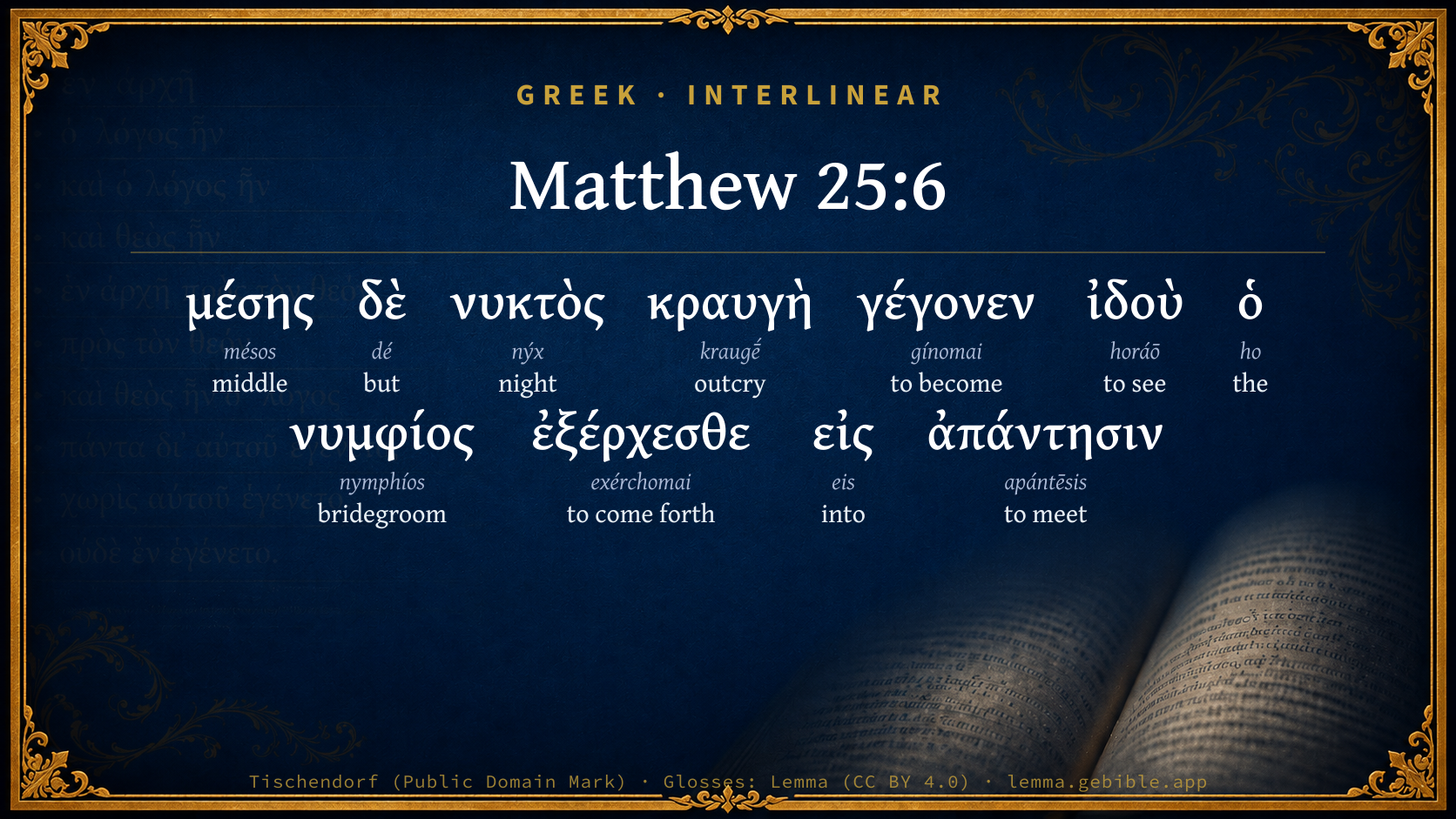
Greek (Tischendorf 8th ed.) Matthew 25:6 appears in the Greek New Testament. The text above is from the Tischendorf 8th edition. Each word links to its Strong’s number and a concise gloss. Click any word for its full Thayer’s Greek Lexicon entry.
Download image
Cite this verse

Matthew 25:6 (World English Bible). Public Domain. Lemma interlinear Bible study tool, https://lemma.gebible.app/v/matthew/25/6.

Show BibTeX & RIS
BibTeX
RIS
English Translation
But at midnight there was a cry, 'Behold! The bridegroom is coming! Come out to meet him!'
World English Bible · Public Domain
Highlights
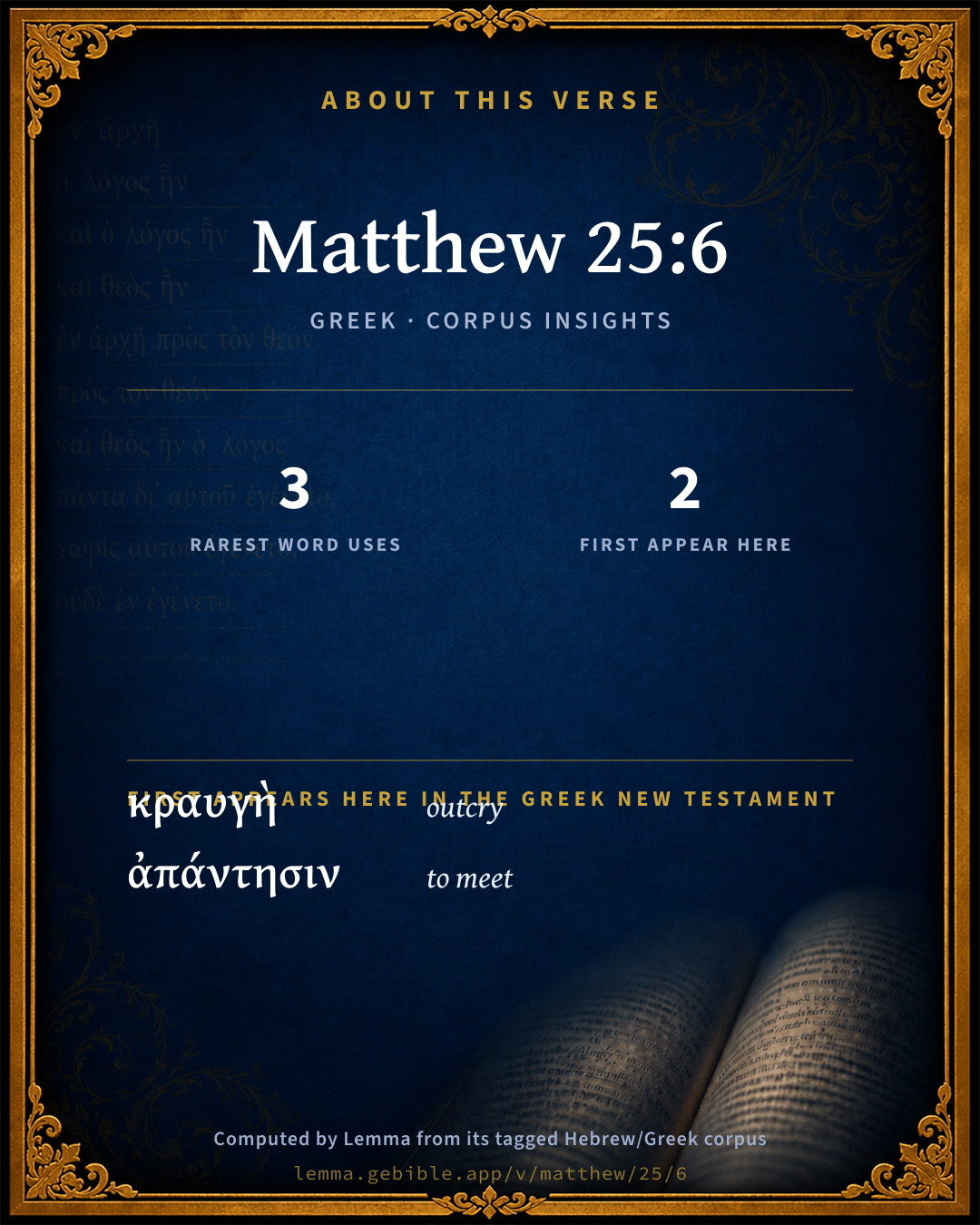
  • 2 first appearances in the Greek New Testament
Full analysis ↓
Download a study sheet

One document with this verse’s original text, its word-by-word gloss line, the meaning frame, cross-references with their text, attributed commentary, and full source and license credits — printable, and it pastes into notes with its structure intact.

This verse Autodidact and up

Study sheet (.html) Plain text (.txt)

A passage Seminary Student

Up to 50 verses in one chapter. A passage sheet keeps up to 6 commentary sources and 12 cross-references per verse, in the order this page ranks them, and says so on the sheet whenever that leaves anything out. Ask for a single verse and you get the Autodidact verse sheet above.

Everything on this page stays free to read, with no account — the sheet is a download of what is already on screen, not access to it.

Want to remove ads? Support Godless Engineer
Compare translations 3

The same verse in 3 English versions, stacked beneath the original-language interlinear above. Click any original word for its lexicon entry.

Each is an independent rendering of the whole verse — the interlinear is not word-aligned to these translations.

Highlighted words mark where these versions differ — a whole-verse word diff, not a word-by-word alignment.

  • World English Bible Public Domain
    But at midnight there was a cry, 'Behold! The bridegroom is coming! Come out to meet him!'
  • King James Version Public Domain
    And at midnight there was a cry made, Behold, the bridegroom cometh; go ye out to meet him.
  • unfoldingWord Literal Text CC BY-SA 4.0
    But in the middle of the night there was a cry, ‘Behold, the bridegroom! Go out to the meeting.’

unfoldingWord Literal Text — © unfoldingWord, licensed CC BY-SA 4.0. Word-aligned USFM3 via Door43 (git.door43.org/unfoldingWord/en_ult).

Versions to compare (up to 4)

3 of 4 selected

Show all 19 translations

Every available English version of this verse, each an independent rendering of the whole verse.

  • World English Bible Public Domain
    But at midnight there was a cry, 'Behold! The bridegroom is coming! Come out to meet him!'
  • Berean Standard Bible Public Domain
    At midnight the cry rang out: ‘Here is the bridegroom! Come out to meet him!’
  • Majority Standard Bible Public Domain
    At midnight the cry rang out: ‘Behold, the bridegroom is coming! Come out to meet him!’
  • King James Version Public Domain
    And at midnight there was a cry made, Behold, the bridegroom cometh; go ye out to meet him.
  • American Standard Version (1901) Public Domain
    But at midnight there is a cry, Behold, the bridegroom! Come ye forth to meet him.
  • Revised Version (1885) Public Domain
    But at midnight there is a cry, Behold, the bridegroom! Come ye forth to meet him.
  • Geneva Bible (1599) Public Domain
    And at midnight there was a crie made, Behold, the bridegrome commeth: goe out to meete him.
  • Douay-Rheims (1899) Public Domain
    And at midnight there was a cry made: Behold the bridegroom cometh, go ye forth to meet him.
  • Young's Literal Translation Public Domain
    and in the middle of the night a cry was made, Lo, the bridegroom doth come; go ye forth to meet him.
  • Literal Standard Version CC BY-SA 4.0
    and in the middle of the night a cry was made, Behold, the bridegroom comes; go forth to meet him!
  • Unlocked Literal Bible CC BY-SA 4.0
    But at midnight there was a cry, 'Look, the bridegroom! Go out and meet him.'
  • unfoldingWord Literal Text CC BY-SA 4.0
    But in the middle of the night there was a cry, ‘Behold, the bridegroom! Go out to the meeting.’
  • Darby Bible Public Domain
    But in [the] middle of [the] night there was a cry, Behold, the bridegroom; go forth to meet him.
  • World Messianic Bible Public Domain
    But at midnight there was a cry, ‘Behold! The bridegroom is coming! Come out to meet him!’
  • Webster's Bible Public Domain
    And at midnight there was a cry made, Behold, the bridegroom cometh; go ye out to meet him.
  • Free Bible Version CC BY-SA 4.0
    At midnight the shout came, ‘Look, the bridegroom's here! Come out and meet him!’
  • Bible in Basic English Public Domain
    But in the middle of the night there is a cry, The husband comes! Go out to him.
  • Text-Critical English NT CC BY 4.0
    But in the middle of the night there was a shout: ‘Behold, the bridegroom is coming! Come out to meet him.’
  • Tyndale New Testament (1534) Public Domain
    And even at mydnyght there was a crye made: beholde the brydgrome cometh goo out against him.

Literal Standard Version (2020), Covenant Press — licensed CC BY-SA 4.0. Text via the HelloAO Bible API (eBible.org). Unlocked Literal Bible (unfoldingWord) — licensed CC BY-SA 4.0. Text via the HelloAO Bible API (eBible.org). unfoldingWord Literal Text — © unfoldingWord, licensed CC BY-SA 4.0. Word-aligned USFM3 via Door43 (git.door43.org/unfoldingWord/en_ult). Free Bible Version, Dr. Jonathan Gallagher — licensed CC BY-SA 4.0. Text via the HelloAO Bible API (eBible.org).

Word by word

More ways to search: Search by grammar → Find every occurrence → Compare this word →

Practice this passage: Drill this verse → Learn its vocabulary →

About this verse

These counts appear in no published source. They are computed here, from the morphology-tagged text and Lemma’s own curated glosses. What Lemma adds →

11
words
11
distinct lemmas
Gospels
section

Notable vocabulary

The rarest word here is ἀπάντησιν to meet G529 — appearing just 3 times in the whole Greek New Testament.

First appearance in Scripture

These words make their first canonical appearance in the Greek New Testament here:

  • κραυγὴ outcry G2906
  • ἀπάντησιν to meet G529

Shared distinctive vocabulary

ἀπάντησιν to meet G529 occurs in 3 verses of the Greek New Testament. Also found in:
Cross-references

22

Topical passages linked to Matthew 25:6 in the Treasury of Scripture Knowledge — connected by theme and wording, ordered by reader-vote popularity; previews shown in the World English Bible.

  • 2 Peter 3:10 But the day of the Lord will come as a thief in the night; in which the heavens will pass away with a great noise, and the elements will be dissolved with fervent heat, and the earth and the works that are in it will be burned up.
  • Matthew 24:31 He will send out his angels with a great sound of a trumpet, and they will gather together his chosen ones from the four winds, from one end of the sky to the other.
  • Matthew 24:44 Therefore also be ready, for in an hour that you don't expect, the Son of Man will come.
  • Matthew 25:1 "Then the Kingdom of Heaven will be like ten virgins, who took their lamps, and went out to meet the bridegroom.
  • John 5:28–29 Don't marvel at this, for the hour comes, in which all that are in the tombs will hear his voice,
  • Isaiah 25:9 It shall be said in that day, Behold, this is our God; we have waited for him, and he will save us: this is Yahweh; we have waited for him, we will be glad and rejoice in his salvation.
  • Malachi 3:1–2 "Behold, I send my messenger, and he will prepare the way before me; and the Lord, whom you seek, will suddenly come to his temple; and the messenger of the covenant, whom you desire, behold, he comes!" says Yahweh of hosts.
  • Psalms 98:9 Let them sing before Yahweh, For he comes to judge the earth. He will judge the world with righteousness, And the peoples with equity.
  • Amos 4:12 "Therefore thus will I do to you, Israel; Because I will do this to you, Prepare to meet your God, Israel.
  • Matthew 25:31 "But when the Son of Man comes in his glory, and all the holy angels with him, then he will sit on the throne of his glory.
  • Mark 13:33–37 Watch, keep alert, and pray; for you don't know when the time is.
  • Luke 12:20 "But God said to him, 'You foolish one, tonight your soul is required of you. The things which you have prepared--whose will they be?'
  • Luke 12:38–40 They will be blessed if he comes in the second or third watch, and finds them so.
  • Luke 12:46 then the lord of that servant will come in a day when he isn't expecting him, and in an hour that he doesn't know, and will cut him in two, and place his portion with the unfaithful.
  • 1 Thessalonians 4:16 For the Lord himself will descend from heaven with a shout, with the voice of the archangel, and with God's trumpet. The dead in Christ will rise first,
  • 1 Thessalonians 5:1–3 But concerning the times and the seasons, brothers, you have no need that anything be written to you.
  • 2 Thessalonians 1:7–10 and to give relief to you that are afflicted with us, when the Lord Jesus is revealed from heaven with his mighty angels in flaming fire,
  • Jude 1:14–15 About these also Enoch, the seventh from Adam, prophesied, saying, "Behold, the Lord came with ten thousands of his holy ones,
  • Revelation 16:15 "Behold, I come like a thief. Blessed is he who watches, and keeps his clothes, so that he doesn't walk naked, and they see his shame."
  • Psalms 50:3–6 Our God comes, and does not keep silent. A fire devours before him. It is very tempestuous around him.
  • Psalms 96:13 Before Yahweh; for he comes, For he comes to judge the earth. He will judge the world with righteousness, The peoples with his truth.
  • Revelation 19:7–9 Let us rejoice and be exceedingly glad, and let us give the glory to him. For the marriage of the Lamb has come, and his wife has made herself ready."

Cross-references courtesy of OpenBible.info (CC BY 4.0).

Commentary

Notes on Matthew 25:6 from classic Christian and Jewish commentators (each source and its license shown beneath its notes). The classic Christian expositions comment on the surrounding passage and are grouped to its opening verse, so a note may address several verses; the Jewish commentaries on the Tanakh (Rashi and others) are per-verse, so they appear only where the commentator wrote on this verse.

Lemma curates 59 commentaries, every one of them public domain or Creative Commons licensed, each selected and text-cleaned for this edition rather than reprinted as found. About our sources →

Joseph Benson's Commentary

Mat 25:6-8. And at midnight — In an hour quite unthought of, and the most alarming. Perhaps the tradition mentioned by Jerome, which asserted that Christ would come to judgment at midnight, might be borrowed from hence; though certainly it is a very absurd one, since that can be the case only under one meridian at a time. There was a cry made, Behold, the bridegroom cometh — As Christ’s coming to judge the world will be at a time the least expected; so then a great cry will be made, for the apostle assures us, he will descend from heaven with a shout, with the voice of the archangel, and with the trump of God, 1Th 4:16. At this great cry, which will be heard to the ends of the earth, these virgins all awake, and begin to trim their lamps, to examine themselves, and prepare to meet their God: and now the foolish first perceive their folly: they find their lamps extinguished, and they have no oil wherewith to supply them: they find themselves destitute of vital religion, of union with Christ, and the graces of his Spirit, and that they have only a name to live while they are dead. Thus the hypocrite’s hope shall perish. And the foolish said unto the wise — Whom before, perhaps, they had despised and derided as needlessly provident; Give us of your oil, for our lamps are gone out — They were therefore once lighted and burning. As if they had said, The light that was in us has become darkness, and the warmth of our love and zeal has become cold and dead, and we are utterly unprepared to meet the bridegroom. What a time was this to make such a discovery! whether the time of being overtaken with some unexpected judgment, the time of death, or that of Christ’s second coming be intended. Reader, Unto which of the saints wilt thou turn? Who can help thee at such a season?

Joseph Benson's Commentary on the Old and New Testaments (1811–1818) — public domain. Text from a community e-Sword module.

Tyndale Open Study Notes

Tyndale Open Resources

25:6 The arrival of the bridegroom at midnight while the bridesmaids slept further highlights the fact that the second coming of Jesus will come suddenly, at a time that no one can anticipate (24:42-51).

Tyndale Open Study Notes — © Tyndale Open Resources, licensed CC BY-SA 4.0. Text via the HelloAO Bible API.

Bengel's Gnomon

Johann Albrecht Bengel

Mat 25:6. Μέσης δὲ νυκτὸς, but at midnight) i.e. during the deep sleep of even these virgins.—κραυγὴ, a cry) sc. to arouse them, accompanied by the blast of a trumpet.[1081]

[1081] Far louder than earth’s loudest artillery: see 1Th 4:16.—B. G. V.

Bengel's Gnomon of the New Testament — English translation (T&T Clark, Edinburgh, 1860) — public domain. Text from a community e-Sword module.

Expositor's Greek Testament

ed. W. Robertson Nicoll

Mat 25:6 . ἰδοὺ ὁ νυμφίος : at length at midnight a cry is raised by some one not asleep lo! the bridegroom ; laconic, rousing, heard by all sleepers. ἐξέρχεσθε εἰς ἀπάντησιν , go forth to meeting: no words that can be dispensed with here either. Go forth whence? from the bride’s house (Goebel); from some inn, or private dwelling on the way, whither they have turned in on finding that the bridegroom tarried (Bleek, Meyer, Weiss). On this point Goebel’s view it to be preferred.

The Expositor's Greek Testament, edited by W. Robertson Nicoll (1897–1910) — public domain. Text from a community e-Sword module.

Adam Clarke's Commentary

Verse 6. At midnight there was a cry] The Jewish weddings were generally celebrated in the night; yet they usually began at the rising of the evening star; but in this case there was a more than ordinary delay.

Behold, the bridegroom cometh] What an awful thing to be summoned to appear before the Judge of quick and dead! The following is an affecting relation, and fas est ab hoste doceri. "When Rabbi Jochanan ben Zachai was sick, his disciples came to visit him; and when he saw them he began to weep. They say to him, Rabbi! the light of Israel, the right hand pillar, the strong hammer, wherefore dost thou weep? He answered them, If they were carrying me before a king of flesh and blood, who is here today, and to-morrow in the grave; who, if he were angry with me, his anger would not last for ever: if he put me in prison, his prison would not be everlasting; if he condemned me to death, that death would not be eternal; whom I could soothe with words or bribe with riches; yet even in these circumstances I should weep. But now I am going before the King of kings, the holy and the blessed God, who liveth and endureth for ever and for ever; who, if he be angry with me, his anger will last for ever; if he put me in prison, his bondage will be everlasting; if he condemn me to death, that death will be eternal; whom I cannot soothe with words nor bribe with riches: when, farther, there are before me two ways, the one to hell and the other to paradise, and I know not in which they are carrying me, shall I not weep?" TALMUD Beracoth, fol. 29.

Adam Clarke's Commentary on the Bible (1810–1826) — public domain. Text from a community e-Sword/MySword module.

Ellicott's Commentary for English Readers

(6) At midnight.—The hour was obviously later than the virgins had expected, and in this we may see a half-veiled suggestion of a like lateness in the coining of the true Bridegroom. The “cry” would be that of the companions of the bridegroom, or of the crowd that mingled with them. In the interpretation of the parable we may see in it, over and above its reference to the final Advent, that which answers to the stir and thrill that announce any coming crisis in the history of Church or people.

A Bible Commentary for English Readers, edited by Charles John Ellicott (1878–1897) — public domain. Text from a community e-Sword module.

The Cambridge Bible for Schools and Colleges

gen. ed. J. J. S. Perowne

6. there was a cry made] Literally, “there is a cry made.”

The Cambridge Bible for Schools and Colleges (gen. ed. J. J. S. Perowne; Cambridge University Press, 1878–1918) — public domain. Text from a community e-Sword module.

John Gill's Exposition

And at midnight there was a cry made;.... Which is no other than the following notice of the bridegroom's coming, expressed in these words:

behold the bridegroom cometh, go ye out to meet him: which supposes that then all things will be ready for his coming: all things respecting this world; all the strange and surprising events that were to come to pass, before the coming of Christ, will now be accomplished; an end put to all the monarchies of the earth; and all the preparations in nature, for the burning of the world finished: all things respecting the ungodly of the world: they will have filled up the measure of their iniquities, and finished their persecutions of the saints: and all things respecting the elect of God, they will be all born, and born again; they will have gone through all their sufferings for Christ, and have all their graces tried and perfected; for when the bridegroom comes, he will come to espouse them openly to himself, for which they must be prepared and adorned, and to take them to himself, that they may be for ever with him. It also supposes, that his coming will be very nigh at hand; it was so represented long ago; it is greatly desired by the saints to be quickly; and it will be in a very short time after this notice: and it signifies that there will be some notice given of it, a little before he comes; and that partly for the glory of his majesty; and that his own people, the wise virgins, may be ready; and that the foolish ones may be left without excuse: and this being prefaced with a "behold", shows the certainty of his coming, than which nothing is more certain, and to be depended on; as appears from Enoch's prophecy, and others of the Old Testament; from Christ's own promise; from the testimony of angels: from the words of the apostles; and from the ordinance of the Lord's supper: and also the importance of it; for things of the greatest moment will follow on it; such as the resurrection of the dead, the judgment of the whole world, the complete happiness of the saints, and the destruction of the wicked: and likewise, that it will be wonderful and astonishing; Christ will come in amazing glory, in his own, in his Father's, and in the glory of the holy angels, and of his power and authority, as the judge of quick and dead. And in this notice advice is given to the virgins,

go ye out to meet him; see Sol 3:11, and may intend either a going forth internally, as the wise virgins did in the exercise of grace, of faith in the coming of Christ, of love of his appearance, and earnest desire after it; or a going forth externally, as all the virgins did in a way of visible profession, taking up and trimming their lamps; or literally and corporeally, as the saints will, that will be found alive at Christ's coming. Now this notice is called "a cry"; and refers not to the voice of Christ in raising the dead, for this will be before the coming of Christ, whereas that will be when he is come; and for the same reason, not to the voice of the archangel, if he can be thought to be distinct from Christ. Some think it regards a secret general impulse, that will be upon the spirits of the people of God, with respect to the bridegroom's coming, but this does not seem to answer to a cry; rather it should intend some remarkable providence, as the earthquake in Rev 11:13 when a tenth part of the city shall fall, seven thousand men of note be slain, and the rest affrighted; or the sounding of the seventh angel, Rev 11:15, or, what is most likely, the voice of a great multitude, as of many waters, and of mighty thunderings, declaring, that the marriage of the Lamb was come, and the bride ready, Rev 19:6, and will be a very loud one: it will awaken all the virgins, and will be the cry, not of one, but of many; and will be very sudden and surprising, though joyful to the saints: this cry will be made, not by the virgins, for they will be asleep; nor by Christ himself, for he will not be come; nor by the angels, for they will come with him, and not before; rather by the ministers of the Gospel, who are the angels so often spoken of in the book of the Revelations, who sound the trumpets at different times, and on different occasions; who also will sound this trumpet, and give this last and general notice of Christ's coming; who will be all at once apprized of it, and give an universal alarm of it together in all the churches: thus, as the notice of Christ's first coming was made by the prophets, the notice of his second coming will be made by the ministers of the Gospel: and this will be at "midnight": which expresses the state of the church a little before the coming of Christ: it will be a night season with it, a time of darkness both with respect to Gospel light, and the presence of God with his people; a time of coldness and lukewarmness, as to zeal for God, love to his people, and concern for the interest of Christ; a time of drowsiness and sleep, of insensibility and security, of indolence and inactivity: so as the coming of Christ will be later than was first expected; it will be sudden, and at unawares, and like a thief in the night; but whether it will be literally in the night season, as his first coming, is not certain. The Jews expect (q), that at the end of the world Moses and Messiah will come in the night, the one from the wilderness, and the other from Rome: and they make frequent mention of God's going into the garden of Eden, or paradise, at midnight, and there rejoicing with good men. It is said (r), that R. Eliezer and R. Jose

"were sitting one night, and studying in the law, and about midnight, a man cried (or the cock crowed), bless ye the blessing; says R. Eliezer, now is, the time that the holy, blessed God goes into the garden of Eden, to rejoice with the righteous.''

(q) Targum Hieros. in Exod xii. 42. (r) Zohar in Exod. fol. 76. 4. & in Lev. fol. 21. 1. & 23. 2.

John Gill's Exposition of the Whole Bible (1746–1763) — public domain (CC PDM 1.0). Text via the HelloAO Bible API.

Trapp's Complete Commentary

John Trapp

6 And at midnight there was a cry made, Behold, the bridegroom cometh; go ye out to meet him.

Ver. 6. There was a cry made] By the trumpet of the archangel, {a} and the voice of God, say some interpreters; and Jerome reports it for an apostolic tradition that Christ shall come at midnight. But of that hour no man knoweth, saith the Judge himself. Others there are that expound this cry of the preaching of the gospel, according to that voice of the crier, "Prepare ye the way of the Lord," &c., Mat 3:3; And here- clames ut stentora vincas, Cry aloud, spare not, &c.

{a} Recte ad Archangeli vocem referetur. Aret.

John Trapp, A Commentary or Exposition upon All the Books of the Old and New Testament (1647–1656) — public domain. Text from a community e-Sword module.

Albert Barnes' Notes on the Bible

At midnight - Later than was the usual custom, and hence, they had fallen asleep.

A cry made - Of those who were coming with the bridegroom.

Albert Barnes' Notes on the Bible (1834–1885) — public domain. Text from a community e-Sword/MySword module.

Haydock's Catholic Bible Commentary

There was a cry. So shall we all have to rise again at the sound of the last trumpet, to meet our judge, either like the wise virgins, who having their oil ready, and their lamps trimmed and burning, soon prepare themselves to give in their accounts to their Lord; or, like the foolish, who having made no provision of the oil of good works, are compelled to seek it at the time they are to be judged. (St. Augustine) --- It is said he will come at midnight; i.e. when least expected.

George Leo Haydock (1774–1849), Haydock's Catholic Family Bible and Commentary, 1859 edition — public domain. Excludes Psalms (Douay-Rheims chapter numbering differs from Protestant) and Deuterocanonical books (Catholic canon only).

Whedon's Commentary on the Bible

Daniel D. Whedon

6. At midnight — In the very depth of the shades of time. This slumber by no means implies the unconsciousness of the souls of the dead. It implies that the day of probationary life has completely closed. Those who sleep with the oil in their lamps are happy. Blessed are the dead who die in the Lord, for they rest from their labours; and their works of faith and repentance follow them into the future, to render them blessed.

Rev_14:13. To them the judgment day will not seem distant; for it will not be tedious waiting, though that day is to be the full consummation of their bliss. Ages will be but as moments. As in some clear and beautiful atmospheres distant objects seem near at hand, so in the blessed air of the paradise of pure spirits the coming of the Judge, though it should be ages on ages distant, is, in full accordance with the phrases of Scripture, close at hand. To the restless spirits of the wicked it will be distant when their mind’s eye looks over the vast length of unrest to be endured before that day; but it will even to them seem terribly near when they contemplate the terrors of the day itself and the woes that shall follow. There was a cry made — By the narrative which we have given from Mr. Ward, it may be supposed that this cry was an ordinary fact at weddings; and so may be considered no significant part of the parable. It may have been the cry of self-announcement from the bridegroom’s party, or of waiting spectators, or of the virgins rousing each other. It does not contradict the fact that the coming of the Son of man is unwarned. It is more properly to be considered as identical with the blast of the last trumpet, announcing that the day of grace is past, and that the judgment day is come. More properly still, it is the cry of conscious confession and despair echoing through the world, that THE JUDGE COMETH and we must meet our doom.

Daniel D. Whedon (gen. ed.), Commentary on the Old and New Testaments (1874–1909) — public domain. Text from a community e-Sword module.

The Pulpit Commentary

At midnight. When sleep is deepest and awaking most unwelcome. The Lord will come "as a thief in the night". (Mat_24:42-44 1Th_5:2) There was a cry made (gegonen , hath been made). The cry comes either from the watchers or from the advancing company. We are told by the apostle (1Th_4:16) that "the Lord himself shall descend from heaven with a shout, with the voice of the archangel, and with the trump of God." The suddenness of the event is indicated by the tense of the verb hath been," "there is," a cry. The bridegroom cometh! The best manuscripts omit the verb, which omission makes the expression more graphic. The bridegroom is Christ; he comes now to judge, to punish and reward; and Christians have to meet him, and show how their duties have been performed, and how their personal preparation has been made.

The Pulpit Commentary (1880–1919), ed. H.D.M. Spence-Jones & Joseph S. Exell — public domain. Text from a community e-Sword module.

John Wesley's Explanatory Notes

At midnight - In an hour quite unthought of.

John Wesley, Explanatory Notes Upon the Whole Bible (1754–1765) — public domain. Text via the GEBible commentary corpus.

Kretzmann's Popular Commentary

Paul E. Kretzmann

The coming of the bridegroom:

v. 6. And at midnight there was a cry made, Behold, the bridegroom cometh; go ye out to meet him.

v. 7. Then all those virgins arose and trimmed their lamps.

v. 8. And the foolish said unto the wise, Give us of your oil; for our lamps are gone out.

v. 9. But the wise answered, saying, Not so, lest there be not enough for us and you; but go ye rather to them that sell, and buy for yourselves.

v. 10. And. while they went to buy, the bridegroom came; and they that were ready went in with him to the marriage; and the door was shut.

After an unusually long delay, after they had almost given up all hopes, someone, having been aroused by the noise of the approaching company of the bridegroom, gave the alarm. All of the virgins quickly jumped up and trimmed the wicks of their lamps, in order that they might be burning with full brightness as they entered into the wedding-feast. But the improvident virgins were not ready for the emergency, their lamps, whose oil had been consumed, were at the point of going out, there was a mere glimmering of a dry wick. But their appeal to the prudent virgins met with a cold reception. If their request were granted, there was danger that they all would lack oil and be refused admission to the marriage festival. This is not selfishness, but sound prudence. In the emergency of Christ’s coming to Judgment, the helpfulness of the Christian life is a thing of the past, and the bands of friendship and even of the closest relationship are torn asunder. The time of grace is at an end. The merchants, the dispensers of God’s grace, have definitely closed their shops. Everyone must stand on his own merits. "That is a clap of thunder against those that rely upon the merits of the saints and other people; since none of them has enough for himself, not to speak of having something left over to impart to others. Therefore, when they now want to come and knock, and would also like to go in to the wedding, they will have to hear, as did the foolish virgins: I know you not; those that were to come in have come in. That will be a terrible sentence. " The frantic attempts of the imprudent virgins to provide fuel for their lamps were without avail. And, in the meantime, the festival procession reached the home of the bride. Those that were fully prepared in every respect went with the bride groom and were seated at the festival board, whereupon the door was locked. Fatal words, shutting off all hope!

Paul E. Kretzmann, Popular Commentary of the Bible (1921–1924) — public domain. Text from a community e-Sword module.

Burkitt's Expository Notes on the New Testament

William Burkitt

At midnight, that is, at the most dismal and unseasonable time, when all the virgins were fast asleep; and, when awakened in great affrightment, could not on a sudden consider what to do. Such is the case of those who put off their repentance and preparation for another world, till they are surprised by death and judgment.

Lord, how will the midnight cry of the Bridegroom’s coming terrify and amaze the unprepared soul! What a surprising word will this be, Behold, the Bridegroom cometh!

Learn hence, That the Bridegroom will certainly come, though at his own time; and then all shall be called upon, both prepared and unprepared, to go forth to meet him. Reason says he may come, because there is a just God, that will render to every one according to his deeds, and reward both body and soul for all the services they have done for God. The body shall not always remain like a solitary widow in the dust, but shall meet its old companion, the soul, again.

And as reason says he may come, faith says he will come, and argues from the promise of Christ, Joh 14:3, and from the purchase of Christ, from Christ’s affection to us, and from our affection to him: faith has seen him upon the cross, and determines she shall see him in the clouds. The Bridegroom will certainly come at his own time: happy they that are ready to go forth to meet him.

William Burkitt's Expository Notes on the New Testament (1700–1703) — public domain. Text from a community e-Sword module.

The People's New Testament

B. W. Johnson

6. And at midnight there was a cry made. Midnight is the hour of slumber and silence when an outcry is always startling and unexpected. The implication is that the cry of the coming of the Bridegroom, the trump of the archangel, will be sudden and unexpected. Compare Matt. 24:27 and 1 Thess. 5:23.

B. W. Johnson's The People's New Testament with Notes (1889–1891) — public domain. Electronic text from the Christian Classics Ethereal Library (CCEL) ThML edition.

Cambridge Greek Testament for Schools and Colleges

6. ἔρχεται, omitted after ὁ νυμφίος according to all the important codices greatly enhances the vividness of the narrative.

6. κραυγὴ γέγονεν. ‘A cry is raised’. fit sonus (Verg.). The tense gives vividness.

ἐξέρχεσθε. The Codex Alexandrinus commences at this word.

Cambridge Greek Testament for Schools and Colleges (Cambridge University Press, 1896; 21 vols, various authors incl. Carr, Maclear, Plummer, Farrar, Lumby, Moule, M. R. James, Simcox) — public domain. Text from a community e-Sword module.

International Critical Commentary

6. And in the middle of the night a cry was raised, Behold, the bridegroom! come out to meet him].

(L)

International Critical Commentary — older volumes (1896–1929), various authors — public domain. Text from a community e-Sword module.

Vincent's Word Studies in the New Testament

Marvin R. Vincent

There was a cry made [κραυγη γεγονεν] . Rev., there is a cry. The verb is in the perfect tense, representing the past event as perpetuated in the present result, and hence is rendered by the English present. A great and decisive change was the result of the cry. No more sleeping, waiting, or silence. There is a cry, and behold the awaking, the bustle, the trimming of lamps and the running to the oil - vendors.

To meet him [εις απαντησιν] . The translation can hardly convey the meaning of the Greek phrase, which implies a custom or familiar ceremony. Come forth unto meeting.

Marvin R. Vincent, Word Studies in the New Testament (1887–1900) — public domain. Text from a community e-Sword/MySword module.

Lesson kit

Teaching starters — assembled from the data on this page, not authored interpretation. Every prompt links to the verse data it draws on. Edit before teaching.

Matthew, in the Gospels, opens this verse with 11 words (11 distinct Greek lemmas). Its most distinctive word is apántēsis (“to meet”). A historical commentator’s framing appears above. Read the whole chapter for the surrounding context.

Discussion questions

  1. What does “to meet” (apántēsis) contribute to the verse as a whole?
  2. 2 words make their first appearance in Scripture here. What does this debut establish?
  3. How does Acts 28:15, which shares the word «to meet», read alongside this verse?
  4. These translations render this verse differently; the difference is in the English rendering, not the original. What questions does that raise?
  5. Compare how Joseph Benson's Commentary and Tyndale Open Study Notes read this verse. Where do they agree or differ?

Things to notice

Reading settings

Reading text

Shown beneath each verse's original-language words.

Old Testament
Old Testament edition

Read the OT as the Masoretic Hebrew (MT) or the Greek Septuagint (LXX).

English shown for the Greek Septuagint (in the Hebrew ↔ Greek comparison).

Comparing translations? Open the Compare panel on any verse page to stack up to four side by side.