

Colossians 2:18
Greek (Tischendorf 8th ed.) Colossians 2:18 appears in the Greek New Testament. The text above is from the Tischendorf 8th edition. Each word links to its Strong’s number and a concise gloss. Click any word for its full Thayer’s Greek Lexicon entry.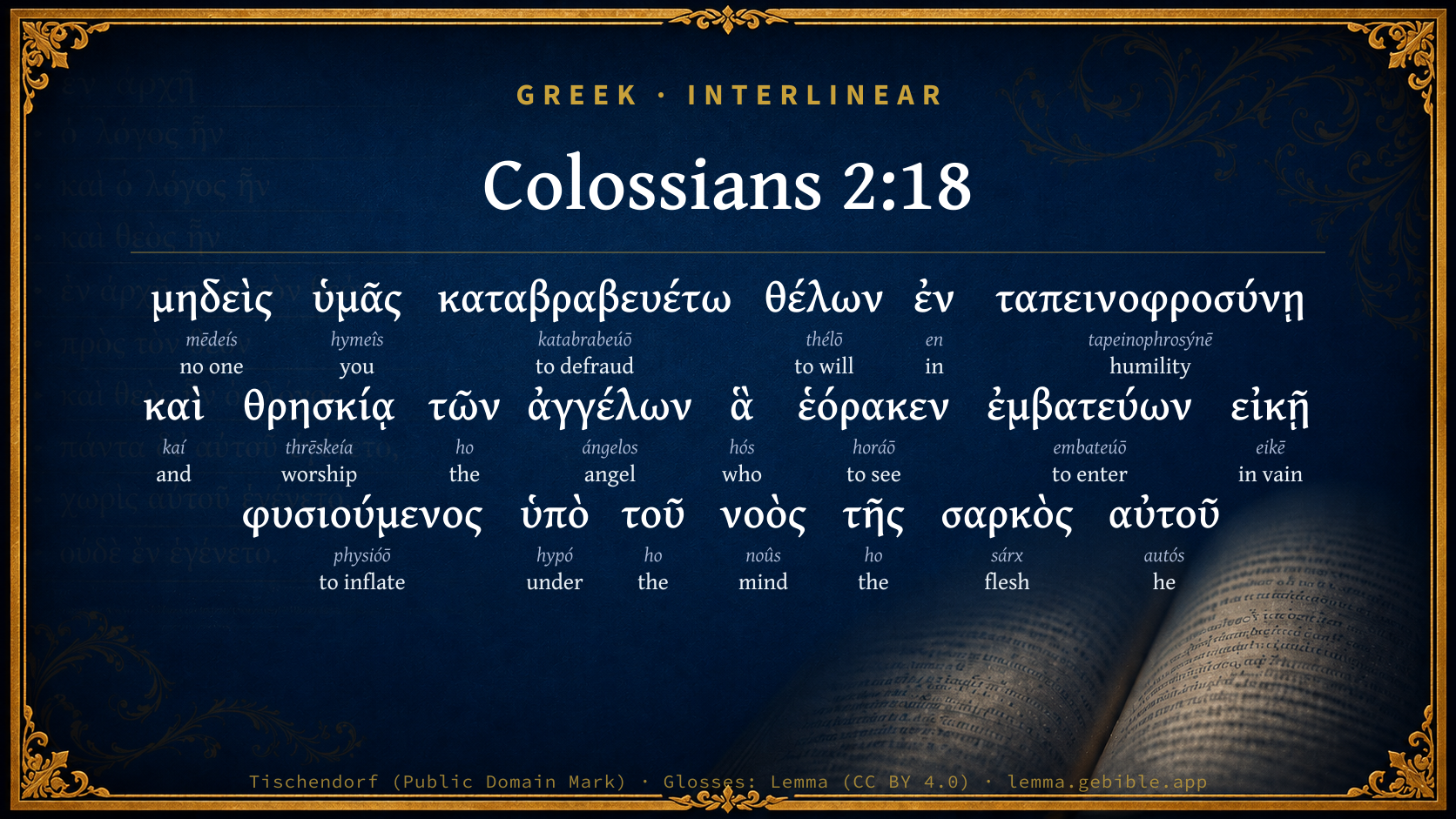
Let no one rob you of your prize by a voluntary humility and worshipping of the angels, dwelling in the things which he has not seen, vainly puffed up by his fleshly mind,
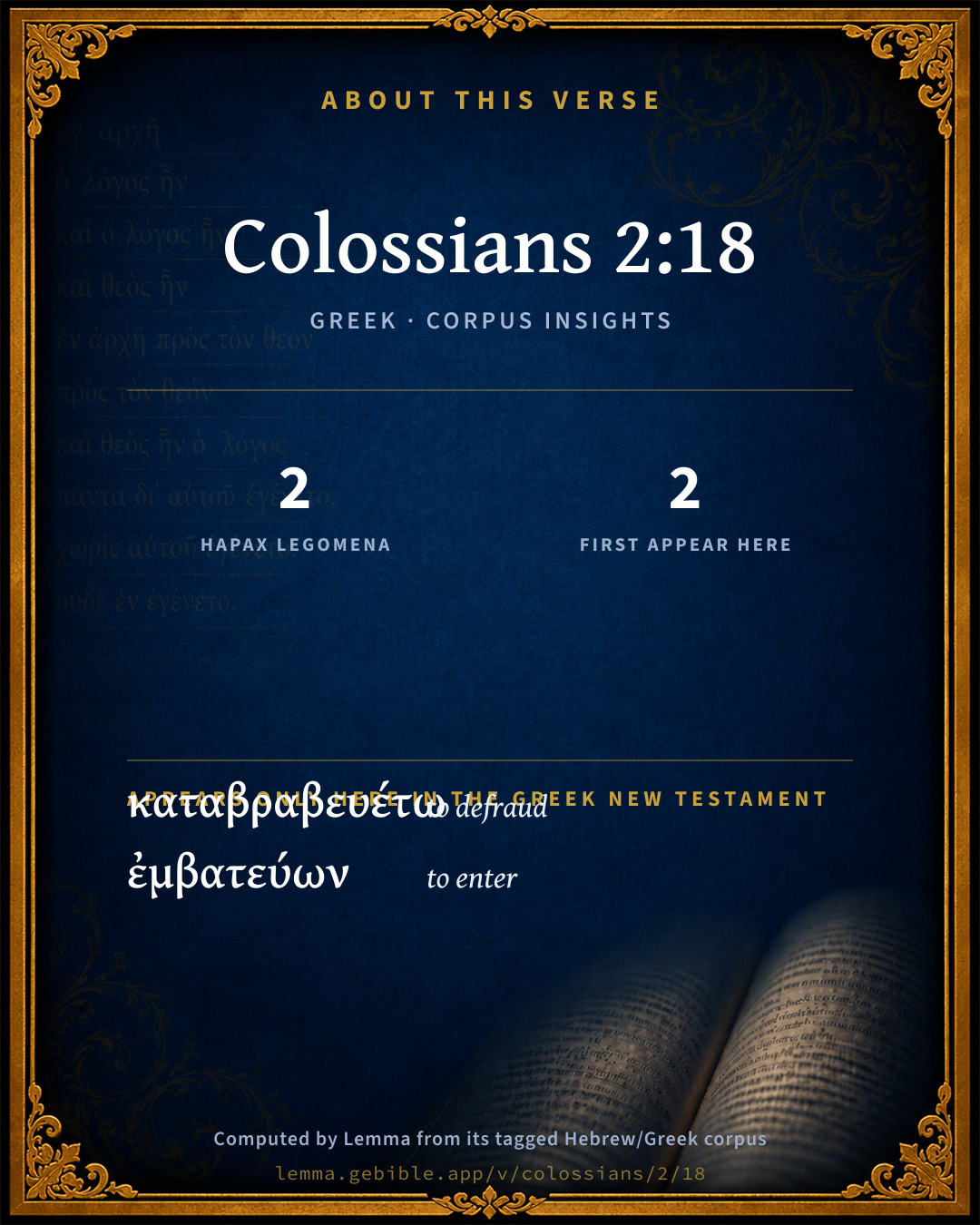
- 2 hapax legomena — only here in the Greek New Testament
- 2 first appearances in the Greek New Testament
Download a study sheet
One document with this verse’s original text, its word-by-word gloss line, the meaning frame, cross-references with their text, attributed commentary, and full source and license credits — printable, and it pastes into notes with its structure intact.
This verse Autodidact and up
A passage Seminary Student
Up to 50 verses in one chapter. A passage sheet keeps up to 6 commentary sources and 12 cross-references per verse, in the order this page ranks them, and says so on the sheet whenever that leaves anything out. Ask for a single verse and you get the Autodidact verse sheet above.
Everything on this page stays free to read, with no account — the sheet is a download of what is already on screen, not access to it.
Compare translations 3
The same verse in 3 English versions, stacked beneath the original-language interlinear above. Click any original word for its lexicon entry.
Each is an independent rendering of the whole verse — the interlinear is not word-aligned to these translations.
Highlighted words mark where these versions differ — a whole-verse word diff, not a word-by-word alignment.
-
World English Bible Public Domain
Let no one rob you of your prize by a voluntary humility and worshipping of the angels, dwelling in the things which he has not seen, vainly puffed up by his fleshly mind,
-
King James Version Public Domain
Let no man beguile you of your reward in a voluntary humility and worshipping of angels, intruding into those things which he hath not seen, vainly puffed up by his fleshly mind,
-
unfoldingWord Literal Text CC BY-SA 4.0
Let no one delighting in false humility and worship of the angels deprive you of your prize, standing on things he has seen, becoming puffed up without cause by the mind of his flesh
unfoldingWord Literal Text — © unfoldingWord, licensed CC BY-SA 4.0. Word-aligned USFM3 via Door43 (git.door43.org/unfoldingWord/en_ult).
Show all 19 translations
Every available English version of this verse, each an independent rendering of the whole verse.
-
World English Bible Public Domain
Let no one rob you of your prize by a voluntary humility and worshipping of the angels, dwelling in the things which he has not seen, vainly puffed up by his fleshly mind,
-
Berean Standard Bible Public Domain
Do not let anyone who delights in false humility and the worship of angels disqualify you with speculation about what he has seen. Such a person is puffed up without basis by his unspiritual mind.
-
Majority Standard Bible Public Domain
Do not let anyone who delights in false humility and the worship of angels disqualify you with speculation about what he has not seen. Such a person is puffed up without basis by his unspiritual mind.
-
King James Version Public Domain
Let no man beguile you of your reward in a voluntary humility and worshipping of angels, intruding into those things which he hath not seen, vainly puffed up by his fleshly mind,
-
American Standard Version (1901) Public Domain
Let no man rob you of your prize by a voluntary humility and worshipping of the angels, dwelling in the things which he hath seen, vainly puffed up by his fleshly mind,
-
Revised Version (1885) Public Domain
Let no man rob you of your prize by a voluntary humility and worshipping of the angels, dwelling in the things which he hath seen, vainly puffed up by his fleshly mind,
-
Geneva Bible (1599) Public Domain
Let no man at his pleasure beare rule ouer you by humblenesse of minde, and worshipping of Angels, aduauncing himselfe in those thinges which hee neuer sawe, rashly puft vp with his fleshly minde,
-
Douay-Rheims (1899) Public Domain
Let no man seduce you, willing in humility, and religion of angels, walking in the things which he hath not seen, in vain puffed up by the sense of his flesh,
-
Young's Literal Translation Public Domain
let no one beguile you of your prize, delighting in humble-mindedness and `in' worship of the messengers, intruding into the things he hath not seen, being vainly puffed up by the mind of his flesh,
-
Literal Standard Version CC BY-SA 4.0
let no one deceive you of your prize, delighting in humble-mindedness and [in] worship of the messengers, intruding into the things he has not seen, being vainly puffed up by the mind of his flesh,
-
Unlocked Literal Bible CC BY-SA 4.0
Let no one who wants humility and the worship of angels judge you out of your prize. Such a person enters into the things he has seen and becomes puffed up by his fleshly thinking.
-
unfoldingWord Literal Text CC BY-SA 4.0
Let no one delighting in false humility and worship of the angels deprive you of your prize, standing on things he has seen, becoming puffed up without cause by the mind of his flesh
-
Darby Bible Public Domain
Let no one fraudulently deprive you of your prize, doing his own will in humility and worship of angels, entering into things which he has not seen, vainly puffed up by the mind of his flesh,
-
World Messianic Bible Public Domain
Let no one rob you of your prize by self-abasement and worshiping of the angels, dwelling in the things which he has not seen, vainly puffed up by his fleshly mind,
-
Webster's Bible Public Domain
Let no man beguile you of your reward in a voluntary humility and worshiping of angels, intruding into those things which he hath not seen, vainly puffed up by his fleshly mind,
-
Free Bible Version CC BY-SA 4.0
Don't let anyone cheat you out of your prize by insisting you have to beat yourself, or worship angels. They think they are better than anyone else because of visions they say they've had, and become ridiculously conceited in their sinful minds.
-
Bible in Basic English Public Domain
Let no man take your reward from you by consciously making little of himself and giving worship to angels; having his thoughts fixed on the things which he has seen, being foolishly lifted up in his natural mind,
-
Text-Critical English NT CC BY 4.0
Let no one who delights in false humility and angelic religion disqualify you. Such a person takes his stand on things he has not seen, being puffed up without reason by the mind of his flesh,
-
Tyndale New Testament (1534) Public Domain
Let no man make you shote at a wronge (marke) which after his awne ymaginacion walketh in the humblenes and holynes of angels thinges which he never sawe: causlesse puft vp with his flesshly mynde
Literal Standard Version (2020), Covenant Press — licensed CC BY-SA 4.0. Text via the HelloAO Bible API (eBible.org). Unlocked Literal Bible (unfoldingWord) — licensed CC BY-SA 4.0. Text via the HelloAO Bible API (eBible.org). unfoldingWord Literal Text — © unfoldingWord, licensed CC BY-SA 4.0. Word-aligned USFM3 via Door43 (git.door43.org/unfoldingWord/en_ult). Free Bible Version, Dr. Jonathan Gallagher — licensed CC BY-SA 4.0. Text via the HelloAO Bible API (eBible.org).
Word by word
More ways to search: Search by grammar → Find every occurrence → Compare this word →
Practice this passage: Drill this verse → Learn its vocabulary →
- Appears 1× in the Greek New Testament
- First appears here
- Part of Speech
- Verb
- Tense
- Present
- Voice
- Active
- Mood
- Imperative
- Person
- 3rd person
- Number
- Singular
Full Thayer's Definition
- μηδεὶς mēdeís G3367 “no one” Adjective, Nominative, Singular, Masculine, Negative
- ὑμᾶς hymeîs G5210 “you” Personal pronoun, 2nd person, Accusative, Plural
- καταβραβευέτω katabrabeúō G2603 “to defraud” Verb, Present, Active, Imperative, 3rd person, Singular
- θέλων thélō G2309 “to will” Verb, Present, Active, Participle, Nominative, Singular, Masculine
- ἐν en G1722 “in” Preposition
- ταπεινοφροσύνῃ tapeinophrosýnē G5012 “humility” Noun, Dative, Singular, Feminine
- καὶ kaí G2532 “and” Conjunction
- θρησκίᾳ thrēskeía G2356 “worship” Noun, Dative, Singular, Feminine
- τῶν ho G3588 “the” Article, Genitive, Plural, Masculine
- ἀγγέλων ángelos G32 “angel” Noun, Genitive, Plural, Masculine
- ἃ hós G3739 “who” Relative pronoun, Accusative, Plural, Neuter
- ἑόρακεν horáō G3708 “to see” Verb, Perfect, Active, Indicative, 3rd person, Singular
- ἐμβατεύων embateúō G1687 “to enter” Verb, Present, Active, Participle, Nominative, Singular, Masculine
- εἰκῇ eikē G1500 “in vain” Adverb
- φυσιούμενος physióō G5448 “to inflate” Verb, Present, Passive, Participle, Nominative, Singular, Masculine
- ὑπὸ hypó G5259 “under” Preposition
- τοῦ ho G3588 “the” Article, Genitive, Singular, Masculine
- νοὸς noûs G3563 “mind” Noun, Genitive, Singular, Masculine
- τῆς ho G3588 “the” Article, Genitive, Singular, Feminine
- σαρκὸς sárx G4561 “flesh” Noun, Genitive, Singular, Feminine
- αὐτοῦ autós G846 “he” Personal pronoun, Genitive, Singular, Masculine
About this verse
These counts appear in no published source. They are computed here, from the morphology-tagged text and Lemma’s own curated glosses. What Lemma adds →
- 21
- words
- 19
- distinct lemmas
- Pauline Epistles
- section
Notable vocabulary
2 hapax legomena — words that appear only here in the entire Greek New Testament:
First appearance in Scripture
These words make their first canonical appearance in the Greek New Testament here:
Shared distinctive vocabulary
θρησκίᾳ worship G2356 occurs in 4 verses of the Greek New Testament. Also found in:
Repetition
A word recurs within this verse:
- τῶν the G3588 ×3
Cross-references
40Topical passages linked to Colossians 2:18 in the Treasury of Scripture Knowledge — connected by theme and wording, ordered by reader-vote popularity; previews shown in the World English Bible.
- Colossians 2:8 Be careful that you don't let anyone rob you through his philosophy and vain deceit, after the tradition of men, after the elements of the world, and not after Christ.
- 1 John 4:1–2 Beloved, don't believe every spirit, but test the spirits, whether they are of God, because many false prophets have gone out into the world.
- Colossians 2:23 Which things indeed appear like wisdom in self-imposed worship, and humility, and severity to the body; but aren't of any value against the indulgence of the flesh.
- 1 Timothy 1:7 desiring to be teachers of the law, though they understand neither what they say, nor about what they strongly affirm.
- 1 Timothy 4:1 But the Spirit says expressly that in later times some will fall away from the faith, paying attention to seducing spirits and doctrines of demons,
- Revelation 22:8–9 Now I, John, am the one who heard and saw these things. When I heard and saw, I fell down to worship before the feet of the angel who had shown me these things.
- Romans 1:25 who exchanged the truth of God for a lie, and worshiped and served the creature rather than the Creator, who is blessed forever. Amen.
- 1 Corinthians 8:5–6 For though there are things that are called "gods," whether in the heavens or on earth; as there are many "gods" and many "lords;"
- Matthew 24:24 For there will arise false christs, and false prophets, and they will show great signs and wonders, so as to lead astray, if possible, even the chosen ones.
- 2 Corinthians 11:3 But I am afraid that somehow, as the serpent deceived Eve in his craftiness, so your minds might be corrupted from the simplicity that is in Christ.
- Ephesians 5:6 Let no one deceive you with empty words. For because of these things, the wrath of God comes on the children of disobedience.
- Philippians 3:14 I press on toward the goal for the prize of the high calling of God in Christ Jesus.
- James 3:14–16 But if you have bitter jealousy and selfish ambition in your heart, don't boast and don't lie against the truth.
- 2 John 1:7–11 For many deceivers have gone out into the world, those who don't confess that Jesus Christ came in the flesh. This is the deceiver and the Antichrist.
- Genesis 3:13 Yahweh God said to the woman, "What is this you have done?" The woman said, "The serpent deceived me, and I ate."
- Numbers 25:18 for they vex you with their wiles, with which they have deceived you in the matter of Peor, and in the matter of Cozbi, the daughter of the prince of Midian, their sister, who was slain on the day of the plague in the matter of Peor.
- Psalms 138:1–2 I will give you thanks with my whole heart. Before the gods, I will sing praises to you.
- Ezekiel 13:3 Thus says the Lord Yahweh, Woe to the foolish prophets, who follow their own spirit, and have seen nothing!
- Daniel 11:38 But in his place shall he honor the god of fortresses; and a god whom his fathers didn't know shall he honor with gold, and silver, and with precious stones, and pleasant things.
- 1 Corinthians 8:1 Now concerning things sacrificed to idols: We know that we all have knowledge. Knowledge puffs up, but love builds up.
- Galatians 5:19–20 Now the works of the flesh are obvious, which are: adultery, sexual immorality, uncleanness, lustfulness,
- 1 John 2:26 These things I have written to you concerning those who would lead you astray.
- Revelation 3:11 I am coming quickly! Hold firmly that which you have, so that no one takes your crown.
- Deuteronomy 29:29 The secret things belong to Yahweh our God; but the things that are revealed belong to us and to our children forever, that we may do all the words of this law.
- Job 38:2 "Who is this who darkens counsel By words without knowledge?
- Isaiah 57:9 You went to the king with oil, and did increase your perfumes, and did send your ambassadors far off, and did debase yourself even to Sheol.
- Romans 8:6–8 For the mind of the flesh is death, but the mind of the Spirit is life and peace;
- Romans 16:18 For those who are such don't serve our Lord, Jesus Christ, but their own belly; and by their smooth and flattering speech, they deceive the hearts of the innocent.
- 1 Corinthians 3:3 for you are still fleshly. For insofar as there is jealousy, strife, and factions among you, aren't you fleshly, and don't you walk in the ways of men?
- 1 Corinthians 4:18 Now some are puffed up, as though I were not coming to you.
- 1 Corinthians 9:24 Don't you know that those who run in a race all run, but one receives the prize? Run like that, that you may win.
- 1 Corinthians 13:4 Love is patient and is kind; love doesn't envy. Love doesn't brag, is not proud,
- 2 Corinthians 12:20 For I am afraid that by any means, when I come, I might find you not the way I want to, and that I might be found by you as you don't desire; that by any means there would be strife, jealousy, outbursts of anger, factions, slander, whisperings, proud thoughts, riots;
- Colossians 2:4 Now this I say that no one may delude you with persuasiveness of speech.
- James 4:1–6 Where do wars and fightings among you come from? Don't they come from your pleasures that war in your members?
- 2 Peter 2:14 having eyes full of adultery, and who can't cease from sin; enticing unsettled souls; having a heart trained in greed; children of cursing;
- Revelation 12:9 The great dragon was thrown down, the old serpent, he who is called the devil and Satan, the deceiver of the whole world. He was thrown down to the earth, and his angels were thrown down with him.
- Revelation 13:8 All who dwell on the earth will worship him, everyone whose name has not been written from the foundation of the world in the book of life of the Lamb who has been killed.
- Revelation 13:14 He deceives my own people who dwell on the earth because of the signs he was granted to do in front of the beast; saying to those who dwell on the earth, that they should make an image to the beast who had the sword wound and lived.
- Revelation 19:10 I fell down before his feet to worship him. He said to me, "Look! Don't do it! I am a fellow bondservant with you and with your brothers who hold the testimony of Jesus. Worship God, for the testimony of Jesus is the Spirit of Prophecy."
Cross-references courtesy of OpenBible.info (CC BY 4.0).
Where the printed editions differ
1 variantPlaces in this verse where the major printed Greek editions disagree on the wording in a way that affects the translation — a comparison of editions, not a manuscript-by-manuscript collation. The editions are the modern critical texts (Nestlé-Aland 28/27, SBL, Westcott-Hort, Tregelles, Tyndale House) and the traditional texts behind the KJV (the Textus Receptus and the Byzantine/Majority text). It is not a claim about which reading is original.
-
Extra text
μὴ
“not”
In TRByz Not in NA28NA27TynSBLWHTregμὴ (mē) 'not' is only in traditional manuscripts (TR+Byz)
Textual data: Translators Amalgamated Greek New Testament (STEPBible TAGNT) · CC BY 4.0.
Lesson kit
Teaching starters — assembled from the data on this page, not authored interpretation. Every prompt links to the verse data it draws on. Edit before teaching.
Colossians, in the Pauline Epistles, opens this verse with 21 words (19 distinct Greek lemmas). Its most distinctive word is katabrabeúō (“to defraud”). A historical commentator’s framing appears above. Read the whole chapter for the surrounding context.
Discussion questions
- What does “to defraud” (katabrabeúō) contribute to the verse as a whole?
- 2 words here appear nowhere else in the Greek New Testament. Why might the author reach for such rare wording?
- 2 words make their first appearance in Scripture here. What does this debut establish?
- How does Acts 26:5, which shares the word «worship», read alongside this verse?
- What does the repetition of “the” (3× in this one verse) do in this verse?
- These translations render this verse differently; the difference is in the English rendering, not the original. What questions does that raise?
- Compare how The Cambridge Bible for Schools and Colleges and The Biblical Illustrator read this verse. Where do they agree or differ?
Things to notice
- 2 words in this verse appear nowhere else in the Greek New Testament.
- 2 words make their first canonical appearance in Scripture here.
- These translations choose different wording for 24 words in this verse.
- “the” occurs 3× in this single verse.
- 19 distinct Greek lemmas span 21 words in this verse.
Commentary
Notes on Colossians 2:18 from classic Christian and Jewish commentators (each source and its license shown beneath its notes). The classic Christian expositions comment on the surrounding passage and are grouped to its opening verse, so a note may address several verses; the Jewish commentaries on the Tanakh (Rashi and others) are per-verse, so they appear only where the commentator wrote on this verse.
Lemma curates 59 commentaries, every one of them public domain or Creative Commons licensed, each selected and text-cleaned for this edition rather than reprinted as found. About our sources →
The Cambridge Bible for Schools and Colleges
gen. ed. J. J. S. Perowne
The Cambridge Bible for Schools and Colleges (gen. ed. J. J. S. Perowne; Cambridge University Press, 1878–1918) — public domain. Text from a community e-Sword module.
The Biblical Illustrator
Joseph S. Exell
The Biblical Illustrator, edited by Joseph S. Exell (c. 1880s–1900s) — public domain. Text from a community e-Sword module.
Joseph Benson's Commentary
Joseph Benson's Commentary on the Old and New Testaments (1811–1818) — public domain. Text from a community e-Sword module.
Whedon's Commentary on the Bible
Daniel D. Whedon
Daniel D. Whedon (gen. ed.), Commentary on the Old and New Testaments (1874–1909) — public domain. Text from a community e-Sword module.
The Pulpit Commentary
The Pulpit Commentary (1880–1919), ed. H.D.M. Spence-Jones & Joseph S. Exell — public domain. Text from a community e-Sword module.
The Preacher's Complete Homiletical Commentary
Joseph S. Exell (gen. ed.)
The Preacher's Complete Homiletical Commentary (gen. ed. Joseph S. Exell; Funk & Wagnalls, c. 1892) — public domain (pre-1929). A full-Bible homiletical/sermon-outline anthology covering 65 of 66 books (2 John is absent from the source module). Text from a community e-Sword module.
Tyndale Open Study Notes
Tyndale Open Resources
Tyndale Open Study Notes — © Tyndale Open Resources, licensed CC BY-SA 4.0. Text via the HelloAO Bible API.
Bengel's Gnomon
Johann Albrecht Bengel
Bengel's Gnomon of the New Testament — English translation (T&T Clark, Edinburgh, 1860) — public domain. Text from a community e-Sword module.
Meyer's Critical & Exegetical Commentary
Heinrich August Wilhelm Meyer
Meyer — Critical and Exegetical Commentary on the New Testament — English translation by Peter Christie, edited by Frederick Crombie (T&T Clark, 1880) — public domain. Text from a community e-Sword module.
Expositor's Greek Testament
ed. W. Robertson Nicoll
The Expositor's Greek Testament, edited by W. Robertson Nicoll (1897–1910) — public domain. Text from a community e-Sword module.
Geneva Bible (1599)
Geneva Bible translators
Geneva Bible (1599) marginal notes — public domain. Text via Bolls.life.
Jamieson, Fausset & Brown
Robert Jamieson, A. R. Fausset & David Brown
Jamieson, Fausset & Brown — Commentary Critical and Explanatory on the Whole Bible (1871) — public domain (CC PDM 1.0). Text via the HelloAO Bible API.
Adam Clarke's Commentary
Adam Clarke's Commentary on the Bible (1810–1826) — public domain. Text from a community e-Sword/MySword module.
John Calvin's Commentaries
John Calvin's Commentaries (1540-1563) — public domain. Text from the Calvin Translation Society English edition (1840s-50s) via the Christian Classics Ethereal Library (ccel.org). Calvin's coverage is partial (roughly two-thirds of the Bible); uncommented books and verses are honest gaps, never fabricated. The 19th-century editor's footnotes and remarks are omitted so the notes are faithfully Calvin's own voice.
Ellicott's Commentary for English Readers
A Bible Commentary for English Readers, edited by Charles John Ellicott (1878–1897) — public domain. Text from a community e-Sword module.
John Gill's Exposition
John Gill's Exposition of the Whole Bible (1746–1763) — public domain (CC PDM 1.0). Text via the HelloAO Bible API.
Trapp's Complete Commentary
John Trapp
John Trapp, A Commentary or Exposition upon All the Books of the Old and New Testament (1647–1656) — public domain. Text from a community e-Sword module.
Albert Barnes' Notes on the Bible
Albert Barnes' Notes on the Bible (1834–1885) — public domain. Text from a community e-Sword/MySword module.
Haydock's Catholic Bible Commentary
George Leo Haydock (1774–1849), Haydock's Catholic Family Bible and Commentary, 1859 edition — public domain. Excludes Psalms (Douay-Rheims chapter numbering differs from Protestant) and Deuterocanonical books (Catholic canon only).
Matthew Poole's English Annotations
Matthew Poole's English Annotations on the Holy Bible (1683–1685) — public domain. Text from a community e-Sword/MySword module.
John Wesley's Explanatory Notes
John Wesley, Explanatory Notes Upon the Whole Bible (1754–1765) — public domain. Text via the GEBible commentary corpus.
Scofield Reference Notes
C. I. Scofield
The Scofield Reference Bible (1917 edition), notes by C. I. Scofield — public domain. Text from a community e-Sword module.
Burkitt's Expository Notes on the New Testament
William Burkitt
William Burkitt's Expository Notes on the New Testament (1700–1703) — public domain. Text from a community e-Sword module.
The People's New Testament
B. W. Johnson
B. W. Johnson's The People's New Testament with Notes (1889–1891) — public domain. Electronic text from the Christian Classics Ethereal Library (CCEL) ThML edition.
unfoldingWord translationNotes
Door43 World Missions Community
unfoldingWord translationNotes — © Distant Shores Media and the Door43 World Missions Community, licensed CC BY-SA 4.0. Source: git.door43.org/Door43/en_tn.
Cambridge Greek Testament for Schools and Colleges
Cambridge Greek Testament for Schools and Colleges (Cambridge University Press, 1896; 21 vols, various authors incl. Carr, Maclear, Plummer, Farrar, Lumby, Moule, M. R. James, Simcox) — public domain. Text from a community e-Sword module.
Alford’s Greek Testament
Henry Alford
Henry Alford, The Greek Testament (1849–1861) — public domain. Text from a community e-Sword module.
International Critical Commentary
International Critical Commentary — older volumes (1896–1929), various authors — public domain. Text from a community e-Sword module.
Vincent's Word Studies in the New Testament
Marvin R. Vincent
Marvin R. Vincent, Word Studies in the New Testament (1887–1900) — public domain. Text from a community e-Sword/MySword module.
Lightfoot's Colossians and Philemon
J. B. Lightfoot
J. B. Lightfoot, St Paul's Epistles to the Colossians and Philemon: a revised text with introductions, notes and dissertations (London: Macmillan, 1875) — public domain. Electronic text from Project Gutenberg (ebook #50857). Covers Colossians and Philemon only (the verse-by-verse notes; introductions and dissertations are omitted); Lightfoot's companion Galatians and Philippians volumes are not included, as the available public-domain scans carry garbled Greek that cannot be faithfully reproduced.