
Matthew 27:49

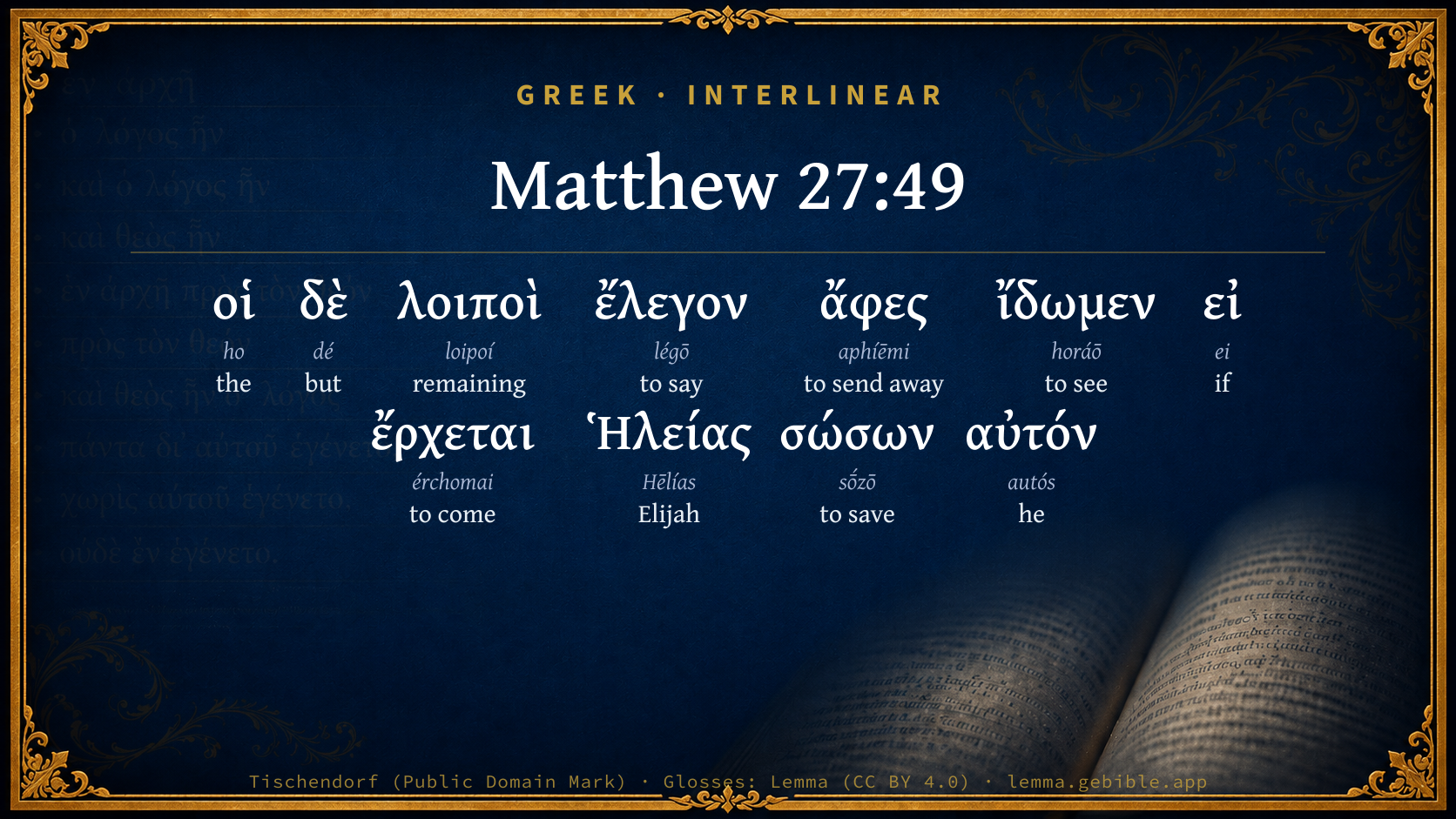
Greek (Tischendorf 8th ed.) Matthew 27:49 appears in the Greek New Testament. The text above is from the Tischendorf 8th edition. Each word links to its Strong’s number and a concise gloss. Click any word for its full Thayer’s Greek Lexicon entry.
Download image
Cite this verse

Matthew 27:49 (World English Bible). Public Domain. Lemma interlinear Bible study tool, https://lemma.gebible.app/v/matthew/27/49.

Show BibTeX & RIS
BibTeX
RIS
English Translation
The rest said, "Let him be. Let's see whether Elijah comes to save him."
World English Bible · Public Domain
Download a study sheet

One document with this verse’s original text, its word-by-word gloss line, the meaning frame, cross-references with their text, attributed commentary, and full source and license credits — printable, and it pastes into notes with its structure intact.

This verse Autodidact and up

Study sheet (.html) Plain text (.txt)

A passage Seminary Student

Up to 50 verses in one chapter. A passage sheet keeps up to 6 commentary sources and 12 cross-references per verse, in the order this page ranks them, and says so on the sheet whenever that leaves anything out. Ask for a single verse and you get the Autodidact verse sheet above.

Everything on this page stays free to read, with no account — the sheet is a download of what is already on screen, not access to it.

Want to remove ads? Support Godless Engineer
Compare translations 3

The same verse in 3 English versions, stacked beneath the original-language interlinear above. Click any original word for its lexicon entry.

Each is an independent rendering of the whole verse — the interlinear is not word-aligned to these translations.

Highlighted words mark where these versions differ — a whole-verse word diff, not a word-by-word alignment.

  • World English Bible Public Domain
    The rest said, "Let him be. Let's see whether Elijah comes to save him."
  • King James Version Public Domain
    The rest said, Let be, let us see whether Elias will come to save him.
  • unfoldingWord Literal Text CC BY-SA 4.0
    But the rest were saying, “Leave! Let us see if Elijah comes, saving him.”

unfoldingWord Literal Text — © unfoldingWord, licensed CC BY-SA 4.0. Word-aligned USFM3 via Door43 (git.door43.org/unfoldingWord/en_ult).

Versions to compare (up to 4)

3 of 4 selected

Show all 19 translations

Every available English version of this verse, each an independent rendering of the whole verse.

  • World English Bible Public Domain
    The rest said, "Let him be. Let's see whether Elijah comes to save him."
  • Berean Standard Bible Public Domain
    But the others said, “Leave Him alone. Let us see if Elijah comes to save Him.”
  • Majority Standard Bible Public Domain
    But the others said, “Leave Him alone. Let us see if Elijah comes to save Him.”
  • King James Version Public Domain
    The rest said, Let be, let us see whether Elias will come to save him.
  • American Standard Version (1901) Public Domain
    And the rest said, Let be; let us see whether Elijah cometh to save him.
  • Revised Version (1885) Public Domain
    And the rest said, Let be; let us see whether Elijah cometh to save him.
  • Geneva Bible (1599) Public Domain
    Other said, Let be: let vs see, if Elias wil come and saue him.
  • Douay-Rheims (1899) Public Domain
    And the others said: Let be, let us see whether Elias will come to deliver him.
  • Young's Literal Translation Public Domain
    but the rest said, `Let alone, let us see if Elijah doth come -- about to save him.'
  • Literal Standard Version CC BY-SA 4.0
    but the rest said, “Let alone, let us see if Elijah comes—about to save Him.”
  • Unlocked Literal Bible CC BY-SA 4.0
    The rest of them said, “Leave him alone. Let us see whether Elijah comes to save him.”
  • unfoldingWord Literal Text CC BY-SA 4.0
    But the rest were saying, “Leave! Let us see if Elijah comes, saving him.”
  • Darby Bible Public Domain
    But the rest said, Let be; let us see if Elias comes to save him.
  • World Messianic Bible Public Domain
    The rest said, “Let him be. Let’s see whether Elijah comes to save him.”
  • Webster's Bible Public Domain
    The rest said, Forbear, let us see whether Elijah will come to save him.
  • Free Bible Version CC BY-SA 4.0
    But the others said, “Leave him alone. Let's see if Elijah will come and save him.”
  • Bible in Basic English Public Domain
    And the rest said, Let him be; let us see if Elijah will come to his help.
  • Text-Critical English NT CC BY 4.0
    But the rest said, “Leave him alone. Let us see if Elijah comes to save him.”
  • Tyndale New Testament (1534) Public Domain
    Other sayde let be: let vs se whyther Helyas will come and deliver him.

Literal Standard Version (2020), Covenant Press — licensed CC BY-SA 4.0. Text via the HelloAO Bible API (eBible.org). Unlocked Literal Bible (unfoldingWord) — licensed CC BY-SA 4.0. Text via the HelloAO Bible API (eBible.org). unfoldingWord Literal Text — © unfoldingWord, licensed CC BY-SA 4.0. Word-aligned USFM3 via Door43 (git.door43.org/unfoldingWord/en_ult). Free Bible Version, Dr. Jonathan Gallagher — licensed CC BY-SA 4.0. Text via the HelloAO Bible API (eBible.org).

Word by word

More ways to search: Search by grammar → Find every occurrence → Compare this word →

Practice this passage: Drill this verse → Learn its vocabulary →

Ἡλείας
Hēlías
G2243
“Elijah”
Noun, Nominative, Singular, Masculine
Part of Speech
Noun
Case
Nominative
Number
Singular
Gender
Masculine
Full Thayer's Definition

Origin: of hebrew origin H452

TDNT: 17:28,3

Elijah = "my God is Jehovah" 1. a prophet born at Thisbe, the unflinching champion of the theocracy in the reigns of the idolatrous kings Ahab and Ahaziah. He was taken up to heaven without dying, whence the Jews expected he would return just before the advent of the Messiah, whom he would prepare the minds of the Israelites to receive.
  1. οἱ ho G3588 “the” Article, Nominative, Plural, Masculine
  2. δὲ dé G1161 “but” Conjunction
  3. λοιποὶ loipoí G3062 “remaining” Adjective, Nominative, Plural, Masculine
  4. ἔλεγον légō G3004 “to say” Verb, Imperfect, Active, Indicative, 3rd person, Plural
  5. ἄφες aphíēmi G863 “to send away” Verb, Aorist, Active, Imperative, 2nd person, Singular
  6. ἴδωμεν horáō G3708 “to see” Verb, Aorist, Active, Subjunctive, 1st person, Plural
  7. εἰ ei G1487 “if” Conditional
  8. ἔρχεται érchomai G2064 “to come” Verb, Present, Middle or Passive deponent, Indicative, 3rd person, Singular
  9. σώσων sṓzō G4982 “to save” Verb, Future, Active, Participle, Nominative, Singular, Masculine
  10. αὐτόν autós G846 “he” Personal pronoun, Accusative, Singular, Masculine

About this verse

These counts appear in no published source. They are computed here, from the morphology-tagged text and Lemma’s own curated glosses. What Lemma adds →

11
words
11
distinct lemmas
Gospels
section

Shared distinctive vocabulary

Ἡλείας Elijah G2243 occurs in 29 verses of the Greek New Testament. Also found in:
Where the printed editions differ

1 variant

Places in this verse where the major printed Greek editions disagree on the wording in a way that affects the translation — a comparison of editions, not a manuscript-by-manuscript collation. The editions are the modern critical texts (Nestlé-Aland 28/27, SBL, Westcott-Hort, Tregelles, Tyndale House) and the traditional texts behind the KJV (the Textus Receptus and the Byzantine/Majority text). It is not a claim about which reading is original.

  1. Extra text
    Ἄλλος δὲ λαβὼν λόγχην ἔνυξεν αὐτοῦ τὴν πλευράν, καὶ ἐξῆλθεν ὕδωρ καὶ αἷμα.

    “another now having taken a spear pierced of him <the> side and went out water and blood.”

    In WH Not in NA28NA27TynSBLTregTRByz

    Ἄλλος δὲ λαβὼν λόγχην ἔνυξεν αὐτοῦ τὴν πλευράν, καὶ ἐξῆλθεν ὕδωρ καὶ αἷμα. (Allos de labōn logchēn enuxen autou tēn pleuran kai exēlthen hudōr kai haima) 'another now having taken a spear pierced of him side and went out water and blood.' is only in a few manuscripts (WH)

Textual data: Translators Amalgamated Greek New Testament (STEPBible TAGNT) · CC BY 4.0.

Commentary

Notes on Matthew 27:49 from classic Christian and Jewish commentators (each source and its license shown beneath its notes). The classic Christian expositions comment on the surrounding passage and are grouped to its opening verse, so a note may address several verses; the Jewish commentaries on the Tanakh (Rashi and others) are per-verse, so they appear only where the commentator wrote on this verse.

Lemma curates 59 commentaries, every one of them public domain or Creative Commons licensed, each selected and text-cleaned for this edition rather than reprinted as found. About our sources →

Bengel's Gnomon

Johann Albrecht Bengel

Mat 27:49. Οἱ δὲ λοιποὶ, but the rest) i.e. of those present, opposed to those whose speech and conduct is related in Mat 27:47-48.[1210]—ἔλεγον, κ.τ.λ., said, etc.) After the fearful darkness, they return to their scoffs.—ἄφες, let be) They mean, that the aid of their companion [who offered the vinegar] is unnecessary, as Elias has been summoned.

[1210] Not, however, excluding the man who presented to Jesus, on a hyssop stick, the spunge filled with vinegar. We may readily suppose that this man was a Jew enlisted among the Roman soldiery. Comp. with this view Mar 15:36.—Harm., p. 574.

Bengel's Gnomon of the New Testament — English translation (T&T Clark, Edinburgh, 1860) — public domain. Text from a community e-Sword module.

Expositor's Greek Testament

ed. W. Robertson Nicoll

Mat 27:49 . ἄφες : either redundant coalescing with ἴδωμεν = let us see ( cf. chap. Mat 7:4 ), age videamus , Grotius ( vide also Burton, M. T., § 161), or meaning: hold, stop, don’t give Him the drink, let us see whether Elias will come ( ἔρχεται , comes without fail) to help Him. The latter is the more probable. The λοιποὶ belong to the scoffing crew. The remainder of this verse about the spear thrust another, final, act of mercy, though attested by important MSS., seems to be imported from Joh 19:34 . It is omitted in R. V [159]

[159] Revised Version.

The Expositor's Greek Testament, edited by W. Robertson Nicoll (1897–1910) — public domain. Text from a community e-Sword module.

Adam Clarke's Commentary

Verse 49. After this verse, BCL and five others add, Another, taking a spear, pierced his side, and there came out blood and water. Several of the fathers add the same words here: they appear, however, to be an interpolation from Joh 19:34.

Adam Clarke's Commentary on the Bible (1810–1826) — public domain. Text from a community e-Sword/MySword module.

Ellicott's Commentary for English Readers

(49) Let us see whether Elias will come.—Here again we have eager expectation rather than derision. Was the “great and dreadful day” (Mal_4:5) about to burst on them? Would the long-expected prophet at last appear? The sponge and vinegar would seem to minds thus on the stretch an unworthy interruption of the catastrophe of the great drama of which they were spectators.

A Bible Commentary for English Readers, edited by Charles John Ellicott (1878–1897) — public domain. Text from a community e-Sword module.

The Cambridge Bible for Schools and Colleges

gen. ed. J. J. S. Perowne

49. Let be] We must understand this to mean either (1) leave him, do not assist him; or (2) leave it, do not give the draught to him; or (3) “Let be” in the Greek coalesces with the verb following, and = “let us see.” For the construction in the original cp. Luk_6:42. In Mark the words “Let alone; let us see” are put in the mouth of him who offered the wine to the Saviour. There “let alone” may = “let me alone.”

to save him] Here the Sinaitic and Vatican MSS. add, “and another took a spear and pierced his side, and there came out water and blood.”

The Cambridge Bible for Schools and Colleges (gen. ed. J. J. S. Perowne; Cambridge University Press, 1878–1918) — public domain. Text from a community e-Sword module.

John Gill's Exposition

Jesus, when he had cried again,.... "A second time", as the Persic version; for he had cried once before, and expressed the words he did, as in Mat 27:46, what he now delivered were, "Father, into thy hands I commend my Spirit", Luk 23:46, and "it is finished", Joh 19:30, which he said

with a loud voice; which showed the vehemency of his affection, his strong confidence in God, and his being fearless of death; as also he thus spoke, that he might be heard, and his words attended to, since they contained things of the greatest importance and consequence: moreover, being able to express himself in such a manner, this declared him to be more than a mere man; for after such agonies in the garden, and so much fatigue in being hurried from place to place, and such loss of blood by being buffeted, scourged, crowned with thorns, and nailed to the accursed tree, where, being stretched, he had hung for some hours; to speak with so loud a voice was more than human, and was a conviction to the centurion, that he was a divine person: for when he saw that he so cried out, and "gave up the ghost", he said, "truly this man was the Son of God",

Mar 15:39, and likewise it shows, that he died freely and voluntarily, and not through force and necessity: it was not all that men had done, or could do to him, that could have forced his life from him: he died willingly, and when nature was in its full strength; and which is signified in the next phrase,

yielded up the ghost, or "dismissed the Spirit", as the Syriac version truly renders it; he sent it away. It was not taken from him, he laid down his life of himself, as the Lord of it, and gave himself freely to be an offering and sacrifice in the room of his people; which is a proof of his great love, and amazing grace unto them.

John Gill's Exposition of the Whole Bible (1746–1763) — public domain (CC PDM 1.0). Text via the HelloAO Bible API.

Trapp's Complete Commentary

John Trapp

49 The rest said, Let be, let us see whether Elias will come to save him.

Ver. 49. Let us see whether Elias, &c.] This mocking is the murder of the tongue, which therefore our Saviour suffered, ut nos illusori Satanae insultaremus, saith one. It is reported of Aretine, that by a long custom of libellous and contumelious speaking against men, he had gotten such a habit that at last he came to diminish and disesteem God himself. May not the same be made good of these malicious miscreants?

John Trapp, A Commentary or Exposition upon All the Books of the Old and New Testament (1647–1656) — public domain. Text from a community e-Sword module.

Albert Barnes' Notes on the Bible

The rest said ... - Still deriding his sufferings, and refusing to allow even the poor consolation of a drink, to assuage the thirst of the Saviour of the world in his dying agonies.

Albert Barnes' Notes on the Bible (1834–1885) — public domain. Text from a community e-Sword/MySword module.

Whedon's Commentary on the Bible

Daniel D. Whedon

49. Let be — This was not spoken to the soldier who was relieving his thirst with the sponge. As appears by Mark, the soldier himself joined in the expression. It means, “Wait and let us see if Elias will come to his rescue.” These words plainly show that there was no jest. There was an actual suspense, awakened by the awful darkness, as to whether the divine interposition would not take place.

After this verse, I am inclined to place the prayer of the penitent malefactor, in Luk_23:42-43. Matthew (Mat_27:44) clearly affirms that the thieves reviled him. Now it might be perfectly reasonable to say, as some do, that Matthew uses the plural for the singular, if the other thief silently assented, or did not dissent from the reproaches. But it is too much to concede that Matthew includes both in the plural as reviling, at the very moment when one never did revile, but reproved the reviler and prayed to Jesus. The only way of fair reconciliation is to hold Matthew and Luke as narrating different moments of the action of the malefactors. To suppose that one of them relented after the approach of supernatural darkness, brings the fact into correspondence with other proofs of a subsidence of hostile feeling at that point.

Daniel D. Whedon (gen. ed.), Commentary on the Old and New Testaments (1874–1909) — public domain. Text from a community e-Sword module.

The Pulpit Commentary

The rest but the rest said, Let be (afev). This is a common expression, meaning, "Stand off!" "Be quiet!" "Soft!" The bystanders addressed the person who had presented the drink. In St. Mark the verb is in the plural, afete , that is, the giver of the drink calls upon the others to keep quiet and wait. Let as see whether Elias will come (ercetai , cometh, is coming). They speak in a kind of superstitious mockery, half deriding and half believing in the possible appearance of the great prophet. Between this verse and the following, the Sinaitic, Vatican, and some other manuscripts, together with some few versions, insert a passage borrowed from Joh_19:34, "And another taking a spear pierced his side, and there came out water and blood." This evident interpolation has been introduced by a scribe, who deemed it expedient to rectify an omission on St. Matthew"s part, and clumsily inserted it in a wrong place. It is to be rejected, not only on critical, but on historical and theological grounds, seeing that it makes the piercing of the side to precede Christ"s death, and conveys the impression that it was this spear wound that cut short his life.

The Pulpit Commentary (1880–1919), ed. H.D.M. Spence-Jones & Joseph S. Exell — public domain. Text from a community e-Sword module.

The People's New Testament

B. W. Johnson

49. Let be, let us see, etc. This was spoken in the way of interruption of him who was furnishing the draught of vinegar. According to Mark, he replied, and asked to be let alone.

B. W. Johnson's The People's New Testament with Notes (1889–1891) — public domain. Electronic text from the Christian Classics Ethereal Library (CCEL) ThML edition.

Cambridge Greek Testament for Schools and Colleges

49. After this verse the important MSS. אBCL insert these words: ἄλλος δὲ λαβὼν λόγχην ἔνυξεν αὐτοῦ τὴν πλευράν, καὶ ἐξῆλθεν ὕδωρ καὶ αἷμα. Cp. Joh 19:34. Evidence from the Fathers points to the very early existence of this important reading, which states that the Saviour was pierced while still living. The words are, however, rightly rejected by the best textual criticism. See Tischendorf and Meyer loc., and Scrivener (, &c. p. 472, 480), who well points out the danger of following without discrimination the reading of even the oldest and most authoritative MSS.

49. ἄφες ἴδωμεν. We must understand this to mean either (1) leave him, do not assist him; or (2) leave it, do not give the draught to him; or (3) ἄφες coalesces with the verb following as in modern Greek, and = ‘let us see.’ For the construction cp. ch. Mat 7:4 and Luk 6:42. In Mark the words ἄφετε ἴδωμεν are put in the mouth of him who offered the wine to the Saviour. There ἄφετε may mean, ‘let me alone.’

Cambridge Greek Testament for Schools and Colleges (Cambridge University Press, 1896; 21 vols, various authors incl. Carr, Maclear, Plummer, Farrar, Lumby, Moule, M. R. James, Simcox) — public domain. Text from a community e-Sword module.

Alford’s Greek Testament

Henry Alford

49.] If we take our account as the Strictly precise one, the rest—in mockery—call upon this person to desist, and wait for Elias to come to save Him: if that of Mark, the giver of the drink calls upon the rest (also in mockery) to let this suffice or to let him (the giver) alone, and wait, &c. The former seems more probable. It is remarkable that the words undeniably interpolated from John should have found their place here before the death of Jesus, and can only be attributed to carelessness, there being no other place here for the insertion of the indignity but this, and the interpolator not observing that in John it is related as inflicted after death.

Henry Alford, The Greek Testament (1849–1861) — public domain. Text from a community e-Sword module.

International Critical Commentary

(M) 49. And the rest said, Stay, let us see whether Elias is coming to save Him.] Mk. has: “Saying, Let us see whether Elias is coming to take Him down.” In Mk. it is the offerer of the vinegar who, as he gave the Lord to drink, said, “Let us see,” etc. But Mt. infers from the plural ἴδωμεν that it was not the offerer of the vinegar, but the bystanders who said, “Let us see.” He therefore substitutes for λέγων, οἱ δὲ λοιποὶ εἶπαν, changes Ἀφετε into ἄφες “And the rest said, Stay” (i.e. “do not relieve Him”), and changes καθελεῖν αὐτον into σώσων. “Let us see if Elias will come to His assistance.” For Mk.’s ἄφετε ἴδωμεν, cf. Mat 7:4.—σώσων] For the rare fut. part., see Blass, p. 37. See also Moulton, p. 356 n.

49. At the end of this verse the words: ἄλλος δὲ λαβὼν λόγχην ἔνυξεν αὐτοῦ τὴν πλευρὰν καὶ ὲξῆλθεν ὔδωρ καὶ αἶμα, are added by א B C L U Γ 54 8 67 115 127 *. The words seem to be a gloss derived from Joh 19:34 inserted by someone whose memory was recalled to Joh 19:34 by the εἶς ὲξ αὐτῶν of the last verse. In spite of their strong attestation, the fact that the next verse begins with ὁ δὲ Ἰησοῦς πάλιν κράξας, and the contradiction, in fact, between the statement made by the verse as here placed and the Fourth Gospel, has served to check the transmission of the words by later copyists. The clause is omitted by A D αἰ S1 latt.

International Critical Commentary — older volumes (1896–1929), various authors — public domain. Text from a community e-Sword module.

Lesson kit

Teaching starters — assembled from the data on this page, not authored interpretation. Every prompt links to the verse data it draws on. Edit before teaching.

Matthew, in the Gospels, opens this verse with 11 words (11 distinct Greek lemmas). Its most distinctive word is Hēlías (“Elijah”). A historical commentator’s framing appears above. Read the whole chapter for the surrounding context.

Discussion questions

  1. What does “Elijah” (Hēlías) contribute to the verse as a whole?
  2. Matthew 11:14 shares the word «Elijah» with this verse. How do the two illuminate each other?
  3. These translations render this verse differently; the difference is in the English rendering, not the original. What questions does that raise?
  4. Reading how Bengel's Gnomon and Expositor's Greek Testament read this verse, where do the two commentators agree and where do they part?

Things to notice

Reading settings

Reading text

Shown beneath each verse's original-language words.

Old Testament
Old Testament edition

Read the OT as the Masoretic Hebrew (MT) or the Greek Septuagint (LXX).

English shown for the Greek Septuagint (in the Hebrew ↔ Greek comparison).

Comparing translations? Open the Compare panel on any verse page to stack up to four side by side.