

Luke 7:22
Greek (Tischendorf 8th ed.) Luke 7:22 appears in the Greek New Testament. The text above is from the Tischendorf 8th edition. Each word links to its Strong’s number and a concise gloss. Click any word for its full Thayer’s Greek Lexicon entry.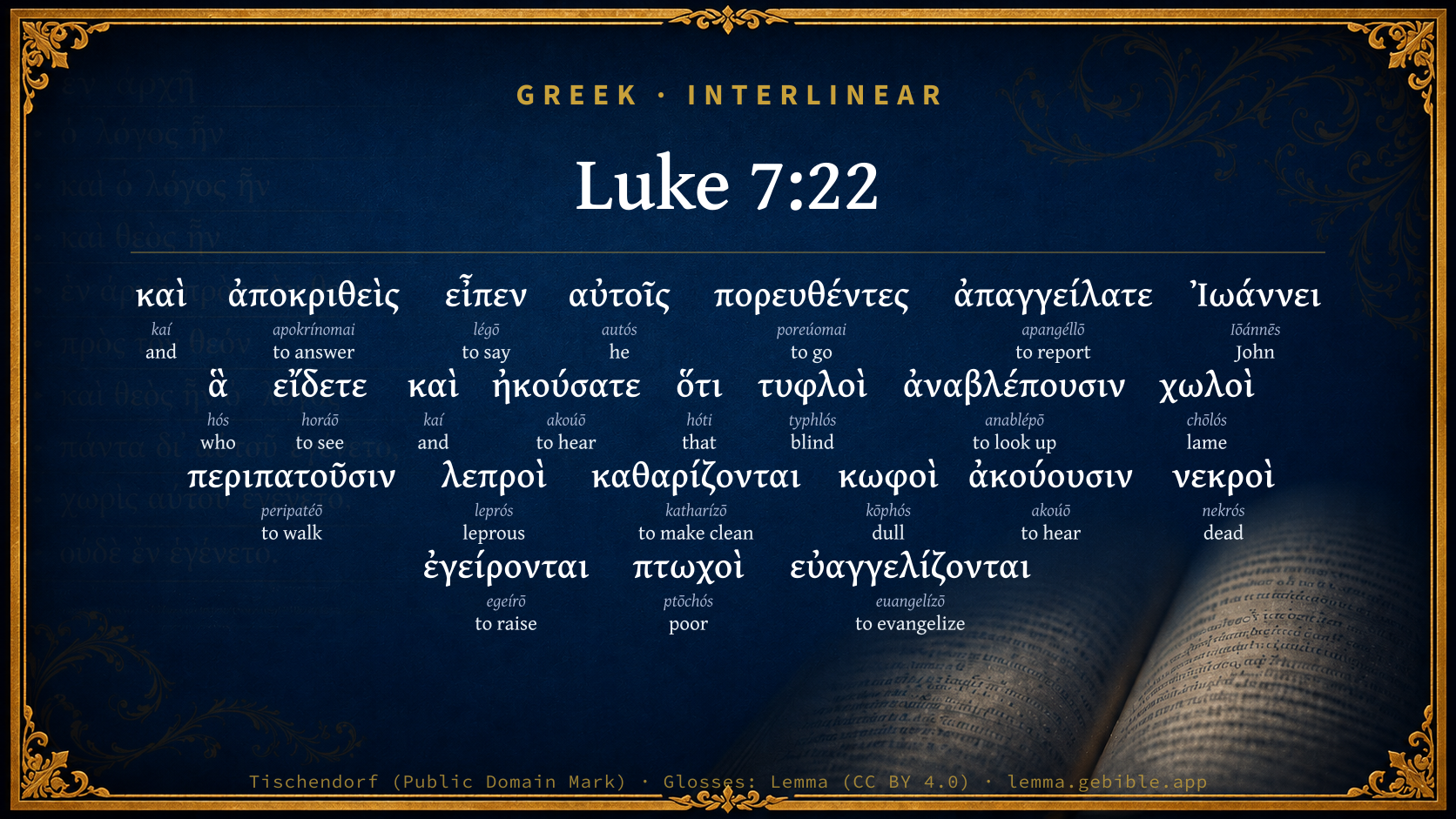
Jesus answered them, "Go and tell John the things which you have seen and heard: that the blind receive their sight, the lame walk, the lepers are cleansed, the deaf hear, the dead are raised up, and the poor have good news preached to them.
Download a study sheet
One document with this verse’s original text, its word-by-word gloss line, the meaning frame, cross-references with their text, attributed commentary, and full source and license credits — printable, and it pastes into notes with its structure intact.
This verse Autodidact and up
A passage Seminary Student
Up to 50 verses in one chapter. A passage sheet keeps up to 6 commentary sources and 12 cross-references per verse, in the order this page ranks them, and says so on the sheet whenever that leaves anything out. Ask for a single verse and you get the Autodidact verse sheet above.
Everything on this page stays free to read, with no account — the sheet is a download of what is already on screen, not access to it.
Compare translations 3
The same verse in 3 English versions, stacked beneath the original-language interlinear above. Click any original word for its lexicon entry.
Each is an independent rendering of the whole verse — the interlinear is not word-aligned to these translations.
Highlighted words mark where these versions differ — a whole-verse word diff, not a word-by-word alignment.
-
World English Bible Public Domain
Jesus answered them, "Go and tell John the things which you have seen and heard: that the blind receive their sight, the lame walk, the lepers are cleansed, the deaf hear, the dead are raised up, and the poor have good news preached to them.
-
King James Version Public Domain
Then Jesus answering said unto them, Go your way, and tell John what things ye have seen and heard; how that the blind see, the lame walk, the lepers are cleansed, the deaf hear, the dead are raised, to the poor the gospel is preached.
-
unfoldingWord Literal Text CC BY-SA 4.0
And answering, he said to them, “Having gone, report to John what you have seen and heard: the blind see again, the lame walk, lepers are cleansed and the deaf hear, the dead are raised, the poor are being told the gospel.
unfoldingWord Literal Text — © unfoldingWord, licensed CC BY-SA 4.0. Word-aligned USFM3 via Door43 (git.door43.org/unfoldingWord/en_ult).
Show all 19 translations
Every available English version of this verse, each an independent rendering of the whole verse.
-
World English Bible Public Domain
Jesus answered them, "Go and tell John the things which you have seen and heard: that the blind receive their sight, the lame walk, the lepers are cleansed, the deaf hear, the dead are raised up, and the poor have good news preached to them.
-
Berean Standard Bible Public Domain
So He replied, “Go back and report to John what you have seen and heard: The blind receive sight, the lame walk, the lepers are cleansed, the deaf hear, the dead are raised, and the good news is preached to the poor.
-
Majority Standard Bible Public Domain
So Jesus replied, “Go back and report to John what you have seen and heard: The blind receive sight, the lame walk, the lepers are cleansed, the deaf hear, the dead are raised, and the good news is preached to the poor.
-
King James Version Public Domain
Then Jesus answering said unto them, Go your way, and tell John what things ye have seen and heard; how that the blind see, the lame walk, the lepers are cleansed, the deaf hear, the dead are raised, to the poor the gospel is preached.
-
American Standard Version (1901) Public Domain
And he answered and said unto them, Go and tell John the things which ye have seen and heard; the blind receive their sight, the lame walk, the lepers are cleansed, and the deaf hear, the dead are raised up, the poor have good tidings preached to them.
-
Revised Version (1885) Public Domain
And he answered and said unto them, Go your way, and tell John what things ye have seen and heard; the blind receive their sight, the lame walk, the lepers are cleansed, and the deaf hear, the dead are raised up, the poor have good tidings preached to them.
-
Geneva Bible (1599) Public Domain
And Iesus answered, and saide vnto them, Goe your wayes and shewe Iohn, what things ye haue seene and heard: that the blinde see, the halt goe, the lepers are cleansed, the deafe heare, the dead are raised, and the poore receiue the Gospel.
-
Douay-Rheims (1899) Public Domain
And answering, he said to them: Go and relate to John what you have heard and seen: the blind see, the lame walk, the lepers are made clean, the deaf hear, the dead rise again, to the poor the gospel is preached:
-
Young's Literal Translation Public Domain
And Jesus answering said to them, `Having gone on, report to John what ye saw and heard, that blind men do see again, lame do walk, lepers are cleansed, deaf do hear, dead are raised, poor have good news proclaimed;
-
Literal Standard Version CC BY-SA 4.0
And Jesus answering said to them, “Having gone on, report to John what you saw and heard, that blind men see again, lame walk, lepers are cleansed, deaf hear, dead are raised, poor have good news proclaimed;
-
Unlocked Literal Bible CC BY-SA 4.0
Jesus answered and said to them, “After you have gone on your way, report to John what you have seen and heard. Blind people are receiving sight, lame people are walking, lepers are being cleansed, deaf people are hearing, people who have died are being raised back to life, and needy people are being told the good news.
-
unfoldingWord Literal Text CC BY-SA 4.0
And answering, he said to them, “Having gone, report to John what you have seen and heard: the blind see again, the lame walk, lepers are cleansed and the deaf hear, the dead are raised, the poor are being told the gospel.
-
Darby Bible Public Domain
And Jesus answering said to them, Go, bring back word to John of what ye have seen and heard: that blind see, lame walk, lepers are cleansed, deaf hear, dead are raised, poor are evangelized;
-
World Messianic Bible Public Domain
Yeshua answered them, “Go and tell Yochanan the things which you have seen and heard: that the blind receive their sight, the lame walk, the lepers are cleansed, the deaf hear, the dead are raised up, and the poor have good news preached to them.
-
Webster's Bible Public Domain
Then Jesus answering, said to them, Go, and tell John what things ye have seen and heard; that the blind see, the lame walk, lepers are cleansed, the deaf hear, the dead are raised, to the poor the gospel is preached.
-
Free Bible Version CC BY-SA 4.0
Jesus answered John's disciples, “Go and tell John what you've seen and heard. The blind see, the lame walk, the lepers cured, the deaf hear, the dead raised back to life, the poor are told the good news.
-
Bible in Basic English Public Domain
And answering them he said, Go back and give news to John of what you have seen, and the things which have come to your ears; the blind now see, those who had no power in their legs are walking, lepers are made clean, those who had no hearing now have their ears open, dead men come to life again, and the poor have the good news given to them.
-
Text-Critical English NT CC BY 4.0
So Jesus replied to John's disciples, “Go tell John what you have seen and heard: The blind receive their sight, the lame walk, lepers are made clean, the deaf hear, the dead are raised, and the poor have good news preached to them.
-
Tyndale New Testament (1534) Public Domain
And Iesus answered and sayd vnto them: Goo youre wayes and shewe Iohn what thinges ye have sene and harde: how that the blynde se the halt goo the lepers are clensed the deafe heare the deed aryse to the poore is the glad tydinges preached
Literal Standard Version (2020), Covenant Press — licensed CC BY-SA 4.0. Text via the HelloAO Bible API (eBible.org). Unlocked Literal Bible (unfoldingWord) — licensed CC BY-SA 4.0. Text via the HelloAO Bible API (eBible.org). unfoldingWord Literal Text — © unfoldingWord, licensed CC BY-SA 4.0. Word-aligned USFM3 via Door43 (git.door43.org/unfoldingWord/en_ult). Free Bible Version, Dr. Jonathan Gallagher — licensed CC BY-SA 4.0. Text via the HelloAO Bible API (eBible.org).
Word by word
More ways to search: Search by grammar → Find every occurrence → Compare this word →
Practice this passage: Drill this verse → Learn its vocabulary →
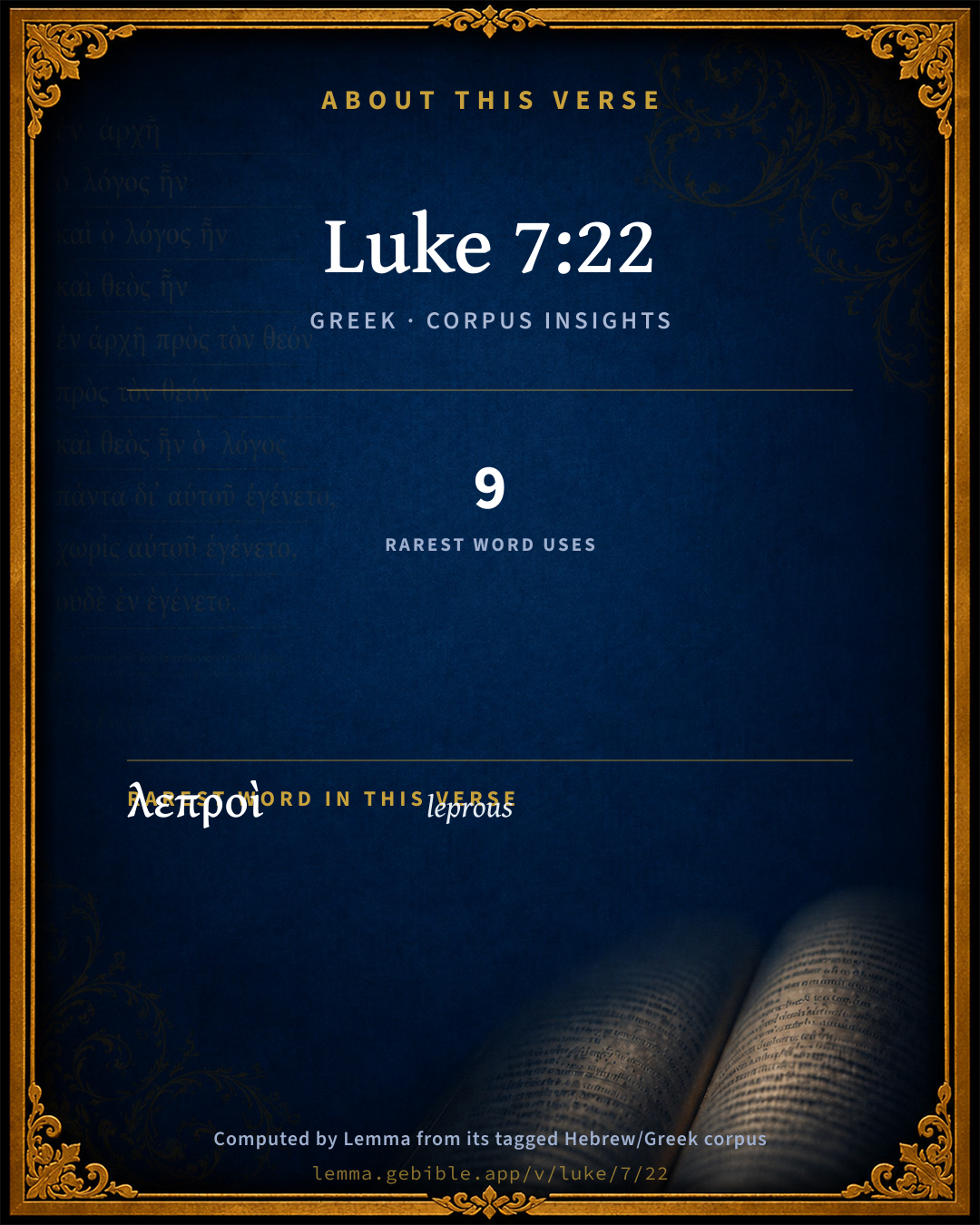
- Appears 9× in the Greek New Testament
- First appears at Matthew 8:2
- Part of Speech
- Adjective
- Case
- Nominative
- Number
- Plural
- Gender
- Masculine
Full Thayer's Definition
- καὶ kaí G2532 “and” Conjunction
- ἀποκριθεὶς apokrínomai G611 “to answer” Verb, Aorist, Passive deponent, Participle, Nominative, Singular, Masculine
- εἶπεν légō G3004 “to say” Verb, Aorist, Active, Indicative, 3rd person, Singular
- αὐτοῖς autós G846 “he” Personal pronoun, Dative, Plural, Masculine
- πορευθέντες poreúomai G4198 “to go” Verb, Aorist, Passive deponent, Participle, Nominative, Plural, Masculine
- ἀπαγγείλατε apangéllō G518 “to report” Verb, Aorist, Active, Imperative, 2nd person, Plural
- Ἰωάννει Iōánnēs G2491 “John” Noun, Dative, Singular, Masculine
- ἃ hós G3739 “who” Relative pronoun, Accusative, Plural, Neuter
- εἴδετε horáō G3708 “to see” Verb, Aorist, Active, Indicative, 2nd person, Plural
- καὶ kaí G2532 “and” Conjunction
- ἠκούσατε akoúō G191 “to hear” Verb, Aorist, Active, Indicative, 2nd person, Plural
- ὅτι hóti G3754 “that” Conjunction
- τυφλοὶ typhlós G5185 “blind” Adjective, Nominative, Plural, Masculine
- ἀναβλέπουσιν anablépō G308 “to look up” Verb, Present, Active, Indicative, 3rd person, Plural
- χωλοὶ chōlós G5560 “lame” Adjective, Nominative, Plural, Masculine
- περιπατοῦσιν peripatéō G4043 “to walk” Verb, Present, Active, Indicative, 3rd person, Plural
- λεπροὶ leprós G3015 “leprous” Adjective, Nominative, Plural, Masculine
- καθαρίζονται katharízō G2511 “to make clean” Verb, Present, Passive, Indicative, 3rd person, Plural
- κωφοὶ kōphós G2974 “dull” Adjective, Nominative, Plural, Masculine
- ἀκούουσιν akoúō G191 “to hear” Verb, Present, Active, Indicative, 3rd person, Plural
- νεκροὶ nekrós G3498 “dead” Adjective, Nominative, Plural, Masculine
- ἐγείρονται egeírō G1453 “to raise” Verb, Present, Passive, Indicative, 3rd person, Plural
- πτωχοὶ ptōchós G4434 “poor” Adjective, Nominative, Plural, Masculine
- εὐαγγελίζονται euangelízō G2097 “to evangelize” Verb, Present, Passive, Indicative, 3rd person, Plural
About this verse
These counts appear in no published source. They are computed here, from the morphology-tagged text and Lemma’s own curated glosses. What Lemma adds →
- 24
- words
- 22
- distinct lemmas
- Gospels
- section
Cross-references
29Topical passages linked to Luke 7:22 in the Treasury of Scripture Knowledge — connected by theme and wording, ordered by reader-vote popularity; previews shown in the World English Bible.
- Isaiah 35:5–6 Then the eyes of the blind shall be opened, and the ears of the deaf shall be unstopped.
- Isaiah 61:1–3 The Spirit of the Lord Yahweh is on me; because Yahweh has anointed me to preach good news to the humble; he has sent me to bind up the broken-hearted, to proclaim liberty to the captives, and the opening [of the prison] to those who are bound;
- Luke 4:18 "The Spirit of the Lord is on me, Because he has anointed me to preach good news to the poor. He has sent me to heal the brokenhearted, To proclaim release to the captives, Recovering of sight to the blind, To deliver those who are crushed,
- Isaiah 29:18–19 In that day shall the deaf hear the words of the book, and the eyes of the blind shall see out of obscurity and out of darkness.
- James 2:5 Listen, my beloved brothers. Didn't God choose those who are poor in this world to be rich in faith, and heirs of the Kingdom which he promised to those who love him?
- Matthew 9:28–30 When he had come into the house, the blind men came to him. Jesus said to them, "Do you believe that I am able to do this?" They told him, "Yes, Lord."
- Matthew 15:30–31 Great multitudes came to him, having with them the lame, blind, mute, maimed, and many others, and they put them down at his feet. He healed them,
- Matthew 21:14 The blind and the lame came to him in the temple, and he healed them.
- Luke 7:14–15 He came near and touched the coffin, and the bearers stood still. He said, "Young man, I tell you, arise!"
- Luke 8:53–55 They were ridiculing him, knowing that she was dead.
- Acts 14:8–10 At Lystra a certain man sat, impotent in his feet, a cripple from his mother's womb, who never had walked.
- Acts 26:18 to open their eyes, that they may turn from darkness to light and from the power of Satan to God, that they may receive remission of sins and an inheritance among those who are sanctified by faith in me.'
- Job 29:15 I was eyes to the blind, And feet to the lame.
- Psalms 146:8 Yahweh opens the eyes of the blind. Yahweh raises up those who are bowed down. Yahweh loves the righteous.
- Isaiah 32:3–4 The eyes of those who see shall not be dim, and the ears of those who hear shall listen.
- Isaiah 42:16 I will bring the blind by a way that they don't know; in paths that they don't know will I lead them; I will make darkness light before them, and crooked places straight. These things will I do, and I will not forsake them.
- Isaiah 43:8 Bring forth the blind people who have eyes, and the deaf who have ears.
- Jeremiah 31:8 Behold, I will bring them from the north country, and gather them from the uttermost parts of the earth, [and] with them the blind and the lame, the woman with child and her who travails with child together: a great company shall they return here.
- Zephaniah 3:12 But I will leave in the midst of you an afflicted and poor people, and they will take refuge in the name of Yahweh.
- Mark 7:32–37 They brought to him one who was deaf and had an impediment in his speech. They begged him to lay his hand on him.
- Luke 5:12–15 It happened, while he was in one of the cities, behold, there was a man full of leprosy. When he saw Jesus, he fell on his face, and begged him, saying, "Lord, if you want to, you can make me clean."
- Luke 7:21 In that hour he cured many of diseases and plagues and evil spirits; and to many who were blind he gave sight.
- Luke 17:12–19 As he entered into a certain village, ten men who were lepers met him, who stood at a distance.
- Isaiah 42:6–7 I, Yahweh, have called you in righteousness, and will hold your hand, and will keep you, and give you for a covenant of the people, for a light of the Gentiles;
- Luke 18:35–43 It happened, as he came near Jericho, a certain blind man sat by the road, begging.
- John 1:46 Nathanael said to him, "Can any good thing come out of Nazareth?" Philip said to him, "Come and see."
- John 9:30–33 The man answered them, "How amazing! You don't know where he comes from, yet he opened my eyes.
- Acts 3:2–8 A certain man who was lame from his mother's womb was being carried, whom they laid daily at the door of the temple which is called Beautiful, to ask gifts for the needy of those who entered into the temple.
- Acts 8:7 For unclean spirits came out of many of those who had them. They came out, crying with a loud voice. Many who had been paralyzed and lame were healed.
Cross-references courtesy of OpenBible.info (CC BY 4.0).
Lesson kit
Teaching starters — assembled from the data on this page, not authored interpretation. Every prompt links to the verse data it draws on. Edit before teaching.
Luke, in the Gospels, opens this verse with 24 words (22 distinct Greek lemmas). Its most distinctive word is leprós (“leprous”). A historical commentator’s framing appears above. Read the whole chapter for the surrounding context.
Discussion questions
- The word leprós carries the sense “leprous.” How does it shape the verse?
- Matthew 8:2 shares the word «leprous» with this verse. How do the two illuminate each other?
- “to hear” occurs 2× in this one verse. What is the effect of the repetition?
- These translations render this verse differently. What is at stake in choosing one wording over another?
- Reading how Tyndale Open Study Notes and Expositor's Greek Testament read this verse, where do the two commentators agree and where do they part?
Things to notice
- These translations choose different wording for 26 words in this verse.
- “to hear” occurs 2× in this single verse.
- 22 distinct Greek lemmas span 24 words in this verse.
Commentary
Notes on Luke 7:22 from classic Christian and Jewish commentators (each source and its license shown beneath its notes). The classic Christian expositions comment on the surrounding passage and are grouped to its opening verse, so a note may address several verses; the Jewish commentaries on the Tanakh (Rashi and others) are per-verse, so they appear only where the commentator wrote on this verse.
Lemma curates 59 commentaries, every one of them public domain or Creative Commons licensed, each selected and text-cleaned for this edition rather than reprinted as found. About our sources →
Tyndale Open Study Notes
Tyndale Open Resources
Tyndale Open Study Notes — © Tyndale Open Resources, licensed CC BY-SA 4.0. Text via the HelloAO Bible API.
Expositor's Greek Testament
ed. W. Robertson Nicoll
The Expositor's Greek Testament, edited by W. Robertson Nicoll (1897–1910) — public domain. Text from a community e-Sword module.
Adam Clarke's Commentary
Adam Clarke's Commentary on the Bible (1810–1826) — public domain. Text from a community e-Sword/MySword module.
Ellicott's Commentary for English Readers
A Bible Commentary for English Readers, edited by Charles John Ellicott (1878–1897) — public domain. Text from a community e-Sword module.
The Cambridge Bible for Schools and Colleges
gen. ed. J. J. S. Perowne
The Cambridge Bible for Schools and Colleges (gen. ed. J. J. S. Perowne; Cambridge University Press, 1878–1918) — public domain. Text from a community e-Sword module.
John Gill's Exposition
John Gill's Exposition of the Whole Bible (1746–1763) — public domain (CC PDM 1.0). Text via the HelloAO Bible API.
Trapp's Complete Commentary
John Trapp
John Trapp, A Commentary or Exposition upon All the Books of the Old and New Testament (1647–1656) — public domain. Text from a community e-Sword module.
Haydock's Catholic Bible Commentary
George Leo Haydock (1774–1849), Haydock's Catholic Family Bible and Commentary, 1859 edition — public domain. Excludes Psalms (Douay-Rheims chapter numbering differs from Protestant) and Deuterocanonical books (Catholic canon only).
The Pulpit Commentary
The Pulpit Commentary (1880–1919), ed. H.D.M. Spence-Jones & Joseph S. Exell — public domain. Text from a community e-Sword module.
John Wesley's Explanatory Notes
John Wesley, Explanatory Notes Upon the Whole Bible (1754–1765) — public domain. Text via the GEBible commentary corpus.
Burkitt's Expository Notes on the New Testament
William Burkitt
William Burkitt's Expository Notes on the New Testament (1700–1703) — public domain. Text from a community e-Sword module.
Cambridge Greek Testament for Schools and Colleges
Cambridge Greek Testament for Schools and Colleges (Cambridge University Press, 1896; 21 vols, various authors incl. Carr, Maclear, Plummer, Farrar, Lumby, Moule, M. R. James, Simcox) — public domain. Text from a community e-Sword module.
International Critical Commentary
International Critical Commentary — older volumes (1896–1929), various authors — public domain. Text from a community e-Sword module.
Vincent's Word Studies in the New Testament
Marvin R. Vincent
Marvin R. Vincent, Word Studies in the New Testament (1887–1900) — public domain. Text from a community e-Sword/MySword module.