Mark 2:16

Greek (Tischendorf 8th ed.) Mark 2:16 appears in the Greek New Testament. The text above is from the Tischendorf 8th edition. Each word links to its Strong’s number and a concise gloss. Click any word for its full Thayer’s Greek Lexicon entry.
Download image
Cite this verse

Mark 2:16 (World English Bible). Public Domain. Lemma interlinear Bible study tool, https://lemma.gebible.app/v/mark/2/16.

Show BibTeX & RIS
BibTeX
RIS
English Translation
The scribes and the Pharisees, when they saw that he was eating with the sinners and tax collectors, said to his disciples, "Why is it that he eats and drinks with tax collectors and sinners?"
World English Bible · Public Domain
Download a study sheet

One document with this verse’s original text, its word-by-word gloss line, the meaning frame, cross-references with their text, attributed commentary, and full source and license credits — printable, and it pastes into notes with its structure intact.

This verse Autodidact and up

Study sheet (.html) Plain text (.txt)

A passage Seminary Student

Up to 50 verses in one chapter. A passage sheet keeps up to 6 commentary sources and 12 cross-references per verse, in the order this page ranks them, and says so on the sheet whenever that leaves anything out. Ask for a single verse and you get the Autodidact verse sheet above.

Everything on this page stays free to read, with no account — the sheet is a download of what is already on screen, not access to it.

Want to remove ads? Support Godless Engineer
Compare translations 3

The same verse in 3 English versions, stacked beneath the original-language interlinear above. Click any original word for its lexicon entry.

Each is an independent rendering of the whole verse — the interlinear is not word-aligned to these translations.

Highlighted words mark where these versions differ — a whole-verse word diff, not a word-by-word alignment.

  • World English Bible Public Domain
    The scribes and the Pharisees, when they saw that he was eating with the sinners and tax collectors, said to his disciples, "Why is it that he eats and drinks with tax collectors and sinners?"
  • King James Version Public Domain
    And when the scribes and Pharisees saw him eat with publicans and sinners, they said unto his disciples, How is it that he eateth and drinketh with publicans and sinners?
  • unfoldingWord Literal Text CC BY-SA 4.0
    And the scribes of the Pharisees, having seen that he eats with the sinners and tax collectors, were saying to his disciples, “Does he eat with the tax collectors and sinners?”

unfoldingWord Literal Text — © unfoldingWord, licensed CC BY-SA 4.0. Word-aligned USFM3 via Door43 (git.door43.org/unfoldingWord/en_ult).

Versions to compare (up to 4)

3 of 4 selected

Show all 19 translations

Every available English version of this verse, each an independent rendering of the whole verse.

  • World English Bible Public Domain
    The scribes and the Pharisees, when they saw that he was eating with the sinners and tax collectors, said to his disciples, "Why is it that he eats and drinks with tax collectors and sinners?"
  • Berean Standard Bible Public Domain
    When the scribes who were Pharisees saw Jesus eating with these people, they asked His disciples, “Why does He eat with tax collectors and sinners?”
  • Majority Standard Bible Public Domain
    When the scribes and Pharisees saw Jesus eating with these people, they asked His disciples, “Why does He eat and drink with tax collectors and sinners?”
  • King James Version Public Domain
    And when the scribes and Pharisees saw him eat with publicans and sinners, they said unto his disciples, How is it that he eateth and drinketh with publicans and sinners?
  • American Standard Version (1901) Public Domain
    And the scribes of the Pharisees, when they saw that he was eating with the sinners and publicans, said unto his disciples, `How is it' that he eateth and drinketh with publicans and sinners?
  • Revised Version (1885) Public Domain
    And the scribes of the Pharisees, when they saw that he was eating with the sinners and publicans, said unto his disciples, He eateth and drinketh with publicans and sinners.
  • Geneva Bible (1599) Public Domain
    And when the Scribes and Pharises sawe him eate with the Publicanes and sinners, they sayd vnto his disciples, Howe is it, that hee eateth and drinketh with Publicanes and sinners?
  • Douay-Rheims (1899) Public Domain
    And the scribes and the Pharisees, seeing that he ate with publicans and sinners, said to his disiples: Why doth your master eat and drink with publicans and sinners?
  • Young's Literal Translation Public Domain
    And the scribes and the Pharisees, having seen him eating with the tax-gatherers and sinners, said to his disciples, `Why -- that with the tax-gatherers and sinners he doth eat and drink?'
  • Literal Standard Version CC BY-SA 4.0
    And the scribes and the Pharisees, having seen Him eating with the tax collectors and sinners, said to His disciples, “Why—that with the tax collectors and sinners He eats and drinks?”
  • Unlocked Literal Bible CC BY-SA 4.0
    When the scribes, who were Pharisees, saw that Jesus was eating with the sinful people and tax collectors, they said to his disciples, “Why does he eat with tax collectors and sinful people?”
  • unfoldingWord Literal Text CC BY-SA 4.0
    And the scribes of the Pharisees, having seen that he eats with the sinners and tax collectors, were saying to his disciples, “Does he eat with the tax collectors and sinners?”
  • Darby Bible Public Domain
    And the scribes and the Pharisees, seeing him eating with sinners and tax-gatherers, said to his disciples, Why [is it] that he eats and drinks with tax-gatherers and sinners?
  • World Messianic Bible Public Domain
    The scribes and the Pharisees, when they saw that he was eating with the sinners and tax collectors, said to his disciples, “Why is it that he eats and drinks with tax collectors and sinners?”
  • Webster's Bible Public Domain
    And when the scribes and Pharisees saw him eating with publicans and sinners, they said to his disciples, How is it that he eateth and drinketh with publicans and sinners.
  • Free Bible Version CC BY-SA 4.0
    When the religious leaders of the Pharisees saw Jesus eating with such people, they asked Jesus' disciples, “Why does he eat with tax collectors and sinners?”
  • Bible in Basic English Public Domain
    And the scribes of the Pharisees, when they saw that he was taking food with the tax-farmers and sinners, said to his disciples, Why does he take food and drink with such men?
  • Text-Critical English NT CC BY 4.0
    When the scribes and the Pharisees saw Jesus eating with tax collectors and sinners, they said to his disciples, “Why is he eating and drinking with tax collectors and sinners?”
  • Tyndale New Testament (1534) Public Domain
    And when the Scribes and Pharises sawe him eate with publicans and synnere they sayde vnto his disciples: how is it that he eateth and drynketh with publicans and synners?

Literal Standard Version (2020), Covenant Press — licensed CC BY-SA 4.0. Text via the HelloAO Bible API (eBible.org). Unlocked Literal Bible (unfoldingWord) — licensed CC BY-SA 4.0. Text via the HelloAO Bible API (eBible.org). unfoldingWord Literal Text — © unfoldingWord, licensed CC BY-SA 4.0. Word-aligned USFM3 via Door43 (git.door43.org/unfoldingWord/en_ult). Free Bible Version, Dr. Jonathan Gallagher — licensed CC BY-SA 4.0. Text via the HelloAO Bible API (eBible.org).

Word by word

More ways to search: Search by grammar → Find every occurrence → Compare this word →

Practice this passage: Drill this verse → Learn its vocabulary →

τελωνῶν
telṓnēs
G5057
“tax collector”
Noun, Genitive, Plural, Masculine
Part of Speech
Noun
Case
Genitive
Number
Plural
Gender
Masculine
Full Thayer's Definition

Origin: from G5056 and G5608

TDNT: 09:28,1

1. a renter or farmer of taxes a. among the Romans, usually a man of equestrian rank 2. a tax gatherer, collector of taxes or tolls, one employed by a publican or farmer general in the collection of taxes. The tax collectors were as a class, detested not only by the Jews, but by other nations also, both on account of their employment and of the harshness, greed, and deception, with which they did their job.
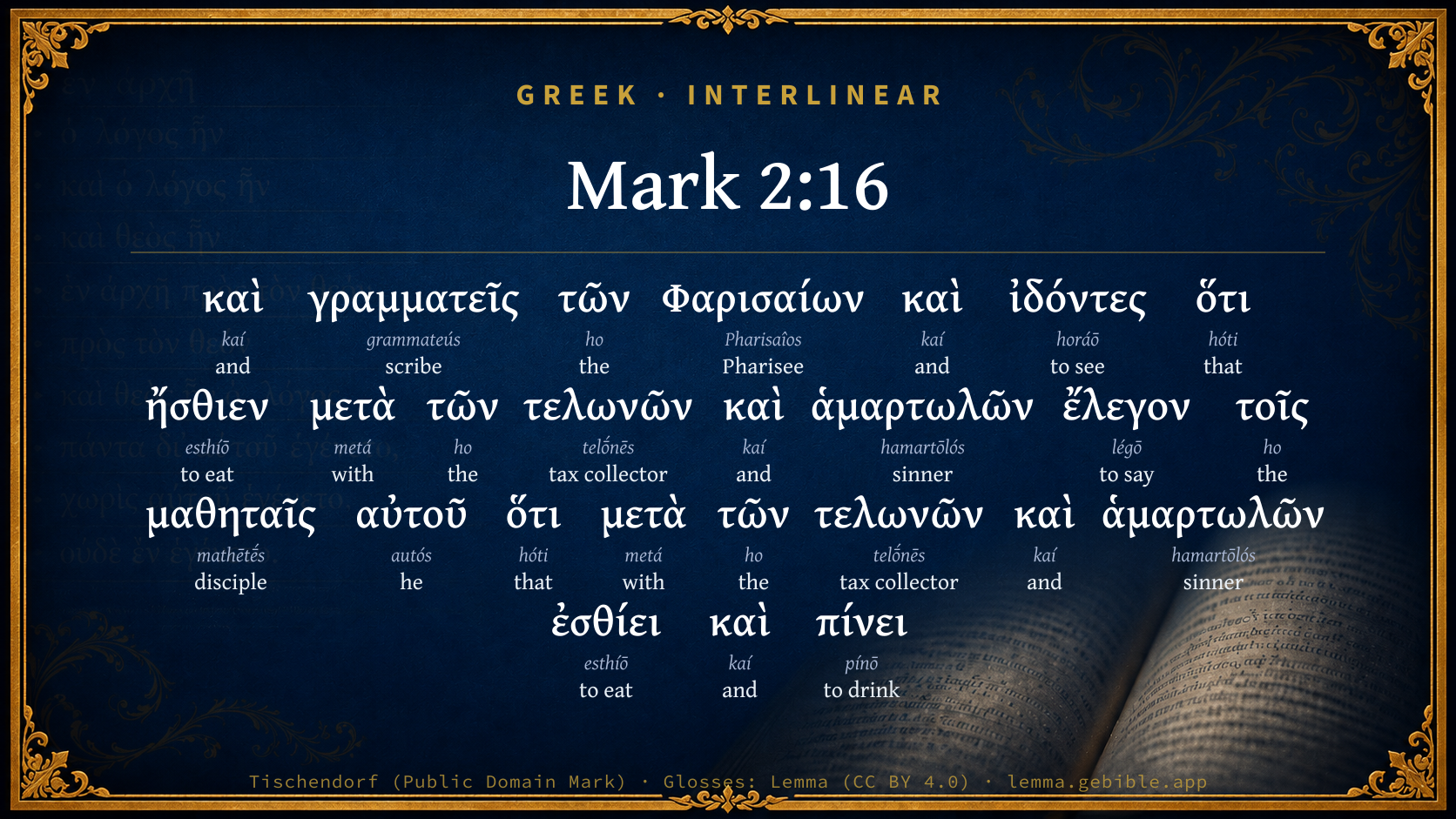
  1. καὶ kaí G2532 “and” Conjunction
  2. γραμματεῖς grammateús G1122 “scribe” Noun, Nominative, Plural, Masculine
  3. τῶν ho G3588 “the” Article, Genitive, Plural, Masculine
  4. Φαρισαίων Pharisaîos G5330 “Pharisee” Noun, Genitive, Plural, Masculine
  5. καὶ kaí G2532 “and” Conjunction
  6. ἰδόντες horáō G3708 “to see” Verb, Aorist, Active, Participle, Nominative, Plural, Masculine
  7. ὅτι hóti G3754 “that” Conjunction
  8. ἤσθιεν esthíō G2068 “to eat” Verb, Imperfect, Active, Indicative, 3rd person, Singular
  9. μετὰ metá G3326 “with” Preposition
  10. τῶν ho G3588 “the” Article, Genitive, Plural, Masculine
  11. καὶ kaí G2532 “and” Conjunction
  12. ἁμαρτωλῶν hamartōlós G268 “sinner” Adjective, Genitive, Plural, Masculine
  13. ἔλεγον légō G3004 “to say” Verb, Imperfect, Active, Indicative, 3rd person, Plural
  14. τοῖς ho G3588 “the” Article, Dative, Plural, Masculine
  15. μαθηταῖς mathētḗs G3101 “disciple” Noun, Dative, Plural, Masculine
  16. αὐτοῦ autós G846 “he” Personal pronoun, Genitive, Singular, Masculine
  17. ὅτι hóti G3754 “that” Conjunction
  18. μετὰ metá G3326 “with” Preposition
  19. τῶν ho G3588 “the” Article, Genitive, Plural, Masculine
  20. τελωνῶν telṓnēs G5057 “tax collector” Noun, Genitive, Plural, Masculine
  21. καὶ kaí G2532 “and” Conjunction
  22. ἁμαρτωλῶν hamartōlós G268 “sinner” Adjective, Genitive, Plural, Masculine
  23. ἐσθίει esthíō G2068 “to eat” Verb, Present, Active, Indicative, 3rd person, Singular
  24. καὶ kaí G2532 “and” Conjunction
  25. πίνει pínō G4095 “to drink” Verb, Present, Active, Indicative, 3rd person, Singular

About this verse

These counts appear in no published source. They are computed here, from the morphology-tagged text and Lemma’s own curated glosses. What Lemma adds →

26
words
14
distinct lemmas
Gospels
section

Notable vocabulary

The rarest word here is τελωνῶν tax collector G5057 — appearing just 21 times in the whole Greek New Testament.

Shared distinctive vocabulary

τελωνῶν tax collector G5057 occurs in 20 verses of the Greek New Testament. Also found in:

Repetition

Words recur within this verse:

  • ἤσθιεν to eat G2068 ×2
  • τελωνῶν tax collector G5057 ×2
  • ἁμαρτωλῶν sinner G268 ×2
  • καὶ and G2532 ×5
  • τῶν the G3588 ×4
  • ὅτι that G3754 ×2
  • μετὰ with G3326 ×2

Cross-references

11

Topical passages linked to Mark 2:16 in the Treasury of Scripture Knowledge — connected by theme and wording, ordered by reader-vote popularity; previews shown in the World English Bible.

  • Luke 18:11 The Pharisee stood and prayed to himself like this: 'God, I thank you, that I am not like the rest of men, extortioners, unrighteous, adulterers, or even like this tax collector.
  • Luke 19:7 When they saw it, they all murmured, saying, "He has gone in to lodge with a man who is a sinner."
  • Luke 19:10 For the Son of Man came to seek and to save that which was lost."
  • Isaiah 65:5 who say, Stand by yourself, don't come near to me, for I am holier than you. These are a smoke in my nose, a fire that burns all the day.
  • Acts 23:9 A great clamor arose, and some of the scribes of the Pharisees part stood up, and contended, saying, "We find no evil in this man. But if a spirit or angel has spoken to him, let's not fight against God!"
  • 1 Corinthians 2:15 But he who is spiritual discerns all things, and he himself is judged by no one.
  • Matthew 9:11 When the Pharisees saw it, they said to his disciples, "Why does your teacher eat with tax collectors and sinners?"
  • Matthew 18:17 If he refuses to listen to them, tell it to the assembly. If he refuses to hear the assembly also, let him be to you as a Gentile or a tax collector.
  • Mark 2:7 "Why does this man speak blasphemies like that? Who can forgive sins but God alone?"
  • Luke 15:2–7 The Pharisees and the scribes murmured, saying, "This man welcomes sinners, and eats with them."
  • Hebrews 12:3 For consider him who has endured such contradiction of sinners against himself, that you don't grow weary, fainting in your souls.

Cross-references courtesy of OpenBible.info (CC BY 4.0).

Where the printed editions differ

1 variant

Places in this verse where the major printed Greek editions disagree on the wording in a way that affects the translation — a comparison of editions, not a manuscript-by-manuscript collation. The editions are the modern critical texts (Nestlé-Aland 28/27, SBL, Westcott-Hort, Tregelles, Tyndale House) and the traditional texts behind the KJV (the Textus Receptus and the Byzantine/Majority text). It is not a claim about which reading is original.

  1. Extra text
    καὶ πίνει;

    “and drinks?”

    In TregTRByz Not in NA28NA27TynSBLWH

    καὶ πίνει;¶ (kai pinei) 'and drinks?' is only in traditional manuscripts (Treg+TR+Byz)

Textual data: Translators Amalgamated Greek New Testament (STEPBible TAGNT) · CC BY 4.0.

Commentary

Notes on Mark 2:16 from classic Christian and Jewish commentators (each source and its license shown beneath its notes). The classic Christian expositions comment on the surrounding passage and are grouped to its opening verse, so a note may address several verses; the Jewish commentaries on the Tanakh (Rashi and others) are per-verse, so they appear only where the commentator wrote on this verse.

Lemma curates 59 commentaries, every one of them public domain or Creative Commons licensed, each selected and text-cleaned for this edition rather than reprinted as found. About our sources →

The Biblical Illustrator

Joseph S. Exell

Mar_2:16

And when the scribes and Pharisees saw Him eat with publicans and sinners.

The curse of bigotry

The sins society winks at are worse than those it censures. The most alarming sin is the self-delusion that we have no sin. The pride of the Pharisees had made them so callous that a sharp lancet was needed to get at the wound.

I. Bigotry bespatters with mire the fairest deed. According to its creed, better that a tree of fruitful goodness should not grow than that it should depart by a hairbreadth from the prescribed shape.

II. Bigotry blindfolds its own eyes. It can only see sin when sin wears a particular hue. It can see avarice or theft, but not insincerity or pride.

III. Bigotry seeks its bad ends by crooked ways. These scribes lacked courage, so instead of attacking Christ openly they tried to undermine His authority with His disciples.

IV. Bigotry cheats itself of largest blessing. Christ would have illuminated and enriched these proud Pharisees if they had allowed Him to. But they were too proud to admit their hunger, and so they starved. He who thinks himself already perfect is past improvement. Like hide-bound animals he cannot grow. (D. Davies, M. A.)

An implied charge set aside

Negatively:

1. That Christ did not associate with publicans and sinners because He entertained too humble an opinion of Himself. He knew that He was intellectually and morally superior to them.

2. That Christ did not associate with publicans and sinners because He was not choice as to His society. Evil communications corrupt good manners.

3. That Christ did not associate with publicans and sinners because of His sympathy with them. It was not their wickedness that drew Him to them; morally He had nothing in common with them.

Positively:

1. That to have refused Levis invitation would not have been courteous.

2. That in accepting Levis invitation Christ displayed a spirit of condescension.

3. That by eating and drinking with publicans and sinners Christ exhibited a friendly disposition towards them.

4. That attending Levis feast gave Christ an excellent opportunity of doing Publicans and sinners good. (G. Cron.)

Christs relations with the world

To come, then, to the root of the whole matter; the supreme Lover of the universe, God, is in the tenderest relations to everything that is. Not that we are to make no difference between good and evil. We are to make a difference between them. If we have the spirit of the Lord Jesus Christ our goodness will make us more lenient, more charitable, more patient with bad men and bad things. And remember one thing-that no human heart is ever cured till you can find another heart to brood it; for the cure of the heart is of the heart, and a loving heart cures an unloving heart; and as God lives by His purity to make more pure, by His love to heal mens selfishness, by His beauty and majesty and power to draw men up out of animal life into spiritual life; so His followers may imitate Him in those respects, and make atonement for those who are ready to perish-the atonement that love is always making-and as far as they carry that out they may redeem men. (H. W. Beecher.)

Christ welcoming sinners

We are told that in stormy weather it is not unusual for small birds to be blown out of sight of land on to the sea. They are often seen by voyagers out of their reckoning and far from the coast, hovering over the masts on weary wings as if they wanted to alight and rest themselves, but fearing to do so. A traveller tells us that on one occasion a little lark, which followed the ship for a considerable distance, was at last compelled through sheer weariness to alight. He was so worn out as to be easily caught. The warmth of the hand was so agreeable to him that he sat down on it, burying his little cold feet in his feathers, and looking about with his bright eye not in the least afraid, and as if feeling assured that he had been cast amongst good kind people whom he had no occasion to be so backward in trusting. A touching picture of the soul who is aroused by the Spirit of God and blown out of its own reckoning by the winds of conviction; and the warm reception which the weary little bird received at the hands of the passengers conveys but a faint idea of that welcome which will greet the worn-out, sin-sick souls who will commit themselves into the hands of the only Saviour. (C. H. Spurgeon.)

Christ in company with sinners; or, the law of social intercourse in the Christian life

We have in this narrative a beautiful illustration of the law of social intercourse in the Christian life, given by Christ, and which, therefore, may be regarded as of authority. We observe-

I. That the morally good must associate with the socially depraved. How is it that He eateth and drinketh with publicans and sinners?

1. That the morally good may take part in the social festivals of the depraved, but not for the mere purpose of social enjoyment or intellectual companionship. Christ did not go to the house of Levi merely to enjoy a sumptuous banquet, or to participate in the festivities of unholy men.

2. The morally good may associate with the depraved in the commercial enterprise of life. The good must have dealings with the unholy in the commerce of the world. The tares and the wheat must grow together until the harvest.

3. The morally good are sometimes brought into incidental companionship with the depraved.

II. That the morally good in companionship with the socially depraved must be animated by remedial motives, and must give forth influences ennobling to the soul. They that are whole have no need of the physician, but they that are sick.

1. The Christian must go into the company of the morally depraved with right views of their sad condition, and with an intense desire for their recovery.

2. The Christian can give forth healing influences to the morally depraved by kindly words, by gentle disposition, by judicious teaching, and by unpretentious example.

Lessons:

1. That the morally good must go into the company of the socially depraved.

2. That the morally good are the physicians of the race; they must be careful not to take the infection of sin, and to exercise judiciously their healing art.

3. That society will best be regenerated by individual effort. (J. S. Exell, M. A.)

The Biblical Illustrator, edited by Joseph S. Exell (c. 1880s–1900s) — public domain. Text from a community e-Sword module.

Tyndale Open Study Notes

Tyndale Open Resources

2:16 The teachers of religious law who were Pharisees understood Jesus’ act of eating with sinners as intentionally accepting them as friends (Luke 15:1-2; 19:5, 7; Acts 11:2-18; Gal 2:11-12). Jesus indicated that these tax collectors and sinners were invited to share in the Kingdom of God. In Jesus’ ministry, even Gentiles were invited to share the Kingdom (Mark 5:1-20; 7:24-30; cp. Matt 8:5-13; Luke 7:1-10; John 4:43-54).

Tyndale Open Study Notes — © Tyndale Open Resources, licensed CC BY-SA 4.0. Text via the HelloAO Bible API.

Bengel's Gnomon

Johann Albrecht Bengel

Mar 2:16.[19] Τὶ ὅτι) So the LXX.; Jdg 11:7, etc.

[19] Mar 2:15. Καὶ ἠκολούθησαν, and they were following) Therefore even then already with reformed minds they were holding to [entering upon] the right way.—V. g.

Bengel's Gnomon of the New Testament — English translation (T&T Clark, Edinburgh, 1860) — public domain. Text from a community e-Sword module.

Expositor's Greek Testament

ed. W. Robertson Nicoll

Mar 2:16 . ἔλεγον : the scribes advance from thinking (Mar 2:6 ) to speaking ; not yet, however, to Jesus but about Him to His disciples. They note, with disapproval, His kindly relations with “sinners”. The publicans and other disreputables had also noted the fact. The story of the palsied man and the “blasphemous” word, “thy sins be forgiven thee,” had got abroad, making them prick up their ears, and awakening decided interest in these tabooed circles, in the “Blasphemer”.

The Expositor's Greek Testament, edited by W. Robertson Nicoll (1897–1910) — public domain. Text from a community e-Sword module.

Cambridge Greek Testament for Schools and Colleges

16. γραμματεῖς τῶν Φαρισαίων καὶ ἰσόντες ([299][300][301][302] 33) rather than γρ. καὶ οἱ Φαρισαῖοι ἰδόντες ([303][304][305][306]). ὅτι ἐσθίει ([307] 33) is probably to be preferred to ὅτι ἤσθιεν ([308][309][310] or αὐτὸν ἐσθίοντα ([311][312][313][314][315]).

[299] Codex Sinaiticus. 4th cent. Discovered by Tischendorf in 1859 at the Monastery of St Katharine on Mount Sinai. Now at St Petersburg. The whole Gospel, ending at Mar 16:8. Photographic facsimile, 1911.

[300] Codex Vaticanus. 4th cent., but perhaps a little later than א. In the Vatican Library almost since its foundation by Pope Nicolas V., and one of its greatest treasures. The whole Gospel, ending at Mar 16:8. Photographic facsimile, 1889.

[301] Codex Regius. 8th cent. An important witness. At Paris. Contains Mar 1:1 to Mar 10:15; Mar 10:30 to Mar 15:1; Mar 15:20 to Mar 16:20, but the shorter ending is inserted between Mar 16:8 and Mar 16:9, showing that the scribe preferred it to the longer one.

[302] Codex Sangallensis. 9th or 10th cent. Contains the Gospels nearly complete, with an interlinear Latin translation. The text of Mark is specially good, agreeing often with CL. At St Gall.

[303] Codex Alexandrinus. 5th cent. Brought by Cyril Lucar, Patriarch of Constantinople, from Alexandria, and afterwards presented by him to King Charles I. in 1628. In the British Museum. The whole Gospel. Photographic facsimile, 1879.

[304] Codex Ephraemi. 5th cent. A palimpsest: the original writing has been partially rubbed out, and the works of Ephraem the Syrian have been written over it; but a great deal of the original writing has been recovered; of Mark we have Mar 1:17 to Mar 6:31, Mar 8:5 to Mar 12:29, Mar 13:19 to Mar 16:20. In the National Library at Paris.

[305] Codex Oxoniensis. 9th cent. Contains Mark, except Mar 3:35 to Mar 6:20.

[306] Codex Petropolitanus. 9th cent. Gospels almost complete. Mar 16:18-20 is in a later hand.

[307] Codex Vaticanus. 4th cent., but perhaps a little later than א. In the Vatican Library almost since its foundation by Pope Nicolas V., and one of its greatest treasures. The whole Gospel, ending at Mar 16:8. Photographic facsimile, 1889.

[308] Codex Sinaiticus. 4th cent. Discovered by Tischendorf in 1859 at the Monastery of St Katharine on Mount Sinai. Now at St Petersburg. The whole Gospel, ending at Mar 16:8. Photographic facsimile, 1911.

[309] Codex Bezae. 6th cent. Has a Latin translation (d) side by side with the Greek text, and the two do not quite always agree. Presented by Beza to the University Library of Cambridge in 1581. Remarkable for its frequent divergences from other texts. Contains Mark, except Mar 16:15-20, which has been added by a later hand. Photographic facsimile, 1899.

[310] Codex Regius. 8th cent. An important witness. At Paris. Contains Mar 1:1 to Mar 10:15; Mar 10:30 to Mar 15:1; Mar 15:20 to Mar 16:20, but the shorter ending is inserted between Mar 16:8 and Mar 16:9, showing that the scribe preferred it to the longer one.

[311] Codex Alexandrinus. 5th cent. Brought by Cyril Lucar, Patriarch of Constantinople, from Alexandria, and afterwards presented by him to King Charles I. in 1628. In the British Museum. The whole Gospel. Photographic facsimile, 1879.

[312] Codex Ephraemi. 5th cent. A palimpsest: the original writing has been partially rubbed out, and the works of Ephraem the Syrian have been written over it; but a great deal of the original writing has been recovered; of Mark we have Mar 1:17 to Mar 6:31, Mar 8:5 to Mar 12:29, Mar 13:19 to Mar 16:20. In the National Library at Paris.

[313] Codex Oxoniensis. 9th cent. Contains Mark, except Mar 3:35 to Mar 6:20.

[314] Codex Sangallensis. 9th or 10th cent. Contains the Gospels nearly complete, with an interlinear Latin translation. The text of Mark is specially good, agreeing often with CL. At St Gall.

[315] Codex Petropolitanus. 9th cent. Gospels almost complete. Mar 16:18-20 is in a later hand.

ἁμαρτωλῶν κ. τελωνῶν ([316][317][318] 33) rather than τελ. κ. ἁμαρτ. ([319][320][321][322][323][324]) by assimilation to next line.

[316] Codex Vaticanus. 4th cent., but perhaps a little later than א. In the Vatican Library almost since its foundation by Pope Nicolas V., and one of its greatest treasures. The whole Gospel, ending at Mar 16:8. Photographic facsimile, 1889.

[317] Codex Bezae. 6th cent. Has a Latin translation (d) side by side with the Greek text, and the two do not quite always agree. Presented by Beza to the University Library of Cambridge in 1581. Remarkable for its frequent divergences from other texts. Contains Mark, except Mar 16:15-20, which has been added by a later hand. Photographic facsimile, 1899.

[318] Codex Regius. 8th cent. An important witness. At Paris. Contains Mar 1:1 to Mar 10:15; Mar 10:30 to Mar 15:1; Mar 15:20 to Mar 16:20, but the shorter ending is inserted between Mar 16:8 and Mar 16:9, showing that the scribe preferred it to the longer one.

[319] Codex Sinaiticus. 4th cent. Discovered by Tischendorf in 1859 at the Monastery of St Katharine on Mount Sinai. Now at St Petersburg. The whole Gospel, ending at Mar 16:8. Photographic facsimile, 1911.

[320] Codex Alexandrinus. 5th cent. Brought by Cyril Lucar, Patriarch of Constantinople, from Alexandria, and afterwards presented by him to King Charles I. in 1628. In the British Museum. The whole Gospel. Photographic facsimile, 1879.

[321] Codex Ephraemi. 5th cent. A palimpsest: the original writing has been partially rubbed out, and the works of Ephraem the Syrian have been written over it; but a great deal of the original writing has been recovered; of Mark we have Mar 1:17 to Mar 6:31, Mar 8:5 to Mar 12:29, Mar 13:19 to Mar 16:20. In the National Library at Paris.

[322] Codex Oxoniensis. 9th cent. Contains Mark, except Mar 3:35 to Mar 6:20.

[323] Codex Sangallensis. 9th or 10th cent. Contains the Gospels nearly complete, with an interlinear Latin translation. The text of Mark is specially good, agreeing often with CL. At St Gall.

[324] Codex Petropolitanus. 9th cent. Gospels almost complete. Mar 16:18-20 is in a later hand.

16. οἱ γραμματεῖς τῶν Φαρισαίων. Those of the Scribes who belonged to the Pharisees. There were Scribes before there were Pharisees, but most of them seem to have been Pharisees (cf. Act 23:9). The phrase is unusual, and hence the reading of [397][398][399][400], etc. [401] also has γρ. κ. οἱ [402]. These unfriendly followers of course would not enter the house in which τελῶναι and ἁμαρτωλοί were being entertained. The strongest characteristic of the Pharisees was their holding that the unwritten tradition was as binding as the written Law; indeed some held that to transgress the tradition of the elders was worse than transgressing the Law.

[397] Codex Alexandrinus. 5th cent. Brought by Cyril Lucar, Patriarch of Constantinople, from Alexandria, and afterwards presented by him to King Charles I. in 1628. In the British Museum. The whole Gospel. Photographic facsimile, 1879.

[398] Codex Ephraemi. 5th cent. A palimpsest: the original writing has been partially rubbed out, and the works of Ephraem the Syrian have been written over it; but a great deal of the original writing has been recovered; of Mark we have Mar 1:17 to Mar 6:31, Mar 8:5 to Mar 12:29, Mar 13:19 to Mar 16:20. In the National Library at Paris.

[399] Codex Oxoniensis. 9th cent. Contains Mark, except Mar 3:35 to Mar 6:20.

[400] Codex Petropolitanus. 9th cent. Gospels almost complete. Mar 16:18-20 is in a later hand.

[401] Codex Bezae. 6th cent. Has a Latin translation (d) side by side with the Greek text, and the two do not quite always agree. Presented by Beza to the University Library of Cambridge in 1581. Remarkable for its frequent divergences from other texts. Contains Mark, except Mar 16:15-20, which has been added by a later hand. Photographic facsimile, 1899.

[402] Codex Beratinus. 6th cent. Contains Mar 1:1 to Mar 14:62.

ἔλεγον τοῖς μαθηταῖς. The question was perhaps asked several times; but they do not as yet assail Jesus Himself. It is probably as another collision between Christ and the Scribes that this narrative is placed here.

“Ὅτι μετὰ τῶν τελωνῶν. We have ὅτι for τί again Mar 9:11; Mar 9:28, where Mt. has τί or διὰ τί: here both Mt. and Lk. have διὰ τί. In class. Grk ὅστις sometimes introduces an indirect question, but in these passages the question is direct. Here, however, the ὅτι may be merely recitative; He eateth and drinketh, etc. (R.V.). The changes of order in Mar 2:15-16 are curious (τελ. κ. ἁμαρ., ἁμαρ. κ. τελ., τελ. κ. ἁμαρ.), and it is not the Scribes who differ from the Evangelist, but the Evangelist from himself. In Mar 2:16 the two classes are twice coupled under one art. as a single class, and A.V. ignores the art. in both places. See on Mar 4:3. As the disciples were eating with them, the criticism touched them as well as the Master, and Lk. has ἐσθίετε for ἐσθίει. The same criticism was made by Celsus in the second century. He taunts Christians with His having as His disciples infamous persons, τελώνας καὶ ναύτας τοὺς πονηροτάτους (Orig. Cels. i. 62).

Cambridge Greek Testament for Schools and Colleges (Cambridge University Press, 1896; 21 vols, various authors incl. Carr, Maclear, Plummer, Farrar, Lumby, Moule, M. R. James, Simcox) — public domain. Text from a community e-Sword module.

Adam Clarke's Commentary

Verse 16. Sinners] By αμαρτωλοι, the Gentiles or heathens are generally to be understood in the Gospels, for this was a term the Jews never applied to any of themselves, See Clarke on Mt 9:10.

How is it that he eateth] Some very good MSS., several versions, with Chrysostom and Augustin, read, Why doth YOUR MASTER eat?

Adam Clarke's Commentary on the Bible (1810–1826) — public domain. Text from a community e-Sword/MySword module.

The Cambridge Bible for Schools and Colleges

gen. ed. J. J. S. Perowne

16. they said unto his disciples] Overawed by the miracles He had wrought and the overthrow they had lately experienced at the healing of the paralytic, and not as yet venturing on any open rupture with Him, they vent their displeasure on His disciples. It is not likely that the Pharisees were present at the feast, or they would have involved themselves in the same blame. Probably they looked in while it was in progress, and afterwards came forward to the disciples coming out.

The Cambridge Bible for Schools and Colleges (gen. ed. J. J. S. Perowne; Cambridge University Press, 1878–1918) — public domain. Text from a community e-Sword module.

John Gill's Exposition

When Jesus heard it, he saith to them,.... Christ either overheard what they said to his disciples, or he heard it from the relation of the disciples; and when he did, he turned to the Scribes and Pharisees, and spoke to them the following words:

they that are whole, have no need of the physician, but they that are sick; which seems to be a proverbial expression, signifying that he was a physician; that these publicans and sinners were sick persons, and needed his company and assistance; but that they, the Scribes and Pharisees, were whole, and in good health, in their own esteem, and so wanted no relief; and therefore ought not to take it amiss, that he attended the one, and not the other. These words give a general view of mankind, in their different sentiments of themselves and of Christ; and of the usefulness of Christ to one sort, and not another. There are some that cry up the power of man's freewill, and plead for the strength and purity of human, nature, and extol its excellencies and abilities; and it is no wonder that these see no need of Christ, either for themselves or others: hence preachers of this complexion leave Christ out of their ministry for the most part; and generally speaking, lessen the glory and dignity of his person, depreciate his offices, reject his righteousness, and deny his satisfaction and atonement: and such reckon themselves the favourites of heaven, and are ready to say, whom shall God delight to honour, but us, who are so pure and holy? they therefore trust in their own righteousness, and despise others, and submit not to the righteousness of Christ; they make their own works their saviours, and so neglect the great salvation by Christ. There are others that are sick, and are quite sick of themselves; they see the impurity of their nature, how unsound and unhealthful they are; that from the crown of the head to the sole of the foot, there is no soundness in them, nothing but wounds, bruises, and putrefying sores: their loins are filled with the loathsome disease of sin; they are sensible of their inability to cure themselves, and that no mere creature can help them; and that all besides Christ, are physicians of no value: and therefore they apply to him, whose blood is a balm for every wound, and a medicine for every sickness and disease, and which cleanses from all sin: and whereas such, and such only, see their need of Christ as a physician, these only does he attend under this character; See Gill on Mat 9:12. Adding this as a reason,

I came not to call the righteous, but sinners to repentance. These words explain, what is more obscurely and figuratively expressed in the former; it appears from hence, that by "the whole" are meant, "righteous" persons; not such who are made righteous, by the righteousness of Christ imputed to them, but such who were outwardly righteous before men, who trusted in themselves that they were righteous, depended on their own righteousness, and fancied themselves, with respect to the righteousness of the law, blameless; and so, in their own apprehensions, stood in no need of Christ and his righteousness: yea, even needed not repentance, according to their own thoughts of things, and therefore were not called to it, but were left to their own stupidity and blindness; these were the Scribes and Pharisees; and by the "sick", are meant "sinners"; such who are made sensible of sin, and so of their need of Christ as a Saviour; and who have evangelical repentance given them, and are called to the exercise and profession of it: and Christ's calling sinners to repentance, and bestowing that grace, together with the remission of sins, which goes along with it, is doing his work and office as a "physician". This evangelist makes no mention of the passage in Hos 6:6, with which these words are introduced in Matthew. The last words, to "repentance", are omitted by the Vulgate Latin, Syriac, Persic, and Ethiopic versions, and are wanting in some ancient copies; but are retained in the Arabic version, and in most copies, as in Mat 9:13. See Gill on Mat 9:13.

John Gill's Exposition of the Whole Bible (1746–1763) — public domain (CC PDM 1.0). Text via the HelloAO Bible API.

Trapp's Complete Commentary

John Trapp

16 And when the scribes and Pharisees saw him eat with publicans and sinners, they said unto his disciples, How is it that he eateth and drinketh with publicans and sinners?

Ver. 16. They said unto his disciples] They dared not say it to him, where the hedge is lowest the beast breaks over. The devil, as the poet- quae desperat renitescere posse, relinquit. What he hopes not to effect, he never attempts. (Horat. de Arte Poet.)

John Trapp, A Commentary or Exposition upon All the Books of the Old and New Testament (1647–1656) — public domain. Text from a community e-Sword module.

Albert Barnes' Notes on the Bible

See the notes at Mat 9:12-13.

Albert Barnes' Notes on the Bible (1834–1885) — public domain. Text from a community e-Sword/MySword module.

The Pulpit Commentary

According to the most approved readings, this verse should run thus: And the scribes of the Pharisees, when they saw that he was eating with the sinners and publicans, said unto his disciples, He eateth and drinketh with publicans and sinners. The words "publicans and sinners" are thus inverted in their order in the two clauses, as though they were convertible terms. Of course, the scribes and Pharisees had not sat down at this feast, but some of them had probably found their way into the chamber in which the feast was going on, where they would comment freely upon what they saw, and condemn our Lord"s conduct as inconsistent with his character. It is as though they said, "By this conduct he transgresses the Law of God and the traditions of the elders. Why, then, do you follow him?"

The Pulpit Commentary (1880–1919), ed. H.D.M. Spence-Jones & Joseph S. Exell — public domain. Text from a community e-Sword module.

John Wesley's Explanatory Notes

And the scribes and Pharisees said - So now the wise men being joined by the saints of the world, went a little further in raising prejudices against our Lord. In his answer he uses as yet no harshness, but only calm, dispassionate reasoning.

John Wesley, Explanatory Notes Upon the Whole Bible (1754–1765) — public domain. Text via the GEBible commentary corpus.

Scofield Reference Notes

C. I. Scofield

sinners

Sin

(See Scofield Rom 3:23).

The Scofield Reference Bible (1917 edition), notes by C. I. Scofield — public domain. Text from a community e-Sword module.

Alford’s Greek Testament

Henry Alford

16.] ἰδόντες αὐτ. ἐσθ., having observed Him eating; but not to be literally pressed. The question was after the feast, at which, being in the house of a Publican, they were not present.

Henry Alford, The Greek Testament (1849–1861) — public domain. Text from a community e-Sword module.

International Critical Commentary

16. Καὶ ἠκολούθουν αὐτῷ καὶ (οἱ) γραμματεῖς τῶν Φαρισαίων, καὶ ἰδόντες ὅτι ἐσθίει (ἦσθιεν) μετὰ τῶν ἁμαρτωλῶν καὶ τελωνῶν, ἕλεγον τοῖς μαθηταῖς αὐτοῦ, Ὅτι μετὰ τῶν τελωνῶν καὶ ἁμαρτωλῶν ἐσθίει; (καὶ πίνει)—And there followed him also (the) Scribes of the Pharisees, and having seen that he eats with the sinners and tax-gatherers, they said to his disciples, Why does he eat (and drink) with the tax-gatherers and sinners?

καὶ γραμματεῖς τῶν Φαρισαίων, καὶ ἰδόντες instead of καὶ οἱ γραμματεῖς καὶ οἱ Φαρισαῖοι, ἰδόντες, Tisch. א L Δ 33. τῶν Φαρισαίων is the reading also of Treg. WH. RV. txt. Insert καὶ before ἰδόντες also Treg. ὅτι ἐσθίει, instead of αὐτὸν ἐσθίοντα, WH. RV. B 33, mss. of Lat. Vet. Pesh. Memph. some edd. ὅτι ἤσθιεν Tisch. Treg. א DL mss. of Lat. Vet. Memph. edd. Harcl. ἁμαρτωλῶν καὶ τελωνῶν, instead of the reverse order, Treg. WH. RV. BDL 33, mss. of Lat. Vet. and of Vulg., Memph. edd. Omit τί before ὅτι Tisch. Treg. WH. RV. BL 33, 108, 246. * Omit καὶ πίνει (Treg. marg.) WH. RV.marg. א BD mss. of Lat. Vet. etc.

ὅτι … ἐσθίει (καὶ πίνει)—why does he eat (and drink) … ?1 This charge of eating with tax-gatherers and sinners was fitted to discredit Jesus’ claim to be a rabbi, or teacher. For the Scribes and their followers would not even associate with the common people for fear of ceremonial defilement; much less with the vicious class, to eat with whom was an especial abomination. The tax-gatherers were classed with sinners, that is, with the vile and degraded, not only by the Jews, but all over the Roman Empire. The secret of this was, that the taxes were collected, not by the paid agents of the government, but by officers who themselves paid the government for the privilege, and then reimbursed themselves by extortion and fraud. They let it out to others, and these to still a third class, who were selected generally from the inhabitants of the province, because their knowledge of the people would expedite the work. This last is the class called τελῶναι in N.T., and the unpatriotic nature of their employment was added to its extortionate methods, placing them under a double ban.

International Critical Commentary — older volumes (1896–1929), various authors — public domain. Text from a community e-Sword module.

Vincent's Word Studies in the New Testament

Marvin R. Vincent

Scribes and Pharisees. But the best texts read grammateiv twn Farisaiwn, scribes of the Pharisees. So Rev. Scribes belonging to the sect of the Pharisees. They had followed him into the hall where the company were seated. This hall answered to the k'hawah of Arabian houses, which is thus described by William Gifford Palgrave : "The k'hawah was a long, oblong hall about twenty feet in height, fifty in length, and sixteen or thereabouts in breadth. The walls were covered in a rudely decorative manner with brown and white wash, and sunk here and there into small triangular recesses, destined to the reception of books, lamps, and other such like objects. The roof was of timber, and flat; the floor was strewn with fine, clean sand, and garnished all round alongside of the walls with long strips of carpet, upon which cushions, covered with faded silk, were disposed at suitable intervals. In poorer houses, felt rugs usually take the place of carpets" (" Central and Eastern Arabia ").

Marvin R. Vincent, Word Studies in the New Testament (1887–1900) — public domain. Text from a community e-Sword/MySword module.

Lesson kit

Teaching starters — assembled from the data on this page, not authored interpretation. Every prompt links to the verse data it draws on. Edit before teaching.

Mark, in the Gospels, opens this verse with 26 words (14 distinct Greek lemmas). Its most distinctive word is telṓnēs (“tax collector”). A historical commentator’s framing appears above. Read the whole chapter for the surrounding context.

Discussion questions

  1. How does “tax collector” (telṓnēs) shape what this verse is saying?
  2. Matthew 5:46 shares the word «tax collector» with this verse. How do the two illuminate each other?
  3. “to eat” occurs 2× in this one verse. What is the effect of the repetition?
  4. These translations render this verse differently. What is at stake in choosing one wording over another?
  5. Reading how The Biblical Illustrator and Tyndale Open Study Notes read this verse, where do the two commentators agree and where do they part?

Things to notice

Reading settings

Reading text

Shown beneath each verse's original-language words.

Old Testament
Old Testament edition

Read the OT as the Masoretic Hebrew (MT) or the Greek Septuagint (LXX).

English shown for the Greek Septuagint (in the Hebrew ↔ Greek comparison).

Comparing translations? Open the Compare panel on any verse page to stack up to four side by side.