Mark 8:24

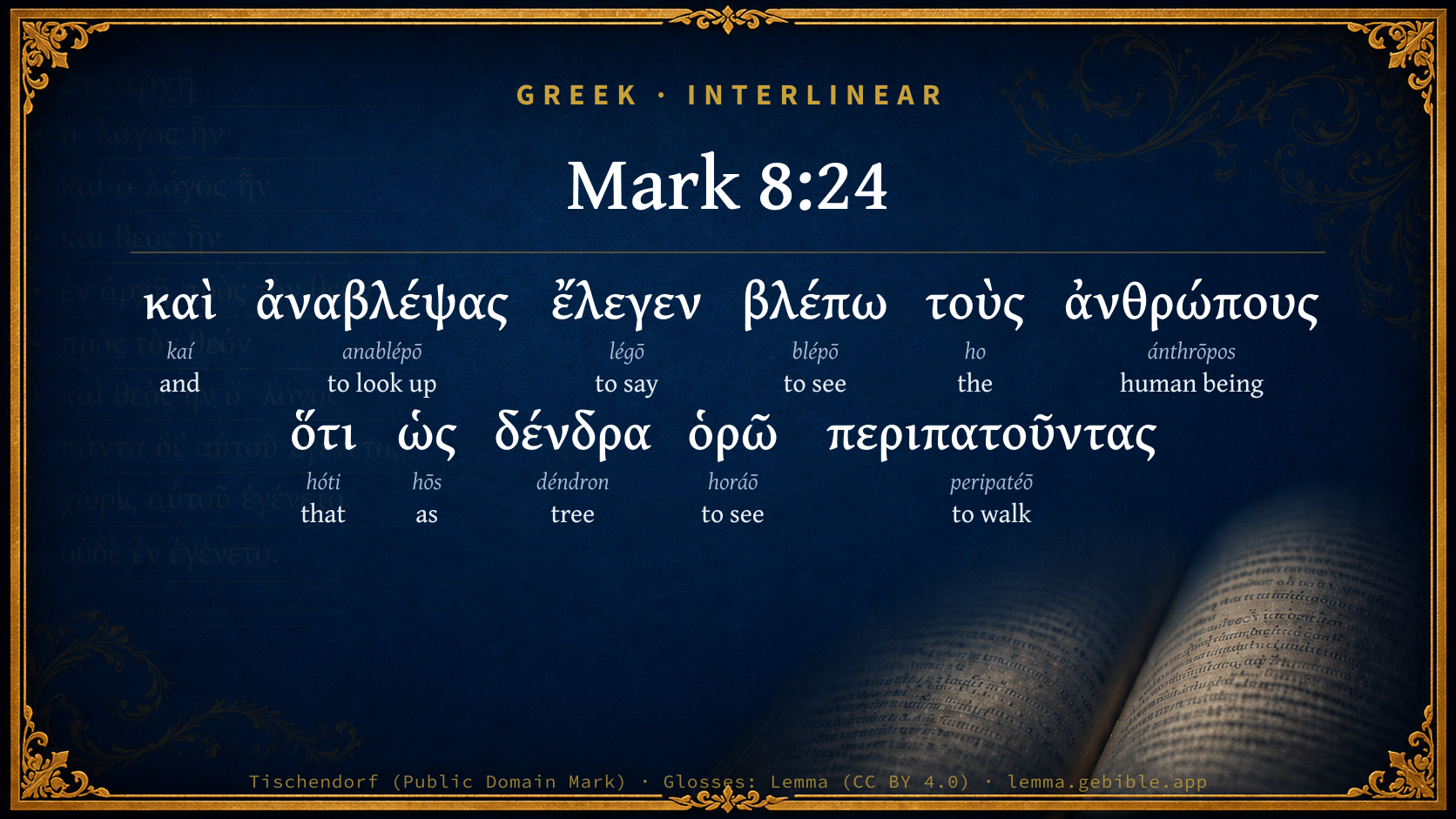
Greek (Tischendorf 8th ed.) Mark 8:24 appears in the Greek New Testament. The text above is from the Tischendorf 8th edition. Each word links to its Strong’s number and a concise gloss. Click any word for its full Thayer’s Greek Lexicon entry.
Download image
Cite this verse

Mark 8:24 (World English Bible). Public Domain. Lemma interlinear Bible study tool, https://lemma.gebible.app/v/mark/8/24.

Show BibTeX & RIS
BibTeX
RIS
English Translation
He looked up, and said, "I see men; for I see them like trees walking."
World English Bible · Public Domain
Download a study sheet

One document with this verse’s original text, its word-by-word gloss line, the meaning frame, cross-references with their text, attributed commentary, and full source and license credits — printable, and it pastes into notes with its structure intact.

This verse Autodidact and up

Study sheet (.html) Plain text (.txt)

A passage Seminary Student

Up to 50 verses in one chapter. A passage sheet keeps up to 6 commentary sources and 12 cross-references per verse, in the order this page ranks them, and says so on the sheet whenever that leaves anything out. Ask for a single verse and you get the Autodidact verse sheet above.

Everything on this page stays free to read, with no account — the sheet is a download of what is already on screen, not access to it.

Want to remove ads? Support Godless Engineer
Compare translations 3

The same verse in 3 English versions, stacked beneath the original-language interlinear above. Click any original word for its lexicon entry.

Each is an independent rendering of the whole verse — the interlinear is not word-aligned to these translations.

Highlighted words mark where these versions differ — a whole-verse word diff, not a word-by-word alignment.

  • World English Bible Public Domain
    He looked up, and said, "I see men; for I see them like trees walking."
  • King James Version Public Domain
    And he looked up, and said, I see men as trees, walking.
  • unfoldingWord Literal Text CC BY-SA 4.0
    And having looked up, he was saying, “I see men, for I see like trees walking.”

unfoldingWord Literal Text — © unfoldingWord, licensed CC BY-SA 4.0. Word-aligned USFM3 via Door43 (git.door43.org/unfoldingWord/en_ult).

Versions to compare (up to 4)

3 of 4 selected

Show all 19 translations

Every available English version of this verse, each an independent rendering of the whole verse.

  • World English Bible Public Domain
    He looked up, and said, "I see men; for I see them like trees walking."
  • Berean Standard Bible Public Domain
    The man looked up and said, “I can see the people, but they look like trees walking around.”
  • Majority Standard Bible Public Domain
    The man looked up and said, “I can see the people, but they look like trees walking around.”
  • King James Version Public Domain
    And he looked up, and said, I see men as trees, walking.
  • American Standard Version (1901) Public Domain
    And he looked up, and said, I see men; for I behold `them' as trees, walking.
  • Revised Version (1885) Public Domain
    And he looked up, and said, I see men; for I behold them as trees, walking.
  • Geneva Bible (1599) Public Domain
    And he looked vp, and said, I see men: for I see them walking like trees.
  • Douay-Rheims (1899) Public Domain
    And looking up, he said: I see men as it were trees, walking.
  • Young's Literal Translation Public Domain
    and he, having looked up, said, `I behold men, as I see trees, walking.'
  • Literal Standard Version CC BY-SA 4.0
    and he, having looked up, said, “I behold men, as I see trees, walking.”
  • Unlocked Literal Bible CC BY-SA 4.0
    He looked up, and said, “I see men who look like walking trees.”
  • unfoldingWord Literal Text CC BY-SA 4.0
    And having looked up, he was saying, “I see men, for I see like trees walking.”
  • Darby Bible Public Domain
    And having looked up, he said, I behold men, for I see [them], as trees, walking.
  • World Messianic Bible Public Domain
    He looked up, and said, “I see men, but I see them like walking trees.”
  • Webster's Bible Public Domain
    And he looked up, and said, I see men as trees walking.
  • Free Bible Version CC BY-SA 4.0
    The man looked around, and said, “I can see people, but they look like trees walking.”
  • Bible in Basic English Public Domain
    And looking up, he said, I see men; I see them like trees, walking.
  • Text-Critical English NT CC BY 4.0
    The man looked up and said, “I can see people, but they look like trees walking around.”
  • Tyndale New Testament (1534) Public Domain
    And he loked vp and sayde: I se the men: For I se the walke as they were trees.

Literal Standard Version (2020), Covenant Press — licensed CC BY-SA 4.0. Text via the HelloAO Bible API (eBible.org). Unlocked Literal Bible (unfoldingWord) — licensed CC BY-SA 4.0. Text via the HelloAO Bible API (eBible.org). unfoldingWord Literal Text — © unfoldingWord, licensed CC BY-SA 4.0. Word-aligned USFM3 via Door43 (git.door43.org/unfoldingWord/en_ult). Free Bible Version, Dr. Jonathan Gallagher — licensed CC BY-SA 4.0. Text via the HelloAO Bible API (eBible.org).

Word by word

More ways to search: Search by grammar → Find every occurrence → Compare this word →

Practice this passage: Drill this verse → Learn its vocabulary →

About this verse

These counts appear in no published source. They are computed here, from the morphology-tagged text and Lemma’s own curated glosses. What Lemma adds →

11
words
11
distinct lemmas
Gospels
section

Notable vocabulary

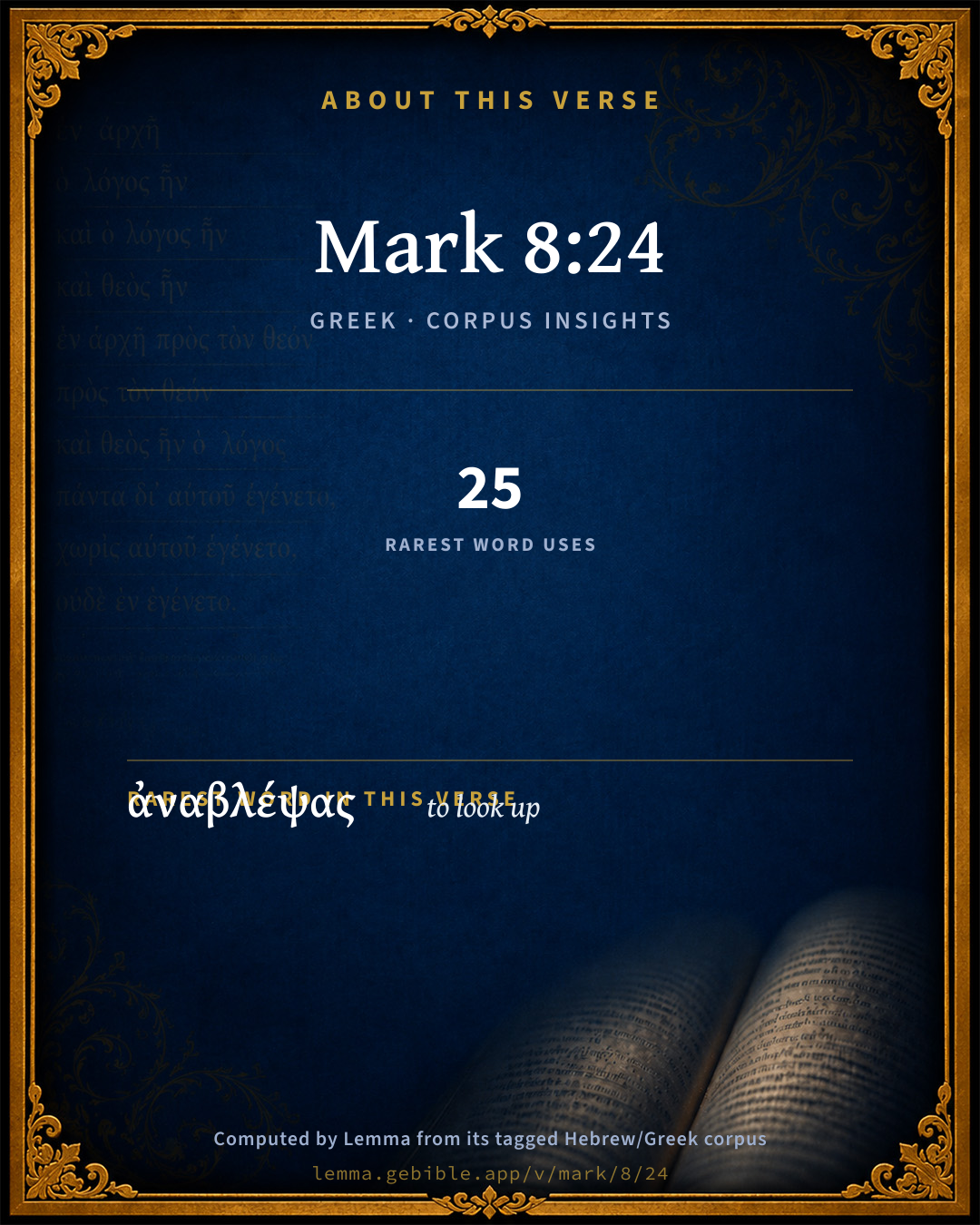
The rarest word here is ἀναβλέψας to look up G308 — appearing just 25 times in the whole Greek New Testament.

Shared distinctive vocabulary

ἀναβλέψας to look up G308 occurs in 23 verses of the Greek New Testament. Also found in:

Cross-references

4

Topical passages linked to Mark 8:24 in the Treasury of Scripture Knowledge — connected by theme and wording, ordered by reader-vote popularity; previews shown in the World English Bible.

  • Isaiah 29:18 In that day shall the deaf hear the words of the book, and the eyes of the blind shall see out of obscurity and out of darkness.
  • Isaiah 32:3 The eyes of those who see shall not be dim, and the ears of those who hear shall listen.
  • 1 Corinthians 13:9–12 For we know in part, and we prophesy in part;
  • Judges 9:36 When Gaal saw the people, he said to Zebul, Behold, there come people down from the tops of the mountains. Zebul said to him, You see the shadow of the mountains as if they were men.

Cross-references courtesy of OpenBible.info (CC BY 4.0).

Commentary

Notes on Mark 8:24 from classic Christian and Jewish commentators (each source and its license shown beneath its notes). The classic Christian expositions comment on the surrounding passage and are grouped to its opening verse, so a note may address several verses; the Jewish commentaries on the Tanakh (Rashi and others) are per-verse, so they appear only where the commentator wrote on this verse.

Lemma curates 59 commentaries, every one of them public domain or Creative Commons licensed, each selected and text-cleaned for this edition rather than reprinted as found. About our sources →

Tyndale Open Study Notes

Tyndale Open Resources

8:24-25 The healing was not instantaneous—the man saw imperfectly at first. Jesus’ second laying on of hands brought complete healing. Who is this man who stills the sea and heals the blind? Peter reveals this in the next account—he is the Messiah (8:29).

Tyndale Open Study Notes — © Tyndale Open Resources, licensed CC BY-SA 4.0. Text via the HelloAO Bible API.

Bengel's Gnomon

Johann Albrecht Bengel

Mar 8:24. Ὡς δένδρα, περιπατοῦντας,[1] as trees, walking) The blind man says, that it is by this alone [their walking] that he knows they are men, not trees, viz. because they walk.

[1] The fuller reading, ὅτι ὡς δένδρα ὁρῶ περιπατοῦντας, was preferred by the margin of the Ed. Maj., but the Ed. 2 and Vers. Germ. agree with the Gnomon.—E. B. ABC corrected later GLXΔ, have ὅτι and ὁρῶ. But Dabc omit both. Vulg., “homines velut arbores.” The Elzevir Rec. Text omit both.—ED. and TRANSL.

Bengel's Gnomon of the New Testament — English translation (T&T Clark, Edinburgh, 1860) — public domain. Text from a community e-Sword module.

Expositor's Greek Testament

ed. W. Robertson Nicoll

Mar 8:24 . ἀναβλέψας : the narrative contains three compounds of βλέπω ( ἀνὰ , διὰ , ἐν ); the first denotes looking up in the tentative manner of blind men, the second looking through (a mist as it were) so as to see clearly, the third looking into so as to see distinctly, as one sees the exact outlines of a near object ( cf. Mar 14:67 ). ὡς δένδρα , as trees, so indistinct was vision as yet; yet not trees, but men because moving (“non arbores, quia ambulent,” Bengel). He knew what a man is like, therefore he had once seen, not born blind.

The Expositor's Greek Testament, edited by W. Robertson Nicoll (1897–1910) — public domain. Text from a community e-Sword module.

Geneva Bible (1599)

Geneva Bible translators

He perceived some moving of men, when he could not discern their bodies.

Geneva Bible (1599) marginal notes — public domain. Text via Bolls.life.

Adam Clarke's Commentary

Verse 24. I see men as trees, walking.] His sight was so imperfect that he could not distinguish between men and trees, only by the motion of the former.

Adam Clarke's Commentary on the Bible (1810–1826) — public domain. Text from a community e-Sword/MySword module.

Ellicott's Commentary for English Readers

(24) I see men as trees, walking.—The better MSS. give two words expressing different forms of perception, “I behold men, for I see them walking as trees.” His sight was not yet clear, but he interpreted what it told him rightly. The naturalness of this description of the first impression of the restored sense strikes every reader. From the point of view which looks on our Lord’s miracles as having a symbolic character, and being, as it were, acted parables, we may see in it that which represents an analogous stage in the spiritual growth of men, when truths for which before they had no faculty of vision are seen for the first time, but are not as yet apprehended in their full or definite proportions. They need a second touch of the Divine Hand, the passing away of another film of ignorance or prejudice, and then they too see all things clearly.

A Bible Commentary for English Readers, edited by Charles John Ellicott (1878–1897) — public domain. Text from a community e-Sword module.

The Cambridge Bible for Schools and Colleges

gen. ed. J. J. S. Perowne

24. as trees, walking] He had not been born blind. He remembered the appearance of natural objects, and in the haze of his brightening vision he saw certain moving forms about him, “trees he should have accounted them from their height, but men from their motion.”

The Cambridge Bible for Schools and Colleges (gen. ed. J. J. S. Perowne; Cambridge University Press, 1878–1918) — public domain. Text from a community e-Sword module.

John Gill's Exposition

And he looked up,.... This is omitted in the Arabic and Persic versions. The sense is, that he opened his eyelids, and lifted up his eyes, to try if he could see, and he could, and did see again; his sight was returned again, though very imperfectly as yet:

and said, I see men, as trees, walking: he saw some objects at a little distance from him, which, by their motion, he supposed to be men; otherwise his sight was so imperfect, that he could not have distinguished them from trees: he was capable of discerning the bulk of their bodies, and that they walked, or moved forward; but he could not distinguish the particular parts of their bodies; they seemed to be like trunks of trees, in an erect posture, and which he should have took for such, had it not been for their walking. As this man immediately, upon Christ's putting spittle on his eyes, and laying his hands on him, had sight given him, though it was very obscure and glimmering; so, as soon as ever the Gospel comes with power, it dispels the darkness of the mind, and introduces light; though at first it is but very small; it is let in gradually: the sinner is first convinced of the evil of his actions, and then of the sinfulness of his nature; he first sees the ability and suitableness of Christ as a Saviour, and after that his willingness, and his interest in him as such; and all this is commonly before he is so well acquainted with the dignity and infiniteness of his person, as the Son of God: and it is some time before he has his spiritual senses exercised to discern between good and evil, between truth and error; or arrives to a clear and distinct knowledge of Gospel truths, and a stability in them. Hence it is, that such are greatly harassed with Satan's temptations; are disquieted in their souls; are filled with doubts and fears, and are in danger of being imposed upon by false teachers.

John Gill's Exposition of the Whole Bible (1746–1763) — public domain (CC PDM 1.0). Text via the HelloAO Bible API.

Trapp's Complete Commentary

John Trapp

24 And he looked up, and said, I see men as trees, walking.

Ver. 24. I see men as trees, walking] This was done, saith an expositor, to the end that Christ’s power might be the more distinctly known; as also to instruct men in their degrees and progresses of spiritual illumination, to give God the glory wholly, both for the beginning and for the accomplishment. He is author and finisher of our faith, Heb 12:2.

John Trapp, A Commentary or Exposition upon All the Books of the Old and New Testament (1647–1656) — public domain. Text from a community e-Sword module.

Albert Barnes' Notes on the Bible

I see men, as trees, walking - I see men walking, but see them so indistinctly that, but for their “motion,” I could not distinguish them from trees. I cannot distinctly see their shapes and features. Probably our Lord did not “at once” restore him fully to sight, that he might strengthen his faith. Seeing that Jesus had partially restored him, it was evidence that he could “wholly,” and it led him to exercise faith anew in him, and to feel more strikingly his dependence on him.

Albert Barnes' Notes on the Bible (1834–1885) — public domain. Text from a community e-Sword/MySword module.

Haydock's Catholic Bible Commentary

Man[1] as trees walking. In the Latin text, walking may agree either with men, or with trees, but the Greek shews that walking must be referred to men. Perhaps Christ restored sight in this manner to the man by degrees, to make him more sensible of the benefit; or to teach us how difficult is a sinner’s conversion; of which this was a figure. (Witham)

===============================

[BIBLIOGRAPHY]

Video homines velut arbores ambulantes, Greek: Blepo taus anthropous os dendra peripatountas.

====================

George Leo Haydock (1774–1849), Haydock's Catholic Family Bible and Commentary, 1859 edition — public domain. Excludes Psalms (Douay-Rheims chapter numbering differs from Protestant) and Deuterocanonical books (Catholic canon only).

Whedon's Commentary on the Bible

Daniel D. Whedon

24. Men as trees, walking — Had the man been born blind he would not have recognized either men or trees as such. One who has received his sight for the first time would not know a circle from a square, or identify any visible form as being what he had heretofore known.

Daniel D. Whedon (gen. ed.), Commentary on the Old and New Testaments (1874–1909) — public domain. Text from a community e-Sword module.

The Pulpit Commentary

And he looked up, and said, I see men as trees, walking. He looked ups natural action. He instinctively looked in the direction of the source of light. The words in the Greek of the next clause are as follows: blepw toupouv oti wv dendra orw peripatountav : I see men; for I behold them as trees, walking; that is, "I see something confusedly and obscurely, not clearly; for I see what I think must be men, and yet so dimly that they look to me like trees, only that I know that men move from their places, whereas trees do not." The word "walking" refers to the men, and not to the trees, as is evident from the Greek. This man, as yet partially blind, saw men as in shadow, magnified by the mist, looking much larger than they really were.

The Pulpit Commentary (1880–1919), ed. H.D.M. Spence-Jones & Joseph S. Exell — public domain. Text from a community e-Sword module.

John Wesley's Explanatory Notes

I see men as trees walking - He distinguished men from trees only by their motion.

John Wesley, Explanatory Notes Upon the Whole Bible (1754–1765) — public domain. Text via the GEBible commentary corpus.

The People's New Testament

B. W. Johnson

24. I see men; for I behold them as trees, walking. Certain moving forms about him, but without the power of discerning their shape or magnitude; trees he should have accounted them from their height, but men from their motion.

B. W. Johnson's The People's New Testament with Notes (1889–1891) — public domain. Electronic text from the Christian Classics Ethereal Library (CCEL) ThML edition.

unfoldingWord translationNotes

Door43 World Missions Community

He looked up

"The man looked up"

I see men who look like walking trees

The man sees men walking around, yet they are not clear to him, so he compares them to trees. AT: "Yes, I see people! They are walking around, but I cannot see them clearly. They look like trees" (See: Simile)

Then he again

"Then Jesus again"

and the man opened his eyes, his sight was restored

The phrase "his sight was restored" can be written in active form. AT: "restoring the man's sight, and then the man opened his eyes" (See: Active or Passive)

translationWords

like

restore

unfoldingWord translationNotes — © Distant Shores Media and the Door43 World Missions Community, licensed CC BY-SA 4.0. Source: git.door43.org/Door43/en_tn.

Cambridge Greek Testament for Schools and Colleges

24. ὅτι ὡς δένδρα ὁρῶ περιπατοῦντας ([1689][1690][1691][1692][1693][1694][1695][1696][1697]) rather than ὡς δεν. περιπ. ([1698]2[1699] Versions).

[1689] Codex Sinaiticus. 4th cent. Discovered by Tischendorf in 1859 at the Monastery of St Katharine on Mount Sinai. Now at St Petersburg. The whole Gospel, ending at Mar 16:8. Photographic facsimile, 1911.

[1690] Codex Alexandrinus. 5th cent. Brought by Cyril Lucar, Patriarch of Constantinople, from Alexandria, and afterwards presented by him to King Charles I. in 1628. In the British Museum. The whole Gospel. Photographic facsimile, 1879.

[1691] Codex Vaticanus. 4th cent., but perhaps a little later than א. In the Vatican Library almost since its foundation by Pope Nicolas V., and one of its greatest treasures. The whole Gospel, ending at Mar 16:8. Photographic facsimile, 1889.

[1692] Codex Ephraemi. 5th cent. A palimpsest: the original writing has been partially rubbed out, and the works of Ephraem the Syrian have been written over it; but a great deal of the original writing has been recovered; of Mark we have Mar 1:17 to Mar 6:31, Mar 8:5 to Mar 12:29, Mar 13:19 to Mar 16:20. In the National Library at Paris.

[1693] An asterisk denotes that the word is not found elsewhere in N.T., and such words are included in the index, even if there is no note on them in the commentary.

[1694] Codex Regius. 8th cent. An important witness. At Paris. Contains Mar 1:1 to Mar 10:15; Mar 10:30 to Mar 15:1; Mar 15:20 to Mar 16:20, but the shorter ending is inserted between Mar 16:8 and Mar 16:9, showing that the scribe preferred it to the longer one.

[1695] Codex Oxoniensis. 9th cent. Contains Mark, except Mar 3:35 to Mar 6:20.

[1696] Codex Sangallensis. 9th or 10th cent. Contains the Gospels nearly complete, with an interlinear Latin translation. The text of Mark is specially good, agreeing often with CL. At St Gall.

[1697] Codex Petropolitanus. 9th cent. Gospels almost complete. Mar 16:18-20 is in a later hand.

[1698] Codex Ephraemi. 5th cent. A palimpsest: the original writing has been partially rubbed out, and the works of Ephraem the Syrian have been written over it; but a great deal of the original writing has been recovered; of Mark we have Mar 1:17 to Mar 6:31, Mar 8:5 to Mar 12:29, Mar 13:19 to Mar 16:20. In the National Library at Paris.

[1699] Codex Bezae. 6th cent. Has a Latin translation (d) side by side with the Greek text, and the two do not quite always agree. Presented by Beza to the University Library of Cambridge in 1581. Remarkable for its frequent divergences from other texts. Contains Mark, except Mar 16:15-20, which has been added by a later hand. Photographic facsimile, 1899.

24. ἀναβλέψας. The man looked up in order to answer the question; the attempt to stretch forth the withered hand is similar (Mar 3:5). The context nearly always shows whether ἀναβλέπω means “look up” (Mar 6:41, Mar 7:34, Mar 16:4) or “recover sight” (Mar 10:51-52). Here and Joh 9:11 either meaning is possible. Cf. ἀνάγειν, ἀνακαλεῖν.

ἔλεγεν. Conversational.

Βλέπω τοὺς ἀνθρώπους ὅτι. See crit. note. I see the men, for I perceive people as trees walking. His sight is imperfect; he knows that what he sees are men, because they walk, but to him they look like trees. The change from βλέπω to ὁρῶ should be marked as in Mar 4:12.

Cambridge Greek Testament for Schools and Colleges (Cambridge University Press, 1896; 21 vols, various authors incl. Carr, Maclear, Plummer, Farrar, Lumby, Moule, M. R. James, Simcox) — public domain. Text from a community e-Sword module.

Alford’s Greek Testament

Henry Alford

24.] I see men, because I see them walking as it were trees; i.e. not distinct in individual peculiarity, but as trees in the hedge-row flit by the traveller. It is a minute mark of truth, that he describes the appearance of persons as he doubtless had often had occasion to do during the failing of sight which had ended in his blindness. By no possibility can the words convey, as Wordsw., three different stages of returning vision: “I see men. I see them standing still, and dimly, as trees. I see them walking.” For thus the ὅτι is altogether passed over, and περιπατοῦντας taken out of its government, and most unnaturally made into a sentence by itself.

Henry Alford, The Greek Testament (1849–1861) — public domain. Text from a community e-Sword module.

International Critical Commentary

24. βλέπω τοὺς ἀνθρώπους ὅτι, etc.—The AV., I see men as trees walking, ignores this ὅτι. RV., I see men; for I see them as trees walking. That is, what would otherwise be taken by him for trees he knows to be men by their walking around. This indistinctness of vision is due not to the confusion of his ideas arising from his previous blindness, but to the incompleteness of his cure. This is the single case of a gradual cure in our Lord’s life, and the narrative gives us no clue to the meaning of it. But we have no right to argue from this single case that gradualness was the ordinary method of Jesus’ cures.2

International Critical Commentary — older volumes (1896–1929), various authors — public domain. Text from a community e-Sword module.

Vincent's Word Studies in the New Testament

Marvin R. Vincent

I see men as trees walking (following the reading, Blepw touv ajnqrwpouv wJv dendra peripatountav). The Rev. reads, following the amended text, I see men, for [οτι] I behold [ορω] them as trees, walking. He saw them dimly. They looked like trees, large and misshapen; but he knew they were men, for they were walking about.

Marvin R. Vincent, Word Studies in the New Testament (1887–1900) — public domain. Text from a community e-Sword/MySword module.

Lesson kit

Teaching starters — assembled from the data on this page, not authored interpretation. Every prompt links to the verse data it draws on. Edit before teaching.

Mark, in the Gospels, opens this verse with 11 words (11 distinct Greek lemmas). Its most distinctive word is anablépō (“to look up”). A historical commentator’s framing appears above. Read the whole chapter for the surrounding context.

Discussion questions

  1. What does “to look up” (anablépō) contribute to the verse as a whole?
  2. How does Matthew 11:5, which shares the word «to look up», read alongside this verse?
  3. The translations on this page render this verse differently — a whole-verse word diff, not a word-by-word alignment. What might account for the different wordings?
  4. Compare how Tyndale Open Study Notes and Bengel's Gnomon read this verse. Where do they agree or differ?

Things to notice

Reading settings

Reading text

Shown beneath each verse's original-language words.

Old Testament
Old Testament edition

Read the OT as the Masoretic Hebrew (MT) or the Greek Septuagint (LXX).

English shown for the Greek Septuagint (in the Hebrew ↔ Greek comparison).

Comparing translations? Open the Compare panel on any verse page to stack up to four side by side.