
Mark 9:8

Greek (Tischendorf 8th ed.) Mark 9:8 appears in the Greek New Testament. The text above is from the Tischendorf 8th edition. Each word links to its Strong’s number and a concise gloss. Click any word for its full Thayer’s Greek Lexicon entry.
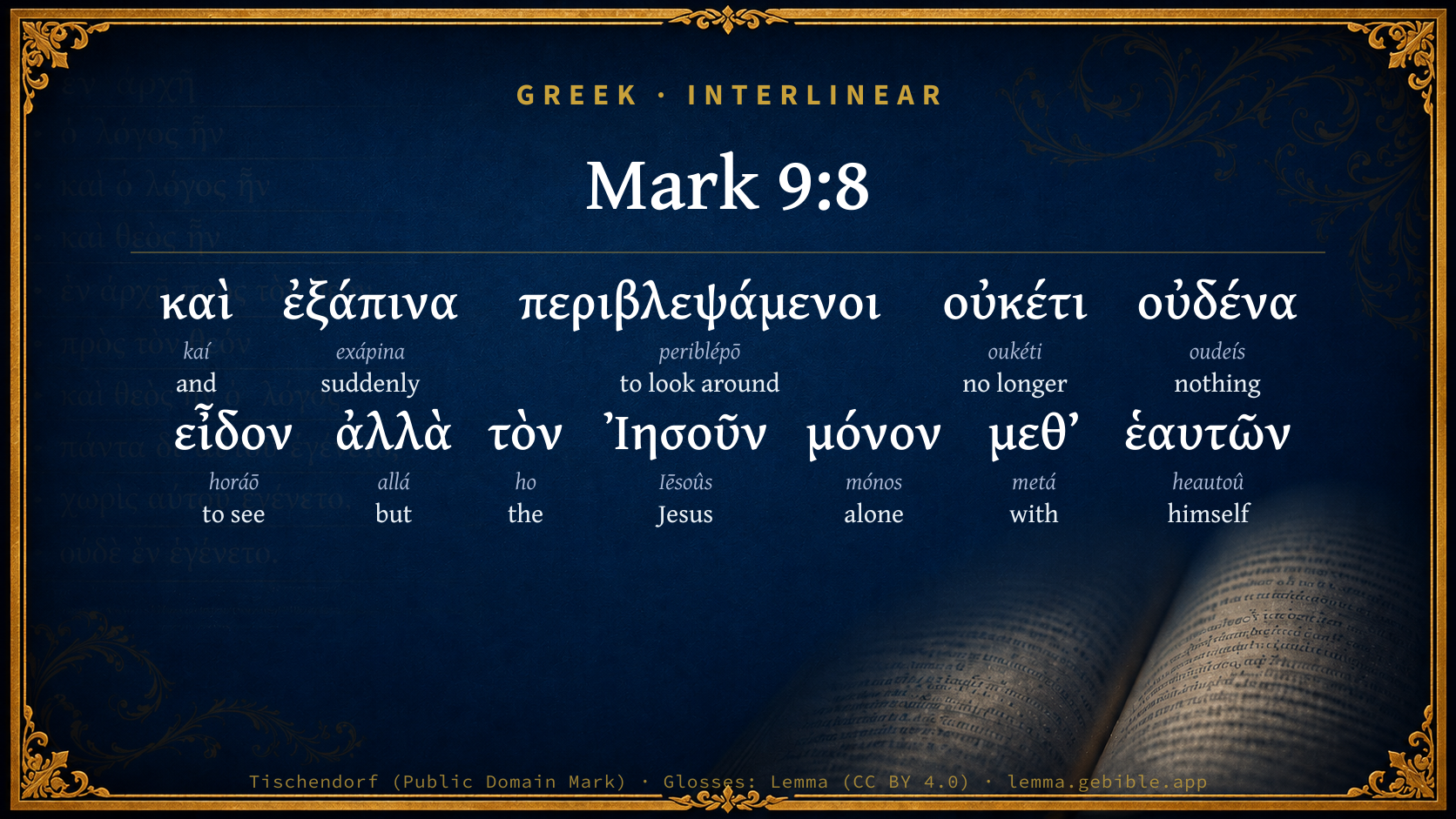
Download image
Cite this verse

Mark 9:8 (World English Bible). Public Domain. Lemma interlinear Bible study tool, https://lemma.gebible.app/v/mark/9/8.

Show BibTeX & RIS
BibTeX
RIS
English Translation
Suddenly looking around, they saw no one with them any more, except Jesus only.
World English Bible · Public Domain
Highlights
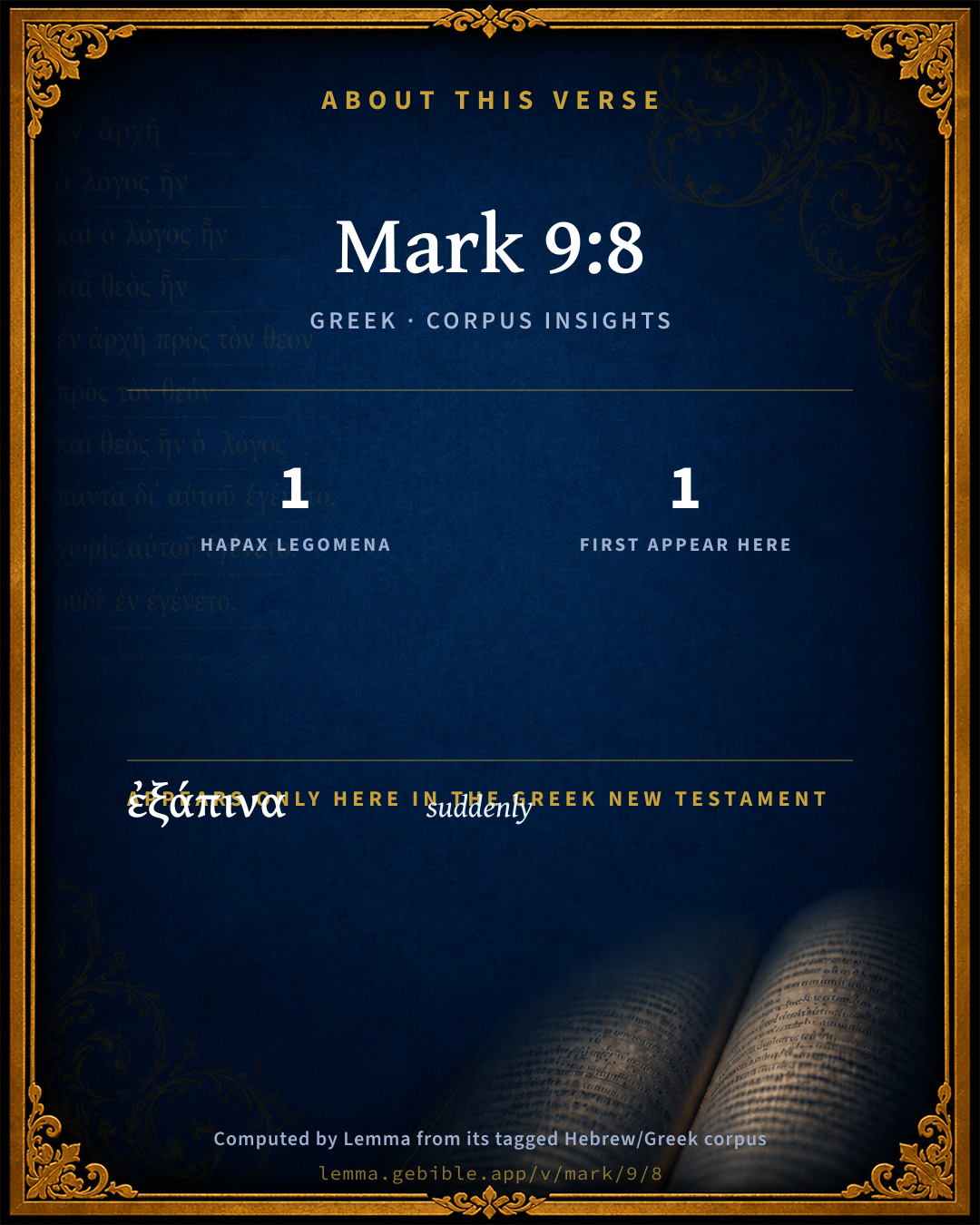
  • 1 hapax legomenon — only here in the Greek New Testament
  • 1 first appearance in the Greek New Testament
Full analysis ↓
Download a study sheet

One document with this verse’s original text, its word-by-word gloss line, the meaning frame, cross-references with their text, attributed commentary, and full source and license credits — printable, and it pastes into notes with its structure intact.

This verse Autodidact and up

Study sheet (.html) Plain text (.txt)

A passage Seminary Student

Up to 50 verses in one chapter. A passage sheet keeps up to 6 commentary sources and 12 cross-references per verse, in the order this page ranks them, and says so on the sheet whenever that leaves anything out. Ask for a single verse and you get the Autodidact verse sheet above.

Everything on this page stays free to read, with no account — the sheet is a download of what is already on screen, not access to it.

Want to remove ads? Support Godless Engineer
Compare translations 3

The same verse in 3 English versions, stacked beneath the original-language interlinear above. Click any original word for its lexicon entry.

Each is an independent rendering of the whole verse — the interlinear is not word-aligned to these translations.

Highlighted words mark where these versions differ — a whole-verse word diff, not a word-by-word alignment.

  • World English Bible Public Domain
    Suddenly looking around, they saw no one with them any more, except Jesus only.
  • King James Version Public Domain
    And suddenly, when they had looked round about, they saw no man any more, save Jesus only with themselves.
  • unfoldingWord Literal Text CC BY-SA 4.0
    And suddenly, having looked around, they no longer saw anyone with them, but only Jesus.

unfoldingWord Literal Text — © unfoldingWord, licensed CC BY-SA 4.0. Word-aligned USFM3 via Door43 (git.door43.org/unfoldingWord/en_ult).

Versions to compare (up to 4)

3 of 4 selected

Show all 19 translations

Every available English version of this verse, each an independent rendering of the whole verse.

  • World English Bible Public Domain
    Suddenly looking around, they saw no one with them any more, except Jesus only.
  • Berean Standard Bible Public Domain
    Suddenly, when they looked around, they saw no one with them except Jesus.
  • Majority Standard Bible Public Domain
    Suddenly, when they looked around, they saw no one with them except Jesus.
  • King James Version Public Domain
    And suddenly, when they had looked round about, they saw no man any more, save Jesus only with themselves.
  • American Standard Version (1901) Public Domain
    And suddenly looking round about, they saw no one any more, save Jesus only with themselves.
  • Revised Version (1885) Public Domain
    And suddenly looking round about, they saw no one any more, save Jesus only with themselves.
  • Geneva Bible (1599) Public Domain
    And suddenly they looked roud about, and sawe no more any man saue Iesus only with them.
  • Douay-Rheims (1899) Public Domain
    And as they came down from the mountain, he charged them not to tell any man what things they had seen, till the Son of man shall be risen again from the dead.
  • Young's Literal Translation Public Domain
    and suddenly, having looked around, they saw no one any more, but Jesus only with themselves.
  • Literal Standard Version CC BY-SA 4.0
    and suddenly, having looked around, they saw no one anymore, but Jesus only with themselves.
  • Unlocked Literal Bible CC BY-SA 4.0
    Suddenly, when they looked around, they no longer saw anyone with them, but only Jesus.
  • unfoldingWord Literal Text CC BY-SA 4.0
    And suddenly, having looked around, they no longer saw anyone with them, but only Jesus.
  • Darby Bible Public Domain
    And suddenly having looked around, they no longer saw any one, but Jesus alone with themselves.
  • World Messianic Bible Public Domain
    Suddenly looking around, they saw no one with them any more, except Yeshua only.
  • Webster's Bible Public Domain
    And suddenly, when they had looked around, they saw no man any more, save Jesus only with themselves.
  • Free Bible Version CC BY-SA 4.0
    Then, all of a sudden, as they were watching, there was nobody. Only Jesus was with them.
  • Bible in Basic English Public Domain
    And suddenly looking round about, they saw no one any longer, but Jesus only with themselves.
  • Text-Critical English NT CC BY 4.0
    And suddenly, when they looked around, they no longer saw anyone with them but Jesus.
  • Tyndale New Testament (1534) Public Domain
    And sodenly they loked rounde aboute them and sawe no man more then Iesus only with them.

Literal Standard Version (2020), Covenant Press — licensed CC BY-SA 4.0. Text via the HelloAO Bible API (eBible.org). Unlocked Literal Bible (unfoldingWord) — licensed CC BY-SA 4.0. Text via the HelloAO Bible API (eBible.org). unfoldingWord Literal Text — © unfoldingWord, licensed CC BY-SA 4.0. Word-aligned USFM3 via Door43 (git.door43.org/unfoldingWord/en_ult). Free Bible Version, Dr. Jonathan Gallagher — licensed CC BY-SA 4.0. Text via the HelloAO Bible API (eBible.org).

Word by word

More ways to search: Search by grammar → Find every occurrence → Compare this word →

Practice this passage: Drill this verse → Learn its vocabulary →

About this verse

These counts appear in no published source. They are computed here, from the morphology-tagged text and Lemma’s own curated glosses. What Lemma adds →

12
words
12
distinct lemmas
Gospels
section

Notable vocabulary

1 hapax legomenon — a word that appears only here in the entire Greek New Testament:

  • ἐξάπινα suddenly G1819

First appearance in Scripture

This word makes its first canonical appearance in the Greek New Testament here:

  • ἐξάπινα suddenly G1819

Shared distinctive vocabulary

περιβλεψάμενοι to look around G4017 occurs in 7 verses of the Greek New Testament. Also found in:
Cross-references

4

Topical passages linked to Mark 9:8 in the Treasury of Scripture Knowledge — connected by theme and wording, ordered by reader-vote popularity; previews shown in the World English Bible.

  • Luke 24:31 Their eyes were opened, and they recognized him, and he vanished out of their sight.
  • Acts 8:39–40 When they came up out of the water, the Spirit of the Lord caught Philip away, and the eunuch didn't see him any more, for he went on his way rejoicing.
  • Acts 10:16 This was done three times, and immediately the vessel was received up into heaven.
  • Luke 9:36 When the voice came, Jesus was found alone. They were silent, and told no one in those days any of the things which they had seen.

Cross-references courtesy of OpenBible.info (CC BY 4.0).

Commentary

Notes on Mark 9:8 from classic Christian and Jewish commentators (each source and its license shown beneath its notes). The classic Christian expositions comment on the surrounding passage and are grouped to its opening verse, so a note may address several verses; the Jewish commentaries on the Tanakh (Rashi and others) are per-verse, so they appear only where the commentator wrote on this verse.

Lemma curates 59 commentaries, every one of them public domain or Creative Commons licensed, each selected and text-cleaned for this edition rather than reprinted as found. About our sources →

The Biblical Illustrator

Joseph S. Exell

Mar_9:8

Save Jesus only.

Jesus only

I. When the workman is tempted to waste his employers substance, or the time which is his property, and says to himself, There is nobody to see; nobody will know, he would be checked if he remembered and realized that in absolute fact he owes his duty to no man, save to Jesus only, Jesus who for thirty years shared the workmans lot, and put dignity forever upon honest handiwork.

II. But not alone for this worlds business and behaviour, and temperament, is this thought true: in the matter of the souls salvation blessed are they who see no man save Jesus only.

1. There is danger for the young in letting their religion be based on mere love or regard for a minister or a religious friend.

2. Others there are who allow their religion to be unduly influenced by particular places and circumstances.

3. In the days when we feel burdened with a sense of our sin, may we then look to no man, save to Jesus only.

4. In the hour of death you will have the one Friend to go with you, when all others must leave you. (Canon Erskine Clarke.)

Jesus only in death

When Bishop Beveredge was on his death bed, his memory so failed that he did not know even his nearest relative. His chaplain said, Do you know me? Who are you? was the answer. His own wife asked him, Do you know me? Who are you? was the only answer. On being told that it was his wife he said that he did not know her. Then one standing by said, Do you know Jesus Christ? Jesus Christ, he replied, reviving as if the name acted on him like a cordial, yes, I have known Him these forty years: He is my only hope. Brethren, when our time cometh to depart to the place of peace, may we in like manner see no man, save Jesus only. But if the presence of Jesus is to abide with us when flesh and heart and mind are failing, it must be cherished in the days of health and strength and vigour.

None missed if Jesus be present

Love brings to the Saviour a flaming heart; obedience comes on willing feet; patience bows down to receive its load: while faith stretches out an empty hand, to be filled with His free gifts. A faithful Sunday school teacher lay dying. The light of heaven was in his eye, and seraphic smiles played upon his thin lids, as he thought of his mighty Redeemer. Just before he sank away, he turned to his daughter, who was trying to anticipate his every wish by her loving care, and said, Bring-. More he could not say, for strength was too far gone. What shall I bring, dear father? asked the anxious child. Bring-. Dear, precious father, do tell me what to bring! The dying man rallied for a last effort, and feebly murmured-

Bring forth the royal diadem,

And crown Him Lord of all!

If, in the closing hour of life, the Saviour is as near to us, we cannot complain of the lack of other comforters. We shall be sure to awake at last to His likeness, and shall shine forth as the sun, in our Fathers kingdom. (J. H. Norton.)

Mans abiding Friend

Whoever and whatever vanishes, Jesus remains with His disciples.

I. Though physical health departs, He abides. When heart and flesh fail, He is present to succour and strengthen the soul, and to bear it to one of the many mansions He has prepared.

II. Though worldly possessions disappear, He remains. Secular wealth, rightly used, is an incalculable blessing; it not only serves to relieve from all worldly anxieties, and minister to bodily comfort and intellectual enjoyment, but also gives us power to help our fellowmen both temporally and spiritually. But how often do riches take wings and fly away! But Christ is the true riches: He is of more value than untold gold; and nothing can deprive us of Him.

III. Though dearest friends depart, He abides. Good men are constantly losing from their social sphere those who have charmed them with their presence, and inspired them with their talk. When listening to them either in the sanctuary, the club, or on the domestic hearth, they have felt it good to be there. But one by one they vanish; the time comes when the best is gone, and all is social desolation; and like the disciples, they look around, and see no man any more, save Jesus only, with themselves. He is the abiding Friend, and having Him we have all. (D. Thomas, D. D.)

Jesus only with themselves

I. It was a symbolical intimation that when He that is perfect and eternal had come, all that was imperfect and preparatory should vanish away. And that this latter was the character both of the Law and the Prophets is obvious. Moses had Christ constantly in view, and the entire scheme of Levitical worship which he was inspired to draw up, looked forward to Him. So, too, the prophets in various ways predicted an age of surpassing glory, which should culminate at the Messiahs coming.

II. Not only was all prophecy fulfilled in Christ, but the prophetic character also received its perfect development in Him. He not only announced, He was, the Word of God. The lesson of this mysterious scene was this: that Moses and Elias and Christ were three no longer, no more separated, but made one by God. Legislator and prophet both were summoned to the scene of the transfiguration, and both symbolically (by vanishing away, leaving Jesus only with the disciples) consigned their finished work into Christs hands, knowing that henceforth there was but one dispensation, one tabernacle, one gospel. (H. M. Luckock, D. D.)

The Biblical Illustrator, edited by Joseph S. Exell (c. 1880s–1900s) — public domain. Text from a community e-Sword module.

MacLaren's Expositions of Holy Scripture

Alexander MacLaren

Mark

THE TRANSFIGURATION

JESUS ONLY!

Mar 9:8.

The Transfiguration was the solemn inauguration of Jesus for His sufferings and death.

Moses, the founder, and Elijah, the restorer, of the Jewish polity, the great Lawgiver and the great Prophet, were present. The former had died and been mysteriously buried, the latter had been translated without ‘seeing death.’ So both are visitors from the unseen world, appearing to own that Jesus is the Lord of that dim land, and that there they draw their life from Him. The conversation is about Christ’s ‘decease,’ the wonderful event which was to constitute Him Lord of the living and of the dead. The divine voice of command, ‘Hear Him!’ gives the meaning of their disappearance. At that voice they depart and Jesus is left alone. The scene is typical of the ultimate issue of the world’s history. The King’s name only will at last be found inscribed on the pyramid. Typical, too, is it not, of a Christian’s blessed death? When the ‘cloud’ is past no man is seen any more but ‘Jesus only.’

I. The solitary Saviour.

The disciples are left alone with the divine Saviour.

1. He is alone in His nature. ‘Son of God.’

2. He is alone in the sinlessness of His manhood. ‘My Beloved Son!’

3. He is alone as God’s Voice to men. ‘Hear Him!’

The solitary Saviour, because sufficient. ‘Thou, O Christ, art all I want.’

Sufficient, too, for ever.

His life is eternal.

His love is eternal.

The power of His Cross Is eternal.

II. The vanishing witnesses.

1. The connection of the past with Christ. The authority of the two representatives of the Old Covenant was only {a} derived and subordinate; {b} prophetic; {c} transient.

2. The thought may be widened into that of the relation of all teachers and guides to Jesus Christ.

3. The two witness to the relation of the unseen world to Jesus Christ.

{a} Its inhabitants are undying.

{b} Are subject to the sway of Jesus.

{c} Are expectantly waiting a glorious future.

4. They witness to the central point of Christ’s work-’His decease.’ This great event is the key to the world’s history.

III. The waiting disciples.

1. What Christian life should be. Giving Him our sole trust and allegiance.

{a} Seeing Him in all things.

{b} Constant communion. ‘Abide in Me.’

{c} Using everything as helps to Him.

2. What Christian death may become.

Alexander MacLaren, Expositions of Holy Scripture (1904–1910) — public domain. Text from a community e-Sword module.

Tyndale Open Study Notes

Tyndale Open Resources

9:8 Only Jesus remained, not Moses or Elijah. Jesus was clearly superior to Elijah and Moses.

Tyndale Open Study Notes — © Tyndale Open Resources, licensed CC BY-SA 4.0. Text via the HelloAO Bible API.

Bengel's Gnomon

Johann Albrecht Bengel

Mar 9:8. Ἐξάπινα) This is an adverb often found in the LXX.—μεθʼ ἑαυτῶν, with themselves) because He was still about to suffer.

Bengel's Gnomon of the New Testament — English translation (T&T Clark, Edinburgh, 1860) — public domain. Text from a community e-Sword module.

Expositor's Greek Testament

ed. W. Robertson Nicoll

Mar 9:8 . ἐξάπινα , suddenly, a form belonging to late Greek = ἐξαπίνης = ἐξαίφνης : here only in N. T.; several times in Sept [72] Kypke cites examples from the Psalms of Solomon and Jamblichus. The word here qualifies not περιβλεψάμενοι , but the change in the state of things which they discovered ( εἶδον ) on looking around. οὐκέτι οὐδένα ἀλλὰ , etc.; no longer any one except ( ἀλλὰ = εἰ μὴ after a negative). τὸν Ἰησοῦν , etc.: Jesus alone with themselves: the whole celestial vision gone as quickly as it came.

[72]Septuagint.

The Expositor's Greek Testament, edited by W. Robertson Nicoll (1897–1910) — public domain. Text from a community e-Sword module.

The Cambridge Bible for Schools and Colleges

gen. ed. J. J. S. Perowne

8. when they had looked round about] At first (1) they fell prostrate on their faces (Mat_17:6; comp. Exo_3:6; 1Ki_19:13), then (2) recovering from the shock of the Voice from heaven (Mat_17:6; comp. Exo_20:19; Hab_3:2; Hab_3:16; Heb_12:19), they (3) suddenly gazed all around them, and saw no man, save Jesus only. “Hinc constat, hunc esse Filium, audiendum, non Mosen, non Eliam.” Bengel. “Quæ ex Verbo cœperunt, in Verbo desinunt.” S. Ambrose.

The Cambridge Bible for Schools and Colleges (gen. ed. J. J. S. Perowne; Cambridge University Press, 1878–1918) — public domain. Text from a community e-Sword module.

John Gill's Exposition

And suddenly, when they had looked round about,.... Upon hearing the voice, to see if they could observe any other object, by whom it was pronounced, and whether the same they had seen continued:

they saw no man any more; neither Moses, nor Elias, not at that time, nor ever after;

save Jesus only with themselves: the voice only regarded him, and being directed to them; See Gill on Mat 17:8.

John Gill's Exposition of the Whole Bible (1746–1763) — public domain (CC PDM 1.0). Text via the HelloAO Bible API.

Trapp's Complete Commentary

John Trapp

8 And suddenly, when they had looked round about, they saw no man any more, save Jesus only with themselves.

Ver. 8. {See Trapp on "Mat 17:8"}

John Trapp, A Commentary or Exposition upon All the Books of the Old and New Testament (1647–1656) — public domain. Text from a community e-Sword module.

The Pulpit Commentary

And suddenly looking round about, they saw no one any more, save Jesus only with themselves. St. Matthew here says, (Mat_17:6) "When the disciples heard it, they fell on their face, and were sere afraid. And Jesus came and touched them, and said, Arise, and be not afraid." St. Mark omits this; but in his characteristic manner states that which implies what St. Matthew has recorded. It was the "touch" of Jesus that caused them to look round about; and then in a moment they perceived that they were alone with Jesus, as they were before this manifestation began. The order of incidents in the Transfiguration appears to have been this: Our Lord is praying. The disciples, fatigued with the ascent of the mountain, are heavy with sleep; and Christ is transfigured. Then appear Moses and Elijah; and they are talking with Jesus about his exodus his decease to be accomplished at Jerusalem. The disciples mused from their sleep by the supernatural brightness, and by the conversation, and now, fully awake, behold the glory of Jesus, and Hoses and Elijah talking with him. As Moses and Elijah are preparing for their departure, Peter, excited, enchanted, bewildered, and yet grieved to see that they were going, seeks to detain them by the proposal to make some temporary resting-place for them. Then comes the bright overshadowing cloud, and a voice out of the cloud, "This is my beloved Son: hear ye him." At the sound of this voice the disciples fall terrified to the earth. But they are soon comforted by Christ, and, looking up, they see him alone with themselves.

"Jesus only.

The transition from the glory and the spiritual vision to the sober light of common day from the Christ uplifted in the radiance of heaven, and waited upon by the greatest spirits of ancient Hebrew religion, to the humiliated form of the man Jesus was a perilous one for ordinary mortals to pass through. But it was necessary. It is for faith to penetrate the spiritual significance of ordinary forms and appearances, and grasp the Divine. It is to faith, and faith alone, that God is manifest in the flesh.

I JESUS OUTLIVES HIS RECOMMENDATIONS. He is ever more, far more, than he appears to be. Some things and persons have nothing remaining when you strip the pretense and tinsel away. The radiance subsides into damp mist, and the glorious brightness proves but bottle-glass. It is this overmastering intrinsic worth and power of Jesus which explains his enduring influence. Eloquent advocacy has been engaged in his cause, great ideas have been associated with him, his claims have been attested by miraculous powers and signs, and ever and again the background of the Divine mystery from which he emerged has revealed itself, and a multitude of external proofs etc., are forthcoming when required; but he himself is greater than them all, and contains their latent possibilities within himself. When excitement, etc., are over, there still remains the power to elicit faith and constrain personal attachment. He himself is the ultimate verification of the faith of his disciples.

II NOT THE SIGN OR MARVEL, BUT CHRIST IT IS THAT SAVES. The former only provisional, the latter permanent. The familiar, continuing, sympathizing Christ. The crucified One; the risen again; and in spiritual presence the Dweller in the heart of faith. It is this Christ whose power is felt within, a vital energy and a moral impulse; an Interpreter of the mysteries of life and death.

III HE ALONE IS SUFFICIENT FOR OUR NEED. There is an unhealthy longing for dainties in things spiritual as in bodily satisfactions. His teaching, his example, his sympathy, his perfect sacrifice, are ours if we but believe. God his testified his approval and acceptance, and commends him to us. Our own experience will seal and confirm the prophecies and attestations of others: "Now we believe, not because of thy saying; for we have heard him ourselves; and know that this is indeed the Christ, the Savior of the world". M. (Joh_4:42)

The Pulpit Commentary (1880–1919), ed. H.D.M. Spence-Jones & Joseph S. Exell — public domain. Text from a community e-Sword module.

Kretzmann's Popular Commentary

Paul E. Kretzmann

The end of the transfiguration:

v. 8. And suddenly, when they had looked round about, they saw no man any more, save Jesus only with themselves.

v. 9. And as they came down from the mountain, He charged them that they should tell no man what things they had seen till the Son of Man were risen from the dead.

v. 10. And they kept that saying with themselves, questioning one with another what the rising from the dead should mean.

Just as quickly as the miraculous appearance had begun, it also ended. The disciples, still half dazed, felt that the pall was lifted, and, looking about them, saw no one but Jesus alone with them. Moses and Elijah had been returned to the place of eternal happiness in the same wonderful manner as they had been brought down to the mountain. Jesus, their Master, now was with them again in His usual form and dress, with no evidence of the glory which had just shone through Him. His reassuring words and touch brought them back fully to their senses. While they were then descending from the mountain together, He gave them the earnest charge to transmit the account of what they had seen to no one until after the resurrection of the Son of Man. The people had an altogether wrong idea as to the work and mission of the Messiah, and the news of this miraculous appearance would only have strengthened this false conception. But at that time, when His. death would have removed and disproved all wrong beliefs and hopes in an earthly Messiah, with an earthly kingdom, and especially after He would have risen from the dead, then this revelation should be part of their preaching, they should not hesitate about proclaiming the full truth about the transfiguration. The three disciples accepted this charge in the proper spirit of meekness and obedience; they kept their secret until the time that Jesus had indicated, even from the other disciples. In the meantime, however, they discussed the question among themselves, how that was to be understood concerning the rising from the dead. Not that they did not know that there would be a resurrection of the dead on the last day. This doctrine was known and believed by all the Jews, the only ones dissenting being the sect of the Sadducees. The difficulty for them lay in this, both when He should arise from the dead, as some manuscripts have it, and how this would be done. Christ’s one announcement concerning His Passion, death, and resurrection had not yet entered into their heart and understanding. What express and particular resurrection of the dead the Lord was referring to for Himself was a mystery to them. Thus earnest Christians will find many points in Scriptures and in the sayings of Jesus that are a mystery to them; they do not understand in what sense they are to be understood and applied in individual instances; but careful searching of the Word will open the eyes, under the guidance of the Spirit.

Paul E. Kretzmann, Popular Commentary of the Bible (1921–1924) — public domain. Text from a community e-Sword module.

Cambridge Greek Testament for Schools and Colleges

8. ἐξάπινα. To be taken with εἶδον. Here only in N.T., but not rare in LXX. Elsewhere we have ἐξαίφνης (ἐξέφνης, W.H.); Mar 13:36; Luk 2:13; Luk 9:39; Act 9:3. Sudden return to normal conditions. They expected to see some further marvel.

οὐκέτι οὐδένα. See on Mar 1:44; neither here nor there is there a double neg. in Mt.

Cambridge Greek Testament for Schools and Colleges (Cambridge University Press, 1896; 21 vols, various authors incl. Carr, Maclear, Plummer, Farrar, Lumby, Moule, M. R. James, Simcox) — public domain. Text from a community e-Sword module.

Alford’s Greek Testament

Henry Alford

8. οὐδένα] none of those who appeared, but (sondern, ‘nay, on the contrary’) Jesus alone.

Henry Alford, The Greek Testament (1849–1861) — public domain. Text from a community e-Sword module.

International Critical Commentary

8. ἐξάπινα—suddenly.3 The vision vanished suddenly, and things returned to their natural condition. There is a difference of opinion whether the adverb belongs with the participle or the verb. It can make little difference, since both denote parts of the same act, looking and seeing. But this very fact shows that the adv. belongs with the part., since to put it with the verb separates the two closely related parts of the same act. In accordance with this principle, we should say, suddenly they looked around and saw, not, they looked around and suddenly saw. And for the same reason, the Greek joins the adverb and the part. ἐξάπινα denotes the quick transition from the heavenly vision to ordinary conditions.

εἰ μὴ before τὸν Ἰησοῦν, instead of ἀλλὰ, WH. RV. א BDN 33, 61, Latt. Memph. ἀλλὰ is adversative, not meaning except, and irregular here, so that internal probability favors that reading.

ELIJAH AND THE SON OF MAN

International Critical Commentary — older volumes (1896–1929), various authors — public domain. Text from a community e-Sword module.

Vincent's Word Studies in the New Testament

Marvin R. Vincent

Suddenly [εξαπινα] . The Greek word only here in the New Testament.

Marvin R. Vincent, Word Studies in the New Testament (1887–1900) — public domain. Text from a community e-Sword/MySword module.

Lesson kit

Teaching starters — assembled from the data on this page, not authored interpretation. Every prompt links to the verse data it draws on. Edit before teaching.

Mark, in the Gospels, opens this verse with 12 words (12 distinct Greek lemmas). Its most distinctive word is exápina (“suddenly”). A historical commentator’s framing appears above. Read the whole chapter for the surrounding context.

Discussion questions

  1. The word exápina carries the sense “suddenly.” How does it shape the verse?
  2. This verse holds 1 word here found nowhere else in the Greek New Testament. What might the rare word draw attention to?
  3. The word “suddenly” first appears here in Scripture. What is being introduced at this debut?
  4. Mark 3:5 shares the word «to look around» with this verse. How do the two illuminate each other?
  5. These translations render this verse differently; the difference is in the English rendering, not the original. What questions does that raise?
  6. Reading how The Biblical Illustrator and MacLaren's Expositions of Holy Scripture read this verse, where do the two commentators agree and where do they part?

Things to notice

  • 1 word in this verse appears nowhere else in the Greek New Testament.
  • 1 word makes its first canonical appearance in Scripture here.
  • These translations choose different wording for 17 words in this verse.
  • 12 distinct Greek lemmas span 12 words in this verse.

Reading settings

Reading text

Shown beneath each verse's original-language words.

Old Testament
Old Testament edition

Read the OT as the Masoretic Hebrew (MT) or the Greek Septuagint (LXX).

English shown for the Greek Septuagint (in the Hebrew ↔ Greek comparison).

Comparing translations? Open the Compare panel on any verse page to stack up to four side by side.