
Matthew 26:51

Greek (Tischendorf 8th ed.) Matthew 26:51 appears in the Greek New Testament. The text above is from the Tischendorf 8th edition. Each word links to its Strong’s number and a concise gloss. Click any word for its full Thayer’s Greek Lexicon entry.
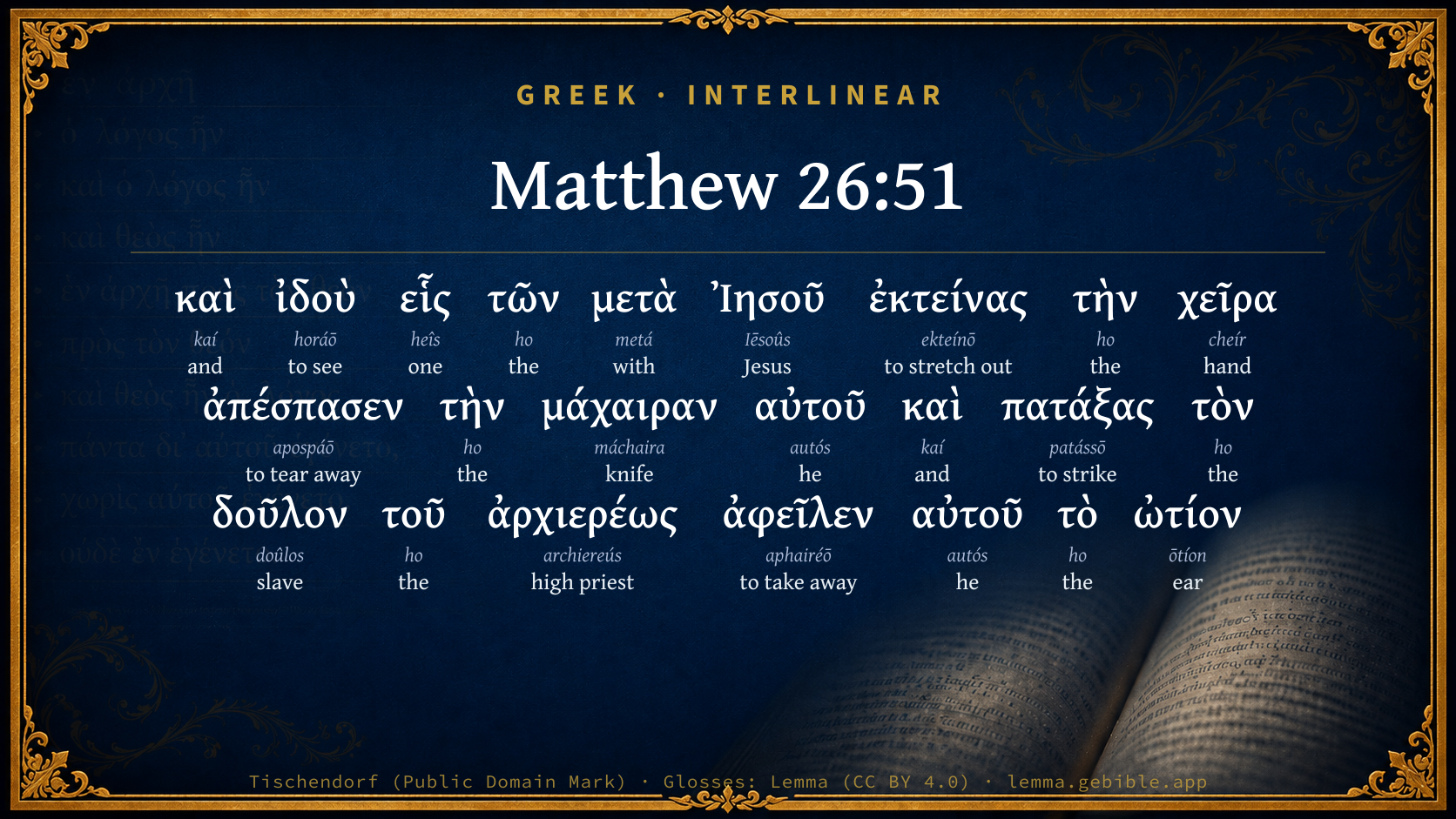
Download image
Cite this verse

Matthew 26:51 (World English Bible). Public Domain. Lemma interlinear Bible study tool, https://lemma.gebible.app/v/matthew/26/51.

Show BibTeX & RIS
BibTeX
RIS
English Translation
Behold, one of those who were with Jesus stretched out his hand, and drew his sword, and struck the servant of the high priest, and struck off his ear.
World English Bible · Public Domain
Highlights
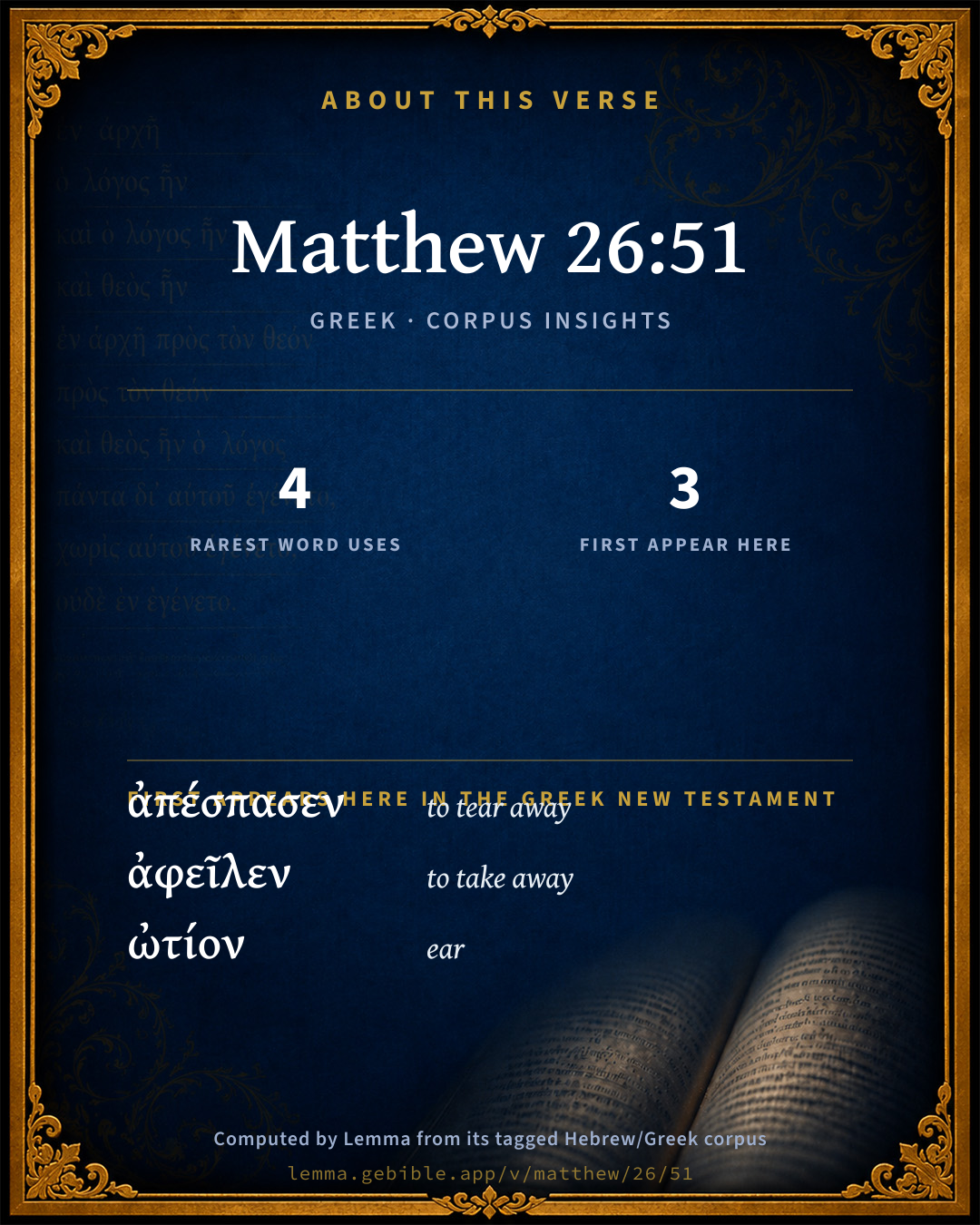
  • 3 first appearances in the Greek New Testament
Full analysis ↓
Download a study sheet

One document with this verse’s original text, its word-by-word gloss line, the meaning frame, cross-references with their text, attributed commentary, and full source and license credits — printable, and it pastes into notes with its structure intact.

This verse Autodidact and up

Study sheet (.html) Plain text (.txt)

A passage Seminary Student

Up to 50 verses in one chapter. A passage sheet keeps up to 6 commentary sources and 12 cross-references per verse, in the order this page ranks them, and says so on the sheet whenever that leaves anything out. Ask for a single verse and you get the Autodidact verse sheet above.

Everything on this page stays free to read, with no account — the sheet is a download of what is already on screen, not access to it.

Want to remove ads? Support Godless Engineer
Compare translations 3

The same verse in 3 English versions, stacked beneath the original-language interlinear above. Click any original word for its lexicon entry.

Each is an independent rendering of the whole verse — the interlinear is not word-aligned to these translations.

Highlighted words mark where these versions differ — a whole-verse word diff, not a word-by-word alignment.

  • World English Bible Public Domain
    Behold, one of those who were with Jesus stretched out his hand, and drew his sword, and struck the servant of the high priest, and struck off his ear.
  • King James Version Public Domain
    And, behold, one of them which were with Jesus stretched out his hand, and drew his sword, and struck a servant of the high priest's, and smote off his ear.
  • unfoldingWord Literal Text CC BY-SA 4.0
    And behold, one of the ones with Jesus, having stretched out his hand, drew his sword, and having struck the servant of the high priest, cut off his ear.

unfoldingWord Literal Text — © unfoldingWord, licensed CC BY-SA 4.0. Word-aligned USFM3 via Door43 (git.door43.org/unfoldingWord/en_ult).

Versions to compare (up to 4)

3 of 4 selected

Show all 19 translations

Every available English version of this verse, each an independent rendering of the whole verse.

  • World English Bible Public Domain
    Behold, one of those who were with Jesus stretched out his hand, and drew his sword, and struck the servant of the high priest, and struck off his ear.
  • Berean Standard Bible Public Domain
    At this, one of Jesus’ companions drew his sword and struck the servant of the high priest, cutting off his ear.
  • Majority Standard Bible Public Domain
    At this, one of Jesus’ companions drew his sword and struck the servant of the high priest, cutting off his ear.
  • King James Version Public Domain
    And, behold, one of them which were with Jesus stretched out his hand, and drew his sword, and struck a servant of the high priest's, and smote off his ear.
  • American Standard Version (1901) Public Domain
    And behold, one of them that were with Jesus stretched out his hand, and drew his sword, and smote the servant of the high priest, and struck off his ear.
  • Revised Version (1885) Public Domain
    And behold, one of them that were with Jesus stretched out his hand, and drew his sword, and smote the servant of the high priest, and struck off his ear.
  • Geneva Bible (1599) Public Domain
    And behold, one of them which were with Iesus, stretched out his hand, and drewe his sworde, and strooke a seruaunt of the high Priest, and smote off his eare.
  • Douay-Rheims (1899) Public Domain
    And behold one of them that were with Jesus, stretching forth his hand, drew out his sword: and striking the servant of the high priest, cut off his ear.
  • Young's Literal Translation Public Domain
    And lo, one of those with Jesus, having stretched forth the hand, drew his sword, and having struck the servant of the chief priest, he took off his ear.
  • Literal Standard Version CC BY-SA 4.0
    And behold, one of those with Jesus, having stretched forth the hand, drew his sword, and having struck the servant of the chief priest, he took off his ear.
  • Unlocked Literal Bible CC BY-SA 4.0
    Behold, one of those who was with Jesus stretched out his hand, drew his sword, and struck the servant of the high priest, and cut off his ear.
  • unfoldingWord Literal Text CC BY-SA 4.0
    And behold, one of the ones with Jesus, having stretched out his hand, drew his sword, and having struck the servant of the high priest, cut off his ear.
  • Darby Bible Public Domain
    And behold, one of those with Jesus stretched out his hand and drew his sword, and smiting the bondman of the high priest took off his ear.
  • World Messianic Bible Public Domain
    Behold, one of those who were with Yeshua stretched out his hand and drew his sword, and struck the servant of the high priest, and cut off his ear.
  • Webster's Bible Public Domain
    And behold, one of them, who were with Jesus, stretched out his hand, and drew his sword, and struck a servant of the high priest, and smote off his ear.
  • Free Bible Version CC BY-SA 4.0
    One of those who was with Jesus reached for his sword and pulled it out. He struck the high priest's servant, cutting off his ear.
  • Bible in Basic English Public Domain
    And one of those who were with Jesus put out his hand, and took out his sword and gave the servant of the high priest a blow, cutting off his ear.
  • Text-Critical English NT CC BY 4.0
    And behold, one of the men with Jesus stretched out his hand, drew his sword, and struck the servant of the high priest, cutting off his ear.
  • Tyndale New Testament (1534) Public Domain
    And beholde one of them which were with Iesus stretched oute his honde and drue his swearde and stroke a servaunt of the hye preste and smote of his eare.

Literal Standard Version (2020), Covenant Press — licensed CC BY-SA 4.0. Text via the HelloAO Bible API (eBible.org). Unlocked Literal Bible (unfoldingWord) — licensed CC BY-SA 4.0. Text via the HelloAO Bible API (eBible.org). unfoldingWord Literal Text — © unfoldingWord, licensed CC BY-SA 4.0. Word-aligned USFM3 via Door43 (git.door43.org/unfoldingWord/en_ult). Free Bible Version, Dr. Jonathan Gallagher — licensed CC BY-SA 4.0. Text via the HelloAO Bible API (eBible.org).

Word by word

More ways to search: Search by grammar → Find every occurrence → Compare this word →

Practice this passage: Drill this verse → Learn its vocabulary →

ἀπέσπασεν
apospáō
G645
“to tear away”
Verb, Aorist, Active, Indicative, 3rd person, Singular
Part of Speech
Verb
Tense
Aorist
Voice
Active
Mood
Indicative
Person
3rd person
Number
Singular
Full Thayer's Definition

Origin: from G575 and G4685

TDNT: None

1. to draw off, tear away
  1. καὶ kaí G2532 “and” Conjunction
  2. ἰδοὺ horáō G3708 “to see” Verb, Aorist, Middle, Imperative, 2nd person, Singular
  3. εἷς heîs G1520 “one” Adjective, Nominative, Singular, Masculine
  4. τῶν ho G3588 “the” Article, Genitive, Plural, Masculine
  5. μετὰ metá G3326 “with” Preposition
  6. Ἰησοῦ Iēsoûs G2424 “Jesus” Noun, Genitive, Singular, Masculine
  7. ἐκτείνας ekteínō G1614 “to stretch out” Verb, Aorist, Active, Participle, Nominative, Singular, Masculine
  8. τὴν ho G3588 “the” Article, Accusative, Singular, Feminine
  9. χεῖρα cheír G5495 “hand” Noun, Accusative, Singular, Feminine
  10. τὴν ho G3588 “the” Article, Accusative, Singular, Feminine
  11. μάχαιραν máchaira G3162 “knife” Noun, Accusative, Singular, Feminine
  12. αὐτοῦ autós G846 “he” Personal pronoun, Genitive, Singular, Masculine
  13. καὶ kaí G2532 “and” Conjunction
  14. πατάξας patássō G3960 “to strike” Verb, Aorist, Active, Participle, Nominative, Singular, Masculine
  15. τὸν ho G3588 “the” Article, Accusative, Singular, Masculine
  16. δοῦλον doûlos G1401 “slave” Noun, Accusative, Singular, Masculine
  17. τοῦ ho G3588 “the” Article, Genitive, Singular, Masculine
  18. ἀρχιερέως archiereús G749 “high priest” Noun, Genitive, Singular, Masculine
  19. ἀφεῖλεν aphairéō G851 “to take away” Verb, Aorist, Active, Indicative, 3rd person, Singular
  20. αὐτοῦ autós G846 “he” Personal pronoun, Genitive, Singular, Masculine
  21. τὸ ho G3588 “the” Article, Accusative, Singular, Neuter
  22. ὠτίον ōtíon G5621 “ear” Noun, Accusative, Singular, Neuter

About this verse

These counts appear in no published source. They are computed here, from the morphology-tagged text and Lemma’s own curated glosses. What Lemma adds →

23
words
16
distinct lemmas
Gospels
section

Notable vocabulary

The rarest word here is ἀπέσπασεν to tear away G645 — appearing just 4 times in the whole Greek New Testament.

First appearance in Scripture

These words make their first canonical appearance in the Greek New Testament here:

  • ἀπέσπασεν to tear away G645
  • ἀφεῖλεν to take away G851
  • ὠτίον ear G5621

Shared distinctive vocabulary

ἀπέσπασεν to tear away G645 occurs in 4 verses of the Greek New Testament. Also found in:
Repetition

Words recur within this verse:

  • τῶν the G3588 ×6
  • καὶ and G2532 ×2
  • αὐτοῦ he G846 ×2

Cross-references

8

Topical passages linked to Matthew 26:51 in the Treasury of Scripture Knowledge — connected by theme and wording, ordered by reader-vote popularity; previews shown in the World English Bible.

  • Mark 14:47 But a certain one of those who stood by drew his sword, and struck the servant of the high priest, and cut off his ear.
  • John 18:36 Jesus answered, "My Kingdom is not of this world. If my Kingdom were of this world, then my servants would fight, that I wouldn't be delivered to the Jews. But now my Kingdom is not from here."
  • 2 Corinthians 10:4 for the weapons of our warfare are not of the flesh, but mighty before God to the throwing down of strongholds,
  • Luke 22:49–51 When those who were around him saw what was about to happen, they said to him, "Lord, shall we strike with the sword?"
  • Matthew 26:35 Peter said to him, "Even if I must die with you, I will not deny you." All of the disciples also said likewise.
  • Luke 22:36–38 Then he said to them, "But now, whoever has a purse, let him take it, and likewise a wallet. Whoever has none, let him sell his cloak, and buy a sword.
  • John 18:10–11 Simon Peter therefore, having a sword, drew it, and struck the high priest's servant, and cut off his right ear. The servant's name was Malchus.
  • Luke 9:55 But he turned and rebuked them, "You don't know of what kind of spirit you are.

Cross-references courtesy of OpenBible.info (CC BY 4.0).

Commentary

Notes on Matthew 26:51 from classic Christian and Jewish commentators (each source and its license shown beneath its notes). The classic Christian expositions comment on the surrounding passage and are grouped to its opening verse, so a note may address several verses; the Jewish commentaries on the Tanakh (Rashi and others) are per-verse, so they appear only where the commentator wrote on this verse.

Lemma curates 59 commentaries, every one of them public domain or Creative Commons licensed, each selected and text-cleaned for this edition rather than reprinted as found. About our sources →

Tyndale Open Study Notes

Tyndale Open Resources

26:51 one of the men with Jesus: This was Peter (John 18:26).

Tyndale Open Study Notes — © Tyndale Open Resources, licensed CC BY-SA 4.0. Text via the HelloAO Bible API.

Bengel's Gnomon

Johann Albrecht Bengel

Mat 26:51. Εἷς, one) St Matthew does not mention Peter by name. He might have had more reasons than one for his silence. Danger might possibly threaten Peter from the unbelieving Jews.—τὸν δοῦλον, the slave) He perhaps acted more violently than the rest by his master’s desire.—τὸ ὠτίον, his ear) with a most dangerous stroke, He had aimed at the shoulder of the principal aggressor.

Bengel's Gnomon of the New Testament — English translation (T&T Clark, Edinburgh, 1860) — public domain. Text from a community e-Sword module.

Meyer's Critical & Exegetical Commentary

Heinrich August Wilhelm Meyer

Mat_26:51. It is strange that the Synoptists have not mentioned the name of Peter here (Joh_18:10, where the name of the high priests servant is also given). It may be that, with a view to prevent the apostle from getting into trouble with the authorities, his name was suppressed from the very first, and that, accordingly, the incident came to be incorporated in the primitive gospel traditions without any names being mentioned, it having been reserved for John ultimately to supply this omission.

αὐτοῦ τὸ ὠτίον] his ear (see on Mat_8:3). On ὠτίον, see Lobeck, ad Phryn. p. 211. He missed the head at which the stroke was aimed.

Meyer — Critical and Exegetical Commentary on the New Testament — English translation by Peter Christie, edited by Frederick Crombie (T&T Clark, 1880) — public domain. Text from a community e-Sword module.

Expositor's Greek Testament

ed. W. Robertson Nicoll

Mat 26:51-54 . Blood drawn . ἰδού , introducing a second scene connected with the apprehension ( cf. Mat 26:47 ); the use of a weapon by one of Christ’s disciples. A quite likely occurrence if any of them happened to have weapons in their hands, though we may wonder at that. It might be a large knife used in connection with the Paschal feast. Who used the weapon is not said by the Synop. Did they know? The article before μάχαιραν might suggest that the whole party were armed, each disciple having his sword. The fear that they might be explains the largeness of the band following Judas.

The Expositor's Greek Testament, edited by W. Robertson Nicoll (1897–1910) — public domain. Text from a community e-Sword module.

Adam Clarke's Commentary

Verse 51. One of them which were with Jesus] This was Peter-struck a servant of the high priest's, the servant's name was Malchus, Joh 18:10, and smote off his ear. In Lu 22:51, it is said, Jesus touched and healed it. Here was another miracle, and striking proof of the Divinity of Christ. Peter did not cut the ear, merely, he cut it OFF, αφειλεν. Now to heal it, Jesus must either take up the ear and put it on again, or else create a new one - either of these was a miracle, which nothing less than unlimited power could produce. See Clarke on Joh 18:10.

Adam Clarke's Commentary on the Bible (1810–1826) — public domain. Text from a community e-Sword/MySword module.

Ellicott's Commentary for English Readers

(51) One of them which were with Jesus.—It is remarkable that, though all four Gospels record the fact, St. John alone (Joh_18:10-11) records the names both of the disciple who struck the blow (Peter) and of the servant whom he attacked. The reticence of the first three Gospels in this instance, as in that of the woman with the box of ointment, must have been obviously intentional; but it is not easy to conjecture its motive.

Drew his sword.—We learn from Luk_22:33 that there were but two swords in the whole company of the twelve. One of these naturally was in Peter’s possession, as being the foremost of the whole band.

A servant of the high priest’s.—St. John (Joh_18:11) with the precision characteristic of his narrative, especially in this part of the Gospel history, gives the servant’s name as Malchus, and states that it was the right ear that was cut off. He came, it would seem, not as one of the officers of the Temple, but as the personal slave of Caiaphas. Three of the four Gospels use the diminutive form of the Greek for “ear,” St. Luke only (Luk_22:50) giving the primitive word. It is doubtful, however, whether the former was used with any special significance. St. Luke also (Luk_22:51) alone records the fact that our Lord touched and healed the wound thus made.

A Bible Commentary for English Readers, edited by Charles John Ellicott (1878–1897) — public domain. Text from a community e-Sword module.

The Cambridge Bible for Schools and Colleges

gen. ed. J. J. S. Perowne

51. one of them] This was St Peter, named by St John, but not by the earlier Evangelists, probably from motives of prudence.

his sword] Probably a short sword or dirk, worn in the belt.

a servant] Rather, the servant, or rather slave; St John gives his name, Malchus. St Luke alone records the cure of Malchus.

The Cambridge Bible for Schools and Colleges (gen. ed. J. J. S. Perowne; Cambridge University Press, 1878–1918) — public domain. Text from a community e-Sword module.

John Gill's Exposition

Then said Jesus unto him,.... That is, unto Peter,

put up again thy sword into its place, or sheath. This Christ said not only to rebuke Peter for his rashness, but to soften the minds of the multitude, who must be enraged at such an action; and which was still more effectually done by his healing the man's ear: and indeed, had it not been for these words, and this action of Christ's; and more especially had it not been owing to the powerful influence Christ had over the spirits of these men, in all probability Peter, and the rest of the apostles, had been all destroyed at once,

For all they that take the sword, shall perish with the sword. This is not to be understood of magistrates who bear not the sword in vain, are ministers of God for good, and revengers of evil works; but of private persons that use the sword, and that not in self-defence, but for private revenge; or engage in a quarrel, to which they are not called; and such generally perish, as Peter must have done, had it not been for the interposition of almighty power. Though this seems to be spoken not so much of Peter, and of the danger he exposed himself to, by taking and using the sword, and so to deter him from it, but rather of these his enemies: and as an argument to make and keep Peter easy and quiet, and exercise patience, since, in a little time, God would avenge himself of them; and that the Jews, who now made use of the sword of the Roman soldiers, would perish by the sword of the Romans, as in a few years after the whole nation did.

John Gill's Exposition of the Whole Bible (1746–1763) — public domain (CC PDM 1.0). Text via the HelloAO Bible API.

Trapp's Complete Commentary

John Trapp

51 And, behold, one of them which were with Jesus stretched out his hand, and drew his sword, and struck a servant of the high priest’s, and smote off his ear.

Ver. 51. One of them which were with Jesus] This was Peter, who asked leave to strike, but stayed not till he had it, out of a preposterous zeal to his Master, and because he would be a man of his word. A wonderful work of God it was surely, that hereupon he was not hewn in a hundred pieces by the barbarous soldiers. Well might the Psalmist say, "He that is our God is the God of salvation; and unto God the Lord belong the issues from death," Psa 68:20; "My times are in thine hand," Psa 31:15. But this stout swordsman could not be found, when his Master was, after this, apprehended and arraigned. Plato hath observed, Peritissimi lanistae in ludo, sunt inertissimi in belle, the most skilful fencers are the most cowardly soldiers.

John Trapp, A Commentary or Exposition upon All the Books of the Old and New Testament (1647–1656) — public domain. Text from a community e-Sword module.

Haydock's Catholic Bible Commentary

Drew out his sword. Peter did not comprehend the meaning of what Christ had said, Luke xxii. 36. He that hath not a sword, let him buy one, which was no more than an intimation of the approaching danger. Now Peter, or some of them, asked, and said: Lord, shall we strike? But he struck without staying for an answer. (Witham)

George Leo Haydock (1774–1849), Haydock's Catholic Family Bible and Commentary, 1859 edition — public domain. Excludes Psalms (Douay-Rheims chapter numbering differs from Protestant) and Deuterocanonical books (Catholic canon only).

Matthew Poole's English Annotations

Matthew relates this history shortly, but Mark much more, Mar 14:47; he saith no more than this, And one of them that stood by drew a sword, and smote a servant of the high priest, and cut off his ear. Luke also relates something of it, Luk 22:50,51, And one of them smote the servant of the high priest, and cut off his right ear. And Jesus answered and said, Suffer ye thus far. And he touched his ear, and healed him. John relates the same passage with some more particulars, Joh 18:10. Then Simon Peter having a sword drew it, and smote the high priest’s servant, and cut off his right ear. The servant’s name was Malchus. Then said Jesus unto Peter, Put up thy sword into the sheath: the cup which my Father hath given me, shall I not drink it? If any ask, how Christ and his disciples came to have a sword, he may be satisfied that they had two, from Luk 22:35-38, which verses being in none of the other evangelists, I have left to be spoken to in their order. The disciples seeing the officers laying hands on Christ, as was said Mat 26:50, knowing what would follow, as Luke saith, one of them (St. John tells us it was Peter) drew a sword, and smote off the right ear of one of the high priest’s servants. John tells us his name was Malchus. Our Saviour reproveth Peter, commanding him to put up the sword again into its sheath, and telling him,

1. That he who taketh the sword should perish with the sword. It is to be understood of private persons taking up the sword to destroy their lawful magistrates; and this lesson it teacheth all Christians. Men must have the sword given orderly into their hands, before they may use it, and that no private person can have against the supreme magistrate.

2. Secondly, (saith our Saviour), I needed not thy help to defend me. If I were to make any defence, I could

pray to my Father, and he should

give me more than twelve legions of angels; there is therefore no need of thy drawing a sword in my defence.

3. The Scripture (saith he) must be fulfilled; it was prophesied of me that I should be thus used, and those prophecies must be fulfilled. Having reproved Peter, and silenced his passion, Luke tells us, he begged leave so far as to touch his ear, and he healed it; thus doing good to those that hated him, and working a miracle in the sight of them, which (had not their hearts been hardened) might have convinced them both of his innocency and his Divine power; but they take no notice of his kindness. Now he applies himself to the multitude of his enemies.

Matthew Poole's English Annotations on the Holy Bible (1683–1685) — public domain. Text from a community e-Sword/MySword module.

Whedon's Commentary on the Bible

Daniel D. Whedon

51. One… drew his sword — Two swords, as appears by Luk_22:38, were in possession of the disciples, and perhaps two disciples proposed to resist, as appears probable by Luk_22:49. Our Lord is being bound and gives no reply. But one of them, Peter, draws his unbidden sword. The Greek word for sword here used is μαχαιρα, machaira, and signifies a knife, which was used either as a weapon, as a slaughter-knife, or a sacrificial knife for slaying and dividing the victim. The two knives used by the two disciples in preparing the passover lamb were, probably, the swords in possession on the present occasion. A servant of the high priest — John tells us his name was Malchus. Jesus requests the officers to pause until he could remedy the matter, and he heals the ear of Malchus and utters the following rebuke.

Not one step can the multitude stir while our Lord is engaged in this work and uttering these words. They obey their Lord, unconscious of his supremacy or the secret of their own obedience. And why did not they cease to bind him when they saw his miracles? We answer, the very fact that they found themselves able to bind him induced them to proceed.

They doubtless paused in surprise at his deed. Yet, since he was so weak as to submit and to be bound, it was plain, (so they inferred,) that he was a mortal and a malefactor. If he is supernatural, why does he not break our bands and drive us from his presence and become King Messiah? Our Lord answers in the following verses. How then would the Scriptures be fulfilled?

Smote off his ear — He meant doubtless to smite off his head; but perhaps the same power that healed, prevented the true aim of the blow.

Daniel D. Whedon (gen. ed.), Commentary on the Old and New Testaments (1874–1909) — public domain. Text from a community e-Sword module.

The Pulpit Commentary

One of them which were with Jesus. St. John names Peter as the agent in the attack on the high priest"s servant; he also alone gives the name of the servant, Malchus. Of the circumstances which led to the subsequent miracle all the evangelists give an account; the miracle itself is related only by St. Luke. Conjecture has attempted to give reasons for these deficiencies in some of the narratives, and the complementary details in others; but it is wisest to say that thus it has seemed good to the Holy Ghost who guided the writers, and there to leave the subject. Drew his sword. The apostles had evidently misunderstood the Lord"s words uttered a little while before, (Luk_22:36-38) "He that hath no sword, let him sell his cloke, and buy one." Two of them had then exhibited the weapons with which they had armed themselves, as if ready to repel violence And now one of these, thinking that the hour was arrived for striking a blow in his Master"s defence, resorted to violence. Physical courage, indeed, Peter possessed, as was proved by his attitude in the face of fearful odds, but of moral courage he and his comrades exhibited little evidence, when, as soon as their Master was apprehended and led away, they "all forsook him, and fled" (ver. 56). Struck a (the) servant of the high priest"s. The man was the high priest"s servant in a special way what we should call his body-servant; he had evidently made himself conspicuous in the arrest, and Peter struck fiercely at his head as the foremost of the aggressors. St. John, who was acquainted with the high priest and his household, gives his name as Malchus, a Syriac word, meaning "Counsellor." Smote off his ear. The blow fell short, but inflicted a serious wound. How the mischief was repaired by the healing touch of Christ is mentioned alone by Luke the physician, for whom the incident would have special interest. We may note, in passing, that this miracle (the last which Christ worked before his death) was wholly unsolicited and unexpected on the part of the recipient, and was performed upon an enemy actually engaged in hostility. What more striking proof of the Lord"s mercy and forgiveness could have been given? What better way could there be of demonstrating the nature of the kingdom which he came to establish? Thus he displayed his superhuman power even while surrendering himself to captivity and death. By this immediate action too he secured his followers from reprisal, so that they were allowed to retire unmolested, and Peter, though recognized to have been one of those in the garden, (Joh_18:26) was not punished for his part in the transaction.

The Pulpit Commentary (1880–1919), ed. H.D.M. Spence-Jones & Joseph S. Exell — public domain. Text from a community e-Sword module.

John Wesley's Explanatory Notes

And one of them striking the servant of the high priest - Probably the person that seized Jesus first; Cut off his ear - Aiming, it seems, to cleave his head, but that by a secret providence interposing, he declined the blow. Mark xiv, 47; Luke xxii, 49; John xviii, 10.

John Wesley, Explanatory Notes Upon the Whole Bible (1754–1765) — public domain. Text via the GEBible commentary corpus.

Kretzmann's Popular Commentary

Paul E. Kretzmann

Resistance offered by Peter:

v. 51. And, behold, one of them which were with Jesus stretched out his hand, and drew his sword, and struck a servant of the high priest’s, and smote off his ear.

v. 52. Then said Jesus unto him, Put up again thy sword into his place; for all they that take the sword shall perish with the sword.

v. 53. Thinkest thou that I cannot now pray to My Father, and He shall presently give Me more than twelve legions of angels?

v. 54. But how then shall the Scriptures be fulfilled, that thus it must be?

Due to a misunderstanding of Christ’s words concerning the necessity of being effectively prepared against all enemies, Luk 22:36-38, the disciples had provided two swords. In the excitement of the moment, a carnal anger which can very well be explained, took hold of one of the disciples, Simon Peter. Drawing the sword which he had taken with him, he put the full force of his indignation into his blow, succeeding so well that he cut off the ear of the high priest’s servant. That was carnal zeal, without a proper weighing of the circumstances, without considering the possible evil results for the Lord. Such fleshly haste is altogether out of place in the service of the Master. The reproof of Jesus is thus well deserved. Put away the sword into its proper place. The reason for the order: Draw the sword, perish with the sword. Unless one has the duty of using the sword, as a member of the government or by the command of the government in a matter which is not sinful, he has no business to make use of arms. The followers of Christ shall not carry on their work with force of arms, but by the Word, in the power of the Holy Ghost. Note also: By implication, there is the inference that the government shall make use of her rights and duties in carrying the sword for the punishment of evildoers. "Where worldly government lets the sword play against sin and offense, that means to serve God. For God has commanded it, since He does not want to let sin and offense go unpunished. That is a special division which God makes among men that He gives the sword into the hands of a few, to hinder the evil and to protect the subjects."

Jesus adduces another reason for objecting to the use of the sword at this time. If He had chosen not to take the way of suffering which was now opening before Him, He might have adopted a far easier and more effective way of disposing of His enemies. He might have asked His heavenly Father for the assistance of more than twelve legions of angels, or more than twelve thousand strong spirits of light, for whom it would have been an easy matter to vanquish the band here assembled. But what Christ is principally concerned about is the fulfillment of the Scriptures, of which He had said that they could not be broken, upon which thousands of the believers of the Old Testament had placed their trust, the hope of the Messiah that would earn a full and complete redemption for the whole world. "That is what Christ says: It must be thus that the Scriptures might be fulfilled. As though He would say: I might easily have begun this matter differently. However, do not ask any further, but believe the Scriptures. If thou wilt not believe or follow the Scriptures, then leave it. Thus we say also to our wise people: We invent no new doctrine, preach no different faith than that of which Scriptures speak. And if we have taught and preached according to Scripture, we have done our share, and let the others remain wise; but we remain with the small crew which believes and follows Scriptures."

Paul E. Kretzmann, Popular Commentary of the Bible (1921–1924) — public domain. Text from a community e-Sword module.

Burkitt's Expository Notes on the New Testament

William Burkitt

The rude multitude laying hands upon Christ, the disciples, who had remitted their watch, do resume their courage, and are willing to rescue their Master if they can; particularly Peter draws his sword, and cuts off the ear of Malchus, one of the forwardest to lay hold on Jesus.

Observe here St. Peter’s zeal and sincere love for his Lord and Master: it was in great sincerity spoken, Though I die with thee, yet will I not deny thee. But why did not Peter draw his sword upon Judas, rather than Malchus? Perhaps because though Judas was more faulty, yet Malchus was more forward to arrest and carry off our Saviour. How doth a pious breast swell with indignation at the sight of any open affront offered unto Christ!

Observe here, That though St. Peter’s heart was sincere, yet his hand was rash: good intentions are no warrant for irregular actions; and accordingly Christ, who accepted his affection, reproves him for the action: put up thy sword; for they that take the sword, shall perish by the sword.

Learn hence, That Christ will thank no man to fight for him wihtout a warrant and commission from him. To resist a lawful magistrate, even in Christ’s own defence, is rash zeal, and discountenanced by the gospel. To a lawful power lawfully executed, there must be yielded due obedience.

Observe lastly, Our Lord’s absolute refusal to be rescued out of his enemies’ hands, with the reason of it: "Did I incline to be rescued by force, (as if our Lord had said,) I could demand all the troops of angels in heaven to show themselves upon that occasion, but how can this stand with the decree of my Father, with the declaration of the scripture, with the demonstration of my mercy, and with the salvation of miserable mankind?"

Learn thence, That Christ was infinitely more concerned for the salvation of lost sinners, than for his own death and sufferings; more concerned for our eternal salvation, than for his own temporal preservation. Had he been rescued by the power of angels, we had fallen a prey into the paw of devils.

William Burkitt's Expository Notes on the New Testament (1700–1703) — public domain. Text from a community e-Sword module.

The People's New Testament

B. W. Johnson

51. One … drew his sword. Peter (John 18:26). Smote the servant of the high priest. As we learn from John, his name was Malchus. The Lord healed his wound. Peter asked, “Shall we fight?” and without waiting for an answer, struck the blow.

B. W. Johnson's The People's New Testament with Notes (1889–1891) — public domain. Electronic text from the Christian Classics Ethereal Library (CCEL) ThML edition.

unfoldingWord translationNotes

Door43 World Missions Community

Behold

The word "behold" here alerts us to pay attention to the surprising information that follows.

who take up the sword

The word "sword" is a metonym for the act of killing someone with a sword. The implied information can be stated explicitly. AT: "who pick up a sword to kill others" or "who want to kill other people" (See: Metonymy and Assumed Knowledge and Implicit Information)

sword will perish by the sword

"sword will die by means of the sword" or "sword—it is with the sword that someone will kill them"

Do you think that I could not call ... angels?

Jesus uses a question to remind the person with the sword that Jesus could stop those who are arresting him. AT: "Surely you know that I could call ... angels" (See: Rhetorical Question)

Do you think

Here "you" is singular and refers to the person with the sword. (See: Forms of You)

my Father

This is an important title for God that describes the relationship between God and Jesus. (See: Translating Son and Father)

more than twelve legions of angels

The word "legion" is a military term that refers to a group of about 6,000 soldiers. Jesus means God would send enough angels to easily stop those who are arresting Jesus. The exact number of angels is not important. AT: "more than 12 really large groups of angels" (See: Numbers)

But how then would the scriptures be fulfilled, that this must happen?

Jesus uses a question to explain why he is letting these people arrest him. This can be stated in active form. AT: "But if I did that, I would not be able to fulfill what God said in the scriptures must happen" (See: Rhetorical Question and Active or Passive)

translationWords

sword

servant

high priest

perish

God the Father

angel

word of God

fulfill

unfoldingWord translationNotes — © Distant Shores Media and the Door43 World Missions Community, licensed CC BY-SA 4.0. Source: git.door43.org/Door43/en_tn.

Cambridge Greek Testament for Schools and Colleges

51. εἷς τῶν μετὰ Ἰησοῦ. This was St Peter, named by St John, but not by the earlier Evangelists, probably from motives of prudence.

τὴν μάχαιραν. Probably a short sword or dirk, worn in the belt.

τὸν δοῦλον. The servant, or rather slave. St John gives his name, Malchus. St Luke alone records the cure of Malchus.

τὸ ὠτίον. ὠτάριον (Mark). Lobeck, on Phryn. p. 211, remarks the tendency in common speech to express parts of the body by diminution, as τὰ ῥινία—τὸ ὀμμάτιον—στηθίδιον—χελύνιον—σαρκίον.

Cambridge Greek Testament for Schools and Colleges (Cambridge University Press, 1896; 21 vols, various authors incl. Carr, Maclear, Plummer, Farrar, Lumby, Moule, M. R. James, Simcox) — public domain. Text from a community e-Sword module.

Alford’s Greek Testament

Henry Alford

51.] The εἷς (or εἷς τις of Luke) was Peter;—John ver. 10. Why he was not mentioned, is idle to enquire: one supposition only must be avoided—that there is any purpose in the omission. It is absurd to suppose that the mention of his name in a book current only among Christians, many years after the fact, could lead to his apprehension, which did not take place at the time, although he was recognized as the striker in the palace of the High-priest, John ver. 26. The real reason of the non-apprehension was, that the servant was healed by the Lord.

This is the first opposition to ‘Thy will be done.’ Luke expresses it, that they saw what would happen—and asked, ‘Lord, shall we smite with the sword?’ Then, while the other (for there were but two swords in the company) was waiting for the reply, the rash Peter, in the very spirit of ch. 16:22, smote with the sword—the weapon of the flesh:—an outbreak of the natural man no less noticeable than that more-noticed one which followed before morning. All four Evangelists agree in this account. Luke and John are most exact—the latter giving the name of the slave,—Malchus.

The aim was a deadly one, and Peter narrowly escaped being one ὅστις ἐν τῇ στάσει φόνον πεποιήκει. From Luke, ver. 51, we learn that our Lord said ἐᾶτε ἕως τούτου (on the meaning of which see note there), touched the ear and healed it.

ὠτίον] “Plerisque corporis partibus vulgaris dialectus formam deminutivam tribuit, τὰ ῥινία, Aristot. Physiogn. iii. 57, τὸ ὀμμάτιον iii. 46, στηθίδιον, χελύνιον, σαρκίον (corpus).” Lobeck on Phryn. p. 211, note.

Henry Alford, The Greek Testament (1849–1861) — public domain. Text from a community e-Sword module.

International Critical Commentary

(M) 51. And, behold, one of those who were with Jesus stretched forth his hand, and drew his sword, and smote the servant of the high priest, and struck off his ear.] Mk. has: “And one of those who stood by drew his sword, and struck the servant of the high priest, and struck off his ear.”—ἰδού] See on 1:20.—εἷς] Mk. has εἶς δέ τις, on which see Blass, p. 144.—τῶν μετὰ Ἰησοῦ] for Mk.’s vaguer τῶν παρεστηκότων.—πατάξας] Mk. has ἔπαισεν, cf. Mat 26:68. Lk. also has ἐπάταξε. See on Luk 22:50.

E 52-54. Mt. adds here three verses which have no parallel in Mk. or Lk.

Then saith Jesus to him, Return thy sword to its place: for all who take the sword shall perish with the sword. Or thinkest thou that I cannot appeal to My Father, and He shall now furnish Me with more than twelve legions of angels? How then should the Scriptures be fulfilled, that thus it must happen?]—τότε] See on 2:7.—πλείω] indecl. א* B D; see Moulton, p. 50.

The insertion seems intended to throw light upon the meaningless incident of Mk v. 47. This was an act which might have led to an attempt to prevent Christ’s arrest. But He Himself checked it. He did not desire the plans of His enemies to be thwarted.

International Critical Commentary — older volumes (1896–1929), various authors — public domain. Text from a community e-Sword module.

Vincent's Word Studies in the New Testament

Marvin R. Vincent

The servant [τον δουλον] . The article marks the special servant; the body - servant.

Ear [ωτιον] . A diminutive in form but not in sense; according to a Greek popular usage which expressed parts of the body by diminutives; as rJinia, the nostrils; ojmmation, the eye; sarkion, the body. Peter aimed his blow at the servant 's head, but missed.

Marvin R. Vincent, Word Studies in the New Testament (1887–1900) — public domain. Text from a community e-Sword/MySword module.

Lesson kit

Teaching starters — assembled from the data on this page, not authored interpretation. Every prompt links to the verse data it draws on. Edit before teaching.

Matthew, in the Gospels, opens this verse with 23 words (16 distinct Greek lemmas). Its most distinctive word is apospáō (“to tear away”). A historical commentator’s framing appears above. Read the whole chapter for the surrounding context.

Discussion questions

  1. What does “to tear away” (apospáō) contribute to the verse as a whole?
  2. 3 words here appear for the first time in Scripture. What is being introduced at this debut?
  3. Luke 22:41 shares the word «to tear away» with this verse. How do the two illuminate each other?
  4. “the” occurs 6× in this one verse. What is the effect of the repetition?
  5. The translations on this page render this verse differently — a whole-verse word diff, not a word-by-word alignment. What might account for the different wordings?
  6. Reading how Tyndale Open Study Notes and Bengel's Gnomon read this verse, where do the two commentators agree and where do they part?

Things to notice

  • 3 words make their first canonical appearance in Scripture here.
  • These translations choose different wording for 8 words in this verse.
  • “the” occurs 6× in this single verse.
  • 16 distinct Greek lemmas span 23 words in this verse.

Reading settings

Reading text

Shown beneath each verse's original-language words.

Old Testament
Old Testament edition

Read the OT as the Masoretic Hebrew (MT) or the Greek Septuagint (LXX).

English shown for the Greek Septuagint (in the Hebrew ↔ Greek comparison).

Comparing translations? Open the Compare panel on any verse page to stack up to four side by side.