Mark 5:6

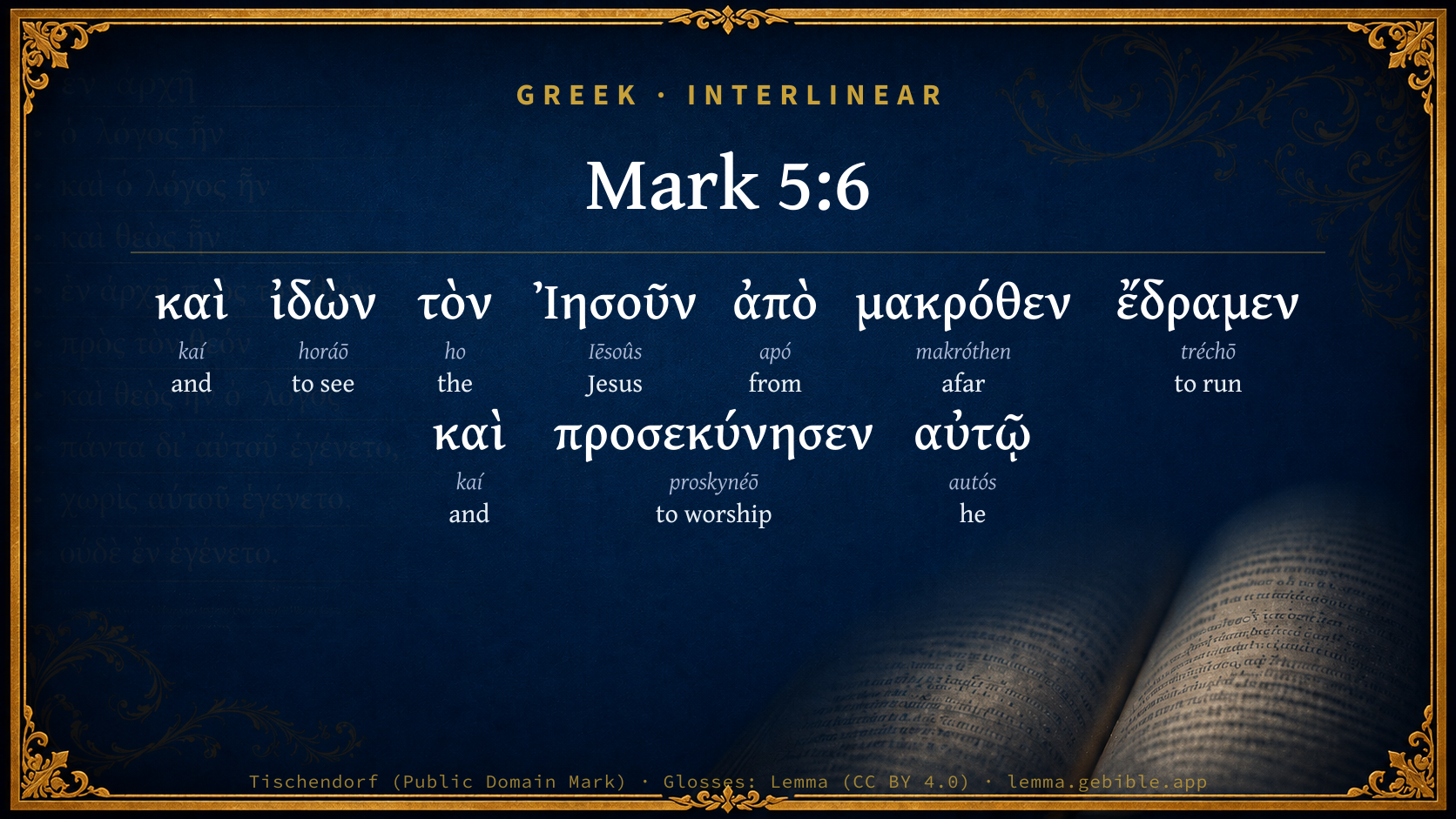
Greek (Tischendorf 8th ed.) Mark 5:6 appears in the Greek New Testament. The text above is from the Tischendorf 8th edition. Each word links to its Strong’s number and a concise gloss. Click any word for its full Thayer’s Greek Lexicon entry.
Download image
Cite this verse

Mark 5:6 (World English Bible). Public Domain. Lemma interlinear Bible study tool, https://lemma.gebible.app/v/mark/5/6.

Show BibTeX & RIS
BibTeX
RIS
English Translation
When he saw Jesus from afar, he ran and bowed down to him,
World English Bible · Public Domain
Download a study sheet

One document with this verse’s original text, its word-by-word gloss line, the meaning frame, cross-references with their text, attributed commentary, and full source and license credits — printable, and it pastes into notes with its structure intact.

This verse Autodidact and up

Study sheet (.html) Plain text (.txt)

A passage Seminary Student

Up to 50 verses in one chapter. A passage sheet keeps up to 6 commentary sources and 12 cross-references per verse, in the order this page ranks them, and says so on the sheet whenever that leaves anything out. Ask for a single verse and you get the Autodidact verse sheet above.

Everything on this page stays free to read, with no account — the sheet is a download of what is already on screen, not access to it.

Want to remove ads? Support Godless Engineer
Compare translations 3

The same verse in 3 English versions, stacked beneath the original-language interlinear above. Click any original word for its lexicon entry.

Each is an independent rendering of the whole verse — the interlinear is not word-aligned to these translations.

Highlighted words mark where these versions differ — a whole-verse word diff, not a word-by-word alignment.

  • World English Bible Public Domain
    When he saw Jesus from afar, he ran and bowed down to him,
  • King James Version Public Domain
    But when he saw Jesus afar off, he ran and worshipped him,
  • unfoldingWord Literal Text CC BY-SA 4.0
    And having seen Jesus from a distance, he ran to him and bowed down to him.

unfoldingWord Literal Text — © unfoldingWord, licensed CC BY-SA 4.0. Word-aligned USFM3 via Door43 (git.door43.org/unfoldingWord/en_ult).

Versions to compare (up to 4)

3 of 4 selected

Show all 19 translations

Every available English version of this verse, each an independent rendering of the whole verse.

  • World English Bible Public Domain
    When he saw Jesus from afar, he ran and bowed down to him,
  • Berean Standard Bible Public Domain
    When the man saw Jesus from a distance, he ran and fell on his knees before Him.
  • Majority Standard Bible Public Domain
    When the man saw Jesus from a distance, he ran and fell on his knees before Him.
  • King James Version Public Domain
    But when he saw Jesus afar off, he ran and worshipped him,
  • American Standard Version (1901) Public Domain
    And when he saw Jesus from afar, he ran and worshipped him;
  • Revised Version (1885) Public Domain
    And when he saw Jesus from afar, he ran and worshipped him;
  • Geneva Bible (1599) Public Domain
    And when he saw Iesus afarre off, he ranne, and worshipped him,
  • Douay-Rheims (1899) Public Domain
    And seeing Jesus afar off, he ran and adored him.
  • Young's Literal Translation Public Domain
    And, having seen Jesus from afar, he ran and bowed before him,
  • Literal Standard Version CC BY-SA 4.0
    And having seen Jesus from afar, he ran and prostrated to Him,
  • Unlocked Literal Bible CC BY-SA 4.0
    When he saw Jesus from a distance, he ran to him and bowed down before him.
  • unfoldingWord Literal Text CC BY-SA 4.0
    And having seen Jesus from a distance, he ran to him and bowed down to him.
  • Darby Bible Public Domain
    But seeing Jesus from afar off, he ran and did him homage,
  • World Messianic Bible Public Domain
    When he saw Yeshua from afar, he ran and bowed down to him,
  • Webster's Bible Public Domain
    But when he saw Jesus afar off, he ran and worshiped him,
  • Free Bible Version CC BY-SA 4.0
    Seeing Jesus from a distance he ran and kneeled in front of him.
  • Bible in Basic English Public Domain
    And when he saw Jesus from far off, he went quickly to him and gave him worship;
  • Text-Critical English NT CC BY 4.0
    When he saw Jesus from a distance, he ran and bowed down before him.
  • Tyndale New Testament (1534) Public Domain
    When he had spied Iesus afarre of he rane and worshipped him

Literal Standard Version (2020), Covenant Press — licensed CC BY-SA 4.0. Text via the HelloAO Bible API (eBible.org). Unlocked Literal Bible (unfoldingWord) — licensed CC BY-SA 4.0. Text via the HelloAO Bible API (eBible.org). unfoldingWord Literal Text — © unfoldingWord, licensed CC BY-SA 4.0. Word-aligned USFM3 via Door43 (git.door43.org/unfoldingWord/en_ult). Free Bible Version, Dr. Jonathan Gallagher — licensed CC BY-SA 4.0. Text via the HelloAO Bible API (eBible.org).

Word by word

More ways to search: Search by grammar → Find every occurrence → Compare this word →

Practice this passage: Drill this verse → Learn its vocabulary →

About this verse

These counts appear in no published source. They are computed here, from the morphology-tagged text and Lemma’s own curated glosses. What Lemma adds →

10
words
9
distinct lemmas
Gospels
section

Notable vocabulary

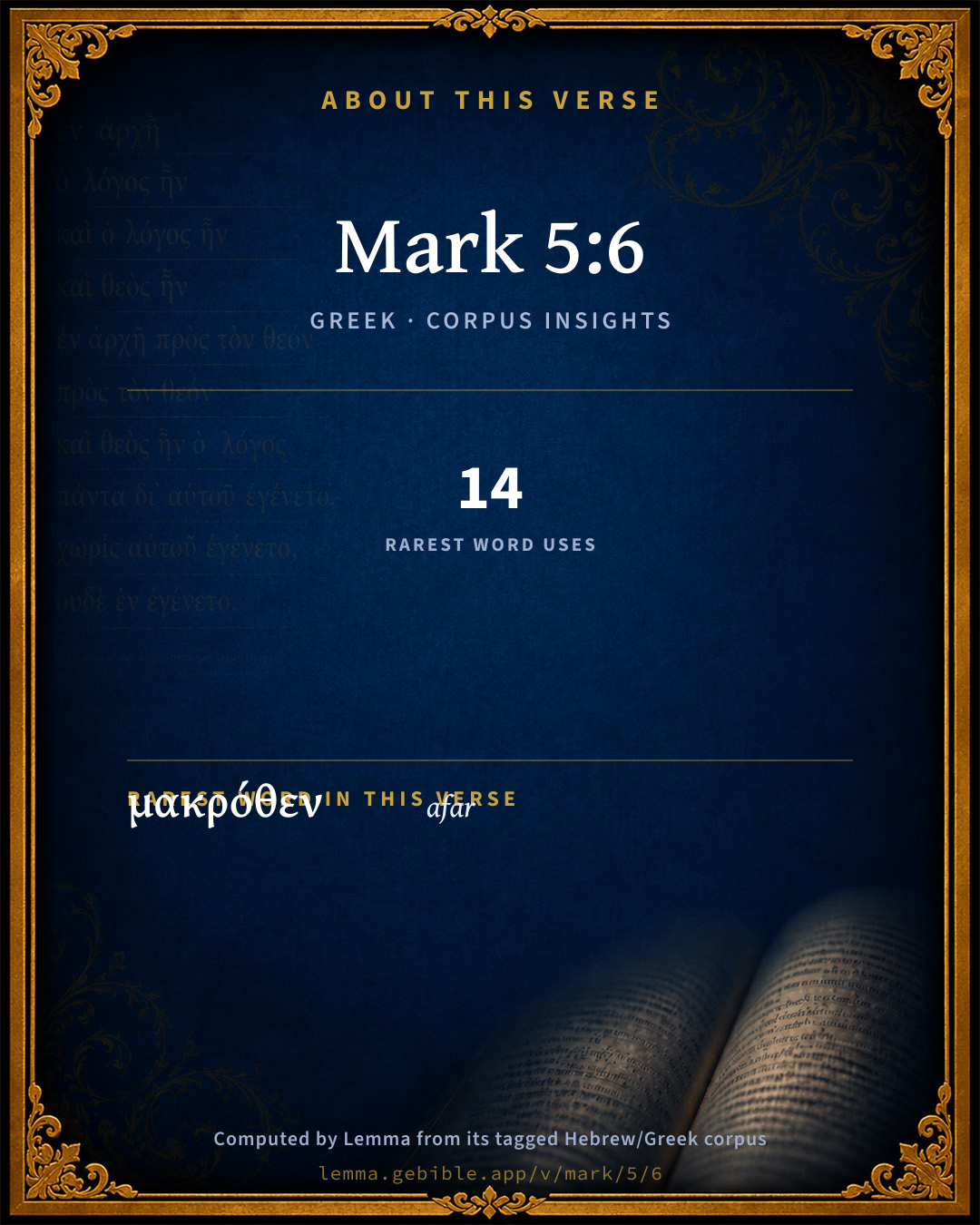
The rarest word here is μακρόθεν afar G3113 — appearing just 14 times in the whole Greek New Testament.

Shared distinctive vocabulary

μακρόθεν afar G3113 occurs in 14 verses of the Greek New Testament. Also found in:

Repetition

A word recurs within this verse:

Cross-references

5

Topical passages linked to Mark 5:6 in the Treasury of Scripture Knowledge — connected by theme and wording, ordered by reader-vote popularity; previews shown in the World English Bible.

  • James 2:19 You believe that God is one. You do well. The demons also believe, and shudder.
  • Psalms 66:3 Tell God, "How awesome are your deeds! Through the greatness of your power, your enemies submit themselves to you.
  • Luke 4:41 Demons also came out from many, crying out, and saying, "You are the Christ, the Son of God!" Rebuking them, he didn't allow them to speak, because they knew that he was the Christ.
  • Psalms 72:9 Those who dwell in the wilderness shall bow before him. His enemies shall lick the dust.
  • Acts 16:17 Following Paul and us, she cried out, "These men are servants of the Most High God, who proclaim to us the way of salvation!"

Cross-references courtesy of OpenBible.info (CC BY 4.0).

Commentary

Notes on Mark 5:6 from classic Christian and Jewish commentators (each source and its license shown beneath its notes). The classic Christian expositions comment on the surrounding passage and are grouped to its opening verse, so a note may address several verses; the Jewish commentaries on the Tanakh (Rashi and others) are per-verse, so they appear only where the commentator wrote on this verse.

Lemma curates 59 commentaries, every one of them public domain or Creative Commons licensed, each selected and text-cleaned for this edition rather than reprinted as found. About our sources →

The Biblical Illustrator

Joseph S. Exell

Mar_5:6

But when he saw Jesus afar off.

The sinners place

Jesus is afar off in the sinners apprehension, and the sinner is in very deed far off from God.

1. As to character. What a difference between the demoniac and Jesus.

2. As to knowledge. The demoniac knew Jesus, but knew little of His love.

3. As to hope. This man had no hope of recovery, or but a faint one, and that hope the demons tried to extinguish.

4. As to possession. The demoniac had no hold upon the Saviour; on the contrary, he cried, What have I to do with Thee? Immeasurable is the distance between God and a sinner; it is wide as the gulf between sin and holiness, death and life, hell and heaven. (C. H. Spurgeon.)

The sinners wisest course

The demoniac was all in confusion, for he was under contending influences: his own spirit and the evil spirit strove together. He ran towards Jesus, and worshipped Him; and yet in the same breath he cried, What have I to do with Thee? Thus are sinners tossed about. But it is the sinners wisest course to run to Jesus; for-

1. He is the Son of the Most High God.

2. He is the great Enemy of our enemy, the devil.

3. He is abundantly able to drive out a legion of devils.

4. He can cause us to be clothed in our right mind.

5. He permits us, even now, to draw near and worship Him. (C. H. Spurgeon.)

The law of attraction

A needle will move towards a magnet, when once a magnet has moved near to it. Our heart manifests a sweet willingness towards salvation and holiness when the great and glorious goodwill of the Lord operates upon it. It is ours to run to Jesus as it all the running were ours; but the secret truth is that the Lord runs towards us, and this is the very heart of the business. (C. H. Spurgeon.)

The Biblical Illustrator, edited by Joseph S. Exell (c. 1880s–1900s) — public domain. Text from a community e-Sword module.

Tyndale Open Study Notes

Tyndale Open Resources

5:6-8 Despite the man’s horrible condition, Jesus’ coming provided him a glimmer of hope; he ran and knelt before Jesus, seeking help. • Son of the Most High God: Evil spirits know Jesus’ true identity (1:24, 34; 3:11). • There was no struggle; Jesus was in charge and the evil spirit obeyed the Master. Torture is the final judgment awaiting evil spirits (Matt 8:29; Luke 8:31).

Tyndale Open Study Notes — © Tyndale Open Resources, licensed CC BY-SA 4.0. Text via the HelloAO Bible API.

Bengel's Gnomon

Johann Albrecht Bengel

Mar 5:6. Ἔδραμε, ran) A specimen and foretaste of the Lordship of Christ. The man possessed ran in spite of the demons, as may readily be supposed.

Bengel's Gnomon of the New Testament — English translation (T&T Clark, Edinburgh, 1860) — public domain. Text from a community e-Sword module.

Expositor's Greek Testament

ed. W. Robertson Nicoll

Mar 5:6-13 . Meeting with Jesus . This desperate case will test Christ’s power to heal. Madness, as wild and untamable as the wind or the sea. What is going to happen?

Mar 5:6 . ἀπὸ μακρόθεν , from afar, a relative expression, a favourite pleonasm in Mk. (Mar 14:54 , Mar 15:40 ). προσεκύνησεν : worshipful attitude, as of one who feels already the charm or spell of Him before whom he kneels; already there is a presentiment and commencement of cure, though not yet welcome.

The Expositor's Greek Testament, edited by W. Robertson Nicoll (1897–1910) — public domain. Text from a community e-Sword module.

Adam Clarke's Commentary

Verse 6. Worshipped him] Did him homage; compelled thereto by the power of God. How humiliating to Satan, thus to be obliged to acknowledge the superiority of Christ!

Adam Clarke's Commentary on the Bible (1810–1826) — public domain. Text from a community e-Sword/MySword module.

Ellicott's Commentary for English Readers

(6) He ran and worshipped him.—The precise attitude would be that of one who not only knelt but touched the ground with his forehead in token of his suppliant reverence.

A Bible Commentary for English Readers, edited by Charles John Ellicott (1878–1897) — public domain. Text from a community e-Sword module.

The Cambridge Bible for Schools and Colleges

gen. ed. J. J. S. Perowne

6. afar off] St Mark alone tells us this. While, as a man, he is attracted towards the Holy One; as possessed by the Legion, he desires to withdraw from Him.

The Cambridge Bible for Schools and Colleges (gen. ed. J. J. S. Perowne; Cambridge University Press, 1878–1918) — public domain. Text from a community e-Sword module.

John Gill's Exposition

But when he saw Jesus afar off,.... For it seems the tombs among which this man dwelt, were at some distance from the sea shore: wherefore when it is said, Mar 5:2, that this man met Jesus, as soon as he came out of the ship: the meaning that he then came forth to meet him, as he might do upon sight of persons landing afar off; though he might not know then, who Jesus was: but coming nearer, and perceiving who he was, such was the power of Christ over the devils in him, that though sore against their wills, they obliged him to move on speedily towards him; so that

he ran and worshipped him: he made all imaginable haste to him; and when he came up to him, fell down at his feet before him, acknowledging his superiority and power, whom no chains nor fetters could bind, nor any man tame; nor durst any man pass that way, for fear of him: and yet, upon sight of Christ, without a word spoken to him, he runs and prostrates himself before him. This is an instance of the superiority of Christ over the devils, who knowing who he is, are filled with horror at him, fall down before him, and in their way do homage to him; though it is impossible they should be spiritual worshippers of him: unless this is rather to be understood of the man himself, who, at the sight of Christ, might have his senses for the present restored, and a knowledge of Christ given: to whom he ran speedily, and threw himself at his feet, hoping for relief from him: however, it may be an emblem of a poor awakened sinner, having a distant sight of Christ, who, upon it, makes haste unto him, and prostrates itself before him, believing he is able, if willing, to save him from the power of Satan, the evil of sin, and from eternal ruin and damnation.

John Gill's Exposition of the Whole Bible (1746–1763) — public domain (CC PDM 1.0). Text via the HelloAO Bible API.

Trapp's Complete Commentary

John Trapp

6 But when he saw Jesus afar off, he ran and worshipped him,

Ver. 6. {See Trapp on "Mat 8:28"}

John Trapp, A Commentary or Exposition upon All the Books of the Old and New Testament (1647–1656) — public domain. Text from a community e-Sword module.

Whedon's Commentary on the Bible

Daniel D. Whedon

6. Saw Jesus… ran — A traveller not far from this region describes a similar scene near Lebanon: “The silence of night was now broken by fierce yells and howlings, which I discovered proceeded from a naked maniac, who was fighting with some wild dogs for a bone. The moment he perceived me he left his canine comrades, and, bounding along with rapid strides, seized my horse’s bridle, and almost forced him backward over the cliff.” — Warburton’s ‘Crescent and the Cross.’

Worshipped him — The spirit recognized with a supernatural discernment our Lord’s superior nature, and did him a reverence.

Daniel D. Whedon (gen. ed.), Commentary on the Old and New Testaments (1874–1909) — public domain. Text from a community e-Sword module.

The Pulpit Commentary

And when he saw Jesus from afar. These words, "from afar," explain the fact of our Lord being immediately met by the man as soon as he left the boat. Vers. 3-5 inclusive must be regarded as parenthetical. They describe the ordinary condition of the demoniac, and his sad wild life from day to day. From the high ground which he frequented he had seen the boat, in which Jesus was, nearing the shore. He had seen the other boats. Perhaps he had seen the sudden rise of the storm and its equally sudden suppression; and he, like others who witnessed it, was affected by it. So he hastened to the shore; he ran and worshipped him. He felt the power of his presence, and so he was constrained through fear to do him reverence, for "the devils also believe and shudder (frissousi)". (Jam_2:19)

The Pulpit Commentary (1880–1919), ed. H.D.M. Spence-Jones & Joseph S. Exell — public domain. Text from a community e-Sword module.

Kretzmann's Popular Commentary

Paul E. Kretzmann

Acknowledging Jesus as the superior:

v. 6. But when he saw Jesus afar off, he ran and worshiped Him,

v. 7. and cried with a loud voice and said, What have I to do with Thee, Jesus, Thou Son of the most high God? I adjure Thee by God that Thou torment me not.

v. 8. For He said unto Him, Come out of the man, thou unclean spirit.

v. 9. And He asked him, What is thy name? And he answered, saying, My name is Legion; for we are many.

v. 10. And he besought Him much that He would not send them away out of the country.

Other people had been in danger of their lives on account of the fierceness of the man. Demoniac strength and utter misery were combined in the poor sufferer. But here the man saw Jesus, and Him the evil spirits knew, had known Him from the time that they were, together with their leader, Satan, thrown out of heaven, Jud 1:6. They must needs recognize Him, no matter where they met Him, as their sovereign Lord and King. And so the man came running and did the Lord homage, casting himself down at His feet in a worshipful attitude, acknowledging even by his action that he knew Jesus to be the Lord. And at the same time, with a cry of fear and prayer, he begs Christ: What business have we two, Thou and I, together, Jesus, Thou Son of God most high? The confession was apparently wrung from him under the pressure of abject terror, together with the plea that Jesus should not torment him, not condemn him at this time to the torment of hell, which was his eventual lot, just as he was even then suffering damnation in being banished from heaven. The evil spirits thus were obliged to recognize in Christ their future Judge, wanted to be rid of His presence, and yet must plead for the slightest favor and extension of time. For though the place of torment is even now their home, yet, by God’s permission, in the interval before the last Judgment, they have power to torture and destroy God’s creatures on earth. They, more than anyone else, dread the last Judgment. For then the place of torment will become a dungeon from which there is no escape and no hope of the slightest reprieve. Then they will see and feel nothing but the fire which was prepared for the devil and his angels. Then the torture of damnation will never have an end, 2Pe 2:4. This cry of terror was occasioned by the fact that Christ was just about to say (conative imperfect); it was evident from Christ’s manner and look that it was on His tongue to speak the word which would release the poor sufferer from the clutches of his tormentors. Christ now permits an intermission in the proceedings lest the evil spirits vent their spite on the man. He asked the demoniac: What name is thine? And the answer, with the explanation, was: Legion, on account of their great number. Not only one unclean spirit was here devastating the temple of the poor man’s body, but a host of them. For the Roman legion comprised a number of between five and six thousand men, and the members of such a body were united under iron discipline. The name was thus the "emblem of irresistible power and of a multitude organized into unity. " The devil is not so listless in his method of attack as the Christians are in warding it off. Not only does he walk about as a roaring lion, seeking whom he might devour, but he has his armies, the spirits of darkness, trained in obedience and concerted attack. The spirits now begged Jesus not to send them out of this region which they seem to have favored on account of the nature of the population. It is a strange thing to find the devil pleading with the Lord for a favor; but if it suits his plans, he can be most abject.

Paul E. Kretzmann, Popular Commentary of the Bible (1921–1924) — public domain. Text from a community e-Sword module.

Cambridge Greek Testament for Schools and Colleges

6. καὶ ἰδὼν τὸν Ἰησοῦν. He had not come out of his dismal shelter because he saw Jesus land, so that his meeting Him (Mar 5:2) was accidental on his part.

ἀπὸ μακρόθεν. A pleonasm of which Mk is fond; Mar 8:3, Mar 11:13, Mar 14:54, Mar 15:40. Cf. ἐκ παιδιόθεν (Mar 9:21). In Mat 26:58 the ἀπό is omitted in [1070][1071][1072] and in Mat 27:55 ἀπʼ is omitted in [1073][1074] In class. Greek we should have πρόσωθεν or πόρρωθεν rather than μακρόθεν. Blass § 29. 3.

[1070] Codex Sinaiticus. 4th cent. Discovered by Tischendorf in 1859 at the Monastery of St Katharine on Mount Sinai. Now at St Petersburg. The whole Gospel, ending at Mar 16:8. Photographic facsimile, 1911.

[1071] Codex Ephraemi. 5th cent. A palimpsest: the original writing has been partially rubbed out, and the works of Ephraem the Syrian have been written over it; but a great deal of the original writing has been recovered; of Mark we have Mar 1:17 to Mar 6:31, Mar 8:5 to Mar 12:29, Mar 13:19 to Mar 16:20. In the National Library at Paris.

[1072] Codex Boreelianus. Once in the possession of John Boreel. 9th cent. At Utrecht. Contains Mk 1–41; Mar 2:8-23; Mar 3:5 to Mar 11:6; Mar 11:27 to Mar 14:54; Mar 15:6-39; Mar 16:19-20.

[1073] Codex Sinaiticus. 4th cent. Discovered by Tischendorf in 1859 at the Monastery of St Katharine on Mount Sinai. Now at St Petersburg. The whole Gospel, ending at Mar 16:8. Photographic facsimile, 1911.

[1074] Codex Regius. 8th cent. An important witness. At Paris. Contains Mar 1:1 to Mar 10:15; Mar 10:30 to Mar 15:1; Mar 15:20 to Mar 16:20, but the shorter ending is inserted between Mar 16:8 and Mar 16:9, showing that the scribe preferred it to the longer one.

Cambridge Greek Testament for Schools and Colleges (Cambridge University Press, 1896; 21 vols, various authors incl. Carr, Maclear, Plummer, Farrar, Lumby, Moule, M. R. James, Simcox) — public domain. Text from a community e-Sword module.

Alford’s Greek Testament

Henry Alford

6.] ἀπὸ μακ. ἔδρ., peculiar to Mark.

Henry Alford, The Greek Testament (1849–1861) — public domain. Text from a community e-Sword module.

International Critical Commentary

6. ἀπὸ μακρόθεν—from a distance.1 προσεκύνησεν αὐτῷ—he made obeisance to him.2 The verb in the N.T. denotes prostration before another in token of reverence, but properly it denotes reverence by kissing the hand towards another.

This act of homage seems inconsistent with the expostulation which follows. It is evident, throughout the narrative, that Jesus has to deal with a hostile attitude in the man, dominated, as he is, by the demon. But the demons, nothwithstanding, recognize Jesus’ mastery over them, and adopt a suppliant rather than a defiant attitude. The προσεκύνει is not inconsistent with the ὀρκίζω, or παρεκάλει, v. 10, 11.

λέγει, says. The historical present, characteristic of Mk.

This reading, instead of εἶπε, said, Tisch. Treg. WH. RV. א ABCKM D Harcl. etc.

International Critical Commentary — older volumes (1896–1929), various authors — public domain. Text from a community e-Sword module.

Vincent's Word Studies in the New Testament

Marvin R. Vincent

Afar off [απο μακροθεν] . Peculiar to Mark, as is also he ran.

Marvin R. Vincent, Word Studies in the New Testament (1887–1900) — public domain. Text from a community e-Sword/MySword module.

Lesson kit

Teaching starters — assembled from the data on this page, not authored interpretation. Every prompt links to the verse data it draws on. Edit before teaching.

Mark, in the Gospels, opens this verse with 10 words (9 distinct Greek lemmas). Its most distinctive word is makróthen (“afar”). A historical commentator’s framing appears above. Read the whole chapter for the surrounding context.

Discussion questions

  1. The word makróthen carries the sense “afar.” How does it shape the verse?
  2. Matthew 26:58 shares the word «afar» with this verse. How do the two illuminate each other?
  3. “and” occurs 2× in this one verse. What is the effect of the repetition?
  4. These translations render this verse differently. What is at stake in choosing one wording over another?
  5. Reading how The Biblical Illustrator and Tyndale Open Study Notes read this verse, where do the two commentators agree and where do they part?

Things to notice

Reading settings

Reading text

Shown beneath each verse's original-language words.

Old Testament
Old Testament edition

Read the OT as the Masoretic Hebrew (MT) or the Greek Septuagint (LXX).

English shown for the Greek Septuagint (in the Hebrew ↔ Greek comparison).

Comparing translations? Open the Compare panel on any verse page to stack up to four side by side.