

Mark 14:41
Greek (Tischendorf 8th ed.) Mark 14:41 appears in the Greek New Testament. The text above is from the Tischendorf 8th edition. Each word links to its Strong’s number and a concise gloss. Click any word for its full Thayer’s Greek Lexicon entry.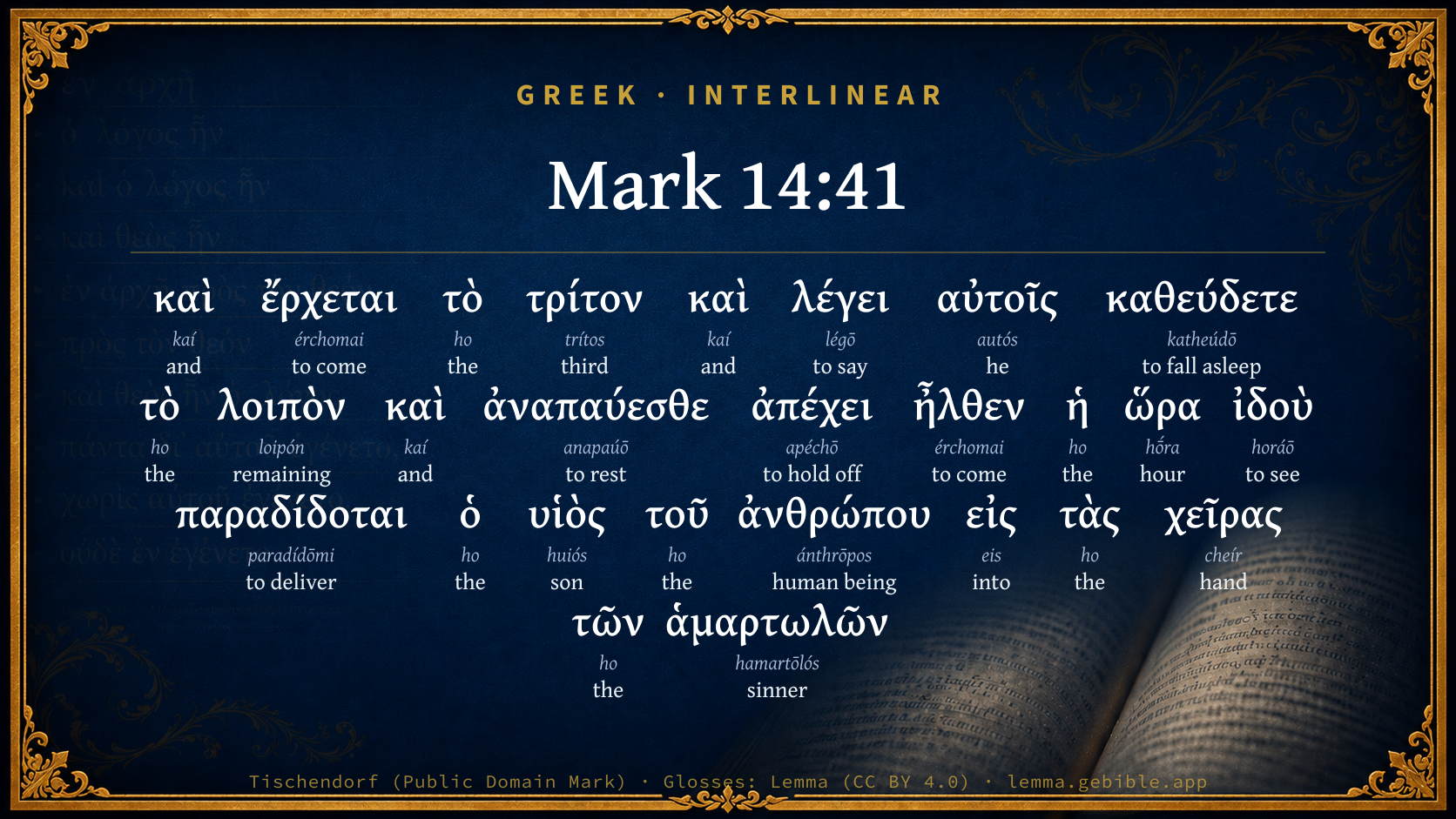
He came the third time, and said to them, "Sleep on now, and take your rest. It is enough. The hour has come. Behold, the Son of Man is betrayed into the hands of sinners.
Download a study sheet
One document with this verse’s original text, its word-by-word gloss line, the meaning frame, cross-references with their text, attributed commentary, and full source and license credits — printable, and it pastes into notes with its structure intact.
This verse Autodidact and up
A passage Seminary Student
Up to 50 verses in one chapter. A passage sheet keeps up to 6 commentary sources and 12 cross-references per verse, in the order this page ranks them, and says so on the sheet whenever that leaves anything out. Ask for a single verse and you get the Autodidact verse sheet above.
Everything on this page stays free to read, with no account — the sheet is a download of what is already on screen, not access to it.
Compare translations 3
The same verse in 3 English versions, stacked beneath the original-language interlinear above. Click any original word for its lexicon entry.
Each is an independent rendering of the whole verse — the interlinear is not word-aligned to these translations.
Highlighted words mark where these versions differ — a whole-verse word diff, not a word-by-word alignment.
-
World English Bible Public Domain
He came the third time, and said to them, "Sleep on now, and take your rest. It is enough. The hour has come. Behold, the Son of Man is betrayed into the hands of sinners.
-
King James Version Public Domain
And he cometh the third time, and saith unto them, Sleep on now, and take your rest: it is enough, the hour is come; behold, the Son of man is betrayed into the hands of sinners.
-
unfoldingWord Literal Text CC BY-SA 4.0
And he comes the third time and says to them, “Are you still sleeping and resting? It is enough! The hour has come. Behold, the Son of Man is handed over into the hands of the sinners.
unfoldingWord Literal Text — © unfoldingWord, licensed CC BY-SA 4.0. Word-aligned USFM3 via Door43 (git.door43.org/unfoldingWord/en_ult).
Show all 19 translations
Every available English version of this verse, each an independent rendering of the whole verse.
-
World English Bible Public Domain
He came the third time, and said to them, "Sleep on now, and take your rest. It is enough. The hour has come. Behold, the Son of Man is betrayed into the hands of sinners.
-
Berean Standard Bible Public Domain
When Jesus returned the third time, He said, “Are you still sleeping and resting? That is enough! The hour has come. Look, the Son of Man is betrayed into the hands of sinners.
-
Majority Standard Bible Public Domain
When Jesus returned the third time, He said, “Are you still sleeping and resting? That is enough! The hour has come. Look, the Son of Man is betrayed into the hands of sinners.
-
King James Version Public Domain
And he cometh the third time, and saith unto them, Sleep on now, and take your rest: it is enough, the hour is come; behold, the Son of man is betrayed into the hands of sinners.
-
American Standard Version (1901) Public Domain
And he cometh the third time, and saith unto them, Sleep on now, and take your rest: it is enough; the hour is come; behold, the Son of man is betrayed into the hands of sinners.
-
Revised Version (1885) Public Domain
And he cometh the third time, and saith unto them, Sleep on now, and take your rest: it is enough; the hour is come; behold, the Son of man is betrayed into the hands of sinners.
-
Geneva Bible (1599) Public Domain
And he came the third time, and said vnto them, Sleepe henceforth, and take your rest: it is ynough: the houre is come: beholde, the Sonne of man is deliuered into the hands of sinners.
-
Douay-Rheims (1899) Public Domain
And he cometh the third time, and saith to them: Sleep ye now, and take your rest. It is enough: the hour is come: behold the Son of man shall be betrayed into the hands of sinners.
-
Young's Literal Translation Public Domain
And he cometh the third time, and saith to them, `Sleep on henceforth, and rest -- it is over; the hour did come; lo, the Son of Man is delivered up to the hands of the sinful;
-
Literal Standard Version CC BY-SA 4.0
And He comes the third time and says to them, “Sleep on from now on, and rest—it is over; the hour came; behold, the Son of Man is delivered up into the hands of the sinful;
-
Unlocked Literal Bible CC BY-SA 4.0
He came the third time and said to them, “Are you still sleeping and taking your rest? Enough! The hour has come. Look! The Son of Man is being betrayed into the hands of sinners.
-
unfoldingWord Literal Text CC BY-SA 4.0
And he comes the third time and says to them, “Are you still sleeping and resting? It is enough! The hour has come. Behold, the Son of Man is handed over into the hands of the sinners.
-
Darby Bible Public Domain
And he comes the third time and says to them, Sleep on now, and take your rest. It is enough; the hour is come; behold, the Son of man is delivered up into the hands of sinners.
-
World Messianic Bible Public Domain
He came the third time and said to them, “Sleep on now, and take your rest. It is enough. The hour has come. Behold, the Son of Man is betrayed into the hands of sinners.
-
Webster's Bible Public Domain
And he cometh the third time, and saith to them, Sleep on now, and take your rest: it is enough, the hour is come; behold, the Son of man is betrayed into the hands of sinners.
-
Free Bible Version CC BY-SA 4.0
He returned a third time, and asked them, “Are you still asleep? Are you still resting? Well that's enough, because the time has come! Look, the Son of man is about to be betrayed into the hands of sinners.
-
Bible in Basic English Public Domain
And he came the third time, and said to them, Go on sleeping now and take your rest: it is enough; the hour has come; see, the Son of man is given up into the hands of evil men.
-
Text-Critical English NT CC BY 4.0
Then he came a third time and said to them, “Sleep on now and take your rest! That is enough; the hour has come. Behold, the Son of Man is delivered up into the hands of sinners.
-
Tyndale New Testament (1534) Public Domain
And he cam the thyrde tyme and sayd vnto the: slepe hens forth and take youre ease it is ynough. The houre is come beholde the sonne of man shalbe delyvered into the hondes of synners.
Literal Standard Version (2020), Covenant Press — licensed CC BY-SA 4.0. Text via the HelloAO Bible API (eBible.org). Unlocked Literal Bible (unfoldingWord) — licensed CC BY-SA 4.0. Text via the HelloAO Bible API (eBible.org). unfoldingWord Literal Text — © unfoldingWord, licensed CC BY-SA 4.0. Word-aligned USFM3 via Door43 (git.door43.org/unfoldingWord/en_ult). Free Bible Version, Dr. Jonathan Gallagher — licensed CC BY-SA 4.0. Text via the HelloAO Bible API (eBible.org).
Word by word
More ways to search: Search by grammar → Find every occurrence → Compare this word →
Practice this passage: Drill this verse → Learn its vocabulary →
- Appears 12× in the Greek New Testament
- First appears at Matthew 11:28
- Part of Speech
- Verb
- Tense
- Present
- Voice
- Middle
- Mood
- Indicative
- Person
- 2nd person
- Number
- Plural
Full Thayer's Definition
- καὶ kaí G2532 “and” Conjunction
- ἔρχεται érchomai G2064 “to come” Verb, Present, Middle or Passive deponent, Indicative, 3rd person, Singular
- τὸ ho G3588 “the” Article, Accusative, Singular, Neuter
- τρίτον trítos G5154 “third” Adjective, Accusative, Singular, Neuter
- καὶ kaí G2532 “and” Conjunction
- λέγει légō G3004 “to say” Verb, Present, Active, Indicative, 3rd person, Singular
- αὐτοῖς autós G846 “he” Personal pronoun, Dative, Plural, Masculine
- καθεύδετε katheúdō G2518 “to fall asleep” Verb, Present, Active, Indicative, 2nd person, Plural
- τὸ ho G3588 “the” Article, Accusative, Singular, Neuter
- λοιπὸν loipón G3063 “remaining” Adjective, Accusative, Singular, Neuter
- καὶ kaí G2532 “and” Conjunction
- ἀναπαύεσθε anapaúō G373 “to rest” Verb, Present, Middle, Indicative, 2nd person, Plural
- ἀπέχει apéchō G568 “to hold off” Verb, Present, Active, Indicative, 3rd person, Singular
- ἦλθεν érchomai G2064 “to come” Verb, Aorist, Active, Indicative, 3rd person, Singular
- ἡ ho G3588 “the” Article, Nominative, Singular, Feminine
- ὥρα hṓra G5610 “hour” Noun, Nominative, Singular, Feminine
- ἰδοὺ horáō G3708 “to see” Verb, Aorist, Middle, Imperative, 2nd person, Singular
- παραδίδοται paradídōmi G3860 “to deliver” Verb, Present, Passive, Indicative, 3rd person, Singular
- ὁ ho G3588 “the” Article, Nominative, Singular, Masculine
- υἱὸς huiós G5207 “son” Noun, Nominative, Singular, Masculine
- τοῦ ho G3588 “the” Article, Genitive, Singular, Masculine
- ἀνθρώπου ánthrōpos G444 “human being” Noun, Genitive, Singular, Masculine
- εἰς eis G1519 “into” Preposition
- τὰς ho G3588 “the” Article, Accusative, Plural, Feminine
- χεῖρας cheír G5495 “hand” Noun, Accusative, Plural, Feminine
- τῶν ho G3588 “the” Article, Genitive, Plural, Masculine
- ἁμαρτωλῶν hamartōlós G268 “sinner” Adjective, Genitive, Plural, Masculine
About this verse
These counts appear in no published source. They are computed here, from the morphology-tagged text and Lemma’s own curated glosses. What Lemma adds →
- 27
- words
- 18
- distinct lemmas
- Gospels
- section
Cross-references
21Topical passages linked to Mark 14:41 in the Treasury of Scripture Knowledge — connected by theme and wording, ordered by reader-vote popularity; previews shown in the World English Bible.
- Mark 9:31 For he was teaching his disciples, and said to them, "The Son of Man is being handed over to the hands of men, and they will kill him; and when he is killed, on the third day he will rise again."
- Mark 14:35 He went forward a little, and fell on the ground, and prayed that, if it were possible, the hour might pass away from him.
- John 17:1 Jesus said these things, and lifting up his eyes to heaven, he said, "Father, the time has come. Glorify your Son, that your Son may also glorify you;
- Judges 10:14 Go and cry to the gods which you have chosen; let them save you in the time of your distress.
- 1 Kings 18:27 It happened at noon, that Elijah mocked them, and said, Cry aloud; for he is a god: either he is musing, or he is gone aside, or he is on a journey, or peradventure he sleeps and must be awakened.
- 1 Kings 22:15 When he was come to the king, the king said to him, Micaiah, shall we go to Ramoth-gilead to battle, or shall we forbear? He answered him, Go up and prosper; and Yahweh will deliver it into the hand of the king.
- 2 Kings 3:13 Elisha said to the king of Israel, What have I to do with you? get you to the prophets of your father, and to the prophets of your mother. The king of Israel said to him, No; for Yahweh has called these three kings together to deliver them into the hand of Moab.
- Ecclesiastes 11:9 Rejoice, young man, in your youth, And let your heart cheer you in the days of your youth, And walk in the ways of your heart, And in the sight of your eyes; But know that for all these things God will bring you into judgment.
- Ezekiel 20:39 As for you, house of Israel, thus says the Lord Yahweh: Go you, serve everyone his idols, and hereafter also, if you will not listen to me; but my holy name shall you no more profane with your gifts, and with your idols.
- Matthew 26:2 "You know that after two days the Passover is coming, and the Son of Man will be delivered up to be crucified."
- Matthew 26:45–46 Then he came to his disciples, and said to them, "Sleep on now, and take your rest. Behold, the hour is at hand, and the Son of Man is betrayed into the hands of sinners.
- Mark 7:9 He said to them, "Full well do you reject the commandment of God, that you may keep your tradition.
- Mark 10:33–34 "Behold, we are going up to Jerusalem. The Son of Man will be delivered to the chief priests and the scribes. They will condemn him to death, and will deliver him to the Gentiles.
- Mark 14:10 Judas Iscariot, who was one of the twelve, went away to the chief priests, that he might deliver him to them.
- Mark 14:18 As they sat and were eating, Jesus said, "Most assuredly I tell you, one of you will betray me -- he who eats with me."
- John 7:30 They sought therefore to take him; but no one laid a hand on him, because his hour had not yet come.
- John 8:20 Jesus spoke these words in the treasury, as he taught in the temple. Yet no one arrested him, because his hour had not yet come.
- John 12:23 Jesus answered them, "The time has come for the Son of Man to be glorified.
- John 12:27 "Now my soul is troubled. What shall I say? 'Father, save me from this time?' But for this cause I came to this time.
- John 13:1–2 Now before the feast of the Passover, Jesus knowing that his time had come that he would depart from this world to the Father, having loved his own who were in the world, he loved them to the end.
- Acts 7:52 Which of the prophets didn't your fathers persecute? They killed those who foretold the coming of the Righteous One, of whom you have now become betrayers and murderers.
Cross-references courtesy of OpenBible.info (CC BY 4.0).
Lesson kit
Teaching starters — assembled from the data on this page, not authored interpretation. Every prompt links to the verse data it draws on. Edit before teaching.
Mark, in the Gospels, opens this verse with 27 words (18 distinct Greek lemmas). Its most distinctive word is anapaúō (“to rest”). A historical commentator’s framing appears above. Read the whole chapter for the surrounding context.
Discussion questions
- How does “to rest” (anapaúō) shape what this verse is saying?
- How does Matthew 11:28, which shares the word «to rest», read alongside this verse?
- What does the repetition of “to come” (2× in this one verse) do in this verse?
- These translations render this verse differently. What is at stake in choosing one wording over another?
- Compare how The Biblical Illustrator and Tyndale Open Study Notes read this verse. Where do they agree or differ?
Things to notice
- These translations choose different wording for 17 words in this verse.
- “to come” occurs 2× in this single verse.
- 18 distinct Greek lemmas span 27 words in this verse.
Commentary
Notes on Mark 14:41 from classic Christian and Jewish commentators (each source and its license shown beneath its notes). The classic Christian expositions comment on the surrounding passage and are grouped to its opening verse, so a note may address several verses; the Jewish commentaries on the Tanakh (Rashi and others) are per-verse, so they appear only where the commentator wrote on this verse.
Lemma curates 59 commentaries, every one of them public domain or Creative Commons licensed, each selected and text-cleaned for this edition rather than reprinted as found. About our sources →
The Biblical Illustrator
Joseph S. Exell
The Biblical Illustrator, edited by Joseph S. Exell (c. 1880s–1900s) — public domain. Text from a community e-Sword module.
Tyndale Open Study Notes
Tyndale Open Resources
Tyndale Open Study Notes — © Tyndale Open Resources, licensed CC BY-SA 4.0. Text via the HelloAO Bible API.
Bengel's Gnomon
Johann Albrecht Bengel
Bengel's Gnomon of the New Testament — English translation (T&T Clark, Edinburgh, 1860) — public domain. Text from a community e-Sword module.
Expositor's Greek Testament
ed. W. Robertson Nicoll
The Expositor's Greek Testament, edited by W. Robertson Nicoll (1897–1910) — public domain. Text from a community e-Sword module.
Ellicott's Commentary for English Readers
A Bible Commentary for English Readers, edited by Charles John Ellicott (1878–1897) — public domain. Text from a community e-Sword module.
The Cambridge Bible for Schools and Colleges
gen. ed. J. J. S. Perowne
The Cambridge Bible for Schools and Colleges (gen. ed. J. J. S. Perowne; Cambridge University Press, 1878–1918) — public domain. Text from a community e-Sword module.
John Gill's Exposition
John Gill's Exposition of the Whole Bible (1746–1763) — public domain (CC PDM 1.0). Text via the HelloAO Bible API.
Trapp's Complete Commentary
John Trapp
John Trapp, A Commentary or Exposition upon All the Books of the Old and New Testament (1647–1656) — public domain. Text from a community e-Sword module.
The Pulpit Commentary
The Pulpit Commentary (1880–1919), ed. H.D.M. Spence-Jones & Joseph S. Exell — public domain. Text from a community e-Sword module.
Scofield Reference Notes
C. I. Scofield
The Scofield Reference Bible (1917 edition), notes by C. I. Scofield — public domain. Text from a community e-Sword module.
Cambridge Greek Testament for Schools and Colleges
Cambridge Greek Testament for Schools and Colleges (Cambridge University Press, 1896; 21 vols, various authors incl. Carr, Maclear, Plummer, Farrar, Lumby, Moule, M. R. James, Simcox) — public domain. Text from a community e-Sword module.
Alford’s Greek Testament
Henry Alford
Henry Alford, The Greek Testament (1849–1861) — public domain. Text from a community e-Sword module.
International Critical Commentary
International Critical Commentary — older volumes (1896–1929), various authors — public domain. Text from a community e-Sword module.
Vincent's Word Studies in the New Testament
Marvin R. Vincent
Marvin R. Vincent, Word Studies in the New Testament (1887–1900) — public domain. Text from a community e-Sword/MySword module.