
Matthew 26:45

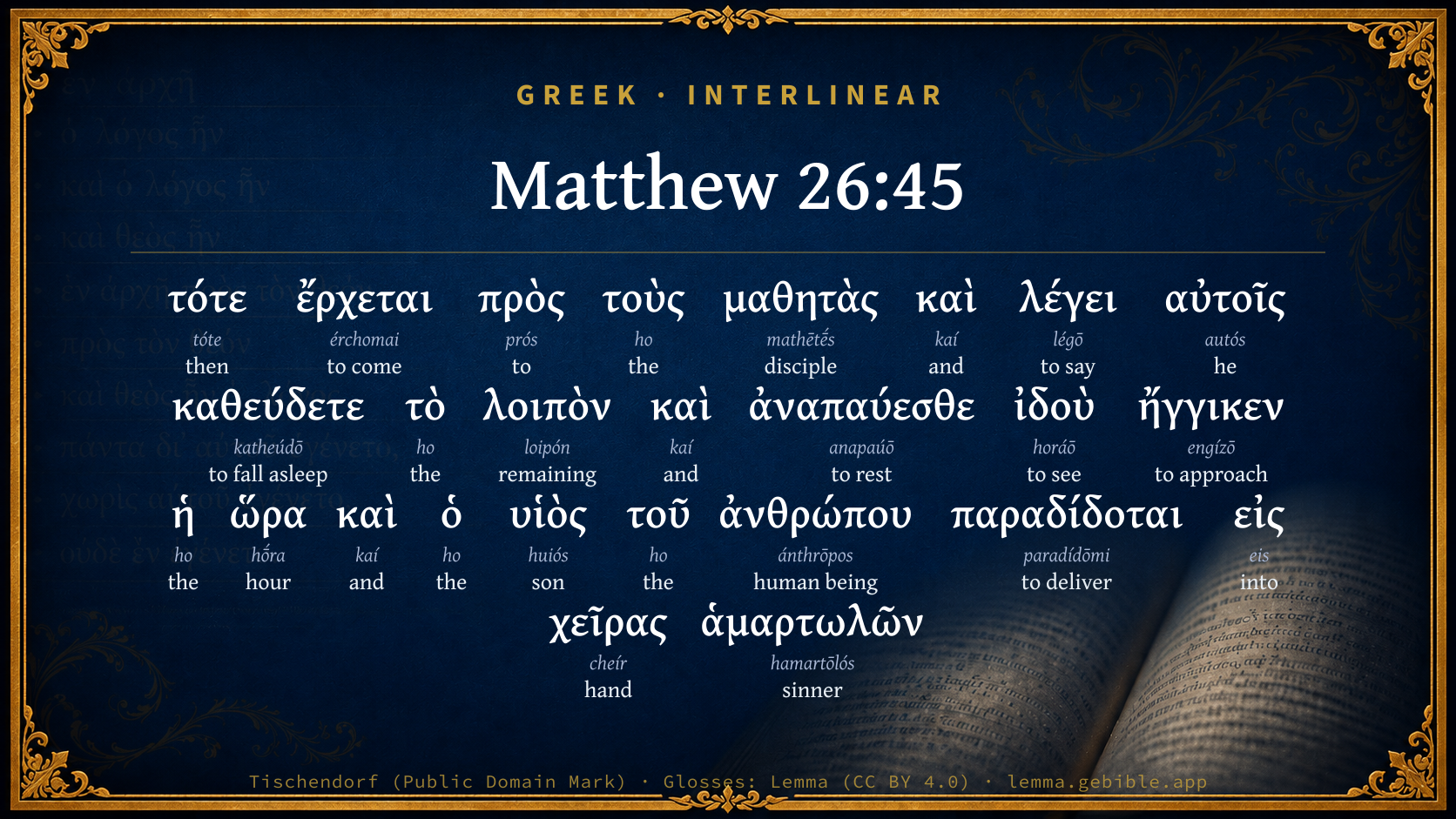
Greek (Tischendorf 8th ed.) Matthew 26:45 appears in the Greek New Testament. The text above is from the Tischendorf 8th edition. Each word links to its Strong’s number and a concise gloss. Click any word for its full Thayer’s Greek Lexicon entry.
Download image
Cite this verse

Matthew 26:45 (World English Bible). Public Domain. Lemma interlinear Bible study tool, https://lemma.gebible.app/v/matthew/26/45.

Show BibTeX & RIS
BibTeX
RIS
English Translation
Then he came to his disciples, and said to them, "Sleep on now, and take your rest. Behold, the hour is at hand, and the Son of Man is betrayed into the hands of sinners.
World English Bible · Public Domain
Highlights
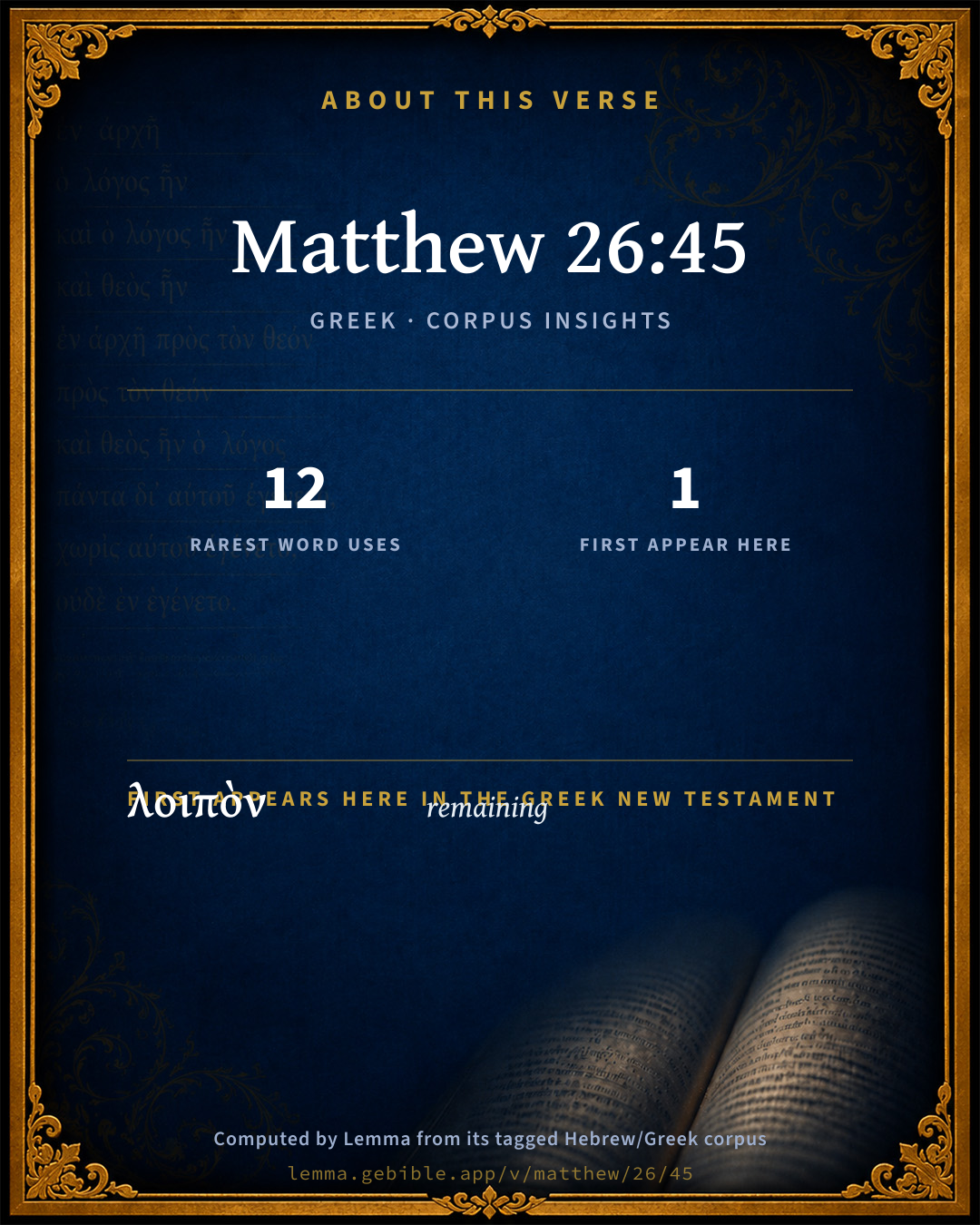
  • 1 first appearance in the Greek New Testament
Full analysis ↓
Download a study sheet

One document with this verse’s original text, its word-by-word gloss line, the meaning frame, cross-references with their text, attributed commentary, and full source and license credits — printable, and it pastes into notes with its structure intact.

This verse Autodidact and up

Study sheet (.html) Plain text (.txt)

A passage Seminary Student

Up to 50 verses in one chapter. A passage sheet keeps up to 6 commentary sources and 12 cross-references per verse, in the order this page ranks them, and says so on the sheet whenever that leaves anything out. Ask for a single verse and you get the Autodidact verse sheet above.

Everything on this page stays free to read, with no account — the sheet is a download of what is already on screen, not access to it.

Want to remove ads? Support Godless Engineer
Compare translations 3

The same verse in 3 English versions, stacked beneath the original-language interlinear above. Click any original word for its lexicon entry.

Each is an independent rendering of the whole verse — the interlinear is not word-aligned to these translations.

Highlighted words mark where these versions differ — a whole-verse word diff, not a word-by-word alignment.

  • World English Bible Public Domain
    Then he came to his disciples, and said to them, "Sleep on now, and take your rest. Behold, the hour is at hand, and the Son of Man is betrayed into the hands of sinners.
  • King James Version Public Domain
    Then cometh he to his disciples, and saith unto them, Sleep on now, and take your rest: behold, the hour is at hand, and the Son of man is betrayed into the hands of sinners.
  • unfoldingWord Literal Text CC BY-SA 4.0
    Then he comes to the disciples and says to them, “Are you still sleeping and resting? Behold, the hour has come near, and the Son of Man is handed over into the hands of sinners.

unfoldingWord Literal Text — © unfoldingWord, licensed CC BY-SA 4.0. Word-aligned USFM3 via Door43 (git.door43.org/unfoldingWord/en_ult).

Versions to compare (up to 4)

3 of 4 selected

Show all 19 translations

Every available English version of this verse, each an independent rendering of the whole verse.

  • World English Bible Public Domain
    Then he came to his disciples, and said to them, "Sleep on now, and take your rest. Behold, the hour is at hand, and the Son of Man is betrayed into the hands of sinners.
  • Berean Standard Bible Public Domain
    Then He returned to the disciples and said, “Are you still sleeping and resting? Look, the hour is near, and the Son of Man is betrayed into the hands of sinners.
  • Majority Standard Bible Public Domain
    Then He returned to His disciples and said, “Are you still sleeping and resting? Look, the hour is near, and the Son of Man is betrayed into the hands of sinners.
  • King James Version Public Domain
    Then cometh he to his disciples, and saith unto them, Sleep on now, and take your rest: behold, the hour is at hand, and the Son of man is betrayed into the hands of sinners.
  • American Standard Version (1901) Public Domain
    Then cometh he to the disciples, and saith unto them, Sleep on now, and take your rest: behold, the hour is at hand, and the Son of man is betrayed into the hands of sinners.
  • Revised Version (1885) Public Domain
    Then cometh he to the disciples, and saith unto them, Sleep on now, and take your rest: behold, the hour is at hand, and the Son of man is betrayed into the hands of sinners.
  • Geneva Bible (1599) Public Domain
    Then came he to his disciples, and said vnto them, Sleepe henceforth, and take your rest: behold, the houre is at hand, and the Sonne of man is giuen into the hands of sinners.
  • Douay-Rheims (1899) Public Domain
    Then he cometh to his disciples, and saith to them: Sleep ye now and take your rest; behold the hour is at hand, and the Son of man shall be betrayed into the hands of sinners.
  • Young's Literal Translation Public Domain
    then cometh he unto his disciples, and saith to them, `Sleep on henceforth, and rest! lo, the hour hath come nigh, and the Son of Man is delivered up to the hands of sinners.
  • Literal Standard Version CC BY-SA 4.0
    then He comes to His disciples and says to them, “Sleep on from now on, and rest! Behold, the hour has come near, and the Son of Man is delivered up into the hands of sinners.
  • Unlocked Literal Bible CC BY-SA 4.0
    Then Jesus came to the disciples and said to them, “Are you still sleeping and taking your rest? Look, the hour is at hand, and the Son of Man is being betrayed into the hands of sinners.
  • unfoldingWord Literal Text CC BY-SA 4.0
    Then he comes to the disciples and says to them, “Are you still sleeping and resting? Behold, the hour has come near, and the Son of Man is handed over into the hands of sinners.
  • Darby Bible Public Domain
    Then he comes to the disciples and says to them, Sleep on now and take your rest; behold, the hour has drawn nigh, and the Son of man is delivered up into the hands of sinners.
  • World Messianic Bible Public Domain
    Then he came to his disciples and said to them, “Are you still sleeping and resting? Behold, the hour is at hand, and the Son of Man is betrayed into the hands of sinners.
  • Webster's Bible Public Domain
    Then he cometh to his disciples, and saith to them, Sleep on now, and take your rest: behold, the hour is at hand, and the Son of man is betrayed into the hands of sinners.
  • Free Bible Version CC BY-SA 4.0
    Then he returned to the disciples, and told them, “How can you still be sleeping and resting? Look, the time has come. The Son of man is about to be betrayed into the hands of sinners!
  • Bible in Basic English Public Domain
    Then he comes to the disciples; and says to them, Go on sleeping now, and take your rest: for the hour is come, and the Son of man is given into the hands of evil men.
  • Text-Critical English NT CC BY 4.0
    Then he came to his disciples and said to them, “Sleep on now and take your rest! Behold, the hour has drawn near, and the Son of Man is delivered up into the hands of sinners.
  • Tyndale New Testament (1534) Public Domain
    Then came he to his disciples and sayd vnto them: Slepe hence forth and take youre reest. Take hede the houre is at honde and the sonne of man shalbe betrayed into the hondes of synners.

Literal Standard Version (2020), Covenant Press — licensed CC BY-SA 4.0. Text via the HelloAO Bible API (eBible.org). Unlocked Literal Bible (unfoldingWord) — licensed CC BY-SA 4.0. Text via the HelloAO Bible API (eBible.org). unfoldingWord Literal Text — © unfoldingWord, licensed CC BY-SA 4.0. Word-aligned USFM3 via Door43 (git.door43.org/unfoldingWord/en_ult). Free Bible Version, Dr. Jonathan Gallagher — licensed CC BY-SA 4.0. Text via the HelloAO Bible API (eBible.org).

Word by word

More ways to search: Search by grammar → Find every occurrence → Compare this word →

Practice this passage: Drill this verse → Learn its vocabulary →

ἀναπαύεσθε
anapaúō
G373
“to rest”
Verb, Present, Middle, Indicative, 2nd person, Plural
Part of Speech
Verb
Tense
Present
Voice
Middle
Mood
Indicative
Person
2nd person
Number
Plural
Full Thayer's Definition

Origin: from G303 and G3973

TDNT: 06:50,6

1. to cause or permit one to cease from any movement or labour in order to recover and collect his strength 2. to give rest, refresh, to give one's self rest, take rest 3. to keep quiet, of calm and patient expectation
  1. τότε tóte G5119 “then” Adverb
  2. ἔρχεται érchomai G2064 “to come” Verb, Present, Middle or Passive deponent, Indicative, 3rd person, Singular
  3. πρὸς prós G4314 “to” Preposition
  4. τοὺς ho G3588 “the” Article, Accusative, Plural, Masculine
  5. μαθητὰς mathētḗs G3101 “disciple” Noun, Accusative, Plural, Masculine
  6. καὶ kaí G2532 “and” Conjunction
  7. λέγει légō G3004 “to say” Verb, Present, Active, Indicative, 3rd person, Singular
  8. αὐτοῖς autós G846 “he” Personal pronoun, Dative, Plural, Masculine
  9. καθεύδετε katheúdō G2518 “to fall asleep” Verb, Present, Active, Indicative, 2nd person, Plural
  10. τὸ ho G3588 “the” Article, Accusative, Singular, Neuter
  11. λοιπὸν loipón G3063 “remaining” Adjective, Accusative, Singular, Neuter
  12. καὶ kaí G2532 “and” Conjunction
  13. ἰδοὺ horáō G3708 “to see” Verb, Aorist, Middle, Imperative, 2nd person, Singular
  14. ἤγγικεν engízō G1448 “to approach” Verb, Perfect, Active, Indicative, 3rd person, Singular
  15. ἡ ho G3588 “the” Article, Nominative, Singular, Feminine
  16. ὥρα hṓra G5610 “hour” Noun, Nominative, Singular, Feminine
  17. καὶ kaí G2532 “and” Conjunction
  18. ὁ ho G3588 “the” Article, Nominative, Singular, Masculine
  19. υἱὸς huiós G5207 “son” Noun, Nominative, Singular, Masculine
  20. τοῦ ho G3588 “the” Article, Genitive, Singular, Masculine
  21. ἀνθρώπου ánthrōpos G444 “human being” Noun, Genitive, Singular, Masculine
  22. παραδίδοται paradídōmi G3860 “to deliver” Verb, Present, Passive, Indicative, 3rd person, Singular
  23. εἰς eis G1519 “into” Preposition
  24. χεῖρας cheír G5495 “hand” Noun, Accusative, Plural, Feminine
  25. ἁμαρτωλῶν hamartōlós G268 “sinner” Adjective, Genitive, Plural, Masculine

About this verse

These counts appear in no published source. They are computed here, from the morphology-tagged text and Lemma’s own curated glosses. What Lemma adds →

26
words
20
distinct lemmas
Gospels
section

Notable vocabulary

The rarest word here is ἀναπαύεσθε to rest G373 — appearing just 12 times in the whole Greek New Testament.

First appearance in Scripture

This word makes its first canonical appearance in the Greek New Testament here:

  • λοιπὸν remaining G3063

Shared distinctive vocabulary

ἀναπαύεσθε to rest G373 occurs in 12 verses of the Greek New Testament. Also found in:
Repetition

Words recur within this verse:

Cross-references

8

Topical passages linked to Matthew 26:45 in the Treasury of Scripture Knowledge — connected by theme and wording, ordered by reader-vote popularity; previews shown in the World English Bible.

  • John 13:1 Now before the feast of the Passover, Jesus knowing that his time had come that he would depart from this world to the Father, having loved his own who were in the world, he loved them to the end.
  • Mark 14:41–42 He came the third time, and said to them, "Sleep on now, and take your rest. It is enough. The hour has come. Behold, the Son of Man is betrayed into the hands of sinners.
  • Luke 22:53 When I was with you in the temple daily, you didn't stretch out your hands against me. But this is your hour, and the power of darkness."
  • John 12:27 "Now my soul is troubled. What shall I say? 'Father, save me from this time?' But for this cause I came to this time.
  • John 17:1 Jesus said these things, and lifting up his eyes to heaven, he said, "Father, the time has come. Glorify your Son, that your Son may also glorify you;
  • Matthew 26:2 "You know that after two days the Passover is coming, and the Son of Man will be delivered up to be crucified."
  • Matthew 26:14–15 Then one of the twelve, who was called Judas Iscariot, went to the chief priests,
  • Matthew 26:18 He said, "Go into the city to a certain person, and tell him, 'The Teacher says, "My time is at hand. I will keep the Passover at your house with my disciples."'"

Cross-references courtesy of OpenBible.info (CC BY 4.0).

Commentary

Notes on Matthew 26:45 from classic Christian and Jewish commentators (each source and its license shown beneath its notes). The classic Christian expositions comment on the surrounding passage and are grouped to its opening verse, so a note may address several verses; the Jewish commentaries on the Tanakh (Rashi and others) are per-verse, so they appear only where the commentator wrote on this verse.

Lemma curates 59 commentaries, every one of them public domain or Creative Commons licensed, each selected and text-cleaned for this edition rather than reprinted as found. About our sources →

Bengel's Gnomon

Johann Albrecht Bengel

Mat 26:45. Καθεύδετε τὸ λοιπὸν, sleep on now) An imperative, leaving the disciples, as it were to themselves, wholly given up as they were to sleep, and thus exciting them so much the more urgently by tenderness joined with severity. It is not an instance of irony, but metonymy, q.d. “You do not listen to Me when attempting to rouse you, others soon will come and rouse yon. In the meanwhile sleep, if you have leisure for so doing.” In St Luke (Luk 22:46) we find τί καθεύδετε “why sleep ye?” with an interrogation, which some have introduced into St Matthew and St Mark.—ἀναπαύεσθε, take your rest), as Sleep is opposed to Watching, so Rest to the labour of prayer.—ἠ ὥρα, the hour) often foretold. In Mat 26:18 He had said less definitely “My time.”

Bengel's Gnomon of the New Testament — English translation (T&T Clark, Edinburgh, 1860) — public domain. Text from a community e-Sword module.

Meyer's Critical & Exegetical Commentary

Heinrich August Wilhelm Meyer

Mat_26:45. The annoyance at finding the disciples asleep (Mat_26:40 : οὕτως οὐκ ἰσχύσατε, κ.τ.λ.) now deepens into an intensely painful irony: sleep on now, and have out your rest (the emphasis is not on τὸ λοιπόν, but on καθεύδετε κ. ἀναπ.)! He had previously addressed them with a γρηγορεῖτε, but to how little purpose! and, accordingly, He now turns to them with the sadly ironical abandonment of one who has no further hope, and tells them to do quite the reverse sleep on, etc. Comp. Euthymius Zigabenus, Beza, Münster, Erasmus, Calvin, Er. Schmid, Maldonatus, Bengel, Jansen, Michaelis, Fritzsche, Keim, Ewald. On λοιπόν and τὸ λοιπόν, for the rest of the time, in the sense of jam (Vulgate), henceforward (Plat. Prot. p. 321 C), see Schaefer, ad Long. p. 400; Jacobs, ad Philostr. p. 663. Comp. on Act_27:20. To object, as is frequently done, that the ironical view does not accord with the frame of mind in which Jesus must have been, is to fail to appreciate aright the nature of the situation. Irony is not inconsistent even with the deepest anguish of soul, especially in cases where such anguish is also accompanied with such clearness of judgment as we find in the present instance; and consider what it was for Jesus to see such an overpowering tendency to sleep on the part of His disciples, and to find everything so different from what He needed, and might reasonably have expected! Winer, p. 292 [E. T. 391], following Chrysostom, Theophylact (who, however, admits the plausibility of the ironical view), and Grotius, excludes the idea of irony, and interprets thus: sleep on, then, as you are doing, and take your rest, which words are supposed to be spoken permissively in accordance with the calm, mild, resigned spirit produced by the prayers in which He had just been engaged. This is also substantially the view of Kuinoel, de Wette, Morison, Weiss on Mark; and see even Augustine, who says: verba indulgentis eis jam somnum. But the idea that any such indulgence was seriously intended, would be incompatible with the danger referred to at Mat_26:41, and which He knew was threatening even the disciples themselves. There are others, again, who are disposed to take the words interrogatively, thus: are ye still asleep? Such is the view of Henry Stephens, Heumann, Kypke, Krebs, in spite of the ordinary usage with regard to τὸ λοιπόν, to understand which in the sense of henceforth (Bleek, Volkmar) would be entirely out of keeping with the use of the present here. If, however, the mark of interrogation be inserted after καθεύδετε, and τὸ λοιπὸν καὶ ἀναπαύεσθε be then taken imperatively (Klostermann), in that case καί would have the intensive force of even; but its logical position would have to be before τὸ λοιπόν, not before ἀναπαύεσθε, where it could be rendered admissible at all only by an artificial twisting of the sense (now you may henceforth rest on, even as long as you choose).

While Jesus is in the act of uttering His καθεύδετε, κ.τ.λ., He observes the hostile band approaching; the painful irony changes to a painful earnestness, and He continues in abrupt and disjointed words: ἰδοὺ, ἤγγικεν, κ.τ.λ. The ἡ ὥρα should be taken absolutely: hora fatalis, Joh_17:1. The next clause describes in detail the character of that hour.

εἰς χεῖρας ἁμαρτ.] into sinners hands. He refers to the members of the Sanhedrim, at whose disposal He would be placed by means of His apprehension, and not to the Romans (Maldonatus, Grotius, Hilgenfeld), nor to both of these together (Lange). The παραδιδούς is not God, but Judas, acting, however, in pursuance of the divine purpose, Act_2:23.

Meyer — Critical and Exegetical Commentary on the New Testament — English translation by Peter Christie, edited by Frederick Crombie (T&T Clark, 1880) — public domain. Text from a community e-Sword module.

Expositor's Greek Testament

ed. W. Robertson Nicoll

Mat 26:45 . καθεύδετε λ . κ . ἀναπαύεσθε , sleep now and rest; not ironical or reproachful, nor yet seriously meant, but concessive = ye may sleep and rest indefinitely so far as I am concerned; I need no longer your watchful interest. The Master’s time of weakness is past; He is prepared to face the worst. ἡ ὥρα : He expects the worst to begin forthwith: the cup, which He prayed might pass, to be put immediately into His hands. παραδίδοται , betrayal the first step, on the point of being taken. ἁμαρτωλῶν , the Sanhedrists, with whom Judas has been bargaining. ἐγείρ . ἄγωμ .: sudden change of mood, on signs of a hostile approach: arise, let us go; spoken as if by a general to his army. ὁ παραδιδούς , the traitor is seen to be coming. It is noticeable that throughout the narrative, in speaking of the action of Judas the verb παραδίδωμι is used instead of προδίδωμι : the former expresses the idea of delivering to death, the latter of delivering into the hands of those who sought His life (Euthy. on Mat 26:21 ).

The scene in the garden is intrinsically probable and without doubt historical. The temptation was to suppress rather than to invent in regard both to the behaviour of Jesus and to that of His disciples. It is not the creation of theology, though theology has made its own use of it. It is recorded simply because it was known to have happened.

The Expositor's Greek Testament, edited by W. Robertson Nicoll (1897–1910) — public domain. Text from a community e-Sword module.

Adam Clarke's Commentary

Verse 45. Sleep on now, and take your rest] Perhaps it might be better to read these words interrogatively, and paraphrase them thus: Do ye sleep on still? Will no warnings avail? Will no danger excite you to watchfulness and prayer? My hour - in which I am to be delivered up, is at hand; therefore now think of your own personal safety.

The Son of man is betrayed into the hands of sinners.] αμαρτωλων, viz. the Gentiles or heathens, who were generally distinguished by this appellation from the Jews. Here it probably means the Roman cohort that was stationed on festivals for the defence of the temple. By the Romans he was adjudged to death; for the Jews acknowledged that they had no power in capital cases. See the note on Mt 9:10.

Adam Clarke's Commentary on the Bible (1810–1826) — public domain. Text from a community e-Sword/MySword module.

Ellicott's Commentary for English Readers

(45) Sleep on now, and take your rest.—There is an obvious difficulty in these words, followed as they are so immediately by the “Rise, let us be going,” of the next verse. We might, at first, be inclined to see in them a shade of implied reproach. “Sleep on now, if sleep under such conditions is possible; make the most of the short interval that remains before the hour of the betrayal comes.” Something of this kind seems obviously implied, but the sudden change is, perhaps, best explained by the supposition that it was not till after these words had been spoken that the Traitor and his companions were seen actually approaching, and that it was this that led to the words seemingly so different in their purport, bidding the slumberers to rouse themselves from sleep. The past, which, as far as their trial went, might have been given to sleep, was over. A new crisis had come calling for action.

A Bible Commentary for English Readers, edited by Charles John Ellicott (1878–1897) — public domain. Text from a community e-Sword module.

The Cambridge Bible for Schools and Colleges

gen. ed. J. J. S. Perowne

45, 46. Sleep on now … Rise, let us be going] The sudden transition may be explained either (1) by regarding the first words as intended for a rebuke, or else (2) at that very moment Judas appeared, and the time for action had come. The short, quick sentences, especially as reported by St Mark, favour the second suggestion.

The Cambridge Bible for Schools and Colleges (gen. ed. J. J. S. Perowne; Cambridge University Press, 1878–1918) — public domain. Text from a community e-Sword module.

John Gill's Exposition

Rise, let us be going,.... Not to run away from the enemy, but to meet him: this was said, partly to arouse his sleepy disciples; and partly to show his love to his Father, and his submission to his will; as also to express the fortitude of his mind as man; he was now rid of his fears, and free from those agonies and dreadful apprehensions of things, he was but a little while ago possessed of; and likewise, to signify his willingness to be apprehended, and to suffer, and die, in the room of his people:

he is at hand that doth betray me. This shows his omniscience: he not only knew, as he did from the beginning, who should betray him; but he knew when be would do it; and he knew where the betrayer now was, that he was just now coming upon him, in order to deliver him the hands of sinful men. And this he spake with trepidity of soul, with greatness of mind, being no more concerned at it, than when he gave him the sop, and bid him do what he did quickly: he does not mention his name; nor did he ever, when he spoke of him as the betrayer; either because the disciples, as yet, did not fully and certainly know who should betray him, and he would not now surprise them with it; or because they did, and therefore it was needless to mention his name; or rather, because he was unworthy to be mentioned by name: a "behold" is prefixed to this, partly to awaken the attention of his disciples; and partly to express what an horrid, insolent, and unparalleled action that was, Judas was now about to be guilty of.

John Gill's Exposition of the Whole Bible (1746–1763) — public domain (CC PDM 1.0). Text via the HelloAO Bible API.

Trapp's Complete Commentary

John Trapp

45 Then cometh he to his disciples, and saith unto them, Sleep on now, and take your rest: behold, the hour is at hand, and the Son of man is betrayed into the hands of sinners.

Ver. 45. Sleep on now, and take your rest] q.d. Do so, if you can, at least. {a} But now the hour is come, wherein you shall have small either leisure or list to sleep, though never so drowsy spirited, for "the Son of man is betrayed," &c. Luther readeth the words indicatively, and by way of question, thus, Ah! do ye now sleep and take your rest? Will ye, with Solomon’s drunkard, sleep upon a mast pole? take a nap upon a weather cock? Thus this heavenly eagle, though he love his young ones dearly, yet he pricketh and beateth them out of the nest. The best (as bees) are killed with the honey of flattery, but quickened with the vinegar of reproof.

{a} Sarcasmus quo egebat discipulorum torpor. Beza.

John Trapp, A Commentary or Exposition upon All the Books of the Old and New Testament (1647–1656) — public domain. Text from a community e-Sword module.

Haydock's Catholic Bible Commentary

Sleep on now. These were words spoken, as it were, ironically. The hour is come, that I am to be betrayed. (Witham) --- It seems more probable that he then permitted them to sleep for some time, compassionating their weakness, and leaving them undisturbed. For, it is not very probable that after the agony he had just been in, he should address his disciples ironically; so that the words in the next verse, Rise, let us go, seem to have been spoken after he had permitted them to enjoy a short repose. (Jansenius) --- St. Augustine also supposes that after our Lord said, sleep ye now, he was silent for some time, and only then added, it is enough, the hour is come.

George Leo Haydock (1774–1849), Haydock's Catholic Family Bible and Commentary, 1859 edition — public domain. Excludes Psalms (Douay-Rheims chapter numbering differs from Protestant) and Deuterocanonical books (Catholic canon only).

Whedon's Commentary on the Bible

Daniel D. Whedon

45. Cometh he to his disciples — For the last time he now returns; for the betrayer is at hand, and from the invisible struggle with hell he is next to undergo the visible struggle with men.

Sleep on now, and take your rest — But why should he bid them sleep now when the tramp of the soldier is almost in their hearing? Of all the renderings of this verse to meet this query, I think the best is that which by merely changing the punctuation, which is of no authority, makes it a question. Sleep ye on now, and take your rest? Is it a time for slumber when the betrayer is on the approach? There is another meaning admissable. The whole matter is now decided, and you may sleep on, as watching is needless.

The hour — The great suffering, atoning hour is come; and the executioners of vicarious justice, though they mean it not, are now at hand.

Let us be going — Our Lord now directs his face toward the terrible sufferings of the cross. He is strengthened, and calm from his past agony. He meets his betrayer, his foes, his judges, with a majesty which shows that he is Lord even of those to whom he submits. His glory even in this his suffering is most particularly described in the narrative of John.

Daniel D. Whedon (gen. ed.), Commentary on the Old and New Testaments (1874–1909) — public domain. Text from a community e-Sword module.

The Pulpit Commentary

Cometh he. St. Hilary comments on these three visits: "On his first return he reproves, on the second he holds his peace, on the third he bids to rest." The contest was over; the human will was now entirely one with the Divine will. Sleep on now (to loipon , henceforward), and take your rest. This is probably to be understood literally. There was a short interval still before the apprehension and the subsequent events; as they could not watch, they might use this in finishing their sleep, and recruiting their wearied bodies in preparation for the coming trial. Many expositors find an irony in Christ"s words, taken in connection with those that follow, as if he meant, "In a few minutes I shall be seized; sleep on if you can; you will soon be miserably awakened, make the most of the present." But at this moment the tender Jesus would surely never have condescended to address his friends in such a style. All his words and actions were animated with the deepest love for them and anxiety on their account. A change to irony is really inconceivable under the circumstances. Nor is there any reason to take the sentence interrogatively, "Sleep ye at such a moment?" It is more simple to regard the words as said bona fide, with no mental reservation and no implied censure. We may suppose that a pause ensued before the utterance of the next clause, and that the Lord allowed his fatigued followers to sleep on till the last moment. Behold, the hour is at hand, and (kai , equivalent to when) the Son of man is betrayed (paradidotai , is being betrayed) into the hands of sinners. He calls all simmers who take part in his apprehension, trial, and death not the Romans only, (as Act_2:23) but priests, eiders, multitude, who joined in the crowd and incurred the guilt. There is now no sign of wavering; he is ready, yea, eager to meet the sufferings which he foresees.

The Pulpit Commentary (1880–1919), ed. H.D.M. Spence-Jones & Joseph S. Exell — public domain. Text from a community e-Sword module.

John Wesley's Explanatory Notes

Sleep on now, if you can, and take your rest - For any farther service you can be of to me.

John Wesley, Explanatory Notes Upon the Whole Bible (1754–1765) — public domain. Text via the GEBible commentary corpus.

Scofield Reference Notes

C. I. Scofield

sinners

Sin. (See Scofield "Rom 3:23").

The Scofield Reference Bible (1917 edition), notes by C. I. Scofield — public domain. Text from a community e-Sword module.

Kretzmann's Popular Commentary

Paul E. Kretzmann

The end of the struggle:

v. 45. Then cometh He to His disciples and saith unto them, Sleep on now and take your rest; behold, the hour is at hand, and the Son of Man is betrayed into the hands of sinners.

v. 46. Rise, let us be going; behold, he is at hand that doth betray Me.

Without respite, without aid had His harassed soul wrestled with death and hell. And His body was wearied to the point of utter exhaustion. Dragging Himself back finally to His sleeping disciples, He tells them, not in irony or with reproach, but with complete resignation: So far as I am concerned, you might sleep on now; this battle is ended, your watchfulness in My behalf is no longer needed. But it is better for their own sakes that they arise now, for the hour of His betrayal is at hand. The traitor, who was to deliver Him into the hands of the Gentiles to be killed by them, was approaching in the distance. Clearly, ringingly He gives His command: Arise, let us go! There is no hesitation, no shrinking now. He is not like a fugitive whom the officers of the law must seek and finally drag forth from a place of hiding; He is like a conqueror meeting the vanquished.

Paul E. Kretzmann, Popular Commentary of the Bible (1921–1924) — public domain. Text from a community e-Sword module.

Burkitt's Expository Notes on the New Testament

William Burkitt

Our Saviour having poured out his soul in prayer to God in the garden, he is now ready, and waits for the coming of his enemies; being first in the field: accordingly, while he yet spake, came Judas, one of the twelve, and under his conduct a band of soldiers to apprehend him. It was the lot and portion of our blessed Redeemer to be betrayed into the hands of his mortal enemies, by the treachery of a false and dissembling friend.

Observe here, The traitor, the treason, the manner how, and the time when, this treasonable design was executed.

Observe, 1. The betrayer, Judas; all the evangelists carefully describe him by his name, Judas, by his surname, Iscariot; lest he should be mistaken for Jude, the brother of James. God is tender and careful of the names and reputations of his upright-hearted servants. He is also described by his office, one of the twelve. The eminence of his place of station was an high aggravation of his transgression. Nay, in some respect he was preferred above the rest, having a peculiar trust reposed in him; he bare the bag: that is, he was almoner and steward of Christ’s family, to take care for the necessary accommodations of Christ and his apostles; and yet this man, thus called, thus honoured, thus respectfully treated, by Christ, for the lucre of a little money perfidiously betrays him. O whither will not a bad heart, and a busy devil, carry a man!

Learn hence, 1. That the greatest professors had need be jealous of their own hearts, and look well to the grounds and principles of their profession. A profession begun in hypocrisy, will certainly end in apostasy.

Learn, 2. That persons are never in such imminent danger, as when they meet with temptations exactly suited to their master-lust. Covetousness was Judas’s master-sin; the love of the world made him a slave to Satan, and the devil lays a temptation before him which suits his temper, hits his humour, and it prevails immediately. O pray, pray that ye may be kept from a strong and suitable temptation, a temptation suited to your predominant lust and inclination.

Observe, 2. As the betrayer Judas, so the treason itself, with its aggravating circumstances: he led an armed multitude to the place where Christ was, gave them a signal to discover him, and encouraged them to lay hands upon him, and hold him fast. This was the hellish design Satan put into his heart, and it has these aggravating circumstances attending it. He had seen the miracles which Christ wrought by the power of God, and could not but know him to be a Divine Person. He could not sin out of ignorance or blind zeal, but the love of money made him do what he did.

Farther, what he did was not done by the persuasions of any, but he was a volunteer in this service. The high priest neither sent to him, nor sent for him, but he offers his service, and no doubt they were very much surprised to find one of Christ’s own disciples at the head of a conspiracy against him.

Learn hence, That no man knows where he shall stop or stand when he first enters the ways of sin; should any one have told Judas, that his love of money would at last so far prevail upon him, as to make him sell the blood of Jesus Christ, he would have answered, as Hazael did Elisha, Is thy servant a dog, that I should do this thing? Wickedness, like holiness, doth not presently come to its full strength in the soul, but grows up by insensible degrees. Men do not commence masters in the art of villany in an instant; they begin first with lesser, then with greater sins; first wih secret, then with open sins. Doubtless Judas was an old though secret sinner; surely he could not immediately attain to such an height of impudence, and so great a degree of stupidity.

Hear, ye professors of religion, ye that partake of ordinances, frequent sacraments, take heed of living as Judas did, in the allowed commission of any secret sin, to the wasting of your consciences, and the destroying of your souls.

Observe, 3. The manner how this hellish plot was executed; partly by force, and partly by fraud: by force, in that he came with a multitude armed with swords and staves: and by fraud; he gives him a kiss, and says, Hail, Master. Here was the honey in the tongue, and poison in the heart. This treacherous kiss enhanced his crime beyond expression. O vilest of hypocrites, how durst thou approach so near thy Lord in the exercise of so much baseness and ingratitude! But none sin with so much impudence and abstinacy as apostates.

Learn we hence, To beware of men: when we see too, too glittering appearances, we may suspect the inside. Charity for others is our duty, but too great confidence may be our snare. There is so much hypocrisy in many, and so much corruption in all, that we must not be too confident.

Observe, 4. The time when this treasonable design was executed upon Christ; when he was in the garden with his disciples, exhorting them to prayer and watchfulness, dropping heavenly and most seasonable counsels upon them. While he yet spake, lo, Judas came, and the multitude with him. Judas found Christ in the most heavenly and excellent employment, when he came to apprehend him. O how happy is it, when our sufferings find us in God’s way, engaged in his service, and engaging his assistance by fervent supplication? Thus did our Lord’s sufferings meet him; may they so meet us!

William Burkitt's Expository Notes on the New Testament (1700–1703) — public domain. Text from a community e-Sword module.

The People's New Testament

B. W. Johnson

45. Sleep on now, and take your rest. I look upon these words as reproachful. The hour when he needed their watchfulness and sympathy was past. They had failed to guard in the hour when he wished to be alone with God. Now the moment is at hand; the soldiers are approaching.

B. W. Johnson's The People's New Testament with Notes (1889–1891) — public domain. Electronic text from the Christian Classics Ethereal Library (CCEL) ThML edition.

unfoldingWord translationNotes

Door43 World Missions Community

Are you still sleeping and taking your rest?

Jesus uses a question to scold the disciples for going to sleep. AT: "I am disappointed that you are still sleeping and resting!" (See: Rhetorical Question)

the hour is at hand

This is an idiom. AT: "the time has come" (See: Idiom)

the Son of Man is being betrayed

This can be stated in active form. AT: "someone is betraying the Son of Man" (See: Active or Passive)

the Son of Man

Jesus is speaking about himself in the third person. (See: First, Second, or Third Person)

betrayed into the hands of sinners

Here "hands" refers to power or control. AT: "betrayed into the power of sinners" or "betrayed so that sinners will have power over him" (See: Metonymy)

Look

"Pay attention to what I am about to tell you"

translationWords

hour, hours

Son of Man

betray

hand

sin

unfoldingWord translationNotes — © Distant Shores Media and the Door43 World Missions Community, licensed CC BY-SA 4.0. Source: git.door43.org/Door43/en_tn.

Cambridge Greek Testament for Schools and Colleges

45, 46. Καθεύδετε … ἐγείρεσθε κ.τ.λ. The sudden transition may be explained either (1) by regarding the first words as intended for a rebuke, or else (2) at that very moment Judas appeared, and the time for action had come. The short, quick sentences, especially as reported by St Mark, favour the second suggestion. The words ὁ υἱὸς τοῦ ἀνθρώπου παραδίδοται mark the approach of the band, ἰδοὺ ἤγγικεν ὁ παραδιδούς με that of Judas himself, who is now distinctly seen.

Cambridge Greek Testament for Schools and Colleges (Cambridge University Press, 1896; 21 vols, various authors incl. Carr, Maclear, Plummer, Farrar, Lumby, Moule, M. R. James, Simcox) — public domain. Text from a community e-Sword module.

International Critical Commentary

(M) 45. Then He cometh to the disciples, and saith to them, Sleep on and rest; behold the hour is at hand, and the Son of Man is being delivered up into the hands of sinners.] Mk. has: “And He cometh the third time, and saith to them, Sleep on now and rest it is enough, the hour has come: behold the Son of Man is being delivered up into the hands of sinners.”—ἔρχεται] as in vv. 36 and 40. Mt. retains the historic present, contrary to his custom.—τότε] see on 2:7. Mt. omits Mk.’s rare impers. ἀπέχει.

International Critical Commentary — older volumes (1896–1929), various authors — public domain. Text from a community e-Sword module.

Vincent's Word Studies in the New Testament

Marvin R. Vincent

The hour is at hand. He probably heard the tramp and saw the lanterns of Judas and his band.

Marvin R. Vincent, Word Studies in the New Testament (1887–1900) — public domain. Text from a community e-Sword/MySword module.

Lesson kit

Teaching starters — assembled from the data on this page, not authored interpretation. Every prompt links to the verse data it draws on. Edit before teaching.

Matthew, in the Gospels, opens this verse with 26 words (20 distinct Greek lemmas). Its most distinctive word is anapaúō (“to rest”). A historical commentator’s framing appears above. Read the whole chapter for the surrounding context.

Discussion questions

  1. The word anapaúō carries the sense “to rest.” How does it shape the verse?
  2. This is the first place “remaining” appears in Scripture (first appears here). What does its debut here establish?
  3. How does Matthew 11:28, which shares the word «to rest», read alongside this verse?
  4. What does the repetition of “the” (5× in this one verse) do in this verse?
  5. The translations on this page render this verse differently — a whole-verse word diff, not a word-by-word alignment. What might account for the different wordings?
  6. Compare how Bengel's Gnomon and Meyer's Critical & Exegetical Commentary read this verse. Where do they agree or differ?

Things to notice

  • 1 word makes its first canonical appearance in Scripture here.
  • These translations choose different wording for 20 words in this verse.
  • “the” occurs 5× in this single verse.
  • 20 distinct Greek lemmas span 26 words in this verse.

Reading settings

Reading text

Shown beneath each verse's original-language words.

Old Testament
Old Testament edition

Read the OT as the Masoretic Hebrew (MT) or the Greek Septuagint (LXX).

English shown for the Greek Septuagint (in the Hebrew ↔ Greek comparison).

Comparing translations? Open the Compare panel on any verse page to stack up to four side by side.