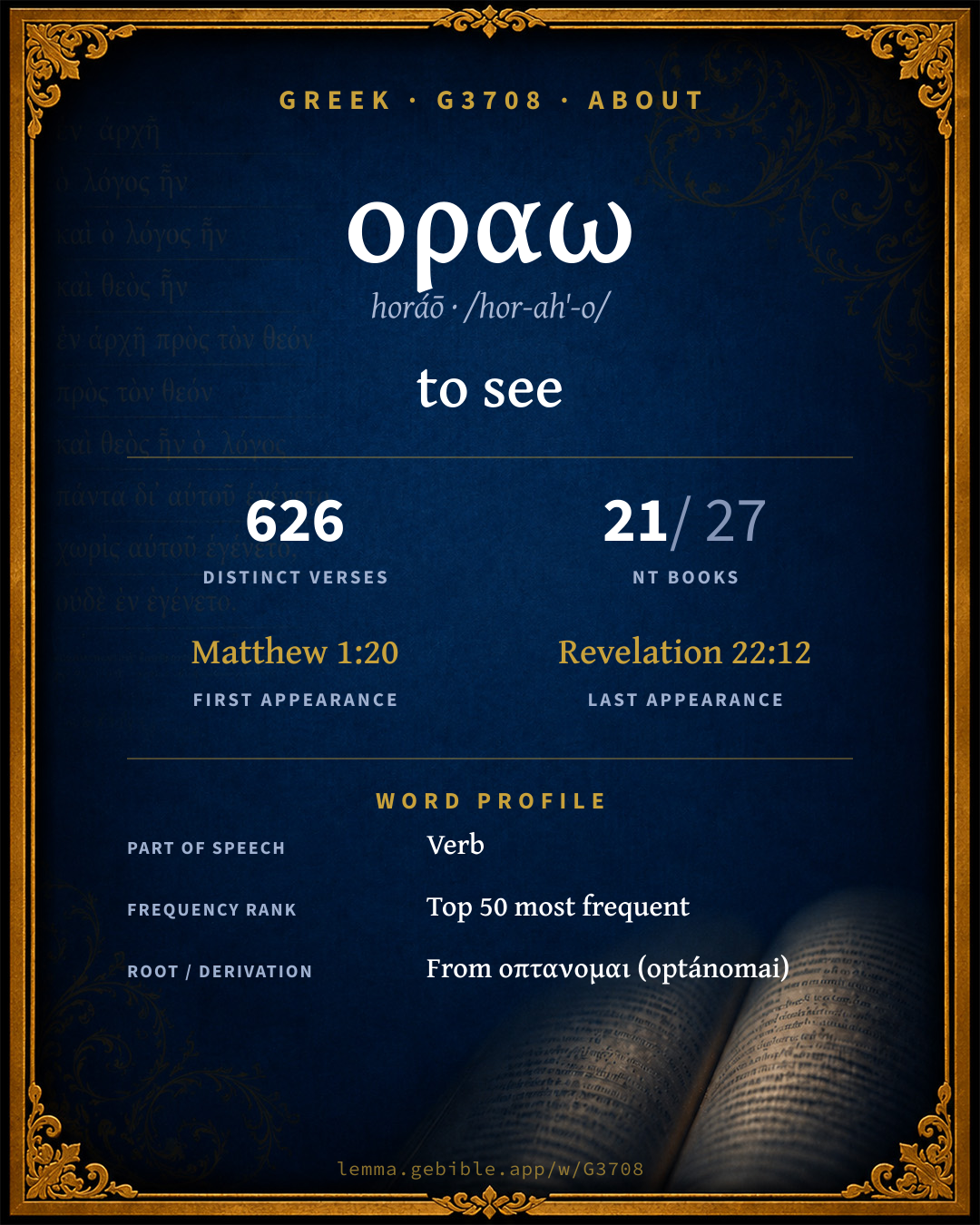
ὁράω
to see
‘to see’ is one of 6 main senses fuller range ↓
Full lexicon entry — Thayer's Greek Lexicon
From Thayer's Greek Lexicon
Where this word appears
See every Aorist-tense verb in the Greek New Testament →
Grammar key — what these labels mean
Part of speech
- Verb
- An action or state-of-being word.
Tense
- Aorist
- Action viewed as a simple whole, without regard to duration — often past (perfective aspect).
- Future
- Action expected in future time.
- Perfect
- A completed past action with continuing present results.
- Present
- Ongoing or general action in present time (imperfective aspect).
- Imperfect
- Continuous or repeated action in past time (“was writing”).
- Pluperfect
- A past action completed before another past point (“had written”).
Voice
- Middle
- The subject acts on or for itself, or with special interest in the action.
- Active
- The subject performs the action.
- Passive
- The subject receives the action.
- Middle deponent
- Middle in form but active in meaning.
Mood
- Imperative
- Expresses a command or request.
- Participle
- A verbal adjective (“writing,” “having written”).
- Indicative
- States a fact or asks a factual question (the mood of reality).
- Infinitive
- A verbal noun (“to write”), unmarked for person or number.
- Subjunctive
- Expresses probability, purpose, or possibility (the mood of contingency).
Case
- Nominative
- The case of the subject (and the predicate nominative).
- Genitive
- The case of source, possession, or “of” — answers “whose / from what.”
Person
- 2nd person
- The one addressed (“you”).
- 1st person
- The speaker (“I / we”).
- 3rd person
- The one spoken about (“he / she / it / they”).
Gender
- Masculine
- Grammatically masculine.
- Feminine
- Grammatically feminine.
Number
- Singular
- One.
- Plural
- More than one.
31 distinct verses where G3708 appears in the Perfect tense, across 7 books. Filtered view — show all forms. Click any verse to open its interlinear word-by-word view. Verse text shown in the World English Bible for context — . Each verse’s Greek form is shown with its reference; the English is not keyword-highlighted, since the data carries no word-level English alignment. Use “Compare translations” on any verse to read it across multiple English versions. This concordance covers the Greek New Testament; Septuagint (Greek Old Testament) occurrences of this word are not indexed here.
Luke 3 verses
- Luke 1:22 ἑώρακεν perf act ind 3sg attic When he came out, he could not speak to them, and they perceived that he had seen a vision in the temple. He continued making signs to them, and remained mute.
- Luke 9:36 ἑώρακαν perf act ind 3pl When the voice came, Jesus was found alone. They were silent, and told no one in those days any of the things which they had seen.
- Luke 24:23 ἑωρακέναι perf act inf and when they didn't find his body, they came saying that they had also seen a vision of angels, who said that he was alive.
John 18 verses
- John 1:18 ἑώρακεν perf act ind 3sg attic No one has seen God at any time. The one and only Son, who is in the bosom of the Father, he has declared him.
- John 1:34 ἑώρακα perf act ind 1sg attic I have seen, and have testified that this is the Son of God."
- John 3:11 ἑωράκαμεν perf act ind 1pl attic Most assuredly I tell you, we speak that which we know, and testify of that which we have seen, and you don't receive our witness.
- John 3:32 ἑώρακεν perf act ind 3sg attic What he has seen and heard, of that he testifies; and no one receives his witness.
- John 4:45 ἑωρακότες perf act ptcp nom pl masc attic So when he came into Galilee, the Galileans received him, having seen all the things that he did in Jerusalem at the feast, for they also went to the feast.
- John 5:37 ἑωράκατε perf act ind 2pl attic The Father himself, who sent me, has testified about me. You have neither heard his voice at any time, nor seen his form.
- John 6:36 ἑωράκατέ perf act ind 2pl attic But I told you that you have seen me, and yet you don't believe.
- John 6:46 ἑώρακέν ἑώρακεν perf act ind 3sg attic perf act ind 3sg attic Not that anyone has seen the Father, except he who is from God. He has seen the Father.
- John 8:38 ἑώρακα perf act ind 1sg attic I say the things which I have seen with my Father; and you also do the things which you have seen with your father."
- John 8:57 ἑώρακας perf act ind 2sg attic The Jews therefore said to him, "You are not yet fifty years old, and have you seen Abraham?"
- John 9:37 ἑώρακας perf act ind 2sg attic Jesus said to him, "You have both seen him, and it is he who speaks with you."
- John 14:7 ἑωράκατε perf act ind 2pl attic If you had known me, you would have known my Father also. From now on, you know him, and have seen him."
- John 14:9 ἑωρακὼς ἑώρακεν perf act ptcp nom sg masc attic perf act ind 3sg attic Jesus said to him, "Have I been with you such a long time, and do you not know me, Philip? He who has seen me has seen the Father. How do you say, 'Show us the Father?'
- John 15:24 ἑωράκασιν perf act ind 3pl attic If I hadn't done among them the works which no one else did, they wouldn't have had sin. But now have they seen and also hated both me and my Father.
- John 19:35 ἑωρακὼς perf act ptcp nom sg masc attic He who has seen has testified, and his testimony is true. He knows that he tells the truth, that you may believe.
- John 20:18 ἑώρακα perf act ind 1sg attic Mary Magdalene came and told the disciples that she had seen the Lord, and that he had said these things to her.
- John 20:25 ἑωράκαμεν ἴδω perf act ind 1pl attic aor act subj 1sg The other disciples therefore said to him, "We have seen the Lord!" But he said to them, "Unless I see in his hands the print of the nails, and put my hand into his side, I will not believe."
- John 20:29 ἑώρακάς ἰδόντες perf act ind 2sg attic aor act ptcp nom pl masc Jesus said to him, "Because you have seen me, you have believed. Blessed are those who have not seen, and have believed."
Acts 1 verse
1 Corinthians 1 verse
Colossians 2 verses
- Colossians 2:1 ἑόρακαν perf act ind 3pl For I desire to have you know how greatly I struggle for you, and for those at Laodicea, and for as many as have not seen my face in the flesh;
- Colossians 2:18 ἑόρακεν perf act ind 3sg Let no one rob you of your prize by a voluntary humility and worshipping of the angels, dwelling in the things which he has not seen, vainly puffed up by his fleshly mind,
1 John 5 verses
- 1 John 1:1 ἑωράκαμεν perf act ind 1pl attic That which was from the beginning, that which we have heard, that which we have seen with our eyes, that which we saw, and our hands touched, concerning the Word of life
- 1 John 1:2 ἑωράκαμεν perf act ind 1pl attic (and the life was revealed, and we have seen, and testify, and declare to you the life, the eternal life, which was with the Father, and was revealed to us);
- 1 John 1:3 ἑωράκαμεν perf act ind 1pl attic that which we have seen and heard we declare to you, that you also may have fellowship with us. Yes, and our fellowship is with the Father, and with his Son, Jesus Christ.
- 1 John 3:6 ἑώρακεν perf act ind 3sg attic Whoever remains in him doesn't sin. Whoever sins hasn't seen him, neither knows him.
- 1 John 4:20 ἑώρακεν ἑώρακεν perf act ind 3sg attic perf act ind 3sg attic If a man says, "I love God," and hates his brother, he is a liar; for he who doesn't love his brother whom he has seen, how can he love God whom he has not seen?
3 John 1 verse
About this entry
At a glance — auto-summarized from this page’s data, not written by a person. Every figure links to its source below. This summary describes the numbers; it doesn’t interpret them.
“to see” is the headline sense of the Greek verb οραω (horáō). Where the King James Version says “seen,” newer translations reach for “saw” (Berean Standard Bible) and “behold” (unfoldingWord Literal Text); the renderings breakdown has the detail. The Greek New Testament uses it across 626 verses — among the most common. First canonically at Matthew 1:20, it enters the text early. Catalogued under 6 senses, its meaning is not single-sense. The sections below give every sense, occurrence, and version rendering.
Gloss history
Strong's 1890 vs modern scholarship

About this word
Strong's G3708 catalogs a Greek word from the Greek New Testament.
These counts are not copied from any lexicon or concordance. They are computed here, from the morphology-tagged Greek New Testament. What Lemma adds →
- 626
- distinct verses
- The word appears in 626 distinct verses.
- 21 / 27
- NT books
- The word appears in 21 of 27 New Testament books.
- #27
- by frequency
- Top 50 most frequent Greek words (rank 27 of 5,347 Greek words by occurrence).
View all 626 occurrences in the concordance →
By section of the New Testament
By traditional corpus
Conventional, traditional groupings — biblical authorship is debated, so this is a traditional corpus grouping, not an authorship claim. Some books belong to more than one corpus (Luke is in both the Gospels and the Lukan corpus, and so on), so these shares overlap and need not total 100%. Each figure is a share of the word’s 626 distinct verses.
- Gospels 393 verses · 63%
- Lukan (Luke–Acts) 209 verses · 33%
- Johannine 165 verses · 26%
- Revelation 77 verses · 12%
- Pauline corpus 37 verses · 6%
- General (Catholic) Epistles 21 verses · 3%
- Hebrews 14 verses · 2%
How translations render this word
Counts come from each version’s own published word-to-Strong’s tagging or interlinear alignment — an approximate guide to how each version renders this word, not a word-level alignment the data otherwise carries. Because each total is that version’s own tagged count, the per-version totals vary from one another and need not match the appearance or distinct-verse counts above. These counts may also differ from a printed concordance because Lemma counts each distinctly tagged rendering and does not collapse phrase taggings into a single head-word total. This is a fixed set of word-tagged versions (KJV, ASV, BSB, ULT) and does not change with the reading translation you choose elsewhere. Each version’s license is shown beside its name below (and on Sources).
- King James Version: Seen 10×, See 8×, Take heed 5×
- American Standard Version: Seen 10×, See 7×, Hath seen 6×
- Berean Standard Bible: Saw 87×, See 51×, I saw 36×
- unfoldingWord Literal Text: Behold 224×, Having seen 76×, See 73×
King James Version Public Domain
Renders G3708 across 67 tagged occurrences — most commonly:
Plus other, less common renderings. Plus 19 renderings that appear only once — usually multi-word phrases or single function words the recovered tagging swept in, not distinct renderings. Not rendered by a distinct English word in 1 further occurrence.
American Standard Version Public Domain
Renders G3708 across 66 tagged occurrences — most commonly:
Plus other, less common renderings. Plus 19 renderings that appear only once — usually multi-word phrases or single function words the recovered tagging swept in, not distinct renderings.
Berean Standard Bible Public Domain
Renders G3708 across 445 tagged occurrences — most commonly:
Plus other, less common renderings. Plus 63 renderings that appear only once — usually multi-word phrases or single function words the recovered tagging swept in, not distinct renderings. Not rendered by a distinct English word in 3 further occurrences.
unfoldingWord Literal Text CC BY-SA 4.0
Renders G3708 across 730 tagged occurrences — most commonly:
Plus other, less common renderings. Plus 38 renderings that appear only once — usually multi-word phrases or single function words the recovered tagging swept in, not distinct renderings.
Senses in Thayer's
The 6 senses Thayer's distinguishes for this word, in lexicon order (not ranked by frequency or importance). The full entry — with sub-senses — is in the Lexicon Entry tab.
- to see with the eyes
- to see with the mind, to perceive, know
- to see, i.e. become acquainted with by experience, to experience
- to take heed, beware
- to care for, pay heed to
- I was seen, showed myself, appeared
Word origin
Derived from οπτανομαι (optánomai) (G3700) — to look at.
Properly to stare at (compare G3700 ) that is (by implication) to discern clearly (physically or mentally); by extension to attend to; by hebraism to experience ; passively to appear : - behold perceive see take heed.
— Strong’s Exhaustive Concordance (1890), public domain.
Forms in the corpus
The 76 distinct written forms G3708 takes in the Greek New Testament, most frequent first — each parse links to that tense’s occurrences in the concordance.
The 60 most common forms are shown; 16 rarer forms follow in the full concordance.
Same root — word family
Other Thayer's entries built from the same root as G3708, grouped by Strong’s listed origin. These share a root / origin per the lexicon — not necessarily a shared meaning. Each links to that word’s own entry.
Derives from
Shares the same root
- ομμα ómma G3659 eye
- οπη opḗ G3692 opening
- οπισθεν ópisthen G3693 behind
- οπτασια optasía G3701 vision
- οφθαλμος ophthalmós G3788 eye
- οφις óphis G3789 serpent
- οφρυς ophrŷs G3790 eyebrow
- οψις ópsis G3799 face
- σκυθρωπος skythrōpós G4659 sad-faced
Derived from this word
- οπτανομαι optánomai G3700 to look at
- οραμα hórama G3705 vision
- ορασις hórasis G3706 sight
- ορατος horatós G3707 visible
Proper names from this root
People and places named from this root — a name, not an additional meaning of the word.
Compare all same-root words → Showing 4 of 15 — not the complete family. 1 of the same-root words is a proper name (a person or place). They share a root, not necessarily a meaning.
Septuagint usage
The same Greek word οραω appears 1,200 times in the Greek Old Testament (Septuagint), across 1,119 verses in 37 books.
- 1,200
- LXX occurrences
- Tagged occurrences of this Greek word in the Septuagint.
- 1,119
- verses
- Distinct Septuagint verses containing this word.
- 37 / 39
- OT books
- The word appears in 37 of the 39 Old Testament books.
Sample Septuagint occurrences
- Genesis 1:4 ὁράω
- Exodus 2:2 ὁράω
- Leviticus 5:1 ὁράω
- Numbers 1:49 ὁράω
- Deuteronomy 1:8 ὁράω
- Joshua 2:1 ὁράω
- Judges 1:24 ὁράω
- Ruth 1:18 ὁράω
- 1 Samuel 1:22 ὁράω
- 2 Samuel 1:7 ὁράω
- 1 Kings 3:5 ὁράω
- 2 Kings 2:10 ὁράω
Septuagint occurrences (same lexeme)
Every verse where the same Strong’s number (G3708) appears in the Greek Septuagint — showing the first 50 of 1,119. Verse text shown in the World English Bible for context; the Greek form is the matched word — the English is not keyword-highlighted.
- Genesis 1:4 ὁράω God saw the light, and saw that it was good. God divided the light from the darkness.
- Genesis 1:8 ὁράω God called the expanse sky. There was evening and there was morning, a second day.
- Genesis 1:9 ὁράω God said, "Let the waters under the sky be gathered together to one place, and let the dry land appear," and it was so.
- Genesis 1:10 ὁράω God called the dry land Earth, and the gathering together of the waters he called Seas. God saw that it was good.
- Genesis 1:12 ὁράω The earth brought forth grass, herbs yielding seed after their kind, and trees bearing fruit, with its seed in it, after their kind: and God saw that it was good.
- Genesis 1:18 ὁράω and to rule over the day and over the night, and to divide the light from the darkness. God saw that it was good.
- Genesis 1:21 ὁράω God created the large sea creatures, and every living creature that moves, with which the waters swarmed, after their kind, and every winged bird after its kind. God saw that it was good.
- Genesis 1:25 ὁράω God made the animals of the earth after their kind, and the cattle after their kind, and everything that creeps on the ground after its kind. God saw that it was good.
- Genesis 1:31 ὁράω God saw everything that he had made, and, behold, it was very good. There was evening and there was morning, the sixth day.
- Genesis 2:19 ὁράω Out of the ground Yahweh God formed every animal of the field, and every bird of the sky, and brought them to the man to see what he would call them. Whatever the man called every living creature, that was its name.
- Genesis 3:6 ὁράω When the woman saw that the tree was good for food, and that it was a delight to the eyes, and that the tree was to be desired to make one wise, she took of the fruit of it, and ate; and she gave some to her husband with her, and he ate.
- Genesis 6:2 ὁράω that God's sons saw that men's daughters were beautiful, and they took for themselves wives of all that they chose.
- Genesis 6:5 ὁράω Yahweh saw that the wickedness of man was great in the earth, and that every imagination of the thoughts of his heart was only evil continually.
- Genesis 6:12 ὁράω God saw the earth, and saw that it was corrupt, for all flesh had corrupted their way on the earth.
- Genesis 7:1 ὁράω Yahweh said to Noah, "Come with all of your household into the ark, for I have seen your righteousness before me in this generation.
- Genesis 8:5 ὁράω The waters receded continually until the tenth month. In the tenth month, on the first day of the month, the tops of the mountains were seen.
- Genesis 8:7 ὁράω and he sent forth a raven. It went back and forth, until the waters were dried up from off the earth.
- Genesis 8:8 ὁράω He sent forth a dove from him, to see if the waters were abated from off the surface of the ground,
- Genesis 8:13 ὁράω It happened in the six hundred first year, in the first month, the first day of the month, the waters were dried up from off the earth. Noah removed the covering of the ark, and looked. He saw that the surface of the ground was dried.
- Genesis 9:14 ὁράω It will happen, when I bring a cloud over the earth, that the rainbow will be seen in the cloud,
- Genesis 9:16 ὁράω The rainbow will be in the cloud. I will look at it, that I may remember the everlasting covenant between God and every living creature of all flesh that is on the earth."
- Genesis 9:22 ὁράω Ham, the father of Canaan, saw the nakedness of his father, and told his two brothers outside.
- Genesis 9:23 ὁράω Shem and Japheth took a garment, and laid it on both their shoulders, went in backwards, and covered the nakedness of their father. Their faces were backwards, and they didn't see their father's nakedness.
- Genesis 11:5 ὁράω Yahweh came down to see the city and the tower, which the children of men built.
- Genesis 12:7 ὁράω Yahweh appeared to Abram, and said, "I will give this land to your seed." He built an altar there to Yahweh, who appeared to him.
- Genesis 12:12 ὁράω It will happen, when the Egyptians will see you, that they will say, 'This is his wife.' They will kill me, but they will save you alive.
- Genesis 12:14 ὁράω It happened that when Abram had come into Egypt, the Egyptians saw that the woman was very beautiful.
- Genesis 12:15 ὁράω The princes of Pharaoh saw her, and praised her to Pharaoh; and the woman was taken into Pharaoh's house.
- Genesis 13:10 ὁράω Lot lifted up his eyes, and saw all the plain of the Jordan, that it was well watered every where, before Yahweh destroyed Sodom and Gomorrah, like the garden of Yahweh, like the land of Egypt, as you go to Zoar.
- Genesis 13:14 ὁράω Yahweh said to Abram, after Lot was separated from him, "Now, lift up your eyes, and look from the place where you are, northward and southward and eastward and westward,
- Genesis 13:15 ὁράω for all the land which you see, I will give to you, and to your offspring forever.
- Genesis 16:4 ὁράω He went in to Hagar, and she conceived. When she saw that she had conceived, her mistress was despised in her eyes.
- Genesis 16:5 ὁράω Sarai said to Abram, "This wrong is your fault. I gave my handmaid into your bosom, and when she saw that she had conceived, I was despised in her eyes. Yahweh judge between me and you."
- Genesis 16:13 ὁράω She called the name of Yahweh who spoke to her, "You are a God who sees," for she said, "Have I even stayed alive after seeing him?"
- Genesis 16:14 ὁράω Therefore the well was called Beer Lahai Roi. Behold, it is between Kadesh and Bered.
- Genesis 17:1 ὁράω When Abram was ninety-nine years old, Yahweh appeared to Abram, and said to him, "I am God Almighty. Walk before me, and be blameless.
- Genesis 18:1 ὁράω Yahweh appeared to him by the oaks of Mamre, as he sat in the tent door in the heat of the day.
- Genesis 18:2 ὁράω He lifted up his eyes and looked, and saw that three men stood opposite him. When he saw them, he ran to meet them from the tent door, and bowed himself to the earth,
- Genesis 18:21 ὁράω I will go down now, and see whether they have done altogether according to the cry of it, which is come to me. If not, I will know."
- Genesis 19:1 ὁράω The two angels came to Sodom at evening. Lot sat in the gate of Sodom. Lot saw them, and rose up to meet them. He bowed himself with his face to the earth,
- Genesis 19:28 ὁράω He looked toward Sodom and Gomorrah, and toward all the land of the plain, and looked, and saw that the smoke of the land went up as the smoke of a furnace.
- Genesis 21:9 ὁράω Sarah saw the son of Hagar the Egyptian, whom she had borne to Abraham, mocking.
- Genesis 21:16 ὁράω She went and sat down opposite him, a good way off, about a bow shot away. For she said, "Don't let me see the death of the child." She sat over against him, and lifted up her voice, and wept.
- Genesis 21:19 ὁράω God opened her eyes, and she saw a well of water. She went, filled the bottle with water, and gave the boy drink.
- Genesis 22:4 ὁράω On the third day Abraham lifted up his eyes, and saw the place far off.
- Genesis 22:8 ὁράω Abraham said, "God will provide himself the lamb for a burnt offering, my son." So they both went together.
- Genesis 22:13 ὁράω Abraham lifted up his eyes, and looked, and saw that behind him was a ram caught in the thicket by his horns. Abraham went and took the ram, and offered him up for a burnt offering instead of his son.
- Genesis 22:14 ὁράω Abraham called the name of that place Yahweh-Jireh. As it is said to this day, "In Yahweh's mountain it will be provided.
- Genesis 24:30 ὁράω It happened, when he saw the ring, and the bracelets on his sister's hands, and when he heard the words of Rebekah his sister, saying, "This is what the man said to me," that he came to the man. Behold, he was standing by the camels at the spring.
- Genesis 24:63 ὁράω Isaac went out to meditate in the field at the evening. He lifted up his eyes, and saw, and, behold, there were camels coming.
These are occurrences of the same Greek lexeme (G3708) in the Septuagint — not a translation of any one Hebrew word. The store carries no word-level Hebrew↔Greek alignment, so no Hebrew original is asserted here. Counts come from the recovered LXX Strong's tagging — high-frequency vocabulary is well covered, while rare or late forms may be untagged — so they reflect tagged occurrences and may slightly undercount.