Matthew 25:37

Greek (Tischendorf 8th ed.) Matthew 25:37 appears in the Greek New Testament. The text above is from the Tischendorf 8th edition. Each word links to its Strong’s number and a concise gloss. Click any word for its full Thayer’s Greek Lexicon entry.
Download image
Cite this verse

Matthew 25:37 (World English Bible). Public Domain. Lemma interlinear Bible study tool, https://lemma.gebible.app/v/matthew/25/37.

Show BibTeX & RIS
BibTeX
RIS
English Translation
"Then the righteous will answer him, saying, 'Lord, when did we see you hungry, and feed you; or thirsty, and give you a drink?
World English Bible · Public Domain
Download a study sheet

One document with this verse’s original text, its word-by-word gloss line, the meaning frame, cross-references with their text, attributed commentary, and full source and license credits — printable, and it pastes into notes with its structure intact.

This verse Autodidact and up

Study sheet (.html) Plain text (.txt)

A passage Seminary Student

Up to 50 verses in one chapter. A passage sheet keeps up to 6 commentary sources and 12 cross-references per verse, in the order this page ranks them, and says so on the sheet whenever that leaves anything out. Ask for a single verse and you get the Autodidact verse sheet above.

Everything on this page stays free to read, with no account — the sheet is a download of what is already on screen, not access to it.

Want to remove ads? Support Godless Engineer
Compare translations 3

The same verse in 3 English versions, stacked beneath the original-language interlinear above. Click any original word for its lexicon entry.

Each is an independent rendering of the whole verse — the interlinear is not word-aligned to these translations.

Highlighted words mark where these versions differ — a whole-verse word diff, not a word-by-word alignment.

  • World English Bible Public Domain
    "Then the righteous will answer him, saying, 'Lord, when did we see you hungry, and feed you; or thirsty, and give you a drink?
  • King James Version Public Domain
    Then shall the righteous answer him, saying, Lord, when saw we thee an hungred, and fed thee? or thirsty, and gave thee drink?
  • unfoldingWord Literal Text CC BY-SA 4.0
    Then the righteous will answer him, saying, ‘Lord, when did we see you being hungry and feed? Or being thirsty and give to drink?

unfoldingWord Literal Text — © unfoldingWord, licensed CC BY-SA 4.0. Word-aligned USFM3 via Door43 (git.door43.org/unfoldingWord/en_ult).

Versions to compare (up to 4)

3 of 4 selected

Show all 19 translations

Every available English version of this verse, each an independent rendering of the whole verse.

  • World English Bible Public Domain
    "Then the righteous will answer him, saying, 'Lord, when did we see you hungry, and feed you; or thirsty, and give you a drink?
  • Berean Standard Bible Public Domain
    Then the righteous will answer Him, ‘Lord, when did we see You hungry and feed You, or thirsty and give You something to drink?
  • Majority Standard Bible Public Domain
    Then the righteous will answer Him, ‘Lord, when did we see You hungry and feed You, or thirsty and give You something to drink?
  • King James Version Public Domain
    Then shall the righteous answer him, saying, Lord, when saw we thee an hungred, and fed thee? or thirsty, and gave thee drink?
  • American Standard Version (1901) Public Domain
    Then shall the righteous answer him, saying, Lord, when saw we thee hungry, and fed thee? or athirst, and gave thee drink?
  • Revised Version (1885) Public Domain
    Then shall the righteous answer him, saying, Lord, when saw we thee an hungred, and fed thee? or athirst, and gave thee drink?
  • Geneva Bible (1599) Public Domain
    Then shall the righteous answere him, saying, Lord, when sawe we thee an hungred, and fed thee? or a thirst, and gaue thee drinke?
  • Douay-Rheims (1899) Public Domain
    Then shall the just answer him, saying: Lord, when did we see thee hungry, and fed thee; thirsty, and gave thee drink?
  • Young's Literal Translation Public Domain
    `Then shall the righteous answer him, saying, Lord, when did we see thee hungering, and we nourished? or thirsting, and we gave to drink?
  • Literal Standard Version CC BY-SA 4.0
    Then will the righteous answer Him, saying, Lord, when did we see You hungering, and we nourished? Or thirsting, and we gave to drink?
  • Unlocked Literal Bible CC BY-SA 4.0
    Then the righteous will answer and say, 'Lord, when did we see you hungry and feed you? Or thirsty and give you a drink?
  • unfoldingWord Literal Text CC BY-SA 4.0
    Then the righteous will answer him, saying, ‘Lord, when did we see you being hungry and feed? Or being thirsty and give to drink?
  • Darby Bible Public Domain
    Then shall the righteous answer him saying, Lord, when saw we thee hungering, and nourished thee; or thirsting, and gave thee to drink?
  • World Messianic Bible Public Domain
    “Then the righteous will answer him, saying, ‘Lord, when did we see you hungry and feed you, or thirsty and give you a drink?
  • Webster's Bible Public Domain
    Then will the righteous answer him, saying, Lord, when saw we thee hungry, and fed thee? or thirsty, and gave thee drink?
  • Free Bible Version CC BY-SA 4.0
    Then those who are right will answer, ‘Lord, when did we see you hungry and fed you, or thirsty and gave you a drink?
  • Bible in Basic English Public Domain
    Then will the upright make answer to him, saying, Lord, when did we see you in need of food, and give it to you? or in need of drink, and give it to you?
  • Text-Critical English NT CC BY 4.0
    Then the righteous will answer him, ‘Lord, when did we see yoʋ hungry and feed yoʋ, or thirsty and give yoʋ something to drink?
  • Tyndale New Testament (1534) Public Domain
    Then shall the righteous answere him sayinge master when sawe we the anhongred and feed the? or a thurst and gave the drinke?

Literal Standard Version (2020), Covenant Press — licensed CC BY-SA 4.0. Text via the HelloAO Bible API (eBible.org). Unlocked Literal Bible (unfoldingWord) — licensed CC BY-SA 4.0. Text via the HelloAO Bible API (eBible.org). unfoldingWord Literal Text — © unfoldingWord, licensed CC BY-SA 4.0. Word-aligned USFM3 via Door43 (git.door43.org/unfoldingWord/en_ult). Free Bible Version, Dr. Jonathan Gallagher — licensed CC BY-SA 4.0. Text via the HelloAO Bible API (eBible.org).

Word by word

More ways to search: Search by grammar → Find every occurrence → Compare this word →

Practice this passage: Drill this verse → Learn its vocabulary →

ἐθρέψαμεν
tréphō
G5142
“to nourish”
Verb, Aorist, Active, Indicative, 1st person, Plural
Part of Speech
Verb
Tense
Aorist
Voice
Active
Mood
Indicative
Person
1st person
Number
Plural
Full Thayer's Definition

Origin: a primary verb (properly, threpho

TDNT: but perhaps strength. from the base of 5157 through the idea of convolution)

1. to nourish, support 2. feed 3. to give suck, to fatten 4. to bring up, nurture
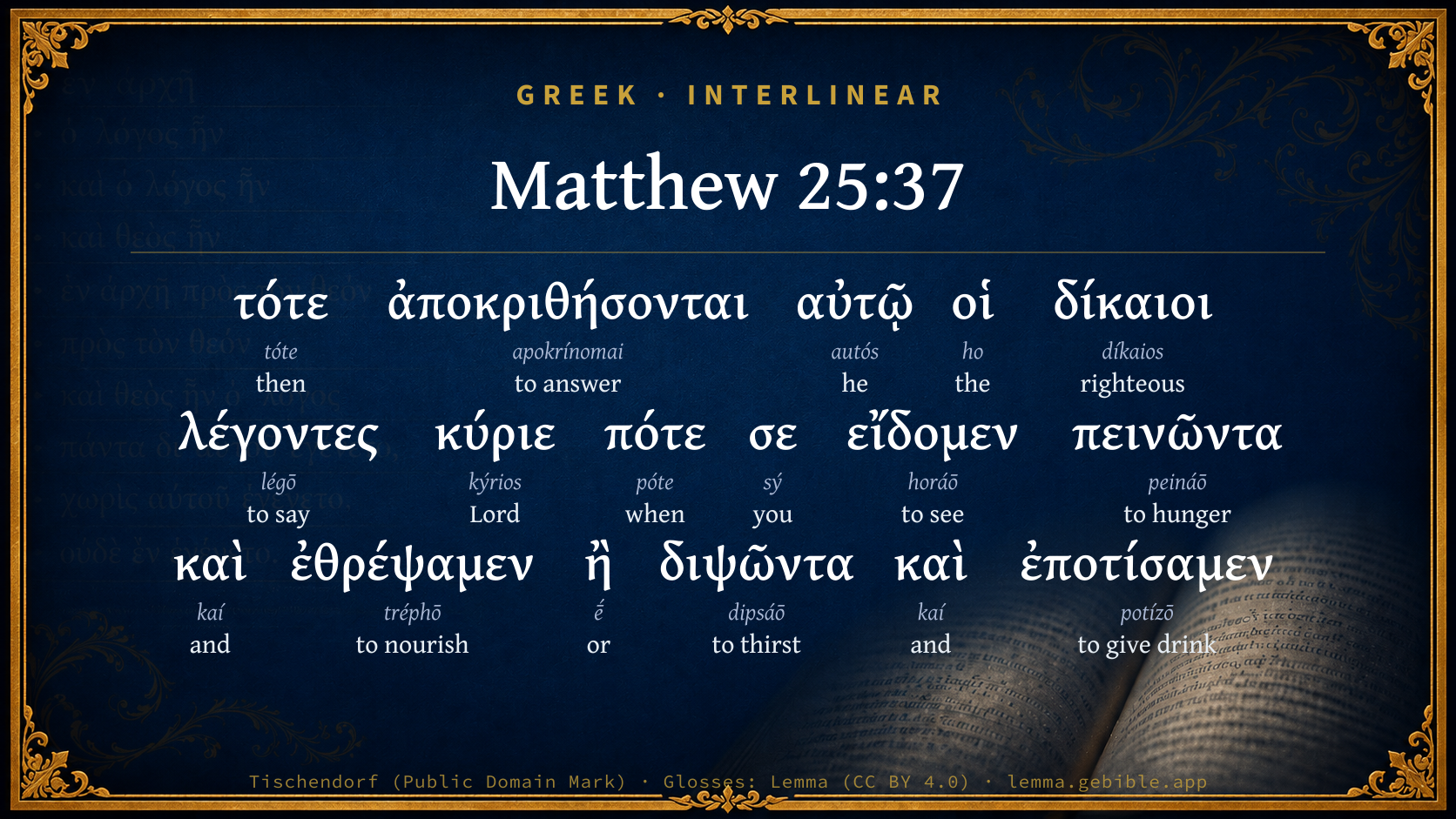
  1. τότε tóte G5119 “then” Adverb
  2. ἀποκριθήσονται apokrínomai G611 “to answer” Verb, Future, Passive deponent, Indicative, 3rd person, Plural
  3. αὐτῷ autós G846 “he” Personal pronoun, Dative, Singular, Masculine
  4. οἱ ho G3588 “the” Article, Nominative, Plural, Masculine
  5. δίκαιοι díkaios G1342 “righteous” Adjective, Nominative, Plural, Masculine
  6. λέγοντες légō G3004 “to say” Verb, Present, Active, Participle, Nominative, Plural, Masculine
  7. κύριε kýrios G2962 “Lord” Noun, Vocative, Singular, Masculine
  8. πότε póte G4219 “when” Particle, Interrogative
  9. σε sý G4771 “you” Personal pronoun, 2nd person, Accusative, Singular
  10. εἴδομεν horáō G3708 “to see” Verb, Aorist, Active, Indicative, 1st person, Plural
  11. πεινῶντα peináō G3983 “to hunger” Verb, Present, Active, Participle, Accusative, Singular, Masculine
  12. καὶ kaí G2532 “and” Conjunction
  13. ἢ ḗ G2228 “or” Particle
  14. διψῶντα dipsáō G1372 “to thirst” Verb, Present, Active, Participle, Accusative, Singular, Masculine
  15. καὶ kaí G2532 “and” Conjunction
  16. ἐποτίσαμεν potízō G4222 “to give drink” Verb, Aorist, Active, Indicative, 1st person, Plural

About this verse

These counts appear in no published source. They are computed here, from the morphology-tagged text and Lemma’s own curated glosses. What Lemma adds →

17
words
16
distinct lemmas
Gospels
section

Notable vocabulary

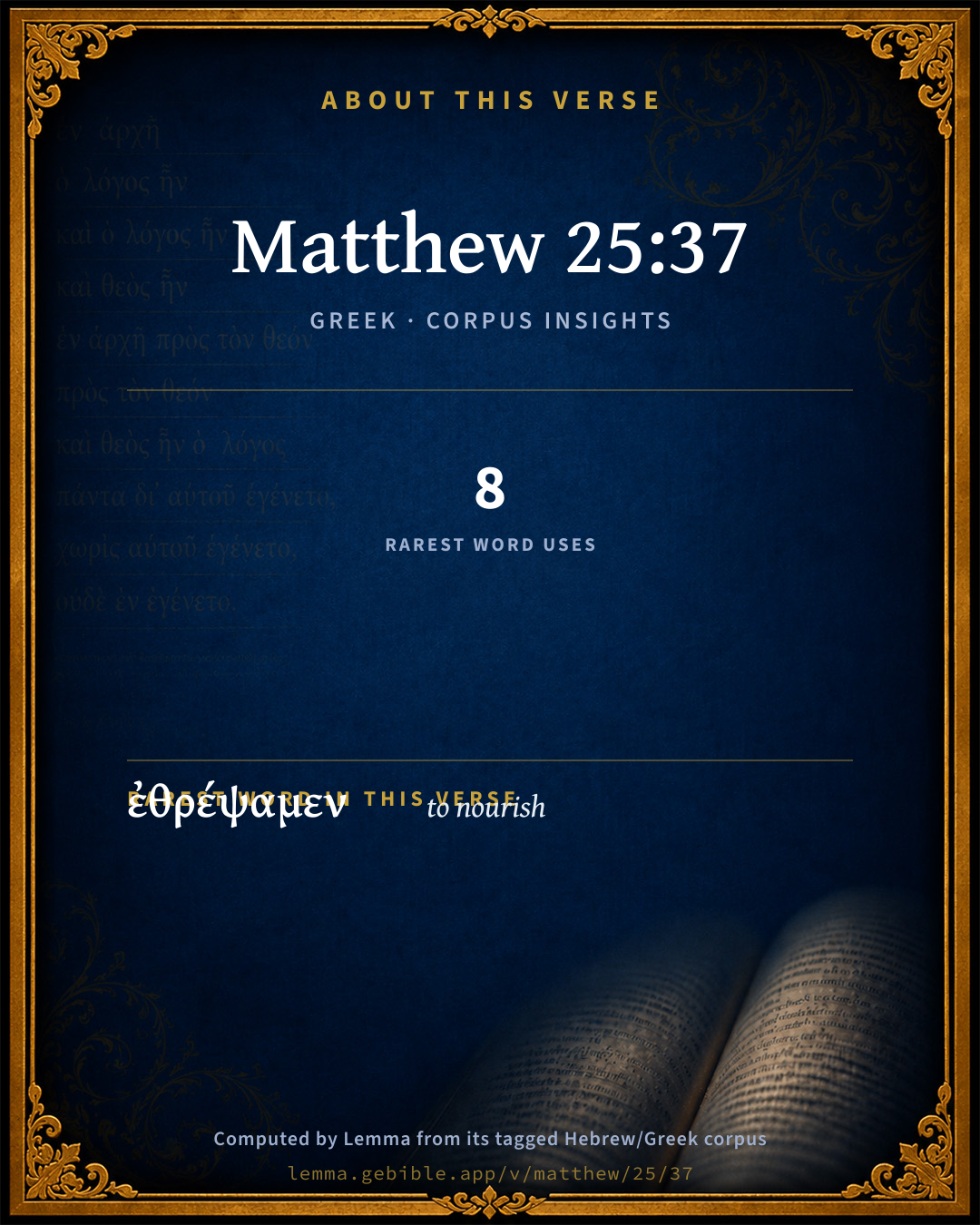
The rarest word here is ἐθρέψαμεν to nourish G5142 — appearing just 8 times in the whole Greek New Testament.

Shared distinctive vocabulary

ἐθρέψαμεν to nourish G5142 occurs in 8 verses of the Greek New Testament. Also found in:

Repetition

A word recurs within this verse:

Cross-references

6

Topical passages linked to Matthew 25:37 in the Treasury of Scripture Knowledge — connected by theme and wording, ordered by reader-vote popularity; previews shown in the World English Bible.

  • Matthew 6:3 But when you do merciful deeds, don't let your left hand know what your right hand does,
  • 1 Chronicles 29:14 But who am I, and what is my people, that we should be able to offer so willingly as this? For all things come of you, and of your own have we given you.
  • 1 Peter 5:5–6 Likewise, you younger ones, be subject to the elder. Yes, all of you gird yourselves with humility, to subject yourselves to one another; for "God resists the proud, but gives grace to the humble."
  • Proverbs 15:33 The fear of Yahweh teaches wisdom. Before honor is humility.
  • Isaiah 64:6 For we are all become as one who is unclean, and all our righteousness are as a polluted garment: and we all do fade as a leaf; and our iniquities, like the wind, take us away.
  • 1 Corinthians 15:10 But by the grace of God I am what I am. His grace which was bestowed on me was not futile, but I worked more than all of them; yet not I, but the grace of God which was with me.

Cross-references courtesy of OpenBible.info (CC BY 4.0).

Commentary

Notes on Matthew 25:37 from classic Christian and Jewish commentators (each source and its license shown beneath its notes). The classic Christian expositions comment on the surrounding passage and are grouped to its opening verse, so a note may address several verses; the Jewish commentaries on the Tanakh (Rashi and others) are per-verse, so they appear only where the commentator wrote on this verse.

Lemma curates 59 commentaries, every one of them public domain or Creative Commons licensed, each selected and text-cleaned for this edition rather than reprinted as found. About our sources →

Joseph Benson's Commentary

Mat 25:37-40. Then shall the righteous answer, &c. — The righteous, with great surprise, ask, with reverence and humility, when all this happened, since they never had seen him in want of their assistance, nor could remember that they had ever bestowed aught upon him. It cannot be supposed, however, that either the righteous or the wicked should answer in the very words here mentioned. But what we learn here from is, That neither of them have the same estimation of their own works which the Judge hath. And the King shall answer — Inasmuch as, &c. — “This is unspeakably astonishing! The united wisdom of men and angels could not have thought of any thing more proper to convey an idea of the warmth and strength of the divine benevolence to men, or offer a more constraining motive to charity, than that the Son of God should declare from the judgment-seat, in presence of the whole universe assembled, that such good offices as are done to the afflicted are done to him. Having in the days of his flesh suffered injuries and afflictions unspeakable, he considers all the virtuous distressed as members of his body, loves them tenderly, and is so much interested in their welfare, that when they are happy he rejoices; when they are distressed he is grieved: Ye have done it unto me — O wonderful condescension of the Son of God! O astonishing stupidity of men, who neglect altogether, or are persuaded with difficulty to do good to Christ! That Jesus should call the poor, even among the heathen, his brethren, is a great honour to the human nature, and shows the divine benignity in an amiable light. This happy relation arises from the manhood which he still possesses in common with men, and from the poverty, affliction, and other miseries of mankind, that he was exposed to while he lived in the world. He calls good men, more especially, his brethren, because they are children of the same Father, (namely, God,) after whose image they are formed by the influence of his Spirit. It is this conformity of natures, human and divine, which makes men Christ’s brethren; for which reason, in whatever person it is found, he will acknowledge the relation, without regard to any circumstance whatever that is out of the person’s power.” — Macknight.

Joseph Benson's Commentary on the Old and New Testaments (1811–1818) — public domain. Text from a community e-Sword module.

Tyndale Open Study Notes

Tyndale Open Resources

25:37 These righteous ones (see 5:6, 20) are those who do God’s will as taught by Jesus, expressed most clearly in deeds of love (7:12; 9:9-13; 22:34-40; 25:35-40).

Tyndale Open Study Notes — © Tyndale Open Resources, licensed CC BY-SA 4.0. Text via the HelloAO Bible API.

Bengel's Gnomon

Johann Albrecht Bengel

Mat 25:37. Πότε Σὲ εἴδομεν, κ.τ.λ., when saw we Thee, etc.[1102]) The faithful do not estimate their good deeds, nor the wicked their bad (Mat 25:44), in the same manner as the Judge.

[1102] In like manner, many of the righteous, who have conferred benefits on each other in this world, remain mutually unknown.—B. G. V.

Bengel's Gnomon of the New Testament — English translation (T&T Clark, Edinburgh, 1860) — public domain. Text from a community e-Sword module.

Meyer's Critical & Exegetical Commentary

Heinrich August Wilhelm Meyer

Mat_25:37 ff. Not mere modesty (not even, according to Olshausen, unconscious modesty), but an actual declining with humility, on the ground that they have never rendered the loving services in question to Christ Himself; for they do not venture to estimate the moral value of those services according to the lofty principle of Christs unity with His people, Mat_18:5, Mat_10:40. The Lord Himself then explains what He means, Mat_25:40. Hence it does not follow from this passage that these δίκαιοι have not as yet been consciously leading the New Testament life (Auberlen, Cremer). Bengel well remarks: Fideles opera bona sua, impii mala Mat_25:44, non perinde aestimant ut judex.

πότε σὲ εἴδομεν] three times, earnestly, honestly.

ἐφʼ ὅσον] in quantum, inasmuch as; see on Rom_11:13.

ἐποιήσατε] ye have done it, namely, the things previously mentioned.

ἑνὶ τούτων τῶν ἀδελφῶν μου τῶν ἐλαχίστων] to a single one of these my brethren, and that of the most insignificant of them. Those words, which are referred by Keil, Olshausen, Georgii, Hilgenfeld, Keim (see on Mat_25:31 f.), to Christians in general; by Cremer, to the elect; by Luthardt, to the Christian church in its distress; by Auberlen, to their poor miserable fellow-men (comp. de Wette, Ullmann in the Stud. u. Krit. 1847, p. 164 ff.),do not admit of being also referred to the apostles (Mat_28:10; 1Co_4:13), to whom, as surrounding His judgment-throne, Christ is supposed to point; for the amount of love shown to the apostles cannot be taken as the universal standard of judgment; and though the apostles themselves, appearing here, as they do, in their relation to the rest of Christians, may well be called the brethren of Christ (Mat_28:10; Joh_20:17); yet they would certainly not be described by Him as the least of such brethren. No; as during His earthly life Christ is always surrounded by the obscure and despised (the poor, the humble, publicans and sinners, and such like), who seek their salvation through Him; so He also represents Himself as still surrounded by such as these on the occasion of the judgment (comp. Ewald, p. 420). In consequence of their longing after Him, and of their love for Him, and the eternal salvation to be found in Him (as ἠγαπηκότες τὴν ἐπιφάνειαν αὐτοῦ, 2Ti_4:8), they here come crowding around the throne of His glory; and to these He now points. They are the πτωχοί, πενθοῦντες, πρᾳεῖς, δεδιωγμένοι of the Sermon on the Mount, who are now on the point of receiving the promised bliss.

Meyer — Critical and Exegetical Commentary on the New Testament — English translation by Peter Christie, edited by Frederick Crombie (T&T Clark, 1880) — public domain. Text from a community e-Sword module.

Expositor's Greek Testament

ed. W. Robertson Nicoll

Mat 25:37 . κύριε : not necessarily spoken by disciples supposed to know or believe in Jesus (Weiss). The title fits the judicial dignity of the person addressed by whomsoever used. In disclaiming the praise accorded, those who call the Judge κύριος virtually deny personal acquaintance with Him.

The Expositor's Greek Testament, edited by W. Robertson Nicoll (1897–1910) — public domain. Text from a community e-Sword module.

Adam Clarke's Commentary

Verse 37. Lord, when saw we thee an hungered, c.] This barbarous expression, an hungered, should be banished out of the text, wheresoever it occurs, and the simple word hungry substituted for it. Whatever is done for Christ's sake, is done through Christ's grace and he who does the work attributes to Jesus both the will and the power by which the work was done, and seeks and expects the kingdom of heaven not as a reward, but as a gift of pure unmerited mercy. Yet, while workers together with his grace, God attributes to them that which they do through his influence, as if they had done it independently of him. God has a right to form what estimate he pleases of the works wrought through himself: but man is never safe except when he attributes all to his Maker.

Adam Clarke's Commentary on the Bible (1810–1826) — public domain. Text from a community e-Sword/MySword module.

Ellicott's Commentary for English Readers

(37) When saw we thee an hungred?—It is clear that this question of surprise could not be asked by any who, as believers in Christ, have come under this teaching. They know, even now, the full significance of their acts of mercy, and that knowledge is as their strongest motive. But in the lips of the heathen who stand before the judgment-seat such a question will be natural enough. They have acted from what seemed merely human affection towards merely human objects, and they are therefore rightly represented as astonished when they hear that they have, in their ministrations to the sons of men, been ministering to the Son of Man.

A Bible Commentary for English Readers, edited by Charles John Ellicott (1878–1897) — public domain. Text from a community e-Sword module.

John Gill's Exposition

Then shall the righteous answer him,.... From whence it appears, that only such shall be at the right hand of Christ, who are righteous persons, who have the righteousness of Christ imputed to them; and, in consequence of which, are created anew unto righteousness and true holiness; and, under the influence of divine grace, live soberly, righteously, and godly: and those, upon hearing such works ascribed unto them, will, with wonder and astonishment, reply,

saying, Lord, when saw we thee an hungered, and fed thee? or thirsty, and gave thee drink? which answer arises partly from not attending to, or thoroughly understanding the words of Christ, which they seem to take in such sense, as if he meant these things were personally done to him; whereas the far greater part of them had never seen him in the flesh, and much less in such circumstances as required such things to be done to him; and partly from surprise and astonishment, that he should take notice of such mean actions, and so highly extol them, and graciously reward them; as also from a forgetfulness of them, their left hand not knowing what their right hand had done: which shows, that they had put no confidence in their works, or depended upon them for their justification before God, and acceptance, with him; these were out of sight, and mind; their only trust being in the person, blood, righteousness, and sacrifice of Christ.

John Gill's Exposition of the Whole Bible (1746–1763) — public domain (CC PDM 1.0). Text via the HelloAO Bible API.

Trapp's Complete Commentary

John Trapp

37 Then shall the righteous answer him, saying, Lord, when saw we thee an hungred, and fed thee? or thirsty, and gave thee drink?

Ver. 37. Then shall the righteous, &c.] Not that there shall be then any such dialogism (say divines) at the last day: but Christ would hereby give us to understand that the saints rising again, and returning to themselves, can never sufficiently set forth such a bounty in Christ, whereby he taketh all they do to their poor necessitous brethren, in as good part as done to his sacred self.

John Trapp, A Commentary or Exposition upon All the Books of the Old and New Testament (1647–1656) — public domain. Text from a community e-Sword module.

Albert Barnes' Notes on the Bible

Then shall the righteous ... - This answer is indicative of humility - a deep sense of their being unworthy such commendation. They will feel that their poor acts of kindness have come so far short of what they should have been that they have no claim to praise or reward. It is not, however, to be supposed that in the day of judgment this will be actually “said” by the righteous, but that this would be a proper expression of their feelings.

Albert Barnes' Notes on the Bible (1834–1885) — public domain. Text from a community e-Sword/MySword module.

Whedon's Commentary on the Bible

Daniel D. Whedon

37. Then shall the righteous answer — The great principle of the inadequacy of all creature merit to so high a reward is here put into the mouths of the saints, where it most beautifully belongs. It is a truth which their deep humility prompts them to express.

Daniel D. Whedon (gen. ed.), Commentary on the Old and New Testaments (1874–1909) — public domain. Text from a community e-Sword module.

The Pulpit Commentary

Vers. 37-39. Shall the righteous answer him. The righteous are those on the right hand, those who have passed through earthly probation, and have come forth holy and pure. Their reply (which is given before the Lord"s explanation) is contained in three verses, which recapitulate the deeds specified by the Lord, with some slight variation in the wording. When saw we thee, etc.? If this reply is conceived as spoken by the followers of Christ, who most be supposed to know what he had said, (Mat_10:40-42, "He that receiveth you receiveth me," etc.) it must be considered as expressive, not so much of surprise, as profound humility, which had never hitherto realized the grand idea. They had done so little, they had rendered him no service personally, they were unworthy so to do how could they merit such a reward? If the answer is taken as given by non-Christians, it shows ignorance of the high value of their service, and astonishment that, in following the dictates of conscience and charity, they had unwittingly had the supreme honour of serving Christ. Mediaeval legends have exemplified the identity of Christ and his suffering members by telling how saints have seen him in those whom they relieved. Such stories are told of Saints Augustine, Christopher, Martin, and others. And fed thee (eyreqamen). Instead of "gave me to eat" (ver. 35). Sick or in prison, and came unto thee. Instead of "sick, and ye visited me; in prison," etc. The Lord could not more emphatically have recommended works of mercy as having the highest value in his estimation. "There is a mystery in many of the actions of men, which needs the interpretation of the Master" (Morison).

The Pulpit Commentary (1880–1919), ed. H.D.M. Spence-Jones & Joseph S. Exell — public domain. Text from a community e-Sword module.

John Wesley's Explanatory Notes

Then shall the righteous answer - It cannot be, that either the righteous or the wicked should answer in these very words. What we learn herefrom is, that neither of them have the same estimation of their own works as the Judge hath.

John Wesley, Explanatory Notes Upon the Whole Bible (1754–1765) — public domain. Text via the GEBible commentary corpus.

Scofield Reference Notes

C. I. Scofield

righteous

(See Scofield "Rom 10:10")

The Scofield Reference Bible (1917 edition), notes by C. I. Scofield — public domain. Text from a community e-Sword module.

Burkitt's Expository Notes on the New Testament

William Burkitt

Here we have a dialogue or interchangeable discourse betwixt Christ and his faithful servants at the great day.

Where observe, Their question and his reply. Their question, Lord, when did we feed thee, clothe, or visit thee? We have forgot the time, though such is thy goodness to remember it.

Learn thence, That Christ keeps a faithful record of all our acts of pious charity, when we have forgotten them. If we remember to do good, Christ will be sure to remember the good we have done; aye, and reward it as well as remember it.

Again, this question of theirs may proceed from admiration and wonder, and from an humble sense of their own nothingness, and from the greatness of Christ’s condescension, in taking notice of such mean services, and requiting them with such a transcendent reward.

Learn hence, That when Christ comes to reward his children and people, they will wonder and be astonished at the poverty and meanness of their own services, and at the transcendency and greatness of his rewards.

Observe next, Our Lord’s reply, In as much as ye did it to the least of these my brethren, ye did it unto me.

Where observe, 1. The title put by Jesus Christ upon his poorest and meanest members, My brethren.

2. The resentment of the kindness showed to his brethren, as shown unto himself: In as much as ye did it to them, ye have done it to me.

Learn thence, That such is the endearing intimacy between Christ and his members, that whatsoever is done to any of them, is esteemed by him as done unto himself.

William Burkitt's Expository Notes on the New Testament (1700–1703) — public domain. Text from a community e-Sword module.

The People's New Testament

B. W. Johnson

37, 38, 39. Then shall the righteous answer him, saying, Lord, when saw we thee, etc. The saints in all ages, in lands unknown when Christ was on earth, saints who had never seen him when he was in the flesh, he commends for feeding, visiting and entertaining him whom they had never seen in person. What more natural than for them to exclaim: “When saw we thee? When did we entertain thee?” etc.

B. W. Johnson's The People's New Testament with Notes (1889–1891) — public domain. Electronic text from the Christian Classics Ethereal Library (CCEL) ThML edition.

unfoldingWord translationNotes

Door43 World Missions Community

the righteous

This can be stated as an adjective. AT: "the righteous people" (See: Nominal Adjectives)

Or thirsty ... Or naked

The understood information can be stated clearly. AT: "Or when did we see you thirsty ... Or when did we see you naked" (See: Ellipsis)

the King

This is another title for the Son of Man. Jesus is speaking about himself in the third person. (See: First, Second, or Third Person)

say to them

"say to those at his right hand"

Truly I say to you

"I tell you the truth." This emphasizes what the King says next.

one of the least

"one of the least important"

these brothers of mine

Here "brothers" refers to anyone, male or female, who obeys the King. AT: "my brothers and sisters here" or "these who are like my brothers and sisters" (See: When Masculine Words Include Women)

you did it for me

"I consider that you did it for me"

translationWords

righteous

lord

amen

unfoldingWord translationNotes — © Distant Shores Media and the Door43 World Missions Community, licensed CC BY-SA 4.0. Source: git.door43.org/Door43/en_tn.

Alford’s Greek Testament

Henry Alford

37-40.] The answer of these δίκαιοι appears to me to shew plainly (as Olshausen and Stier interpret it) that they are not to be understood as being the covenanted servants of Christ. Such an answer it would be impossible for them to make, who had done all distinctly with reference to Christ, and for his sake, and with his declaration of ch. 10:40-42 before them. Such a supposition would remove all reality, as indeed it has generally done, from our Lord’s description. See the remarkable difference in the answer of the faithful servants, vv. 20, 22. The saints are already in his glory—judging the world with Him (1Co 6:2)—accounted as parts of, representatives of, Himself (ver. 40)—in this judgment they are not the judged (Joh 5:24: 1Co 11:31). But these who are the judged, know not that all their deeds of love have been done to and for Christ—they are overwhelmed with the sight of the grace which has been working in and for them, and the glory which is now their blessed portion. And notice, that it is not the works, as such, but the love which prompted them—that love which was their faith,—which felt its way, though in darkness, to Him who is Love,—which is commended.

τῶν ἀδελφ.] Not necessarily the saints with Him in glory—though primarily those—but also any of the great family of man. Many of those here judged may never have had opportunity of doing these things to the saints of Christ properly so called.

In this is fulfilled the covenant of God to Abraham, ἐνευλογηθήσονται ἐν τῷ σπέρματί σου πάντα τὰ ἔθνη τῆς γῆς. Gen 22:18.

Henry Alford, The Greek Testament (1849–1861) — public domain. Text from a community e-Sword module.

International Critical Commentary

37. Then the righteous shall answer Him, saying, Lord, when saw we Thee hungry, and fed Thee? or thirsty, and gave Thee to drink?]

(L)

International Critical Commentary — older volumes (1896–1929), various authors — public domain. Text from a community e-Sword module.

Lesson kit

Teaching starters — assembled from the data on this page, not authored interpretation. Every prompt links to the verse data it draws on. Edit before teaching.

Matthew, in the Gospels, opens this verse with 17 words (16 distinct Greek lemmas). Its most distinctive word is tréphō (“to nourish”). A historical commentator’s framing appears above. Read the whole chapter for the surrounding context.

Discussion questions

  1. How does “to nourish” (tréphō) shape what this verse is saying?
  2. How does Matthew 6:26, which shares the word «to nourish», read alongside this verse?
  3. What does the repetition of “and” (2× in this one verse) do in this verse?
  4. These translations render this verse differently; the difference is in the English rendering, not the original. What questions does that raise?
  5. Compare how Joseph Benson's Commentary and Tyndale Open Study Notes read this verse. Where do they agree or differ?

Things to notice

Reading settings

Reading text

Shown beneath each verse's original-language words.

Old Testament
Old Testament edition

Read the OT as the Masoretic Hebrew (MT) or the Greek Septuagint (LXX).

English shown for the Greek Septuagint (in the Hebrew ↔ Greek comparison).

Comparing translations? Open the Compare panel on any verse page to stack up to four side by side.