

Matthew 27:4
Greek (Tischendorf 8th ed.) Matthew 27:4 appears in the Greek New Testament. The text above is from the Tischendorf 8th edition. Each word links to its Strong’s number and a concise gloss. Click any word for its full Thayer’s Greek Lexicon entry.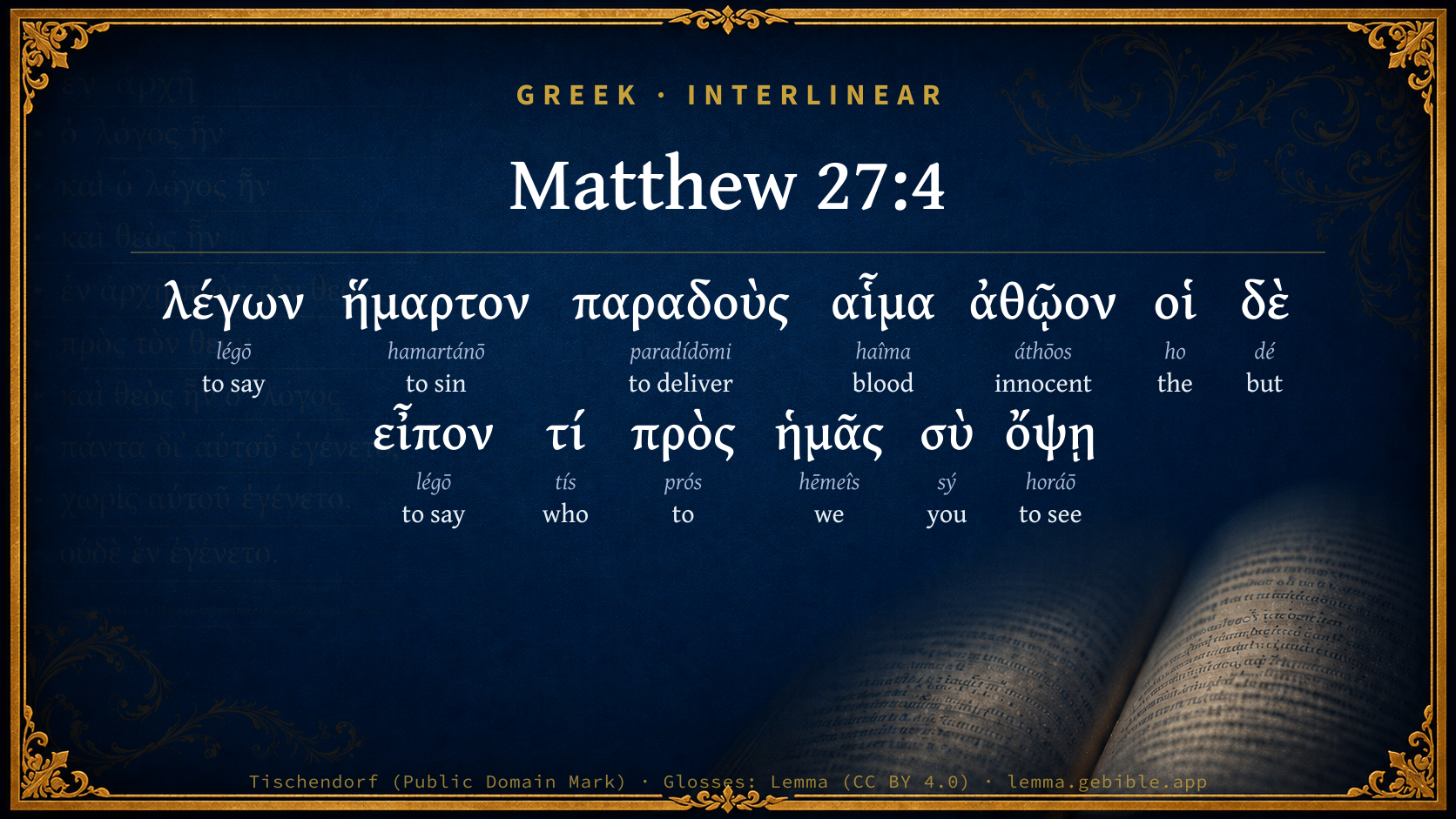
saying, "I have sinned in that I betrayed innocent blood." But they said, "What is that to us? You see to it."
Download a study sheet
One document with this verse’s original text, its word-by-word gloss line, the meaning frame, cross-references with their text, attributed commentary, and full source and license credits — printable, and it pastes into notes with its structure intact.
This verse Autodidact and up
A passage Seminary Student
Up to 50 verses in one chapter. A passage sheet keeps up to 6 commentary sources and 12 cross-references per verse, in the order this page ranks them, and says so on the sheet whenever that leaves anything out. Ask for a single verse and you get the Autodidact verse sheet above.
Everything on this page stays free to read, with no account — the sheet is a download of what is already on screen, not access to it.
Compare translations 3
The same verse in 3 English versions, stacked beneath the original-language interlinear above. Click any original word for its lexicon entry.
Each is an independent rendering of the whole verse — the interlinear is not word-aligned to these translations.
Highlighted words mark where these versions differ — a whole-verse word diff, not a word-by-word alignment.
-
World English Bible Public Domain
saying, "I have sinned in that I betrayed innocent blood." But they said, "What is that to us? You see to it."
-
King James Version Public Domain
Saying, I have sinned in that I have betrayed the innocent blood. And they said, What is that to us? see thou to that.
-
unfoldingWord Literal Text CC BY-SA 4.0
saying, “I have sinned, having handed over innocent blood.” But they said, “What to us? You will see.”
unfoldingWord Literal Text — © unfoldingWord, licensed CC BY-SA 4.0. Word-aligned USFM3 via Door43 (git.door43.org/unfoldingWord/en_ult).
Show all 19 translations
Every available English version of this verse, each an independent rendering of the whole verse.
-
World English Bible Public Domain
saying, "I have sinned in that I betrayed innocent blood." But they said, "What is that to us? You see to it."
-
Berean Standard Bible Public Domain
“I have sinned by betraying innocent blood,” he said. “What is that to us?” they replied. “You bear the responsibility.”
-
Majority Standard Bible Public Domain
“I have sinned by betraying innocent blood,” he said. “What is that to us?” they replied. “You bear the responsibility.”
-
King James Version Public Domain
Saying, I have sinned in that I have betrayed the innocent blood. And they said, What is that to us? see thou to that.
-
American Standard Version (1901) Public Domain
saying, I have sinned in that I betrayed innocent blood. But they said, What is that to us? see thou `to it'.
-
Revised Version (1885) Public Domain
saying, I have sinned in that I betrayed innocent blood. But they said, What is that to us? see thou to it.
-
Geneva Bible (1599) Public Domain
Saying, I haue sinned, betraying the innocent bloud. But they sayde, What is that to vs? see thou to it.
-
Douay-Rheims (1899) Public Domain
Saying: I have sinned in betraying innocent blood. But they said: What is that to us? look thou to it.
-
Young's Literal Translation Public Domain
`I did sin, having delivered up innocent blood;' and they said, `What -- to us? thou shalt see!'
-
Literal Standard Version CC BY-SA 4.0
“I sinned, having delivered up innocent blood”; and they said, “What [is that] to us? You will see!”
-
Unlocked Literal Bible CC BY-SA 4.0
and said, “I have sinned by betraying innocent blood.” But they said, “What is that to us? See to that yourself.”
-
unfoldingWord Literal Text CC BY-SA 4.0
saying, “I have sinned, having handed over innocent blood.” But they said, “What to us? You will see.”
-
Darby Bible Public Domain
saying, I have sinned [in] having delivered up guiltless blood. But they said, What is that to us? see *thou* [to that].
-
World Messianic Bible Public Domain
saying, “I have sinned in that I betrayed innocent blood.” But they said, “What is that to us? You see to it.”
-
Webster's Bible Public Domain
Saying, I have sinned in that I have betrayed innocent blood. And they said, What is that to us? see thou to that.
-
Free Bible Version CC BY-SA 4.0
“I've sinned! I've betrayed innocent blood!” he told them. “What's that got to do with us?” they replied. “That's your problem!”
-
Bible in Basic English Public Domain
Saying, I have done wrong in giving into your hands an upright man. But they said, What is that to us? it is your business.
-
Text-Critical English NT CC BY 4.0
saying, “I have sinned by betraying innocent blood.” But they said, “What is that to us? See to it yoʋrself.”
-
Tyndale New Testament (1534) Public Domain
sayinge: I have synned betrayinge the innocent bloud. And they sayde: what is that to vs? Se thou to that.
Literal Standard Version (2020), Covenant Press — licensed CC BY-SA 4.0. Text via the HelloAO Bible API (eBible.org). Unlocked Literal Bible (unfoldingWord) — licensed CC BY-SA 4.0. Text via the HelloAO Bible API (eBible.org). unfoldingWord Literal Text — © unfoldingWord, licensed CC BY-SA 4.0. Word-aligned USFM3 via Door43 (git.door43.org/unfoldingWord/en_ult). Free Bible Version, Dr. Jonathan Gallagher — licensed CC BY-SA 4.0. Text via the HelloAO Bible API (eBible.org).
Word by word
More ways to search: Search by grammar → Find every occurrence → Compare this word →
Practice this passage: Drill this verse → Learn its vocabulary →
- Appears 2× in the Greek New Testament
- First appears here
- Part of Speech
- Adjective
- Case
- Accusative
- Number
- Singular
- Gender
- Neuter
Full Thayer's Definition
- λέγων légō G3004 “to say” Verb, Present, Active, Participle, Nominative, Singular, Masculine
- ἥμαρτον hamartánō G264 “to sin” Verb, Aorist, Active, Indicative, 1st person, Singular
- παραδοὺς paradídōmi G3860 “to deliver” Verb, Aorist, Active, Participle, Nominative, Singular, Masculine
- αἷμα haîma G129 “blood” Noun, Accusative, Singular, Neuter
- ἀθῷον áthōos G121 “innocent” Adjective, Accusative, Singular, Neuter
- οἱ ho G3588 “the” Article, Nominative, Plural, Masculine
- δὲ dé G1161 “but” Conjunction
- εἶπον légō G3004 “to say” Verb, Aorist, Active, Indicative, 3rd person, Plural
- τί tís G5101 “who” Interrogative pronoun, Nominative, Singular, Neuter
- πρὸς prós G4314 “to” Preposition
- ἡμᾶς hēmeîs G2249 “we” Personal pronoun, 1st person, Accusative, Plural
- σὺ sý G4771 “you” Personal pronoun, 2nd person, Nominative, Singular
- ὄψῃ horáō G3708 “to see” Verb, Future, Middle deponent, Indicative, 2nd person, Singular
About this verse
These counts appear in no published source. They are computed here, from the morphology-tagged text and Lemma’s own curated glosses. What Lemma adds →
- 13
- words
- 12
- distinct lemmas
- Gospels
- section
Notable vocabulary
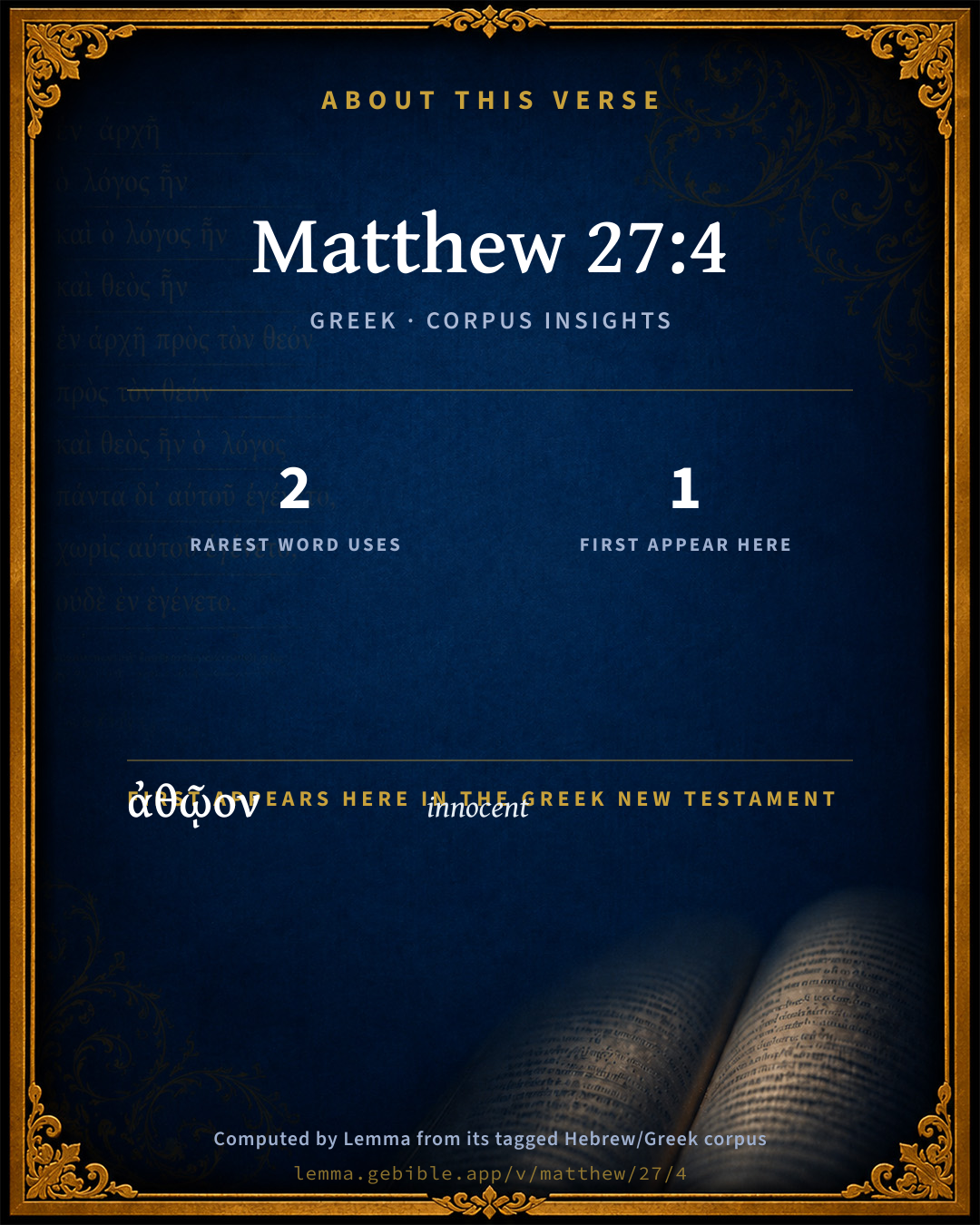
The rarest word here is ἀθῷον innocent G121 — appearing just 2 times in the whole Greek New Testament.
First appearance in Scripture
This word makes its first canonical appearance in the Greek New Testament here:
- ἀθῷον innocent G121
Shared distinctive vocabulary
ἀθῷον innocent G121 occurs in 2 verses of the Greek New Testament. Also found in:
Repetition
A word recurs within this verse:
- λέγων to say G3004 ×2
Cross-references
30Topical passages linked to Matthew 27:4 in the Treasury of Scripture Knowledge — connected by theme and wording, ordered by reader-vote popularity; previews shown in the World English Bible.
- Genesis 42:21–22 They said one to another, "We are most assuredly guilty concerning our brother, in that we saw the distress of his soul, when he begged us, and we wouldn't listen. Therefore this distress has come on us."
- Exodus 9:27 Pharaoh sent, and called for Moses and Aaron, and said to them, "I have sinned this time. Yahweh is righteous, and I and my people are wicked.
- Exodus 10:16–17 Then Pharaoh called for Moses and Aaron in haste, and he said, "I have sinned against Yahweh your God, and against you.
- Exodus 12:31 He called for Moses and Aaron by night, and said, "Rise up, get out from among my people, both you and the children of Israel; and go, serve Yahweh, as you have said!
- 1 Samuel 15:24 Saul said to Samuel, I have sinned; for I have transgressed the commandment of Yahweh, and your words, because I feared the people, and obeyed their voice.
- 1 Samuel 15:30 Then he said, I have sinned: yet honor me now, Please, before the elders of my people, and before Israel, and turn again with me, that I may worship Yahweh your God.
- 1 Samuel 28:16–20 Samuel said, Why then do you ask of me, seeing Yahweh is departed from you, and is become your adversary?
- 1 Kings 21:27 It happened, when Ahab heard those words, that he tore his clothes, and put sackcloth on his flesh, and fasted, and lay in sackcloth, and went softly.
- 2 Kings 24:4 and also for the innocent blood that he shed; for he filled Jerusalem with innocent blood: and Yahweh would not pardon.
- Job 16:2 "I have heard many such things. Miserable comforters are you all!
- Jeremiah 26:15 Only know for certain that, if you put me to death, you will bring innocent blood on yourselves, and on this city, and on the inhabitants of it; for of a truth Yahweh has sent me to you to speak all these words in your ears.
- Jonah 1:14 Therefore they cried to Yahweh, and said, "We beg you, Yahweh, we beg you, let us not perish for this man's life, and don't lay on us innocent blood; for you, Yahweh, have done as it pleased you."
- Matthew 27:19 While he was sitting on the judgment seat, his wife sent to him, saying, "Have nothing to do with that righteous man, for I have suffered many things this day in a dream because of him."
- Matthew 27:23–25 But the governor said, "Why? What evil has he done?" But they cried out exceedingly, saying, "Let him be crucified!"
- Matthew 27:54 Now the centurion, and those who were with him watching Jesus, when they saw the earthquake, and the things that were done, feared exceedingly, saying, "Truly this was the Son of God."
- Luke 16:25–26 "But Abraham said, 'Son, remember that you, in your lifetime, received your good things, and Lazarus, in like manner, bad things. But now here he is comforted and you are in anguish.
- Luke 23:22 He said to them the third time, "Why? What evil has this man done? I have found no capital crime in him. I will therefore chastise him and release him."
- Luke 23:41 And we indeed justly, for we receive the due reward for our deeds, but this man has done nothing wrong."
- Luke 23:47 When the centurion saw what was done, he glorified God, saying, "Certainly this was a righteous man."
- John 19:7 The Jews answered him, "We have a law, and by our law he ought to die, because he made himself the Son of God."
- Acts 13:28 Though they found no cause for death, they still asked Pilate to have him killed.
- Acts 18:15–17 but if they are questions about words and names and your own law, look to it yourselves. For I don't want to be a judge of these matters."
- Romans 3:19 Now we know that whatever things the law says, it speaks to those who are under the law, that every mouth may be closed, and all the world may be brought under the judgment of God.
- 1 Timothy 4:2 through the hypocrisy of men who speak lies, branded in their own conscience as with a hot iron;
- Titus 1:16 They profess that they know God, but by their works they deny him, being abominable, disobedient, and unfit for any good work.
- Hebrews 7:26 For such a high priest was fitting for us: holy, guiltless, undefiled, separated from sinners, and made higher than the heavens;
- 1 Peter 1:19 but with precious blood, as of a lamb without spot, the blood of Christ;
- 1 John 3:12 unlike Cain, who was of the evil one, and killed his brother. Why did he kill him? Because his works were evil, and his brother's righteous.
- Job 13:4 But you are forgers of lies. You are all physicians of no value.
- Revelation 11:10 Those who dwell on the earth rejoice over them, and they will be glad. They will give gifts to one another, because these two prophets tormented those who dwell on the earth.
Cross-references courtesy of OpenBible.info (CC BY 4.0).
Where the printed editions differ
1 variantPlaces in this verse where the major printed Greek editions disagree on the wording in a way that affects the translation — a comparison of editions, not a manuscript-by-manuscript collation. The editions are the modern critical texts (Nestlé-Aland 28/27, SBL, Westcott-Hort, Tregelles, Tyndale House) and the traditional texts behind the KJV (the Textus Receptus and the Byzantine/Majority text). It is not a claim about which reading is original.
-
Different wording
ἀθῷον.
“innocent.”
In NA28NA27TynSBLTregTRByz Not in WHδίκαιον (dikaion) 'righteous' occurs in a few manuscripts (WH) instead of ἀθῷον. (athōon) 'innocent.' in older manuscripts (NA28+NA27+Tyn+SBL+Treg+TR+Byz)
Textual data: Translators Amalgamated Greek New Testament (STEPBible TAGNT) · CC BY 4.0.
Lesson kit
Teaching starters — assembled from the data on this page, not authored interpretation. Every prompt links to the verse data it draws on. Edit before teaching.
Matthew, in the Gospels, opens this verse with 13 words (12 distinct Greek lemmas). Its most distinctive word is áthōos (“innocent”). A historical commentator’s framing appears above. Read the whole chapter for the surrounding context.
Discussion questions
- The word áthōos carries the sense “innocent.” How does it shape the verse?
- This is the first place “innocent” appears in Scripture (first appears here). What does its debut here establish?
- How does Matthew 27:24, which shares the word «innocent», read alongside this verse?
- What does the repetition of “to say” (2× in this one verse) do in this verse?
- These translations render this verse differently. What is at stake in choosing one wording over another?
- Compare how Tyndale Open Study Notes and Bengel's Gnomon read this verse. Where do they agree or differ?
Things to notice
- 1 word makes its first canonical appearance in Scripture here.
- These translations choose different wording for 6 words in this verse.
- “to say” occurs 2× in this single verse.
- 12 distinct Greek lemmas span 13 words in this verse.
Commentary
Notes on Matthew 27:4 from classic Christian and Jewish commentators (each source and its license shown beneath its notes). The classic Christian expositions comment on the surrounding passage and are grouped to its opening verse, so a note may address several verses; the Jewish commentaries on the Tanakh (Rashi and others) are per-verse, so they appear only where the commentator wrote on this verse.
Lemma curates 59 commentaries, every one of them public domain or Creative Commons licensed, each selected and text-cleaned for this edition rather than reprinted as found. About our sources →
Tyndale Open Study Notes
Tyndale Open Resources
Tyndale Open Study Notes — © Tyndale Open Resources, licensed CC BY-SA 4.0. Text via the HelloAO Bible API.
Bengel's Gnomon
Johann Albrecht Bengel
Bengel's Gnomon of the New Testament — English translation (T&T Clark, Edinburgh, 1860) — public domain. Text from a community e-Sword module.
Meyer's Critical & Exegetical Commentary
Heinrich August Wilhelm Meyer
Meyer — Critical and Exegetical Commentary on the New Testament — English translation by Peter Christie, edited by Frederick Crombie (T&T Clark, 1880) — public domain. Text from a community e-Sword module.
Expositor's Greek Testament
ed. W. Robertson Nicoll
The Expositor's Greek Testament, edited by W. Robertson Nicoll (1897–1910) — public domain. Text from a community e-Sword module.
Jamieson, Fausset & Brown
Robert Jamieson, A. R. Fausset & David Brown
Jamieson, Fausset & Brown — Commentary Critical and Explanatory on the Whole Bible (1871) — public domain (CC PDM 1.0). Text via the HelloAO Bible API.
Adam Clarke's Commentary
Adam Clarke's Commentary on the Bible (1810–1826) — public domain. Text from a community e-Sword/MySword module.
Ellicott's Commentary for English Readers
A Bible Commentary for English Readers, edited by Charles John Ellicott (1878–1897) — public domain. Text from a community e-Sword module.
The Cambridge Bible for Schools and Colleges
gen. ed. J. J. S. Perowne
The Cambridge Bible for Schools and Colleges (gen. ed. J. J. S. Perowne; Cambridge University Press, 1878–1918) — public domain. Text from a community e-Sword module.
John Gill's Exposition
John Gill's Exposition of the Whole Bible (1746–1763) — public domain (CC PDM 1.0). Text via the HelloAO Bible API.
Trapp's Complete Commentary
John Trapp
John Trapp, A Commentary or Exposition upon All the Books of the Old and New Testament (1647–1656) — public domain. Text from a community e-Sword module.
Albert Barnes' Notes on the Bible
Albert Barnes' Notes on the Bible (1834–1885) — public domain. Text from a community e-Sword/MySword module.
Whedon's Commentary on the Bible
Daniel D. Whedon
Daniel D. Whedon (gen. ed.), Commentary on the Old and New Testaments (1874–1909) — public domain. Text from a community e-Sword module.
The Pulpit Commentary
The Pulpit Commentary (1880–1919), ed. H.D.M. Spence-Jones & Joseph S. Exell — public domain. Text from a community e-Sword module.
John Wesley's Explanatory Notes
John Wesley, Explanatory Notes Upon the Whole Bible (1754–1765) — public domain. Text via the GEBible commentary corpus.
Scofield Reference Notes
C. I. Scofield
The Scofield Reference Bible (1917 edition), notes by C. I. Scofield — public domain. Text from a community e-Sword module.
The People's New Testament
B. W. Johnson
B. W. Johnson's The People's New Testament with Notes (1889–1891) — public domain. Electronic text from the Christian Classics Ethereal Library (CCEL) ThML edition.
Cambridge Greek Testament for Schools and Colleges
Cambridge Greek Testament for Schools and Colleges (Cambridge University Press, 1896; 21 vols, various authors incl. Carr, Maclear, Plummer, Farrar, Lumby, Moule, M. R. James, Simcox) — public domain. Text from a community e-Sword module.
International Critical Commentary
International Critical Commentary — older volumes (1896–1929), various authors — public domain. Text from a community e-Sword module.