
Matthew 8:29

Greek (Tischendorf 8th ed.) Matthew 8:29 appears in the Greek New Testament. The text above is from the Tischendorf 8th edition. Each word links to its Strong’s number and a concise gloss. Click any word for its full Thayer’s Greek Lexicon entry.
Download image
Cite this verse

Matthew 8:29 (World English Bible). Public Domain. Lemma interlinear Bible study tool, https://lemma.gebible.app/v/matthew/8/29.

Show BibTeX & RIS
BibTeX
RIS
English Translation
Behold, they cried out, saying, "What do we have to do with you, Jesus, Son of God? Have you come here to torment us before the time?"
World English Bible · Public Domain
Highlights
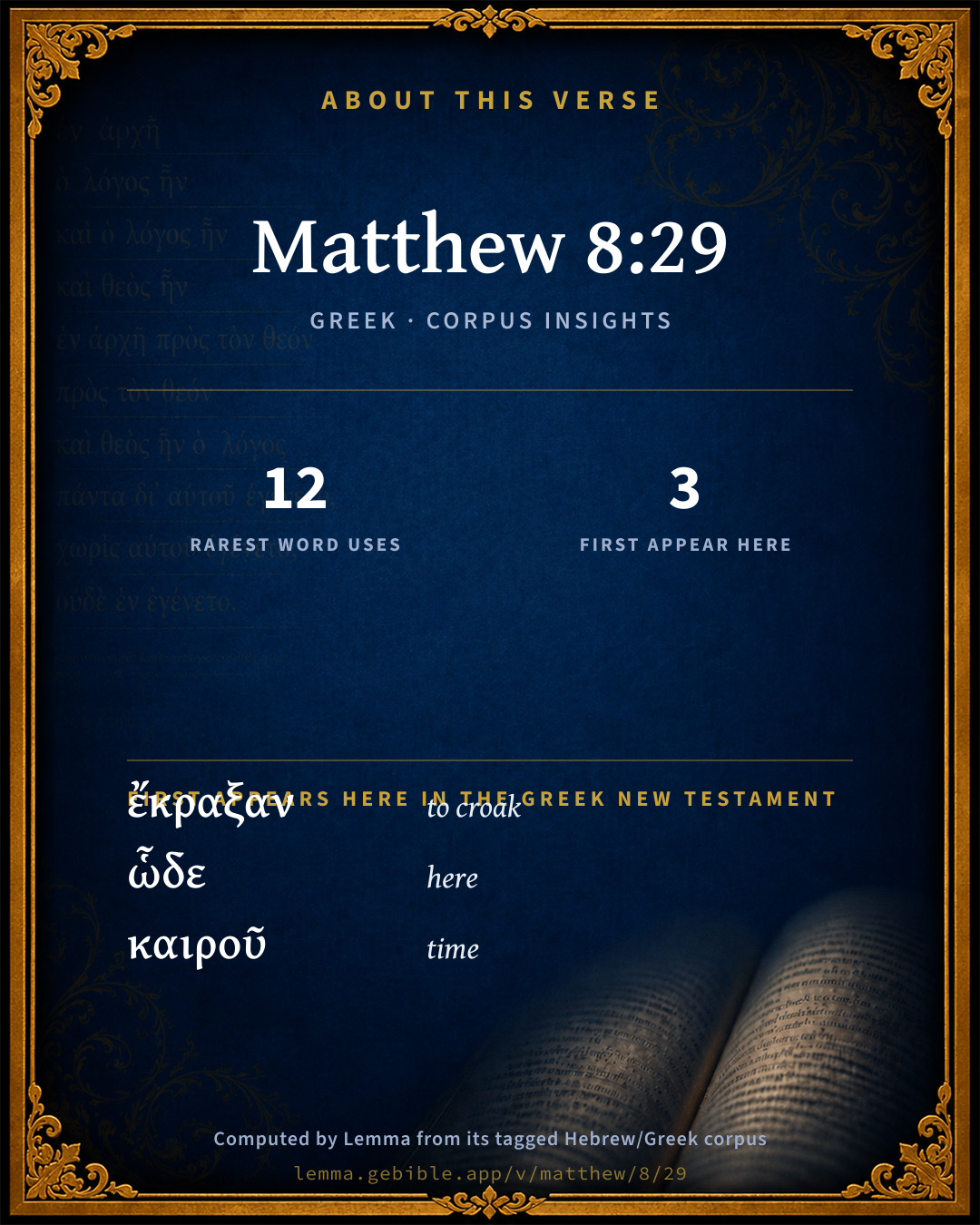
  • 3 first appearances in the Greek New Testament
Full analysis ↓
Download a study sheet

One document with this verse’s original text, its word-by-word gloss line, the meaning frame, cross-references with their text, attributed commentary, and full source and license credits — printable, and it pastes into notes with its structure intact.

This verse Autodidact and up

Study sheet (.html) Plain text (.txt)

A passage Seminary Student

Up to 50 verses in one chapter. A passage sheet keeps up to 6 commentary sources and 12 cross-references per verse, in the order this page ranks them, and says so on the sheet whenever that leaves anything out. Ask for a single verse and you get the Autodidact verse sheet above.

Everything on this page stays free to read, with no account — the sheet is a download of what is already on screen, not access to it.

Want to remove ads? Support Godless Engineer
Compare translations 3

The same verse in 3 English versions, stacked beneath the original-language interlinear above. Click any original word for its lexicon entry.

Each is an independent rendering of the whole verse — the interlinear is not word-aligned to these translations.

Highlighted words mark where these versions differ — a whole-verse word diff, not a word-by-word alignment.

  • World English Bible Public Domain
    Behold, they cried out, saying, "What do we have to do with you, Jesus, Son of God? Have you come here to torment us before the time?"
  • King James Version Public Domain
    And, behold, they cried out, saying, What have we to do with thee, Jesus, thou Son of God? art thou come hither to torment us before the time?
  • unfoldingWord Literal Text CC BY-SA 4.0
    And behold, they cried out, saying, “What to us and to you, Son of God? Have you come here to torment us before the set time?”

unfoldingWord Literal Text — © unfoldingWord, licensed CC BY-SA 4.0. Word-aligned USFM3 via Door43 (git.door43.org/unfoldingWord/en_ult).

Versions to compare (up to 4)

3 of 4 selected

Show all 19 translations

Every available English version of this verse, each an independent rendering of the whole verse.

  • World English Bible Public Domain
    Behold, they cried out, saying, "What do we have to do with you, Jesus, Son of God? Have you come here to torment us before the time?"
  • Berean Standard Bible Public Domain
    “What do You want with us, Son of God?” they shouted. “Have You come here to torture us before the appointed time?”
  • Majority Standard Bible Public Domain
    “What do You want with us, Jesus, Son of God?” they shouted. “Have You come here to torture us before the appointed time?”
  • King James Version Public Domain
    And, behold, they cried out, saying, What have we to do with thee, Jesus, thou Son of God? art thou come hither to torment us before the time?
  • American Standard Version (1901) Public Domain
    And behold, they cried out, saying, What have we to do with thee, thou Son of God? art thou come hither to torment us before the time?
  • Revised Version (1885) Public Domain
    And behold, they cried out, saying, What have we to do with thee, thou Son of God? art thou come hither to torment us before the time?
  • Geneva Bible (1599) Public Domain
    And beholde, they cryed out, saying, Iesus the sonne of God, what haue we to do with thee? Art thou come hither to tormet vs before ye time?
  • Douay-Rheims (1899) Public Domain
    And behold they cried out, saying: What have we to do with thee, Jesus Son of God? art thou come hither to torment us before the time?
  • Young's Literal Translation Public Domain
    and lo, they cried out, saying, `What -- to us and to thee, Jesus, Son of God? didst thou come hither, before the time, to afflict us?'
  • Literal Standard Version CC BY-SA 4.0
    and behold, they cried out, saying, “What [regards] us and You, [[Jesus,]] Son of God? Did You come here to afflict us before the time?”
  • Unlocked Literal Bible CC BY-SA 4.0
    Behold, they cried out and said, “What do we have to do with you, Son of God? Have you come here to torment us before the set time?”
  • unfoldingWord Literal Text CC BY-SA 4.0
    And behold, they cried out, saying, “What to us and to you, Son of God? Have you come here to torment us before the set time?”
  • Darby Bible Public Domain
    And behold, they cried out, saying, What have we to do with thee, Son of God? hast thou come here before the time to torment us?
  • World Messianic Bible Public Domain
    Behold, they cried out, saying, “What do we have to do with you, Yeshua, Son of God? Have you come here to torment us before the time?”
  • Webster's Bible Public Domain
    And behold, they cried out, saying, What have we to do with thee, Jesus, thou Son of God? art thou come hither to torment us before the time?
  • Free Bible Version CC BY-SA 4.0
    They shouted out, “What have you got to do with us, you Son of God? Have you come to torture us before our time?”
  • Bible in Basic English Public Domain
    And they gave a loud cry, saying, What have we to do with you, you Son of God? Have you come here to give us punishment before the time?
  • Text-Critical English NT CC BY 4.0
    And behold, they cried out, “What do yoʋ have to do with us, Jesus, Son of God? Have yoʋ come here to torment us before the appointed time?”
  • Tyndale New Testament (1534) Public Domain
    And behold they cryed out sayinge: O Iesu the sonne of God what have we to do with the? Art thou come hyther to torment vs before the tyme be come?

Literal Standard Version (2020), Covenant Press — licensed CC BY-SA 4.0. Text via the HelloAO Bible API (eBible.org). Unlocked Literal Bible (unfoldingWord) — licensed CC BY-SA 4.0. Text via the HelloAO Bible API (eBible.org). unfoldingWord Literal Text — © unfoldingWord, licensed CC BY-SA 4.0. Word-aligned USFM3 via Door43 (git.door43.org/unfoldingWord/en_ult). Free Bible Version, Dr. Jonathan Gallagher — licensed CC BY-SA 4.0. Text via the HelloAO Bible API (eBible.org).

Word by word

More ways to search: Search by grammar → Find every occurrence → Compare this word →

Practice this passage: Drill this verse → Learn its vocabulary →

βασανίσαι
basanízō
G928
“to torture”
Verb, Aorist, Active, Infinitive
Part of Speech
Verb
Tense
Aorist
Voice
Active
Mood
Infinitive
Full Thayer's Definition

Origin: from G931

TDNT: 10:22,0

1. to test (metals) by the touchstone, which is a black siliceous stone used to test the purity of gold or silver by the colour of the streak produced on it by rubbing it with either metal 2. to question by applying torture 3. to torture 4. to vex with grievous pains (of body or mind), to torment 5. to be harassed, distressed a. of those who at sea are struggling with a head wind
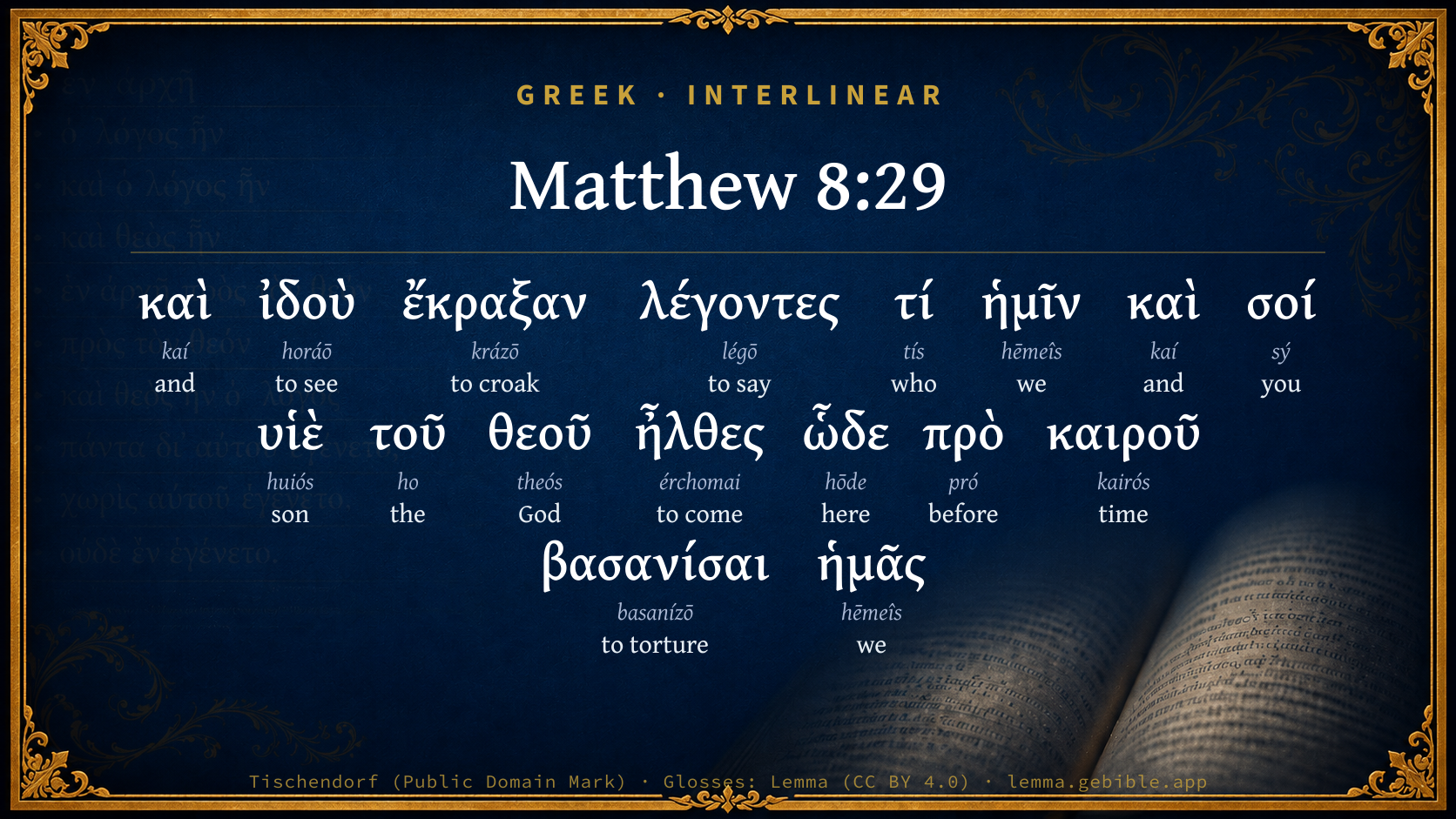
  1. καὶ kaí G2532 “and” Conjunction
  2. ἰδοὺ horáō G3708 “to see” Verb, Aorist, Middle, Imperative, 2nd person, Singular
  3. ἔκραξαν krázō G2896 “to croak” Verb, Aorist, Active, Indicative, 3rd person, Plural
  4. λέγοντες légō G3004 “to say” Verb, Present, Active, Participle, Nominative, Plural, Masculine
  5. τί tís G5101 “who” Interrogative pronoun, Nominative, Singular, Neuter
  6. ἡμῖν hēmeîs G2249 “we” Personal pronoun, 1st person, Dative, Plural
  7. καὶ kaí G2532 “and” Conjunction
  8. σοί sý G4771 “you” Personal pronoun, 2nd person, Dative, Singular
  9. υἱὲ huiós G5207 “son” Noun, Vocative, Singular, Masculine
  10. τοῦ ho G3588 “the” Article, Genitive, Singular, Masculine
  11. θεοῦ theós G2316 “God” Noun, Genitive, Singular, Masculine
  12. ἦλθες érchomai G2064 “to come” Verb, Aorist, Active, Indicative, 2nd person, Singular
  13. ὧδε hōde G5602 “here” Adverb
  14. πρὸ pró G4253 “before” Preposition
  15. καιροῦ kairós G2540 “time” Noun, Genitive, Singular, Masculine
  16. ἡμᾶς hēmeîs G2249 “we” Personal pronoun, 1st person, Accusative, Plural

About this verse

These counts appear in no published source. They are computed here, from the morphology-tagged text and Lemma’s own curated glosses. What Lemma adds →

17
words
15
distinct lemmas
Gospels
section

Notable vocabulary

The rarest word here is βασανίσαι to torture G928 — appearing just 12 times in the whole Greek New Testament.

First appearance in Scripture

These words make their first canonical appearance in the Greek New Testament here:

Shared distinctive vocabulary

βασανίσαι to torture G928 occurs in 12 verses of the Greek New Testament. Also found in:
Repetition

Words recur within this verse:

Cross-references

17

Topical passages linked to Matthew 8:29 in the Treasury of Scripture Knowledge — connected by theme and wording, ordered by reader-vote popularity; previews shown in the World English Bible.

  • Mark 1:24 saying, "Ha! What do we have to do with you, Jesus, you Nazarene? Have you come to destroy us? I know you who you are: the Holy One of God!"
  • Luke 4:34 saying, "Ah! what have we to do with you, Jesus of Nazareth? Have you come to destroy us? I know you who you are: the Holy One of God!"
  • James 2:19 You believe that God is one. You do well. The demons also believe, and shudder.
  • Mark 5:7 and crying out with a loud voice, he said, "What have I to do with you, Jesus, you Son of the Most High God? I adjure you by God, don't torment me."
  • Luke 8:28 When he saw Jesus, he cried out, and fell down before him, and with a loud voice said, "What do I have to do with you, Jesus, you Son of the Most High God? I beg you, don't torment me!"
  • Matthew 4:3 The tempter came and said to him, "If you are the Son of God, command that these stones become bread."
  • 2 Peter 2:4 For if God didn't spare angels when they sinned, but cast them down to Tartarus, and committed them to pits of darkness, to be reserved to judgment;
  • 2 Samuel 16:10 The king said, What have I to do with you, you sons of Zeruiah? Because he curses, and because Yahweh has said to him, Curse David; who then shall say, Why have you done so?
  • Luke 4:41 Demons also came out from many, crying out, and saying, "You are the Christ, the Son of God!" Rebuking them, he didn't allow them to speak, because they knew that he was the Christ.
  • John 2:4 Jesus said to her, "Woman, what does that have to do with you and me? My hour has not yet come."
  • 2 Samuel 19:22 David said, What have I to do with you, you sons of Zeruiah, that you should this day be adversaries to me? shall there any man be put to death this day in Israel? for don't I know that I am this day king over Israel?
  • 1 Kings 17:18 She said to Elijah, What have I to do with you, you man of God? You have come to me to bring my sin to memory, and to kill my son!
  • Mark 3:11 The unclean spirits, whenever they saw him, fell down before him, and cried, "You are the Son of God!"
  • Acts 16:17 Following Paul and us, she cried out, "These men are servants of the Most High God, who proclaim to us the way of salvation!"
  • Jude 1:6 Angels who didn't keep their first domain, but deserted their own dwelling place, he has kept in everlasting bonds under darkness for the judgment of the great day.
  • Judges 11:12 Jephthah sent messengers to the king of the children of Ammon, saying, What have you to do with me, that you are come to me to fight against my land?
  • Joel 3:4 "Yes, and what are you to me, Tyre, and Sidon, And all the regions of Philistia? Will you repay me? And if you repay me, I will swiftly and speedily return your repayment on your own head.

Cross-references courtesy of OpenBible.info (CC BY 4.0).

Commentary

Notes on Matthew 8:29 from classic Christian and Jewish commentators (each source and its license shown beneath its notes). The classic Christian expositions comment on the surrounding passage and are grouped to its opening verse, so a note may address several verses; the Jewish commentaries on the Tanakh (Rashi and others) are per-verse, so they appear only where the commentator wrote on this verse.

Lemma curates 59 commentaries, every one of them public domain or Creative Commons licensed, each selected and text-cleaned for this edition rather than reprinted as found. About our sources →

Kretzmann's Popular Commentary

Paul E. Kretzmann

Their cry and confession:

v. 29. And, behold, they cried out, saying. What have we to do with Thee, Jesus, Thou Son of God? Art Thou come hither to torment us before the time?

Jesus, having come to destroy the works of the devil, to redeem men from his sinister influence, from his destructive power, 1Jn 3:8, immediately commanded the evil spirits to leave the men, Luk 8:29. But they, speaking with the tongue of one of the demoniacs, pleaded with Him not to torment them. Note: The devil knows the man Jesus to be the Son of God; the evil spirits recognize in Him the future Judge; they fear the last judgment with its condemnation. Even now hell is for them a place of torture, excruciating, incessant. But until the last day, and especially during the days preceding the final judgment, they have, in a measure, the power and the might to destroy and to torture God’s creatures. But even so they are excluded from blessed communion with God. On the Day of Judgment they will be condemned into the abyss of hell, to be chained there forever with fetters of darkness. So they plead not to be tortured before that time.

Paul E. Kretzmann, Popular Commentary of the Bible (1921–1924) — public domain. Text from a community e-Sword module.

Tyndale Open Study Notes

Tyndale Open Resources

8:29 Those controlled by Satan immediately recognized Jesus’ true identity as the Son of God (see Mark 1:24) and answered the question asked by Jesus’ disciples when he had calmed the storm (Matt 8:27). Elsewhere, Jesus’ true nature and identity are acknowledged by the Father (3:17; 17:5), Satan (4:3, 6), humans (14:33; 16:16; 27:54), and Christ himself (11:27; 24:36; 28:19). • God’s appointed time is the final, eternal damnation of all who oppose God (see Jude 1:6; Rev 20:10).

Tyndale Open Study Notes — © Tyndale Open Resources, licensed CC BY-SA 4.0. Text via the HelloAO Bible API.

Bengel's Gnomon

Johann Albrecht Bengel

Mat 8:29. Τί ἡμῖν καὶ σοὶ, what have we to do with Thee?) A formula of declining interference or intercourse. See S. V. 1Ki 17:18; Jdg 11:12; 2Ki 3:13. They confess in this address their despair and horrible expectation, and at the same time they seem to add, “we desire to have dealings, not with Thee, but with men liable to sin.”—Υἱὲ τοῦ Θεοῦ, Son of God) Men seeking aid addressed Him with confidence as the Son of David; devils with terror, as the Son of God.—ὧδε, hither) The devils claimed, as it were, some right in that place, and especially over the swine in that place.—πρὸ καιροῦ, before the time) This may be construed either with ἦλθες, hast Thou come, or with βασανίσαι, to torment, or with both. Jesus came indeed when the world was ripe for His coming, and yet sooner than the enemy desired. Thus in Rom 5:6, we read Χριστὸς—κατὰ—καιρὸν—ἀπέθανε, IN DUE TIME Christ died.—βασανίσαι, to torment) It is torment for the devils to be without the bodies of man or beast, which they ardently desire to possess, that they may thereby, for the time being, extinguish that fire with which they are always burning. See Mat 8:31. This was a prelude to their being hereafter placed in subjection under the feet of Jesus.

Bengel's Gnomon of the New Testament — English translation (T&T Clark, Edinburgh, 1860) — public domain. Text from a community e-Sword module.

Meyer's Critical & Exegetical Commentary

Heinrich August Wilhelm Meyer

Mat_8:29. Τί ἡμῖν κ. σοί] See on Joh_2:4. The demons according to their nature, already recognise in Jesus, the Messiah, their mighty and most dangerous enemy, and cum terrore appellant filium Dei, Bengel.

πρὸ καιροῦ] prematurely, i.e. before the Messianic judgment (Mat_25:41).

βασανίσαι ἡμᾶς] to hurl us, as servants of Satan, down to the torments of Hades (Luk_16:23; Rev_14:10; Rev_20:10). The lunatics identify themselves with the demons by whom they are possessed. It is plain, however, from their very language that they were Jews, and not Gentiles (Casaubon, Neander).

Meyer — Critical and Exegetical Commentary on the New Testament — English translation by Peter Christie, edited by Frederick Crombie (T&T Clark, 1880) — public domain. Text from a community e-Sword module.

Expositor's Greek Testament

ed. W. Robertson Nicoll

Mat 8:29 . ἰδοὺ ἔκραξαν : sudden, startling, unearthly cry, fitted to shock weak nerves. But not the cry of men about to make an assault. The madmen, whom all feared and shunned, were subdued by the aspect of the stranger who had arrived in the neighbourhood. To be taken as a fact, however strange and mysterious, partly explained by the fact that Jesus was not afraid of them any more than He had been of the storm. They felt His power in the very look of His eye. τί ἡμῖν καὶ σοί : an appropriate speech even in the mouth of one demoniac, for he speaks in the name of the legion of devils (Mar 5:9 ) by which he conceives himself possessed. Identifying himself with the demons, he shrinks from the new comer with an instinctive feeling that He is a foe. υἱὲ τοῦ θεοῦ : ὁ ἅγιος τ . θ . in the Capernaum synagogue case; strange, almost incredible divination. Yet “insanity is much nearer the kingdom of God than worldly-mindedness. There was, doubtless, something in the whole aspect and manner of Jesus which was fitted to produce almost instantaneously a deep, spiritual impression to which child-like, simple, ingenuous souls like the Galilean fishermen, sinful, yet honest-hearted men like those who met at Matthew’s feast, readily surrendered themselves. Men with shattered reason also felt the spell, while the wise and the strong-minded too often used their intellect, under the bias of passion or prejudice, to resist the force of truth. In this way we may account for the prompt recognition of Jesus by the Gadarene demoniac. All that is necessary to explain it is the Messianic hope prevalent in Gadara as elsewhere, and the sight of Jesus acting on an impressionable spirit” (Bruce, The Miraculous Element in the Gospels p. 187). πρὸ καιροῦ : before the appointed time of judgment. The article wanting here before κ . as in other phrases in N. T., e.g. , ἐν καιρῷ , Mat 24:45 . βασανίσαι , to torment with pain in Hades, described as a place of torment in Luk 16:28 , cf. Mat 8:23 .

The Expositor's Greek Testament, edited by W. Robertson Nicoll (1897–1910) — public domain. Text from a community e-Sword module.

Adam Clarke's Commentary

Verse 29. What have we to do with thee] The literal translation of τι ημιν και σοι, is, What is it to us and to thee; which perhaps might be understood to imply their disclaiming any design to interfere with the work of Christ, and that he should not therefore meddle with them; for it appears they exceedingly dreaded his power.

What have we to do with thee, is a Jewish phrase, which often occurs in the Old Testament, signifying an abrupt refusal of some request, or a wish not to be troubled with the company or importunity of others. Jehu said to the messenger who was sent by Joram to meet him, What hast thou to do with peace? David said, What have I to do with you, ye sons of Zeruiah? Compare Jdg 11:12; 2Sa 16:10; 2Kg 9:18; Ezr 4:3; Joh 2:4. See Clarke on Mr 1:24.

Jesus, thou Son of God] Griesbach omits the word Jesus, on the authority of several MSS. of the greatest antiquity and respectability; besides some versions, and several of the fathers. I heartily concur with these MSS., c., for this simple reason, among others, that the word Jesus, i.e. Saviour, was of too ominous an import to the Satanic interest to be used freely, in such a case, by any of his disciples or subalterns.

Art thou come hither to torment us before the time?] From this it appears that a greater degree of punishment awaited these demons than they at that time endured and that they knew there was a time determined by the Divine Judge, when they should be sent into greater torments.

Adam Clarke's Commentary on the Bible (1810–1826) — public domain. Text from a community e-Sword/MySword module.

Ellicott's Commentary for English Readers

(29) They cried out, saying . . .—St. Mark adds that the demoniac, seeing Jesus from afar, ran and did homage (“worshipped” in the English version) to Him, and (with St. Luke) gives the fuller form of his cry, “What have I to do with thee, Jesus, thou Son of the Most High God?” It is remarkable that this is the only instance in which that name is addressed to our Lord, though it is used of Him before His birth in Luk_1:32. A probable explanation is, that the name “the Most High God” was frequently used in the formulae of exorcism, and so had become familiar to the demoniacs. So, the damsel with a spirit of divination, in Act_16:17, speaks of St. Paul and his companions as servants of the Most High God. The question meets us. Was the discernment that led to the confession altogether preternatural, or had the possessed man heard of the fame of Jesus? But if he had only heard, how came he to recognise the Prophet “a great way off?” Possibly the true explanation lies involved in the mystery of the psychological state into which the sufferer had passed under the frightful influences that were working in him.

To torment us before the time.—So the abode of Dives is “a place of torment” (Luk_16:28), and the ministers of judgment are the “tormentors” (Mat_18:34). The man identifies himself with the demons; looks forward, when the hour of judgment shall come, to condemnation; and claims, in the meantime, to be let alone. Who that has been called to minister to the souls of men in their demoniac state has not often heard language all but identical? The words added by St. Mark are singularly characteristic: “I adjure thee by God.” It is as if the man had listened so often to the formulæ of exorcists that they had become, as it were, his natural speech, and he too will try their effect as an adjuration. The command given to the “unclean spirit” to “come out of the man” had, we find from St. Mark and St. Luke, been given previously, as the man drew near, and was the occasion of this frenzied cry.

At this stage, too, they add, our Lord asked the question, “What is thy name?” The most terrible phenomenon of possession, as of many forms of insanity, was the divided consciousness which appears in this case. Now the demon speaks, and now the man. The question would recall to the man’s mind that he once had a human name, with all its memories of human fellowship. It was a stage, even in spite of the paroxysm that followed, in the process of recovery, in so far as it helped to disentangle him from the confusion between himself and the demons which caused his misery. But, at first, the question seems only to increase the evil: “My name is Legion, for we are many.” The irresistible might, the full array of the Roman legion, with its six thousand soldiers, seemed to the demoniac the one adequate symbol of the wild, uncontrollable impulses of passion and of dread that were sweeping through his soul. It would hardly have seemed possible that the force of literalism could have led any interpreter to infer the actual presence of six thousand demons, each with a personality of His own, and to calculate accordingly the number that must have entered into each of the two thousand swine: and yet this has been done.

A Bible Commentary for English Readers, edited by Charles John Ellicott (1878–1897) — public domain. Text from a community e-Sword module.

The Cambridge Bible for Schools and Colleges

gen. ed. J. J. S. Perowne

29. What have we to do with thee] Not “what is there in common between you and us?” but “what cause of war is there between us?” The same expression occurs in this sense 2Ch_35:21.

The Cambridge Bible for Schools and Colleges (gen. ed. J. J. S. Perowne; Cambridge University Press, 1878–1918) — public domain. Text from a community e-Sword module.

John Gill's Exposition

And there was a good way off from them,.... "Nigh unto the mountains", as Mark says, or "on the mountain", as Luke, bordering on the sea shore; so that though it was at some distance, yet within sight. The Vulgate Latin, and the Hebrew edition of Munster read, "not far off"; and the Persic version, "near them": which agree with the accounts of Mark and Luke, who say, that there were "there", or hard by, "an herd of many swine feeding". Since swine's flesh was forbidden the Jews to eat, Lev 11:7 it may be asked, how came it to pass, that there should be any number of these creatures, or that such a herd of them should be kept in the land of Israel? To which may be replied, that though the Jews might not eat swine's flesh, they were not forbid to bring them up; which they might do, in order to sell to the Gentiles, who dwelt among them; and particularly to the Romans, under whose government they now were, and with whom swine's flesh was in great esteem: but still a difficulty remains; for it was not only forbidden by the law of God to eat swine's flesh, but, by the Jewish canons, to bring them up, and make any advantage of them in any shape: their law was this, , "an Israelite might not bring up hogs in any place" (r): the reasons of this canon were many, partly because of the uncleanness of these creatures; hence one of their writers (s) observing, that next to those words, they "are unclean unto you", are, "and the swine", says, that this is to teach us, that "it is forbidden to bring up hogs"; and partly, because of the damage which these creatures do to other men's fields: hence (t).

"the wise men say, cursed is he that brings up dogs and hogs, , "because they do much hurt".''

But the chief reason given by the Gemafists (u) for this prohibition, was the fact following:

"When the Hasmonean family, or Maccabees, were at war with one another, Hyrcanus was within (Jerusalem), and Aristobulus without, and every day they let down to them money in a box; and they sent up to them the daily sacrifices: there was one old man who understood the wisdom of the Greeks, and he said unto them, as long as they employ themselves in the service (of God), they will not be delivered into your hands: on the morrow they let down their money, and they sent them up a hog; and when it came to the middle of the wall, he fixed his hoofs in the wall, and the land of Israel shook, &c. at that time they said, cursed be the man , "that breeds hogs"; and cursed is the man that teaches his son the learning of the Grecians.''

Before this time, it seems to have been lawful to bring them up, and trade with them: but now it was forbid, not only to breed them, but to receive any gain or profit by them; for this is another of their rules (w).

"It is forbidden to bring up a hog, in order to get any profit by his skin, or by his lard, or fat, to anoint with, or to light (lamps) with; yea, though it may fall to him by inheritance.''

And nothing was more infamous and reproachful among them, than a keeper of these creatures: when therefore they had a mind to cast contempt upon a man, they would call him (x), "a breeder of hogs", or (y), "a hog herd". But after all, it was only an Israelite that was forbid this; a stranger might bring them up, for this is one of their canons (z).

"A man may sell fetches to give to a stranger that breeds hogs, but to an Israelite it is forbidden to breed them.''

Yea, they say (a),

"If others breed them to anoint skins with their lard, or to sell them to an Israelite to anoint with them, it was lawful: all fat may be sold, which is not for eating.''

And so some cities are supposed to have hogs in them, concerning which they observe (b), that

"a city that has hogs in it, is free from the "mezuzah";''

the schedules which were fastened to the posts of doors and gates: but now supposing this herd of swine belonged to Jews in these parts, it may easily be accounted for; for since they lived among Heathens, they might not have so great a regard to the directions of their Rabbins; and especially, since it was so much for their profit and advantage, they might make no scruple to break through these ordinances. Though this herd of swine may well enough be thought to belong to the Gentiles, that dwelt in this country; since Gadara was a Grecian city, and then inhabited more by Syrians, than by Jews, as Josephus relates (c).

(r) Misn. Bava Kama, c. 7. sect. 7. Midrash Kohelet, fol. 77. 2. (s) Baal Hatturim, in Deut. xiv. 7, 8. (t) Maimon. Nezike Mammon, c. 5. sect. 9. (u) T. Bab. Bava Kama, fol. 82. 2. Menachot, fol. 64. 2. Sota, fol. 49. 2. (w) Tosaphot in Pesach, art. 62. (x) T. Hieros. Shekalim, fol. 47. 3. (y) lb. Trumot, fol. 46. 3. (z) Piske Tosaphot in Sabbat, art. 317. (a) Yom. Tob. & Ez. Chayim, in Misn. Bava Kama, c. 7. sect. 7. (b) Ib. art. 130. (c) De Bello Jud. l. 2. c. 33.

John Gill's Exposition of the Whole Bible (1746–1763) — public domain (CC PDM 1.0). Text via the HelloAO Bible API.

Trapp's Complete Commentary

John Trapp

29 And, behold, they cried out, saying, What have we to do with thee, Jesus, thou Son of God? art thou come hither to torment us before the time?

Ver. 29. What have we to do with thee] Horrible impudence. As if Christ were not concerned when his members are vexed. David felt his own coat cut and his own cheeks shaven in the coats and cheeks of his servants; and shall not Christ be as sensible of the abuses done to his? The sovereign suffers in the subject. Neither is it other than just, that the arraignment of mean malefactors runs in the style of wrong to the king’s crown and dignity.

Jesus, thou Son of God] The devil speaks Christ fair, but only to be rid of him. So deal many by Christ’s ministers, that rip up their consciences, and so put them into a hell above ground. St Mark tells us that they worshipped our Saviour; St Luke, that they adjured him. Satan, saith one, doth not always appear in one and the same fashion. At Lystra he appeared like a comedian, at Athens like a philosopher, at Ephesus like an artificer, and here like an exorcist; as to Saul he appeared like the old prophet, who could not have spoken more gravely, severely, divinely, than the fiend did. But as, when one commended the pope’s legate at the Council of Basil, Sigismund the emperor answered, Tamen Romanus est: Yet I am a Roman, so when the devil comes commended unto us under what name soever, let us cry out, Yet he is a devil; and remember still to resist him, steadfast in the faith, 1Pe 5:8-9.

Art thou come hither to torment us] To dispossess us. Lo, it is another hell to the devil to be idle, or otherwise than evil occupied. Should not we hold it our heaven to be well doing? {a} Learn for shame of the devil, saith father Latimer, to be busy about the salvation of your own and other men’s souls, which he so studiously seeks to destroy. Athanasius hath a conceit, that the devil may he driven out of a body by repeating the 68th Psalm. Origen saith of devils, no greater torment to them than to see men addicted to the Scriptures: In hoc eorum omnis flamma est, in hoc uruntur incendio. Chrysostom saith, we may lash and scourge the devil by fasting and prayer, which the prophet Isaiah calls a charm or enchantment, Isa 26:16; (לחש).

Before the time] For they are respited and reprieved, as it were, in respect of full torment, and suffered, as free prisoners, to flutter in the air, and to course about the earth till that great day; which they tremble to think on, and which they that mock at, 2Pe 3:3, or make light of, are worse than devils. {b}

{a} Tantum abest ut in oves Dei habeat potestatem.

{b} Ut iugulent homines, surgunt, &c. Horace.

John Trapp, A Commentary or Exposition upon All the Books of the Old and New Testament (1647–1656) — public domain. Text from a community e-Sword module.

Haydock's Catholic Bible Commentary

Before the time which God has marked to drive us from the world, and to bury us for ever in the prison of hell. (Bible de Vence) --- What have we to do with thee? Or what hast thou to do with us? what harm have we done thee? Art thou come hither to torment us before the time? That is, before the time and day of judgment, after which the torments and punishments of the devils will be increased. (Witham)

George Leo Haydock (1774–1849), Haydock's Catholic Family Bible and Commentary, 1859 edition — public domain. Excludes Psalms (Douay-Rheims chapter numbering differs from Protestant) and Deuterocanonical books (Catholic canon only).

Matthew Poole's English Annotations

Mark saith, Mar 5:8, that Jesus first said to him, Come out of the man; and, Mar 5:6,7, when he saw Jesus afar off he ran and worshipped him, and cried with a loud voice, What have I to do with thee, Jesus, thou Son of the most high God? I adjure thee, that thou torment me not. Luke’s relation, Luk 8:28,29, is much the same with Mark’s. The devils possessing these poor creatures, hearing Christ, to whose power they knew they were subject, to command them out of this man, or these two men, said, What have we to do with, thee, Jesus, thou Son of God? The devils knew Christ to be the Son of God, though the Jews would not believe it; they say unto him,

What have we to do with thee? A usual phrase, made use of where men had no desire to be troubled with the company, converse, or importunity of others, Jos 22:24; 2Sa 16:10; 2Ki 9:18; 2Ch 35:21; Joe 3:4; Joh 2:4, when they came to them with some ungrateful motions, &c.

Art thou come hither to torment us before the time? Either they look upon their dispossession as a torment, for the devil is not at quiet but when he is doing evil; and as this is the temper of the old serpent, so we shall observe that he communicates it to his seed, Pro 4:16; or else the devil was afraid lest Christ should have commanded him to his chains before the day of judgment.

Matthew Poole's English Annotations on the Holy Bible (1683–1685) — public domain. Text from a community e-Sword/MySword module.

The Pulpit Commentary

And, behold. This probably seemed to the evangelist not the least of the many strange things that he introduced by this phrase. They cried out, saying, What have we to do with thee? (Ti hmin kai soi ; dlw wnl hm, frequent in the Old Testament, e.g. 2Sa_16:10). What community either of interest or of character? The deepest realization of personal sinfulness may coexist with absolute ignorance of the Divine love. Jesus. Omitted by the Revised Version here, yet genuine in the parallel passages, Matthew omitted from their utterance the name which (Mat_1:21) indicated the bridging of the chasm between the sinner and God. Thou Son of God? Their sense of sin, their belief in a future torment, and their use of this phrase, alike point to their being Jews. Observe how great a contrast is implied by this term on the lips of demoniacs. As in 1Jn_3:8 (cf. Bishop Westcott there), it brings out the nature of the conflict ("the spiritual adversary of man has a mightier spiritual antagonist"), so here. Art thou come hither had they felt themselves safe in that distant spot and its gloomy surroundings, far away from all religious influence? to torment us before the time? Their abject terror is still more evident in the parallel passages. Observe

(1) the words are not given as those of the demons, hut as the men"s own;

(2) a future torment is assumed;

(3) they have no doubt as to their own share in it.

The Pulpit Commentary (1880–1919), ed. H.D.M. Spence-Jones & Joseph S. Exell — public domain. Text from a community e-Sword module.

John Wesley's Explanatory Notes

What have we to do with thee - This is a Hebrew phrase, which signifies. Why do you concern yourself about us? 2 Sam. xvi, 10. Before the time - The great day.

John Wesley, Explanatory Notes Upon the Whole Bible (1754–1765) — public domain. Text via the GEBible commentary corpus.

Burkitt's Expository Notes on the New Testament

William Burkitt

Observe, The devils knew Christ to be the Son of God, and that he came into the world to be a Saviour, but not their Saviour; and therefore they cry out, What have we to do with thee? or thou with us?

O what an uncomfortable faith is this, to believe that Christ is a Saviour, and at the same time to know that he is none of our Saviour! But what is their outcry against Christ? This, Art thou come to torment us before the time?

Learn, 1. That there are tortures appointed to the spiritual natures of evil angels. The fire of hell is conceived to be partly material, and partly spiritual; partly material, to work upon bodies of evil men, and partly spritual to work upon the souls of men, and the spirits of evil angels.

Learn, 2. That though the devils be now as full of discontent as they can be, yet they are not so full of torment as they shall be; their speech here intimates, that there will be a time when their torments shall be increased when they shall have their fill of torment: therefore they pray, Increase not our torments before the appointed time of their increase.

William Burkitt's Expository Notes on the New Testament (1700–1703) — public domain. Text from a community e-Sword module.

The People's New Testament

B. W. Johnson

29. They cried out. This account shows: (1) That demoniacal possession was not simply bodily or mental disease. (2) That evil spirits actually took possession of and controlled human beings. (3) That these controlled the actions and organs of speech of their poor victims. (4) We learn elsewhere that sin prepared the way for the entrance of the demon. Thou Son of God. The demons, like the devil, recognized him. Torment us before our time. These words show that they expected the final triumph of Christ.

B. W. Johnson's The People's New Testament with Notes (1889–1891) — public domain. Electronic text from the Christian Classics Ethereal Library (CCEL) ThML edition.

Cambridge Greek Testament for Schools and Colleges

29. ἰδοὺ ἔκραξαν. Cp. Verg. Aen. IV. 490, Mugire videbis | sub pedibus terram; but ἰδοὺ in Hellenistic Greek is little more than a vivid transitional particle, drawing attention to what follows.

Cambridge Greek Testament for Schools and Colleges (Cambridge University Press, 1896; 21 vols, various authors incl. Carr, Maclear, Plummer, Farrar, Lumby, Moule, M. R. James, Simcox) — public domain. Text from a community e-Sword module.

Alford’s Greek Testament

Henry Alford

29. τί ἡμ. κ. σοί] מַה־לָּנוּ וָלָךְ. See 2Sa 16:10; 2Sa 19:22. πρὸ καιροῦ is peculiar to this Gospel: υἱὲ τοῦ θ. common to all.

Henry Alford, The Greek Testament (1849–1861) — public domain. Text from a community e-Sword module.

International Critical Commentary

29. And, behold, they cried out, saying, What have we to do with Thee, Thou Son of God? art Thou come here before the time to torment us?] Mk. has: “And seeing Jesus from afar, he ran and worshipped Him. And cried with a loud voice, and saith, What have I to do with Thee, Jesus, Son of the Most High God? I adjure Thee by God, do not torment me.”

For καὶ ἰδού, see Introduction, p. lxxxv.

υἱὲ τοῦ θεοῦ] We may suppose that the fame of Christ’s miracles had preceded Him, cf. 4:24. The demoniacs, seeing Him approaching, guessed Him to be the great healer. They address Him as “Son of God,” meaning no more than one who was endowed with divine power, or possibly using it as equivalent to Messiah. Cf. Dalm. Words, 274 ff.—βασανίσαι] The word carries us into the atmosphere of the then current belief about demons, their activity and their destiny. See the art. “Demon” in DB. It was believed that evil demons could enter into human beings and dominate their personality. They could also be expelled by magic. Josephus speaks of one Eleazer whom he had seen curing demoniacs by holding a magical ring to the nose of the patient. He then drew the demon out through his nostrils (Ant. viii. 46, 47). The demons have power to afflict mankind until the day of judgment, when they will be punished, Enoch 15-16. Cf. Weber, Jüd. Theol. 254 ff.; Bousset, Rel. Jüd. 331 ff. The demons who have taken possession of the two men here spoken of see coming one whose fame as an exorcist had preceded His arrival. They beg Him not to anticipate for them the destined torments of hell by casting them out homeless into the wilderness. Mt. here omits Mk vv. 8-10, which are not necessary to the story, and contain a question: “What is thy name?” ascribed to Christ. Cf. the omission of such questions from the parallels to Mar 5:30, Mar 5:6:38, 8:Mar 5:19-20, Mar 5:23, Mar 5:9:12, Mar 5:16, Mar 5:21, Mar 5:38, Mar 5:10:3, Mar 5:14:14; and see introduction, p. xxxii.

(M)

International Critical Commentary — older volumes (1896–1929), various authors — public domain. Text from a community e-Sword module.

Lesson kit

Teaching starters — assembled from the data on this page, not authored interpretation. Every prompt links to the verse data it draws on. Edit before teaching.

Matthew, in the Gospels, opens this verse with 17 words (15 distinct Greek lemmas). Its most distinctive word is basanízō (“to torture”). A historical commentator’s framing appears above. Read the whole chapter for the surrounding context.

Discussion questions

  1. The word basanízō carries the sense “to torture.” How does it shape the verse?
  2. 3 words make their first appearance in Scripture here. What does this debut establish?
  3. How does Matthew 8:6, which shares the word «to torture», read alongside this verse?
  4. What does the repetition of “and” (2× in this one verse) do in this verse?
  5. These translations render this verse differently; the difference is in the English rendering, not the original. What questions does that raise?
  6. Compare how Kretzmann's Popular Commentary and Tyndale Open Study Notes read this verse. Where do they agree or differ?

Things to notice

  • 3 words make their first canonical appearance in Scripture here.
  • These translations choose different wording for 7 words in this verse.
  • “and” occurs 2× in this single verse.
  • 15 distinct Greek lemmas span 17 words in this verse.

Reading settings

Reading text

Shown beneath each verse's original-language words.

Old Testament
Old Testament edition

Read the OT as the Masoretic Hebrew (MT) or the Greek Septuagint (LXX).

English shown for the Greek Septuagint (in the Hebrew ↔ Greek comparison).

Comparing translations? Open the Compare panel on any verse page to stack up to four side by side.