
Judges 1:24

Hebrew (Westminster Leningrad Codex) Judges 1:24 appears in the Hebrew Old Testament. The text above is from the Westminster Leningrad Codex. Each word links to its Strong’s number, a concise gloss, and parsing drawn from the Open Scriptures Hebrew Bible morphology. Click any word for its full Brown-Driver-Briggs (BDB) entry.
Download image
Cite this verse

Judges 1:24 (World English Bible). Public Domain. Lemma interlinear Bible study tool, https://lemma.gebible.app/v/judges/1/24.

Show BibTeX & RIS
BibTeX
RIS
English Translation
The watchers saw a man come forth out of the city, and they said to him, Show us, we pray you, the entrance into the city, and we will deal kindly with you.
World English Bible · Public Domain
Download a study sheet

One document with this verse’s original text, its word-by-word gloss line, the meaning frame, cross-references with their text, attributed commentary, and full source and license credits — printable, and it pastes into notes with its structure intact.

This verse Autodidact and up

Study sheet (.html) Plain text (.txt)

A passage Seminary Student

Up to 50 verses in one chapter. A passage sheet keeps up to 6 commentary sources and 12 cross-references per verse, in the order this page ranks them, and says so on the sheet whenever that leaves anything out. Ask for a single verse and you get the Autodidact verse sheet above.

Everything on this page stays free to read, with no account — the sheet is a download of what is already on screen, not access to it.

Want to remove ads? Support Godless Engineer
Compare translations 3

The same verse in 3 English versions, stacked beneath the original-language interlinear above. Click any original word for its lexicon entry.

Each is an independent rendering of the whole verse — the interlinear is not word-aligned to these translations.

Highlighted words mark where these versions differ — a whole-verse word diff, not a word-by-word alignment.

  • World English Bible Public Domain
    The watchers saw a man come forth out of the city, and they said to him, Show us, we pray you, the entrance into the city, and we will deal kindly with you.
  • King James Version Public Domain
    And the spies saw a man come forth out of the city, and they said unto him, Show us, we pray thee, the entrance into the city, and we will show thee mercy.
  • unfoldingWord Literal Text CC BY-SA 4.0
    And the observers saw a man going out from the city, and they said to him, “Show us, please, the entrance of the city, and we will do kindness with you.”

unfoldingWord Literal Text — © unfoldingWord, licensed CC BY-SA 4.0. Word-aligned USFM3 via Door43 (git.door43.org/unfoldingWord/en_ult).

Versions to compare (up to 4)

3 of 4 selected

Show all 18 translations

Every available English version of this verse, each an independent rendering of the whole verse.

  • World English Bible Public Domain
    The watchers saw a man come forth out of the city, and they said to him, Show us, we pray you, the entrance into the city, and we will deal kindly with you.
  • Berean Standard Bible Public Domain
    and when the spies saw a man coming out of the city, they said to him, “Please show us how to get into the city, and we will treat you kindly.”
  • Majority Standard Bible Public Domain
    and when the spies saw a man coming out of the city, they said to him, “Please show us how to get into the city, and we will treat you kindly.”
  • King James Version Public Domain
    And the spies saw a man come forth out of the city, and they said unto him, Show us, we pray thee, the entrance into the city, and we will show thee mercy.
  • American Standard Version (1901) Public Domain
    And the watchers saw a man come forth out of the city, and they said unto him, Show us, we pray thee, the entrance into the city, and we will deal kindly with thee.
  • Revised Version (1885) Public Domain
    And the watchers saw a man come forth out of the city, and they said unto him, Shew us, we pray thee, the entrance into the city, and we will deal kindly with thee.
  • Geneva Bible (1599) Public Domain
    And the spies sawe a man come out of the citie, and they saide vnto him, Shewe vs, we praie thee, the way into the citie, and we will shewe thee mercie.
  • Douay-Rheims (1899) Public Domain
    They saw a man coming out of the city, and they said to him: Shew us the entrance into the city, and we will shew thee mercy.
  • Young's Literal Translation Public Domain
    and the watchers see a man coming out from the city, and say to him, `Shew us, we pray thee, the entrance of the city, and we have done with thee kindness.'
  • Literal Standard Version CC BY-SA 4.0
    and the watchers see a man coming out from the city, and say to him, “Please show us the entrance of the city, and we have done kindness with you.”
  • Unlocked Literal Bible CC BY-SA 4.0
    The spies saw a man coming out of the city, and they said to him, “Show us, please, how to get into the city, and we will be kind to you.”
  • unfoldingWord Literal Text CC BY-SA 4.0
    And the observers saw a man going out from the city, and they said to him, “Show us, please, the entrance of the city, and we will do kindness with you.”
  • Darby Bible Public Domain
    And the spies saw a man coming out of the city, and they said to him, "Pray, show us the way into the city, and we will deal kindly with you."
  • World Messianic Bible Public Domain
    The watchers saw a man come out of the city, and they said to him, “Please show us the entrance into the city, and we will deal kindly with you.”
  • Webster's Bible Public Domain
    And the spies saw a man coming out of the city, and they said to him, Show us, we pray thee, the entrance into the city, and we will show thee mercy.
  • Free Bible Version CC BY-SA 4.0
    The spies saw a man leaving the town and told him, “Please show us how to get into town, and we will treat you well.”
  • Bible in Basic English Public Domain
    And the watchers saw a man coming out of the town, and said to him, If you will make clear to us the way into the town, we will be kind to you.
  • JPS Tanakh (1917) Public Domain
    And the watchers saw a man come forth out of the city, and they said unto him: 'Show us, we pray thee, the entrance into the city, and we will deal kindly with thee.'

Literal Standard Version (2020), Covenant Press — licensed CC BY-SA 4.0. Text via the HelloAO Bible API (eBible.org). Unlocked Literal Bible (unfoldingWord) — licensed CC BY-SA 4.0. Text via the HelloAO Bible API (eBible.org). unfoldingWord Literal Text — © unfoldingWord, licensed CC BY-SA 4.0. Word-aligned USFM3 via Door43 (git.door43.org/unfoldingWord/en_ult). Free Bible Version, Dr. Jonathan Gallagher — licensed CC BY-SA 4.0. Text via the HelloAO Bible API (eBible.org).

Word by word

More ways to search: Search by grammar → Find every occurrence → Compare this word →

Practice this passage: Drill this verse → Learn its vocabulary →

מְב֣וֹא
mâbôwʼ
H3996
“entrance of”
Noun, Common, Masculine, Singular, Construct
Part of Speech
Noun
Type
Common
Gender
Masculine
Number
Singular
State
Construct
Full BDB Definition

Origin: from H935

TWOT: 212b

entrance, a coming in, entering - sunset - sunset - sunset, west
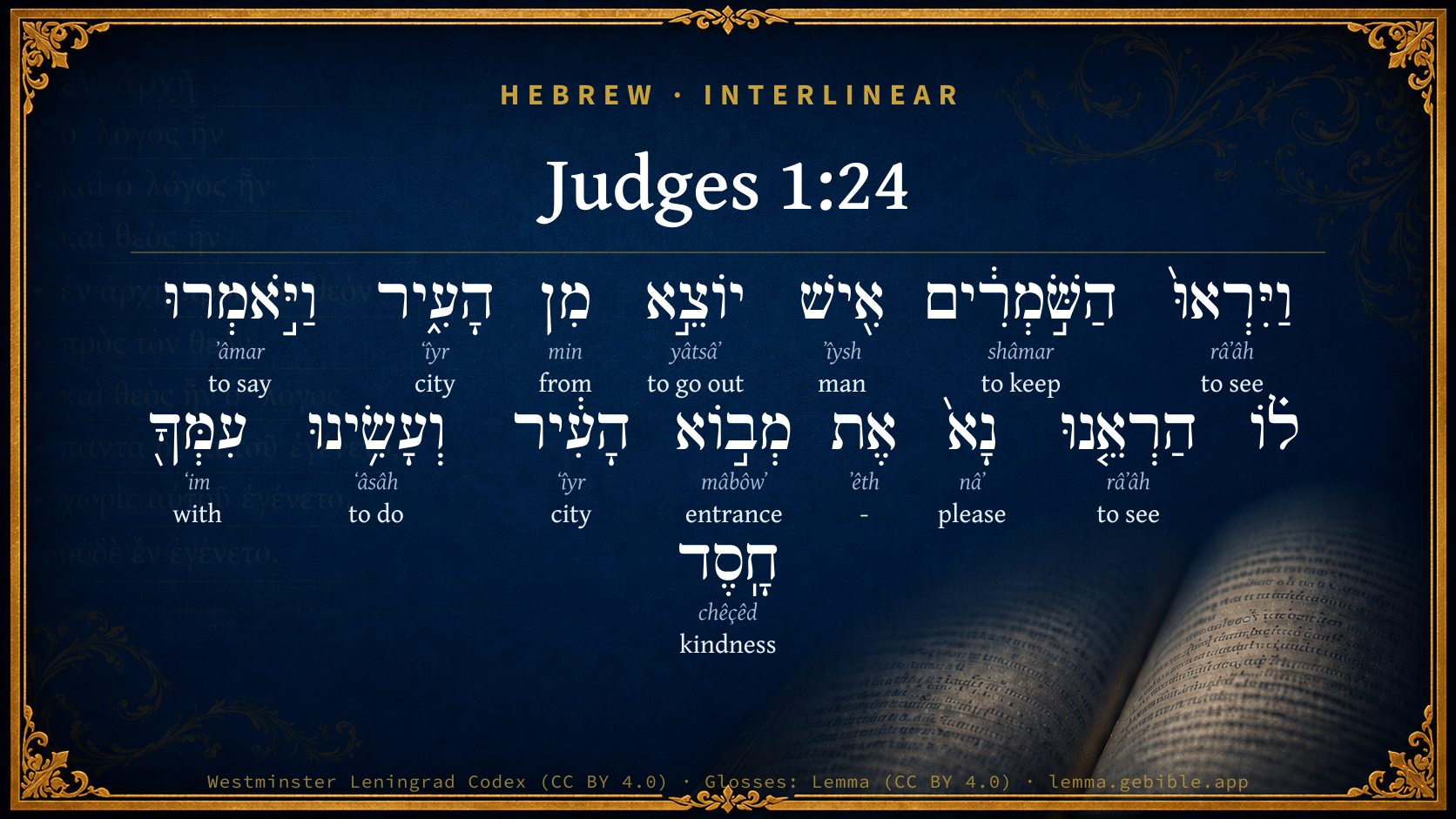
  1. וַיִּרְאוּ֙ râʼâh H7200 “and · to see” Conjunction + Verb, Qal, Sequential Imperfect, 3rd Person, Masculine, Plural
  2. הַשֹּׁ֣מְרִ֔ים shâmar H8104 “the · keeping” Particle, Definite Article + Verb, Qal, Participle Active, Masculine, Plural, Absolute
  3. אִ֖ישׁ ʼîysh H376 “man” Noun, Common, Masculine, Singular, Absolute
  4. יוֹצֵ֣א yâtsâʼ H3318 “going out” Verb, Qal, Participle Active, Masculine, Singular, Absolute
  5. מִן min H4480 “from” Preposition
  6. הָעִ֑יר ʻîyr H5892 “the · city” Particle, Definite Article + Noun, Common, Feminine, Singular, Absolute
  7. וַיֹּ֣אמְרוּ ʼâmar H559 “and · to say” Conjunction + Verb, Qal, Sequential Imperfect, 3rd Person, Masculine, Plural
  8. הַרְאֵ֤נוּ râʼâh H7200 “see · us” Verb, Hiphil, Imperative, 2nd Person, Masculine, Singular + Suffix, Personal, 1st Person, Common, Plural
  9. נָא֙ nâʼ H4994 “please” Particle, Exhortation
  10. אֶת ʼêth H853 “-” Particle, Direct Object
  11. הָעִ֔יר ʻîyr H5892 “the · city” Particle, Definite Article + Noun, Common, Feminine, Singular, Absolute
  12. וְעָשִׂ֥ינוּ ʻâsâh H6213 “and · to do” Conjunction + Verb, Qal, Sequential Perfect, 1st Person, Common, Plural
  13. עִמְּךָ֖ ʻim H5973 “with · you” Preposition + Suffix, Personal, 2nd Person, Masculine, Singular
  14. חָֽסֶד chêçêd H2617 “kindness” Noun, Common, Masculine, Singular, Absolute

About this verse

These counts appear in no published source. They are computed here, from the morphology-tagged text and Lemma’s own curated glosses. What Lemma adds →

16
words
13
distinct lemmas
Historical
section

Notable vocabulary

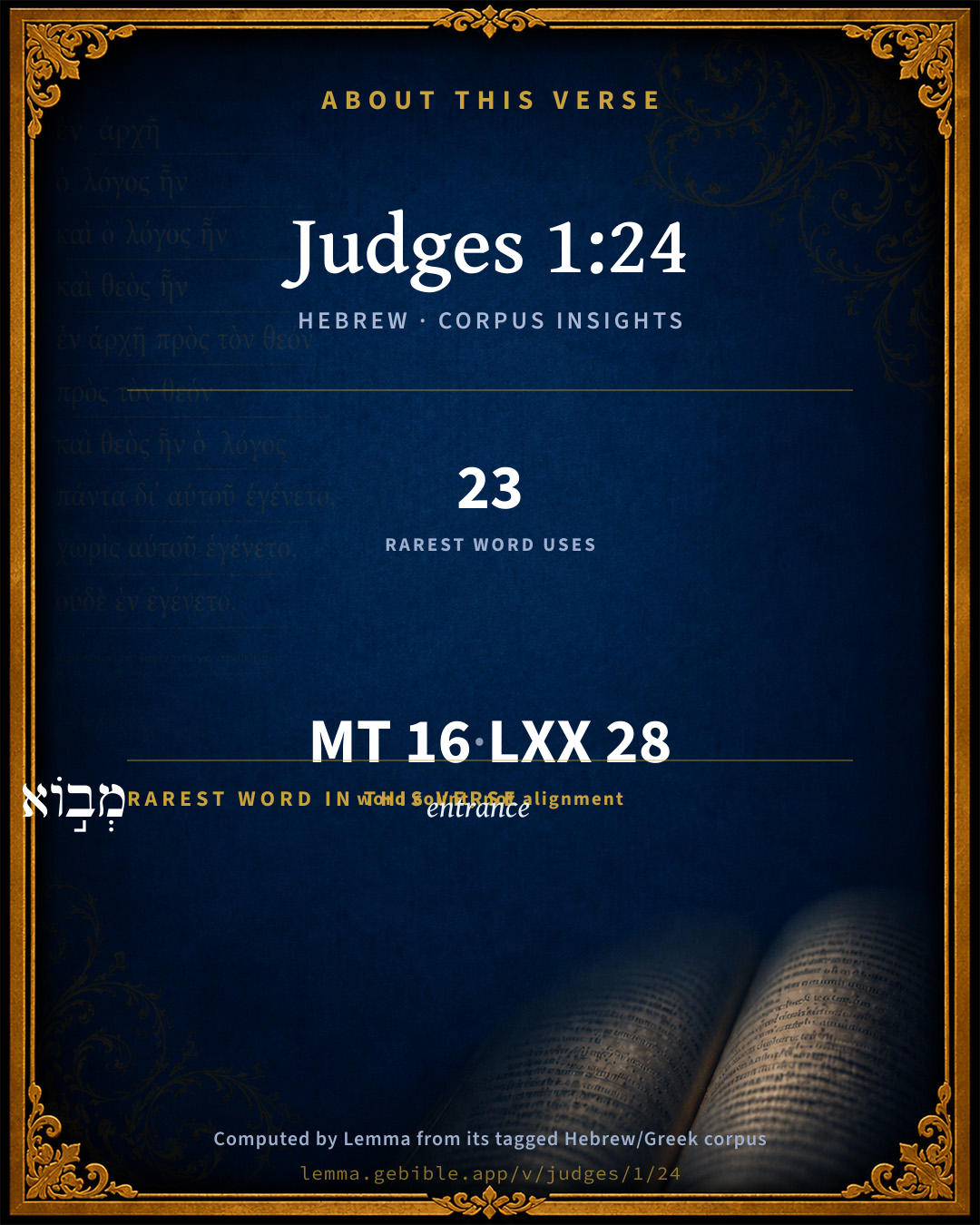
The rarest word here is מְב֣וֹא entrance H3996 — appearing just 23 times in the whole Hebrew Bible.

Shared distinctive vocabulary

מְב֣וֹא entrance H3996 occurs in 23 verses of the Hebrew Bible. Also found in:

Grammatical profile

  • 6 verbs
  • 5 nouns
  • 3 prepositions
  • 2 particles

Verb forms

  • וַיִּרְאוּ֙ Qal · Sequential Imperfect
  • הַשֹּׁ֣מְרִ֔ים Qal · Participle Active
  • יוֹצֵ֣א Qal · Participle Active
  • וַיֹּ֣אמְרוּ Qal · Sequential Imperfect
  • הַרְאֵ֤נוּ Hiphil · Imperative
  • וְעָשִׂ֥ינוּ Qal · Sequential Perfect

Repetition

Words recur within this verse — often emphatic in Hebrew:

  • וַיִּרְאוּ֙ to see H7200 ×2
  • הָעִ֑יר city H5892 ×2

Hebrew & Septuagint length

In English translation the verse runs 33 words from the Hebrew and 36 from the Septuagint (LXX English) — closely comparable.

A rough comparison of the two English renderings, which tokenize alike — not a word-level alignment.

Word counts can differ between the Hebrew and the Greek without any difference in meaning — e.g. the Hebrew direct-object marker אֵת has no separate Greek word, and Greek often adds the article ὁ.

In the original languages it is 16 Hebrew tokens and 28 Greek tokens — but the two are counted differently (Hebrew bundles its prefixes and suffixes into one token; the Greek is in lemma form), so that isn’t a like-for-like length.

Cross-references

2

Topical passages linked to Judges 1:24 in the Treasury of Scripture Knowledge — connected by theme and wording, ordered by reader-vote popularity; previews shown in the World English Bible.

  • Joshua 2:12–14 Now therefore, please swear to me by Yahweh, since I have dealt kindly with you, that you also will deal kindly with my father's house, and give me a true token;
  • 1 Samuel 30:15 David said to him, Will you bring me down to this troop? He said, Swear to me by God, that you will neither kill me, nor deliver me up into the hands of my master, and I will bring you down to this troop.

Cross-references courtesy of OpenBible.info (CC BY 4.0).

Hebrew and Greek witnesses Masoretic Hebrew ↔ Greek Septuagint

The same verse in the two great witnesses to the Old Testament, shown verse-for-verse.

These are two independent witnesses, not word-aligned to each other, and the Septuagint is shown in lemma (dictionary) form.

Hebrew Judges 1:24 Masoretic · Westminster Leningrad Codex

וַיִּרְאוּ֙ הַשֹּׁ֣מְרִ֔ים אִ֖ישׁ יוֹצֵ֣א מִן הָעִ֑יר וַיֹּ֣אמְרוּ ל֗וֹ הַרְאֵ֤נוּ נָא֙ אֶת מְב֣וֹא הָעִ֔יר וְעָשִׂ֥ינוּ עִמְּךָ֖ חָֽסֶד

The watchers saw a man come forth out of the city, and they said to him, Show us, we pray you, the entrance into the city, and we will deal kindly with you.

World English Bible · Public Domain

Greek LXX Judges 1:24 Septuagint · lemma form

καί ὁράω ὁ φυλάσσω καί ἰδού ἀνήρ ἐκπορεύομαι ἐκ ὁ πόλις καί λαμβάνω αὐτός καί εἶπον αὐτός δεικνύω ἐγώ ὁ πόλις ὁ εἴσοδος καί ποιέω μετά σύ ἔλεος

And the spies looked, and behold, a man went out of the city, and they took him; and they said to him, Show us the way into the city, and we will deal mercifully with you.

LXX2012 (modern English Septuagint) · Public Domain

Hebrew: Westminster Leningrad Codex (CC BY 4.0). Greek: Septuagint (public domain); English from LXX2012 (modern English Septuagint) (Public Domain). How the Septuagint differs from the Hebrew →

Targum (Aramaic paraphrase)

1

The Targum is the ancient Jewish Aramaic paraphrase of the Hebrew Scriptures — an interpretive translation, not the Hebrew text itself. Onkelos (literal) and Pseudo-Jonathan (expansive) render the Torah, and Jonathan the Prophets. Coverage is partial: where no permissively-licensed English translation exists for a verse, only the Aramaic is shown. This is verse-level text, not a word-by-word alignment to the Hebrew.

  1. Targum Jonathan Prophets (Joshua–Malachi)
    וַחֲזוֹ נָטְרַיָא גַבְרָא נָפֵיק מִן קַרְתָּא וַאֲמַרוּ לֵיהּ אַחֲזֵינָא כְעַן יַת מַעֲלָנָא דְקַרְתָּא וְנַעְבֵּד עִמָךְ טִיבוּ:

    (no public-domain English translation for this verse)

    Targum Jonathan — Aramaic: “Mikraot Gedolot” (public domain). English: “Sefaria Community Translation” (CC0 1.0 (public-domain dedication)); “London "Chaldee Paraphrase," 1871” (public domain). Text via Sefaria.

Commentary

Notes on Judges 1:24 from classic Christian and Jewish commentators (each source and its license shown beneath its notes). The classic Christian expositions comment on the surrounding passage and are grouped to its opening verse, so a note may address several verses; the Jewish commentaries on the Tanakh (Rashi and others) are per-verse, so they appear only where the commentator wrote on this verse.

Lemma curates 59 commentaries, every one of them public domain or Creative Commons licensed, each selected and text-cleaned for this edition rather than reprinted as found. About our sources →

Trapp's Complete Commentary

John Trapp

Jdg 1:24 And the spies saw a man come forth out of the city, and they said unto him, Shew us, we pray thee, the entrance into the city, and we will shew thee mercy.

Ver. 24. And the spies saw a man come forth.] Whether upon his ordinary business, or to fall to the enemy, is uncertain.

24 Now unto him that is able to keep you from falling, and to present you faultless before the presence of his glory with exceeding joy,

Ver. 24. That is able] q.d. I can only counsel you, it is God must keep you.

John Trapp, A Commentary or Exposition upon All the Books of the Old and New Testament (1647–1656) — public domain. Text from a community e-Sword module.

Jamieson, Fausset & Brown

Robert Jamieson, A. R. Fausset & David Brown

the spies . . . said, . . . Show us, . . . the entrance into the city--that is, the avenues to the city, and the weakest part of the walls.

we will show thee mercy--The Israelites might employ these means of getting possession of a place which was divinely appropriated to them: they might promise life and rewards to this man, though he and all the Canaanites were doomed to destruction (Jos 2:12-14); but we may assume the promise was suspended on his embracing the true religion, or quitting the country, as he did. If they had seen him to be firmly opposed to either of these alternatives, they would not have constrained him by promises any more than by threats to betray his countrymen. But if they found him disposed to be serviceable, and to aid the invaders in executing the will of God, they might promise to spare him.

Jamieson, Fausset & Brown — Commentary Critical and Explanatory on the Whole Bible (1871) — public domain (CC PDM 1.0). Text via the HelloAO Bible API.

Adam Clarke's Commentary

Verse 24. Show us - the entrance into the city] Taken in whatever light we choose, the conduct of this man was execrable. He was a traitor to his country, and he was accessary to the destruction of the lives and property of his fellow citizens, which he most sinfully betrayed, in order to save his own. According to the rules and laws of war, the children of Judah might avail themselves of such men and their information; but this does not lessen, on the side of this traitor, the turpitude of the action.

Adam Clarke's Commentary on the Bible (1810–1826) — public domain. Text from a community e-Sword/MySword module.

Ellicott's Commentary for English Readers

(24) The spies.—Perhaps, rather, the scouts of the blockading squadron. The Israelites, like most ancient nations, were little able to take cities by storm, and relied either on blockade or on internal treachery.

Saw a man come forth.—Probably he stole out secretly, and was seized by the scouts. Similarly the Persians took Sardis by seizing a path used by a man who had dropped his helmet, and descended the hill fortress to pick it up (Herod. i. 84).

We will shew thee mercy.—They bribed him. with the promise of personal safety. (Compare Jos_2:12; Jos_2:6)

A Bible Commentary for English Readers, edited by Charles John Ellicott (1878–1897) — public domain. Text from a community e-Sword module.

The Cambridge Bible for Schools and Colleges

gen. ed. J. J. S. Perowne

24. watchers] i.e. the Israelite outposts. The word favours an emendation such as ‘encamped’ in Jdg_1:23; cf. 2Sa_11:16.

the entrance into the city] i.e. not the gate, but the point where the city could be most easily entered by an attacking party. For the stipulation cf. Jos_2:12 f.

The Cambridge Bible for Schools and Colleges (gen. ed. J. J. S. Perowne; Cambridge University Press, 1878–1918) — public domain. Text from a community e-Sword module.

John Gill's Exposition

And the spies saw a man come forth out of the city,.... Or "the keepers" (r); those that were sent to watch, and observe, and get what intelligence they could of the city, and the way into it:

and they said unto him, show us, we pray, thee, the entrance into the city; not the gate or gates of it, which no doubt were visible enough, but some private way into it; the Jews, as before observed, think the entrance was by the way of a cave, or some hidden passage, of which Jarchi and Kimchi make mention:

and we will show thee mercy; give him a reward for it, or spare him and his family when the city came into their hands.

(r) "custodes", Pagninus, Montanus; "observatores", Vatablus, Drusius, Junius & Tremellius, Piscator.

John Gill's Exposition of the Whole Bible (1746–1763) — public domain (CC PDM 1.0). Text via the HelloAO Bible API.

Haydock's Catholic Bible Commentary

Mercy. The city belonged of right to them, so that they might use this means, as they were not bound to enquire by what motives the man was actuated thus to betray his country. He might be convinced, like Rahab, that God had granted it to the Israelites, and these might justly requite his good dispositions and suffer him to depart in peace. (Bonfrere; Grotius; Calmet)

George Leo Haydock (1774–1849), Haydock's Catholic Family Bible and Commentary, 1859 edition — public domain. Excludes Psalms (Douay-Rheims chapter numbering differs from Protestant) and Deuterocanonical books (Catholic canon only).

Matthew Poole's English Annotations

The entrance into the city; on which side it is weakest, that we may best invade and take it.

Matthew Poole's English Annotations on the Holy Bible (1683–1685) — public domain. Text from a community e-Sword/MySword module.

Whedon's Commentary on the Bible

Daniel D. Whedon

24. The entrance into the city — Not the ordinary gates, for to find these they needed no information; but that entrance which is least guarded, and by which it is easiest to take the whole city by surprise.

And we will show thee mercy — This indicates that the Hebrews were not absolutely commanded to kill all the Canaanites; but there was an implied condition of stubborn refusal to surrender, and to acknowledge the supremacy of the Israelites.

Daniel D. Whedon (gen. ed.), Commentary on the Old and New Testaments (1874–1909) — public domain. Text from a community e-Sword module.

The Pulpit Commentary

We will show thee mercy. Compare the saving of Rahab alive, with all her house, at the taking of Jericho. (Jos_6:23) This history is not preserved in the parallel place in Joshua 16.

The Pulpit Commentary (1880–1919), ed. H.D.M. Spence-Jones & Joseph S. Exell — public domain. Text from a community e-Sword module.

John Wesley's Explanatory Notes

The entrance - On which side it is weakest, that we might best invade and take it.

John Wesley, Explanatory Notes Upon the Whole Bible (1754–1765) — public domain. Text via the GEBible commentary corpus.

Keil & Delitzsch

C. F. Keil & F. Delitzsch

And the watchmen (i.e., the spies sent out to explore Bethel) saw a man coming out of the town, and got him to show them the entrance into it, under a promise that they would show him favour, i.e., would spare the lives of himself and his family (see Jos 2:12-13); whereupon they took the town and smote it without quarter, according to the law in Deu 20:16-17, letting none but the man and his family go. By "the entrance into the city" we are not to understand the gate of the town, but the way or mode by which they could get into the town, which was no doubt fortified.

Keil & Delitzsch — Biblical Commentary on the Old Testament (1861–1891) — public domain (CC PDM 1.0). Text via the HelloAO Bible API. (Old Testament only.)

Rashi

Rabbi Shlomo Yitzchaki (Rashi)

The entrance to the city. It was entered through a cave. A hazelnut tree stood at the mouth of the cave, and they passed through the tree into the cave.

Rashi on the Tanakh — English translations: “The Judaica Press complete Tanach with Rashi, translated by A. J. Rosenberg” (CC BY 4.0); “Pentateuch with Rashi's commentary by M. Rosenbaum and A.M. Silbermann, 1929-1934” (public domain); “The Metsudah Tanach series, Lakewood, N.J” (CC BY 4.0); and “The Book of Joshua, Metsudah Publications, 1997” (CC BY 4.0). Text via Sefaria.

Lesson kit

Teaching starters — assembled from the data on this page, not authored interpretation. Every prompt links to the verse data it draws on. Edit before teaching.

Judges, in the Historical, opens this verse with 16 words (13 distinct Hebrew lemmas). Its most distinctive word is mâbôwʼ (“entrance”). A historical commentator’s framing appears above. Read the whole chapter for the surrounding context.

Discussion questions

  1. The word mâbôwʼ carries the sense “entrance.” How does it shape the verse?
  2. How does Deuteronomy 11:30, which shares the word «entrance», read alongside this verse?
  3. What does the repetition of “to see” (2× in this one verse) do in this verse?
  4. These translations render this verse differently. What is at stake in choosing one wording over another?
  5. «וַיִּרְאוּ֙» is a Qal Sequential Imperfect verb. How does that grammatical form shape the action described?
  6. Compare how Trapp's Complete Commentary and Jamieson, Fausset & Brown read this verse. Where do they agree or differ?

Things to notice

Reading settings

Reading text

Shown beneath each verse's original-language words.

Old Testament
Old Testament edition

Read the OT as the Masoretic Hebrew (MT) or the Greek Septuagint (LXX).

English shown for the Greek Septuagint (in the Hebrew ↔ Greek comparison).

Comparing translations? Open the Compare panel on any verse page to stack up to four side by side.