
Mark 2:14

Greek (Tischendorf 8th ed.) Mark 2:14 appears in the Greek New Testament. The text above is from the Tischendorf 8th edition. Each word links to its Strong’s number and a concise gloss. Click any word for its full Thayer’s Greek Lexicon entry.
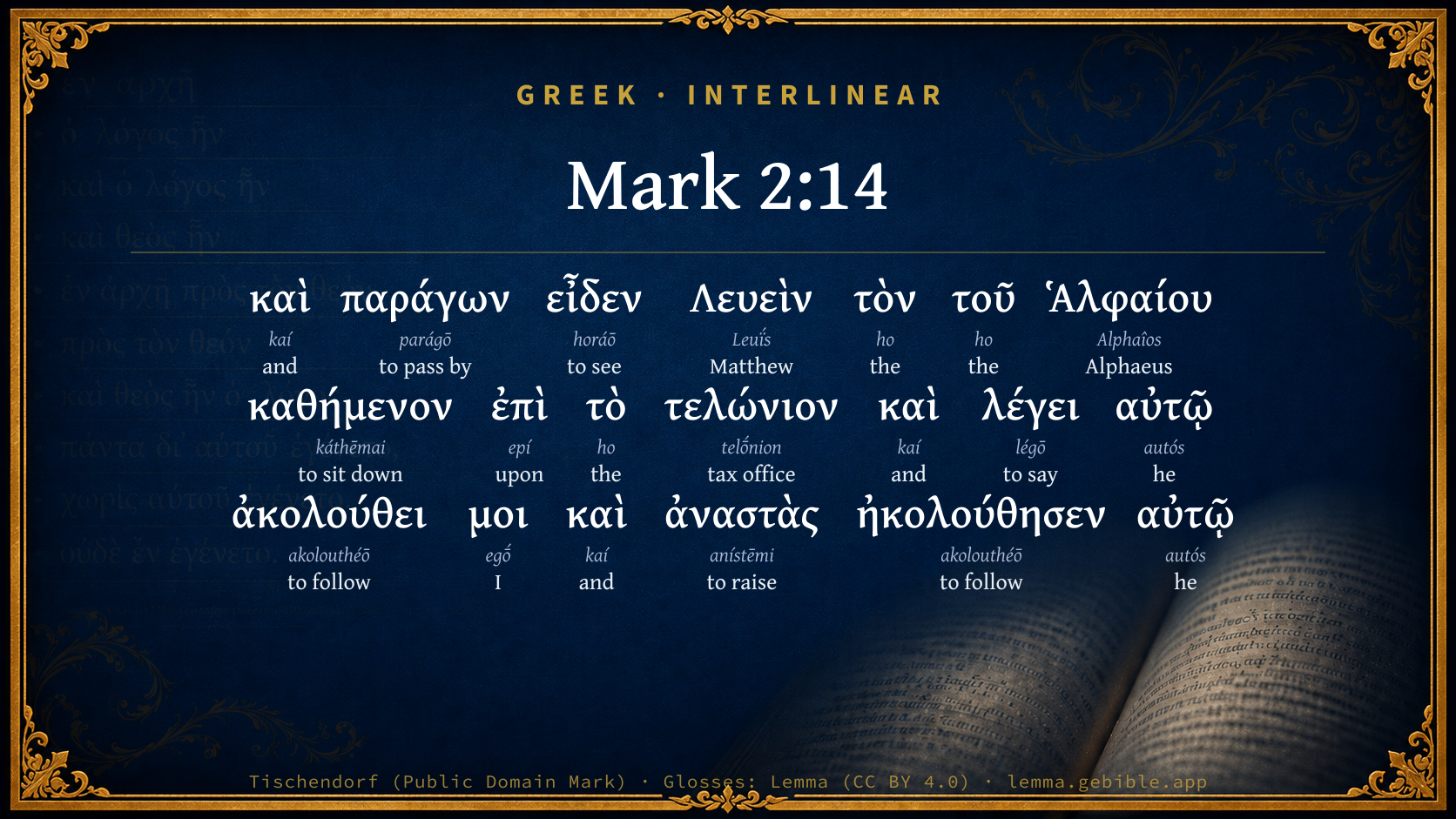
Download image
Cite this verse

Mark 2:14 (World English Bible). Public Domain. Lemma interlinear Bible study tool, https://lemma.gebible.app/v/mark/2/14.

Show BibTeX & RIS
BibTeX
RIS
English Translation
As he passed by, he saw Levi, the son of Alphaeus, sitting at the tax office, and he said to him, "Follow me." And he arose and followed him.
World English Bible · Public Domain
Highlights
  • 1 first appearance in the Greek New Testament
Full analysis ↓
Download a study sheet

One document with this verse’s original text, its word-by-word gloss line, the meaning frame, cross-references with their text, attributed commentary, and full source and license credits — printable, and it pastes into notes with its structure intact.

This verse Autodidact and up

Study sheet (.html) Plain text (.txt)

A passage Seminary Student

Up to 50 verses in one chapter. A passage sheet keeps up to 6 commentary sources and 12 cross-references per verse, in the order this page ranks them, and says so on the sheet whenever that leaves anything out. Ask for a single verse and you get the Autodidact verse sheet above.

Everything on this page stays free to read, with no account — the sheet is a download of what is already on screen, not access to it.

Want to remove ads? Support Godless Engineer
Compare translations 3

The same verse in 3 English versions, stacked beneath the original-language interlinear above. Click any original word for its lexicon entry.

Each is an independent rendering of the whole verse — the interlinear is not word-aligned to these translations.

Highlighted words mark where these versions differ — a whole-verse word diff, not a word-by-word alignment.

  • World English Bible Public Domain
    As he passed by, he saw Levi, the son of Alphaeus, sitting at the tax office, and he said to him, "Follow me." And he arose and followed him.
  • King James Version Public Domain
    And as he passed by, he saw Levi the son of Alphaeus sitting at the receipt of custom, and said unto him, Follow me. And he arose and followed him.
  • unfoldingWord Literal Text CC BY-SA 4.0
    And passing by, he saw Levi the of Alphaeus sitting at the tax collector’s office, and he says to him, “Follow me.” And having gotten up, he followed him.

unfoldingWord Literal Text — © unfoldingWord, licensed CC BY-SA 4.0. Word-aligned USFM3 via Door43 (git.door43.org/unfoldingWord/en_ult).

Versions to compare (up to 4)

3 of 4 selected

Show all 19 translations

Every available English version of this verse, each an independent rendering of the whole verse.

  • World English Bible Public Domain
    As he passed by, he saw Levi, the son of Alphaeus, sitting at the tax office, and he said to him, "Follow me." And he arose and followed him.
  • Berean Standard Bible Public Domain
    As He was walking along, He saw Levi son of Alphaeus sitting at the tax booth. “Follow Me,” He told him, and Levi got up and followed Him.
  • Majority Standard Bible Public Domain
    As He was walking along, He saw Levi son of Alphaeus sitting at the tax booth. “Follow Me,” He told him, and Levi got up and followed Him.
  • King James Version Public Domain
    And as he passed by, he saw Levi the son of Alphaeus sitting at the receipt of custom, and said unto him, Follow me. And he arose and followed him.
  • American Standard Version (1901) Public Domain
    And as he passed by, he saw Levi the `son' of Alphaeus sitting at the place of toll, and he saith unto him, Follow me. And he arose and followed him.
  • Revised Version (1885) Public Domain
    And as he passed by, he saw Levi the son of Alphaeus sitting at the place of toll, and he saith unto him, Follow me. And he arose and followed him.
  • Geneva Bible (1599) Public Domain
    And as Iesus passed by, hee sawe Leui the sonne of Alpheus sit at the receit of custome, and said vnto him, Folowe me. And he arose and followed him.
  • Douay-Rheims (1899) Public Domain
    And when he was passing by, he saw Levi the son of Alpheus sitting at the receipt of custom; and he saith to him: Follow me. And rising up, he followed him.
  • Young's Literal Translation Public Domain
    and passing by, he saw Levi of Alpheus sitting at the tax-office, and saith to him, `Be following me,' and he, having risen, did follow him.
  • Literal Standard Version CC BY-SA 4.0
    and passing by, He saw Levi of Alpheus sitting at the tax office, and says to him, “Follow Me,” and he, having risen, followed Him.
  • Unlocked Literal Bible CC BY-SA 4.0
    As he passed by, he saw Levi son of Alphaeus sitting at the tax collector's tent and he said to him, “Follow me.” He got up and followed him.
  • unfoldingWord Literal Text CC BY-SA 4.0
    And passing by, he saw Levi the of Alphaeus sitting at the tax collector’s office, and he says to him, “Follow me.” And having gotten up, he followed him.
  • Darby Bible Public Domain
    And passing by, he saw Levi the [son] of Alphaeus sitting at the tax-office, and says to him, Follow me. And he rose up and followed him.
  • World Messianic Bible Public Domain
    As he passed by, he saw Levi the son of Halfai sitting at the tax office. He said to him, “Follow me.” And he arose and followed him.
  • Webster's Bible Public Domain
    And as he passed by, he saw Levi the son of Alpheus, sitting at the receipt of custom, and said to him, Follow me. And he arose, and followed him.
  • Free Bible Version CC BY-SA 4.0
    As he walked along, he saw Levi son of Alphaeus sitting at the tax collector's booth. “Follow me,” Jesus told him. Levi got up and followed Jesus.
  • Bible in Basic English Public Domain
    And when he went by, he saw Levi, the son of Alphaeus, seated at the place where taxes were taken, and he said to him, Come with me. And he got up, and went with him.
  • Text-Critical English NT CC BY 4.0
    As he was walking along, he saw Levi the son of Alphaeus sitting at the tax booth. Jesus said to him, “Follow me,” so Levi rose and followed him.
  • Tyndale New Testament (1534) Public Domain
    And as Iesus passed by he sawe Levy the sonne of Alphey syt at the receyte of custome and sayde vnto him: folowe me. And he arose and folowed him.

Literal Standard Version (2020), Covenant Press — licensed CC BY-SA 4.0. Text via the HelloAO Bible API (eBible.org). Unlocked Literal Bible (unfoldingWord) — licensed CC BY-SA 4.0. Text via the HelloAO Bible API (eBible.org). unfoldingWord Literal Text — © unfoldingWord, licensed CC BY-SA 4.0. Word-aligned USFM3 via Door43 (git.door43.org/unfoldingWord/en_ult). Free Bible Version, Dr. Jonathan Gallagher — licensed CC BY-SA 4.0. Text via the HelloAO Bible API (eBible.org).

Word by word

More ways to search: Search by grammar → Find every occurrence → Compare this word →

Practice this passage: Drill this verse → Learn its vocabulary →

τελώνιον
telṓnion
G5058
“tax office”
Noun, Accusative, Singular, Neuter
Part of Speech
Noun
Case
Accusative
Number
Singular
Gender
Neuter
Full Thayer's Definition

Origin: from a presumed derivative of G5057

TDNT: None

1. customs, toll 2. toll house, place of toll, tax office 3. the place in which the tax collector sat to collect the taxes
  1. καὶ kaí G2532 “and” Conjunction
  2. παράγων parágō G3855 “to pass by” Verb, Present, Active, Participle, Nominative, Singular, Masculine
  3. εἶδεν horáō G3708 “to see” Verb, Aorist, Active, Indicative, 3rd person, Singular
  4. Λευεὶν Leuḯs G3018 “Matthew” Noun, Accusative, Singular, Masculine
  5. τὸν ho G3588 “the” Article, Accusative, Singular, Masculine
  6. τοῦ ho G3588 “the” Article, Genitive, Singular, Masculine
  7. Ἁλφαίου Alphaîos G256 “Alphaeus” Noun, Genitive, Singular, Masculine
  8. καθήμενον káthēmai G2521 “to sit down” Verb, Present, Middle or Passive deponent, Participle, Accusative, Singular, Masculine
  9. ἐπὶ epí G1909 “upon” Preposition
  10. τὸ ho G3588 “the” Article, Accusative, Singular, Neuter
  11. καὶ kaí G2532 “and” Conjunction
  12. λέγει légō G3004 “to say” Verb, Present, Active, Indicative, 3rd person, Singular
  13. αὐτῷ autós G846 “he” Personal pronoun, Dative, Singular, Masculine
  14. ἀκολούθει akolouthéō G190 “to follow” Verb, Present, Active, Imperative, 2nd person, Singular
  15. μοι egṓ G1473 “I” Personal pronoun, 1st person, Dative, Singular
  16. καὶ kaí G2532 “and” Conjunction
  17. ἀναστὰς anístēmi G450 “to raise” Verb, Aorist, Active, Participle, Nominative, Singular, Masculine
  18. ἠκολούθησεν akolouthéō G190 “to follow” Verb, Aorist, Active, Indicative, 3rd person, Singular
  19. αὐτῷ autós G846 “he” Personal pronoun, Dative, Singular, Masculine

About this verse

These counts appear in no published source. They are computed here, from the morphology-tagged text and Lemma’s own curated glosses. What Lemma adds →

20
words
14
distinct lemmas
Gospels
section

Notable vocabulary

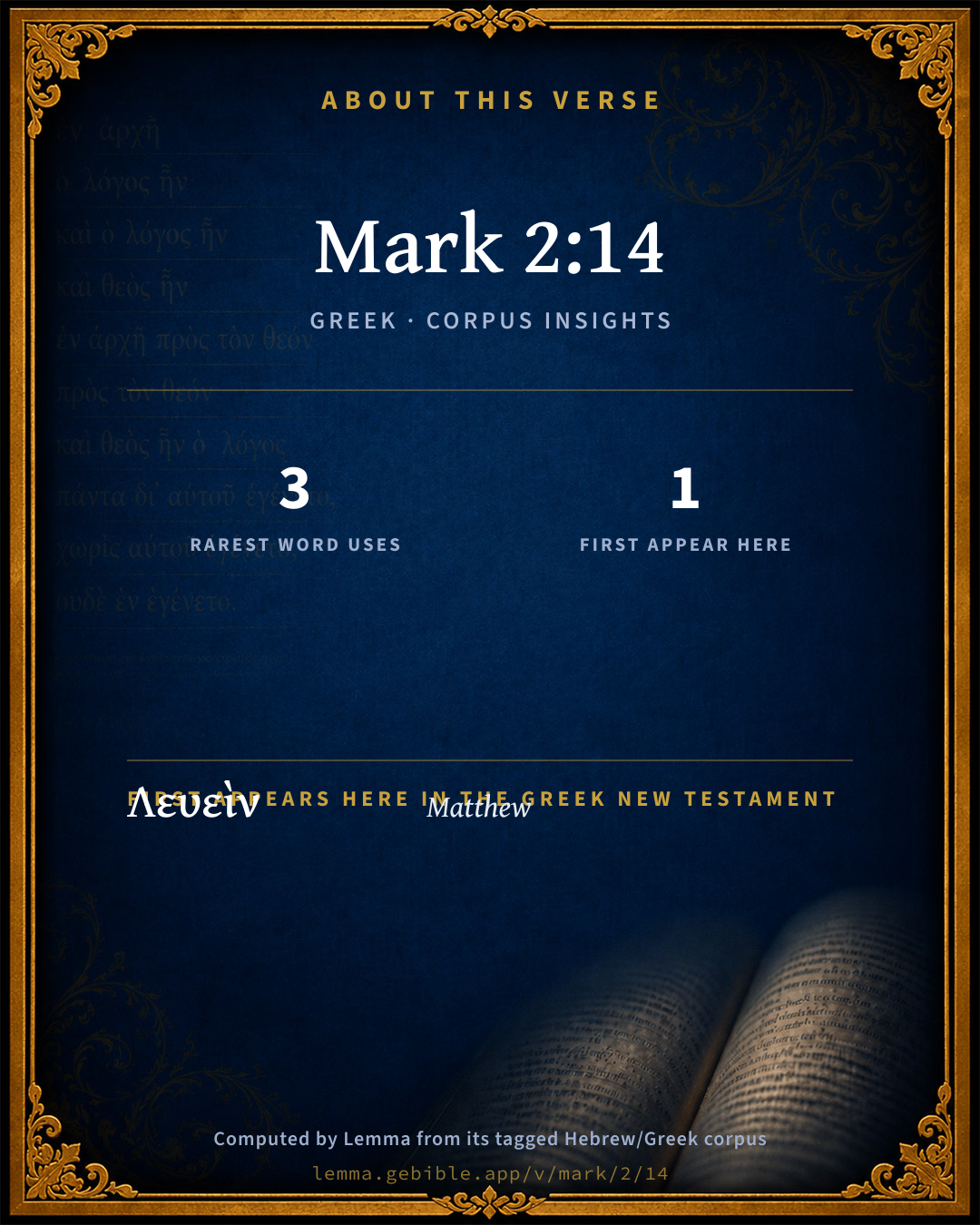
The rarest word here is τελώνιον tax office G5058 — appearing just 3 times in the whole Greek New Testament.

First appearance in Scripture

This word makes its first canonical appearance in the Greek New Testament here:

  • Λευεὶν Matthew G3018

Shared distinctive vocabulary

τελώνιον tax office G5058 occurs in 3 verses of the Greek New Testament. Also found in:
Repetition

Words recur within this verse:

  • ἀκολούθει to follow G190 ×2
  • καὶ and G2532 ×3
  • τὸν the G3588 ×3
  • αὐτῷ he G846 ×2

Cross-references

6

Topical passages linked to Mark 2:14 in the Treasury of Scripture Knowledge — connected by theme and wording, ordered by reader-vote popularity; previews shown in the World English Bible.

  • Luke 5:27–32 After these things he went out, and saw a tax collector named Levi sitting at the tax office, and said to him, "Follow me!"
  • Luke 6:15 Matthew; Thomas; James, the son of Alphaeus; Simon, who was called the Zealot;
  • Matthew 4:19–22 He said to them, "Come after me, and I will make you fishers for men."
  • Matthew 9:9–13 As Jesus passed by from there, he saw a man called Matthew sitting at the tax collection office. He said to him, "Follow me." He got up and followed him.
  • Mark 1:17–20 Jesus said to them, "Come after me, and I will make you into fishers for men."
  • Mark 3:18 Andrew; Philip; Bartholomew; Matthew; Thomas; James, the son of Alphaeus; Thaddaeus; Simon the Zealot;

Cross-references courtesy of OpenBible.info (CC BY 4.0).

Commentary

Notes on Mark 2:14 from classic Christian and Jewish commentators (each source and its license shown beneath its notes). The classic Christian expositions comment on the surrounding passage and are grouped to its opening verse, so a note may address several verses; the Jewish commentaries on the Tanakh (Rashi and others) are per-verse, so they appear only where the commentator wrote on this verse.

Lemma curates 59 commentaries, every one of them public domain or Creative Commons licensed, each selected and text-cleaned for this edition rather than reprinted as found. About our sources →

The Biblical Illustrator

Joseph S. Exell

Mar_2:14-15

And as He passed by, He saw Levi, the son of Alphaeus, sitting at the receipt of custom.

The call of Matthew

The story is placed immediately after a miracle, as if to hint that Matthews conversion was a miracle. There are points of similarity between the miracle and the conversion. Matthew was spiritually palsied by his sins and his money making; hence he needed the Divine command, Arise and walk. There may be points of likeness also between Matthews personal story and our own. These may be profitably considered.

I. His call seemed accidental and unlikely.

1. Jesus had often been at Capernaum, which He had selected to be His own city; and yet Matthew remained unsaved. Was it likely he would now be called? Had not his day of grace closed?

2. Jesus was about other business; for we read, As He passed by. Would He now be likely to call Matthew?

3. Jesus left many other persons uncalled; was it not highly probable that the tax gatherer would be passed by? Yet Jesus called to Himself, Levi, the son of Alphaeus, while many another man had no such special call.

II. His call was altogether unthought of and unsought.

1. He was in a degrading business. None but the lowest of the Jews would care to gather taxes for the Roman conqueror. His discipleship would bring no honour to Christ.

2. He was in an ensnaring business. Money is bird lime to the soul.

3. He would not have dared to follow Jesus even if he had wished to do so. He felt himself to be too unworthy.

4. He would have been repulsed by the other disciples, had he proposed to come without the Lords open invitation.

5. He made no sign in the direction of Jesus. No prayer was offered by him, nor wish expressed towards better things.

III. His call was given by the Lord, with full knowledge of him. He saw Levi, and called him.

1. He saw all the evil that had been in him and was yet there.

2. He saw his adaptation for holy service, as a recorder and penman.

3. He saw all that He meant to make of him.

4. He saw in him His chosen, His redeemed, His convert, His disciple, His apostle, His biographer. The Lord calls as He pleases, but He sees what He is doing. Sovereignty is not blind; but acts with boundless wisdom.

IV. His call was graciously condescending.

1. The Lord called Levi, the son of Alphaeus, or, as he himself says, a man named Matthew,-that was his best.

2. He was a publican-that may not have been his worst.

3. He allowed such a sinner to be His personal attendant; yea, called him to that honour, saying, Follow Me.

4. He allowed him to do this immediately, without putting him into quarantine.

V. His call was sublimely simple.

1. Few were the words-Follow Me. It is very tersely recorded-He saw … said … and he arose and followed Him.

2. Clear was the direction.

3. Personal was the address.

4. Royal was the command.

VI. His call was immediately effectual.

1. Matthew followed at once.

2. He followed spiritually as well as literally.

3. He followed wholly.

4. He followed growingly.

5. He followed ever after, never deserted his Leader.

VII. His call was a door of hope for others.

1. His salvation encouraged other publicans to come to Jesus.

2. His open house gave opportunity to his friends to hear Jesus.

3. His personal ministry brought others to the Saviour.

4. His written Gospel has convinced many, and will always do so.

Application: Are you up to your neck in business? Are you sitting at the receipt of custom? Yet may a call come to you at once. It does come. Hear it attentively; rise earnestly; respond immediately. (C. H. Spurgeon.)

Call of Levi

Such as sit at the receipt of custom are hard to be converted; but Jesus manifests His power by doing it with one word alone. Grace disengages Matthew from the love of money, to make him an apostle; the love of money will separate Judas from Christ, to make him an apostate: thus our Lord makes Himself amends beforehand. St. Matthews example had no influence on Judas, though perhaps it was Christs design to lay it before his eyes. Let us profit by the one as well as the other; and let us, with feat and trembling, adore the different judgments of God in relation to souls. (Quesnel.)

Calls to duty joyful

When the Saviour calls, follow Him gladly. Never regret a duty, or lament a responsibility, or grieve over a sacrifice required. If we were as wise as Matthew, we should celebrate with festive joy every call to duty. (R. Glover.)

The attraction of the Divine call

We read in classic story, how the lyre of Orpheus enchanted with its music, not only the wild beasts, but the very trees and rocks upon Olympus, so that they moved from their places to follow him; so Christ, our heavenly Orpheus, with the music of His gracious speech, draws after Him those less susceptible to benign influences than beasts, and trees, and stones, even poor, hardened, senseless, sinful souls. Let Him but strike His golden harp, and whisper in thy heart, Come, follow Me, and thou, like another Matthew, shalt be won.

The call of Levi

Well might he sit down here; for he had a great weight upon him, the burden of his covetousness, and the desires of gold, bred in him by the often traffic he had with it. Gold is heaviest of all metals; but it is made more heavy by covetousness. For it more oppresses the heart of him that loves it, than the back of him that bears it. And where was he sitting? At the receipt of custom. If it be more blessed to give than to receive, certainly to be a receiver of extorted oppression from the grudging people must be no happy nor blessed thing. This customhouse was such. The receiving of custom breeds a custom of receiving; and that, a desire still to receive more; which desire worldly men will ever seek to satisfy, though with the oppression of their poor brethren. This made this place and office hateful to the people. Publicans and sinners went ever together in their mouths … Christ found him, as he was Levi, the publican; but looked on him, as he was Matthew, the apostle … He called him to an office much more gainful … where he should still be a receiver, and a gainer too; but not, as here, ten or fifteen per centum; but where one should bring forth thirty, one sixty, one an hundred-fold. (Wm. Austin.)

God often calls men in strange places

Not in the house of prayer, not in the preaching of the Word; but when all these things have been absent, and all surrounding circumstances have seemed most adverse to the work of grace, that grace has put forth its power. The tavern, the theatre, the gaming house, the race course, and other similar haunts of worldliness and sin, have sometimes been the scene of Gods converting grace. As an old writer says, Our calling is uncertain in respect of place, for God calls some from their ships, and some from their shops; some from under the hedges, and others from the market; so that, if a man can but make out unto his own soul that he is certainly called, the time when and the place where matter little.

The call of Levi, or Christs voice to the soul

I. That Christ calls men to follow Him.

1. That the call of Christ is antecedent to any human endeavour after Him.

2. That it is often effectively addressed to the most unlikely men.

3. That it is addressed to men when they are occupied with the secular duties of life.

4. That it takes men from the lower duties and sends them to the higher.

II. That Christs call to men must be immediately obeyed-And he arose and followed Him.

1. That obedience must be immediate.

(1) Not to be hindered by intellectual perplexities.

(2) Not to be hindered by commercial or domestic anxieties.

2. That obedience must be self-sacrificing.

3. That it must be willing.

4. That it must be continuous.

Learn:

1. To heed the calls of Christ to the soul.

2. To subordinate the secular to the moral.

3. That true religion consists in following Christ.

4. That it is well to speak to men for their moral good. (J. S. Exell, M. A.)

Matthew the publican

Alas! that the son of a devout, God-fearing Israelite should have fallen so low. Even the outcasts, the sons of Belial, hesitated long before they thus sold themselves to work iniquity. But he had gone freely and voluntarily into the service of the heathen. A fathers stern commands, a mothers earnest pleadings, the entreaties of a loving sister and the expostulations of manly and pure-hearted brothers, the fair fame of the family, upon whose proud escutcheon no such blot had ever come since the days of their great ancestor, David-all these were of no avail to turn this wayward young man from the evil course he had chosen, and at length his name had been blotted from their record and; to all outward seeming, he was to them as if he had never lived. The neighbours and friends left out his name when they spoke of the children of Kolas (as in Mar_6:3), and at morning and evening prayer no audible petition went up to heaven for the erring and sinful one. But, hardened as he was, and great as was the distress he had given to his family, Levi was not beyond the free grace of the Redeemer of men. Jesus was his cousin, according to the flesh, and though He knew how the hearts of that dear family at Nazareth were breaking with anguish over him as utterly lost, yet He, the Divine Redeemer, did not despair of his recovery from the depth of his degradation and sin. Having loved him with an everlasting love, He would draw him out of the depths by the power of His loving kindness. And so it came to pass that when Jesus had left Nazareth and the home of His youth for busy, bustling Capernaum, because there He could accomplish a more comprehensive and effective work in establishing the kingdom of God on the earth, His eye more than once rested on poor Levi, and He saw that, in spite of his bravado, his sins were making him wretched. And when on that bright summer morning He went from Peters house to His work of teaching and healing at the shore of the lake, as He passed the stall or booth where Levi was receiving the tolls and taxes, He said only, Follow me; and the tax gatherer, a few moments ago so hardened and brusque, instantly abandoned his books and accounts, his money and receipts, and, rising from his seat, followed Jesus. Nor did he ever return to the base employment he had left. The change of heart and purpose, though apparently instantaneous, was thorough and permanent. One evidence of its thoroughness was manifested in his desire to bring others who had fallen into the same degradation as himself under the gracious influence of Christs teachings. And Levi made Him (i.e., Christ)

, says the evangelist Luke, a great feast in his own house; and there was a great company of publicans and of others that sat down with them. To these sinful souls our blessed Lord spoke words of forgiveness and pardon, and they became, as St. Mark tells, His followers thenceforward. As for Matthew, he undoubtedly grew in grace, and was restored to the loving favour of his family; for it was, at the farthest, but a very few months later that Jesus chose him as one of the twelve, and with him two, and possibly three of his brothers, the devout and exemplary James the Just being one, and gave him his new name Matthew, The gift of God. Matthews remembrance of his early history and sins seems to have kept him humble, and have prevented him from participating in those unseemly wrangles as to who should be the greatest, in which some of the others indulged; but he was a keen observer, and from the day when he abandoned his publicans stall to his death he must have felt more profoundly than any of the others the certainty that Jesus was the Son of God as well as the Son of Mary. Some practical lessons:

I. Family pride is not a sufficient preservative against deeds of shame.

II. Has dishonour been brought upon your family name by a prodigal? Do not despair of him. You have a great burden of shame and grief to bear; but do not cease to love the prodigal, to pray for him, to hope for him. He, like St. Matthew, may yet hear and obey the voice of Christ.

1. If you did your best to train him in the way in which he should go, be very sure that the healthful influences by which you surrounded him are still with him, fighting mightily against the degrading influence by which he is now encompassed, and they may yet prevail. Not in vain did you do your duty in regard to him.

2. Ah, but it may be that you cannot recall the days of his boyhood without personal shame. You permitted many things to prevent you from training him duly in godliness and true manliness; the example you set before him was not really ennobling. Well, humble yourself before God, and hope in God for your son as well as for yourself. He may yet yield to the persistent drawings of the Divine love.

III. No man should permit his business or his social surroundings to hinder him from following Christ.

IV. One of the very best evidences of a mans conversion is a real manifestation of care for the spiritual welfare of these of his own class. (Anon.)

The call of Levi

I. The person called, A publican, etc.

II. The manner in which he is called.

1. Externally-by the Word.

2. Internally-by Christs power and Spirit.

3. These two must ever be combined.

III. The manner in which Levi treated the call.

1. He did not disregard it, as many.

2. He did not promise a compliance like others.

3. He instantly obeyed, and is thus an example to all who are called.

IV. The call itself. Christ goes before-

1. To prepare Himself for sympathy.

2. To remove doubts as to the way.

3. To free from oppressive responsibility.

4. To show how we are to walk in the way.

5. To remove obstructions.

6. To be a companion. Are you following Christ? (Expository Discourses.)

The feast of Levi, or the festival of a renewed soul

I. It was a festival held to celebrate the most important event in the history of a soul.

1. It was indicative of joy.

2. It was indicative of gratitude.

3. It was indicative of worship. The newly converted soul is characterized by devotion.

II. It was held to introduce to Christ those who were in need of his loving mercy.

1. It was a time for the introduction of sinful companions to Christ.

2. It was a time of leave taking between Levi and his former friends. Not to leave the old life in a hostile spirit.

III. It was a festival too lofty in moral significance to be rightly interpreted by the conventional bigots of the age.

IV. It was a festival beautifully illustrative of Christs mission to the world.

1. We see from this festival that Christ came to save the morally sinful.

2. We see from this festival that Christ came to heal the morally diseased.

Lessons:

1. That the life of the renewed soul should be a constant festival of icy.

2. That Christians should endeavour to bring their comrades to the Saviour.

3. That humanity has a Divine Physician. (J. S. Exell, M. A.)

The Biblical Illustrator, edited by Joseph S. Exell (c. 1880s–1900s) — public domain. Text from a community e-Sword module.

Bengel's Gnomon

Johann Albrecht Bengel

Mar 2:14.[17] ΤΕΛΏΝΙΟΝ, the receipt of custom) At the sea; Mar 2:13.

[17] Comp. on this history, note on Mat 9:9.—E. B.

Bengel's Gnomon of the New Testament — English translation (T&T Clark, Edinburgh, 1860) — public domain. Text from a community e-Sword module.

Expositor's Greek Testament

ed. W. Robertson Nicoll

Mar 2:14 . Λευῒν . Levi, the son of Alphaeus, the name here and in Lk. different from that given in first gospel, but the incident manifestly the same, and the man therefore also; Levi his original name, Matthew his apostle name. Mk. names Matthew in his apostle list (Mar 3:18 ), but he fails to identify the two, though what he states about Levi evidently points to a call to apostleship similar to that to the four fishermen (Mar 1:16 ; Mar 1:20 ). The compiler of the first Gospel, having Mk. before him, and, noticing the omission, substituted the name Matthew for Levi, adding to it λεγόμενον (Mar 9:9 ) to hint that he had another name. ἀκολούθει μοι : a call to apostleship (in terms identical in all three Synoptics), and also to immediate service in connection with the mission to the publicans ( vide on Mt.).

The Expositor's Greek Testament, edited by W. Robertson Nicoll (1897–1910) — public domain. Text from a community e-Sword module.

Geneva Bible (1599)

Geneva Bible translators

Matthew’s other name.

Geneva Bible (1599) marginal notes — public domain. Text via Bolls.life.

Adam Clarke's Commentary

Verse 14. Levi] The same as Matthew; he appears to have been a Jew, though employed in the odious office of a tax-gatherer. For an account of his call, see his Gospel, Mt 9:9, &c.

Adam Clarke's Commentary on the Bible (1810–1826) — public domain. Text from a community e-Sword/MySword module.

Ellicott's Commentary for English Readers

(14-17) Levi the son of Alphæus.—See Notes on Mat_9:9-13. St. Mark and St. Luke agree in giving the name Levi, the former alone describes him as the son of Alphæus.

A Bible Commentary for English Readers, edited by Charles John Ellicott (1878–1897) — public domain. Text from a community e-Sword module.

The Cambridge Bible for Schools and Colleges

gen. ed. J. J. S. Perowne

14. Levi] This was probably the name by which he was known to his Jewish brethren. He may have changed his name after and in memory of his call, so that he who had before been known by the name of Levi, was now known as Matthew, or Mattathias, a favourite name amongst the Jews after the Captivity, and = Theodore, the “Gift of God.”

son of Alphæus] Some have identified this Alphæus with Alphæus the father of St James the Less. But in the lists of the Apostles the two are never named together, like other pairs of brothers in the Apostolic body.

receipt of custom] Situated as Capernaum was at the nucleus of roads which diverged to Tyre, Damascus, Jerusalem, and Sepphoris, it was a busy centre of merchandise, and a natural place for the collection of tribute and taxes.

Follow me] Though he belonged to a class above all others hated and despised by the Jews, trebly hated where, as in the present instance, the tax-gatherer was himself a Jew, yet the Lord did not hesitate to invite him to become one of the Twelve.

and followed him] We cannot doubt that the new disciple had already listened to some of the discourses and beheld some of the wondrous miracles of Christ, so that he was now in the eyes of Him, Who read the heart, prepared for his call.

The Cambridge Bible for Schools and Colleges (gen. ed. J. J. S. Perowne; Cambridge University Press, 1878–1918) — public domain. Text from a community e-Sword module.

John Gill's Exposition

And it came to pass, that as Jesus sat at meat in his house,.... In the house of Levi; not in the custom house, or toll booth, for that he left; but in his house in the city of Capernaum, where he had him, and made an entertainment for him, in token of gratitude, for the high favour bestowed on him:

many publicans and sinners sat also together, with Jesus, and his disciples; being invited by Levi, and not objected to by Christ; See Gill on Mat 9:10.

for there were many, and they followed him; either Christ whom they had observed to have called Matthew, and had heard preach by the sea side; or else Matthew; and so the Persic version renders it, "for many followed Matthew". The Ethiopic version reads the words, "and they were many", that is, publicans and sinners, "and the Scribes and Pharisees followed him"; mentioned in the next verse, from whence it seems to be taken; though true it is, that not only a large number of publicans and sinners followed Christ, but also many of the Scribes and Pharisees; yet with a different view from the former, not to get any advantage to themselves, but, if they could, an advantage against Christ.

John Gill's Exposition of the Whole Bible (1746–1763) — public domain (CC PDM 1.0). Text via the HelloAO Bible API.

Trapp's Complete Commentary

John Trapp

14 And as he passed by, he saw Levi the son of Alphaeus sitting at the receipt of custom, and said unto him, Follow me. And he arose and followed him.

Ver. 14. And as he passed by he saw Levi] Our calling is of free grace, Eze 16:6; Isa 65:1. The scribes and Pharisees are let alone; and this publican called to the work.

And he arose and followed him] Leaving his gainful trade, and following his own ignominy, ruin, death. Nihil hic disputat unde vivere debeat: faith fears no famine: Christ is a universal good, an "All in all."

John Trapp, A Commentary or Exposition upon All the Books of the Old and New Testament (1647–1656) — public domain. Text from a community e-Sword module.

Albert Barnes' Notes on the Bible

Levi, the son of Alpheus - The same, undoubtedly, as “Matthew,” the writer of the gospel which bears his name. It was not uncommon among the Jews to have two names.

The receipt of custom - See the notes at Mat 9:9.

Albert Barnes' Notes on the Bible (1834–1885) — public domain. Text from a community e-Sword/MySword module.

Haydock's Catholic Bible Commentary

To follow Christ, is to imitate him; wherefore this apostle, that he might be able to follow Christ, the model of poverty, not so much by his bodily steps, as by the inward affections of his soul, forsook all; he not only forsook his present goods, but despised all danger, which he incurred by leaving his business abruptly, and without rendering any account of it to his employers or governors. (Ven. Bede) --- The person to whom Christ addresses the words, follow me, was Matthew: see Matthew ix. 9.

George Leo Haydock (1774–1849), Haydock's Catholic Family Bible and Commentary, 1859 edition — public domain. Excludes Psalms (Douay-Rheims chapter numbering differs from Protestant) and Deuterocanonical books (Catholic canon only).

Matthew Poole's English Annotations

We had this piece of history with some addition in Mat 9:9-13, where he was called Matthew: Mark and Luke both call him Levi: it was ordinary with the Jews to have two names. See Poole on "Mat 9:9".

Matthew Poole's English Annotations on the Holy Bible (1683–1685) — public domain. Text from a community e-Sword/MySword module.

Whedon's Commentary on the Bible

Daniel D. Whedon

14. Levi the son of Alpheus — We learn from the parallel passage in Matthew that this Levi was Matthew himself. If the Alpheus here mentioned was the same Alpheus as in Mat_10:3, then Matthew was the cousin of Jesus, being brother of James the Less.

Daniel D. Whedon (gen. ed.), Commentary on the Old and New Testaments (1874–1909) — public domain. Text from a community e-Sword module.

The Pulpit Commentary

Vers. 14, 15. Levi"s call from dishonor to discipleship.

All the sacred Scriptures serve to show that God"s redemption is meant for those who are conscious of their sin, however grievous have been their offenses. Promises prove this. Isaiah"s description of a people whose head was faint and whose heart was sick is followed by the invitation, "Come now, and let us reason together," etc., and this is intensified by the gracious words of Christ, "Come unto me, all ye that labour," etc. Facts suggest the same truth, e.g. God"s dealing with Adam, the call of idolatrous Abram, and the pardon of Manasseh; and all such evidences are concentrated in Christ. Descended through Tamar, Rahab, Bathsheba, and David, he chose no spotless ancestry according to the flesh, but was from the first "numbered with the transgressors." His life-work touched the sinful the woman who was a sinner, the adulteress of Samaria, the thief on the cross, etc. No wonder that his gospel was received by publicans and by sinners, in the house of Herod, in the court of Nero, among the idolatrous Ephesians and the profligate Corinthians. He came "not to call the righteous, but sinners to repentance." Levi the publican was an example of these. Let us consider

I THE POSITION LEVI OCCUPIED "Levi" was the original name borne by the evangelist and apostle who was known in the Church as "Matthew," equivalent to "God"s gift," he being so named because in him the Lord had a fulfillment of his own words, "All that the Father hath given me shall come to me, and him that cometh to me, I will in no wise cast out." Levi was a tax-gatherer, a rate collector, employed by the richer publicans (of whom Zacchaeus was an example) to collect dues levied on the lake fishery or on the traffic passing through the district to Damascus; and consideration of what that involved may encourage the despondent.

1. He was low in the social scale. As a standing emblem of the authority of Roman tyranny, the tax-gatherer, especially when, like Levi, he was a renegade Jew, was intensely hated and despised; none of his fellow-countrymen would speak or eat with him. From the first Christ set himself against this prejudice and social distinction. As the "Son of man," as the King of men, he would have no narrow circle from which to draw his followers. His blessings were for the most despised and poor, as are God"s air and sunshine.

2. He was an outcast from religious men. As patriots, the Jews hated him; as upholders of the ancient faith, they excommunicated him. Hence Matthew the apostle would seem to be a marvel of grace. The excommunicated man was to build up the communion of the Christian Church, the apostle was to become a pillar of Divine truth, the instrument of oppression was to proclaim true liberty, the byword was to become a burning and a shining light. God chose despised things to bring to nought those which were great and honored. The Church"s judgment is not always right, therefore "judge not, that ye be not judged." Christ saw in Levi one who was seeking higher things, and he said to him, "Follow me.

3. He was subject to grievous temptations. The bad reputation of the publicans was doubtless, to a large extent, deserved. The vicious system of raising revenue adopted by Rome, and still practiced in Turkey, would tend to make men avaricious, hard, and unscrupulous. Large sums of money passed through their hands, and were loosely collected and accounted for; bribes were frequently offered and universally accepted, in order to obtain exemptions and privileges; and a publican, from the mere fact of being one, had no reputation to lose, so that if he had been more scrupulous than others he would get no credit for it. In that position Christ saw Levi and pitied him, and thence in his love he called him, teaching us that none are so low, or have circumstances so adverse, as to be beyond the reach of his pity and salvation.

II THE SERVICE LEVI ATTEMPTED.

1. He freely gave up all to follow Jesus. It was a lucrative position, but he felt called to something nobler, for the sake of which any sacrifice should be made. Suggest certain trades and occupations which am now such a hindrance to the Divine life that for Christ"s sake they ought to be abandoned by his followers. Indicate the call which sometimes comes to Christians to give up even innocent employments, for the higher work of preaching Christ.

2. He invited others to see and hear his Master. Luke (Luk_5:27) speaks of this as a "great feast" which Levi made in honor of his Lord; to which he invited his old comrades, who like himself would be popularly ranked among "the publicans and sinners." The feast was an occasion for speaking his farewell, and giving reasons for the change in his life. He wished to show that he was about to serve One greater than Caesar, and to do a nobler work. At his request Jesus became his guest. May that gracious Lord appear in our homes, at all our festive gatherings, and so show himself through us to those around us, that they too may find joy in his service! A.R.

The Pulpit Commentary (1880–1919), ed. H.D.M. Spence-Jones & Joseph S. Exell — public domain. Text from a community e-Sword module.

John Wesley's Explanatory Notes

Matt. ix, 9; Luke v, 27.

John Wesley, Explanatory Notes Upon the Whole Bible (1754–1765) — public domain. Text via the GEBible commentary corpus.

McGarvey & Pendleton's Commentaries

J. W. McGarvey

J. W. McGarvey's The Fourfold Gospel [XXXVI. The Call of Matthew].

XXXVI. THE CALL OF MATTHEW. (At or near Capernaum.) aMATT. IX. 9; bMARK II. 13, 14; cLUKE V. 27, 28.

c27 And after these thingsa [after the healing of the paralytic] he went forth, aagain by the seaside [i. e., he left Capernaum, and sought the shore of the sea, which formed a convenient auditorium for him, and which was hence a favorite scene for his teaching]; and all the multitude resorted unto him, and he taught them. 14 And as he aJesus passed by from thence, he saw cand beheld aa man, ca publican, named ccalled Matthew, cLevi, bthe son of Alphaeus [It will be observed that Matthew, in his account of his call, does not make himself prominent. All [189] the evangelists keep themselves in the background. Because Mark and Luke give us the name Levi, it has been thought by some that they describe the call of a different person from the one mentioned by Matthew--an opinion which seems to have started with Origen. But the difference in name is not an important divergence, for many in that day had two names; as, for example, Lebbæus, who was called Thaddæus; Silas, who was called Sylvanus; John, who was called Mark; etc. Moreover, it was then common to change the name; as is shown by the cases of Simon, who became Peter; Joseph, who became Barnabas; Saul, who became Paul, etc. Therefore, as we have previously suggested ( Mat_10:3). It is not likely, however, that Matthew and James were brothers, for Alphæus was a very common Jewish name, and brothers are usually mentioned in pairs in the apostolic lists, and these two are not so mentioned. Pool takes the extreme view here, contending that James, Matthew, Thaddæus, and Simon Zelotes were four brethren], sitting at the place of toll [Wherever it is at all practicable, Orientals sit at their work. The place of toil was usually a booth or a small hut. Whether Matthew's booth was by the lake, to collect duties on goods and people ferried across; or whether it was by the roadside on the great highway leading from Damascus to Acco, to collect taxes on all produce brought into Capernaum, is not material. The revenues which Rome derived from conquered nations consisted of tolls, tithes, harbor duties, taxes for use of public pasture lands, and duties for the use of mines and salt works], and he saith { csaid unto him, Follow me. 28 And he forsook all, And he arose crose up and followed [190] him. [Such obedience was not, of course, performed in ignorance; it indicates that Matthew was already a disciple, as were the four fisherman when they also received a like call. Matthew was now called to become a personal attendant of Jesus, preparatory to being chosen an apostle. Nor are we to conclude from the abruptness of his movements that he went off without settling accounts with the head of his office. Though it may be more dramatic to thus picture him as departing at once, yet the settlement of accounts was indispensable to his good name in the future, and in no way diminishes the reality and beauty of his sacrifice--a beauty which Matthew himself forbears to mention, as became him ( Pro_27:2). But Matthew certainly neither delayed nor sought counsel ( Gal_1:15, Gal_1:16). By thus calling a publican, Jesus reproved the religious narrowness of his times.] [191]

[FFG 189-191]

J. W. McGarvey (with Philip Y. Pendleton), Commentaries on the New Testament (The Fourfold Gospel, 1914; Acts; and the epistles) — public domain. Text from a community e-Sword/MySword module.

The People's New Testament

B. W. Johnson

14. He saw Levi the son of Alphæus. Matthew Levi; the apostle after this, but now a publican. On the call of Matthew and Matthew's feast see notes on Matt. 9:9–17, and compare also Luke 5:27–39.

B. W. Johnson's The People's New Testament with Notes (1889–1891) — public domain. Electronic text from the Christian Classics Ethereal Library (CCEL) ThML edition.

Cambridge Greek Testament for Schools and Colleges

14. For Λευείν ([271]c[272][273][274] Λευίν ([275][276][277][278][279][280][281] Λευί ([282][283][284][285][286] 33), Λευεί ([287][288] [289] some cursives and Lat-Vet. have Ἰάκωβον. The Gospel of Peter sub fin. has Λευείς. Vulg. has Leuin.

[271] Codex Sinaiticus. 4th cent. Discovered by Tischendorf in 1859 at the Monastery of St Katharine on Mount Sinai. Now at St Petersburg. The whole Gospel, ending at Mar 16:8. Photographic facsimile, 1911.

[272] Codex Vaticanus. 4th cent., but perhaps a little later than א. In the Vatican Library almost since its foundation by Pope Nicolas V., and one of its greatest treasures. The whole Gospel, ending at Mar 16:8. Photographic facsimile, 1889.

[273] Codex Regius. 8th cent. An important witness. At Paris. Contains Mar 1:1 to Mar 10:15; Mar 10:30 to Mar 15:1; Mar 15:20 to Mar 16:20, but the shorter ending is inserted between Mar 16:8 and Mar 16:9, showing that the scribe preferred it to the longer one.

[274] odex Campianus. 9th cent. At Paris. Gospels complete.

[275] Codex Ephraemi. 5th cent. A palimpsest: the original writing has been partially rubbed out, and the works of Ephraem the Syrian have been written over it; but a great deal of the original writing has been recovered; of Mark we have Mar 1:17 to Mar 6:31, Mar 8:5 to Mar 12:29, Mar 13:19 to Mar 16:20. In the National Library at Paris.

[276] Codex Boreelianus. Once in the possession of John Boreel. 9th cent. At Utrecht. Contains Mk 1–41; Mar 2:8-23; Mar 3:5 to Mar 11:6; Mar 11:27 to Mar 14:54; Mar 15:6-39; Mar 16:19-20.

[277] Codex Seidelianus I. 9th or 10th cent. Contains Mar 1:13 to Mar 14:18; Mar 14:25 to Mar 16:20.

[278] Codex Seidelianus II. 9th or 10th cent. Contains Mar 1:1-31; Mar 2:4 to Mar 15:43; Mar 16:14-20.

[279] Codex Vaticanus. 10th cent. Dated A.D. 949.

[280] Codex Nanianus. 9th or 10th cent. Gospels complete.

[281] odex Mosquensis. 9th cent.

[282] Codex Alexandrinus. 5th cent. Brought by Cyril Lucar, Patriarch of Constantinople, from Alexandria, and afterwards presented by him to King Charles I. in 1628. In the British Museum. The whole Gospel. Photographic facsimile, 1879.

[283] Codex Cyprius. 9th cent. One of the seven uncials which have the Gospels complete, the others being אBMSUΩ. At Paris.

[284] Codex Oxoniensis. 9th cent. Contains Mark, except Mar 3:35 to Mar 6:20.

[285] Codex Sangallensis. 9th or 10th cent. Contains the Gospels nearly complete, with an interlinear Latin translation. The text of Mark is specially good, agreeing often with CL. At St Gall.

[286] Codex Petropolitanus. 9th cent. Gospels almost complete. Mar 16:18-20 is in a later hand.

[287] Codex Sinaiticus. 4th cent. Discovered by Tischendorf in 1859 at the Monastery of St Katharine on Mount Sinai. Now at St Petersburg. The whole Gospel, ending at Mar 16:8. Photographic facsimile, 1911.

[288] n asterisk denotes that the word is not found elsewhere in N.T., and such words are included in the index, even if there is no note on them in the commentary.

[289] Codex Bezae. 6th cent. Has a Latin translation (d) side by side with the Greek text, and the two do not quite always agree. Presented by Beza to the University Library of Cambridge in 1581. Remarkable for its frequent divergences from other texts. Contains Mark, except Mar 16:15-20, which has been added by a later hand. Photographic facsimile, 1899.

14. παράγων εἶδεν. As in Mar 1:16; the repetition confirms the view that πάλιν refers to Mar 1:16. Once more, on the shore of the Lake, He becomes a fisher of men.

Λευείν. See crit. note. The fact that James the Less was son of an Alphaeus (Mar 3:18) may have led to the reading Ἰάκωβον. That Levi and James were brothers, sons of the same Alphaeus, is improbable. They are associated in no list of the Apostles. With Λευείν Lk. has his favourite ὀνόματι, and with Μαθθαῖον Mt. has his λεγόμενον. Mk has λεγόμενος once (Mar 15:7) and ὀνόματι not at all.

καθήμενον ἐπὶ τὸ τελώνιον. Sitting at or near the place where toll was collected. The douane of the Lake; the word occurs only in this connexion; cf. δεκατώνιον, the office of a collector of tenths. In N.T., ἐπί c. acc. often answers the question Where? Blass § 43. 1. Capernaum was on some of the main trade routes, and here tolls were collected for the tetrarch; hence the πολλοὶ τελῶναι (Mar 2:15), some of whom would be sitting with Levi. There is no serious ground for doubting the identity of Levi the toll-gatherer with Matthew the toll-gatherer. The two names do not cause great difficulty, although they are not quite parallel to the other instances among the Apostles. In those of Simon Peter and Thomas Didymus, one name is Semitic, the other Greek. Bartholomew (who is probably Nathaniel) has a patronymic for one name. But both Levi and Matthew are Semitic, and neither is a patronymic.

Ἀκολούθει μοι. A call to be a disciple (Mar 8:34), and perhaps to be an Apostle (Mar 1:17): cf. Mat 8:22; Luk 9:59. It certainly meant leaving his lucrative post at the τελώνιον, and therefore it was a severer test than the call to the four fishermen: Lk. inserts καταλιπών πάντα. They could, and did, return to their fishing, when the work to which Jesus had called them seemed to be at an end. Once more Jesus appears as the reader of hearts. If He had not known Levi’s character, He would not have called one of his very unpromising profession to be an Apostle: his ministrations would be unacceptable to every Jew who had known him as a toll-collector. There may have been a religious stir among the toll-collectors. Many of them had come to listen to John (Luk 3:12).

ἀναστὰς ἠκολούθησεν αὐτῷ. The Hebraistic pleonasm ἀναστάς is in all three. We may suppose that Levi heard Christ teach, or that he knew something of His teaching, and had thought about it. But there is nothing incredible in the thought that there was something in Christ’s look and manner and sudden invitation which answered to a craving in the toll-gatherer’s heart, and that he felt at once, like Francis of Assisi at the Portiuncula, that this was a call which came home to him. Such feeling may show want of mental ballast, as Porphyry thought. The outcome is the only practical test of its value; “By their fruits ye shall know them.”

Cambridge Greek Testament for Schools and Colleges (Cambridge University Press, 1896; 21 vols, various authors incl. Carr, Maclear, Plummer, Farrar, Lumby, Moule, M. R. James, Simcox) — public domain. Text from a community e-Sword module.

International Critical Commentary

14. Λευεὶν τὸν τοῦ Ἀλφαίου—Levi, the son of Alphœus. So Luk 5:27. In Mat 9:9, however, where the same event is told in almost identical language, Μαθθαῖον, Matthew, is substituted for Levi. The two are to be identified, therefore, as different names of the same person.

Alphæus is also the name of the father of James the less. But as Matthew and James are not associated in any list of the apostles, there is no sufficient reason for identifying this Alphæus with the other.

ἐπὶ τὸ τελώνιον, not in the toll-house, but near it. See Thay.-Grm. Lex. τελώνιον denotes the place in which the customs were collected. It is a late Greek word.1 Ἀκολούθει μοι—follow me. This is the common language of Jesus in summoning disciples to personal attendance on himself, which is evidently the meaning here. The apparent abruptness of the call, and the immediateness with which it is answered, are relieved of their strangeness by the fact that Jesus had now been teaching long enough to call the attention of men to himself, so that the summons probably brought to a crisis and decision thoughts already in Levi’s mind.

International Critical Commentary — older volumes (1896–1929), various authors — public domain. Text from a community e-Sword module.

Vincent's Word Studies in the New Testament

Marvin R. Vincent

See on Mt 9:9.

Marvin R. Vincent, Word Studies in the New Testament (1887–1900) — public domain. Text from a community e-Sword/MySword module.

Lesson kit

Teaching starters — assembled from the data on this page, not authored interpretation. Every prompt links to the verse data it draws on. Edit before teaching.

Mark, in the Gospels, opens this verse with 20 words (14 distinct Greek lemmas). Its most distinctive word is telṓnion (“tax office”). A historical commentator’s framing appears above. Read the whole chapter for the surrounding context.

Discussion questions

  1. What does “tax office” (telṓnion) contribute to the verse as a whole?
  2. The word “Matthew” first appears here in Scripture. What is being introduced at this debut?
  3. Matthew 9:9 shares the word «tax office» with this verse. How do the two illuminate each other?
  4. “to follow” occurs 2× in this one verse. What is the effect of the repetition?
  5. The translations on this page render this verse differently — a whole-verse word diff, not a word-by-word alignment. What might account for the different wordings?
  6. Reading how The Biblical Illustrator and Bengel's Gnomon read this verse, where do the two commentators agree and where do they part?

Things to notice

  • 1 word makes its first canonical appearance in Scripture here.
  • These translations choose different wording for 14 words in this verse.
  • “to follow” occurs 2× in this single verse.
  • 14 distinct Greek lemmas span 20 words in this verse.

Reading settings

Reading text

Shown beneath each verse's original-language words.

Old Testament
Old Testament edition

Read the OT as the Masoretic Hebrew (MT) or the Greek Septuagint (LXX).

English shown for the Greek Septuagint (in the Hebrew ↔ Greek comparison).

Comparing translations? Open the Compare panel on any verse page to stack up to four side by side.