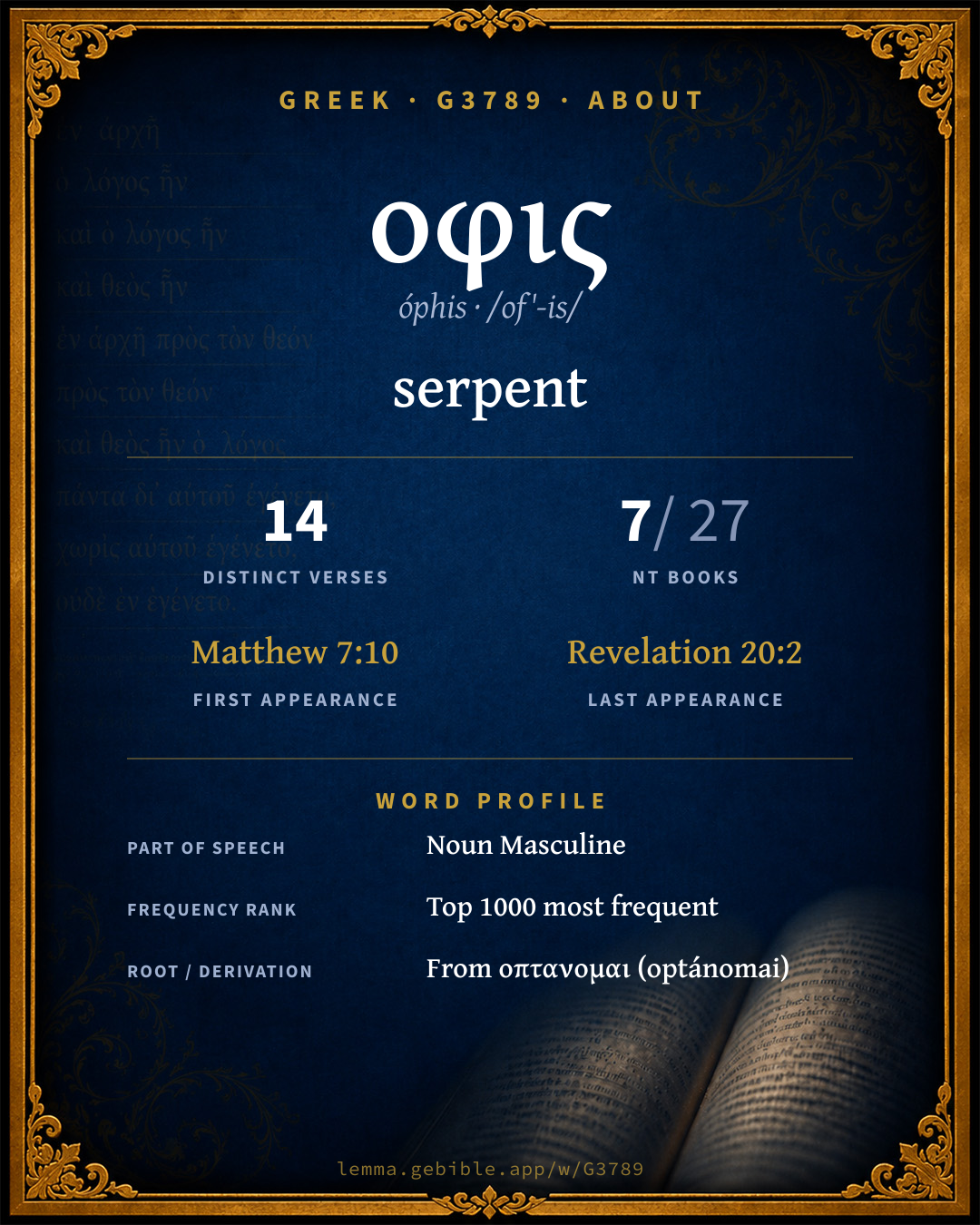
ὄφις
serpent
‘serpent’ is one of 2 main senses fuller range ↓
Full lexicon entry — Thayer's Greek Lexicon
From Thayer's Greek Lexicon
Where this word appears
See every Nominative-case word in the Greek New Testament →
Grammar key — what these labels mean
Part of speech
- Noun
- A naming word — a person, place, thing, or idea.
Case
- Nominative
- The case of the subject (and the predicate nominative).
- Accusative
- The case of the direct object and of extent.
- Genitive
- The case of source, possession, or “of” — answers “whose / from what.”
- Dative
- The case of the indirect object, means, or location — “to / for / with / in.”
- Vocative
- The case of direct address (“O Lord”).
Gender
- Masculine
- Grammatically masculine.
Number
- Singular
- One.
- Plural
- More than one.
Grammatical forms
- Noun, Nominative, Singular, Masculine 4 times (29%)
- Noun, Accusative, Singular, Masculine 3 times (21%)
- Noun, Genitive, Plural, Masculine 2 times (14%)
- Noun, Accusative, Plural, Masculine 1 time (7%)
- Noun, Dative, Plural, Masculine 1 time (7%)
- Noun, Genitive, Singular, Masculine 1 time (7%)
- Noun, Nominative, Plural, Masculine 1 time (7%)
- Noun, Vocative, Plural, Masculine 1 time (7%)
Parsed forms decoded from the imported morphology (Robinson–Tischendorf, public domain), counted across 14 parsed occurrences — not distinct verses.
Every verse where G3789 appears — 14 distinct verses across 7 books. Click any verse to open its interlinear word-by-word view. Verse text shown in the World English Bible for context — . Each verse’s Greek form is shown with its reference; the English is not keyword-highlighted, since the data carries no word-level English alignment. Use “Compare translations” on any verse to read it across multiple English versions. This concordance covers the Greek New Testament; Septuagint (Greek Old Testament) occurrences of this word are not indexed here.
Matthew 3 verses
- Matthew 7:10 ὄφιν n acc sg masc Or if he asks for a fish, who will give him a serpent?
- Matthew 10:16 ὄφεις n nom pl masc "Behold, I send you out as sheep in the midst of wolves. Therefore be wise as serpents, and harmless as doves.
- Matthew 23:33 ὄφεις n voc pl masc You serpents, you offspring of vipers, how will you escape the judgment of Gehenna?
Mark 1 verse
Luke 2 verses
- Luke 10:19 ὄφεων n gen pl masc Behold, I give you authority to tread on serpents and scorpions, and over all the power of the enemy. Nothing will in any way hurt you.
- Luke 11:11 ὄφιν n acc sg masc "Which of you fathers, if your son asks for bread, will give him a stone? Or if he asks for a fish, he won't give him a snake instead of a fish, will he?
John 1 verse
1 Corinthians 1 verse
2 Corinthians 1 verse
Revelation 5 verses
- Revelation 9:19 ὄφεσιν n dat pl masc For the power of the horses is in their mouths, and in their tails. For their tails are like serpents, and have heads, and with them they harm.
- Revelation 12:9 ὄφις n nom sg masc The great dragon was thrown down, the old serpent, he who is called the devil and Satan, the deceiver of the whole world. He was thrown down to the earth, and his angels were thrown down with him.
- Revelation 12:14 ὄφεως n gen sg masc Two wings of the great eagle were given to the woman, that she might fly into the wilderness to her place, so that she might be nourished for a time, and times, and half a time, from the face of the serpent.
- Revelation 12:15 ὄφις n nom sg masc The serpent spewed water out of his mouth after the woman like a river, that he might cause her to be carried away by the stream.
- Revelation 20:2 ὄφις n nom sg masc He seized the dragon, the old serpent, which is the devil and Satan, who deceives the whole inhabited earth, and bound him for a thousand years,
About this entry
At a glance — auto-summarized from this page’s data, not written by a person. Every figure links to its source below. This summary describes the numbers; it doesn’t interpret them.
The Greek noun οφις centers on the idea of “serpent.” Its English rendering has broadened — “serpent” classically, “snakes” (Berean Standard Bible) in modern versions; see the renderings breakdown. The Greek New Testament uses it across 14 verses — uncommon. Revelation dominates its distribution — 5 of 14 verses. Thayer's distinguishes 2 senses for it. For the data behind this summary, explore the sense tree and the renderings breakdown below.
Gloss history
Strong's 1890 vs modern scholarship
About this word
Strong's G3789 catalogs a Greek word from the Greek New Testament.
These counts are not copied from any lexicon or concordance. They are computed here, from the morphology-tagged Greek New Testament. What Lemma adds →
- 14
- distinct verses
- The word appears in 14 distinct verses.
- 7 / 27
- NT books
- The word appears in 7 of 27 New Testament books.
- #814
- by frequency
- Top 1000 most frequent Greek words (rank 814 of 5,347 Greek words by occurrence).
View all 14 occurrences in the concordance →
Most concentrated in
- Revelation 5 verses 36%
- Matthew 3 verses 21%
- Luke 2 verses 14%
By section of the New Testament
By traditional corpus
Conventional, traditional groupings — biblical authorship is debated, so this is a traditional corpus grouping, not an authorship claim. Some books belong to more than one corpus (Luke is in both the Gospels and the Lukan corpus, and so on), so these shares overlap and need not total 100%. Each figure is a share of the word’s 14 distinct verses.
- Gospels 7 verses · 50%
- Johannine 6 verses · 43%
- Revelation 5 verses · 36%
- Lukan (Luke–Acts) 2 verses · 14%
- Pauline corpus 2 verses · 14%
How translations render this word
Counts come from each version’s own published word-to-Strong’s tagging or interlinear alignment — an approximate guide to how each version renders this word, not a word-level alignment the data otherwise carries. Because each total is that version’s own tagged count, the per-version totals vary from one another and need not match the appearance or distinct-verse counts above. These counts may also differ from a printed concordance because Lemma counts each distinctly tagged rendering and does not collapse phrase taggings into a single head-word total. This is a fixed set of word-tagged versions (KJV, ASV, BSB, ULT) and does not change with the reading translation you choose elsewhere. Each version’s license is shown beside its name below (and on Sources).
- King James Version: Serpent 8×, Serpents 5×
- American Standard Version: Serpent 8×, Serpents 5×
- Berean Standard Bible: Snakes 5×, Serpent 4×, Snake 3×
- unfoldingWord Literal Text: Serpent 6×, Snakes 4×, Serpents 2×
King James Version Public Domain
Renders G3789 across 14 tagged occurrences — most commonly:
Plus 1 rendering that appears only once — usually multi-word phrases or single function words the recovered tagging swept in, not distinct renderings.
American Standard Version Public Domain
Renders G3789 across 14 tagged occurrences — most commonly:
Plus 1 rendering that appears only once — usually multi-word phrases or single function words the recovered tagging swept in, not distinct renderings.
Berean Standard Bible Public Domain
Renders G3789 across 14 tagged occurrences — most commonly:
Plus 2 renderings that appear only once — usually multi-word phrases or single function words the recovered tagging swept in, not distinct renderings.
unfoldingWord Literal Text CC BY-SA 4.0
Renders G3789 across 14 tagged occurrences — most commonly:
Senses in Thayer's
The 2 senses Thayer's distinguishes for this word, in lexicon order (not ranked by frequency or importance). The full entry — with sub-senses — is in the Lexicon Entry tab.
- snake, serpent
- with the ancients…
Word origin
Derived from οπτανομαι (optánomai) (G3700) — to look at.
Probably from G3700 (through the idea of sharpness of vision); a snake figuratively (as a type of sly cunning) an artful malicious person especially Satan : - serpent.
— Strong’s Exhaustive Concordance (1890), public domain.
Forms in the corpus
The 6 distinct written forms G3789 takes in the Greek New Testament, most frequent first — each parse links to that case’s occurrences in the concordance.
| Form | Parsing | Example | Uses |
|---|---|---|---|
| ὄφις óphis | Noun, Nominative, Singular, Masculine | 2 Corinthians 11:3 | 4 |
| ὄφεις ópheis | Noun, Accusative, Plural, Masculine | Mark 16:18 | 3 |
| ὄφιν óphin | Noun, Accusative, Singular, Masculine | Matthew 7:10 | 3 |
| ὄφεων ópheōn | Noun, Genitive, Plural, Masculine | Luke 10:19 | 2 |
| ὄφεσιν óphesin | Noun, Dative, Plural, Masculine | Revelation 9:19 | 1 |
| ὄφεως ópheōs | Noun, Genitive, Singular, Masculine | Revelation 12:14 | 1 |
Same root — word family
Other Thayer's entries built from the same root as G3789, grouped by Strong’s listed origin. These share a root / origin per the lexicon — not necessarily a shared meaning. Each links to that word’s own entry.
Derives from
Shares the same root
- ομμα ómma G3659 eye
- οπη opḗ G3692 opening
- οπισθεν ópisthen G3693 behind
- οπτασια optasía G3701 vision
- οραω horáō G3708 to see
- οφθαλμος ophthalmós G3788 eye
- οφρυς ophrŷs G3790 eyebrow
- οψις ópsis G3799 face
- σκυθρωπος skythrōpós G4659 sad-faced
Proper names from this root
People and places named from this root — a name, not an additional meaning of the word.
Compare all same-root words → Showing 4 of 12 — not the complete family. 1 of the same-root words is a proper name (a person or place). They share a root, not necessarily a meaning.
Septuagint usage
The same Greek word οφις appears 35 times in the Greek Old Testament (Septuagint), across 29 verses in 13 books.
- 35
- LXX occurrences
- Tagged occurrences of this Greek word in the Septuagint.
- 29
- verses
- Distinct Septuagint verses containing this word.
- 13 / 39
- OT books
- The word appears in 13 of the 39 Old Testament books.
Sample Septuagint occurrences
- Genesis 3:1 ὄφις
- Exodus 4:3 ὄφις
- Numbers 21:6 ὄφις
- Deuteronomy 8:15 ὄφις
- 2 Kings 18:4 ὄφις
- Job 20:16 ὄφις
- Psalms 57:5 ὄφις
- Proverbs 23:32 ὄφις
- Ecclesiastes 10:8 ὄφις
- Isaiah 14:29 ὄφις
- Jeremiah 8:17 ὄφις
- Amos 5:19 ὄφις
Septuagint occurrences (same lexeme)
Every verse where the same Strong’s number (G3789) appears in the Greek Septuagint. Verse text shown in the World English Bible for context; the Greek form is the matched word — the English is not keyword-highlighted.
- Genesis 3:1 ὄφις Now the serpent was more subtle than any animal of the field which Yahweh God had made. He said to the woman, "Yes, has God said, 'You shall not eat of any tree of the garden?'"
- Genesis 3:2 ὄφις The woman said to the serpent, "Of the fruit of the trees of the garden we may eat,
- Genesis 3:4 ὄφις The serpent said to the woman, "You won't surely die,
- Genesis 3:13 ὄφις Yahweh God said to the woman, "What is this you have done?" The woman said, "The serpent deceived me, and I ate."
- Genesis 3:14 ὄφις Yahweh God said to the serpent, "Because you have done this, cursed are you above all cattle, and above every animal of the field. On your belly shall you go, and you shall eat dust all the days of your life.
- Genesis 49:17 ὄφις Dan will be a serpent in the way, An adder in the path, That bites the horse's heels, So that his rider falls backward.
- Exodus 4:3 ὄφις He said, "Throw it on the ground." He threw it on the ground, and it became a snake; and Moses ran away from it.
- Exodus 4:17 ὄφις You shall take this rod in your hand, with which you shall do the signs."
- Exodus 7:15 ὄφις Go to Pharaoh in the morning. Behold, he goes out to the water; and you shall stand by the river's bank to meet him; and the rod which was turned to a serpent you shall take in your hand.
- Numbers 21:6 ὄφις Yahweh sent fiery serpents among the people, and they bit the people; and much people of Israel died.
- Numbers 21:7 ὄφις The people came to Moses, and said, We have sinned, because we have spoken against Yahweh, and against you; pray to Yahweh, that he take away the serpents from us. Moses prayed for the people.
- Numbers 21:8 ὄφις Yahweh said to Moses, Make you a fiery serpent, and set it on a standard: and it shall happen, that everyone who is bitten, when he sees it, shall live.
- Numbers 21:9 ὄφις Moses made a serpent of brass, and set it on the standard: and it happened, that if a serpent had bitten any man, when he looked to the serpent of brass, he lived.
- Deuteronomy 8:15 ὄφις who led you through the great and terrible wilderness, [in which were] fiery serpents and scorpions, and thirsty ground where was no water; who brought you forth water out of the rock of flint;
- 2 Kings 18:4 ὄφις He removed the high places, and broke the pillars, and cut down the Asherah: and he broke in pieces the brazen serpent that Moses had made; for to those days the children of Israel did burn incense to it; and he called it Nehushtan.
- Job 20:16 ὄφις He shall suck cobra venom. The viper's tongue shall kill him.
- Psalms 57:5 ὄφις Be exalted, God, above the heavens! Let your glory be above all the earth!
- Psalms 139:4 ὄφις For there is not a word on my tongue, But, behold, Yahweh, you know it altogether.
- Proverbs 23:32 ὄφις In the end, it bites like a snake, And poisons like a viper.
- Proverbs 30:19 ὄφις The way of an eagle in the air; The way of a serpent on a rock; The way of a ship in the midst of the sea; And the way of a man with a maiden.
- Ecclesiastes 10:8 ὄφις He who digs a pit may fall into it; and whoever breaks through a wall may be bitten by a snake.
- Ecclesiastes 10:11 ὄφις If the snake bites before it is charmed, then is there no profit for the charmer's tongue.
- Isaiah 14:29 ὄφις Don't rejoice, O Philistia, all of you, because the rod that struck you is broken; for out of the serpent's root shall come forth an adder, and his fruit shall be a fiery flying serpent.
- Isaiah 27:1 ὄφις In that day Yahweh with his hard and great and strong sword will punish leviathan the swift serpent, and leviathan the crooked serpent; and he will kill the monster that is in the sea.
- Isaiah 65:25 ὄφις The wolf and the lamb shall feed together, and the lion shall eat straw like the ox; and dust shall be the serpent's food. They shall not hurt nor destroy in all my holy mountain, says Yahweh.
- Jeremiah 8:17 ὄφις For, behold, I will send serpents, adders, among you, which will not be charmed; and they shall bite you, says Yahweh.
- Jeremiah 26:22 ὄφις and Jehoiakim the king sent men into Egypt, [namely], Elnathan the son of Achbor, and certain men with him, into Egypt;
- Amos 5:19 ὄφις As if a man fled from a lion, And a bear met him; Or he went into the house and leaned his hand on the wall, And a snake bit him.
- Micah 7:17 ὄφις They will lick the dust like a serpent. Like crawling things of the earth they shall come trembling out of their dens. They will come with fear to Yahweh our God, And will be afraid because of you.
These are occurrences of the same Greek lexeme (G3789) in the Septuagint — not a translation of any one Hebrew word. The store carries no word-level Hebrew↔Greek alignment, so no Hebrew original is asserted here. Counts come from the recovered LXX Strong's tagging — high-frequency vocabulary is well covered, while rare or late forms may be untagged — so they reflect tagged occurrences and may slightly undercount.