
John 3:11

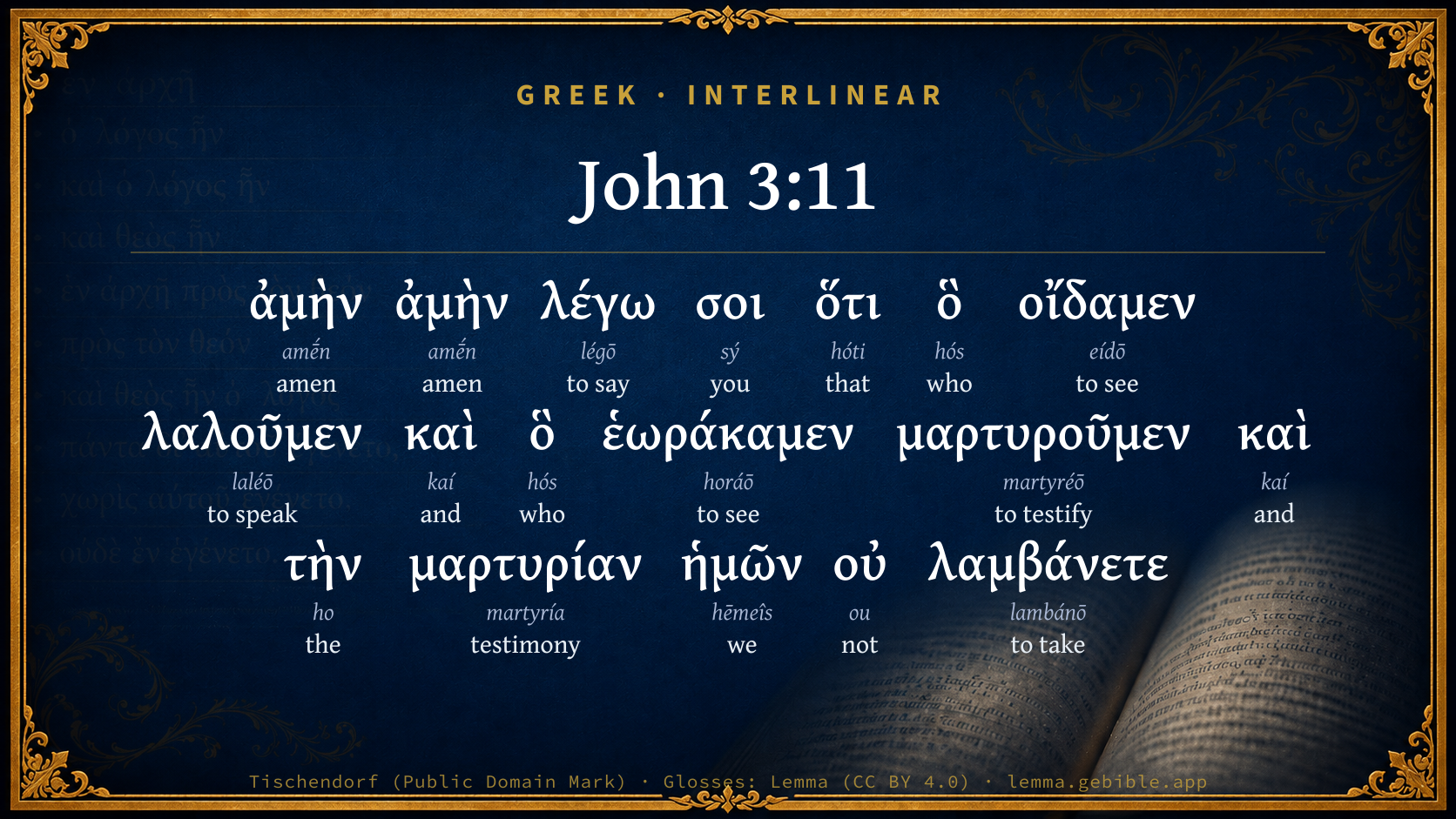
Greek (Tischendorf 8th ed.) John 3:11 appears in the Greek New Testament. The text above is from the Tischendorf 8th edition. Each word links to its Strong’s number and a concise gloss. Click any word for its full Thayer’s Greek Lexicon entry.
Download image
Cite this verse

John 3:11 (World English Bible). Public Domain. Lemma interlinear Bible study tool, https://lemma.gebible.app/v/john/3/11.

Show BibTeX & RIS
BibTeX
RIS
English Translation
Most assuredly I tell you, we speak that which we know, and testify of that which we have seen, and you don't receive our witness.
World English Bible · Public Domain
Download a study sheet

One document with this verse’s original text, its word-by-word gloss line, the meaning frame, cross-references with their text, attributed commentary, and full source and license credits — printable, and it pastes into notes with its structure intact.

This verse Autodidact and up

Study sheet (.html) Plain text (.txt)

A passage Seminary Student

Up to 50 verses in one chapter. A passage sheet keeps up to 6 commentary sources and 12 cross-references per verse, in the order this page ranks them, and says so on the sheet whenever that leaves anything out. Ask for a single verse and you get the Autodidact verse sheet above.

Everything on this page stays free to read, with no account — the sheet is a download of what is already on screen, not access to it.

Want to remove ads? Support Godless Engineer
Compare translations 3

The same verse in 3 English versions, stacked beneath the original-language interlinear above. Click any original word for its lexicon entry.

Each is an independent rendering of the whole verse — the interlinear is not word-aligned to these translations.

Highlighted words mark where these versions differ — a whole-verse word diff, not a word-by-word alignment.

  • World English Bible Public Domain
    Most assuredly I tell you, we speak that which we know, and testify of that which we have seen, and you don't receive our witness.
  • King James Version Public Domain
    Verily, verily, I say unto thee, We speak that we do know, and testify that we have seen; and ye receive not our witness.
  • unfoldingWord Literal Text CC BY-SA 4.0
    Truly, truly, I say to you that we speak we know, and we testify about we have seen, and you do not receive our testimony.

unfoldingWord Literal Text — © unfoldingWord, licensed CC BY-SA 4.0. Word-aligned USFM3 via Door43 (git.door43.org/unfoldingWord/en_ult).

Versions to compare (up to 4)

3 of 4 selected

Show all 19 translations

Every available English version of this verse, each an independent rendering of the whole verse.

  • World English Bible Public Domain
    Most assuredly I tell you, we speak that which we know, and testify of that which we have seen, and you don't receive our witness.
  • Berean Standard Bible Public Domain
    Truly, truly, I tell you, we speak of what we know, and we testify to what we have seen, and yet you people do not accept our testimony.
  • Majority Standard Bible Public Domain
    Truly, truly, I tell you, we speak of what we know, and we testify to what we have seen, and yet you people do not accept our testimony.
  • King James Version Public Domain
    Verily, verily, I say unto thee, We speak that we do know, and testify that we have seen; and ye receive not our witness.
  • American Standard Version (1901) Public Domain
    Verily, verily, I say unto thee, We speak that which we know, and bear witness of that which we have seen; and ye receive not our witness.
  • Revised Version (1885) Public Domain
    Verily, verily, I say unto thee, We speak that we do know, and bear witness of that we have seen; and ye receive not our witness.
  • Geneva Bible (1599) Public Domain
    Verely, verely I say vnto thee, wee speake that we know, and testifie that we haue seene: but yee receiue not our witnesse.
  • Douay-Rheims (1899) Public Domain
    Amen, amen I say to thee, that we speak what we know, and we testify what we have seen, and you receive not our testimony.
  • Young's Literal Translation Public Domain
    `Verily, verily, I say to thee -- What we have known we speak, and what we have seen we testify, and our testimony ye do not receive;
  • Literal Standard Version CC BY-SA 4.0
    Truly, truly, I say to you, what We have known We speak, and what We have seen We testify, and you do not receive Our testimony;
  • Unlocked Literal Bible CC BY-SA 4.0
    Truly, truly, I say to you, we speak what we know, and we testify about what we have seen. Yet you do not accept our testimony.
  • unfoldingWord Literal Text CC BY-SA 4.0
    Truly, truly, I say to you that we speak we know, and we testify about we have seen, and you do not receive our testimony.
  • Darby Bible Public Domain
    Verily, verily, I say unto thee, We speak that which we know, and we bear witness of that which we have seen, and ye receive not our witness.
  • World Messianic Bible Public Domain
    Most certainly I tell you, we speak that which we know and testify of that which we have seen, and you don’t receive our witness.
  • Webster's Bible Public Domain
    Verily, verily, I say to thee, We speak what we know, and testify what we have seen; and ye receive not our testimony.
  • Free Bible Version CC BY-SA 4.0
    “I tell you the truth, we speak of what we know and give evidence regarding what we have seen, but you refuse to accept our testimony.
  • Bible in Basic English Public Domain
    Truly, I say to you, We say that of which we have knowledge; we give witness of what we have seen; and you do not take our witness to be true.
  • Text-Critical English NT CC BY 4.0
    Truly, truly, I say to yoʋ, we speak of what we know, and we testify about what we have seen, but you do not receive our testimony.
  • Tyndale New Testament (1534) Public Domain
    Verely verely I saye vnto the we speake that we knowe and testify that we have sene: and ye receave not oure witnes.

Literal Standard Version (2020), Covenant Press — licensed CC BY-SA 4.0. Text via the HelloAO Bible API (eBible.org). Unlocked Literal Bible (unfoldingWord) — licensed CC BY-SA 4.0. Text via the HelloAO Bible API (eBible.org). unfoldingWord Literal Text — © unfoldingWord, licensed CC BY-SA 4.0. Word-aligned USFM3 via Door43 (git.door43.org/unfoldingWord/en_ult). Free Bible Version, Dr. Jonathan Gallagher — licensed CC BY-SA 4.0. Text via the HelloAO Bible API (eBible.org).

Word by word

More ways to search: Search by grammar → Find every occurrence → Compare this word →

Practice this passage: Drill this verse → Learn its vocabulary →

μαρτυρίαν
martyría
G3141
“testimony”
Noun, Accusative, Singular, Feminine
Part of Speech
Noun
Case
Accusative
Number
Singular
Gender
Feminine
Full Thayer's Definition

Origin: from G3144

TDNT: 11:54,6

1. a testifying a. the office committed to the prophets of testifying concerning future events 2. what one testifies, testimony, i.e. before a judge
  1. ἀμὴν amḗn G281 “amen” Hebrew transliteration
  2. ἀμὴν amḗn G281 “amen” Hebrew transliteration
  3. λέγω légō G3004 “to say” Verb, Present, Active, Indicative, 1st person, Singular
  4. σοι sý G4771 “you” Personal pronoun, 2nd person, Dative, Singular
  5. ὅτι hóti G3754 “that” Conjunction
  6. ὃ hós G3739 “who” Relative pronoun, Accusative, Singular, Neuter
  7. οἴδαμεν eídō G1492 “to see” Verb, Perfect, Active, Indicative, 1st person, Plural
  8. λαλοῦμεν laléō G2980 “to speak” Verb, Present, Active, Indicative, 1st person, Plural
  9. καὶ kaí G2532 “and” Conjunction
  10. ὃ hós G3739 “who” Relative pronoun, Accusative, Singular, Neuter
  11. ἑωράκαμεν horáō G3708 “to see” Verb, Perfect, Active, Indicative, 1st person, Plural, Attic form
  12. μαρτυροῦμεν martyréō G3140 “to testify” Verb, Present, Active, Indicative, 1st person, Plural
  13. καὶ kaí G2532 “and” Conjunction
  14. τὴν ho G3588 “the” Article, Accusative, Singular, Feminine
  15. ἡμῶν hēmeîs G2249 “we” Personal pronoun, 1st person, Genitive, Plural
  16. οὐ ou G3756 “not” Particle, Negative
  17. λαμβάνετε lambánō G2983 “to take” Verb, Present, Active, Indicative, 2nd person, Plural

About this verse

These counts appear in no published source. They are computed here, from the morphology-tagged text and Lemma’s own curated glosses. What Lemma adds →

18
words
15
distinct lemmas
Gospels
section

Shared distinctive vocabulary

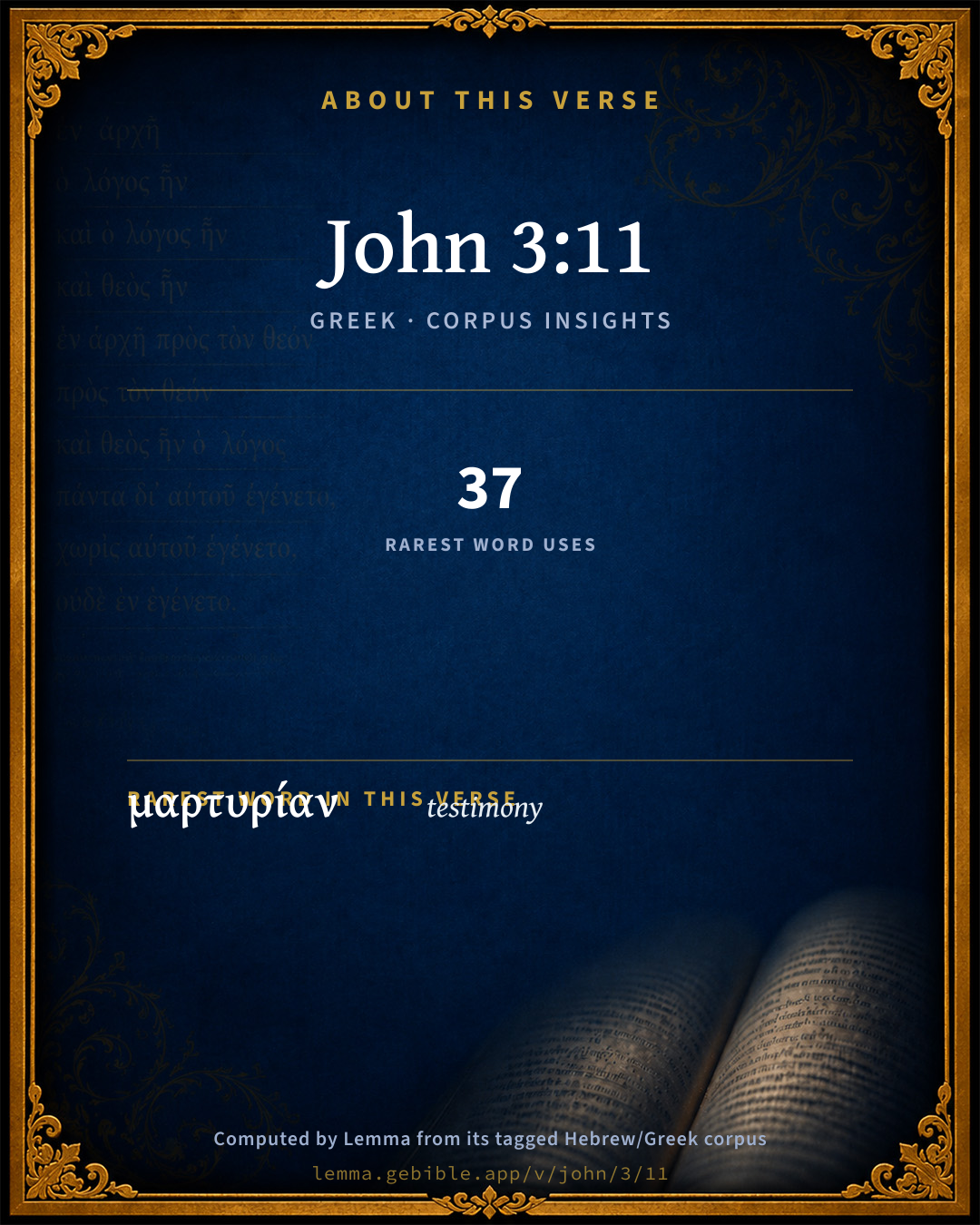
μαρτυρίαν testimony G3141 occurs in 33 verses of the Greek New Testament. Also found in:
Repetition

Words recur within this verse:

Cross-references

29

Topical passages linked to John 3:11 in the Treasury of Scripture Knowledge — connected by theme and wording, ordered by reader-vote popularity; previews shown in the World English Bible.

  • John 8:38 I say the things which I have seen with my Father; and you also do the things which you have seen with your father."
  • 1 John 5:6–12 This is he who came by water and blood, Jesus Christ; not with the water only, but with the water and the blood. It is the Spirit who testifies, because the Spirit is the truth.
  • John 1:18 No one has seen God at any time. The one and only Son, who is in the bosom of the Father, he has declared him.
  • John 8:14 Jesus answered them, "Even if I testify about myself, my testimony is true, for I know where I came from, and where I am going; but you don't know where I came from, or where I am going.
  • John 12:49 For I spoke not from myself, but the Father who sent me, he gave me a commandment, what I should say, and what I should speak.
  • John 14:24 He who doesn't love me doesn't keep my words. The word which you hear isn't mine, but the Father's who sent me.
  • John 7:16 Jesus therefore answered them, "My teaching is not mine, but his who sent me.
  • John 8:28–29 Jesus therefore said to them, "When you have lifted up the Son of Man, then you will know that I am he, and I do nothing of myself, but as my Father taught me, I say these things.
  • Isaiah 53:1 Who has believed our message? and to whom has the arm of Yahweh been revealed?
  • Isaiah 65:2 I have spread out my hands all the day to a rebellious people, who walk in a way that is not good, after their own thoughts;
  • John 3:32–34 What he has seen and heard, of that he testifies; and no one receives his witness.
  • Acts 28:23–27 When they had appointed him a day, many people came to him at his lodging. He explained to them, testifying about the Kingdom of God, and persuading them concerning Jesus, both from the law of Moses and from the prophets, from morning until evening.
  • 2 Corinthians 4:4 in whom the god of this world has blinded the minds of the unbelieving, that the light of the Gospel of the glory of Christ, who is the image of God, should not dawn on them.
  • Isaiah 50:2 Why, when I came, was there no man? when I called, was there none to answer? Is my hand shortened at all, that it can't redeem? or have I no power to deliver? Behold, at my rebuke I dry up the sea, I make the rivers a wilderness: their fish stink, because there is no water, and die for thirst.
  • Isaiah 55:4 Behold, I have given him for a witness to the peoples, a leader and commander to the peoples.
  • Luke 10:22 Turning to the disciples, he said, "All things have been delivered to me by my Father. No one knows who the Son is, except the Father, and who the Father is, except the Son, and he to whomever the Son desires to reveal him."
  • John 1:11 He came to his own, and those who were his own didn't receive him.
  • John 5:31–40 "If I testify about myself, my witness is not valid.
  • John 12:37–38 But though he had done so many signs before them, yet they didn't believe in him,
  • Acts 22:18 and saw him saying to me, 'Hurry and get out of Jerusalem quickly, because they will not receive testimony concerning me from you.'
  • 1 John 1:1–3 That which was from the beginning, that which we have heard, that which we have seen with our eyes, that which we saw, and our hands touched, concerning the Word of life
  • Revelation 1:5 and from Jesus Christ, the faithful witness, the firstborn of the dead, and the ruler of the kings of the earth. To him who loves us, and washed us from our sins by his blood;
  • Matthew 11:27 All things have been delivered to me by my Father. No one knows the Son, except the Father; neither does anyone know the Father, except the Son, and he to whom the Son desires to reveal him.
  • Matthew 23:37 "Jerusalem, Jerusalem, who kills the prophets, and stones those who are sent to her! How often would I have gathered your children together, even as a hen gathers her chickens under her wings, and you would not!
  • John 3:3 Jesus answered him, "Most assuredly, I tell you, unless one is born anew, he can't see the Kingdom of God."
  • John 3:5 Jesus answered, "Most assuredly I tell you, unless one is born of water and spirit, he can't enter into the Kingdom of God!
  • John 3:13 No one has ascended into heaven, but he who descended out of heaven, the Son of Man, who is in heaven.
  • John 5:43 I have come in my Father's name, and you don't receive me. If another comes in his own name, you will receive him.
  • Revelation 3:14 "To the angel of the assembly in Laodicea write: "The Amen, the Faithful and True Witness, the Head of God's creation, says these things:

Cross-references courtesy of OpenBible.info (CC BY 4.0).

Commentary

Notes on John 3:11 from classic Christian and Jewish commentators (each source and its license shown beneath its notes). The classic Christian expositions comment on the surrounding passage and are grouped to its opening verse, so a note may address several verses; the Jewish commentaries on the Tanakh (Rashi and others) are per-verse, so they appear only where the commentator wrote on this verse.

Lemma curates 59 commentaries, every one of them public domain or Creative Commons licensed, each selected and text-cleaned for this edition rather than reprinted as found. About our sources →

The Biblical Illustrator

Joseph S. Exell

Joh_3:11

We speak that we do know

Divine certainties

I.

Consider THE PLACE THE BIBLE HOLDS as an evidence of Christianity.

1. The Bible is the history of the Jewish people, and their existence to-day is a guarantee that the basis of the book is firm and undeniable.

2. Every contemporaneous and collateral witness adds to this assurance. The remains of Egypt and Assyria, the traditions of the Jews, allusions in Greek and Roman monuments and classic authors are grounds upon which we are assured of the historic character of the Scriptures.

3. The Bible is a whole literature.

4. It is the history of a religion. The fundamental ideas of the various books are the same--but there is a manifest progress. The earlier writers look forward to a greater revelation. The ideas become clearer and clearer. The advancing faith never contradicts the past, and at length the culmination appears in Jesus.

II. THE ADAPTATION OF CHRISTIANITY TO THE SPIRITUAL NEEDS OF MAN. Christ makes great assertions, but never attempts to prove them. Here He makes His heaters hesitation the consequence, not of defect in the evidence, but of defect in the man. For such a truth as the new birth admitted of no other evidence than its own light. Salvation must be based on a voluntary self-surrender. No more proof must be given therefore than will leave room for doubt, if men desire to doubt. Mathematical truth admits of perfect demonstration, but if religious truth leaves no room for doubt, then faith ceases to be religious. Its evidence is a probation for man. The force of this evidence varies according to spiritual condition. If a man is debased by sin, he will not readily open his heart, but if he is convicted of sinfulness, he will respond to the gospel and perceive how exactly Divine revelation is adapted to his need. Then its certainty will be felt in proportion to what he has found of peace and gladness. Just as the correspondence between the eye and light makes it absolutely certain that the one was made for the other, so it is with Christianity. Water cannot rise above the level of its source, and that men should of their own accord produce the Bible, and infuse into it such a marvellous power of raising men near its standard, is incredible. We shall feel the force of this far more if we can bring our own experience forward as a testimony. In this way each Christian becomes a living proof. (P. W. Darnton, B. A.)

Christian faith a reality

It seems a moderate claim that the alleged truths of our religion should be respected as realities But this demand covers the whole ground. Admit

1. That God is a real Father and Sovereign.

2. That each soul is His child and subject.

3. That separation from Him is the most terrible of disasters, to be healed at any cost.

4. That Jesus is the Christ who achieves that reconciliation.

5. That a righteous life is the fulfilment of human destiny. Admit this, and you have granted the whole conclusion. The terms imply something more than intellectual assent. There is such a thing as an ineffectual creed. To realize a doctrine is to have it wrought into the roots of our life. This realization only takes place when the truth emerges from the nebulous haze of conjecture into clear, sharp light--when it takes hold of feeling and is taken hold of by faith. This is needed now for the true efficiency of religion. For our religion is not dogma, or theory, or dream, but a spiritual power. Let us examine a few facts, in the Christian faith which authenticate its claim as a religion of realities.

I. THE IDEA OF GOD. Christianity did not create this. It simply places itself on the basis of a natural reality affirmed by the consenting feelings and philosophies of the nations; and then proceeds to nourish and satisfy it.

1. It is a real authority that speaks (Joh_3:11).

2. There is reality in the very attitudes and occasions of its revelations.

3. Reality in its substance. God is a Spirit, and with that simple announcement old idolatries that materialized the gods, and mythologies that multiplied them, vanished.

4. Reality in its disclosures of Gods nearness and condescension. He is the God of houses, streets, schools--not distant or etherealized.

II. This opens the true doctrine of INTERCOURSE WITH GOD, or prayer. What is natural if not that a child should speak to his parents, that man should ask for what God only can give? Prayer is a reality--something yearned for, something satisfying. So speaks the worlds best experience. To pretend to ask things we do not really desire, or things we have heard others ask for, is not prayer, but speculation or traditional mummery. Christ brings prayer back to reality. Ask, and ye shall receive.

III. Co-ordinate with this is LOVE FOR MAN. Here again Christianity does not create the faculty, but out of it weaves the bond of spiritual brotherhood. In training this social instinct Christianity gives it the brightest tokens of reality.

1. It stimulates fellowship, and by the healthiest motive--disinterested mercy, of which its central and crucified Form is the incarnate example.

2. It regulates it by the wisest law--broad, far-seeing, equity, saving it from wronging one class by righting another, from destroying without constructing.

3. It directs it to the purest object--the personal relief, the universal liberation, the spiritual rectitude of each soul.

IV. Turning from the social to the private offices of Christianity, we encounter the only satisfactory interpretation of the natural YEARNING TOWARDS AN IDEAL MORAL PERFECTION. It is only in very inferior natures that this sensibility to exalted goodness is utterly depraved. Baseness secretly confesses the beauty of magnanimity. The story of incorruptible conscience is the perpetual charm of literature. With all select souls there is a tantalizing disparity between the aspiring aim and the lagging performance. How does the gospel justify this real passion for the best?

1. By blessing these native aspirations as the Divine seal set on humanity.

2. By encouraging them.

3. By furnishing them nutriment and discipline to ripen their vigour.

4. By holding up one in whom all their promises are realized.

5. By giving them a hereafter where they shall mature into open vision and into calm and balanced power.

V. Not less does the gospel fit the varieties of human consciousness in its great doctrine of A RULING CHOICE DETERMINING CHARACTER. It divides the world into two classes by the inexorable line of that voluntary consecration. There is one differencing point, the point of motive, where the worlds people and Gods divide.

VI. But there is one reality darker and more fearful. THE LAW AND GUIDE OF LIFE HAS BEEN BROKEN. I know I am frail, offending, and guilty. Who shall deliver me? Christ. He has come for that.

VII. Infer, then, THE REALITY OF CHRISTIANITY.

1. In its ministry to the cravings of simple, honest hearts.

2. In its marvellous adaptation to the pain and gladness, fear and hope of our humanity.

3. In its unpretending address to our common habits, speaking the language of life.

4. In its boundless relief for a boundless difficulty.

5. In its expanding and exhaustless fulness for all glowing souls.

VIII. THE EARLY CHRISTIANS PREACHED, LIVED, DIED, FOR THIS REALITY, AND CONQUERED THE WORLD. (Bp. Huntington.)

The positiveness of Christianity as a truth and a practice

Whatever exists, exists positively, has existence and also energy. Positiveness is the very soul of growth.

I. CHRISTIANITY IS POSITIVE.

1. God is a positive Being.

2. Man is a positive being.

3. Sin is a positive condition.

4. Holiness is a positive state,

II. CHRISTIANITY MUST BE POSITIVELY APPLIED.

1. It is to honour God.

2. It is to be serviceable to man.

3. It is to prove victorious over sin.

4. It is to be potential unto holiness.

III. THE POSITIVENESS OF CHRISTIANITY IS NEUTRALIZED

1. When it is interpreted as a system of polite moral and aesthetic education. There is a class of writers and preachers who blot out of the Scriptures everything that is positive, who drop every word that bristles with damnatory energy, theorize the birth of Jesus, reduce the atonement to heroism, treat human depravity as a misfortune, speak patronizingly of hell as an exploded idea, and allude pleasantly to heaven as a benevolent myth. Many people are frightened by this modern thought. They need not be, for this is a positive age, and a negative religion can make no headway.

2. When it is over-organized. Christ did not organize it because He saw that truth was over.organized, and therefore cramped. Christianity is a power only when it is organized in human hearts. (W. H. H. Murray.)

The positiveness of Christianity

You may judge of this

I. BY ITS WORDS. Its shalls and shall nots are like so many bugle notes put into print. They sound with the energy of the Apocalyptic trumpets. Its commandments fall upon the conscience as a hammer of steel falls upon the anvil. Its warnings sound like the solemn protest of an indignant universe. Its threatenings roll over the guilty soul like the dreadful reverberations of ponderous thunder. Even its invitations suggest the tension of anxiety, and its entreaties come to our ears impelled by the urgency of anxious and infinite affection. Its very words are charged with significance almost to the limit of explosion. Heaven and hell, sin and holiness, faith and unbelief, life and death, salvation and damnation--these are glorious or dreadful words, mighty affirmations, expressions which challenge the attention of the most sceptical, and fill the thoughtful mind with solemn awe. No other religion has ever weighted the pages of its sacred books with such dreadful emphasis; no other religion has ever brought its believers face to face with such stupendous positiveness of assertion and conception. But if the verbal expression of Christianity is thus positive, what language is adequate to describe the positiveness of

II. ITS SPIRIT? If its body is so tense and vibrant with energies, who may pourtray the vigour of its animating spirit? If the unlighted orb, as it hangs rayless overhead, can draw every eye to its dark circle, and compel human attention, what would be its power if its inherent fires should break through the shell of sombre surface, and the mighty sphere should suddenly be ablaze with beams? Tell me, you who know the words of Scripture, and have also felt the movings of its matchless and irresistible spirit, which is the stronger? Tell me, you who once heard in the word heaven the sound of sweet but far-off music, but who now have the resonance of the Divine harmonies sounding in you, did you know aught of that melodious word until the chime of it made music in your soul? No. Not till the spirit of Christianity is received into his heart can man know or dream how positive are its operations. Nor can man know what hell is until he lies enfolded within the coils of some serpentine remorse, and the dreadful stricture tightens on his conscience until he screams and moans in the agony of a tormented spirit. Do not say exaggeration, for you know that what I say is true, when I declare that men and women there have been who have committed crimes so dark, dreadful, and damning, so obnoxious even to their blurred moral vision, that the memory of their deed has haunted them--yea, haunted them so that they could not eat, nor sleep, nor forget: thefires of remorse were within their bosom, and they could not quench them; the damned spot was on their hands, and all the seas could not wash the awful stain away, and at last they died: died screaming in agony, as if the torment of hell had already got hold of them; and it had. (W. H. H. Murray.)

Gods message is but carelessly listened to

Massilon, in the first sermon he ever preached, found the whole audience, upon his getting into the pulpit, in a disposition no way favourable to his intentions. Their nods, whispers, or drowsy behaviour showed him that there was no great profit to be expected from his sowing in a soil so improper. However, he soon changed the disposition of his audience by his manner of beginning. If, says he, a cause, the most important that could be conceived, were to be tried at the bar before qualified judges; if this cause interested ourselves in particular; if the eyes of the whole kingdom were fixed upon the events; if the most eminent counsel were employed on both sides; and if we had heard from our infancy of this yet undetermined trial--would you not all sit with due attention and warm expectation to the pleadings on each side? Would not all your hopes and fears be hinged on the final decision? And yet, let me tell you, you have this moment a cause where not one nation, but all the world, are spectators; tried not before a fallible tribunal, but the awful throne of heaven, where not your temporal and transitory interests are the subject of debate, but your eternal happiness or misery; where the cause is still undetermined, but, perhaps, the very moment I am speaking may fix the irrevocable decree that shall last for ever; and yet, notwithstanding all this, you can hardly sit with patience to hear the tidings of your own salvation. I plead the cause of heaven, and yet I am scarcely attended to.

The Biblical Illustrator, edited by Joseph S. Exell (c. 1880s–1900s) — public domain. Text from a community e-Sword module.

Joseph Benson's Commentary

Joh 3:11. We speak that we do know — I, and all that truly believe in me. Or, he may refer to the testimony that was given to the truth of his doctrine by John the Baptist, and to the preaching also of his own disciples, who all concurred in testifying the same things, the certainty of which they were assured of by the illuminating influences of the Holy Spirit, and by their own experience, while it was known to Christ by his omniscience, and by the intimate acquaintance that he had with all the counsels of his Father. And testify that we have seen — Here our Lord alludes to what was required in the law to qualify a man to be a witness, namely, that he should be able to declare concerning what he testified, that he had seen, or known it, Lev 5:1. And as Christ, therefore, had a clear perception and certain knowledge of the truth of what he said, there was the highest reason to receive his testimony, and to regard him as a true and faithful witness. And ye — Jewish rulers, teachers, and people, are generally of such a disposition that ye receive not our witness — Either as true or important; but disbelieve and reject, or neglect it.

Joseph Benson's Commentary on the Old and New Testaments (1811–1818) — public domain. Text from a community e-Sword module.

Bengel's Gnomon

Johann Albrecht Bengel

Joh 3:11. Ἀμὴν ἀμὴν λέγω σοι, verily, verily, I say unto thee) Three times this expression is used to Nicodemus.—οἴδαμεν, we know) Jesus does not associate with Himself John or any other man: ch. Joh 1:18, Joh 6:46, “No man hath seen God at any time; the only-begotten Son, etc., He hath declared Him:—not that any man hath seen the Father, save He which is of God, He hath seen the Father.” He speaks of Himself and of the Spirit. Comp. as to the Son, Joh 3:32, “What He hath seen and heard, that He testifieth:” as to the Holy Spirit, Joh 3:8; Joh 3:34, “He whom God hath sent, speaketh the words of God; for God giveth not the Spirit by measure unto Him;” ch. Joh 16:13, “The Spirit of truth—shall not speak of Himself; but whatsoever He shall hear, that shall He speak;” [also ch. Joh 5:30, I can of mine own self do nothing; as I hear, I judge.]—λαλοῦμεν) That only is what we speak.—οὐ λαμβάνετε, ye do not receive) [in faith, to wit.—V. g.] The plural, as in Joh 3:2, [Nicodemus said] we know.

Bengel's Gnomon of the New Testament — English translation (T&T Clark, Edinburgh, 1860) — public domain. Text from a community e-Sword module.

Meyer's Critical & Exegetical Commentary

Heinrich August Wilhelm Meyer

Joh_3:11. Jesus now discloses to the henceforth silent Nicodemus, in growing excitement of feeling, the source of his ignorance, namely, his unbelief in what He testifies, and which yet is derived from His own knowledge and intuition.

The plurals οἴδαμεν, etc., are, as is clear from the singulars immediately following in Joh_3:12, simply rhetorical (plurals of category; see Sauppe and Kühner ad Xen. Mem. 1. 2. 46), and refer only to Jesus Himself. Comp. Joh_4:38, and its frequent use by St. Paul when he speaks of himself in the plural. To include the disciples (Hengstenberg, Godet), or to explain them as refering to general Christian consciousness as contrasted with the Jewish (Hilgenfeld), would be quite inappropriate to what has been stated (see especially ὃ ἑωράκ. μαρτ.). To understand them as including John the Baptist (Knapp, Hofmann, Luthardt, Weizsäcker, Weiss, Steinfass), or him along with the prophets (Luther, Beza, Calvin, Tholuck), or even God (Chrysostom, Euthymius Zigabenus, Rupertus, Calovius, etc.), or the Holy Ghost (Bengel), is quite arbitrary, and without a trace of support in the text, nay, on account of the ἑωράκ., opposed to it, for the Baptist especially did not by Joh_1:34 occupy the same stage of ἑωρακέναι with Christ. It is, moreover, quite against the context when B. Crusius says: men generally are the subject of the verbs οἴδαμεν and ἑωράκ., so that human thingswhat one sees and knows (τὰ ἐπίγεια, Joh_3:12)are meant.

Observe the gradual ascent in the parallelism, in which ἑωράκαμεν does not refer to the knowledge attained in this earthly life (Weizsäcker), but to the vision of God enjoyed by Christ in His pre-existent state. Comp. Joh_3:32; Joh_1:18; Joh_6:46; Joh_8:38; Joh_17:5.

οὐ λαμβάνετε] ye Jews: comp. τοῦ Ἰσραήλ, Joh_3:10; and for the fact itself, Joh_1:11-12. The reproach, like the οὐ πιστεύετε of Joh_3:12, refers to the nation as a whole, with a reference also to Nicodemus himself. To render this as a question (Ewald) only weakens the tragic relation of the second half of the verse to the first.

Meyer — Critical and Exegetical Commentary on the New Testament — English translation by Peter Christie, edited by Frederick Crombie (T&T Clark, 1880) — public domain. Text from a community e-Sword module.

Expositor's Greek Testament

ed. W. Robertson Nicoll

Joh 3:11 . ἀμὴν , ἀμὴν … οὐ λαμβάνετε . From this point dialogue ceases, and we have now an unbroken utterance of Jesus. It starts with a certification of the truth of what Nicodemus had professed himself unable to understand. ὃ οἴδαμεν λαλοῦμεν . Why plural? Were the disciples present and are they included? Or does it mean Jesus and the prophets, or Jesus and the Baptist, or Jesus and the Father, or is it the rhetorical “we”? Possibly it is merely an unconscious transition to the plural, as in this same verse the σοι of the first clause becomes a plural in λαμβάνετε in the last clause. Or there may be an indefinite identification of Himself with all who had apprehended the nature of the new birth the Baptist and the best of his disciples. Jesus does not wish to represent Himself as alone able to testify of such matters. Weiss’ view is peculiar. He thinks that the contents of the μαρτυροῦμεν consist of what John and Jesus saw at the Baptism, when the Spirit’s descent indicated Jesus as the Baptiser with the Spirit.

The Expositor's Greek Testament, edited by W. Robertson Nicoll (1897–1910) — public domain. Text from a community e-Sword module.

Godet's Commentaries

Frédéric Louis Godet

ADDITIONAL NOTES BY THE AMERICAN EDITOR.

XIII.

1. At Joh 3:11, Jesus makes a step in advance in the discourse, and now assumes in a more formal way the position of the teacher of this teacher. He declares to him, first of all, that He is qualified to make known to him the truth, because He has seen and knows; He has, what no human teacher has, the heavenly knowledge (Joh 3:11; Joh 3:13). But Nicodemus, through dwelling in the psychical rather than the spiritual region, is not ready to receive and believe that which is to be communicated.

2. This want of belief on the part of Nicodemus does not seem to be referred by Jesus directly to sin or the sinful will, as in the case of the Jews afterwards, but to the fact that his thoughts are wholly in the outward and visible, as indicated by his questions respecting the new birth. The conversation apparently is designed to be an educating one to the end of faith, and so there is no sharp rebuke, but only the effort to bring him to see the need of entering into a higher sphere.

3. The earthly things must refer to the new birth, because this is the only matter which had been spoken of (εἶπον, Joh 3:12). The spiritual change, though having its origin and originating force in heaven (ἅνωθεν, ἐκ τοῦ πνεύματος), is yet accomplished on earth. It is, indeed, the earthly work of the new kingdom. The ζωὴ αἰώνιος opens and begins here. This was the fundamental thing to be presented in answer to the question with which we may believe the conversation to have been commenced. If this could not be understood, what possibility could there be of understanding the things which were beyond this—the heavenly things?

4. The heavenly things must, undoubtedly, be indicated in the words of this conversation—otherwise there would be little significance in mentioning them. If, however, they are thus indicated, they must be found in what follows, and must, apparently, be centered in the mission and crucifixion of the Son of man to the end of the salvation of men. The fundamental fact and truth of the Gospel—the divine provision for bringing men to eternal life through believing on the only-begotten Son—cannot be understood by one who does not apprehend the necessity of the new birth, that is, by one who does not know that the kingdom of God is a kingdom in and over the soul, not to be entered by belonging to a particular nation. The necessity of the new birth may be realized on earth and the new birth is accomplished on earth, but the great divine plan, with its wide-reaching relations, which involves and is carried out by means of this spiritual regeneration, is a thing belonging to heaven, and one which must be revealed by the Son, who descends out of heaven and who is in heaven. Joh 3:13 holds, in the thought as well as in its position, the intermediate place between Joh 3:12 and Joh 3:14 : Joh 3:12, the heavenly things are mentioned; Joh 3:13, the Son is the only one who can reveal them; Joh 3:14, what they are.

Vv. 11-13. In opposition to the doctorate of the letter, devoid of all spiritual intuition, Jesus announces to him the coming of a teaching, which will rest on the immediate knowledge of the truth (Joh 3:11). In order that Nicodemus may profit by this higher teaching, Jesus invites him to faith (Joh 3:12). Finally He displays to him, in His own person, the perfect revealer (Joh 3:13). Weiss and Keil think that Jesus wishes now to point out the way to attain regeneration, and, consequently, also to understand it. But the setting forth of salvation given in the sequel is far too considerable for it possibly to be caused by so special a relation to that which precedes.

Ver. 11. “Verily, verily, I say unto thee, We speak that we do know and bear testimony of that we have seen; and ye receive not our testimony.”

The formula amen, amen (“in truth”), declares, as always, a truth which Jesus is about to draw from the depths of His consciousness, and which, presenting itself as a revelation to the mind of His interlocutor, must triumph over his prejudices or his doubts. The rabbinical teaching worked upon the letter of the Scriptures, but did not place itself in contact with the essential truth which it contained (v. 39). Jesus proclaims with an inward satisfaction the coming of a wholly different teaching of holy things, which will have the character of certainty: “that which we know;” because it will spring from immediate intuition: “that which we have seen.” The two subordinate verbs, we speak, and we testify, are in correspondence with the two principal verbs: one speaks(declares) that which one knows; one testifies of what one has seen. There is, moreover, evident progress between each verb and the corresponding verb of the following clause: Knowledge rises to the clearness of sight, and speaking assumes the solemn character of testimony. The contrast marked here by Jesus between the rabbinical teaching and His own struck even the people; comp. Mat 7:28-29.

But of whom, then, does Jesus speak when He says “We”? What is this college of new teachers whom He contrasts with the caste of the scribes and sages of this age which passes away (1Co 1:20)? These plurals “we speak...we testify” have been explained in a variety of ways. Beza and Tholuck understand by we: “I and the prophets.” Bengel: “I and the Holy Spirit.” Chrysostom and Euthymius: “I and God.” The impossibility of these explanations is manifest. De Wette and Lucke see in this we a plural of majesty; Meyer and Keil, the plural of category: “teachers such as I.” These explanations are less untenable. But this first person of the plural, used for the designation of Himself, is unexampled in the mouth of Jesus. And why return afterwards to the singular (Joh 3:12-13): “I tell thee...if I have told you...if I tell you.”

Just as the you is addressed to other persons besides Nicodemus (comp. Joh 3:2 : we know), so the we must be applied not only to Jesus, but to a plurality of individuals which He opposes to that of which Nicodemus is the representative. We must, therefore, suppose that Jesus here announces to Nicodemus the existence of a certain number of men who al ready represent the new mode of teaching. According to Knapp, Hofmann, Luthardt, Weiss, etc., Jesus, when speaking thus, thinks only of Himself and John the Baptist. He alludes to that which John and He beheld in the scene of the baptism. But the idea of regeneration to which it is claimed that this seeing and knowing refer is totally foreign to the scene of the baptism, and even in our chapter, Joh 3:31-32, the forerunner expressly places himself outside of the limits of the new teaching inaugurated by Jesus. We believe, therefore, with Lange, Hengstenberg and Westcott, that Jesus is thinking of Himself and His disciples, of whom one or several were at that moment with Him; and who were beginning already to become the organs of this new teaching-office inaugurated by Him.

In the person of Jesus, then, through His acts and His words, heaven is constantly opened before their eyes (Joh 1:51); already they truly seeand know; their gaze pierces to the essence of things: “He who hath seen me, hath seen the Father.” On this foundation, they already testify. What vivacity, what freshness, in the declaration of John and Andrew, Joh 1:42, in that of Philip, Joh 1:47, in the exclamation of Nathanael, Joh 1:50, in the profession of Peter, Joh 6:68-69! There are here, no doubt in a weak measure, sight and testimony. Jesus feels Himself no more alone. Hence the feeling of profound joy which breathes in these plurals: we speak, we know, etc., and which betrays itself even in the form of His language. Indeed, Luthardt has observed, with reason, that we see appearing here that form of parallelism which constitutes the poetic rhythm of the Hebrew language. This feature of style betrays emotion and always marks a moment of peculiar exaltation (Joh 5:37; Joh 6:35; Joh 6:55-56; Joh 12:44-45).

The language resembles chant. Nicodemus must learn that things are more advanced than he thinks! This passage recalls the one in the Synoptics where Jesus declares the preference which God gives to little children, to His humble and ignorant disciples, over the intelligent and learned rabbis of Jerusalem (Mat 11:25; Luk 11:21). While his colleagues and himself are still waiting for the solemn hour of the advent of the kingdom, that kingdom is already present without their knowledge, and others participate in it before them! Meyer, Astie and others refer the expression “we have seen” to the knowledge possessed by Christ in His pre-existent state. But Weiss himself rejects here this explanation which he thinks himself obliged to adopt in other analogous cases (see on Joh 3:13). It would be altogether incompatible with the interpretation which we have given to the word we.

Before unfolding to Nicodemus what He knows and what He sees of the things above, Jesus sadly reverts to the manner in which His testimony has been received by the leaders of the theocracy: “And ye receive not our testimony.” Καί, and, has the meaning here of and yet (Joh 1:10). This copula brings out better than would the particleκαίτοι, yet (which John never uses), the contradiction between two facts which should be exclusive of each other and which nevertheless move on together (hearing and rejecting the testimony). Jesus was conscious, as every living preacher is, of the inward resistance which His appearance and His teaching met in the hearts of the people and their rulers. A presentiment of this might have been had already at the time of the deputation of the Sanhedrim to John (Joh 1:19 ff.). The conduct of the people and the authorities, with regard to the solemn procedure of Jesus in the temple (Joh 2:12 ff.), had given Him the measure of that which awaited Him. The words of Nicodemus himself (Joh 3:2), in which he had called Him teacher in consideration of His miracles, not of His teaching itself (Joh 3:2), showed how little His word had found access to hearts. The want of spiritual receptivity, which the misunderstanding of Nicodemus had just betrayed, will, as Jesus perceives, render very difficult the acceptance of the heavenly revelations which he brings to the world:

Frédéric Louis Godet — Commentaries on Luke, John, Romans, and 1 Corinthians — English translation (T&T Clark, Edinburgh, 1870s–1890s) — public domain. Text from a community e-Sword module.

Geneva Bible (1599)

Geneva Bible translators

You handle doubtful things, and such as you have no certain author for, and yet men believe you: but I teach those things that are of a truth and well known, and you believe me not.

Geneva Bible (1599) marginal notes — public domain. Text via Bolls.life.

Jamieson, Fausset & Brown

Robert Jamieson, A. R. Fausset & David Brown

We speak that we know, and . . . have seen--that is, by absolute knowledge and immediate vision of God, which "the only-begotten Son in the bosom of the Father" claims as exclusively His own (Joh 1:18). The "we" and "our" are here used, though Himself only is intended, in emphatic contrast, probably, with the opening words of Nicodemus, "Rabbi, we know.", &c.

ye receive not, &c.--referring to the class to which Nicodemus belonged, but from which he was beginning to be separated in spirit.

Jamieson, Fausset & Brown — Commentary Critical and Explanatory on the Whole Bible (1871) — public domain (CC PDM 1.0). Text via the HelloAO Bible API.

Adam Clarke's Commentary

Verse 11. We speak that we do know] I and my disciples do not profess to teach a religion which we do not understand, nor exemplify in our conduct. A strong but delicate reproof to Nicodemus, who, though a master of Israel, did not understand the very rudiments of the doctrine of salvation. He was ignorant of the nature of the new birth. How wretched is the lot of that minister, who, while he professes to recommend the salvation of God to others, is all the while dealing in the meagre, unfruitful traffic of an unfelt truth! Let such either acquire the knowledge of the grace of God themselves, or cease to proclaim it.

Ye receive not our witness.] It was deemed criminal among the Jews to question or depart from the authority of their teachers. Nicodemus grants that our Lord is a teacher come from God, and yet scruples to receive his testimony relative to the new birth, and the spiritual nature of the Messiah's kingdom.

Adam Clarke's Commentary on the Bible (1810–1826) — public domain. Text from a community e-Sword/MySword module.

John Calvin's Commentaries

11. We speak what we know. Some refer this to Christ and John the Baptist; others say that the plural number is used instead of the singular. For my own part, I have no doubt that Christ mentions himself in connection with all the prophets of God, and speaks generally in the person of all. Philosophers and other vain-glorious teachers frequently bring forward trifles which they have themselves invented; but Christ claims it as peculiar to himself and all the servants of God, that they deliver no doctrine but what is certain. For God does not send ministers to prattle about things that are unknown or doubtful, but trains them in his school, that what they have learned from himself they may afterwards deliver to others. Again, as Christ, by this testimony, recommends to us the certainty of his doctrine, so he enjoins on all his ministers a law of modesty, not to put forward their own dreams or conjectures — not to preach human inventions, which have no solidity in theme but to render a faithful and pure testimony to God. Let every man, therefore, see what the Lord has revealed to him, that no man may go beyond the bounds of his faith; and, lastly, that no man may allow himself to speak any thing but what he has heard from the Lord. It ought to be observed, likewise, that Christ here confirms his doctrine by an oath, that it may have full authority over us.

You receive not our testimony. This is added, that the Gospel may lose nothing on account of the ingratitude of men. For since few persons are to be found who exercise faith in the truth of God, and since the truth is everywhere rejected by the world, we ought to defend it against contempt, that its majesty may not be held in less estimation, because the whole world despises it, and obscures it by impiety. Now though the meaning of the words be simple and one, still we must draw from this passage a twofold doctrine. The first is, that our faith in the Gospel may not be weakened, if it have few disciples on the earth; as if Christ had said, Though you do not receive my doctrine, it remains nevertheless certain and durable; for the unbelief of men will never prevent God from remaining always true. The other is, that they who, in the present day, disbelieve the Gospel, will not escape with impunity, since the truth of God is holy and sacred. We ought to be fortified with this shield, that we may persevere in obedience to the Gospel in opposition to the obstinacy of men. True indeed, we must hold by this principle, that our faith be founded on God. But when we have God as our security, we ought, like persons elevated above the heavens, boldly to tread the whole world under our feet, or regard it with lofty disdain, rather than allow the unbelief of any persons whatever to fill us with alarm. As to the complaint which Christ makes, that his testimony is not received, we learn from it, that the word of God has, in all ages, been distinguished by this peculiar feature, that they who believed it were few; for the expression — you receive not — belongs to the greater number, and almost to the whole body of the people. There is no reason, therefore, that we should now be discouraged, if the number of those who believe be small.

John Calvin's Commentaries (1540-1563) — public domain. Text from the Calvin Translation Society English edition (1840s-50s) via the Christian Classics Ethereal Library (ccel.org). Calvin's coverage is partial (roughly two-thirds of the Bible); uncommented books and verses are honest gaps, never fabricated. The 19th-century editor's footnotes and remarks are omitted so the notes are faithfully Calvin's own voice.

Ellicott's Commentary for English Readers

(11) Once again the “Verily, verily” of deeper truth. “We speak that we do know” is in sharp contrast to their formal teaching of matters external to the truth. The plural is not usual in the language of Christ, and the immediate passage to the singular forbids us to accept the usual grammatical explanation that it is the plural of majesty. He apparently joins others with Himself,—those who have spoken and known and testified, and whose testimony has been rejected by the Jews. We have to think of him whose life-work was to bear witness of the Light (Joh_1:8), and of the band of disciples who form a little school round their Master, and who in Jerusalem, as in Galilee, testified of Him; and it may even be that in the house and presence of one of that band this conversation took place (comp. Joh_3:2). They knew the power of the new life, and had been baptised of water and of spirit. In their measure and degree, as He in fulness, they spake what they knew, and testified what they had seen. (Comp. Joh_15:27.)

And ye receive not our witness—i.e., “ye Jews,” the teachers, of whom Nicodemus was one, the representatives of His own who received Him not (Joh_1:11). This attitude of the mind which refused to accept the evidence of witnesses as to things they had known and seen was of the essence of unbelief, and made further revelation impossible. When the will closed the faculty of faith, it left open no access for fuller spiritual truth.

A Bible Commentary for English Readers, edited by Charles John Ellicott (1878–1897) — public domain. Text from a community e-Sword module.

The Cambridge Bible for Schools and Colleges

gen. ed. J. J. S. Perowne

11. We speak that we do know] The plural is no proof that any of the disciples were present, though S. John at least may have been; nor does it necessarily include more than Christ Himself. The plurals may be rhetorical, giving the saying the tone of a proverb; but the next verse seems to shew that they do include others. Christ and his disciples tell of earthly things, Christ alone of heavenly.

testify] Or, bear witness of (see on Joh_1:7).

we have seen] Of which we have immediate knowledge. Comp. Joh_1:18; Joh_14:7; Joh_14:9.

and ye receive not] The tragic tone once more; see on Joh_1:5. ‘Ye teachers of Israel,’ the very men who should receive it.

The Cambridge Bible for Schools and Colleges (gen. ed. J. J. S. Perowne; Cambridge University Press, 1878–1918) — public domain. Text from a community e-Sword module.

John Gill's Exposition

If I have told you earthly things,.... Not that the doctrines he delivered were earthly ones; for he was not of the earth, but from heaven, and above all, and so spake not of the earth, but of heaven, Joh 3:31; and this doctrine of regeneration was an heavenly doctrine; and the thing itself required supernatural power, and grace from above: but either they were the more easy doctrines of the Gospel; or were delivered in a plain and easy style, and illustrated by similes taken from earthly things, as from human birth, from the water, and from the wind:

and ye believe not; i.e. those things; ye do not receive them, nor give credit to them; or "me", as the Ethiopic Version adds, who relate them on the best evidence, having fully known, and clearly seen them:

how shall ye believe; give credit to me, or receive my testimony:

if I tell you of heavenly things? of the more sublime doctrines of the Gospel, such as the descent of the Messiah from heaven; the union of the two natures, human and divine, in him; his being the only begotten Son of God; his crucifixion and death, signified by the lifting up of the serpent on a pole in the wilderness; and the wonderful love of God to the Gentile world in giving Christ to, and for them; and the salvation, and eternal happiness of all that believe in him, whether they be Jews or Gentiles; and these delivered in language suitable to them, without figures, or natural similes, which help the understanding, and convey ideas of things more easily to it.

John Gill's Exposition of the Whole Bible (1746–1763) — public domain (CC PDM 1.0). Text via the HelloAO Bible API.

Trapp's Complete Commentary

John Trapp

11 Verily, verily, I say unto thee, We speak that we do know, and testify that we have seen; and ye receive not our witness.

Ver. 11. Ye receive not our witness] Our Saviour joins himself with the prophets (whose writings Nicodenms had read so negligently), and takes it for a dishonour that he should have written for men the great things of his law, and they continue strangers thereto, Hos 8:12.

John Trapp, A Commentary or Exposition upon All the Books of the Old and New Testament (1647–1656) — public domain. Text from a community e-Sword module.

Albert Barnes' Notes on the Bible

We speak - Jesus here speaks in the plural number, including himself and those engaged with him in preaching the gospel. Nicodemus had said Joh 3:2, “we know that thou art,” etc., including himself and those with whom he acted. Jesus in reply said, we, who are engaged in spreading the new doctrines about which you have come to inquire, speak what we know. We do not deliver doctrines which we do not practically understand. This is a positive affirmation of Jesus, which he had a right to make about his new doctrine. he knew its truth, and those who came into his kingdom knew it also. We learn here:

That the Pharisees taught doctrines which they did not practically understand. They taught much truth Mat 23:2, but they were deplorably ignorant of the plainest matters in their practical application. Every minister of the gospel ought to be able to appeal to his own experience, and to say that he knows the truth which he is communicating to others. Every Sunday school teacher should be able to say, “I Know what I am communicating; I have experienced what is meant by the new birth, and the love of God, and the religion which I am teaching.”

Testify - Bear witness to.

That we have seen - Jesus had seen by his omniscient eye all the operations of the Spirit on the hearts of men. His ministers have seen its effects as we see the effects of the wind, and, having seen men changed from sin to holiness, they are qualified to bear witness to the truth and reality of the change. Every successful minister of the gospel thus becomes a witness of the saving power of the gospel.

Ye receive not - Ye Pharisees. Though we give evidence of the truth of the new religion; though miracles are performed, and proof is given that this doctrine came from heaven, yet you reject it.

Our witness - Our testimony. The evidence which is furnished by miracles and by the saving power of the gospel. Men reject revelation though it is attested by the strongest evidence, and though it is constantly producing the most desirable changes in the hearts and lives of men.

Albert Barnes' Notes on the Bible (1834–1885) — public domain. Text from a community e-Sword/MySword module.

Haydock's Catholic Bible Commentary

We speak what we know. It may perhaps be asked here, why Christ speaks in the plural number? To this we must answer, that it is the only Son of God, who is here speaking, showing us how the Father is in the Son, and the Son in the Father, and the Holy Ghost proceeding from both. (St. Thomas Aquinas)

George Leo Haydock (1774–1849), Haydock's Catholic Family Bible and Commentary, 1859 edition — public domain. Excludes Psalms (Douay-Rheims chapter numbering differs from Protestant) and Deuterocanonical books (Catholic canon only).

Matthew Poole's English Annotations

Christ speaketh only of himself, though he speaketh in the plural number, for in the next verse he saith only, If I have told you earthly things; he lets Nicodemus know that he spake nothing but he was certain of. This he expresses by two words, know and have seen, which are terms expressive of the greatest certainty of a thing imaginable; for the terms express a certainty of the mind, arising both from the rational deduction and sensible demonstration: and herein our Saviour lets his ministers know what is their duty to teach unto people, viz. what they know and have seen. Those that think that the doctrine of the gospel would have no certainty but for the authority of the church, stand highly concerned to reflect upon this text.

Ye receive not our witness; ye ought to believe what I tell you upon the authority of my revelation; but such is the hardness of your heart, such your stubbornness and unbelief, that you receive not my testimony.

Matthew Poole's English Annotations on the Holy Bible (1683–1685) — public domain. Text from a community e-Sword/MySword module.

Whedon's Commentary on the Bible

Daniel D. Whedon

11. We… we… we—Jesus in the next verse speaks of himself in the singular. Who then is this we? “Himself and the prophets,” says Tholuck; “himself and John the Baptist,” says Knapp; “teachers like himself,” says Meyer; “all born of the Spirit,” say Lange and Wesley. “A proverbial saying,” says Alford, whom we thus far quote. In all this we agree with Stier, who refers it to the three persons of the Trinity. This is clear, as may soon be evident, from the fact that the we is said to know from seeing, and to be in heaven. Testify—on earth.

That we have seen—in heaven. Joh_3:13. Ye—The same as Nicodemus’s we in Joh_3:2, who are described in Joh_1:23-25.

Receive not our witness—They were guilty of receiving him as a miraculously attested teacher, (Joh_3:2,) and yet refusing to accept his teachings. Very futile, therefore, is the cavil that these words could not have been spoken at this time by Jesus, because they imply a rejection of him which had not occurred so early.

Daniel D. Whedon (gen. ed.), Commentary on the Old and New Testaments (1874–1909) — public domain. Text from a community e-Sword module.

The Pulpit Commentary

Verily, verily, I say to thee, We speak that which we know, and testify that which we have seen. Lucke and Meyer think that our Lord here merely uses the pluralis majestaticus uses it as St. Paul does, when clearly he was referring to himself alone. It is difficult to believe this in the curious and impressive change of person here adopted, and the return to the first person singular in ver. 12. There was some reason why Jesus, in making this particular saying, uses the plural.

(1) Luthardt says, "Christ and the Baptist.

(2) Luther and Tholuck, "Christ and the whole prophetic company.

(3) Stier, "The Three Persons of the blessed Trinity" (see Chrysostom, etc.).

(4) Hengstenberg, Godet, Westcott, Moulton, have in various ways recognized the fact that the company of the disciples already called into the spiritual kingdom, and alive to the mighty power of the Spirit in recreating humanity, were present at this interview. They stood there to affirm the reality of the truth of which their Lord was speaking. Nothing in this sentence is incongruous with the experience and practice of those who had appreciated and were already speaking of the necessity of radical change or spiritual regeneration and of genuine repentance. John in his First Epistle (1:1-4) uses some of the very phraseology of this solemn verse, o ewrakamen ... marturoumen . Our Lord, on this occasion, gave him permission to do so. The knowledge which he spake of, the vision to which he testified, was in its way and to a degree within the compass of any disciple who had been waked up by the Lord"s words to crave an entirely new beginning of his life, a birth of the Spirit. And ye receive not our testimony. This melancholy assertion proves that from the very first (as John said in his "prologue" concerning all the ministry of the Logos, and all the testimony of the prophetic Spirit to the reality of the light) "the darkness receiveth it not." The first demand which the Divine Lord made was rejected, the first "testimony" was disbelieved. From the beginning the dark shadow of death fell on his path. Nicodemus, or those whom he represented, may have had their curiosity excited, but their entire attitude was non-admission of the fundamental principle, viz. the inward illumination and life he came to supply.

The Pulpit Commentary (1880–1919), ed. H.D.M. Spence-Jones & Joseph S. Exell — public domain. Text from a community e-Sword module.

John Wesley's Explanatory Notes

We speak what we know - I and all that believe in me.

John Wesley, Explanatory Notes Upon the Whole Bible (1754–1765) — public domain. Text via the GEBible commentary corpus.

The People's New Testament

B. W. Johnson

11. We speak that we do know … ye receive not our witness. “Ye” includes Nicodemus and all Jews who failed to confess him; “we” includes himself and those who should testify of him by the Spirit.

B. W. Johnson's The People's New Testament with Notes (1889–1891) — public domain. Electronic text from the Christian Classics Ethereal Library (CCEL) ThML edition.

Cambridge Greek Testament for Schools and Colleges

11. οἴδαμεν. The plurals between singulars are to be noted. They may be rhetorical, giving the saying the tone of a proverb; but the next verse seems to shew that they are literal. Jesus and His disciples tell of earthly things, Jesus alone of heavenly. Note the order and the pairing of the verbs; That which we know, we speak; and of that which we have seen, we bear witness. see on Joh 1:18. For καὶ … οὐ λαμβ. The tragic tone once more; see on Joh 1:5.

Cambridge Greek Testament for Schools and Colleges (Cambridge University Press, 1896; 21 vols, various authors incl. Carr, Maclear, Plummer, Farrar, Lumby, Moule, M. R. James, Simcox) — public domain. Text from a community e-Sword module.

Alford’s Greek Testament

Henry Alford

11.] Henceforward the discourse is an answer to the unbelief, and in answering that, to the question (πῶς δύν. τ. γεν.) of Nicodemus: by shewing him the appointed means of this new birth, and of being upheld in the life to which it is the entrance, viz. faith in the Son of God.

ὃ οἴδαμεν λ.…] Why these plurals? Various interpretations have been given: ἢ περὶ ἑαυτοῦ καὶ τοῦ πατρὸς τοῦτό φησιν, ἢ περὶ ἑαυτοῦ μόνομ (Euthym.);—“Loquitur de se et de Spiritu” (Bengel);—of Himself and the Prophets (Beza, Tholuck);—of Himself and John the Baptist (Knapp);—of Teachers like Himself (Meyer);—of all the born of the Spirit (Lange, Wesley);—of the three Persons in the Holy Trinity (Stier);—or, the plural is only rhetorical (Lücke, De Wette). I had rather take it as a proverbial saying; q. d. ‘I am one of those who,’ &c. Our Lord thereby brings out the unreasonableness of that unbelief which would not receive His witness, but made it an exception to the general proverbial rule.

οὐ λαμβάνετε, addressed still to Nicodemus, and through him to the Jews: not to certain others who were present, as Olsh. supposes.

Henry Alford, The Greek Testament (1849–1861) — public domain. Text from a community e-Sword module.

International Critical Commentary

11. For the introductory ἀμὴν ἀμήν, see on 1:51.

With this verse v. 32 is closely parallel: ὃ ἐώρακεν καὶ ἤκουσεν, τοῦτο μαρτυρεῖ· καὶ τὴν μαρτυρίαν αὐτοῦ οὐδεὶς λαμβάνει. We should expect καίτοι rather than καί in the second member of the sentence in both cases, but Jn. never uses καίτοι. See on 1:10.

ὃ οἴδαμεν λαλοῦμεν. Cf. 8:38, 12:50, 16:18.

The verb λαλεῖν is used with special frequency in Jn. It occurs nearly 6o times in the Gospel; and 30 times it is placed in the mouth of Jesus in the first person singular, the only Synoptic instance of this latter use being Luk 24:44. The general distinction between λέγειν and λαλεῖν, viz. that λέγειν relates to the substance of what is said, while λαλεῖν has to do with the fact and the manner of utterance, holds good to a certain extent in Jn., as it does in classical Greek. But in Jn. the two verbs cannot always be distinguished in their usage and meaning, any more than “say” and “speak” can always be distinguished in English. Here ὃ οἴδαμεν λαλοῦμεν should be rendered “we speak of what we know,” the words spoken not being given; but then ταῦτα τὰ ῥήματα ἐλάλησεν (8:20) means, “He spoke these words,” viz. the very words that have just been cited (cf. 16:25, 17:1, 13, etc.). See, in particular, 10:6, 14:10, 12:49, 16:18, in which passages the verb λαλεῖν is used exactly as λέγειν might be; cf. 8:43.

If there is any special tinge of meaning in λαλεῖν as compared with λέγειν in Jn., it is that λαλεῖν suggests frankness or openness of speech. Jn. “assigns it to Christ 33 times in the first person, whereas it is never thus used by the Synoptists, except at Luk 24:44 after the Resurrection” (Abbott, Diat. 2251b). See on 18:20.

The plural forms οἴδαμεν, λαλοῦμεν, etc., arrest attention. The verse is introduced by the solemn ἀμὴν ἀμήν, and so is represented by Jn. as spoken by Jesus. Now the plural of majesty is not ascribed to Jesus anywhere, and in v. 12 He employs the singular εἶπον. Abbott (Diat. 2428) suggests that the plurals here associate the Father’s witness with that of the Son (cf. 5:32, 37); but this would be foreign to the context. Further, v. 32, ὃ ἑώρακεν καὶ ἥκουσεν, τοῦτο μαρτυρεῖ is clearly a repetition of what is said in this verse.

The plurals οἴδαμεν are, therefore, explained (cf. 4:22) by some exegetes (e.g. Godet, Westcott) as associating His disciples with Jesus in the testimony with which He confronts Nicodemus. “We,” i.e. my disciples and I, “speak of what we know.” But this is markedly unlike the authoritative tone of the rest of the discourse. Nor is there any other instance of the disciples’ testimony being mentioned in the same breath as His own testimony. They bore witness, indeed, because they had been with Him from the beginning (15:27), but He did not rely on this while He was in the flesh. Even if we adopt the reading ἢμᾶς for ἐμέ at 9:4 (where see note), we do not get a true parallel to ὃ ἐωράκαμεν μαρτυροῦμεν of the present verse.

The similarity of the language used here to that which Jn., in other passages, uses to associate his own witness with that of his fellow-disciples is very close: e.g. ὃ ἀκηκόαμεν, ὃ ἐωράκαμεν … ὃ ἐθεασάμεθα … ἀπαγγέλλομεν ὑμῖν (1 Jn. 1f.; cf. 1Jn 4:14), or ἐθεασάμεθα τὴν δόξαν αὐτοῦ (1:14), or the use of οἴδαμεν in 1Jn 3:2, 1Jn 3:14, 1Jn 3:5:15, 1Jn 3:19, 1Jn 3:20. And, having regard to the way in which commentary and free narrative are intermingled in this chapter (see on v. 16), we seem to be driven to the conclusion that in v. 11 Jn. is not reproducing the actual words of Jesus so much as the profound conviction of the Apostolic age that the Church’s teaching rested on the testimony of eye-witnesses (cf. 1Jn 4:14). He has turned the singular ἑώρακα (see v. 32) into the plural ἑωράκαμεν (v. 11), just as in v. 5 he has added ἐξ ὕδατος to the original saying of the Lord about the need of spiritual birth.

καὶ τὴν μαρτυρίαν ἡμῶν οὐ λαμβάνετε. This is repeated (v. 32), and is a frequent theme in the Fourth Gospel. Cf. 1:11, 5:43, 12:37.

International Critical Commentary — older volumes (1896–1929), various authors — public domain. Text from a community e-Sword module.

Vincent's Word Studies in the New Testament

Marvin R. Vincent

We speak - we know - we have seen. After the use of the singular number in vv. 3, 5, 7, 12, the plural here is noteworthy. It is not merely rhetorical - "a plural of majesty" - but is explained by ver. 8, "every one that is born of the Spirit." The new birth imparts a new vision. The man who is born of the Spirit hath eternal life (ver. 36); and life eternal is to know God and Jesus Christ whom He hath sent (xvii. 3). "Ye have an anointing from the Holy One, and ye know [οιδατε] all things" 22 (1Jo 2:20). He who is born of water and of the Spirit sees the kingdom of God. This we therefore includes, with Jesus, all who are truly born anew of the Spirit. Jesus meets the we know of Nicodemus (ver. 2), referring to the class to which he belonged, with another we know, referring to another class, of which He was the head and representative. We know [οιδαμεν] , absolutely. See on 2 24.

Testify [μαρτυρουμεν] . Rev., better, bear witness of. See on 1 7.

Marvin R. Vincent, Word Studies in the New Testament (1887–1900) — public domain. Text from a community e-Sword/MySword module.

Lesson kit

Teaching starters — assembled from the data on this page, not authored interpretation. Every prompt links to the verse data it draws on. Edit before teaching.

John, in the Gospels, opens this verse with 18 words (15 distinct Greek lemmas). Its most distinctive word is martyría (“testimony”). A historical commentator’s framing appears above. Read the whole chapter for the surrounding context.

Discussion questions

  1. What does “testimony” (martyría) contribute to the verse as a whole?
  2. Mark 14:55 shares the word «testimony» with this verse. How do the two illuminate each other?
  3. “amen” occurs 2× in this one verse. What is the effect of the repetition?
  4. The translations on this page render this verse differently — a whole-verse word diff, not a word-by-word alignment. What might account for the different wordings?
  5. Reading how The Biblical Illustrator and Joseph Benson's Commentary read this verse, where do the two commentators agree and where do they part?

Things to notice

Reading settings

Reading text

Shown beneath each verse's original-language words.

Old Testament
Old Testament edition

Read the OT as the Masoretic Hebrew (MT) or the Greek Septuagint (LXX).

English shown for the Greek Septuagint (in the Hebrew ↔ Greek comparison).

Comparing translations? Open the Compare panel on any verse page to stack up to four side by side.