Matthew 9:22

Greek (Tischendorf 8th ed.) Matthew 9:22 appears in the Greek New Testament. The text above is from the Tischendorf 8th edition. Each word links to its Strong’s number and a concise gloss. Click any word for its full Thayer’s Greek Lexicon entry.
Download image
Cite this verse

Matthew 9:22 (World English Bible). Public Domain. Lemma interlinear Bible study tool, https://lemma.gebible.app/v/matthew/9/22.

Show BibTeX & RIS
BibTeX
RIS
English Translation
But Jesus, turning around and seeing her, said, "Daughter, cheer up! Your faith has made you well." And the woman was made well from that hour.
World English Bible · Public Domain
Download a study sheet

One document with this verse’s original text, its word-by-word gloss line, the meaning frame, cross-references with their text, attributed commentary, and full source and license credits — printable, and it pastes into notes with its structure intact.

This verse Autodidact and up

Study sheet (.html) Plain text (.txt)

A passage Seminary Student

Up to 50 verses in one chapter. A passage sheet keeps up to 6 commentary sources and 12 cross-references per verse, in the order this page ranks them, and says so on the sheet whenever that leaves anything out. Ask for a single verse and you get the Autodidact verse sheet above.

Everything on this page stays free to read, with no account — the sheet is a download of what is already on screen, not access to it.

Want to remove ads? Support Godless Engineer
Compare translations 3

The same verse in 3 English versions, stacked beneath the original-language interlinear above. Click any original word for its lexicon entry.

Each is an independent rendering of the whole verse — the interlinear is not word-aligned to these translations.

Highlighted words mark where these versions differ — a whole-verse word diff, not a word-by-word alignment.

  • World English Bible Public Domain
    But Jesus, turning around and seeing her, said, "Daughter, cheer up! Your faith has made you well." And the woman was made well from that hour.
  • King James Version Public Domain
    But Jesus turned him about, and when he saw her, he said, Daughter, be of good comfort; thy faith hath made thee whole. And the woman was made whole from that hour.
  • unfoldingWord Literal Text CC BY-SA 4.0
    But Jesus, having turned and having seen her, said, “Daughter, take courage; your faith has saved you.” And the woman was saved from that hour.

unfoldingWord Literal Text — © unfoldingWord, licensed CC BY-SA 4.0. Word-aligned USFM3 via Door43 (git.door43.org/unfoldingWord/en_ult).

Versions to compare (up to 4)

3 of 4 selected

Show all 19 translations

Every available English version of this verse, each an independent rendering of the whole verse.

  • World English Bible Public Domain
    But Jesus, turning around and seeing her, said, "Daughter, cheer up! Your faith has made you well." And the woman was made well from that hour.
  • Berean Standard Bible Public Domain
    Jesus turned and saw her. “Take courage, daughter,” He said, “your faith has healed you.” And the woman was cured from that very hour.
  • Majority Standard Bible Public Domain
    Jesus turned around and saw her. “Take courage, daughter,” He said, “your faith has healed you.” And the woman was healed from that very hour.
  • King James Version Public Domain
    But Jesus turned him about, and when he saw her, he said, Daughter, be of good comfort; thy faith hath made thee whole. And the woman was made whole from that hour.
  • American Standard Version (1901) Public Domain
    But Jesus turning and seeing her said, Daughter, be of good cheer; thy faith hath made thee whole. And the woman was made whole from that hour.
  • Revised Version (1885) Public Domain
    But Jesus turning and seeing her said, Daughter, be of good cheer; thy faith hath made thee whole. And the woman was made whole from that hour.
  • Geneva Bible (1599) Public Domain
    Then Iesus turned him about, and seeing her, did say, Daughter, be of good comfort: thy faith hath made thee whole. And the woman was made whole at that same moment.)
  • Douay-Rheims (1899) Public Domain
    But Jesus turning and seeing her, said: Be of good heart, daughter, thy faith hath made thee whole. And the woman was made whole from that hour.
  • Young's Literal Translation Public Domain
    And Jesus having turned about, and having seen her, said, `Be of good courage, daughter, thy faith hath saved thee,' and the woman was saved from that hour.
  • Literal Standard Version CC BY-SA 4.0
    And Jesus having turned, and having seen her, said, “Take courage, daughter, your faith has saved you,” and the woman was saved from that hour.
  • Unlocked Literal Bible CC BY-SA 4.0
    But Jesus turned and saw her, and said, “Daughter, take courage; your faith has made you well.” And the woman was healed from that hour.
  • unfoldingWord Literal Text CC BY-SA 4.0
    But Jesus, having turned and having seen her, said, “Daughter, take courage; your faith has saved you.” And the woman was saved from that hour.
  • Darby Bible Public Domain
    But Jesus turning and seeing her, said, Be of good courage, daughter; thy faith has healed thee. And the woman was healed from that hour.
  • World Messianic Bible Public Domain
    But Yeshua, turning around and seeing her, said, “Daughter, cheer up! Your faith has made you well.” And the woman was made well from that hour.
  • Webster's Bible Public Domain
    But Jesus turned himself about, and when he saw her, he said, Daughter, be of good comfort; thy faith hath made thee whole. And the woman was made whole from that hour.)
  • Free Bible Version CC BY-SA 4.0
    Jesus turned and saw her. “Be happy, for your trust in me has healed you,” he told her. The woman was immediately healed.
  • Bible in Basic English Public Domain
    But Jesus, turning and seeing her, said, Daughter, take heart; your faith has made you well. And the woman was made well from that hour.
  • Text-Critical English NT CC BY 4.0
    But when Jesus turned around and saw her, he said, “Take courage, daughter; yoʋr faith has healed yoʋ.” And the woman was healed from that hour.
  • Tyndale New Testament (1534) Public Domain
    Then Iesus tourned him about and behelde her sayinge: Doughter be of good conforte thy faith hath made the safe. And she was made whole even that same houre.

Literal Standard Version (2020), Covenant Press — licensed CC BY-SA 4.0. Text via the HelloAO Bible API (eBible.org). Unlocked Literal Bible (unfoldingWord) — licensed CC BY-SA 4.0. Text via the HelloAO Bible API (eBible.org). unfoldingWord Literal Text — © unfoldingWord, licensed CC BY-SA 4.0. Word-aligned USFM3 via Door43 (git.door43.org/unfoldingWord/en_ult). Free Bible Version, Dr. Jonathan Gallagher — licensed CC BY-SA 4.0. Text via the HelloAO Bible API (eBible.org).

Word by word

More ways to search: Search by grammar → Find every occurrence → Compare this word →

Practice this passage: Drill this verse → Learn its vocabulary →

θάρσει
tharséō
G2293
“to be courageous”
Verb, Present, Active, Imperative, 2nd person, Singular
Part of Speech
Verb
Tense
Present
Voice
Active
Mood
Imperative
Person
2nd person
Number
Singular
Full Thayer's Definition

Origin: from G2294

TDNT: 03:25,3

1. to be of good courage, be of good cheer
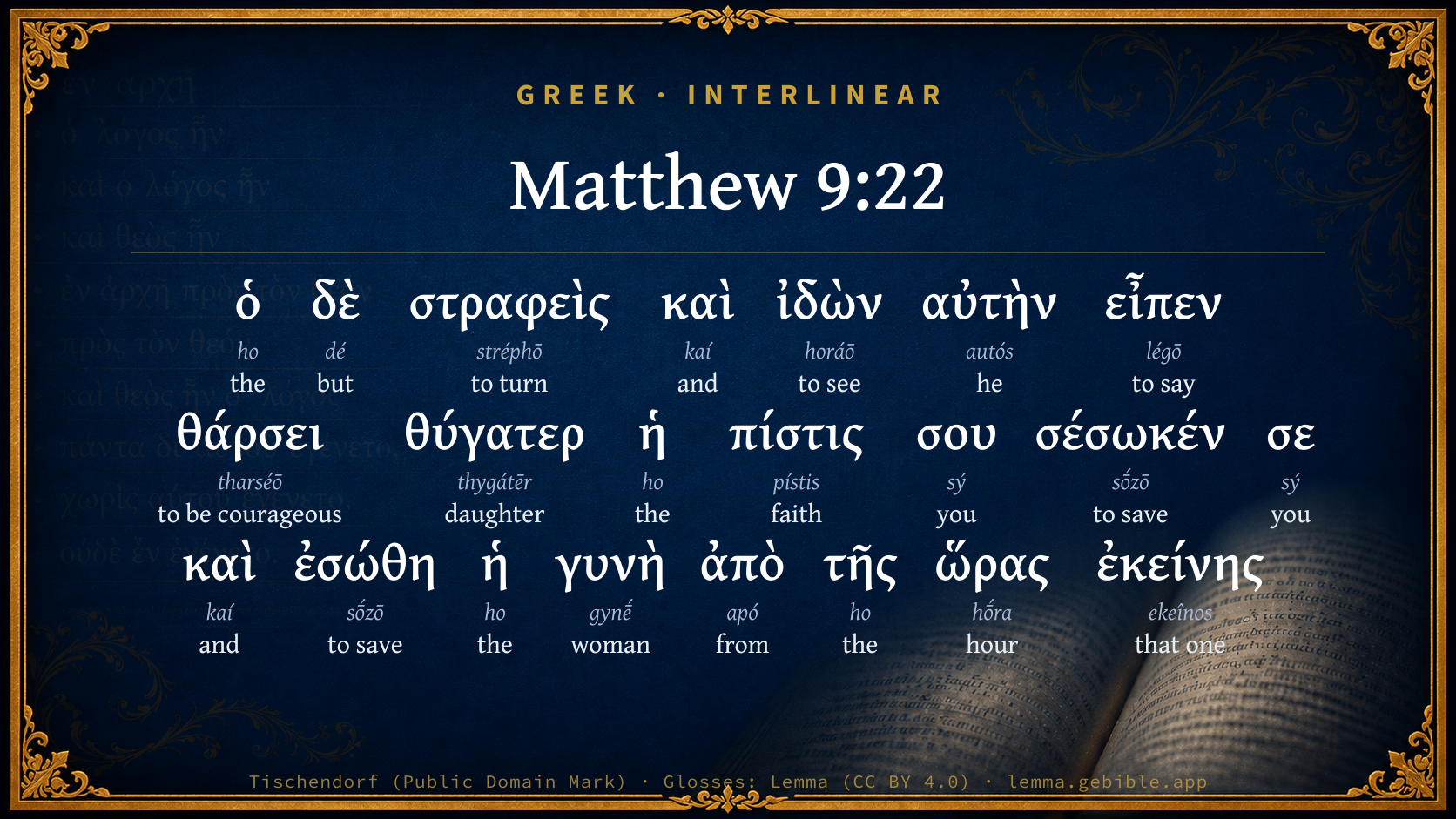
  1. ὁ ho G3588 “the” Article, Nominative, Singular, Masculine
  2. δὲ dé G1161 “but” Conjunction
  3. στραφεὶς stréphō G4762 “to turn” Verb, Aorist, Passive, Participle, Nominative, Singular, Masculine
  4. καὶ kaí G2532 “and” Conjunction
  5. ἰδὼν horáō G3708 “to see” Verb, Aorist, Active, Participle, Nominative, Singular, Masculine
  6. αὐτὴν autós G846 “he” Personal pronoun, Accusative, Singular, Feminine
  7. εἶπεν légō G3004 “to say” Verb, Aorist, Active, Indicative, 3rd person, Singular
  8. θύγατερ thygátēr G2364 “daughter” Noun, Vocative, Singular, Feminine
  9. ἡ ho G3588 “the” Article, Nominative, Singular, Feminine
  10. πίστις pístis G4102 “faith” Noun, Nominative, Singular, Feminine
  11. σου sý G4771 “you” Personal pronoun, 2nd person, Genitive, Singular
  12. σέσωκέν sṓzō G4982 “to save” Verb, Perfect, Active, Indicative, 3rd person, Singular
  13. σε sý G4771 “you” Personal pronoun, 2nd person, Accusative, Singular
  14. καὶ kaí G2532 “and” Conjunction
  15. ἐσώθη sṓzō G4982 “to save” Verb, Aorist, Passive, Indicative, 3rd person, Singular
  16. ἡ ho G3588 “the” Article, Nominative, Singular, Feminine
  17. γυνὴ gynḗ G1135 “woman” Noun, Nominative, Singular, Feminine
  18. ἀπὸ apó G575 “from” Preposition
  19. τῆς ho G3588 “the” Article, Genitive, Singular, Feminine
  20. ὥρας hṓra G5610 “hour” Noun, Genitive, Singular, Feminine
  21. ἐκείνης ekeînos G1565 “that one” Demonstrative pronoun, Genitive, Singular, Feminine

About this verse

These counts appear in no published source. They are computed here, from the morphology-tagged text and Lemma’s own curated glosses. What Lemma adds →

22
words
16
distinct lemmas
Gospels
section

Notable vocabulary

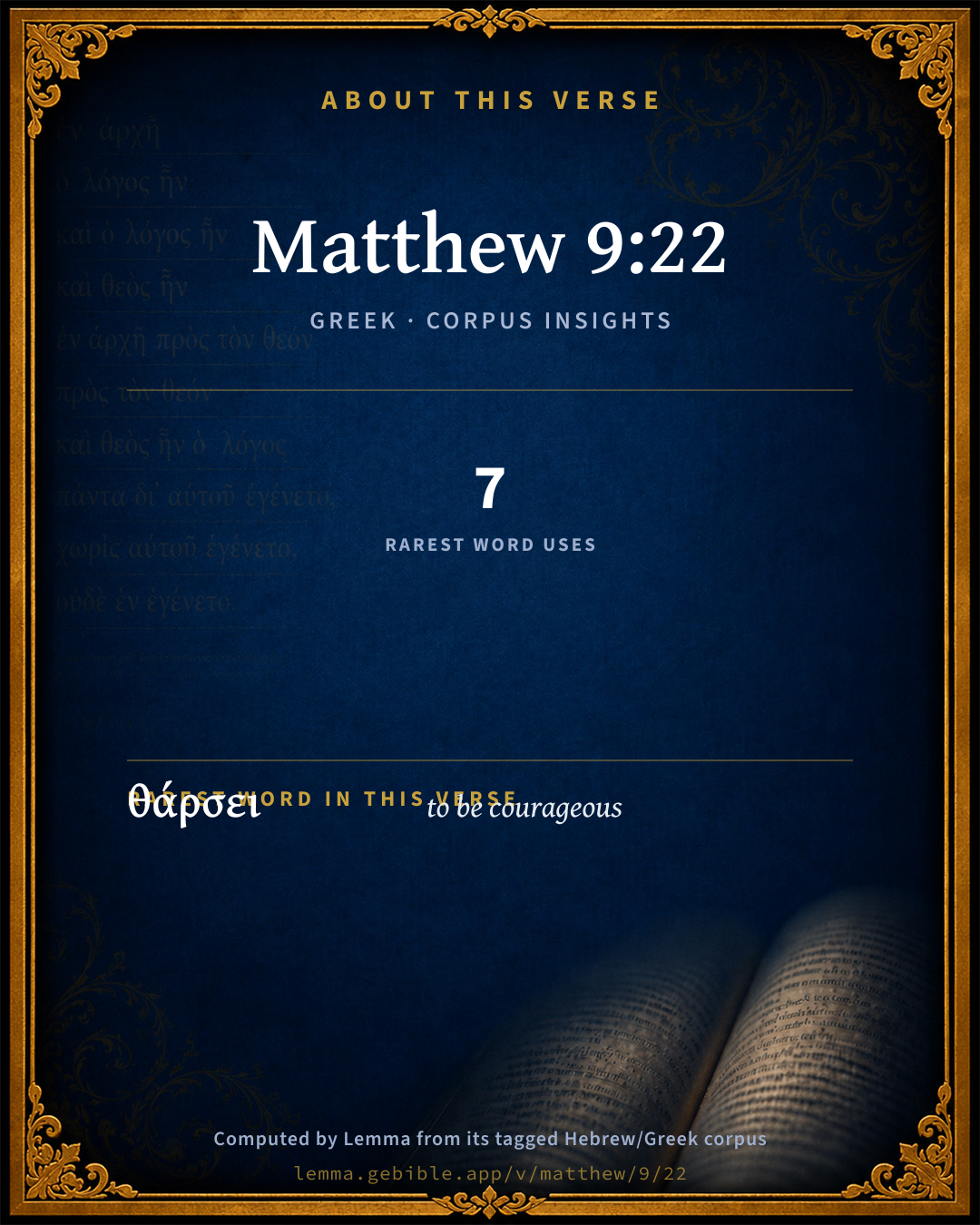
The rarest word here is θάρσει to be courageous G2293 — appearing just 7 times in the whole Greek New Testament.

Shared distinctive vocabulary

θάρσει to be courageous G2293 occurs in 7 verses of the Greek New Testament. Also found in:

Repetition

Words recur within this verse:

Cross-references

14

Topical passages linked to Matthew 9:22 in the Treasury of Scripture Knowledge — connected by theme and wording, ordered by reader-vote popularity; previews shown in the World English Bible.

  • Luke 7:50 He said to the woman, "Your faith has saved you. Go in peace."
  • Matthew 15:28 Then Jesus answered her, "Woman, great is your faith! Be it done to you even as you desire." And her daughter was healed from that hour.
  • Matthew 9:2 Behold, they brought to him a man who was paralyzed, lying on a bed. Jesus, seeing their faith, said to the paralytic, "Son, cheer up! Your sins are forgiven you."
  • Mark 10:52 Jesus said to him, "Go your way. Your faith has made you well." Immediately he received his sight, and followed Jesus in the way.
  • Luke 8:48 He said to her, "Daughter, cheer up. Your faith has made you well. Go in peace."
  • Luke 17:19 Then he said to him, "Get up, and go your way. Your faith has healed you."
  • Luke 18:42 Jesus said to him, "Receive your sight. Your faith has healed you."
  • Mark 5:34 He said to her, "Daughter, your faith has made you well. Go in peace, and be cured of your disease."
  • Matthew 9:29 Then he touched their eyes, saying, "According to your faith be it done to you."
  • John 4:53 So the father knew that it was at that hour in which Jesus said to him, "Your son lives." He believed, as did his whole house.
  • Acts 14:9 He was listening to Paul speaking, who, fastening eyes on him, and seeing that he had faith to be made whole,
  • Acts 16:18 She was doing this for many days. But Paul, becoming greatly annoyed, turned and said to the spirit, "I charge you in the name of Jesus Christ to come out of her!" It came out that very hour.
  • Hebrews 4:2 For indeed we have had good news preached to us, even as they also did, but the word they heard didn't profit them, because it wasn't mixed with faith by those who heard.
  • Matthew 17:18 Jesus rebuked him, the demon went out of him, and the boy was cured from that hour.

Cross-references courtesy of OpenBible.info (CC BY 4.0).

Commentary

Notes on Matthew 9:22 from classic Christian and Jewish commentators (each source and its license shown beneath its notes). The classic Christian expositions comment on the surrounding passage and are grouped to its opening verse, so a note may address several verses; the Jewish commentaries on the Tanakh (Rashi and others) are per-verse, so they appear only where the commentator wrote on this verse.

Lemma curates 59 commentaries, every one of them public domain or Creative Commons licensed, each selected and text-cleaned for this edition rather than reprinted as found. About our sources →

Tyndale Open Study Notes

Tyndale Open Resources

9:22 Your faith has made you well (literally has saved you): Physical healing demonstrated her spiritual salvation (see 8:17).

Tyndale Open Study Notes — © Tyndale Open Resources, licensed CC BY-SA 4.0. Text via the HelloAO Bible API.

Bengel's Gnomon

Johann Albrecht Bengel

Mat 9:22. Θύγατερ, daughter) She was, therefore, not advanced in years.[423]—ἡ πίστις σου σέσωκέ σε, thy faith hath placed thee in a state of health or salvation[424]) Our Lord was wont to say thus to those who, of themselves, as it were drew the health of their body and soul to themselves;[425] see Luk 7:50; Luk 17:19; Luk 18:42; by which words He shows that He knew the existence and extent of their faith; He praises and confirms their faith; He ratifies the gift, and commands it to remain; and at the same time intimates, that if others remain without help, unbelief is the only cause.[426]

[423] Our gracious Saviour did not at all censure her on the ground that she neglected to offer a prayer to Him, and as it were stole help from Him.—V. g.

[424] E. V. Thy faith hath made thee whole.—(I. B.)

[425] In the original, “qui salutem corporis et animæ ad se ultro quasi attraxere”—“attraxere,” “by their own instrumentality;” “ultro” “of their own accord.” See Reff.—(I. B.)

[426] It more than once happened, that a person came to know that he had faith only when the Saviour announced the fact to him, and not before.—V. g.

Bengel's Gnomon of the New Testament — English translation (T&T Clark, Edinburgh, 1860) — public domain. Text from a community e-Sword module.

Meyer's Critical & Exegetical Commentary

Heinrich August Wilhelm Meyer

Mat_9:22. Jesus immediately (see on Mat_9:4) perceives her object and her faith, and affectionately (θύγατερ, as a term of address, like τέκνον, Mat_9:2, occurs nowhere else in the New Testament) intimates to her that ἡ πίστις σοῦ σέσωκέ σε, on account of thy faith thou art saved (healed)! The perfect describes what is going to happen directly and immediately, as if it were something already taking place. See Kühner, ii. 1, p. 129. Comp. Mar_10:52, Luk_18:42, and the counterpart of this among tragic poets, as in ὄλωλα, τέθνηκα, and such like. The cure, according to Matthew, was effected by an exercise of Jesus will, which responds to the womans faith in His miraculous power, not through the mere touching of the garment (in answer to Strauss). The result was instantaneous and complete. To try to account for the miraclo by the influence of fear (Ammon), religious excitement (Schenkel), a powerful hope quickening the inactive organs (Keim), is not sufficiently in keeping with the well authenticated result, and is inadequate to the removal of so inveterate a malady (the twelve years duration of which must indeed be ascribed to legend).

ἀπὸ τῆς ὥρ. ἐκ.] not equivalent to ἐν τῇ ὥρ ἐκ. (Mat_8:14), but the thing begins to take place from that hour onward. Comp. Mat_15:28, Mat_17:18. Ἀπό and ἐν therefore express the same result, the instantaneous cure, in forms differing according to the manner in which the thing is conceived.

According to Eusebius, H. E. vii. 17, the womans name was Veronica (Evang. Nicod. in Thilo, I. p. 561), and a Gentile belonging to Paneas, where she erected a statue to Jesus. However, see Robinson, neuere Forsch. p. 537.

Meyer — Critical and Exegetical Commentary on the New Testament — English translation by Peter Christie, edited by Frederick Crombie (T&T Clark, 1880) — public domain. Text from a community e-Sword module.

Adam Clarke's Commentary

Verse 22. Daughter, be of good comfort] θαρσει θυγατερ, Take courage, daughter. See Clarke on Mt 9:2. The reason of this kind speech was-Jesus, finding that virtue had proceeded from him; made inquiry who had touched him. The woman, finding that she could not be hid, came fearing and trembling, (Mr 5:33,) and confessed the truth: to dispel these fears and to comfort her mind, Jesus said, Daughter, take courage.

Thy faith hath made thee whole.] η πιστις σου σεσωκε σε, This thy faith hath saved thee: i.e. thy faith in my power has interested that power in thy behalf, so that thou art saved from thy disorder, and from all its consequences. See Clarke on Lu 8:46.

Adam Clarke's Commentary on the Bible (1810–1826) — public domain. Text from a community e-Sword/MySword module.

Ellicott's Commentary for English Readers

(22) Be of good comfort.—The same word of tenderness is spoken to her as had been spoken to the paralytic. What each needed, she the most of the two, was the courage, the enthusiasm of faith.

Thy faith hath made thee whole.—Literally, thy faith hath saved thee. The rendering of the Authorised version is not wrong, and yet it represents but part of the full meaning of the word. Her faith had saved her, in the higher as well as in the lower sense. The teaching of the narrative lies almost on the surface. There may be imperfect knowledge, false shame, imperfect trust, and yet if the germ of faith be there, Christ, the Healer both of the souls and bodies of men, recognises even the germ, and answers the longing desire of the soul to be freed from its uncleanness. Other healers may have been sought in vain, but it finds its way through the crowd that seems to hinder its approach, and the “virtue” which it seeks goes forth even from the “hem of the garment,” even through outward ordinances (for thus we interpret the miracle, which is also a parable), which in themselves have no healing power. Eusebius, in his Church History (vii. 13), states that the woman belonged to Cæsarea Philippi, and that, in thankfulness for her cure, she set up two statues in bronze—one of herself in the attitude of supplication, and the other of our Lord standing erect and stretching forth His hand to her—and that these were shown in his own day, in the early part of the fourth century. In the apocryphal Gospel of Nicodemus (v. 26) she is called Veronica.

The other Gospels relate more fully that the issue of blood ceased; that “she felt in her body that she was healed of her plague;” that Jesus perceived that “virtue had gone out of Him,” and asked the question, “Who is it that touched Me?” that the disciples answered—Peter as usual foremost (Luk_8:45)—“The multitude throng Thee and press Thee, and askest Thou, Who touched Me?” that our Lord then give His reason for the question. He had felt a touch, the touch of faith and unspoken prayer, which was very different from the pressure of the eager, curious crowd.

A Bible Commentary for English Readers, edited by Charles John Ellicott (1878–1897) — public domain. Text from a community e-Sword module.

The Cambridge Bible for Schools and Colleges

gen. ed. J. J. S. Perowne

22. thy faith hath made thee whole] Rather, “thy faith hath saved thee,” and not the external act of touching my garment. True faith—spiritual insight—will be accepted by Jesus in spite of ignorance.

The Cambridge Bible for Schools and Colleges (gen. ed. J. J. S. Perowne; Cambridge University Press, 1878–1918) — public domain. Text from a community e-Sword module.

John Gill's Exposition

And when Jesus came into the ruler's house,.... Both Mark and Luke relate, how that before this, whilst they were in the way, and just as Christ had done speaking to the poor woman, that news was brought to the ruler, that his daughter was actually dead, and therefore need not give Jesus any further trouble; when Christ encouraged him not to be cast down at the tidings, but believe, and she should be restored again; and that he suffered none to follow him, but Peter, James, and John: and

saw the minstrels, or "pipers"; how many there were, is not known: it is certain there were more than one; and it was a rule with the (z) Jews that

"the poorest man in Israel (when his wife died) had not less , "than two pipes", and one mourning woman.''

And since this was a daughter of a ruler of the synagogue that was dead, there might be several of them. These instruments were made use of, not to remove the melancholy of surviving friends, or allay the grief of the afflicted family; but, on the contrary, to excite it: for the Jewish writers say (a), these pipes were hollow instruments, with which they made a known sound, , "to stir up lamentation and mourning": and for the same purpose, they had their mourning women, who answered to the pipe; and by their dishevelled hair, and doleful tones, moved upon the affections, and drew tears from others; and very likely are the persons, that Mark says, "wept and wailed greatly". Sometimes trumpets were made use of on these mournful occasions (b); but whether these were used only for persons more advanced in years, and pipes for younger ones, as by the Heathens (c), at least, at some times, is not certain.

And the people making a noise; the people of the house, the relations of the deceased, the neighbours, who came in on this occasion; and others, in a sort of tumult and uproar, hurrying and running about; some speaking in the praise of the dead, others lamenting her death, and others preparing things proper for the funeral; all which shew, that she was really dead: among these also, might be the mourners that made a noise for the dead;

"for since mourning was for the honour of the dead, therefore they obliged the heirs to hire mourning men, and mourning women, to mourn for the same (d).''

(z) Misn. Cetubot. c. 4. sect. 4. Maimon Ishot, c. 14. sect. 23. (a) Maimon & Bartenora in Misn. Sabbat, c. 23. sect. 4. (b) Midrash Kohelet, fol. 77. 4. (c) Vid. Kirchman. de funer. Roman. l. 2. c. 5. (d) Maimon. Hilch. Ebel, c. 12. sect. 1.

John Gill's Exposition of the Whole Bible (1746–1763) — public domain (CC PDM 1.0). Text via the HelloAO Bible API.

Trapp's Complete Commentary

John Trapp

22 But Jesus turned him about, and when he saw her, he said, Daughter, be of good comfort; thy faith hath made thee whole. And the woman was made whole from that hour.

Ver. 22. But Jesus turned him about] To take notice of it himself, and to notify it to others. For these reasons, saith Chrysostom: 1. To free the woman from fear, lest her conscience should call her recreant, as one that had stole a cure. 2. To make up in her what was wanting to her faith, if she should have any such thought to do Son 3:1-11. To manifest her faith, for other men’s imitation. 4. To make known his omniscience, and so his Divinity. 5. To confirm the ruler’s faith, and so fit him for further mercy. 6. To teach her and us that not his garment, but himself, did the cure. This makes against that Popish foppery in worshipping relics, as the clothes wherein Christ’s body was enwrapped, of the virtue whereof Paleottus, Archbishop of Bonony, set forth a great book, A. D. 1617.

And the woman was made whole, &c.] That fable recorded by Eusebius is scarcely worth relating; that this woman should set up at her door in Caesarea Philippi a statue of brass in honour of our Saviour; near whereto grew a certain herb good for all diseases. Irenaeus (far more ancient than Eusebius) reproveth the heretics, called Gnostici, for that they carried about them the image of Christ made in Pilate’s time, after his own proportion; using also for declaration of their affection towards it to set garlands upon the head of it. And in Epiphanius’s time (who lived soon after Eusebius) images and statues of Christ or the saints were abhorred by Christians. The Turks will not endure any image, no not upon their coin, because of the second commandment; and the Papists, for their imagery, they call idolaters.

John Trapp, A Commentary or Exposition upon All the Books of the Old and New Testament (1647–1656) — public domain. Text from a community e-Sword module.

Haydock's Catholic Bible Commentary

Greek: Epistrapseis kai idon, turning about and seeing, as if he were ignorant, and wished to see who it was that had touched him, as the other evangelists relate. In St. Mark (v. 29,) we see she was cured on touching the garment; and Jesus only confirms the cure by what he says in verse 34. --- But Jesus turning about. Our divine Saviour, fearing lest he might alarm the woman by his words, says immediately to her, Take courage; and at the same time calls her his daughter, because her faith had rendered her such. (St. John Chrysostom)

George Leo Haydock (1774–1849), Haydock's Catholic Family Bible and Commentary, 1859 edition — public domain. Excludes Psalms (Douay-Rheims chapter numbering differs from Protestant) and Deuterocanonical books (Catholic canon only).

Matthew Poole's English Annotations

Matthew relates this story shortly, as he doth many others, being only intent upon recording the miracle. We must here supply something out of Mark and Luke. Mark saith, Mar 5:29-34, And straightway the fountain of her blood was dried up; and she felt in her body that she was healed of that plague. And Jesus, immediately knowing in himself that virtue had gone out of him, turned him about in the press, and said, who touched my clothes? And his disciples said unto him, Thou seest the multitude thronging thee, and sayest thou, Who touched me? And he looked round about to see her that had done this thing. But the woman fearing and trembling, knowing what was done in her came and fell down before him, and told him all the truth. And he said unto her, Daughter, thy faith hath made thee whole; go in peace, and be whole of thy plague. Luke reports the same circumstances with little variation, Luk 8:45-48. Christ was not ignorant of this woman’s coming and touching his garment, he doubtless influenced her to the motion, his inquiry was therefore only that the miracle might be taken notice of: he knew that virtue was gone out of him, and had healed the woman, for he had commanded it so to go out, or she had not been healed; but he desired that the people might take notice that she was healed by his grace, not by any magical virtue in his clothes. The woman is brought openly to come and confess it, that she had touched his clothes, and that she was healed. She feared and trembled, lest she should have offended. Christ comforts her, by assuring her the cure, and telling her, that her faith in him, as an instrumental cause, had effected it. We have met with Christ often before, as well as in this text, and shall again often meet with him, ascribing much to the exercise of faith. And the faith to which he ascribes so much seemeth not to be justifying faith, or that exercise of grace whereby a soul, in the sense of its lost estate by reason of sin, accepteth of him as its Saviour, and relies upon his merits alone for salvation; for we read nothing of the persons’ repentance for sin, nor reliance upon Christ for the salvation of their souls, or any profession of any such thing. Is it then so valuable an act of faith to believe that Christ is the Son of God? I answer,

1. Though faith in Christ be the only saving faith, yet a faith in God, being persuaded of his power and trusting in him, is an exercise of grace, which God (as appeareth in Scripture) much rewarded with blessings of this life; it giveth God the honour of his power, &c.

2. But, secondly: The great truth, That Christ was the eternal Son of God, was that which God more especially aimed at to give the world’s assent unto and persuasion of at this time; and indeed preliminary and necessary to people’s receiving of him as their Saviour, for, Cursed is he that trusteth in man. It was also the great truth which the Pharisees and the rest of the Jews did oppose. Hence our Saviour takes all occasions both to confirm and to encourage this faith; which was but a persuasion that he was clothed with a Divine power, and did that which no man could do; and that he had in him Divine goodness, ready to relieve man’s infirmities, according to that power.

3. It is hardly possible that any should truly and seriously believe that Christ, being apparently man, and the Son of man, should also exercise a power which none but God could do; and that they should not believe in him as the Saviour of the world, and be quickened to the use of those means which he should reveal for their salvation. For these reasons, amongst others, we may conceive that Christ predicates this faith so much in those in whom he found it.

This miracle being wrought by our Lord in his way to Jairus’s house, after the first notice he had of the dangerous sickness of his daughter, the evangelist now goeth on to give us an account of his perfecting that good work.

Matthew Poole's English Annotations on the Holy Bible (1683–1685) — public domain. Text from a community e-Sword/MySword module.

The Pulpit Commentary

But Jesus turned him about. The order of the words shows that the thought centres, not on the action, but on the Person. It marks the transition of the narrative from the woman to Christ. Further, "to understand the greatness of Jesus" love, consider how a Pharisee might have treated one ceremonially so unclean" (Kubel). And when he saw her. The parallel passages show that this was after his inquiry who it was, etc. He said, Daughter, be of good comfort; good cheer (Revised Version); Yarsei Yugater . Daughter contains the same thought as "son" in ver. 2. St. Matthew alone, as there, expands its purpose by prefixing Yarei. Yugatera de auth h pistiv authv yugatera authhsen (Chrysostom, in loc. ). Thy faith hath made thee whole; hath saved thee (Revised Version). It is possible that the additional words recorded in the parallel passages, "Go in peace," point to more than only physical restoration. And the woman was made whole (saved, Revised Version margin) from that hour.

The Pulpit Commentary (1880–1919), ed. H.D.M. Spence-Jones & Joseph S. Exell — public domain. Text from a community e-Sword module.

John Wesley's Explanatory Notes

Take courage - Probably she was struck with fear, when he turned and looked upon her, Mark v, 33; Luke viii, 47; lest she should have offended him, by touching his garment privately; and the more so, because she was unclean according to the law, Lev. xv, 25.

John Wesley, Explanatory Notes Upon the Whole Bible (1754–1765) — public domain. Text via the GEBible commentary corpus.

Cambridge Greek Testament for Schools and Colleges

22. Eusebius (H. E. VII. 18) states that in the city of Cæsarea-Philippi stood a bronze statue of this woman kneeling before the Saviour, who was represented extending his hand to her.

Cambridge Greek Testament for Schools and Colleges (Cambridge University Press, 1896; 21 vols, various authors incl. Carr, Maclear, Plummer, Farrar, Lumby, Moule, M. R. James, Simcox) — public domain. Text from a community e-Sword module.

Alford’s Greek Testament

Henry Alford

22.] The cure was effected on her touching our Lord’s garment, Mar 5:27-29: Luk 8:44. And our Lord enquired who touched Him (Mark, Luke), for He perceived that virtue had gone out of Him (Luke). She, knowing what had been done to her, came fearing and trembling, and told Him all.

Henry Alford, The Greek Testament (1849–1861) — public domain. Text from a community e-Sword module.

International Critical Commentary

(M) 22. And Jesus turned and saw her, and said, Be of good courage, daughter, thy faith hath saved thee.] In these words the editor summarises Mk vv. 30-34.—θάρσει]is inserted by Mt. as in 9:2. For his insertion of καὶ ἐσώθη ἡ γυνὴ ἀπὸ τῆς ὥρας ἐκείνης, cf. 8:13, 15:28, 17:18 and Introduction, p. xxxii.—ἡ πίστις σου] πίστις here, as in 8:10, 9:2 = assurance, trust in the power of Christ to heal.

International Critical Commentary — older volumes (1896–1929), various authors — public domain. Text from a community e-Sword module.

Lesson kit

Teaching starters — assembled from the data on this page, not authored interpretation. Every prompt links to the verse data it draws on. Edit before teaching.

Matthew, in the Gospels, opens this verse with 22 words (16 distinct Greek lemmas). Its most distinctive word is tharséō (“to be courageous”). A historical commentator’s framing appears above. Read the whole chapter for the surrounding context.

Discussion questions

  1. The word tharséō carries the sense “to be courageous.” How does it shape the verse?
  2. How does Matthew 9:2, which shares the word «to be courageous», read alongside this verse?
  3. What does the repetition of “to save” (2× in this one verse) do in this verse?
  4. These translations render this verse differently. What is at stake in choosing one wording over another?
  5. Compare how Tyndale Open Study Notes and Bengel's Gnomon read this verse. Where do they agree or differ?

Things to notice

Reading settings

Reading text

Shown beneath each verse's original-language words.

Old Testament
Old Testament edition

Read the OT as the Masoretic Hebrew (MT) or the Greek Septuagint (LXX).

English shown for the Greek Septuagint (in the Hebrew ↔ Greek comparison).

Comparing translations? Open the Compare panel on any verse page to stack up to four side by side.