Revelation 22:12

Greek (Tischendorf 8th ed.) Revelation 22:12 appears in the Greek New Testament. The text above is from the Tischendorf 8th edition. Each word links to its Strong’s number and a concise gloss. Click any word for its full Thayer’s Greek Lexicon entry.
Download image
Cite this verse

Revelation 22:12 (World English Bible). Public Domain. Lemma interlinear Bible study tool, https://lemma.gebible.app/v/revelation/22/12.

Show BibTeX & RIS
BibTeX
RIS
English Translation
"Behold, I come quickly. My reward is with me, to repay to each man according to his work.
World English Bible · Public Domain
Download a study sheet

One document with this verse’s original text, its word-by-word gloss line, the meaning frame, cross-references with their text, attributed commentary, and full source and license credits — printable, and it pastes into notes with its structure intact.

This verse Autodidact and up

Study sheet (.html) Plain text (.txt)

A passage Seminary Student

Up to 50 verses in one chapter. A passage sheet keeps up to 6 commentary sources and 12 cross-references per verse, in the order this page ranks them, and says so on the sheet whenever that leaves anything out. Ask for a single verse and you get the Autodidact verse sheet above.

Everything on this page stays free to read, with no account — the sheet is a download of what is already on screen, not access to it.

Want to remove ads? Support Godless Engineer
Compare translations 3

The same verse in 3 English versions, stacked beneath the original-language interlinear above. Click any original word for its lexicon entry.

Each is an independent rendering of the whole verse — the interlinear is not word-aligned to these translations.

Highlighted words mark where these versions differ — a whole-verse word diff, not a word-by-word alignment.

  • World English Bible Public Domain
    "Behold, I come quickly. My reward is with me, to repay to each man according to his work.
  • King James Version Public Domain
    And, behold, I come quickly; and my reward is with me, to give every man according as his work shall be.
  • unfoldingWord Literal Text CC BY-SA 4.0
    Behold, I am coming quickly, and my reward with me, to render to each one as his work is.

unfoldingWord Literal Text — © unfoldingWord, licensed CC BY-SA 4.0. Word-aligned USFM3 via Door43 (git.door43.org/unfoldingWord/en_ult).

Versions to compare (up to 4)

3 of 4 selected

Show all 19 translations

Every available English version of this verse, each an independent rendering of the whole verse.

  • World English Bible Public Domain
    "Behold, I come quickly. My reward is with me, to repay to each man according to his work.
  • Berean Standard Bible Public Domain
    “Behold, I am coming soon, and My reward is with Me, to give to each one according to what he has done.
  • Majority Standard Bible Public Domain
    “Behold, I am coming soon, and My reward is with Me, to give to each one according to what he has done.
  • King James Version Public Domain
    And, behold, I come quickly; and my reward is with me, to give every man according as his work shall be.
  • American Standard Version (1901) Public Domain
    Behold, I come quickly; and my reward is with me, to render to each man according as his work is.
  • Revised Version (1885) Public Domain
    Behold, I come quickly; and my reward is with me, to render to each man according as his work is.
  • Geneva Bible (1599) Public Domain
    And beholde, I come shortly, and my reward is with mee, to giue euery man according as his worke shall be.
  • Douay-Rheims (1899) Public Domain
    Behold, I come quickly; and my reward is with me, to render to every man according to his works.
  • Young's Literal Translation Public Domain
    And lo, I come quickly, and my reward `is' with me, to render to each as his work shall be;
  • Literal Standard Version CC BY-SA 4.0
    Behold, I come quickly, and My reward [is] with Me, to render to each as his work will be;
  • Unlocked Literal Bible CC BY-SA 4.0
    “Look! I am coming soon. My reward is with me, to pay back each one according to what he has done.
  • unfoldingWord Literal Text CC BY-SA 4.0
    Behold, I am coming quickly, and my reward with me, to render to each one as his work is.
  • Darby Bible Public Domain
    Behold, I come quickly, and my reward with me, to render to every one as his work shall be.
  • World Messianic Bible Public Domain
    “Behold, I am coming soon! My reward is with me, to repay to each man according to his work.
  • Webster's Bible Public Domain
    And behold, I come quickly; and my reward is with me, to give to every man according as his work shall be.
  • Free Bible Version CC BY-SA 4.0
    “I am coming soon, and I am bringing my reward to give to everybody based on what they've done.
  • Bible in Basic English Public Domain
    See, I come quickly; and my reward is with me, to give to every man the outcome of his works.
  • Text-Critical English NT CC BY 4.0
    “Behold, I am coming quickly, and my reward is with me, to repay each person according to their works.
  • Tyndale New Testament (1534) Public Domain
    And beholde I come shortly and my rewarde with me to geve every man accordinge as his dedes shalbe.

Literal Standard Version (2020), Covenant Press — licensed CC BY-SA 4.0. Text via the HelloAO Bible API (eBible.org). Unlocked Literal Bible (unfoldingWord) — licensed CC BY-SA 4.0. Text via the HelloAO Bible API (eBible.org). unfoldingWord Literal Text — © unfoldingWord, licensed CC BY-SA 4.0. Word-aligned USFM3 via Door43 (git.door43.org/unfoldingWord/en_ult). Free Bible Version, Dr. Jonathan Gallagher — licensed CC BY-SA 4.0. Text via the HelloAO Bible API (eBible.org).

Word by word

More ways to search: Search by grammar → Find every occurrence → Compare this word →

Practice this passage: Drill this verse → Learn its vocabulary →

ταχύ
tachý
G5035
“quickly”
Adverb
Part of Speech
Adverb
Full Thayer's Definition

Origin: neuter singular of G5036 (as adverb)

TDNT: None

1. quickly, speedily (without delay)
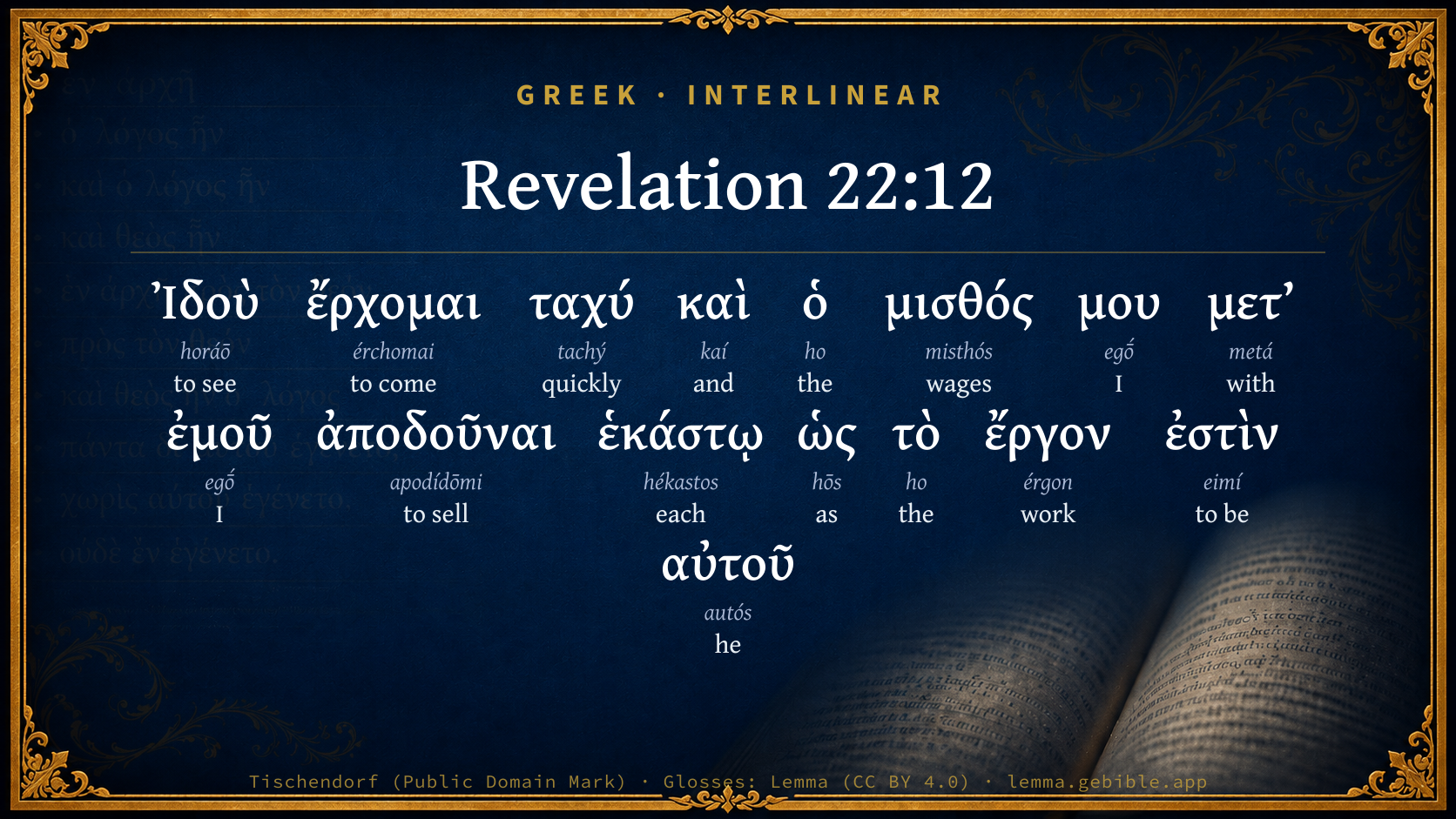
  1. Ἰδοὺ horáō G3708 “to see” Verb, Aorist, Middle, Imperative, 2nd person, Singular
  2. ἔρχομαι érchomai G2064 “to come” Verb, Present, Middle or Passive deponent, Indicative, 1st person, Singular
  3. καὶ kaí G2532 “and” Conjunction
  4. ὁ ho G3588 “the” Article, Nominative, Singular, Masculine
  5. μισθός misthós G3408 “wages” Noun, Nominative, Singular, Masculine
  6. μου egṓ G1473 “I” Personal pronoun, 1st person, Genitive, Singular
  7. μετ’ metá G3326 “with” Preposition
  8. ἐμοῦ egṓ G1473 “I” Personal pronoun, 1st person, Genitive, Singular
  9. ἀποδοῦναι apodídōmi G591 “to sell” Verb, Aorist, Active, Infinitive
  10. ἑκάστῳ hékastos G1538 “each” Adjective, Dative, Singular, Masculine
  11. ὡς hōs G5613 “as” Adverb
  12. τὸ ho G3588 “the” Article, Nominative, Singular, Neuter
  13. ἔργον érgon G2041 “work” Noun, Nominative, Singular, Neuter
  14. ἐστὶν eimí G1510 “to be” Verb, Present, Active, Indicative, 3rd person, Singular
  15. αὐτοῦ autós G846 “he” Personal pronoun, Genitive, Singular, Masculine

About this verse

These counts appear in no published source. They are computed here, from the morphology-tagged text and Lemma’s own curated glosses. What Lemma adds →

16
words
14
distinct lemmas
Revelation
section

Notable vocabulary

The rarest word here is ταχύ quickly G5035 — appearing just 11 times in the whole Greek New Testament.

Shared distinctive vocabulary

ταχύ quickly G5035 occurs in 11 verses of the Greek New Testament. Also found in:

Repetition

Words recur within this verse:

Cross-references

14

Topical passages linked to Revelation 22:12 in the Treasury of Scripture Knowledge — connected by theme and wording, ordered by reader-vote popularity; previews shown in the World English Bible.

  • Matthew 16:27 For the Son of Man will come in the glory of his Father with his angels, and then he will render to everyone according to his deeds.
  • Isaiah 62:11 Behold, Yahweh has proclaimed to the end of the earth, Say you to the daughter of Zion, Behold, your salvation comes; behold, his reward is with him, and his recompense before him.
  • Isaiah 40:10 Behold, the Lord Yahweh will come as a mighty one, and his arm will rule for him: Behold, his reward is with him, and his recompense before him.
  • 1 Corinthians 3:14 If any man's work remains which he built on it, he will receive a reward.
  • Revelation 22:7 "Behold, I come quickly. Blessed is he who keeps the words of the prophecy of this book."
  • 1 Corinthians 3:8 Now he who plants and he who waters are the same, but each will receive his own reward according to his own labor.
  • Romans 2:6–11 who "will pay back to everyone according to their works:"
  • Romans 14:12 So then each one of us will give account of himself to God.
  • Revelation 11:18 The nations were angry, and your wrath came, as did the time for the dead to be judged, and to give your bondservants the prophets, their reward, as well as to the saints, and those who fear your name, to the small and the great; and to destroy those who destroy the earth."
  • Revelation 20:12 I saw the dead, the great and the small, standing before the throne, and they opened books. Another book was opened, which is the book of life. The dead were judged out of the things which were written in the books, according to their works.
  • Revelation 22:20 He who testifies these things says, "Yes, I come quickly." Amen! Yes, come, Lord Jesus.
  • Isaiah 3:10–11 Tell the righteous "Good!" For they shall eat the fruit of their deeds.
  • Zephaniah 1:14 The great day of Yahweh is near. It is near, and hurries greatly, the voice of the day of Yahweh. The mighty man cries there bitterly.
  • 1 Corinthians 9:17–18 For if I do this of my own will, I have a reward. But if not of my own will, I have a stewardship entrusted to me.

Cross-references courtesy of OpenBible.info (CC BY 4.0).

Commentary

Notes on Revelation 22:12 from classic Christian and Jewish commentators (each source and its license shown beneath its notes). The classic Christian expositions comment on the surrounding passage and are grouped to its opening verse, so a note may address several verses; the Jewish commentaries on the Tanakh (Rashi and others) are per-verse, so they appear only where the commentator wrote on this verse.

Lemma curates 59 commentaries, every one of them public domain or Creative Commons licensed, each selected and text-cleaned for this edition rather than reprinted as found. About our sources →

The Cambridge Bible for Schools and Colleges

gen. ed. J. J. S. Perowne

The Witness of the Lord, Rev_22:12-16

12. I come quickly] Of course He Who “comes” is the Lord Jesus: but we are probably not to imagine that He is personally present—the angel still speaks in His name.

my reward is with me] Isa_40:10; Isa_62:11.

to give every man] Better, to render to every man. The source of the expression is in Job_34:11; Ps. 42:12. In the N. T. this retribution is ascribed to God in Rom_2:6, to the Son in His own words in St Mat_16:27.

shall be] Read, is.

The Cambridge Bible for Schools and Colleges (gen. ed. J. J. S. Perowne; Cambridge University Press, 1878–1918) — public domain. Text from a community e-Sword module.

Joseph Benson's Commentary

Rev 22:12-15. And behold, I — Jesus Christ; come quickly — To judge the world. And my reward — Both of grace and vengeance; is with me — The reward which I shall assign, both to the righteous and the wicked, shall be conferred at my coming; to give to every man according as his work — His spirit and conduct, his whole inward and outward behaviour, shall be. And to confirm it further, I repeat it again, I am Alpha, &c. — Rather, the Alpha and the Omega, &c. — Who exist from everlasting to everlasting. How clear, incontestable a proof does our Lord here give of his divine glory! He is the Lord of the whole creation, by whom all things began to be formed, and by whom all things are to be finished; so that he will do all his pleasure, through all the ages of time, to the consummation of all things; and nothing can prevent or hinder the sure and full accomplishment of his word. Therefore, blessed, happy, are they, and they alone, that do his commandments — And so prepare for his important appearance; that they may have a right — Through his gracious covenant; to the tree of life —

To all the blessings signified by it. When Adam broke his commandment, he was debarred from the tree of life. They who keep his commandments, who show their faith by their works, shall have access to it, and shall eat of it. For without are dogs — That is, the unclean, the contentious and quarrelsome, the fierce and rapacious. The sentence, in the original, is abrupt, as expressing abhorrence. The gates are ever open; but not for dogs. These are, and ever shall be, shut out, as also sorcerers, &c. — All that live in the violation of the known laws of God. See on Rev 21:8.

Joseph Benson's Commentary on the Old and New Testaments (1811–1818) — public domain. Text from a community e-Sword module.

Tyndale Open Study Notes

Tyndale Open Resources

22:12 Christ is coming soon . . . to repay all people, not just on the basis of their profession of faith, but according to their deeds (see 2:23; 11:18; 14:13; 20:12-13; see also Prov 24:12; Matt 16:27; 2 Cor 5:10). Not every statement of belief is genuine (John 2:23-25); faith will show itself in actions (Jas 2:14-26). We are indeed saved by the grace and power of God in Christ. Our works do not save us, but they do indicate the seriousness of our confession and provide a just basis for our ultimate reward or punishment.

Tyndale Open Study Notes — © Tyndale Open Resources, licensed CC BY-SA 4.0. Text via the HelloAO Bible API.

Geneva Bible (1599)

Geneva Bible translators

The second place belonging unto the use of this book, as I said, verse 10. Also (saith God by the Angel) though there should be no use of this book unto men: yet it shall be of this use unto me, that it is a witness of my truth unto my glory, who will come shortly to give and execute just judgment, in this verse: who have taught that all these things have their being in me, in verse 13, and have denounced blessedness unto my servants in the Church, verse 14, and reprobation unto the ungodly, verse 15.

Geneva Bible (1599) marginal notes — public domain. Text via Bolls.life.

Jamieson, Fausset & Brown

Robert Jamieson, A. R. Fausset & David Brown

And--in none of our manuscripts. But A, B, Vulgate, Syriac, Coptic, and CYPRIAN omit it.

behold, I come quickly--(Compare Rev 22:7).

my reward is with me-- (Isa 40:10; Isa 62:11).

to give--Greek, "to render."

every man--Greek, "to each."

shall be--so B in MAI. But B in TISCHENDORF, and A, Syriac, read, "is."

Jamieson, Fausset & Brown — Commentary Critical and Explanatory on the Whole Bible (1871) — public domain (CC PDM 1.0). Text via the HelloAO Bible API.

Adam Clarke's Commentary

Verse 12. Behold, I come quickly] I come to establish nay cause, comfort and support my followers, and punish the wicked.

Adam Clarke's Commentary on the Bible (1810–1826) — public domain. Text from a community e-Sword/MySword module.

Ellicott's Commentary for English Readers

(12) And, behold, I come quickly . . .—Rather, Behold, I am coming quickly, and My reward is with Me to give back to each one as his work is. To give back to each: here we have the truth declared by St. Paul uttered in words borrowed from Isaiah (Isa_40:10). “Whatsoever a man soweth, that shall he also reap,” wrote St. Paul (Gal_6:7-8): “God gives back to each one his work,” says St. John.

A Bible Commentary for English Readers, edited by Charles John Ellicott (1878–1897) — public domain. Text from a community e-Sword module.

John Gill's Exposition

And, behold, I come quickly,..... This is repeated, to confirm the truth of Christ's second coming, and the speediness of it, and to point at the time when the above shall be, and to add what follows.

And my reward is with me: which words are taken out of Isa 40:10 and which being compared together, furnish out a clear proof of Christ being the true Jehovah, the eternal God. There is a reward of debt, or a due reward, a reward of punishment, which is the just recompense of reward, which, shall be righteously given to wicked men for their sin, Heb 2:2 and there is a reward of grace, which is also called the recompence of reward, the reward of the inheritance, which is no other than the gift of eternal life, which God of his free grace bestows upon his people, Heb 11:26 and both these are with Christ; they are in his hands, he has authority from God, as Mediator, to inflict vengeance on the wicked, and to give eternal life to his people; both which he will do, for this is with him:

to give every man according as his work shall be; if his work is evil, and he is an unjust and filthy man, and the course of his conversation has been vicious, the reward of debt, or just punishment, will be rendered to him; but if his work is the fruit of grace, and he has had his conversation in the world by the grace of God, and he is a righteous person, justified by the righteousness of Christ, and a holy, good man, sanctified by the Spirit of God, the reward of grace, the crown of righteousness, will be given to him.

John Gill's Exposition of the Whole Bible (1746–1763) — public domain (CC PDM 1.0). Text via the HelloAO Bible API.

Trapp's Complete Commentary

John Trapp

12 And, behold, I come quickly; and my reward is with me, to give every man according as his work shall be.

Ver. 12. Behold, I come quickly] Therefore quicken your pace, bestir yourselves lustily; your time is short, your task is long, your wages inconceivable.

John Trapp, A Commentary or Exposition upon All the Books of the Old and New Testament (1647–1656) — public domain. Text from a community e-Sword module.

Albert Barnes' Notes on the Bible

And behold, I come quickly - See the notes on Rev 1:1, Rev 1:3. These are undoubtedly the words of the Redeemer; and the meaning is, that the period when the unchanging sentence would be passed on each individual - on the unjust, the filthy, the righteous, and the holy - would not be remote. The design of this seems to be to impress on the mind the solemnity of the truth that the condition hereafter will soon be fixed, and to lead people to prepare for it. In reference to each individual, the period is near when it is to be determined whether he will be holy or sinful to all eternity. What thought could there be more adapted to impress on the mind the importance of giving immediate attention to the concerns of the soul?

And my reward is with me - I bring it with me to give to every man: either life or death; heaven or hell; the crown or the curse. He will be prepared immediately to execute the sentence. Compare Mat. 25:31-46.

To give every man according as his work shall be - See the Mat 16:27 note; Rom 2:6 note; 2Co 5:10 note.

Albert Barnes' Notes on the Bible (1834–1885) — public domain. Text from a community e-Sword/MySword module.

Matthew Poole's English Annotations

I come quickly, to the last judgment, as before, Rev 22:7.

And my reward is with me; I bring with me a power and authority to recompense every man according to what he hath done, Rev 20:13; Dan 12:2; Mat 25:34,35, &c.; Rom 2:6.

Matthew Poole's English Annotations on the Holy Bible (1683–1685) — public domain. Text from a community e-Sword/MySword module.

The Pulpit Commentary

And, behold, I come quickly. Omit "and" (cf. vers. 7, 10, etc.; see also on ver. 11). Note also that once more the words are spoken as by Christ himself (cf. ver. 7). And my reward is with me, to give every man according as his work shall be; as his work is, according to the best authorities. This is one of the fundamental truths enforced throughout the book; cf. the epistles to the seven Churches. (Rev_2:5, Rev_2:10, Rev_2:16, Rev_2:17, Rev_2:22, Rev_2:26, etc.) Similar language is found in Isa_40:10 Isa_62:11. The infinitive phrase seems to be explanatory of the idea contained in the word misyov , "reward;" the double nature of the reward being thus indicated. (See homily on Rev_1:7)

The day of recompense.

"My reward is with me, to give every man according as his work shall be." It is related of Daniel Webster, the regality of whose moral endowment no one disputes, that when once asked what was the greatest thought that had ever occupied his mind, he replied, "The fact of my personal accountability to God." And yet this thought is one not frequently present in men"s minds, because it is one that is but little welcome. The very phraseology of the text, its several words, seem to point at one and another of the hindrances to the reception! of this thought. As, for example

I IS DIFFERENCE. HOW many minds are wrapped up in this! They feel no concern; they are spiritually asleep, as was Jonah literally, though the ship and all in it were nigh to perishing; and though the great day of Christ"s award is hastening on. Now, to arouse such as these, the text begins with the startling word, "Behold!" Thus does it "cry aloud.

II PROCRASTINATION. Many, Felix like, put off to "a more convenient season" the consideration of a fact like this. It was this very fact that Paul reasoned about and at which Felix trembled; but, nevertheless, the consideration of which be, as thousands are ever doing, put off. Now, as if to protest against and to prevent such conduct, Christ says, "Behold, I come quickly." There is no time for delay; "now is the day of salvation.

III MOTIONS AND IDEAS OF PRIVILEGE. There were, there are, those who counted themselves God"s favourites. The Jews did, and, in a very real sense, so they were; but not in such sense as would suffer them to be indifferent to the moral demands of God. They, however, flattered themselves that God would not judge them as he did others. And there are those who have persuaded themselves that they are God"s elect, but who pervert the doctrine of God"s election to allowance of themselves in evil. Now, as if to meet these, the Lord here makes no difference, but says, "I will give every man according," etc.

IV ABUSE OF DOCTRINE OF FAITH. The doctrine of justification by faith has come in many minds to mean little more than a mere mental reference to the atonement of Christ. They think that a passport to eternal life. Such people say, "Oh, we believe, we trust in Jesus," and with this their faith ends. But Christ here declares, not only the rewardableness of works, but also that his reward will be according to each man"s work. No profession of faith only, Or talking of "casting deadly doing down see the well known but mischievous mission hymn will avail where the question of what our "work" is will be the all important, all decisive one.

V RELIANCE ON PAST EXPERIENCES. It is said of Cromwell that on his death bed he asked one of his chaplains, "If a man were once in grace, would he be always so?" And his chaplain answered, "Yes, certainly." "Well, then," said Cromwell, "it is well with me, for I know I was once in grace." We presume not to judge him or any man, but these words of the Lord do not countenance any such reliance on the past. For his reward is "according as his work shall be. Not according as it once was, but as it is when the Lord comes. Thus does he beat down these "refuges of lies," and take away "these battlements which are not the Lord"s" But our real refuge is to awake now and turn unto the Lord as they who have no hope but in him, and at once to manifest the reality of our repentance and faith by doing those works which he has commanded. S.C.

Vers. 12-15. Three facts in the moral empire of God.

"Behold, I come quickly; and my reward is with me, to render to each man according as his work is," etc. These words suggest to our notice three supreme facts in the moral condition of mankind the requital, the beatified, and the execrable.

I THE REQUITAL. "Behold, I come quickly; and my reward is with me, to render to each man according as his work is." "When the light of the world shines fully forth, then will each man be found to have the thing for which he has toiled. "The wages of sin," "the gift of God each will be received in its fulness. We are continually fancying there will be some reversal of that law that somehow we shall not reap what we have sown" (Maurice). But the fact is, the law of a requital goes on inviolably from the dawn of our moral life through all the years and ages of our existence; the sowing and the reaping are settled facts in our biographies. "With what measure we mete, it is measured to us again." Every voluntary action vibrates and reverberates through all the hills and valleys of our conscious life. Three remarks are here suggested concerning this law of requital.

1. Its action is prompt. "I come quickly." No sooner do you discharge the act than the retribution is at hand. There is not a moment"s delay. "Sin lieth at the door." No sooner is the blow struck than its vibration is felt.

2. Its action, is first. "Each man according as his work is." It is with every man individually; not man in the mass, but man in the unit.

3. Its action is immutable. "Alpha and Omega." He who originated and who every instant administered this law, is the "same yesterday, today, and forever." The Beginning, the Means, and End of all things but sin. Thus, brothers, none of us can extricate ourselves from our deeds, or break our shackles of responsibilities. Nemesis is always at our heels. Though it walks with woolen feet unheard, it approaches "quickly," without a pause.

II THE BEATIFIED. "Blessed are they that wash their robes, that they may have the right to come to the tree of life, and may enter in by the gates into the city." Wherein does the true blessedness of man consist? Not in his professions, or theories, or ceremonies, but in his "deeds." "Show me thy faith by thy works." Who are the men that are going constantly into eternal life? Those that do the works of the Father. "Inasmuch as ye have done it unto the least of these," etc. The "deeds" of a man are not formal or occasional accidents, but the fruit of his life the exudation and fruition of his whole life. Herein, then, is the beatification of our whole nature keeping the commandments. Mark this beatifying keeping the commandments. Working out the will of God involves our moral cleansing ("was their robes"); the high, moral right to the highest life as a right to come to the tree of life and to enter into the gates. "Blessed are they who do his commandments the commandments of Christ that the authority may hereafter be continuously over the "tree of life, that they may have the right given them to eat forever the tree of life, and that they who have entered in may, once for all, enter in by means of the gate towers; that is, openly and without challenge, not surreptitiously or by climbing up some other way into the city. Not all shall possess this knowledge" (Vaughan).

III THE EXECRABLE. "Without are the dogs, and the sorcerers, and the fornicators, and the murderers, and the idolaters, and every one that loveth and maketh a lie." All souls who are outside this truly beatified state this state of practical obedience to the Divine will are truly execrable. For outside that blessed realm of experience are "dogs the unclean and ravenous appendages of Eastern cities, types of all that is rapacious in human nature. And "sorcerers those who practise imposture in arts and religions, and trade on the credulity of ignorant men. And "fornicators the dissolute and immoral. And "murderers private assassins, hireling soldiers, and malignant spirits. And "idolaters those who bow down before the empty fashions of vanity, the parade of wealth, and all the pomp and glitter of titled fools. Whatsoever in the human mind rules the soul is idolatry. There is but one true God and one true worship. The true God is the one supreme Object of worship. Oh, the awful world that lies outside the realm of the good! D.T.

The Pulpit Commentary (1880–1919), ed. H.D.M. Spence-Jones & Joseph S. Exell — public domain. Text from a community e-Sword module.

John Wesley's Explanatory Notes

I - Jesus Christ. Come quickly - To judge the world. And my reward is with me - The rewards which I assign both to the righteous and the wicked are given at my coming. To give to every man according as his work - His whole inward and outward behaviour shall be.

John Wesley, Explanatory Notes Upon the Whole Bible (1754–1765) — public domain. Text via the GEBible commentary corpus.

Burkitt's Expository Notes on the New Testament

William Burkitt

The former verses contained a dialogue or interlocutory discourse between the angel and St. John: here Christ begins to speak, and continues his speech to the middle of the 20th verse, wherein he declares, that it will not be long before he comes to judge the world, to give unto those who are good everlasting happiness, and to them that are evil everlasting punishment.

Here observe, 1. An excitation, Behold!

2. The celestial object, Christ Jesus, I come quickly.

And, 3. The end of his coming, My reward is with me to render to every one according to his works.

Learn hence, 1. That the notices of our Lord’s coming to judgment, are usually, in scripture, ushered in with great solemnity, with a mark of attention and observation; this word, Behold, is generally prefixed and set before; thus, Jud 1:25.

Behold! the Lord cometh with then thousand of his saints, to execute judgment upon all. So the apostle James gives an awful admonition, Behold! the judge standeth before the door, ready to pass a final sentence. And St. John in this book of the Revelation seldom speaks of Christ’s coming, but he breaks forth into an ecstasy of admiration: Behold! he cometh with clouds, and every eye shall see him, and they which pierced him.

Learn, 2. That the special distribution of rewards and punishments is reserved until the second coming and appearance of Jesus Christ: My reward is with me to give to every man according to his work.

Learn, 3. That it is our wisdom and duty to represent, by actual and solemn thoughts, the certain and speedy coming of Christ to the righteous judgment of the world: I come; behold, I come; behold, I come quickly, to render unto every man according to his works.

William Burkitt's Expository Notes on the New Testament (1700–1703) — public domain. Text from a community e-Sword module.

The People's New Testament

B. W. Johnson

12. Behold, I come quickly, and my reward is with me. Then the unjust and the holy shall each be rewarded according to his works.

B. W. Johnson's The People's New Testament with Notes (1889–1891) — public domain. Electronic text from the Christian Classics Ethereal Library (CCEL) ThML edition.

unfoldingWord translationNotes

Door43 World Missions Community

General Information:

As the book of Revelation is ending, Jesus gives a closing greeting. (See: End of Story)

the alpha and the omega, the first and the last, the beginning and the end

These three phrases share similar meanings and emphasize that Jesus has and will exist for all time. (See: Parallelism and Merism)

the alpha and the omega

These are first and last letters of the Greek alphabet. Possible meanings are 1) "the one who began all things and who ends all things" or 2) "the one who has always lived and who always will live." If unclear to readers you may consider using the first and last letters of your alphabet. See how you translated this in Revelation 1:8. AT: "the A and the Z" or "the first and the last" (See: Metaphor and Merism)

the first and the last

This refers to the eternal nature of Jesus. See how you translated this in Revelation 1:17. (See: Merism)

the beginning and the end

Possible meanings are 1) "the one who began all things and the one who will cause all things to end" or 2) "the one who existed before all things and who will exist after all things." See how you translated this in Revelation 21:6.

translationWords

reward

unfoldingWord translationNotes — © Distant Shores Media and the Door43 World Missions Community, licensed CC BY-SA 4.0. Source: git.door43.org/Door43/en_tn.

Cambridge Greek Testament for Schools and Colleges

12–16. THE WITNESS OF THE LORD

12. ἰδού. Text. Rec[882] with 1 καὶ ἰδού.

[882] Rec. Textus Receptus as printed by Scrivener.

12. ἰδοὺ ἔρχομαι ταχύ. Of course He Who “comes” is the Lord Jesus: it does not follow that He is personally present to the Seer, possibly the angel still speaks in His name.

ὁ μισθός μου μετʼ ἐμοῦ. Isa 5:10; Isa 62:11.

ἀποδοῦναι. To render to every man. The source of the expression is in Job 34:11; Psa 62:12. In the N.T. this retribution is ascribed to God in Rom 2:6, to the Son in His own words in St Mat 16:27.

Cambridge Greek Testament for Schools and Colleges (Cambridge University Press, 1896; 21 vols, various authors incl. Carr, Maclear, Plummer, Farrar, Lumby, Moule, M. R. James, Simcox) — public domain. Text from a community e-Sword module.

Vincent's Word Studies in the New Testament

Marvin R. Vincent

My reward is with me [ο μισθος μου μετ εμου] . Misqov reward is strictly wages. Compare Isa 40:10; Isa 61:11. See on 2Pe 2:13. To give [αποδουναι] . Lit., to give back or in return for, thus appropriate to misqov reward. Hence Rev., better, render. See on give an account, Luk 16:2; and gave, Act 4:33.

Shall be [εσται] . Read ejstin is.

Marvin R. Vincent, Word Studies in the New Testament (1887–1900) — public domain. Text from a community e-Sword/MySword module.

Lesson kit

Teaching starters — assembled from the data on this page, not authored interpretation. Every prompt links to the verse data it draws on. Edit before teaching.

Revelation, in the Revelation, opens this verse with 16 words (14 distinct Greek lemmas). Its most distinctive word is tachý (“quickly”). A historical commentator’s framing appears above. Read the whole chapter for the surrounding context.

Discussion questions

  1. How does “quickly” (tachý) shape what this verse is saying?
  2. Matthew 5:25 shares the word «quickly» with this verse. How do the two illuminate each other?
  3. “the” occurs 2× in this one verse. What is the effect of the repetition?
  4. These translations render this verse differently. What is at stake in choosing one wording over another?
  5. Reading how The Cambridge Bible for Schools and Colleges and Joseph Benson's Commentary read this verse, where do the two commentators agree and where do they part?

Things to notice

Reading settings

Reading text

Shown beneath each verse's original-language words.

Old Testament
Old Testament edition

Read the OT as the Masoretic Hebrew (MT) or the Greek Septuagint (LXX).

English shown for the Greek Septuagint (in the Hebrew ↔ Greek comparison).

Comparing translations? Open the Compare panel on any verse page to stack up to four side by side.