

Matthew 22:4
Greek (Tischendorf 8th ed.) Matthew 22:4 appears in the Greek New Testament. The text above is from the Tischendorf 8th edition. Each word links to its Strong’s number and a concise gloss. Click any word for its full Thayer’s Greek Lexicon entry.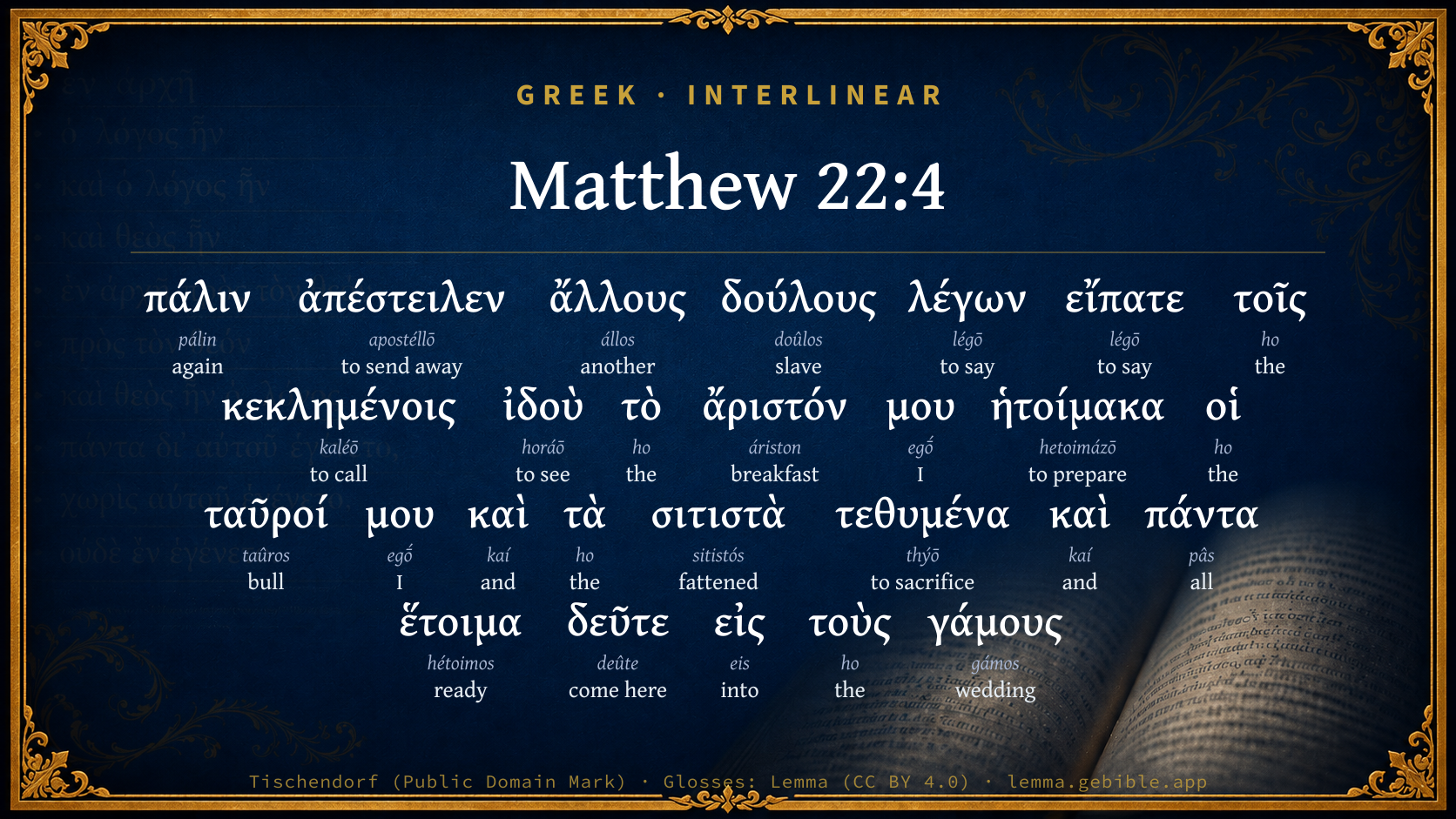
Again he sent out other servants, saying, 'Tell those who are invited, "Behold, I have made ready my dinner. My oxen and my fatlings are killed, and all things are ready. Come to the marriage feast!"'
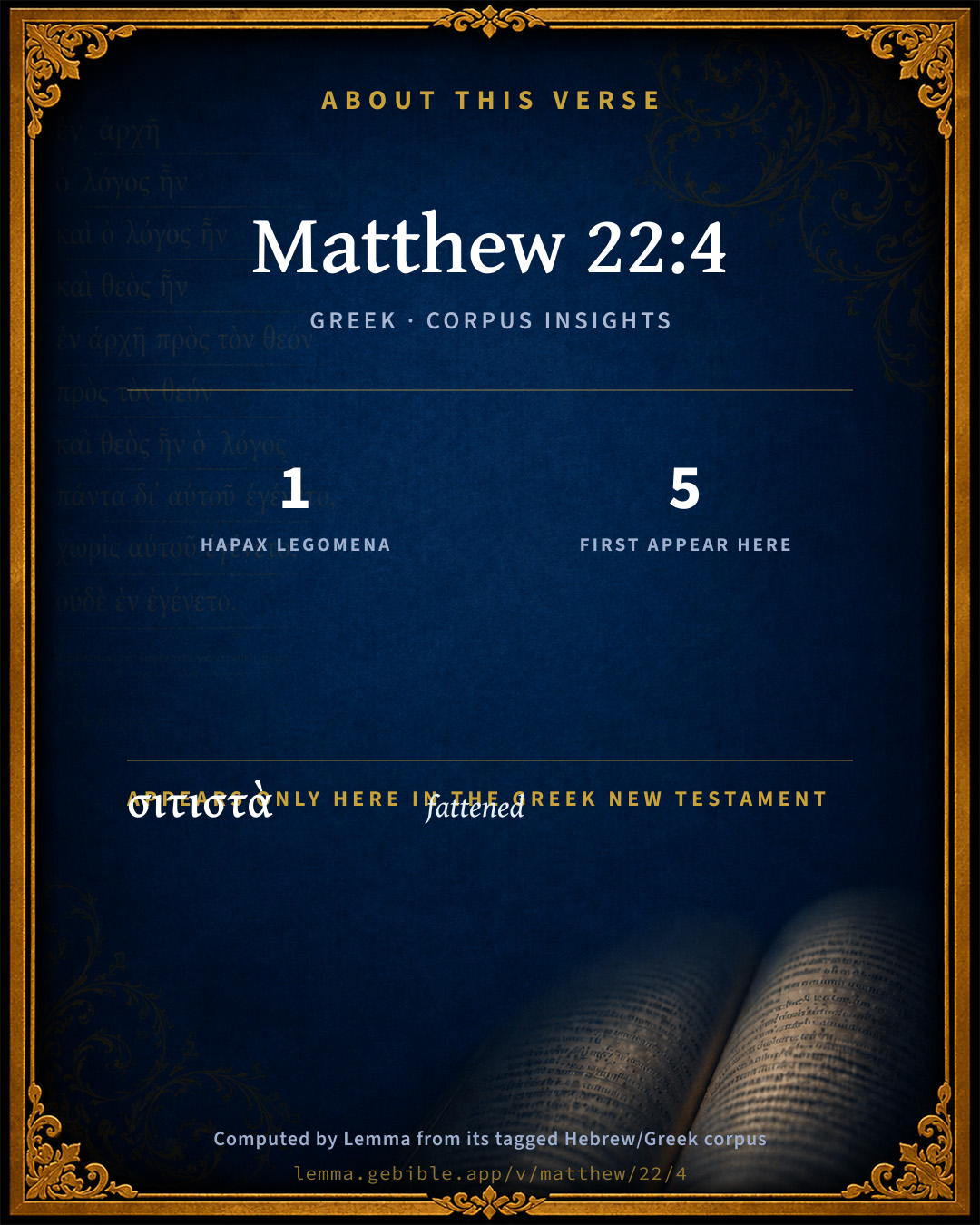
- 1 hapax legomenon — only here in the Greek New Testament
- 5 first appearances in the Greek New Testament
Download a study sheet
One document with this verse’s original text, its word-by-word gloss line, the meaning frame, cross-references with their text, attributed commentary, and full source and license credits — printable, and it pastes into notes with its structure intact.
This verse Autodidact and up
A passage Seminary Student
Up to 50 verses in one chapter. A passage sheet keeps up to 6 commentary sources and 12 cross-references per verse, in the order this page ranks them, and says so on the sheet whenever that leaves anything out. Ask for a single verse and you get the Autodidact verse sheet above.
Everything on this page stays free to read, with no account — the sheet is a download of what is already on screen, not access to it.
Compare translations 3
The same verse in 3 English versions, stacked beneath the original-language interlinear above. Click any original word for its lexicon entry.
Each is an independent rendering of the whole verse — the interlinear is not word-aligned to these translations.
Highlighted words mark where these versions differ — a whole-verse word diff, not a word-by-word alignment.
-
World English Bible Public Domain
Again he sent out other servants, saying, 'Tell those who are invited, "Behold, I have made ready my dinner. My oxen and my fatlings are killed, and all things are ready. Come to the marriage feast!"'
-
King James Version Public Domain
Again, he sent forth other servants, saying, Tell them which are bidden, Behold, I have prepared my dinner: my oxen and my fatlings are killed, and all things are ready: come unto the marriage.
-
unfoldingWord Literal Text CC BY-SA 4.0
Again he sent other servants, saying, ‘Say to the ones having been invited, “Behold, I have prepared my dinner. My bulls and fattened calves have been killed, and all things are ready. Come to the wedding feast.”’
unfoldingWord Literal Text — © unfoldingWord, licensed CC BY-SA 4.0. Word-aligned USFM3 via Door43 (git.door43.org/unfoldingWord/en_ult).
Show all 19 translations
Every available English version of this verse, each an independent rendering of the whole verse.
-
World English Bible Public Domain
Again he sent out other servants, saying, 'Tell those who are invited, "Behold, I have made ready my dinner. My oxen and my fatlings are killed, and all things are ready. Come to the marriage feast!"'
-
Berean Standard Bible Public Domain
Again, he sent other servants and said, ‘Tell those who have been invited that I have prepared my dinner. My oxen and fattened cattle have been killed, and everything is ready. Come to the wedding banquet.’
-
Majority Standard Bible Public Domain
Again, he sent other servants and said, ‘Tell those who have been invited that I have prepared my dinner. My oxen and fattened cattle have been killed, and everything is ready. Come to the wedding banquet.’
-
King James Version Public Domain
Again, he sent forth other servants, saying, Tell them which are bidden, Behold, I have prepared my dinner: my oxen and my fatlings are killed, and all things are ready: come unto the marriage.
-
American Standard Version (1901) Public Domain
Again he sent forth other servants, saying, Tell them that are bidden, Behold, I have made ready my dinner; my oxen and my fatlings are killed, and all things are ready: come to the marriage feast.
-
Revised Version (1885) Public Domain
Again he sent forth other servants, saying, Tell them that are bidden, Behold, I have made ready my dinner: my oxen and my fatlings are killed, and all things are ready: come to the marriage feast.
-
Geneva Bible (1599) Public Domain
Againe hee sent foorth other seruants, saying. Tell them which are bidden, Beholde, I haue prepared my dinner: mine oxen and my fatlings are killed, and all thinges are readie: come vnto the mariage.
-
Douay-Rheims (1899) Public Domain
Again he sent other servants, saying: Tell them that were invited, Behold, I have prepared my dinner; my beeves and fatlings are killed, and all things are ready: come ye to the marriage.
-
Young's Literal Translation Public Domain
`Again he sent forth other servants, saying, Say to those who have been called: Lo, my dinner I prepared, my oxen and the fatlings have been killed, and all things `are' ready, come ye to the marriage-feasts;
-
Literal Standard Version CC BY-SA 4.0
Again he sent forth other servants, saying, Say to those who have been called: Behold, I prepared my early meal, my oxen and the fatlings have been killed, and all things [are] ready, come to the wedding feasts;
-
Unlocked Literal Bible CC BY-SA 4.0
Again the king sent other servants, saying, 'Tell them who are invited, “See, I have prepared my dinner. My oxen and fattened calves have been killed, and all things are ready. Come to the marriage feast.”'
-
unfoldingWord Literal Text CC BY-SA 4.0
Again he sent other servants, saying, ‘Say to the ones having been invited, “Behold, I have prepared my dinner. My bulls and fattened calves have been killed, and all things are ready. Come to the wedding feast.”’
-
Darby Bible Public Domain
Again he sent other bondmen, saying, Say to the persons invited, Behold, I have prepared my dinner; my oxen and my fatted beasts are killed, and all things ready; come to the wedding feast.
-
World Messianic Bible Public Domain
Again he sent out other servants, saying, ‘Tell those who are invited, “Behold, I have prepared my dinner. My cattle and my fatlings are killed, and all things are ready. Come to the wedding feast!”’
-
Webster's Bible Public Domain
Again, he sent other servants, saying, Tell them who are invited, Behold, I have prepared my dinner: my oxen and my fatlings are killed, and all things are ready: come to the marriage.
-
Free Bible Version CC BY-SA 4.0
So he sent out more servants, with the instructions, ‘Tell those who are invited that I've prepared the wedding banquet. The bulls and fattened calves have been killed—everything's ready. So come to the wedding!’
-
Bible in Basic English Public Domain
Again he sent out other servants, with orders to say to the guests, See, I have made ready my feast: my oxen and my fat beasts have been put to death, and all things are ready: come to the feast.
-
Text-Critical English NT CC BY 4.0
Again he sent other servants, saying, ‘Tell those who are invited, “Behold, I have prepared my dinner, my oxen and the fattened cattle have been slaughtered, and everything is ready. Come to the wedding feast.” ’
-
Tyndale New Testament (1534) Public Domain
Ageyne he sent forth other servauntes sayinge: Tell them which are bydden: beholde I have prepared my dynner myne oxen and my fatlinges are kylled and all thinges are redy come vnto the mariage.
Literal Standard Version (2020), Covenant Press — licensed CC BY-SA 4.0. Text via the HelloAO Bible API (eBible.org). Unlocked Literal Bible (unfoldingWord) — licensed CC BY-SA 4.0. Text via the HelloAO Bible API (eBible.org). unfoldingWord Literal Text — © unfoldingWord, licensed CC BY-SA 4.0. Word-aligned USFM3 via Door43 (git.door43.org/unfoldingWord/en_ult). Free Bible Version, Dr. Jonathan Gallagher — licensed CC BY-SA 4.0. Text via the HelloAO Bible API (eBible.org).
Word by word
More ways to search: Search by grammar → Find every occurrence → Compare this word →
Practice this passage: Drill this verse → Learn its vocabulary →
- Appears 1× in the Greek New Testament
- First appears here
- Part of Speech
- Adjective
- Case
- Nominative
- Number
- Plural
- Gender
- Neuter
Full Thayer's Definition
- πάλιν pálin G3825 “again” Adverb
- ἀπέστειλεν apostéllō G649 “to send away” Verb, Aorist, Active, Indicative, 3rd person, Singular
- ἄλλους állos G243 “another” Adjective, Accusative, Plural, Masculine
- δούλους doûlos G1401 “slave” Noun, Accusative, Plural, Masculine
- λέγων légō G3004 “to say” Verb, Present, Active, Participle, Nominative, Singular, Masculine
- εἴπατε légō G3004 “to say” Verb, Aorist, Active, Imperative, 2nd person, Plural
- τοῖς ho G3588 “the” Article, Dative, Plural, Masculine
- κεκλημένοις kaléō G2564 “to call” Verb, Perfect, Passive, Participle, Dative, Plural, Masculine
- ἰδοὺ horáō G3708 “to see” Verb, Aorist, Middle, Imperative, 2nd person, Singular
- τὸ ho G3588 “the” Article, Accusative, Singular, Neuter
- ἄριστόν áriston G712 “breakfast” Noun, Accusative, Singular, Neuter
- μου egṓ G1473 “I” Personal pronoun, 1st person, Genitive, Singular
- ἡτοίμακα hetoimázō G2090 “to prepare” Verb, Perfect, Active, Indicative, 1st person, Singular
- οἱ ho G3588 “the” Article, Nominative, Plural, Masculine
- ταῦροί taûros G5022 “bull” Noun, Nominative, Plural, Masculine
- μου egṓ G1473 “I” Personal pronoun, 1st person, Genitive, Singular
- καὶ kaí G2532 “and” Conjunction
- τὰ ho G3588 “the” Article, Nominative, Plural, Neuter
- σιτιστὰ sitistós G4619 “fattened” Adjective, Nominative, Plural, Neuter
- τεθυμένα thýō G2380 “to sacrifice” Verb, Perfect, Passive, Participle, Nominative, Plural, Neuter
- καὶ kaí G2532 “and” Conjunction
- πάντα pâs G3956 “all” Adjective, Nominative, Plural, Neuter
- ἕτοιμα hétoimos G2092 “ready” Adjective, Nominative, Plural, Neuter
- δεῦτε deûte G1205 “come here” Verb, Present, Active, Imperative, 2nd person, Plural
- εἰς eis G1519 “into” Preposition
- τοὺς ho G3588 “the” Article, Accusative, Plural, Masculine
- γάμους gámos G1062 “wedding” Noun, Accusative, Plural, Masculine
About this verse
These counts appear in no published source. They are computed here, from the morphology-tagged text and Lemma’s own curated glosses. What Lemma adds →
- 27
- words
- 20
- distinct lemmas
- Gospels
- section
Notable vocabulary
1 hapax legomenon — a word that appears only here in the entire Greek New Testament:
- σιτιστὰ fattened G4619
First appearance in Scripture
These words make their first canonical appearance in the Greek New Testament here:
Shared distinctive vocabulary
ἄριστόν breakfast G712 occurs in 3 verses of the Greek New Testament. Also found in:
Cross-references
16Topical passages linked to Matthew 22:4 in the Treasury of Scripture Knowledge — connected by theme and wording, ordered by reader-vote popularity; previews shown in the World English Bible.
- Acts 13:46 Paul and Barnabas spoke out boldly, and said, "It was necessary that God's word should be spoken to you first. Since indeed you thrust it from you, and judge yourselves unworthy of eternal life, behold, we turn to the Gentiles.
- Matthew 21:36 Again, he sent other servants more than the first: and they treated them the same way.
- John 6:50–57 This is the bread which comes down out of heaven, that anyone may eat of it and not die.
- Nehemiah 9:17 and refused to obey, neither were mindful of your wonders that you did among them, but hardened their neck, and in their rebellion appointed a captain to return to their bondage. But you are a God ready to pardon, gracious and merciful, slow to anger, and abundant in loving kindness, and didn't forsake them.
- Psalms 86:5 For you, Lord, are good, and ready to forgive; Abundant in loving kindness to all those who call on you.
- Proverbs 9:1–2 Wisdom has built her house. She has carved out her seven pillars.
- Song of Solomon 5:1 I have come into my garden, my sister, my bride. I have gathered my myrrh with my spice; I have eaten my honeycomb with my honey; I have drunk my wine with my milk. Friends Eat, friends! Drink, yes, drink abundantly, beloved. Beloved
- Matthew 22:8 "Then he said to his servants, 'The wedding is ready, but those who were invited weren't worthy.
- Luke 10:1–16 Now after these things, the Lord also appointed seventy others, and sent them two by two ahead of him into every city and place, where he was about to come.
- Luke 14:17 He sent out his servant at supper time to tell those who were invited, 'Come, for everything is ready now.'
- Luke 24:46–47 He said to them, "Thus it is written, and thus it was necessary for the Christ to suffer and to rise from the dead the third day,
- Acts 1:8 But you will receive power when the Holy Spirit has come upon you. You will be witnesses to me in Jerusalem, in all Judea and Samaria, and to the uttermost parts of the earth."
- Acts 11:19–20 They therefore who were scattered abroad by the oppression that arose about Stephen traveled as far as Phoenicia, Cyprus, and Antioch, speaking the word to no one except to Jews only.
- Acts 28:17–31 It happened that after three days Paul called together those who were the leaders of the Jews. When they had come together, he said to them, "I, brothers, though I had done nothing against the people, or the customs of our fathers, still was delivered prisoner from Jerusalem into the hands of the Romans,
- Romans 8:32 He who didn't spare his own Son, but delivered him up for us all, how would he not also with him freely give us all things?
- 1 Corinthians 5:7–8 Purge out the old yeast, that you may be a new lump, even as you are unleavened. For indeed Christ, our Passover, has been sacrificed in our place.
Cross-references courtesy of OpenBible.info (CC BY 4.0).
Lesson kit
Teaching starters — assembled from the data on this page, not authored interpretation. Every prompt links to the verse data it draws on. Edit before teaching.
Matthew, in the Gospels, opens this verse with 27 words (20 distinct Greek lemmas). Its most distinctive word is sitistós (“fattened”). A historical commentator’s framing appears above. Read the whole chapter for the surrounding context.
Discussion questions
- How does “fattened” (sitistós) shape what this verse is saying?
- This verse holds 1 word here found nowhere else in the Greek New Testament. What might the rare word draw attention to?
- 5 words here appear for the first time in Scripture. What is being introduced at this debut?
- Luke 11:38 shares the word «breakfast» with this verse. How do the two illuminate each other?
- “to say” occurs 2× in this one verse. What is the effect of the repetition?
- The translations on this page render this verse differently — a whole-verse word diff, not a word-by-word alignment. What might account for the different wordings?
- Reading how Joseph Benson's Commentary and Whedon's Commentary on the Bible read this verse, where do the two commentators agree and where do they part?
Things to notice
- 1 word in this verse appears nowhere else in the Greek New Testament.
- 5 words make their first canonical appearance in Scripture here.
- These translations choose different wording for 21 words in this verse.
- “to say” occurs 2× in this single verse.
- 20 distinct Greek lemmas span 27 words in this verse.
Commentary
Notes on Matthew 22:4 from classic Christian and Jewish commentators (each source and its license shown beneath its notes). The classic Christian expositions comment on the surrounding passage and are grouped to its opening verse, so a note may address several verses; the Jewish commentaries on the Tanakh (Rashi and others) are per-verse, so they appear only where the commentator wrote on this verse.
Lemma curates 59 commentaries, every one of them public domain or Creative Commons licensed, each selected and text-cleaned for this edition rather than reprinted as found. About our sources →
Joseph Benson's Commentary
Joseph Benson's Commentary on the Old and New Testaments (1811–1818) — public domain. Text from a community e-Sword module.
Whedon's Commentary on the Bible
Daniel D. Whedon
Daniel D. Whedon (gen. ed.), Commentary on the Old and New Testaments (1874–1909) — public domain. Text from a community e-Sword module.
Bengel's Gnomon
Johann Albrecht Bengel
Bengel's Gnomon of the New Testament — English translation (T&T Clark, Edinburgh, 1860) — public domain. Text from a community e-Sword module.
Meyer's Critical & Exegetical Commentary
Heinrich August Wilhelm Meyer
Meyer — Critical and Exegetical Commentary on the New Testament — English translation by Peter Christie, edited by Frederick Crombie (T&T Clark, 1880) — public domain. Text from a community e-Sword module.
Expositor's Greek Testament
ed. W. Robertson Nicoll
The Expositor's Greek Testament, edited by W. Robertson Nicoll (1897–1910) — public domain. Text from a community e-Sword module.
Geneva Bible (1599)
Geneva Bible translators
Geneva Bible (1599) marginal notes — public domain. Text via Bolls.life.
Jamieson, Fausset & Brown
Robert Jamieson, A. R. Fausset & David Brown
Jamieson, Fausset & Brown — Commentary Critical and Explanatory on the Whole Bible (1871) — public domain (CC PDM 1.0). Text via the HelloAO Bible API.
Adam Clarke's Commentary
Adam Clarke's Commentary on the Bible (1810–1826) — public domain. Text from a community e-Sword/MySword module.
Ellicott's Commentary for English Readers
A Bible Commentary for English Readers, edited by Charles John Ellicott (1878–1897) — public domain. Text from a community e-Sword module.
John Gill's Exposition
John Gill's Exposition of the Whole Bible (1746–1763) — public domain (CC PDM 1.0). Text via the HelloAO Bible API.
Trapp's Complete Commentary
John Trapp
John Trapp, A Commentary or Exposition upon All the Books of the Old and New Testament (1647–1656) — public domain. Text from a community e-Sword module.
Albert Barnes' Notes on the Bible
Albert Barnes' Notes on the Bible (1834–1885) — public domain. Text from a community e-Sword/MySword module.
The Pulpit Commentary
The Pulpit Commentary (1880–1919), ed. H.D.M. Spence-Jones & Joseph S. Exell — public domain. Text from a community e-Sword module.
John Wesley's Explanatory Notes
John Wesley, Explanatory Notes Upon the Whole Bible (1754–1765) — public domain. Text via the GEBible commentary corpus.
The People's New Testament
B. W. Johnson
B. W. Johnson's The People's New Testament with Notes (1889–1891) — public domain. Electronic text from the Christian Classics Ethereal Library (CCEL) ThML edition.
unfoldingWord translationNotes
Door43 World Missions Community
unfoldingWord translationNotes — © Distant Shores Media and the Door43 World Missions Community, licensed CC BY-SA 4.0. Source: git.door43.org/Door43/en_tn.
Alford’s Greek Testament
Henry Alford
Henry Alford, The Greek Testament (1849–1861) — public domain. Text from a community e-Sword module.
International Critical Commentary
International Critical Commentary — older volumes (1896–1929), various authors — public domain. Text from a community e-Sword module.
Vincent's Word Studies in the New Testament
Marvin R. Vincent
Marvin R. Vincent, Word Studies in the New Testament (1887–1900) — public domain. Text from a community e-Sword/MySword module.