
Matthew 12:10

Greek (Tischendorf 8th ed.) Matthew 12:10 appears in the Greek New Testament. The text above is from the Tischendorf 8th edition. Each word links to its Strong’s number and a concise gloss. Click any word for its full Thayer’s Greek Lexicon entry.
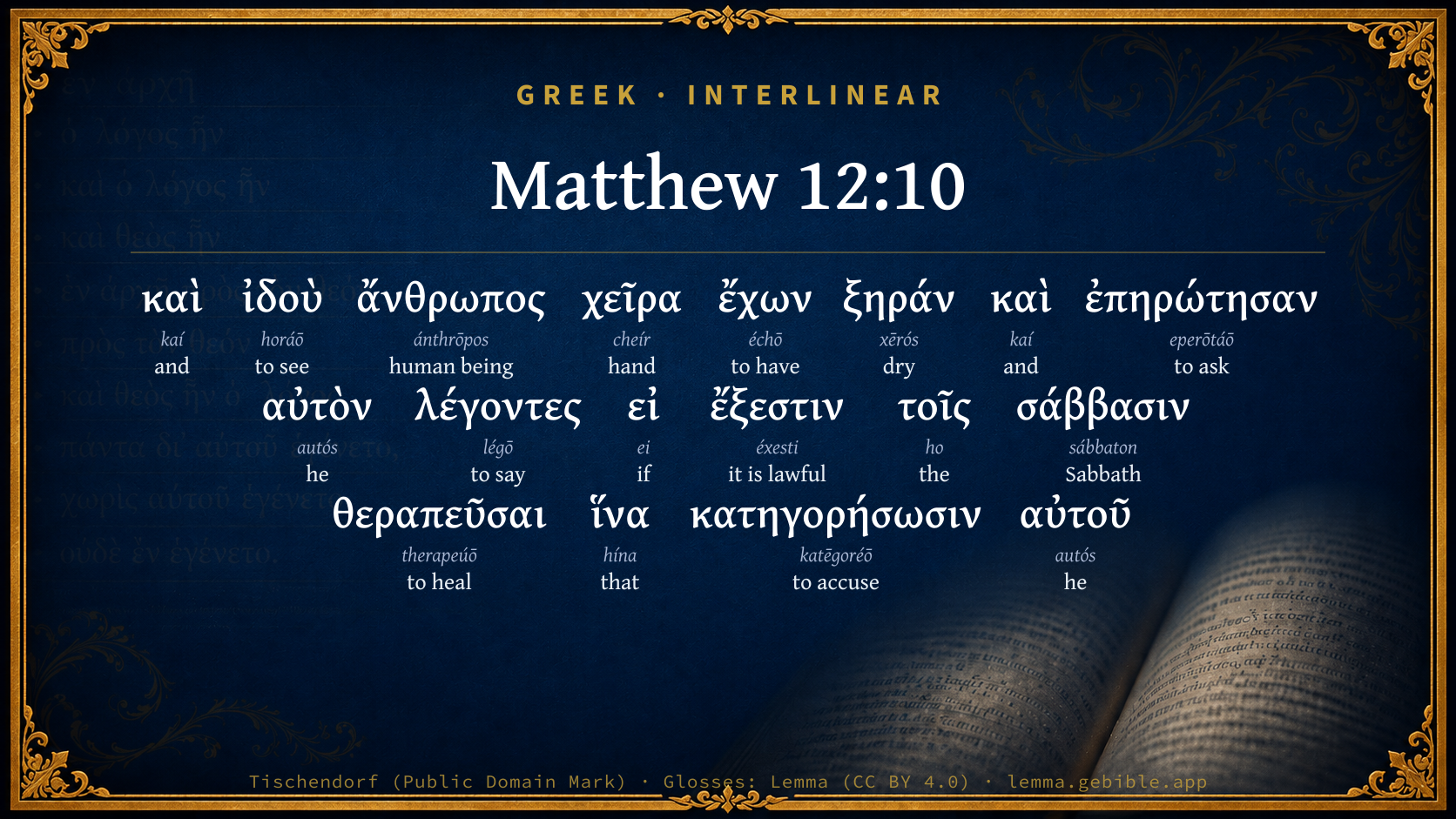
Download image
Cite this verse

Matthew 12:10 (World English Bible). Public Domain. Lemma interlinear Bible study tool, https://lemma.gebible.app/v/matthew/12/10.

Show BibTeX & RIS
BibTeX
RIS
English Translation
And behold there was a man with a withered hand. They asked him, "Is it lawful to heal on the Sabbath day?" that they might accuse him.
World English Bible · Public Domain
Highlights
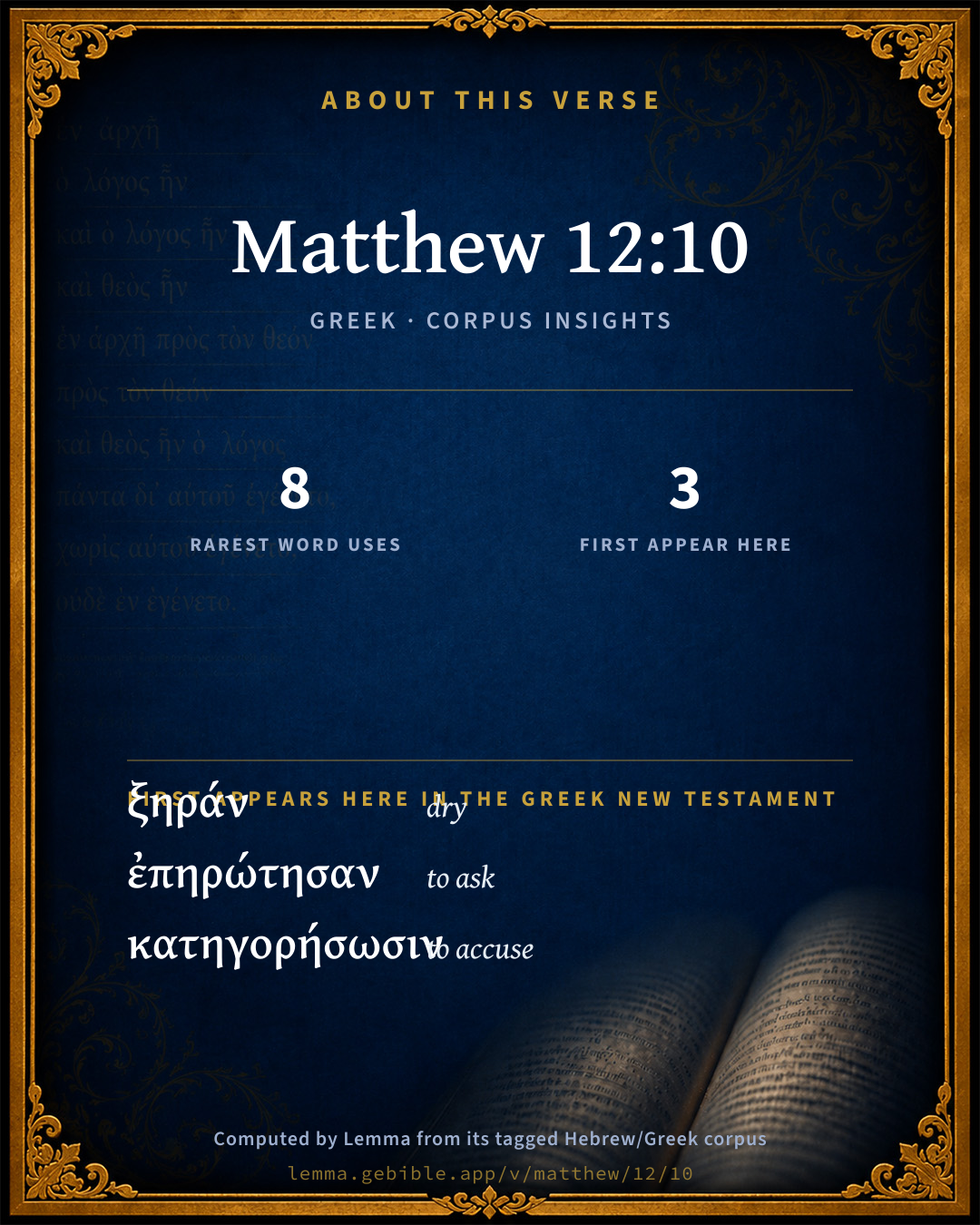
  • 3 first appearances in the Greek New Testament
Full analysis ↓
Download a study sheet

One document with this verse’s original text, its word-by-word gloss line, the meaning frame, cross-references with their text, attributed commentary, and full source and license credits — printable, and it pastes into notes with its structure intact.

This verse Autodidact and up

Study sheet (.html) Plain text (.txt)

A passage Seminary Student

Up to 50 verses in one chapter. A passage sheet keeps up to 6 commentary sources and 12 cross-references per verse, in the order this page ranks them, and says so on the sheet whenever that leaves anything out. Ask for a single verse and you get the Autodidact verse sheet above.

Everything on this page stays free to read, with no account — the sheet is a download of what is already on screen, not access to it.

Want to remove ads? Support Godless Engineer
Compare translations 3

The same verse in 3 English versions, stacked beneath the original-language interlinear above. Click any original word for its lexicon entry.

Each is an independent rendering of the whole verse — the interlinear is not word-aligned to these translations.

Highlighted words mark where these versions differ — a whole-verse word diff, not a word-by-word alignment.

  • World English Bible Public Domain
    And behold there was a man with a withered hand. They asked him, "Is it lawful to heal on the Sabbath day?" that they might accuse him.
  • King James Version Public Domain
    And, behold, there was a man which had his hand withered. And they asked him, saying, Is it lawful to heal on the sabbath days? that they might accuse him.
  • unfoldingWord Literal Text CC BY-SA 4.0
    And behold, a man having a withered hand, and they questioned him, saying, “Is it lawful to heal on the Sabbaths?” so that they might accuse him.

unfoldingWord Literal Text — © unfoldingWord, licensed CC BY-SA 4.0. Word-aligned USFM3 via Door43 (git.door43.org/unfoldingWord/en_ult).

Versions to compare (up to 4)

3 of 4 selected

Show all 19 translations

Every available English version of this verse, each an independent rendering of the whole verse.

  • World English Bible Public Domain
    And behold there was a man with a withered hand. They asked him, "Is it lawful to heal on the Sabbath day?" that they might accuse him.
  • Berean Standard Bible Public Domain
    and a man with a withered hand was there. In order to accuse Jesus, they asked Him, “Is it lawful to heal on the Sabbath?”
  • Majority Standard Bible Public Domain
    and a man with a withered hand was there. In order to accuse Jesus, they asked Him, “Is it lawful to heal on the Sabbath?”
  • King James Version Public Domain
    And, behold, there was a man which had his hand withered. And they asked him, saying, Is it lawful to heal on the sabbath days? that they might accuse him.
  • American Standard Version (1901) Public Domain
    and behold, a man having a withered hand. And they asked him, saying, Is it lawful to heal on the sabbath day? that they might accuse him.
  • Revised Version (1885) Public Domain
    and behold, a man having a withered hand. And they asked him, saying, Is it lawful to heal on the sabbath day? that they might accuse him.
  • Geneva Bible (1599) Public Domain
    And beholde, there was a man which had his hand dried vp. And they asked him, saying, Is it lawfull to heale vpon a Sabbath day? that they might accuse him.
  • Douay-Rheims (1899) Public Domain
    And behold there was a man who had a withered hand, and they asked him, saying: Is it lawful to heal on the sabbath days? that they might accuse him.
  • Young's Literal Translation Public Domain
    and lo, there was a man having the hand withered, and they questioned him, saying, `Is it lawful to heal on the sabbaths?' that they might accuse him.
  • Literal Standard Version CC BY-SA 4.0
    and behold, there was a man having the hand withered, and they questioned Him, saying, “Is it lawful to heal on the Sabbaths?” That they might accuse Him.
  • Unlocked Literal Bible CC BY-SA 4.0
    Behold, there was a man who had a withered hand. The Pharisees asked Jesus, saying, “Is it lawful to heal on the Sabbath?” so that they might accuse him of sinning.
  • unfoldingWord Literal Text CC BY-SA 4.0
    And behold, a man having a withered hand, and they questioned him, saying, “Is it lawful to heal on the Sabbaths?” so that they might accuse him.
  • Darby Bible Public Domain
    And behold, there was a man having his hand withered. And they asked him, saying, Is it lawful to heal on the sabbath? that they might accuse him.
  • World Messianic Bible Public Domain
    And behold, there was a man with a withered hand. They asked him, “Is it lawful to heal on the Sabbath day?” so that they might accuse him.
  • Webster's Bible Public Domain
    And behold, there was a man who had his hand withered. And they asked him, saying, Is it lawful to heal on the sabbath? that they might accuse him.
  • Free Bible Version CC BY-SA 4.0
    A man was there with a crippled hand. “Does the law allow healing on the Sabbath?” they asked him, looking for a reason to accuse him.
  • Bible in Basic English Public Domain
    And there was a man with a dead hand. And they put a question to him, saying, Is it right to make a man well on the Sabbath day? so that they might have something against him.
  • Text-Critical English NT CC BY 4.0
    And behold, there was a man who had a withered hand. In order to accuse Jesus, the Pharisees asked him, “Is it lawful to heal on the Sabbath?”
  • Tyndale New Testament (1534) Public Domain
    and beholde ther was a man whiche had his hande dryed vp. And they axed him sayinge: ys it lawfull to heale apon the saboth dayes? because they myght acuse him.

Literal Standard Version (2020), Covenant Press — licensed CC BY-SA 4.0. Text via the HelloAO Bible API (eBible.org). Unlocked Literal Bible (unfoldingWord) — licensed CC BY-SA 4.0. Text via the HelloAO Bible API (eBible.org). unfoldingWord Literal Text — © unfoldingWord, licensed CC BY-SA 4.0. Word-aligned USFM3 via Door43 (git.door43.org/unfoldingWord/en_ult). Free Bible Version, Dr. Jonathan Gallagher — licensed CC BY-SA 4.0. Text via the HelloAO Bible API (eBible.org).

Word by word

More ways to search: Search by grammar → Find every occurrence → Compare this word →

Practice this passage: Drill this verse → Learn its vocabulary →

ξηράν
xērós
G3584
“dry”
Adjective, Accusative, Singular, Feminine
Part of Speech
Adjective
Case
Accusative
Number
Singular
Gender
Feminine
Full Thayer's Definition

Origin: from the base of G3582 (through the idea of scorching)

TDNT: None

1. dry a. of members of the body deprived of their natural juices, shrunk, wasted, withered b. of the land in distinction from the water
  1. καὶ kaí G2532 “and” Conjunction
  2. ἰδοὺ horáō G3708 “to see” Verb, Aorist, Middle, Imperative, 2nd person, Singular
  3. ἄνθρωπος ánthrōpos G444 “human being” Noun, Nominative, Singular, Masculine
  4. χεῖρα cheír G5495 “hand” Noun, Accusative, Singular, Feminine
  5. ἔχων échō G2192 “to have” Verb, Present, Active, Participle, Nominative, Singular, Masculine
  6. καὶ kaí G2532 “and” Conjunction
  7. ἐπηρώτησαν eperōtáō G1905 “to ask” Verb, Aorist, Active, Indicative, 3rd person, Plural
  8. αὐτὸν autós G846 “he” Personal pronoun, Accusative, Singular, Masculine
  9. λέγοντες légō G3004 “to say” Verb, Present, Active, Participle, Nominative, Plural, Masculine
  10. εἰ ei G1487 “if” Conditional
  11. ἔξεστιν éxesti G1832 “it is lawful” Verb, Present, Active, Indicative, 3rd person, Singular
  12. τοῖς ho G3588 “the” Article, Dative, Plural, Neuter
  13. σάββασιν sábbaton G4521 “Sabbath” Noun, Dative, Plural, Neuter
  14. θεραπεῦσαι therapeúō G2323 “to heal” Verb, Aorist, Active, Infinitive
  15. ἵνα hína G2443 “that” Conjunction
  16. κατηγορήσωσιν katēgoréō G2723 “to accuse” Verb, Aorist, Active, Subjunctive, 3rd person, Plural
  17. αὐτοῦ autós G846 “he” Personal pronoun, Genitive, Singular, Masculine

About this verse

These counts appear in no published source. They are computed here, from the morphology-tagged text and Lemma’s own curated glosses. What Lemma adds →

18
words
16
distinct lemmas
Gospels
section

Notable vocabulary

The rarest word here is ξηράν dry G3584 — appearing just 8 times in the whole Greek New Testament.

First appearance in Scripture

These words make their first canonical appearance in the Greek New Testament here:

  • ξηράν dry G3584
  • ἐπηρώτησαν to ask G1905
  • κατηγορήσωσιν to accuse G2723

Shared distinctive vocabulary

ξηράν dry G3584 occurs in 8 verses of the Greek New Testament. Also found in:
Repetition

Words recur within this verse:

  • καὶ and G2532 ×2
  • αὐτὸν he G846 ×2

Cross-references

19

Topical passages linked to Matthew 12:10 in the Treasury of Scripture Knowledge — connected by theme and wording, ordered by reader-vote popularity; previews shown in the World English Bible.

  • Luke 13:14 The ruler of the synagogue, being indignant because Jesus had healed on the Sabbath, said to the multitude, "There are six days in which men ought to work. Therefore come on those days and be healed, and not on the Sabbath day!"
  • John 9:16 Some therefore of the Pharisees said, "This man is not from God, because he doesn't keep the Sabbath." Others said, "How can a man who is a sinner do such signs?" There was division among them.
  • John 8:6 They said this testing him, that they might have something to accuse him of. But Jesus stooped down, and wrote on the ground with his finger.
  • Matthew 22:17–18 Tell us therefore, what do you think? Is it lawful to pay taxes to Caesar, or not?"
  • Luke 11:54 lying in wait for him, and seeking to catch him in something he might say, that they might accuse him.
  • John 5:10 So the Jews said to him who was cured, "It is the Sabbath. It is not lawful for you to carry the mat."
  • Isaiah 32:6 For the fool will speak folly, and his heart will work iniquity, to practice profanity, and to utter error against Yahweh, to make empty the soul of the hungry, and to cause the drink of the thirsty to fail.
  • Zechariah 11:17 Woe to the worthless shepherd who leaves the flock! The sword will be on his arm, and on his right eye. His arm will be completely withered, and his right eye will be totally blinded!"
  • Matthew 12:2 But the Pharisees, when they saw it, said to him, "Behold, your disciples do what is not lawful to do on the Sabbath."
  • Luke 14:3–6 Jesus, answering, spoke to the lawyers and Pharisees, saying, "Is it lawful to heal on the Sabbath?"
  • 1 Kings 13:4–6 It happened, when the king heard the saying of the man of God, which he cried against the altar in Bethel, that Jeroboam put forth his hand from the altar, saying, Lay hold on him. His hand, which he put forth against him, dried up, so that he could not draw it back again to him.
  • Luke 23:2 They began to accuse him, saying, "We found this man perverting the nation, forbidding paying taxes to Caesar, and saying that he himself is Christ, a king."
  • John 5:3 In these lay a great multitude of those who were sick, blind, lame, or paralyzed, waiting for the moving of the water;
  • Isaiah 59:4 None sues in righteousness, and none pleads in truth: they trust in vanity, and speak lies; they conceive mischief, and bring forth iniquity.
  • Isaiah 59:13 transgressing and denying Yahweh, and turning away from following our God, speaking oppression and revolt, conceiving and uttering from the heart words of falsehood.
  • Matthew 19:3 Pharisees came to him, testing him, and saying, "Is it lawful for a man to divorce his wife for any reason?"
  • Luke 6:6–7 It also happened on another Sabbath that he entered into the synagogue and taught. There was a man there, and his right hand was withered.
  • Luke 20:22 Is it lawful for us to pay taxes to Caesar, or not?"
  • Luke 23:14 and said to them, "You brought this man to me as one that perverts the people, and see, I have examined him before you, and found no basis for a charge against this man concerning those things of which you accuse him.

Cross-references courtesy of OpenBible.info (CC BY 4.0).

Commentary

Notes on Matthew 12:10 from classic Christian and Jewish commentators (each source and its license shown beneath its notes). The classic Christian expositions comment on the surrounding passage and are grouped to its opening verse, so a note may address several verses; the Jewish commentaries on the Tanakh (Rashi and others) are per-verse, so they appear only where the commentator wrote on this verse.

Lemma curates 59 commentaries, every one of them public domain or Creative Commons licensed, each selected and text-cleaned for this edition rather than reprinted as found. About our sources →

The Biblical Illustrator

Joseph S. Exell

Mat_12:10

And behold there was a man which had his hand withered.

The withered hand

I. The person to whom the command in our text is addressed.

1. TO a man who was hopelessly incapable of obeying. The hand had lost the moisture of life. Christs power is displayed on our inability.

2. To one who was perfectly willing.

II. The person who gave the command. He said.

III. The command itself. The stretching forth of the hand was-

1. An act of faith.

2. An act of decision. The Pharisees around him.

IV. This mans obedience.

1. He did not do something else in preference to what Jesus commanded.

2. He did not raise any questions.

3. He was told to stretch out his hand, and he did so.

V. The result of this stretching out of the mans hand in obedience to the command.

1. The healing was manifest.

2. It was immediate.

3. It was permanent. (C. H. Spurgeon.)

The withered hand

I. A common calamity.

II. The man could do nothing.

III. He knew he could do nothing.

IV. He is a type of those whose usefulness is spoiled by some defect-the crotchety, ill-tempered, hasty, niggardly man.

V. The causes of this withered hand.

1. Disuse.

2. Multiplied anxieties and cares.

3. Contact with poisonous matters-questionable company or pleasures.

VI. The cure. The services of the synagogue not enough. The solemn ritual, the round of confession and sacrifice, of singing and the word, each of these was a help to the healing power, but nothing more-hands that pointed and lifted the sufferer nearer to the great Restorer. At last, before the man there stands the living Christ, as He stands before all who seek Him. Then swiftly comes the being made whole. That living Presence sought; that great Love appealed to; that mighty Power trusted; His word waited for, believed, obeyed. Thus may every withered hand be stretched forth perfectly whole. (Mark Guy Pearse.)

The use of means

It is one of the sophisms of every age Go urge the Spirits efficacy, as a plea for the neglect of means. It is folly and presumption to think that, because power is with God and from God, efforts should not be in ourselves. (Dr. Manton.)

The Biblical Illustrator, edited by Joseph S. Exell (c. 1880s–1900s) — public domain. Text from a community e-Sword module.

Joseph Benson's Commentary

Mat 12:10. There was a man which had his hand withered — The nerves and sinews of it being shrunk up, so that it was entirely useless. And they — Namely, the scribes and Pharisees, who had either mixed with the crowd that followed Jesus, or were in the synagogue before he came; asked him, saying, Is it lawful to heal on the sabbath day? — They made this inquiry merely that they might find matter whereon to ground an accusation against him. For they fully expected he would say that it was lawful, in opposition to the doctrine of their learned men, who accounted performing cures on the sabbath a violation of the holy rest of that day. Accordingly Mark says, They watched him whether he would heal, &c. — So gross was their hypocrisy, that they resolved to raise an outcry against him, if on the sabbath he should give a lame man the use of his hand, while they themselves were profaning it by an action which would have polluted any day; were seeking an opportunity to murder one who had never done them any harm, but had been and was incessantly doing them good!

Joseph Benson's Commentary on the Old and New Testaments (1811–1818) — public domain. Text from a community e-Sword module.

Tyndale Open Study Notes

Tyndale Open Resources

12:10 Does the law permit: Rabbinic tradition permitted healing on the Sabbath only if life was in danger. Since life was not in jeopardy, the Pharisees thought healing was not permitted.

Tyndale Open Study Notes — © Tyndale Open Resources, licensed CC BY-SA 4.0. Text via the HelloAO Bible API.

Bengel's Gnomon

Johann Albrecht Bengel

Mat 12:10. Ἄνθρωπος ἦν, κ.τ.λ., there was a man, etc.) He had either come thither of his own accord, that he might be healed, or else he had been brought by others with an insidious design.—ἵνα κατηγορήσωσιν αὐτοῦ, that they might accuse Him) As if He had broken the Sabbath, which was then greatly respected even by courts of law. See Mat 12:14.

Bengel's Gnomon of the New Testament — English translation (T&T Clark, Edinburgh, 1860) — public domain. Text from a community e-Sword module.

Meyer's Critical & Exegetical Commentary

Heinrich August Wilhelm Meyer

Mat_12:10. The nature of the affection of the withered hand, in which there was a defective circulation (1Ki_13:4; Zec_11:17; Joh_5:3), cannot be further defined. It is certain, however, that what was wrong was not merely a deficiency in the power of moving the hand, in which case the cure would be sufficiently explained by our Lords acting upon the will and the muscular force (Keim).

The traditions forbade healing on the Sabbath, except in cases where life was in danger. Wetstein and Schoettgen on this passage.

εἰ] in the New Testament (Winer, p. 474 [E. T. 639]; Buttmann, neut. Gr. p. 214 [E. T. 249]) is so applied, in opposition to classical usage (see Hartung, Partikell. II. p. 202 f.; Klotz, ad Devar. pp. 508, 511), that it directly introduces the words containing the question. Comp. Mat_19:3; Luk_13:22; Luk_22:49; Act_1:6; occurring also in the LXX., not in the Apocrypha. However, in the order of ideas in the mind of the questioner is to be found the logical connection, which has occasioned and which will explain the indirectly interrogative use of εἰ (I would like to know, or some such expression), just as we Germans are also in the habit of asking at once: ob das erlaubt ist? The character of the questions introduced by εἰ is that of uncertainty and hesitation (Hartung, 1. 1; Kühner, II. 2, p. 1032), which in this instance is quite in keeping with the tempting which the questioners had in view. Fritzsches purely indirect interpretation (interrogarunt eum hoc modo, an liceret, etc.) is precluded by λέγοντες, and the passages where the question is preceded by some form of address such as κύριε in Act_1:6; Luk_22:49.

ἵνα κατηγορ. αὐτοῦ] before the local court (κρίσις, Mat_5:21) in the town, and that on the charge of teaching to violate the law of the Sabbath.

Meyer — Critical and Exegetical Commentary on the New Testament — English translation by Peter Christie, edited by Frederick Crombie (T&T Clark, 1880) — public domain. Text from a community e-Sword module.

Expositor's Greek Testament

ed. W. Robertson Nicoll

Mat 12:10 . καὶ ἰδοὺ , here, as in Mat 8:2 , Mat 9:2 , introducing in a lively manner the story. ξηράν , a dry hand, possibly a familiar expression in Hebrew pathology (De Wette); useless, therefore a serious enough affliction for a working man (a mason, according to Hebrew Gospel, Jerome ad loc. ), especially if it was the right hand, as Luke states. But the cure was not urgent for a day, could stand over; therefore a good test case as between rival conceptions of Sabbath law. ἐπηρώτησαν . The Pharisees asked a question suggested by the case, as if eager to provoke Jesus and put Him to the proof. Mark says they observed Him, waiting for Him to take the initiative. The former alternative suits the hypothesis of immediate temporal sequence. εἰ ἔξεστιν , etc. After λέγοντες we expect, according to classic usage, a direct question without εἰ . The εἰ is in its place in Mark (Mar 12:2 ), and the influence of his text may be suspected (Weiss) as explaining the incorrectness in Matthew. But εἰ in direct questions is not unusual in N. T. (Mat 19:3 ; Luk 13:23 ; Luk 22:49 ), vide Winer, § 57, 2, and Meyer ad loc. In Mark’s account Christ, not the Pharisees, puts the question.

The Expositor's Greek Testament, edited by W. Robertson Nicoll (1897–1910) — public domain. Text from a community e-Sword module.

Adam Clarke's Commentary

Verse 10. A man which had his hand withered.] Probably through a partial paralysis. The man's hand was withered; but God's mercy had still preserved to him the use of his feet: He uses them to bring him to the public worship of God, and Jesus meets and heals him there. How true is the proverb - It is never so ill with us, but it might be much worse!

Adam Clarke's Commentary on the Bible (1810–1826) — public domain. Text from a community e-Sword/MySword module.

Ellicott's Commentary for English Readers

(10) There was a man which had his hand withered.—Two facts are implied: (1.) That the Pharisees expected our Lord to heal the man thus afflicted. They knew that commonly the mere sight of suffering of this kind called out His sympathy, and that the sympathy passed into act. (2.) That they had resolved, ii He did so heal, to make it the ground of a definite accusation before the local tribunal, the “judgment” of Mat_5:21. The casuistry of the Rabbis allowed the healing art to be practised on the Sabbath in cases of life and death, but the “withered hand,” a permanent infirmity, obviously did not come under that category.

A Bible Commentary for English Readers, edited by Charles John Ellicott (1878–1897) — public domain. Text from a community e-Sword module.

The Cambridge Bible for Schools and Colleges

gen. ed. J. J. S. Perowne

10. his hand withered] i. e. paralysed or affected by atrophy. St Luke has “his right hand.”

The Cambridge Bible for Schools and Colleges (gen. ed. J. J. S. Perowne; Cambridge University Press, 1878–1918) — public domain. Text from a community e-Sword module.

John Gill's Exposition

And he said unto them,.... Well knowing their intentions, and also their usages and customs, which he was able to produce and object to them; in which, through covetousness, they showed more regard to their beasts, than they did humanity to their fellow creatures:

what man shall there be among you, that shall have one sheep, and if it fall into a pit on the sabbath day, will he not lay hold on it, and lift it out? Christ appeals to them in a case which was usually done among them, and which, without delay, no man would scruple to do; though their present rule of direction, in such a case, is this (f):

"if a beast fall into a ditch, or a pool of water, if food can be given it, where it is, they feed it till the going out of the sabbath; but if not, bolsters and pillows may be brought, and put under it, and if it can come out: it may come out:''

and which is elsewhere (g) a little differently expressed;

"if a beast fall into a ditch, or pool of water, it is forbidden a man to bring it out with his hand; but if he can give it food where it is, it may be fed till the going out of the sabbath:''

which seems to have been made since the times of Christ, and in opposition to this observation of his.

(f) Maimon. Hilchot Sabbat, c. 25. sect. 26. (g) Kotsensis Mitzvot Tora pr. neg. 65.

John Gill's Exposition of the Whole Bible (1746–1763) — public domain (CC PDM 1.0). Text via the HelloAO Bible API.

Trapp's Complete Commentary

John Trapp

10 And, behold, there was a man which had his hand withered. And they asked him, saying, Is it lawful to heal on the sabbath days? that they might accuse him.

Ver. 10. Which had his hand withered] So have all covetous caitiffs, who may well be said, amidst all their hoards, to have no current coin, no quick silver. They sit abrood upon what they have got, as Euclio in the Comedian: and when, by laying out their money, they might "lay hold on eternal life," they will not he drawn to it. But as Alphonsus, king of Spain, when he stood to be king of the Romans, was prevented by his hopes, because he, being a great mathematician, was drawing lines (saith the chronicler) when he should have drawn out his purse; so here.

John Trapp, A Commentary or Exposition upon All the Books of the Old and New Testament (1647–1656) — public domain. Text from a community e-Sword module.

Haydock's Catholic Bible Commentary

Is it lawful? His enemies perceiving in what manner he excused his disciples, have recourse to a fresh stratagem. (St. Jerome) --- By this question they did not seek learning or improvement, but merely an occasion to ensnare Jesus in his words. If he answered in the affirmative, they would accuse him of violating the repose of the sabbath, enjoined by the law of Moses; if in the negative, of cruelty and want of feeling, and would infallibly have objected his own practice against him, as he had before justified his disciples for plucking corn on the sabbath. Jesus seeing their malice, avoids their captious question by proposing one to them, as we read in St. Mark. Is it lawful to do good or ill on the sabbath? As if he had said, whether is it better to assist your neighbor on the sabbath, or to abandon him in his distress, when you are able to afford him relief? Unable to give an answer, that would not be a justification of his actions, they remain silent; but he still presses the subject, by retorting their own actions upon themselves. They afforded relief to brute animals that stood in need of it on the sabbath. It was therefore cruelty, or mere malice, to cavil at his relieving the sick man on the sabbath. (Jansenius)

George Leo Haydock (1774–1849), Haydock's Catholic Family Bible and Commentary, 1859 edition — public domain. Excludes Psalms (Douay-Rheims chapter numbering differs from Protestant) and Deuterocanonical books (Catholic canon only).

Matthew Poole's English Annotations

Mark, repeating the same history, saith, Mar 3:1,2, There was a man which had a withered hand, and they watched him, whether he would heal him on the sabbath day, that they might accuse him. So saith Luk 6:6,7, only he addeth that it was his right hand, which made his affliction greater. They asked him not that they might rightly inform themselves, but that they might accuse him to their magistrates, that had power in those cases, for the violation of the sabbath was, amongst the Jews, a capital crime.

Matthew Poole's English Annotations on the Holy Bible (1683–1685) — public domain. Text from a community e-Sword/MySword module.

Whedon's Commentary on the Bible

Daniel D. Whedon

§ 34. — WITHERED HAND RESTORED, Mat_12:9-21.

10. His hand withered — A case of paralysis, by which the hand was shrunken away, and the nerves of motion had become incapable of action. This has ever been regarded as an incurable disease. They asked him — Luke informs us that they were watching our Lord’s movements that they might be able to accuse him of breaking the Sabbath. That they might accuse him — The position of the minds of the accusers of our Lord was peculiar and strange. They did not doubt that he was about to work a miracle; they expected it. But they are intending to make out that his miracles are contrary to the divine law, and so immoral. They would then have some ground for saying that he worked miracles by a diabolical power; which charge they did soon begin to make.

Daniel D. Whedon (gen. ed.), Commentary on the Old and New Testaments (1874–1909) — public domain. Text from a community e-Sword module.

The Pulpit Commentary

And, behold, there was a man which had his hand withered; and behold a man having a withered hand (Revised Version, with Westcott and Hort). For the quotation by Jerome from "the Gospel which the Nazarenes and Ebionites use" (comp. also Introduction, p. 16), in which this man tells our Lord, "Coementarius (a mason) eram, manibus vietum quaeritans," see especially Resch, "Agrapha," p. 379. And they asked him, saying. In the narrative of healing the man with the dropsy, found in Luk_14:1-6 (vide supra), a similar question is asked by our Lord. Is it lawful to heal on the sabbath days? The Tahnudic answer is that it is unlawful except in cases of actual danger to life (cf. Schurer, IL 2:104). but whether this distinction was really drawn as early as the time of our Lord"s not known in the present backward state of all critical investigations of Jewish literature. That they might accuse him; i.e. before the local court, Mat_5:21 (Meyer). Observe that, recognizing his readiness to help others, they desire (according to Matthew) to get a clear statement from him whether he would follow the traditional law (as we may assume it was) or net, intending to base their accusation on his reply. Verbally, however, Christ avoids the dilemma, as in the more famous case of the tribute to Caesar. (Mat_22:21)

The Pulpit Commentary (1880–1919), ed. H.D.M. Spence-Jones & Joseph S. Exell — public domain. Text from a community e-Sword module.

The People's New Testament

B. W. Johnson

10. A man which had his hand withered. That is, dried up from a deficient absorption of the nutriment. Luke says his “right hand.” The disease here indicated results in a loss both in size and in power of the arm; for it there is no remedy known to man. Compare Mark 3:1–6 and Luke 6:6–11. And they asked him. Luke says it was the scribes and Pharisees. Is it lawful to heal on the Sabbath? In the opinion of the Pharisees, to kindle or extinguish a fire on the Sabbath was a great desecration of the day, nor was even sickness allowed to violate rabbinical rules. It was forbidden to give an emetic on the Sabbath, to set a broken bone, or put back a dislocated joint. Of course, they had added all this to the law of Moses. That they might accuse him. Not in the conversation merely, but before the local judge, the officers of the synagogue, or the council.

B. W. Johnson's The People's New Testament with Notes (1889–1891) — public domain. Electronic text from the Christian Classics Ethereal Library (CCEL) ThML edition.

Cambridge Greek Testament for Schools and Colleges

10. χεῖρα ἔχων ξηράν, i.e. paralysed or affected by atrophy. St Luke has ἡ χεὶρ αὐτοῦ ἡ δεξιά.

εἰ does not introduce direct questions in Attic Greek. For this later use, compare Latin an and even si. The construction is probably due to an ellipse. Winer, 639.

Cambridge Greek Testament for Schools and Colleges (Cambridge University Press, 1896; 21 vols, various authors incl. Carr, Maclear, Plummer, Farrar, Lumby, Moule, M. R. James, Simcox) — public domain. Text from a community e-Sword module.

Alford’s Greek Testament

Henry Alford

10.] This narrative is found in Mark and Luke with considerable variation in details from our text, those two Evangelists agreeing however with one another. In both these accounts, they (the Scribes and Pharisees, Luke) were watching our Lord to see whether He would heal on the Sabbath:—and He (knowing their thoughts, Luke) ordered the man to stand forth in the midst, and asked them the question here given. The question about the animal does not occur in either of them, but in Luk 14:5, on a similar occasion. The additional particulars given are very interesting. By Luke,—it was the right hand; by Mark,—our Lord looked round on them μετʼ ὀργῆς, συνλυπούμενος ἐπὶ τῇ πωρώσει τῆς καρδίας αὐτῶν:—and the Herodians were joined with the Pharisees in their counsel against Him. See notes on Luke.

ξηράν = ἐξηραμμένην Mark, of which the use had been lost and the vital powers withered.

Henry Alford, The Greek Testament (1849–1861) — public domain. Text from a community e-Sword module.

International Critical Commentary

(M) 10. And, behold, a man having a withered hand. And they questioned Him, saying, Is it lawful to heal on the Sabbath? that they might accuse Him.] “Mk. has: “And there was there a man having the hand withered. And they were observing Him, if He would heal him on the Sabbath, that they might accuse Him.”—καὶ ἰδού] See on 1:20. Mk. has καὶ ἦν ἐκεῖ.—χεῖρα ἔχων ξηράν] Mk. has ἐξηραμμένην ἔχων τὴν χεῖρα. Lk. also has ξηρά.—καὶ ἐπηρώτησαν αὐτὸν λέγοντες] Mk. has καὶ παρετήρουν αὐτόν.—εἰ ἔξεστιν—θεραπεύειν] Mk. has εἰ—θεραπεύσει αὐτόν. For εἰ before a direct question, cf. Blass, p. 260.

Mk. has here: “And He saith to the man having the withered (ξηράν) hand, Rise into the midst. And He saith to them, Is it lawful on the Sabbath to do good or to do evil, to save life or to kill? And they were silent. And looking round at them with anger, being grieved at the hardness of their hearts.” Mt. omits all this. He elsewhere omits clauses which describe Christ’s human emotions. See Introduction, p. xxxi. Here he substitutes instead an example of the doing good of which Mk. speaks in v. 4.

That he may introduce vv. 11, 12 the editor changes Mk.’s “they were observing Him, if,” into a direct challenge, “they asked Him if.”

International Critical Commentary — older volumes (1896–1929), various authors — public domain. Text from a community e-Sword module.

Vincent's Word Studies in the New Testament

Marvin R. Vincent

Is it lawful ? [ει εξεστιν] . The eij can hardly be rendered into English. It gives an indeterminate, hesitating character to the question : I would like to know if, etc.

Marvin R. Vincent, Word Studies in the New Testament (1887–1900) — public domain. Text from a community e-Sword/MySword module.

Lesson kit

Teaching starters — assembled from the data on this page, not authored interpretation. Every prompt links to the verse data it draws on. Edit before teaching.

Matthew, in the Gospels, opens this verse with 18 words (16 distinct Greek lemmas). Its most distinctive word is xērós (“dry”). A historical commentator’s framing appears above. Read the whole chapter for the surrounding context.

Discussion questions

  1. The word xērós carries the sense “dry.” How does it shape the verse?
  2. 3 words here appear for the first time in Scripture. What is being introduced at this debut?
  3. Matthew 23:15 shares the word «dry» with this verse. How do the two illuminate each other?
  4. “and” occurs 2× in this one verse. What is the effect of the repetition?
  5. These translations render this verse differently. What is at stake in choosing one wording over another?
  6. Reading how The Biblical Illustrator and Joseph Benson's Commentary read this verse, where do the two commentators agree and where do they part?

Things to notice

  • 3 words make their first canonical appearance in Scripture here.
  • These translations choose different wording for 11 words in this verse.
  • “and” occurs 2× in this single verse.
  • 16 distinct Greek lemmas span 18 words in this verse.

Reading settings

Reading text

Shown beneath each verse's original-language words.

Old Testament
Old Testament edition

Read the OT as the Masoretic Hebrew (MT) or the Greek Septuagint (LXX).

English shown for the Greek Septuagint (in the Hebrew ↔ Greek comparison).

Comparing translations? Open the Compare panel on any verse page to stack up to four side by side.