Matthew 28:17

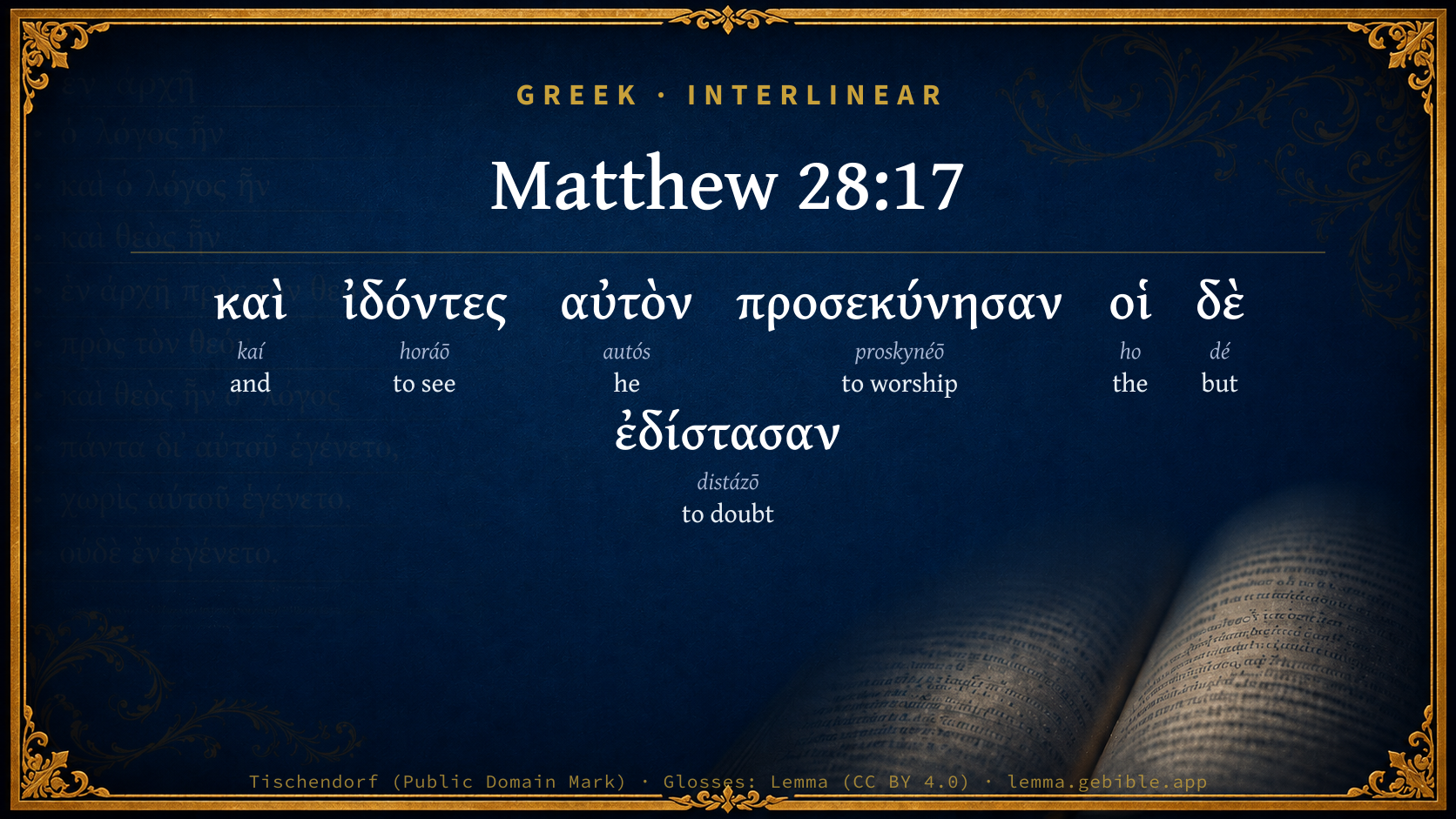
Greek (Tischendorf 8th ed.) Matthew 28:17 appears in the Greek New Testament. The text above is from the Tischendorf 8th edition. Each word links to its Strong’s number and a concise gloss. Click any word for its full Thayer’s Greek Lexicon entry.
Download image
Cite this verse

Matthew 28:17 (World English Bible). Public Domain. Lemma interlinear Bible study tool, https://lemma.gebible.app/v/matthew/28/17.

Show BibTeX & RIS
BibTeX
RIS
English Translation
When they saw him, they bowed down to him, but some doubted.
World English Bible · Public Domain
Download a study sheet

One document with this verse’s original text, its word-by-word gloss line, the meaning frame, cross-references with their text, attributed commentary, and full source and license credits — printable, and it pastes into notes with its structure intact.

This verse Autodidact and up

Study sheet (.html) Plain text (.txt)

A passage Seminary Student

Up to 50 verses in one chapter. A passage sheet keeps up to 6 commentary sources and 12 cross-references per verse, in the order this page ranks them, and says so on the sheet whenever that leaves anything out. Ask for a single verse and you get the Autodidact verse sheet above.

Everything on this page stays free to read, with no account — the sheet is a download of what is already on screen, not access to it.

Want to remove ads? Support Godless Engineer
Compare translations 3

The same verse in 3 English versions, stacked beneath the original-language interlinear above. Click any original word for its lexicon entry.

Each is an independent rendering of the whole verse — the interlinear is not word-aligned to these translations.

Highlighted words mark where these versions differ — a whole-verse word diff, not a word-by-word alignment.

  • World English Bible Public Domain
    When they saw him, they bowed down to him, but some doubted.
  • King James Version Public Domain
    And when they saw him, they worshipped him: but some doubted.
  • unfoldingWord Literal Text CC BY-SA 4.0
    And having seen him, they worshiped, but they doubted.

unfoldingWord Literal Text — © unfoldingWord, licensed CC BY-SA 4.0. Word-aligned USFM3 via Door43 (git.door43.org/unfoldingWord/en_ult).

Versions to compare (up to 4)

3 of 4 selected

Show all 19 translations

Every available English version of this verse, each an independent rendering of the whole verse.

  • World English Bible Public Domain
    When they saw him, they bowed down to him, but some doubted.
  • Berean Standard Bible Public Domain
    When they saw Him, they worshiped Him, but some doubted.
  • Majority Standard Bible Public Domain
    When they saw Him, they worshiped Him, but some doubted.
  • King James Version Public Domain
    And when they saw him, they worshipped him: but some doubted.
  • American Standard Version (1901) Public Domain
    And when they saw him, they worshipped `him'; but some doubted.
  • Revised Version (1885) Public Domain
    And when they saw him, they worshipped him: but some doubted.
  • Geneva Bible (1599) Public Domain
    And when they sawe him, they worshipped him: but some douted.
  • Douay-Rheims (1899) Public Domain
    And seeing them they adored: but some doubted.
  • Young's Literal Translation Public Domain
    and having seen him, they bowed to him, but some did waver.
  • Literal Standard Version CC BY-SA 4.0
    and having seen Him, they worshiped Him, but some wavered.
  • Unlocked Literal Bible CC BY-SA 4.0
    When they saw him, they worshiped him, but some doubted.
  • unfoldingWord Literal Text CC BY-SA 4.0
    And having seen him, they worshiped, but they doubted.
  • Darby Bible Public Domain
    And when they saw him, they did homage to him: but some doubted.
  • World Messianic Bible Public Domain
    When they saw him, they bowed down to him; but some doubted.
  • Webster's Bible Public Domain
    And when they saw him, they worshiped him: but some doubted.
  • Free Bible Version CC BY-SA 4.0
    When they saw him they worshiped him, though some doubted.
  • Bible in Basic English Public Domain
    And when they saw him they gave him worship: but some were in doubt.
  • Text-Critical English NT CC BY 4.0
    When they saw him, they worshiped him, but some doubted.
  • Tyndale New Testament (1534) Public Domain
    And when they sawe hym they worshipped him. But some of them douted.

Literal Standard Version (2020), Covenant Press — licensed CC BY-SA 4.0. Text via the HelloAO Bible API (eBible.org). Unlocked Literal Bible (unfoldingWord) — licensed CC BY-SA 4.0. Text via the HelloAO Bible API (eBible.org). unfoldingWord Literal Text — © unfoldingWord, licensed CC BY-SA 4.0. Word-aligned USFM3 via Door43 (git.door43.org/unfoldingWord/en_ult). Free Bible Version, Dr. Jonathan Gallagher — licensed CC BY-SA 4.0. Text via the HelloAO Bible API (eBible.org).

Word by word

More ways to search: Search by grammar → Find every occurrence → Compare this word →

Practice this passage: Drill this verse → Learn its vocabulary →

About this verse

These counts appear in no published source. They are computed here, from the morphology-tagged text and Lemma’s own curated glosses. What Lemma adds →

7
words
7
distinct lemmas
Gospels
section

Notable vocabulary

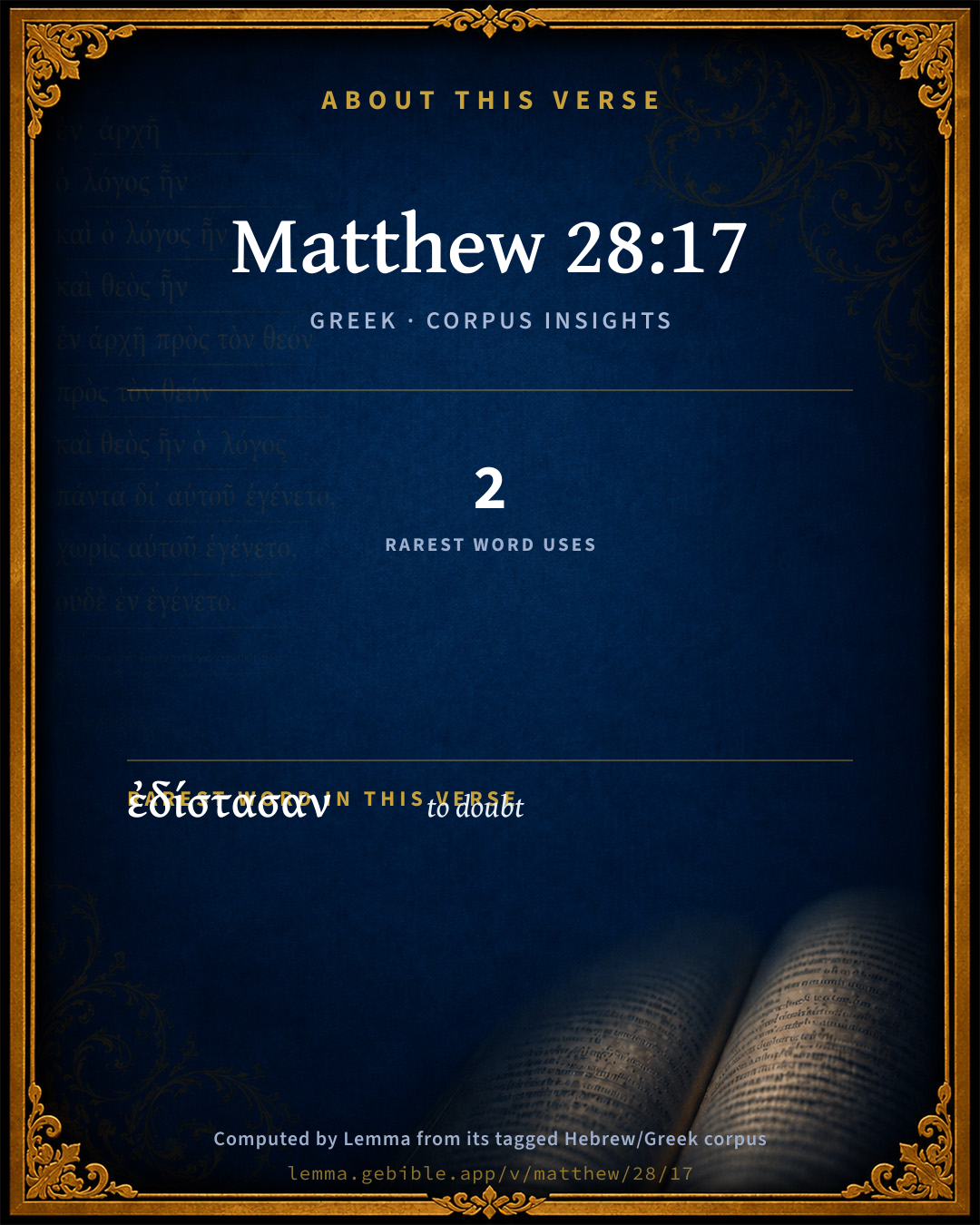
The rarest word here is ἐδίστασαν to doubt G1365 — appearing just 2 times in the whole Greek New Testament.

Shared distinctive vocabulary

ἐδίστασαν to doubt G1365 occurs in 2 verses of the Greek New Testament. Also found in:

Cross-references

6

Topical passages linked to Matthew 28:17 in the Treasury of Scripture Knowledge — connected by theme and wording, ordered by reader-vote popularity; previews shown in the World English Bible.

  • Psalms 2:12 Kiss the son, lest he be angry, and you perish in the way, For his wrath will soon be kindled. Blessed are all those who take refuge in him.
  • Psalms 45:11 So the king will desire your beauty, Honor him, for he is your lord.
  • Matthew 16:28 Most assuredly I tell you, there are some standing here who will in no way taste of death, until they see the Son of Man coming in his Kingdom."
  • Matthew 28:9 As they went to tell his disciples, behold, Jesus met them, saying, "Rejoice!" They came and took hold of his feet, and worshiped him.
  • John 5:23 that all may honor the Son, even as they honor the Father. He who doesn't honor the Son doesn't honor the Father who sent him.
  • 1 Corinthians 15:6 Then he appeared to over five hundred brothers at once, most of whom remain until now, but some have also fallen asleep.

Cross-references courtesy of OpenBible.info (CC BY 4.0).

Commentary

Notes on Matthew 28:17 from classic Christian and Jewish commentators (each source and its license shown beneath its notes). The classic Christian expositions comment on the surrounding passage and are grouped to its opening verse, so a note may address several verses; the Jewish commentaries on the Tanakh (Rashi and others) are per-verse, so they appear only where the commentator wrote on this verse.

Lemma curates 59 commentaries, every one of them public domain or Creative Commons licensed, each selected and text-cleaned for this edition rather than reprinted as found. About our sources →

The Biblical Illustrator

Joseph S. Exell

Mat_28:17

But some doubted.

Doubts

I. Philosophic doubts. All men are not philosophers, and cannot reason as Descartes did from self to all outside. We must accept some axioms without proof.

II. Rationalistic doubts. The withholding faith in spite of evidence. They mistake the use of reason in matters of faith. Men act upon three propositions in determining what is right.

1. That is right which we think to be right.

2. There is no telling what right is.

3. That there is a final arbiter.

The objections of the rationalists are based on foregone conclusions.

1. It is declared a priori that the Infinite cannot be a person.

2. That nature is uniform. These are urged against the Bible. But miracles have been wrought. Will a man stand on the wharf as the steamboat is departing and declare that steam is an absurdity?

III. Spiritual doubts. Such are pestered with fears of a different kind.

1. They believe that death is a crisis.

2. That the soul is guilty. Are we pardoned?

3. Some are troubled by the doctrine of election. (F. L. Patton, D. D.)

Religious doubts

1. There is a sense in which Christianity is accountable for the doubts with which it is often assailed. It fosters the spirit of thoughtfulness, inquiry, of mental activity. There are bodily states-of liver and stomach-that may contribute to affect us with temporary gloom of doubt. There are states of the social atmosphere that may contribute to affect us in the same way; when the general air is charged with doubt, we can hardly help being affected by it. Some doubts are the sign of mental quickening. But we must be careful to distinguish these from those resulting from moral deterioration and decline. What used to be a beautiful certainty has paled away in the mist, not, though, under research, but through too much business care; it has come upon him like a change of weather in the night. Sometimes, again, it is a deeper understanding, or a more vivid perception of one particular link, that renders us doubtful in relation to other things. We must be careful in yielding too readily to the apparent inevitable destructiveness of a truth that has burst upon us with new and fascinating power. The contradiction may be a temporary illusion. Again, men often come to doubt what they have ceased to require so urgently as they did; wanting it less, they believe it less. (S. A. Tipple.)

Doubts and fears

I. From whence arise those doubts and fears so distressing to many? Many fruitful sources from whence they spring.

1. Sin is often the cause. Inward foes, etc.

2. Carelessness will often lead to uncertainty and doubt.

3. Disobedience, neglected duty, etc.

4. Worldliness necessarily produces them.

5. Seasons of temptation are often seasons of doubt. Satan worries whom he cannot devour with a malicious joy.

6. Ignorance is perhaps the most fruitful source. Ignorance of what is written was evidently the cause of doubt here. How many appear not to understand (Psa_103:12; Rom_8:1; Joh_10:28, etc.). Salvation is a present certain reality (Eph_2:8; Eph_1:7; Heb_10:14). It may be ignorance as to the work of the Holy Spirit. Losing sight of Christ, many become taken up with feelings and self.

II. Their baneful influence. They by no means prove a state of high spirituality.

1. Doubts dishonour God; rob Him of the praise that is due to Him.

2. Mar our comfort.

3. Weaken our strength for service, conflict, and devotion.

4. They chill our affection.

5. They stunt our spiritual growth.

6. Unfit us to witness for Christ.

7. Influence others unfavourably.

III. Their remedy. As faith is a fruit of the ever-blessed Spirit, no assurance can be obtained but from the same Divine source.

1. Look and get away from self.

2. Study the sacred word more.

3. Live nearer the Lord.

4. Seek to have a more simple, child-like faith-faith that takes God at His word; that raises no cavilling questions; that lives above circumstances, appearances, and feelings, even upon Thus saith the Lord. (G. Cobb.)

Scepticism

I. Doubting in matters of religion. Doubt which arises from ignorance. Doubts which mark the course of inquiry. Doubts which indicate moral perversity. Doubts about our personal religion.

II. The practical influence of doubting in matters of religion. It is no apology for indifference. It ought to stimulate inquiry. It contains an element of belief-doubt, not denial. It may be an ultimate benefit.

1. Christianity is not doubtful because it has been doubted.

2. Its truths are so great that occasional doubting is not wonderful.

3. All classes of doubters should not be treated with indiscriminate harshness.

4. There are broad marks of distinction between the doubts of the saint and of the sinner. (D. Young, D. D.)

Doubt not to abandon truth

When the ship shakes, do not throw yourself into the sea. When storms of doubt assault spiritual truths, do not abandon yourself to the wild evil of the world that cannot rest. The ship rolls in the wind, but by the wind advances. (T. Lynch.)

We must not let go manifest truths because we cannot answer all questions about them. (J. Collier.)

Some doubted

1. You hesitate because you are measuring by human standards and taking your level from nature.

2. You want more proof than God is pleased to give.

3. You judge that God should do something extraordinary.

4. Your faith depends upon what is rare and accidental.

5. Perhaps an interval of carelessness has dimmed the moral eye.

6. There was some temptation to doubt.

7. To God it is no little thing to be doubted by His child.

8. I feel sure that some who have doubted are now in heaven. (J. Vaughan, M. A.)

Good doubting

He does not doubt wisely who, though stopping short of being an accomplished unbeliever, allows doubt to get ahead of belief; who does not, in fact, make believing his object, using the power and right of doubting only to preserve him against premature and crude and false conclusions. The truth-loving man will read and search, and think, and, let me add, pray, with the view to enlarge, and build, and beautify such a home for his soul as we are reminded of by the words of Solomon. Every wise woman buildeth her house, but the foolish plucketh it down with her hands; and wisdom hath builded her house, she hath hewn out her seven pillars. I believe in the palace-home of wisdom, with its seven pillars. But what home for the soul will the mere habit of doubting-and especially of doubting, for doubting sake-ever build, and what would be the pillars thereof? (H. H. Dobney.)

The Biblical Illustrator, edited by Joseph S. Exell (c. 1880s–1900s) — public domain. Text from a community e-Sword module.

Joseph Benson's Commentary

Mat 28:17. When they saw him, they worshipped — The greatest part were so fully convinced that the person they saw was their Master, that they worshipped him; but some doubted — But with respect to a few, their joy, on seeing the Lord, put them into a kind of perturbation, and their desire that it might be him. made them afraid it was not. This reason is assigned by Luke for the unbelief of some on a former occasion, Mat 24:41. They believed not for joy and wonder; and therefore it may fitly be offered to account for the unbelief of others on this. “Besides, the thing is agreeable to nature, men being commonly afraid to believe what they vehemently wish, lest they should indulge themselves in a false joy, which they must soon lose. Hence the saying in Terence, Misera mens incredula est: quo plus cupio, minus credo. ‘My anxious mind is incredulous: the more I wish, the less I believe.’ The case of the disciples, whose desire and joy made them doubt the truth of what they saw, may be illustrated by the instance of the states of Greece and Asia, whose joy and surprise on hearing a Roman herald declare them all free, and at liberty to use their own laws, had a similar effect upon them, as the story is beautifully told by Livy, lib. 33. cap. 35.” The Prussian editors, however, who are followed by some others, render the clause thus, — even those who had doubted. “Probably at this appearance the apostles received orders to return to Jerusalem; for from Act 1:3-12, compared with Luk 24:50, it is plain that our Lord’s discourses, before his ascension, related Mar 16:15, and Luk 24:44, were delivered in or near to the city. Besides, he ascended from the mount of Olives, as we shall see in the subsequent evangelists. Wherefore, if the orders for the apostles to repair to Jerusalem were not given at this appearance, Jesus must have showed himself again, which indeed is not impossible, as it is evident from 1Co 15:7 that he showed himself somewhere, after his appearance to the five hundred brethren, to the Apostle James alone, though none of the evangelists have given the least hint of this appearance. Among the apostles there were two persons of that name: one the brother of John, who was killed by Herod, another the brother or cousin of Jesus. Perhaps it was to James the brother of John that our Lord appeared after his resurrection. His being to suffer martyrdom so early, might make this special favour necessary.”

Joseph Benson's Commentary on the Old and New Testaments (1811–1818) — public domain. Text from a community e-Sword module.

Tyndale Open Study Notes

Tyndale Open Resources

28:17 some of them doubted: This might be a veiled reference to Thomas (John 20:24-29), but all eleven might have experienced a mixture of both worship and doubt (see also Matt 14:31; Luke 24:10-11; John 20:24-29).

Tyndale Open Study Notes — © Tyndale Open Resources, licensed CC BY-SA 4.0. Text via the HelloAO Bible API.

Bengel's Gnomon

Johann Albrecht Bengel

Mat 28:17. Οἱ δὲ, others, or, some) sc. of the Twelve. The day of Pentecost, however, removed all doubt from these, if any remained. The slower they were at first to believe, the greater credit is due to them afterwards as witnesses. Leo, in his first sermon on the Ascension, says, “They doubted, in order that we should not doubt.”

Bengel's Gnomon of the New Testament — English translation (T&T Clark, Edinburgh, 1860) — public domain. Text from a community e-Sword module.

Meyer's Critical & Exegetical Commentary

Heinrich August Wilhelm Meyer

Mat_28:17 Ἰδόντες, κ.τ.λ.] According to the account now before us, evidently the first occasion of meeting again since the resurrection, and the first impression produced by itcorresponding to the ὄψεσθε of Mat_28:7; Mat_28:10. See, besides, on Mat_28:10.

οἱ δὲ ἐδίστασαν] It was previously said in a general way that the eleven fell prostrate before Him, though all did not do so: some doubted whether He, whom they saw before them, could really be Jesus. This particular is added by means of οἱ δέ, which, however, is not preceded by a corresponding οἱ μέν before προσεκύνησαν, because this latter applied to the majority, whereas the doubters, who did not prostrate themselves, were only the exception. Had Matthews words been: οἱ μὲν προσεκύνησαν, οἱ δὲ ἐδίστασαν, he would thus have represented the eleven as divided into two co-ordinate parts, into as nearly as possible two halves, and so have stated something different from what was intended. This is a case precisely similar to that of the οἱ δὲ ἐῤῥάπισαν of Mat_26:67, where, in like manner, the preceding ἐκολάφισαν αὐτόν (without οἱ μέν) represents what was done by the majority. Quibus in locis primum universa res ponitur, deinde partitio nascitur, quae ostendit, priora quoque verba non de universa causa jam accipi posse, Klotz, ad Devar. p. 358. Comp. Xen. Hell. i. 2. 14 : ᾤχοντο ἐς Δεκέλειαν, οἱ δʼ ἐς Μέγαρα; Cyrop. iv. 5. 46: ὁρᾶτε ἵππους, ὅσοι ἡμῖν πάρεισιν, οἱ δὲ προσάγονται, and the passages in Pflugk, ad Eur. Hec. 1160; Kühner, II. 2, p. 808. According to Fritzsche, a preceding οἱ μὲν οὐκ ἐδίστασαν should be understood. This, however, is purely arbitrary, for the ἐδίστασαν has its appropriate correlative already in the preceding προσεκύνησαν. Again, as matter of course, we must not think of predicating the προσεκύνησαν of the doubters as well, which would be psychologically absurd (only after his doubts were overcome, did Thomas exclaim: ὁ κυριός μου κ. ὁ θεός μου!). Fritzsche (comp. Theophylact, Grotius, and Markland in Eur. Suppl. p. 326) attempts to obviate this objection by understanding ἐδίστασαν in a pluperfect sense (they had doubted before they saw Jesus); an expedient, however, of the same arbitrary nature as before (comp. on Joh_18:24), and such as no reader of our passage (with προσεκύνησαν before him) would have suspected to be at all necessary. Others, in spite of the plain and explicit statements of Matthew, and in order to free the eleven from the imputation of doubt, have here turned to account the five hundred brethren, 1Co_15:6 (Calovius, Michaelis, Ebrard, Lange), or the seventy disciples (Kuinoel), and attributed the ἐδίστασαν to certain of these! Others, again, have resorted to conjecture; Beza, for example, thinks that for οἱ δέ we might read οὐδέ; Bornemann, in the Stud. u. Krit. 1843, p. 126 (comp. Schleusner), suggests: οἱ δὲ διέστασαν (some fell prostrate, the others started back from each other with astonishment). The doubting itself on the part of the disciples (comp. Luk_24:31; Luk_24:37; Luk_24:41; Joh_20:19; Joh_20:26) is not to be explained by the supposition of an already glorified state of the body (following the Fathers, Olshausen, Glöckler, Krabbe, Kühn, wie ging Chr. durch d. Grabes Thür? 1838; comp. Kinkels unscriptural idea of a repeated ascension to heaven, in the Stud. u. Krit. 1841, p. 597 ff.), for after His resurrection Christ still retained His material bodily organism, as the evangelists are at some pains to remind us (Luk_24:39-43; Joh_20:20; Joh_20:27; Joh_21:5; comp. also Act_1:21 f., Mat_10:41). At the same time, it is not enough to appeal to the fact that nothing that was subject to death any longer adhered to the living One (Hase), but, in accordance with the evangelic accounts of the appearing and sudden vanishing of the risen Lord, and of the whole relation in which He stood to His disciples and His disciples to Him, we must assume some change in the bodily organism and outward aspect of Jesus, a mysterious transformation of His whole person, an intermediate phase of existence between the bodily nature as formerly existing and the glorified state into which He passed at the moment of the ascension,a phase of existence, however, of which it is impossible for us to form any distinct conception, for this is a case where analogy and experience alike fail us. His body did not retain, as did those of Jairus daughter, the young man of Nain, and Lazarus, exactly the same essential nature as belonged to it before death, but still it was not as yet the σῶμα τῆς δόξης αὐτοῦ (Php_3:21), though it was certainly immortal, a fact which of itself would necessarily involve the very essential change which came over it; comp. also Bleek.

Meyer — Critical and Exegetical Commentary on the New Testament — English translation by Peter Christie, edited by Frederick Crombie (T&T Clark, 1880) — public domain. Text from a community e-Sword module.

Expositor's Greek Testament

ed. W. Robertson Nicoll

Mat 28:17 . very meagre statement, the whole interest of the evangelist being absorbed by the words spoken by Jesus. προσεκύνησαν as in Mat 28:9 , but the men less demonstrative than the women; no mention of seizing Jesus by the feet. οἱ δὲ ἐδίστασαν : but some doubted ( cf. Mat 14:31 , in reference to Peter). This clause seems to qualify and limit the previous statement as to the worshipping, giving this sense: they worshipped, i.e. , the most of them, for some were in doubt. So Meyer, who cites in support Klotz, Ad Devar , whose statement is to the effect that in passages of this kind containing a clause with δὲ without a μέν preceding, a universal affirmation is first made and then a division follows, which shows that a universal affirmation was not really intended (p. 358). Various methods have been adopted to get rid of the unwelcome conclusion that some of the eleven did not do homage, e.g. , by taking ἐδίστασαν as a pluperfect (Fritzsche, Grotius), or by finding the doubters among the 500 mentioned by St. Paul (1Co 15:6 ), or even by altering the text οἱ δὲ into οὐδέ (Beza). The whole narrative is so brief and vague as to lend support to the hypothesis that in the appearance of Jesus here recorded we have not one particular occurrence, but a general picture of the Christophanies, in which mingled conflicting feelings of reverent recognition and hesitation as to the identity of the person played their part. Such is the view of Keil, Steinmeyer, and Holtzmann (H. C.).

The Expositor's Greek Testament, edited by W. Robertson Nicoll (1897–1910) — public domain. Text from a community e-Sword module.

Jamieson, Fausset & Brown

Robert Jamieson, A. R. Fausset & David Brown

And when they saw him, they worshipped him; but some doubted--certainly none of "the Eleven," after what took place at previous interviews in Jerusalem. But if the five hundred were now present, we may well believe this of some of them.

Jamieson, Fausset & Brown — Commentary Critical and Explanatory on the Whole Bible (1871) — public domain (CC PDM 1.0). Text via the HelloAO Bible API.

Adam Clarke's Commentary

Verse 17. But some doubted.] That is, Thomas only at first doubted. The expression simply intimates, that they did not all believe at that time. See the same form noticed on Mt 26:8, and Mt 27:44.

Adam Clarke's Commentary on the Bible (1810–1826) — public domain. Text from a community e-Sword/MySword module.

Ellicott's Commentary for English Readers

(17) They worshipped him—i.e., fell prostrate at His feet. The act, as has been said, was not new in itself, but it seems certain that our Lord’s manifestations of His Presence after the Resurrection had made the faith of the disciples stronger and clearer (comp. Joh_20:28), and so the act acquired a new significance.

Some doubted.—It seems hard at first to conceive how those who had been present in the upper chamber at Jerusalem (Joh_20:19-26) could still feel doubt; but the narrative of Joh_21:4 throws some light upon it. There was something mysterious and supernatural in the manifestation of the glorified body—outlines, at first indistinct and scarcely recognised, and then the whole form seen as it had been seen in life. The more devoted and loving disciples were probably, here as before, the first to recognise their Lord. Others questioned whether it was a phantom (comp. Notes on Mat_14:26) or a reality.

A Bible Commentary for English Readers, edited by Charles John Ellicott (1878–1897) — public domain. Text from a community e-Sword module.

The Cambridge Bible for Schools and Colleges

gen. ed. J. J. S. Perowne

17. worshipped him] See note ch. Mat_20:20. It is characteristic of St Matthew’s Gospel that this word, which indicates the homage and prostration before a king, should occur twelve times, whereas it is found twice only in each of the other Synoptics.

some] Probably not some of the Apostles, but some of the five hundred who had not previously seen the Lord.

doubted] The same word is used of St Peter’s doubt, ch. Mat_14:31, and in these passages only in N. T.; there too the doubt is followed by adoration, Mat_14:33.

The Cambridge Bible for Schools and Colleges (gen. ed. J. J. S. Perowne; Cambridge University Press, 1878–1918) — public domain. Text from a community e-Sword module.

John Gill's Exposition

And when, they saw him, they worshipped him,.... With divine adoration, as the eternal Son of God; for so he was now declared to be by his resurrection from the dead, Rom 1:4,

but some doubted; or "some of them", as the Syriac and Arabic versions render it; that is, some of the eleven disciples: not that they doubted now that Christ was risen from the dead; since he had appeared several times to them before this, and had given them all the proofs of the truth of his resurrection they could desire; but they, who worshipped him now in Galilee, had doubted before in Jerusalem; not only Thomas, but all of them: they looked upon the words of the women as idle tales; nor did the rest believe the two disciples, with whom Christ travelled to Emmaus: wherefore he upbraids them for their unbelief, Luk 24:11, or else the sense is, that some of them, though they believed Christ was risen from the dead, of which they had had the strongest assurance; yet they doubted whether what they then saw on the mountain was he, or whether it was not a spirit, or a mere phantom; and therefore, as in the next verse, he "came" nearer to them, when they knew him: or else this may be understood of some of the seventy disciples, or of the five hundred brethren, who saw him at this time, and at first had some doubts of his resurrection, but were afterwards fully satisfied.

John Gill's Exposition of the Whole Bible (1746–1763) — public domain (CC PDM 1.0). Text via the HelloAO Bible API.

Trapp's Complete Commentary

John Trapp

17 And when they saw him, they worshipped him: but some doubted.

Ver. 17. They worshipped him, but some doubted] Even while they worshipped, they doubted; yet was not their worship rejected. The Lord knoweth his still, 2Ti 2:19. But they know not him still, as here in this text; howbeit they are "known of him," Gal 4:9, and their whole way both known and approved, Psa 1:6.

John Trapp, A Commentary or Exposition upon All the Books of the Old and New Testament (1647–1656) — public domain. Text from a community e-Sword module.

Albert Barnes' Notes on the Bible

They worshipped him - Paid him honour as the Messiah.

But some doubted - As, for example, Thomas, Joh 20:25. The disciples had not expected his resurrection; they were therefore slow to believe. The mention of their doubting shows that they were honest men that they were not easily imposed on that they had not previously agreed to affirm that he had risen - that they were convinced only by the strength of the evidence. Their caution in examining the evidence; their slowness to believe; their firm conviction after all their doubts; and their willingness to show their conviction even by their “death,” is most conclusive proof that they were “not” deceived in regard to the fact of his resurrection.

Albert Barnes' Notes on the Bible (1834–1885) — public domain. Text from a community e-Sword/MySword module.

Haydock's Catholic Bible Commentary

They adored: but some doubted. This, says Theophylactus, need not be understood of the apostles, but of others, who had not seen Christ after his resurrection. It may also be expounded of those disciples who had doubted at the first, and particularly of St. Thomas the apostle. (Witham) --- These doubted not of the resurrection or divinity of Christ, but whether the person that appeared to them was really their Master, Jesus Christ. (Bible de Vence)

George Leo Haydock (1774–1849), Haydock's Catholic Family Bible and Commentary, 1859 edition — public domain. Excludes Psalms (Douay-Rheims chapter numbering differs from Protestant) and Deuterocanonical books (Catholic canon only).

Whedon's Commentary on the Bible

Daniel D. Whedon

17. And when they saw him — At the first and more distant perception of his person. They worshipped him — That is, some of them recognized him with faith, and worshipped him as their Lord. Some doubted — They distrusted whether it was really he until a nearer approach.

Daniel D. Whedon (gen. ed.), Commentary on the Old and New Testaments (1874–1909) — public domain. Text from a community e-Sword module.

The Pulpit Commentary

They worshipped him. Evidently here they, or the majority of those present (for it is plain that others beside the apostles were there), adored him as God and Lord. This is the first time that this action of supreme worship is mentioned in connection with the disciples, though the women had offered the same homage to him (ver. 9). But some doubted (oi de without oi men edistasan). (For the verb, comp. Mat_14:31) The doubters could not have been any of the eleven, for they had seen the Lord more than once at Jerusalem, and had had indubitable proofs that he had risen from the dead, and was no mere spirit or spiritual appearance, but possessed of his former body, with new powers, faculties, and laws. Those who for the moment doubted did not hesitate to acknowledge his resurrection, but his identity. They were, perhaps, at a distance. Christ may have appeared surrounded with heavenly glory; at any rate, in a shape, or vesture, or with an aspect with which they were not familiar; hence in this majestic form, they failed to recognize the "despised and rejected of men," the lowly Jesus whom they had known. (cf. Joh_21:4)

Doubts as to the Resurrection.

If some doubted when they saw Jesus, it is not surprising that some doubt now that it is nearly nineteen centuries since our Lord was on earth among men in visible form. Therefore it is not just or charitable to turn savagely against people who are seriously perplexed. The only right and Christian course is to try to help them.

I THERE MUST BE MUCH MYSTERY IN RELIGION. It reaches out beyond our everyday experience, and deals with things of God and the unseen world, and therefore we should be prepared to see the clouds gathering over many of its difficult regions. If we look for a mathematical demonstration or a scientific verification of the facts and doctrines of our faith, we shall often be disappointed. At present, in this world of partial lights, such things are not always to be had on demand. Religion belongs to the region of practical life. If we have enough evidence for a reasonable conviction, this is all that we really need. Absolute freedom from all questions we cannot have; nor do we need it; we are disciplined by our mental difficulties.

II THERE ARE DIFFICULTIES WHICH OUR OWN IGNORANCE WILL ACCOUNT FOR. We do not know why "some doubted." Was our Lord"s appearance greatly altered? We cannot for a moment imagine that some one else was personating the dead Christ. The very fact that some who saw him doubted about him shows that even the more sceptical Christians did see the risen Christ. But how mysterious are these vague Hints! They just show that we have not yet full light. In the twilight there are many obscurities.

III IT IS OUR DUTY TO EXAMINE THE EVIDENCE OF THE RESURRECTION. Too often doubt feeds on itself. Some people devour sceptical books, but they have not patience to examine the other side. They give a large welcome to doubts of all kinds, thinking his conduct fair and generous and liberal-minded; but they are very grudging of receiving what is urged in favour of Christian truth. Then there are those who are too careless to think at all seriously. They catch the floating doubts and play with them indolently no more. Others are earnest in the pursuit of truth. These people would to well to consider the cumulative evidence for the resurrection of Christ.

1. There is the alternative What became of his body if he did not rise?

2. How could men who had despaired suddenly wake up to a great confidence if no resurrection had occurred to revive their faith?

3. If one or two hysterical fanatics might have fancied they had seen a flitting ghost in the twilight, is that a reason for believing that a dozen men could have had a similar hallucination not to mention the five hundred to whom St. Paul refers many of whom he knew to be alive in his own day? St. Paul"s undoubted Epistle to the Corinthians sums up the evidence with great force.

IV FAITH IN THE RESURRECTION IS LARGELY DEPENDENT ON OUR IDEA OF CHRIST. This is not merely a question of a historical fact. The resurrection of Christ is not to be compared with the fabled resurrection of Nero. We have first to learn who Christ was. The unique nature of Christ, seen in his earthly life, prepares us to believe in his resurrection. It is not merely a resurrection; it is the resurrection of Christ that we are to see, as the crowning of his wonderful life on earth. W.F.A.

The Pulpit Commentary (1880–1919), ed. H.D.M. Spence-Jones & Joseph S. Exell — public domain. Text from a community e-Sword module.

The People's New Testament

B. W. Johnson

17. When they saw him they worshipped him. It is also stated of the women (verse 9) that they worshiped him, or kneeled at his feet. Some doubted. This does not, as I suppose, refer to the eleven. The doubts of all, including the skeptical Thomas, had been silenced before this. But the story that he had risen seemed so incredible, that there were those assembled on this occasion who had been doubters. These, “when they saw him,” remained doubters no longer, but “worshiped him.”

B. W. Johnson's The People's New Testament with Notes (1889–1891) — public domain. Electronic text from the Christian Classics Ethereal Library (CCEL) ThML edition.

Cambridge Greek Testament for Schools and Colleges

17. προσεκύνησαν. See note, ch. Mat 20:20. It is characteristic of St Matthew’s Gospel that this word, which indicates the homage and prostration before a king, should occur twelve times, whereas it is found twice only in each of the other Synoptics.

οἱ δέ. Probably not some of the Apostles, but some of the five hundred who had not previously seen the Lord.

For οἱ δὲ when οἱ μὲν is omitted in the first clause see note, ch. Mat 26:67. Il. XI. 536, ἀφʼ ἱππείων ὁπλέων ῥαθάμιγγες ἒβαλλον, | αἱ δʼ ἀπʼ ἐπισσώτρων (Winer, p. 131, and Riddell on Plato, Apol. Soc., p. 18, note 3, and Dig. 241).

ἐδίστασαν. The same word is used of St Peter’s doubt, ch. Mat 14:31, and in these passages only in N.T.; there too the doubt is followed by adoration, 28:33.

Cambridge Greek Testament for Schools and Colleges (Cambridge University Press, 1896; 21 vols, various authors incl. Carr, Maclear, Plummer, Farrar, Lumby, Moule, M. R. James, Simcox) — public domain. Text from a community e-Sword module.

International Critical Commentary

17. And when they saw Him, they worshipped; but some doubted.]—προσκυνεῖν] See on 2:2.—οἱ δέ] “Some,” not of the Eleven, but of others who were present. The proper contrast to “doubted “would be “believed”; but Mt. is aware that the Eleven had already seen Christ in Jerusalem, where their doubts were dispelled. See on 27:8. For διστάζειν, cf. 14:31.

(M?)

International Critical Commentary — older volumes (1896–1929), various authors — public domain. Text from a community e-Sword module.

Vincent's Word Studies in the New Testament

Marvin R. Vincent

Worshipped [προσεκυνησαν] . As in ver. 9. Prostrated themselves. The first time that the disciples are described as doing so.

Marvin R. Vincent, Word Studies in the New Testament (1887–1900) — public domain. Text from a community e-Sword/MySword module.

Lesson kit

Teaching starters — assembled from the data on this page, not authored interpretation. Every prompt links to the verse data it draws on. Edit before teaching.

Matthew, in the Gospels, opens this verse with 7 words (7 distinct Greek lemmas). Its most distinctive word is distázō (“to doubt”). A historical commentator’s framing appears above. Read the whole chapter for the surrounding context.

Discussion questions

  1. The word distázō carries the sense “to doubt.” How does it shape the verse?
  2. Matthew 14:31 shares the word «to doubt» with this verse. How do the two illuminate each other?
  3. The translations on this page render this verse differently — a whole-verse word diff, not a word-by-word alignment. What might account for the different wordings?
  4. Reading how The Biblical Illustrator and Joseph Benson's Commentary read this verse, where do the two commentators agree and where do they part?

Things to notice

Reading settings

Reading text

Shown beneath each verse's original-language words.

Old Testament
Old Testament edition

Read the OT as the Masoretic Hebrew (MT) or the Greek Septuagint (LXX).

English shown for the Greek Septuagint (in the Hebrew ↔ Greek comparison).

Comparing translations? Open the Compare panel on any verse page to stack up to four side by side.