Matthew 14:26

Greek (Tischendorf 8th ed.) Matthew 14:26 appears in the Greek New Testament. The text above is from the Tischendorf 8th edition. Each word links to its Strong’s number and a concise gloss. Click any word for its full Thayer’s Greek Lexicon entry.
Download image
Cite this verse

Matthew 14:26 (World English Bible). Public Domain. Lemma interlinear Bible study tool, https://lemma.gebible.app/v/matthew/14/26.

Show BibTeX & RIS
BibTeX
RIS
English Translation
When the disciples saw him walking on the sea, they were troubled, saying, "It's a ghost!" and they cried out for fear.
World English Bible · Public Domain
Highlights
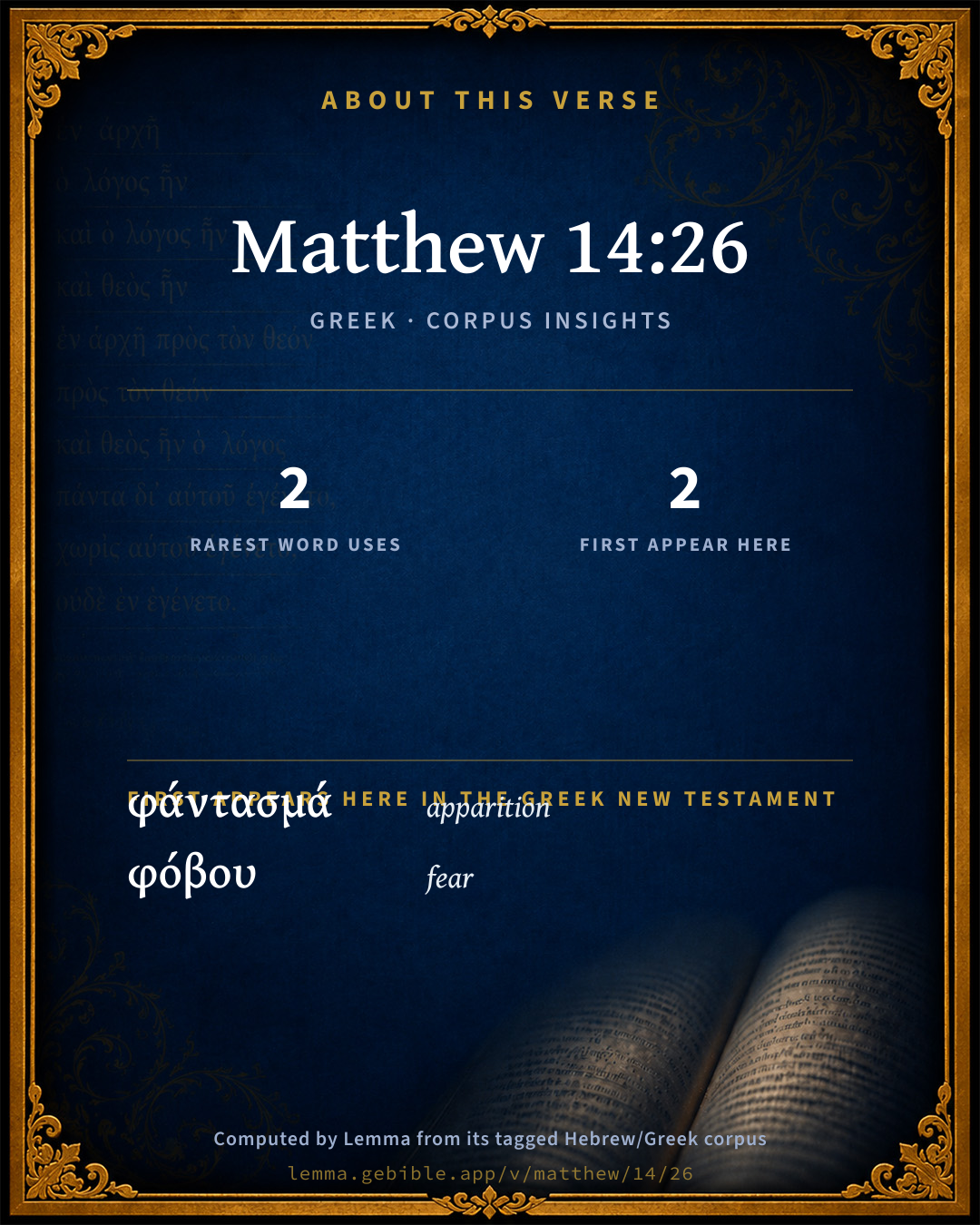
  • 2 first appearances in the Greek New Testament
Full analysis ↓
Download a study sheet

One document with this verse’s original text, its word-by-word gloss line, the meaning frame, cross-references with their text, attributed commentary, and full source and license credits — printable, and it pastes into notes with its structure intact.

This verse Autodidact and up

Study sheet (.html) Plain text (.txt)

A passage Seminary Student

Up to 50 verses in one chapter. A passage sheet keeps up to 6 commentary sources and 12 cross-references per verse, in the order this page ranks them, and says so on the sheet whenever that leaves anything out. Ask for a single verse and you get the Autodidact verse sheet above.

Everything on this page stays free to read, with no account — the sheet is a download of what is already on screen, not access to it.

Want to remove ads? Support Godless Engineer
Compare translations 3

The same verse in 3 English versions, stacked beneath the original-language interlinear above. Click any original word for its lexicon entry.

Each is an independent rendering of the whole verse — the interlinear is not word-aligned to these translations.

Highlighted words mark where these versions differ — a whole-verse word diff, not a word-by-word alignment.

  • World English Bible Public Domain
    When the disciples saw him walking on the sea, they were troubled, saying, "It's a ghost!" and they cried out for fear.
  • King James Version Public Domain
    And when the disciples saw him walking on the sea, they were troubled, saying, It is a spirit; and they cried out for fear.
  • unfoldingWord Literal Text CC BY-SA 4.0
    But the disciples, having seen him walking on the sea, were greatly troubled, saying, “It is a ghost,” and they cried out from fear.

unfoldingWord Literal Text — © unfoldingWord, licensed CC BY-SA 4.0. Word-aligned USFM3 via Door43 (git.door43.org/unfoldingWord/en_ult).

Versions to compare (up to 4)

3 of 4 selected

Show all 19 translations

Every available English version of this verse, each an independent rendering of the whole verse.

  • World English Bible Public Domain
    When the disciples saw him walking on the sea, they were troubled, saying, "It's a ghost!" and they cried out for fear.
  • Berean Standard Bible Public Domain
    When the disciples saw Him walking on the sea, they were terrified. “It’s a ghost!” they said, and cried out in fear.
  • Majority Standard Bible Public Domain
    When the disciples saw Him walking on the sea, they were terrified. “It’s a ghost!” they said, and cried out in fear.
  • King James Version Public Domain
    And when the disciples saw him walking on the sea, they were troubled, saying, It is a spirit; and they cried out for fear.
  • American Standard Version (1901) Public Domain
    And when the disciples saw him walking on the sea, they were troubled, saying, It is a ghost; and they cried out for fear.
  • Revised Version (1885) Public Domain
    And when the disciples saw him walking on the sea, they were troubled, saying, It is an apparition; and they cried out for fear.
  • Geneva Bible (1599) Public Domain
    And when his disciples sawe him walking on the sea, they were troubled, saying, It is a spirit, and cried out for feare.
  • Douay-Rheims (1899) Public Domain
    And they seeing him walk upon the sea, were troubled, saying: It is an apparition. And they cried out for fear.
  • Young's Literal Translation Public Domain
    and the disciples having seen him walking upon the sea, were troubled saying -- `It is an apparition,' and from the fear they cried out;
  • Literal Standard Version CC BY-SA 4.0
    and the disciples having seen Him walking on the sea, were troubled, saying, “It is an apparition,” and from the fear they cried out;
  • Unlocked Literal Bible CC BY-SA 4.0
    When the disciples saw him walking on the sea, they were terrified and said, “It is a ghost,” and they cried out in fear.
  • unfoldingWord Literal Text CC BY-SA 4.0
    But the disciples, having seen him walking on the sea, were greatly troubled, saying, “It is a ghost,” and they cried out from fear.
  • Darby Bible Public Domain
    And the disciples, seeing him walking on the sea, were troubled, saying, It is an apparition. And they cried out through fear.
  • World Messianic Bible Public Domain
    When the disciples saw him walking on the sea, they were troubled, saying, “It’s a ghost!” and they cried out for fear.
  • Webster's Bible Public Domain
    And when the disciples saw him walking on the sea, they were troubled, saying, It is a spirit; and they cried out for fear.
  • Free Bible Version CC BY-SA 4.0
    When the disciples saw him walking on the sea, they were terrified. They screamed out in fear, “It's a ghost!”
  • Bible in Basic English Public Domain
    And when they saw him walking on the sea, they were troubled, saying, It is a spirit; and they gave cries of fear.
  • Text-Critical English NT CC BY 4.0
    When the disciples saw him walking on the sea, they were terrified and said, “It is a ghost!” And they cried out in fear.
  • Tyndale New Testament (1534) Public Domain
    And when his disciples sawe him walkynge on the see they were troubled sayinge: it is some spirite and cryed out for feare.

Literal Standard Version (2020), Covenant Press — licensed CC BY-SA 4.0. Text via the HelloAO Bible API (eBible.org). Unlocked Literal Bible (unfoldingWord) — licensed CC BY-SA 4.0. Text via the HelloAO Bible API (eBible.org). unfoldingWord Literal Text — © unfoldingWord, licensed CC BY-SA 4.0. Word-aligned USFM3 via Door43 (git.door43.org/unfoldingWord/en_ult). Free Bible Version, Dr. Jonathan Gallagher — licensed CC BY-SA 4.0. Text via the HelloAO Bible API (eBible.org).

Word by word

More ways to search: Search by grammar → Find every occurrence → Compare this word →

Practice this passage: Drill this verse → Learn its vocabulary →

φάντασμά
phántasma
G5326
“apparition”
Noun, Nominative, Singular, Neuter
Part of Speech
Noun
Case
Nominative
Number
Singular
Gender
Neuter
Full Thayer's Definition

Origin: from G5324

TDNT: 09:06,1

1. an appearance 2. an apparition, spectre
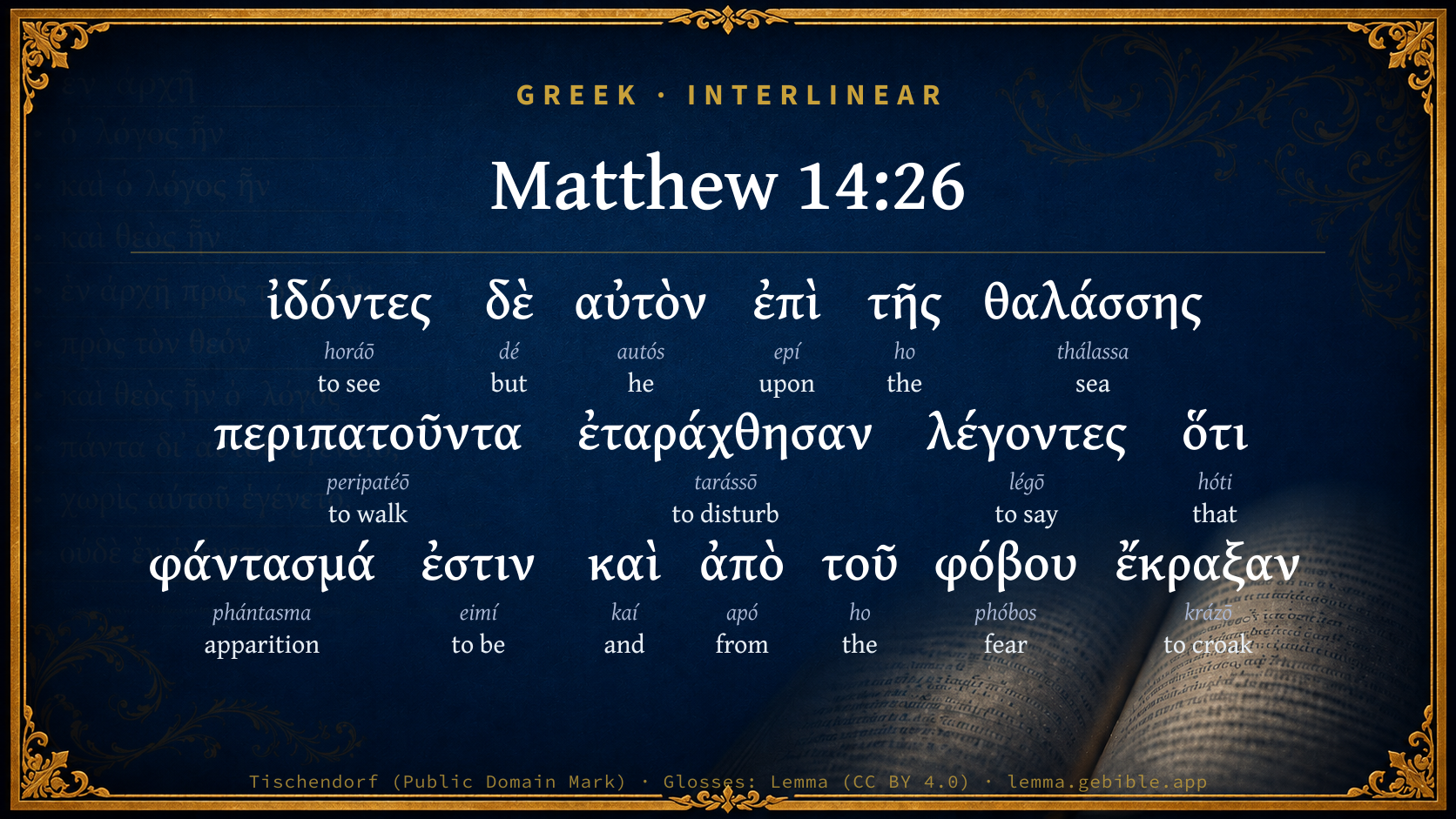
  1. ἰδόντες horáō G3708 “to see” Verb, Aorist, Active, Participle, Nominative, Plural, Masculine
  2. δὲ dé G1161 “but” Conjunction
  3. αὐτὸν autós G846 “he” Personal pronoun, Accusative, Singular, Masculine
  4. ἐπὶ epí G1909 “upon” Preposition
  5. τῆς ho G3588 “the” Article, Genitive, Singular, Feminine
  6. θαλάσσης thálassa G2281 “sea” Noun, Genitive, Singular, Feminine
  7. περιπατοῦντα peripatéō G4043 “to walk” Verb, Present, Active, Participle, Accusative, Singular, Masculine
  8. ἐταράχθησαν tarássō G5015 “to disturb” Verb, Aorist, Passive, Indicative, 3rd person, Plural
  9. λέγοντες légō G3004 “to say” Verb, Present, Active, Participle, Nominative, Plural, Masculine
  10. ὅτι hóti G3754 “that” Conjunction
  11. ἐστιν eimí G1510 “to be” Verb, Present, Active, Indicative, 3rd person, Singular
  12. καὶ kaí G2532 “and” Conjunction
  13. ἀπὸ apó G575 “from” Preposition
  14. τοῦ ho G3588 “the” Article, Genitive, Singular, Masculine
  15. φόβου phóbos G5401 “fear” Noun, Genitive, Singular, Masculine
  16. ἔκραξαν krázō G2896 “to croak” Verb, Aorist, Active, Indicative, 3rd person, Plural

About this verse

These counts appear in no published source. They are computed here, from the morphology-tagged text and Lemma’s own curated glosses. What Lemma adds →

17
words
16
distinct lemmas
Gospels
section

Notable vocabulary

The rarest word here is φάντασμά apparition G5326 — appearing just 2 times in the whole Greek New Testament.

First appearance in Scripture

These words make their first canonical appearance in the Greek New Testament here:

  • φάντασμά apparition G5326
  • φόβου fear G5401

Shared distinctive vocabulary

φάντασμά apparition G5326 occurs in 2 verses of the Greek New Testament. Also found in:

Repetition

A word recurs within this verse:

Cross-references

10

Topical passages linked to Matthew 14:26 in the Treasury of Scripture Knowledge — connected by theme and wording, ordered by reader-vote popularity; previews shown in the World English Bible.

  • Revelation 1:17 When I saw him, I fell at his feet like a dead man. He laid his right hand on me, saying, "Don't be afraid. I am the first and the last,
  • Mark 6:49–50 but they, when they saw him walking on the sea, supposed that it was a ghost, and cried out;
  • Luke 1:11–12 An angel of the Lord appeared to him, standing on the right side of the altar of incense.
  • Daniel 10:6–12 his body also was like the beryl, and his face as the appearance of lightning, and his eyes as flaming torches, and his arms and his feet like burnished brass, and the voice of his words like the voice of a multitude.
  • 1 Samuel 28:12–14 When the woman saw Samuel, she cried with a loud voice; and the woman spoke to Saul, saying, Why have you deceived me? for you are Saul.
  • Job 4:14–16 Fear came on me, and trembling, Which made all my bones shake.
  • Luke 24:37 But they were terrified and filled with fear, and supposed that they had seen a spirit.
  • Luke 24:45 Then he opened their minds, that they might understand the Scriptures.
  • Acts 12:15 They said to her, "You are crazy!" But she insisted that it was so. They said, "It is his angel."
  • Luke 24:5 Becoming terrified, they bowed their faces down to the earth. They said to them, "Why do you seek the living among the dead?

Cross-references courtesy of OpenBible.info (CC BY 4.0).

Commentary

Notes on Matthew 14:26 from classic Christian and Jewish commentators (each source and its license shown beneath its notes). The classic Christian expositions comment on the surrounding passage and are grouped to its opening verse, so a note may address several verses; the Jewish commentaries on the Tanakh (Rashi and others) are per-verse, so they appear only where the commentator wrote on this verse.

Lemma curates 59 commentaries, every one of them public domain or Creative Commons licensed, each selected and text-cleaned for this edition rather than reprinted as found. About our sources →

The Biblical Illustrator

Joseph S. Exell

Mat_14:26

And when the disciples saw Him walking on the sea, they were troubled.

Christ walking on the sea

Here are presented two points.

I. Human need.

II. Divine help. These two facts are involved in the two aspects of humanity.

I. I ask you to consider the attitude of man towards the supernatural and the unknown. They cried out for fear. This was the cry of men tossed and toiling on the wild deep, in the gloom of night. Very startling must have been to them the appearance of that form, advancing through the shadow and over the sea. But that was a cry of our common nature; it was a spontaneous human utterance from a mysterious depth, which under all forms of civilization, and all kinds of religion, abides in the soul of man. Every man awakens to the conviction that there is something beyond this world. It may not be a very practical conviction; thousands may live without any steady appreciation of that to which such a conviction points. But there are occasions when it is suddenly realized. There are three conditions of nature which are especially adapted to stir these feelings of mystery and awe, and all three are involved in the circumstances of the text. These are night, the night sky, and the sea.

1. Witness the common terror of the dead night-time and the dark, not a mere childish superstition, but a solemn awe creeping over the innermost fibres of the heart, In thought from the visions of the night, said Eliphaz, when deep sleep falleth on men, etc. Even the sceptical mind has acted upon the conviction that something must people that undefined space into which the visible world melts away.

2. Or, again, who has ever looked up through the darkness and gazed upon those orbs of light and glory that shame all splendours of the earth, without the spontaneous conviction of powers and intelligences dwelling outside these beaten ways of our traffic and our thought? What influences rain upon us from those starry depths? What unseen messengers glide down these awful solitudes?

3. Or, once more, consider that element in which the greatness and the mystery of nature and of life are represented. What suggestions of the supernatural and the unknown rise upon us from the bosom of the sea. What intimations beyond our sight; what a conviction of our impotence. Regarding thus this attitude of human need, what help has been found for it?

Two answers have come-one from the side of human sentiment, the other from human reason.

1. One answer elicited in this attitude of human need appears in various forms of superstition. Rock-temples and bloody altars, and human sacrifices proclaim the fact that human nature does not all gravitate to sense and the darkness of annihilation. The superstitious sentiments need some explanation.

2. The answer that comes from the side of reason. Law, force, order, are sublime facts, but not enough for human nature. You cannot by scientific explanation of the seen repress mans earnest inquiry about the unseen. To our human need, and our attitude towards the supernatural, Christ has come. There is only one voice that can say, Be of good cheer, be not afraid.

II. Consider the attitude of man respecting the natural and the known, and here you will observe the conditions of human need and divine help. These men who cried out for fear had been toiling in rowing. We are troubled here amidst the perplexities and trials of daily life. In one way or another many of us are toiling in rowing-the toil of pleasure-or we are rowing through heavy waves of care. Our need calls for Divine help. In seasons of gloom, looking out upon the world around us through shadows, we discern objects at which we shudder. That which excites our fears may be a blessing; but we know it not, and need the assurance that can bid us be of good cheer. (E. H. Chapin)

Jesus no phantom

I. It is too common an error to make a phantom of Christ.

1. How often is this done in the matter of sin and the cleansing of it. Our sin is real to us; but is Christ as real to us?

2. In the matter of our acceptance with God after pardon. Our shortcomings real; equally real the righteousness of Christ.

3. In the matter of sanctification.

4. In times of trial.

5. In time of death.

6. In Christian work.

II. We make Christ a phantom most when he is most really Christ. When He walked on the waves there was more of Christ visible than on land; His Godhead visible. In the pardon of great sin you see most of Christ; so in great distress and danger.

III. Our greatest sorrows arise from our treating our Lord as unreal. TO some Christ is an indifferent spirit. Many a poor sinner imagines Him to be an angry spirit and cries out for fear.

IV. If we could but be cured of this desperate mischief, our Lord Jesus Christ would have a higher place in our esteem, and many other beneficial results would follow:

1. Knowledge.

2. Worship.

3. Service. (C. H. Spurgeon.)

Eastern belief in Spirits

The belief is quite general in the East that there exists a class of beings whom they call Jins, both male and female, good and bad, which hold an intermediate position between angels and men, were created before the latter, are made of fire, or perhaps of gas, and are capable of assuming a variety of forms, or of becoming invisible at pleasure. They eat, drink, and marry-sometimes human beings-as well as die, though they live several centuries. Many events are accounted for in the East by the agency of the Jins; so that they do not exist in stories alone, but are recognized as active agents in human affairs, (Van Lennep.)

The magic of the Saviours voice

It is a wonderful organ, this human voice-wonderful in itself, and no less so in its effects. It is wonderful as an exponent of individual mind and character, being somehow very closely connected with a man, and contributing largely to constitute that aggregate of special qualities we call individuality. So much so, that one is known, is revealed and recognized, by his voice almost as much as by anything outward.. And it is wonderful as an instrument for affecting others. The Saviours voice on this occasion operated like a charm; it wrought like magic upon them. It is amazing what power the living voice, especially a long-known and much-loved voice, has to touch the heart, and to awaken confidence and peace, and emotions of all kinds, that may have been long dormant in the soul. (A. L. R. Foote.)

The Biblical Illustrator, edited by Joseph S. Exell (c. 1880s–1900s) — public domain. Text from a community e-Sword module.

Joseph Benson's Commentary

Mat 14:26-27. And when the disciples saw him, they were troubled — “It is well known that it is never entirely dark on the water not to urge that the moon might perhaps now be in the last quarter, as it must have been, if this was about three weeks before the passover.” By that little light, therefore, which they had, the disciples, seeing him, but not perfectly discerning who he was, were much terrified: saying, It is a spirit, Οτι φαντασμα εστι, It is an apparition: for they justly supposed that no human body could be supported by the water. Although the original word here used is not spirit, but apparition, yet that the Jews in general, particularly the Pharisees, believed in the existence of spirits, and that spirits sometimes appeared, is evident from Luk 24:37; Luk 24:39, and Act 23:8-9. And they cried out with fear — Through their dread of what might be the consequence: for, Mar 6:50, they all saw him, and were troubled. We see here, that even appearances and approaches of deliverance may be the occasions of trouble and perplexity to God’s people, who are sometimes put into great fear when they are most highly favoured. See Luk 1:29, and Exo 3:6. To allay the fears of his disciples, Christ immediately drew near and spake to them, in a tone of voice with which they were all perfectly acquainted, saying, θαρσειτε, Take courage: it is I — Your Lord and Master; be not afraid — Either of me, who am your friend, or of the violent tempest, which cannot hurt you while you are under my protection.

Joseph Benson's Commentary on the Old and New Testaments (1811–1818) — public domain. Text from a community e-Sword module.

Bengel's Gnomon

Johann Albrecht Bengel

Mat 14:26. Ἐτάραχθησαν, they were troubled) We often take Christ for another rather than for Christ: cf. Mat 14:2. The disciples now feared not only the sea, but also the Lord.—φάντασμα, an apparition) φάντασμα and φάσμα are identical in meaning. See Wis 17:15; Wis 17:4. Nor does φαντασία greatly differ from them. Ibid. Mat 18:17.

Bengel's Gnomon of the New Testament — English translation (T&T Clark, Edinburgh, 1860) — public domain. Text from a community e-Sword module.

Meyer's Critical & Exegetical Commentary

Heinrich August Wilhelm Meyer

Mat_14:26 ff. Ἐπὶ τῆς θαλάσσης (see critical notes): upon the sea. There, just at that spot, they saw Him walking as He was coming toward them over the sea (Mat_14:25). Observe the appropriate change of cases. For genitive, comp. Job_9:8. περιπατῶν … ἐπὶ θαλάσσης, Lucian, Philops. xiii. ἐφʼ ὕδατος βαδίζοντα, 14 :hist. ii. 4, al.

φάντασμα] They shared (Luk_24:37) the popular belief in apparitions (Plat. Phaed. p. 81 D: ψυχῶν σκιοειδῆ φαντάσματα; Eur. Hec. 54; Lucian, Philops. 29; Wis_17:15). Comp. the nocturnos Lemures in Horace, Ep. ii. 2. 209.

Mat_14:27. ἐλάλ. αὐτ.] ἀπὸ τῆς φωνῆς δῆλον ἑαυτὸν ποιεῖ, Chrysostom.

Mat_14:28-31 are not found in any of the other Gospels, but their contents are entirely in keeping with Peters temperament (ὁ πανταχοῦ θερμὸς κ. ἀεὶ τῶν ἄλλων προπηδῶν, Chrysostom).

βλέπων] not: as He perceived, but: as He saw; for, when on the sea, He was in immediate contact with the manifestations of the storm.

καταποντίζεσθαι] pro modo fidei ferebatur ab aqua (Bengel); namely, by the influence of Christs power, for which influence, however, he became unreceptive through doubt, and accordingly began to sink.

Meyer — Critical and Exegetical Commentary on the New Testament — English translation by Peter Christie, edited by Frederick Crombie (T&T Clark, 1880) — public domain. Text from a community e-Sword module.

Expositor's Greek Testament

ed. W. Robertson Nicoll

Mat 14:26 . φάντασμα : a little touch of sailor superstition natural in the circumstances; presupposes the impression that they saw something walking on the sea.

The Expositor's Greek Testament, edited by W. Robertson Nicoll (1897–1910) — public domain. Text from a community e-Sword module.

Geneva Bible (1599)

Geneva Bible translators

A spirit, as it is here taken, is that which a man imagineth to himself vainly in his mind, persuading himself that he seeth something, and seeth nothing.

Geneva Bible (1599) marginal notes — public domain. Text via Bolls.life.

Adam Clarke's Commentary

Verse 26. It is a spirit] That the spirits of the dead might and did appear, was a doctrine held by the greatest and holiest of men that ever existed; and a doctrine which the caviliers, free-thinkers and bound-thinkers, of different ages, have never been able to dispove.

Adam Clarke's Commentary on the Bible (1810–1826) — public domain. Text from a community e-Sword/MySword module.

John Gill's Exposition

But straightway Jesus spake unto them,.... Directly, the very moment, as soon as ever they cried out, and he perceived the consternation they were in, as one truly affected towards them, and concerned for their welfare; he called out aloud unto them, not coming with any intention to fright them, but to save them;

saying, be of good cheer, it is I, be not afraid: take heart, be of good courage, do not be affrighted at my appearance, from whom you have nothing to fear; nor be afraid of the storm and tempest in which you are, I will deliver you; for it is I, your Master, Saviour, and Redeemer, and not any hurtful spirit; who am able to save you, and am come for that purpose. Christ may be sometimes near his people, and they not know him; as the Lord was in the place where Jacob was, and he knew it not, Gen 28:16 and as Christ was standing by Mary Magdalene at the sepulchre, and she took him to be the gardener: and for want of a distinct knowledge of Christ in his person, offices, and grace, persons have wrong apprehensions of him, and are filled with dread and fears, concluding they have no interest in him; that he is a Saviour, but not of them; that their sins are so many, and of such a die, and attended with such aggravating circumstances, that though he is able to save them, he never can be willing to receive such vile sinners as they are: but when Christ makes himself known unto them, as the able and willing Saviour, and their Saviour and Redeemer, then, instead of dreading him as a judge, their fears vanish, their faith increases, and they are ready to do anything he shall order them; as Peter says in the next verse, who was willing to come to Christ on the water, when he knew who he was, if he was but pleased to bid him come.

John Gill's Exposition of the Whole Bible (1746–1763) — public domain (CC PDM 1.0). Text via the HelloAO Bible API.

Trapp's Complete Commentary

John Trapp

26 And when the disciples saw him walking on the sea, they were troubled, saying, It is a spirit; and they cried out for fear.

Ver. 26. They were troubled] Ere they were helped: things often go backward, before they come forward with us. Deus plagam sanaturus, graviorem infligit: he knows how to commend his mercies to us.

And they cried out for fear] For fear of him, in whom was laid up all their comfort. But pessimus in dubiis augur, timor. -How often are we mistaken, and befooled by our fears!

John Trapp, A Commentary or Exposition upon All the Books of the Old and New Testament (1647–1656) — public domain. Text from a community e-Sword module.

Albert Barnes' Notes on the Bible

They were troubled - They were afraid. The sight was remarkable. It was sufficient to awe them. In the dark night, amid the tumultuous billows appeared the form of a man. They thought it was a spirit an apparition. It was a common belief among the ancients that the spirits of people after death frequently appeared to the living.

Albert Barnes' Notes on the Bible (1834–1885) — public domain. Text from a community e-Sword/MySword module.

The Pulpit Commentary

And when the disciples saw him walking on the sea, they were troubled, saying, It is a spiritan apparition (Revised Version, fantasma estin)and they cried out for fear.

A first lesson on the spiritual presence.

The answer of the disciples to the sight of Jesus walking on the sea revealed the fact that they shared the superstitious sentiments of their age. They said, "It is a spirit." "Orientals continue to believe, as of old, in supernatural agencies, not only in the all-pervading and all-controlling providence and personal influence of the Deity, which they have ever pushed to extreme fatalism, but also in the existence and activity, either for good or for evil, of spirits and invisible beings, who people the air." Our Lord desired to guide his disciples to worthier apprehensions of spiritual things, through the proper apprehension of himself as a spiritual Being and a spiritual Messiah. Our Lord had wrought many miracles which displayed his power, and revealed him as

(1) Lord of Nature in all her moods;

(2) of death in all its stages;

(3) of devils in all their forms of mischief;

(4) of souls in all their spiritual needs.

Now, by this walking on the sea, he would reveal to them something of the mystery which belonged to his own Person. And this particular revelation was called for by the fact that the disciples had encouraged the attempt of the people to make their Master a merely earthly king. (Joh_6:15)

I CHRIST"S BODILY PRESENCE DID BUT ILLUSTRATE HIS SPIRITUAL PRESENCE. It should be clearly seen that our Lord was with his disciples in a double sense. He was with them spiritually, just as he is still with us; but, besides that, he was with them in bodily relations, in ways that could be apprehended by their senses. That bodily presence was given to teach them what the spiritual presence is and involves. The record of that bodily presence is preserved that it might do the same thing for us. Christ, by coming on the sea, taught the disciples two things.

1. That he would be with them when they could not see him.

2. That they must not wonder if he came to them in strange forms and manifestations. He was teaching them how to use their wings in the spiritual atmosphere, as the mother bird teaches her fledgelings.

II CHRIST"S BODILY PRESENCE WAS PRESENTLY TO PASS INTO A SPIRITUAL PRESENCE. The first suggestion was the loss of bodyweight which enabled Jesus to walk on the water. The second suggestion was the passing of the bodily into the spiritual at the Resurrection. The third was the passing of the spiritual body beyond the apprehension of the senses at the Ascension. The illustrative bodily presence has gone now, and gone forever; the reality of the spiritual presence of Christ is the possession and the glory of his Church today. R.T.

The Pulpit Commentary (1880–1919), ed. H.D.M. Spence-Jones & Joseph S. Exell — public domain. Text from a community e-Sword module.

Burkitt's Expository Notes on the New Testament

William Burkitt

See how the disciples take their deliverer to be a destroyer: their fears were highest when their deliverer and deliverance were nearest. God may be coming with salvation and deliverance for his church, when she for the present cannot discern him.

William Burkitt's Expository Notes on the New Testament (1700–1703) — public domain. Text from a community e-Sword module.

The People's New Testament

B. W. Johnson

26. A spirit. An apparition, an unreal appearance of a real person. The word is not that unusually rendered “spirit.” He would appear to them at first like a dark, moving speck upon the waters, then as a human figure; but in the dark, tempestuous sky, and not dreaming that it could be their Lord, they take it for a spirit (Luke 24:37). Cried out. In fright.

B. W. Johnson's The People's New Testament with Notes (1889–1891) — public domain. Electronic text from the Christian Classics Ethereal Library (CCEL) ThML edition.

Cambridge Greek Testament for Schools and Colleges

26. ἀπὸ τοῦ φόβου ἔκραξαν. Note the article. Not merely cried out from fear, but the fear which necessarily resulted from the appearance made them cry out.

Cambridge Greek Testament for Schools and Colleges (Cambridge University Press, 1896; 21 vols, various authors incl. Carr, Maclear, Plummer, Farrar, Lumby, Moule, M. R. James, Simcox) — public domain. Text from a community e-Sword module.

International Critical Commentary

26. And the disciples seeing Him walking on the sea, were troubled, saying that it is a phantasm; and they cried out from fear.] Mk. has: “And seeing Him walking on the sea, they thought that it is a phantasm; and they cried out (ἀνέκραξαν). For all saw Him and were troubled.” Mt. slips here into Mk.’s genitive, ἐπὶ τῆς θαλάσσης. See Gould on Mar 6:48.

(M)

International Critical Commentary — older volumes (1896–1929), various authors — public domain. Text from a community e-Sword module.

Vincent's Word Studies in the New Testament

Marvin R. Vincent

A spirit [φαντασμα] . Of which our word phantasm is a transcription. Rev., rather stiffly, apparition. Wyc., phantom.

Marvin R. Vincent, Word Studies in the New Testament (1887–1900) — public domain. Text from a community e-Sword/MySword module.

Lesson kit

Teaching starters — assembled from the data on this page, not authored interpretation. Every prompt links to the verse data it draws on. Edit before teaching.

Matthew, in the Gospels, opens this verse with 17 words (16 distinct Greek lemmas). Its most distinctive word is phántasma (“apparition”). A historical commentator’s framing appears above. Read the whole chapter for the surrounding context.

Discussion questions

  1. How does “apparition” (phántasma) shape what this verse is saying?
  2. 2 words make their first appearance in Scripture here. What does this debut establish?
  3. How does Mark 6:49, which shares the word «apparition», read alongside this verse?
  4. What does the repetition of “the” (2× in this one verse) do in this verse?
  5. These translations render this verse differently; the difference is in the English rendering, not the original. What questions does that raise?
  6. Compare how The Biblical Illustrator and Joseph Benson's Commentary read this verse. Where do they agree or differ?

Things to notice

  • 2 words make their first canonical appearance in Scripture here.
  • These translations choose different wording for 8 words in this verse.
  • “the” occurs 2× in this single verse.
  • 16 distinct Greek lemmas span 17 words in this verse.

Reading settings

Reading text

Shown beneath each verse's original-language words.

Old Testament
Old Testament edition

Read the OT as the Masoretic Hebrew (MT) or the Greek Septuagint (LXX).

English shown for the Greek Septuagint (in the Hebrew ↔ Greek comparison).

Comparing translations? Open the Compare panel on any verse page to stack up to four side by side.