
John 15:24

Greek (Tischendorf 8th ed.) John 15:24 appears in the Greek New Testament. The text above is from the Tischendorf 8th edition. Each word links to its Strong’s number and a concise gloss. Click any word for its full Thayer’s Greek Lexicon entry.
Download image
Cite this verse

John 15:24 (World English Bible). Public Domain. Lemma interlinear Bible study tool, https://lemma.gebible.app/v/john/15/24.

Show BibTeX & RIS
BibTeX
RIS
English Translation
If I hadn't done among them the works which no one else did, they wouldn't have had sin. But now have they seen and also hated both me and my Father.
World English Bible · Public Domain
Download a study sheet

One document with this verse’s original text, its word-by-word gloss line, the meaning frame, cross-references with their text, attributed commentary, and full source and license credits — printable, and it pastes into notes with its structure intact.

This verse Autodidact and up

Study sheet (.html) Plain text (.txt)

A passage Seminary Student

Up to 50 verses in one chapter. A passage sheet keeps up to 6 commentary sources and 12 cross-references per verse, in the order this page ranks them, and says so on the sheet whenever that leaves anything out. Ask for a single verse and you get the Autodidact verse sheet above.

Everything on this page stays free to read, with no account — the sheet is a download of what is already on screen, not access to it.

Want to remove ads? Support Godless Engineer
Compare translations 3

The same verse in 3 English versions, stacked beneath the original-language interlinear above. Click any original word for its lexicon entry.

Each is an independent rendering of the whole verse — the interlinear is not word-aligned to these translations.

Highlighted words mark where these versions differ — a whole-verse word diff, not a word-by-word alignment.

  • World English Bible Public Domain
    If I hadn't done among them the works which no one else did, they wouldn't have had sin. But now have they seen and also hated both me and my Father.
  • King James Version Public Domain
    If I had not done among them the works which none other man did, they had not had sin: but now have they both seen and hated both me and my Father.
  • unfoldingWord Literal Text CC BY-SA 4.0
    If I had not done the works that no one else did among them, they would have no sin, but now they have both seen and hated both me and my Father.

unfoldingWord Literal Text — © unfoldingWord, licensed CC BY-SA 4.0. Word-aligned USFM3 via Door43 (git.door43.org/unfoldingWord/en_ult).

Versions to compare (up to 4)

3 of 4 selected

Show all 19 translations

Every available English version of this verse, each an independent rendering of the whole verse.

  • World English Bible Public Domain
    If I hadn't done among them the works which no one else did, they wouldn't have had sin. But now have they seen and also hated both me and my Father.
  • Berean Standard Bible Public Domain
    If I had not done among them the works that no one else did, they would not be guilty of sin; but now they have seen and hated both Me and My Father.
  • Majority Standard Bible Public Domain
    If I had not done among them the works that no one else did, they would not be guilty of sin; but now they have seen and hated both Me and My Father.
  • King James Version Public Domain
    If I had not done among them the works which none other man did, they had not had sin: but now have they both seen and hated both me and my Father.
  • American Standard Version (1901) Public Domain
    If I had not done among them the works which none other did, they had not had sin: but now have they both seen and hated both me and my Father.
  • Revised Version (1885) Public Domain
    If I had not done among them the works which none other did, they had not had sin: but now have they both seen and hated both me and my Father.
  • Geneva Bible (1599) Public Domain
    If I had not done workes among them which none other man did, they had not had sinne: but nowe haue they both seene, and haue hated both me, and my Father.
  • Douay-Rheims (1899) Public Domain
    If I had not done among them the works that no other man hath done, they would not have sin; but now they have both seen and hated both me and my Father.
  • Young's Literal Translation Public Domain
    if I did not do among them the works that no other hath done, they were not having sin, and now they have both seen and hated both me and my Father;
  • Literal Standard Version CC BY-SA 4.0
    if I did not do among them the works that no other has done, they were not having sin, and now they have both seen and hated both Me and My Father;
  • Unlocked Literal Bible CC BY-SA 4.0
    If I had not done the works that no one else did among them, they would have no sin, but now they have seen and hated both me and my Father.
  • unfoldingWord Literal Text CC BY-SA 4.0
    If I had not done the works that no one else did among them, they would have no sin, but now they have both seen and hated both me and my Father.
  • Darby Bible Public Domain
    If I had not done among them the works which no other one has done, they had not had sin; but now they have both seen and hated both me and my Father.
  • World Messianic Bible Public Domain
    If I hadn’t done among them the works which no one else did, they wouldn’t have had sin. But now they have seen and also hated both me and my Father.
  • Webster's Bible Public Domain
    If I had not done among them the works which no other man hath done, they had not had sin: but now have they both seen, and hated both me and my Father.
  • Free Bible Version CC BY-SA 4.0
    If I had not given them such a demonstration through things that no one had ever done before, they wouldn't be guilty of sin, but despite seeing all this they hated both me and my Father.
  • Bible in Basic English Public Domain
    If I had not done among them the works which no other man ever did, they would have had no sin: but now they have seen, and they have had hate in their hearts for me and my Father.
  • Text-Critical English NT CC BY 4.0
    If I had not done among them the works that no one else had done, they would have no sin, but now they have seen and hated both me and my Father.
  • Tyndale New Testament (1534) Public Domain
    If I had not done workes amonge the which none other man dyd they had not had synne. But now have they sene and yet have hated bothe me and my father:

Literal Standard Version (2020), Covenant Press — licensed CC BY-SA 4.0. Text via the HelloAO Bible API (eBible.org). Unlocked Literal Bible (unfoldingWord) — licensed CC BY-SA 4.0. Text via the HelloAO Bible API (eBible.org). unfoldingWord Literal Text — © unfoldingWord, licensed CC BY-SA 4.0. Word-aligned USFM3 via Door43 (git.door43.org/unfoldingWord/en_ult). Free Bible Version, Dr. Jonathan Gallagher — licensed CC BY-SA 4.0. Text via the HelloAO Bible API (eBible.org).

Word by word

More ways to search: Search by grammar → Find every occurrence → Compare this word →

Practice this passage: Drill this verse → Learn its vocabulary →

μεμισήκασιν
miséō
G3404
“to hate”
Verb, Perfect, Active, Indicative, 3rd person, Plural
Part of Speech
Verb
Tense
Perfect
Voice
Active
Mood
Indicative
Person
3rd person
Number
Plural
Full Thayer's Definition

Origin: from a primary misos (hatred)

TDNT: 15:23,6

1. to hate, pursue with hatred, detest 2. to be hated, detested
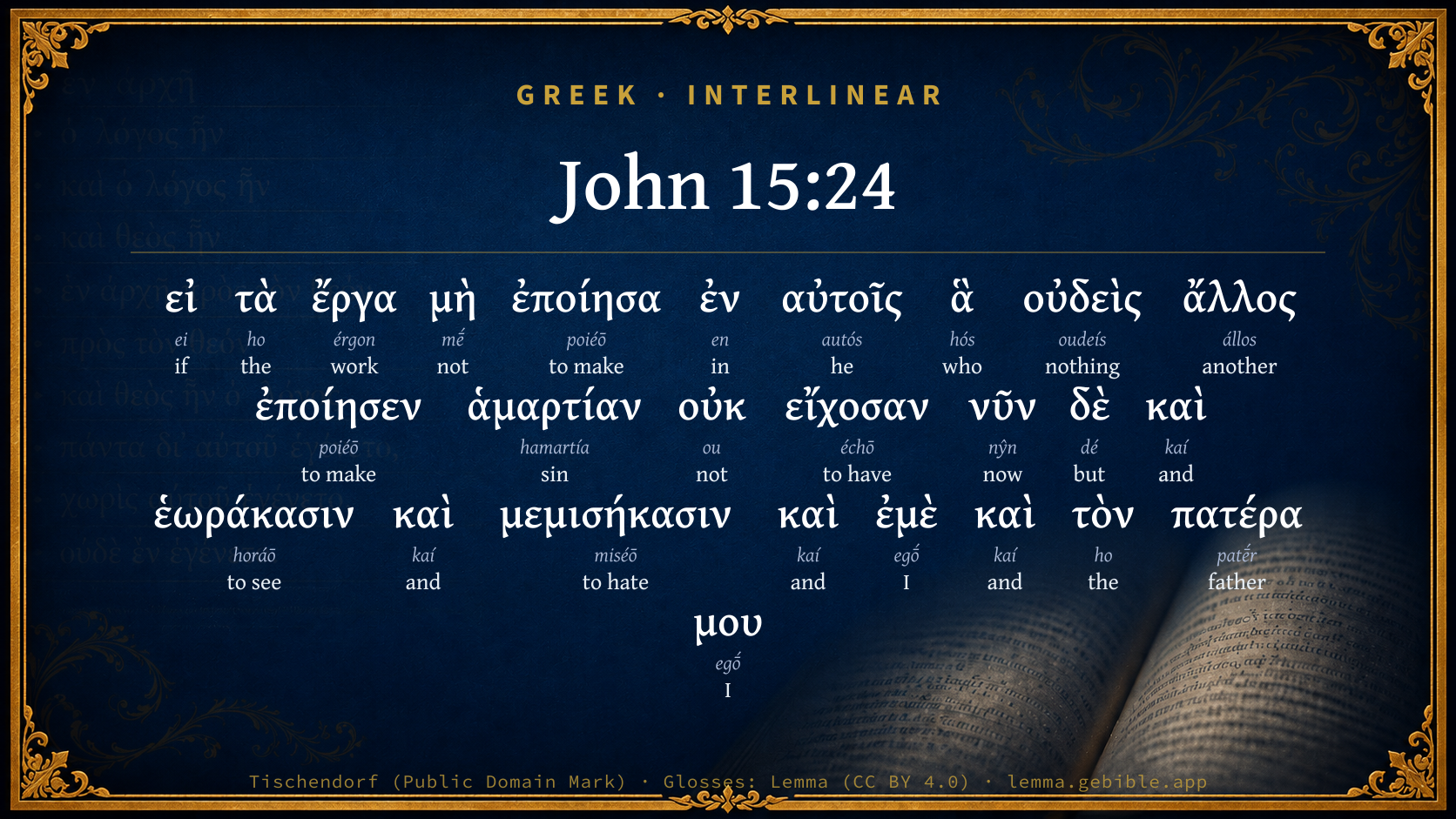
  1. εἰ ei G1487 “if” Conditional
  2. τὰ ho G3588 “the” Article, Accusative, Plural, Neuter
  3. ἔργα érgon G2041 “work” Noun, Accusative, Plural, Neuter
  4. μὴ mḗ G3361 “not” Particle, Negative
  5. ἐποίησα poiéō G4160 “to make” Verb, Aorist, Active, Indicative, 1st person, Singular
  6. ἐν en G1722 “in” Preposition
  7. αὐτοῖς autós G846 “he” Personal pronoun, Dative, Plural, Masculine
  8. ἃ hós G3739 “who” Relative pronoun, Accusative, Plural, Neuter
  9. οὐδεὶς oudeís G3762 “nothing” Adjective, Nominative, Singular, Masculine, Negative
  10. ἄλλος állos G243 “another” Adjective, Nominative, Singular, Masculine
  11. ἐποίησεν poiéō G4160 “to make” Verb, Aorist, Active, Indicative, 3rd person, Singular
  12. ἁμαρτίαν hamartía G266 “sin” Noun, Accusative, Singular, Feminine
  13. οὐκ ou G3756 “not” Particle, Negative
  14. εἴχοσαν échō G2192 “to have” Verb, Imperfect, Active, Indicative, 3rd person, Plural
  15. νῦν nŷn G3568 “now” Adverb
  16. δὲ dé G1161 “but” Conjunction
  17. καὶ kaí G2532 “and” Conjunction
  18. ἑωράκασιν horáō G3708 “to see” Verb, Perfect, Active, Indicative, 3rd person, Plural, Attic form
  19. καὶ kaí G2532 “and” Conjunction
  20. καὶ kaí G2532 “and” Conjunction
  21. ἐμὲ egṓ G1473 “I” Personal pronoun, 1st person, Accusative, Singular
  22. καὶ kaí G2532 “and” Conjunction
  23. τὸν ho G3588 “the” Article, Accusative, Singular, Masculine
  24. πατέρα patḗr G3962 “father” Noun, Accusative, Singular, Masculine
  25. μου egṓ G1473 “I” Personal pronoun, 1st person, Genitive, Singular

About this verse

These counts appear in no published source. They are computed here, from the morphology-tagged text and Lemma’s own curated glosses. What Lemma adds →

26
words
20
distinct lemmas
Gospels
section

Shared distinctive vocabulary

μεμισήκασιν to hate G3404 occurs in 36 verses of the Greek New Testament. Also found in:
Repetition

Words recur within this verse:

Cross-references

31

Topical passages linked to John 15:24 in the Treasury of Scripture Knowledge — connected by theme and wording, ordered by reader-vote popularity; previews shown in the World English Bible.

  • John 5:36 But the testimony which I have is greater than that of John, for the works which the Father gave me to accomplish, the very works that I do, testify about me, that the Father has sent me.
  • John 14:9 Jesus said to him, "Have I been with you such a long time, and do you not know me, Philip? He who has seen me has seen the Father. How do you say, 'Show us the Father?'
  • John 7:31 But of the multitude, many believed in him. They said, "When the Christ comes, he won't do more signs than those which this man has done, will he?"
  • John 9:32 Since the world began it has never been heard of that anyone opened the eyes of someone born blind.
  • John 10:32 Jesus answered them, "I have shown you many good works from my Father. For which of those works do you stone me?"
  • John 10:37 If I don't do the works of my Father, don't believe me.
  • Deuteronomy 5:9 you shall not bow down yourself to them, nor serve them; for I, Yahweh, your God, am a jealous God, visiting the iniquity of the fathers on the children, and on the third and on the fourth generation of those who hate me;
  • Proverbs 8:36 But he who sins against me wrongs his own soul. All those who hate me love death."
  • Matthew 9:33 When the demon was cast out, the mute man spoke. The multitudes marveled, saying, "Nothing like this has ever been seen in Israel!"
  • John 3:2 The same came to him by night, and said to him, "Rabbi, we know that you are a teacher come from God, for no one can do these signs that you do, unless God is with him."
  • Hebrews 2:3–4 how will we escape if we neglect so great a salvation-- which at the first having been spoken through the Lord, was confirmed to us by those who heard;
  • Exodus 20:5 you shall not bow yourself down to them, nor serve them, for I, Yahweh your God, am a jealous God, visiting the iniquity of the fathers on the children, on the third and on the fourth generation of those who hate me,
  • Matthew 11:5 the blind receive their sight, the lame walk, the lepers are cleansed, the deaf hear, the dead are raised up, and the poor have good news preached to them.
  • Matthew 11:20–24 Then he began to denounce the cities in which most of his mighty works had been done, because they didn't repent.
  • Mark 2:12 He arose, and immediately took up the mat, and went out in front of them all; so that they were all amazed, and glorified God, saying, "We never saw anything like this!"
  • Luke 10:12–16 I tell you, it will be more tolerable in that day for Sodom than for that city.
  • Luke 19:37–40 As he was now getting near, at the descent of the Mount of Olives, the whole multitude of the disciples began to rejoice and praise God with a loud voice for all the mighty works which they had seen,
  • Luke 24:19 He said to them, "What things?" They said to him, "The things concerning Jesus, the Nazarene, who was a prophet mighty in deed and word before God and all the people;
  • John 6:36 But I told you that you have seen me, and yet you don't believe.
  • John 11:47–50 The chief priests therefore and the Pharisees gathered a council, and said, "What are we doing? For this man does many signs.
  • John 12:37–40 But though he had done so many signs before them, yet they didn't believe in him,
  • John 12:45 He who sees me sees him who sent me.
  • Acts 2:22 "Men of Israel, hear these words! Jesus of Nazareth, a man approved by God to you by mighty works and wonders and signs which God did by him in the midst of you, even as you yourselves know,
  • Acts 10:38 even Jesus of Nazareth, how God anointed him with the Holy Spirit and with power, who went about doing good and healing all who were oppressed by the devil, for God was with him.
  • Romans 1:30 backbiters, hateful to God, insolent, haughty, boastful, inventors of evil things, disobedient to parents,
  • Romans 8:7–8 because the mind of the flesh is hostile towards God; for it is not subject to God's law, neither indeed can it be.
  • 2 Timothy 3:4 traitors, headstrong, conceited, lovers of pleasure rather than lovers of God;
  • James 4:4 You adulterers and adulteresses, don't you know that friendship with the world is enmity with God? Whoever therefore wants to be a friend of the world makes himself an enemy of God.
  • Psalms 81:15 The haters of Yahweh would cringe before him, And their punishment would last forever.
  • Matthew 21:32 For John came to you in the way of righteousness, and you didn't believe him, but the tax collectors and the prostitutes believed him. When you saw it, you didn't even repent afterward, that you might believe him.
  • John 12:10 But the chief priests conspired to put Lazarus to death also,

Cross-references courtesy of OpenBible.info (CC BY 4.0).

Commentary

Notes on John 15:24 from classic Christian and Jewish commentators (each source and its license shown beneath its notes). The classic Christian expositions comment on the surrounding passage and are grouped to its opening verse, so a note may address several verses; the Jewish commentaries on the Tanakh (Rashi and others) are per-verse, so they appear only where the commentator wrote on this verse.

Lemma curates 59 commentaries, every one of them public domain or Creative Commons licensed, each selected and text-cleaned for this edition rather than reprinted as found. About our sources →

Joseph Benson's Commentary

Joh 15:24-27. If I had not done among them, &c. — If I had wrought no miracle at all among them; nay, if I had not done such extraordinary works as no other man ever did, not even their prophets, or Moses himself; they had not had sin — Any degree of sin comparable to that which they are now under: but now they have both seen, &c. — But now, as they have rejected my superior miracles, which they have seen with their own eyes, at the same time that they own the evidence of those which Moses wrought, of which they have heard only by distant report, they manifest such an obstinate perverseness of temper, that I may truly say, they have both seen and hated both me and my Father. For in my miracles, which are greater than any hitherto exhibited, they have seen, or might have seen, who I am; namely, the only-begotten Son of God; and who is my Father; for the glory of all the divine perfections shines forth in my miracles. Nevertheless, they have rejected me, who have performed these miracles, and my Father likewise, who sent me to perform them; so that, shutting their eyes against the light thus shining on them, and hardening their hearts against that incontrovertible evidence of my mission, which my mighty works afford, it is evident they reject me, not out of ignorance and weakness, but out of wilful hatred to me, and him that sent me, and therefore are utterly inexcusable. But this cometh to pass — This is all permitted; that the word might be fulfilled — Or, in consequence of this being permitted, the word is fulfilled; see note on chap. Joh 12:37-40; that is written in the law — Or in their sacred volume; (namely, Psa 35:19;) They hated me without a cause — These very words, strictly speaking, were spoken concerning David, and are here applied to the Messiah, both because David was a type of him, and because he was hated without a cause, (see Isa 3:3-9; Dan 9:26; Zec 12:10,) as David was. The meaning is, Be not surprised that I, who am the Messiah, have been rejected of the Jews. It has happened according to the prediction of their own prophets. But when the Comforter is come, &c. — But, “for your encouragement I assure you, that they will not always continue thus obstinately bent against me and my religion. When he, who is to comfort you under all your troubles by the aid he will afford you, and who on that account is justly styled the Comforter; when he is come, whom I will send you from the Father — To remain always with you; even the Spirit of truth — He shall bear witness to me and to my religion so effectually, that many of the Jews shall be converted.” — Macknight. We may observe here, that the Spirit’s coming, and being sent, by our Lord, from the Father, to testify of him, are personal characters, and plainly distinguish him from the Father and the Son. And his title as the Spirit of truth, together with his proceeding from the Father, can agree to none but a divine person. And that he proceeds from the Son as well as from the Father, may be fairly argued from his being called the Spirit of Christ, 1Pe 1:11; and from his being said to be sent by Christ from the Father, as well as sent by the Father in Christ’s name. And ye also — Weak as you now appear, shall, by his powerful assistance, bear a courageous and convincing testimony to me, because you have been with me from the beginning — Namely, of my ministry, and therefore are the best qualified to give an account of my whole conduct; which, the better it is known, the more it will justify my cause, and expose the wickedness of those that rise up against me. In other words, “In process of time men’s eyes shall be opened to discern the authority of your testimony; and they shall give credit to your reports concerning me, because they shall know that ye have been my companions from the very first, consequently eye and ear-witnesses of all that I have done and said: so that after a while you shall testify concerning me, and preach my religion far more successfully than it will be in your power to do at the beginning.” See Doddridge and Macknight.

Joseph Benson's Commentary on the Old and New Testaments (1811–1818) — public domain. Text from a community e-Sword module.

Bengel's Gnomon

Johann Albrecht Bengel

Joh 15:24. Ἑωράκασι, they have seen) the works.

Bengel's Gnomon of the New Testament — English translation (T&T Clark, Edinburgh, 1860) — public domain. Text from a community e-Sword module.

Expositor's Greek Testament

ed. W. Robertson Nicoll

Joh 15:24 . εἰ τὰ ἔργα … οὐκ εἶχον . This repeats in a slightly varied form the statement of Joh 15:22 . He had not only come and spoken, but had done works which none other had done, cf. Joh 3:2 ; Joh 9:32 ; Joh 7:31 . The miracles wrought by Christ were themselves of a kind fitted to produce faith. In them men were meant to see God, Joh 5:17 ; Joh 5:19-20 . So that He could say, νῦν δὲ καὶ ἑωράκασι … μου . This is their guilt, that they have both seen and hated both me and my Father. This does not imply that they had been conscious of seeing the Father in Christ, but only that in point of fact they had done so. Cf. Joh 14:9 ; Joh 1:18 .

The Expositor's Greek Testament, edited by W. Robertson Nicoll (1897–1910) — public domain. Text from a community e-Sword module.

Jamieson, Fausset & Brown

Robert Jamieson, A. R. Fausset & David Brown

If I had not done . . . the works which none other . . . did--(See on Joh 12:37).

Jamieson, Fausset & Brown — Commentary Critical and Explanatory on the Whole Bible (1871) — public domain (CC PDM 1.0). Text via the HelloAO Bible API.

John Calvin's Commentaries

24. If I had not done among them the works Under the word works he includes, in my opinion, all the proofs which he gave of his Divine glory; for by miracles, and by the power of the Holy Spirit, and by other demonstrations, he clearly proved that he was the Son of God, so that in him was plainly seen the majesty of the Only-begotten Son, as we have seen under John 1:14 It is commonly objected, that he did not perform more miracles or greater miracles than Moses and the Prophets. The answer is well known, that Christ is more eminent in miracles in this respect, that he was not merely a minister, like the rest, but was strictly the Author of them; for he employed his own name, his own authority, and his own power, in performing miracles. But, as I have said, he includes in general all the testimonies of heavenly and spiritual power by which his Divinity was displayed.

They have seen and hated. He concludes that his enemies cannot escape by any shifts to which they may have recourse, since they despised his power, which evidently was altogether Divine; for God had openly manifested his Divinity in the Son; and therefore it would serve no purpose for them to say that they had only to do with a mortal man. This passage reminds us to consider attentively the works of God, in which, by displaying his power, he wishes us to render the honor which is due to him. Hence it follows, that all who obscure the gifts of God, or who contemptuously overlook them, are ungrateful to God, and malicious.

John Calvin's Commentaries (1540-1563) — public domain. Text from the Calvin Translation Society English edition (1840s-50s) via the Christian Classics Ethereal Library (ccel.org). Calvin's coverage is partial (roughly two-thirds of the Bible); uncommented books and verses are honest gaps, never fabricated. The 19th-century editor's footnotes and remarks are omitted so the notes are faithfully Calvin's own voice.

Ellicott's Commentary for English Readers

(24) If I had not done among them the works.—Comp. Note on Joh_15:22, and for the evidence of our Lord’s works, see Joh_5:36; Joh_9:3-4; Joh_9:24; Joh_10:21; Joh_10:37; Joh_14:10. They met the evidence of works by the assertion that He was a sinner, and possessed a devil. Their hatred led them to ascribe the highest good to the power of evil. To such hearts there are no channels by which goodness can approach. (Comp. especially Notes on Mat_12:31-32.)

A Bible Commentary for English Readers, edited by Charles John Ellicott (1878–1897) — public domain. Text from a community e-Sword module.

The Cambridge Bible for Schools and Colleges

gen. ed. J. J. S. Perowne

24. the works] If they did not see that His words were Divine they might at least have seen that His works were such. Comp. Joh_10:38, Joh_14:11, Joh_5:36. Here again their sin was against light; for they admitted the works (Joh_11:47).

which none other man did] Comp. Joh_9:32.

seen … my Father] Comp. Joh_14:9-10.

The Cambridge Bible for Schools and Colleges (gen. ed. J. J. S. Perowne; Cambridge University Press, 1878–1918) — public domain. Text from a community e-Sword module.

John Gill's Exposition

And ye shall also bear witness,.... That is, of Christ; of all the things he did in Jerusalem, and in the land of the Jews; being eyewitnesses, and ministers, or servants of the word, who constantly attended upon him; of all the good he did to the bodies and souls of men; of the various miracles he wrought, and of the several doctrines which were taught by him: what they saw with their eyes, heard with their ears, and with their hands handled of the word of life, that they could declare, and did declare, and bore a faithful testimony to; they were to be, and were witnesses of his sufferings and death, of his resurrection from the dead, and ascension to heaven; they were a company of select men, chosen before of God, for this purpose; they were the most proper to be concerned herein, having been for a considerable time his intimates and associates:

because ye have been with me from the beginning; from the beginning of his ministry; for as soon as he entered on his public work, he called them to be followers of him; and who continued with him to the end, and therefore were the most capable of bearing a testimony concerning his person, doctrines, and works; of all he did and suffered, from first to last.

Next: John Chapter 16

John Gill's Exposition of the Whole Bible (1746–1763) — public domain (CC PDM 1.0). Text via the HelloAO Bible API.

Trapp's Complete Commentary

John Trapp

24 If I had not done among them the works which none other man did, they had not had sin: but now have they both seen and hated both me and my Father.

Ver. 24. Works which none other man did] More stupendous, because by my own power, and all to the people’s profit. These were of use in the Church’s infancy, and Papists boast of them still; but those are the devil’s lying wonders, 2Th 2:9. As for our religion, Pudet diabolum Lutheri doctrinam miraculis confirmare, It is shameful that the devil confirms the traching of Luther, saith Gretser the Jesuit. But we answer with Augustine, He that now looks for a miracle is himself a great miracle: Qui adhuc prodigia quaerit magnum est ipse prodigium. Christ was the only Thaumaturgus or wonder worker. This is attested by Josephus the Jew, and confessed by Mahomet.

John Trapp, A Commentary or Exposition upon All the Books of the Old and New Testament (1647–1656) — public domain. Text from a community e-Sword module.

Albert Barnes' Notes on the Bible

The works which none other man did - The miracles of Jesus surpassed those of Moses and the prophets:

In their number. He healed great multitudes, and no small part of his life was occupied in doing good by miraculous power. In their nature. They involved a greater exertion of power. He healed all forms of disease. He showed that his power was superior to all kinds of pain. He raised Lazarus after he had been four days dead. He probably refers also to the fact that he had performed miracles of a different kind from all the prophets. He did all this by his own power; Moses and the prophets by the invoked power of God. Jesus spake and it was done, showing that he had power of himself to do more than all the ancient prophets had done. It may be added that his miracles were done in a short time. They were constant, rapid, continued, in all places. Wherever he was, he showed that he had this power, and in the short space of three years and a half it is probable that he performed more miracles than are recorded of Moses and Elijah, and all the prophets put together.

Albert Barnes' Notes on the Bible (1834–1885) — public domain. Text from a community e-Sword/MySword module.

Haydock's Catholic Bible Commentary

How can this be true, that Christ wrought greater wonders than any one else had ever done? We find recounted in the Old Testament, the miracles of Elias and Eliseus, who raised the dead to life, healed the sick, and brought down fire from heaven; of Moses, who afflicted Egypt with plagues, divided the Red Sea, for the passage of the Israelites, and brought water from the rock; of Josue, who stopped the waters of the Jordan, for the passage of the children of Israel, and in the battle of Gabaon, made the sun and moon stand still; in all which miracles, there appeared a greater manifestation of power, than in any of the miracles wrought by our Saviour, during his ministry. But to this may be answered, that the miracles of our Saviour were much more numerous than those of any of the saints of the Old Testament, even of Moses himself; particularly when we compare the few years which he preached, and manifested the glory of his Father by his miracles, with the long life of Moses: Christ did not preach full four years, whereas Moses governed the people forty years. Again, if the miracles of Jesus were not of so astonishing a nature, at least they always had for their object, the healing of the sick, and the good of the people; which the prophets have given us, as the distinguishing characteristics of the miracles of the Messias. Add to this, the ease and authority with which he performs them, which are most sensible proofs of their superiority. But what chiefly distinguishes his miracles, from those of the other saints, is, that he performed them in proof of his divinity, and of his mission, as the deliverer of Israel: whereas the prophets only perform miracles, as the ministers of the Lord, and as so many voices, which foretold the Messias. Besides, if the ancient saints could work miracles, they never could confer that power upon others, as Christ did upon his disciples, of which the Jews themselves were witnesses, in al the places whither Christ sent his disciples. We omit mentioning his resurrection, which at this time he had not performed, but had already foretold, and which was the greatest miracle that has ever been performed. (Calmet)

George Leo Haydock (1774–1849), Haydock's Catholic Family Bible and Commentary, 1859 edition — public domain. Excludes Psalms (Douay-Rheims chapter numbering differs from Protestant) and Deuterocanonical books (Catholic canon only).

Matthew Poole's English Annotations

Our Saviour often appeals to his works, both to own his mission from God, and also to prove the Jews inexcusable in their not receiving and embracing him; for which latter purpose he mentions them here, and saith, that he had done such works as no man did, and by his own power and virtue. Christ did some works such as we do not read that ever man did; as the multiplying of the loaves, the giving sight to those that were born blind, the healing of so many desperate diseases: and for such as he did which God had also given men a power to do, he did them in a quite different manner from that in which men did them. Elisha raised the Shunammite’s child to life; but it was by prayer. Peter cured the lame man, Act 3:6; but it was in the name of Jesus Christ of Nazareth. We read indeed of Christ’s praying at the raising of Lazarus; but his ordinary way was by his word of command, which was a quite different way than that used by those men by whom miracles had been wrought. Besides, it is manifest that the generality of the Jews did not look upon Christ as one sent from God, though many of them did: and admit that there had been nothing in the miracles wrought by Christ, more than Elijah, or Elisha, or the prophets had done; yet it had been sufficient for to have convinced them, that he acted by a Divine power, and must be sent and authorized by and from God to do what he did. Now saith our Saviour, If I had not done before their faces such works as no man could do but by a power derived from God, and some such as God never authorized men to do, their sin had been nothing to what now it is: but now they have understood that I am sent from my Father; and knowing this, yet going on in their most malicious designs against me, they both declare a hatred and malice against my Father who sent me, and me as sent by him.

Matthew Poole's English Annotations on the Holy Bible (1683–1685) — public domain. Text from a community e-Sword/MySword module.

Whedon's Commentary on the Bible

Daniel D. Whedon

24. If—There is another if enforcing and expanding the if of Joh_15:22.

Had not done… works—Not by his word only, but by his works, attesting the superhuman power of his word, had he revealed to them the truth. His word, like original right and truth, attested itself to the conscience. His work, such as none other man did, attested his superhuman nature to their reason. With conscience and reason combining to attest his superhuman excellence, it was an excuseless folly for human beings to reject and hate him, claiming to be the Son and Messenger of God.

Seen and hated… me and my Father—His works were not merely in themselves separate evidences. They were a part of his character and of himself. They were the attributes going to make up his divine person, as it appeared before them. He walked before them an Omnipotent. He passed in the scene before their eyes visible God. The curtain was uplifted, and upon the level stage of earth God incarnate passed before their view, as the visible Jehovah passed before the eyes of Moses. Hence he could truly say, now have they both seen and hated both me and my Father.

Daniel D. Whedon (gen. ed.), Commentary on the Old and New Testaments (1874–1909) — public domain. Text from a community e-Sword module.

The Pulpit Commentary

If I had not done among them works which none other did Here he comes down from "Word" to "work," and indicates the lower agency, that of works, which are neither inoperative nor valueless, and which transcend all other similar deeds. They are works of the Son of God, works of creation and of healing, triumphant conflict with the forces of nature and the malice of the devil, of a kind which may be compared with, but which exceed all human and angelic ministry. They had not had sin, but now they have both seen and hated both me and my Father.

The works as well as the words of Christ might have softened their hearts, but the Divine claims, which were thus pressed home upon the conscience, provoked their malice. "They took counsel to kill him;" "They took up stones to stone him." They hated God as God, and goodness and truth just because they were goodness and truth. The awful condemnation is here pronounced, "that men loved darkness rather than light." They positively saw their Father, and hated him. This is the most terrible condemnation that can be pronounced on moral beings.

The Pulpit Commentary (1880–1919), ed. H.D.M. Spence-Jones & Joseph S. Exell — public domain. Text from a community e-Sword module.

Scofield Reference Notes

C. I. Scofield

sin

Sin. (See Scofield "Rom 3:23").

The Scofield Reference Bible (1917 edition), notes by C. I. Scofield — public domain. Text from a community e-Sword module.

The People's New Testament

B. W. Johnson

24. If I had not done, etc. The proof of his divine mission was such that they were left without excuse. Hated both me and my Father. The Jews claimed to love God, but when God, manifest in the flesh, appeared, they hated him. The hatred of Christ is the hate of God.

B. W. Johnson's The People's New Testament with Notes (1889–1891) — public domain. Electronic text from the Christian Classics Ethereal Library (CCEL) ThML edition.

Cambridge Greek Testament for Schools and Colleges

24. τὰ ἔργα. If they did not perceive that His words were Divine, they might at least have recognised His works as such (Joh 10:38, Joh 14:11, Joh 5:36). Here again their sin was against light: they admitted the works (Joh 11:47) as such that none other did (Joh 9:32), and like Philip they had seen, without recognising, the Father (Joh 14:9-10).

Cambridge Greek Testament for Schools and Colleges (Cambridge University Press, 1896; 21 vols, various authors incl. Carr, Maclear, Plummer, Farrar, Lumby, Moule, M. R. James, Simcox) — public domain. Text from a community e-Sword module.

Alford’s Greek Testament

Henry Alford

24.] He refers to the testimony of His works among them also, as leaving them again without excuse;—they had had ocular witness of His mission.

ἐν αὐτοῖς—not to them (as Aug.), but as Act 2:22, ἐν μέσῳ ὑμῶν.

ἐποίησεν is, not only by external evidence, but also by internal, the right reading. πεποίηκεν (as Lücke remarks, ii. 643) would imply that the ἄλλοι referred to were contemporaries of our Lord,—or, at all events, that their works still lasted.

ἑωράκασιν does not refer to the works (as Lücke), but to καὶ ἐμὲ καὶ τὸν πατέρα μου, see ch. 14:9.

Henry Alford, The Greek Testament (1849–1861) — public domain. Text from a community e-Sword module.

International Critical Commentary

24. εἰ τὰ ἔργα μὴ ἐποίησα κτλ. The Jews were blameworthy because they did not recognise that the “works,” as well as the “words” of Jesus revealed God.

In all the Gospels, the impression made by His works of wonder is noted; e.g. Mar 1:27, Luk 4:36, Joh 3:2 (where see note) and 7:31. It is not the highest kind of faith that is thus generated (14:11), but nevertheless such faith is, in its measure, worthy and laudable (see on 2:11). And, more than once in the Fourth Gospel, Jesus Himself appeals to the witness of His ἔργα in confirmation of His Divine mission (5:36, 10:32, 37), as He does here. As His words were greater than those of any other (7:46), so were His works such as οὐδεὶς ἄλλος ἐποίησεν (cf. 9:32, Mat 9:33). If He had not wrought works of this wonderful character among them (ἐν αὐτοῖς), the Jews would not have been counted blameworthy; but as things were, they were left without excuse (Mat 11:21, Luk 10:13).

ἐποίησεν. So אABDLΘ; the rec. has πεποίηκεν.

νῦν δὲ καί κτλ., “but now they have both seen and hated both me and my Father,” the perfects indicating the persistence of their hostility (cf. Abbott, Diat. 2443). The construction of the sentence, καί being four times repeated, shows that ἑωράκασιν as well as μεμισήκασιν governs τὸν πατέρα μου no less than ἐμέ. Jesus said later on ὁ ἑωρακὼς ἐμὲ ἑώρακεν τὸν πατέρα (14:9); but the original fault of the Jews was, as He had said before (6:36), ἑωράκατέ με καὶ οὐ πιστεύετε (see on 14:7). Neither in His words nor in His works did they discern the Divine mission of Jesus; and, not discerning who had sent Him, they hated Him and therefore implicitly His Father (v. 23).

International Critical Commentary — older volumes (1896–1929), various authors — public domain. Text from a community e-Sword module.

Godet's Commentaries

Frédéric Louis Godet

Ver. 24. If the testimony which Jesus bore to Himself did not succeed in enlightening them, His works ought at least to have procured credence for His testimony. The one who did not have a consciousness sufficiently developed to apprehend the divine character of His teachings, had at least eyes to behold His miracles.

For the first two καί, see Joh 6:36 : they have caused things which seemed incompatible to move together: seeing and hating;and this at once (the two following καί) with reference to me and my Father: these last two καί are additive, not adversative.

Frédéric Louis Godet — Commentaries on Luke, John, Romans, and 1 Corinthians — English translation (T&T Clark, Edinburgh, 1870s–1890s) — public domain. Text from a community e-Sword module.

Lesson kit

Teaching starters — assembled from the data on this page, not authored interpretation. Every prompt links to the verse data it draws on. Edit before teaching.

John, in the Gospels, opens this verse with 26 words (20 distinct Greek lemmas). Its most distinctive word is miséō (“to hate”). A historical commentator’s framing appears above. Read the whole chapter for the surrounding context.

Discussion questions

  1. What does “to hate” (miséō) contribute to the verse as a whole?
  2. How does Matthew 5:43, which shares the word «to hate», read alongside this verse?
  3. What does the repetition of “to make” (2× in this one verse) do in this verse?
  4. The translations on this page render this verse differently — a whole-verse word diff, not a word-by-word alignment. What might account for the different wordings?
  5. Compare how Joseph Benson's Commentary and Bengel's Gnomon read this verse. Where do they agree or differ?

Things to notice

Reading settings

Reading text

Shown beneath each verse's original-language words.

Old Testament
Old Testament edition

Read the OT as the Masoretic Hebrew (MT) or the Greek Septuagint (LXX).

English shown for the Greek Septuagint (in the Hebrew ↔ Greek comparison).

Comparing translations? Open the Compare panel on any verse page to stack up to four side by side.