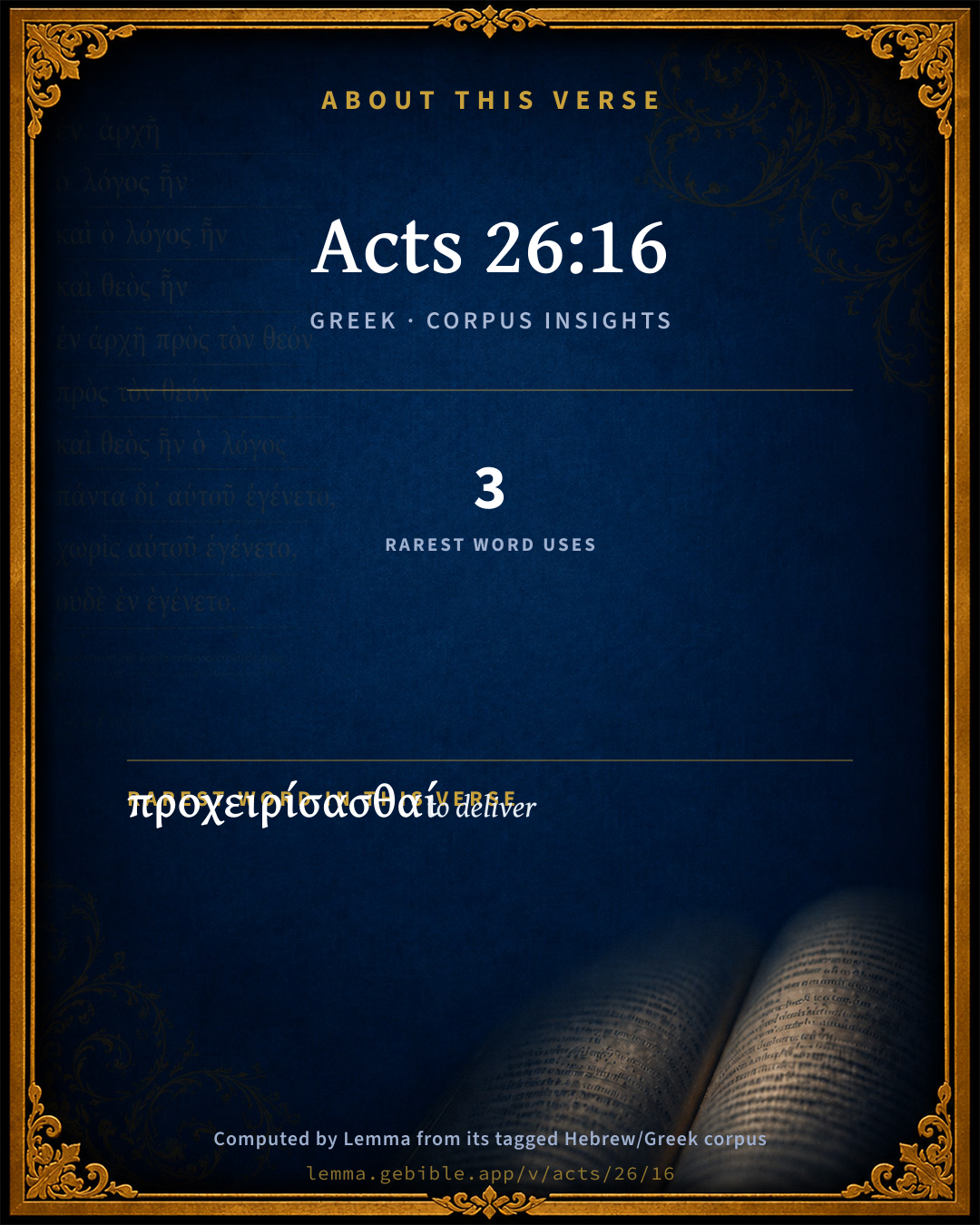
Acts 26:16

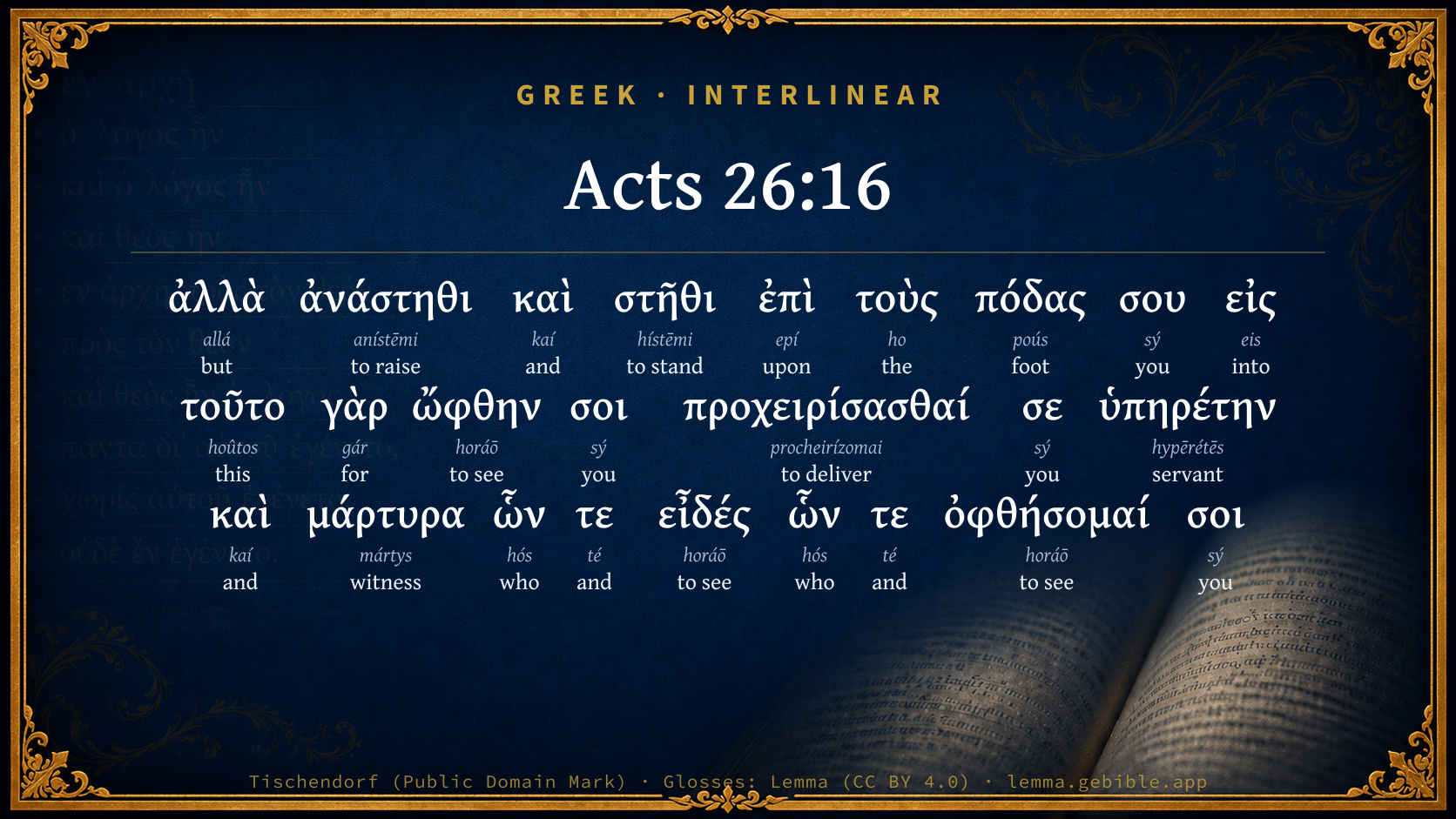
Greek (Tischendorf 8th ed.) Acts 26:16 appears in the Greek New Testament. The text above is from the Tischendorf 8th edition. Each word links to its Strong’s number and a concise gloss. Click any word for its full Thayer’s Greek Lexicon entry.
Download image
Cite this verse

Acts 26:16 (World English Bible). Public Domain. Lemma interlinear Bible study tool, https://lemma.gebible.app/v/acts/26/16.

Show BibTeX & RIS
BibTeX
RIS
English Translation
But arise, and stand on your feet, for I have appeared to you for this purpose: to appoint you a servant and a witness both of the things which you have seen, and of the things which I will reveal to you;
World English Bible · Public Domain
Download a study sheet

One document with this verse’s original text, its word-by-word gloss line, the meaning frame, cross-references with their text, attributed commentary, and full source and license credits — printable, and it pastes into notes with its structure intact.

This verse Autodidact and up

Study sheet (.html) Plain text (.txt)

A passage Seminary Student

Up to 50 verses in one chapter. A passage sheet keeps up to 6 commentary sources and 12 cross-references per verse, in the order this page ranks them, and says so on the sheet whenever that leaves anything out. Ask for a single verse and you get the Autodidact verse sheet above.

Everything on this page stays free to read, with no account — the sheet is a download of what is already on screen, not access to it.

Want to remove ads? Support Godless Engineer
Compare translations 3

The same verse in 3 English versions, stacked beneath the original-language interlinear above. Click any original word for its lexicon entry.

Each is an independent rendering of the whole verse — the interlinear is not word-aligned to these translations.

Highlighted words mark where these versions differ — a whole-verse word diff, not a word-by-word alignment.

  • World English Bible Public Domain
    But arise, and stand on your feet, for I have appeared to you for this purpose: to appoint you a servant and a witness both of the things which you have seen, and of the things which I will reveal to you;
  • King James Version Public Domain
    But rise, and stand upon thy feet: for I have appeared unto thee for this purpose, to make thee a minister and a witness both of these things which thou hast seen, and of those things in the which I will appear unto thee;
  • unfoldingWord Literal Text CC BY-SA 4.0
    But get up and stand on your feet, because for this I have appeared to you, to appoint you a servant and a witness both of the things in which you have seen me and of the things in which I will be shown to you,

unfoldingWord Literal Text — © unfoldingWord, licensed CC BY-SA 4.0. Word-aligned USFM3 via Door43 (git.door43.org/unfoldingWord/en_ult).

Versions to compare (up to 4)

3 of 4 selected

Show all 19 translations

Every available English version of this verse, each an independent rendering of the whole verse.

  • World English Bible Public Domain
    But arise, and stand on your feet, for I have appeared to you for this purpose: to appoint you a servant and a witness both of the things which you have seen, and of the things which I will reveal to you;
  • Berean Standard Bible Public Domain
    ‘But get up and stand on your feet. For I have appeared to you to appoint you as a servant and as a witness of what you have seen from Me and what I will show you.
  • Majority Standard Bible Public Domain
    ‘But get up and stand on your feet. For I have appeared to you to appoint you as a servant and as a witness of what you have seen and what I will show you.
  • King James Version Public Domain
    But rise, and stand upon thy feet: for I have appeared unto thee for this purpose, to make thee a minister and a witness both of these things which thou hast seen, and of those things in the which I will appear unto thee;
  • American Standard Version (1901) Public Domain
    But arise, and stand upon thy feet: for to this end have I appeared unto thee, to appoint thee a minister and a witness both of the things wherein thou hast seen me, and of the things wherein I will appear unto thee;
  • Revised Version (1885) Public Domain
    But arise, and stand upon thy feet: for to this end have I appeared unto thee, to appoint thee a minister and a witness both of the things wherein thou hast seen me, and of the things wherein I will appear unto thee;
  • Geneva Bible (1599) Public Domain
    But rise and stand vp on thy feete: for I haue appeared vnto thee for this purpose, to appoint thee a minister and a witnesse, both of the things which thou hast seene, and of the things in the which I will appeare vnto thee,
  • Douay-Rheims (1899) Public Domain
    But rise up, and stand upon thy feet: for to this end have I appeared to thee, that I may make thee a minister, and a witness of those things which thou hast seen, and of those things wherein I will appear to thee,
  • Young's Literal Translation Public Domain
    but rise, and stand upon thy feet, for for this I appeared to thee, to appoint thee an officer and a witness both of the things thou didst see, and of the things `in which' I will appear to thee,
  • Literal Standard Version CC BY-SA 4.0
    but rise, and stand on your feet, for this I appeared to you, to appoint you an officer and a witness both of the things you saw, and of the things [in which] I will appear to you,
  • Unlocked Literal Bible CC BY-SA 4.0
    Now get up and stand on your feet; because for this purpose I appeared to you, to appoint you to be a servant and a witness concerning the things that you know about me now and the things that I will show to you later;
  • unfoldingWord Literal Text CC BY-SA 4.0
    But get up and stand on your feet, because for this I have appeared to you, to appoint you a servant and a witness both of the things in which you have seen me and of the things in which I will be shown to you,
  • Darby Bible Public Domain
    but rise up and stand on thy feet; for, for this purpose have I appeared to thee, to appoint thee to be a servant and a witness both of what thou hast seen, and of what I shall appear to thee in,
  • World Messianic Bible Public Domain
    But arise, and stand on your feet, for I have appeared to you for this purpose: to appoint you a servant and a witness both of the things which you have seen and of the things which I will reveal to you;
  • Webster's Bible Public Domain
    But rise, and stand upon thy feet: for I have appeared to thee for this purpose, to make thee a minister and a witness both of the things which thou hast seen, and of the things in which I will appear to thee;
  • Free Bible Version CC BY-SA 4.0
    ‘But pick yourself up and get to your feet. The reason why I've appeared to you is to appoint you as my servant, to be a witness for me, telling others how you have seen me and everything I will reveal to you.
  • Bible in Basic English Public Domain
    But get up on your feet: for I have come to you for this purpose, to make you a servant and a witness of the things in which you have seen me, and of those in which you will see me;
  • Text-Critical English NT CC BY 4.0
    But rise and stand on yoʋr feet, for I have appeared to yoʋ for this purpose, to appoint yoʋ as a servant and witness to the things yoʋ have seen and to the things in which I will appear to yoʋ.
  • Tyndale New Testament (1534) Public Domain
    But ryse and stond vp on thy fete. For I have apered vnto the for this purpose to make the a minister and a witnes both of tho thinges which thou hast sene and of tho thinges in the which I will appere vnto the

Literal Standard Version (2020), Covenant Press — licensed CC BY-SA 4.0. Text via the HelloAO Bible API (eBible.org). Unlocked Literal Bible (unfoldingWord) — licensed CC BY-SA 4.0. Text via the HelloAO Bible API (eBible.org). unfoldingWord Literal Text — © unfoldingWord, licensed CC BY-SA 4.0. Word-aligned USFM3 via Door43 (git.door43.org/unfoldingWord/en_ult). Free Bible Version, Dr. Jonathan Gallagher — licensed CC BY-SA 4.0. Text via the HelloAO Bible API (eBible.org).

Word by word

More ways to search: Search by grammar → Find every occurrence → Compare this word →

Practice this passage: Drill this verse → Learn its vocabulary →

προχειρίσασθαί
procheirízomai
G4400
“to deliver”
Verb, Aorist, Middle deponent, Infinitive
Part of Speech
Verb
Tense
Aorist
Voice
Middle deponent
Mood
Infinitive
Full Thayer's Definition

Origin: middle voice from G4253 and a derivative of G5495

TDNT: 6:862,*

1. to put into the hand, to deliver into the hands 2. to take into one's hands 3. to set before one's self, to prostrate, to determine 4. to choose, to appoint a. for one's use b. for one's salvation
  1. ἀλλὰ allá G235 “but” Conjunction
  2. ἀνάστηθι anístēmi G450 “to raise” Verb, Aorist, Active, Imperative, 2nd person, Singular
  3. καὶ kaí G2532 “and” Conjunction
  4. στῆθι hístēmi G2476 “to stand” Verb, Aorist, Active, Imperative, 2nd person, Singular
  5. ἐπὶ epí G1909 “upon” Preposition
  6. τοὺς ho G3588 “the” Article, Accusative, Plural, Masculine
  7. πόδας poús G4228 “foot” Noun, Accusative, Plural, Masculine
  8. σου sý G4771 “you” Personal pronoun, 2nd person, Genitive, Singular
  9. εἰς eis G1519 “into” Preposition
  10. τοῦτο hoûtos G3778 “this” Demonstrative pronoun, Accusative, Singular, Neuter
  11. γὰρ gár G1063 “for” Conjunction
  12. ὤφθην horáō G3708 “to see” Verb, Aorist, Passive, Indicative, 1st person, Singular
  13. σοι sý G4771 “you” Personal pronoun, 2nd person, Dative, Singular
  14. σε sý G4771 “you” Personal pronoun, 2nd person, Accusative, Singular
  15. ὑπηρέτην hypērétēs G5257 “servant” Noun, Accusative, Singular, Masculine
  16. καὶ kaí G2532 “and” Conjunction
  17. μάρτυρα mártys G3144 “witness” Noun, Accusative, Singular, Masculine
  18. ὧν hós G3739 “who” Relative pronoun, Genitive, Plural, Neuter
  19. τε té G5037 “and” Particle
  20. εἶδές horáō G3708 “to see” Verb, Aorist, Active, Indicative, 2nd person, Singular
  21. ὧν hós G3739 “who” Relative pronoun, Genitive, Plural, Neuter
  22. τε té G5037 “and” Particle
  23. ὀφθήσομαί horáō G3708 “to see” Verb, Future, Passive, Indicative, 1st person, Singular
  24. σοι sý G4771 “you” Personal pronoun, 2nd person, Dative, Singular

About this verse

These counts appear in no published source. They are computed here, from the morphology-tagged text and Lemma’s own curated glosses. What Lemma adds →

25
words
17
distinct lemmas
Acts
section

Notable vocabulary

The rarest word here is προχειρίσασθαί to deliver G4400 — appearing just 3 times in the whole Greek New Testament.

Shared distinctive vocabulary

προχειρίσασθαί to deliver G4400 occurs in 3 verses of the Greek New Testament. Also found in:

Repetition

Words recur within this verse:

Cross-references

31

Topical passages linked to Acts 26:16 in the Treasury of Scripture Knowledge — connected by theme and wording, ordered by reader-vote popularity; previews shown in the World English Bible.

  • Acts 22:14–15 He said, 'The God of our fathers has appointed you to know his will, and to see the Righteous One, and to hear a voice from his mouth.
  • Ezekiel 2:1 He said to me, Son of man, stand on your feet, and I will speak with you.
  • Daniel 10:11 He said to me, Daniel, you man greatly beloved, understand the words that I speak to you, and stand upright; for to you am I now sent. When he had spoken this word to me, I stood trembling.
  • Romans 15:16 that I should be a servant of Christ Jesus to the Gentiles, ministering as a priest the Gospel of God, that the offering up of the Gentiles might be made acceptable, sanctified by the Holy Spirit.
  • Galatians 1:12 For neither did I receive it from man, nor was I taught it, but it came to me through revelation of Jesus Christ.
  • 1 Timothy 1:12 And I thank him who enabled me, Christ Jesus our Lord, because he counted me faithful, appointing me to service;
  • Acts 23:11 The following night, the Lord stood by him, and said, "Cheer up, Paul, for as you have testified about me at Jerusalem, so you must testify also at Rome."
  • Romans 1:5 through whom we received grace and apostleship, for obedience of faith among all the nations, for his name's sake;
  • 2 Corinthians 4:1 Therefore seeing we have this ministry, even as we obtained mercy, we don't faint.
  • 2 Corinthians 12:1–7 It is doubtless not profitable for me to boast. For I will come to visions and revelations of the Lord.
  • Galatians 2:2 I went up by revelation, and I laid before them the Gospel which I preach among the Gentiles, but privately before those who were respected, for fear that I might be running, or had run, in vain.
  • Ephesians 3:7–8 of which I was made a servant, according to the gift of that grace of God which was given me according to the working of his power.
  • Colossians 1:23 if it is so that you continue in the faith, grounded and steadfast, and not moved away from the hope of the Gospel which you heard, which is being proclaimed in all creation under heaven; of which I, Paul, was made a servant.
  • Colossians 1:25 of which I was made a servant, according to the stewardship of God which was given me toward you, to fulfill the word of God,
  • Acts 9:6–9 But rise up, and enter into the city, and you will be told what you must do."
  • Acts 9:15–16 But the Lord said to him, "Go your way, for he is my chosen vessel to bear my name before the nations and kings, and the children of Israel.
  • Acts 13:1–4 Now in the assembly that was at Antioch there were some prophets and teachers: Barnabas, Simeon who was called Niger, Lucius of Cyrene, Manaen the foster-brother of Herod the tetrarch, and Saul.
  • Acts 18:9–10 The Lord said to Paul in the night by a vision, "Don't be afraid, but speak and don't be silent;
  • Acts 20:24 But these things don't count; nor do I hold my life dear to myself, so that I may finish my race with joy, and the ministry which I received from the Lord Jesus, to fully testify to the Gospel of the grace of God.
  • Acts 21:19 When he had greeted them, he reported one by one the things which God had worked among the Gentiles through his ministry.
  • Acts 22:10 I said, 'What shall I do, Lord?' The Lord said to me, 'Arise, and go into Damascus. There you will be told about all things which are appointed for you to do.'
  • Acts 22:17–21 "It happened that, when I had returned to Jerusalem, and while I prayed in the temple, I fell into a trance,
  • Acts 27:23–24 For there stood by me this night an angel, belonging to the God whose I am and whom I serve,
  • 2 Corinthians 5:18 But all things are of God, who reconciled us to himself through Jesus Christ, and gave to us the ministry of reconciliation;
  • Colossians 1:7 even as you learned of Epaphras our beloved fellow servant, who is a faithful minister of Christ on our behalf,
  • 1 Thessalonians 3:2 and sent Timothy, our brother and God's servant in the Gospel of Christ, to establish you, and to comfort you concerning your faith;
  • 1 Timothy 4:6 If you instruct the brothers of these things, you will be a good servant of Christ Jesus, nourished in the words of the faith, and of the good doctrine which you have followed.
  • 2 Timothy 4:5 But you be sober in all things, suffer hardship, do the work of an evangelist, and fulfill your ministry.
  • Acts 1:17 For he was numbered with us, and received his portion in this ministry.
  • Acts 1:25 to take part in this ministry and apostleship from which Judas fell away, that he might go to his own place."
  • Acts 6:4 But we will continue steadfastly in prayer and in the ministry of the word."

Cross-references courtesy of OpenBible.info (CC BY 4.0).

Where the printed editions differ

1 variant

Places in this verse where the major printed Greek editions disagree on the wording in a way that affects the translation — a comparison of editions, not a manuscript-by-manuscript collation. The editions are the modern critical texts (Nestlé-Aland 28/27, SBL, Westcott-Hort, Tregelles, Tyndale House) and the traditional texts behind the KJV (the Textus Receptus and the Byzantine/Majority text). It is not a claim about which reading is original.

  1. Extra text
    με

    “of Me”

    In NA28NA27TynSBLWH Not in TregTRByz

    με (me) 'of Me' is only in older manuscripts (NA28+NA27+Tyn+SBL+WH)

Textual data: Translators Amalgamated Greek New Testament (STEPBible TAGNT) · CC BY 4.0.

Commentary

Notes on Acts 26:16 from classic Christian and Jewish commentators (each source and its license shown beneath its notes). The classic Christian expositions comment on the surrounding passage and are grouped to its opening verse, so a note may address several verses; the Jewish commentaries on the Tanakh (Rashi and others) are per-verse, so they appear only where the commentator wrote on this verse.

Lemma curates 59 commentaries, every one of them public domain or Creative Commons licensed, each selected and text-cleaned for this edition rather than reprinted as found. About our sources →

The Biblical Illustrator

Joseph S. Exell

Act_26:16-18

But rise, and stand upon thy feet; for I have appeared unto thee to make thee a minister and a witness.

Christianity self-attested

If you had given you what was asserted to be a speech made long ago by your father, the first reading of it would settle the matter. Knowing your father, his sentiments, his mode of expression, you would be able to say instantly whether the speech was authentic or fabricated. We ought by this time to know enough of Christs manner to be able to say whether any speech purporting to be His was actually ever spoken by His lips. Is this? Let us see. Christ is reported as saying--

1. I have appeared unto thee for this purpose. Here I recall the words which made the first ministers, Follow Me. He is as personal as ever.

2. I have appeared unto thee for this purpose, to make-- Here I remember the word, I will make you fishers of men. Jesus Christ is still Creator. The speaker does not propose to modify, add to, rearrange.

3. To make thee a minister--that is a new word--and a witness--that is an old word. Ye are, said Jesus Christ, witnesses of these things.

4. Proceed still further: a witness both of these things which thou hast seen. Why, that is the old method: Go and show John again those things which ye do hear and see. We speak as eyewitnesses; we are not quoters from authors of an ancient date.

5. Proceed further: and of those things in the which I will appear unto thee. Jesus said, I have yet many things to say unto you, but ye cannot bear them now. There is no end to the meaning of revelation. There is no end to the literature of the alphabet. The letters are but six-and-twenty in number, and no man attempts to add another! It is the same with the New Testament. Observe, nothing is added to the revelation. However large the book, it is all in the alphabet; however magnificent the unfoldment of the truth by human eloquence, the truth itself is the distinct and direct gift of God alone.

6. Proceed now to verse 17: Delivering them from the people and from the Gentiles. Here is the Lords own speech: Behold, I send you forth as sheep in the midst of wolves, etc. It is a marvellous thing if this was invented. It is impossible, considering Sauls antecedents, that he could have invented a speech so perfect, not only in the letter, but in the spirit.

7. The eighteenth verse is a summary of all that Jesus began both to do and to say. The miracles and the gospels are all there. For example, To open their eyes. That is what Jesus Christ was always doing. He could never be at rest in the presence of the blind. Again and again He said, According to your faith, be it unto you. Christ will not have any blind followers.

8. To turn them from darkness to light. When did He ever turn men from light to darkness? Whenever He visited a town, the inhabitants were startled by an excess of intellectual lustre; old thoughts stood up in new meanings when He breathed them; the law itself became a kind of gospel when He repronounced its awful words.

9. And from the power of Satan unto God. When did He ever reverse that process? His first battle was with the devil in the wilderness, and His last battle was with the devil on the Cross.

10. Go further: that they may receive forgiveness of sins. That is His very word: Son, daughter, thy sins, which are many, are all forgiven thee. That is not the kind of word which a bad man would be likely to invent.

11. But how was this forgiveness to be accomplished? and how was it be followed? By inheritance among them which are sanctified. The whole process is set down to the action of faith. Have we ever heard that word before? Why, the word is the keyword of Christs ministry. Conclusion: So far the speech is self-proving. I find in it no syllable or tone that is not in vital accord with everything we have read in the Gospels ever spoken or done by the Son of God. This is a field of evidence to which I would invite every student of the Scriptures. Read the Book carefully through with a view to see how far its parts are confirmed by one another, and how far even apparent discrepancies admit of a kind of reconciliation which adds infinite force to the substantial argument for the unity of the Scriptures. Perhaps a more vivid instance of confirmation could hardly be produced than the one which is now before us. Paul is supposed to be in a fanatical state of mind; he is struck down to the ground, blinded, disabled; he is supposedly the victim of an hallucination of the most complete kind; yet when he himself reports what happened to him, no slip or flaw can be found in his evidence which throws the slightest doubt upon the identity of the doctrine of Jesus Christ, as revealed in the accepted Gospels. More than Chat, everything is here which is needed. Take this as a programme for the revolution, regeneration, and perfecting of the world, and add to it one line that is not involved in its unfathomable wisdom. It cannot be done. (J. Parker, D. D.)

Why am I saved

1. Notice the swiftness of the revelation of Gods purpose as to the apostle of the Gentiles. An ordinary call to the ministry usually involves long processes of self-examination and observation of Gods guiding providences.

2. The distinctness with which Paul comprehended his mission is notable. He continually declares his one, only aim in life to apprehend (or lay hold of) Him, he says, who has laid hold of me.

3. This obedient spirit deserves distinct mention. I was not disobedient to the heavenly vision. He never was. At the end of his life he wrote, I have kept the faith. But turning away from these and other lines of discussion, let us accentuate the proposition that God has a purpose in our salvation. We ought to know what that purpose is. Am I saved merely to have my name entered on a Church roll? to keep up a form of godliness?

No; I am saved for a two-fold purpose--viz., to glorify Gods grace in my personal salvation and sanctification, and also to advance the kingdom of God in the world.

1. We infer, first of all, the need of the illuminating light from heaven to make us realise our high calling of God.

2. Again, we see our obligation to fulfil Christs purpose in our salvation as Paul saw the purpose of his salvation and accomplished it. (G. E. Reed.)

The objects of the Christian ministry

I. The object of the Christian ministry is the exhibition of the character of God. That there is a God, all Nature cries aloud through all her works (Psa_19:1-4; Rom_1:20). But Nature is a speechless beauty, waiting in silence till man shall find leisure and inclination to he instructed by dumb signs. She discloses some traces of his wisdom, goodness, and power; but a sinner, under a sense of his guilt, might remain in her presence for ages, without discovering what is essential to his relief. It was reserved to the gospel to reveal the character of Him whose perfections are unceasingly adored in the world of light, whose will is law, to whose designs all beings and all events are subservient, whose hands supply the wants of every creature, whose heart compassionates the children of sorrow, whose frown is hell, whose smile is heaven. Even the Old Testament afforded but partial discoveries of Him. A veil still remained over Him; which veil the gospel has drawn aside. His holiness, His justice, and His mercy, shine in the clearest light; there, if genuine Christians, we effectually discern the doctrines which demand our faith, the privileges which claim our gratitude, the promises which encourage our hope, the principles which compose our character.

II. The Christian ministry is designed to promote the destruction of the kingdom of satan and the establishment of that of Christ. The dominion of Satan commenced at an early period. Its foundation was laid in falsehood. The supports of his throne are delusion and depravity, wrought into a thousand fantastic and ten thousand odious forms. But the usurper was not permitted to reign without control. His final defeat was predicted in the very scene which had been disgraced by his victory. Then was the assurance given, that the seed of the woman should bruise the serpents head. At length the Messiah came, for the glorious purpose of recovering this colony of rebels to the duty they had renounced, and the felicity they had forfeited. His triumphs began in the wilderness, where He foiled the tempter, and compelled him to retire; they were extended, when the seventy returned with joy, saying, Lord, even the devils are subject to us through Thy name. But it was after His resurrection and ascension that this mighty Conqueror shone forth in the splendour of His sublimest achievements. The commission with which He invested the apostles was accompanied with power from on high; and He bare them witness, both with signs and wonders, and with divers miracles and gifts of the Holy Ghost. A thousand delusions were scattered by the beams of truth; the slumbers of insensibility were shaken off; the rock of impenitence was melted; faith opened to the moral wanderer a heavenly prospect; peace cheered the bosom that had throbbed with anguish; and the sceptre of righteousness was swayed over the faculties, passions, and appetites, that had been perverted and enslaved by the tyranny of hell.

III. The Christian ministry is established for the purpose of leading those among whom it is exercised to the practise of pure and undefiled religion, and thus effecting the most important change that can be introduced into the condition of mankind (verse 18). Accordingly, we find the same apostle afterwards stating (Tit_2:11-12). Such is the influence of the gospel on the character of everyone by whom it is cordially received. It not only reveals a Saviour, but is the instrument of conveying salvation. Through the medium of the gospel the Holy Spirit enlightens the understanding, subdues vicious propensities, restores the Divine image, and prepares the frail tenant of earth for the inheritance reserved in heaven.

IV. The Christian ministry will result in the brightest manifestation of the Saviours glory. To Him it owes its origin, its support, its conductors, and its efficacy. He is the Subject of it. Apart from His dignity and condescension; His virtues and sufferings; His doctrines, commandments, and promises; the miracles which He wrought, the atonement which He made, His triumph over His death, His constant intercession, and the grace which flows from His inexhaustible fulness--the Christian ministry were a mere name, and those who engage in it only beat the air. But when a man, saved from eternal ruin ascends before a congregation inspired with grateful astonishment, and anxious to see every hearer a participant of his own felicity, how can he forget his Divine benefactor, or allude to Him in obscure language, and with faint regard! Behold Him, and all who, being honoured with the same office, press forward in the same spirit, continually insisting on the all-important theme. They are the servants of Jesus Christ, and they urge His authority; they live upon His smile, and they want words to express the magnitude of the privilege; they are the almoners of His bounty, and they beseech, as on the bended knee, their fellow mortals to receive it. Great is the reward which awaits them all. (O. A. Jeary.)

Gods work upon minister and convert

I. A work wrought by God upon the minister.

1. Subjugation. While a man is a rebel, the Lord does not appoint him an ambassador; while he is dead in sin, a preacher of the way of life. Paul was struck down; for if he had not fallen, he would not have known how to lift others up. He remained blind for three days; otherwise he would not have been qualified to deal with others in darkness. See what God does in His ministers to fit them for your conversion. In order to slay your sins the shaft has been polished. Each of the best locks made by our eminent locksmiths is unique, and each needs its own special key: so God fits certain men for reaching certain men.

2. Encouragement. Rise, and stand upon thy feet. Men can hardly be very useful till they cease to be despondent, and become energetic and hopeful. I have noticed that those who do not believe that they will be successful seldom are so; but those who rise and stand upon their feet, and manfully expect that God will bless them, are not disappointed.

3. Ordination. And to this end he must see the Lord for himself. Our Lords appearing--

(1) Makes him willing to be a servant, for that is the meaning of the word minister. When the renewed mind beholds the Lord, it cries out, What wilt Thou have me to do?

(2) Qualifies him to act as a witness. We cannot bear witness to that which we have never seen. Hearsay is of small value. Heads are won by reasoning, but hearts are won by witness bearing.

4. Continuous instruction. He is to be a witness not only of those things which he has seen, but also of those things in the which the Lord will yet appear unto him.

5. Constant preservation. Delivering thee from the people, etc. Pauls life was always in danger, and yet never in real peril, for the Lord was his keeper. So shall every true servant of Christ be kept as with a garrison from all evil.

II. The work wrought in the hearer.

1. Illumination: the Lord sends His servant to open their eyes. Men are born blind, and continue blind till, by the power of Jesus, sight is given to them. Your education and surroundings have perhaps placed a film of prejudice over your eyes; if a candid, childlike spirit were given you, you would see. Or possibly some favourite sin is like a cataract upon the eye of your conscience, and you cannot see the evil of sin or the beauty of holiness. Or it may be that unbelief darkens your soul.

2. Conversion: to turn them from darkness to light. What a blessed turning is that which makes us face truth, and goodness, and God, and heaven; and leave ignorance, sin, and hell behind.

3. Translation. As the soul is brought into a new element, so is it also brought under a new government. From the power of Satan unto God. Somebody says, I do not understand how this can be performed in a minute. Well, two men are fighting, and we beg them to leave off. Do you recommend them to leave off gradually? If anybody held a pistol at my head, I should not say, Take it away by degrees. Changes of mind such as are necessary to conversion had need be quick when sin is to be forsaken, for every moment deepens the guilt. It may seem a very gradual process by which a man who was dead comes to life; but for certain there is a point at which he left the dead and became alive, and that point God sees very clearly, even though we do not.

4. Complete forgiveness. The same moment that we receive Christ, we receive forgiveness of sins and inheritance among them which are sanctified. What a blessing to become an heir of God! To what choice company is a sinner introduced when he believes in Jesus! He is a freeholder among the burgesses of the New Jerusalem.

5. And all this has for its certificate and mark of genuineness these words--By faith that is in Me. The whole process of salvation is by faith.

III. A work which must be done by the hearer himself. This text speaks of Paul being an instrument in the hands of God of opening mens eyes, etc., and they seem to be passive; but now they are called upon to be active. We are created thinking, intelligent beings, and we are saved as such. Never let us forget either the free agency of man or the purposes of God. Grace reigns not over slaves, but over obedient children.

1. You must repent. It is not the work of God the Holy Ghost to repent for you, but to lead you to repent.

2. You must turn to God. Your prayer may be, Turn thou me, and I shall be turned; but the command is, Turn ye, turn ye, why will ye die? God will turn you, but you have willingly to yield, and thus turn yourself.

3. You must do works meet for repentance; for wherever there is true faith there will be corresponding works, such as these: restitution if you have wronged anyone, reconciliation if you are at enmity with anyone, acknowledgment if you have spoken falsely, giving up of evil habits, and an earnest endeavour to be pure and holy. (C. H. Spurgeon.)

Apostolic ministry

I. Its theme. What had he to testify?

1. All that he had seen of Christ. He had seen and heard great things amidst the bright light which struck him to the ground.

2. All that he should see of Christ. He would receive many more communications. A true minister will be always receiving fresh communications of truth, and he must proclaim the new as well as the old.

II. Its beneficence. He had to effect--

1. The highest good.

(1) Spiritual illumination: Open their eyes. An expression this implying--

(a) The moral blindness of the sinner.

(b) The restorative character of Christianity--it does not give new eyes, but opens the old ones.

(c) The genuineness of Christ as a reformer--the design of impostors is to close eyes.

(2) Soul emancipation: From the power of Satan unto God. Satan enslaves men by lust, worldliness, prejudice, superstition, etc. The ministers work is to manumit the slave.

(3) Divine forgiveness: That they may receive forgiveness of sins. This act is represented in the Bible as cancelling, forgetting, drowning sin; separating the sinner from his sin.

(4) Eternal blessedness: Inheritance amongst them which are sanctified, etc.

(a) Legitimate possession--having a kind of right to it.

(b) Social intercourse among them, not a scene of isolation.

(c) Moral purity sanctified. The Christian circle is holy.

2. The highest good by a simple method. By no onerous labour or costly sacrifices, but by faith that is in Me; not in priests, not in human creeds, not in the opinions of men about Me. Faith in Christ is not a mere thing of the intellect; it involves the deepest sympathies of the heart. Nor is it even a thing of thought and feeling combined; it takes the form of living acts; it moulds the life.

(1) Faith is in itself one of the easiest acts a man can perform. A child can believe; the propensity to believe is one of the strongest in human nature. Credulity has ruined the world.

(2) Faith in itself is one of the most influential acts. What a man really believes sways his thoughts, controls his passions, and regulates his life.

III. Its fulfilment. I was not disobedient unto the heavenly vision. He discharged this commission.

1. Self-denyingly.

2. Continuously. He began when he was converted, and went on. This is the true order. Begin with those nearest at hand.

3. Reformatively. His grand aim was spiritually to reform men, which includes two things--

(1) A renewed mind. Repent--a thorough change--and turn.

(2) A renewed life. Works meet for repentance: the conduct answering the new state of the soul. (D. Thomas, D. D.)

Christian ministry defined

This is the kind of ministry which Christ wishes to establish. No other statement is needed. This conception is such as never entered into the uninspired mind, and, in particular, never could have entered into a mind constituted as was Sauls.

I. Rise and stand upon thy feet. Here is the typical manliness of the Christian ministry. We do not want crawling, fawning men, but men who can stand up and show their stature and force. The minister, realising Christs conception, does not apologise for his existence: he stands upon his feet. Jesus did not speak to Saul as he lay down in the dust. He will not send frightened things about His messages and errands; He will have the whole man at his best. But what kind of manliness? Only that manliness which is made possible by Christ. To stand without permission to stand is impertinence; to stand in obedience to Divine injunction is humility. God can make men sit down, roll in the dust of the ground; and it is out of such lying that the true strength comes. If we have not first been laid down by the Divine power, we cannot stand in the Divine strength. The command is a royal command. He who has stood before Christ may well stand before kings. We get over all our nervousness when we are with the Lord. Fear God, and have no other fear.

II. For I have appeared unto thee to make thee a minister. Then ministers are not man made; they are not turned out by machinery. Only Christ can make ministers. We have forgotten this; we have taken to making a species of ecclesiastical pottery. We do not read, I have appeared unto thee to make thee an equal, a priest, but a minister--i.e., a servant, a slave. There is no mistaking the minister which Christ makes. The seal of Christ is not always the kind we like; but somewhere there is the indubitable sign--in one man in the intellect, in another in the tender heart; here in the eloquence that fills the ear with delight, and there in the pleading, holy intercession that lifts the listening soul into the quietude of heaven.

III. Christ must not only find the minister, He must find the sermon.

1. A minister and a witness of these things which thou hast seen. Not those things which thou hast imagined, invented; so that a man denying thy ministry must first deny thy character. Wondrous ministry! the soul continually upon oath, the voice forbidden to utter anything for the sake of uttering it, and charged to tell what the soul has already heard. No man could have imagined such a call, and especially no man like Paul.

2. Of those things in the which I will appear unto thee. There is a growing revelation. Christianity has a future as well as a past. Expect the vision; wait for the additional revelation. It will not be anything new in the sense of unrelated, but new in the sense of development, progress from the thing already in the soul. Sometimes we say of a sermon, How large a sermon from so small a text! No. In every acorn there is enough to clothe all the mountains of the earth with umbrageous oaks--forests out of which navies might be cut and palaces might be built. There is nothing new in the oak; everything was in the acorn. It is so when Jesus comes to us--the same Jesus, the same grace, the same Spirit, but growing in grace and in the knowledge of our Lord Jesus Christ.

IV. Delivering thee from the people and from the Gentiles. Shall I, then, be in the clutch of evil men? Yes; but thou shalt be delivered from them. Every minister has his stormy career if he be a faithful minister. Sometimes a minister will tell you--as if he were preaching his own funeral sermon--that he never had a difference with any human creature. What an awful life to have lived! Hear the light saying, I never had a battle with darkness! The true minister cannot have a peaceful and luxurious life. Who wants the minister in his proper capacity? Not the makers of ill-gotten gain, profane men, worldly men, self-idolaters, nor men whose books have never been audited by pure sunlight. Many want him as a companion, a man as well-read as themselves, exchanging the pleasant word; but who wants him as a representative of the throne of God? Let any minister try that course, and he will soon see that it is impossible to be popular. (J. Parker, D. D.)

The Biblical Illustrator, edited by Joseph S. Exell (c. 1880s–1900s) — public domain. Text from a community e-Sword module.

Joseph Benson's Commentary

Act 26:16-18. But rise and stand upon thy feet — Though thou hast persecuted me and my followers in this outrageous manner, and hast been engaged in a desperate attempt to destroy them from the face of the earth, and, by so doing, hast forfeited thy life. I am determined graciously to spare it, and to use thee hereafter as the instrument of my grace. For I have appeared unto thee — In this extraordinary manner; for this purpose, to make thee a minister — Of my gospel; and a witness both of these things which thou hast seen — Now, at this time; and of those in which I will appear unto thee — Namely, hereafter; Delivering thee from the people — The Jews; and the Gentiles, to whom — Both Jews and Gentiles; I now send thee — Paul gives them to know that the liberty he enjoyed, even in bonds, was promised to him, as well as his preaching to the Gentiles. I, denotes the authority of the sender; now, the time whence his mission was dated. For his apostleship, as well as his conversion, commenced at this moment. To open their eyes — The eyes of them who are now in a miserable state of blindness, whether Jews or Gentiles. He opens them who sends Paul, and he does it by Paul who is sent. And to turn them from darkness — From that state of ignorance and folly in which they are involved; that is, with respect to the Gentiles, to turn them from following false and blind guides, their oracles, divinations, and superstitious usages, received by tradition from their fathers, and the corrupt notions they had of their gods. And with respect to the Jews, to rescue them from their ignorance of the spirituality, extent, and obligation of the moral law, and of the shadowy, typical, and temporary nature of the Mosaic institution in general, as also from their ignorance of the spiritual and heavenly nature of the Messiah’s kingdom, and the qualifications necessary for becoming subjects of it, and of the true sense of the prophetic writings with relation to these things; to light — The light of divine knowledge and wisdom; and from the power of Satan — Who now holds them in a state of sin and guilt, weakness and wretchedness; unto God — To his love and service: for it was not sufficient for them to have their eyes opened, it was also necessary to have their hearts renewed; not enough to be turned from darkness to light, but they must be turned from sin to holiness; which, indeed, follows of course; for Satan rules by the power of darkness, and God by the convincing evidence of light. Idolaters were and are, in a special manner, under the power of Satan, paying their homage to creatures of their own fancy; to images, or imaginary beings; or to God’s creatures, not formed and given to man for any such purpose; that is, in effect, doing service to devils: but all sinners, also, are under the power of Satan, influenced by his temptations, yielding themselves captives to his will and pleasure. But converting grace rescues them from his tyranny, and brings them into subjection to God; translates them out of the kingdom of darkness into the kingdom of God’s dear Son. Observe, reader, when gracious dispositions are as strong in the soul as corrupt and sinful dispositions had been, it is then turned from the power of Satan unto God. That they may receive forgiveness of sins — That they may be pardoned, and restored to God’s favour, which by sin they had forfeited. They are delivered from the dominion of sin, that they may be delivered from that death which is the wages of sin; not that they may merit that forgiveness, as a debt or reward, but that they may receive it as a free gift, together with the comfort arising from it; they are persuaded to lay down their arms, and return to their allegiance, that they may have the benefit of the act of indemnity passed by God in behalf of those who do so. An inheritance, or lot, among them which are sanctified — That Isaiah , 1 st, That they may be sanctified as well as justified; may be redeemed from all iniquity, Tit 2:14; cleansed from all unrighteousness, 1Jn 1:9; from all unholy tempers, words, and works, purified from all pollution of the flesh and of the spirit, 2Co 7:1; and made glorious souls, not having spot, or wrinkle, or any such thing, but constituted holy and without blemish, Eph 5:26-27; in other words, so renewed by the power of the Holy Ghost as to bear the image of the heavenly, as they had borne that of the earthly, and be made partakers of the divine nature, Tit 3:5; 2Pe 1:4. 2d, That they may receive an inheritance among such as are thus sanctified, even the inheritance incorruptible, undefiled, and that fadeth not away. For this inheritance, the forgiveness of our sins and the sanctification of our nature prepare us; removing that guilt and depravity which were the chief hinderances in the way of our receiving it. As all those that shall be saved hereafter must be sanctified as well as justified here, all that receive the heavenly inheritance must be thus entitled to it and made meet for it: and none can be saints in heaven that are not first saints on earth; so we need no more to ensure our happiness in a future world, than to possess these blessings in this world. And, as is here stated, these, together with the heavenly inheritance, for which they prepare us, are received by faith in Jesus: for faith in him, and in the promises of God, made to the penitent and believing through him; the faith whereby we not only receive divine revelation in general, but the record which God hath given of his Son in particular; by which we apply to, and rely on, Christ as the Lord our righteousness and sanctification, and resign ourselves to him as the Lord our proprietor and ruler; this is that faith whereby we receive forgiveness, holiness, and eternal life, the salvation of grace here, and the salvation of glory hereafter.

Joseph Benson's Commentary on the Old and New Testaments (1811–1818) — public domain. Text from a community e-Sword module.

Bengel's Gnomon

Johann Albrecht Bengel

Act 26:16. Ὧν τε ὀφθήσομαί σοι) and of those visions which I will hereafter impart to thee [“of those things, in the which I will appear unto thee”].

Bengel's Gnomon of the New Testament — English translation (T&T Clark, Edinburgh, 1860) — public domain. Text from a community e-Sword module.

Meyer's Critical & Exegetical Commentary

Heinrich August Wilhelm Meyer

Act_26:16-18. Ἀλλά] Prostravit Christus Paulum, ut eum humiliaret; nunc eum erigit ac jubet bono esse animo, Calvin.

εἰς τοῦτο γάρ] εἰς τοῦτο points emphatically to what follows (προχειρίσασθαι κ.τ.λ.), and γάρ assigns the reason for what precedes (ἀνάστηθι κ.τ.λ.).

προχειρ.] in order to appoint thee. See on Act_3:20, Act_22:14. He was, indeed, the σκεῦος ἐκλογῆς, Act_9:15.

ὧν τε ὀφθήσομαί σοι] ὧν is to be resolved into τούτων ἅ; but ὀφθήσομαι is not, with Luther, Bengel, and others, including Bornemann, to be taken as causative (videre faciam), but purely passive (I shall be seen). The ἅ contained in ὧν is equivalent to διʼ ἅ, on account of which; see Stallb. ad Plat. Symp. p. 174 A; Ellendt, Lex. Soph. II. p. 374; especially Soph. Oed. T. 788, where ὧν μὲν ἱκόμην is likewise to be resolved into τούτων διʼ ἃ ἱκόμην. Consequently: and of those things, on account of which I shall appear to thee (tibi videbor). Comp. Winer, p. 246 [E. T. 329], who, however, without reason contradicts himself, p. 135 [E. T. 178].

ἐξαιρούμενός σε] is an accompanying definition to ὀφθήσομαί σοι: rescuing thee (as thy deliverer) from the people (i.e. κατʼ ἐξοχήν, the Jewish nation) and from the Gentiles, from their hostile power. On ἐξαιρ., comp. Act_7:10, Act_12:11, Act_23:27; Gal_1:4, LXX. and Apocr.; Dem. 256. 2, al. Calvin appropriately says: Hic armatur contra omnes metus, qui eum manebant, et simul praeparatur ad crucis tolerantiam.

εἰς οὕς] is not, with Calvin, Grotius, and others, to be referred merely to τῶν ἐθνῶν, but, with Beza, Bengel, Heinrichs, Kuinoel, de Wette, to τοῦ λαοῦ κ. τ. ἐθνῶν together, which is required by the significant bearing of Act_26:19-20.

ἀποστέλλω] not future, but strictly present.

ἀνοῖξαι ὀφθαλμοὺς αὐτῶν] contains the aim of the mission. And this opening of their eyes, i.e. the susceptibility for the knowledge of divine truth (the opposite: Act_28:27; Rom_11:8), which was to be brought to them by the preaching of the gospel (Act_26:23), was to have the design: τοῦ ἐπιστρέψαι (that they may turn themselves; on account of Act_26:20, less admissible is the rendering of Beza and Bengel: ut convertas) ἀπὸ σκότους εἰς φῶς, from darkness to light, i.e. from a condition, in which they are destitute of saving truth and involved in ignorance and sin, to the opposite element, καὶ (ἀπὸ) τῆς ἐξουσίας τοῦ Σατανᾶ κ.τ.λ. The two more precise definitions of ἐπιστρέψαι apply to both, to the Jews and Gentiles; but the latter has respect in its predominant reference to the Gentiles, who are ἄθεοι ἐν τῷ κόσμῳ (Eph_2:12), under the power of Satan, the ἄρχων τοῦ κόσμου τούτου, Eph_2:2.

τοῦ λαβεῖν αὐτοὺς ἄφεσιν … εἰς ἐμέ] This now contains the aim of τοῦ ἐπιστρέψαι κ.τ.λ., and so the ultimate aim of ἀνοῖξαι ὀφθαλμοὺς αὐτῶν.

κλῆρον ἐν τοῖς ἡγιασμ.] See on Act_20:32.

πίστει τῇ εἰς ἐμέ] belongs to λαβεῖν. Faith on Christ, as the subjective condition (causa apprehendens) of the forgiveness of sins and the attainment of the Messianic salvation, is with great emphasis placed at the close; the form also of the expression has weight.

Meyer — Critical and Exegetical Commentary on the New Testament — English translation by Peter Christie, edited by Frederick Crombie (T&T Clark, 1880) — public domain. Text from a community e-Sword module.

Expositor's Greek Testament

ed. W. Robertson Nicoll

Act 26:16 . ἀλλὰ ἀνάστηθι : “Prostravit Christus Paulum ut eum humiliaret; nunc eum erigit ac jubet bono esse animo,” Calvin; for the expression cf. Eze 2:1-2 . προχειρ ., cf. Act 3:14 , Act 22:14 , Act 9:15 , σκεῦος ἐκλογῆς . ὑπηρέτην καὶ μάρτυρα ὧν τε εἶδες , so like the Twelve, and cf. also αὐτόπται καὶ ὑπηρέται τοῦ λόγου , Luk 1:1 ; in Cor. Act 4:1 St. Paul speaks of himself as ὑπηρέτης . ὧν τε εἶδές με , see critical note, “wherein thou hast seen me,” R.V., cf. 1Co 9:1 , quite in harmony with the stress which the Apostle there lays upon “seeing the Lord”. ὧν τειὀφθ . = τούτων ἅ : “and of the things wherein I will appear to thee,” so A. and R.V. Cf. Act 18:9 ; Act 22:18 ; Act 22:21 ; Act 23:11 , 2Co 12:2 . ὀφθ ., future passive (Grimm-Thayer), cannot be rendered “I will make thee to see,” or “I will communicate to thee by vision,” as if = ἐγὼ ὑποδείξω , Act 9:16 . For construction see Page, and Blass, in loco .

The Expositor's Greek Testament, edited by W. Robertson Nicoll (1897–1910) — public domain. Text from a community e-Sword module.

Jamieson, Fausset & Brown

Robert Jamieson, A. R. Fausset & David Brown

But rise, &c.--Here the apostle appears to condense into one statement various sayings of his Lord to him in visions at different times, in order to present at one view the grandeur of the commission with which his Master had clothed him [ALFORD].

a minister . . . both of these things which thou hast seen--putting him on a footing with those "eye-witnesses and ministers of the word" mentioned in Luk 1:2.

and of those in which I will appear to thee--referring to visions he was thereafter to be favored with; such as Act 18:9-10; Act 22:17-21; Act 23:11; Co2 12:1-10, &c. (Gal 1:12).

Jamieson, Fausset & Brown — Commentary Critical and Explanatory on the Whole Bible (1871) — public domain (CC PDM 1.0). Text via the HelloAO Bible API.

Adam Clarke's Commentary

Verse 16. But rise, c.] The particulars mentioned here, and in the two following verses, are not given in Ac 9:1-9, nor in Ac 22:6-11, where he gives an account of his conversion. He has detailed the different circumstances of that important event, as he saw it necessary and perhaps there were several others which then took place, that he had no opportunity of mentioning, because there was nothing in succeeding occurrences which rendered it necessary to produce them.

To make thee a minister] υπηρετην, An under-rower; that is, one who is under the guidance and authority of another; an assistant, or servant. So Paul was to act solely under the authority of Jesus Christ; and tug hard at the oar, in order to bring the vessel, through the tempestuous ocean, to the safe harbour. See the concluding observations on John 6, See Clarke on Joh 6:71.

And a witness] μαρτυρα, A martyr. Though this word literally means a witness, yet we apply it only to such persons as have borne testimony to the truth of God at the hazard and expense of their lives. In this sense, also, ancient history states St. Paul to have been a witness; for it is said he was beheaded at Rome, by the command of Nero.

In the which I will appear] Here Christ gives him to understand that he should have farther communications from himself; and this may refer either to those interpositions of Divine Providence by which he was so often rescued from destruction, or to those encouragements which he received in dreams, visions, trances, &c., or to that general inspiration under which he was enabled to apprehend and reveal the secret things of God, for the edification of the Church. To all of which may be added that astonishing power by which he was so often enabled to work miracles for the confirmation of the truth.

Adam Clarke's Commentary on the Bible (1810–1826) — public domain. Text from a community e-Sword/MySword module.

John Calvin's Commentaries

16. But rise. Christ did throw down Paul that he might humble him; now he lifteth him up, and biddeth him be of good courage. And even we are daily thrown down by his voice to this end, that we may be taught to be modest; but look whom he throweth down, he doth raise the same again gently. And this is no small consolation, when Christ saith that he appeared to him not as a revenger to plague him for his madness, for those stripes which he had unjustly and cruelly given, for his bloody sentences, or for that trouble wherewith he had troubled the saints, for his wicked resisting of the gospel, but as a merciful Lord, intending to use his industry, and to call him to an honorable ministry. For he made him a witness of those things which he saw, and which he should afterward see. This vision was worthy to be recorded, by which he learned that Christ reigneth in heaven, that he might no longer proudly contemn him, but acknowledge that he is the Son of God, and the promised Redeemer; he had other revelations afterward, as he saith in the Second Epistle to the Corinthians, and 12th chapter (2 Corinthians 12:1).

John Calvin's Commentaries (1540-1563) — public domain. Text from the Calvin Translation Society English edition (1840s-50s) via the Christian Classics Ethereal Library (ccel.org). Calvin's coverage is partial (roughly two-thirds of the Bible); uncommented books and verses are honest gaps, never fabricated. The 19th-century editor's footnotes and remarks are omitted so the notes are faithfully Calvin's own voice.

Ellicott's Commentary for English Readers

(16) But rise, and stand upon thy feet.—The report of the words heard by the Apostle is much fuller than in either Act_9:11 or Act_22:10, and may fairly be thought of as embodying what followed on the actual words so recorded, the substance of “the visions and revelations of the Lord” (2Co_12:1), by which, in those days of blindness and ecstasy, the future of his life was marked out for him, and the gospel which he was to preach revealed in its fulness. In such states of consciousness, the man who is in contact with the supernatural life does not take note of the sequence of thoughts with the precision of a short-hand reporter.

A minister and a witness.—The first word is the same as that which the Apostle uses of himself in 1Co_4:1.

A Bible Commentary for English Readers, edited by Charles John Ellicott (1878–1897) — public domain. Text from a community e-Sword module.

The Cambridge Bible for Schools and Colleges

gen. ed. J. J. S. Perowne

16. to make [R. V. appoint] thee a minister] The verb is that which in Act_22:14 is rendered “have chosen” (R. V. appointed), and implies a deliberate selection and appointment. Saul was “a chosen vessel” (Act_9:15).

and a witness both of these things which thou hast seen] Rev. Ver. “a witness both of the things wherein thou hast seen me,” with a certain amount of MS. authority, though A.V. is well supported. St Paul dwells not unfrequently in his Epistles on his having seen Jesus. Cp. 1Co_9:1; 1Co_15:8, &c., and he makes this the ground of his independence in the Apostolic work, so that he can say he is not a whit behind any of the other Apostles.

and of those things in the which I will appear unto thee] St Paul was more favoured than the rest of the Apostles, as far as we gather from the N. T. records, with visions from God to guide and comfort him at critical points in his work. Cp. Act_18:9; Act_23:11; and 2Co_2:2. It was specially important that Paul should have seen Jesus, so that he might bear independent witness to the truth of his resurrection.

The Cambridge Bible for Schools and Colleges (gen. ed. J. J. S. Perowne; Cambridge University Press, 1878–1918) — public domain. Text from a community e-Sword module.

John Gill's Exposition

But rise and stand upon thy feet,.... This, and what follows in this and the two next verses, are not in any of the former accounts; and these words are used not only because Saul was fallen to the earth, and are an encouragement to rise up, and stand corporeally, but to take heart, and be of good cheer; for though he had acted so vile and cruel a part by Christ, and his people, yet he had designs of grace, and good will to him; and this appearance was not for his destruction, but for his honour, comfort, and usefulness:

for I have appeared unto thee for this purpose; not to take vengeance for past offences, but for the ends hereafter mentioned: and this appearance of Christ was real, corporeal, and personal, and not imaginary, or merely visionary and intellectual; and it was to this sight of Christ he more than once refers, partly in proof of Christ's resurrection from the dead, and partly to demonstrate the truth of his apostleship, Co1 9:1.

to make thee a minister and a witness, both of those things which thou hast seen, and of those things in the which I will appear unto thee; so that he was an apostle, not of men, nor by man, but by Jesus Christ, as he himself says, Gal 1:1. He was a minister, not of man's making, but of Christ's; and they are the only true ministers of the Gospel, who are made by Christ, who have their mission and commission, their qualifications, gifts, and abilities, their doctrine, work, and wages from him: and the apostle's work, as a minister, was to be a witness; it was to testify what he had seen of Christ corporeally; and what knowledge of his person, office, and grace was now communicated to him by the spirit of wisdom and revelation; and what should hereafter be made known to him, either mediately by Ananias, or immediately by Christ and his Spirit; for the apostle had after appearances, visions, and revelations; see Act 22:17.

John Gill's Exposition of the Whole Bible (1746–1763) — public domain (CC PDM 1.0). Text via the HelloAO Bible API.

Trapp's Complete Commentary

John Trapp

16 But rise, and stand upon thy feet: for I have appeared unto thee for this purpose, to make thee a minister and a witness both of these things which thou hast seen, and of those things in the which I will appear unto thee;

Ver. 16. But rise and stand upon thy feet] Thus,

" Deiecit ut relevet; premit ut solatia praestet;

Enecat, ut possit vivificare, Deus."

John Trapp, A Commentary or Exposition upon All the Books of the Old and New Testament (1647–1656) — public domain. Text from a community e-Sword module.

Albert Barnes' Notes on the Bible

But rise ... - The particulars mentioned in this verse and the two following are not recorded in the account of Paul’s conversion in Acts 9; but it is not improbable that many circumstances may have occurred which are not recorded. Paul dwells on them here at length in order particularly to show his authority for doing what he had done in preaching to the Gentiles.

To make thee a minister - A minister of the gospel; a preacher of the truth.

And a witness - See the notes on Act 22:15.

Which thou hast seen - On the road to Damascus; that is, of the Lord Jesus, and of the fact that he was risen from the dead.

And of those things ... - Of those further manifestations of my person, purposes, and will, which I will yet make to you. It is evident from this that the Lord Jesus promised to manifest himself to Paul in his ministry, and to make to him still further displays of his will and glory. Compare Act 22:17-18. This was done by his rescuing him from destruction and danger; by inspiration; by the growing and expanding view which Paul was permitted to take of the character and perfections of the Lord Jesus. In this we see that it is the duty of ministers to bear witness not only to the truth of religion in general, or of that which they can demonstrate by argument, but more especially of that which they experience in their own hearts, and which they understand by having themselves been the subjects of it. No man is qualified to enter the ministry who has not a personal saving view of the glory and perfections of the Lord Jesus, and who does not go to his work as a witness of those things which he has felt; and no man enters the ministry with these feelings who has not, as Paul had, a promise that he shall see still brighter displays of the perfections of the Saviour, and be permitted to advance in the knowledge of him and of his work. The highest personal consolation in this work is the promise of being admitted to ever-growing and expanding views of the glory of the Lord Jesus, and of experiencing his presence, guidance, and protection.

Albert Barnes' Notes on the Bible (1834–1885) — public domain. Text from a community e-Sword/MySword module.

Haydock's Catholic Bible Commentary

Wherein I will appear to thee. From whence interpreters take notice, that Christ divers times appeared to St. Paul to reveal things to him. (Witham)

George Leo Haydock (1774–1849), Haydock's Catholic Family Bible and Commentary, 1859 edition — public domain. Excludes Psalms (Douay-Rheims chapter numbering differs from Protestant) and Deuterocanonical books (Catholic canon only).

Matthew Poole's English Annotations

Stand upon thy feet; as Daniel was bidden by the angel, Dan 10:11, to mitigate his consternation and fear.

Of those things in the which I will appear unto thee: St. Paul accordingly had many visions and revelations, Act 28:9; 23:11; 2Co 12:2; as he was more abundant in his sufferings for Christ, so in consolations from Christ, 2Co 1:5.

Matthew Poole's English Annotations on the Holy Bible (1683–1685) — public domain. Text from a community e-Sword/MySword module.

Whedon's Commentary on the Bible

Daniel D. Whedon

16-18. Paul gives in rich clauses the great commission he received. Lechler, sustained by Alford, strangely maintains that Paul attributes to Jesus here words not spoken by him, but by Ananias. The words of Ananias, in Act_22:14-15, bear but slender resemblance to these of Jesus. They justify no supposition either that Jesus spoke not these words complete, or that Ananias spoke not just the words recorded as his. The supposition that both were uttered implies no tame repetition. The obvious truth appears to be that Ananias was inspired to utter a brief confirmatory witness of the reality of the full commission given by Jesus to Paul.

16. Stand upon thy feet—The proper position for receiving the highest commission ever bestowed on man.

A witness—(See note on Luk_1:2.)

Hast seen—Namely, this wonderful manifestation of Christ, as proof of the divinity of his Gospel.

I will appear—This was the first of many personal appearances of Jesus to him, as if his guardian angel were the Angel of the covenant. The other apostles had been under the tutelage of the terrene Jesus; this apostle of the risen Jesus.

Daniel D. Whedon (gen. ed.), Commentary on the Old and New Testaments (1874–1909) — public domain. Text from a community e-Sword module.

The Pulpit Commentary

Arise for rise, A.V.; to this end have I, etc., for I have, etc., for this purpose, A.V.; appoint for make, A.V.; the things wherein thou hast seen me for these things which thou hast seen, A.V. and T.R.; the things wherein for those things in the which, A.V. For to this end have I appeared, etc. On comparing this statement with those in Act_9:6 and Act_22:10, Act_22:14, Act_22:15, it appears that in this condensed account given before King Agrippa, St. Paul blends into one message the words spoken to him when the Lord first appeared to him, and the instruction subsequently given to him through Ananias, and the words spoken to him in the trance. (Act_22:17-21) This may especially be inferred from Act_9:6, and again from comparing Act_22:15 with this verse.

Vers. 16-18. Minister and messenger.

The charge given by the manifested Savior to the stricken and awakened Saul is one which, in a true sense, though in smaller measure, we can apply to ourselves. We look at

I THE TWOFOLD RELATION IN WHICH HE WAS TO STAND. "To make thee a minister and a witness." Paul was to be

(1) related to Christ as his servant, and to be

(2) related to his fellow-men as their teacher. We are to engage in every Christian work as those who carry with them everywhere a sense of obedience to a Divine Master. We are to do and say nothing which we feel that he does not desire us to do or to say. We are also to feel flint, in regard to our fellows, we are as those who have a Divine message to deliver. If we are content to expound our own views, to establish our own position, or to secure a large following for ourselves, we fall miserably short of our true vocation; we are called to convey Christ"s message to mankind.

II THE TWOFOLD SOURCE WHENCE HE WAS TO DRAW HIS MESSAGE. He was to bear witness "both of these things which he had seen, and of those things in the which Christ would appear unto him" (ver. 16). Not only was he to narrate what he already knew, but he was to convey and enforce the truths which were soon to be revealed to him. We are to draw continually on this double source. We are

(1) to repeat the facts and truths with which past experience and study have made us familiar; and also

(2) to unfold those later and maturer views which our Lord will be revealing to our open and inquiring minds.

III THE TWOFOLD PROTECTION OF WHICH HE WAS ASSURED. "Delivering thee from the (Jewish) people, and from the Gentiles" (ver. 17). He was to encounter serious perils and difficulties, but he would escape the one and surmount the other. He would find himself opposed and thwarted by the Jews and the Gentiles, by those who were "nigh" and by those who were "afar off," by the children of privilege from whom he might have hoped to receive help, and by the sons of ignorance from whom he might have expected to endure hostility. By whomsoever assailed, the Divine Savior would be his defense. We, too, may expect to be opposed by two parties by those within and by "them that are without," by the heirs of privilege and by the aliens and strangers. If we are faithful and trustful, we may safely cast ourselves on the care of our Divine Friend, who, if he does not save us from, will assuredly save us in, the disappointments and the sufferings which will threaten us as champions of his cause.

IV THE TWOFOLD ISSUE OF HIS WORK.

1. Spiritual illumination. Those to whom he was to go would turn "from darkness to light," their "eyes having been opened." Having been blind to the existence, or to the nature and character, or to the claims of God; or blind to the worth of the human soul, or to the true end and aim of human life, or to the solemnity of death and judgment; or blind to the excellency of holy service, to the beauty of holiness, to the blessedness of consecration and self-denial; they were to perceive, to understand, to rejoice in the truth, to walk in the light. Their experience in the spiritual realm would answer to his in the material world who should awake from blackest night to brightest day.

2. Deliverance. "From the power of Satan irate God" (ver. 18). In ignorance and sin men are the bondmen of the evil one, held in his cords, subject to his sway. Delivered from the power of sin, they become the freedmen of Christ; they walk in "the glorious liberty of the children of God." From a degrading bondage they are rescued, that they may rejoice in a holy, elevating freedom.

V THE TWOFOLD BLESSING HE WAS TO PROMISE.

1. Forgiveness of sins.

2. Sanctification they may receive," etc. (ver. 18). Immediately on the exercise of faith they were to receive the abounding mercy of God, that forgiveness" which means not only the not holding them under condemnation, but also the positive reception of them into Divine favor, the admission of them to the Father"s table, the reinstatement of them into all the privileges of sonship. And gradually they were to rise into a state of sanctification, leaving old and evil things behind, and reaching forth to that which is before; attaining to the stature of Christian manhood, becoming holy even as God is holy. (1Pe_1:16)

VI THE ONE CONDITION ON WHICH HE MUST INSIST. "By faith that is in me." Every blessing promised was and is to be attained by faith in Jesus Christ himself. Not the acceptance of a creed, nor admission to a Church, nor submission to a ceremony, but a living faith in a living Savior; the cordial acceptance of Jesus Christ himself as the Divine Savior, the rightful Lord, the all-sufficient Friend of the human heart. C.

The Pulpit Commentary (1880–1919), ed. H.D.M. Spence-Jones & Joseph S. Exell — public domain. Text from a community e-Sword module.

Burkitt's Expository Notes on the New Testament

William Burkitt

St. Paul had given king Agrippa an account of his miraculous conversion in the former verses; in these he declares to him his extraordinary commission to preach the gospel; that Christ, who appeared to him from heaven, chose him to be a preacher as well as a professor of the gospel, assuring him that he would stand by him, and deliver him from the persecutions both of Jews and Gentiles, to whom he should send him, and would bless his endeavours to the opening of the eyes of their understanding, and to the turning of them from darkness to light, and from the power of Satan unto God, that they might receive, by faith in Christ, remission of sins, and a portion of the heavenly inheritance among such as are regenerated by his Spirit.

Here note, 1. The honour which God is pleased to put upon the ministry of the word, his own ordinance: the apostle, who was only the instrument, is said to open the eyes of the blind, and turn sinners from darkness to light, and from the power of Satan unto God: all which is properly and principally the work of the Spirit of Christ; yet he is pleased to put this honour upon his instruments, the ministers, by whom he worketh all this, and for which reason they are called co-workers, or workers together with Christ.

Note, 2. The apostle’s mission, I send thee. Great is the dignity of gospel-ministers, they are God’s messengers; their commission is sealed by the whole Trinity, and intimates both their dignity and duty. To intimate their holiness, they are called men of God; for their vigilancy, watchmen; for their courage, they are called soldiers; for their painfulness, harvest labourers; for their care of the flock, shepherds: for their wisdom, overseers; for their industry, husbandmen; for their patience, fisherman; for their tenderness, nurses; for their affectionateness, fathers and mothers; for their faithfulness, stewards. A very high and honourable calling; the Son of God despised it not.

Note, 3. St. Paul’s commission in the several branches of it.

1. To open their eyes; that is, to enlighten their understandings, that they may know God and their duty to him: in order to which there is required, 1. Ability in the preachers; how can they open the eyes of others who are blind and ignorant themselves? Ought not they that undertake to be guides and leaders, very well to know the way themselves?

2. Perspicuity in the sermon: What hope can there be of opening men’s understandings, when the matter delivered is closed up from them? It was St. Paul’s aim to speak words easy to be understood, and it should be ours; it is the same thing to preach in an unknown tongue as in an unknown style, above the reach of our hearers.

Painted glass is more costly, but the plainer glass is the clearer and more useful. But we must take care, that though we come in plainness, yet not in rudeness of speech.

The second part of St. Paul’s commission was to turn men from darkness to light, and from the power of Satan unto God: in order to which he was turned from these himself. He has little reason to expect that God will honour his ministry for the conversion of others from sin and Satan, who is under the dominion of both himself. The minister’s life is the people’s looking-glass, by which they usually dress themselves.

Note, 4. The happy fruit of St. Paul’s mission and commission both. That they may receive forgiveness of sins, and an inheritance among them that are sanctified. Wheresoever true repentance is wrought by the ministry of the word, there is forgiveness attained, and a title to the inheritance of heaven attained with it.

Note, lastly, A threefold metaphorical description of the sinful state of nature before conversion, and the like of a state of grace after conversion.

The state of nature is a state of blindness, To open their eyes.

A state of darkness, To turn them from darkness to light.

A state of slavery, And from the power of Satan unto God.

The state of grace after conversion is set forth by sight, light, and liberty. All this is Christ’s work originally, but his minister’s work instrumentally: I have sent thee to open their eyes, to turn them from darkness to light, and from the power of Satan unto God.

William Burkitt's Expository Notes on the New Testament (1700–1703) — public domain. Text from a community e-Sword module.

Godbey's Commentary on the New Testament

William B. Godbey

16. “.....For unto this I have appeared unto thee, to make thee a minister and a martyr of the things which you see, and of which I shall appear unto thee”; i. e., Jesus continued to reveal His wonderful truth to Paul, inspiring him to write more of the same than any other man.

William B. Godbey, Commentary on the New Testament (1896–1900) — public domain. Text from a community e-Sword module.

McGarvey & Pendleton's Commentaries

J. W. McGarvey

See notes on verse 12

J. W. McGarvey (with Philip Y. Pendleton), Commentaries on the New Testament (The Fourfold Gospel, 1914; Acts; and the epistles) — public domain. Text from a community e-Sword/MySword module.

Cambridge Greek Testament for Schools and Colleges

16. προχειρίσασθαί σε ὑπηρέτην, to appoint thee a minister. Cf. for the verb, Act 22:14. It implies a deliberate selection and appointment. For this reason St Paul was σκεῦος ἐκλογῆς (Act 9:15).

καὶ μάρτυρα ὦν τε εἶδες, and a witness both of those things which thou hast seen. The Rev. Vers, gives ‘wherein thou hast seen Me,’ reading με after εἶδες. This reading gives a good sense, for St Paul dwells not unfrequently in his Epistles on his having seen Jesus. Cf. 1Co 9:1; 1Co 15:8, &c., and he makes this the ground of his independence in the Apostolic work, so that he can say he is not a whit behind any of the other Apostles.

But the Text. recept. is accepted by Lachmann, Tischendorf and Tregelles.

For the attraction of ὦν for ἆ see note on Act 1:1.

ὦν τε ὀφθήσομαί σοι, and of those things in the which I will appear unto thee. St Paul was more favoured than the rest of the Apostles, as far as we gather from the N.T. records, with visions from God to guide and comfort him at critical points in his work. Cf. Act 18:9; Act 23:11; and 2Co 12:2. It was specially important that Paul should have seen Jesus, so that he might bear independent witness to the truth of his Resurrection.

Cambridge Greek Testament for Schools and Colleges (Cambridge University Press, 1896; 21 vols, various authors incl. Carr, Maclear, Plummer, Farrar, Lumby, Moule, M. R. James, Simcox) — public domain. Text from a community e-Sword module.

Alford’s Greek Testament

Henry Alford

16.] εἰς τοῦτο refers to what follows, προχειρ. &c.,—γάρ gives the reason for ἀνάστηθι, &c. (Meyer.)

προχειρ.] See reff.

μάρτυρα ὧν τε εἶδες] Stier remarks, that Paul was the witness of the glory of Christ: whereas Peter, the first of the former twelve, describes himself (1Pe 5:1) as ‘a witness of the sufferings of Christ, and a partaker of the glory that shall be revealed.’ So true it was that this ἔκτρωμα among the Apostles, became, by divine grace, more than they all (1Co 15:8-10). The expression ὑπηρέτην ὧν εἶδες may be compared with ὑπηρέται τοῦ λόγου, which Luke calls the αὐτόπται, Luk 1:2.

ὧν τε ὀφθήσομαί σοι] (1) ὀφθ. must be passive, not (as Bornemann, Winer (not in edn. 6, § 39. 3, remark 1), Wahl, al.) causative (‘videre faciam’),—but as E. V., I will appear unto thee. (2) the gen. is exactly paralleled (Meyer) by Soph. Œd. Tyr. 788, ὧν μὲν ἱκόμην = τούτων (rather ἐκείνων) διʼ ἃ ἱκόμην. So here ὧν = τούτων (ἐκείνων) διʼ ἃ ὀφθ., the things in (or on account of) which I will appear to thee. That such visions did take place, we know, from ch. 18:9; 22:18; 23:11; 2Co 12:1; Gal 1:12.

Henry Alford, The Greek Testament (1849–1861) — public domain. Text from a community e-Sword module.

Vincent's Word Studies in the New Testament

Marvin R. Vincent

Have I appeared [ωφθην] . See on Luk 22:43.

To make [προχειρισασθαι] . Better, as Rev., appoint. See on ch. Act 3:20. A minister and a witness. See on Mt 5:25; Act 1:22.

Marvin R. Vincent, Word Studies in the New Testament (1887–1900) — public domain. Text from a community e-Sword/MySword module.

Lesson kit

Teaching starters — assembled from the data on this page, not authored interpretation. Every prompt links to the verse data it draws on. Edit before teaching.

Acts, in the Acts, opens this verse with 25 words (17 distinct Greek lemmas). Its most distinctive word is procheirízomai (“to deliver”). A historical commentator’s framing appears above. Read the whole chapter for the surrounding context.

Discussion questions

  1. The word procheirízomai carries the sense “to deliver.” How does it shape the verse?
  2. Acts 3:20 shares the word «to deliver» with this verse. How do the two illuminate each other?
  3. “to see” occurs 3× in this one verse. What is the effect of the repetition?
  4. The translations on this page render this verse differently — a whole-verse word diff, not a word-by-word alignment. What might account for the different wordings?
  5. Reading how The Biblical Illustrator and Joseph Benson's Commentary read this verse, where do the two commentators agree and where do they part?

Things to notice

Reading settings

Reading text

Shown beneath each verse's original-language words.

Old Testament
Old Testament edition

Read the OT as the Masoretic Hebrew (MT) or the Greek Septuagint (LXX).

English shown for the Greek Septuagint (in the Hebrew ↔ Greek comparison).

Comparing translations? Open the Compare panel on any verse page to stack up to four side by side.