
Ruth 1:18

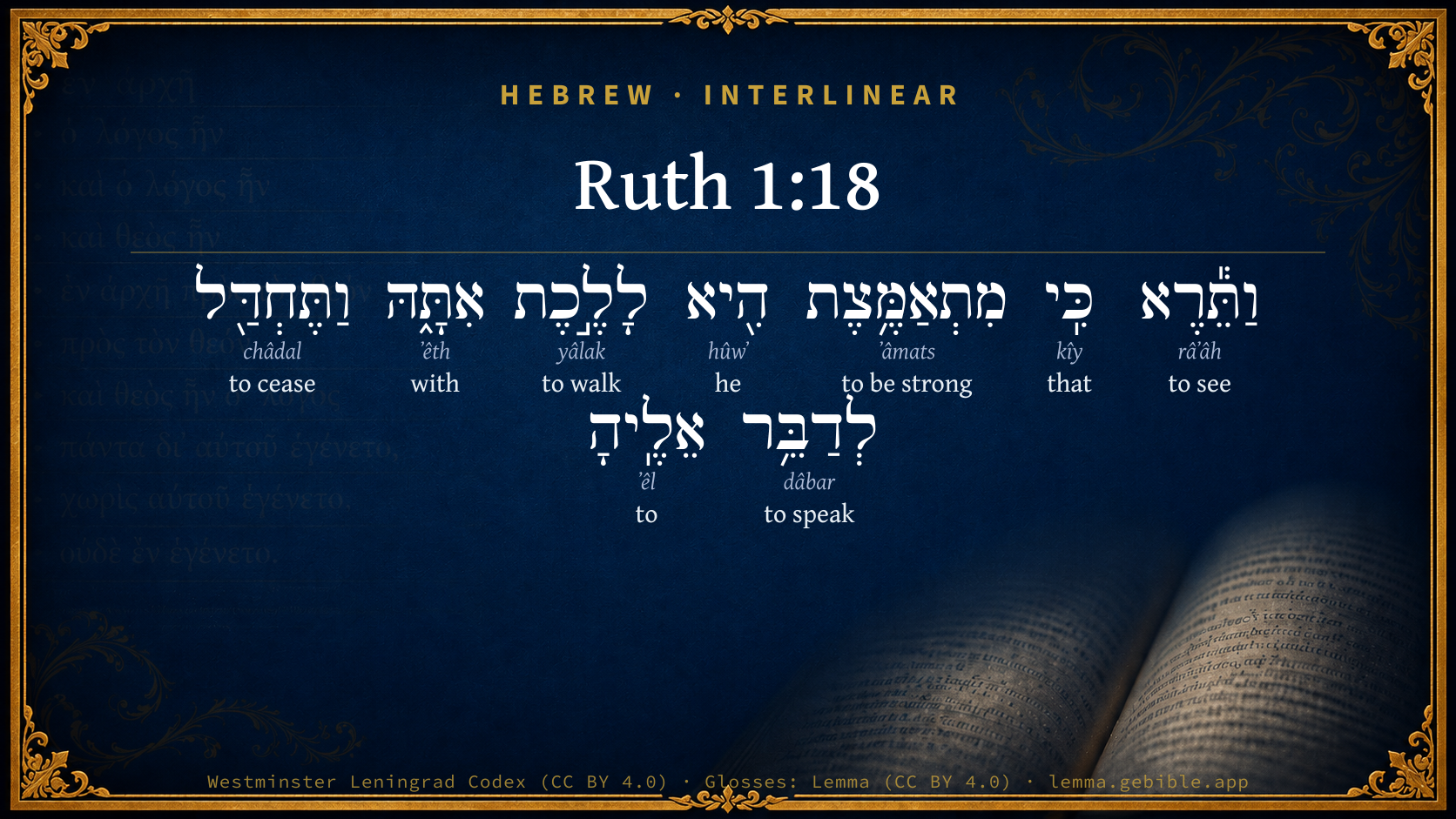
Hebrew (Westminster Leningrad Codex) Ruth 1:18 appears in the Hebrew Old Testament. The text above is from the Westminster Leningrad Codex. Each word links to its Strong’s number, a concise gloss, and parsing drawn from the Open Scriptures Hebrew Bible morphology. Click any word for its full Brown-Driver-Briggs (BDB) entry.
Download image
Cite this verse

Ruth 1:18 (World English Bible). Public Domain. Lemma interlinear Bible study tool, https://lemma.gebible.app/v/ruth/1/18.

Show BibTeX & RIS
BibTeX
RIS
English Translation
When she saw that she was steadfastly minded to go with her, she left off speaking to her.
World English Bible · Public Domain
Download a study sheet

One document with this verse’s original text, its word-by-word gloss line, the meaning frame, cross-references with their text, attributed commentary, and full source and license credits — printable, and it pastes into notes with its structure intact.

This verse Autodidact and up

Study sheet (.html) Plain text (.txt)

A passage Seminary Student

Up to 50 verses in one chapter. A passage sheet keeps up to 6 commentary sources and 12 cross-references per verse, in the order this page ranks them, and says so on the sheet whenever that leaves anything out. Ask for a single verse and you get the Autodidact verse sheet above.

Everything on this page stays free to read, with no account — the sheet is a download of what is already on screen, not access to it.

Want to remove ads? Support Godless Engineer
Compare translations 3

The same verse in 3 English versions, stacked beneath the original-language interlinear above. Click any original word for its lexicon entry.

Each is an independent rendering of the whole verse — the interlinear is not word-aligned to these translations.

Highlighted words mark where these versions differ — a whole-verse word diff, not a word-by-word alignment.

  • World English Bible Public Domain
    When she saw that she was steadfastly minded to go with her, she left off speaking to her.
  • King James Version Public Domain
    When she saw that she was stedfastly minded to go with her, then she left speaking unto her.
  • unfoldingWord Literal Text CC BY-SA 4.0
    Then she saw that she was determined to go with her, and she refrained from speaking to her.

unfoldingWord Literal Text — © unfoldingWord, licensed CC BY-SA 4.0. Word-aligned USFM3 via Door43 (git.door43.org/unfoldingWord/en_ult).

Versions to compare (up to 4)

3 of 4 selected

Show all 18 translations

Every available English version of this verse, each an independent rendering of the whole verse.

  • World English Bible Public Domain
    When she saw that she was steadfastly minded to go with her, she left off speaking to her.
  • Berean Standard Bible Public Domain
    When Naomi saw that Ruth was determined to go with her, she stopped trying to persuade her.
  • Majority Standard Bible Public Domain
    When Naomi saw that Ruth was determined to go with her, she stopped trying to persuade her.
  • King James Version Public Domain
    When she saw that she was stedfastly minded to go with her, then she left speaking unto her.
  • American Standard Version (1901) Public Domain
    And when she saw that she was stedfastly minded to go with her, she left off speaking unto her.
  • Revised Version (1885) Public Domain
    And when she saw that she was stedfastly minded to go with her, she left speaking unto her.
  • Geneva Bible (1599) Public Domain
    Whe she saw that she was stedfastly minded to go with her, she left speaking vnto her.
  • Douay-Rheims (1899) Public Domain
    Then Noemi, seeing that Ruth was steadfastly determined to go with her, would not be against it, nor persuade her any more to return to her friends:
  • Young's Literal Translation Public Domain
    And she seeth that she is strengthening herself to go with her, and she ceaseth to speak unto her;
  • Literal Standard Version CC BY-SA 4.0
    And she sees that she is strengthening herself to go with her, and she ceases to speak to her;
  • Unlocked Literal Bible CC BY-SA 4.0
    When Naomi saw that Ruth was determined to go with her, she stopped arguing with her.
  • unfoldingWord Literal Text CC BY-SA 4.0
    Then she saw that she was determined to go with her, and she refrained from speaking to her.
  • Darby Bible Public Domain
    And when she saw that she was stedfastly minded to go with her, she left off speaking to her.
  • World Messianic Bible Public Domain
    When Naomi saw that she was determined to go with her, she stopped urging her.
  • Webster's Bible Public Domain
    When she saw that she was steadfastly resolved to go with her, then she left speaking to her.
  • Free Bible Version CC BY-SA 4.0
    When Naomi saw that Ruth was determined to go with her, she stopped telling Ruth to go home.
  • Bible in Basic English Public Domain
    And when she saw that Ruth was strong in her purpose to go with her she said no more.
  • JPS Tanakh (1917) Public Domain
    And when she saw that she was stedfastly minded to go with her, she left off speaking unto her.

Literal Standard Version (2020), Covenant Press — licensed CC BY-SA 4.0. Text via the HelloAO Bible API (eBible.org). Unlocked Literal Bible (unfoldingWord) — licensed CC BY-SA 4.0. Text via the HelloAO Bible API (eBible.org). unfoldingWord Literal Text — © unfoldingWord, licensed CC BY-SA 4.0. Word-aligned USFM3 via Door43 (git.door43.org/unfoldingWord/en_ult). Free Bible Version, Dr. Jonathan Gallagher — licensed CC BY-SA 4.0. Text via the HelloAO Bible API (eBible.org).

Word by word

More ways to search: Search by grammar → Find every occurrence → Compare this word →

Practice this passage: Drill this verse → Learn its vocabulary →

מִתְאַמֶּ֥צֶת
ʼâmats
H553
“being strong”
Verb, Hithpael, Participle Active, Feminine, Singular, Absolute
Part of Speech
Verb
Stem
Hithpael
Form
Participle Active
Gender
Feminine
Number
Singular
State
Absolute
Full BDB Definition

Origin: a primitive root

TWOT: 117

to be strong, alert, courageous, brave, stout, bold, solid, hard - (Qal) to be strong, brave, bold - (Piel) to strengthen, secure (for oneself), harden (heart), make firm, make obstinate, assure - (Hithpael) to be determined, to make oneself alert, strengthen oneself, confirm oneself, persist in, prove superior to - (Hiphil) to exhibit strength, be strong, feel strong
  1. וַתֵּ֕רֶא râʼâh H7200 “and · to see” Conjunction + Verb, Qal, Sequential Imperfect, 3rd Person, Feminine, Singular
  2. כִּֽי kîy H3588 “that” Conjunction
  3. הִ֖יא hûwʼ H1931 “he” Pronoun, Personal, 3rd Person, Feminine, Singular
  4. לָלֶ֣כֶת yâlak H3212 “to walk” Preposition + Verb, Qal, Infinitive Construct
  5. אִתָּ֑הּ ʼêth H854 “with · her” Preposition + Suffix, Personal, 3rd Person, Feminine, Singular
  6. וַתֶּחְדַּ֖ל châdal H2308 “and · to cease” Conjunction + Verb, Qal, Sequential Imperfect, 3rd Person, Feminine, Singular
  7. לְדַבֵּ֥ר dâbar H1696 “to speak” Preposition + Verb, Piel, Infinitive Construct
  8. אֵלֶֽיהָ ʼêl H413 “to · her” Preposition + Suffix, Personal, 3rd Person, Feminine, Singular

About this verse

These counts appear in no published source. They are computed here, from the morphology-tagged text and Lemma’s own curated glosses. What Lemma adds →

9
words
9
distinct lemmas
Historical
section

Shared distinctive vocabulary

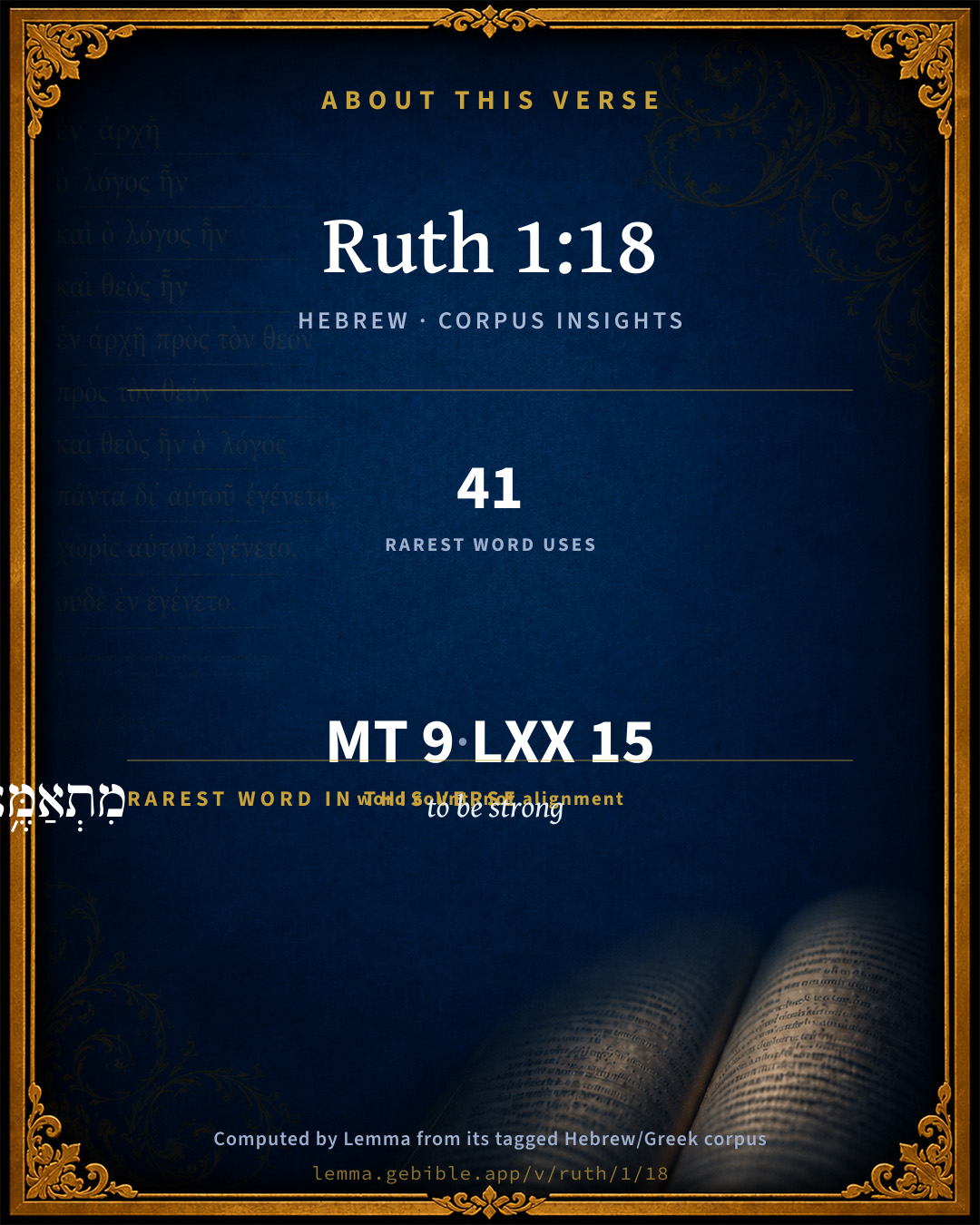
מִתְאַמֶּ֥צֶת to be strong H553 occurs in 41 verses of the Hebrew Bible. Also found in:

Grammatical profile

  • 5 verbs
  • 1 pronoun
  • 2 prepositions
  • 1 conjunction

Verb forms

  • וַתֵּ֕רֶא Qal · Sequential Imperfect
  • מִתְאַמֶּ֥צֶת Hithpael · Participle Active
  • לָלֶ֣כֶת Qal · Infinitive Construct
  • וַתֶּחְדַּ֖ל Qal · Sequential Imperfect
  • לְדַבֵּ֥ר Piel · Infinitive Construct

Hebrew & Septuagint length

In English translation the verse runs 18 words from the Hebrew and 18 from the Septuagint (LXX English) — the same length.

A rough comparison of the two English renderings, which tokenize alike — not a word-level alignment.

Word counts can differ between the Hebrew and the Greek without any difference in meaning — e.g. the Hebrew direct-object marker אֵת has no separate Greek word, and Greek often adds the article ὁ.

In the original languages it is 9 Hebrew tokens and 15 Greek tokens — but the two are counted differently (Hebrew bundles its prefixes and suffixes into one token; the Greek is in lemma form), so that isn’t a like-for-like length.

Cross-references

3

Topical passages linked to Ruth 1:18 in the Treasury of Scripture Knowledge — connected by theme and wording, ordered by reader-vote popularity; previews shown in the World English Bible.

  • Acts 21:14 When he would not be persuaded, we ceased, saying, "The Lord's will be done."
  • Acts 2:42 They continued steadfastly in the apostles' teaching and fellowship, in the breaking of bread, and prayer.
  • Ephesians 6:10 Finally, be strong in the Lord, and in the strength of his might.

Cross-references courtesy of OpenBible.info (CC BY 4.0).

Hebrew and Greek witnesses Masoretic Hebrew ↔ Greek Septuagint

The same verse in the two great witnesses to the Old Testament, shown verse-for-verse.

These are two independent witnesses, not word-aligned to each other, and the Septuagint is shown in lemma (dictionary) form.

Hebrew Ruth 1:18 Masoretic · Westminster Leningrad Codex

וַתֵּ֕רֶא כִּֽי מִתְאַמֶּ֥צֶת הִ֖יא לָלֶ֣כֶת אִתָּ֑הּ וַתֶּחְדַּ֖ל לְדַבֵּ֥ר אֵלֶֽיהָ

When she saw that she was steadfastly minded to go with her, she left off speaking to her.

World English Bible · Public Domain

Greek LXX Ruth 1:18 Septuagint · lemma form

ὁράω δέ νωεμιν ὅτι κραταιόω αὐτός ὁ πορεύομαι μετά αὐτός ὁ λαλέω πρός αὐτός ἔτι

And Noemin seeing that she was determined to go with her, ceased to speak to her any more.

LXX2012 (modern English Septuagint) · Public Domain

Hebrew: Westminster Leningrad Codex (CC BY 4.0). Greek: Septuagint (public domain); English from LXX2012 (modern English Septuagint) (Public Domain). How the Septuagint differs from the Hebrew →

Commentary

Notes on Ruth 1:18 from classic Christian and Jewish commentators (each source and its license shown beneath its notes). The classic Christian expositions comment on the surrounding passage and are grouped to its opening verse, so a note may address several verses; the Jewish commentaries on the Tanakh (Rashi and others) are per-verse, so they appear only where the commentator wrote on this verse.

Lemma curates 59 commentaries, every one of them public domain or Creative Commons licensed, each selected and text-cleaned for this edition rather than reprinted as found. About our sources →

Trapp's Complete Commentary

John Trapp

Rth 1:18 When she saw that she was stedfastly minded to go with her, then she left speaking unto her.

Ver. 18. When she saw that she was steadfastly minded.] Heb., Strengthened herself, to wit, by her oath; and so gave sufficient testimony of the grace of God in her, that she was "steadfast and unmovable." {1Co 15:58}

Then she left speaking unto her.] She rested in Ruth’s resolution, being well assured of her honest mind, which now to suspect were breach of charity.

John Trapp, A Commentary or Exposition upon All the Books of the Old and New Testament (1647–1656) — public domain. Text from a community e-Sword module.

The Biblical Illustrator

Joseph S. Exell

Rth_1:18

When she saw that she was stedfastly minded to go with her, then she left speaking unto her.

Trust after testing

After proof and trial made of their fidelity we are to trust our brethren, without any further suspicion. Not to try before we trust is want of wisdom; not to trust after we have tried is want of charity. The goldsmith must purify the dross and ore from the gold, but he must be wary lest he makes waste of good metal if over-curious in too often refining. We may search and sound the sincerity of our brethren, but after good experience made of their uprightness we must take heed lest by continual sifting and proving them we offend a weak Christian. (T. Fuller, B. D.)

Benefit of a thorough decision

Those who appear half-hearted in their self-consecration expose themselves to a legion of tempters. Lingering on the border-land, they keep within the arrow mark of Satan. Keeping in the suburbs of Sodom, they are in danger of coming within the sweep of its consuming fires. The world hopes that it shall get them back again to its ranks. They resemble persons walking in a crowd with flowing robes, which afford those who wish them evil an easy means of pulling them back and laying them in the dust. When it becomes clearly seen that our heart is fixed, the world gives us up in despair and leaves off speaking unto us. And how that choice ennobled the young Moabitess! What pure human love! What high devotion! What sublime self-renunciation! What true wisdom introducing among the elements that should determine her choice eternity as well as time! Decision of character gives full play to a mans powers whatever they be, and makes them his own. (A. Thomson, D. D.)

Decision a safeguard

If a man is seen to be decided in his stand for Christ, antagonists will give over assailing him. There is nothing in the use of which men are more discriminating than entreaty, argument, or influence. So long as the object of their solicitude is wavering, they will bring all their batteries to bear upon him, for there is still the hope that he will yield. But when he comes openly and determinedly out for Christ, they will waste no more ammunition on him. They leave him thenceforth alone, and attack some one else. Thus decision, while it may require an effort to make it, is, after it is made, a safeguard against assault, So long as a vessel has no flag at her mast-head, the sea-robber may think it safe to attack her; but let her hoist the flag of this nation, and that will make the assailant pause. In like manner, the hoisting over us of the banner of the Cross, being a symbol of decision, is also an assurance of protection. (W.M. Taylor, D. D.)

The Biblical Illustrator, edited by Joseph S. Exell (c. 1880s–1900s) — public domain. Text from a community e-Sword module.

Joseph Benson's Commentary

Rth 1:18. That she was steadfastly minded to go with her, &c. — Was not this the very thing that Naomi aimed at in all she said, namely, to bring Ruth to be of this steadfast mind? Then she left off speaking — Having gained her point. For she could desire no further confirmation of it than that solemn protestation which Ruth had just now made. See the power of resolution, how it puts temptation to silence! Those that are but half resolved, and go on in the ways of religion without a steadfast mind, stand like a door ajar, which invites a thief. But resolution shuts and bolts the door, and then the devil flees from us.

Joseph Benson's Commentary on the Old and New Testaments (1811–1818) — public domain. Text from a community e-Sword module.

John Gill's Exposition

When she saw that she was steadfastly minded to go with her,.... That she was strong in her resolutions, and steadfast in her determinations not to go back to her own country, but to go forward with her; and nothing could move her from the firm purpose of her mind, which was what Naomi wanted to make trial of:

then she left speaking unto her: that is, upon that head of returning home; otherwise, no doubt, upon this a close, comfortable, religious conversation ensued, which made their journey the more pleasant and agreeable.

John Gill's Exposition of the Whole Bible (1746–1763) — public domain (CC PDM 1.0). Text via the HelloAO Bible API.

The Pulpit Commentary

And she perceived. In our idiom we should have introduced the proper name, "And Naomi perceived." That she was determined to go with her. She saw that Ruth was fixed in her resolution. And she left off speaking to her. She "gave in." Ruth, as Fuller has it, was "a fixed star.

Moral steadfastness.

"When she saw that she was steadfastly minded." "Then she left speaking." The test had done a true work, and we see the heroine who could stand fast. Yes; "having done all, to stand," is something in the great emergencies and temptations of life. There are times when to stand in the rush of the stream, as the river breaks into spray around us, is as much for the hour as we can do, and God knows and honors that.

I THE STEADFAST MIND GIVES THE STEADFAST STEP. A double-minded man is unstable in all his ways. Veering here and there like the wind, there is no dependence on the direction he may take. The man or the woman is made by something within them invisible to the world. When Christ was led as a lamb to the slaughter, the great conflict had been fought out in Gethsemane, and then the steps were calm and steadfast. What an hour is that in which, in common parlance, "the mind is made up," the resolution taken. This is firmness, as opposed to obstinacy, which acts with out reasons, and often in the teeth of them. The misery caused in this world by obstinate people is to be seen sometimes in the home, where sulkiness of temper makes the lives of others miserable Firmness is the result of the thoughtful decision of an enlightened mind and a consecrated heart.

II THE STEADFAST MIND MAKES THE REST COMPANION. Ruth was ready for the companion journey back to Bethlehem. And in all our life journeys nothing is so precious as a steadfast heart. There are times of misinterpretation in all lives times of disheartenment, times of shadow and darkness. In such hours a steadfast companion is God"s richest gift to us. What consolation it is to know that even humanly every support will not give way, that there will always be one eye to brighten, one hand to help, one heart to love, one mind to appreciate. The fickle and irresolute may have a transient beauty and a winning manner, but these are poor endowments without a steadfast mind.

III THE STEADFAST MIND IS FREED FROM THE INFINITUDE OF LESSER WORRIES. It is made up. It is not open to every solicitation. It is negative to doubt and distrust. This is the right way, and naught can move it. The feeble and irresolute have a restless life. They are constantly balancing expediences and advantages. Christ our Divine Lord set his face steadfastly to go to Jerusalem. The hardest journey of all to the shame and spitting, the awful darkness and the cruel cross. If we are firm and decided in our purposes we shall not be wasting either time or strength upon the solicitations of the popular or profitable. A voice within will say, "This is the way, walk ye in it. W.M.S.

The Pulpit Commentary (1880–1919), ed. H.D.M. Spence-Jones & Joseph S. Exell — public domain. Text from a community e-Sword module.

Keil & Delitzsch

C. F. Keil & F. Delitzsch

As she insisted strongly upon going with her (התאמּץ, to stiffen one's self firmly upon a thing), Naomi gave up persuading her any more to return.

Keil & Delitzsch — Biblical Commentary on the Old Testament (1861–1891) — public domain (CC PDM 1.0). Text via the HelloAO Bible API. (Old Testament only.)

Rashi

Rabbi Shlomo Yitzchaki (Rashi)

so she stopped speaking to her From here they derived that we do not overburden him and we are not overly meticulous with him (i.e., with a prospective convert).

Rashi on the Tanakh — English translations: “The Judaica Press complete Tanach with Rashi, translated by A. J. Rosenberg” (CC BY 4.0); “Pentateuch with Rashi's commentary by M. Rosenbaum and A.M. Silbermann, 1929-1934” (public domain); “The Metsudah Tanach series, Lakewood, N.J” (CC BY 4.0); and “The Book of Joshua, Metsudah Publications, 1997” (CC BY 4.0). Text via Sefaria.

Ibn Ezra

Rabbi Abraham ibn Ezra

"Steadfastly minded": From the reflexive form (hitpa'el).

Ibn Ezra on the Tanakh — English translations: “Sefaria Community Translation” (CC0 1.0 (public-domain dedication)); “Yalkut, Sifsei Chachomim Chumash, Metsudah Publications, 2009” (CC BY 4.0); and “Commentary of Ibn Ezra on Isaiah - trans. by M. Friedlander, 1873” (public domain). Text via Sefaria.

Lesson kit

Teaching starters — assembled from the data on this page, not authored interpretation. Every prompt links to the verse data it draws on. Edit before teaching.

Ruth, in the Historical, opens this verse with 9 words (9 distinct Hebrew lemmas). Its most distinctive word is ʼâmats (“to be strong”). A historical commentator’s framing appears above. Read the whole chapter for the surrounding context.

Discussion questions

  1. How does “to be strong” (ʼâmats) shape what this verse is saying?
  2. How does Genesis 25:23, which shares the word «to be strong», read alongside this verse?
  3. These translations render this verse differently. What is at stake in choosing one wording over another?
  4. «וַתֵּ֕רֶא» is a Qal Sequential Imperfect verb. How does that grammatical form shape the action described?
  5. Compare how Trapp's Complete Commentary and The Biblical Illustrator read this verse. Where do they agree or differ?

Things to notice

Reading settings

Reading text

Shown beneath each verse's original-language words.

Old Testament
Old Testament edition

Read the OT as the Masoretic Hebrew (MT) or the Greek Septuagint (LXX).

English shown for the Greek Septuagint (in the Hebrew ↔ Greek comparison).

Comparing translations? Open the Compare panel on any verse page to stack up to four side by side.