
Matthew 17:3

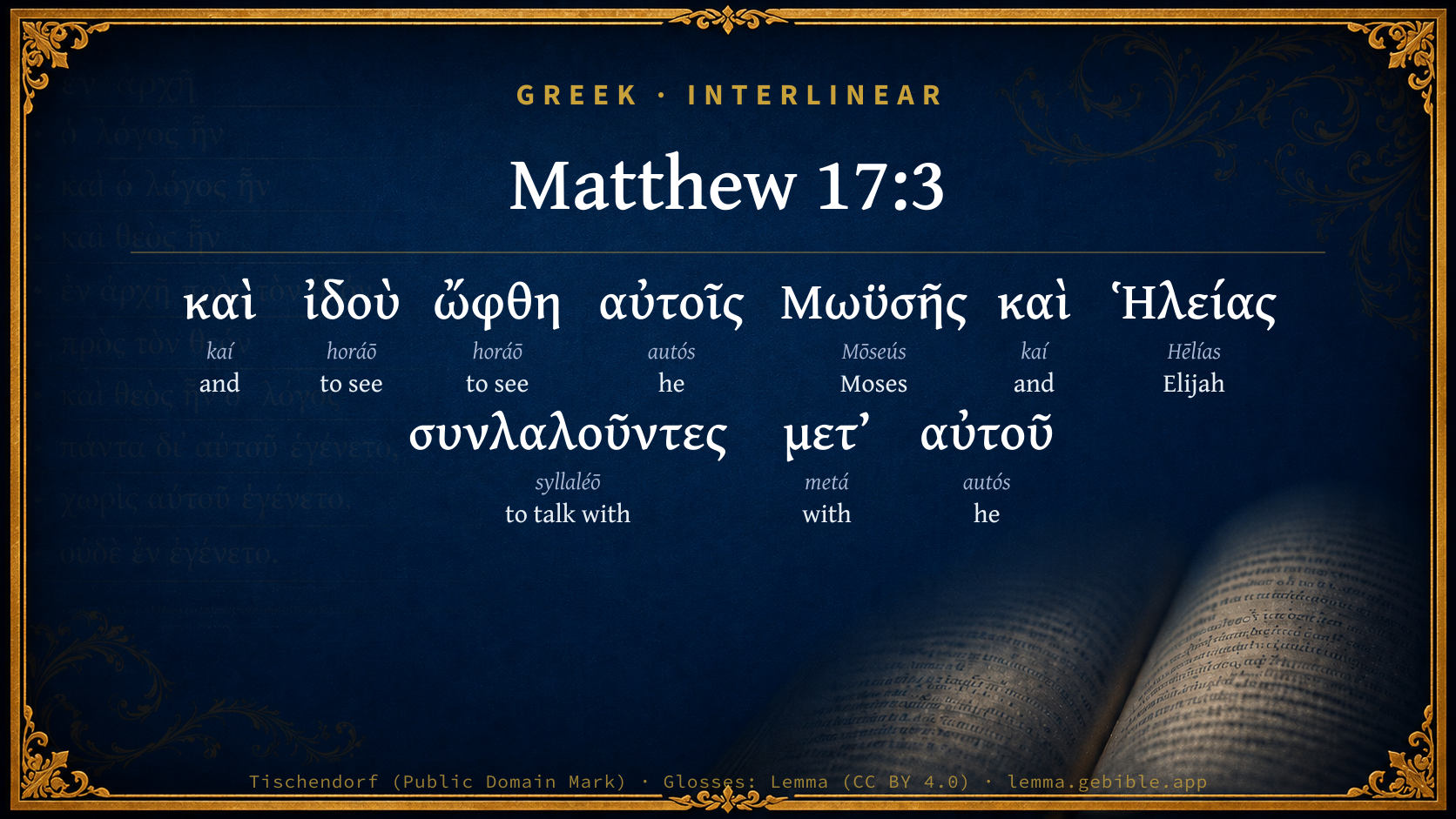
Greek (Tischendorf 8th ed.) Matthew 17:3 appears in the Greek New Testament. The text above is from the Tischendorf 8th edition. Each word links to its Strong’s number and a concise gloss. Click any word for its full Thayer’s Greek Lexicon entry.
Download image
Cite this verse

Matthew 17:3 (World English Bible). Public Domain. Lemma interlinear Bible study tool, https://lemma.gebible.app/v/matthew/17/3.

Show BibTeX & RIS
BibTeX
RIS
English Translation
Behold, Moses and Elijah appeared to them talking with him.
World English Bible · Public Domain
Highlights
  • 1 first appearance in the Greek New Testament
Full analysis ↓
Download a study sheet

One document with this verse’s original text, its word-by-word gloss line, the meaning frame, cross-references with their text, attributed commentary, and full source and license credits — printable, and it pastes into notes with its structure intact.

This verse Autodidact and up

Study sheet (.html) Plain text (.txt)

A passage Seminary Student

Up to 50 verses in one chapter. A passage sheet keeps up to 6 commentary sources and 12 cross-references per verse, in the order this page ranks them, and says so on the sheet whenever that leaves anything out. Ask for a single verse and you get the Autodidact verse sheet above.

Everything on this page stays free to read, with no account — the sheet is a download of what is already on screen, not access to it.

Want to remove ads? Support Godless Engineer
Compare translations 3

The same verse in 3 English versions, stacked beneath the original-language interlinear above. Click any original word for its lexicon entry.

Each is an independent rendering of the whole verse — the interlinear is not word-aligned to these translations.

Highlighted words mark where these versions differ — a whole-verse word diff, not a word-by-word alignment.

  • World English Bible Public Domain
    Behold, Moses and Elijah appeared to them talking with him.
  • King James Version Public Domain
    And, behold, there appeared unto them Moses and Elias talking with him.
  • unfoldingWord Literal Text CC BY-SA 4.0
    And behold, Moses and Elijah were seen by them, talking with him.

unfoldingWord Literal Text — © unfoldingWord, licensed CC BY-SA 4.0. Word-aligned USFM3 via Door43 (git.door43.org/unfoldingWord/en_ult).

Versions to compare (up to 4)

3 of 4 selected

Show all 19 translations

Every available English version of this verse, each an independent rendering of the whole verse.

  • World English Bible Public Domain
    Behold, Moses and Elijah appeared to them talking with him.
  • Berean Standard Bible Public Domain
    Suddenly Moses and Elijah appeared before them, talking with Jesus.
  • Majority Standard Bible Public Domain
    Suddenly Moses and Elijah appeared before them, talking with Jesus.
  • King James Version Public Domain
    And, behold, there appeared unto them Moses and Elias talking with him.
  • American Standard Version (1901) Public Domain
    And behold, there appeared unto them Moses and Elijah talking with him.
  • Revised Version (1885) Public Domain
    And behold, there appeared unto them Moses and Elijah talking with him.
  • Geneva Bible (1599) Public Domain
    And beholde, there appeared vnto them Moses, and Elias, talking with him.
  • Douay-Rheims (1899) Public Domain
    And behold there appeared to them Moses and Elias talking with him.
  • Young's Literal Translation Public Domain
    and lo, appear to them did Moses and Elijah, talking together with him.
  • Literal Standard Version CC BY-SA 4.0
    and behold, Moses and Elijah appeared to them, talking together with Him.
  • Unlocked Literal Bible CC BY-SA 4.0
    Behold, there appeared to them Moses and Elijah talking with him.
  • unfoldingWord Literal Text CC BY-SA 4.0
    And behold, Moses and Elijah were seen by them, talking with him.
  • Darby Bible Public Domain
    and lo, Moses and Elias appeared to them talking with him.
  • World Messianic Bible Public Domain
    Behold, Moses and Elijah appeared to them talking with him.
  • Webster's Bible Public Domain
    And behold, there appeared to them Moses and Elijah talking with him.
  • Free Bible Version CC BY-SA 4.0
    Then suddenly Moses and Elijah appeared before them, talking together with Jesus.
  • Bible in Basic English Public Domain
    And Moses and Elijah came before their eyes, talking with him.
  • Text-Critical English NT CC BY 4.0
    And behold, Moses and Elijah appeared to them, talking with him.
  • Tyndale New Testament (1534) Public Domain
    And beholde ther appered vnto the Moses and Helyas talkinge with him.

Literal Standard Version (2020), Covenant Press — licensed CC BY-SA 4.0. Text via the HelloAO Bible API (eBible.org). Unlocked Literal Bible (unfoldingWord) — licensed CC BY-SA 4.0. Text via the HelloAO Bible API (eBible.org). unfoldingWord Literal Text — © unfoldingWord, licensed CC BY-SA 4.0. Word-aligned USFM3 via Door43 (git.door43.org/unfoldingWord/en_ult). Free Bible Version, Dr. Jonathan Gallagher — licensed CC BY-SA 4.0. Text via the HelloAO Bible API (eBible.org).

Word by word

More ways to search: Search by grammar → Find every occurrence → Compare this word →

Practice this passage: Drill this verse → Learn its vocabulary →

About this verse

These counts appear in no published source. They are computed here, from the morphology-tagged text and Lemma’s own curated glosses. What Lemma adds →

10
words
7
distinct lemmas
Gospels
section

Notable vocabulary

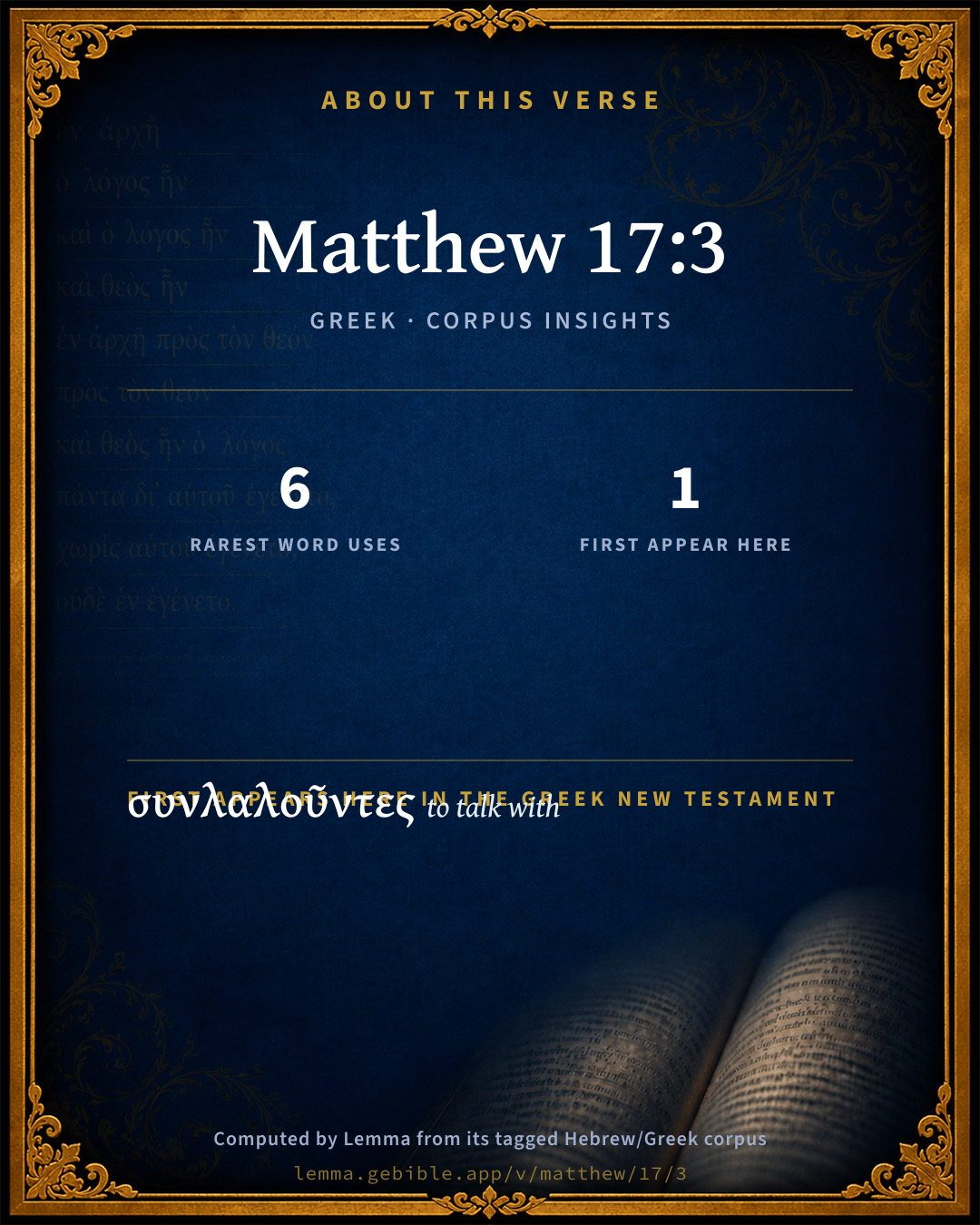
The rarest word here is συνλαλοῦντες to talk with G4814 — appearing just 6 times in the whole Greek New Testament.

First appearance in Scripture

This word makes its first canonical appearance in the Greek New Testament here:

  • συνλαλοῦντες to talk with G4814

Shared distinctive vocabulary

συνλαλοῦντες to talk with G4814 occurs in 6 verses of the Greek New Testament. Also found in:
Repetition

Words recur within this verse:

  • ἰδοὺ to see G3708 ×2
  • καὶ and G2532 ×2
  • αὐτοῖς he G846 ×2

Cross-references

20

Topical passages linked to Matthew 17:3 in the Treasury of Scripture Knowledge — connected by theme and wording, ordered by reader-vote popularity; previews shown in the World English Bible.

  • Malachi 4:5 Behold, I will send you Elijah the prophet before the great and terrible day of Yahweh comes.
  • Luke 24:44 He said to them, "This is what I told you, while I was still with you, that all things which are written in the law of Moses, the prophets, and the psalms, concerning me must be fulfilled."
  • Deuteronomy 34:10 There has not arisen a prophet since in Israel like Moses, whom Yahweh knew face to face,
  • 1 Kings 18:36–40 It happened at the time of the offering of the [evening] offering, that Elijah the prophet came near, and said, Yahweh, the God of Abraham, of Isaac, and of Israel, let it be known this day that you are God in Israel, and that I am your servant, and that I have done all these things at your word.
  • Mark 9:4 Elijah and Moses appeared to them, and they were talking with Jesus.
  • Deuteronomy 18:18 I will raise them up a prophet from among their brothers, like you; and I will put my words in his mouth, and he shall speak to them all that I shall command him.
  • Deuteronomy 34:5–6 So Moses the servant of Yahweh died there in the land of Moab, according to the word of Yahweh.
  • 1 Kings 17:1 Elijah the Tishbite, who was of the foreigners of Gilead, said to Ahab, As Yahweh, the God of Israel, lives, before whom I stand, there shall not be dew nor rain these years, but according to my word.
  • 2 Kings 2:11–14 It happened, as they still went on, and talked, that behold, [there appeared] a chariot of fire, and horses of fire, which parted them both apart; and Elijah went up by a whirlwind into heaven.
  • Matthew 17:10–13 His disciples asked him, saying, "Then why do the scribes say that Elijah must come first?"
  • Luke 1:17 He will go before him in the spirit and power of Elijah, 'to turn the hearts of the fathers to the children,' and the disobedient to the wisdom of the just; to make ready a people prepared for the Lord."
  • Luke 9:30–31 Behold, two men were talking with him, who were Moses and Elijah,
  • Luke 9:33 It happened, as they were parting from him, that Peter said to Jesus, "Master, it is good for us to be here. Let's make three tents: one for you, and one for Moses, and one for Elijah," not knowing what he said.
  • Luke 16:16 The law and the prophets were until John. From that time the Gospel of the Kingdom of God is preached, and everyone is forcing his way into it.
  • Luke 24:27 Beginning from Moses and from all the prophets, he explained to them in all the Scriptures the things concerning himself.
  • 2 Corinthians 3:7–11 But if the service of death, written engraved on stones, came with glory, so that the children of Israel could not look steadfastly on the face of Moses for the glory of his face; which was passing away:
  • Matthew 11:13–14 For all the prophets and the law prophesied until John.
  • John 1:17 For the law was given through Moses. Grace and truth came through Jesus Christ.
  • John 5:45–47 "Don't think that I will accuse you to the Father. There is one who accuses you, even Moses, on whom you have set your hope.
  • Hebrews 3:1–6 Therefore, holy brothers, partakers of a heavenly calling, consider the Apostle and High Priest of our confession, Jesus;

Cross-references courtesy of OpenBible.info (CC BY 4.0).

Commentary

Notes on Matthew 17:3 from classic Christian and Jewish commentators (each source and its license shown beneath its notes). The classic Christian expositions comment on the surrounding passage and are grouped to its opening verse, so a note may address several verses; the Jewish commentaries on the Tanakh (Rashi and others) are per-verse, so they appear only where the commentator wrote on this verse.

Lemma curates 59 commentaries, every one of them public domain or Creative Commons licensed, each selected and text-cleaned for this edition rather than reprinted as found. About our sources →

Joseph Benson's Commentary

Mat 17:3-4. And behold — To heighten the grandeur and solemnity of the scene; there appeared unto them — That is, unto the disciples as well as Jesus; Moses and Elias — Luke says, two men, which were Moses and Elias, and Mark, Elias with Moses. Moses, the great lawgiver of the Jews, and Elijah, who had been a most zealous restorer and defender of the law, appeared in the glories of immortality, wherewith the blessed above are adorned: talking with him — And, according to Luke, the subject of their conversation was, the decease which he should accomplish at Jerusalem, that is, his departure out of the present life, or the sufferings and death whereby he was to atone for sin, and effect the redemption of mankind: a subject the most important of all others, and therefore the most proper to employ the thoughts and tongues of these illustrious personages, the most illustrious, certainly, that had ever met together on earth in one place. But the three disciples were seized with an irresistible drowsiness, and fell into a deep sleep. They awoke, however, time enough to see Christ’s glory, and that of the two men who stood with him. Probably the streams of light which issued from Christ’s body, especially his countenance, and the voices of Moses and Elias talking with him, made such an impression on their senses as to awake them. Lifting up their eyes, therefore, they must have been amazed beyond measure when they beheld their Master in the majesty of his transfigured state, and his illustrious attendants, whom they might know to be Moses and Elias by revelation, or by what they said, or by the appellations which Jesus gave them in speaking to them. Peter, particularly, being both afraid and glad at the glorious sight, was in the utmost confusion. Nevertheless, the forwardness of his disposition prompted him to say something, and just as Moses and Elias were departing from Jesus, he said, Lord, it is good for us to be here — So doubtless they found it. Both before and after this transfiguration they had many refreshing seasons with their Master, heard many ravishing sermons, and saw many wonderful miracles; yet in no place, and on no occasion but this, were they ever heard to say, It is good for us to be here. Peter fancied, doubtless, that Jesus had now assumed his proper dignity; that Elias was come, according to Malachi’s prediction; and that the kingdom was at length begun. Wherefore, in the first hurry of his thoughts, he proposed to provide some accommodation for Jesus and his august attendants, intending, perhaps, to bring the rest of the disciples, with the multitude, from the plain below, to behold his matchless glory. He thought this was better for his Master than to be killed at Jerusalem. He said, therefore, If thou wilt, let us make here three tabernacles — He says, three, not six, because the apostles desired to be with their Master. They were words of rapturous surprise, and, as Mark observes, very improper. But, perhaps, few in such an astonishing circumstance could have been perfectly masters of themselves.

Joseph Benson's Commentary on the Old and New Testaments (1811–1818) — public domain. Text from a community e-Sword module.

Tyndale Open Study Notes

Tyndale Open Resources

17:3 Moses symbolizes the law and Elijah the prophets. They appeared as witnesses to Christ, to demonstrate that Jesus, God’s Son, is the fulfillment of everything written in the Law and the Prophets (see 5:17-20; 11:2-6; 12:28).

Tyndale Open Study Notes — © Tyndale Open Resources, licensed CC BY-SA 4.0. Text via the HelloAO Bible API.

Bengel's Gnomon

Johann Albrecht Bengel

Mat 17:3. Ὤφθησαν, appeared) sc. with their bodies.—Μωσῆς καὶ Ἡλίας, Moses and Elias) The departure of each of them from this world had been singular: each of them was remarkable for revelations vouchsafed to him on Mount Sinai and Horeb. Both of them are mentioned together in Mal 4:4-5. It is probable that Moses was raised to life immediately on his death and burial, so that he was not dead whilst Elias was living in heaven: he certainly, after his decease, entered the land of promise, in which this holy mountain was situated. And yet Christ, not Moses, is the ἀπαρχὴ, the primitiæ, the first-fruits. The resuscitation of Moses does not confer life upon others; that of Christ does. This appearance, however, of Moses alive from the dead, is full of mystery. Who will venture to assert that he had already obtained immortality (ἀθανασία), and did not receive any advancement in bliss (βελτίωσις) after the resurrection of Christ?[779] Oh, how many things there are in the world of glory above our comprehension! If this appearance of Moses and Elias were not mentioned in the canonical Scriptures, although attested by other sufficient witnesses, who would not consider it as a fable?—μετʼ Αὐτοῦ συλλαλοῦντες, conversing with Him) There is no pleonasm.[780] Each of them conversed with Jesus. A conversation of the highest importance (colloquium maximum). Moses stood at the end of the first dispensation,[781] Elias, in the middle of the middle dispensation; Jesus, on the threshold of the last. They bear witness to the true Messiah, and to Him only.—ΜΕΤʼ ΑὐΤΟῦ, with Him) They conversed with Him only, not with the three apostles.

[779] On the first day of the month Adar, according to Josephus, B. IV. Ant., at the end, Moses died (comp. Deu 34:8; Jos 1:11; Jos 4:19). Beng. had mentioned this in Harm. Ev., Ed. i. on this passage, and had noticed that Christ’s transfiguration had taken place at the same time of year, in the presence of Moses; subjoining a caution, that though this remark might not seem to have much weight, yet it was possible it might be of use to some hereafter. Shortly after, some one appealed to the transfiguration of Christ as having occurred in the month of September, as a ground of expecting the coming of Moses and Elias in the month of September A.D. 1737: an error which this observation of Beng., however minute and overstrained it may seem to some, might have served to refute. See Harm. Ev. Ed. ii., pp. 375, 376.—E. B.

[780] See explanation of technical terms in Appendix.—(I. B.)

[781] At the end of the first dispensation, viz. the patriarchal; though Moses also stood at the beginning of the second, viz. that of the law. In this latter point of view, as Moses stands at the beginning of the law as its representative, so Elias at the beginning of the prophets, and the Lord Jesus at the beginning of the Gospel, at once its representative and embodiment.—ED.

Bengel's Gnomon of the New Testament — English translation (T&T Clark, Edinburgh, 1860) — public domain. Text from a community e-Sword module.

Meyer's Critical & Exegetical Commentary

Heinrich August Wilhelm Meyer

Mat_17:3. Αὐτοῖς] the disciples, Mat_17:2. They saw conversing with Jesus, Moses and Elias, who, as forerunners of the Messiah, represented the law and the prophets (Schoettgen, Wetstein). Comp. Mat_17:5; Mat_17:8. It was not from what Jesus told them afterwards that they came first to know who those two were, but they themselves recognised them at once (Mat_17:4), though not from their conversation, as has been arbitrarily supposed (Theophylact). The recognition was immediate and directly involved in the marvellous manifestation itself.

The subject of conversation, so far as the accounts of Matthew and Mark are concerned, does not appear to have been once inquired into. According to Ebrard, Jesus communicated to the fathers of the old dispensation the blessed intelligence of his readiness to redeem them by His death. According to Luk_9:31, Moses and Elias converse with Jesus about His impending death.

Meyer — Critical and Exegetical Commentary on the New Testament — English translation by Peter Christie, edited by Frederick Crombie (T&T Clark, 1880) — public domain. Text from a community e-Sword module.

Expositor's Greek Testament

ed. W. Robertson Nicoll

Mat 17:3 . καὶ ἰδού introduces a leading and remarkable feature in the scene: ὤφθη αὐτοῖς , there appeared to the three disciples, not necessarily an absolutely real, objective presence of Moses and Elias. All purposes would be served by an appearance in vision . Sufficient objectivity is guaranteed by the vision being enjoyed by all the three, which would have been improbable if purely subjective. Recognition of Moses and Elias was of course involved in the vision. For a realistic view of the occurrence the question arises, how was recognition possible? Euthy. Zig. says the disciples had read descriptions of famous men, including Moses and Elias, in old Hebrew books Another suggestion is that Moses appeared with the law in his hand, and Elias in his fiery chariot. συλλαλοῦντες μ . ἀ ., conversing with Jesus, and, it goes without saying (Lk. does say it), on the theme uppermost in all minds, the main topic of recent conversations, the cross ; the vision, in its dramatis personæ and their talk, reflecting the state of mind of the seers.

The Expositor's Greek Testament, edited by W. Robertson Nicoll (1897–1910) — public domain. Text from a community e-Sword module.

Adam Clarke's Commentary

Verse 3. Moses and Elias] Elijah came from heaven in the same body which he had upon earth, for he was translated, and did not see death, 2Kg 2:11. And the body of Moses was probably raised again, as a pledge of the resurrection; and as Christ is to come to judge the quick and the dead, for we shall not all die, but all shall be changed, 1Co 15:51, he probably gave the full representation of this in the person of Moses, who died, and was thus raised to life, (or appeared now as he shall appear when raised from the dead in the last day), and in the person of Elijah, who never tasted death. Both their bodies exhibit the same appearance, to show that the bodies of glorified saints are the same, whether the person had been translated, or whether he had died. It was a constant and prevalent tradition among the Jews, that both Moses and Elijah should appear in the times of the Messiah, and to this very tradition the disciples refer, Mt 17:10.

We may conceive that the law in the person of Moses, the great Jewish legislator, and the prophets in the person of Elijah, the chief of the prophets, came now to do homage to Jesus Christ, and to render up their authority into his hands; as he was the END of the law, and the grand subject of the predictions of the prophets. This appears more particularly from what St. Luke says, Lu 9:31, that Moses and Elijah conversed with our Lord on his death, which he was about to accomplish, (πληρουν to fulfil,) because in it, all the rites, ceremonies, and sacrifices of the law, as well as the predictions of the prophets, were fulfilled.

Adam Clarke's Commentary on the Bible (1810–1826) — public domain. Text from a community e-Sword/MySword module.

Ellicott's Commentary for English Readers

(3) Moses and Elias.—The identification of the forms which the disciples saw was, we may well believe, intuitive. If we accept the narrative as a whole, it is legitimate to assume that, in the state of consciousness to which they had been raised, they were capable of a spiritual illumination which would reveal to them who they were who were thus recognising their Master’s work and doing homage to His majesty. There was, it is obvious, a singular fitness in each case. One was the great representative of the Law, which was a “school master” or “servant-tutor” (see Note on Gal_3:24) leading men to Christ, the other of the whole goodly fellowship of the prophets. Of one it had been said that a “Prophet like unto him” should come in the latter days (Deu_18:18), to whom men should hearken; of the other, that he should come again to “turn the hearts of the fathers to the children” (Mal_4:5). The close of the ministry of each was not after the “common death of all men.” No man knew of the sepulchre of Moses (Deu_34:6), and Elijah had passed away in the chariots and horses of fire (2Ki_2:11). Both were associated in men’s minds with the glory of the kingdom of the Christ. The Jerusalem Targum on Exodus 12 connects the coming of Moses with that of the Messiah. Another Jewish tradition predicts his appearance with that of Elijah. Their presence now was an attestation that their work was over, and that the Christ had come.

Talking with him.—St. Luke (Luk_9:31) adds the subject of their communing: “They spake of His decease which He should accomplish at Jerusalem.” So far as the disciples then entered into the meaning of what they heard, or afterwards recalled it, it was a witness that the spirits of the lawgiver and the prophet accepted the sufferings and the death which had shaken the faith of the disciples as the necessary conditions of the Messianic kingdom. It is significant that the word for “decease” (exodos) reappears in this sense once only in the New Testament, and then in close connection with a reference to the Transfiguration (2Pe_1:15).

A Bible Commentary for English Readers, edited by Charles John Ellicott (1878–1897) — public domain. Text from a community e-Sword module.

The Cambridge Bible for Schools and Colleges

gen. ed. J. J. S. Perowne

3. Moses and Elias] (Elijah). The representatives of the Law and the Prophets. The whole history of the Jewish Church is brought in one glance, as it were, before the Apostles’ eyes in its due relation to Christ. St Luke names the subject of converse: they “spake of his decease which he should accomplish at Jerusalem” (Mat_9:31).

The Cambridge Bible for Schools and Colleges (gen. ed. J. J. S. Perowne; Cambridge University Press, 1878–1918) — public domain. Text from a community e-Sword module.

John Gill's Exposition

And behold there appeared unto them,.... The disciples:

Moses and Elias; Moses the giver of the law, and Elias one of the chief of the prophets: one of them had been dead near a thousand and five hundred years, and the other had been caught up to heaven, about nine hundred years before this. The Jews sometimes speak of these two as together. They say (c),

"that the Shekinah never descends below, but , "Moses and Elias" ascend above.''

Yea, they expect that these two will come together in future time; for so they represent (d) a God saying to Moses;

"Moses, as thou hast given thy life for them (the Israelites) in this world, so in time to come (the days of the Messiah) when I shall bring Elias the prophet, , "you two shall come together".''

Now they came. Luke says, they appeared "in glory": in glorious bodies, in a glory upon their bodies; like, though inferior, to the glorious body of Christ, now transfigured: that they appeared in their own real bodies, no doubt need be made; about the body of Elijah, or Elias, there is no difficulty; since he was carried soul and body to heaven, he died not, but was changed; and has ever since remained in a glorious body, in which he doubtless now appeared: and why this should not be the case of Moses, or why he should appear in another body, and not his own, I see not; for though he died, yet he was buried by the Lord, and no man ever knew the place of his sepulchre; and there was a dispute about his body, between Michael and the devil, all which are uncommon circumstances: so that it might be, that his body was, quickly after his death, raised and restored to him; or at this time, as a pledge of the resurrection of the dead, as Christ's transfiguration was of his glory. The Jews have a notion that Moses is not dead, but is ascended, and stands and ministers to God, in the highest heavens (e): the appearance of these two with Christ, was to show, that Christ is the end of the law and prophets; that there is an entire agreement between him and them, and that they have their full accomplishment in him; and also shows, that he was neither Elias, nor any of the prophets, as some took him to be; since he was distinct from them, and the chief and more glorious than any of them. If it should be asked; how came the disciples to know these two to be Moses and Elias, since they never saw them before, nor could have any statues or pictures of them, these being not allowed among the Jews; nor do the accounts of them in Scripture seem to be sufficient to direct them to such a thought; especially, since by their glorification, they must be greatly altered: it may be replied, they knew them, either by immediate divine revelation, or by the discourse that passed between them and Christ; for it follows,

talking with him. The Jews often speak of the appearance of Elias to their doctors, and of his conversing with them, and teaching them. Whether this is done with design to lessen the glory of this appearance, I will not say; however, they cannot reasonably object to the probability of this account, since they make it to be so frequent among themselves; though they look upon it as an high favour, and that such are holy good men, that are indulged with it, take an instance or two: thus they say (f) of a certain person,

"Lo! the pious man, whom Elias used , "to converse with".''

And elsewhere it is said (g),

"R. Phineas and R. Mari, the sons of R. Chasda, were godly men, , "and Elias was talking with them", and they were priests.''

What Moses and Elias were talking with our Lord about, is expressed by Luke; see Gill on Luk 9:31.

(c) T. Bab. Succab, fol. 5. 1. (d) Debarim Rabba, sect. 3. fol. 239. 2. (e) T. Bab. Sota, fol. 13. 2. Maimon. praefat. ad Seder Zeraim in Talmud. fol. 86. 4. (f) T. Bab. Bava Bathra, fol. 7. 2. (g) Juchasin, fol. 101. 1. Vid. fol. 79. 1. & 118. 2. & 13. 132. 1. & T. Bab. Cetubot, fol. 106. 1.

John Gill's Exposition of the Whole Bible (1746–1763) — public domain (CC PDM 1.0). Text via the HelloAO Bible API.

Trapp's Complete Commentary

John Trapp

3 And, behold, there appeared unto them Moses and Elias talking with him.

Ver. 3. Moses and Elias appeared] Those immortalitalis candidali, as the ancients called them. God had buried Moses, but brought him forth afterwards glorious; the same body which was hidden in the valley of Moab appeareth here in the hill of Tabor. Christ by rotting refines our bodies also; and we know that when "he, who is our life, shall appear, then shall we also appear with him in glory," Col 3:4. As in the meantime, be not we conformed to this world, but rather transformed by the renewing of our minds, Rom 12:2; and in whatever transfiguration or ravishment we cannot find Moses, and Elias, and Christ to meet (as here they did in this sacred synod), that is, if what we find in us be not agreeable to the Scriptures, we may well suspect it as an illusion.

John Trapp, A Commentary or Exposition upon All the Books of the Old and New Testament (1647–1656) — public domain. Text from a community e-Sword module.

Albert Barnes' Notes on the Bible

And behold there appeared unto them Moses and Elias - Moses, a distinguished servant of God, by whom the law was given, and whose institutions typified the Messiah. It was particularly proper that he should appear, when his prophecies and types were about to be fulfilled, and the rites which he had instituted were about to be done away. Elias, or Elijah, a distinguished prophet, taken to heaven without seeing death. See 2Ki 2:11. Elijah had been honored eminently by being thus translated, and still more by being made the model of the forerunner of the Messiah, Mal 4:5; Luk 1:17; Mat 11:14. They appeared “in glory” Luk 9:31; i. e., as they are in heaven with the glory which the redeemed have there.

Talking with him - Luke Luk 9:31 informs us that they conversed about “his decease which he should accomplish at Jerusalem.” To redeemed spirits that death was an object of intense interest. By faith in that death they had been saved; and now that the Redeemer of mankind was about to die, it is no wonder that this was the burden of his and their thoughts.

Luke adds Luk 9:32 that “Peter and they that were with him were heavy with sleep.” It is not improbable that this was in the night; that Jesus was engaged in prayer; and that he had permitted his weary followers to compose themselves to rest. It was after they were awaked that they saw this vision. Probably the sudden splendor, the bright shining aroused them from sleep.

Albert Barnes' Notes on the Bible (1834–1885) — public domain. Text from a community e-Sword/MySword module.

Haydock's Catholic Bible Commentary

Moses and Elias. Jesus Christ had been taken by the people for Elias, Jeremias, or one of the prophets. He therefore chose the chief of all the prophets to be present, that he might shew his great superiority over them, and verify the illustrious confession of Peter. The Jews had accused Christ of blasphemy, and of breaking the sabbath; the presence of Moses and Elias refuted the calumny; for the founder of the Jewish laws would never have sanctioned him who was a transgressor of those laws; and Elias, so full of zeal for the glory of God, would never have paid homage to one who made himself equal to God, had he not really been the Son of the Most High. (St. John Chrysostom, hom. lvii.) --- St. Hilary thinks that Moses and Elias (who represent the law and the prophets, and who here bear witness to the divinity of Jesus Christ,) will be the precursors of his second coming, alluded to in Revelations, chap. xi, though the general opinion of the Fathers is, that the two witnesses there mentioned are Enoch and Elias. (Jansenius) --- It is hence evident, that the saints departed can and do, with the permission of God, take an interest in the affairs of the living. (St. Augustine, de cura pro mort. chap. xv. 16.) --- For as angels elsewhere, so here the saints also, served our Saviour; and as angels, both in the Old and New Testament, were frequently present at the affairs of men, so may saints. (Bristow) --- All interpreters agree that Elias appeared in his own body, but various are their opinions with regard to the apparition of Moses. (Haydock)

George Leo Haydock (1774–1849), Haydock's Catholic Family Bible and Commentary, 1859 edition — public domain. Excludes Psalms (Douay-Rheims chapter numbering differs from Protestant) and Deuterocanonical books (Catholic canon only).

Matthew Poole's English Annotations

Mark adds, Mar 9:6, For he wist not what to say; for they were sore afraid. Luke addeth, Luk 9:31-33, who appeared in glory, and spake of his decease which he should accomplish at Jerusalem. But Peter and they that were with him were heavy with sleep: and when they were awake, they saw his glory, and the two men that stood with him. And it came to pass, as they departed from him, Peter said unto Jesus, Master, it is good for us to be here, &c.: not knowing what he said. So as the history seemeth to be thus: After six or eight days Christ took Peter, James, and John, and went up into a mountain, and prayed. While he prayeth his disciples fall asleep. Waking, they saw him with his face shining gloriously, like the sun, and his garments white as snow, and two men talking with him about his death and passion, whom they (by revelation) knew to be Moses and Elias. They were sore afraid, and Peter, not well knowing or considering what he said, saith to Christ,

Master, it is good for us to be here: and let us make three tabernacles; one for thee, and one for Moses, and one for Elias. It is most likely that Moses and Elias appeared in their own bodies. As to Elias, there was no difficulty, for his body was taken up to heaven in a fiery chariot. For Moses, it is said the Lord buried him in a valley in the land of Moab, over against Bethpeor: but no man knoweth of his sepulchre unto this day, Deu 34:6. The devil and the archangel had a dispute about his body, Jud 1:9. It is very probable God raised up the body of Moses for this transfiguration testimony, that by the law and the prophets, represented in Moses, the giver of the law, and Elias, one of the most famous of the prophets, the disciples might be confirmed in their faith concerning Christ as the true Messias, and also fortified against the scandal and temptation of that ignominious death which he was soon after to undergo; and that these three apostles, being the highest number of witnesses, by the law of Moses, to confirm a thing, might be judged competent witnesses of what they saw and heard. Do not think Peter’s saying, let us make here three tabernacles, &c., proceeded from any pleasure or satisfaction that he had from this glimpse he had of the Divine and excellent glory; for how could this consist with that fear with which Mark saith they were possessed? but that, as Mark saith, he wist not what to say, or, as Luke, not knowing what he said. Which I take to be, as a reasonable, so the best excuse can be made for the errors and weakness discovered in his speech, as if Moses and Elias, or Christ, could have dwelt there, &c.

Matthew Poole's English Annotations on the Holy Bible (1683–1685) — public domain. Text from a community e-Sword/MySword module.

Whedon's Commentary on the Bible

Daniel D. Whedon

3. There appeared… Moses and Elias — Alford well remarks: “The two who appeared to them were the representatives of the law and the prophets; both had been removed from this world in a mysterious manner — the one without death, the other by death indeed, but so that his body followed not the lot of the bodies of all; both, like the Greater One with whom they spoke, had endured that supernatural fast of forty days and nights; both had been on the holy mount in the visions of God. And now they came endowed with glorified bodies, before the rest of the dead, to hold converse with the Lord on that sublime event which had been the great central subject of all their teachings, and solemnly to consign into tits hands once and for all, in a symbolical and glorious representation, their delegated and expiring power. And then follows the divine Voice, as at the Baptism, commanding, however, here, in addition, the sole hearing and obedience of Him whose power and glory were thus testified.”

How, it is asked, did the disciples recognize these celebrated personages? And some have answered that our Lord may have subsequently informed them. But it appears by Mat_17:4 that Peter knew them at the time. The disciples may have learned their identity by the conversation; or, more probably still, the same elevation of spirit by which they were able to see them at all enabled them to know, as by intuition, who they were. Probably the risen saints, after the crucifixion, were known in the same way.

Daniel D. Whedon (gen. ed.), Commentary on the Old and New Testaments (1874–1909) — public domain. Text from a community e-Sword module.

The Pulpit Commentary

And, behold. The exclamation, thrice repeated (ver. 5), marks the suddenness and unexpectedness of the occurrence. They who now appeared were no delusive, imaginary figures, but real personages, objectively presented to the spectators, in such bodies as appertained to their condition. Moses and Elias. St. Luke adds, "who appeared in glory," radiant with the light which always accompanies heavenly visitors. Why these two saints were chosen to be present on this momentous occasion may be explained by various considerations. Both these worthies experienced something unparalleled in their departure from this life. Elijah was taken up to heaven without dying; Moses died, indeed, but he was buried by God in an unknown grave, and his body was under the especial care of Michael the archangel, (see Jud_1:9) and we know not that it saw corruption. From the unseen world these were brought to do homage to the Messiah Moses, a type of those blessed spirits who in Paradise await the final consummation, Elijah, a type of the saints who, after the resurrection, perfect in soul and body, shall enter into glory. Here were the representatives of the Law and the prophets, the principal supporters of the old covenant, honouring him who was introducing the new covenant, which was to fulfil and supersede the previous one. Spurious, degraded Judaism rejected Christ"s claims; real, orthodox Judaism acknowledged him and reverenced him as the Christ foretold and fort, shadowed, "of whom Moses and the prophets did write". (Joh_1:45) Now, too, it was made manifest that Jesus was not Elias or one of the prophets, as some erroneously had supposed, but different from and superior to all; that he had power over life and death, and could bring whom he would from the unseen World; that the cross and Passion were not degrading, or proofs of weakness, but glorious and triumphant accomplishments of the will or God. The question is asked How did Peter and the rest recognize the two heavenly visitants? There may have been something conventional in their garb or appearance, which at once identified them; or the apostles may have known them by spiritual intuition or special revelation; or they may have gathered their knowledge from the conversation which they overheard. Anyhow, it was necessary that the two should be recognized, otherwise their appearance would have lost its significance, and the confirmation which they were intended to afford would fail to be given. Is there here an intimation that in heaven the blessed will know each other, though they never met in the flesh shall know even as they have been known? Talking with him. St. Luke tells us the subject of this mysterious dialogue they "spoke of his decease (exodon , exodus, departure) which he was about to accomplish at Jerusalem." They conversed, not of the glory which was his before the world began, nor of the kingdom which he came to establish, but of his coming suffering and death, with their tremendous issues. At the very moment of this revelation of Divinity, the discourse is of humiliation and the cross. The apostles had been slow to understand the future that awaited their Master; here the great saints of the covenant bore their testimony to Christ"s fulfilment of what had been prophesied and shadowed aforehand, how by the sufferings of his sacred humanity eternal glory should be won. So might the apostles be strengthened to look forward without apprehension or weak shrinking; for through the grave and gate of death lay the road to a joyful resurrection and celestial happiness.

The reappearance of Moses and Elias.

St. Luke materially adds to our knowledge of this scene when he tells us the subject of the conversation of this mysterious company. They "spake of his decease which he should accomplish at Jerusalem." It may be seeing deeper into the mystery of the scene if we can apprehend that, for the time, Jesus was out of the bodily and within the spiritual sphere to which Moses and Elias belonged. Instead of thinking that they came down to him, it is better to think he was with them. That Transfiguration was the temporary freedom of the Son of God from his body limitations; a temporary resumption of heavenly conditions in a heavenly sphere; a freedom from the human for the sake of a time of Divine and spiritual communion. The scene lay in that region of the supernatural which was the proper, the eternal, sphere of the Son of God. The Transfiguration cannot be understood apart from a careful estimate of Christ"s circumstances and moods of mind at this time. He had been virtually rejected in Galilee. His work there was finished. He retired northward, depressed in spirit. The failure in Galilee seemed a foreshadowing of the great failure. He was beginning to tread the pathway at whose end was a cross of shame. But why did Christ anticipate? Why did he not do the duty of the hour, and leave the morrow to take care of the things of itself? Explain that the virtue of Christ"s death lay in its being a voluntary surrender; no mere accident a real sacrifice. Then it must be known, distinctly thought about, and accepted beforehand. The glory came when he, in prayer, was wrestling to gain a full acceptance of this will of God that he should suffer. A part of his comforting came from the communion of representative men.

I THE LIGHTER VIEW OF THE REAPPEARANCE OF MOSES AND ELIAS. There is a view with which we are so familiar that, maybe, we have never even thought of criticizing it. All the commentaries say, "The representatives of the Law and the prophets," though the reason for choosing Elijah to represent the prophets is never suggested. These two men are assumed to have given the witness of the Jewish Church to our Lord"s death.

II THE DEEPER VIEW OF THE REAPPEARANCE OF MOSES AND ELIAS. "The presence of Moses and Elias suggests far off unknown relations to, and vibrations of joy to, the pre-Messianic children of light." "He conversed with his great predecessors, Moses and Elias, who could thoroughly sympathize with him, and whose work his death was to fulfil.

These were the two men most profoundly interested in the recovery and redemption of men. And therefore they were so supremely interested in the work of Christ. Even these three disciples could not give Jesus full sympathy. St. Peter"s foolish talk showed that they could not. Jesus found sympathy in glorified saints. R.T.

The Pulpit Commentary (1880–1919), ed. H.D.M. Spence-Jones & Joseph S. Exell — public domain. Text from a community e-Sword module.

John Wesley's Explanatory Notes

There appeared Moses and Elijah - Here for the full confirmation of their faith in Jesus, Moses, the giver of the law, Elijah, the most zealous of all the prophets, and God speaking from heaven, all bore witness to him.

John Wesley, Explanatory Notes Upon the Whole Bible (1754–1765) — public domain. Text via the GEBible commentary corpus.

Kretzmann's Popular Commentary

Paul E. Kretzmann

A further revelation:

v. 3. And, behold, there appeared unto them Moses and Elias, talking with Him.

v. 4. Then answered Peter and said unto Jesus, Lord, it is good for us to be here; if Thou wilt, let us make here three tabernacles; one for Thee, and one for Moses, and one for Elias.

The evangelist indicates with the usual "Behold!" that this was not the least remarkable part of the scene. Note: Any attempt at weakening the importance of this passage by trying to explain it as a mere vision in a sleep and by doubting the possibility of a recognition of these men on the part of the disciples interferes with the simple, objective narrative of Matthew. How they knew the prophets is immaterial; they recognized, they knew them at once. Though throughout in that peculiar state of half-waking and half-sleeping, their senses were able to grasp and retain all the points of the picture before them. Moses, who died before the Lord, whose grave God alone knew, Deu 34:5-6, and Elijah, whom God took up into heaven in a fiery chariot, 2Ki 2:11, actually were seen by them as they conversed with Jesus on His death, which He was soon to accomplish. Both of these prophets had not seen corruption, and they were speaking to the Lord, whose body could not see corruption. They were witnesses and representatives of the Old Covenant, one having given the Law, the other having been zealous for the Law, but neither had been able to stop the transgression. Here was one greater than the Law who, by His perfect fulfillment of the Law, would redeem those that were under the Law. The glory of the phenomenon was too much for the disciples—they became dazed by its brilliance. Peter voiced the opinion of the others when he cried out: Lord, it is good for us to be in this place. He desired at once to build three tabernacles, one for Christ, one for Moses, one for Elijah, that they might continue there in glory. The underlying thought may have been that it would be so much more pleasant to stay here, where the glory of heaven had been brought down to them, than to go to Jerusalem and have Jesus enter upon the way of suffering.

Paul E. Kretzmann, Popular Commentary of the Bible (1921–1924) — public domain. Text from a community e-Sword module.

Burkitt's Expository Notes on the New Testament

William Burkitt

Observe here, the glorious attendance upon our Saviour at his glorious transfiguration; they were two men, Moses and Elias. This being but a glimpse of Christ’s glory, not a full manifestation of it, only two of the glorified saints attend upon Christ at it; when he shall come in his full glory, ten thousand of thousands shall attend him. These two attendants were two men, not two angels; because men were more nearly concerned in what was done; they were not only spectators but partners. Man’s restoration was Christ’s principal aim: the angels’ confirmation his less principal design. But why Moses and Elias?

1. Moses the giver of the law, and Elias the chief of the prophets, attending both upon Christ, did shew the consent of the law and the prophets with Christ,and their fulfilling and accomplishment in him.

2. Because these two were the most laborious servants of Christ, both adventured their lives in God’s cause, and therefore are highly honoured by Christ. Such as honour him, he will honour.

William Burkitt's Expository Notes on the New Testament (1700–1703) — public domain. Text from a community e-Sword module.

The People's New Testament

B. W. Johnson

3. There appeared unto them Moses and Elias. (1) Among all the prophets and saints of the Old Testament these were the two, of which one had not died (2 Kings 2:11), and the other had no sooner tasted of death than his body was withdrawn from under the dominion of death and of him that had the power of death (Deut. 34:6; Jude 9). Both, therefore, came from hades, but from hades conquered. (2) Again, these two were the acknowledged heads and representatives, the one of the law, the other of the prophets (compare Matt. 7:12). And they were talking with Jesus. The subject of their conversation is given in Luke 9:31. It was the decease (exodus, departure, referring to his death and ascension) which he should accomplish at Jerusalem. In this brief interview between the greatest worthies of the old dispensation and the Founder of the new dispensation their conversation would be confined to the most important theme of earth and heaven. That was the Savior's death.

B. W. Johnson's The People's New Testament with Notes (1889–1891) — public domain. Electronic text from the Christian Classics Ethereal Library (CCEL) ThML edition.

unfoldingWord translationNotes

Door43 World Missions Community

Behold

This word alerts us to pay attention to the surprising information that follows.

to them

This refers to Peter, James, and John.

with him

"with Jesus"

answered and said

"said." Peter is not responding to a question.

it is good for us to be here

It is not clear whether "us" refers only to Peter, James, and John, or if it refers to everyone there, including Jesus, Elijah, and Moses. If you can translate so that both options are possible, do so. (See: Exclusive and Inclusive "We" and Inclusive "We")

shelters

Possible meanings are 1) places for people to come for worship or 2) temporary places for people to sleep.

translationWords

Moses

Elijah

Peter

Jesus

lord

unfoldingWord translationNotes — © Distant Shores Media and the Door43 World Missions Community, licensed CC BY-SA 4.0. Source: git.door43.org/Door43/en_tn.

Cambridge Greek Testament for Schools and Colleges

3. Μωϋσῆς καὶ Ἡλίας (Elijah). The representatives of the Law and the Prophets. The whole history of the Jewish Church is brought in one glance, as it were, before the Apostles’ eyes in its due relation to Christ. St Luke names the subject of converse: they ‘spake of his decease which he should accomplish at Jerusalem’ (Mat 9:31).

Cambridge Greek Testament for Schools and Colleges (Cambridge University Press, 1896; 21 vols, various authors incl. Carr, Maclear, Plummer, Farrar, Lumby, Moule, M. R. James, Simcox) — public domain. Text from a community e-Sword module.

Alford’s Greek Testament

Henry Alford

3.] There need be no question concerning the manner of the recognition of Moses and Elias by the disciples: it may have been intuitive and immediate. We can certainly not answer with Olshausen, that it may have arisen from subsequent information derived from our Lord, for Peter’s words in the next verse preclude this. Luke adds, οἳ ὀφθέντες ἐν δόξῃ ἔλεγον τὴν ἔξοδον αὐτοῦ ἣν ἔμελλεν πληροῦν ἐν Ἱερουσαλήμ.

Henry Alford, The Greek Testament (1849–1861) — public domain. Text from a community e-Sword module.

International Critical Commentary

3. And, behold, there appeared unto them Moses and Elias talking with Him.] Mk. has: “And there appeared to them Elias with Moses, and they were talking with Jesus.”—καὶ ἰδού] see on 1:20. The order Moses and Elias, substituted by Mt. and Lk. for Elias with Moses, is probably simply due to a natural desire for the chronological order; cf. Lk.’s order in 11:31, 32, as compared with Mat 12:41, Mat 12:42. On Elijah as the expected forerunner of the Messiah, see note on v. 10. There seem to be traces in Jewish literature of a belief that Moses would accompany Elijah when he came; see Volz, Jüd. Eschat. 191-193, and cf. Jochanan ben Zaccai in Midr. Debarim R. Par. 111 (Wünsche), p. 55: “When I bring the prophet Elijah, you shall both (Moses and Elijah) come together.” Moses may be referred to as one of the two witnesses of Rev 11:3; see Bousset and Swete, in loc., and Tert. Anim. 50.

(M)

International Critical Commentary — older volumes (1896–1929), various authors — public domain. Text from a community e-Sword module.

Lesson kit

Teaching starters — assembled from the data on this page, not authored interpretation. Every prompt links to the verse data it draws on. Edit before teaching.

Matthew, in the Gospels, opens this verse with 10 words (7 distinct Greek lemmas). Its most distinctive word is syllaléō (“to talk with”). A historical commentator’s framing appears above. Read the whole chapter for the surrounding context.

Discussion questions

  1. How does “to talk with” (syllaléō) shape what this verse is saying?
  2. This is the first place “to talk with” appears in Scripture (first appears here). What does its debut here establish?
  3. How does Mark 9:4, which shares the word «to talk with», read alongside this verse?
  4. What does the repetition of “to see” (2× in this one verse) do in this verse?
  5. The translations on this page render this verse differently — a whole-verse word diff, not a word-by-word alignment. What might account for the different wordings?
  6. Compare how Joseph Benson's Commentary and Tyndale Open Study Notes read this verse. Where do they agree or differ?

Things to notice

  • 1 word makes its first canonical appearance in Scripture here.
  • These translations choose different wording for 5 words in this verse.
  • “to see” occurs 2× in this single verse.
  • 7 distinct Greek lemmas span 10 words in this verse.

Reading settings

Reading text

Shown beneath each verse's original-language words.

Old Testament
Old Testament edition

Read the OT as the Masoretic Hebrew (MT) or the Greek Septuagint (LXX).

English shown for the Greek Septuagint (in the Hebrew ↔ Greek comparison).

Comparing translations? Open the Compare panel on any verse page to stack up to four side by side.