
Luke 13:35

Greek (Tischendorf 8th ed.) Luke 13:35 appears in the Greek New Testament. The text above is from the Tischendorf 8th edition. Each word links to its Strong’s number and a concise gloss. Click any word for its full Thayer’s Greek Lexicon entry.
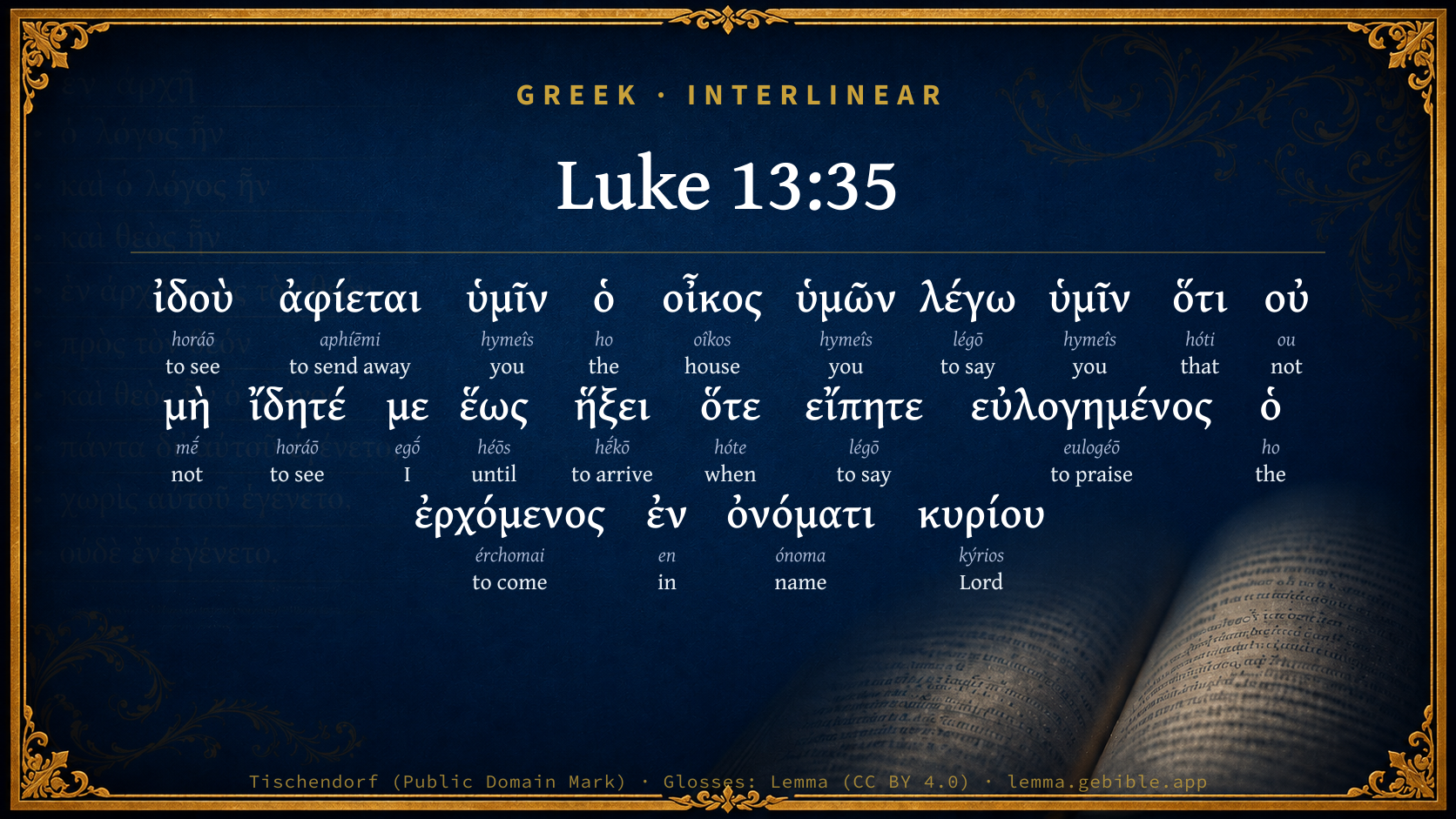
Download image
Cite this verse

Luke 13:35 (World English Bible). Public Domain. Lemma interlinear Bible study tool, https://lemma.gebible.app/v/luke/13/35.

Show BibTeX & RIS
BibTeX
RIS
English Translation
Behold, your house is left to you desolate. I tell you, you will not see me, until you say, 'Blessed is he who comes in the name of the Lord!'"
World English Bible · Public Domain
Download a study sheet

One document with this verse’s original text, its word-by-word gloss line, the meaning frame, cross-references with their text, attributed commentary, and full source and license credits — printable, and it pastes into notes with its structure intact.

This verse Autodidact and up

Study sheet (.html) Plain text (.txt)

A passage Seminary Student

Up to 50 verses in one chapter. A passage sheet keeps up to 6 commentary sources and 12 cross-references per verse, in the order this page ranks them, and says so on the sheet whenever that leaves anything out. Ask for a single verse and you get the Autodidact verse sheet above.

Everything on this page stays free to read, with no account — the sheet is a download of what is already on screen, not access to it.

Want to remove ads? Support Godless Engineer
Compare translations 3

The same verse in 3 English versions, stacked beneath the original-language interlinear above. Click any original word for its lexicon entry.

Each is an independent rendering of the whole verse — the interlinear is not word-aligned to these translations.

Highlighted words mark where these versions differ — a whole-verse word diff, not a word-by-word alignment.

  • World English Bible Public Domain
    Behold, your house is left to you desolate. I tell you, you will not see me, until you say, 'Blessed is he who comes in the name of the Lord!'"
  • King James Version Public Domain
    Behold, your house is left unto you desolate: and verily I say unto you, Ye shall not see me, until the time come when ye shall say, Blessed is he that cometh in the name of the Lord.
  • unfoldingWord Literal Text CC BY-SA 4.0
    Behold, your house is left to you. And I say to you, you will certainly not see me until it comes when you say, ‘Blessed is the one coming in the name of the Lord.’”

unfoldingWord Literal Text — © unfoldingWord, licensed CC BY-SA 4.0. Word-aligned USFM3 via Door43 (git.door43.org/unfoldingWord/en_ult).

Versions to compare (up to 4)

3 of 4 selected

Show all 19 translations

Every available English version of this verse, each an independent rendering of the whole verse.

  • World English Bible Public Domain
    Behold, your house is left to you desolate. I tell you, you will not see me, until you say, 'Blessed is he who comes in the name of the Lord!'"
  • Berean Standard Bible Public Domain
    Look, your house is left to you desolate. And I tell you that you will not see Me again until you say, ‘Blessed is He who comes in the name of the Lord.’”
  • Majority Standard Bible Public Domain
    Look, your house is left to you desolate. And I tell you that you will not see Me again until you say, ‘Blessed is He who comes in the name of the Lord.’”
  • King James Version Public Domain
    Behold, your house is left unto you desolate: and verily I say unto you, Ye shall not see me, until the time come when ye shall say, Blessed is he that cometh in the name of the Lord.
  • American Standard Version (1901) Public Domain
    Behold, your house is left unto you `desolate': and I say unto you, Ye shall not see me, until ye shall say, Blessed is he that cometh in the name of the Lord.
  • Revised Version (1885) Public Domain
    Behold, your house is left unto you desolate: and I say unto you, Ye shall not see me, until ye shall say, Blessed is he that cometh in the name of the Lord.
  • Geneva Bible (1599) Public Domain
    Beholde, your house is left vnto you desolate: and verely I tell you, ye shall not see me vntill the time come that ye shall say, Blessed is he that commeth in the Name of the Lord.
  • Douay-Rheims (1899) Public Domain
    Behold your house shall be left to you desolate. And I say to you, that you shall not see me till the time come, when you shall say: Blessed is he that cometh in the name of the Lord.
  • Young's Literal Translation Public Domain
    `Lo, your house is being left to you desolate, and verily I say to you -- ye may not see me, till it may come, when ye may say, Blessed `is' he who is coming in the name of the Lord.'
  • Literal Standard Version CC BY-SA 4.0
    Behold, your house is being left to you desolate, and truly I say to you, you may not see Me, until it may come when you may say, Blessed [is] He who is coming in the Name of the LORD.”
  • Unlocked Literal Bible CC BY-SA 4.0
    See, your house is abandoned. I say to you, you will not see me until you say, 'Blessed is he who comes in the name of the Lord.'”
  • unfoldingWord Literal Text CC BY-SA 4.0
    Behold, your house is left to you. And I say to you, you will certainly not see me until it comes when you say, ‘Blessed is the one coming in the name of the Lord.’”
  • Darby Bible Public Domain
    Behold, your house is left unto you; and I say unto you, that ye shall not see me until it come that ye say, Blessed [is] he that comes in the name of [the] Lord.
  • World Messianic Bible Public Domain
    Behold, your house is left to you desolate. I tell you, you will not see me until you say, ‘Blessed is he who comes in the name of the Lord!’”
  • Webster's Bible Public Domain
    Behold, your house is left to you desolate. And verily I say to you, ye shall not see me, until the time shall come when ye shall say, Blessed is he that cometh in the name of the Lord.
  • Free Bible Version CC BY-SA 4.0
    Look, your house is left desolate, and I tell you that you won't see me again until you say, ‘Blessed is he who comes in the name of the Lord.’”
  • Bible in Basic English Public Domain
    Now see, your house is waste, and I say to you, You will not see me again till you say, A blessing on him who comes in the name of the Lord.
  • Text-Critical English NT CC BY 4.0
    Behold, your house is left to you desolate. I tell you, you will certainly not see me again until the time comes when you say, ‘Blessed is he who comes in the name of the Lord!’ ”
  • Tyndale New Testament (1534) Public Domain
    Beholde youre habitacion shalbe left vnto you desolate. For I tell you ye shall not se me vntill the tyme come that ye shall saye blessed is he that commeth in the name of the Lorde.

Literal Standard Version (2020), Covenant Press — licensed CC BY-SA 4.0. Text via the HelloAO Bible API (eBible.org). Unlocked Literal Bible (unfoldingWord) — licensed CC BY-SA 4.0. Text via the HelloAO Bible API (eBible.org). unfoldingWord Literal Text — © unfoldingWord, licensed CC BY-SA 4.0. Word-aligned USFM3 via Door43 (git.door43.org/unfoldingWord/en_ult). Free Bible Version, Dr. Jonathan Gallagher — licensed CC BY-SA 4.0. Text via the HelloAO Bible API (eBible.org).

Word by word

More ways to search: Search by grammar → Find every occurrence → Compare this word →

Practice this passage: Drill this verse → Learn its vocabulary →

ἥξει
hḗkō
G2240
“to arrive”
Verb, Future, Active, Indicative, 3rd person, Singular
Part of Speech
Verb
Tense
Future
Voice
Active
Mood
Indicative
Person
3rd person
Number
Singular
Full Thayer's Definition

Origin: a primary verb

TDNT: 17:26,3

1. to have come, have arrived, be present 2. metaph. a. to come to one, i.e. to seek an intimacy with one, become his follower: to come upon one (unexpectedly) b. to come upon one, of things endured
  1. ἰδοὺ horáō G3708 “to see” Verb, Aorist, Middle, Imperative, 2nd person, Singular
  2. ἀφίεται aphíēmi G863 “to send away” Verb, Present, Passive, Indicative, 3rd person, Singular
  3. ὑμῖν hymeîs G5210 “you” Personal pronoun, 2nd person, Dative, Plural
  4. ὁ ho G3588 “the” Article, Nominative, Singular, Masculine
  5. οἶκος oîkos G3624 “house” Noun, Nominative, Singular, Masculine
  6. ὑμῶν hymeîs G5210 “you” Personal pronoun, 2nd person, Genitive, Plural
  7. λέγω légō G3004 “to say” Verb, Present, Active, Indicative, 1st person, Singular
  8. ὑμῖν hymeîs G5210 “you” Personal pronoun, 2nd person, Dative, Plural
  9. ὅτι hóti G3754 “that” Conjunction
  10. οὐ ou G3756 “not” Particle, Negative
  11. μὴ mḗ G3361 “not” Particle, Negative
  12. ἴδητέ horáō G3708 “to see” Verb, Aorist, Active, Subjunctive, 2nd person, Plural
  13. με egṓ G1473 “I” Personal pronoun, 1st person, Accusative, Singular
  14. ἕως héōs G2193 “until” Adverb
  15. ὅτε hóte G3753 “when” Adverb
  16. εἴπητε légō G3004 “to say” Verb, Aorist, Active, Subjunctive, 2nd person, Plural
  17. εὐλογημένος eulogéō G2127 “to praise” Verb, Perfect, Passive, Participle, Nominative, Singular, Masculine
  18. ὁ ho G3588 “the” Article, Nominative, Singular, Masculine
  19. ἐρχόμενος érchomai G2064 “to come” Verb, Present, Middle or Passive deponent, Participle, Nominative, Singular, Masculine
  20. ἐν en G1722 “in” Preposition
  21. ὀνόματι ónoma G3686 “name” Noun, Dative, Singular, Neuter
  22. κυρίου kýrios G2962 “Lord” Noun, Genitive, Singular, Masculine

About this verse

These counts appear in no published source. They are computed here, from the morphology-tagged text and Lemma’s own curated glosses. What Lemma adds →

23
words
18
distinct lemmas
Gospels
section

Shared distinctive vocabulary

ἥξει to arrive G2240 occurs in 25 verses of the Greek New Testament. Also found in:
Repetition

Words recur within this verse:

Cross-references

28

Topical passages linked to Luke 13:35 in the Treasury of Scripture Knowledge — connected by theme and wording, ordered by reader-vote popularity; previews shown in the World English Bible.

  • Psalms 118:26 Blessed is he who comes in the name of Yahweh! We have blessed you out of the house of Yahweh.
  • Mark 11:9–10 Those who went in front, and those who followed, cried out, "Hosanna! Blessed is he who comes in the name of the Lord!
  • Matthew 21:9 The multitudes who went before him, and who followed kept shouting, "Hosanna to the son of David! Blessed is he who comes in the name of the Lord! Hosanna in the highest!"
  • John 12:13 they took the branches of the palm trees, and went out to meet him, and cried out, "Hosanna! Blessed is he who comes in the name of the Lord, the King of Israel!"
  • Isaiah 52:7 How beautiful on the mountains are the feet of him who brings good news, who publishes peace, who brings good news of good, who publishes salvation, who says to Zion, Your God reigns!
  • Hosea 3:4–5 For the children of Israel shall abide many days without king, and without prince, and without sacrifice, and without sacred stone, and without ephod or idols.
  • John 12:35–36 Jesus therefore said to them, "Yet a little while the light is with you. Walk while you have the light, that darkness doesn't overtake you. He who walks in the darkness doesn't know where he is going.
  • John 14:19–23 Yet a little while, and the world will see me no more; but you will see me. Because I live, you will live also.
  • Isaiah 1:7–8 Your country is desolate. Your cities are burned with fire. Strangers devour your land in your presence, And it is desolate, As overthrown by strangers.
  • Daniel 9:26–27 After the sixty-two weeks the Anointed One shall be cut off, and shall have nothing: and the people of the prince who shall come shall destroy the city and the sanctuary; and the end of it shall be with a flood, and even to the end shall be war; desolations are determined.
  • Luke 19:38–40 saying, "Blessed is the King who comes in the name of the Lord! Peace in heaven, and glory in the highest!"
  • Luke 21:5–6 As some were talking about the temple and how it was decorated with beautiful stones and gifts, he said,
  • Luke 21:24 They will fall by the edge of the sword, and will be led captive into all the nations. Jerusalem will be trampled down by the Gentiles, until the times of the Gentiles are fulfilled.
  • John 7:34–36 You will seek me, and won't find me; and where I am, you can't come."
  • John 8:22–24 The Jews therefore said, "Will he kill himself, that he says, 'Where I am going, you can't come?'"
  • Acts 6:13–14 and set up false witnesses who said, "This man never stops speaking blasphemous words against this holy place and the law.
  • Romans 10:9–15 that if you will confess with your mouth the Lord Jesus, and believe in your heart that God raised him from the dead, you will be saved.
  • Leviticus 26:31–32 I will lay your cities waste, and will bring your sanctuaries to desolation, and I will not take delight in the sweet fragrence of your offerings.
  • Psalms 69:25 Let their habitation be desolate. Let no one dwell in their tents.
  • Isaiah 5:5–6 Now I will tell you what I will do to my vineyard. I will take away its hedge, and it will be eaten up. I will break down its wall of it, and it will be trampled down.
  • Isaiah 40:9–11 You who tell good news to Zion, go up on a high mountain; you who tell good news to Jerusalem, lift up your voice with strength; lift it up, don't be afraid; say to the cities of Judah, Behold, your God!
  • Isaiah 64:10–11 Your holy cities are become a wilderness, Zion is become a wilderness, Jerusalem a desolation.
  • Micah 3:12 Therefore Zion for your sake will be plowed like a field, And Jerusalem will become heaps of rubble, And the mountain of the temple like the high places of a forest.
  • Zechariah 12:10 I will pour on the house of David, and on the inhabitants of Jerusalem, the spirit of grace and of supplication; and they will look to me whom they have pierced; and they shall mourn for him, as one mourns for his only son, and will grieve bitterly for him, as one grieves for his firstborn.
  • Zechariah 14:2 For I will gather all nations against Jerusalem to battle; and the city will be taken, the houses rifled, and the women ravished. half of the city will go out into captivity, and the rest of the people will not be cut off from the city.
  • 2 Corinthians 3:15–18 But to this day, when Moses is read, a veil lies on their heart.
  • Jeremiah 22:5 But if you will not hear these words, I swear by myself, says Yahweh, that this house shall become a desolation.
  • Zechariah 11:1–2 Open your doors, Lebanon, That the fire may devour your cedars.

Cross-references courtesy of OpenBible.info (CC BY 4.0).

Where the printed editions differ

2 variants

Places in this verse where the major printed Greek editions disagree on the wording in a way that affects the translation — a comparison of editions, not a manuscript-by-manuscript collation. The editions are the modern critical texts (Nestlé-Aland 28/27, SBL, Westcott-Hort, Tregelles, Tyndale House) and the traditional texts behind the KJV (the Textus Receptus and the Byzantine/Majority text). It is not a claim about which reading is original.

  1. Extra text
    ἔρημος.

    “desolate.”

    In TRByz Not in NA28NA27TynSBLWHTreg
  2. Extra text
    ἀμὴν

    “Amen”

    In TR Not in NA28NA27TynSBLWHTregByz

    ἔρημος. ἀμὴν (erēmos amēn) 'desolate. Amen' is only in traditional manuscripts (Treg+TR+Byz)

Textual data: Translators Amalgamated Greek New Testament (STEPBible TAGNT) · CC BY 4.0.

Commentary

Notes on Luke 13:35 from classic Christian and Jewish commentators (each source and its license shown beneath its notes). The classic Christian expositions comment on the surrounding passage and are grouped to its opening verse, so a note may address several verses; the Jewish commentaries on the Tanakh (Rashi and others) are per-verse, so they appear only where the commentator wrote on this verse.

Lemma curates 59 commentaries, every one of them public domain or Creative Commons licensed, each selected and text-cleaned for this edition rather than reprinted as found. About our sources →

Tyndale Open Study Notes

Tyndale Open Resources

13:35 your house is abandoned: Jesus predicted the destruction of Jerusalem that took place in AD 70. • Blessings on the one who comes in the name of the Lord! This refers to Ps 118:26. Psalm 118 was one of the psalms sung by pilgrims going up to Jerusalem for the annual festivals. Here Jesus referred to his second coming.

Tyndale Open Study Notes — © Tyndale Open Resources, licensed CC BY-SA 4.0. Text via the HelloAO Bible API.

Bengel's Gnomon

Johann Albrecht Bengel

Luk 13:35. Ἰδοὺ ἀφίεται ὑμῖν ὁ οἶκος ὑμῶν) Many have added ἔρημος from Matthew.[137] In Luke the Saviour is represented as having said these words in Galilee: nor did He subsequently afford the people of Jerusalem the opportunity of seeing Him, until, after the resurrection of Lazarus, at His own royal entry, they said, Blessed is He who cometh in the name of the Lord.[138] Therefore, from the time of this declaration and prelude up to the time of that entry of His, He left their house to them,[139] though not yet however ‘desolate’ [therefore the ἜΡΗΜΟΝ here is spurious]. But in Matthew, after His royal entry, going out from the temple for the last time, He solemnly declared their house to be left desolate.[140] [We have been permitted to observe the same nice distinction in the words respectively used, between Luk 11:49, and Mat 23:34: see the notes on both passages.—Harm., p. 407.]—λέγω δὲ ὑμῖν, but I say unto you) He speaks sternly, and yet mercifully, as we have just now remarked. Nay, even in Mat 23:39, the ἀμὴν, verily, is wanting, by the insertion of which in Luke some have intensified the sternness of His denunciation.[141] The particle, δὲ, but, opposes to one another the present desolation of their abandoned house, and their acclamations so soon about to follow.

[137] AB Vulg. Orig. 3,188b; 642d, omit ἔρημος. But Dabc Iren. and Rec. Text, add ἔρημος.—ED. and TRANSL.

[138] This can only be the immediate temporary fulfilment of His prophecy. For that it is not the full and exhaustive fulfilment of it is plain from the fact, that presently after they had used the words, “Blessed is He,” etc., ch. Luk 19:38, He “wept over the city,” Luk 11:41-44, and denied that it even then “knew the time of its visitation” by Him in mercy. Therefore the time is yet future when the Jews, according to Psa 118:22; Psa 118:26, Zec 4:7; Zec 12:10, shall recognise Him in the character (= name) of Lord.—ED. and TRANSL.

[139] I am confidently of opinion that the house in this passage is the same as that of which He speaks in Mat 23:38, though at a different time. Moreover, that the temple is meant in the passage of Matthew, is evident from Mat 24:1, where, immediately after that most solemn declaration, the Saviour is said to have departed from the temple. What need, then, could He have had of the demonstrative οὖτος in order to point out that house or temple, seeing that He spake these words in the temple itself? Truly the article ὁ, in such a case, was more than sufficient. I moreover will most freely grant, that the Jews never called the temple their own house, but always the house of the Lord (although S. R. D. S. F. Lorenz, in his diss. de Induratione Israelis ante finem dierum finiendâ, Argent. 1771, p. 50, shows the contrary to be the fact). But yet, seeing that He did not hesitate to call the temple σπήλαιον λῃστῶν (ch. Luk 19:46), need we wonder that He, in order to express indignation, might have called it in this passage “the house of the Jews?” Never did the Jewish people, as far as I know, call themselves the people of Moses: and yet the Lord, when angry with the people, says to Moses, “Thy people have corrupted themselves,” Exo 32:7. Comp. by all means Jer 7:4; Jer 7:8, where the nomenclature [which they arrogated to themselves]. The temple of the Lord, is reproved as false: Comp. Hos 1:9, לֹא עַמִּוי, not—my people and Rom 2:28, not a Jew; comp. with this Rev 3:9, etc. I make these remarks by the way of an answer to Ernesti Bibl. Theol. Tom. x. p. 184, et seqq.—E. B.

[140] Mat 23:38, BL Memph. Orig. 3,167cd omit ἔρημος. But both internal probability for the reason given by Beng., and the weighty authorities, Dabcd Vulg. Orig. Iren. and Cypr. support it.—ED. and TRANSL.

[141] ABDabc Vulg. omit ἀμὴν. Rec. Text, without any primary authority, inserts it.—ED. and TRANSL.

Bengel's Gnomon of the New Testament — English translation (T&T Clark, Edinburgh, 1860) — public domain. Text from a community e-Sword module.

Adam Clarke's Commentary

Verse 35. Your house] Ὁ οικος, the temple-called here your house, not my house - I acknowledge it no longer; I have abandoned it, and will dwell in it no more for ever. So he said, 2Ch 36:17, when he delivered the temple into the hands of the Chaldeans - the house of YOUR sanctuary. A similar form of speech is found, Ex 32:7, where the Lord said to Moses, THY people, c., to intimate that he acknowledged them no longer for his followers. See the notes on Mt 23:21 Mt 23:38. But some think that our Lord means, not the temple, but the whole commonwealth of the Jews.

The principal subjects it this chapter may be found considered at large, on the parallel places in Matthew and Mark, to which the reader is referred. As to the account of the woman with the spirit of infirmity, which is not mentioned by any other of the evangelists, see it largely illustrated in the notes on Lu 13:11, &c.

Adam Clarke's Commentary on the Bible (1810–1826) — public domain. Text from a community e-Sword/MySword module.

The Cambridge Bible for Schools and Colleges

gen. ed. J. J. S. Perowne

35. Behold, your house is left unto you desolate] The authenticity of the word ‘desolate’ is very doubtful, as it is omitted in א, A, B, K, L, &c. The words therefore mean ‘The Shechinah has vanished from you now (Eze_10:19; Eze_11:23). The house is now yours, not God’s; and because yours therefore a cave of brigands.’ If the word ‘desolate’ be genuine, it may allude to Dan_9:27 and “the desolating wing of abomination,” as well as to other prophecies, Lev_26:31; Mic_3:12;

Isa_5:5-6. There is a remarkable parallel in 2Es_1:30-33, “I gathered you together as a hen gathereth her chickens under her wings: but now, what shall I do unto you? I will cast you out from my face. ...Thus saith the Almighty Lord, your house is desolate, I will cast you out as the wind doth stubble.”

Ye shall not see me] “Their senses are still blinded. The veil of the Talmud that hangs over their eyes is twice as heavy as the veil of Moses.” Van Oosterzee.

until the time come when ye shall say] It is a most frivolous interpretation of these words to make them merely refer to the Hosannas of Palm Sunday (Luk_19:38) as though they meant, ‘I shall not visit Jerusalem till the day of my humble triumph.’ They clearly refer to the future and final penitence of Israel. The ‘perfecting’ of Jesus would be His death, and then once again He would return as “the Coming One.” Hos_3:4-5; Psa_118:26. Here, as in so many other stern passages of Scripture, in the Valley of Achor is opened a door of Hope, for the phrase implies ‘till the time comes as come it will’ (Zechariah 12; Romans 11).

The Cambridge Bible for Schools and Colleges (gen. ed. J. J. S. Perowne; Cambridge University Press, 1878–1918) — public domain. Text from a community e-Sword module.

Trapp's Complete Commentary

John Trapp

35 Behold, your house is left unto you desolate: and verily I say unto you, Ye shall not see me, until the time come when ye shall say, Blessed is he that cometh in the name of the Lord.

Ver. 35. See Mat 23:38-39.

John Trapp, A Commentary or Exposition upon All the Books of the Old and New Testament (1647–1656) — public domain. Text from a community e-Sword module.

Whedon's Commentary on the Bible

Daniel D. Whedon

35. Your house is left—Our Lord speaks as from a future standpoint; namely, his departure by death at the crucifixion. The word desolate is here spurious; but is used in the later utterance of the apostrophe as the sign of utter giving over of the city to its fate.

Not see me—In the later utterance Jesus adds ye shall not see me henceforth; as the standpoint of his abandonment, was then already assumed. That sad abandonment still continues, for the vail is still on Israel’s heart. But though Jerusalem be desolate and Israel scattered, His unseen person is still on Zion, and His unseen feet still stand on Olivet. His ever preserving care perpetuates the race in its vicissitudes, waiting for the day when devoted Israel shall say, Blessed is he that cometh in the name of Jesus the Lord. Through what ages his spirit shall thereafter watch over restored and millennial Israel until He shall appear to gather his elect into his kingdom, we cannot say. For in the dim perspective of prophecy distant events and ages are reduced in size; time is almost dropped from the account, and events far asunder are visually made to touch. See notes on Mat_24:14-29. See, also, Supplementary Note on Matthew 25. But when at the consummation of the time he shall appear, every eye shall see him; the guilty shall look upon him whom they have pierced, and mourn; and the true Jerusalem shall say, Blessed is he that COMETH.

Daniel D. Whedon (gen. ed.), Commentary on the Old and New Testaments (1874–1909) — public domain. Text from a community e-Sword module.

The Pulpit Commentary

Behold, your house is left unto you desolate. The older authorities omit "desolate." The sentence will then read, "your house is left unto you." Their house from henceforth, not his. Ye shall not see me, until the time come when ye shall say, Blessed is he that cometh in the Name of the Lord. "Ye shall not see me." Van Oosterzee comments here: "Their senses are still blinded. The veil of the Talmud that hangs over their eyes is twice as heavy as the veil of Moses." The promise which concludes this saying of the Master can only refer to the far future, to the day of the penitence of Israel. It harmonizes with the voice of the older prophets, and tells us that the day will surely come when the people shall look on him whom they pierced, and shall mourn. But that mourning will be turned speedily into joy.

The Pulpit Commentary (1880–1919), ed. H.D.M. Spence-Jones & Joseph S. Exell — public domain. Text from a community e-Sword module.

John Wesley's Explanatory Notes

Your house is left to you desolate - Is now irrecoverably consigned to desolation and destruction: And verily I say to you, after a very short space, ye shall not see me till the time come, when taught by your calamities, ye shall be ready and disposed to say, Blessed is he that cometh in the name of the Lord. It does not imply, that they should then see Jesus at all; but only that they would earnestly wish for the Messiah, and in their extremity be ready to entertain any who should assume that character.

John Wesley, Explanatory Notes Upon the Whole Bible (1754–1765) — public domain. Text via the GEBible commentary corpus.

Scofield Reference Notes

C. I. Scofield

until (See Scofield "Mat 23:39").

Lord Jehovah. Psa 118:26.

The Scofield Reference Bible (1917 edition), notes by C. I. Scofield — public domain. Text from a community e-Sword module.

Cambridge Greek Testament for Schools and Colleges

35. ἔρημος has probably been added from Mat 23:38.

ἂν after ἕως is omitted in BDL, &c. ἥξει AD, &c.

35. ἰδοὺ ἀφίεται ὑμῖν ὁ οἶκος ὑμῶν. The authenticity of the word ἔρημος (‘desolate’) is very doubtful, as it is omitted in אABKL, &c. The words therefore mean ‘The Shechinah has vanished from you now (Eze 10:19; Eze 11:23). The house is now yours, not God’s; and because yours therefore a cave of brigands.’ If the word ἔρημος be genuine, it may allude to Dan 9:27 and “the desolating wing of abomination,” as well as to other prophecies, Lev 26:31; Mic 3:12; Isa 5:5-6. There is a remarkable parallel in 2Es 1:30-33, “I gathered you together as a hen gathereth her chickens under her wings: but now, what shall I do unto you? I will cast you out from my face.… Thus saith the Almighty Lord, your house is desolate, I will cast you out as the wind doth stubble.”

οὐ μὴ ἴδητέ με. “Their senses are still blinded. The veil of the Talmud that hangs over their eyes is twice as heavy as the veil of Moses.” Van Oosterzee.

ἕως ἥξει ὅτε εἴπητε. Quando dixeritis. ὅτε with the subj. without ἂν is a frequent Homeric idiom, though hardly found in Attic prose. It implies the event apart from all supposition. (See Winer, p. 372.). If the reading be ἕως ἂν ἥξῃ it implies that the time would come, though none could say (ἂν) when it should come. It is a most frivolous interpretation of these words to make them merely refer to the Hosannas of Palm Sunday (Luk 19:38) as though they meant, ‘I shall not visit Jerusalem till the day of my humble triumph.’ They clearly refer to the future and final penitence of Israel. The ‘perfecting’ of Jesus would be His death, and then once again He would return as “the Coming One.” Hos 3:4-5; Psa 118:26. Here, as in so many other stern passages of Scripture, in the Valley of Achor is opened a door of Hope, for the phrase implies ‘till the time comes as come it will’ (Zechariah 12; Romans 11).

Cambridge Greek Testament for Schools and Colleges (Cambridge University Press, 1896; 21 vols, various authors incl. Carr, Maclear, Plummer, Farrar, Lumby, Moule, M. R. James, Simcox) — public domain. Text from a community e-Sword module.

Alford’s Greek Testament

Henry Alford

35.] These verses are in too close connexion with the preceding to allow of the supposition that they are inserted unchronologically, as Grot., ., De W., Neander, and even Schleierm. suppose: and their variations from those in Matthew (23:37-39) are striking and characteristic. For γάρ, which there accounts for the ἐρημία of the temple, then for the last time left by our Lord, does not appear here, but δέ, introducing a fresh saying, having I believe another meaning: and the words ἀπʼ ἄρτι, which follow ἴδητε there, marking that moment as the commencement of the dereliction, are here omitted. Surely these differences indicate an uttering of the words prophetically, previous to their utterance in the act of departure. Our Lord overleaps in prophetic foresight the death just set forth as certain, and speaks of the ages to come, during which the holy city should be desolate and trodden down of the Gentiles.

That the very words εὐλ. ὁ ἐρχ. κ.τ.λ. were used by the multitude at the Lord’s entry into Jerusalem, I should much rather ascribe to a misunderstanding by them and the disciples of this very declaration, than for a moment suppose that these words found any sufficient fulfilment in that entry (Erasmus, Paulus, Wieseler).

Henry Alford, The Greek Testament (1849–1861) — public domain. Text from a community e-Sword module.

International Critical Commentary

35. ἀφίεται ὑμῖν ὁ ὑμῶν. Neither here (D A G D M U X, Δ Latt. Boh. Syr.) nor in Mat 23:38, where it is better attested, is ἔρημος more than a gloss. Comp. ἵτι εἰς ἐρήμωσιν ἔσται ὁ οἶκος οὖτος (Jer 22:5), and ἐγκαταλέλοιπα τὸν οἶκόν μου, ἀφῆκα τὴν κληρονομίαν μου (Jer 12:7). “Is being left to you” means “You have it entirely to yourselves to possess and protect; for God no longer dwells in it and protects it.” Comp. ἀφεθήσεται (17:34, 35). By “your house” is meant the home of ψὰ τέκνα σου, the city of Jerusalem. Note the repetition ὑμῖν … ὑμῶν. Syr-Sin., here has, “Your house is forsaken”; in Mt. it is defective.

λέγω δὲ ὑμῖν οὐ μὴ ἴδητέ με. With great solemnity and with strong assurance. Comp. Joh 7:34, Joh 8:21.

ἕως εἴπητε. Their seeing Him is dependent upon their repentance; and this is left uncertain; for the ἥξει ὅτε ἂν ἥξηανχὲͅ ὅτε after ἕως (A D, Vulg.) is not genuine.1 There are three interpretations of the point of time indicated by this declaration. (1) The cries of the multitude on Palm Sunday (19:38; Mat 21:9; Mar 11:9). But this is quite inadequate. Christ would not have declared with this impressive solemnity the fact that He would not enter Jerusalem for some weeks, or possibly months. (2) The Second Advent. But where are we told that the unbelieving Jews will welcome the returning Christ with hymns of praise? (3) The conversion of the Jews throughout all time. This last no doubt is right. The quotation Εὐλογημέος, κ.τ.λ., is verbatim from LXX of Psa 118:26, and ἐν ὀνόματι Κυρίου means as the representative of Jehovah. Converted Israel will thus welcome the spiritual presence of the Messiah.

§ Found in Luke alone.

Vulg. Vulgate.

Wetst. Wetstein.

Wic. Wiclif.

Rhem. Rheims (or Douay).

RV. Revised Version.

Jos. Josephus.

אԠא Cod. Sinaiticus, sæc. iv. Brought by Tischendorf from the Convent of St. Catherine on Mt. Sinai; now at St. Petersburg. Contains the whole Gospel complete.

A A. Cod. Alexandrinus, sæc. v. Once in the Patriarchal Library at Alexandria; sent by Cyril Lucar as a present to Charles 1. in 1628, and now in the British Museum. Complete.

D D. Cod. Bezae, sæc. vi. Given by Beza to the University Library at Cambridge 1581. Greek and Latin. Contains the whole Gospel.

L L. Cod. Regius Parisiensis, sæc. viii. National Library at Paris. Contains the whole Gospel.

M M. Cod. Campianus, sæc. ix. In the National Library at Paris. Contains the whole Gospel.

T T. Cod. Borgianus, sæc. v. In the Library of the Propaganda at Rome. Greek and Egyptian. Contains 22:20-23:20.

X X. Cod. Monacensis, sæc. ix. In the University Library at Munich. Contains 1:1-37, 2:19-3:38, 4:21-10:37, 11:1-18:43, 20:46-24:53.

1 Both ἀργός (contr. from ἀεργός) and ἀργία are used of land that yields no return: Xen. Cyr. iii. 2, 19; Theophr. H. Phys. v. 9, 8. Comp. Rom 6:6 “that the body as an instrument of sin may be rendered unproductive, inactive” (καταργηθῇ); also 1Co 15:26; 2Co 3:14; 2Ti 1:10.

B B. Cod. Vaticanus, sæc. 4. In the Vatican Library certainly since 15331 (Batiffol, La Vaticane de Paul 3, etc., p. 86).

Boh. Bohairic.

Aeth. Ethiopic.

Syr Syriac.

Sin. Sinaitic.

L. J. Leben Jesu

Cov. Coverdale.

Luth. Luther.

Iren. Irenæus.

U U. Cod. Nanianus, sæc. x. In the Library of St. Mark’s, Venice. Contains the whole Gospel.

Edersh. Edersheim, Life and Times of Jesus the Messiah.

AV. Authorized Version.

1 With this pair of Parables comp. the Garments and the Wine-skins (5:36-39), the Rash Builder and the Rash King (14:28-32), the Lost Sheep and the Lost Coin (15:3-10). Other pairs are not in immediate juxtaposition; e.g. the Friend at Midnight (11:5-8) and the Unjust Judge (18:1-8).

1 West. quotes from the Talmud, “There was a stalk of mustard in Sichin from which sprang out three branches, of which one was broken off, and out of it they made a covering for a potter’s hut, and there were formed on it three cabs of mustard. Rabbi Simeon, son of Calaphta, said, A stalk of mustard was in my field into which I was wont to climb, as men are wont to climb into a fig tree.”

Beng. Bengel.

Tert. Tertullian.

R R. Cod. Nitriensis Rescriptus, sæc. 8. Brought from a convent in the Nitrian desert about 1847, and now in the British Museum. Contains 1:1-13, 1:69-2:4, 16-27, 4:38-5:5, 5:25-6:8, 18-36, 39, 6:49-7:22, 44, 46, 47, 8:5-15, 8:25-9:1, 12-43, 10:3-16, 11:5-27, 12:4-15, 40-52, 13:26-14:1, 14:12-15:1, 15:13-16:16, 17:21-18:10, 18:22-20:20, 20:33-47, 21:12-22:15, 42-56, 22:71-23:11, 38-51. By a second hand 15:19-21.

1 Cyril argues that, because we have ταύτῃ and not ἐκείνῃ with τῇ ἀλώπεκι, the fox must be some one nearer the spot than Herod, viz. the Pharisees (Migne, vol. 72. p. 582). Theophylact uses the same argument. But it is the common use of οὖτος for that which is condemned or despised, vulpi isti; or still more simply, “that fox of yours,” i.e. whom you put forward and make use of. Comp. οὗτος, 5:21, 7:39, 49; Joh 6:42, Joh 6:7:15, Joh 6:36, Joh 6:49, Joh 6:9:16, Joh 6:12:34.

D. B. Smith’s Dictionary of the Bible, 2nd edition.

1 “The number three seems here, as in the three years (ver. 7), to denote a period of time as complete in itself, with a beginning, middle, and end” (Andrews, L. of our Lord, p. 396). Universi tamporis requisiti ad opus suum perfectio significatur (Cajetan).

Wsctt. Westcott.

2 Maldonatus, whom Trench approves, makes the πλήν signify, “Although I must die on the third day, yet threats will not interfere with My continuing My work until then” Rather, “Although I must go to Jerusalem, yet a is not threats which send Me thither.”

1 But perhaps even in the case of the Baptist the hierarchy at Jerusalem had a hand. was “delivered up” by some party. Comp. παραδοθῆναι (Mar 1:14), παρεδόθη (Mat 4:12).

1 Hier sind alle Ausflüchte vergebens, und man muss bekennen: sind diess wirkliche Worte Jesu, so muss or öfter and länger, als es den synoptischen Berichten nack scheint, in Jerusalem thätig gewesen sein (L. J. 1864, p. 249).

G G. Cod. Harleianus, sæc. ix. In the British Museum. Contains considerable portions.

Δ̠Δ. Cod. Sangallensis, sæc. ix. In the monastery of St. Gall in Switzerland. Greek and Latin. Contains the whole Gospel.

Latt. Latin.

1 Not only do א B K L M P X, Syr. Boh. Arm. and omit ἤξει ὅτε, but no authorities insert the words Mat 23:39, which adds to the weight of the evidence against ban here.

International Critical Commentary — older volumes (1896–1929), various authors — public domain. Text from a community e-Sword module.

Lesson kit

Teaching starters — assembled from the data on this page, not authored interpretation. Every prompt links to the verse data it draws on. Edit before teaching.

Luke, in the Gospels, opens this verse with 23 words (18 distinct Greek lemmas). Its most distinctive word is hḗkō (“to arrive”). A historical commentator’s framing appears above. Read the whole chapter for the surrounding context.

Discussion questions

  1. How does “to arrive” (hḗkō) shape what this verse is saying?
  2. How does Matthew 8:11, which shares the word «to arrive», read alongside this verse?
  3. What does the repetition of “to see” (2× in this one verse) do in this verse?
  4. These translations render this verse differently; the difference is in the English rendering, not the original. What questions does that raise?
  5. Compare how Tyndale Open Study Notes and Bengel's Gnomon read this verse. Where do they agree or differ?

Things to notice

Reading settings

Reading text

Shown beneath each verse's original-language words.

Old Testament
Old Testament edition

Read the OT as the Masoretic Hebrew (MT) or the Greek Septuagint (LXX).

English shown for the Greek Septuagint (in the Hebrew ↔ Greek comparison).

Comparing translations? Open the Compare panel on any verse page to stack up to four side by side.