Mark 15:39

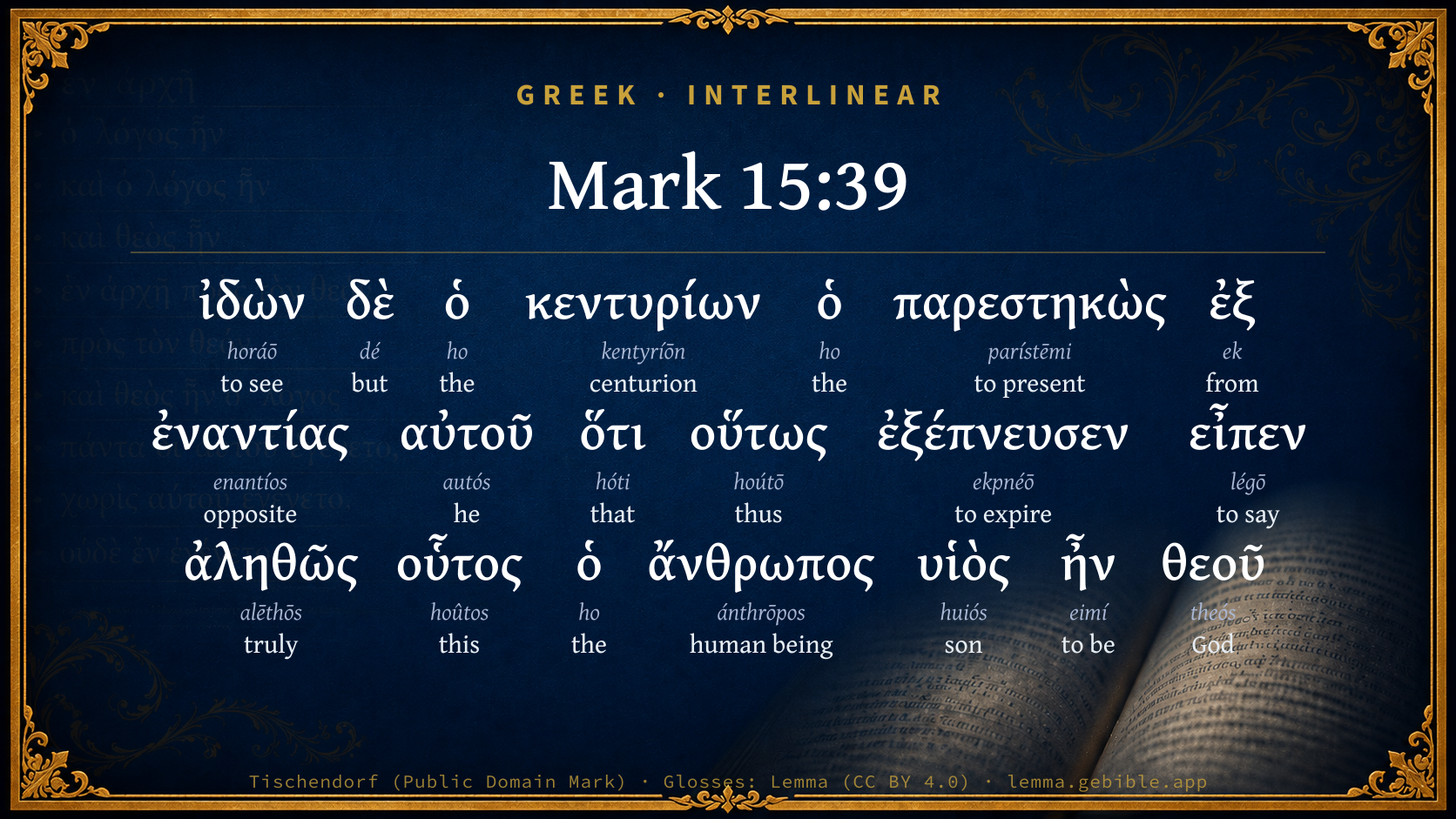
Greek (Tischendorf 8th ed.) Mark 15:39 appears in the Greek New Testament. The text above is from the Tischendorf 8th edition. Each word links to its Strong’s number and a concise gloss. Click any word for its full Thayer’s Greek Lexicon entry.
Download image
Cite this verse

Mark 15:39 (World English Bible). Public Domain. Lemma interlinear Bible study tool, https://lemma.gebible.app/v/mark/15/39.

Show BibTeX & RIS
BibTeX
RIS
English Translation
When the centurion, who stood by opposite him, saw that he cried out like this and breathed his last, he said, "Truly this man was the Son of God!"
World English Bible · Public Domain
Highlights
  • 1 first appearance in the Greek New Testament
Full analysis ↓
Download a study sheet

One document with this verse’s original text, its word-by-word gloss line, the meaning frame, cross-references with their text, attributed commentary, and full source and license credits — printable, and it pastes into notes with its structure intact.

This verse Autodidact and up

Study sheet (.html) Plain text (.txt)

A passage Seminary Student

Up to 50 verses in one chapter. A passage sheet keeps up to 6 commentary sources and 12 cross-references per verse, in the order this page ranks them, and says so on the sheet whenever that leaves anything out. Ask for a single verse and you get the Autodidact verse sheet above.

Everything on this page stays free to read, with no account — the sheet is a download of what is already on screen, not access to it.

Want to remove ads? Support Godless Engineer
Compare translations 3

The same verse in 3 English versions, stacked beneath the original-language interlinear above. Click any original word for its lexicon entry.

Each is an independent rendering of the whole verse — the interlinear is not word-aligned to these translations.

Highlighted words mark where these versions differ — a whole-verse word diff, not a word-by-word alignment.

  • World English Bible Public Domain
    When the centurion, who stood by opposite him, saw that he cried out like this and breathed his last, he said, "Truly this man was the Son of God!"
  • King James Version Public Domain
    And when the centurion, which stood over against him, saw that he so cried out, and gave up the ghost, he said, Truly this man was the Son of God.
  • unfoldingWord Literal Text CC BY-SA 4.0
    Now the centurion, having stood by opposite him, having seen that he expired in this way, said, “Truly this man was a Son of God.”

unfoldingWord Literal Text — © unfoldingWord, licensed CC BY-SA 4.0. Word-aligned USFM3 via Door43 (git.door43.org/unfoldingWord/en_ult).

Versions to compare (up to 4)

3 of 4 selected

Show all 19 translations

Every available English version of this verse, each an independent rendering of the whole verse.

  • World English Bible Public Domain
    When the centurion, who stood by opposite him, saw that he cried out like this and breathed his last, he said, "Truly this man was the Son of God!"
  • Berean Standard Bible Public Domain
    When the centurion standing there in front of Jesus saw how He had breathed His last, he said, “Truly this man was the Son of God!”
  • Majority Standard Bible Public Domain
    When the centurion standing there in front of Jesus saw how He had cried out and breathed His last, he said, “Truly this man was the Son of God!”
  • King James Version Public Domain
    And when the centurion, which stood over against him, saw that he so cried out, and gave up the ghost, he said, Truly this man was the Son of God.
  • American Standard Version (1901) Public Domain
    And when the centurion, who stood by over against him, saw that he so gave up the ghost, he said, Truly this man was the Son of God.
  • Revised Version (1885) Public Domain
    And when the centurion, which stood by over against him, saw that he so gave up the ghost, he said, Truly this man was the Son of God.
  • Geneva Bible (1599) Public Domain
    Nowe when the Centurion, which stoode ouer against him, sawe that he thus crying gaue vp the ghost, he saide, Truely this man was the Sonne of God.
  • Douay-Rheims (1899) Public Domain
    And the centurion who stood over against him, seeing that crying out in this manner he had given up the ghost, said: Indeed this man was the son of God.
  • Young's Literal Translation Public Domain
    and the centurion who was standing over-against him, having seen that, having so cried out, he yielded the spirit, said, `Truly this man was Son of God.'
  • Literal Standard Version CC BY-SA 4.0
    and the centurion who was standing opposite Him, having seen that, having so cried out, He yielded the spirit, said, “Truly this Man was [the] Son of God.”
  • Unlocked Literal Bible CC BY-SA 4.0
    When the centurion who stood and faced Jesus saw that he had died in this way, he said, “Truly this man was the Son of God.”
  • unfoldingWord Literal Text CC BY-SA 4.0
    Now the centurion, having stood by opposite him, having seen that he expired in this way, said, “Truly this man was a Son of God.”
  • Darby Bible Public Domain
    And the centurion who stood by over against him, when he saw that he had expired having thus cried out, said, Truly this man was Son of God.
  • World Messianic Bible Public Domain
    When the centurion, who stood by opposite him, saw that he cried out like this and breathed his last, he said, “Truly this man was the Son of God!”
  • Webster's Bible Public Domain
    And when the centurion who stood over against him, saw that he so cried out, and expired, he said, Truly this man was the Son of God.
  • Free Bible Version CC BY-SA 4.0
    When the centurion standing there in front of Jesus saw how he died, he said, “This man was truly the Son of God.”
  • Bible in Basic English Public Domain
    And when the captain, who was near, saw how he gave up his spirit, he said, Truly this man was a son of God.
  • Text-Critical English NT CC BY 4.0
    Now when the centurion who was standing in front of Jesus saw how he cried out and breathed his last breath, he said, “Truly this man was the Son of God.”
  • Tyndale New Testament (1534) Public Domain
    And when the Centurion which stode before him sawe that he so cryed and gave vp the gooste he sayd: truly this man was the sonne of God.

Literal Standard Version (2020), Covenant Press — licensed CC BY-SA 4.0. Text via the HelloAO Bible API (eBible.org). Unlocked Literal Bible (unfoldingWord) — licensed CC BY-SA 4.0. Text via the HelloAO Bible API (eBible.org). unfoldingWord Literal Text — © unfoldingWord, licensed CC BY-SA 4.0. Word-aligned USFM3 via Door43 (git.door43.org/unfoldingWord/en_ult). Free Bible Version, Dr. Jonathan Gallagher — licensed CC BY-SA 4.0. Text via the HelloAO Bible API (eBible.org).

Word by word

More ways to search: Search by grammar → Find every occurrence → Compare this word →

Practice this passage: Drill this verse → Learn its vocabulary →

κεντυρίων
kentyríōn
G2760
“centurion”
Noun, Nominative, Singular, Masculine
Part of Speech
Noun
Case
Nominative
Number
Singular
Gender
Masculine
Full Thayer's Definition

Origin: of Latin origin

TDNT: None

1. centurion, an officer in the Roman army
  1. ἰδὼν horáō G3708 “to see” Verb, Aorist, Active, Participle, Nominative, Singular, Masculine
  2. δὲ dé G1161 “but” Conjunction
  3. ὁ ho G3588 “the” Article, Nominative, Singular, Masculine
  4. ὁ ho G3588 “the” Article, Nominative, Singular, Masculine
  5. παρεστηκὼς parístēmi G3936 “to present” Verb, Perfect, Active, Participle, Nominative, Singular, Masculine
  6. ἐξ ek G1537 “from” Preposition
  7. ἐναντίας enantíos G1727 “opposite” Adjective, Genitive, Singular, Feminine
  8. αὐτοῦ autós G846 “he” Personal pronoun, Genitive, Singular, Masculine
  9. ὅτι hóti G3754 “that” Conjunction
  10. οὕτως hoútō G3779 “thus” Adverb
  11. ἐξέπνευσεν ekpnéō G1606 “to expire” Verb, Aorist, Active, Indicative, 3rd person, Singular
  12. εἶπεν légō G3004 “to say” Verb, Aorist, Active, Indicative, 3rd person, Singular
  13. ἀληθῶς alēthōs G230 “truly” Adverb
  14. οὗτος hoûtos G3778 “this” Demonstrative pronoun, Nominative, Singular, Masculine
  15. ὁ ho G3588 “the” Article, Nominative, Singular, Masculine
  16. ἄνθρωπος ánthrōpos G444 “human being” Noun, Nominative, Singular, Masculine
  17. υἱὸς huiós G5207 “son” Noun, Nominative, Singular, Masculine
  18. ἦν eimí G1510 “to be” Verb, Imperfect, Active, Indicative, 3rd person, Singular
  19. θεοῦ theós G2316 “God” Noun, Genitive, Singular, Masculine

About this verse

These counts appear in no published source. They are computed here, from the morphology-tagged text and Lemma’s own curated glosses. What Lemma adds →

20
words
18
distinct lemmas
Gospels
section

Notable vocabulary

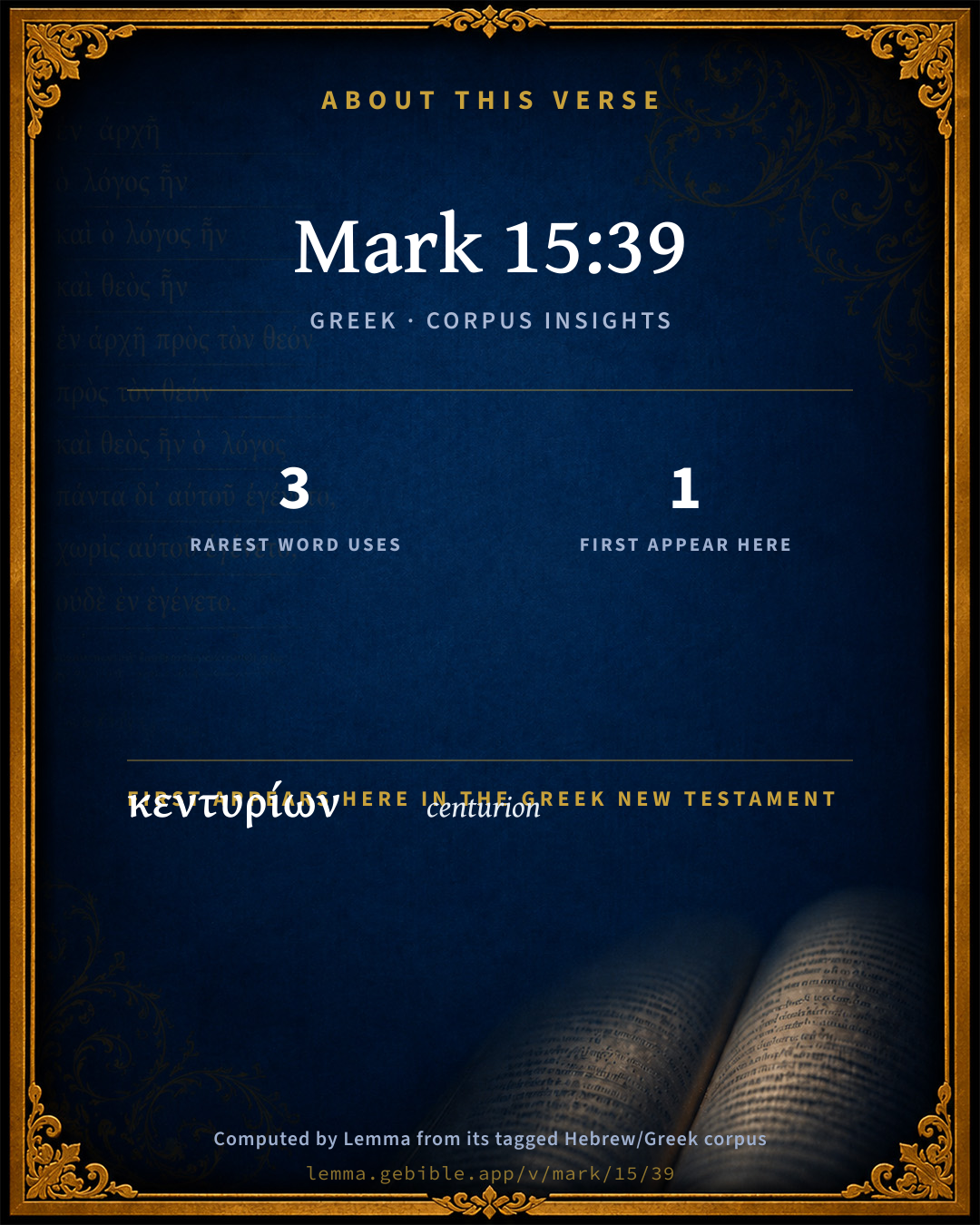
The rarest word here is κεντυρίων centurion G2760 — appearing just 3 times in the whole Greek New Testament.

First appearance in Scripture

This word makes its first canonical appearance in the Greek New Testament here:

  • κεντυρίων centurion G2760

Shared distinctive vocabulary

κεντυρίων centurion G2760 occurs in 3 verses of the Greek New Testament. Also found in:

Repetition

A word recurs within this verse:

Cross-references

8

Topical passages linked to Mark 15:39 in the Treasury of Scripture Knowledge — connected by theme and wording, ordered by reader-vote popularity; previews shown in the World English Bible.

  • Matthew 27:54 Now the centurion, and those who were with him watching Jesus, when they saw the earthquake, and the things that were done, feared exceedingly, saying, "Truly this was the Son of God."
  • Luke 23:47–48 When the centurion saw what was done, he glorified God, saying, "Certainly this was a righteous man."
  • Matthew 27:43 He trusts in God. Let God deliver him now, if he wants him; for he said, 'I am the Son of God.'"
  • Matthew 8:5–10 When he came into Capernaum, a centurion came to him, asking him,
  • Mark 15:44–45 Pilate marveled if he were already dead; and summoning the centurion, he asked him whether he had been dead long.
  • Acts 10:1 Now there was a certain man in Caesarea, Cornelius by name, a centurion of what was called the Italian Regiment,
  • Acts 27:1–3 When it was determined that we should sail for Italy, they delivered Paul and certain other prisoners to a centurion named Julius, of the Augustan band.
  • Acts 27:43 But the centurion, desiring to save Paul, stopped them from their purpose, and commanded that those who could swim should throw themselves overboard first to go toward the land;

Cross-references courtesy of OpenBible.info (CC BY 4.0).

Where the printed editions differ

1 variant

Places in this verse where the major printed Greek editions disagree on the wording in a way that affects the translation — a comparison of editions, not a manuscript-by-manuscript collation. The editions are the modern critical texts (Nestlé-Aland 28/27, SBL, Westcott-Hort, Tregelles, Tyndale House) and the traditional texts behind the KJV (the Textus Receptus and the Byzantine/Majority text). It is not a claim about which reading is original.

  1. Extra text
    κράξας

    “having cried out”

    In TregTRByz Not in NA28NA27TynSBLWH

    κράξας (kraxas) 'having cried out' is only in traditional manuscripts (Treg+TR+Byz)

Textual data: Translators Amalgamated Greek New Testament (STEPBible TAGNT) · CC BY 4.0.

Commentary

Notes on Mark 15:39 from classic Christian and Jewish commentators (each source and its license shown beneath its notes). The classic Christian expositions comment on the surrounding passage and are grouped to its opening verse, so a note may address several verses; the Jewish commentaries on the Tanakh (Rashi and others) are per-verse, so they appear only where the commentator wrote on this verse.

Lemma curates 59 commentaries, every one of them public domain or Creative Commons licensed, each selected and text-cleaned for this edition rather than reprinted as found. About our sources →

The Biblical Illustrator

Joseph S. Exell

Mar_15:39

Truly this Man was the Son of God.

The centurions confession

Never did reason obtain a more complete victory over prejudice. Death is the touchstone of the soul. Even in the most favourable circumstances it tries a man severely. But in this instance there were many aggravating circumstances to weigh clown and overwhelm the soul.

1. The treason of Judas. Jesus had been delivered up to His enemies by one who had been admitted to His friendship and close intercourse with Him.

2. Christs utter abandonment by His disciples. Not a voice had been uttered in Ills defence, or to comfort Him; not one was found to come forward courageously and acknowledge Him.

3. The injustice of His sentence. Even His judge was convinced of His innocence; yet He was condemned to the most cruel death ever devised.

4. The ignominy accompanying His punishment. The death of Jesus, expiring in the midst of tortures, abused, insulted, cursed by a whole nation, is the most horrible that could be feared.

5. His knowledge of all that was to come upon Him. His passion and death commenced in Gethsemane. There He resigned Himself unreservedly to all the anguish He afterwards underwent. Nor did He for one moment draw back from the awful sufferings that followed. Was not the centurion justified in the conclusion forced upon him by such a spectacle as this-that He who could thus die must be of a truth not Man only, but the very Son of God? (L. H. Horne, B. D.)

The believing centurion

What was Jesus Christ to this heavy-bearded, battle-scarred soldier? He had heard of Him, doubtless, for the hot talk and the excited crowds in the streets of Jerusalem could not have escaped the notice of one of the officers appointed to preserve order in the city. But in his opinion Christ was nothing but a Jewish fanatic, in regard to whom he was profoundly indifferent. He had received the order to superintend the execution of this disturber of the peace without any emotion. After an impassive fashion he had directed the details of the execution, supposing that it would be only the repetition of a scene familiar to him. The fact was far otherwise. As has been said, he halted as he passed the cross when Jesus uttered His loud death cry. He was within a few feet of Him, and must have involuntarily fixed his gaze on Him at such a sound. He saw the change pass over His features; the light of life leaving them, and the head suddenly sink. As it did so, the earthquake shook the ground, and made the three crosses tremble. But the tremor of the earth affected the Roman less than the piercing cry and sudden death. He had likely attended many crucifixions, but had never seen or heard of a man dying within a few hours on a cross. He had never heard a crucified man, strong to the last, utter a shriek that showed, as that of Jesus did, the full vigour of the vital organs to the last. He felt that there was something mysterious in it, and joining with it all he had seen and heard of the sufferer, he broke involuntarily into this confession. The triumphs of the kingdom of the cross were beginning. The Jewish thief had already asked and received Messiahs salvation, and now the Gentile centurion bowed in loyalty to the Divine Sufferer. The confession of the centurion wag a sort of first fruits of the crucifixion. Tradition has it that years afterwards, unable to shake off the influence, he became a preacher of the gospel; and certainly that cross testified, as nothing else could, to the divinity of Him who endured its pains. (E. S. Atwood.)

Converting power in the sight of Christ

The Roman centurion is not one you would have expected to be impressed. He was there but casually; had probably only been in Jerusalem a few days, Caesarea being his station. His deities were those whose chief characteristic was power. Meekness and lowliness were, by his people, considered failings, not virtues. He had probably everything about religion to learn; and yet be follows the dying thief in the path of faith and of salvation. He would not mean, perhaps, by his exclamation, all that St. Paul would have meant; but he meant that Christ was more than mere man; that God was in Him; that whatever claims He made we should reverently admit them. Such a converting power is there in the mere sight of Christ. We have but to fix our honest gaze on Him and we begin to believe upon Him and to become like Him. (R. Glover.)

The risen Lord Divine

If in dying the Roman officer became convinced that Jesus was Divine, how much more should we be convinced of the Divinity of a risen and exalted Christ. (D. C. Hughes, M. A.)

Involuntary testimony to the Divinity of Jesus

A well-known learned man of Saxony, after having all his life long attacked Jesus and His gospel with all the weapons of sophistry he could command, was in his old age partially deprived of his reason, chiefly through the fear of death, and frequently fell into religious paroxysms of a peculiar nature. He was almost daily observed conversing with himself, while pacing to and fro in his chamber, on one of the walls of which, between other pictures, hung one of the Saviour. Repeatedly he halted before the latter, and said, in a horrifying tone of voice, After all, Thou wast only a Man. Then, after a short pause, he would continue, What wast Thou more than a Man? Ought I to worship Thee? No, I will not worship Thee, for Thou art only Rabbi Jesus, Josephs son, of Nazareth. Uttering these words, he would return with a deeply affected countenance, and exclaim, What dost Thou say? That Thou camest from above! How terribly Thou eyest me! Oh, Thou art dreadful! But Thou art only a Man, after all! Then he would again rush away, but soon return with faltering step, crying out, What! Art Thou in reality the Son of God? The same scenes were daily renewed, till the unhappy man, struck by paralysis, dropped down dead; and then really stood before his Judge, who, even in His picture, had so strikingly and overpoweringly judged him.

The evidence which arises from the nature and character of the gospel

I. That the religion of the gospel is the only one which has ever yet appeared among mankind which is adequate to all the instinctive desires and expectations of the human mind.

II. There is a second view of it which arises from its relation to the welfare of society, or the prosperity of the world. III, That the religion of the gospel is the only one which has ever appeared among mankind which is commensurate to the future hopes or expectations of the human soul. (A. Alison, LL. B.)

The centurion

He had been condemned as a blasphemer by the ecclesiastical authorities, because He had said that He was the Son of God. It was proper, it was needful, that His claims should be vindicated. This was done, indeed, effectually by His resurrection from the dead: He was then declared to be the Son of God with power-with the most powerful weight of evidence. But it was not necessary to wait till the third day; it was fitting rather that something should be done to vindicate His claims while He yet suffered, so that His enemies should not completely triumph. The prodigies which attended the crucifixion of our Lord seemed necessary also, in order to bring His death into harmony with His life. As in the person so also in the history of Jesus, there was a strange combination of humiliation and dignity, of power and weakness. The centurion was convinced by the scenes which he witnessed of the innocence of Jesus. When the centurion saw what was done, he glorified God, saying, Certainly this was a righteous man. His enemies had said all manner of evil of Him. They had said that He was a sinner, a Sabbath breaker, a profane person, a leader of sedition, a Samaritan who had a devil and was mad. But to the centurion all nature became animated, vocal, and refuted these foul calumnies. The centurion was convinced by the scenes which he witnessed, not only of the innocence of our Lord, but also of His Messiahship; he not only exclaimed, Certainly this was a righteous man, but he said again, Truly this was the Son of God. Some have supposed that we should interpret this as the language of a heathen; and that it means simply this was a son of a god; He was a hero; there was something Divine in Him. But in reading the new Testament we are struck with the fact that many of the Roman soldiers, those especially of any rank, who were stationed in Judea, appear to have derived much religious knowledge from their intercourse with the Jews. It is necessary only to refer to the centurion at Capernaum. This centurion appears to have known that Jesus claimed to be the Son of God, the promised deliverer of mankind, but that the Jews denied the claims of Jesus, that they rejected Him, that they pronounced Him guilty of blasphemy, and worthy of death; and now the centurion felt that God had decided the controversy-that He had decided it against the Jews and in favour of Jesus. He and those with him felt that those prodigies were expressions of the Divine displeasure; they said therefore, What have we done? We have been partakers with the Jews in this great sin; we have contributed to the murder of this righteous man; we have crucified the Son of God. And what will God do? He will surely be avenged on such a people; He will punish such a deed as this! Here it is worthy of remark, that they were soldiers, Roman soldiers who were thus impressed by the prodigies which attended the death of our Lord; they were Gentile soldiers who were convinced by those signs and wonders of the innocence of Jesus, and of the justice of His claims; the Jews were not impressed, were not convinced by them; nothing could convince them; nothing could remove their prejudices and unbelief; especially of the chief priests and rulers. So it often is; we frequently find most where we expect least; we often find publicans and sinners, soldiers and Gentiles, more open to conviction, and more susceptible of impression, than religious professors and self-righteous Pharisees. Of all men these indeed are generally the most hardened and the most hopeless. We should remark further: the centurion and those that were with him watching Jesus, that is to say, those who were the least guilty of all the parties concerned in the melancholy transactions of that day, feared greatly when they saw in the wonders which attended the death of our Lord the proofs of His Messiahship, and of the Divine displeasure against His enemies; but those who were most guilty had no fear. Luke tells us indeed that all the people that came together to that sight, beholding the things that were done, smote their breasts and returned. But Annas and Caiaphas, the chief priests and rulers, were not amongst them. Their consciences were seared, their minds were reprobate; they were given up to judicial blindness and obduracy. (J. J. Davies.)

The Biblical Illustrator, edited by Joseph S. Exell (c. 1880s–1900s) — public domain. Text from a community e-Sword module.

Joseph Benson's Commentary

Mar 15:39-41. When the centurion saw that he so cried out, and gave up the ghost — Cried out with such strength of voice, and such firm confidence in God, even at the moment when he expired, he said, Truly this man was the Son of God — See this translation defended and explained, in the note on Mat 27:54. Who followed him and ministered unto him — Waited upon him, and provided him with necessaries.

Joseph Benson's Commentary on the Old and New Testaments (1811–1818) — public domain. Text from a community e-Sword module.

Lange's Commentary on the Holy Scriptures

7. The Descent of Jesus into the Realm of Death. His Death, and the Tokens of the New Life. Mar_15:39-47

(Parallels: Mat_27:54-66; Luk_23:39-56; Joh_19:31-42.)

39And when the centurion, which stood over against him, saw that he so cried out,12and gave up the ghost, he said, Truly this man was the Son of God. 40There were also women looking on afar off: among whom was Mary Magdalene, and Mary the mother of James the less and of Joses, and Salome; 41 (Who also, when he was in Galilee, followed him, and ministered unto him;) and many other women which came up with 42him unto Jerusalem. And now, when the even was come, (because it was the 43preparation, that is, the day before the sabbath,)13 Joseph of Arimathea, an honourable counsellor, which also waited for the kingdom of God, came, and went in14 boldly unto Pilate, and craved the body of Jesus. 44And Pilate marvelled if he were already dead: and, calling unto him the centurion, he asked him whether he had been any while dead. 45And when he knew it of the centurion, he gave the body15 to Joseph. And he bought 46fine linen, and took him down, and wrapped him in the linen, and laid16 him in a sepulchre which was hewn out of a rock, and rolled a stone unto the door of the sepulchre. 47And Mary Magdalene, and Mary the mother of Joses,17 beheld where he was laid.18

EXEGETICAL AND CRITICAL

See Matthew and Luke.—In the account of the centurion’s exclamation, Mark harmonizes with Matthew: the occasion of it he makes, characteristically, to have been the loud cry of the expiring Jesus. The three women beneath the cross, he mentions, like Matthew; also Salome by name, adding many other women, whom he does not specialize. Still more generally and comprehensively is this sorrowing circle alluded to by Luke. Like the other two Synoptics, Mark is less full in his narration of the burial than John; nevertheless he declares with exactness, as do John and Luke, the day to have been the παρασκευή. Nicodemus is missing here; Joseph of Arimathea is described as the disciple of Jesus in words different from Matthew, and more explicitly than Luke: “Who waited for the kingdom of God.” In this, the Petrine idea of the kingdom appears. That the step of Joseph was a bold one; that Pilate called the centurion, and assured himself of the certainty of Jesus’ death: these are features which are peculiar to Mark.

Mar_15:39. Said, Truly this man.—Comp. Note upon Matthew.—The noticing of the motive of the centurion’s cry, viz.: that he saw that Christ κράξας ἐξέπνευσεν, is peculiar to Mark, and is strikingly characteristic of him. The Lion of Judah is, even in His departing, a dying lion. The expression of a wondrous power of life and spirit in the last sign of life, the triumphant shout in death, was to the warrior, who had learned to know death from a totally different side upon the battle-fields, a new revelation. Theophylact: ού̔τω δεσποτικῶς ἐξέπνευσε. De Wette, following some others, gives but a weak conception: He saw in the speedier death of Jesus a favor from the gods. As to the monstrously gnostic explanation of the passage given by Baur, consult Meyer.

Mar_15:40. James the Less.—Meyer makes this remark apply solely to the stature. Comp., on the contrary, Jdg_6:15. No doubt it points to a second James, rather than to James the disciple in the stricter sense, since James the son of Alpheus, as he is elsewhere termed, was not the brother of James the Greater. Comp. Note on Matthew. That this Mary the mother of James the Less and of Joses is identical with Mary the wife of Alpheus, is proved by Joh_19:25.

Mar_15:42. And now, when the even was come, because.—We cannot construe this passage: Because it was even, Joseph came. Reasons: 1. The Jews, indeed, who, according to John, prayed Pilate to remove the bodies, had no other ground for the request than that the next day was the Sabbath. Joseph, on the contrary, had quite a different motive. He wished to entomb the Lord’s body with respect, and for this purpose could only employ the circumstance that the Jews themselves wished it removed. The connection of the words, in ἐπὲὶ ἦν, κ.τ.λ., with ἐλθὼν ’Ιωσήφ, κ.τ.λ., would be, notwithstanding all that is said to the contrary, very clumsy; and the correction ἦλθεν, moreover, goes to prove this. 3. Then had Joseph in a legal sense come too late. He must come before the evening. Accordingly, we understand the passage thus: between ὀψία and ὀψία there was a difference (sunsetting, and twilight); upon the evening preceding a feast, the earlier ὀψία was observed. About this time Joseph appeared upon Golgotha, and then he went to Pilate.—Was the preparation, that is, the day before the Sabbath.—See Note on Matthew. Meyer says: “Here, accordingly, there is not a trace that this Friday was itself a festival.” The trace is given fully, Mar_14:12. If the day mentioned there was the 14th Nisan, then the following day must have been the 15th Nisan. Besides, we know that upon a Passover-feast, where the second day of the feast was at the same time a Sabbath, upon this day, according to the Jewish ideas of the Sabbath, the chief feast fell, as is distinctly shown in Joh_19:31. See Wieseler, Chron. Synop. p. 386. By the Sabbath occurring upon the second day of the feast, the first feast-day became the preparation, the day before the Sabbath.

Mar_15:43. Came, and went in boldly—He had come; had seen what occurred as the bones of the crucified were broken; knew that Jesus was about to be taken down; and now he felt that there was no time to be lost, and hence he dared to ask.

Mar_15:44. Whether He had been any while (already long) dead, πάλαι.—Before the return of the centurion. He wished to be sure as to what he did.

Mar_15:45. Gave the body.—Joseph being known as a wealthy man, we might have expected, from the character of Pilate, that he would have extorted money, because the bodies were frequently sold (see the quotations in Meyer). This generosity was the mark of a strange state of mind. Probably he was glad to hear that Jesus was really dead, because the Saviour in His higher nature had grown awful to him.

Mar_15:47. Where He was laid: ποῦ τέθειται.—From this time onward, there appears to have been a relation of confidence and friendship between the old disciples (the women), and the new disciples (Joseph and Nicodemus). In consequence of this new-born confidence and friendship, the Galilean women enter without hesitation the garden of the rich counsellor, and kneel down before the grave. According to Mark and Luke, their intention was at the same time to mark accurately the grave; already they were thinking of the anointing after the Sabbath. Bauer: It was not always the custom in Israel to employ a shroud in burying, and the shortness of time on, this occasion did not admit of it.

DOCTRINAL AND ETHICAL

1. See the parallel passages in Matthew.

2. The signs of the new life, which present themselves in the death of Jesus.

3. The Lord’s death-cry, as expressing the might of His life and spirit, was the awakening of the heathen captain. Death is swallowed up in victory, 1 Corinthians 15. The death of believers is henceforth a new death, the prospect of a new world, the presentation of a new world for contemplation.

HOMILETICAL AND PRACTICAL

The last word of the Jewish priest: He was a blasphemer, is contradicted by, the first word of the heathen soldier: He was the Son of God.—Golgotha becomes changed by the Lord’s death: 1. The enemies, mockers, and blasphemers have vanished; 2. the friends, confessors, and worshippers appear.—The alternation of life and death in the dying hour of Christ: 1. While He still lived, all sank in death; 2. when He died, all awoke to a new life.—With Christ’s death, the presentiments of His resurrection spring up in the minds of believers.—The miraculous workings of the death of Jesus upon those who come under its influence, so different and yet so uniform: 1. So different: the heathen, Roman warrior, the emblem of the Roman Empire shattered to its foundations; the timid Jewish women transformed into heroines; the honorable Jewish counsellor, a Christian grave-digger to the Lord; Pilate, the proud man of the world, himself overcome by the spirit of mildness. 2. So uniform: all agree in the self-forgetful manifestation of their homage, and in an expression of readiness to do or to suffer, evidencing the beginning of a new life.—The soft sleep of the Saviour, and His sacred watchers: two female disciples on Good Friday, two angels on Easter morning.—The little congregation at the grave of Jesus, the germ of all Christian congregations.—All Christian Churches are Churches of the Holy Sepulchre.

Starke:—Christ is also the heathen’s Saviour.—Nova Bibl. Tub.:—Even in the assembly of the wicked, and in a godless council, there may be a pious councillor; therefore beware of impious judgments.—Quesnel:—God knows where to find persons who will carry out His plans, how dangerous soever they may be.—What appears to be destroyed, will turn out well at the end. Therefore despair not, dear Christian; believe and trust.—Whosoever hazards anything for the Lord, God will enable that venturer to succeed.—The counsel of the godless never succeeds; that of the righteous stands sure.—Look more to Christ’s glory than to self-interest and personal praise.—It is a beautiful work of love when the rich bury the poor.—Let the grave be as deep and as well-guarded as it may, the omnipotence of God will open it, and bring forth the dead.—Braune:—The Head, like the members, was carried to resurrection through the grave.

Brieger:—The pious confessors (the first, the penitent thief; the second, the captain) condemn the chief council and all the people, Isa_53:9. He was to have been buried, like other transgressors, on Golgotha. The heavenly Father had decreed otherwise.—Bauer:—From this time forward, God’s witnesses for the crucified Jesus come forward into view.

Footnotes:

[12][Mar_15:39.—Codd. B., L., Tischendorf omit κράξας; Lachmann retains it with Receptus.]

[13][Mar_15:42.—A., B., Lachmann read πρὸς σάββατον (Meyer: only an error of the copyist); Tischendorf reads with the Receptus προσάββατον.]

[14][Mar_15:43.—A., B., C., Lachmann, Tischendorf read ελθών instead of ἦλθεν.]

[15][Mar_15:45.—B., D., L., Lachmann, Tischendorf read πτῶμα (corpse) instead of σῶμα.]

[16][Mar_15:46.—B., D., L., Lachmann, Tischendorf read ἔθηκεν; Receptus, κατέθηκεν; Cod. A., κάθηκεν.]

[17][Mar_15:47.—Cod. A. reads Ἰωσήφ; B., Δ., Lachmann, Tischendorf read Ἰωσῆτος, which is merely the Greek form of Ιωσῆ.

[18][Mar_15:47.—A., B., C., Lachmann, Tischendorf read τέθειται; Receptus, τίθεται.]

Lange's Commentary on the Holy Scriptures (Critical, Doctrinal, and Homiletical), ed. John Peter Lange, English translation edited by Philip Schaff (1864–1880) — public domain. Text from a community e-Sword module.

Tyndale Open Study Notes

Tyndale Open Resources

15:39 the Roman officer: Literally the centurion. The Latin word centurion refers to an officer in charge of 100 men. • Jesus as the Son of God was announced by God (1:11; 9:7), by demons (1:24, 34; 3:11; 5:7), by Mark (1:1), by Jesus himself (12:6; 13:32; 14:61-62), and now by a Gentile officer.

Tyndale Open Study Notes — © Tyndale Open Resources, licensed CC BY-SA 4.0. Text via the HelloAO Bible API.

Expositor's Greek Testament

ed. W. Robertson Nicoll

Mar 15:39 . κεντυρίων , a Latinism = centurio , for which Mt. and Lk. give the Greek ἑκατόνταρχος . ἐξ ἐναντίας ( χώρας ), right opposite Jesus, so that he could hear and see all distinctly. The thing that chiefly impressed him, according to Mk., was the manner of His death. οὕτως ἐξέπνευσεν = with a loud voice, as if life were still strong, and so much sooner than usual, as of one who, needing no Elijah to aid Him, could at will set Himself free from misery. This was a natural impression on the centurion’s part, and patristic interpreters endorse it as true and important. Victor Ant. says that the loud voice showed that Jesus died κατʼ ἐξουσίαν , and Theophylact applies to the ἐξέπνευσεν the epithet δεσποτικῶς . But it may be questioned whether this view is in accord either with fact or with sound theology. What of the φέρουσι in Mar 15:22 ? And is there not something docetic in self-rescue from the pangs of the cross, instead of leaving the tragic experience to run its natural course? Mt.’s explanation of the wonder of the centurion, by the external events earthquake, etc. is, by comparison, secondary. Schanz characterises Mk.’s account as “schöner psychologisch” (psychologically finer).

The Expositor's Greek Testament, edited by W. Robertson Nicoll (1897–1910) — public domain. Text from a community e-Sword module.

Ellicott's Commentary for English Readers

(39) When the centurion.—St. Mark, after his manner, uses the actual Latin word, St. Matthew the Greek equivalent.

(39-47) See Notes on Mat_27:54-61.

A Bible Commentary for English Readers, edited by Charles John Ellicott (1878–1897) — public domain. Text from a community e-Sword module.

The Cambridge Bible for Schools and Colleges

gen. ed. J. J. S. Perowne

39–41. The Confession of the Centurion

39. when the centurion] in charge of the quaternion of soldiers. See above, Mar_15:24.

that he so cried out] The whole demeanour of the Divine Sufferer, the loudness of the cry, and the words He uttered, thrilled the officer through and through. Death he must have often witnessed, on the battle-field, in the amphitheatre at Cæsarea, in tumultuous insurrections in Palestine, but never before had he been confronted with the majesty of a Voluntary Death undergone for the salvation of the world. The expression of a wondrous power of life and spirit in the last sign of life, the triumphant shout in death, was to him a new revelation.

the Son of God] In an ecstacy of awe and wonder “he glorified God,” he exclaimed, “In truth this man was righteous” (Luk_23:47); nay, he went further, and declared, “This Man was a (or the) Son of God.” It is possible that on bringing the Lord back after the scourging, which he superintended, the centurion may have heard the mysterious declaration of the Jews, that by their Law the Holy One ought to die, because He made Himself the Son of God (Joh_19:7). The words made a great impression on Pilate then (Joh_19:8). But now the centurion had seen the end. And what an end! All that he had dimly believed of heroes and demigods is transfigured. This man was more. He was the Son of God. Together with the centurion at Capernaum (Matthew 8) and Cornelius at Cæsarea (Acts 10) he forms in the Gospel and Apostolic histories a triumvirate of believing Gentile soldiers. The words, I, if I be lifted up, will draw all men unto me, had been already fulfilled in the instance of the penitent malefactor. They are now true of this Roman officer. The “Lion of the tribe of Judah” was “reigning from the Tree.”

The Cambridge Bible for Schools and Colleges (gen. ed. J. J. S. Perowne; Cambridge University Press, 1878–1918) — public domain. Text from a community e-Sword module.

John Gill's Exposition

Joseph of Arimathea, an honourable counsellor,.... A man of a good aspect, well dressed, and that behaved well and honourably in his office, as a counsellor: he seems to have been a priest, and one of the bench of priests that sat in the high priest's chamber, which is called, , "the chamber of the counsellors" (d); with whom he advised there, in matters of moment:

which also waited for the kingdom of God; for the coming and kingdom of the Messiah, for the Gospel dispensation, the world to come, the Jews were so much in expectation of.

Came and went in boldly unto Pilate; not now ashamed of Christ, or afraid openly to appear in his cause, and declare himself a lover of him, a believer in him, and a disciple of his, though he formerly was:

and craved the body of Jesus; desired leave to take it down from the cross, and bury it; See Gill on Mat 27:58.

(d) T. Bab. Yoma, fol. 3. 2. & Hieros. Yoma, fol. 38. 3.

John Gill's Exposition of the Whole Bible (1746–1763) — public domain (CC PDM 1.0). Text via the HelloAO Bible API.

Trapp's Complete Commentary

John Trapp

39 And when the centurion, which stood over against him, saw that he so cried out, and gave up the ghost, he said, Truly this man was the Son of God.

Ver. 39. {See Trapp on "Mat 27:54"} {See Trapp on "Mat 27:55"}

John Trapp, A Commentary or Exposition upon All the Books of the Old and New Testament (1647–1656) — public domain. Text from a community e-Sword module.

Haydock's Catholic Bible Commentary

The centurion considered the crying out of our Saviour as an effect not of human, but divine power, since it generally happens that people at the moment the soul quits the body are reduced to so debilitated a state, that they are scarce able to utter the least word. Although Jesus was truly the natural, not the adoptive, Son of God, it is nevertheless probable that the centurion, being a Gentile, did not speak in this manner as if he knew Jesus to be the natural Son of God. He did not know that the Son of God was really true God, equal to the Father, but called him Son of God, as if adopted, on account of his extraordinary sanctity; or, perhaps, he might have called him the Son of God, in order to oppose the Jews, who called our Saviour a blasphemer, because he made himself the Son of God. (Dionysius)

George Leo Haydock (1774–1849), Haydock's Catholic Family Bible and Commentary, 1859 edition — public domain. Excludes Psalms (Douay-Rheims chapter numbering differs from Protestant) and Deuterocanonical books (Catholic canon only).

The Pulpit Commentary

And when the centurion, which stood by over against him (oo parethkwav autou) saw that he so gave up the ghost. The words, "so cried out," are not in the most important authorities. It was the business of the centurion to watch all that took place, and to see that the sentence was executed. He must have been standing close under the cress; and there was that in the whole demeanour of the dying Sufferer, so different from anything that he had ever witnessed before, that it drew from him the involuntary exclamation, Truly this man was the Son of God. He had observed him through those weary hours; he had noticed the meekness and the dignity of the Sufferer; he had heard those words, so deeply impressed upon the faith and reverence of Christians, which fell from him from time to time as he hung there; and then at last he heard the piercing cry, so startling, so unexpected, which escaped him just before he yielded up his spirit; and he could come to no other conclusion than this, that he was in very deed God"s Son. It has been supposed by some that this centurion was Longiuus, who was led by the miracles which accompanied the death of Christ, to acknowledge him to be the Son of God, and to be a herald of his resurrection, and was ultimately himself put to death for the sake of Christ in Cappadocia. St. Chrysostom repeats the common report, that on account of his faith he was at last crowned with martyrdom.

The Pulpit Commentary (1880–1919), ed. H.D.M. Spence-Jones & Joseph S. Exell — public domain. Text from a community e-Sword module.

unfoldingWord translationNotes

Door43 World Missions Community

the centurion

This is the centurion who supervised the soldiers who crucified Jesus.

who stood and faced Jesus

Here "faced" is an idiom that means to look towards someone. AT: "who stood in front of Jesus" (See: Idiom)

that he had died in this way

"how Jesus had died" or "the way Jesus had died"

Son of God

This is an important title for Jesus. (See: Translating Son and Father)

looked on from a distance

"watched from far away"

(the mother of James ... and of Joses)

"who was the mother of James ... and of Joses." This can be written without the parentheses.

James the younger

"the younger James." This man was referred to as "the younger" probably to distinguish him from another man named James.

Joses

This Joses was not that same person as the younger brother of Jesus. See how you translated the same name in Mark 6:3. (See: How to Translate Names)

Salome

Salome is the name of a woman. (See: How to Translate Names)

When he was in Galilee they followed him ... with him to Jerusalem

"When Jesus was in Galilee these women followed him ... with him to Jerusalem." This is background information about the women who watched the crucifixion from a distance. (See: Background Information)

came up with him to Jerusalem

Jerusalem was higher than almost any other place in Israel, so it was normal for people to speak of going up to Jerusalem and going down from it.

translationWords

centurion

amen

Son of God

Mary Magdalene

Mary

James (brother of Jesus)

Galilee

Jerusalem

unfoldingWord translationNotes — © Distant Shores Media and the Door43 World Missions Community, licensed CC BY-SA 4.0. Source: git.door43.org/Door43/en_tn.

Bengel's Gnomon

Johann Albrecht Bengel

[39. Οὕτω κράξας, having thus cried out) Christ was not exhausted to death by faintness, but most voluntarily laid down His life.—V. g.]

Bengel's Gnomon of the New Testament — English translation (T&T Clark, Edinburgh, 1860) — public domain. Text from a community e-Sword module.

Cambridge Greek Testament for Schools and Colleges

39. [3463][3464][3465][3466] omit κράξας after οὕτως.

[3463] Codex Sinaiticus. 4th cent. Discovered by Tischendorf in 1859 at the Monastery of St Katharine on Mount Sinai. Now at St Petersburg. The whole Gospel, ending at Mar 16:8. Photographic facsimile, 1911.

[3464] Codex Vaticanus. 4th cent., but perhaps a little later than א. In the Vatican Library almost since its foundation by Pope Nicolas V., and one of its greatest treasures. The whole Gospel, ending at Mar 16:8. Photographic facsimile, 1889.

[3465] Codex Regius. 8th cent. An important witness. At Paris. Contains Mar 1:1 to Mar 10:15; Mar 10:30 to Mar 15:1; Mar 15:20 to Mar 16:20, but the shorter ending is inserted between Mar 16:8 and Mar 16:9, showing that the scribe preferred it to the longer one.

[3466] Codex Athous Laurae. 8th cent. Like N and Σ, it is written in silver letters on purple vellum. Contains Mar 9:5 to Mar 16:20, and, as in L, the shorter ending is inserted between Mar 16:8 and Mar 16:9. As in Δ, the text of Mark is specially good.

39. ὁ κεντυρίων. One of Mk’s Latinisms, already used by Polybius. In Mt., Lk., and Acts we have ἑκατοντάρχης or -χος. All three call him “the centurion,” the one whose duty it was to see the sentence of execution carried out, supplicio praepositus. Legend gives the name of Longinus (λόγχη, Joh 19:34) to him and to the soldier who pierced the Lord’s side, apparently identifying the two. Bede calls him Legorrius. He was standing close by, opposite the middle cross, and it was his duty to keep strict watch, which would be all the more necessary during the darkness, and what he had noted greatly impressed him. Legend says that he was healed of sore eyes by Christ’s blood, which fell on him during his watch, and that he became a Christian martyr. The Gospel narrative is very different.

ὅτι οὕτως ἐξέπνευσεν. The manner of Christ’s death, especially the confidence with which He committed His spirit into His Father’s hands, completed the conviction which had been growing in him. All three Evangelists endeavour to describe this heathen soldier’s attitude towards Christ’s death. He was awe-struck. This was no dangerous or despicable criminal. This Man was not merely innocent but righteous (Lk.), and he was quite right in claiming God as His Father (Mk, Mt.). In this way Mk confirms Lk.’s report of Christ’s last Word, which Mk himself does not record. He also, in recording the centurion’s comment, reveals his own feeling about the Gentiles. The moment after the death of the Messiah the power of that death is recognized by a heathen who had taken part in inflicting it. This heathen echoes the exordium of the Gospel. See on Mar 1:1. The centurion had perhaps been told that Jesus had supernatural powers and claimed to be Divine. But he had himself heard Him, with His dying breath, address God as His Father, and he knew that dying men do not tell wanton lies. The centurion, no doubt, meant far less than the truth when he called Jesus “a son of God.” But at least he meant that he had never seen a better man die a nobler death. Lk. says that in this confession the centurion “glorified God”; i.e. he unconsciously did so. Augustine (De Cons. Ev. iii. 20) treats the differences between the narratives well. The good character of the centurions in N.T. has often been noticed; cf. Mat 8:5-13; Act 10:22; Act 22:26; Act 23:17; Act 23:23-24; Act 24:23; Act 27:43. Roman organization produced and promoted men of fine character. See Polybius Mar 6:24.

Cambridge Greek Testament for Schools and Colleges (Cambridge University Press, 1896; 21 vols, various authors incl. Carr, Maclear, Plummer, Farrar, Lumby, Moule, M. R. James, Simcox) — public domain. Text from a community e-Sword module.

Alford’s Greek Testament

Henry Alford

39.] ὁ παρεστ. ἐξ ἐναντ. αὐτ., a minute mark of accuracy, so common in Mark.

οὕτως—οὕτω δεσποτικῶς, Thl. There was something in the manner of this last cry so unusual and superhuman, that the Centurion (see on Matt.) was convinced that He must have been that Person, whom He was accused as having declared Himself to be. Observe the Latin κεντυρίων = ἑκατόνταρχος in ║ Matt. Luke.

40,

Henry Alford, The Greek Testament (1849–1861) — public domain. Text from a community e-Sword module.

International Critical Commentary

39. κεντυρίων5—centurion. οὕτω ἐξέπνευσεν—so expired. The only thing narrated by Mk. to which the οὕτω can refer is the darkness over all the land. So Lk. Mt. adds to this an earthquake. The portent(s) accompanying the death of Jesus convinced the centurion that he was υἱὸς θεοῦ, not the Son of God, but a son of God, a hero after the heathen conception. Lk. says δίκαιος, a righteous man.

Omit κράξας after οὕτω, Tisch. WH. א BL Memph. It changes the statement from he expired with this cry to he so expired. The former would really give no reason for the centurion’s exclamation.

International Critical Commentary — older volumes (1896–1929), various authors — public domain. Text from a community e-Sword module.

Vincent's Word Studies in the New Testament

Marvin R. Vincent

Son of God. Not the Son of God, which Rev. has retained, but a son of God. To the centurion Christ was a hero or demigod. See on Mt 27:54.

Marvin R. Vincent, Word Studies in the New Testament (1887–1900) — public domain. Text from a community e-Sword/MySword module.

Lesson kit

Teaching starters — assembled from the data on this page, not authored interpretation. Every prompt links to the verse data it draws on. Edit before teaching.

Mark, in the Gospels, opens this verse with 20 words (18 distinct Greek lemmas). Its most distinctive word is kentyríōn (“centurion”). A historical commentator’s framing appears above. Read the whole chapter for the surrounding context.

Discussion questions

  1. The word kentyríōn carries the sense “centurion.” How does it shape the verse?
  2. This is the first place “centurion” appears in Scripture (first appears here). What does its debut here establish?
  3. How does Mark 15:44, which shares the word «centurion», read alongside this verse?
  4. What does the repetition of “the” (3× in this one verse) do in this verse?
  5. The translations on this page render this verse differently — a whole-verse word diff, not a word-by-word alignment. What might account for the different wordings?
  6. Compare how The Biblical Illustrator and Joseph Benson's Commentary read this verse. Where do they agree or differ?

Things to notice

  • 1 word makes its first canonical appearance in Scripture here.
  • These translations choose different wording for 20 words in this verse.
  • “the” occurs 3× in this single verse.
  • 18 distinct Greek lemmas span 20 words in this verse.

Reading settings

Reading text

Shown beneath each verse's original-language words.

Old Testament
Old Testament edition

Read the OT as the Masoretic Hebrew (MT) or the Greek Septuagint (LXX).

English shown for the Greek Septuagint (in the Hebrew ↔ Greek comparison).

Comparing translations? Open the Compare panel on any verse page to stack up to four side by side.