
Matthew 2:9

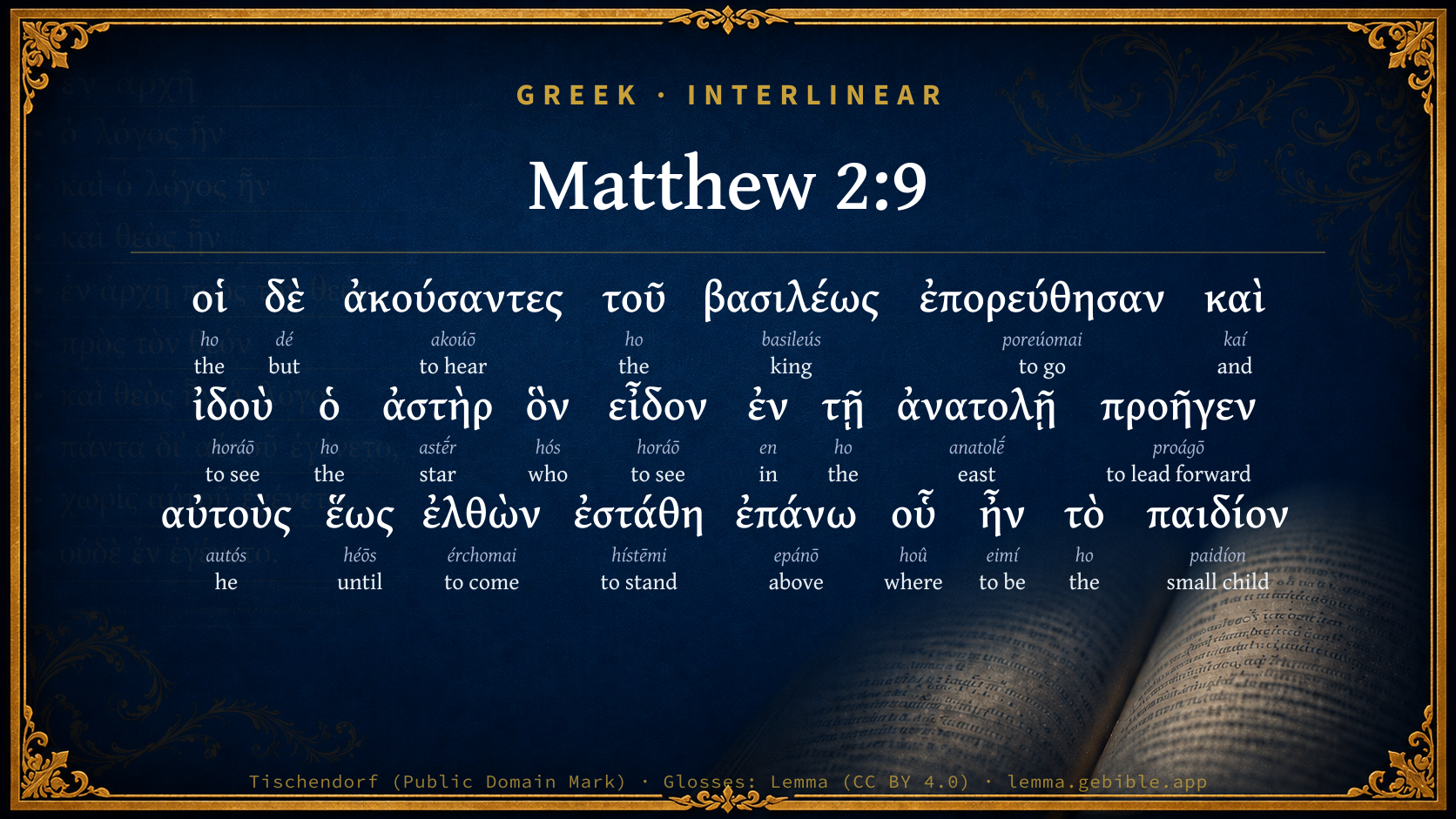
Greek (Tischendorf 8th ed.) Matthew 2:9 appears in the Greek New Testament. The text above is from the Tischendorf 8th edition. Each word links to its Strong’s number and a concise gloss. Click any word for its full Thayer’s Greek Lexicon entry.
Download image
Cite this verse

Matthew 2:9 (World English Bible). Public Domain. Lemma interlinear Bible study tool, https://lemma.gebible.app/v/matthew/2/9.

Show BibTeX & RIS
BibTeX
RIS
English Translation
They, having heard the king, went their way; and behold, the star, which they saw in the east, went before them, until it came and stood over where the young child was.
World English Bible · Public Domain
Highlights
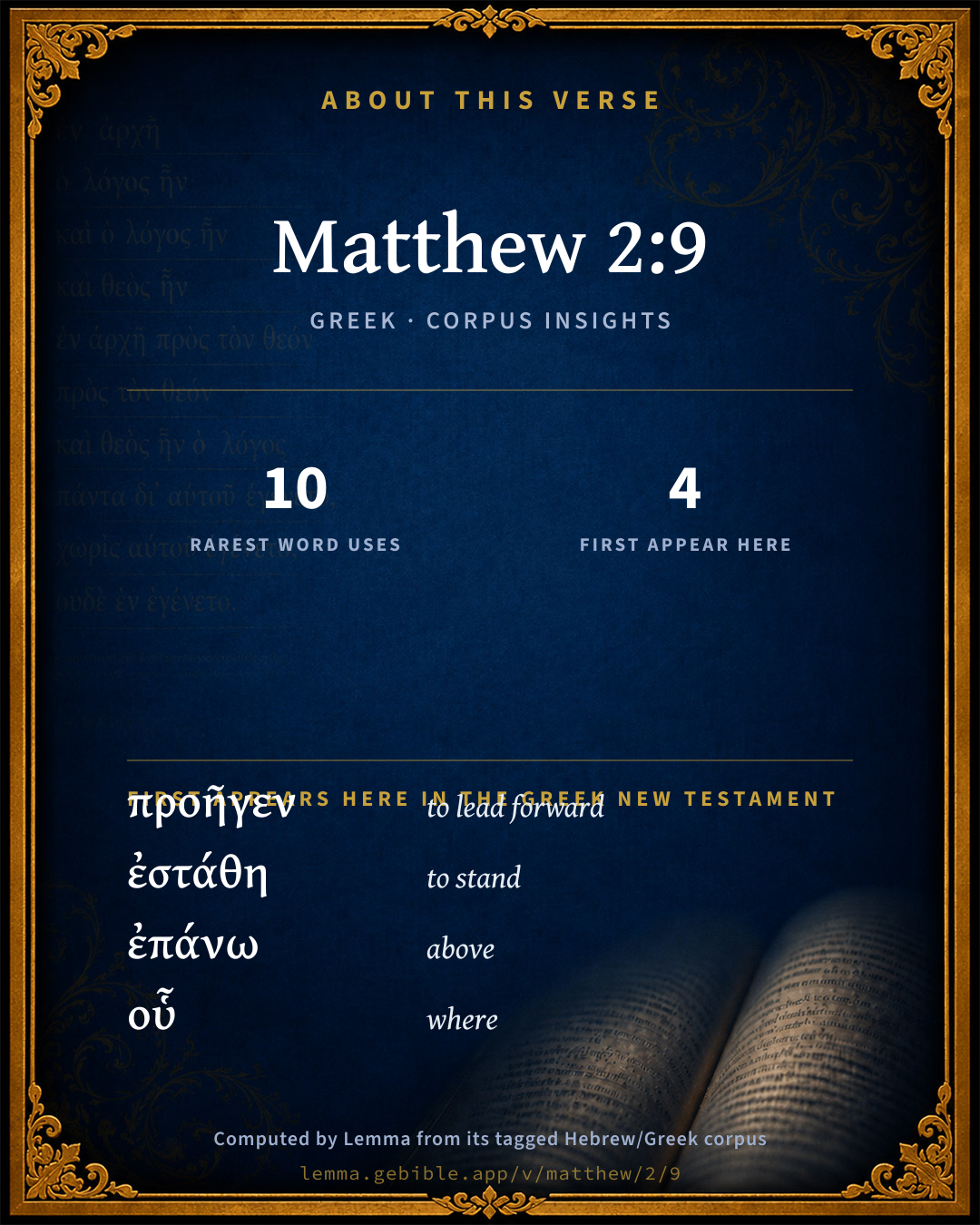
  • 4 first appearances in the Greek New Testament
Full analysis ↓
Download a study sheet

One document with this verse’s original text, its word-by-word gloss line, the meaning frame, cross-references with their text, attributed commentary, and full source and license credits — printable, and it pastes into notes with its structure intact.

This verse Autodidact and up

Study sheet (.html) Plain text (.txt)

A passage Seminary Student

Up to 50 verses in one chapter. A passage sheet keeps up to 6 commentary sources and 12 cross-references per verse, in the order this page ranks them, and says so on the sheet whenever that leaves anything out. Ask for a single verse and you get the Autodidact verse sheet above.

Everything on this page stays free to read, with no account — the sheet is a download of what is already on screen, not access to it.

Want to remove ads? Support Godless Engineer
Compare translations 3

The same verse in 3 English versions, stacked beneath the original-language interlinear above. Click any original word for its lexicon entry.

Each is an independent rendering of the whole verse — the interlinear is not word-aligned to these translations.

Highlighted words mark where these versions differ — a whole-verse word diff, not a word-by-word alignment.

  • World English Bible Public Domain
    They, having heard the king, went their way; and behold, the star, which they saw in the east, went before them, until it came and stood over where the young child was.
  • King James Version Public Domain
    When they had heard the king, they departed; and, lo, the star, which they saw in the east, went before them, till it came and stood over where the young child was.
  • unfoldingWord Literal Text CC BY-SA 4.0
    And they, having heard the king, went, and behold, the star that they saw in the east was going before them until, having come, it stood over where the young child was.

unfoldingWord Literal Text — © unfoldingWord, licensed CC BY-SA 4.0. Word-aligned USFM3 via Door43 (git.door43.org/unfoldingWord/en_ult).

Versions to compare (up to 4)

3 of 4 selected

Show all 19 translations

Every available English version of this verse, each an independent rendering of the whole verse.

  • World English Bible Public Domain
    They, having heard the king, went their way; and behold, the star, which they saw in the east, went before them, until it came and stood over where the young child was.
  • Berean Standard Bible Public Domain
    After they had heard the king, they went on their way, and the star they had seen in the east went ahead of them until it stood over the place where the Child was.
  • Majority Standard Bible Public Domain
    After they had heard the king, they went on their way, and the star they had seen in the east went ahead of them until it stood over the place where the Child was.
  • King James Version Public Domain
    When they had heard the king, they departed; and, lo, the star, which they saw in the east, went before them, till it came and stood over where the young child was.
  • American Standard Version (1901) Public Domain
    And they, having heard the king, went their way; and lo, the star, which they saw in the east, went before them, till it came and stood over where the young child was.
  • Revised Version (1885) Public Domain
    And they, having heard the king, went their way; and lo, the star, which they saw in the east, went before them, till it came and stood over where the young child was.
  • Geneva Bible (1599) Public Domain
    So when they had heard the King, they departed: and loe, the starre which they had seene in the East, went before them, till it came and stoode ouer the place where the babe was.
  • Douay-Rheims (1899) Public Domain
    Who having heard the king, went their way; and behold the star which they had seen in the east, went before them, until it came and stood over where the child was.
  • Young's Literal Translation Public Domain
    And they, having heard the king, departed, and lo, the star, that they did see in the east, did go before them, till, having come, it stood over where the child was.
  • Literal Standard Version CC BY-SA 4.0
    And they, having heard the king, departed, and behold, the star, that they saw in the east, went before them, until, having come, it stood over where the Child was.
  • Unlocked Literal Bible CC BY-SA 4.0
    After they had heard the king, they went on their way, and the star that they had seen in the east went before them until it came and stood still over where the young child was.
  • unfoldingWord Literal Text CC BY-SA 4.0
    And they, having heard the king, went, and behold, the star that they saw in the east was going before them until, having come, it stood over where the young child was.
  • Darby Bible Public Domain
    And they having heard the king went their way; and lo, the star, which they had seen in the east, went before them until it came and stood over the place where the little child was.
  • World Messianic Bible Public Domain
    They, having heard the king, went their way; and behold, the star, which they saw in the east, went before them until it came and stood over where the young child was.
  • Webster's Bible Public Domain
    When they had heard the king, they departed; and lo, the star, which they saw in the east, went before them, till it came and stood over where the young child was.
  • Free Bible Version CC BY-SA 4.0
    After they had heard what the king had to say they went on their way, and the star which they had seen in the east led them until it stopped right above the place where the child was.
  • Bible in Basic English Public Domain
    And after hearing the king, they went on their way; and the star which they saw in the east went before them, till it came to rest over the place where the young child was.
  • Text-Critical English NT CC BY 4.0
    They listened to the king and went on their way, and behold, the star they had seen in the east went before them until it came and stopped over the place where the child was.
  • Tyndale New Testament (1534) Public Domain
    When they had heard the kynge they departed: and lo the starre which they sawe in the eeste went before them tyll it came and stode over the place where the chylde was.

Literal Standard Version (2020), Covenant Press — licensed CC BY-SA 4.0. Text via the HelloAO Bible API (eBible.org). Unlocked Literal Bible (unfoldingWord) — licensed CC BY-SA 4.0. Text via the HelloAO Bible API (eBible.org). unfoldingWord Literal Text — © unfoldingWord, licensed CC BY-SA 4.0. Word-aligned USFM3 via Door43 (git.door43.org/unfoldingWord/en_ult). Free Bible Version, Dr. Jonathan Gallagher — licensed CC BY-SA 4.0. Text via the HelloAO Bible API (eBible.org).

Word by word

More ways to search: Search by grammar → Find every occurrence → Compare this word →

Practice this passage: Drill this verse → Learn its vocabulary →

ἀνατολῇ
anatolḗ
G395
“east”
Noun, Dative, Singular, Feminine
Part of Speech
Noun
Case
Dative
Number
Singular
Gender
Feminine
Full Thayer's Definition

Origin: from G393

TDNT: 06:52,6

1. a rising (of the sun and stars) 2. the east (the direction of the sun's rising)
  1. οἱ ho G3588 “the” Article, Nominative, Plural, Masculine
  2. δὲ dé G1161 “but” Conjunction
  3. ἀκούσαντες akoúō G191 “to hear” Verb, Aorist, Active, Participle, Nominative, Plural, Masculine
  4. τοῦ ho G3588 “the” Article, Genitive, Singular, Masculine
  5. βασιλέως basileús G935 “king” Noun, Genitive, Singular, Masculine
  6. ἐπορεύθησαν poreúomai G4198 “to go” Verb, Aorist, Passive deponent, Indicative, 3rd person, Plural
  7. καὶ kaí G2532 “and” Conjunction
  8. ἰδοὺ horáō G3708 “to see” Verb, Aorist, Middle, Imperative, 2nd person, Singular
  9. ὁ ho G3588 “the” Article, Nominative, Singular, Masculine
  10. ἀστὴρ astḗr G792 “star” Noun, Nominative, Singular, Masculine
  11. ὃν hós G3739 “who” Relative pronoun, Accusative, Singular, Masculine
  12. εἶδον horáō G3708 “to see” Verb, Aorist, Active, Indicative, 3rd person, Plural
  13. ἐν en G1722 “in” Preposition
  14. τῇ ho G3588 “the” Article, Dative, Singular, Feminine
  15. προῆγεν proágō G4254 “to lead forward” Verb, Imperfect, Active, Indicative, 3rd person, Singular
  16. αὐτοὺς autós G846 “he” Personal pronoun, Accusative, Plural, Masculine
  17. ἕως héōs G2193 “until” Adverb
  18. ἐλθὼν érchomai G2064 “to come” Verb, Aorist, Active, Participle, Nominative, Singular, Masculine
  19. ἐστάθη hístēmi G2476 “to stand” Verb, Aorist, Passive, Indicative, 3rd person, Singular
  20. ἐπάνω epánō G1883 “above” Adverb
  21. οὗ hoû G3757 “where” Adverb
  22. ἦν eimí G1510 “to be” Verb, Imperfect, Active, Indicative, 3rd person, Singular
  23. τὸ ho G3588 “the” Article, Nominative, Singular, Neuter
  24. παιδίον paidíon G3813 “small child” Noun, Nominative, Singular, Neuter

About this verse

These counts appear in no published source. They are computed here, from the morphology-tagged text and Lemma’s own curated glosses. What Lemma adds →

25
words
20
distinct lemmas
Gospels
section

Notable vocabulary

The rarest word here is ἀνατολῇ east G395 — appearing just 10 times in the whole Greek New Testament.

First appearance in Scripture

These words make their first canonical appearance in the Greek New Testament here:

  • προῆγεν to lead forward G4254
  • ἐστάθη to stand G2476
  • ἐπάνω above G1883
  • οὗ where G3757

Shared distinctive vocabulary

ἀνατολῇ east G395 occurs in 10 verses of the Greek New Testament. Also found in:
Repetition

Words recur within this verse:

Cross-references

5

Topical passages linked to Matthew 2:9 in the Treasury of Scripture Knowledge — connected by theme and wording, ordered by reader-vote popularity; previews shown in the World English Bible.

  • Matthew 2:2 "Where is he who is born King of the Jews? For we saw his star in the east, and have come to worship him."
  • Psalms 25:12 What man is he who fears Yahweh? He shall instruct him in the way that he shall choose.
  • Proverbs 8:17 I love those who love me. Those who seek me diligently will find me.
  • 2 Peter 1:19 We have the more sure word of prophecy; whereunto you do well that you take heed, as to a lamp shining in a dark place, until the day dawns, and the day star arises in your hearts:
  • Proverbs 2:1–6 My son, if you will receive my words, And store up my commandments within you;

Cross-references courtesy of OpenBible.info (CC BY 4.0).

Commentary

Notes on Matthew 2:9 from classic Christian and Jewish commentators (each source and its license shown beneath its notes). The classic Christian expositions comment on the surrounding passage and are grouped to its opening verse, so a note may address several verses; the Jewish commentaries on the Tanakh (Rashi and others) are per-verse, so they appear only where the commentator wrote on this verse.

Lemma curates 59 commentaries, every one of them public domain or Creative Commons licensed, each selected and text-cleaned for this edition rather than reprinted as found. About our sources →

Matthew Henry's Commentary

We have here the wise men's humble attendance upon this new-born King of the Jews, and the honours they paid him. From Jerusalem they went to Bethlehem, resolving to seek till they should find; but it is very strange that they went alone; that not one person of the court, church, or city, should accompany them, if not in conscience, yet in civility to them, or touched with a curiosity to see this young prince. As the queen of the south, so the wise men of the east, will rise up in judgment against the men of that generation, and of this too, and will condemn them; for they came from a far country, to worship Christ; while the Jews, his kinsmen, would not stir a step, would not go to the next town to bid him welcome. It might have been a discouragement to these wise men to find him whom they sought thus neglected at home. Are we come so far to honour the King of the Jews, and do the Jews themselves put such a slight upon him and us? Yet they persist in their resolution. Note, We must continue our attendance upon Christ, though we be alone in it; whatever others do, we must serve the Lord; if they will not go to heaven with us, yet we must not go to hell with them. Now,

I. See how they found out Christ by the same star that they had seen in their own country, Mat 2:9, Mat 2:10. Observe, 1. How graciously God directed them. By the first appearance of the star they were given to understand where they might enquire for this King, and then it disappeared, and they were left to take the usual methods for such an enquiry. Note, Extraordinary helps are not to be expected where ordinary means are to be had. Well, they had traced the matter as far as they could; they were upon their journey to Bethlehem, but that is a populous town, where shall they find him when they come thither? Here they were at a loss, at their wit's end, but not at their faith's end; they believed that God, who had brought them thither by his word, would not leave them there; nor did he; for, behold, the star which they saw in the east went before them. Note, If we go on as far as we can in the way of duty, God will direct and enable us to do that which of ourselves we cannot do; Up, and be doing, and the Lord will be with thee. Vigilantibus, non dormientibus, succurit lex - The law affords its aid, not to the idle, but to the active. The star had left them a great while, yet now returns. They who follow God in the dark shall find that light is sown, is reserved, for them. Israel was led by a pillar of fire to the promised land, the wise men by a star to the promised Seed, who is himself the bright and morning Star, Rev 22:16. God would rather create a new thing than leave those at a loss who diligently and faithfully sought him. This star was the token of God's presence with them; for he is light, and goes before his people as their Guide. Note, If we by faith eye God in all our ways, we may see ourselves under his conduct; he guides with his eye (Psa 32:8), and said to them, This is the way, walk in it: and there is a day-star that arises in the hearts of those that enquire after Christ, Pe2 1:19. 2. Observe how joyfully they followed God's direction (Mat 2:10). When they saw the star, they rejoiced with exceeding great joy. Now they saw they were not deceived, and had not taken this long journey in vain. When the desire cometh, it is a tree of life. Now they were sure that God was with them, and the tokens of his presence and favour cannot but fill with joy unspeakable the souls of those that know how to value them. Now they could laugh at the Jews in Jerusalem, who, probably, had laughed at them as coming on a fool's errand. The watchmen can give the spouse no tidings of her beloved; yet it is but a little that she passes from them, and she finds him, Sol 3:3, Sol 3:4. We cannot expect too little from man, nor too much from God. What a transport of joy these wise men were in upon this sight of the star; none know so well as those who, after a long and melancholy night of temptation and desertion, under the power of a Spirit of bondage, at length receive the spirit of adoption, witnessing with their spirits that they are the children of God; this is light out of darkness; it is life from the dead. Now they had reason to hope for a sight of the Lord's Christ speedily, of the Sun of righteousness, for they see the Morning Star. Note, We should be glad of every thing that will show us the way to Christ. This star was sent to meet the wise men, and to conduct them into the presence chamber of the King; by this master of ceremonies they were introduced, to have their audience. Now God fulfills his promise of meeting those that are disposed to rejoice and work righteousness (Isa 64:5), and they fulfill his precept. Let the hearts of those rejoice that seek the Lord, Psa 105:3. Note, God is pleased sometimes to favour young converts with such tokens of his love as are very encouraging to them, in reference to the difficulties they meet with at their setting out of the ways of God.

II. See how they made their address to him when they had found him, Mat 2:11. We may well imagine their expectations were raised to find this royal babe, though slighted by the nation, yet honourably attended at home; and what a disappointment it was to them when they found a cottage was his palace, and his own poor mother all the retinue he had! Is this the Saviour of the world? Is this the King of the Jews, nay, and the Prince of the kings of the earth? Yes, this is he, who, though he was rich, yet, for our sakes, became thus poor. However, these wise men were so wise as to see through this veil, and in this despised babe to discern the glory as of the Only-begotten of the Father; they did not think themselves balked or baffled in their enquiry; but, as having found the King they sought, they presented themselves first, and then their gifts, to him.

1. They presented themselves to him: they fell down, and worshipped him. We do not read that they gave such honour to Herod, though he was in the height of his royal grandeur; but to this babe they gave this honour, not only as to a king (then they would have done the same to Herod), but as to a God. Note, All that have found Christ fall down before him; they adore him, and submit themselves to him. He is thy Lord, and worship thou him. It will be the wisdom of the wisest of men, and by this it will appear they know Christ, and understand themselves and their true interests, if they be humble, faithful worshippers of the Lord Jesus.

2. They presented their gifts to him. In the eastern nations, when they did homage to their kings, they made them presents; thus the subjection of the kings of Sheba to Christ is spoken of (Psa 72:10), They shall bring presents, and offer gifts. See Isa 60:6. Note, With ourselves, we must give up all that we have to Jesus Christ; and if we be sincere in the surrender of ourselves to him, we shall not be unwilling to part with what is dearest to us, and most valuable, to him and for him; nor are our gifts accepted, unless we first present ourselves to him living sacrifices. God had respect to Abel, and then to his offering. The gifts they presented were, gold, frankincense, and myrrh, money, and money's-worth. Providence sent this for a seasonable relief to Joseph and Mary in their present poor condition. These were the products of their own country; what God favours us with, we must honour him with. Some think there was a significancy in their gifts; they offered him gold, as a king, paying him tribute, to Caesar, the things that are Caesar's; frankincense, as God, for they honoured God with the smoke of incense; and myrrh, as a Man that should die, for myrrh was used in embalming dead bodies.

III. See how they left him when they had made their address to him, Mat 2:12. Herod appointed them to bring him word what discoveries they had made, and, it is probable, they would have done so, if they had not been countermanded, not suspecting their being thus made his tools in a wicked design. Those that mean honestly and well themselves are easily made to believe that others do so too, and cannot think the world is as bad as it really is; but the Lord knows how to deliver the godly out of temptation. We do not find that the wise men promised to come back to Herod, and, if they had, it must have been with the usual proviso, If God permit; God did not permit them, and prevented the mischief Herod designed to the Child Jesus, and the trouble it would have been to the wise men to have been made involuntarily accessory to it. They were warned of God, chrēmatisthentes - oraculo vel responso accepto - by an oracular intimation. Some think it intimates that they asked counsel of God, and that this was the answer. Note, Those that act cautiously, and are afraid of sin and snares, if they apply themselves to God for direction, may expect to be led in the right way. They were warned not to return to Herod, nor to Jerusalem; those were unworthy to have reports brought them concerning Christ, that might have seen with their own eyes, and would not. They departed into their own country another way, to bring the tidings to their countrymen; but it is strange that we never hear any more of them, and that they or theirs did not afterwards attend him in the temple, whom they had worshipped in the cradle. However, the direction they had from God in their return would be a further confirmation of their faith in this Child, as the Lord from heaven.

Matthew Henry's Commentary on the Whole Bible (1708–1710) — public domain (CC PDM 1.0). Text via the HelloAO Bible API.

Joseph Benson's Commentary

Mat 2:9. When they had heard the king, they departed — Viz., from Jerusalem, without the least suspicion, it seems, of his treacherous and cruel designs. As these sages came from a distant country into Judea upon such an important discovery, and Bethlehem was so near, it is matter of wonder that none of the Jews attended them on their journey. But it is probable they were afraid of Herod. Or, perhaps, the dismission of the wise men might be kept a secret in Jerusalem; so that if any of the Jews had had an inclination to have gone with them, they might not have had an opportunity. And Herod might avoid sending any one with them, lest he should raise suspicion in the minds of the parents or relations of the child; or lest the Jews suspecting a plot, should contrive to bring about a revolt, or raise sedition. Or rather, the whole matter is to be referred to the providence of God, so ordering it that they should go unaccompanied, that the child might not be discovered to Herod. The Lord, however, prepared these illustrious strangers a better guide. For, lo, the star which they saw in the east — In their own country, went before them — This intimates that it had not been their guide in their journey from their own country. Nor was it needful they should have a guide, Jerusalem being sufficiently known. It had shone, it seems, on the night of his nativity, and then had disappeared till the present time. By its not appearing for a time, occasion was given for their inquiries at Jerusalem, which gave notice to the Jews of the birth of Christ; an event of which, it is likely, they would have had no information, if the star had led the wise men first to Bethlehem. And the reappearance of the star was probably intended of God to prevent their being discouraged at their not only not finding the king they sought in the royal city, but not being able to learn that any thing was known there concerning his birth, and especially in perceiving that when they had brought intelligence of it, all ranks seemed to be troubled, and not a single person of those whose native king he was offered himself as a companion to them, though come from a foreign land to worship him. Thus, also, their taking offence at the low condition in which they found Christ and his parents, was prevented. At the same time, it was a great confirmation of their faith, to be thus miraculously conducted to the very town pointed out in the Scriptures as the place of the birth of the Messiah. It left them not till it came and stood over where the young child was — Thus pointing out the very house, lest if they should have been obliged to make anxious inquiry concerning the child, there should be some who might have carried the matter to Herod, and have discovered him and his parents. Here, therefore, the star stopped, and proceeded no further, and not long after, viz., as soon as the wise men arrived at the place, as is most probable, entirely vanished. Hence it appears, that this star was not in the higher heavens, but in the lower regions of the air; for no star in the heavens could have exactly pointed out a particular house. Nothing is said here concerning a ray descending from the star to the top of the house, or concerning the descent of the body of the star. It is therefore probable it was a meteor, which to them had the appearance of a star, as meteors frequently have. This appears, further, from its moving by intervals, sometimes moving and sometimes standing still, which the stars, properly so called, never do. Dr. Whitby conjectures that what the wise men saw in the east might be that very light which shone upon the shepherds at Bethlehem, when the angel came to impart unto them the tidings of our Saviour’s birth. This light certainly was exceeding great, as is clear from its being styled the glory of the Lord, and it was a light from heaven, hanging over their heads, and shining round about them. Now such a light, at a great distance, would appear as a star: or, as it ascended up from the shepherds it might be formed into the likeness of a star. A similar body of light, when they journeyed from Jerusalem to Bethlehem, was formed into the same likeness in which it had formerly appeared, and went before them in the air to the latter city, and then sunk down so low as to point out the very house where the babe lay. In this case the star must have been seen by the wise men on the very day of Christ’s nativity.

Joseph Benson's Commentary on the Old and New Testaments (1811–1818) — public domain. Text from a community e-Sword module.

The Preacher's Complete Homiletical Commentary

Joseph S. Exell (gen. ed.)

CRITICAL NOTES

Mat_2:11. House.—It is not reasonable to suppose that the holy family would require to stay long in the public khan or caravanserai, where the infant Saviour was born. Worshipped.—The gathering of the Gentiles to the light of Israel was an essential part of true Judaism, and could not but be represented in the Gospel which set forth the glories of the King (Maclaren). Gifts.—Natural enough as the traditional gifts of homage to a ruler (Plumptre). Gold would be always a suitable present. Frankincense and myrrh would be used chiefly in the houses of the great and in holy places. They were prized for the delicious fragrance which they suffused (Morison).

MAIN HOMILETICS OF THE PARAGRAPH.—Mat_2:9-11

Doing homage.—In these verses the story of the previous verses is carried a step in advance. The infant King is not only heard of now, He is also beheld. Not only, now, is His kingdom proclaimed; not only is there evidence, now, that the proclamation is understood; we also find it obeyed. Only, however, as in the somewhat parallel case of 1Sa_10:26, by a few; even by those “wise men” of whom we were previously told. Touching these, we see in this passage:

1. How they were brought to this sight.

2. How they were affected thereby.

I. How they were brought to this sight.—We may attribute this, in the first place, to their own perseverance and faith. Unlike the priests, who had only pointed out the right place (Mat_2:5); unlike Herod, who had only asked others to seek it (Mat_2:8); these men started to find it. It would appear, moreover, that they did so with some degree of anxiety. If they had gained something in hearing of Bethlehem, they had lost something in missing the star. (For so the subsequent mention of it in Mat_2:9-10, seems to imply.) For all that, however, they at once followed such light as they had. Bethlehem was the place in which they were bidden to search. To Bethlehem, therefore, “when they had heard the king, they departed.” They were brought to it, next, by the special mercy of God. This was manifested in two separate ways. The way of special encouragement. As they started (so it appears) the “star” reappeared. The sight filled them with joy (Mat_2:10). Knowing to what it had previously guided them, viz. to hearing of Bethlehem as the predicted birthplace of the King they were seeking, they naturally rejoiced to see it again; and felt its reappearance so to be like the voice of a tried friend in their ears. The way of specific direction. After reappearing, the “ ‘star’ went before them” (Mat_2:9) to show them the right way. After going before them, it “stood” still (ibid.), to show them the right spot. “There—under that roof—in that dwelling—is the sight you desire. You have but to go in.”

II. How they were affected by what they saw in that dwelling.—Very significant, on this point, was their demeanour. In a direct manner we are told very little of what they beheld. “They saw the young Child and His mother.” They saw the Babe for which they were seeking, where such a babe might be expected to be, in the arms of its mother. What kind of sight was thus seen by them we can only see, as it were, by reflection—in their looks and gestures. They “fall down” before that Infant in arms. They offer Him worship and homage. Their knees, their hands, their lips even (?) are kissing the ground before Him. Every gesture shows that they have found in Him the King whom they sought. Almost more significant, next, are their gifts. “The peculiar treasure of kings” (Ecc_2:9) is what they present unto Him. The things which they have brought from so far, and carried so carefully, and concealed from all others, they “open” for Him. The tribute of “gold,” the adoration of “frankincense,” the preserving virtue of “myrrh,” are what we see them present. Some think that there is unconscious prophecy as well as homage in this last; and that in this mention of “myrrh,” so soon after His birth, there is a silent reference to His death (see Joh_19:39). At any rate, about the homage there is no manner of doubt. Neither is there any doubt, so we may notice yet further, about the impressiveness of this homage. Not only the nature of the gifts which were presented, but the men that brought them, the distance they came from, the guidance vouchsafed them, and the very tenderness of age of the King to whom these offerings were brought, are significant on this point. Much is rightly made in the Bible of the visit of the Queen of Sheba to Solomon and of the gifts which she brought (1Ki_10:2; 1Ki_10:10, etc.; also Luk_11:31). Great was the evidence afforded thereby of his reputation and power. All this homage, however, was paid to one who, in the ripeness of his age, was seated on the throne of his father David, and had just completed the temple of God. The homage paid here was to an infant in arms, who was hid in a dwelling which had to be pointed out to eyes that had been looking for it for months. It spoke, therefore, with even louder voice and greater accentuation of meaning. It showed that Jesus in obscurity was felt to be greater far than even Solomon in his glory; and that this Son of David, even in His infancy, was far above that!

HOMILIES ON THE VERSES

Mat_2:9-10. The Magi led to Bethlehem.—The wise men follow the direction of Scripture and go toward Bethlehem, having (so far as we read) neither convoy nor encouragement of any company.

1. If we desire to find Christ we must resolve to go after Him, alone or in company, either with or without encouragements from men, as God shall dispose.

2. God is not wanting to such as are on the way to seek Christ, but will renew directions and encouragements unto them as they stand in need; for the star which for a time disappeared, now appeareth again to them.

3. What one means doth not reach, God supplieth by another. The Scripture had told them of Bethlehem, but had not descended so low as the particular house. God supplieth the rest, by the direction of the star.

4. Those means which do lead a man most certainly unto Christ should be the matter of his special joy. “They rejoiced,” etc.—David Dickson.

Mat_2:11. Christ found and worshipped.—

1. Such as seek Christ in truth shall find Him at length.

2. Such as believe that the Scriptures speak of Christ will see Him, though God, in His deepest humiliation, and by faith will pierce through all impediments.

3. Riches, wisdom, honour, and all that we have, ought to be laid down at Christ’s feet and offered to the service of Christ, as the fountain and owner thereof.—Ibid.

Consecration and no-consecration.—Whatever more there may be—and there is much more—in the visit of the wise men to the manger-cradle at Bethlehem, there is at least the lesson of consecration. These wise men had no greater joy than in emptying themselves of their treasures, and bestowing them in humblest adoration upon Him. To every man there comes the old choice of the Greek mythical hero—the choice between virtue and pleasure, between good and evil, between duty and frivolity, between consecration to Christ and subjugation by some other master. Think of a few of the ways in which this call for a choice is answered.

I. There is the answer—which is no answer—of simple indifference.

II. Another form of no-consecration is simple self-culture.—It recognizes that we are endowed with a complex nature, every part of which is capable of being developed. And this development, this contact, are in themselves enjoyment of an exalted kind. Self-culture, even on a humble scale, will never disappoint. But this is short of consecration; and the Christian conscience tells us that it is far inferior to it.

III. Consecration implies not only self-culture but self-surrender, and more than this, the joy of self-surrender. There may be consecration to a great cause, like justice or freedom. There may be consecration to an idea which we almost personify, and even deify, like truth or beauty. But it is to a person—to some one greater, purer, better than ourselves—that consecration is at once most passionately and most perseveringly rendered. And never does consecration of self take a nobler form than when a young man prostrates himself before the feet of his Saviour, and offers to Him, in their prime, the fulness of all his powers.—H. M. Butler.

The homage of the wise men.—

I. An outburst of faith.—

1. In their beholding Christ.

2. Doing obeisance.

3. Presenting noblest gifts.

II. An indication of order and succession of believing experience.—

1. We behold.

2. We fall down.

3. We present gifts.

III. A picture of genuine faith.—

1. Vision issuing in humiliation.

2. Adoration issuing in joy of faith.

3. Perseverance of faith issuing in self-dedication and works of love.—J. P. Lange, D.D.

The Preacher's Complete Homiletical Commentary (gen. ed. Joseph S. Exell; Funk & Wagnalls, c. 1892) — public domain (pre-1929). A full-Bible homiletical/sermon-outline anthology covering 65 of 66 books (2 John is absent from the source module). Text from a community e-Sword module.

Bengel's Gnomon

Johann Albrecht Bengel

Mat 2:9. Οἱ δὲ ἀκούσαντες, τοῦ βασιλέως, But when they had heard the king) The king ought rather to have heard and assisted them. The Magi, however, obtained the answer which they desired.[93]—καὶ ἰδοὺ ὁ ἀστὴρ, κ.τ.λ., and, lo, the star, etc.) During the whole of their journey, they had not seen the star.—ἐλθὼν, having come) It may be conjectured, from the use of this verb, that the star was subject to the guidance of an intelligent cause.—Cf. ἐλθὼν, in Mat 2:8.

[93] Nor were they at all affected by the torpor and apathy of the scribes or of the Jews.—Vers. Germ.

Bengel's Gnomon of the New Testament — English translation (T&T Clark, Edinburgh, 1860) — public domain. Text from a community e-Sword module.

Meyer's Critical & Exegetical Commentary

Heinrich August Wilhelm Meyer

Mat_2:9. Ἀκούσαντες τοῦ βασιλ.] After they had heard the king, they set off on their journey. Description of their unsuspicious behaviour. Comp. Theophylact.

καὶ ἰδοὺ, ὁ ἀστήρ, κ.τ.λ.] They travelled by night, in accordance with Eastern custom. See Hasselquist, Reise nach Paläst. p. 152. Bengel appropriately remarks on ἰδού: Toto itinere non viderant stellam.

ὃν εἶδον] The aorist in the relative sentence, where we use the pluperfect. See Kühner, II. 1, p. 145; Winer, p. 258 [E. T. 343].

προῆγεν] is the descriptive imperfect, not praecesserat (Hermann, Süskind, Paulus, Kuinoel), as if the star had again first shone upon them after they had come to Bethlehem. This explanation is ungrammatical (Buttmann, neut. Gr. p. 173 [E. T. 200]), and serves only to help to diminish the miraculous element, which is quite opposed to the character of the narrative. The common view alone is in keeping with the words: the star, which they had seen in its rising, went before them on their journey from Jerusalem to Bethlehem, and took up a position over the place (the house) where the child was. Amongst the Greeks also stars are mentioned as extraordinary guides, Elsner, p. 5 f.; Wetstein on the passage.

ἐπάνω οὗ ἦν] See Mat_2:11, τὴν οἰκίαν. The going and standing of the star is miraculous; hence also the manner in which the particular house is indicated is left undetermined.

Meyer — Critical and Exegetical Commentary on the New Testament — English translation by Peter Christie, edited by Frederick Crombie (T&T Clark, 1880) — public domain. Text from a community e-Sword module.

Expositor's Greek Testament

ed. W. Robertson Nicoll

Mat 2:9-10 . The Magi go on their errand to Bethlehem . They do not know the way, but the star guides them. ἰδοὺ ὁ ἀστὴρ : looking up to heaven as they set out on their journey, they once more behold their heavenly guide. ὃν εἶδον ἐ . τ . ἀνατολῇ : is the meaning that they had seen the star only at its rising, finding their way to Jesus without its guidance, and that again it appeared leading them to Bethlehem? So Bengel, and after him Meyer. Against this is φαινομένου , Mat 2:7 , which implies continuous visibility. The clause ὃν εἶδον , etc., is introduced for the purpose of identification. It was their celestial guide appearing again. προῆγεν : it kept going before them (imperfect) all the way till, arriving at Bethlehem, it took up its position ( ἐστάθη ) right over the spot where the child was. The star seemed to go before them by an optical illusion (Weiss-Meyer); it really, in the view of the evangelist, went before and stopped over the house (De Wette, who, of course, regards this as impossible in fact).

The Expositor's Greek Testament, edited by W. Robertson Nicoll (1897–1910) — public domain. Text from a community e-Sword module.

Jamieson, Fausset & Brown

Robert Jamieson, A. R. Fausset & David Brown

When they had heard the king, they departed--But where were ye, O Jewish ecclesiastics, ye chief priests and scribes of the people? Ye could tell Herod where Christ should be born, and could hear of these strangers from the far East that the Desire of all nations had actually come; but I do not see you trooping to Bethlehem--I find these devout strangers journeying thither all alone. Yet God ordered this too, lest the news should be blabbed, and reach the tyrant's ears, before the Babe could be placed beyond his reach. Thus are the very errors and crimes and cold indifferences of men all overruled.

and, lo, the star, which they saw in the east--implying apparently that it had disappeared in the interval.

went before them, and stood over where the young child was--Surely this could hardly be but by a luminous meteor, and not very high.

Jamieson, Fausset & Brown — Commentary Critical and Explanatory on the Whole Bible (1871) — public domain (CC PDM 1.0). Text via the HelloAO Bible API.

Adam Clarke's Commentary

Verse 9. In the east] Or, at its rise. See Clarke on Mt 2:2.

Stood over where the young child was.] Super caput pueri, Over the head of the child, as the OPUS IMPERFECTUM, on this place, has it. See Griesbach's Var. Lect. So it appears to have been a simple luminous meteor in a star-like form, and at a very short distance from the ground, otherwise it could not have ascertained the place where the child lay. But the last quoted reading, from the Opus Imperfectum, justifies the opinion that the luminous appearance which had hitherto directed them now encompassed the head of the child; and probably this gave the first idea to the ancient painters, of representing Christ in the manger, with a glory surrounding his head. This glory, or nimbus, is usually given also to saints and eminent persons, especially in the Roman Church, by all Roman Catholic painters.

Adam Clarke's Commentary on the Bible (1810–1826) — public domain. Text from a community e-Sword/MySword module.

Ellicott's Commentary for English Readers

(9) Which they saw. . . .—The words would seem to imply that they started in the evening, and, as they started, saw the star in the direction of Bethlehem. In popular language it served to guide them, and so led them on. We need not suppose that they found the child whom they sought in the “manger” described by St. Luke. There had been time for the crowds that had been gathered by the census to disperse, and Joseph and Mary may have found a house in which they could lodge. The expectations that connected Bethlehem with the coming of the Christ might naturally lead them to remain there at least for a season,

A Bible Commentary for English Readers, edited by Charles John Ellicott (1878–1897) — public domain. Text from a community e-Sword module.

John Gill's Exposition

When they had heard the king,.... With great care and attention, what he had told them of the birth place of the young child; the strict charge he had given them to search diligently for him, and then return to him with an account of the whole affair; and his expressions of respect to the new born prince, which they took to be said in great sincerity,

they departed; took their leave of Herod and his court, and set forward on their journey from Jerusalem to Bethlehem:

and lo, to their great surprise and joy,

the star, which they saw in the east, then appeared; for, it seems, it had for some time disappeared: it looks as if it had been only seen at the time of Christ's birth, and when they were in their own country; for both here, and in Mat 2:2 they are only said to have seen it "in the east", that is, when they were in the east country; so that it seems from that time they had had no sight of it, not while they were on their journey, nor at Jerusalem; nor was it necessary they should. When they saw it in their own country, according to their best observation, it was over the land of Judea, and they were persuaded of it, that it was a certain sign that the king of the Jews was born: they therefore determine upon and prepare for a journey to Jerusalem, the metropolis of the nation, and where the king kept his court, to inquire for him; nor needed they the guidance of the star to direct them to a place so well known; but being in quest of him in an obscure place, and without any guide, this star appears to them; and, which is something very extraordinary,

went before them, till it came, and stood over, where the young child was. This star had a motion, kept pace with them, and was a guide unto them, till it and they came to the place where Christ was; and then it stood directly over the house, so that they had no need to inquire of any person for him. It is certain from hence, that this star was indeed a very unusual one; its being seen in the daytime, its motion and standing still, its situation, which must be very low, and its use to point out the very house where Christ was, show it to be so; but though it was an unusual appearance, it should not be thought incredible. (a) Varro relates, that

"from the time Aeneas went from Troy, he saw the star Venus in the daytime, day after day, till he came to the field of Laurentum, where he saw it no more, by which he knew that those lands were fatal.''

The appearing of this star, and then its disappearing for a time, agree, in some measure, with the account the Jews give of the star which they expect will be seen at the coming of the Messiah; for they (b) say,

"after seven days that star shall be hid, and the Messiah shall be hid for twelve months--when he shall descend, the pillar of fire shall be seen as before, in sight, and afterwards the Messiah shall be revealed, and many people shall be gathered to him.''

(a) Apud Servium in Virgil Aeneid. l. 1. p. 471. Ed. Basil. 1586. (b) Zohar in Exod. fol. 3, 4. & 71. 1.

John Gill's Exposition of the Whole Bible (1746–1763) — public domain (CC PDM 1.0). Text via the HelloAO Bible API.

Trapp's Complete Commentary

John Trapp

9 When they had heard the king, they departed; and, lo, the star, which they saw in the east, went before them, till it came and stood over where the young child was.

Ver. 9. And, lo, the star] A star either newly created, or at least wise strangely carried: for it stands one while, moves another, appears in the lower region, is not obscured by the beams of the sun: so that some have thought it was an angel, {a} It moved slowly, as might be best for the pace and purpose of these pilgrims.

Till it came and stood over where the young child was] They show still at Bethlehem a little hole over the place where our Saviour was born, through which the star fell down to the ground. But who will not conclude that there was a vertigo in his head who first made a star subject to the falling sickness? Fuller’s History of Holy War.

{a} Angelus in specie sideris figuratus. An angel form in the appearance of a star. Per.

John Trapp, A Commentary or Exposition upon All the Books of the Old and New Testament (1647–1656) — public domain. Text from a community e-Sword module.

Albert Barnes' Notes on the Bible

The star ... went before them - From this it appears that the star was a luminous meteor, perhaps at no great distance from the ground. It is not unlikely that they lost sight of it after they had commenced their journey from the East. It is probable that it appeared to them first in the direction of Jerusalem. They concluded that the expected King had been born, and immediately commenced their journey to Jerusalem. When they arrived there, it was important that they should be directed to the very place where he was, and the star again appeared. It was for this reason that they rejoiced. They felt assured that they were under a heavenly guidance, and would be conducted to the new-born King of the Jews. And this shows:

That the birth of Jesus was an event of great moment, worthy of the divine interposition in directing these men to find the place of his nativity. God will guide those who are disposed to find the Saviour. Even if for a time the light should be withdrawn, yet it will again appear, and direct us in the way to the Redeemer. Our being led to Christ should fill us with joy. He is the way, the truth, and the life; the Saviour, the friend, the all in all; there is no other way of life, and there is no peace to the soul until he is found. When we are guided to him, therefore, our hearts should overflow with joy and praise; and we should humbly and thankfully follow every direction that leads to the Son of God, Joh 12:35-36.

Albert Barnes' Notes on the Bible (1834–1885) — public domain. Text from a community e-Sword/MySword module.

Matthew Poole's English Annotations

They departed toward Bethlehem Judah; how long their journey was we cannot tell: some wonder that none of the Jews did attend them in their journey, coming out of their own country upon such a discovery, and impute it either to the Jews’ fear of the tyrant under which they were, or to the blindness and hardness of their hearts, for St. John tells us he came amongst his own, and they received him not; but it is possible that the wise men’s immediate applications were to the court, as thinking that the most probable place to hear of one that should be born King of the Jews; and it may be questioned whether Herod, though he called the scribes and the priests together, told them that his summoning of them was occasioned by the coming of the wise men, for the only question he propounded to them was where Christ was to be born, which they might understand without any relation to the wise men’s question. Nor is it probable that Herod should be more open than needed in publishing the coming of these wise men, or their errand. Yet the text saying that not only Herod, but all Jerusalem, was troubled, suggests to us, that both their coming, and the occasion of it, was noised abroad, more than probably Herod could have wished; but it is like their dismission was so private, that if any of the Jews had had a heart and courage enough to have gone with them, yet they might not have had opportunity. It is more admirable that Herod sent none that he could securely trust with them. But the hand of God was in this thing. They shall be hid whom he will hide. The Lord had prepared them a better guide.

The star, which probably had disappeared for a good time while they were upon their journey to Jerusalem, (for they needed no star to guide them to so famous a place), as soon as they were out of Jerusalem it appeared again,

and went before them, till it came and stood over where the young Child was: probably the star appeared in the lower region, and though it could not point so directly that they should know the very house, yet it might point so near as by inquiry they might easily find it, especially by the influence of God upon their spirits, which doubtless they did not want. Whether these wise men were of the posterity of Balaam, who prophesied of a sceptre that should rise out of Israel, that should smite the corners of Moab, one that should have dominion, & c., Num 24:17,19, or this star had any relation to the star mentioned there, Num 24:17 is very uncertain: it is more probable that these wise men came a much further journey, and that the star there mentioned was not to be understood in a literal sense, but better expounded by Simeon, Luk 2:32, A light to lighten the Gentiles, and to be the glory of his people Israel.

Matthew Poole's English Annotations on the Holy Bible (1683–1685) — public domain. Text from a community e-Sword/MySword module.

Whedon's Commentary on the Bible

Daniel D. Whedon

9. Lo, the star — The star re-appears. What star? The star, namely, which they saw, not at Jerusalem, nor on their way thither, but while they were in the East. Went before them — The starry form came so lowly from the skies as to move horizontally before them, and guide their steps. Whether visible to any other than themselves is not said. Stood over — So specifically and directly as to individualize the very house.

Daniel D. Whedon (gen. ed.), Commentary on the Old and New Testaments (1874–1909) — public domain. Text from a community e-Sword module.

The Pulpit Commentary

When they had heard the king. There is a slight contrast in the Greek, but they for their part having heard the King. They departed; went their way (Revised Version). Took their journey (eporeuyhsan). And lo, the star, which they saw in the East. They would, in accordance with Eastern custom, probably travel by night. Observe that the joy they felt at seeing the star (ver. 10) implies that it had not continued visible (ver. 7, note). They had fully used all means; now they receive fresh Divine guidance. In the East (ver. 2, note). Went before them. Continuously (trohgen); "taking them by the hand and drawing them on" (Chrysostom). Not to show them the way to Bethlehem, for the road was easy, but to assure them of guidance to the Babe, over whose temporary home it stayed. The road to Bethlehem is, and from the nature of the valley must always have been, so nearly straight (until the last half-mile, when there is a sudden turn up the hill) that the star need have moved but slightly. Bethlehem itself is seen soon after passing Mar Elias, a monastery rather more than half-way from Jerusalem (Socin"s "Baedeker," p. 242). Till it came and stood over where the young Child was. Does the true reading (estayh) suggest the unseen hand by which this star was itself guided and stationed? (Mat_27:11) or is it used with a kind of reflexive force, indicating that it was by no chance that it stood still there its stand"? (cf. stayeiv , Luk_18:11, 40 19:8 Act_2:14, et al. ; cf. also Rev_8:3 Rev_12:1-8)

The Pulpit Commentary (1880–1919), ed. H.D.M. Spence-Jones & Joseph S. Exell — public domain. Text from a community e-Sword module.

Kretzmann's Popular Commentary

Paul E. Kretzmann

In simple trustfulness, the Magi proceed to act according to the king’s words:

v. 9. When. they had heard the king, they departed; and, lo, the star which they saw in the East went before them, till it came and stood, over where the young Child was.

They left Jerusalem, apparently all alone and with only general directions to guide them. Herod wanted no talebearers from among those that patterned after him. But the Magi, looking up to heaven, once more see their guide in the sky; they recognize the heavenly sign which had first called their attention to the miracle. And this star kept going before them all the way until, as they came to Bethlehem, it took up its definite position right over the house where the Child was, for He was the object of their search, to Him they were directed. Another proof that the star here referred to was made for just this purpose: it traveled from north to south. It must have stood much lower than other stars, since it indicated exactly in which house the Child was. "But this star, since it goes with them from Jerusalem to Bethlehem, went from north to south; which therefore establishes clearly that it was of a different kind, course, and place than the stars in the sky. It was not an attached star, as the astronomers call the stars, but a free star that could rise and sink, turn to all places."

Paul E. Kretzmann, Popular Commentary of the Bible (1921–1924) — public domain. Text from a community e-Sword module.

Burkitt's Expository Notes on the New Testament

William Burkitt

Observe here, 1. How the star, which for some time disappeared now appears again, to their farther direction in finding Christ: teaching us, That God will not be wanting to such as are on the way to seek Christ, but will renew direction and encouragements to them, according as they stand in need: none ever sincerely sought Christ, but they certainly found him at the last.

Observe, 2. That the joy which arises in such a soul as has found Christ, is unutterable and unspeakable. The wise men here rejoiced with joy, with great joy, with exceeding great joy.

Observe, 3. The wise men having found this young King, they bring presents to him, according to the manner of the Eastern countries; namely, gold, frankincense, and myrrh, which were the principal commodities of the east. But the best present we can make to Christ is ourselves; he seeks not ours, but us; and rather desires what we are than what we have. Yet the providence of God was wonderfully seen in these presents; for hereby provision was made for the sustenance of Joseph and Mary, and the child Jesus, in their exile or flight into Egypt, which they were shortly to undergo.

William Burkitt's Expository Notes on the New Testament (1700–1703) — public domain. Text from a community e-Sword module.

The People's New Testament

B. W. Johnson

9. They went their way. They probably departed immediately after their interview with Herod, and as the appearance of the star as soon as they started indicates that it was night, they probably saw Herod in the evening. So the star … went before them. This language implies a miraculous appearance, like a star, which guided the steps of the wise men. Such a view is no less probable than that a pillar of fire should have guided Israel. This luminous appearance stood over where the young child was. Either over Bethlehem, or over the house where the young child was sheltered.

B. W. Johnson's The People's New Testament with Notes (1889–1891) — public domain. Electronic text from the Christian Classics Ethereal Library (CCEL) ThML edition.

unfoldingWord translationNotes

Door43 World Missions Community

After they

"After the learned men"

they had seen in the east

"they had seen come up in the east" or "they had seen in their country"

went before them

"guided them" or "led them"

stood still over

"stopped over"

where the young child was

"the place where the young child was staying"

translationWords

king

joy

joy

unfoldingWord translationNotes — © Distant Shores Media and the Door43 World Missions Community, licensed CC BY-SA 4.0. Source: git.door43.org/Door43/en_tn.

Cambridge Greek Testament for Schools and Colleges

9. ἐστάθη for ἔστη (אBCD). The passive implies agency, here divine agency: see ch. Mat 27:11.

Cambridge Greek Testament for Schools and Colleges (Cambridge University Press, 1896; 21 vols, various authors incl. Carr, Maclear, Plummer, Farrar, Lumby, Moule, M. R. James, Simcox) — public domain. Text from a community e-Sword module.

Alford’s Greek Testament

Henry Alford

9.] On this see note on ver. 2.

ἐπάνω οὗ ἦν (elliptic for τόπου οὗ ἦν) τὸ π. may mean, ‘over that part of Bethlehem where the young child was,’ which they might have ascertained by enquiry. Or it may even mean, ‘over the whole town of Bethlehem.’ If it is to be understood as standing over the house, and thus indicating to the magi the position of the object of their search, the whole incident must be regarded as miraculous. But this is not necessarily implied, even if the words of the text be literally understood; and in a matter like astronomy, where popular language is so universally broad, and the Scriptures so generally use popular language, it is surely not the letter, but the spirit of the narrative with which we are concerned.

Henry Alford, The Greek Testament (1849–1861) — public domain. Text from a community e-Sword module.

International Critical Commentary

9. And they, having heard the king, went; and, lo, the star, which they saw at (its) rising, went before them, until it came and stood still above (the place) where the child was.]—καὶ ἰδού] see on 1:20.

(P)

9. As regards the incidents of ch. 2, the Palestinian atmosphere of literary style and religious belief is very strongly marked. See Box.1

The narratives certainly received their present form at the hands of Jewish Christians. If we allow for a certain element of poetic looseness, and do not examine every phrase by a rigid standard of photographic accuracy which is quite foreign to Oriental standards of historical narrative, there is nothing to prevent our supposing that these traditions were current in the Palestinian Church in the middle of the century, and that they represent in the main events of history. That Babylonian astrologers should have sought for the expected king in Jerusalem; that the Jewish authorities should have referred them to Bethlehem; that Herod should have killed the infants of that village; that Joseph and Mary should have sought refuge in Egypt, and have eventually settled in Galilee,—all this is entirely within the limits of probability, due account being taken of the circumstances of the age and the political condition of Palestine.

International Critical Commentary — older volumes (1896–1929), various authors — public domain. Text from a community e-Sword module.

Lesson kit

Teaching starters — assembled from the data on this page, not authored interpretation. Every prompt links to the verse data it draws on. Edit before teaching.

Matthew, in the Gospels, opens this verse with 25 words (20 distinct Greek lemmas). Its most distinctive word is anatolḗ (“east”). A historical commentator’s framing appears above. Read the whole chapter for the surrounding context.

Discussion questions

  1. The word anatolḗ carries the sense “east.” How does it shape the verse?
  2. 4 words make their first appearance in Scripture here. What does this debut establish?
  3. How does Matthew 2:1, which shares the word «east», read alongside this verse?
  4. What does the repetition of “to see” (2× in this one verse) do in this verse?
  5. The translations on this page render this verse differently — a whole-verse word diff, not a word-by-word alignment. What might account for the different wordings?
  6. Compare how Matthew Henry's Commentary and Joseph Benson's Commentary read this verse. Where do they agree or differ?

Things to notice

  • 4 words make their first canonical appearance in Scripture here.
  • These translations choose different wording for 13 words in this verse.
  • “to see” occurs 2× in this single verse.
  • 20 distinct Greek lemmas span 25 words in this verse.

Reading settings

Reading text

Shown beneath each verse's original-language words.

Old Testament
Old Testament edition

Read the OT as the Masoretic Hebrew (MT) or the Greek Septuagint (LXX).

English shown for the Greek Septuagint (in the Hebrew ↔ Greek comparison).

Comparing translations? Open the Compare panel on any verse page to stack up to four side by side.