Matthew 4:11

Greek (Tischendorf 8th ed.) Matthew 4:11 appears in the Greek New Testament. The text above is from the Tischendorf 8th edition. Each word links to its Strong’s number and a concise gloss. Click any word for its full Thayer’s Greek Lexicon entry.
Download image
Cite this verse

Matthew 4:11 (World English Bible). Public Domain. Lemma interlinear Bible study tool, https://lemma.gebible.app/v/matthew/4/11.

Show BibTeX & RIS
BibTeX
RIS
English Translation
Then the devil left him, and behold, angels came and ministered to him.
World English Bible · Public Domain
Highlights
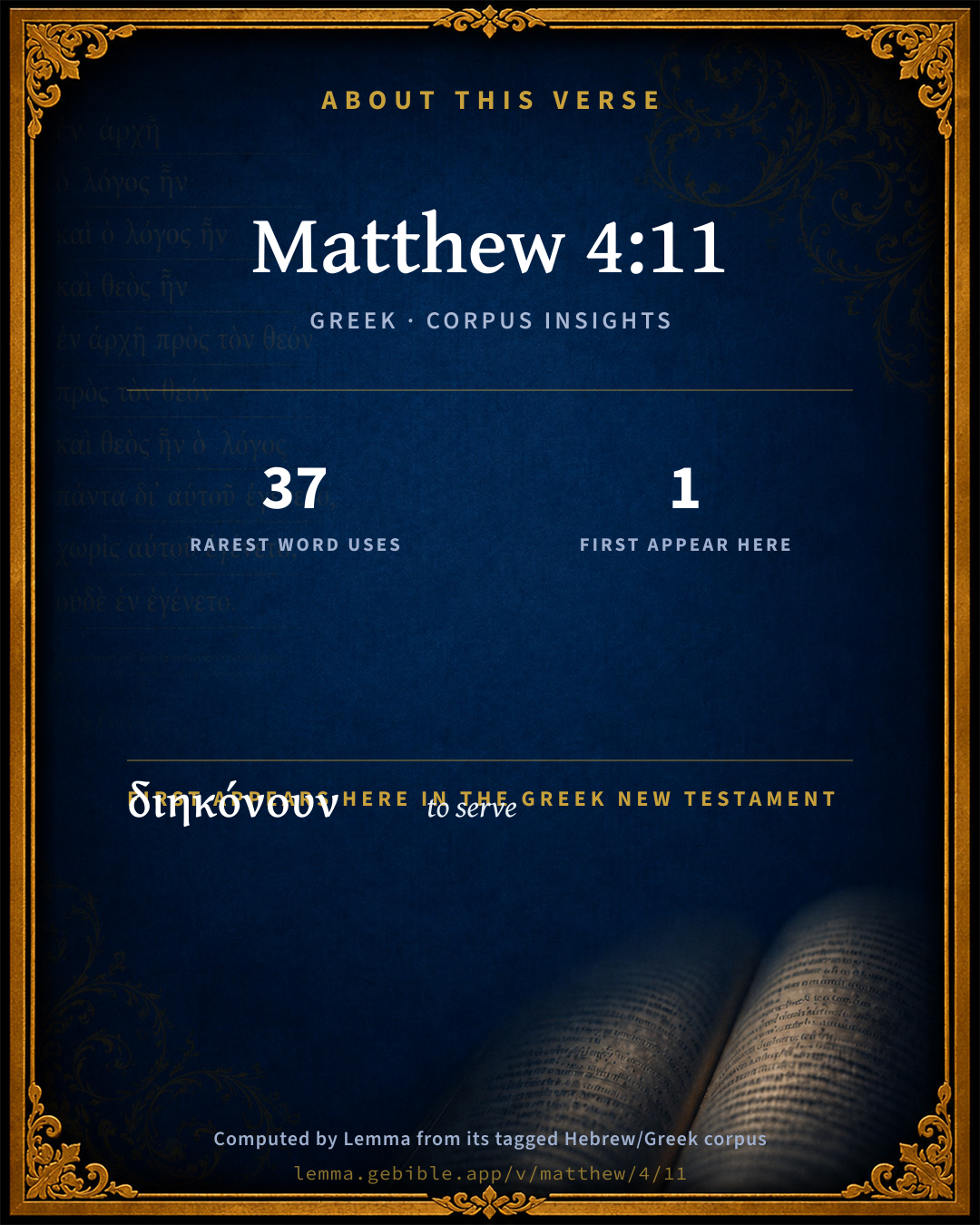
  • 1 first appearance in the Greek New Testament
Full analysis ↓
Download a study sheet

One document with this verse’s original text, its word-by-word gloss line, the meaning frame, cross-references with their text, attributed commentary, and full source and license credits — printable, and it pastes into notes with its structure intact.

This verse Autodidact and up

Study sheet (.html) Plain text (.txt)

A passage Seminary Student

Up to 50 verses in one chapter. A passage sheet keeps up to 6 commentary sources and 12 cross-references per verse, in the order this page ranks them, and says so on the sheet whenever that leaves anything out. Ask for a single verse and you get the Autodidact verse sheet above.

Everything on this page stays free to read, with no account — the sheet is a download of what is already on screen, not access to it.

Want to remove ads? Support Godless Engineer
Compare translations 3

The same verse in 3 English versions, stacked beneath the original-language interlinear above. Click any original word for its lexicon entry.

Each is an independent rendering of the whole verse — the interlinear is not word-aligned to these translations.

Highlighted words mark where these versions differ — a whole-verse word diff, not a word-by-word alignment.

  • World English Bible Public Domain
    Then the devil left him, and behold, angels came and ministered to him.
  • King James Version Public Domain
    Then the devil leaveth him, and, behold, angels came and ministered unto him.
  • unfoldingWord Literal Text CC BY-SA 4.0
    Then the devil leaves him, and behold, angels came and began to minister to him.

unfoldingWord Literal Text — © unfoldingWord, licensed CC BY-SA 4.0. Word-aligned USFM3 via Door43 (git.door43.org/unfoldingWord/en_ult).

Versions to compare (up to 4)

3 of 4 selected

Show all 19 translations

Every available English version of this verse, each an independent rendering of the whole verse.

  • World English Bible Public Domain
    Then the devil left him, and behold, angels came and ministered to him.
  • Berean Standard Bible Public Domain
    Then the devil left Him, and angels came and ministered to Him.
  • Majority Standard Bible Public Domain
    Then the devil left Him, and angels came and ministered to Him.
  • King James Version Public Domain
    Then the devil leaveth him, and, behold, angels came and ministered unto him.
  • American Standard Version (1901) Public Domain
    Then the devil leaveth him; and behold, angels came and ministered unto him.
  • Revised Version (1885) Public Domain
    Then the devil leaveth him; and behold, angels came and ministered unto him.
  • Geneva Bible (1599) Public Domain
    Then the deuill left him: and beholde, the Angels came, and ministred vnto him.
  • Douay-Rheims (1899) Public Domain
    Then the devil left him; and behold angels came and ministered to him.
  • Young's Literal Translation Public Domain
    Then doth the Devil leave him, and lo, messengers came and were ministering to him.
  • Literal Standard Version CC BY-SA 4.0
    Then the Devil leaves Him, and behold, messengers came and were ministering to Him.
  • Unlocked Literal Bible CC BY-SA 4.0
    Then the devil left him, and behold, angels came and served him.
  • unfoldingWord Literal Text CC BY-SA 4.0
    Then the devil leaves him, and behold, angels came and began to minister to him.
  • Darby Bible Public Domain
    Then the devil leaves him, and behold, angels came and ministered to him.
  • World Messianic Bible Public Domain
    Then the devil left him, and behold, angels came and served him.
  • Webster's Bible Public Domain
    Then the devil leaveth him, and behold, angels came and ministered to him.
  • Free Bible Version CC BY-SA 4.0
    Then the devil left him, and angels came to care for him.
  • Bible in Basic English Public Domain
    Then the Evil One went away from him, and angels came and took care of him.
  • Text-Critical English NT CC BY 4.0
    Then the devil left him, and behold, angels came and ministered to him.
  • Tyndale New Testament (1534) Public Domain
    Then the dyvell left hym and beholde the angels came and ministred vnto hym.

Literal Standard Version (2020), Covenant Press — licensed CC BY-SA 4.0. Text via the HelloAO Bible API (eBible.org). Unlocked Literal Bible (unfoldingWord) — licensed CC BY-SA 4.0. Text via the HelloAO Bible API (eBible.org). unfoldingWord Literal Text — © unfoldingWord, licensed CC BY-SA 4.0. Word-aligned USFM3 via Door43 (git.door43.org/unfoldingWord/en_ult). Free Bible Version, Dr. Jonathan Gallagher — licensed CC BY-SA 4.0. Text via the HelloAO Bible API (eBible.org).

Word by word

More ways to search: Search by grammar → Find every occurrence → Compare this word →

Practice this passage: Drill this verse → Learn its vocabulary →

διάβολος
diábolos
G1228
“slanderous”
Adjective, Nominative, Singular, Masculine
Part of Speech
Adjective
Case
Nominative
Number
Singular
Gender
Masculine
Full Thayer's Definition

Origin: from G1225

TDNT: 03:12,1

1. prone to slander, slanderous, accusing falsely a. a calumniator, false accuser, slanderer, 2. metaph. applied to a man who, by opposing the cause of God, may be said to act the part of the devil or to side with him
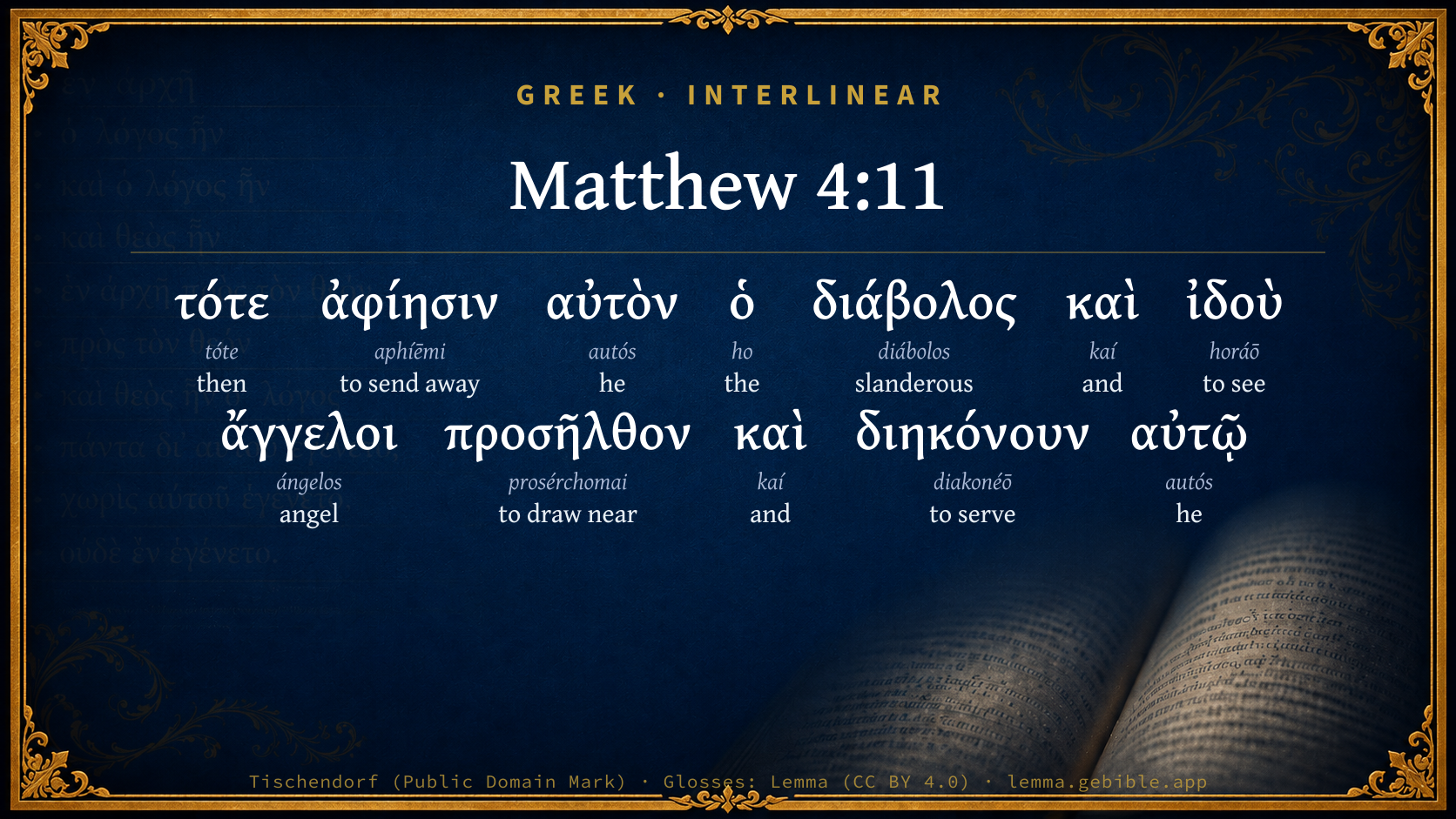
  1. τότε tóte G5119 “then” Adverb
  2. ἀφίησιν aphíēmi G863 “to send away” Verb, Present, Active, Indicative, 3rd person, Singular
  3. αὐτὸν autós G846 “he” Personal pronoun, Accusative, Singular, Masculine
  4. ὁ ho G3588 “the” Article, Nominative, Singular, Masculine
  5. καὶ kaí G2532 “and” Conjunction
  6. ἰδοὺ horáō G3708 “to see” Verb, Aorist, Middle, Imperative, 2nd person, Singular
  7. ἄγγελοι ángelos G32 “angel” Noun, Nominative, Plural, Masculine
  8. προσῆλθον prosérchomai G4334 “to draw near” Verb, Aorist, Active, Indicative, 3rd person, Plural
  9. καὶ kaí G2532 “and” Conjunction
  10. διηκόνουν diakonéō G1247 “to serve” Verb, Imperfect, Active, Indicative, 3rd person, Plural
  11. αὐτῷ autós G846 “he” Personal pronoun, Dative, Singular, Masculine

About this verse

These counts appear in no published source. They are computed here, from the morphology-tagged text and Lemma’s own curated glosses. What Lemma adds →

12
words
10
distinct lemmas
Gospels
section

First appearance in Scripture

This word makes its first canonical appearance in the Greek New Testament here:

  • διηκόνουν to serve G1247

Shared distinctive vocabulary

διάβολος slanderous G1228 occurs in 35 verses of the Greek New Testament. Also found in:

Repetition

Words recur within this verse:

  • αὐτὸν he G846 ×2
  • καὶ and G2532 ×2

Cross-references

12

Topical passages linked to Matthew 4:11 in the Treasury of Scripture Knowledge — connected by theme and wording, ordered by reader-vote popularity; previews shown in the World English Bible.

  • Matthew 26:53 Or do you think that I couldn't ask my Father, and he would even now send me more than twelve legions of angels?
  • Luke 22:43 An angel from heaven appeared to him, strengthening him.
  • Hebrews 1:14 Aren't they all ministering spirits, sent out to do service for the sake of those who will inherit salvation?
  • Luke 4:13 When the devil had completed every temptation, he departed from him until another time.
  • Revelation 5:11–12 I saw, and I heard something like a voice of many angels around the throne, the living creatures, and the elders; and the number of them was ten thousands of ten thousands, and thousands of thousands;
  • Matthew 4:6 and said to him, "If you are the Son of God, throw yourself down, for it is written, 'He will give his angels charge concerning you.' and, 'On their hands they will bear you up, So that you don't dash your foot against a stone.'"
  • Matthew 28:2–5 Behold, there was a great earthquake, for an angel of the Lord descended from the sky, and came and rolled away the stone from the door, and sat on it.
  • Luke 22:53 When I was with you in the temple daily, you didn't stretch out your hands against me. But this is your hour, and the power of darkness."
  • Hebrews 1:6 Again, when he brings in the firstborn into the world he says, "Let all the angels of God worship him."
  • Mark 1:13 He was there in the wilderness forty days tempted by Satan. He was with the wild animals; and the angels were ministering to him.
  • John 14:30 I will no more speak much with you, for the prince of the world comes, and he has nothing in me.
  • 1 Timothy 3:16 Without controversy, the mystery of godliness is great: God was revealed in the flesh, Justified in the spirit, Seen by angels, Preached among the nations, Believed on in the world, And received up in glory.

Cross-references courtesy of OpenBible.info (CC BY 4.0).

Commentary

Notes on Matthew 4:11 from classic Christian and Jewish commentators (each source and its license shown beneath its notes). The classic Christian expositions comment on the surrounding passage and are grouped to its opening verse, so a note may address several verses; the Jewish commentaries on the Tanakh (Rashi and others) are per-verse, so they appear only where the commentator wrote on this verse.

Lemma curates 59 commentaries, every one of them public domain or Creative Commons licensed, each selected and text-cleaned for this edition rather than reprinted as found. About our sources →

The Biblical Illustrator

Joseph S. Exell

Mat_4:11

The devil leaveth him.

The end of the temptation

I. Satans departure on the side of Christ. Christ had repelled Satan in the third temptation in quite a different way from that in the previous contests (Luk_4:8). A coercive and indignant dismissal.

II. Satan also withdrew willingly. He had exhausted his temptations. All the varied forms of temptation are reduceable to three-pride, avarice, and sensuality. Three root-passions (1Jn_2:16). So Christ tempted in all points as we are. Had Satan remained he had no more weapons to try. At the fitting moment Christ revealed His hatred of sin. This overthrow was a new experience.

III. How far this withdrawal was temporary. Satan returned in the Passion, but indirectly through others. He entered into Judas. (W. H. Hutchings, M. A.)

Primarily temptations few.

They are like languages which, though many, are divided into groups or families, and are traceable to a few primitive sources. (W. H. Hutchings, M. A.)

Temptation productive of good

Thus it may prove with us as with the oyster, which stops with a precious pearl the hole in its shell which was originally a disease; as with the broken limb, which having been set, may be stronger than if it never had been broken. It may fare with us as islanders of the Southern Ocean fancy that it fares with them; counting, as they do, that the strength and valour of the warrior whom they have slain in battle passes into themselves as their rightful inheritance. The strength which lay in the temptation has shifted its seat, and passed over into the man who has overcome the temptation. (R. C. Trench.)

Christ the Captain of the tempted

In the old Roman times, there was a great Roman general to whom one of his soldiers said: Oh! the enemy are so many. We are not half so many as the enemy! The enemy is twice as many as we are. The general said to him, How many do you count me for? Do you understand? There are more with us than there are against us. Jesus is with us. How many do you count Him for? (J. Vaughan, M. A.)

The victory

1.It was complete.

2. It was not final.

3. It was the precursor of ether victories, even that of the cross.

4. He has not endured one temptation more than was necessary.

5. The propriety of the prayer, Lead us not into temptation.

6. It was obtained through self-sacrifice.

7. It supplies an antidote to doubt and despair.

8. It was watched in heaven. (L. H. Wiseman.)

Angels came.-

Ministering angels

1. Thoughts.

2. Friends.

3. Children.

4. Books.

5. Flowers.

Angels came

1. To congratulate Christ after His victory.

2. From a disinterested love of us.

3. Because of their love for Christ.

4. To honour God.

5. To teach us the dignity of human nature when faithful in temptation.

6. Christ by this victory had formed a fresh link with the angels-they had passed through trial.

7. Human nature stands between heavenly and Satanic influences. (W. H. Hatchings, M. A.)

The Biblical Illustrator, edited by Joseph S. Exell (c. 1880s–1900s) — public domain. Text from a community e-Sword module.

Joseph Benson's Commentary

Mat 4:11. Then the devil — Being so baffled and confounded as not to be able to present any other temptation which seemed more likely to prevail, leaveth him — Namely, for a season, as Luke observes meditating no doubt some future assault, and especially designing, by and by, to use all stratagems to take away his life. And, behold, angels came and ministered unto him — Not only furnishing him with proper supplies for his hunger, but also congratulating him on so illustrious a victory over the prince of darkness; and doing him honour by the appearance of a number of them, (for one of them would nave sufficed to bring him food,) after this horrible combat with Satan, to which, for wise and gracious reasons, he was pleased to condescend. And it may encourage us in all our temptations to remember, that if our conflict be thus maintained, the struggle will, ere long, be over; and angels, who are now spectators of the combat, will at length congratulate our victory. God teaches us, by all this, that our lives are to have their vicissitudes of temptation and consolation, and that our temptation shall have a happy issue, and that when ordinary means fail we may expect extraordinary helps.

Joseph Benson's Commentary on the Old and New Testaments (1811–1818) — public domain. Text from a community e-Sword module.

Tyndale Open Study Notes

Tyndale Open Resources

4:11 Then the devil went away: Jesus’ rebuff of Satan here foreshadows his victory over demons (12:28), Satan’s defeat through the Cross (Col 2:14-15), and the final victory at the end of history (Rom 16:20; Rev 12:7-17; 20:2-3, 10). • Angels, who had already been involved in the Messiah’s arrival and protection (Matt 1:20, 24; 2:13, 19), now came and took care of Jesus after his temptation, in fulfillment of the Old Testament (4:6; see Ps 91:11-12).

Tyndale Open Study Notes — © Tyndale Open Resources, licensed CC BY-SA 4.0. Text via the HelloAO Bible API.

Bengel's Gnomon

Johann Albrecht Bengel

Mat 4:11. Ἄγγελοι, angels) Who had probably witnessed the contest. Cf. 1Co 4:9; 1Ti 3:16.—διηκόνουν, ministered) Undoubtedly, by doing that which was then necessary, sc. bringing Him food.—Cf. 1Ki 19:5-6.

Bengel's Gnomon of the New Testament — English translation (T&T Clark, Edinburgh, 1860) — public domain. Text from a community e-Sword module.

Meyer's Critical & Exegetical Commentary

Heinrich August Wilhelm Meyer

Mat_4:11. Ἄγγελοι] Angels, without the article.

διηκόνουν] ministered to Him. The remark of Bengel is correct: sine dubio pro eo, ac tum opus erat, sc. allato cibo. So Luther, Piscator, Jansen, Wolf, Hammond, Michaelis, Paulus, Fritzsche, Strauss, de Wette, Ewald, Bleek, Nebe, Keim. Concerning the use of διακονεῖν in this sense, see Wetstein, and Matthiae, ad Soph. Phil. 284; and how pragmatically does this appearance of angels, after a series of temptations that have been victoriously withstood, correspond to the appearance of Satan in Mat_4:3! Comp. 1Ki_19:5. Others, not referring it to food, say that extraordinary divine support (Joh_1:51) is intended (Calvin, Maldonatus, Kuinoel, Olshausen, Kuhn, Ammon, Ebrard), on which view the angels themselves are partly left out, partly effaced from the narrative; whilst Chrysostom (who compares the carrying of Lazarus by angels into Abrahams bosom), Theophylact, Euth. Zigabenus, Grotius, do not enter into any more minute exposition of the διακονεῖν. But considering the appropriateness of the above definite explanation, it is not right to be satisfied with one that is indefinite and wavering.

REMARK.

According to the representation of the evangelists, the temptation of Jesus by the devil appears in the connection of the history as a real external marvellous occurrence. See Ch. F. Fritzsche in Fritzschior. Opusc. p. 122 ff. To abide by this view (Michaelis, Storr, Ebrard, P. Ewald, Graul, Könemann, Arnoldi, Schegg, Delitzsch, Nebe, Engelhardt, Hofmann, Riggenbach, Baumgarten) is a necessary consequence of the denial of any legendary elements in the canonical Gospels, and is equally justifiable with this denial in general. The evangelists were aware that they were relating a real external history in time and space (in answer to Kuhn, Lichtenstein), and the choice only remains between adopting either this view or assuming that of an ideal history in the garb of legend, gradually brought into shape by the power of the idea. All attempts at explaining away the devil and his external appearance are arbitrary contradictions or critical carpings, opposed to the design and representations of the evangelists, more or less of a rationalistic character. This holds good, not merely of the absurd, and, in relation to the third act, even monstrous view of those who, instead of the devil, introduce one or even various individuals, perhaps a member of the Sanhedrim or high priest, who wished to examine Jesus and to win Him over, or destroy Him (Herm. v. d. Hardt, Exegesis he. difficilior. quat. ev. p. 470 ff.; Basedow, Venturini, Möller, neue Ansichten, p. 20 ff.; Rosenmüller, Kuinoel, Feilmoser in the Tüb. Quartalschr. 1828, 1, 2), but also of the view which regards the event as a vision, whether this was brought about by the devil (Origen? Pseudo-Cyprian, Theodore of Mopsuestia), or by God (Farmer, Inquiry into the Nature and Design of Christs Temptation, London, 1761; comp. also Calvin on Mat_4:5), or by natural means (Balth. Becker, Scultetus, Clericus, Wetstein, Bolten, Bertholdt, Jahn, Gabler, Paulus, Gratz, Pfieiderer), or of those who view it as a significant morning dream (Meyer in the Stud. u. Kritik. 1831, p. 319 ff.),which interpretations, moreover, are in contradiction with the clear repose and moral definiteness of the divine-human consciousness of Jesus, in virtue of which there never occurs in His life any condition of ecstasy, or a trace of any special manifestations in dreams. Akin to this, but equally offensive to the gospel history, and besides by no means leaving unaffected the moral character of the development of Jesus Himself, if we look to Heb_2:18; Heb_4:15, is the view which transforms the occurrence into an internal history, which took place in the thoughts and fancy of Jesus (Döderlein, Eichhorn, allg. Bibl. III. p. 283 ff.; Thaddaeus d. i. Dereser, d. Versuch. Christi, Bonn 1794; Hezel, Augusti, Bretschneider, Weisse, Kritik d. ev. Gesch. II. p. 12; Hocheisen in the Tüb. Zeitschr. 1833, 2; Kohlschütter, Pfeiffer, Rink, Ammon, Laufs, Schenkel, Held). On this view the devil has again been recently brought forward, on grounds exegetically justifiable, as the operating principle (Krabbe, Hoffmann, Schmid, bibl. Theol. I. p. 65; and very indirectly also by Ullmann); while, in a more arbitrary manner, it has been attributed to the disciples that they apprehended in an objective form the inner fact related to them by Jesus, that He had rejected the false idea of the Messiah; whilst Neander, L. J. p. 120 ff., substantially giving up the reality of the history of the temptation (a fragmentary symbolical setting forth of the facts of His inner life, where the manner of the devils co-operation is left undetermined), holds hesitatingly by its truth; and Kuhn, moreover, is divided between the historical and unhistorical view of the manner of its occurrence. To those who transfer the history into the inner life of Jesus spirit, belong also Hase and Olshausen, the former of whom recognises in it the whole history of His mental growth, probably externalized by Himself, with reference to Exodus 16, Deu_8:2, Psa_91:11 f, into an individual fact, but in the tradition assumed to be actual history, and who volatilizes the devil into the spirit of the world; while Olshausen, notwithstanding the ὑπὸ τοῦ πνεύματος in Mat_4:1, finds the reality of the. occurrence in this, that the soul of Jesus was exposed to the full operations of the kingdom of darkness; while Lange regards the internal temptation of Jesus as caused by the devil, but brought about by human meansthat is, as an assault of the sympathetic in working of the national and world spirit upon His soul, and as the tentative representatives of this spirit, drags in, by an invention that is his own, the deputation of the Sanhedrim, which had been despatched to John (Joh_1:19), as they were on their way back to Jerusalem. With more caution and with profounder historical insight, Keim (comp. Weizsäcker, p. 239 ff.) regards the history of the temptation in the light of the victorious beginning of the struggle with Satan, Mat_12:25 ff., where the historical kernel is the heavy weight of questions and doubts which were imposed on the soul of Jesus whilst He was calmly meditating upon the obligation and the manner of His vocation to the Messiahship, and on His decision to enter upon it, which had so powerfully taken hold of Him on the banks of the Jordan; on this initial victory Jesus could not have left His disciples without some information. But however we may apprehend the narrative as an historical occurrence in the mind of Jesus, the monstrous nature of the external formation of the history remains the more inexplicable the more directly its origin is brought into connection with Jesus Himself and His circle of disciples, especially as the threefold details of the temptation were still unknown to Mark. To view the event as a parable, is in contradiction to the narrative, arbitrary in itself, and alien to the style of parabolic address employed by Jesus elsewhere. So, after older writers, who, however, endanger the sinless character of Jesus, it has been viewed as a symbolical address of Jesus or of one of His disciples directed against false Messianic hopes. See Schleiermacher, Schr. d. Lukas, 54f., and L. J. p. 157 ff.; B. Crusius, bibl. Theol. p. 303, and on Matthew, p. 82; Usteri in the Stud. u. Krit. 1829, p. 455 ff., who at a later time recanted this opinion, and regarded the narrative as a myth (1832, p. 768); Richter, formam narrat. Mat_4:1-11, parabolicam ex Judaeor. opinione de duplici Adamo esse repetend., Viteb. 1824; Schweizer, Bleek; coinp. Theile, z. Biogr. J. p. 49: a warning directed by some adherent or another in support of the spiritually moral view, in opposition to the chief elements of the earthly Messianic hope. Against the parabolic character, see Hasert in the Stud. u. Krit. 1830, p. 74 f.; Strauss, L. J. I. p. 444 f.; Schmid, bibl. Theol. I. p. 60; Engelhardt, Nebe.

As now, however, the history of the temptation in the first and third evangelists, viewed as an actual external occurrence, contains not merely a legendary magical scenery which is still foreign to the oldest Gospel, but also absolute impossibilities and contradictions with the moral character of Jesus as filled with the Spirit, who does not at once get rid of Satan, but allows him to proceed to the utmost extreme; as, moreover, this occurrence on the other side stands in contradiction with the devils cunning and craftiness (Paulus, exeget. Handb. I. p. 376), whose assaults as proceeding from the devil against the Son of man would be planned with as much clumsiness as pointlessness,there thus remains nothing else than to explain the narrative which in Mark still exhibits its first undeveloped beginnings, the first crystallisations of its ideal contents, the subject of which the narrators deemed to be true history, and repeated as such, as a legend, the contents of which, regarded as thought, possessed historical truth, and which arose among Jewish Christians,[391] being derived from the idea of the Messiah as opposed to the devil, and the necessity and complete realization of which was exhibited in the whole life and work of Christ, placed, like a compendious programme, an epitome omnium tentationum (Bengel), at the beginning of the Messianic career, which commenced at the baptism. Not as if there had not been on the part of Jesus after His baptism, and before His entrance on His work, the most serious preparation and most intense concentration of thought in still retirement, in which the whole opposition of the devil, as well as the manner of His own struggles and conquests which had been peculiarly determined by God, must have presented themselves vividly before His eyes; although this alone could not have given rise to the history of the temptation. For that purpose it was necessary that His holy life, that actual victory over Satan, should first be completed. That narrative might now first have arisen in the living history-moulding power of the ideas which prevails generally throughout the preliminary history, first of all in the form in which it appears in Mark, but soon after gradually expanded into detail, yet again silently excluded by John, considering the impossibility of assigning a place to it in connection with his history. Its expanded form, however, as it lies before us in Matthew and Luke, corresponds with the highest internal truth to the main relations of the opposition directed by the power of the devil against the second Adam and His kingdom,an opposition which is decidedly to be recognised from the very beginning onwards to the end, and victory over which was the condition of His whole work. In this way the contents of the narrative, the psychological factors of which are quite as much the temptability as the sinlessness of the Lord, certainly belong to the history, but not as a concrete occurrence with its three individual acts, but as a summary reflection of the work of Jesus in His vocation in relation to the demoniacal kingdom, without, however, our being obliged to assume as an historical foundation any internal temptation taking place in thought, and any originally symbolic representation of the same, which was transformed into actual history in the course of tradition (de Wette). This foundation is rather the complete victory of our Lord over the craft and power of the devil, as the whole course of His Messianic life is a series of temptations by the devil, with the result of the latter being conquered both in detail and in the main (Heb_2:18; Heb_4:15); comp. Joh_14:30. With profound meaning and truth (for from the very beginning must Jesus make experience of the enemy of His kingdom, begin the struggle with him, and become certain of the right victory) has the synoptic tradition unanimously assigned to the narrative the early place which it occupies; and the attempt cannot be successful to maintain a later special situation as the historical seat of its origin, as Pfleiderer does, who transposes the vision which he assumes into the time of ch. 15 16, making use, moreover, of Joh_6:26 for the first act of the temptation. That the history of the temptation in Matthew is even a later insertion derived from oral tradition (Köstlin), is a very arbitrary inference, from the circumstance that Mat_4:12 does not make any reference to the history of the temptations; Matthew follows Mark, and quotes his short notice from a special source.

The existence of Satan, as well as his personality, is attested throughout the whole of the New Testament, and is altogether independent of the view which may be taken of this individual narrative; see in answer to Hofmann, Schriftbew., Philippi, Dogm. III. p. 332 ff. ed. 2.

[391] Various conceptions from the legendary or mythical point of view, see in Theiss, Löffler, kl. Schr. II. p. 185 ff.; Fritzscho, Usteri in the Stud. ú. Krit. 1832, p. 768 ff.; Strauss, I. p. 479 f.; de Wette, Gfrörer, Gesch. d. Urchr. I. 1, p. 379 ff.; Ewald.The locality of the temptation, the wilderness, was at once suggested as the idea gradually assumed bodily form from the sojourn of Jesus with the Baptist, and from the popular belief that demons had their dwellings in the wilderness; the forty days, however, found their venerable point of connection in the types of Moses and Elias (hardly of the forty years duration of the wanderings of the people in the wilderness, which Delitzsch, Baumgarten, and others drag in here as a type). They are also not excluded by the statement of Justin, c. Tr. 103, that, according to the ἀπομνημον. τ. ἀποστ, the devil came to Jesus ἅμα τῷ ἀναβῆναι αὐτὸν ἀπὸ τοῦ ποταμοῦ τοῦ Ἰορδάνου; but this statement agrees with Mar_1:12 f. As regards the individual temptations, the first was thus connected with the forty days fast of Moses, Deu_9:9; Deu_9:18; the second, with the necessity which existed in the case of the Messiah of His being accredited by miracles; the third, with the certainty of the Messiahs rule over the world, by means of which the government of the devil must come to an end.

Meyer — Critical and Exegetical Commentary on the New Testament — English translation by Peter Christie, edited by Frederick Crombie (T&T Clark, 1880) — public domain. Text from a community e-Sword module.

Expositor's Greek Testament

ed. W. Robertson Nicoll

Mat 4:11 . τότε ἀφίησιν : then , when the peremptory ὕπαγε had been spoken. Nothing was to be made of one who would not do evil that good might come. καὶ ἰδοὺ ἄγγελοι . The angels were ministering to Him, with food, presumably, in the view of the evangelist. It might be taken in a wider sense, as signifying that angels ministered constantly to one who had decidedly chosen the path of obedience in preference to that of self-pleasing.

The Expositor's Greek Testament, edited by W. Robertson Nicoll (1897–1910) — public domain. Text from a community e-Sword module.

Jamieson, Fausset & Brown

Robert Jamieson, A. R. Fausset & David Brown

Then the devil leaveth him--Luke says, "And when the devil had exhausted"--or "quite ended," as in Luk 4:2 --"every (mode of) temptation, he departed from him till a season." The definite "season" here indicated is expressly referred to by our Lord in Joh 14:30; Luk 22:52-53.

and, behold, angels came and ministered unto him--or supplied Him with food, as the same expression means in Mar 1:31; Luk 8:3. Thus did angels to Elijah (Kg1 19:5-8). Excellent critics think that they ministered, not food only, but supernatural support and cheer also. But this would be the natural effect rather than the direct object of the visit, which was plainly what we have expressed. And after having refused to claim the illegitimate ministration of angels in His behalf, oh, with what deep joy would He accept their services when sent, unasked, at the close of all this temptation, direct from Him whom He had so gloriously honored! What "angels' food" would this repast be to Him! and as He partook of it, might not a Voice from heaven be heard again, by any who could read the Father's mind, "Said I not well, This is my beloved Son, in whom I am well pleased?"

Jamieson, Fausset & Brown — Commentary Critical and Explanatory on the Whole Bible (1871) — public domain (CC PDM 1.0). Text via the HelloAO Bible API.

Adam Clarke's Commentary

Verse 11. Behold, angels came and ministered unto him.] That is, brought that food which was necessary to support nature.

The name given to Satan in the third verse is very emphatic, ο πειραζων, the tempter, or trier, from πειρω, to pierce through. To this import of the name there seems to be an allusion, Eph 6:16: The fiery DARTS of the wicked one. This is the precise idea of the word in De 8:2. To humble thee, and to prove thee, TO KNOW WHAT WAS IN THY HEART: לנסתך linesteca, πειρασησε, LXX. that he might bore thee through. The quality and goodness of many things are proved by piercing or boring through; for this shows what is in the heart. Perhaps nothing tends so much to discover what we are, as trials either from men or devils.

Shalt thou serve, or pay religious veneration, λαρρευσεις. This is Mr. Wakefield's translation, and I think cannot be mended. λατρεια comes from λα, very much, and τρεω, I tremble. When a sinner approaches the presence of God, conscious of HIS infinite holiness and justice, and of his own vileness, he will then fully comprehend what this word means. See this religious reverence exemplified in the case of Moses, when in the presence of God; I exceedingly fear, said he, and tremble, Heb 12:21. And yet this fear of God is the beginning of wisdom. See the observations at the end of the chapter.

Adam Clarke's Commentary on the Bible (1810–1826) — public domain. Text from a community e-Sword/MySword module.

Ellicott's Commentary for English Readers

(11) Angels came and ministered unto him.—The tenses of the two verbs differ, the latter implying continued or repeated ministrations. Here also we are in the region of the spiritual life, and must be content to leave the nature of the ministration undefined, instead of sensualising it as poets and artists have done. What is instructive is, that the help of their service, the contrast between the calm and beauty of their presence and that of the wild beasts and of the Tempter, comes as the reward of the abnegation which refused to make their ministry the subject of an experimental test. In this case, also, we find strange coincidences. The fact recorded by St. Matthew explains the words recorded by St. John (Joh_1:51) as uttered but a few days later, and which speak of “the angels of God ascending and descending on the Son of Man.” The words with which St. Luke ends his record of the Temptation may well be noticed here: “And having finished every temptation, the devil departed from him for a season” (literally, till a season). The conflict was not yet ended, and was from time to time renewed—now in the passionate prayer of the disciple (Mat_16:22), now in the open enmity of the prince of this world (Joh_12:31; Joh_14:30).

A Bible Commentary for English Readers, edited by Charles John Ellicott (1878–1897) — public domain. Text from a community e-Sword module.

John Gill's Exposition

Now, when Jesus had heard that John was cast into prison,.... John was cast into prison by Herod; the reason of it may be seen in Mat 14:3. The prison into which he was cast, according to Josephus (s), was the castle of Machaeras: here he continued some time before he was put to death; for from hence he sent two disciples to Jesus, to know if he was the Messiah, Mat 11:2. Now when Jesus heard of this his imprisonment,

he departed into Galilee; not so much on account of safety, or for fear of Herod, but to call his disciples, who lived in that country.

(s) Antiq. l. 18. c. 7.

John Gill's Exposition of the Whole Bible (1746–1763) — public domain (CC PDM 1.0). Text via the HelloAO Bible API.

Trapp's Complete Commentary

John Trapp

11 Then the devil leaveth him, and, behold, angels came and ministered unto him.

Ver. 11. Then the devil left him] If Christ command him away, there is no abiding for him. Here he was foiled and queried, and, as it were, cast down and killed, by Christ our champion. (Stuchius de sacrific. Gentilium.) He came into the field like another Goliah, cracking and calling craven, but ere he went thence, was made to hop headless, as he first a terror, afterwards a scorn, as it was anciently said of those chariots armed with scythes and hooks. Charles VIII, in his expedition against Naples, came into the field like thunder and lightning, but went out like a snuff: more than a man at first, less than a woman at last. Henceforth, therefore, though we are ever to expect temptations till such time as we have gotten that great gulf between the devil and us, Luk 16:26, yet "fear none of those things that ye shall suffer," Nulla maior tentatio quam nulla tentatione pulsari. Behold, the devil shall (by his imps and instruments) cast some of you (not all) into prison (not into hell), that ye may be tried (not destroyed), and ye shall have tribulation ten days (so long, and no longer). "Be thou faithful unto death, and I will give thee a crown of life," Rev 2:10. Satan can look for no crown, he is in perdition already. His aim and endeavour is, to draw us into the same condemnation. This we escape, if we resist, steadfast in the faith: for then he perceives Christ, "the chief Captain of our salvation," to be there; and therefore flees his presence, ever since he felt his prowess. Chrysostom saith, that by the sacrament of the Lord’s supper we are so armed against Satan’s temptations, that he fleeth from us no otherwise than if we were so many leones ignem expuentes, lions that spit fire. It is not silly people’s defying the devil and spitting at his name, that avails anything: for they spit not low enough; they spit him not out of their hearts: yea, they admit him thereinto by yielding to his suggestions; and are miserably foolish, as if men should startle at the name of fire, and yet not fear to be scorched with the flame thereof. Our safest way is to run to Ithiel and Ucal, as Agur did, Pro 30:1-2, to Christ "the author and finisher of our faith," Heb 12:2; who here gave the devil such an inglorious foil, trampled him in the mire, triumphed over him, and hath promised to "tread him under our feet shortly," Rom 16:20.

And, lo, the angels came and ministered unto him] Perhaps food to his body, as once to Elias, 1Ki 19:5-6, but certainly comfort to his soul, as to Jacob, Hagar, Daniel, Zacharias, Joseph, Cornelius, Paul, &c. Dan 9:21; Luk 1:11; Act 10:4; Act 27:23. Socrates and Theodoret tell us of one Theodorus, a martyr, put to extreme torments by Julian the apostate, and dismissed again by him, when he saw him unconquerable. Ruffinus tells us that he met with this martyr, a long time after this trial, and asked him, "whether the pain he felt were not insufferable?" He answered, "that at first it was somewhat grievous; but after a while, there seemed to stand by him a young man in white, who with a soft and comfortable handkerchief wiped off the sweat of his body (which through extreme pain and anguish was little less than blood) and bade him be of good cheer. Insomuch as that it was rather a punishment than a pleasure to him to be taken off the rack, since, when the tormentors had done, the angel was gone. And how many unspeakable comforts ministered the good angels to the modern martyrs in their prisons, at the stake, and in the fire! Christ indeed was not comforted by them till the temptation was over; but to us they minister, many times, in the hour of temptation. They have power over the devils to restrain them; and (though invisibly and insensibly) are as ready to help and comfort us as the evil angels to tempt and trouble us: else were not our protection equal to our danger, and we could neither stand nor rise. An angel stood at Zacharias’ right hand, Luk 1:11; (as the devil did at Joshua’s, Zec 3:1), to show how ready and handy they are to defend and support the saints. It was as he was burning incense. The angels are busiest about us when we are in God’s work: which to set forth, the hangings of the tabernacle of old were full of cherubims within and without. He said unto him, "Fear not, Zacharias." The blessed spirits (though they do not often vocally express it) do pity our human frailties, and secretly suggest comfort to us, when we perceive it not. Alway they stand looking on the face of God to receive commandments, for the accomplishment of all designs for our good; which they have no sooner received than they readily despatch, even with weariness of flight, as Dan 9:21, with so much swiftness, as if they had wearied themselves with flying. I read of a friar that undertook to show to the people a feather of the wing of the angel Gabriel. A plume of whose feathers it might better have become the pope to send to Tyrone the Irish rebel, than that plume of phoenix feathers he sent to honour and encourage him: had his Holiness such command over angels, as they say he hath, or did he not rather collude in one thing, as that friar did in another (Carleton’s Thankful Rem. of God’s Mercies.}

John Trapp, A Commentary or Exposition upon All the Books of the Old and New Testament (1647–1656) — public domain. Text from a community e-Sword module.

Albert Barnes' Notes on the Bible

Then the devil leaveth him - He left him for a time, Luk 4:13. He intended to return again to the temptation, and, if possible, to seduce him yet from God. Compare Joh 14:30; Luk 22:53. See the notes at Heb 12:4.

The angels came and ministered - See the notes at Mat 1:20. They came and supplied his wants and comforted him. From this narrative we may learn:

(a) That no one is so holy as to be free from temptation, for even the Son of God was sorely tempted.

(b) That when God permits a temptation or trial to come upon us, he will, if we look to him, give us grace to resist and overcome it, 1Co 10:13.

(c) We see the art of the tempter. His temptations are adapted to times and circumstances. They are plausible. What could have been mere plausible than his suggestions to Christ? They were applicable to his circumstances. They had the appearance of much piety. They were backed by passages of Scripture misapplied, but still most artfully presented. Satan never comes boldly and tempts people to sin, telling them that they are committing sin. Such a mode would defeat his design. It would put people on their guard. He commences, therefore, artfully and plausibly, and the real purpose does not appear until he has prepared the mind for it. This is the way with all temptation. No wicked person would at once tempt another to be profane, to be drunk, to be an infidel, or to commit adultery. The principles are first corrupted. The confidence is secured. The affections are won. And then the allurement is little by little presented, until the victim falls. How everyone should be on his guard at the very first appearance of evil, at the first suggestion that may possibly lead to sin!

(d) One of the best ways of meeting temptation is by applying Scripture. So our Saviour did, and they will always best succeed who best wield the sword of the Spirit, which is the word of God, Eph 6:17.

Albert Barnes' Notes on the Bible (1834–1885) — public domain. Text from a community e-Sword/MySword module.

Haydock's Catholic Bible Commentary

Then the devil having exhausted all his artifices, left hem for a time, as St. Luke remarks; whence we are to learn, that after we have resisted with success, we are not to think ourselves secure, but avail ourselves of the truce to return thank to God for the victory, and to prepare for fresh combats, especially by fortifying ourselves with the bread of angels in the holy communion. by example he has taught us how to fight and to conquer. The struggle may be painful; but angels, as well as God, witness our struggle, ready to crown our victory. (Haydock)

George Leo Haydock (1774–1849), Haydock's Catholic Family Bible and Commentary, 1859 edition — public domain. Excludes Psalms (Douay-Rheims chapter numbering differs from Protestant) and Deuterocanonical books (Catholic canon only).

Matthew Poole's English Annotations

Resist the devil, saith James, Jam 4:7, and he shall flee from you. Thus he did from the Head, thus he shall do from the members: but as he did not flee from Christ till commanded away, so neither till commanded off by God doth he leave the people of God; but upon our resistance God will command him off, that we may not be tempted above our strength. The evil angels leaving him, the good

angels came and ministered unto him, whether by bringing him food, or bringing him off the mount, or otherwise executing his commands, is not expressed, and it is too much curiosity to inquire. God by this teacheth us, that our lives are to have their vicissitudes of temptations and consolations, and that our temptations shall have a happy issue, and that when ordinary means fail we may expect extraordinary influences and assistances. Luke saith, he departed from him for a season, to let us know, that though there was an end of his more eminent temptations, yet he was not afterward without Satan’s assaults.

Matthew Poole's English Annotations on the Holy Bible (1683–1685) — public domain. Text from a community e-Sword/MySword module.

Whedon's Commentary on the Bible

Daniel D. Whedon

11. Devil leaveth him — Victory, glorious victory, is now won by the Prince of Light. The prince of hell is defeated and overcome. This defeat is the prelude to the hour when the Messiah will cast him into the lake of fire. The second Adam did not, like the first, fall before the power of the tempter; and the victory which he won was won for us, that he might restore the lost Paradise to our race. Angels came and ministered unto him — As soon as the angel of darkness departed the angels of light appeared upon the scene. It is a change from deep night to glorious morning. The Messiah is faint with the terrible combat; and to indicate that he is truly master, angels become the providers of his food and the waiters at his table. And so all his followers, who in his strength win the victory, will find angels to become their ministering servants, and will partake, at the table of their Lord, of the feast of victory.

Daniel D. Whedon (gen. ed.), Commentary on the Old and New Testaments (1874–1909) — public domain. Text from a community e-Sword module.

The Pulpit Commentary

The devil leaveth him; Luke, "departed from him for a season." For though there are crises of temptation, the devil never finally gives up his attack while the object of it is still on earth. May not even direct assaults be included in the remarkable epitome of Messianic life found in Luk_22:28? And, behold, angels came and ministered unto him. Kept back before both by the presence of the evil one, and by the need for the God-Man to contend alone, they now came up to him and ministered to him so long as they could be helpful. (for the change of tenses, cf. Mat_8:15) Mark however (Mar_1:13) implies that they had been present at other times than after this last crisis. Ministered; possibly supplying his bodily need; (cf. Mat_8:15 Luk_10:40) but as, after all, bodily sustenance is but secondary to spiritual, the latter must at least be included. (cf. Heb_1:14) In Luk_22:43 the "strengthening" would appear to be of his whole nature within and without, through the medium of his spirit.

The rest from temptation.

Remark on these representations of Scripture, and remark on them as the representations of Scripture, that

I THE THRICE-DENIED SATAN IS DAUNTED, AND LEAVES OFF AWHILE AT LEAST HIS TEMPTING. Contrast this with the thrice-denied Jesus, (Luk_22:61) not then daunted, but with an intense love recalling Peter by a look.

II THE NEED OF CHRIST WAS A REAL NEED. The "ministry" given now to him was probably in answer both to

(1) his bodily exhaustion by hunger, and

(2) his soul"s weariness a weariness not resulting from any supposed severity in the shape of struggle to overcome temptation, but from the" exceeding trouble" of the aspect of sin, of the presumptuous challenge of sin coming so near, and of the inevitable ruffle of perfect purity under the mere glare of the incarnation of impurity and evil.

III THE MINISTRY OF ANGELS IS A FACT, AND THE KNOWN GRANT OF SUCH MINISTRY AT DIFFERENT TIMES TO MEN IS ALL THAT IS NOW PROFFERED TO CHRIST HIMSELF!

1. This instance of fact, with a hundred others, helps to corroborate our information as to the reality of Christ"s humanity.

2. It is a fresh conviction for all of the watchful unforgettingness of supreme sympathy and divinest compassion.

3. It should greatly help to dignify our sense of the value and the adaptedness of the help and the solace vouchsafed to us, of the conflict, anxiety, vexation, and the irritation of a contact with the world, from which we should so often prefer to be saved, if things were left to our choice.

4. It may well be accepted as the expression and earnest of the calm after all storm is over, and the Divine feeding and succour after all work, trial, life"s-length duty are laid down for the last time on earth. B.

The Pulpit Commentary (1880–1919), ed. H.D.M. Spence-Jones & Joseph S. Exell — public domain. Text from a community e-Sword module.

John Wesley's Explanatory Notes

Angels came and waited upon him - Both to supply him with food, and to congratulate his victory.

John Wesley, Explanatory Notes Upon the Whole Bible (1754–1765) — public domain. Text via the GEBible commentary corpus.

Scofield Reference Notes

C. I. Scofield

angels (See Scofield "Heb 1:4")

The Scofield Reference Bible (1917 edition), notes by C. I. Scofield — public domain. Text from a community e-Sword module.

Kretzmann's Popular Commentary

Paul E. Kretzmann

This last demonstration of almighty authority decided the day:

v. 11. Then the devil leaveth Him; and, behold, angels came and ministered unto Him.

The enemy’s rout was complete, the glorious supremacy of the Lord, not only over man, but also over the spiritual world, had been established. For a season, at least, the devil departed from Him, Luk 4:13. And angels came and acted as His servants, not primarily in bringing Him food, but in giving Him the assurance of the sympathetic understanding and the heavenly support which He now enjoyed on the part of all good spirits, thus ministering to Him with a comfort destined to sustain Him in the days to come. All Christians should take note: "This, however, is written for our consolation, that we know many angels serve us, whereas only one devil tempts us; if we but fight gallantly and stand, God will not let us suffer want. Rather must the angels come from heaven and become our bakers, waiters, and cooks, and serve us in every necessity. It is not written for the sake of Christ, who is not in need of it. If the angels have ministered unto Him, let them also serve us. We should therefore be well equipped with God’s Word, in order that we may defend and sustain ourselves with it. Our dear Lord Jesus Christ, who Himself conquered these temptations for our sakes, give us strength that through Him we may overcome and be saved."

Paul E. Kretzmann, Popular Commentary of the Bible (1921–1924) — public domain. Text from a community e-Sword module.

Burkitt's Expository Notes on the New Testament

William Burkitt

Observe here, 1. The issue of this combat; Satan is conquered, and quits the field! Then the devil leaveth him: teaching us, That nothing like a vigorous resistance of temptation causes the tempter to flee from us; Resist the devil, and he will flee from you.

Observe, 2. Our Lord’s triumph over his enemy: Behold, Angels came and ministered unto him; food to his hungry body, and comfort to his tempted soul. They came no sooner, lest it should be thought he needed their assistance; they came now, because he was now pleased to make use of their assistance.

Learn hence, That those who in the hour of temptation do hold out in resisting Satan shall find the power and faithfulness of God will not be wanting to them, to send in succour and relief in the end.

William Burkitt's Expository Notes on the New Testament (1700–1703) — public domain. Text from a community e-Sword module.

The People's New Testament

B. W. Johnson

11. Then the devil leaveth him. Luke adds, “for a season.” When the devil is resisted he always flees. Angels came and ministered to him. When he fought off the tempter, after the victory was won, angels came to minister to him. I suppose this ministry was to supply him with food, but they also would afford spiritual sympathy.

B. W. Johnson's The People's New Testament with Notes (1889–1891) — public domain. Electronic text from the Christian Classics Ethereal Library (CCEL) ThML edition.

Cambridge Greek Testament for Schools and Colleges

11. διηκόνουν, from διακονέω. The Attic form of the imperfect is ἐδιακόνουν; but διηκόνουν is possibly a right reading, Eur. Cycl. 406. διακονεῖν is strictly to ‘serve at table,’ ‘minister food,’ hence the appropriateness of the word in its use, Act 6:2.

Cambridge Greek Testament for Schools and Colleges (Cambridge University Press, 1896; 21 vols, various authors incl. Carr, Maclear, Plummer, Farrar, Lumby, Moule, M. R. James, Simcox) — public domain. Text from a community e-Sword module.

Alford’s Greek Testament

Henry Alford

11. ἀφίησιν αὐτόν] but only for a season, see ║ Luke. The conflict, however often renewed in secret (of which we cannot speak), was certainly again waged in Gethsemane—αὕτη ὑμῶν ἐστιν ἡ ὥρα, καὶ ἡ ἐξουσία τοῦ σκότους. (Luk 22:53, compare Joh 14:30.) The expression in Luk 10:18, ἐθεώρουν τὸν σατανᾶν ὡς ἀστραπὴν ἐκ τοῦ οὐρανοῦ πεσόντα, must be otherwise understood: see note there.

διηκόνουν] viz. with food, as in the case of Elias, 1Ki 19:6, 1Ki 19:7.

Henry Alford, The Greek Testament (1849–1861) — public domain. Text from a community e-Sword module.

International Critical Commentary

11. Then the devil leaveth Him.] Lk. has: “And having accomplished every temptation, the devil departed from Him for a time.” Mt. now returns to Mar 1:12.

(M) And, behold, angels came and were ministering to Him.] Mk.has: “And the angels were ministering to Him.” For τότε, see on 2:7; for καὶ ἰδού, 1:20; and for προσῆλθον, v. 3.

11. διάβολος] S1 S2 add “for a time,” assimilating to Lk.

The three temptations are clearly symbolical. That is suggested at the outset by “was led by the Spirit,” an external representation of an inward experience. The first temptation was to put to the test His own consciousness of divine “Sonship.” The “Son of God” could change stones into loaves when necessity arose. In answer, Christ refuses thus to test His own convictions. He would act only as God willed. The second was a temptation to put God to the test. If the “Son of God” were in danger, God would protect Him. In answer, Christ appeals to Scripture for proof that such testing was forbidden. The third was a temptation to grasp at once and by one act the Messianic sovereignty of the world, which His consciousness of Messiahship led Him to expect in the future. For answer, Christ finally dismisses (ὕπαγε Σατανᾶ) the tempter. The service of God to which He was pledged forbade the premature hastening of events by methods which involved rebellion against God’s will. Lk. has the last two temptations in the reverse order, and consequently no ὕπαγε Σατανᾶ. His arrangement avoids the double change of scene which is found in Mt.—desert to Jerusalem, Jerusalem to a high mountain. On the other hand, Mt.’s arrangement is probably due to his belief that the offer of universal monarchy formed the fitting climax to the series. By inserting the mountain, the editor may have intended to draw a contrast between the mountain upon which Christ refused Messianic power with that other mountain (28:16) upon which at a later period He told His disciples that all power was given to Him in heaven and upon earth. It seems probable that the three temptations are artificially connected with Mk.’s brief statement (1:12, 13), where the whole scene takes place in the wilderness. “He was in the wilderness forty days, being tempted.” There He was with the beasts, and there presumably angels ministered to Him. But in Mt., after the first temptation, we leave the wilderness, and the ministration of angels presumably took place on the high mountain.

C.—4:12-15:20. MINISTRY IN GALILEE = Mar 1:14-23

(1) 12-17. Appearance in Galilee. From Mar 1:14Mar 1:14, Mar 1:15

(M) 12,

International Critical Commentary — older volumes (1896–1929), various authors — public domain. Text from a community e-Sword module.

Lesson kit

Teaching starters — assembled from the data on this page, not authored interpretation. Every prompt links to the verse data it draws on. Edit before teaching.

Matthew, in the Gospels, opens this verse with 12 words (10 distinct Greek lemmas). Its most distinctive word is diábolos (“slanderous”). A historical commentator’s framing appears above. Read the whole chapter for the surrounding context.

Discussion questions

  1. How does “slanderous” (diábolos) shape what this verse is saying?
  2. The word “to serve” first appears here in Scripture. What is being introduced at this debut?
  3. Matthew 4:1 shares the word «slanderous» with this verse. How do the two illuminate each other?
  4. “he” occurs 2× in this one verse. What is the effect of the repetition?
  5. These translations render this verse differently. What is at stake in choosing one wording over another?
  6. Reading how The Biblical Illustrator and Joseph Benson's Commentary read this verse, where do the two commentators agree and where do they part?

Things to notice

  • 1 word makes its first canonical appearance in Scripture here.
  • These translations choose different wording for 6 words in this verse.
  • “he” occurs 2× in this single verse.
  • 10 distinct Greek lemmas span 12 words in this verse.

Reading settings

Reading text

Shown beneath each verse's original-language words.

Old Testament
Old Testament edition

Read the OT as the Masoretic Hebrew (MT) or the Greek Septuagint (LXX).

English shown for the Greek Septuagint (in the Hebrew ↔ Greek comparison).

Comparing translations? Open the Compare panel on any verse page to stack up to four side by side.