

Matthew 17:5
Greek (Tischendorf 8th ed.) Matthew 17:5 appears in the Greek New Testament. The text above is from the Tischendorf 8th edition. Each word links to its Strong’s number and a concise gloss. Click any word for its full Thayer’s Greek Lexicon entry.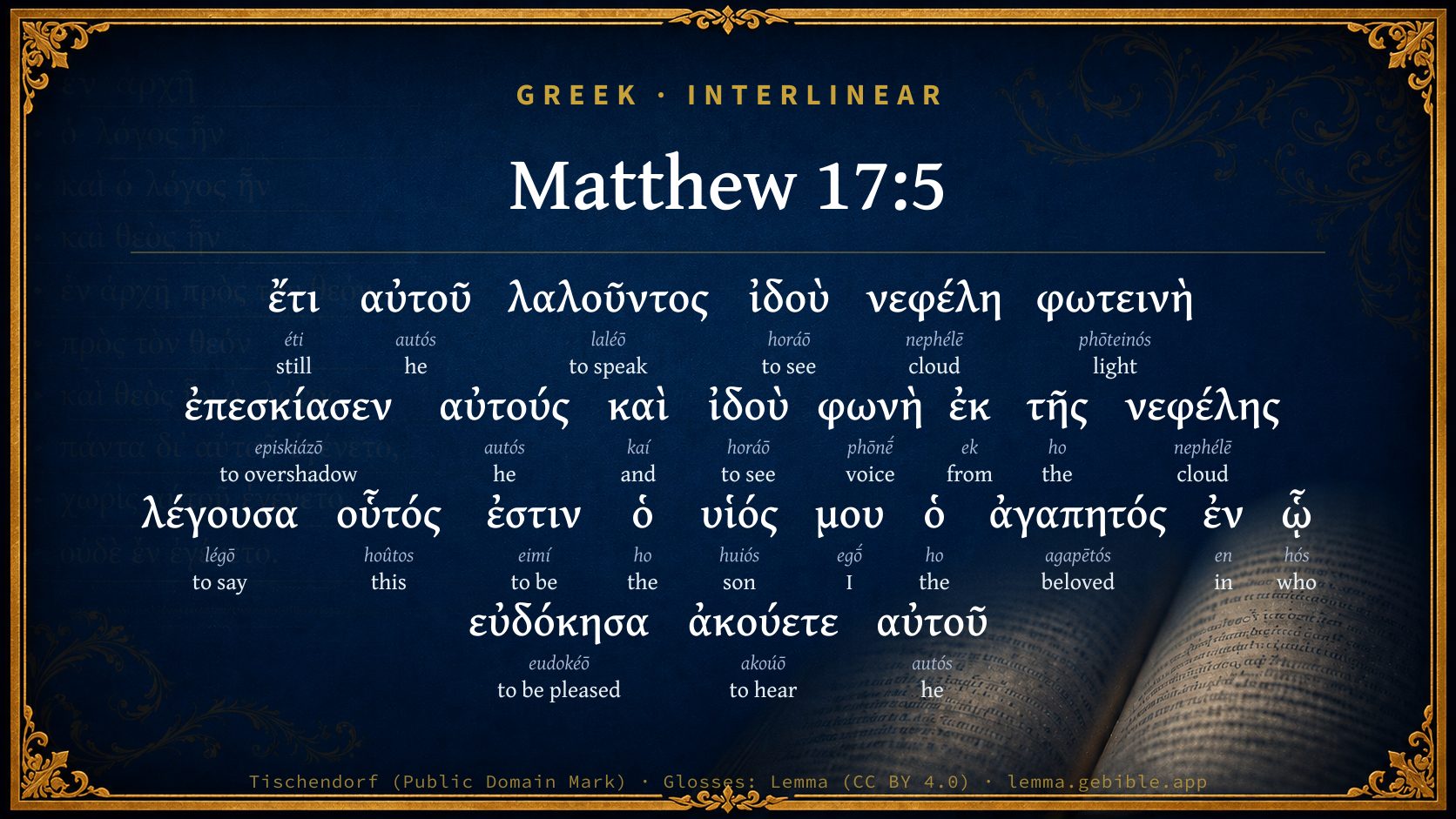
While he was still speaking, behold, a bright cloud overshadowed them. Behold, a voice came out of the cloud, saying, "This is my beloved Son, in whom I am well pleased. Listen to him."
Download a study sheet
One document with this verse’s original text, its word-by-word gloss line, the meaning frame, cross-references with their text, attributed commentary, and full source and license credits — printable, and it pastes into notes with its structure intact.
This verse Autodidact and up
A passage Seminary Student
Up to 50 verses in one chapter. A passage sheet keeps up to 6 commentary sources and 12 cross-references per verse, in the order this page ranks them, and says so on the sheet whenever that leaves anything out. Ask for a single verse and you get the Autodidact verse sheet above.
Everything on this page stays free to read, with no account — the sheet is a download of what is already on screen, not access to it.
Compare translations 3
The same verse in 3 English versions, stacked beneath the original-language interlinear above. Click any original word for its lexicon entry.
Each is an independent rendering of the whole verse — the interlinear is not word-aligned to these translations.
Highlighted words mark where these versions differ — a whole-verse word diff, not a word-by-word alignment.
-
World English Bible Public Domain
While he was still speaking, behold, a bright cloud overshadowed them. Behold, a voice came out of the cloud, saying, "This is my beloved Son, in whom I am well pleased. Listen to him."
-
King James Version Public Domain
While he yet spake, behold, a bright cloud overshadowed them: and behold a voice out of the cloud, which said, This is my beloved Son, in whom I am well pleased; hear ye him.
-
unfoldingWord Literal Text CC BY-SA 4.0
he was still speaking, behold, a bright cloud overshadowed them, and behold, a voice from the cloud, saying, “This is my beloved Son with whom I am well pleased. Listen to him.”
unfoldingWord Literal Text — © unfoldingWord, licensed CC BY-SA 4.0. Word-aligned USFM3 via Door43 (git.door43.org/unfoldingWord/en_ult).
Show all 19 translations
Every available English version of this verse, each an independent rendering of the whole verse.
-
World English Bible Public Domain
While he was still speaking, behold, a bright cloud overshadowed them. Behold, a voice came out of the cloud, saying, "This is my beloved Son, in whom I am well pleased. Listen to him."
-
Berean Standard Bible Public Domain
While Peter was still speaking, a bright cloud enveloped them, and a voice from the cloud said, “This is My beloved Son, in whom I am well pleased. Listen to Him!”
-
Majority Standard Bible Public Domain
While Peter was still speaking, a bright cloud enveloped them, and a voice from the cloud said, “This is My beloved Son, in whom I am well pleased. Listen to Him!”
-
King James Version Public Domain
While he yet spake, behold, a bright cloud overshadowed them: and behold a voice out of the cloud, which said, This is my beloved Son, in whom I am well pleased; hear ye him.
-
American Standard Version (1901) Public Domain
While he was yet speaking, behold, a bright cloud overshadowed them: and behold, a voice out of the cloud, saying, This is my beloved Son, in whom I am well pleased; hear ye him.
-
Revised Version (1885) Public Domain
While he was yet speaking, behold, a bright cloud overshadowed them: and behold, a voice out of the cloud, saying, This is my beloved Son, in whom I am well pleased; hear ye him.
-
Geneva Bible (1599) Public Domain
While he yet spake, behold, a bright cloude shadowed them: and beholde, there came a voyce out of the cloude, saying, This is that my beloued Sonne, in whom I am well pleased: heare him.
-
Douay-Rheims (1899) Public Domain
And as he was yet speaking, behold a bright cloud overshadowed them. And lo, a voice out of the cloud, saying: This is my beloved Son, in whom I am well pleased: hear ye him.
-
Young's Literal Translation Public Domain
While he is yet speaking, lo, a bright cloud overshadowed them, and lo, a voice out of the cloud, saying, `This is My Son, -- the Beloved, in whom I did delight; hear him.'
-
Literal Standard Version CC BY-SA 4.0
While he is yet speaking, behold, a bright cloud overshadowed them, and behold, a voice out of the cloud, saying, “This is My Son, the Beloved, in whom I delighted; hear Him.”
-
Unlocked Literal Bible CC BY-SA 4.0
While he was still speaking, behold, a bright cloud overshadowed them, and behold, there was a voice out of the cloud, saying, “This is my beloved Son, in whom I am well pleased. Listen to him.”
-
unfoldingWord Literal Text CC BY-SA 4.0
he was still speaking, behold, a bright cloud overshadowed them, and behold, a voice from the cloud, saying, “This is my beloved Son with whom I am well pleased. Listen to him.”
-
Darby Bible Public Domain
While he was still speaking, behold, a bright cloud overshadowed them, and lo, a voice out of the cloud, saying, *This* is my beloved Son, in whom I have found my delight: hear him.
-
World Messianic Bible Public Domain
While he was still speaking, behold, a bright cloud overshadowed them. Behold, a voice came out of the cloud, saying, “This is my beloved Son, in whom I am well pleased. Listen to him.”
-
Webster's Bible Public Domain
While he was yet speaking, behold, a bright cloud overshadowed them: and behold, a voice out of the cloud, which said, This is my beloved Son, in whom I am well pleased: hear ye him.
-
Free Bible Version CC BY-SA 4.0
While he was still speaking, a bright cloud covered them. A voice came from the cloud, saying, “This is my son whom I love, who pleases me. Listen to him.”
-
Bible in Basic English Public Domain
While he was still talking, a bright cloud came over them: and a voice out of the cloud, saying, This is my dearly loved Son, with whom I am well pleased; give ear to him.
-
Text-Critical English NT CC BY 4.0
While he was still speaking, behold, a bright cloud overshadowed them, and a voice from the cloud said, “This is my beloved Son, in whom I am well pleased; listen to him!”
-
Tyndale New Testament (1534) Public Domain
Whyll he yet spake beholde a bright cloude shadowed them. And beholde there came a voyce out of the cloude sayinge: this is my deare sonne in whom I delite heare him.
Literal Standard Version (2020), Covenant Press — licensed CC BY-SA 4.0. Text via the HelloAO Bible API (eBible.org). Unlocked Literal Bible (unfoldingWord) — licensed CC BY-SA 4.0. Text via the HelloAO Bible API (eBible.org). unfoldingWord Literal Text — © unfoldingWord, licensed CC BY-SA 4.0. Word-aligned USFM3 via Door43 (git.door43.org/unfoldingWord/en_ult). Free Bible Version, Dr. Jonathan Gallagher — licensed CC BY-SA 4.0. Text via the HelloAO Bible API (eBible.org).
Word by word
More ways to search: Search by grammar → Find every occurrence → Compare this word →
Practice this passage: Drill this verse → Learn its vocabulary →
- Appears 5× in the Greek New Testament
- First appears at Matthew 6:22
- Part of Speech
- Adjective
- Case
- Nominative
- Number
- Singular
- Gender
- Feminine
Full Thayer's Definition
- ἔτι éti G2089 “still” Adverb
- αὐτοῦ autós G846 “he” Personal pronoun, Genitive, Singular, Masculine
- λαλοῦντος laléō G2980 “to speak” Verb, Present, Active, Participle, Genitive, Singular, Masculine
- ἰδοὺ horáō G3708 “to see” Verb, Aorist, Middle, Imperative, 2nd person, Singular
- νεφέλη nephélē G3507 “cloud” Noun, Nominative, Singular, Feminine
- φωτεινὴ phōteinós G5460 “light” Adjective, Nominative, Singular, Feminine
- ἐπεσκίασεν episkiázō G1982 “to overshadow” Verb, Aorist, Active, Indicative, 3rd person, Singular
- αὐτούς autós G846 “he” Personal pronoun, Accusative, Plural, Masculine
- καὶ kaí G2532 “and” Conjunction
- ἰδοὺ horáō G3708 “to see” Verb, Aorist, Middle, Imperative, 2nd person, Singular
- φωνὴ phōnḗ G5456 “voice” Noun, Nominative, Singular, Feminine
- ἐκ ek G1537 “from” Preposition
- τῆς ho G3588 “the” Article, Genitive, Singular, Feminine
- νεφέλης nephélē G3507 “cloud” Noun, Genitive, Singular, Feminine
- λέγουσα légō G3004 “to say” Verb, Present, Active, Participle, Nominative, Singular, Feminine
- οὗτός hoûtos G3778 “this” Demonstrative pronoun, Nominative, Singular, Masculine
- ἐστιν eimí G1510 “to be” Verb, Present, Active, Indicative, 3rd person, Singular
- ὁ ho G3588 “the” Article, Nominative, Singular, Masculine
- υἱός huiós G5207 “son” Noun, Nominative, Singular, Masculine
- μου egṓ G1473 “I” Personal pronoun, 1st person, Genitive, Singular
- ὁ ho G3588 “the” Article, Nominative, Singular, Masculine
- ἀγαπητός agapētós G27 “beloved” Adjective, Nominative, Singular, Masculine
- ἐν en G1722 “in” Preposition
- ᾧ hós G3739 “who” Relative pronoun, Dative, Singular, Masculine
- εὐδόκησα eudokéō G2106 “to be pleased” Verb, Aorist, Active, Indicative, 1st person, Singular
- ἀκούετε akoúō G191 “to hear” Verb, Present, Active, Imperative, 2nd person, Plural
- αὐτοῦ autós G846 “he” Personal pronoun, Genitive, Singular, Masculine
About this verse
These counts appear in no published source. They are computed here, from the morphology-tagged text and Lemma’s own curated glosses. What Lemma adds →
- 27
- words
- 21
- distinct lemmas
- Gospels
- section
Notable vocabulary
The rarest word here is φωτεινὴ light G5460 — appearing just 5 times in the whole Greek New Testament.
First appearance in Scripture
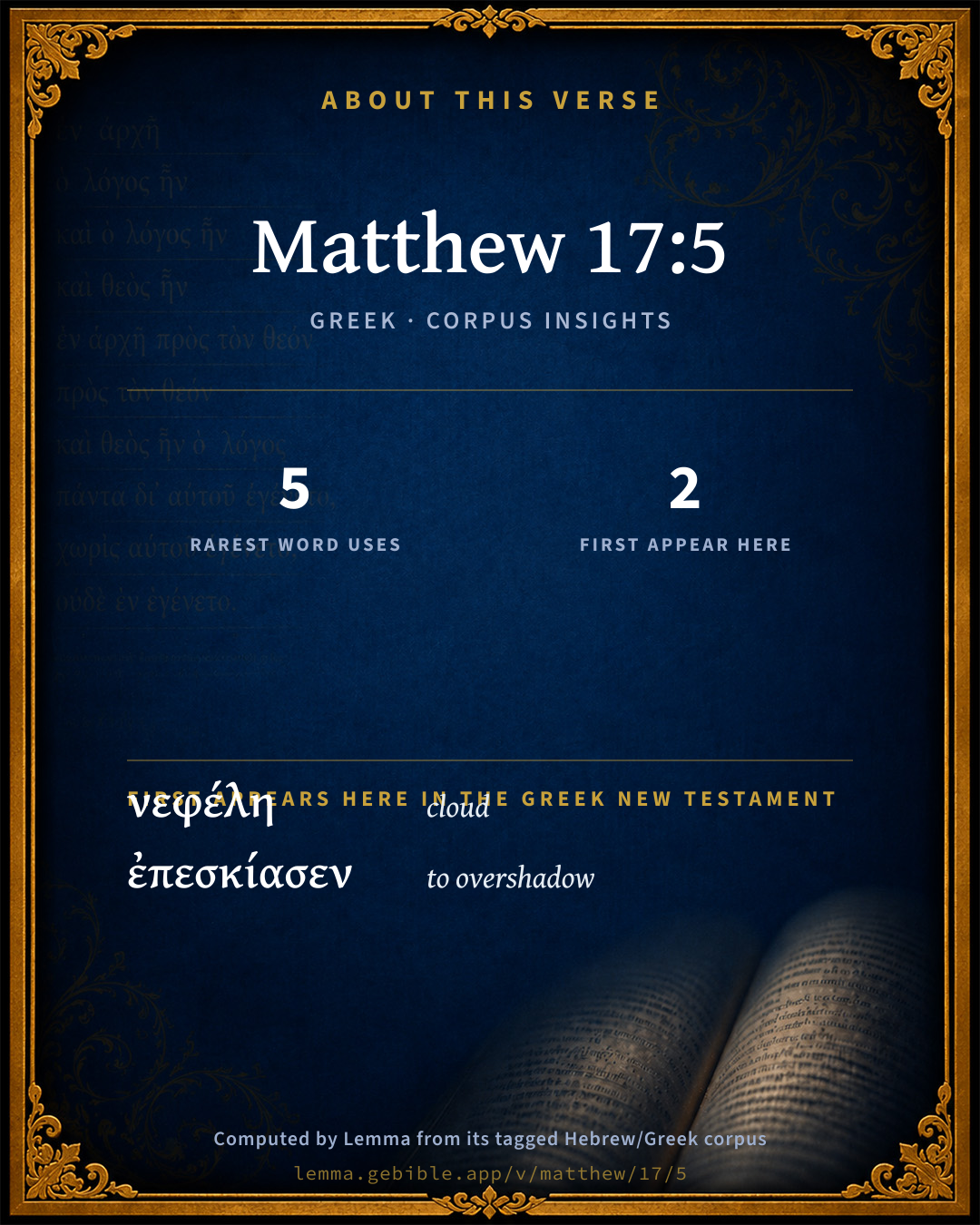
These words make their first canonical appearance in the Greek New Testament here:
Shared distinctive vocabulary
φωτεινὴ light G5460 occurs in 4 verses of the Greek New Testament. Also found in:
Cross-references
36Topical passages linked to Matthew 17:5 in the Treasury of Scripture Knowledge — connected by theme and wording, ordered by reader-vote popularity; previews shown in the World English Bible.
- Matthew 3:17 Behold, a voice out of the heavens said, "This is my beloved Son, with whom I am well pleased."
- Matthew 12:18 "Behold, my servant whom I have chosen; My beloved in whom my soul is well pleased: I will put my Spirit on him. He will proclaim justice to the Gentiles.
- Deuteronomy 18:15 Yahweh your God will raise up to you a prophet from the midst of you, of your brothers, like me; to him you shall listen;
- Mark 9:7 A cloud came, overshadowing them, and a voice came out of the cloud, "This is my beloved Son. Listen to him."
- Hebrews 2:1–3 Therefore we ought to pay greater attention to the things that were heard, lest perhaps we drift away.
- Revelation 1:7 Behold, he is coming with the clouds, and every eye will see him, including those who pierced him. All the tribes of the earth will mourn over him. Even so, Amen.
- Mark 1:11 A voice came out of the sky, "You are my beloved Son, in whom I am well pleased."
- John 3:35 The Father loves the Son, and has given all things into his hand.
- Luke 9:34–35 While he said these things, a cloud came and overshadowed them, and they were afraid as they entered into the cloud.
- Luke 3:22 and the Holy Spirit descended in a bodily form as a dove on him; and a voice came out of the sky, saying "You are my beloved Son. In you I am well pleased."
- Isaiah 42:1 Behold, my servant, whom I uphold; my chosen, in whom my soul delights: I have put my Spirit on him; he will bring forth justice to the Gentiles.
- Hebrews 5:9 Having been made perfect, he became to all of those who obey him the author of eternal salvation,
- Deuteronomy 18:19 It shall happen, that whoever will not listen to my words which he shall speak in my name, I will require it of him.
- Hebrews 1:1–2 God, having in the past spoken to the fathers through the prophets at many times and in various ways,
- Deuteronomy 4:11–12 You came near and stood under the mountain; and the mountain burned with fire to the heart of the sky, with darkness, cloud, and thick darkness.
- John 5:37 The Father himself, who sent me, has testified about me. You have neither heard his voice at any time, nor seen his form.
- John 12:28–30 Father, glorify your name!" Then there came a voice out of the sky, saying, "I have both glorified it, and will glorify it again."
- Acts 3:22–23 For Moses indeed said to the fathers, 'The Lord God will raise up a prophet for you from among your brothers, like me. You shall listen to him in all things whatever he says to you.
- Acts 7:37 This is that Moses, who said to the children of Israel, 'The Lord our God will raise up a prophet for you from among your brothers, like me.'
- Exodus 19:19 When the sound of the trumpet grew louder and louder, Moses spoke, and God answered him by a voice.
- Exodus 40:34–35 Then the cloud covered the tent of meeting, and the glory of Yahweh filled the tent.
- Deuteronomy 5:22 These words Yahweh spoke to all your assembly on the mountain out of the midst of the fire, of the cloud, and of the thick darkness, with a great voice: and he added no more. He wrote them on two tables of stone, and gave them to me.
- 1 Kings 8:10–12 It came to pass, when the priests were come out of the holy place, that the cloud filled the house of Yahweh,
- Psalms 18:10–11 He rode on a cherub, and flew. Yes, he soared on the wings of the wind.
- Isaiah 42:21 It pleased Yahweh, for his righteousness' sake, to magnify the law, and make it honorable.
- John 3:16 For God so loved the world, that he gave his one and only Son, that whoever believes in him should not perish, but have eternal life.
- John 5:20–23 For the Father has affection for the Son, and shows him all things that he himself does. He will show him greater works than these, that you may marvel.
- John 15:9–10 Even as the Father has loved me, I also have loved you. Remain in my love.
- Acts 9:3–6 As he traveled, it happened that he got close to Damascus, and suddenly a light from the sky shone around him.
- Ephesians 1:6 to the praise of the glory of his grace, by which he freely bestowed favor on us in the Beloved,
- Colossians 1:13 who delivered us out of the power of darkness, and translated us into the Kingdom of the Son of his love;
- 2 Peter 1:16–17 For we did not follow cunningly devised fables, when we made known to you the power and coming of our Lord Jesus Christ, but we were eyewitnesses of his majesty.
- Job 38:1 Then Yahweh answered Job out of the whirlwind,
- Psalms 81:7 You called in trouble, and I delivered you. I answered you in the secret place of thunder. I tested you at the waters of Meribah." Selah.
- Acts 1:9 When he had said these things, as they were looking, he was taken up, and a cloud received him out of their sight.
- Hebrews 12:25–26 See that you don't refuse him who speaks. For if they didn't escape when they refused him who warned on the Earth, how much more will we not escape who turn away from him who warns from heaven,
Cross-references courtesy of OpenBible.info (CC BY 4.0).
Lesson kit
Teaching starters — assembled from the data on this page, not authored interpretation. Every prompt links to the verse data it draws on. Edit before teaching.
Matthew, in the Gospels, opens this verse with 27 words (21 distinct Greek lemmas). Its most distinctive word is phōteinós (“light”). A historical commentator’s framing appears above. Read the whole chapter for the surrounding context.
Discussion questions
- The word phōteinós carries the sense “light.” How does it shape the verse?
- 2 words make their first appearance in Scripture here. What does this debut establish?
- How does Matthew 6:22, which shares the word «light», read alongside this verse?
- What does the repetition of “to see” (2× in this one verse) do in this verse?
- These translations render this verse differently. What is at stake in choosing one wording over another?
- Compare how Joseph Benson's Commentary and Tyndale Open Study Notes read this verse. Where do they agree or differ?
Things to notice
- 2 words make their first canonical appearance in Scripture here.
- These translations choose different wording for 11 words in this verse.
- “to see” occurs 2× in this single verse.
- 21 distinct Greek lemmas span 27 words in this verse.
Commentary
Notes on Matthew 17:5 from classic Christian and Jewish commentators (each source and its license shown beneath its notes). The classic Christian expositions comment on the surrounding passage and are grouped to its opening verse, so a note may address several verses; the Jewish commentaries on the Tanakh (Rashi and others) are per-verse, so they appear only where the commentator wrote on this verse.
Lemma curates 59 commentaries, every one of them public domain or Creative Commons licensed, each selected and text-cleaned for this edition rather than reprinted as found. About our sources →
Joseph Benson's Commentary
Joseph Benson's Commentary on the Old and New Testaments (1811–1818) — public domain. Text from a community e-Sword module.
Tyndale Open Study Notes
Tyndale Open Resources
Tyndale Open Study Notes — © Tyndale Open Resources, licensed CC BY-SA 4.0. Text via the HelloAO Bible API.
Bengel's Gnomon
Johann Albrecht Bengel
Bengel's Gnomon of the New Testament — English translation (T&T Clark, Edinburgh, 1860) — public domain. Text from a community e-Sword module.
Meyer's Critical & Exegetical Commentary
Heinrich August Wilhelm Meyer
Meyer — Critical and Exegetical Commentary on the New Testament — English translation by Peter Christie, edited by Frederick Crombie (T&T Clark, 1880) — public domain. Text from a community e-Sword module.
Expositor's Greek Testament
ed. W. Robertson Nicoll
The Expositor's Greek Testament, edited by W. Robertson Nicoll (1897–1910) — public domain. Text from a community e-Sword module.
Geneva Bible (1599)
Geneva Bible translators
Geneva Bible (1599) marginal notes — public domain. Text via Bolls.life.
Adam Clarke's Commentary
Adam Clarke's Commentary on the Bible (1810–1826) — public domain. Text from a community e-Sword/MySword module.
Ellicott's Commentary for English Readers
A Bible Commentary for English Readers, edited by Charles John Ellicott (1878–1897) — public domain. Text from a community e-Sword module.
John Gill's Exposition
John Gill's Exposition of the Whole Bible (1746–1763) — public domain (CC PDM 1.0). Text via the HelloAO Bible API.
Trapp's Complete Commentary
John Trapp
John Trapp, A Commentary or Exposition upon All the Books of the Old and New Testament (1647–1656) — public domain. Text from a community e-Sword module.
Albert Barnes' Notes on the Bible
Albert Barnes' Notes on the Bible (1834–1885) — public domain. Text from a community e-Sword/MySword module.
Matthew Poole's English Annotations
Matthew Poole's English Annotations on the Holy Bible (1683–1685) — public domain. Text from a community e-Sword/MySword module.
Whedon's Commentary on the Bible
Daniel D. Whedon
Daniel D. Whedon (gen. ed.), Commentary on the Old and New Testaments (1874–1909) — public domain. Text from a community e-Sword module.
The Pulpit Commentary
The Pulpit Commentary (1880–1919), ed. H.D.M. Spence-Jones & Joseph S. Exell — public domain. Text from a community e-Sword module.
John Wesley's Explanatory Notes
John Wesley, Explanatory Notes Upon the Whole Bible (1754–1765) — public domain. Text via the GEBible commentary corpus.
Kretzmann's Popular Commentary
Paul E. Kretzmann
Paul E. Kretzmann, Popular Commentary of the Bible (1921–1924) — public domain. Text from a community e-Sword module.
Burkitt's Expository Notes on the New Testament
William Burkitt
William Burkitt's Expository Notes on the New Testament (1700–1703) — public domain. Text from a community e-Sword module.
The People's New Testament
B. W. Johnson
B. W. Johnson's The People's New Testament with Notes (1889–1891) — public domain. Electronic text from the Christian Classics Ethereal Library (CCEL) ThML edition.
unfoldingWord translationNotes
Door43 World Missions Community
unfoldingWord translationNotes — © Distant Shores Media and the Door43 World Missions Community, licensed CC BY-SA 4.0. Source: git.door43.org/Door43/en_tn.
Cambridge Greek Testament for Schools and Colleges
Cambridge Greek Testament for Schools and Colleges (Cambridge University Press, 1896; 21 vols, various authors incl. Carr, Maclear, Plummer, Farrar, Lumby, Moule, M. R. James, Simcox) — public domain. Text from a community e-Sword module.
Alford’s Greek Testament
Henry Alford
Henry Alford, The Greek Testament (1849–1861) — public domain. Text from a community e-Sword module.
International Critical Commentary
International Critical Commentary — older volumes (1896–1929), various authors — public domain. Text from a community e-Sword module.