
Matthew 8:2

Greek (Tischendorf 8th ed.) Matthew 8:2 appears in the Greek New Testament. The text above is from the Tischendorf 8th edition. Each word links to its Strong’s number and a concise gloss. Click any word for its full Thayer’s Greek Lexicon entry.
Download image
Cite this verse

Matthew 8:2 (World English Bible). Public Domain. Lemma interlinear Bible study tool, https://lemma.gebible.app/v/matthew/8/2.

Show BibTeX & RIS
BibTeX
RIS
English Translation
Behold, a leper came to him and worshiped him, saying, "Lord, if you want to, you can make me clean."
World English Bible · Public Domain
Highlights
  • 2 first appearances in the Greek New Testament
Full analysis ↓
Download a study sheet

One document with this verse’s original text, its word-by-word gloss line, the meaning frame, cross-references with their text, attributed commentary, and full source and license credits — printable, and it pastes into notes with its structure intact.

This verse Autodidact and up

Study sheet (.html) Plain text (.txt)

A passage Seminary Student

Up to 50 verses in one chapter. A passage sheet keeps up to 6 commentary sources and 12 cross-references per verse, in the order this page ranks them, and says so on the sheet whenever that leaves anything out. Ask for a single verse and you get the Autodidact verse sheet above.

Everything on this page stays free to read, with no account — the sheet is a download of what is already on screen, not access to it.

Want to remove ads? Support Godless Engineer
Compare translations 3

The same verse in 3 English versions, stacked beneath the original-language interlinear above. Click any original word for its lexicon entry.

Each is an independent rendering of the whole verse — the interlinear is not word-aligned to these translations.

Highlighted words mark where these versions differ — a whole-verse word diff, not a word-by-word alignment.

  • World English Bible Public Domain
    Behold, a leper came to him and worshiped him, saying, "Lord, if you want to, you can make me clean."
  • King James Version Public Domain
    And, behold, there came a leper and worshipped him, saying, Lord, if thou wilt, thou canst make me clean.
  • unfoldingWord Literal Text CC BY-SA 4.0
    And behold, a leper, having approached, bowed before him, saying, “Lord, if you are willing, you are able to make me clean.”

unfoldingWord Literal Text — © unfoldingWord, licensed CC BY-SA 4.0. Word-aligned USFM3 via Door43 (git.door43.org/unfoldingWord/en_ult).

Versions to compare (up to 4)

3 of 4 selected

Show all 19 translations

Every available English version of this verse, each an independent rendering of the whole verse.

  • World English Bible Public Domain
    Behold, a leper came to him and worshiped him, saying, "Lord, if you want to, you can make me clean."
  • Berean Standard Bible Public Domain
    Suddenly a leper came and knelt before Him, saying, “Lord, if You are willing, You can make me clean.”
  • Majority Standard Bible Public Domain
    Suddenly a leper came and knelt before Him, saying, “Lord, if You are willing, You can make me clean.”
  • King James Version Public Domain
    And, behold, there came a leper and worshipped him, saying, Lord, if thou wilt, thou canst make me clean.
  • American Standard Version (1901) Public Domain
    And behold, there came to him a leper and worshipped him, saying, Lord, if thou wilt, thou canst make me clean.
  • Revised Version (1885) Public Domain
    And behold, there came to him a leper and worshipped him, saying, Lord, if thou wilt, thou canst make me clean.
  • Geneva Bible (1599) Public Domain
    And loe, there came a Leper and worshipped him, saying, Master, if thou wilt, thou canst make me cleane.
  • Douay-Rheims (1899) Public Domain
    And behold a leper came and adored him, saying: Lord, if thou wilt, thou canst make me clean.
  • Young's Literal Translation Public Domain
    and lo, a leper having come, was bowing to him, saying, `Sir, if thou art willing, thou art able to cleanse me;'
  • Literal Standard Version CC BY-SA 4.0
    and behold, a leper having come, was prostrating to Him, saying, “Lord, if You are willing, You are able to cleanse me”;
  • Unlocked Literal Bible CC BY-SA 4.0
    Behold, a leper came to him and bowed before him, saying, “Lord, if you are willing, you can make me clean.”
  • unfoldingWord Literal Text CC BY-SA 4.0
    And behold, a leper, having approached, bowed before him, saying, “Lord, if you are willing, you are able to make me clean.”
  • Darby Bible Public Domain
    And behold, a leper came up to [him] and did him homage, saying, Lord, if thou wilt, thou art able to cleanse me.
  • World Messianic Bible Public Domain
    Behold, a leper came to him and worshiped him, saying, “Lord, if you want to, you can make me clean.”
  • Webster's Bible Public Domain
    And behold, there came a leper and worshiped him, saying, Lord, if thou wilt, thou canst make me clean.
  • Free Bible Version CC BY-SA 4.0
    A leper approached him and bowed down, worshiping him, and said, “Lord, if you're willing, please heal me.”
  • Bible in Basic English Public Domain
    And a leper came and gave him worship, saying, Lord, if it is your pleasure, you have power to make me clean.
  • Text-Critical English NT CC BY 4.0
    And behold, a leper came and bowed down before him, saying, “Lord, if yoʋ are willing, yoʋ can make me clean.”
  • Tyndale New Testament (1534) Public Domain
    And lo ther came a lepre and worsheped him sayinge: Master if thou wylt thou canst make me clene.

Literal Standard Version (2020), Covenant Press — licensed CC BY-SA 4.0. Text via the HelloAO Bible API (eBible.org). Unlocked Literal Bible (unfoldingWord) — licensed CC BY-SA 4.0. Text via the HelloAO Bible API (eBible.org). unfoldingWord Literal Text — © unfoldingWord, licensed CC BY-SA 4.0. Word-aligned USFM3 via Door43 (git.door43.org/unfoldingWord/en_ult). Free Bible Version, Dr. Jonathan Gallagher — licensed CC BY-SA 4.0. Text via the HelloAO Bible API (eBible.org).

Word by word

More ways to search: Search by grammar → Find every occurrence → Compare this word →

Practice this passage: Drill this verse → Learn its vocabulary →

λεπρὸς
leprós
G3015
“leprous”
Adjective, Nominative, Singular, Masculine
Part of Speech
Adjective
Case
Nominative
Number
Singular
Gender
Masculine
Full Thayer's Definition

Origin: from the same as G3014

TDNT: 07:53,5

1. scaly, rough 2. leprous, affected with leprosy
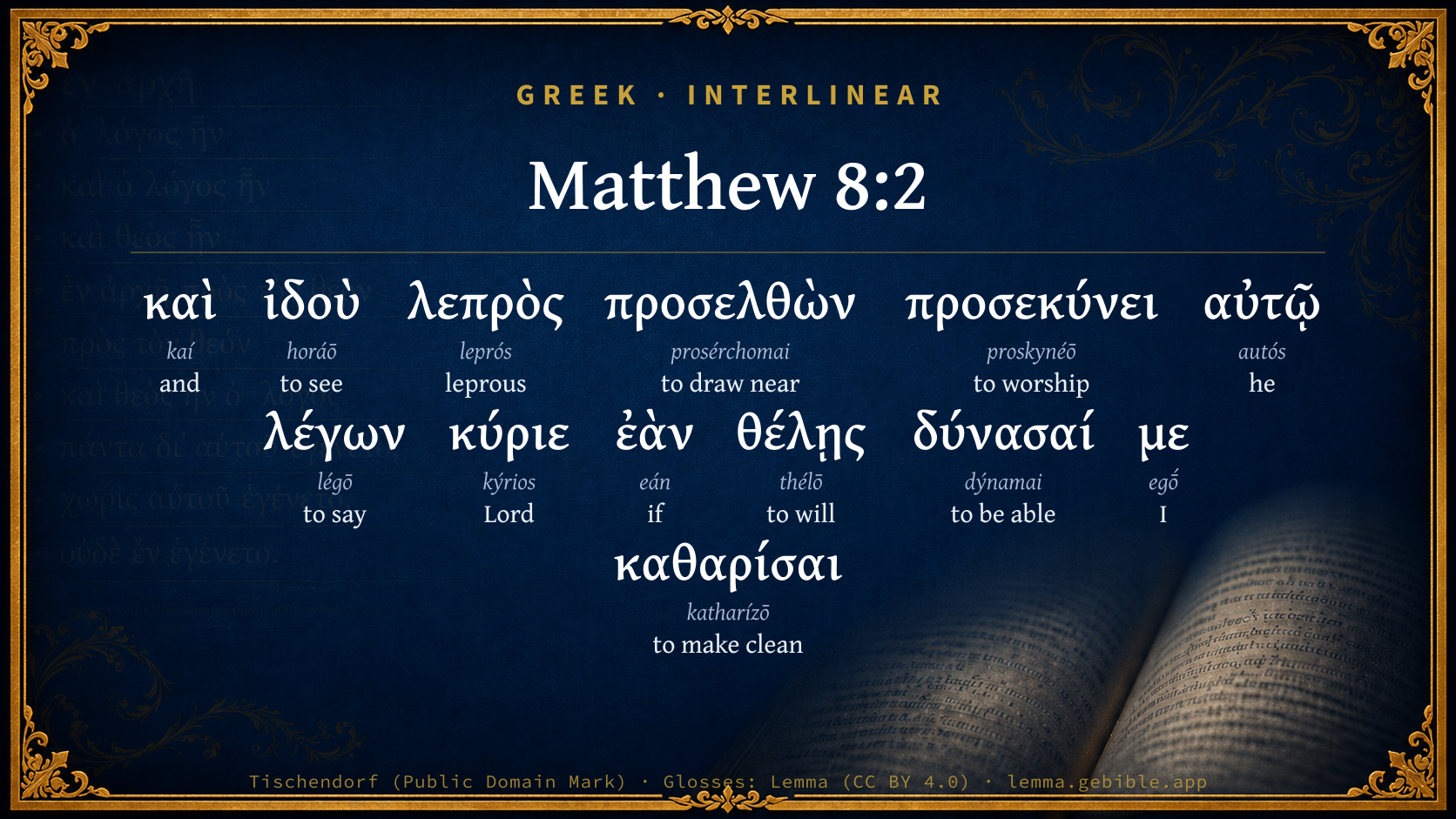
  1. καὶ kaí G2532 “and” Conjunction
  2. ἰδοὺ horáō G3708 “to see” Verb, Aorist, Middle, Imperative, 2nd person, Singular
  3. προσελθὼν prosérchomai G4334 “to draw near” Verb, Aorist, Active, Participle, Nominative, Singular, Masculine
  4. προσεκύνει proskynéō G4352 “to worship” Verb, Imperfect, Active, Indicative, 3rd person, Singular
  5. αὐτῷ autós G846 “he” Personal pronoun, Dative, Singular, Masculine
  6. λέγων légō G3004 “to say” Verb, Present, Active, Participle, Nominative, Singular, Masculine
  7. κύριε kýrios G2962 “Lord” Noun, Vocative, Singular, Masculine
  8. ἐὰν eán G1437 “if” Conditional
  9. θέλῃς thélō G2309 “to will” Verb, Present, Active, Subjunctive, 2nd person, Singular
  10. δύνασαί dýnamai G1410 “to be able” Verb, Present, Middle or Passive deponent, Indicative, 2nd person, Singular
  11. με egṓ G1473 “I” Personal pronoun, 1st person, Accusative, Singular
  12. καθαρίσαι katharízō G2511 “to make clean” Verb, Aorist, Active, Infinitive

About this verse

These counts appear in no published source. They are computed here, from the morphology-tagged text and Lemma’s own curated glosses. What Lemma adds →

13
words
13
distinct lemmas
Gospels
section

Notable vocabulary

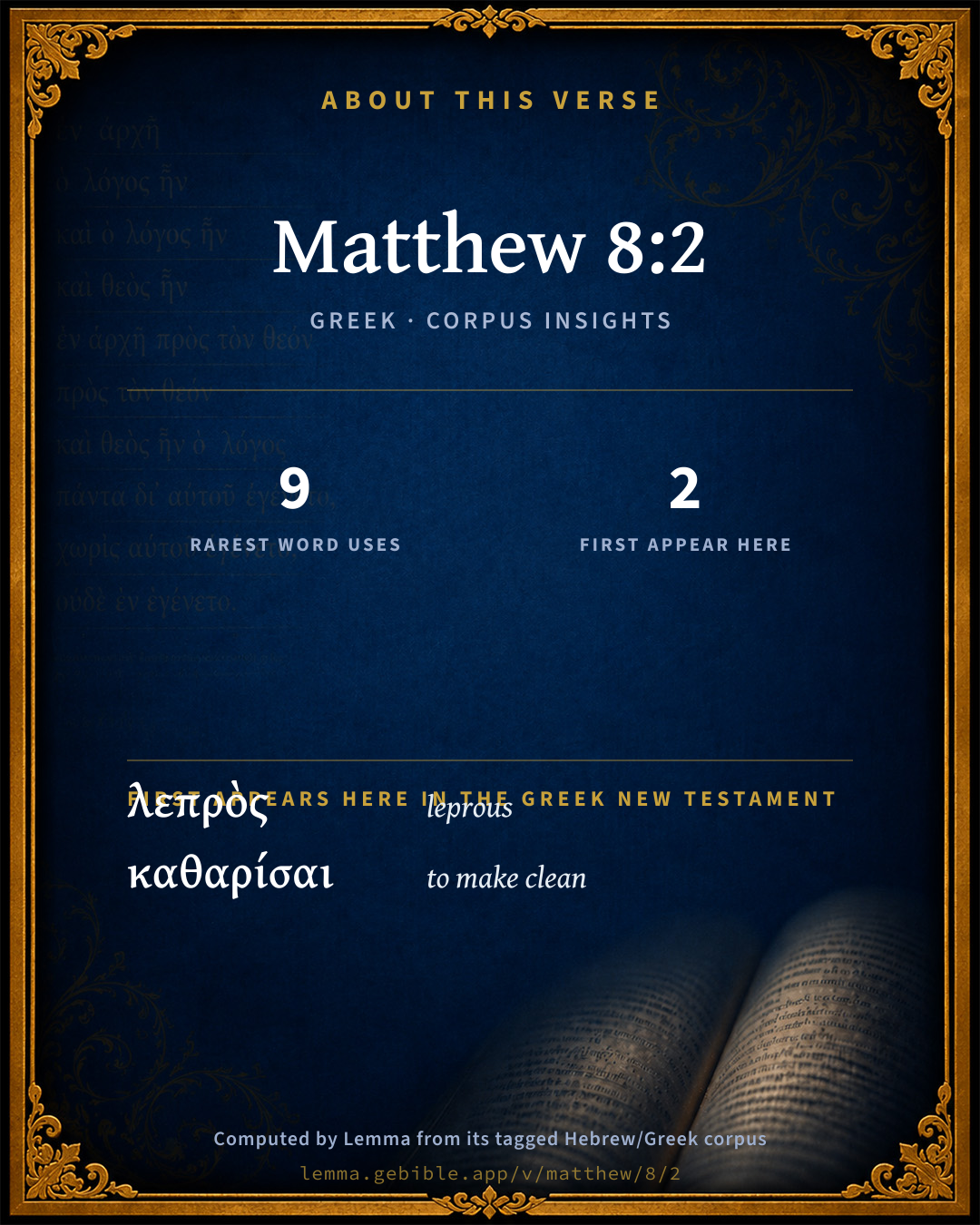
The rarest word here is λεπρὸς leprous G3015 — appearing just 9 times in the whole Greek New Testament.

First appearance in Scripture

These words make their first canonical appearance in the Greek New Testament here:

  • λεπρὸς leprous G3015
  • καθαρίσαι to make clean G2511

Shared distinctive vocabulary

λεπρὸς leprous G3015 occurs in 9 verses of the Greek New Testament. Also found in:
Cross-references

34

Topical passages linked to Matthew 8:2 in the Treasury of Scripture Knowledge — connected by theme and wording, ordered by reader-vote popularity; previews shown in the World English Bible.

  • Mark 1:40–45 There came to him a leper, begging him, kneeling down to him, and saying to him, "If you want to, you can make me clean."
  • Matthew 15:25 But she came and worshiped him, saying, "Lord, help me."
  • Matthew 18:26 The servant therefore fell down and kneeled before him, saying, 'Lord, have patience with me, and I will repay you all!'
  • Luke 17:12–19 As he entered into a certain village, ten men who were lepers met him, who stood at a distance.
  • Leviticus 13:44–46 he is a leprous man. He is unclean. The priest shall surely pronounce him unclean. His plague is on his head.
  • Luke 5:12–14 It happened, while he was in one of the cities, behold, there was a man full of leprosy. When he saw Jesus, he fell on his face, and begged him, saying, "Lord, if you want to, you can make me clean."
  • Acts 10:25 When it happened that Peter entered, Cornelius met him, fell down at his feet, and worshiped him.
  • Numbers 5:2–3 "Command the children of Israel that they put out of the camp every leper, and everyone who has an issue, and whoever is unclean by the dead.
  • Matthew 28:17 When they saw him, they bowed down to him, but some doubted.
  • Mark 9:22–24 Often it has cast him both into the fire and into the water, to destroy him. But if you can do anything, have compassion on us, and help us."
  • John 9:38 He said, "Lord, I believe!" and he worshiped him.
  • 1 Corinthians 14:25 And thus the secrets of his heart are revealed. So he will fall down on his face and worship God, declaring that God is among you indeed.
  • Matthew 9:28–29 When he had come into the house, the blind men came to him. Jesus said to them, "Do you believe that I am able to do this?" They told him, "Yes, Lord."
  • Matthew 20:20 Then the mother of the sons of Zebedee came to him with her sons, kneeling and asking a certain thing of him.
  • Mark 5:6–7 When he saw Jesus from afar, he ran and bowed down to him,
  • Numbers 12:10 The cloud removed from over the Tent; and, behold, Miriam was leprous, as [white as] snow: and Aaron looked at Miriam, and, behold, she was leprous.
  • 2 Kings 5:27 The leprosy therefore of Naaman shall cleave to you, and to your seed forever. He went out from his presence a leper [as white] as snow.
  • 2 Kings 15:5 Yahweh struck the king, so that he was a leper to the day of his death, and lived in a separate house. Jotham the king's son was over the household, judging the people of the land.
  • 2 Chronicles 26:19–21 Then Uzziah was angry; and he had a censer in his hand to burn incense; and while he was angry with the priests, the leprosy broke forth in his forehead before the priests in the house of Yahweh, beside the altar of incense.
  • Matthew 9:18 While he told these things to them, behold, a ruler came and worshiped him, saying, "My daughter has just died, but come and lay your hand on her, and she will live."
  • Matthew 13:58 He didn't do many mighty works there because of their unbelief.
  • Matthew 14:33 Those who were in the boat came and worshiped him, saying, "You are truly the Son of God!"
  • Matthew 26:6 Now when Jesus was in Bethany, in the house of Simon the leper,
  • Luke 4:27 There were many lepers in Israel in the time of Elisha the prophet, yet not one of them was cleansed, except Naaman, the Syrian."
  • Deuteronomy 24:8–9 Take heed in the plague of leprosy, that you observe diligently, and do according to all that the priests the Levites shall teach you: as I commanded them, so you shall observe to do.
  • 2 Samuel 3:39 I am this day weak, though anointed king; and these men the sons of Zeruiah are too hard for me. May Yahweh reward the evil-doer according to his wickedness."
  • 2 Kings 5:1 Now Naaman, captain of the host of the king of Syria, was a great man with his master, and honorable, because by him Yahweh had given victory to Syria: he was also a mighty man of valor, [but he was] a leper.
  • 2 Kings 7:3–4 Now there were four leprous men at the entrance of the gate: and they said one to another, Why sit we here until we die?
  • Matthew 2:11 They came into the house and saw the young child with Mary, his mother, and they fell down and worshiped him. Opening their treasures, they offered to him gifts: gold, frankincense, and myrrh.
  • Matthew 4:9 He said to him, "I will give you all of these things, if you will fall down and worship me."
  • Matthew 10:8 Heal the sick, cleanse the lepers, and cast out demons. Freely you received, so freely give.
  • Matthew 28:9 As they went to tell his disciples, behold, Jesus met them, saying, "Rejoice!" They came and took hold of his feet, and worshiped him.
  • Revelation 19:10 I fell down before his feet to worship him. He said to me, "Look! Don't do it! I am a fellow bondservant with you and with your brothers who hold the testimony of Jesus. Worship God, for the testimony of Jesus is the Spirit of Prophecy."
  • Revelation 22:8–9 Now I, John, am the one who heard and saw these things. When I heard and saw, I fell down to worship before the feet of the angel who had shown me these things.

Cross-references courtesy of OpenBible.info (CC BY 4.0).

Commentary

Notes on Matthew 8:2 from classic Christian and Jewish commentators (each source and its license shown beneath its notes). The classic Christian expositions comment on the surrounding passage and are grouped to its opening verse, so a note may address several verses; the Jewish commentaries on the Tanakh (Rashi and others) are per-verse, so they appear only where the commentator wrote on this verse.

Lemma curates 59 commentaries, every one of them public domain or Creative Commons licensed, each selected and text-cleaned for this edition rather than reprinted as found. About our sources →

Whedon's Commentary on the Bible

Daniel D. Whedon

§ 29. — FIRST MIRACLE — CLEANSING THE LEPER, Mat_8:2-4.

2. Behold… a leper — A living instance of the receptive faith alluded to in the closing lines of our comment on the last chapter, now steps forward in the person of a leper. How do afflictions sometimes urge us to Christ! The leper, who had, perhaps, been in the outskirts of the congregation, had seen his works and heard his words of mercy, comes with the language of humility and confession on his lips.

Leprosy, in its worst form, was one of the most terrible of diseases. It began with red spots upon the body, grouped in circles, and covered with a shiny scale or scab. It became, generally, incurable, and so corrupted the system that it became hereditary for generations. The body crumbled, the limbs fell apart, and the man literally went to pieces.

Yet it seems not to have been clearly contagious. Hence Mr. Trench forcibly argues that all the provisions made against it by Moses, placing its examination under the care of the priest, and exiling the man, when clearly a leper, from society, were established as a matter of ceremonial uncleanness. To impress the lesson of the corruption of sin upon men, the touch of a dead body and every contact with the circumstantials of death, rendered a man unclean. From among diseases, leprosy was selected as the emblem of moral uncleanness, and subjected to priestly examinations, to banishment, and to every abhorrence which could indicate his utter moral defilement. Lev_14:15. All this arose, not from the special wickedness of the man himself, but to present him as a physical representative of the depravity belonging to our inmost nature.

89504e470d0a1a0a0000000d494844520000009e000000b00803000000c9fd270f00000300504c54450000000101010202020303030404040505050606060707070808080909090a0a0a0b0b0b0c0c0c0d0d0d0e0e0e0f0f0f1010101111111212121313131414141515151616161717171818181919191a1a1a1b1b1b1c1c1c1d1d1d1e1e1e1f1f1f2020202121212222222323232424242525252626262727272828282929292a2a2a2b2b2b2c2c2c2d2d2d2e2e2e2f2f2f3030303131313232323333333434343535353636363737373838383939393a3a3a3b3b3b3c3c3c3d3d3d3e3e3e3f3f3f4040404141414242424343434444444545454646464747474848484949494a4a4a4b4b4b4c4c4c4d4d4d4e4e4e4f4f4f5050505151515252525353535454545555555656565757575858585959595a5a5a5b5b5b5c5c5c5d5d5d5e5e5e5f5f5f6060606161616262626363636464646565656666666767676868686969696a6a6a6b6b6b6c6c6c6d6d6d6e6e6e6f6f6f7070707171717272727373737474747575757676767777777878787979797a7a7a7b7b7b7c7c7c7d7d7d7e7e7e7f7f7f8080808181818282828383838484848585858686868787878888888989898a8a8a8b8b8b8c8c8c8d8d8d8e8e8e8f8f8f9090909191919292929393939494949595959696969797979898989999999a9a9a9b9b9b9c9c9c9d9d9d9e9e9e9f9f9fa0a0a0a1a1a1a2a2a2a3a3a3a4a4a4a5a5a5a6a6a6a7a7a7a8a8a8a9a9a9aaaaaaabababacacacadadadaeaeaeafafafb0b0b0b1b1b1b2b2b2b3b3b3b4b4b4b5b5b5b6b6b6b7b7b7b8b8b8b9b9b9babababbbbbbbcbcbcbdbdbdbebebebfbfbfc0c0c0c1c1c1c2c2c2c3c3c3c4c4c4c5c5c5c6c6c6c7c7c7c8c8c8c9c9c9cacacacbcbcbcccccccdcdcdcecececfcfcff7cfb0d0d0d0d1d1d1d2d2d2d3d3d3d4d4d4d5d5d5d6d6d6d7d7d7d8d8d8d9d9d9dadadadbdbdbdcdcdcdddddddedededfdfdfe0e0e0ffe0c7e1e1e1e2e2e2e3e3e3e4e4e4e5e5e5e6e6e6e7e7e7e8e8e8e9e9e9eaeaeaebebebecececedededeeeeeeefefeff0f0f0f1f1f1f2f2f2f3f3f3f4f4f4f5f5f5f6f6f6f7f7f7f8f8f8f9f9f9fafafafbfbfbfcfcfcffffffaa7ee3ba00000001624b47440088051d48000000097048597300000ec400000ec401952b0e1b0000200049444154789c6d9d0d79252b1384b13016b080052c60010b58c00216b08005348c86e3205fbdc5cc49f63e5f76373739c999e969baabab7fe0869fcfe7d6873fedfbf3d9dfefce17fef2473ff8d1d7fef6e38fe7879bd73e9fe5cfcfaf6fffe6b91c5ffc5eedf9b83f3ff7fe39effcf3e9c31bf77313dff313cecf5e397cd1fb3e177de43e6f3e5f9d9b3d17f83ec1e7fef34c9ff3cafe7dc323fafb648f088f48f7f719f67371fff89129fc1c69bfffee4780fd3ef073176beffe23e1fd6ad3d79f9fbff23dbfb0bfbfffdcfac87efff8723f8f42bfeae37d3f7af5e7f799c2e78f6c2ced3e0ff7472b7e3b6fd9e7717fbe4bfecf5bdf057ddfb9f7fbea2bc1ef4525dac78bf76b369fe7ea7f44d51dd0de2bf823c96b5ce702477b3ff7fbf2f702cf8ff5409fb9fb9de7de7bada97fabf5316bcf455fced5f51babed75df2baffee7167f97fef3dfcb3f3a089f3f3ffffecafdcf6ffefee0f37c777f6dff5e5ab7eb6eb3ce19e7aa63ac3dafda471ab94c0939cadcadd795e6fe9459f7bdeecf5f9ddfff5cfddef73fd2487b3f7f16f15d8023e157949fafd53d0fbe1fe35bf71865f04f9ffb9ad75c63eadb3e5a4a798d3624e74e4de24bb979e4b5f2ebedf7e71f295fbdbebe676110ef6b118fa9db90bff8f0ebc47facdeaadb63e692d73577ea334f1458ca6c7df63c7bca29aed925b47e263de6b9765c4932de9df59616bf50711cf1a307d8cf955f54083fbf90f22bc723c3fe058cfd459dfd7c87366aaa49cb56646c69cd3a7aaba3157d96782d4bdca69ff49e6b931ed74e33ee9577afb2434bb7f723dea3915f683b321a58defbff23d4f3247fdee08bbd2fcae6f78e6de536a4a43a47de5ad48178bd2394ec2ceb95d64a6d7db585e7f41559dcdef6be7f2ff5575d86f2dffb1edcfb02d38903fb01adfdabc7770dce42ec9e0a2e1a536eb3c5816ad26425a5bf5e7b4f73d45ef2c0375aed7556898d79c6dddb5d86de3b748123d78bb0dba866b4dc4f4850d4f83942ecefd27eb577defad99fefb381236bb7555b1266cc9253199205078d7209f064d85ba541093da744eafa2b355624ae79edba9bc493e9adf82ac01f3f8f4456d2fe1c4c3f8bfb06b0afed1d403b32effb3c97b1f6b3e72afbe23e7b617a88272166996b49bc3626424a1629724af026f1a65eccd2a3e4dcaddd69e017eb93ee03f586869f17ba5ff8f2aa1a585efcb9ff2be7132f7e91f4ae5d965db3d6b009e5628e439836d1cf9ad17e304113018bbc01a5f591add654819bb1eb403c8979df452ae87f10d758f6c31de7f39aa28681ef2bf683bdfa06fdef07812cee8ff4df74af2485dca3c82f47ca829032fb6249d154b7ee584f8982ed95c65bb2cc51dff728ad4afb531622eda77bdc7ded2f0eff1c6dfcfc11e4d1de13a57efe08198314f48aed30737f464eba510338aab06ca6a4c5d537524fc1deb47c06bad8a4b6d97092d6af36e549b1e8b37e24f1e2c080f71d3fe5aef36eef3a7d39cc1ba81573ff0494cf2f81802ccc5dcb8347e73dabe6926ad11dabf057383b0a77949c78827457593eb04f40a83f51af2679519bb98e58c78552ad7e42b11c5f32ca1a652f2fc07efefcc71fe19720fd0932fce4d2eaaef5bc82943b2a3a49b858daea3967e9ac5e0dd3c7c4a4527dafc595caaaf4d68a7f528a9e4821a4a738227a4f42a22aff928869573df12e191dee371ef9560f7cfcfc468dfdfaec0df7bdf725943f98f284e29a76ec390af388a4bae32859abd8b39058aacb06607dc97a4b8d999714cfaa3ce6ca23c672a1f76bb62467928033dd02997c2781a1c0e1974c7e5e92b77778647bf9a701d90f718918ed7bbfa15a4e26ede9a3cbfe1a4e211d46058d9ab5648d48a1976486ad2a5274ad62eba98f1a4bcae38a2d5ef3d28349fb257a71a7c25b5d3ded941176dc7f38823f1303c237d7d84744a3b0dc695dc4a1c30b104fd74a2b56ada9acaef52839a7ac498e9988ac48d8890d8e1a124f16d6ae564b2e31d71825a1d657381e6b89315d572e58f0d4334788e16cfbd5da83c307f7bc767fc2ebe1e062905adcfb1b4c76cf682f6b99aa04933569cd746d214649c39e2cb8ab8437a9567627296b8b123eeaf7255e4b578f57ce7aac18c2155a0d41cb1d2e899744b64454bf84e90fa90eaf477f65790c715dfb2538bcaba4cf488209ad4f2e5a3fe941e2c9b2f485b8dd614ecd0e0ba79294f28fc8824b5912afda3572cc398494428c0a3c92b2844b7e93158371df9f9fbff0f27983da13727f5e82cd8f24dead678d04de1def56b6ee964aac358e2aa69e12b424cb57a2ec9dc535fa36480b3a94ac72d1a1958b97feca68657445925d12ab0869f4652a41e6125a81c3d605f17e7de3640900cbcf4b8eef6ff8d0a7790934d7ce4dd28d2a03b99b1e5d965eaed1729322041eb2447dd12531a62785414f0ee513ac6871479244b16849e513323c2d6688d75525588d555fa2c15ce52390fe5fd6bc4f52065bb64ebfd9d61b5cc7a5a0230b8eb7b86ddd59f825c0cba9422d657bb27181479684094c933714f9a5d650abcedab60a14eb0d49aa2b1651e26951af10931c46e2852c17894936798f0573b8e793df3dcef150823f8bfd652f232cd9d58c03de536e7984f4205fc880b06c2ac9eee5c7327c40437606124a757c8f89e967d29504ca1241be5a836ccc2f04f11cbd07b31314eab51a9416e859d61e4f02fa05e2f0ca76129467e1f7fa94702be112b910a80bdf85b65a5c2da52c6b66215b04972f30e32a9858c379054e1da89651d64bca116196bdc963adbd5e022bcb024bfc5065225ae01e7a0abae8a564731844f6de2ff88503846f6afd102869b95fb75c41c422caaf1476642a5137636d7b91dc524beba10069b92b3629d4af437e7517804f02f52ceb6ff22f691207963ead52e93c4bdfa83eb520550685ed4b0f373e7fb39a27157aa9de9736ec2d1e71299b169c6fb9fd10b3d01513ba28dd5493f821dc9569915428be6ff12bd2af3721592904a346a817cb5dafab09e784ccd29e3030cb04053b5c2984dce7bc1c47de24e2a932849f23eaeb33a7c001118bb78c65597bd298d424f81701812829c1b04650902cbab1cea86e1bc949b44fbea25453c143e0664cb97a906897224e2368c8b2659482a816c294fa5217fdde6f32f4c48df002dd9f5a028ef1e961de5710692c7597c15a287876f96287a50f0253ad708054143173b97fa3f60b4e1b49771c01339402d3c5d2cafe64098a6dca5312cc301145740931d3f295e4c9311e58fea6218ffbb65bd442b622838a6d17130f39e710c60d82827471c986e655b66271ff53cefa5371f072ec2dcf9500a3c4801fa52661afc6dbc50cb2ae3c8af4aa3c5db657d6fd79edff68efe7c5957fea078ab0e1ceb2f16b41c716b149863c4596d6c8ba81d42a6e4075476c3ee56f3c3f56236d7ecb987b867e29fc0178f9aac05e089248a150c20a5d97e2f12588d7e2e6b5ffad0c853fccfe5bc313b7bbf3b5b2e29a389948991840c50d865c230820746f9935f6f52376f45bc63bcc6ccb1bc321b19bd4ae209eac211370afe8d5bcae6264924b15445626dc94a2af9f43433fcf42487b3f9f3f599ce51645443c85e991ee5236dc528e2187934728c24a02419a51e443d16c3d72ad435f95c15de94941f933b3a88a2289a05a4e8a28382f65ac259fd0a2ce2006d3e4fe799c74fc65ecc6bddf4ac0633505f192b43029a0a4a5240b20517495ef8622f613ebed24ff86141ef66d720830ac248eff7910869a9f38a7120f91fa54aec827d9aff41b4854fa25f0ea01a63ab8dbf29b3ef311c97474cd3f150f9656343e85a55c80ac42e22d2c2ff2474e36b478c599f986e5f6b1fdc436ba4aeda0867cbe33488b57609e02a7442043ac10470bc224d188418d26820a8a354baeb8ef9794e88d3f6f6d793f5ccf2ae9b257ea5f312d104ee95405183018a5aa5a91fee84bfc749ddc455abaa7e2cb1464c4797f81d56b2f6d4fc53f85ff50d2a12962dac261855a3db97e968181b12efdee619e8fa5bdb8f79662bc54e38eab286759cab6b7c49bcaae64dc226da26eb35ee3d1ccdd8edddd475a2599536c44e67e88db09710afb77536495db4a73f20681b422ed146f080336ebe81ca11a222007da9f34f7e41afb6fe1cc58bf718d48f6a09c45f822f11a5825e7d0daac6303924199f8373e6ea58453eb7f3d75cb27587eee288d0645b48c84f2ff11426d411c6035aa5a5ab1480417a7d2e2bec5db037f87efbd79ee8b0e0bf12038622a6b487b32ee4ba022a22b3e541f8cdcf76854113f2f0a88d95c45c1e69fa2cce7d3e64ee008ceaa382b7924a462c71837e9f08e4bc18df4aff6ab082dde42c01fdc3bb27eb915e2a5b48396f89e1d50a1d8a9444810767d31482b99eacfb774a458a3951aeb1756cfc38eb4249db8008b5b957bed1e1587a9fa36d750853b2293b225d9ee687bbf02ed2f1dfd0567ae38ad3da5008a64628a723d5d47198262d2aa8fe18e24bfc8c7867f0e4d5ba11b0df76fc50b2315f68af1092e956208ec043440cf55cbba142aa8974b74f95353ca2233dfc7764e82fd56a8be8cf9c3daaeba52bccb7d6971a56ea564f048a2f924f9bda16630e9f99678c1995d05b76b8856fe82283f9ff10e653873eca7d9b1ea85078bec6cc1b22c5a8967da22ac3296b5d7f129a3697875f78b7a1f62e692b605cbc2b8a55cb9390a5d301f7116254892f2ba3691f7887662ab28c9ca4fdde8389be1274da53be48cf21b998cb092b0a694d9a4193e7a55d14bf203f9da49af4fc0a1e5f7c6f16fd996c75b3952c41efba296b4b06bd3f68b6bac5286fc0db0db46bc05f60ace042c7a86f584119353519edc2ec71c98b596542f216ce657e524e2d5d745af4151d92bbff65b3abe77f8d5dc573efd46594d9e9e65776275428f0b56a43fca58e55d5b6b346aa413b0105072e8b1c59394a60b79c7de6fc84078598688a2d8a8e2b4b2753a591943b98a2829b968bca2505ae07c0927d65b11b7c2287def671dde34642de5c49592b0c8e225b41cca196421027db134b9c7100c4ee56d7bac468d59c142ac2d89bd0efd5abde029df0f251e62534ad6f05d2504f25499bfac6f4c5212712181a5c413898e32732dc47cead94fcc7dcb55478953a8dc488b091cd45214d28e74e430528310556bb8c529832e19f42463a6825b87840ae389796781c42b64693d2950101c1093a83d5d10a4d04ad9811aabb2e5a1ac55cb21aa7e60fde0de5fbab2e9e175b177a5c54a33f4c6cd935d2254008b4807ccb1e95bb138168c7fd754c2239e5e93b884b2ebf68de0c8782d1e4dcf169c8307051ff21e6a59223ecab00ac9b3e864d4850413d8e60bc06f8de517f93fed336e45fad104fff291ad4c30e86f2253e036badda51507e8c9522f25e11d6c20fb501055b68df18c7516448c71500a40ab64e031db6923b57ba204a99e565d963c94e4cf4d67b08d6f56117e0bf33fa70a943e5d34fea679284ba82c22c94230ee855a847db1b422b0ada38c900b994cf69aa5405a767d80e276bc6df6d5f56af6d20af914f69443519f1630e8b76577b99a4ac8242f0577214bab0fa7f22cc1cf6fbc20cea7edc6c890e74ad0114ab4dd9125e8437aac943da3968250e2dcd5080170c395925457c5e5ccce6ee5ca881fa1035931af5057ab55293cf678112ea99952a64934849b9079a66f43ef6d373f4ba13f457f52a7c3a967573892d1eb6fa292a4245fe6df7dad884eb256479a9139c979aa951c0928223946977b5ecab5e54397554c952561b9d42647d205f9936aafba81886992534e0afe6d1dafbfc3e7b752bf9d982a96de917c4c4e34e379749492ed940a1a812c52ec562664f61ccb59f984786edb766516e520f6541491d5923ca25f280baa13e481d5911c213669538b2b8c1d8b5a8872cef540fe535bde0fd26c17cb36e29525970d2206f2b8588940e14017f710f8b62481b82515bb4429ac90606fc0b29753b6bc054a7a2f09649694a534777b2b85f10190521a5224a6643368235111d7e2462b4b1873d8f25bd8e081fb1d45c1f674be22501294623a323d515bb1dea044c7e25cf6655b3b995770b16e2b7190d5ef78f05da6dec44860eb210b4b0476cd3dca5c95dd8a86daf1874c59f02adf1db22a693c11291d351edcdb87e3133b77d4e2528045e9e572cd10cd916c1cf80854db595908ba3d271a6e45db376db699563af907cd5e02ee8515503095d7907153a36669f138fd8ac44bd25e149a2ae350005a0fd5f8e61adfdc40e2497b0abbe28815a1260ac4274861520da6ba0002f57fbd66150a504447f46e59e510de9ea8310b0c1bb4bb4c9bb4ac16afb9ae4a0949914ca158cb117ba330176d7bb9ef53be7ddbcd9f93367f96e2a8b8a896456f2db4b4b5764635d6106d69798131510ecc9d0409f7202050ff1780458183721aa39e789c8209544a8208e0944f360c6f46127bbd5bafeaab2242e3b27eb743ba6ae3c0137ede92f2fdf0785a717551faa1c810a83960663239c9a69096012be8958dedca7610a7fd52d9b5122c424ef55040b97720d6c8109a44a21a4049a4cb3aaab5271f966f57c38bb05a4ed9774de334b1eef03bb0f4f1a886ec396f3250e82c8d302d33e937b7c1ce4402623012d7473834194067f110fade7a7e0a574081c44e863c921d59abd4521b4ba9bf601d0edbdc842885ea75574cdf516014d738ae71fff6c95d25812ca23d52eec16268b931fce04c123e0fc006ff37526d9272f55b5a703d7110591682adb05dc85d21391e37f7fba4fc4a75bc753a07d12b9a4115b746aa7bc3f8b15e92623b28f2096f51cf0566c4937f0bbb3b80412017f8887c17b33d2d207080b6ac1568827e820f2a30d89d14ef94045cb3f8525777072843e371a476a1bce62651865224b0443f96394a9524e27a1031d6d18af3f1032cfbcd81c4c444e6c4df4592e99d34e576b7b28222cf243ad000c05bf5956f07810ed7b9f55e851e60560e255b60ce6504a561e0b5ac00d942159950dc89f48aa0887a301c59197f41bc0e11d22a4dc689f6cf23deefeccc6aeeb32e21838c4dea0ece3cc83122f58186fd052c0d2f09ae97643702c44a57a288d7697e878c916c7ac9f251b75cfc08c5044f2b98e079f259ac47225d0395469ae5518b2bed51bf24a83d31cd9460eea258de241e1ed56844f836dd1162e8d2a09883044198d50f8cda08dcae88b9568793bdb554b806e9ca8ce086d7174f823376c39d5e4f744b5850e970406ce933c979a5a2524fdbe5e7c93310732ed23c893720eeeef62c8050182284468e44e4352f95cf46bb9e84948ac4eeb7bcb72101159f4eb67a4de6922e3a2f2ed48273454b415f1c7894db2606231c70afa3bd32939205b12d2bed5b99bf19a0d991514179b52054a1300799671f93dbc29e7a1c9713d60bf1304169b2574059bf8904eb54f4f48543d21414c294d1b7830c5128d3e028ee12c9ee2a0f4eeb3a627b0a1c93d6a472adfba1a36f91e52e947e864071f7700dda9c2ed30625a14af646d8250c9a7546172aec57ac26cb8435c8846305d994822ac55c4123e9af1320bb70a4ef2c0f95f937d04404060f71a34ebf41e73f2be953caa154f0c0f29b6cdc5b589a7695df2d781c7dd12ccfa025a54cbe33430871319211497473d91a6c499232fe56da3e3990522e604b2e752da57234e00c2dc4165df4a24fdecf2ccebc9c0d75ba4385e188cc8cc6d4a5db7dffa9cceba1c586d05e8ee2853432b49ad4d5db02ee7067c00e1406f50ab8ccb5492d633895117370a55aa14de6d4449333e546086ca1324a9c49c0cfa8644223d351c597c5b2a4465965a59a28562a8866a2e1ed86633322025a57d9d052025b68090b9367ba6624b5d0cd983792b32587b082f9c15532167faa9a6e1bd03d2f4a45176c1808aff4deaae11b46af0c5462306ec5b446cec43386d30a1d6965a8c44539b5a761c3537b642d04564d61932e6e716bb9b8fc35c5fc94208fce22ca1e871cc5e4cf8c85a82611c672b9e09456946b4563d7954e2b49ef6cb4d24d4ce9bc16cf56318a432a549907d3eb85829a08a990533fa0d8e212d02963afca681ea3099dc6a1d6b382fcca71947fa6ece624e623f34b008ca32e357f825b288b62eaba4f92308798a5201ce9ba92a84e53325233d473b92254e0f3d09bc82c13bd7df237866099afd3db1cd5ecb9cf257507927f41bb612fcbeae044f22e3a044e7b3badc8c21ac583cd572313932387cab0de78322c3a99979b21976060548216f5994a3aa7801fa1a3ba58eb0793953757615925ec2aa291e09553023a414dd10797d10329ae946014f00ce18ca3307193cd66ee5edc3f0064a3537011b8c361b831e5434f89ea7a5a33a9a606fa0c327b64924509a1e1697a48ec8f8cc3a95013c5a6e247856f4c8a69a4034fdb85781677517aa69029018adbff3217ea1d62df8cb43c7a810f6341a897311405f8c6bc0ccc8954b73ff9e8127206619e58811b5e22b19251d91010e86a97c2ad62044a55ae21578a8c95103ea632366163a1061e8ee3ee99e494cb03264d8f672ea78c84baa2ec7f7fbea908a377874e890e5dd4633bab2c5faedcbf289cf1108592023c8ca2ac145b9831607ee822c0f1173c494c2d895c4f2528227f83d290d417212e699f76b3b9de6cb4c73c06d24fe2820f30239723e5d8dff6c5bd4c80c9d39c1c75f9b17032936d0ac83a23b9f714ab29a129302f2686689935597bb1ad05277785c9094a40682c7afc69383fd405a5bd9e3e4f50e3ae00b8ccd9f430bacc2de7b9a8662962a47f478c371938f710fa5c545c6a70eec5d89e0263c087a3f97e0f7399dc915a244fd01df2171d839948880cc10caf3583778abbb3931ccee24ccd333679c9201725fcccc8065ad1c3e40b4ea905cb6ff78ef632b55029b05c2eae68093b153a792dd3669d49602dad484fa0e01827eb0bfe25e26cf3408724a3dec7649a97ba41ef816be637c099883693198be385388a40474faa8803ff7251c5edbd7d277bf0a998b8302dfdb8a8725d67e828bbc5236c199e46031bf45c7a3c9e31a4936da29ceea9343df571bd0459860966e64ef44e8aa5c4df4af29ba8b3b80424fae2319a71867c5a7470f028a040425771e270aa32ce95168e2bc33f8df7c4dd86e450c80c970c684b69f40624d28c475174735d98ea8cca15bf487204002a84505e6e6497e5cc3235daa1f74b479b2e47a9f799418a2e38314543938509bcfb51df5121ff18bde3b689da29e8c7fce5f674b5b8ec2279574a33e0ac2e71e8e9db1991ecc49253f8404c618b58bde0906d01305e59426215fad11eb38349de2cc39561802f91304fa7a6d3f69151b0c84e0cc119da18f698e8b48380eb328158f964164a663d16c536cabcd0e9cbd371313fe255337b8be77c941452182dbd74e50a14aee9812876b4376a14ca85b2f0ecce438f0ef60cc044453505916b3fad1a972765d248419d40664e8fd66365a1d3ec62dcc23db34cdf9671c76366551cfe8cf7770f2c59ee2ebf57ba7f9174b01d259d22240d1a06b5df3c377a1c5a8b5e980d941be1fa326368dbae28fe77a707352ce67e0e67f6ef0a58a848286e0ec6de2ec5804efdc2737aae2cd84fa597e2e00bf251a96464989a81143db9b1d30d2154f222cefe146f3f3298c9acaf6085d9ede864ac91b74b6b4daee662f47ee762896cd5050e1736aafb9d015634693952e3b815f1a5bb829d2793f9e2ba1b2e4f1429f4982870b164542dd9e8219f245963d2394200ee13d428252fe654992bd64d48cc10af870ae7556275512cf80d1d0b9ced2edc92051df2c7b60dc523cc51a6aa65cd4c1e542718d4df5cac0513247728ae4214c898332aaac1862a45560f2ccaf218b93125503a61ed5d365e613965786c94817baa75f296fd8c411c01d962509de52a43c70a15a4d6754a4574155dcc353cf2b7808db4bc981a955d409b4ba513e9d8e1021d6148c8c7081d8bcbb4d1b13d25196b75698f618d465fcaae41619f8c0157570292a6c9f0dba6a512cc4419796f61f457dc64049847531a7a61f090fe201a1a181265d515021379a824f01829da64683239420afdb2125511ce4a62a8c5ed4f6d59b8e239732db2486b736e238a4bdc539e2b33cb420c2aa638efd92c333d784715dccdca147c45cfa695c8e085172c52de619d298bf302f50f22457cead27493bc5a83e0a2a4e4529e9bf4e4e5ea4cf319f7121b429ac72dbb0b481451b4b6e1f2805c91315551b5f5bb4f4b34b556665c2cc545c6af1023d2d64f3e022fa9f4e102553cdc43ce9ddd22a53fd9187cbc9c4451f9e0d69ed526e20222b9881973f3f0f12887942732cdd467427be84fa6bd694e88c505e5e65a8f6714096c39c33d74cb5c9ba5405115ea14db8576b049d7ba95914447def8f4b514ad02953e7bbb3bc41530816ec1536937c992461a692eb78a8feddd6cd9d2538aed5181a38741a670512d26a48a3357d8dfc9649f4147b0f1b4ab301c6a9aba30e414e80ac5ddf9877cc2e1ab8524112a26874106aa5848db34285830fca9e728e26f5b49c892ed1fdcbb3fc2688b97853e14140d69d2fb9cccce8b14f70f03622fe77337b80a13174f613ce8ec7b482d51aceb331d33bb52037494a769d51dcb840d913e5c001c2f91841c06739b74a99b776b31cd8ba5f519e223de2d7d8e41952ba5993d8c2d4b061bc6fe2c4c8b11c675b66e7cce4632b3b1483f8f868a88fa457e4a6aaf97a022f8a727f62a730885ffb8c217a84b5d15e467df02057f058364de52143c02754fe1bb8885cb8fcce998d1527213e9774c69ee5790f96e29f5629820cd3f7de9ebec72ac4e5ac92a4498958ac3bfa4ca59633a3c81ba8568bad839a6d0c1fb160a6dd59abded40f6a7c81b61f041c62c07c8ec9d21a72ce34c62dc6130ff95ac5ff60250c0f4c01935165c6ceb126763ced3e1f6f4f8fa28f93ced3e4507c622592746c1f58076596051b62be2a8052d423533196af00249e9838159309f0ebbe8c064805876e82eb456729fae90904697e6424f50b4fd2532f5bdd8c340e5d309c799b814593c79db382d72aacb187ea5eb115cd5adcce51a7614600b0b48d75bd134302d163d324f676d50658efc72e97ab4c22cb37893cc38d75302922b8e1a658a7296564d1dd9b224d4646268d080d8b3b035e299711c71ad6f350000b62346da3c4f0386b15ada2967a4ae52712025f3169414d884c5f46dcda7e9c452116e1468d90c256202bd51447d16774eef96a1fd46138a09770adaf41795ed4baf934178b6de319eb4fb7c8a658a6dcda8e690e051dfe85112e85f353a9bd0807a0c53d740962d1cad2c75776cc3840495cdd24afdececa5464431d22d3fa983e8efaab15557b00002215b0bf5b0f21161b42b9f839ada58eb191c95fae6705a14281ad29f7626e6f5164c91e9823c5853a50b074434ac2e507ec10da9ac10ac227bc4004e676970682faef99bbe197497636d23000015244944415454b28dd443bcd105598c4e7759d54585cf16c5525e7e42c7a91a0c5a918ab1e3b46047786abaf44faf6edd39b74d2c8d7276a645833dbe9aa5882700299174129e2127773fab78e2f8948014f0a6aec50c82b23d17d0a9bf67d27d5da66ecf3c7ae0082afa80f3e985cc99d916529f5ccee3d3eeae42d8cd6a68b724fcee820cb701082567bb2856e1525c05c364f60610159320c5caf729a0215e5b843b69cea9543a432ac0073b3f82f8911ee0f399ec3d18eb3b41fd59421e9c5644c979e68df13993ca8a6efa97988f4049d7191ded8cb49388d4cb9512d14a6a7d87fc34b418c969b1f8b89fcabc3881f8d1489eb3a7dfe6c505b6a94731a92c9e2394dc7406da75d3ebffce4768510462b64d9c85c045f5399ff986e466abb84aa5264363be757945f00a27b75ab25b06e5d05281ce9cf0ba7b5c0a4fc1712a6d21e24c9e08e93d38b9badcee23c52e5502e957f64d377ecb64cbfa1d2fb96773d6984e1501e023b9703bf4cc8ee4d8a9f509d2a4b3a5bc36b0d1805803e8d1852441d39a57a86f908308cebcfde3996321f7b3f6e44c608553352d99602ffbbfb21a4e3c08735336679bffb764b53677babc2f427e5c2e0f1804b273f802612db8b242956730154c7dcf004bbc84ed6855c54469abf28bd5032983ad3de67b9fdde8d739043013ef70498d2489c4330850d9b9c0dc8c8299ae25e04bbf838f32cf913d6d31021dfe2a2d801a74168adb0cd5bdf00b27a3ae6a576723137551ba57937d46d9b618d314c75264910dcff504b5bb4eaab9aec88a121d26295aa0a0c19043ec5b1a84e55df7166217f6b78efb2d6a7c262578dd7dc629e46dcd798adb0bae10441ca1000501ce49771a59aac71dd9f682d6b22bba27adf3262c3a3967124368a5b881784e34b3c7c6dd8565a411bc52f6cfd11b377dbda98442317127e7966c0fc84b2456e03203830ecc0e63578cd566af23d57932454a1520b4709829f06e2787e70262546e15078724bdaafb20d9e2b9f8380e9900bf28663a6de15c81cd90d3c5181a4dbc1ed8b0c44352018967dc94d245b70bf438593882ffc9415c098d67db66a29a7250d0bbd8082417433733b31354cb370babdca95076a716a79fcbde1b8feefb69a82292cf53602ed21e097dda449a7b5636be50cb6d225792ef497c997316b6c8ca46719fc3098f347c2685e01aae22d08f63bf1d4309ae7c1493bb46ba86ba33c9a0ac55fe458a77992db35f7db2d9e4005329c00f55222155d9a4b022a2d42c6f39ec0def964f3191fd6ecc760752a8aa88758729e4f5e045a89e6dac64206c498bb6693d3ca82d88109ed08ed40351e565ffa407c468204de0b7cdebcd3598d91723c5c08b75083100239b32ff4ab3d6ed64f642514db9d98eb17ff63bb4aff72f7af7177bdbe5f0d44561a399396eb153b4052df6764d48731343962535dd70707de5274de622c883c88b034e816389f7b3116c337f0248798e8c9d3e8d09a03e88f0c29982e7ee1d33adf25a3da6f6c65d97f53da820c5e29108154c964f14a85ceeb226693d2a11ecc4560afe8285c4c0b37220e0b052b6ec95ded46013f4e79ddf2b3c3fdbb4d872dcbd218ac6bcde05765d7d33e1a61566605b9f5d2175cc7df68dafc134640f9ebd0636c4a39c7f574f1dd20149e64905f93a5575e9543c4e04bf4fd7f715d795e24ee092631886f8f17e5b7ed4e3192c5112d72b0370a25f3cf166f43e310342cff162334a9587adcc44c9feeecfdf9d9d24aef82c008aae412171852971317266b654a4ea0dc6d9d3674534944351e69930141e33e42b5c9230cc62f5fdb6fc0aed5e286aa035cdf582f0f55a6c971b5ab05be6d4ef8b217c761a98cb1373ce31100217faca15a2325c89048e07691ae9afe72fa0c5ecbf6146eef436b44cccf1b913c0d9019dfdd9dec8ab97fa9271d10360004da10067a6f450ed1c6c73a33cc3083c055d690fc5c820460f4a46375b5328043d5b21b7624b77d9a750a8f004bb344a29848eb811505c94a11aeaf3d1d39d82e0d9dda828eeebe6e8b9f91056f78ab7fdd251c4ab4ebce1659e9768899d7897c34b116b62cb64642a26523a8a7764f4a0fd3c3e72cbb33d7be30e8bfdb4c10618eaba2c9e59f3e56301e47794a96472fa569228b079db014717b0b82bb906fd473cc65c5c2f17325c661a0a8f63119c31f84d1749ccb450bd217eacfecceb479736a632013a8174bf511bb924ed4f7f7bbaf93412a2a7a9a53d8b3798c0f3e28accf9096856c19cf567b367f5051605c571b9da8011072f11712c3abcc39af5ca72292c4c02ef0df1fbf4b9d91b25e05430f8502da58ed3cd4e44e329ac693d198ccca4483d9169375839edeaee134798d962837e211a8ba750e5c19bbc4beae302dacde0263bdf8b87a83d772979c662240955c846af2c2e0551623b54deed2e6c19dfb92a66dcedced76714f76c237b9e228330cd3901c8a74f72e8eeb94def28954133dc25454e6baf33622ddc50e06a9e9496132bcd3d7c8f983bf3f09473c2fa982a12db9bccd088bfb1cb235c9b9bb15b488bce7cf34d39776aa9333bd4024964004d9b8b5668cd63b9786e624a9e20260a9029df735800dad3c3cc99a86634d8dc021c182a9197c87be7d9edf229cc934e4c9a5df15cd068305cf0a24924b62af1a81ceab1d2a03139f4506bf87833b17ba973787cb5d374602689ce1e7d9f467d966def7407181c1bf850a335aab08cf600c8eef76182ecc360133f1dd3a7dd5c150eeac071a168955e67f4c93e113053d23115da96e79f04cf6c2851c641e7217bbcc440381817c1bf9af3c8645e3049102a249dc64f63c73f137e3e0445399a9c9cd41b0630d09e3bb6f2214e2169edd92bc4e899f2194e0921149f240b84574c4b1eb1bd069ba82e9f1ad165ca0216e534ebda7293ceec9082e280375412551635bb4248bca774dcb0bda230c1c21512fb069fa10139a96a0864e039d8eb62278d274abe3d357ea7792ffa04f3930f24a19e6d80109c52aa28c410564a0951a7c5c44e9c7ec647001876c5c20eedae1166eab1bd8bd9fa4aa5c20761b8f4227dc2990aabbc388084b11968ab3e2908c89418b8b88e78fbc63e3b98954dad83f7de30884031ac516461c335e8c15918d3c48993d812d35ff28cd94498f7a0284154a2c99dce26940ce6513824da6a4549847c6607758a465579d28466c415132fe6e83e1b2fb303f9297d5398393b6d2a619691c1cce8a44f4e216b1113500299091a596447397922b9c365f6e5bc236fef593e91c29b09041fa2c931db352ec8b227f0bd372188815d9eb3858390a8b07d813351a00a4bc9b60cf37e6caf0042d175b3c25c05871090a0517dc3732f6fba5af47b716c1fe391b64c9dbd1f4a32950d2fad777062e60d59454b4b8da79c797f5996e04e243f51874e2eace7336218b1490a18f624892e83f5c907f9376a30eb97861e6f3275e016129b36bd8544ef93f988316e9c277aa786846b5bcbcd9e3c39bd14c9d636aa75c9b439315696cfd4396499f35b1805e967d2d05df0ec2c466aab7a7013093a1c28841133d1f5fb3d74825d29323bd1da99bce98bfa72204686ea095c0e8dbab658b6e22a67eb2df6feb12d5ea85205cdb792f4d982531c83b7709849b0cb91cddb9dd8260c87271f2278e60c6ccb553b93fe480b09739218197889dec64ed400fcabe9033b654e01ac327924543d7492c2ecdc5a1fea4a9345bac824db6ede9fa235be68df33ed933ddacc10b2071ec52fb5761c90958b1bf5a8d3410f72ef8d0a1c44c11c9947245d55e3680bcec73b749431292688ab37f6c7b371895d5d8d12099587a0542efb700768057629da2d86c8ee144e61931a17513b7a71bccf3d32b809acc8feba586e3bb3253c374d05dacf99ae2875db4007baf77de6c338a4ca95d6e544929d7374b0c660cea4797390f7679cd2af2ca708fab4c08a96f4f8e454100d2c2529435130599cff500a958b73464c3dedc7645ff1f185eec43aa851209d1e658215b3b9a59f23844edf87fe0b76ab3ff3ad2dd3066c6e172a27a1d44229210f97b195c0eaf559a02aee2267e1328378a2467131680a47d18fd619ac72e393452a9e1ff047b581657fc0e62441ab1641a6501f5d79ebf0fe8eccac7733ce2da5d5ca64e91ccdc76ad04b02c381e74a11a933b094e87f452a2e8b03d7204359017d5cd4fc8737b22666b138e68e9141b2324a6396affbcc3bcfbff99839f29dd14f1d9b68c06f305ae861292f33f54c720da61fa74f108006a7b3b1dc0394d9a36fccf730f51bbd6d8abd3d2210339ebd8e3308ae177baa99282ddc619e392b97ea4fdf9339405ee7f62c69e374bc615aa4084c73743218e77f4776167cbfb5658608d96140661c5c67536483d6b2af8f5d4764cd12c4a36391831c23fbd6f5a932432ecd3a534eaec7babb4c6d91e4967dc35ac4729d5290bfe9de0b32e80df920375d6f203b7b73bf1fdb9bf6cfa90e5b4bc05e5e4e6e0c1e3211b6d29685190487b8542505414be1455157c420baf72b839c9ce6d6d2a24b3fad3e2b4ac1b4f051cf123f6ae1accf963c172b0b15d243456d085818a48be965adf5788ec93ae38fa789cce8db7518156c002fc157a869caf407d033445844ae28f954f6cc0b0639818bb82ae4791677793d9fadd967138d5e65e25b7e23c1ceec45e9931d566c13397bd6ff8c698dfe9dfa66b2958fdc84bcf9110f7eeb03895cb0645e4d9022ac10e071580eb38d8ad053cf9066c6fa44594923fd51ec97c51d5da0a5da43188ef0f4d8c521b9398cdd39eec438379fe79ae7d1e639e2f4991dbdbdad58e22f7cfd3abba83203360ad9fd44917581d362d0ac9b88710bdda515d149f9fe821f2b06ac676ded1ef3d794ac9fd3a1a1362c0ca59f3fc584f545b7c2f6a3730f9279bbcc1ddec123ae3538978b24d2dbded92e4286ccf605363e749fe7435b498e01dfa721250b9f1c5040098c8d5e9c8e6a6c5886896eac1807555a398da08b939dd8bfe403993786546d976b7e3f9e6d7ee17bfec2e981ae72ce9ed4fa3631bb402b8eb1b2c1b81b55abc9895818a37c2ef65391272030650b15de0f7e587387c230e5e753acac4298af2bbbd5237e1c4a3ab8f03991965324d1717a36c0bea7323c43c99c63eb9a7af2f810c4474040835be18e3684b0999a15739fa2236742890ab23798487b3ecbeb59a849b040b02a4ee442168365d433af73e213d332321f5b9a16c75a7f9ce43e1b60cfd918cf2902fa01e5e546e4a123569c1a92fe43fdcd0fb4ae0216818232373906b84ffe0743610304ce90d2c13e51464646399d8863c16e2db55bbd450b1a6856d1a5f6c4866d8ebd5c319d68fbddf8ffed8d1d146084ec2230a316ce85e0a842a7574c7d883ac30f9aa76d953107eaf4438444ebe291073637dfef982935e1d317608e9bf3b519293863d7613a4a4db35f8e0a15e08ae6be4737bcdbbf4e57c80761086a2613c78c99ba23e6e39d20db642eec02b9185160cfa8acd30e8e9127c51571a3c13636fa54d960923db23a6ebebe3c0050c12df1eec0beec75063eedd07024ef000cf3feb6c29e8fd3533b3302fe7d96865fa6c2d7a0ca93460224d247d5a05ae04be89c45458b8c050ec8b0fdc5c6fae42334bbe3e739c2951d9af13aa360eeb02b295b9ea7a5a2bdb1c9e561dff21c2ff154adedb0e19c1373c6f017a310d985b4ee33ff7a713ff8f440292dd46cf68ccb31fc0b0b62584eb9284d5cbadbf31dd1b52d13ec99849dceb23df1c86cb0a7c568e286749f637fd77c4f18ff3d75eaf3bbf1bfdfc09507cedd7615a9b80ebee453cc5462ddc83ec4a9d8bb3f94c244e634f0b2b53d1e95d80ac016166680ab8327a3ca0e210a5ded8cd2dd039ff21340cbbfa78aeee7049fa759727ce28d1a9c466583e608e70d66661ad5c2b58ecd0d9f53565c628527249f3d5e509d12712968bac72c05cd679e643fb31afb39eec9df29b996b5568fbfbb9115d6fddf8f67ffc8fd7be08937afb35f137b6687f4642a85b2880c7e748f0ab8315c29db78eaa8719c077d043922d15b687bc83bbcb26172c50cb738da568fdcb23cbb9d99126fdb8e7d7f4f5bf9e72ca73faef1fcbf10ded35d4ede1a99d5a570d0d862a507e67850a990ed8e8c0c2bf0728240263fcf877b2f4fab867e10cafbc1f633496c457ebe1aa510cb0e779f04fdb5b8d723fe399bf2bb11cc9b0926b369d0b033e3eee8cb90accc8f96b59b3902eaec5dabcc9d9001cfc9a0b6f436e8f7f9d44e53b6f68ca1f7f3853599c6db4c7acf37ffdd04793f5350cf7ffd6c0f5bf689479e0e873132cc939d9e31262e3f086c8aa21b4867a10d4e3a934c5a6b60a558bee23488bd2bafc93d6a7cfcf87ecf68f93c529d573eaf5cef0a7f17797fb5c736b6931c4c52987c8e5b9003c8d02a6b2c57a603e0cab8b067a6b27d22055d9d0e07f5d8078772d16eee476ddfcfed9b6ae9df2fa67dfdf531fecfbba2cf913fdf9d56ed306ee7281c19e9ac40d19a29541f14a11c4e8ec1082f1144cc987a1ea715916f4c36b3bb4e26cac21ea9f768bb27b8bd37fdfcb1fecf5fe9eef7c4c99f57c0cfd9d8f78c178e799802fbca3d35eb1399d82f1819ce8faece709c0e296a4f1c9fb539effce6c420971592b763d0aa153836b22a1f84efd4826dfaef3cf1bdf7e71f07ddafe1bd46f827e86e1fd9e1b3080e71ec1ca01bcf1694f2dd6b411ad93d2c38a2a024afac0c9de6cbd69ad1846fb49bdd69f2580d6c80c3bf1647fb3c672d9dded61fbd7d61eeef9993f7fecfcfdd536313af33f8e003525c7d2bdefa491c63933e7b7d387dbc31f4b74e528fbee10074c704869c01375de07bf2e8fdbb6df2f8c6730ef08b1cfbafb6cef1417ff6a93faee180c7c8265bab4dd4a8ba65732751ee1cbd5386fa11ddc00e0fa6903fbdd3d4a325c995984a29d5d9c965858d37677d82c83993e1aff57fb1ee1cb1f747aef7ec95a7c672d303648227b9bd74ca604783cc3027efbe64169fa23f93ebaec2793f7066a8035ff2b10d1c662ba6397ecf0adbafa39c13fbbe08f36775efff1f30f6ebb906fd4170a2444524f7013fc9bb35c998299efac01d373a390b8c7200f9868fc7f0313284e27c7ec55596f9b8c2fd17e75ef57c7ecfc3fc73ced4efaf7cceffcee21d14d9040b2085dafcb0cb79720462eec384de41782a68eeb98578b60c646fa542b5bd70fe505feb9fbbed73bce7e757c03f38fcebb10fe6bd5363ef227ff748bed8ee63634ebafe443f0fd26c473b4ecc61df205b0dd73bdebaf677f9f67b66cf9fb5daefc988f7d7457f4fafbddf9f1c9ffe79263b7e85fcfe5f991e6bfd8d3f5f203acbffbde56bb5f7bbbbe95f6bdacf7977df135ebe8a7ccf927a0e577924fccaf2cc9d7cffa74afe14fe819d7f4ce1bdc58be9efff8660ff11e2fb7f3ff9f5bb57ba2fe73d606caa79e4dd7f9ef4bde57f21f1f31e2afbe77fbef415fb95f979d8cf1f593fdfb9b8dfdb7cefb45f44b81f203be8ffe7b65f36fcef6bbf5ef2dce2cfe2fe1e9cf095e37e57e3eb618f05bd9ba1ff3cfbfefdeea5c8af5eefbf5fdc4fe87d5de3b1dabff73c7cfee5f4facfff00bea144610480dc470000000049454e44ae426082

Worshipped — The word may signify the reverence paid either to a human or to a divine being. Doubtless, sorrow had so subdued this poor leper, that he was ready to believe this benefactor to be either human or divine, as himself should claim. He could not, indeed, fully measure the amount of power or divinity residing in the Lord’s person, and so his reverence was susceptible of any appropriate measure.

The bowing (called often worshipping) of the Oriental people is low and formal in proportion to the intended reverence paid. A simple inclination of the head is ordinary civility; a low and deliberate curve of the body indicated deep respect; a prostration, with the face upon the ground, was the most worshipful homage.

Lord — Similar varied meanings belong to this title. It may signify the same as our Sir, indicating the respect we pay to man; or it may be a most solemn compellative of God, answering to Jehovah itself.

Note to Mat_8:2, page 107.

That Matthew places the healing of the leper in its true chronological position appears probable from the following considerations: 1. Mark’s account does not assign it any place or date. Luke gives no chronological sign, but says (and this is the only reason for questioning Matthew’s chronology) it was “when he was in a certain city;” or more literally, When he was in one of their cities. But by Matthew’s account Jesus was on his way from the Mount to Capernaum, which was one of their cities. He may have arrived at the precincts of that city before the leper could acquire courage to come forth and state his case, and the miracle be performed in the presence of the multitudes. 2. The words of Matthew imply the immediate succession of the three points, namely, that Jesus came down; that the multitudes followed him toward Capernaum; and that the leper came from the crowds. 3. It seems not only most appropriate, but most natural, and apparently the writer’s intention, to view the miracle as a confirmation of the sermon; and therefore occurring immediately after it.

Daniel D. Whedon (gen. ed.), Commentary on the Old and New Testaments (1874–1909) — public domain. Text from a community e-Sword module.

Tyndale Open Study Notes

Tyndale Open Resources

8:2 Leprosy refers to various skin diseases. Lepers were ceremonially unclean; they were excluded from society unless they became symptom-free and a priest pronounced them clean (see 8:4; Lev 14:2-32). On some occasions, leprosy was a judgment from God (Num 12:9-15; 2 Kgs 5:27; 15:5).

Tyndale Open Study Notes — © Tyndale Open Resources, licensed CC BY-SA 4.0. Text via the HelloAO Bible API.

Bengel's Gnomon

Johann Albrecht Bengel

Mat 8:2. Λεπρὸς, a leper) The most grievous diseases were leprosy (cf. with this passage 2Ki 5:7), paralysis (cf. Mar 2:3 with Mat 8:6) and fever (see Mat 8:14). It is probable that the leper[355] had listened to our Lord’s discourse from a distance.—ἘᾺΝ, Κ.Τ.Λ., if, etc.) the leper does not doubt our Lord’s power, but he humbly rests the event upon His will alone. Faith exclaims, if Thou wilt, not, if Thou canst; see Mar 9:22.—δύνασαι, Thou canst) At the commencement of His ministry, the chief object of Faith was the omnipotence of Jesus. This faith the leper might have conceived from His discourse.

[355] Whose cure Matthew places, in the correct order, between the Sermon on the Mount and the cure of the centurion’s servant.—Harm., p. 252.

Bengel's Gnomon of the New Testament — English translation (T&T Clark, Edinburgh, 1860) — public domain. Text from a community e-Sword module.

Meyer's Critical & Exegetical Commentary

Heinrich August Wilhelm Meyer

Mat_8:2. Λεπρός] λέπρα, צָרַעַת, a most dangerous, contagious disease, descending to the fourth generation, which lacerated the body with scales, tetter, and sores; Trusen, bibl. Krankh. p. 103 ff.; Kurtz in Herzogs Encykl. I. p. 626 ff.; Furer in Schenkels Bibellex. I. p. 317 ff.; Saalschutz, M. R. p. 223 ff.

κύριε] To express the reverence that is founded on the recognition of higher power.

ἐὰν θέλῃς] entire resignation to the mighty will of Jesus.

καθαρίσαι] from the disease that was polluting the body; Plut. Mor. p. 134 D.

ἐκαθαρίσθη αὐτοῦ ἡ λέπρα] and immediately his leprosy was cleansed (Joh_11:32), Mat_13:25, Mat_22:13, Mat_25:41. The leprosy is spoken of as cleansed, according to the idea that the disease experiences the healingthat the disease is healed (Mat_4:23). Differently and more correctly expressed in Mar_1:42.

On θέλω, Bengel aptly observes: echo prompta ad fidem leprosi maturam. In answer to Paulus, who understands the cleansing in the sense of pronouncing clean,as also Schenkel, Keim,see Strauss, II. p. 48 ff., and Bleek.

Meyer — Critical and Exegetical Commentary on the New Testament — English translation by Peter Christie, edited by Frederick Crombie (T&T Clark, 1880) — public domain. Text from a community e-Sword module.

Geneva Bible (1599)

Geneva Bible translators

Christ in healing the leprous with the touching of his hand, showeth that he abhorreth no sinners that come unto him, be they never so unclean.

Geneva Bible (1599) marginal notes — public domain. Text via Bolls.life.

Jamieson, Fausset & Brown

Robert Jamieson, A. R. Fausset & David Brown

And, behold, there came a leper--"a man full of leprosy," says Luk 5:12. Much has been written on this disease of leprosy, but certain points remain still doubtful. All that needs be said here is that it was a cutaneous disease, of a loathsome, diffusive, and, there is reason to believe, when thoroughly pronounced, incurable character; that though in its distinctive features it is still found in several countries--as Arabia, Egypt, and South Africa--it prevailed, in the form of what is called white leprosy, to an unusual extent, and from a very early period, among the Hebrews; and that it thus furnished to the whole nation a familiar and affecting symbol of SIN, considered as (1) loathsome, (2) spreading, (3) incurable. And while the ceremonial ordinances for detection and cleansing prescribed in this case by the law of Moses (Lev. 13:1-14:57) held forth a coming remedy "for sin and for uncleanness" (Psa 51:7; Kg2 5:1, Kg2 5:7, Kg2 5:10, Kg2 5:13-14), the numerous cases of leprosy with which our Lord came in contact, and the glorious cures of them which He wrought, were a fitting manifestation of the work which He came to accomplish. In this view, it deserves to be noticed that the first of our Lord's miracles of healing recorded by Matthew is this cure of a leper.

and worshipped him--in what sense we shall presently see. Mark says (Mar 1:40), he came, "beseeching and kneeling to Him," and Luke says (Luk 5:12), "he fell on his face."

saying, Lord, if thou wilt, thou canst make me clean--As this is the only cure of leprosy recorded by all the three first Evangelists, it was probably the first case of the kind; and if so, this leper's faith in the power of Christ must have been formed in him by what he had heard of His other cures. And how striking a faith is it! He does not say he believed Him able, but with a brevity expressive of a confidence that knew no doubt, he says simply, "Thou canst." But of Christ's willingness to heal him he was not so sure. It needed more knowledge of Jesus than he could be supposed to have to assure him of that. But one thing he was sure of, that He had but to "will" it. This shows with what "worship" of Christ this leper fell on his face before Him. Clear theological knowledge of the Person of Christ was not then possessed even by those who were most with Him and nearest to Him. Much less could full insight into all that we know of the Only-begotten of the Father be expected of this leper. But he who at that moment felt and owned that to heal an incurable disease needed but the fiat of the Person who stood before him, had assuredly that very faith in the germ which now casts its crown before Him that loved us, and would at any time die for His blessed name.

Jamieson, Fausset & Brown — Commentary Critical and Explanatory on the Whole Bible (1871) — public domain (CC PDM 1.0). Text via the HelloAO Bible API.

Adam Clarke's Commentary

Verse 2. And, behold, there came a leper] The leprosy λεπρα, from λεπις, a scale, was an inveterate cutaneous disease, appearing in dry, thin, white scurfy scales or scabs, either on the whole body, or on some part of it, usually attended with violent itching, and often with great pain. The eastern leprosy was a distemper of the most loathsome kind, highly contagious, so as to infect garments, (Le 13:47, c.), and houses, (Le 14:34, c.), and was deemed incurable by any human means. Among the Jews, GOD alone was applied to for its removal and the cure was ever attributed to his sovereign power.

The various symptoms of this dreadful disorder, which was a striking emblem of sin, may be seen in Lev. 13:14:, where also may be read the legal ordinances concerning it which, as on the one hand, they set forth how odious sin is to God, so, on the other, they represent the cleansing of our pollutions by the sacrifice and resurrection of Christ, by the sprinkling and application of his blood, and by the sanctifying and healing influences of the Holy Spirit.

The Greek name λεπρα, seems to have been given to this distemper, on account of the thin, white SCALES (λεπιδες) with which the bodies of the leprous were sometimes so covered as to give them the appearance of snow, Ex 4:6; Nu 12:10; 2Kg 5:27.

Herodotus, lib. 1, mentions this disorder as existing, in his time, among the Persians. He calls it λευκην, the white scab; and says, that those who were affected with it were prohibited from mingling with the other citizens; and so dreadful was this malady esteemed among them that they considered it a punishment on the person, from their great god, the sun, for some evil committed against him. Dr. Mead mentions a remarkable case of this kind which came under his own observation. "A countryman whose whole body was so miserably seized with it that his skin was shining as covered with flakes of snow, and as the furfuraceous or bran-like scales were daily rubbed off, the flesh appeared quick or raw underneath." See the doctor's Medica Sacra, chap. 2. It was probably on account of its tendency to produce this disorder, in that warm climate, that God forbade the use of swine's flesh to the Jews. Feeding on this crude aliment, in union with the intemperate use of ardent spirits, is, in all likelihood, the grand cause of the scurvy, which is so common in the British nations, and which would probably assume the form and virulence of a leprosy, were our climate as hot as that of Judea. See Clarke on Ex 4:6, and on Lev. 13: and 14.

Lord, if thou wilt, thou canst make me clean.] As this leper may be considered as a fit emblem of the corruption of man by sin; so may his cure, of the redemption of the soul by Christ. A sinner, truly penitent, seeks God with a respectful faith; approaches him in the spirit of adoration; humbles himself under his mighty hand, acknowledging the greatness of his fall, and the vileness of his sin; his prayer, like that of the leper, should be humble, plain, and full of confidence in that God who can do all things, and of dependence upon his will or mercy, from which all good must be derived. It is peculiar to God that he need only will what he intends to perform. His power is his will. The ability of God to do what is necessary to be done, and his willingness to make his creatures happy, should be deeply considered by all those who approach him in prayer. The leper had no doubt of the former, but he was far from being equally satisfied in respect of the latter.

Adam Clarke's Commentary on the Bible (1810–1826) — public domain. Text from a community e-Sword/MySword module.

Ellicott's Commentary for English Readers

(2) A leper.—The discussion of leprosy, as to its nature, symptoms, and causes, would be at once long and difficult. The word, which is Greek and not Hebrew in its origin, has probably been used with varying extent of meaning, sometimes including elephantiasis, or even cancer. Even in its narrower meaning, as used by Hippocrates, leprosy was subdivided into three kinds: (1) the mealy, (2) the white, (3) the black, according to the appearance presented by the portions of diseased flesh. Confining ourselves to the Biblical form of the disease, we note (1) its probable origin in the squalor and wretchedness of the Egyptian bondage. It was the “botch,” or plague “of Egypt” (Deu_28:27). In the Egyptian legends of the Exodus, indeed, the Israelites were said to have been expelled because they were lepers. (2) Its main features were the appearance of a bright spot on the flesh, whiter than the rest, spreading, in flaming, cracking; an ichorous humour oozing from the cracks, the skin becoming hard, scaly, “as white as snow” (Exo_4:6; 2Ki_5:27). One so affected was regarded as unclean; his touch brought defilement (Lev_13:3; Lev_13:11; Lev_13:15). He was looked upon as smitten with a divine plague, and cases like those of Miriam and Gehazi gave strength to the belief. He had to live apart from his fellows, to wear on his brow the outward sign of separation, to cry out the words of warning, “Unclean, unclean” (Lev_13:45). The idea which lay at the bottom of this separation seems to have been one of abhorrence rather than precaution. The disease was loathsome, but there is no evidence that it was contagious, or even believed to be contagious. At the stage in which it reached its height, and the whole body was covered with the botch and scabs, the man was, by a strange contrast, declared to be ceremonially clean (Lev_13:13), and in this state, therefore, the leper might return to his kindred, and take his place among the worshippers of the synagogue. In the case now before us, the man would appear to have been as yet in the intermediate stage. St. Luke describes him, however, as “full of leprosy.”

Worshipped him—i.e., as in St. Mark, “falling on his knees,” or in St. Luke, “falling on his face,” in the highest form of Eastern homage. The act gave to the word “Lord” the emphasis of one, at least, of its higher meanings.

If thou wilt, thou canst make me clean.—The words imply either that he had seen or heard of our Lord’s works of healing, or that His words had impressed him with the belief that the Teacher must have a power extending to acts also. There does not appear to have been any previous case of leprosy miraculously cleansed. The words of the man involve a singular mingling of faith and distrust. He believes in the power, he does not as yet believe in the will. Can it stoop to one so foul as he? If he shared the common feeling that leprosy was the punishment of sin, he might ask: himself, Will He pity and relieve one so sinful?

A Bible Commentary for English Readers, edited by Charles John Ellicott (1878–1897) — public domain. Text from a community e-Sword module.

The Cambridge Bible for Schools and Colleges

gen. ed. J. J. S. Perowne

2. a leper] St Luke has “full of leprosy,” a term implying the gravity of the disease,—not that it covered the whole body, in which case the leper was pronounced clean, Lev_13:12-13; Lev_13:16-17. See Our Lord’s Miracles of Healing, ch. 4 (Belcher). Leprosy is to be regarded as especially symbolic of sin: the beginning of the disease is almost unnoticed, it is contagious (this point is disputed, but see in confirmation of the note Belcher, Our Lord’s Miracles of Healing, ch. 4, also Meyer ad loc. who takes the same view), in its worst form it is incurable except by the touch of Christ; it separated a man and classed him with the dead.

worshipped him] The imperfect in the original marks that persistency in prayer, which Jesus had just promised should win acceptance; while the leper’s words imply a faith which is another condition of acceptance.

The Cambridge Bible for Schools and Colleges (gen. ed. J. J. S. Perowne; Cambridge University Press, 1878–1918) — public domain. Text from a community e-Sword module.

John Gill's Exposition

And behold there came a leper,.... As soon as he came down from the mountain, and whilst he was in the way; though Luke says, Luk 5:12 "when he was in a certain city"; in one of the cities of Galilee; one of their large towns, or unwalled cities, into which a leper might come: he might not come into walled (b) towns, at least they might turn him out, though without punishment: for the canon runs thus (c),

"a leper that enters into Jerusalem is to be beaten; but if he enters into any of the other walled towns, though he has no right, as it is said, "he sitteth alone", he is not to be beaten.''

Besides, this leper, as Luke says, was "full of leprosy", Luk 5:12 see the note there; and he might be pronounced clean by the priest, though not healed, and so might go into any city or synagogue: the law concerning such an one, in Lev 13:1 is a very surprising one; that if only there were some risings and appearances of the leprosy here and there, the man was unclean; but if "the leprosy covered all his flesh", then he was pronounced clean; and such was this man: he was a very lively emblem of a poor vile sinner, full of sin and iniquity, who is brought to see himself all over covered with sin, when he comes to Christ for pardon and cleansing; and is so considered by Christ the high priest, when he applies his justifying righteousness and sin purging blood to his conscience. A leper, by the Jews (d), is called "a wicked" man; for they suppose leprosy comes upon him for evil speaking. This account is ushered in with a "behold", as a note of admiration and attention, expressing the wonderfulness of the miracle wrought, and the seasonableness of it to confirm the doctrines Christ had been preaching to the multitude. This man came of his own accord, having heard of the fame of Christ;

and worshipped him in a civil and respectful way, showing great reverence to him as a man; which he did by falling down on his knees, and on his face; prostrating himself before him, in a very humble and submissive manner, as the other evangelists relate: for that he worshipped him as God, is not so manifest; though it is certain he had an high opinion of him, and great faith in him; which he very modestly expresses,

saying, Lord, if thou wilt, thou canst make me clean: he was fully assured of his power, that he could make him clean, entirely rid him of his leprosy, which the priest could not do; who could only, according to the law, pronounce him clean, so that he might be admitted to company, but could not heal him of his disease: this the poor man was persuaded Christ could do for him, and humbly submits it to his will; of which, as yet, he had no intimation from him. And thus it is with poor sensible sinners under first awakenings; they can believe in the ability of Christ to justify them by his righteousness, cleanse them by his blood; and save them by his grace to the uttermost: but they stick at, and hesitate about his willingness, by reason of their own vileness and unworthiness.

(b) Misn. Celim. c. 1. sect. 7. (c) Maimon. Biath Hamikdash, c. 3. sect. 8. & in Misn. Celim. c. 1. sect. 8. (d) Maimon. in Misn. Negaim, c. 12. sect. 5. & Bartenora in ib. sect. 6.

John Gill's Exposition of the Whole Bible (1746–1763) — public domain (CC PDM 1.0). Text via the HelloAO Bible API.

Trapp's Complete Commentary

John Trapp

2 And, behold, there came a leper and worshipped him, saying, Lord, if thou wilt, thou canst make me clean.

Ver. 2. And, behold, there came a leper] This leprosy was most rife in our Saviour’s time; God so ordering that Judea was sickest when her Physician was nearest. The Jews are still a nasty people; and this kind of leprosy seems to have been proper to them, as Plica Polonica, Morbus Gallicus, Sudor Anglicus. No stranger in England was touched with this disease, and yet the English were chased therewith, not in England only, but in other countries abroad; which made them like tyrants, both feared and avoided wherever they came. So were these Jewish lepers. Hence that fable in Tacitus, that the Israelites were driven out of Egypt for that loathsome disease. This, said one malevolent heathen, is the cause why they rest every seventh day. Bodinus observes it for a special providence of God, that in Arabia (which bordereth upon Judea) there are no swine to be found, lest that most leprous creature, saith he, should more and more infest and infect that people, who are naturally subject to the leprosy. {a} And another good author is of the opinion that God did therefore forbid the Jews to eat either swine’s flesh or hare’s flesh, quod ista caro facile in male affectis corporibus putrescat, because in diseased bodies it easily corrupts and turns to ill humours.

And worshipped him] Which he would hardly ever have done, haply, had he not been a leper. Morbi sunt vlrtutum officina: diseases, saith St Ambrose, are the shop of virtues. King Alfred found himself ever best when he was worst; and therefore prayed God to send him always some sickness; Gehazi’s leprosy cured him, his white forehead made him a white soul.

If thou wilt, thou canst, &c.] So another came with, "If thou canst do anything, help us." We never doubt of Christ’s will to do us good (saith a great divine), but, in some degree, we doubt also his power. True faith doubts neither, but believes against sense in things invisible, and against reason in things incredible. Sense corrects imagination, reason corrects sense, but faith corrects both.

{a} Summa Dei bonitate id factum est, ne populos ad lepram proclives, animal leprosissimum magis, ac magis infestaret. Jo. Bodin.

John Trapp, A Commentary or Exposition upon All the Books of the Old and New Testament (1647–1656) — public domain. Text from a community e-Sword module.

Albert Barnes' Notes on the Bible

There came a leper - No disease with which the human family has been afflicted has been more dreadful than that which is often mentioned in the Bible “as the leprosy.” It first exhibits itself on the surface of the skin. The appearance is not always the same, but it commonly resembles the spot made by the puncture of a pin or the pustules of a ringworm. The spots generally make their appearance very suddenly. Perhaps its appearance might be hastened by any sudden passion, as fear or anger. See Num 12:10; 2Ch 26:19. The spots commonly exhibit themselves at first on the face, about the nose and eyes, and increase in size a number of years, until they become as large as a pea or a bean.

There are three kinds of leprosy, distinguished by the appearance of the spots - the white, the black, and the red leprosy. These spots, though few at first, gradually spread until they cover the whole body.

But, though the “appearance” of the disease is at first in the skin, yet it is deeply seated in the bones, and marrow, and joints of the body. We have reason to suppose that in children it is concealed in the system for a number of years until they arrive at the age of puberty; and in adults for three or four years, until at last it gives fearful indications on the skin of its having gained a well-rooted and permanent existence. A leprous person may live twenty, or thirty, or even fifty years, if he received the disease at his birth, but they will be years of indescribable misery. The bones and marrow are pervaded with the disease. The malady advances from one stage to another with slow and certain ruin. “Life still lingers amid the desolation;” the joints, and hands, and feet lose their power; and the body “collapses,” or falls together in a form hideous and awful. There is a form of the disease in which it commences at the extremities: the joints separate; the fingers, toes, and other members one by one fall off; and the malady thus gradually approaches the seat of life. The wretched victim is thus doomed to see himself dying “piecemeal,” assured that no human power can arrest for a moment the silent and steady march of this foe to the seat of life.

This disease is contagious and hereditary. It is easily communicated from one to another, and is transmitted to the third and fourth generation. The last generation that is afflicted with it commonly exhibits the symptoms by decayed teeth, by a fetid breath, and by a diseased complexion.

Moses gave particular directions by which the real leprosy was to be distinguished from other diseases. See Lev. 13. The leprous person was, in order to avoid contagion, very properly separated from the congregation. The inspection of the disease was committed to the priest; and a declaration on his part that the person was healed, was sufficient evidence to restore the afflicted man to the congregation. It was required, also, that the leprous person should bring an offering to the priest of two birds, probably “sparrows” (see Lev 14:4 ‘s margin), one of which was slain and the other dismissed, Lev 14:5-7. In compliance with the laws of the land, Jesus directed the man that he had healed to make the customary offering, and to obtain the testimony of the priest that he was healed. The leprosy has once, and but once, appeared in America. This loathsome and most painful disease has in all other instances been confined to the Old World, and chiefly to the Eastern nations.

It is matter of profound gratitude to a benignant God that this scourge has been permitted but once to visit the New World. That awful calamity was on the island of Guadeloupe, in the West Indies, about the year 1730, and is thus described by an eye-witness: “Its commencement is imperceptible. There appear only some few white spots on the skin. At first they are attended with no pain or inconvenience, but no means whatever will remove them. The disease imperceptibly increases for many years. The spots become larger, and spread over the whole body. When the disease advances, the upper part of the nose swells, the nostrils become enlarged, and the nose itself grows soft. Tumors appear on the jaws; the eyebrows swell; the ears become thick; the points of the fingers, as also the feet and the toes, swell; the nails become scaly; the joints of the hands and feet separate and drop off. In the last stage of the disease the patient becomes a hideous spectacle, and falls to pieces.

Worshipped him - Bowed down before him, to show him respect. See the notes at Mat 2:2.

If thou wilt - This was an exhibition of great faith, and also an acknowledgment of his dependence on the will of Jesus, in order to be healed. So every sinner must come. He must feel that Jesus “can” save him. He must also feel that he has no claim on him; that it depends on his sovereign will; and must cast himself at his feet with the feelings of the leper:

“I can but perish if I go;

I am resolved to try;

For if I stay away, I know

I shall forever die.”

Happily, no one ever came to Jesus with this feeling who was not received and pardoned.

Make me clean - Heal me. The leprosy was regarded as an unclean and disgusting disease. To be “healed,” therefore, was expressed by being “cleansed” from it.

Albert Barnes' Notes on the Bible (1834–1885) — public domain. Text from a community e-Sword/MySword module.

Haydock's Catholic Bible Commentary

As the three evangelists relate the cure of the leper in nearly the same words, and with the same circumstances, we may conclude they speak of the same miracles. St. Matthew alone seems to have observed the time and order of this transaction, viz. after the sermon of the mount; the other two anticipate it. The Bible de Vence seems to infer, from the connection St. Matthew makes between the sermon of the mount and the cure of the leper, that it was not the same leper as that mentioned, Mark i. 40. Luke v. 12. (Bible de Vence) --- Adored him. In St. Mark it is said, kneeling down, chap. i. 40. In St. Luke, prostrating on his face. It is true, none of these expressions do always signify the adoration or worship which is due to God alone, as may appear by several examples in the Old and New Testament; yet this man, by divine inspiration, might know our blessed Saviour to be both God and man. (Witham) --- "Make me clean;" literally, "purify me;" the law treated lepers as impure. (Bible de Vence) --- The leper, by thus addressing our Saviour acknowledges his supreme power and authority, and shews his great faith and earnestness, falling on his knees, as St. Luke relates it. (St. John Chrysostom, hom. xxvi.) Our prayer should be such with great faith and confidence, qualified with profound humility, and entire diffidence of self.

George Leo Haydock (1774–1849), Haydock's Catholic Family Bible and Commentary, 1859 edition — public domain. Excludes Psalms (Douay-Rheims chapter numbering differs from Protestant) and Deuterocanonical books (Catholic canon only).

The Pulpit Commentary

And, behold. In this case the unexpected (Mat_1:20, note) was the near approach (proselywn), the "worship," and the prayer of an outcast. There came a leper. Loathsome physically and typically. The other passages which speak of the healing of lepers by our Lord or the apostles are

(1) Mat_10:8;

(2) Mat_11:5; parallel passage, Luk_7:22;

(3) Luk_17:12;

(4) perhaps Mat_26:6; parallel passage, Mar_14:3.

And worshipped him. (Mat_4:9, note) From the parallel passages we may see that the word here refers more to the posture of his body than to the nature of his thoughts. Saying, Lord, if thou wilt, thou canst make me clean. Leprosy stood in so peculiar and solemn a relation to the Israelites that it would hardly be included under the terms, "all manner of disease, and all manner of sickness," in Mat_4:23, Mat_4:24; we have therefore no evidence that up to this time any leper had been healed by our Lord. The man"s utterance marks, therefore, a distinct advance in faith. None like him, the object of the Divine "stroke," had been healed; but from lesser examples of Jesus" power he argues to the greater. Sure of Jesus" power, he appeals to his heart. Make me clean (kayarisai). Not merely "heal me;" for a leper could not but think of healing and its consequences restoration to social and religious privileges (vide infra).

HOMILIES BY R. TUCK Ver. 2. Doubts turned into prayers.

"if thou wilt." This may be the first instance in which our Lord put forth his power to cleanse a leper, and, if so, the hesitation and anxiety of the man is very naturally explained. His approach is that of a man who had his doubts and fears, but had also his confidences and hopes; and he very properly let his faith decide his action rather than his fears. We may look on him as a man doubting, but showing us how to deal with our doubts; and proving to us how easily our doubts may be dispelled, if we deal wisely with them; and we deal wisely when we do not keep them to ourselves, but turn them into prayers, and speak them out to God.

I THE SPIRIT OF DOUBT. This can only be regarded as an evil thing. The spirit of trustfulness, receptiveness, is becoming to the child of God. A fashion of doubting, and a pride in doubting, as if it were something very clever, are in every way most mischievous, ruinous to our moral nature, because destructive of that which is the great glory of the creature, the capacity for trust. And yet it must also be seen and recognized that doubt is really the working of a necessary quality of mental manhood. He is not really a man who is unable to doubt. To see two sides of a thing, and have to choose between them, involves a period of doubting. The man who cannot doubt cannot have an intelligent faith. The basis of all moral decision is doubt that can weigh considerations. So it is a great thing to say, "We can doubt, yet we do believe." This leper may have heard of the great things Jesus had done, but the question came Could he cleanse a leper? There was no settling that doubt; so he turned it into a prayer, and took it to Christ.

II OUR ACTUAL DOUBTS. It may be well to notice what subjects those doubts chiefly concern. And we must deal, not with intellectual doubts, but with religious doubts those which bear relation to our spiritual condition, our cleansing from sin. Letting the case of the leper be suggestive, we may notice that:

1. Our doubts may concern our need of Christ as a Saviour. It may be that we admit he is the Saviour, but we doubt our need of him as our Saviour.

2. Our doubts may concern the ability of Christ to save. We may incline to accept his good will, and to doubt his power. We may be disposed to say, "If thou canst. " Doubt often makes men think there is something special in their case that puts them beyond the reach of Christ.

3. Our doubts may concern the good will of Christ. Everybody else shunned the leper; how well the man might fear that Christ would shun him too! But he took all his doubts to Christ. R.T.

The Pulpit Commentary (1880–1919), ed. H.D.M. Spence-Jones & Joseph S. Exell — public domain. Text from a community e-Sword module.

John Wesley's Explanatory Notes

A leper came - Leprosies in those countries were seldom curable by natural means, any more than palsies or lunacy. Probably this leper, though he might not mix with the people, had heard our Lord at a distance. Mark i, 40; Luke v, 12.

John Wesley, Explanatory Notes Upon the Whole Bible (1754–1765) — public domain. Text via the GEBible commentary corpus.

Scofield Reference Notes

C. I. Scofield

behold, there came a leper

The King, having in Matthew 5-7. declared the principles of the kingdom, makes proof, in Matthew 8, 9, of His power to banish from the earth the consequences of sin, and to control the elements of nature.

Lord

Gr. Kurios. The first occurrence of the word is applied to Jesus with His evident sanction. In itself the word means "master," and is so used of mere human relationships in, e.g. Mat 6:24; Mat 15:27; Mar 13:35; Eph 6:9 Both uses, divine and human, are brought together in Col 4:1. It is the (Greek - ἀθέμιτος Heb). "Adonai." (See Scofield "Gen 15:2"), and is so used by Jesus Christ in Mat 22:43-45. In the N.T. the distinctive uses of Kurios (Lord) are:

(1) As the N.T. translation of the Heb. Jehovah (Lord), e.g. Mat 1:20; Mat 1:22; Mat 2:15; Mat 3:3; Mat 4:7; Mat 4:10; Mat 11:25; Mat 21:9; Mar 12:29; Mar 12:30; Luk 1:68; Luk 2:9

(2) Jesus Himself so uses Kurios, e.g. Mat 4:7; Mat 4:10; Mat 11:25; Mar 12:11.

(3) But the great use of Kurios is as the divine title of Jesus, the Christ. In this sense it occurs in the N.T. 663 times. That the intent is to identify Jesus Christ with the O.T. Deity is evident from Mat 3:3; Mat 12:8; Mat 21:9; Psa 118:26; Mat 22:43-45; Luk 1:43; Joh 8:58; Joh 14:8-10; Joh 20:28; Act 9:5; Act 13:33. (Psalms 2.). (See Scofield "Joh 20:28").

The Scofield Reference Bible (1917 edition), notes by C. I. Scofield — public domain. Text from a community e-Sword module.

Kretzmann's Popular Commentary

Paul E. Kretzmann

Jesus at once performed a miracle:

v. 2. And, behold, there came a leper, and worshiped Him, saying, Lord, if Thou wilt, Thou canst make me clean.

The evangelist uses the formula for introducing a narrative, for stimulating interest. A leper came to Him, transgressing, in his eagerness and his earnest desire for help, the rules which had been made with regard to those afflicted with this disease. Leprosy is a particularly malignant contagious (not infectious) sickness, though it is not hereditary. It is wide-spread over the world, but it occurs frequently only in the East and along the shores of the Mediterranean Sea. Several varieties of the disease are recognized, since the germ that causes it has been found. In all cases, however, the sickness follows the same general course. Spots of various colors appear on the body, later on also blisters and tubercles. The face soon assumes a stupid appearance. Ulceration, atrophy, wasting away of the bone sets in, which may cause deep holes and even the loss of entire members. In some fortunate cases, death occurs within a short time, in others the disease lasts for many years. Among the Jews, lepers were considered unclean, Lev 13:44-46, had to rend their garments, cover their faces, go without the usual attention to cleanliness, and, upon the approach of people, utter the cry, "Unclean, unclean!" They were obliged to live outside of the camp or city, had a special section of the synagogue reserved for them, and anything they touched, or any house into which they entered, was declared unclean. For their cleansing, a very elaborate ceremonial was prescribed in the Jewish law, Lev 19:1-37. No wonder this poor man was so anxious to be healed. He hurries up to Jesus; he throws himself to the ground in the gesture of abject pleading, fully aware of his own unworthiness and of the great superiority of Him of whom he asks the favor; he calls Him Lord, giving Him divine honor as the promised Messiah. His prayer is short, but comprehensive, a model in form and content. "If Thou wilt"; he had no doubt about the power or ability of Christ, but he is not sure as to His willingness. The humility of his faith leaves the decision to Christ. But if there is to be a cleansing by healing, let it be at once. Insistent, yet humble; willing to leave manner and time of the fulfillment of his prayer to the love and mercy of the Lord. "That means, not only to believe right, but also to pray right; as these two are always together: he that has the right faith has the right form of prayer; he that does not believe rightly cannot pray rightly. For with prayer it must first be thus that the heart be certain; God is so merciful and gracious that He will gladly take away our trouble and help us... That the leper here moderates his prayer and says: ’Lord, if Thou wilt, Thou canst make me clean,’ is not to be understood as though he had doubts in regard to Christ’s goodness and mercy. For faith would be nothing, though he believed that Christ is almighty, could perform, and knows all things. For that is the living faith which does not doubt: God has the good and gracious will to do what we pray. But it is to be understood thus: Faith does not doubt that God has a good will toward the person, does not begrudge him all that is good for him, but rather desires him to have it. Whether, however, that which faith begs and pleads for is good and useful, of that we have no knowledge; that God alone knows. Therefore faith prays thus that it leaves everything to the gracious will of God, whether it will be conducive to His honor and our need, and does not doubt that God will give it, or, if it is not to be given, that His divine will out of great mercy does not give it, since He sees it is best not given. But for all that the faith in God’s gracious will remains certain and sure, whether He grants it or does not grant it."

Paul E. Kretzmann, Popular Commentary of the Bible (1921–1924) — public domain. Text from a community e-Sword module.

McGarvey & Pendleton's Commentaries

J. W. McGarvey

J. W. McGarvey's The Fourfold Gospel [XXXIV. Heals a Leper].

XXXIV. JESUS HEALS A LEPER AND CREATES MUCH EXCITEMENT. aMATT.VIII. 2-4; bMARK I. 40-45; cLUKE V. 12-16.

c12 And it came to pass, while he was in one of the cities [it was a city of Galilee, but as it was not named, it is idle to conjecture which city it was], behold, bthere cometh acame bto him a leper [There is much discussion as to what is here meant by leprosy. Two diseases now go by that name; viz., psoriasis and elephantiasis. There are also three varieties of psoriasis, namely, white, black and red. There are also three varieties or modifications of elephantiasis, namely, tubercular, spotted or streaked, and anæsthetic. Elephantiasis is the leprosy found in modern times in Syria, Greece, Spain, Norway and Africa. Now, since Lev_13:1-59., in determining [176] leprosy, lays great stress on a white or reddish-white depression of the skin, the hairs in which are turned white or yellow, and since it also provides that the leper who is white all over shall be declared clean, and since in the only two cases where lepers are described-- Num_12:10, 2Ki_5:27--they are spoken of as "white as snow," scholars have been led to think that the Biblical leprosy was the white form of psoriasis. But the facts hardly warrant us in excluding the other forms of psoriasis, or even elephantiasis; for 1. Leviticus xiii. also declares that any bright spot or scale shall be pronounced leprosy, if it be found to spread abroad over the body; and this indefinite language would let in elephantiasis, cancer and many other skin diseases. In fact, the law deals with the initial symptoms rather than with the ultimate phases of the fully developed disease. 2. Elephantiasis was a common disease in our Saviour's time, and has been ever since, and would hardly be called leprosy now, if it had not been popularly so called then. The word "leprosy" comes from "lepo," which means to peel off in scales. It is hereditary for generations, though modern medical authorities hold that it is not contagious. However, the returning Crusaders spread it all over Europe in the tenth and eleventh centuries, so that according to Matthew Paris there was no less than nine thousand hospitals set apart for its victims. The facts that the priests had to handle and examine lepers, and that any one who was white all over with leprosy was declared clean, led scholars to think that the laws of Moses, which forbade any one to approach or touch a leper, were not enacted to prevent the spread of a contagion, but for typical and symbolic purposes. It is thought that God chose the leprosy as the symbol of sin and its consequences, and that the Mosaic legislation was given to carry out this conception. Being the most loathsome and incurable of all diseases, it fitly represents in bodily form the ravages of sin in the soul of a man. But there must also have been a sanitary principle in God's laws, since we still deem it wise to separate lepers, and since other people besides the Hebrews (as the Persians) prohibited lepers from mingling with other [177] citizens. Elephantiasis is the most awful disease known. The body of its victim disintegrates joint by joint, until the whole frame crumbles to pieces. Psoriasis is milder, but is very distressing. Mead thus describes a case: The "skin was shining as covered with flakes of snow. And as the furfuraceous or bran-like, scales were daily rubbed off, the flesh appeared quick or raw underneath." In addition to the scaly symptoms, the skin becomes hard and cracks open, and from the cracks an ichorous humor oozes. The disease spreads inwardly, and ends in consumption, dropsy, suffocation, and death], ca man full of leprosy [Some have thought that Luke meant to indicate one so completely covered with leprosy as to be clean ( Lev_13:28, Lev_13:29, Lev_13:36, Lev_13:37). But the fact that Jesus sent him to the priest, shows that he was not such a clean leper. Luke meant to describe a leper in the last stages of the disease--a leper past all hope]: and when he saw Jesus, bbeseeching him, and kneeling down to him, and saying to him, che fell on his face, aand worshipped him, cand besought him, saying, bunto him, cLord [The Jews, in addressing any distinguished person, usually employed the title "Lord." They were also accustomed to kneel before prophets and kings. It is not likely that the leper knew enough of Jesus to address him as the Son of God. He evidently took Jesus for some great prophet; but he must have had great faith, for he was full of confidence that Jesus had power to heal him, although there was but one case of leper-cleansing in the Scriptures-- 2Ki_5:1-19, Luk_4:27], if thou wilt, thou canst make me clean. [The leper believed in the power of Jesus, but doubted his willingness to expend it on one so unworthy and so unclean. In temporal matters we can not always be as sure of God's willingness as we can be of his power. We should note that the man asked rather for the blessing of cleanness than for health. To the Jew uncleanness was more horrible than disease. It meant to be an outcast from Israel, and to be classed with swine, dogs and other odious and abhorrent creatures. The leper, therefore, prayed that the Lord would remove his shame [178] and pollution.] b41 And being moved with compassion, he stretched forth his hand, and touched him [Mark habitually notes the feelings, and hence also the gestures of Jesus. It was not an accidental, but an intentional, touch. Popular belief so confused and confounded leprosy with the uncleanness and corruption of sin, as to make the leper feel that Jesus might also compromise his purity if he concerned himself to relieve it. The touch of Jesus, therefore, gave the leper a new conception of divine compassion. It is argued that Jesus, by this touch, was made legally unclean until the evening ( Lev_13:46, Lev_11:40). But we should note the spirit and purpose of this law. Touch was prohibited because it defiled the person touching, and aided not the person touched. In Jesus' case the reasons for the law were absent, the conditions being reversed. Touching defiled not the toucher, and healed the touched. In all things Jesus touches and shares our human state, but he so shares it that instead of his being defiled by our uncleanness, we are purified by his righteousness. Moreover, Jesus, as a priest after the order of Melchizedek ( Heb_5:6), possessed the priestly right to touch the leper without defilement-- Heb_4:15], and saith unto him, { csaying, I will; be thou made clean. [The Lord's answer is an echo of the man's prayer. The words, "I will," express the high authority of Jesus.] b42 And straightway the ahis cleprosy departed from him, awas cleansed. band he was made clean. ["Luke says, 'departed', giving the merely physical view of the event. Matthew says, 'was cleansed', using ceremonial language. Mark combines the two forms"--Godet.] 43 And he strictly charged him, cto tell no man [The language used indicates that Jesus sternly forbade the man to tell what had been done. The man's conduct, present and future, shows that he needed severe speech. In his uncontrollable eagerness to be healed he had overstepped his privileges, for he was not legally permitted to thus enter cities and draw near to people ( Num_5:2, Num_5:3); he was to keep at a distance from them, and covering his mouth, was to cry, "Tame, [179] tame--unclean, unclean" ( Lev_13:45, Lev_13:46, Luk_17:12, Luk_17:13). The man evinced a like recklessness in disregarding the command of Jesus]: band straightway sent him out, a4 And Jesus saith unto him, See thou tell no man; bsay nothing to any man: [Several reasons are suggested why the Lord thus commanded silence: 1. It may have been better for the man not to mention his cure ( Joh_9:34). 2. He required the decision of the priest to make him legally clean; and too much talk might so prejudice the priests as to lead them to refuse to admit his cure. 3. But the best reason is that it accorded with our Lord's general course, which was to suppress excitement, and thus prevent too great crowds from gathering about him and hindering his work. To take this view is to say that Jesus meant to prevent exactly what happened] cbut go, and show thyself to the priest, and offer for thy cleansing, according as Moses commanded, bthe things which athe gift that Moses commanded, for a testimony unto them. [Though healed of his leprosy, the man was not legally clean until declared so by the priest. The priest alone could readmit him to the congregation. The local priest inspected the healed leper, and if he was found clean or cured, he was purified by the use of two birds, cedar wood, scarlet and hyssop, razor and bath. After seven days he was again inspected, and if still cured the priest repaired with him to the temple, where he offered the gift for his cleansing, which was three lambs, with flour and oil; or if the leper was poor, one lamb and two doves or pigeons, with flour and oil ( Lev_14:19-22.). The healed leper was a testimony that Messiah, the great Physician, had come, and that he respected the law of Moses. This testimony was given both to priests and people.] 45 But he went out [from the presence of Jesus and from the city], and began to publish it much, and to spread abroad the matter, { c15 But so much the more went abroad the report concerning him:. [The leper was so elated that he could scarcely refrain from publishing his cure, and he must also have thought that this was what Jesus really [180] wanted--that in commanding him not to publish it he did not mean what he said] and great multitudes came together to hear, and to be healed by him of their infirmities. binsomuch that Jesus could no more openly enter into a city [Not a natural or physical inability, but the inability of impropriety. Jesus could not do what he judged not best to do. The excitement cause by such an entry was injurious in several ways: 1. It gave such an emphasis to the miracles of Jesus as to make them overshadow his teaching. 2. It threatened to arouse the jealousy of the government. 3. It rendered the people incapable of calm thought. Two things constantly threatened the ministry of Jesus, namely, impatience in the multitude, and envious malice in the priests and Pharisees. Jesus wished to add to neither of these elements of opposition. Thus the disobedience of the leper interrupted Jesus, and thwarted him in his purpose to visit the villages. Disobedience, no matter how well-meaning, always hinders the work of Christ], c16 But he withdrew himself in the deserts, bwas without in desert places: [That is, the the remote grazing-lands like that desert in which he afterwards fed the five thousand. Such was our Lord's unexampled meekness that he preferred the silent deserts to the applause of multitudes. His meekness was as high above the capacity of a merely human being as were his miracles] cand prayed. [Luke's gospel is pre-eminently the gospel of prayer and thanksgiving] band they came to him from every quarter.

[FFG 176-181]

J. W. McGarvey (with Philip Y. Pendleton), Commentaries on the New Testament (The Fourfold Gospel, 1914; Acts; and the epistles) — public domain. Text from a community e-Sword/MySword module.

Cambridge Greek Testament for Schools and Colleges

2. προσελθὼν for ἐλθών. The termination of λεπρὸς caused the omission of πρὸς before ἐλθών.

2. λεπρός. St Luke has ἀνὴρ πλήρης λέπρας, a term implying the gravity of the disease. In Lev 13:13, where a man appears to be pronounced clean if ‘the leprosy have covered all his flesh,’ there is probably, as it is pointed out in the Speaker’s Commentary, a misconception which has caused much difficulty to commentators. The plague there described is not true leprosy or elephantiasis, but the common white leprosy. The priest shall consider and pronounce clean the plague, i.e. declare that it is not true leprosy. Leprosy is to be regarded as especially symbolic of sin: (1) the beginning of the disease is almost unnoticed, (2) it is contagious (this point is disputed, but see in Speaker’s Commentary note preceding Lev 13:13, and Belcher, Our Lord’s Miracles of Healing, ch. IV., also Meyer ad loc. who takes the same view), (3) in its worst form it is incurable except by the touch of Christ; (4) it separated a man and classed him with the dead.

προσεκύνει. The imperfect marks that persistency in prayer, which Jesus had just promised should win acceptance; while the leper’s words imply a faith which is another condition of acceptance.

For the word see note ch. Mat 2:2. Κύριε bears out the idea of Oriental sovereignty conveyed by the verb. In Mark the reading γονυπετῶν is doubtful, St Luke has πεσὼν ἐπὶ πρόσωπον.

Cambridge Greek Testament for Schools and Colleges (Cambridge University Press, 1896; 21 vols, various authors incl. Carr, Maclear, Plummer, Farrar, Lumby, Moule, M. R. James, Simcox) — public domain. Text from a community e-Sword module.

Alford’s Greek Testament

Henry Alford

2.] This same miracle is related by St. Luke without any mark of definiteness, either as to time or place,—καὶ ἐγένετο, ἐν τῷ εἶναι αὐτὸν ἐν μιᾷ τῶν πόλεων.… In this instance there is, and can be, no doubt that the transactions are identical: and this may serve us as a key-note, by which the less obvious and more intricate harmonies of these two narrations may be arranged. The plain assertion of the account in the text requires that the leper should have met our Lord on His descent from the mountain, while great multitudes were following Him. The accounts in St. Luke and St. Mark require no such fixed date. This narrative therefore fixes the occurrence. I conceive it highly probable that St. Matthew was himself a hearer of the Sermon, and one of those who followed our Lord at this time. From St. Luke’s account, the miracle was performed in, or rather, perhaps, in the neighbourhood of, some city: what city, does not appear. As the leper is in all three accounts related to have come to Jesus (καὶ ἰδού implying it in Luke), he may have been outside the city, and have run into it to our Lord.

λεπρός] The limits of a note allow of only an abridgment of the most important particulars relating to this disease. Read Lev 13:14Lev 13:14Lev 13:14. for the Mosaic enactments respecting it, and its nature and symptoms. See also Exo 4:6: Num 12:10: 2Ki 5:27; 2Ki 15:5: 2Ch 26:19, 2Ch 26:21. The whole ordinances relating to leprosy were symbolical and typical. The disease was not contagious: so that the view which makes them mere sanitary regulations is out of the question. The fact of its non-contagious nature has been abundantly proved by learned men, and is evident from the Scripture itself: for the priests had continually to be in close contact with lepers, even to handling and examining them. We find Naaman, a leper, commanding the armies of Syria (2Ki 5:1); Gehazi, though a leper, is conversed with by the king of Israel (2Ki 8:4, 2Ki 8:5); and in the examination of a leper by the priest, if a man was entirely covered with leprosy, he was to be pronounced clean (Lev 13:12, Lev 13:13). The leper was not shut out from the synagogue (Lightfoot, vol. i. p. 513), nor from the Christian churches (Suicer, Thesaurus Patrum, under λεπρός). Besides, the analogy of the other uncleannesses under the Mosaic law, e.g. having touched the dead, having an issue, which are joined with leprosy (Num 5:2), shews that sanitary caution was not the motive of these ceremonial enactments, but a far deeper reason. This disease was specially selected, as being the most loathsome and incurable of all, to represent the effect of the defilement of sin upon the once pure and holy body of man. “Leprosy was, indeed, nothing short of a living death, a poisoning of the springs, a corrupting of all the humours, of life; a dissolution, little by little, of the whole body, so that one limb after another actually decayed and fell away.” (Trench on the Miracles, p. 213.) See Num 12:12. The leper was the type of one dead in sin: the same emblems are used in his misery as those of mourning for the dead: the same means of cleansing as for uncleanness through connexion with death, and which were never used except on these two occasions. Compare Num 19:6, Num 19:13, Num 19:18, with Lev 14:4-7. All this exclusion and mournful separation imported the perpetual exclusion of the abominable and polluted from the true city of God, as declared Rev 21:27, οὐ μὴ εἰσέλθῃ εἰς αὐτὴν πᾶν κοινὸν καὶ ποιῶν βδέλυγμα καὶ ψεῦδος. And David, when after his deadly sin he utters his prayer of penitence, ‘Purge me with hyssop, and I shall be clean,’ Psa 51:7, doubtless saw in his own utter spiritual uncleanness, that of which the ceremonial uncleanness that was purged with hyssop was the type. Thus in the above-cited instances we find leprosy inflicted as the punishment of rebellion, lying, and presumption. ‘I put the plague of leprosy in an house’ (Lev 14:34), ‘Remember what the Lord thy God did to Miriam’ (Deu 24:9), and other passages, point out this plague as a peculiar infliction from God. “The Jews termed it ‘the finger of God,’ and emphatically ‘the stroke.’ They said that it attacked first a man’s house; and if he did not turn, his clothing; and then, if he persisted in sin, himself. So too, they said, that a man’s true repentance was the one condition of his leprosy leaving him.” Trench, p. 216. The Jews, from the prophecy Isa 53:4, had a tradition that the Messiah should be a leper.

προσεκύνει] πεσὼν ἐπὶ πρόσωπον, Luk 5:12 (γονυπετῶν, Mar 1:40). These differences of expression are important. See beginning of note on this verse.

κύριε] Not here merely a title of respect, but an expression of faith in Jesus as the Messiah. “This is the right utterance of κύριε, which will never be made in vain.” Stier. When Miriam was a leper, ἐβόησε Μωυσῆς πρὸς κύριον, λέγων Ὁ θεός, δέομαί σου, ἴασαι αὐτήν, Num 12:13.

Henry Alford, The Greek Testament (1849–1861) — public domain. Text from a community e-Sword module.

International Critical Commentary

2. And behold a leper came and was worshipping Him, saying, Lord, if Thou wilt, Thou canst cleanse me.] Mk. has: “And there cometh to Him a leper, beseeching Him, and kneeling down, saying to Him, that if Thou wilt Thou canst cleanse me.” For καὶ ἰδού as a connecting link, see on 1:20. Mt. avoids Mk.’s historic present ἔρχεται, and substitutes his favourite word προσέρχεσθαι. See on 4:3. For Mk.’s vivid “beseeching Him, and kneeling down,” he substitutes another word (προσκυνεῖν) which is characteristic of the first Gospel. See on 2:2. Mt. omits Mk.’s ὄτι (see Introduction, p. xix). κύριε as a form of address to Christ is common in Mt. and Lk. In Mk. it occurs only 7:28, 10:51. καθαρίζειν is late, and rare outside the LXX. and N.T. It occurs in Jos. Ant. xi. 153, and two or three times in inscriptions in a ceremonial sense; cf. Deissm. Bib. Stud. p. 216, and Ditt. Syll. 633. 3, 653. 37.

International Critical Commentary — older volumes (1896–1929), various authors — public domain. Text from a community e-Sword module.

Lesson kit

Teaching starters — assembled from the data on this page, not authored interpretation. Every prompt links to the verse data it draws on. Edit before teaching.

Matthew, in the Gospels, opens this verse with 13 words (13 distinct Greek lemmas). Its most distinctive word is leprós (“leprous”). A historical commentator’s framing appears above. Read the whole chapter for the surrounding context.

Discussion questions

  1. The word leprós carries the sense “leprous.” How does it shape the verse?
  2. 2 words here appear for the first time in Scripture. What is being introduced at this debut?
  3. Matthew 10:8 shares the word «leprous» with this verse. How do the two illuminate each other?
  4. These translations render this verse differently; the difference is in the English rendering, not the original. What questions does that raise?
  5. Reading how Whedon's Commentary on the Bible and Tyndale Open Study Notes read this verse, where do the two commentators agree and where do they part?

Things to notice

Reading settings

Reading text

Shown beneath each verse's original-language words.

Old Testament
Old Testament edition

Read the OT as the Masoretic Hebrew (MT) or the Greek Septuagint (LXX).

English shown for the Greek Septuagint (in the Hebrew ↔ Greek comparison).

Comparing translations? Open the Compare panel on any verse page to stack up to four side by side.