John 1:49

Greek (Tischendorf 8th ed.) John 1:49 appears in the Greek New Testament. The text above is from the Tischendorf 8th edition. Each word links to its Strong’s number and a concise gloss. Click any word for its full Thayer’s Greek Lexicon entry.
Download image
Cite this verse

John 1:49 (World English Bible). Public Domain. Lemma interlinear Bible study tool, https://lemma.gebible.app/v/john/1/49.

Show BibTeX & RIS
BibTeX
RIS
English Translation
Nathanael answered him, "Rabbi, you are the Son of God! You are King of Israel!"
World English Bible · Public Domain
Download a study sheet

One document with this verse’s original text, its word-by-word gloss line, the meaning frame, cross-references with their text, attributed commentary, and full source and license credits — printable, and it pastes into notes with its structure intact.

This verse Autodidact and up

Study sheet (.html) Plain text (.txt)

A passage Seminary Student

Up to 50 verses in one chapter. A passage sheet keeps up to 6 commentary sources and 12 cross-references per verse, in the order this page ranks them, and says so on the sheet whenever that leaves anything out. Ask for a single verse and you get the Autodidact verse sheet above.

Everything on this page stays free to read, with no account — the sheet is a download of what is already on screen, not access to it.

Want to remove ads? Support Godless Engineer
Compare translations 3

The same verse in 3 English versions, stacked beneath the original-language interlinear above. Click any original word for its lexicon entry.

Each is an independent rendering of the whole verse — the interlinear is not word-aligned to these translations.

Highlighted words mark where these versions differ — a whole-verse word diff, not a word-by-word alignment.

  • World English Bible Public Domain
    Nathanael answered him, "Rabbi, you are the Son of God! You are King of Israel!"
  • King James Version Public Domain
    Nathanael answered and saith unto him, Rabbi, thou art the Son of God; thou art the King of Israel.
  • unfoldingWord Literal Text CC BY-SA 4.0
    Nathaniel replied to him, “Rabbi, you are the Son of God! You are King of Israel!”

unfoldingWord Literal Text — © unfoldingWord, licensed CC BY-SA 4.0. Word-aligned USFM3 via Door43 (git.door43.org/unfoldingWord/en_ult).

Versions to compare (up to 4)

3 of 4 selected

Show all 19 translations

Every available English version of this verse, each an independent rendering of the whole verse.

  • World English Bible Public Domain
    Nathanael answered him, "Rabbi, you are the Son of God! You are King of Israel!"
  • Berean Standard Bible Public Domain
    “Rabbi,” Nathanael answered, “You are the Son of God! You are the King of Israel!”
  • Majority Standard Bible Public Domain
    “Rabbi,” Nathanael answered, “You are the Son of God! You are the King of Israel!”
  • King James Version Public Domain
    Nathanael answered and saith unto him, Rabbi, thou art the Son of God; thou art the King of Israel.
  • American Standard Version (1901) Public Domain
    Nathanael answered him, Rabbi, thou art the Son of God; thou art King of Israel.
  • Revised Version (1885) Public Domain
    Nathanael answered him, Rabbi, thou art the Son of God; thou art King of Israel.
  • Geneva Bible (1599) Public Domain
    Nathanael answered, and saide vnto him, Rabbi, thou art that Sonne of God: thou art that King of Israel.
  • Douay-Rheims (1899) Public Domain
    Nathanael answered him, and said: Rabbi, thou art the Son of God, thou art the King of Israel.
  • Young's Literal Translation Public Domain
    Nathanael answered and saith to him, `Rabbi, thou art the Son of God, thou art the king of Israel.'
  • Literal Standard Version CC BY-SA 4.0
    Nathanael answered and says to Him, “Rabbi, You are the Son of God, You are the King of Israel.”
  • Unlocked Literal Bible CC BY-SA 4.0
    Nathaniel replied, “Rabbi, you are the Son of God! You are the King of Israel!”
  • unfoldingWord Literal Text CC BY-SA 4.0
    Nathaniel replied to him, “Rabbi, you are the Son of God! You are King of Israel!”
  • Darby Bible Public Domain
    Nathanael answered and said to him, Rabbi, thou art the Son of God, thou art the King of Israel.
  • World Messianic Bible Public Domain
    Nathanael answered him, “Rabbi, you are the Son of God! You are King of Israel!”
  • Webster's Bible Public Domain
    Nathanael answered and said to him, Rabbi, thou art the Son of God; thou art the King of Israel.
  • Free Bible Version CC BY-SA 4.0
    “Rabbi, you are the Son of God, the king of Israel!” Nathaniel exclaimed.
  • Bible in Basic English Public Domain
    Nathanael said to him, Rabbi, you are the Son of God, you are King of Israel!
  • Text-Critical English NT CC BY 4.0
    Nathanael answered him, “Rabbi, yoʋ are the Son of God! Yoʋ are the king of Israel!”
  • Tyndale New Testament (1534) Public Domain
    Nathanael answered and sayde vnto him: Rabbi thou arte the sonne of God thou arte the kynge of Israel.

Literal Standard Version (2020), Covenant Press — licensed CC BY-SA 4.0. Text via the HelloAO Bible API (eBible.org). Unlocked Literal Bible (unfoldingWord) — licensed CC BY-SA 4.0. Text via the HelloAO Bible API (eBible.org). unfoldingWord Literal Text — © unfoldingWord, licensed CC BY-SA 4.0. Word-aligned USFM3 via Door43 (git.door43.org/unfoldingWord/en_ult). Free Bible Version, Dr. Jonathan Gallagher — licensed CC BY-SA 4.0. Text via the HelloAO Bible API (eBible.org).

Word by word

More ways to search: Search by grammar → Find every occurrence → Compare this word →

Practice this passage: Drill this verse → Learn its vocabulary →

Ναθαναήλ
Nathanaḗl
G3482
“Nathanael”
Noun, Proper, indeclinable
Part of Speech
Noun · Proper, indeclinable
Full Thayer's Definition

Origin: of hebrew origin H5417

TDNT: None

Nathanael = "gift of God" 1. an intimate disciple of Jesus Christ, he is commonly thought to be the same person as Bartholomew
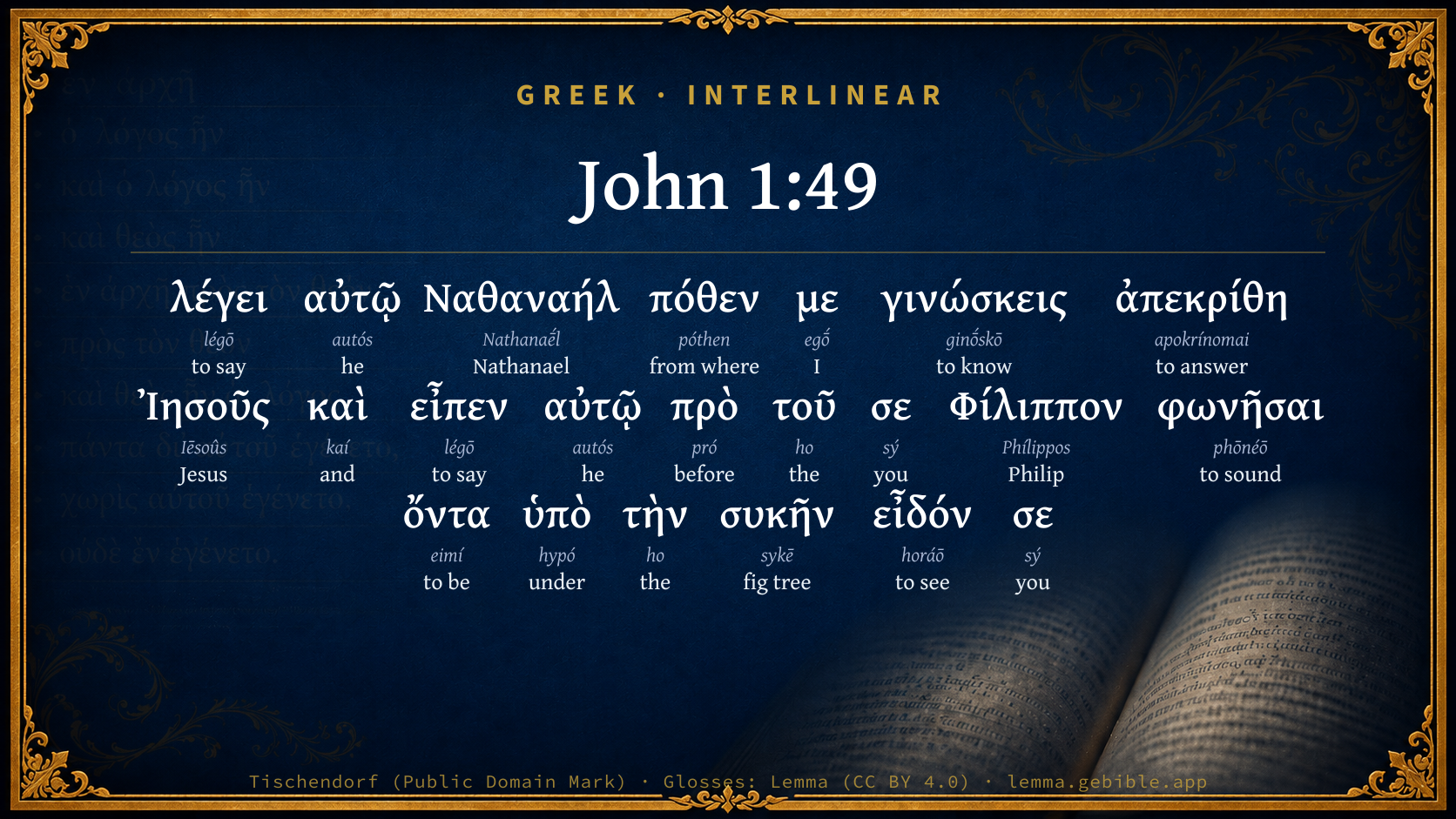
  1. λέγει légō G3004 “to say” Verb, Present, Active, Indicative, 3rd person, Singular
  2. αὐτῷ autós G846 “he” Personal pronoun, Dative, Singular, Masculine
  3. πόθεν póthen G4159 “from where” Adverb, Interrogative
  4. με egṓ G1473 “I” Personal pronoun, 1st person, Accusative, Singular
  5. γινώσκεις ginṓskō G1097 “to know” Verb, Present, Active, Indicative, 2nd person, Singular
  6. ἀπεκρίθη apokrínomai G611 “to answer” Verb, Aorist, Middle deponent, Indicative, 3rd person, Singular
  7. Ἰησοῦς Iēsoûs G2424 “Jesus” Noun, Nominative, Singular, Masculine
  8. καὶ kaí G2532 “and” Conjunction
  9. εἶπεν légō G3004 “to say” Verb, Aorist, Active, Indicative, 3rd person, Singular
  10. αὐτῷ autós G846 “he” Personal pronoun, Dative, Singular, Masculine
  11. πρὸ pró G4253 “before” Preposition
  12. τοῦ ho G3588 “the” Article, Genitive, Singular, Masculine
  13. σε sý G4771 “you” Personal pronoun, 2nd person, Accusative, Singular
  14. Φίλιππον Phílippos G5376 “Philip” Noun, Accusative, Singular, Masculine
  15. φωνῆσαι phōnéō G5455 “to sound” Verb, Aorist, Active, Infinitive
  16. ὄντα eimí G1510 “to be” Verb, Present, Active, Participle, Accusative, Singular, Masculine
  17. ὑπὸ hypó G5259 “under” Preposition
  18. τὴν ho G3588 “the” Article, Accusative, Singular, Feminine
  19. συκῆν sykē G4808 “fig tree” Noun, Accusative, Singular, Feminine
  20. εἶδόν horáō G3708 “to see” Verb, Aorist, Active, Indicative, 1st person, Singular
  21. σε sý G4771 “you” Personal pronoun, 2nd person, Accusative, Singular

About this verse

These counts appear in no published source. They are computed here, from the morphology-tagged text and Lemma’s own curated glosses. What Lemma adds →

22
words
18
distinct lemmas
Gospels
section

Notable vocabulary

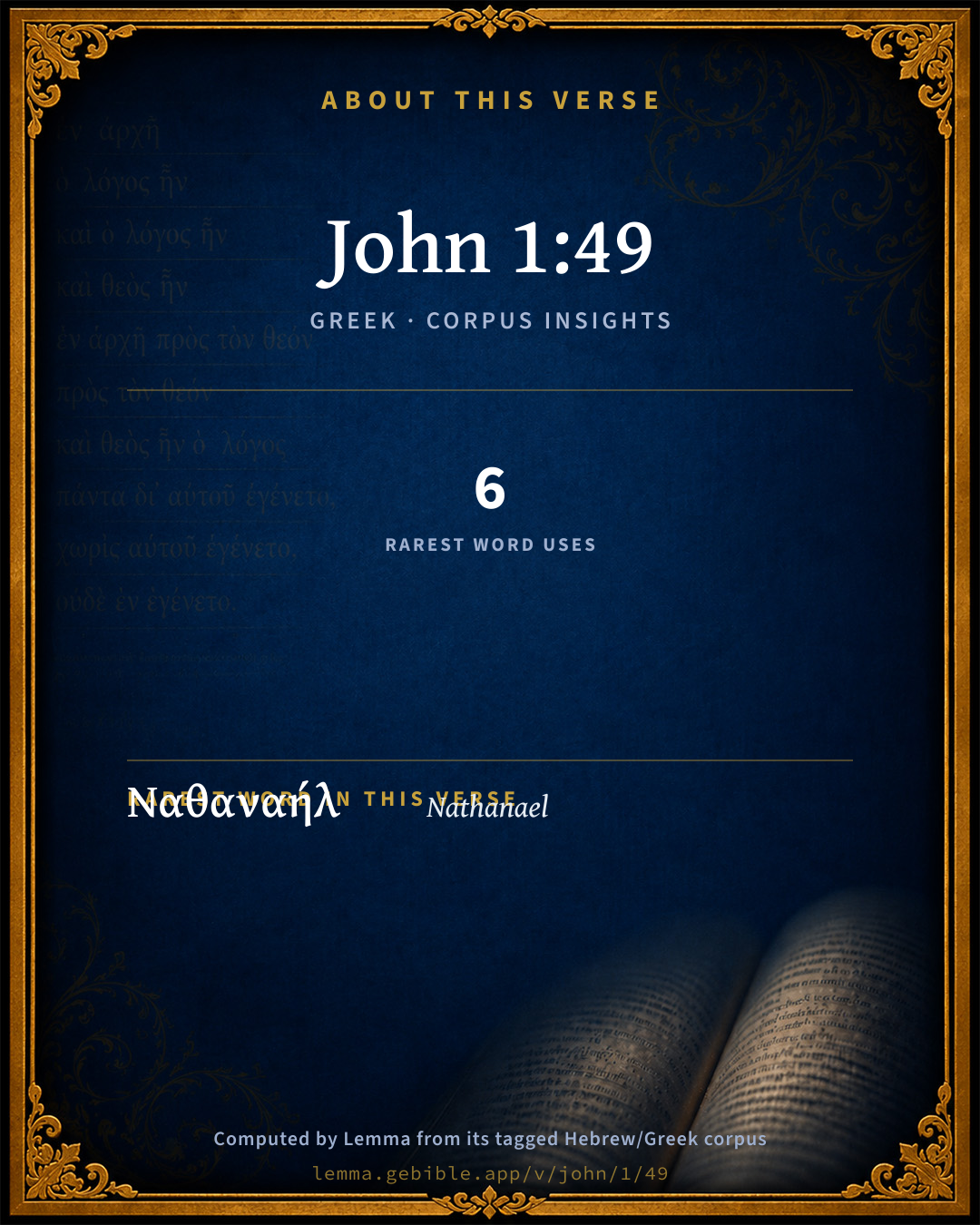
The rarest word here is Ναθαναήλ Nathanael G3482 — appearing just 6 times in the whole Greek New Testament.

Shared distinctive vocabulary

Ναθαναήλ Nathanael G3482 occurs in 6 verses of the Greek New Testament. Also found in:

Repetition

Words recur within this verse:

Cross-references

24

Topical passages linked to John 1:49 in the Treasury of Scripture Knowledge — connected by theme and wording, ordered by reader-vote popularity; previews shown in the World English Bible.

  • Zephaniah 3:15 Yahweh has taken away your judgments. He has thrown out your enemy. The King of Israel, Yahweh, is in the midst of you. You will not be afraid of evil any more.
  • Zechariah 9:9 Rejoice greatly, daughter of Zion! Shout, daughter of Jerusalem! Behold, your king comes to you! He is righteous, and having salvation; Lowly, and riding on a donkey, Even on a colt, the foal of a donkey.
  • Matthew 27:42 "He saved others, but he can't save himself. If he is the King of Israel, let him come down from the cross now, and we will believe in him.
  • Matthew 2:2 "Where is he who is born King of the Jews? For we saw his star in the east, and have come to worship him."
  • Luke 19:38 saying, "Blessed is the King who comes in the name of the Lord! Peace in heaven, and glory in the highest!"
  • John 12:13–15 they took the branches of the palm trees, and went out to meet him, and cried out, "Hosanna! Blessed is he who comes in the name of the Lord, the King of Israel!"
  • Matthew 21:5 "Tell the daughter of Zion, Behold, your King comes to you, Humble, and riding on a donkey, On a colt, the foal of a donkey."
  • Matthew 27:11 Now Jesus stood before the governor: and the governor asked him, saying, "Are you the King of the Jews?" Jesus said to him, "So you say."
  • John 1:34 I have seen, and have testified that this is the Son of God."
  • Hosea 3:5 Afterward the children of Israel shall return, and seek Yahweh their God, and David their king, and shall come with trembling to Yahweh and to his blessings in the last days.
  • Micah 5:2 But you, Bethlehem Ephrathah, Being small among the clans of Judah, Out of you one will come forth to me that is to be ruler in Israel; Whose goings forth are from of old, from everlasting.
  • Matthew 14:33 Those who were in the boat came and worshiped him, saying, "You are truly the Son of God!"
  • John 1:18 No one has seen God at any time. The one and only Son, who is in the bosom of the Father, he has declared him.
  • John 18:37 Pilate therefore said to him, "Are you a king then?" Jesus answered, "You say that I am a king. For this reason I have been born, and for this reason I have come into the world, that I should testify to the truth. Everyone who is of the truth listens to my voice."
  • John 20:28–29 Thomas answered him, "My Lord and my God!"
  • Psalms 110:1 Yahweh says to my Lord, "Sit at my right hand, Until I make your enemies your footstool for your feet."
  • Isaiah 9:7 Of the increase of his government and of peace there shall be no end, on the throne of David, and on his kingdom, to establish it, and to uphold it with justice and with righteousness from henceforth even forever. The zeal of Yahweh of Hosts will perform this.
  • Jeremiah 23:5–6 Behold, the days come, says Yahweh, that I will raise to David a righteous Branch, and he shall reign as king and deal wisely, and shall execute justice and righteousness in the land.
  • John 1:38 Jesus turned, and saw them following, and said to them, "What are you looking for?" They said to him, "Rabbi" (which is to say, being interpreted, Teacher), "where are you staying?"
  • John 19:19–22 Pilate wrote a title also, and put it on the cross. There was written, "JESUS OF NAZARETH, THE KING OF THE JEWS."
  • Psalms 2:6 "Yet I have set my king on my holy hill of Zion."
  • Ezekiel 37:21–25 Say to them, Thus says the Lord Yahweh: Behold, I will take the children of Israel from among the nations, where they are gone, and will gather them on every side, and bring them into their own land:
  • Zechariah 6:12–13 and speak to him, saying, 'Thus says Yahweh of Hosts, "Behold, the man whose name is the Branch: and he shall grow up out of his place; and he shall build the temple of Yahweh;
  • Daniel 9:25 Know therefore and discern, that from the going forth of the commandment to restore and to build Jerusalem to the Anointed One, the prince, shall be seven weeks, and sixty-two weeks: it shall be built again, with street and moat, even in troubled times.

Cross-references courtesy of OpenBible.info (CC BY 4.0).

Commentary

Notes on John 1:49 from classic Christian and Jewish commentators (each source and its license shown beneath its notes). The classic Christian expositions comment on the surrounding passage and are grouped to its opening verse, so a note may address several verses; the Jewish commentaries on the Tanakh (Rashi and others) are per-verse, so they appear only where the commentator wrote on this verse.

Lemma curates 59 commentaries, every one of them public domain or Creative Commons licensed, each selected and text-cleaned for this edition rather than reprinted as found. About our sources →

The Biblical Illustrator

Joseph S. Exell

Joh_1:49

Rabbi, Thou art the Son of God; Thou art the King of Israel

The earliest creed

Remarkable as not being formulated by an ecumenical council, a ]earned rabbi, a matured and educated Christian, but by a simple guileless Jew who had only his Old Testament to learn from, and at his first interview with Christ.

Acquaintance with the Bible and communion with Christ the best qualifications for a creed maker. Would that all had learned this--would that all would learn it. Concerning this creed, notice

I. Its BREVITY. Compare it with its successors: the Apostles, the Nicene, the Athanasian, and the more modern Confessions of particular Churches: each adding something to its predecessor, until the mind is burdened and confused by the multiplicity of propositions.

1. This growth is accounted for by the rise of successive heresies against whose denials or affirmations the Church has protected itself by successive negative or positive articles.

2. This growth is only an expansion of and deduction from the primitive statement: an evolution of what has been involved in germ.

3. This growth has not always been a safeguard against the errors condemned. Churches with the most elaborate creeds have widely departed from the truth.

4. This growth adds nothing to the saving power of the simple confession of the text. All who with guileless heart profess Christ in the words of Nathanael will without doubt be saved everlastingly.

II. ITS SUFFICIENCY.

1. Rabbi. Christ is the Supreme Teacher.

(1) Inspiring prophets and apostles.

(2) Imparting instruction personally. His teaching is simple, profound, beautiful, vivifying.

(3) Giving the Spirit of Truth to guide into all truth.

2. Son of God who became the Son of man to redeem.

(1) His Divinity.

(2) His Atonement.

(3) His brotherly sympathy.

3. King of Israel.

(1) To reign.

(2) To rule.

(3) To conquer.

(4) To reward His servants and punish His enemies.

III. ITS DEFINITENESS.

1. Most creeds are made up of a number of abstract propositions, and are a general testimony of the confessors theological soundness to the world. Hence their feeble moral effect on the confessor. His mind may be sound, but his heart maybe heretical.

2. This creed was a brief statement of faith in Christ made to Christ Himself. The Te Deum is a better confession than the Athanasian or Nicene symbols. It touches and inspires while it gives expression to the feelings of the heart.

IV. THE METHOD OF ITS DELIVERY.

1. Prompt, without study or reluctance.

2. Positive, without misgiving about it or speculation beyond it.

3. Final; Nathanael never outgrew it, although he doubtless filled up the outline.

V. THE OBLIGATION IT INVOLVES.

1. Discipleship:

(1) Docility.

(2) Study.

(3) Continuous proficiency.

2. Saintship:

(1) Trust.

(2) Affection.

(3) Reverence.

(4) Holiness.

3. Loyalty:

(1) Obedience.

(2) Active service.

(3) Fidelity unto death.

VI. THE REWARD IT SECURES.

1. Instruction from the Rabbi.

2. Salvation from the Son of God.

3. Everlasting blessedness from the King of Israel. (J. W. Burn.)

The Biblical Illustrator, edited by Joseph S. Exell (c. 1880s–1900s) — public domain. Text from a community e-Sword module.

Bengel's Gnomon

Johann Albrecht Bengel

Joh 1:49. Ἀπεκρίθη, he answered) Considerate quickness in believing brings with it a blessed [sumptuous] portion: slowness is censured, Luk 24:25, “O fools, and slow of heart to believe.”—σὺ εἶ ὁ ὑιος τοῦ Θεοῦ, Thou art the Son of God) ch. Joh 6:69, “We believe and are sure that Thou art that Christ, the Son of the living God.” Now Nathanael himself confesses more than he had heard from Philip: and retracts his doubt as to the goodness of Jesus.—ὁ ὑιός—ὁ βασιλεύς, the Son—the King) A confession as to the person and office of Christ. σὺ εἶ ὁ βασιλεὺς τοῦ Ἰσραήλ, Thou art the King of Israel) and so my King also, since Thou dost acknowledge me to be a genuine Israelite.

Bengel's Gnomon of the New Testament — English translation (T&T Clark, Edinburgh, 1860) — public domain. Text from a community e-Sword module.

Meyer's Critical & Exegetical Commentary

Heinrich August Wilhelm Meyer

Joh_1:49. The approaching Nathanael heard the testimony of Jesus, and does not decline His commendation,itself a proof of his guileless honesty; but he asks in amazement how Jesus knew him.

ὄντα ὑπὸ τ. συκῆν] belongs, as Joh_1:51 shows, not to φωνῆσαι, but to εἶδόν σε. Therefore, before Philip, Joh_1:46-47, met and called (φωνῆσαι, comp. Joh_2:9, Joh_4:16, Joh_9:28, Joh_18:33), Nathanael had been under a fig-tree; whether the fig-tree of his own house (Mic_4:4; Zec_3:10), whether meditating (possibly upon the Messianic hope of the people), praying, reading,which, according to Rabbinical statements (see in Lightfoot, Schoettgen, Wetstein), were employments performed beneath such trees,we are not informed. He had just come from the tree to the place where Philip met him.[127]

ΕἾΔΌΝ ΣΕ] is usually taken as referring to a glance into the depth of his soul,[128] but contrary to the simple meaning of the words, which affirm nothing else than: I saw thee, not ἔγνων σε, or the like. Comp. also Hengstenberg. The miraculous element in the ΕἾΔΌΝ ΣΕ, which made it a ΣΗΜΕῖΟΝ to Nathanael, and which led to his confession which follows in Joh_1:50, must have consisted in the fact that the fig-tree either was situated out of sight of the place, or so far off that no one with ordinary powers of sight could have discerned a person under it. ΕἾΔΌΝ ΣΕ thus simply interpreted gives the true solution to Nathanaels question, because there could not have been this rapport of miraculous far-seeing on the part of Jesus, had it not just been brought about by the immediate recognition of the true Israelite when he was at that distance. This spiritual elective affinity was the medium of the supernatural εἶδόν σε. Nonnus well says: ὌΜΜΑΣΙ ΚΑῚ ΠΡΑΠΊΔΕΣΣΙ ΤῸΝ Οὐ ΠΑΡΕΌΝΤΑ ΔΟΚΕΎΩΝ. Jesus would not have seen an ordinary Jew, who, being therefore without this spiritual affinity, was beyond the limits of sight.

ὑπὸ τὴν συκ.] with the article: under that well-known fig-tree, beneath which you were, or, if the tree was within the range of vision, pointing towards it. De Wette also rightly abides by the simple meaning, I saw thee, but thinks that what caused the astonishment of Nathanael was the fact that Jesus saw him when he believed himself to he unobserved (though John regarded this seeing as supernatural). But this does not give an adequate motive psychologically for the confession of Joh_1:50; and we must further assume, with Ewald, that the words of Jesus reminded Nathanael of the deep and weighty thoughts which he was revolving when alone under the fig-tree, and he thus perceived that the depths of his soul were laid open before the spiritual eye of Jesus, though this is not indicated in the text.

[127] The reference of the εἶδόν σε to the same place where Philip called him (so, after the Greek Fathers, B. Crusius) must be rejected, because neither the πρὸ τοῦ

φωνῆσαι nor the ὄντα ὑπὸ τὴν συκῆν would thus have their appropriate and necessary point.

[128] Where it is imagined, though without the slightest hint to that effect in the text, that Jesus had a short time before passed by the fig-tree unobserved.

Meyer — Critical and Exegetical Commentary on the New Testament — English translation by Peter Christie, edited by Frederick Crombie (T&T Clark, 1880) — public domain. Text from a community e-Sword module.

Expositor's Greek Testament

ed. W. Robertson Nicoll

Joh 1:49 . The significance of this utterance is further shown by what follows. Naturally Nathanael is surprised by this explicit testimony from one with whom he has had no acquaintance and who has notwithstanding truly described him, and he asks, πόθεν με γινώσκεις ; “how do you know me?” perhaps imagining that some common friend had told Jesus about him. But Jesus ascribes it to another cause: πρὸ τοῦ σε φίλιππον φωνῆσαι ὄντα ὑπὸ τὴν συκῆν εἶδον σε , I saw thee under the fig tree before Philip called thee (not, I saw thee somewhere else before Philip called thee when you were under the fig tree). “Under the fig tree” is obviously significant. Such trees were planted by the wayside (Mat 21:19 ), and the large thick leaf afforded shade. It was the favourite garden tree of the Jews, so that “sitting under one’s fig tree” meant being at home (Mic 4:4 , Zec 3:10 ). The tree formed a natural arbour affording shade and privacy. Thus Schoettgen quotes that it is related of Rabbi Jose and his disciples, “solebant summo mane surgere et sedere et studere sub ficu”. And Lightfoot ( Hor. Heb., in loc. ) says that Nathanael was “aut orans, aut legens, aut meditans, aut aliquid religiosum praestans, in secessu sub aliquâ ficu et extra conspectum hominum”. But evidently Nathanael understood that Jesus had not only seen him when he thought he was unobserved, but had penetrated his thought in retirement, and understood and sympathised with his prayer under the fig tree, for the impression made upon him by this knowledge of Jesus is profound.

The Expositor's Greek Testament, edited by W. Robertson Nicoll (1897–1910) — public domain. Text from a community e-Sword module.

Jamieson, Fausset & Brown

Robert Jamieson, A. R. Fausset & David Brown

Son of God . . . King of Israel--the one denoting His person, the other His office. How much loftier this than anything Philip had said to him! But just as the earth's vital powers, the longer they are frost-bound, take the greater spring when at length set free, so souls, like Nathanael and Thomas (see on Joh 20:28), the outgoings of whose faith are hindered for a time, take the start of their more easy-going brethren when loosed and let go.

Jamieson, Fausset & Brown — Commentary Critical and Explanatory on the Whole Bible (1871) — public domain (CC PDM 1.0). Text via the HelloAO Bible API.

Adam Clarke's Commentary

Verse 49. Rabbi] That is, Teacher! and so this word should be translated.

Thou art the Son of God] The promised Messiah.

Thou art the King of Israel.] The real descendant of David, who art to sit on that spiritual throne of which the throne of David was the type.

Adam Clarke's Commentary on the Bible (1810–1826) — public domain. Text from a community e-Sword/MySword module.

John Calvin's Commentaries

49. Thou art the Son of God. That he acknowledges him to be the Son of God from his divine power is not wonderful; but on what ground does he call him King of Israel? for the two things do not appear to be necessarily connected. But Nathanael takes a loftier view. He had already heard that he is the Messiah, and to this doctrine he adds the confirmation which had been given him. He holds also another principle, that the Son of God will not come without exercising the office of King over the people of God. Justly, therefore, does he acknowledge that he who is the Son of God is also King of Israel And, indeed, faith ought not to be fixed on the essence of Christ alone, (so to speak,) but ought to attend to his power and office; for it would be of little advantage to know who Christ is, if this second point were not added, what he wishes to be towards us, and for what purpose the Father sent him. The reason why the Papists have nothing more than a shadow of Christ is, that they have been careful to look at his mere essence, but have disregarded his kingdom, which consists in the power to save.

Again, when Nathanael calls him King of Israel, though his kingdom extends to the remotest bounds of the earth, the confession is limited to the measure of faith. For he had not yet advanced so far as to know that Christ was appointed to be King over the whole world, or rather, that from every quarter would be collected the children of Abraham, so that the whole world would be the Israel of God. We to whom the wide extent of Christ’s kingdom has been revealed ought to go beyond those narrow limits. Yet following the example of Nathanael, let us exercise our faith in hearing the word, and let us strengthen it by all the means that are in our power; and let it not remain buried, but break out into confession.

John Calvin's Commentaries (1540-1563) — public domain. Text from the Calvin Translation Society English edition (1840s-50s) via the Christian Classics Ethereal Library (ccel.org). Calvin's coverage is partial (roughly two-thirds of the Bible); uncommented books and verses are honest gaps, never fabricated. The 19th-century editor's footnotes and remarks are omitted so the notes are faithfully Calvin's own voice.

Ellicott's Commentary for English Readers

(49) Thou art the Son of God.—The recognition begets recognition. That strange Presence he had felt as a spiritual power quickening hope and thought, making prophets’ words living truths, filling with a true meaning the current beliefs about the Messiah;—yes; it goes through and through him again now. It is there before him. “Rabbi, Thou art the Son of God; Thou art the King of Israel.” (For these titles as existing in the Messianic expectation of the day, comp. Joh_11:27; Joh_12:13; Joh_12:15; Mat_26:63; Mar_3:11; Mar_5:7. See also Note on the quotation from Zech. in Mat_21:5.)

A Bible Commentary for English Readers, edited by Charles John Ellicott (1878–1897) — public domain. Text from a community e-Sword module.

The Cambridge Bible for Schools and Colleges

gen. ed. J. J. S. Perowne

49. thou art the Son of God] We know from other passages that this was one of the recognised titles of the Messiah; Joh_11:27; Mat_26:63; Mar_3:11; Mar_5:7; Luk_4:41. ‘Son of David’ was more common.

the King of Israel] Omit ‘the.’ This phrase “is especially important, because it breathes those politico-theocratic hopes, which since the taking of Jerusalem, Christians at least, if not Jews, must have entirely laid aside.” S. How could a Christian of the second century have thrown himself back to this?

The Cambridge Bible for Schools and Colleges (gen. ed. J. J. S. Perowne; Cambridge University Press, 1878–1918) — public domain. Text from a community e-Sword module.

John Gill's Exposition

Nathanael answered and saith unto him,.... Being fully convinced of his omniscience by these instances:

Rabbi; that is, master, as it is interpreted in Joh 1:38, and is not here, because it is there:

thou art the Son of God; not by creation, for this would be to say no more of him, than may be said of every man; nor by adoption, for in that sense Nathanael himself was a Son of God, and many others; nor on account of his wonderful incarnation, which, it is very likely, at this time Nathanael knew nothing of; nor by reason of his resurrection from the dead, which, as yet, was not, and still less might be known by this person; nor because of his office, as Mediator, for this is expressed in the next clause; but by nature, as being of the same essence, and possessed of the same perfections God is; and of which he was convinced by the instances he gave of his omniscience; for it was from hence, and no other consideration, that he concludes him to be the Son of God: wherefore this phrase must be understood of him, not as Mediator, but as a divine person; as the natural, essential, and eternal Son of God; and who is truly and properly God: he adds,

thou art the King of Israel; having in view, no doubt, the passage in Psa 2:6, where the characters of Son of God, and King of Zion, meet in the same person: not King of Israel, in a literal sense; though he was the son of David, and a descendant of his in a right line, and was of the royal line, and had a legal right to the throne of Israel; and Nathanael might have a view to this, being tinctured with the common national prejudice, that the Messiah would be a temporal prince: but his kingdom is not of this world; nor with observation; but is spiritual; and he is a King over Israel in a spiritual sense, even of saints, whether Jews or Gentiles: whom he conquers by his power, and rules in their hearts by his Spirit, and grace; and protects, and defends them from all their enemies.

John Gill's Exposition of the Whole Bible (1746–1763) — public domain (CC PDM 1.0). Text via the HelloAO Bible API.

Albert Barnes' Notes on the Bible

Rabbi - Master. Applied appropriately to Jesus, and to no one else, Mat 23:10.

The Son of God - By this title he doubtless meant that he was the Messiah. His conscience told him that he had judged right of his character, and that therefore he must know the heart and the desires of the mind. If so, he could not be a mere man, but must be the long-expected Messiah.

The King of Israel - This was one of the titles by which the Messiah was expected, and this was the title which was affixed to his cross, Joh 19:18. This case of Nathanael John adduces as another evidence that Jesus was the Christ. The great object he had in view in writing this gospel was to collect the evidence that he was the Messiah, Joh 20:31. A case, therefore, where Jesus searched the heart, and where his knowledge of the heart convinced a pious Jew that he was the Christ, is very properly adduced as important testimony.

Albert Barnes' Notes on the Bible (1834–1885) — public domain. Text from a community e-Sword/MySword module.

Matthew Poole's English Annotations

The term Rabbi, which Nathanael here giveth to Christ, is of the same significance with Rabban, and Rabboni, Joh 20:16, Rabban, Rabhi, Rabbi, all which signify Master, and my Master; a name which in that age they usually gave their teachers, as a title of honour, Mat 23:7,8, titles that began about the time of our Saviour; for Buxtorf tells us, purer antiquity gave no such titles to their teachers or prophets, thinking it not possible to give those persons (extraordinarily sent of God) titles answerable to their dignity. They say, Hillel, about our Saviour’s time, was the first who was so called; Rabban was counted the highest, Rabbi the next, Rabbi the least. Rabban, they say, lasted about two hundred years, given to seven after Hillel. Nathanael calls him also

the Son of God, as Peter and the other disciples did, Mat 14:33, and Peter, Mat 16:16. But it appeareth, by many following passages, that they had but a faint persuasion of this, till he was declared so with power, by his resurrection from the dead, Rom 1:4. He acknowledgeth Christ also the King of Israel, that is, the true Messiah. This was the title of the Messiah, Mat 21:5; 27:11.

Matthew Poole's English Annotations on the Holy Bible (1683–1685) — public domain. Text from a community e-Sword/MySword module.

Whedon's Commentary on the Bible

Daniel D. Whedon

49. Thou art the Son of God—The title which the Baptist had taught them to apply to Jesus, Joh_1:34.

King of Israel—King in that kingdom of God for which he perhaps had prayed.

Daniel D. Whedon (gen. ed.), Commentary on the Old and New Testaments (1874–1909) — public domain. Text from a community e-Sword module.

The Pulpit Commentary

Nathanael was overcome by irresistible conviction that here was the Searcher of hearts, One gifted with strange powers of sympathy, and with right to claim obedience. Answered him now for the first time with the title of Rabbi, or teacherThou art the Son of God. Nothing is more obvious than that this is the reflection of the testimony of the Baptist. "The Son of God," not a Son of God," or "a Man of God," but the Personage whose rank and glory my master John had recognized. He may have doubted before whether the Baptist had not gone wild with hallucination, and could have meant what he said. Now the reality has flashed upon his mind from the glance of the Saviour"s eye and the tones of his voice (see notes on ver. 34). The great term could not have meant to him what it does now to the Church. Still the truth involved in his words is of priceless significance. Luthardt says, "Nathanael"s faith will never possess more than it embraces at this moment." Godet adds, "The gold seeker puts his hand on an ingot; when he has coined it, he has it better, but not more." The idea of the Divine sonship comes from the Old Testament prophecy, has its root in Psalm 2 and 72, and in all the strange wonderful literature which recognized in the ideal King upon Zion and upon David"s throne One who forevermore has stood and will stand in personal relations with the Father. The Divine sonship is the basis on which Nathanael rears his further faith that he is the King of Israel. He is Messiah-King, because he is "Son of God." The true Israelite recognizes his King. (cf. Luk_1:32 Mat 2:2Jo Mat_12:13) We are not bound to believe that Nathanael saw all that Peter subsequently confessed to be the unanimous conviction of the twelve; (Joh_6:69 Mat_16:16) but the various symphonies of this great confession encompass the Lord from his cradle to the cross. The synoptic narrative is as expressive and convincing as the Johannine.

The Pulpit Commentary (1880–1919), ed. H.D.M. Spence-Jones & Joseph S. Exell — public domain. Text from a community e-Sword module.

John Wesley's Explanatory Notes

Nathanael answered - Happy are they that are ready to believe, swift to receive the truth and grace of God. Thou art the Son of God - So he acknowledges now more than he had heard from Philip: The Son of God, the king of Israel - A confession both of the person and office of Christ.

John Wesley, Explanatory Notes Upon the Whole Bible (1754–1765) — public domain. Text via the GEBible commentary corpus.

The People's New Testament

B. W. Johnson

49. Thou art the Son of God; the King of Israel. Philip had said, “Jesus, the son of Joseph,” as he supposed, but Nathanael, convinced, declared him the Son of God. This is the first confession of the divinity of Jesus.

B. W. Johnson's The People's New Testament with Notes (1889–1891) — public domain. Electronic text from the Christian Classics Ethereal Library (CCEL) ThML edition.

unfoldingWord translationNotes

Door43 World Missions Community

Son of God

This is an important title for Jesus. (See: Translating Son and Father)

Because I said to you ... do you believe?

This remark appears in the form of a question to provide emphasis. AT: "You believe because I said, 'I saw you underneath the fig tree'! (See: Rhetorical Question)

Truly, truly

Translate this the way your language emphasizes that what follows is important and true.

translationWords

Rabbi

Son of God

king

Israel

believe

amen

heaven

angel

Son of Man

unfoldingWord translationNotes — © Distant Shores Media and the Door43 World Missions Community, licensed CC BY-SA 4.0. Source: git.door43.org/Door43/en_tn.

Cambridge Greek Testament for Schools and Colleges

49. ὑπὸ τὴν συκῆν. Note the case, implying motion to under, and comp. Joh 1:18; Joh 1:32-33. The phrase probably means ‘at home,’ in the retirement of his own garden (1Ki 4:25; Mic 4:4; Zec 3:10). He had perhaps been praying or meditating, and seems to feel that Christ knew what his thoughts there had been. It was under a fig tree that S. Augustine heard the famous ‘tolle, lege.’

Cambridge Greek Testament for Schools and Colleges (Cambridge University Press, 1896; 21 vols, various authors incl. Carr, Maclear, Plummer, Farrar, Lumby, Moule, M. R. James, Simcox) — public domain. Text from a community e-Sword module.

Alford’s Greek Testament

Henry Alford

49.] The remark was overheard by Nathanael, and recognized as indicating perfect knowledge of his character. The question πόθ. με γιν. is one of astonishment, but not perhaps yet of suspicion of any thing supernatural. Our Lord’s answer first opens this to him.

πρὸ τοῦ κ.τ.λ.] It would be doubtful whether ὄντα ὑπὸ τ. συκ. belong to φωνῆσαι or to εἶδόν σε, did not ver. 51 decide for the latter construction.

The whole form of our Lord’s answer seems to indicate that the place where Philip called Nathanael was not now in sight, nor had been. The declaration that Jesus had seen him there, at once brings the conviction which he expresses in the next verse. This would not have been the case, unless the sight had been evidently and unquestionably supernatural: and unless the words ὄντα ὑπὸ τὴν συκῆν involved this. Had Jesus merely seen Nathanael without being seen by him, (De Wette,) or had εἶδόν σε only expressed ‘I knew thy character,’ at first sight, ‘although at a distance’ (Lücke), no such immediate conviction would have followed.

ὄντα ὑπὸ τὴν συκῆν, says Wordsw., “is something more than ὑπὸ τῇ συκῇ—the accusative indicates retirement thither as well as concealment there,—perhaps for purposes of prayer and meditation.” In fact it contains in it, ‘when thou wentest under the fig-tree, and while thou wert there.’

Ver. 50 = ‘Thou art the Messiah:’ see Psa 2:7. ch. 11:27: Mat 16:16: Luk 22:70. Olshausen (ii. 77 ff.) maintains that ὁ υἱ. τ. θ. was not a Jewish appellation for the Messiah,—on account of the Jews taking up stones to cast at Jesus when He so called Himself, ch. 10:33. But as Lücke observes (i. 456, note), it was not for the mere use of this Name,—but for using it in a close and literal sense which was unintelligible and appeared blasphemous to them, ἐγὼ κ. ὁ πατὴρ ἕν ἐσμεν,—that they wished to stone Him: see note on ch. 10:36. It was certainly not so common a name as ‘the Son of David,’ for the Messiah.

Nathanael can hardly have meant the name in other than its popular meaning; and the synonymous and better known appellation which he adds, confirms this.

Henry Alford, The Greek Testament (1849–1861) — public domain. Text from a community e-Sword module.

International Critical Commentary

49. Ῥαββεί. See on v. 38.

σὺ εἶ ὁ υἱὸς τοῦ θεοῦ. Cf. Peter’s σὺ εἶ ὁ ἅγιος τοῦ θεοῦ (6:69) and Martha’s σὺ εἶ ὁ Χριστός, ὁ υἱὸς τοῦ θεοῦ (11:27); and see below on v. 51. Nathanael sees in Jesus One who has displayed a wonderful knowledge of his past life (cf. 4:19, 29), and so he identifies Him with the expected Messiah. For the title ὁ υἱὸς τοῦ θεοῦ, see on v. 34 above.

σὺ βασιλεὺς εἶ τοῦ Ἰσραήλ. This, to us, is a lesser title than ὁ υἱὸς τοῦ θεοῦ, but not so to Nathanael; see on 12:13. Nathanael has been hailed by Jesus as an “Israelite,” a worthy and representative son of Israel, and he replies out of the fulness of his heart, “Thou art the King of Israel,” and therefore Nathanael’s King. Both Messianic titles, “Son of God” and “King of Israel,” have their roots in Psa_2.

International Critical Commentary — older volumes (1896–1929), various authors — public domain. Text from a community e-Sword module.

Godet's Commentaries

Frédéric Louis Godet

Ver. 49. “Nathanael says to Him: whence knowest thou me? Jesus answered and said to him: Before Philip called thee, when thou wert under the fig-tree, I saw thee.”

This reply by which Nathanael seems to appropriate to himself the eulogy contained in Joh 1:48 has been criticised as not modest. But he wishes simply to know on what grounds Jesus, who sees him for the first time, forms this judgment of him. Certainly, if we take account of the extraordinary effect which Jesus’ answer produced upon Nathanael (Joh 1:50), it must contain to his view the indubitable proof of the supernatural knowledge which Jesus has of him. Lucke thinks that this knowledge applies only to the inward moral state of Nathanael; Meyer, on the contrary, that it applies only to the external fact of his sitting under the fig-tree. But thoroughly to comprehend the relation of this saying of Jesus, on the one side, to his previous declaration (Joh 1:48), and, on the other, to the exclamation of Nathanael (Joh 1:50), it is indispensable to unite the two views. Not only does Nathanael note the fact that the eye of Jesus had followed him in a place where His natural sight could not reach him, but he understands that the eye of this stranger has penetrated his interior being, and has discerned there a moral fact which justifies the estimate expressed by Jesus in Joh 1:48.

Otherwise, the answer of Jesus does not any the more justify that estimate, and we cannot understand how it can call forth the exclamation of Nathanael in Joh 1:50, or be presented, in Joh 1:51, as the first of the Lord’s miraculous works. What had taken place in Nathanael, at that moment when he was under the fig-tree? Had he made to God the confession of some sin (Psa 32:1-2), taken some holy resolution, made the vow to repair some wrong? However this may be, serious thoughts had filled his heart, so that, on hearing the word of Jesus, he feels that he has been penetrated by a look which participates in the divine omniscience. The words: before Philip called thee, are connected by Weiss with what follows, in this sense: “When thou wert under the fig-tree before Philip called thee.” But they much more naturally qualify the principal verb: I saw thee. And the same is true of the second limiting phrase: “when thou wert under the fig-tree,” which refers rather to what follows than to what precedes. For the situation in which Jesus saw him is of more consequence than that in which Philip called him.The construction of ὑπό, with the accusative (τὴν συκήν), with the verb of rest, is owing to the fact that to the local relation there is joined the moral notion of shelter. I saw denotes a view such as that of Elisha (2 Kings 5). In Jesus, as in the prophets, there was a higher vision, which may be regarded as a partial association with the perfect vision of God. At this word, Nathanael feels himself, as it were, penetrated by a ray of divine light:

Frédéric Louis Godet — Commentaries on Luke, John, Romans, and 1 Corinthians — English translation (T&T Clark, Edinburgh, 1870s–1890s) — public domain. Text from a community e-Sword module.

Lesson kit

Teaching starters — assembled from the data on this page, not authored interpretation. Every prompt links to the verse data it draws on. Edit before teaching.

John, in the Gospels, opens this verse with 22 words (18 distinct Greek lemmas). Its most distinctive word is Nathanaḗl (“Nathanael”). A historical commentator’s framing appears above. Read the whole chapter for the surrounding context.

Discussion questions

  1. How does “Nathanael” (Nathanaḗl) shape what this verse is saying?
  2. How does John 1:46, which shares the word «Nathanael», read alongside this verse?
  3. What does the repetition of “to say” (2× in this one verse) do in this verse?
  4. These translations render this verse differently; the difference is in the English rendering, not the original. What questions does that raise?
  5. Compare how The Biblical Illustrator and Bengel's Gnomon read this verse. Where do they agree or differ?

Things to notice

  • These translations choose different wording for 5 words in this verse.
  • “to say” occurs 2× in this single verse.
  • 18 distinct Greek lemmas span 22 words in this verse.

Reading settings

Reading text

Shown beneath each verse's original-language words.

Old Testament
Old Testament edition

Read the OT as the Masoretic Hebrew (MT) or the Greek Septuagint (LXX).

English shown for the Greek Septuagint (in the Hebrew ↔ Greek comparison).

Comparing translations? Open the Compare panel on any verse page to stack up to four side by side.