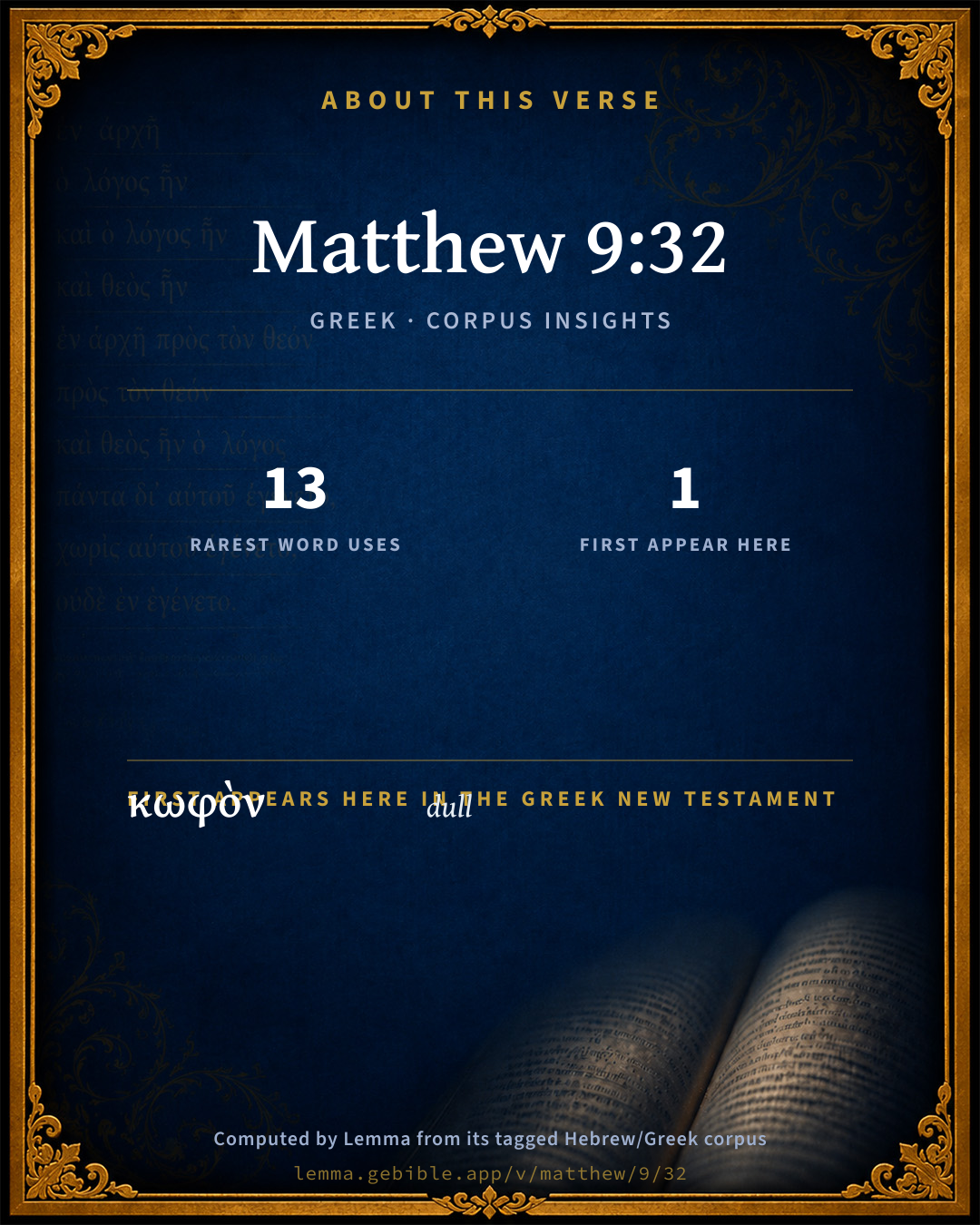
Matthew 9:32

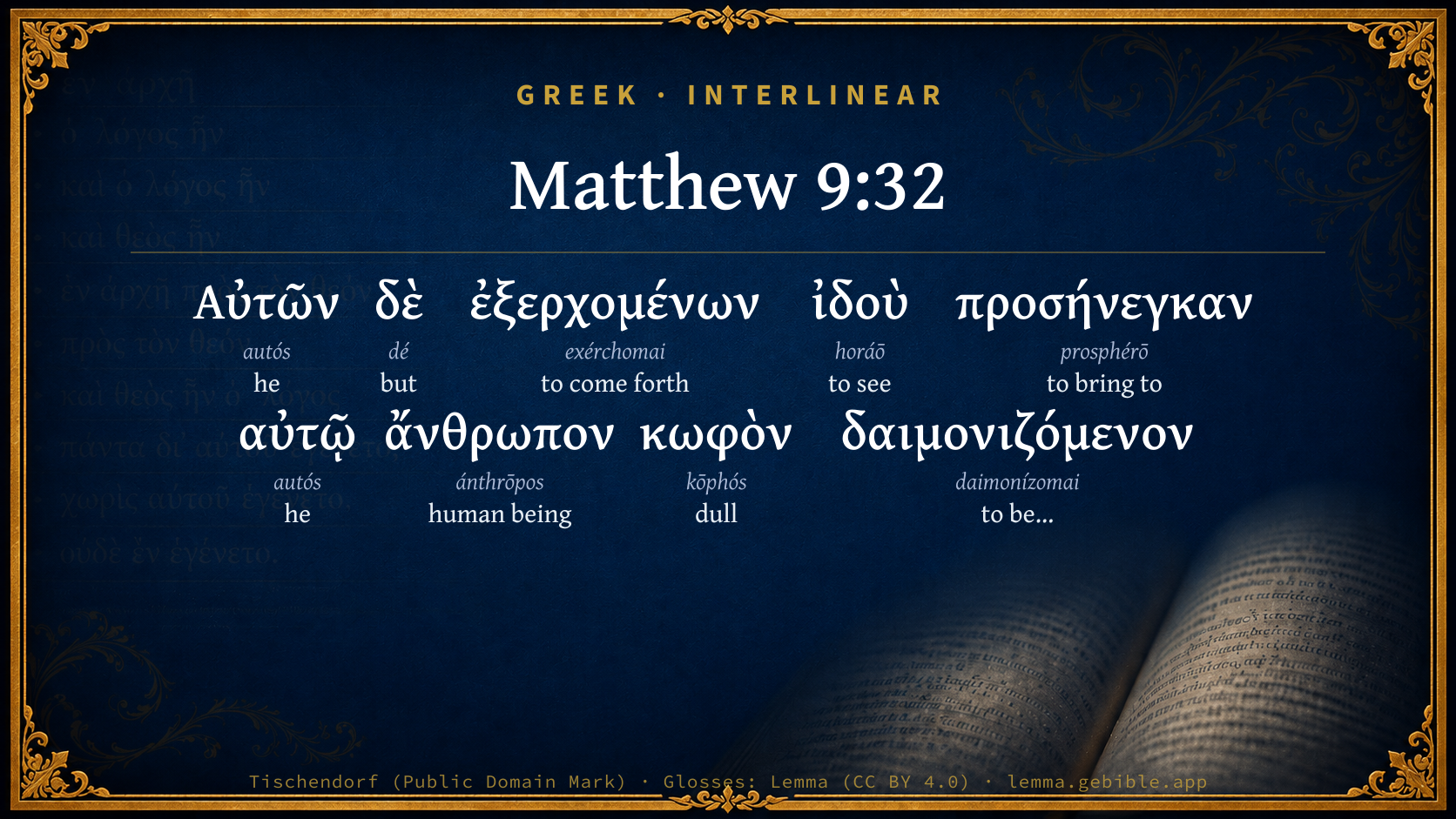
Greek (Tischendorf 8th ed.) Matthew 9:32 appears in the Greek New Testament. The text above is from the Tischendorf 8th edition. Each word links to its Strong’s number and a concise gloss. Click any word for its full Thayer’s Greek Lexicon entry.
Download image
Cite this verse

Matthew 9:32 (World English Bible). Public Domain. Lemma interlinear Bible study tool, https://lemma.gebible.app/v/matthew/9/32.

Show BibTeX & RIS
BibTeX
RIS
English Translation
As they went out, behold, a mute man who was demon possessed was brought to him.
World English Bible · Public Domain
Highlights
  • 1 first appearance in the Greek New Testament
Full analysis ↓
Download a study sheet

One document with this verse’s original text, its word-by-word gloss line, the meaning frame, cross-references with their text, attributed commentary, and full source and license credits — printable, and it pastes into notes with its structure intact.

This verse Autodidact and up

Study sheet (.html) Plain text (.txt)

A passage Seminary Student

Up to 50 verses in one chapter. A passage sheet keeps up to 6 commentary sources and 12 cross-references per verse, in the order this page ranks them, and says so on the sheet whenever that leaves anything out. Ask for a single verse and you get the Autodidact verse sheet above.

Everything on this page stays free to read, with no account — the sheet is a download of what is already on screen, not access to it.

Want to remove ads? Support Godless Engineer
Compare translations 3

The same verse in 3 English versions, stacked beneath the original-language interlinear above. Click any original word for its lexicon entry.

Each is an independent rendering of the whole verse — the interlinear is not word-aligned to these translations.

Highlighted words mark where these versions differ — a whole-verse word diff, not a word-by-word alignment.

  • World English Bible Public Domain
    As they went out, behold, a mute man who was demon possessed was brought to him.
  • King James Version Public Domain
    As they went out, behold, they brought to him a dumb man possessed with a devil.
  • unfoldingWord Literal Text CC BY-SA 4.0
    Now they were going away, behold, they brought to him a mute, demon-possessed man.

unfoldingWord Literal Text — © unfoldingWord, licensed CC BY-SA 4.0. Word-aligned USFM3 via Door43 (git.door43.org/unfoldingWord/en_ult).

Versions to compare (up to 4)

3 of 4 selected

Show all 19 translations

Every available English version of this verse, each an independent rendering of the whole verse.

  • World English Bible Public Domain
    As they went out, behold, a mute man who was demon possessed was brought to him.
  • Berean Standard Bible Public Domain
    As they were leaving, a demon-possessed man who was mute was brought to Jesus.
  • Majority Standard Bible Public Domain
    As they were leaving, a demon-possessed man who was mute was brought to Jesus.
  • King James Version Public Domain
    As they went out, behold, they brought to him a dumb man possessed with a devil.
  • American Standard Version (1901) Public Domain
    And as they went forth, behold, there was brought to him a dumb man possessed with a demon.
  • Revised Version (1885) Public Domain
    And as they went forth, behold, there was brought to him a dumb man possessed with a devil.
  • Geneva Bible (1599) Public Domain
    And as they went out, beholde, they brought to him a domme man possessed with a deuill.
  • Douay-Rheims (1899) Public Domain
    And when they were gone out, behold they brought him a dumb man, possessed with a devil.
  • Young's Literal Translation Public Domain
    And as they are coming forth, lo, they brought to him a man dumb, a demoniac,
  • Literal Standard Version CC BY-SA 4.0
    And as they are coming forth, behold, they brought to Him a man mute, a demoniac,
  • Unlocked Literal Bible CC BY-SA 4.0
    As those two men were going away, behold, a mute man possessed by a demon was brought to Jesus.
  • unfoldingWord Literal Text CC BY-SA 4.0
    Now they were going away, behold, they brought to him a mute, demon-possessed man.
  • Darby Bible Public Domain
    But as these were going out, behold, they brought to him a dumb man possessed by a demon.
  • World Messianic Bible Public Domain
    As they went out, behold, a mute man who was demon possessed was brought to him.
  • Webster's Bible Public Domain
    As thy went out, behold, they brought to him a dumb man possessed with a demon.
  • Free Bible Version CC BY-SA 4.0
    As Jesus and his disciples were leaving, a man was brought to him who was dumb and demon-possessed.
  • Bible in Basic English Public Domain
    And while they were going away, there came to him a man without the power of talking, and with an evil spirit.
  • Text-Critical English NT CC BY 4.0
    As they were going away, behold, a mute man possessed by a demon was brought to Jesus.
  • Tyndale New Testament (1534) Public Domain
    As they went out beholde they brought to hym a dome man possessed af a devyll.

Literal Standard Version (2020), Covenant Press — licensed CC BY-SA 4.0. Text via the HelloAO Bible API (eBible.org). Unlocked Literal Bible (unfoldingWord) — licensed CC BY-SA 4.0. Text via the HelloAO Bible API (eBible.org). unfoldingWord Literal Text — © unfoldingWord, licensed CC BY-SA 4.0. Word-aligned USFM3 via Door43 (git.door43.org/unfoldingWord/en_ult). Free Bible Version, Dr. Jonathan Gallagher — licensed CC BY-SA 4.0. Text via the HelloAO Bible API (eBible.org).

Word by word

More ways to search: Search by grammar → Find every occurrence → Compare this word →

Practice this passage: Drill this verse → Learn its vocabulary →

δαιμονιζόμενον
daimonízomai
G1139
“to be demon-possessed”
Verb, Present, Middle or Passive deponent, Participle, Accusative, Singular, Masculine
Part of Speech
Verb
Tense
Present
Voice
Middle or Passive deponent
Mood
Participle
Case
Accusative
Number
Singular
Gender
Masculine
Full Thayer's Definition

Origin: middle voice from G1142

TDNT: 02:19,1

1. to be under the power of a demon.
  1. Αὐτῶν autós G846 “he” Personal pronoun, Genitive, Plural, Masculine
  2. δὲ dé G1161 “but” Conjunction
  3. ἐξερχομένων exérchomai G1831 “to come forth” Verb, Present, Middle or Passive deponent, Participle, Genitive, Plural, Masculine
  4. ἰδοὺ horáō G3708 “to see” Verb, Aorist, Middle, Imperative, 2nd person, Singular
  5. προσήνεγκαν prosphérō G4374 “to bring to” Verb, Aorist, Active, Indicative, 3rd person, Plural
  6. αὐτῷ autós G846 “he” Personal pronoun, Dative, Singular, Masculine
  7. ἄνθρωπον ánthrōpos G444 “human being” Noun, Accusative, Singular, Masculine
  8. κωφὸν kōphós G2974 “dull” Adjective, Accusative, Singular, Masculine

About this verse

These counts appear in no published source. They are computed here, from the morphology-tagged text and Lemma’s own curated glosses. What Lemma adds →

9
words
8
distinct lemmas
Gospels
section

Notable vocabulary

The rarest word here is δαιμονιζόμενον to be demon-possessed G1139 — appearing just 13 times in the whole Greek New Testament.

First appearance in Scripture

This word makes its first canonical appearance in the Greek New Testament here:

Shared distinctive vocabulary

δαιμονιζόμενον to be demon-possessed G1139 occurs in 13 verses of the Greek New Testament. Also found in:

Repetition

A word recurs within this verse:

  • Αὐτῶν he G846 ×2

Cross-references

4

Topical passages linked to Matthew 9:32 in the Treasury of Scripture Knowledge — connected by theme and wording, ordered by reader-vote popularity; previews shown in the World English Bible.

  • Matthew 4:24 The report about him went out into all Syria. They brought to him all who were sick, afflicted with various diseases and torments, possessed with demons, epileptics, and paralytics; and he healed them.
  • Matthew 12:22–24 Then one possessed by a demon, blind and mute, was brought to him and he healed him, so that the blind and mute man both spoke and saw.
  • Mark 9:17–27 One of the multitude answered, "Teacher, I brought to you my son, who has a mute spirit;
  • Luke 11:14 He was casting out a demon, and it was mute. It happened, when the demon had gone out, the mute man spoke; and the multitudes marveled.

Cross-references courtesy of OpenBible.info (CC BY 4.0).

Commentary

Notes on Matthew 9:32 from classic Christian and Jewish commentators (each source and its license shown beneath its notes). The classic Christian expositions comment on the surrounding passage and are grouped to its opening verse, so a note may address several verses; the Jewish commentaries on the Tanakh (Rashi and others) are per-verse, so they appear only where the commentator wrote on this verse.

Lemma curates 59 commentaries, every one of them public domain or Creative Commons licensed, each selected and text-cleaned for this edition rather than reprinted as found. About our sources →

The Biblical Illustrator

Joseph S. Exell

Mat_9:32-33

And when the devil was cast cut, the dumb spake.

The dumb made to speak

Jesus had just touched the eyes of the blind; now a dumb man is brought to Hint. Speech the special gift and privilege of man. It is the revelation of thought; the aqueduct of the soul; the medium of companionship. Dumbness one of the greatest blights of life. The highest privilege of speech is found in the Divine sphere.

I. Spiritual dumbness is a great calamity. Through four thousand years God was approaching a dispensation of tongues for the highest expression of His life to men. From Abraham to Christ was the dispensation of dreams. Not to use the tongue for the propagation of Divine truth is to cut it off from its highest usefulness. Dumbness and deafness are allied: not to speak for Christ is not to be able to hear Christs words to your own soul (Rom_10:9).

II. Spiritual dumbness is occasioned by demoniacal possession. When Christ cast the devil out the dumb spake.

1. Some complain that their intellectual culture is not sufficient to enable them to speak to edification. Out of the mouth of babes and sucklings God hath ordained praise. The demon of intellectual pride must be cast out.

2. Some say, I have very little ability, others can do so much better. God does not want ability so much as availability. The demon of selfishness must be cast out.

3. Others say, I cant and I wont use my tongue in the Churchs service, I have not been used to it. The demon of wilfulness must be east out.

III. Christs work amongst bieXr is to cast out demons that possess the human soul. (1Jn_3:8.) (J. F. Clymer.)

The Biblical Illustrator, edited by Joseph S. Exell (c. 1880s–1900s) — public domain. Text from a community e-Sword module.

Joseph Benson's Commentary

Mat 9:32-34. As they went out — Namely, the men that had been blind; behold, they brought to him a dumb man — Whose dumbness was owing to his being possessed with a devil. From the circumstance of this demoniac’s being dumb, Erasmus conjectures that he was also deprived of the use of his reason. If so, being insensible of his own misery, he had as little inclination as ability to apply for a cure. He could not even make his misery known by signs, and therefore needed to be brought to the Saviour by others. And when the devil was cast out — Namely, by the powerful word of Jesus; the dumb spake — Readily, distinctly, rationally, and fluently. And the multitude marvelled — Were astonished both at the greatness of the miracle and at the instantaneous manner in which it was wrought, as also at the many other miracles which they had just seen performed. Saying, It was never so seen in Israel — Not even in Israel, where so many wonders have been seen. “This reflection was perfectly just; for no one of the prophets, that we read of in the Old Testament, appears to have wrought so many beneficial miracles in his whole life, as our Lord did in this one afternoon.” — Doddridge. But the Pharisees said, He casteth out devils through the prince of the devils — Not being able to deny facts that were so notorious, in order to prevent the effect which they saw them likely to produce on the people, (namely, to convince them that Jesus was the Messiah,) being moved with the bitterest spite against him, they impudently, and contrary to all reason and common sense, affirmed that instead of being the Christ, or a prophet, he was a vile magician, who cast out devils by the help of Beelzebub, their prince. A calumny this which the Pharisees frequently uttered, but which our Lord fully confuted, as the reader will see in the notes on Mat 12:22-30.

Joseph Benson's Commentary on the Old and New Testaments (1811–1818) — public domain. Text from a community e-Sword module.

Whedon's Commentary on the Bible

Daniel D. Whedon

§ 54. — TENTH MIRACLE — CURING A DUMB DEMONIAC, Mat_9:32-34.

32. Dumb man possessed with a devil — His dumbness was not (like that in Mar_7:31-37) a natural defect, but produced upon him by an evil power. It only required the expulsion of the evil one to relieve the disqualification. Our natural evils spring from sin, and therefore Satan joins with them, when he can, against us. Sin, Satan, and disease are allied enemies of man.

Daniel D. Whedon (gen. ed.), Commentary on the Old and New Testaments (1874–1909) — public domain. Text from a community e-Sword module.

The Preacher's Complete Homiletical Commentary

Joseph S. Exell (gen. ed.)

CRITICAL NOTES

Mat_9:33 Marvelled.—This miracle produced a great impression. Why so, we may easily understand. The Jewish Rabbis and teachers practised exorcism. They professed to cast out evil spirits. They did, perhaps, produce effects of a noticeable kind on nervously disturbed persons. But a deaf and dumb “possessed” person was beyond their reach. They could do nothing with such a case. They could not address the man. He was beyond the scope of any influences which they could bring to bear. Jesus Himself explains to the disciples in another case, where “possession” is ascribed to a “dumb spirit,” that such were peculiarly hard even for faith to deal with (Mar_9:29). Here, then, was an instance of Jesus’ power specially fitted to impress the people, and it also specially exasperated the hostility of His enemies (Laidlaw).

MAIN HOMILETICS OF THE PARAGRAPH.—Mat_9:32-35

Continuance in well-doing.—As the two blind men go out a dumb man is brought in. This is the key of this passage. Whoever may be brought to Him, whatever His enemies say about Him, Jesus goes on as before.

I. The case of the dumb man illustrates this, to begin.—It does so, in the first place, by the singularity of its features. There was something about it that pointed at once to a supernatural cause; something, it may be, in the evident sense of oppression on the part of the sufferer; or in the peculiar obstinacy of his dumbness; or in the utter absence of anything in physical organization, or in lack of mental power in other respects, to account for it. What is evident is that no one present doubted its cause; not the multitude who were so unusually impressed by its cure; not the Pharisees, who would only too gladly have ascribed the evil to something else than demoniac possession had they thought that their doing so would be of any avail. All were agreed that it was a true case, and apparently, also, a very marked case of being “possessed of” the evil one. If the poor man said nothing himself, his very appearance said that. It did so, next, by the completeness of the cure. This was complete in regard to its origin—“the devil went out.” Complete in its issue—the dumb man spake. He has regained his own will. He has regained his old powers. He proves both by his speech. We can well believe that, when he spake at first, no one spake but himself. All ears would listen to hear speech where they had not heard it for so long. But all those ears, and all minds behind them as well, were fully satisfied when they did. There was no doubt of the matter in the judgment of any. The miracle really “spoke for itself.” However abnormal the case, the treatment of it had been triumphant. And this, yet further, all the more so, because of the manner of action. For the Evangelist, it may be observed, speaks of the process almost as a matter of course; like one who does not think it necessary to describe what he has described so often before, or even to state expressly by whose intervention the result described was effected. His language, in fact, to use a modern expression, was almost casual in its tone. “When the devil was gone out, the dumb spake.” Nothing else need be said. Not Who did it. Nor how it was done. Nor how well it was done. In this respect the cry of the multitude “It was never seen so in Israel,” did not apply. On the contrary, very much of the kind had been so seen in Israel in the case of the Saviour. What was so observable here was His doing so now, after having done like it so often before, and in such an exceptional case.

II. The case of the Pharisees illustrates the same point.—When those enemies of Jesus saw what was done, and still more, when they saw the effect it produced, their envy and perplexity were equally great. Something must be attempted to stay this effect; some explanation offered; some pretext put forth. What they bethink themselves of is what they often afterwards tried. They ascribe the power displayed against the devils to a source of like kind; in fact, to the highest source of like kind. These minor devils, they said, were cast out by the greatest of all. Passing over for the moment the absurdly impossible and absolutely suicidal character of this explanation, what we would here notice in it more especially is its outrageous spite and ingratitude. There is no token of sympathy with the rescued victim; no word of thankfulness to the God of Israel, as, apparently, on the part of the multitude; only a resolution, while admitting the facts, not to admit their true force, if possible. Anything rather than allow them to be to the credit of Jesus, and in support of His work. How then, we ask next, does He meet this attempt? This ungrateful action? This cruel wrong? Not, as afterwards, by spoken language, and in a singularly telling manner, but by going on with His work. That, indeed, seems to be all that the Evangelist has to tell us at present. As day follows day; as place after place is visited; as He meets with many or few; as He is confronted with this or that kind of malady; in all this variety there is no variation in His own objects and plans. First of all, everywhere He is the Teacher and Preacher. Next, everywhere the Physician and Friend (Mat_9:35). Not even that “contradiction of sinners against Himself,” of which we have just heard, prevents Him from going on in that course. Anything less like the “works of the devil” it is impossible to conceive. Anything more triumphant it is folly to ask. It is like burying darkness under mountains of light!

1. What a pattern of work we have here.—“Be not weary in well-doing.” So the Apostle taught us by word. So the Saviour here by His life.

2. What an incentive to work we have here.—What was the incentive to work in Christ’s case? To recommend the “gospel of the kingdom.” To rescue men from the power of the devil, however exhibited. To “do good” to us men—us sinners—us lost ones—us undeserving ones. Can we do better than imitate Him? Can we do anything less, indeed, and do right?

MAIN HOMILIES ON THE VERSES

Mat_9:33. Spiritual dumbness.—I. Some complain that their intellectual culture is not sufficient to enable them to speak to edification. Out of the mouths of babes and sucklings God hath ordained praise. The demon of intellectual pride must be cast out.

II. Some say, “I have very little ability, others can do so much better.” God does not want ability so much as availability. The demon of selfishness must be cast out.

III. Others say, “I can’t and I won’t use my tongue in the church’s service. I have not been used to it.” The demon of wilfulness must be cast out.—J. F. Clymer.

Mat_9:35. Christ the Physician.—In Christ we are allied to the highest and the largest ideal of the most disinterested efforts for the physical and moral welfare of man that our earth has ever seen. Times, indeed, there were in His ministry when it might even have seemed that the human body had a greater claim on His attention than the human soul.

I. Now it would be a great mistake to suppose that this feature of our Saviour’s ministry was accidental or inevitable. Nothing in His work was accident; all was deliberate; all had an object. We may infer with reverence and certainty that Christ’s first object was to show Himself as the Deliverer and Restorer of human nature as a whole—not of the reason and conscience merely, without the imagination and the affections—not of the spiritual side of men’s nature, without the bodily; and therefore He was not only Teacher, but also Physician.

II. What is the present function of the human body? We see in it at once a tabernacle and an instrument; it is the tabernacle of the soul and the temple of the Holy Ghost. And thus the human body is, in our idea, itself precious and sacred; it is an object of true reverence, if only by. reason of Him whom it is thus permitted to house and to serve.

III. And again there is the destiny of the body.—Canon Liddon,

Christ’s care of the multitude.—

1. Diligence in teaching and preaching the gospel is the proper way to convert and save souls, which Christ Himself hath appointed and practised in His own person.

2. Justly is the gospel called “the gospel of the kingdom,” both of grace and glory, seeing it is the light which showeth the kingdom, the furnisher of weapons to fight for it, the sceptre whereby the subjects of the kingdom are guided, the rules and law for the subjects’ life. It containeth the evidences of the subjects’ right to the kingdom, and being received in a man’s heart it bringeth with it a kingdom of righteousness, peace, and joy.

3. The best opportunity of people’s convening must be taken for teaching the gospel, and no pains should be spared for that purpose. Christ, the Prince of pastors, went about all the cities and villages, teaching in their synagogues.

4. Christ’s miracles were, all of them, profitable to men.

5. There is no evil or malady of soul or body among people which our Lord is not able and willing to heal in all those that employ Him.—David Dickson.

The Preacher's Complete Homiletical Commentary (gen. ed. Joseph S. Exell; Funk & Wagnalls, c. 1892) — public domain (pre-1929). A full-Bible homiletical/sermon-outline anthology covering 65 of 66 books (2 John is absent from the source module). Text from a community e-Sword module.

Godbey's Commentary on the New Testament

William B. Godbey

THE DEMONIZED DUMMY HEALED

Mat 9:32-34. “And they, going out [i.e., out of the house where He had healed the two blind men], behold, they brought to Him a dumb man, who had a demon. And the demon having been cast out the dummy spake. And the multitudes were astonished, saying, Never did it so appear in Israel. And the Pharisees continued to say, He casteth out the demons through the ruler of the demons.” This was a most decisive case, as the demon had managed so to paralyze the man’s vocal organs as utterly to disqualify him to articulate his voice. The moment Jesus ejected the demon, the man’s speech returned to him all right, and he spoke with volubility and ready utterance. O how the dumb Churches of the present day need a visit from the Prophet of Galilee, that He may cast out all of the dumb demons, and untie the tongue of the members, that they may testify to His glory! That demon certainly has legions of coadjutors in the popular Churches of the present day, whose predominant and distressing plague is dumbness, thus turning the Church into a graveyard, whereas it ought to be a battle-field, reverberating the thunders of heaven’s artillery, commingled with the moans of the wounded and the shrieks of the dying. However, the gospel Church is certainly like a graveyard on the resurrection morn, when millions are leaping into life, with tremendous shouts of victory, while hell is howling under signal and eternal defeat.

These croaking, bigoted Pharisees troop after Him like hell-hounds, barking at all His miracles, bleating out to the multitudes, “He casts out the demons through the ruler of the demons,” thus having the diabolical audacity to fabricate that silly and senseless exegesis of His stupendous miracles that He has secured the cooperation of Beelzebul — i.e., the devil who has command of all these demons, and makes them skedaddle at the rebuke of Jesus; thus plunging headlong into the irretrievable maelstrom of the unpardonable sin.

William B. Godbey, Commentary on the New Testament (1896–1900) — public domain. Text from a community e-Sword module.

Tyndale Open Study Notes

Tyndale Open Resources

9:32-34 The Messiah’s acts invoke faith, astonishment, and derisive rejection.

9:32 Enabling the deaf to hear and the mute to speak is a sign of the Kingdom of God (11:4-5; Isa 35:5-6).

Tyndale Open Study Notes — © Tyndale Open Resources, licensed CC BY-SA 4.0. Text via the HelloAO Bible API.

Bengel's Gnomon

Johann Albrecht Bengel

Mat 9:32. Προσήνεγκαν Αὐτῷ, κ.τ.λ., they brought to Him, etc.) One who could scarcely come of his own accord.

Bengel's Gnomon of the New Testament — English translation (T&T Clark, Edinburgh, 1860) — public domain. Text from a community e-Sword module.

Meyer's Critical & Exegetical Commentary

Heinrich August Wilhelm Meyer

Mat_9:32-33.[438] Αὐτῶν] Placed first for sake of emphasis, in contrast to the new sufferer who presents himself just as they are going out.

ἐφάνη οὕτως] ἐφάνη is impersonal, as in Thucyd. vi. 60. 2 (see Krüger in loc.), so that the general it is to be regarded as matter for explanation. See by all means Krüger, § 61. 5. 6. Nägelsbach, note on Ilias, p. 120, ed. 3. What the matter in question specially is, comes out in the context; Mat_9:33-34, ἐκβάλλει τὰ δαιμόνια. Therefore to be taken thus: never has it, viz. the casting out of demons, been displayed in such a manner among the Israelites. According to Fritzsche, Jesus forms the subject; never had He shown Himself in so illustrious a fashion (Rettig in d. Stud. u. Krit. 1838, p. 788 f.). But in that case, how is ἐν τῷ Ἰσραήλ to be explained? Formerly it was usual to interpret thus: οὕτως stands for τοῦτο or τοιοῦτό τι, like the Hebrew כֵּן (1Sa_23:17). A grammatical inaccuracy; in all the passages referred to as cases in point (Psa_48:6; Jdg_19:30; Neh_8:17), neither כֵּן nor οὕτως means anything else than thus, as in 1 Sam., loc. cit., καὶ Σαοὺλ ὁ πατήρ μου οἶδεν οὕτως: and Saul my father knows it thus. That false canon is also to be shunned in Mar_2:12.

[438] Holtzmann thinks that this story likewise owes its origin merely to an anticipation of Mat_11:5. According to de Wette, Strauss, Keim, it is identical with the healing mentioned in Mat_12:22 ff. According to various sources marked as a duplicate (Keim). The demoniac, ch. 12, is blind and dumb. And see note on Mat_12:22.

Meyer — Critical and Exegetical Commentary on the New Testament — English translation by Peter Christie, edited by Frederick Crombie (T&T Clark, 1880) — public domain. Text from a community e-Sword module.

Expositor's Greek Testament

ed. W. Robertson Nicoll

Mat 9:32-34 . The dumb demoniac (Luk 11:14 ). A slight narrative, very meagre in comparison with the story of the Gerasene demoniac, the interest centring in the conflicting comments of spectators which probably secured for it a place in the Logia of Matthew.

Mat 9:32 . Αὐτῶν ἐξερχομένων : while the two blind men are going out they bring another sufferer to the great Healer; an incessant stream of applicants for aid flowing towards His door. κωφὸν : dumbness the apparent symptom. The word literally means blunt, and in Homer ( Il. , ii. 390) is applied to a weapon. In N. T. it is used with reference to the senses and faculties, here the faculty of speech (Mat 9:33 , ἐλάλησεν ), in Mat 11:5 , that of hearing. δαιμονιζόμενον : the inferred cause. It was known that the dumbness was not due to any physical defect. Speech seemed to be prevented by some foreign spiritual power; the mental disease, possibly, melancholy.

The Expositor's Greek Testament, edited by W. Robertson Nicoll (1897–1910) — public domain. Text from a community e-Sword module.

International Critical Commentary

(E) 32-34. And when they were going out, behold, they brought to Him a dumb man possessed with a demon. And when the demon had been cast out, the dumb man spake: and the multitudes marvelled, saying, Never was it so seen in Israel. But the Pharisees said, By the prince of the demons He casts out demons.] A similar story is substituted by Mat 12:22-24 for Mar 3:19-21. But no mention is there made of the casting out of the demon, as in ἐκβληθέντος τοῦδαιμονίου , Mat 9:33. It is curious that Mt. should not have reversed the order. 9:32-34 would suit the discourse (Mat 12:25-30) better than does 12:22-24. Another curious fact is that Luk 11:14-15 also substitutes for Mar 3:19-21 an incident which has greater similarity to Mat 9:32-34 than to Mat 12:22-24. If, however, Mat 9:34 be omitted, see below, this agreement is much lessened. It would seem that Mt., wishing to find a miracle to conclude his series, has fashioned a short account of the healing of a dumb demoniac from phrases which for the most part occur again in the Gospel. αὐτῶν δὲ ἐξερχομένων is a mere connecting link. ἰδού and προσήνεγκαν αὐτῷ are Mt.’s favourite words. See on 1:20 and 4:3. For κωφὸν δαιμονιζόμενον, cf. Mar 7:32 and 9:25, both of which Mt. omits. ἐκβάλλειν is the word used frequently of the expulsion of demons. When he comes to Mar 3:19-21 the editor wishes to substitute a more suitable introduction to the following discourse. He therefore inserts 12:22-24. Lk. omits Mar 3:19-21, and at a later point in the narrative substitutes for the discourse which follows in Mk, another similar one from a different source which Mt. has also seen. As an introduction to it, Lk. inserts 11:14-15, very possibly by reminiscence of Mat 9:32-33.

International Critical Commentary — older volumes (1896–1929), various authors — public domain. Text from a community e-Sword module.

Geneva Bible (1599)

Geneva Bible translators

An example of that power that Christ hath over the devil.

Geneva Bible (1599) marginal notes — public domain. Text via Bolls.life.

Jamieson, Fausset & Brown

Robert Jamieson, A. R. Fausset & David Brown

As they went out, behold, they brought to him a dumb man possessed with a devil--"demonized." The dumbness was not natural, but was the effect of the possession.

Jamieson, Fausset & Brown — Commentary Critical and Explanatory on the Whole Bible (1871) — public domain (CC PDM 1.0). Text via the HelloAO Bible API.

Adam Clarke's Commentary

Verse 32. A dumb man possessed with a devil.] Some demons rendered the persons they possessed paralytic, some blind, others dumb, &c. It was the interest of Satan to hide his influences under the appearance of natural disorders. A man who does not acknowledge his sin to God, who prays not for salvation, who returns no praises for the mercies he is continually receiving, may well be said to be possessed with a dumb demon.

Adam Clarke's Commentary on the Bible (1810–1826) — public domain. Text from a community e-Sword/MySword module.

Ellicott's Commentary for English Readers

(32) A dumb man possessed with a devil.—This narrative also is given by St. Matthew only. Referring to the Note in the Excursus on Mat_8:28 for the general question as to “possession,” it may be noted here that the phenomena presented in this case were those of catalepsy, or of insanity showing itself in obstinate and sullen silence. The dumbness was a spiritual disease, not the result of congenital malformation. The work of healing restored the man to sanity rather than removed a bodily imperfection. Comp. the analogous phenomena in Mat_12:22, Luk_11:14. The latter agrees so closely with this that but for the fact of St. Matthew’s connecting our Lord’s answer to the accusation of the Pharisees with the second of these miracles, we might have supposed the two identical.

A Bible Commentary for English Readers, edited by Charles John Ellicott (1878–1897) — public domain. Text from a community e-Sword module.

John Gill's Exposition

But the Pharisees said,.... Who were the sworn enemies of Christ, and were filled with envy at him, and malice against him: these men could not bear, that so much honour and glory should be given to Christ; and therefore said,

he casteth out the devils through the prince of the devils: they could not deny matter of fact, that he had cast out a devil; nor could they say he had done an ill thing in so doing; they could not but own that it was a preternatural action, more than human; nor could they contradict what the multitude said, that no such thing had been ever seen, or known, in Israel: but that Christ might not have the glory of the action, and to fix a mark of infamy upon him, foolishly impute it to a diabolical influence, as if one devil would eject another; and to Christ's familiarity with, and the assistance he had from, not a common devil, but the prince of them. In Beza's most ancient manuscript, and in some others, this whole verse is wanting; and were it not, for the general consent of copies, one should be tempted to think these words were not said at this time, because Christ returns no answer to them; and what is observed by Luk 11:15 as following this miracle, is the selfsame as was spoken by Christ in Mat 12:24 and where this passage is more thoroughly considered.

John Gill's Exposition of the Whole Bible (1746–1763) — public domain (CC PDM 1.0). Text via the HelloAO Bible API.

Trapp's Complete Commentary

John Trapp

32 As they went out, behold, they brought to him a dumb man possessed with a devil.

Ver. 32. A dumb man possessed with a devil] Satan still gags many to this day, that they cannot pray to God, profess his name, utter themselves to the good of others. The spirit of faith is no indweller, but sits in the door of the lips. "I believed, therefore have I spoken," 2Co 4:13. The Carthusian monks speak together but once a week. It is a shame to Christians that they speak not often one to another, Mal 3:16, that they come together, not for the better, but for the worse, 1Co 11:17. Inveniar sane superbus, &c., modo impii silentii non arguar, dum Dominus patitur, saith Luther ( Epist. ad Staup.): Better I be counted proud than be sinfully silent.

John Trapp, A Commentary or Exposition upon All the Books of the Old and New Testament (1647–1656) — public domain. Text from a community e-Sword module.

Albert Barnes' Notes on the Bible

And as they went out, behold, they brought unto him - That is, the friends of the dumb man brought him. This seems to have occurred as soon as the blind men which had been healed left him. Possibly it was from what they had observed of his power in healing them.

A dumb man possessed with a devil - That is, the effect of the “possession,” in his case, was to deprive him of speech. Those “possessed with devils” were affected in different ways (see the notes at Mat 4:24), and there is no improbability in supposing that if other forms of disease occurred under demoniacal possessions, this form might occur also.

Albert Barnes' Notes on the Bible (1834–1885) — public domain. Text from a community e-Sword/MySword module.

Haydock's Catholic Bible Commentary

A dumb man. The Greek rather signifies a deaf man: but these defects generally go together, because he that is deaf cannot learn to speak. (Witham)

George Leo Haydock (1774–1849), Haydock's Catholic Family Bible and Commentary, 1859 edition — public domain. Excludes Psalms (Douay-Rheims chapter numbering differs from Protestant) and Deuterocanonical books (Catholic canon only).

Matthew Poole's English Annotations

Some think this the same mentioned Luk 11:14, as shortly as it is here. The word in the Greek signifies deaf as well as dumb, for all persons who are deaf from their birth are also dumb. But it is probable this man was only accidentally dumb, from the power of the devil, that had possessed him, and suppressed his speech. It is observed that Christ cured,

1. Some that came on their own accord to him, as the woman with her bloody flux.

2. Others that could not come, but were brought to him, as the paralytic, before mentioned in this chapter, who was willingly brought.

3. Others who neither came nor were willingly brought, but he occasionally met, Luk 7:12; Joh 5:5; 9:1.

4. Others that were brought without their consent, as the demoniac before mentioned, and this in this verse.

His design was, by these operations, to show himself the Son of God, and therefore did not always stay for people’s voluntarily offering him occasions, but sometimes took them when they were not voluntarily offered, to show the freeness of his grace.

Matthew Poole's English Annotations on the Holy Bible (1683–1685) — public domain. Text from a community e-Sword/MySword module.

The Pulpit Commentary

Vers. 32-34. The demon cast out of the dumb man. The astonishment of the multitudes and their confession. The accusation by the Pharisees. The whole narrative greatly resembles the cure of the blind and dumb man possessed with a devil, (Mat_12:22-24 Luk_11:14, Luk_11:15) as may be seen from the fact that the following words are common to both passages, the brackets indicating a want of exact correspondence in the original. "They brought to him one possessed with a devil, dumb, and the dumb spake. And the multitudes said. ... But the Pharisees, He casteth out the devils by... the prince of the devils.

One explanation is that the two narratives are taken kern different sources, but represent the same incident; another, that as in vers. 27-31, so also here, the narratives of two similar incidents have become assimilated. At any rate, in the case of ver. 34 there has probably been assimilation, and that since the writing of the Gospel. For:

(1) Ver. 34 is wanting in D, the Old Latin manuscripts a and k, Hilary and Juvenens, and is therefore rightly bracketed by Westcott and Hort as perhaps a Western non-interpolation" (2.

(2) The verse seems to be hardly in complete accordance with the aim of the whole section, which ends much more suitably with the effect on the multitudes. In Mat_12:24 the verse forms a climax. (cf. Mat_12:2, Mat_12:10, Mat_12:14) But here there has been no opposition mentioned since the very beginning of the chapter (for the disobedience of the blind men cannot be so called), so that the monstrous accusation comes in quite unexpectedly.

Observe that this is not an ease in which subjective difficulties are in themselves a prima facie argument for the genuineness of a phrase, for the early copyists troubled themselves very little about questions of the internal arrangement and the general aim of the sections.

(And, Revised Version) as they went out (forth, Revised Version; ver. 31). They were still on the threshold (autw exercomenwn). Behold, they brought to him. The rendering of the Revised Version, there was brought to him," is awkward, but avoids the implication that the blind men brought him this fresh case. A dumb man possessed with a devil. In Mat_12:22 the man was blind also.

Vers. 32-34. Two devils.

We have just seen two blind men in agreement. We are now introduced to two devils in diversity. Here is the dumb devil. Here also is the devil muttering blasphemy.

I HERE IS A COMPARISON OF TWO SAD CASES.

1. The dumb demoniac.

(1) Here is a man bodily in the hands of a demon. So completely is he in the power of the evil spirit that his self-control is lost. What an emblem of

the helplessness of those who are morally "carried captive by the devil at his will"!

(2) He is "dumb.

(a) He has no voice for prayer.

(b) He has no voice for praise.

(c) He has no voice for testimony.

(3) God had not opened his mouth. No other power was competent.

2. The blaspheming Pharisee.

(1) He had a voice to impeach the Holy One as a sinner.

(a) Because he did the best works on the best of days.

(b) Because he condescended to eat with publicans and sinners.

(c) Because he did not fast in deference to rabbinical tradition.

(d) Because he proved that he has power on earth to forgive sins.

(2) In all this the devil was concealed. For wherein does this voice essentially differ from that of the Gadarene demoniacs who cried, "What have we to do with thee, thou Son of God?". (Mat_8:29) Malignity is no less devilish because masked as piety.

(3) The blasphemy of the Pharisee advanced to refer the miracles of Christ to diabolical agency.

(a) The miracles as facts could not be disputed. It is too late in the day for the modern sceptic to dispute them.

(b) The Pharisee had no other way in which to evade their evidence but to trace them to the worst possible authorship.

(c) The malignity of Beelzebub is in the libel. And how much better is the sceptic who traces the miracles of Christ to natural causes? Is not the influence of Satan still hidden under what are called natural disorders?

II THE MORE SUBTLE PROVES THE SADDER.

1. The dumb devil is driven out.

(1) The demoniac is brought to Jesus. He cannot come of himself.

(2) He is brought in the arms of compassionate faith. The devil cannot resist the power of faith, though exercised by third parties. Let not the righteous relax the effectual fervent prayer.

(3) In response to prayer the demon is expelled. Behold, the dumb has found his voice. Saul of Tarsus in conversion found his voice in prayer. (see Act_9:11) Praise is the companion of prayer. (Psa_51:15)

2. The multitudes marvel.

(1) No wonder they should, for here were four stupendous miracles wrought in one afternoon.

(a) The healing of the profluvious woman.

(b) The restoring of Jairus"s daughter to life.

(c) The imparting of vision to two blind men.

(d) And now the expulsion of the dumb devil from the demoniac.

(e) To these he immediately added many more (ver. 35).

(2) They express their admiration in the exclamation, "it was never so seen in Israel." And if not in Israel, where, then? For the Hebrews, themselves a miraculous people, were of all peoples the most favoured by the working of miracles amongst them.

3. The blaspheming devil holds his own.

(1) The Pharisees never came to Christ. They were wilfully, therefore hopelessly, wicked.

(2) By their wickedness they prevented the astonished multitude from accepting their Messiah.

(3) The bad influence of the Pharisees is seen in the apostasy of the Hebrew nation to this day. J.A.M.

The Pulpit Commentary (1880–1919), ed. H.D.M. Spence-Jones & Joseph S. Exell — public domain. Text from a community e-Sword module.

John Wesley's Explanatory Notes

Luke xi, 14.

John Wesley, Explanatory Notes Upon the Whole Bible (1754–1765) — public domain. Text via the GEBible commentary corpus.

Scofield Reference Notes

C. I. Scofield

possessed, devil

(Greek - δαιμονίζομαι," demonized). (See Scofield "Mat 7:22").

The Scofield Reference Bible (1917 edition), notes by C. I. Scofield — public domain. Text from a community e-Sword module.

Kretzmann's Popular Commentary

Paul E. Kretzmann

The dumb demoniac:

v. 32. As they went out, behold, they brought to Him a dumb man possessed with a devil.

v. 33. And when the devil was cast out, the dumb spake, and the multitudes marveled, saying, It was never so seen in Israel.

v. 34. But the Pharisees said, He casteth out devils through the prince of the devils.

Hardly had the men of the last miracle gone from the room, in fact, while they were leaving the house, another sufferer was brought to the great Healer. In this case the evil spirits had blunted the faculty of speech. There was no apparent physical defect, but the devil’s power held the tongue and took from the man the ability to speak. No sooner, therefore, was the evil spirit cast out than the dumb could speak in connected discourse. Again the crowd present was filled with wonder, which found its expression in the saying: The like was never seen in Israel. It was unheard of that a man should have such unlimited power, even over demons. Never before, also, had the appearance of the final deliverance been so fully realized. The Messianic revelation was gradually entering into the consciousness of the people. The Pharisees tried to weaken the impression of the miracle by a theory which they had formed: In and through the prince of demons He casts out demons. They insinuate that there is intimate relation and fellowship between Christ and the powers of evil, that He is in league with Satan and can therefore command them at will. Christ purposely ignored the remark in this case, though He might easily have put them to silence. Mat 12:24-28.

Paul E. Kretzmann, Popular Commentary of the Bible (1921–1924) — public domain. Text from a community e-Sword module.

Burkitt's Expository Notes on the New Testament

William Burkitt

Still our Lord goes about doing good; before, he healed the diseased, here he helps the possessed.

Learn, 1. That amongst the many calamities which sin has rendered human nature liable and obnoxious to, this is one, to be bodily possessed by Satan. This man’s dumbness was caused by the devil’s possession.

Learn, 2. That one demonstration of Christ’s divine power, and a convincing evidence of his being truly and really God, was, his casting out devils by the word of his power.

William Burkitt's Expository Notes on the New Testament (1700–1703) — public domain. Text from a community e-Sword module.

The People's New Testament

B. W. Johnson

32, 33. A dumb man, possessed with a devil. Compare Luke 11:14. A complication of physical and spiritual maladies. See note on Matt. 8:29. It was never so seen in Israel. Filled with wonder at the cure, the multitude declared that no prophet had ever done such wonders. They were right.

B. W. Johnson's The People's New Testament with Notes (1889–1891) — public domain. Electronic text from the Christian Classics Ethereal Library (CCEL) ThML edition.

unfoldingWord translationNotes

Door43 World Missions Community

Connecting Statement:

This is the account of Jesus healing a demon-possessed man who could not speak and how people responded.

behold

The word "behold" alerts us to a new person in the story. Your language may have a way of doing this.

a mute man ... was brought to Jesus

This can be stated in active form. AT: "someone brought a mute man ... to Jesus" (See: Active or Passive)

mute

not able to talk

possessed by a demon

This can be stated in active form. AT: "whom a demon had possessed" or "whom a demon was controlling" (See: Active or Passive)

When the demon had been driven out

This can be stated in active form. AT: "After Jesus had forced the demon out" or "After Jesus had commanded the demon to leave" (See: Active or Passive)

the mute man spoke

"the mute man began to speak" or "the man who had been mute spoke" or "the man, who was no longer mute, spoke"

The crowds were astonished

"The people were amazed"

This has never been seen

This can be stated in active form. AT: "This has never happened before" or "No one has ever done anything like this before" (See: Active or Passive)

he drives out demons

"he forces demons to leave"

he drives

The pronoun "he" refers to Jesus.

translationWords

demon-possessed

demon

cast out

amazed

Israel

Pharisee

rule

unfoldingWord translationNotes — © Distant Shores Media and the Door43 World Missions Community, licensed CC BY-SA 4.0. Source: git.door43.org/Door43/en_tn.

Cambridge Greek Testament for Schools and Colleges

32–34. CURE OF A DUMB MAN POSSESSED BY AN EVIL SPIRIT

Luk 11:14-15.

Cambridge Greek Testament for Schools and Colleges (Cambridge University Press, 1896; 21 vols, various authors incl. Carr, Maclear, Plummer, Farrar, Lumby, Moule, M. R. James, Simcox) — public domain. Text from a community e-Sword module.

Alford’s Greek Testament

Henry Alford

32-34.] Healing of a dumb dæmoniac. Peculiar to Matthew. The word ἐξερχομένων, being a present participle, places this miracle in direct connexion with the foregoing. This narration has a singular affinity with that in ch. 12:22, or still more with its parallel in Luk 11:14. In both, the same expression of wonder follows; the same calumny of the Pharisees; only that in ch. 12 the dæmoniac is said (not in Luk_11) to have been likewise blind. These circumstances, coupled with the immediate connexion of this miracle with the cure of the blind men, and the mention of ‘the Son of David’ in both, have led some to suppose that the account in ch. 12 is a repetition, or slightly differing version of the account in our text, intermingled also with the preceding healing of the blind. But the supposition seems unnecessary,—as, the habit of the Pharisees once being to ascribe our Lord’s expulsion of devils to Beelzebub, the repetition of the remark would be natural:—and the other coincidences, though considerable, are not exact enough to warrant it.

This was a dumbness caused by dæmoniacal possession: for the difference between this and the natural infirmity of a deaf and dumb man, see Mar 7:31-37.

Henry Alford, The Greek Testament (1849–1861) — public domain. Text from a community e-Sword module.

Vincent's Word Studies in the New Testament

Marvin R. Vincent

Dumb [κωφον] . The word is also used of deafness (Mt 11:5; Mr 7:32; Luk 7:22). It means dull or blunted. Thus Homer applies it to the earth; the dull, senseless earth (" Iliad, "24 25). Also to a blunted dart (" Iliad," 11 390). The classical writers use it of speech, hearing, sight, and mental perception. In the New Testament, only of hearing and speech, the meaning in each case being determined by the context.

Marvin R. Vincent, Word Studies in the New Testament (1887–1900) — public domain. Text from a community e-Sword/MySword module.

Lesson kit

Teaching starters — assembled from the data on this page, not authored interpretation. Every prompt links to the verse data it draws on. Edit before teaching.

Matthew, in the Gospels, opens this verse with 9 words (8 distinct Greek lemmas). Its most distinctive word is daimonízomai (“to be demon-possessed”). A historical commentator’s framing appears above. Read the whole chapter for the surrounding context.

Discussion questions

  1. How does “to be demon-possessed” (daimonízomai) shape what this verse is saying?
  2. The word “dull” first appears here in Scripture. What is being introduced at this debut?
  3. Matthew 4:24 shares the word «to be demon-possessed» with this verse. How do the two illuminate each other?
  4. “he” occurs 2× in this one verse. What is the effect of the repetition?
  5. The translations on this page render this verse differently — a whole-verse word diff, not a word-by-word alignment. What might account for the different wordings?
  6. Reading how The Biblical Illustrator and Joseph Benson's Commentary read this verse, where do the two commentators agree and where do they part?

Things to notice

  • 1 word makes its first canonical appearance in Scripture here.
  • These translations choose different wording for 12 words in this verse.
  • “he” occurs 2× in this single verse.
  • 8 distinct Greek lemmas span 9 words in this verse.

Reading settings

Reading text

Shown beneath each verse's original-language words.

Old Testament
Old Testament edition

Read the OT as the Masoretic Hebrew (MT) or the Greek Septuagint (LXX).

English shown for the Greek Septuagint (in the Hebrew ↔ Greek comparison).

Comparing translations? Open the Compare panel on any verse page to stack up to four side by side.