
Matthew 12:42

Greek (Tischendorf 8th ed.) Matthew 12:42 appears in the Greek New Testament. The text above is from the Tischendorf 8th edition. Each word links to its Strong’s number and a concise gloss. Click any word for its full Thayer’s Greek Lexicon entry.
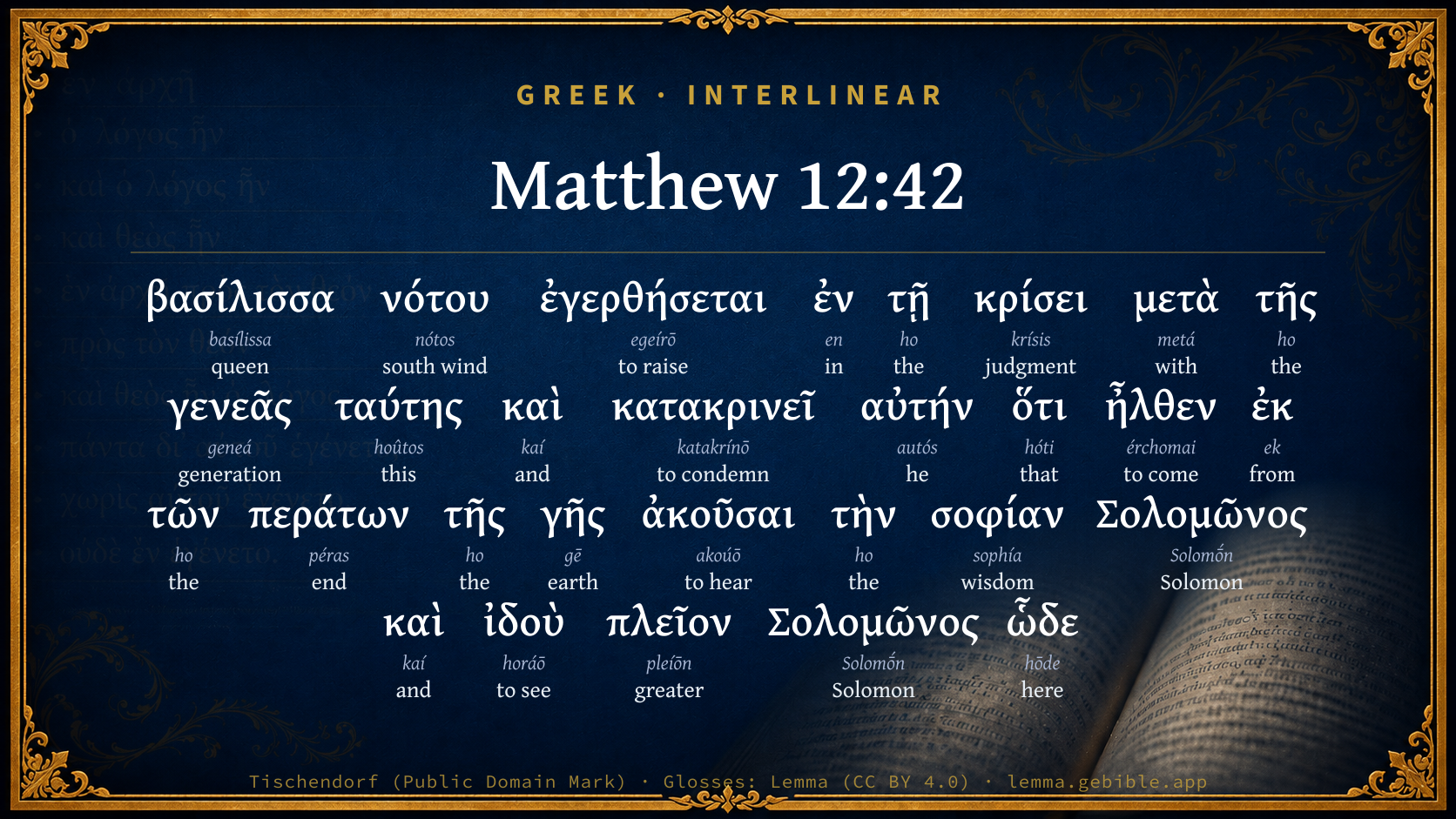
Download image
Cite this verse

Matthew 12:42 (World English Bible). Public Domain. Lemma interlinear Bible study tool, https://lemma.gebible.app/v/matthew/12/42.

Show BibTeX & RIS
BibTeX
RIS
English Translation
The queen of the south will rise up in the judgment with this generation, and will condemn it, for she came from the ends of the earth to hear the wisdom of Solomon; and behold, someone greater than Solomon is here.
World English Bible · Public Domain
Highlights
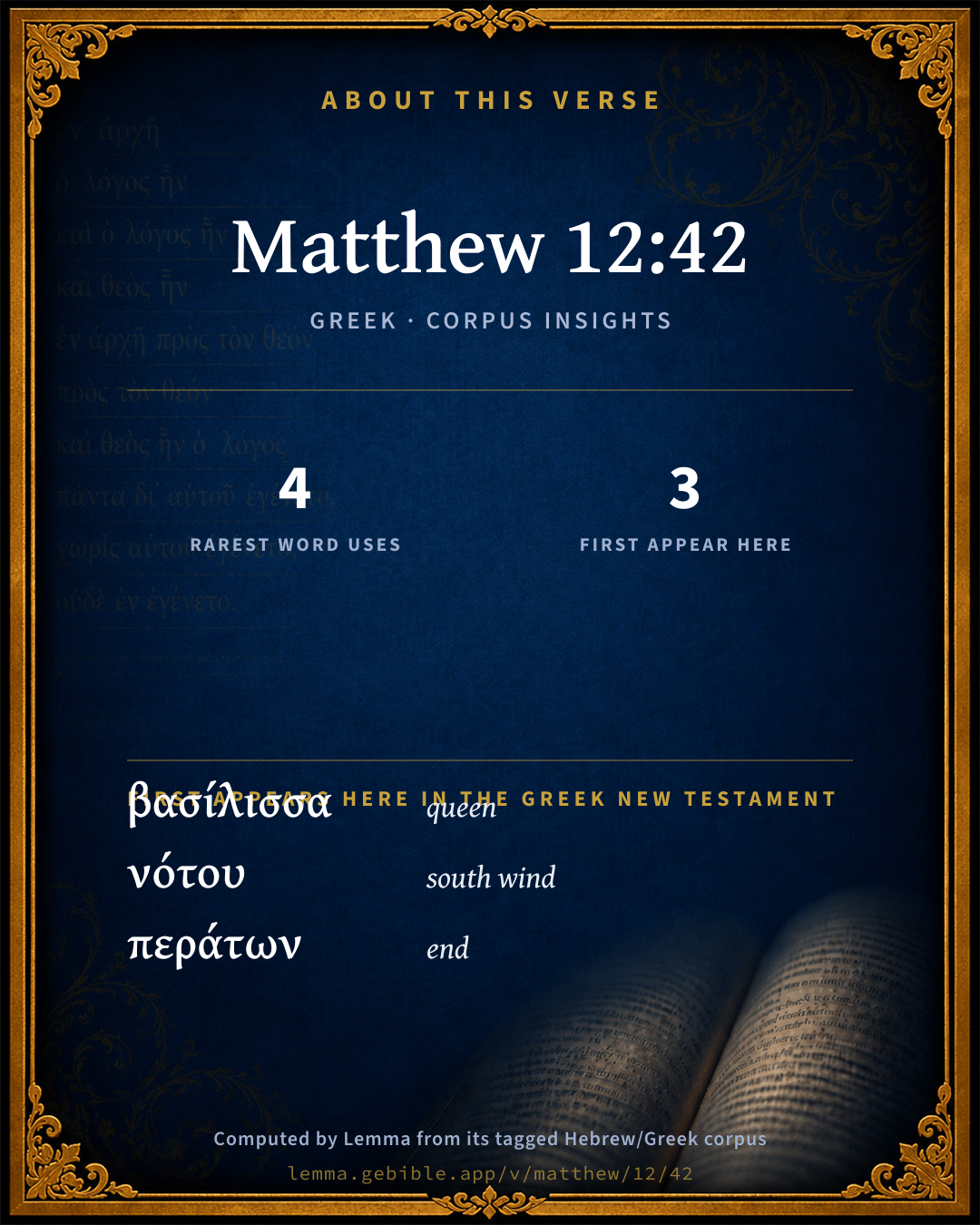
  • 3 first appearances in the Greek New Testament
Full analysis ↓
Download a study sheet

One document with this verse’s original text, its word-by-word gloss line, the meaning frame, cross-references with their text, attributed commentary, and full source and license credits — printable, and it pastes into notes with its structure intact.

This verse Autodidact and up

Study sheet (.html) Plain text (.txt)

A passage Seminary Student

Up to 50 verses in one chapter. A passage sheet keeps up to 6 commentary sources and 12 cross-references per verse, in the order this page ranks them, and says so on the sheet whenever that leaves anything out. Ask for a single verse and you get the Autodidact verse sheet above.

Everything on this page stays free to read, with no account — the sheet is a download of what is already on screen, not access to it.

Want to remove ads? Support Godless Engineer
Compare translations 3

The same verse in 3 English versions, stacked beneath the original-language interlinear above. Click any original word for its lexicon entry.

Each is an independent rendering of the whole verse — the interlinear is not word-aligned to these translations.

Highlighted words mark where these versions differ — a whole-verse word diff, not a word-by-word alignment.

  • World English Bible Public Domain
    The queen of the south will rise up in the judgment with this generation, and will condemn it, for she came from the ends of the earth to hear the wisdom of Solomon; and behold, someone greater than Solomon is here.
  • King James Version Public Domain
    The queen of the south shall rise up in the judgment with this generation, and shall condemn it: for she came from the uttermost parts of the earth to hear the wisdom of Solomon; and, behold, a greater than Solomon is here.
  • unfoldingWord Literal Text CC BY-SA 4.0
    The Queen of the South will stand up in the judgment with this generation and condemn it, for she came from the ends of the earth to hear the wisdom of Solomon, and behold, something greater than Solomon here.

unfoldingWord Literal Text — © unfoldingWord, licensed CC BY-SA 4.0. Word-aligned USFM3 via Door43 (git.door43.org/unfoldingWord/en_ult).

Versions to compare (up to 4)

3 of 4 selected

Show all 18 translations

Every available English version of this verse, each an independent rendering of the whole verse.

  • World English Bible Public Domain
    The queen of the south will rise up in the judgment with this generation, and will condemn it, for she came from the ends of the earth to hear the wisdom of Solomon; and behold, someone greater than Solomon is here.
  • Berean Standard Bible Public Domain
    The Queen of the South will rise at the judgment with this generation and condemn it; for she came from the ends of the earth to hear the wisdom of Solomon, and now One greater than Solomon is here.
  • Majority Standard Bible Public Domain
    The Queen of the South will rise at the judgment with this generation and condemn it; for she came from the ends of the earth to hear the wisdom of Solomon, and now One greater than Solomon is here.
  • King James Version Public Domain
    The queen of the south shall rise up in the judgment with this generation, and shall condemn it: for she came from the uttermost parts of the earth to hear the wisdom of Solomon; and, behold, a greater than Solomon is here.
  • American Standard Version (1901) Public Domain
    The queen of the south shall rise up in the judgment with this generation, and shall condemn it: for she came from the ends of the earth to hear the wisdom of Solomon; and behold, a greater than Solomon is here.
  • Revised Version (1885) Public Domain
    The queen of the south shall rise up in the judgment with this generation, and shall condemn it: for she came from the ends of the earth to hear the wisdom of Solomon; and behold, a greater than Solomon is here.
  • Geneva Bible (1599) Public Domain
    The Queene of the South shall rise in iudgement with this generation, and shall condemne it: for she came from the vtmost partes of the earth to heare the wisdome of Salomon: and beholde, a greater then Salomon is here.
  • Young's Literal Translation Public Domain
    `A queen of the south shall rise up in the judgment with this generation, and shall condemn it, for she came from the ends of the earth to hear the wisdom of Solomon, and lo, a greater than Solomon here!
  • Literal Standard Version CC BY-SA 4.0
    A queen of the south will rise up in the judgment with this generation, and will condemn it, for she came from the ends of the earth to hear the wisdom of Solomon, and behold, [One] greater than Solomon [is] here!
  • Unlocked Literal Bible CC BY-SA 4.0
    The Queen of the South will rise up at the judgment with the men of this generation and condemn them. She came from the ends of the earth to hear the wisdom of Solomon, and see, someone greater than Solomon is here.
  • unfoldingWord Literal Text CC BY-SA 4.0
    The Queen of the South will stand up in the judgment with this generation and condemn it, for she came from the ends of the earth to hear the wisdom of Solomon, and behold, something greater than Solomon here.
  • Darby Bible Public Domain
    A queen of [the] south shall rise up in the judgment with this generation, and shall condemn it; for she came from the ends of the earth to hear the wisdom of Solomon; and behold, more than Solomon [is] here.
  • World Messianic Bible Public Domain
    The Queen of the South will rise up in the judgment with this generation and will condemn it, for she came from the ends of the earth to hear the wisdom of Solomon; and behold, someone greater than Solomon is here.
  • Webster's Bible Public Domain
    The queen of the south shall rise up in the judgment with this generation, and shall condemn it: for she came from the uttermost parts of the earth to hear the wisdom of Solomon; and behold, a greater than Solomon is here.
  • Free Bible Version CC BY-SA 4.0
    The Queen of the South will be raised in the judgment together with this generation and will condemn it because she came from the ends of the earth to hear the wisdom of Solomon—and as you see, there's someone greater than Solomon here!
  • Bible in Basic English Public Domain
    The queen of the South will come up in the day of judging and give her decision against this generation: for she came from the ends of the earth to give ear to the wisdom of Solomon; and now a greater than Solomon is here.
  • Text-Critical English NT CC BY 4.0
    The queen of the South will rise up at the judgment with this generation and condemn it, for she came from the ends of the earth to hear the wisdom of Solomon, and behold, something greater than Solomon is here.
  • Tyndale New Testament (1534) Public Domain
    The quene of the south shall ryse at the daye of iudgement with this generacion and shall condemne the: for she came from the vtmost parties of the worlde to heare the wysdome of Salomon. And beholde a greater then Salomon is here.

Literal Standard Version (2020), Covenant Press — licensed CC BY-SA 4.0. Text via the HelloAO Bible API (eBible.org). Unlocked Literal Bible (unfoldingWord) — licensed CC BY-SA 4.0. Text via the HelloAO Bible API (eBible.org). unfoldingWord Literal Text — © unfoldingWord, licensed CC BY-SA 4.0. Word-aligned USFM3 via Door43 (git.door43.org/unfoldingWord/en_ult). Free Bible Version, Dr. Jonathan Gallagher — licensed CC BY-SA 4.0. Text via the HelloAO Bible API (eBible.org).

Word by word

More ways to search: Search by grammar → Find every occurrence → Compare this word →

Practice this passage: Drill this verse → Learn its vocabulary →

βασίλισσα
basílissa
G938
“queen”
Noun, Nominative, Singular, Feminine
Part of Speech
Noun
Case
Nominative
Number
Singular
Gender
Feminine
Full Thayer's Definition

Origin: from G936

TDNT: 10:51,0

1. queen
  1. νότου nótos G3558 “south wind” Noun, Genitive, Singular, Masculine
  2. ἐγερθήσεται egeírō G1453 “to raise” Verb, Future, Passive, Indicative, 3rd person, Singular
  3. ἐν en G1722 “in” Preposition
  4. τῇ ho G3588 “the” Article, Dative, Singular, Feminine
  5. κρίσει krísis G2920 “judgment” Noun, Dative, Singular, Feminine
  6. μετὰ metá G3326 “with” Preposition
  7. τῆς ho G3588 “the” Article, Genitive, Singular, Feminine
  8. γενεᾶς geneá G1074 “generation” Noun, Genitive, Singular, Feminine
  9. ταύτης hoûtos G3778 “this” Demonstrative pronoun, Genitive, Singular, Feminine
  10. καὶ kaí G2532 “and” Conjunction
  11. κατακρινεῖ katakrínō G2632 “to condemn” Verb, Future, Active, Indicative, 3rd person, Singular
  12. αὐτήν autós G846 “he” Personal pronoun, Accusative, Singular, Feminine
  13. ὅτι hóti G3754 “that” Conjunction
  14. ἦλθεν érchomai G2064 “to come” Verb, Aorist, Active, Indicative, 3rd person, Singular
  15. ἐκ ek G1537 “from” Preposition
  16. τῶν ho G3588 “the” Article, Genitive, Plural, Neuter
  17. περάτων péras G4009 “end” Noun, Genitive, Plural, Neuter
  18. τῆς ho G3588 “the” Article, Genitive, Singular, Feminine
  19. γῆς gē G1093 “earth” Noun, Genitive, Singular, Feminine
  20. ἀκοῦσαι akoúō G191 “to hear” Verb, Aorist, Active, Infinitive
  21. τὴν ho G3588 “the” Article, Accusative, Singular, Feminine
  22. σοφίαν sophía G4678 “wisdom” Noun, Accusative, Singular, Feminine
  23. Σολομῶνος Solomṓn G4672 “Solomon” Noun, Genitive, Singular, Masculine
  24. καὶ kaí G2532 “and” Conjunction
  25. ἰδοὺ horáō G3708 “to see” Verb, Aorist, Middle, Imperative, 2nd person, Singular
  26. πλεῖον pleíōn G4119 “greater” Adjective, Nominative, Singular, Neuter, Comparative
  27. Σολομῶνος Solomṓn G4672 “Solomon” Noun, Genitive, Singular, Masculine
  28. ὧδε hōde G5602 “here” Adverb

About this verse

These counts appear in no published source. They are computed here, from the morphology-tagged text and Lemma’s own curated glosses. What Lemma adds →

29
words
23
distinct lemmas
Gospels
section

Notable vocabulary

The rarest word here is βασίλισσα queen G938 — appearing just 4 times in the whole Greek New Testament.

First appearance in Scripture

These words make their first canonical appearance in the Greek New Testament here:

  • βασίλισσα queen G938
  • νότου south wind G3558
  • περάτων end G4009

Shared distinctive vocabulary

βασίλισσα queen G938 occurs in 4 verses of the Greek New Testament. Also found in:
Repetition

Words recur within this verse:

  • Σολομῶνος Solomon G4672 ×2
  • τῇ the G3588 ×5
  • καὶ and G2532 ×2

Cross-references

20

Topical passages linked to Matthew 12:42 in the Treasury of Scripture Knowledge — connected by theme and wording, ordered by reader-vote popularity; previews shown in the World English Bible.

  • 1 Kings 10:1–13 When the queen of Sheba heard of the fame of Solomon concerning the name of Yahweh, she came to prove him with hard questions.
  • 2 Chronicles 9:1–12 When the queen of Sheba heard of the fame of Solomon, she came to prove Solomon with hard questions at Jerusalem, with a very great train, and camels that bore spices, and gold in abundance, and precious stones: and when she was come to Solomon, she talked with him of all that was in her heart.
  • Luke 11:31–32 The Queen of the South will rise up in the judgment with the men of this generation, and will condemn them: for she came from the ends of the earth to hear the wisdom of Solomon; and behold, one greater than Solomon is here.
  • Hebrews 1:2–4 has at the end of these days spoken to us by his Son, whom he appointed heir of all things, through whom also he made the worlds.
  • Matthew 17:5 While he was still speaking, behold, a bright cloud overshadowed them. Behold, a voice came out of the cloud, saying, "This is my beloved Son, in whom I am well pleased. Listen to him."
  • John 1:14 The Word became flesh, and lived among us. We saw his glory, such glory as of the one and only Son of the Father, full of grace and truth.
  • 1 Kings 5:12 Yahweh gave Solomon wisdom, as he promised him; and there was peace between Hiram and Solomon; and they two made a league together.
  • 1 Kings 10:24 All the earth sought the presence of Solomon, to hear his wisdom, which God had put in his heart.
  • Isaiah 7:14 Therefore the Lord himself will give you a sign. Behold, the virgin will conceive, and bear a son, and shall call his name Immanuel.
  • Isaiah 9:6–7 For to us a child is born, to us a son is given; and the government shall be on his shoulder: and his name shall be called Wonderful, Counselor, Mighty God, Everlasting Father, Prince of Peace.
  • Matthew 3:17 Behold, a voice out of the heavens said, "This is my beloved Son, with whom I am well pleased."
  • John 1:18 No one has seen God at any time. The one and only Son, who is in the bosom of the Father, he has declared him.
  • Acts 8:27–28 He arose and went; and behold, there was a man of Ethiopia, a eunuch of great authority under Candace, queen of the Ethiopians, who was over all her treasure, who had come to Jerusalem to worship.
  • Philippians 2:6–7 who, existing in the form of God, didn't consider it robbery to be equal with God,
  • 1 Kings 3:9 Give your servant therefore an understanding heart to judge your people, that I may discern between good and evil; for who is able to judge this your great people?
  • 1 Kings 3:12 behold, I have done according to your word: behold, I have given you a wise and an understanding heart; so that there has been none like you before you, neither after you shall any arise like you.
  • 1 Kings 3:28 All Israel heard of the judgment which the king had judged; and they feared the king: for they saw that the wisdom of God was in him, to do justice.
  • 1 Kings 4:29 God gave Solomon wisdom and understanding exceeding much, and very great understanding, even as the sand that is on the sea-shore.
  • 1 Kings 4:34 There came of all peoples to hear the wisdom of Solomon, from all kings of the earth, who had heard of his wisdom.
  • Matthew 12:41 The men of Nineveh will stand up in the judgment with this generation, and will condemn it, for they repented at the preaching of Jonah; and behold, someone greater than Jonah is here.

Cross-references courtesy of OpenBible.info (CC BY 4.0).

Commentary

Notes on Matthew 12:42 from classic Christian and Jewish commentators (each source and its license shown beneath its notes). The classic Christian expositions comment on the surrounding passage and are grouped to its opening verse, so a note may address several verses; the Jewish commentaries on the Tanakh (Rashi and others) are per-verse, so they appear only where the commentator wrote on this verse.

Lemma curates 59 commentaries, every one of them public domain or Creative Commons licensed, each selected and text-cleaned for this edition rather than reprinted as found. About our sources →

The Biblical Illustrator

Joseph S. Exell

Mat_12:42

The Queen of the South shall rise up in judgment.

The Queen of the South, or the earnest inquirer

I. Let us commend her for her inquiring spirit.

1. She was a queen.

2. Her royal court was doubtless already stored with wisdom.

3. She came from a very great distance.

4. She was a foreigner to Solomon and had a religion already.

5. She made a journey which cost her very much expense.

6. She received no invitation.

7. The object she journeyed after was vastly inferior to that which is proposed to our inquiry.

II. How she conducted the inquiry.

1. In person.

2. She went first of all to Solomon.

3. She told him all that was in her heart.

4. She proposed to Solomon her hard questions.

5. She listened carefully to what Solomon told her.

6. She saw the house that he had built.

7. She observed the meat on his table.

8. She looked to the sitting of the servants.

III. The result of her inquiry.

1. A confession of faith.

2. A confession of her unbelief-Howbeit I believed not the words until I came, etc.

3. Her anticipations were exceeded.

4. She blessed Solomons God.

5. She gave to Solomon of her treasures.

6. Solomon made her a present of his royal bounty.

7. She went home to her nation. (C. H. Spurgeon.)

Christian put to shame by the heathen.

Wilt thou not be sore confounded, Christian, when-born, as thou art, in the bosom of the Church, in the midst of so many oracles of Scriptures, so many examples of saints-thou shalt yet see many heathens outstripping thee in goodness; so that, excepting only thy faith, which being without works shall only serve to increase thy shame, instead of adding to thy glory, thou shalt find thyself placed below an Aristides in justice, below a Zeleucus in rectitude, below a Palemon in chastity, below an Antigonus in meekness, below a Socrates in patience, below an Epaminondas in disinterestedness; men who were all of them born in the deep gloom of heathenism, never favoured (as thou hast been) with any knowledge of life eternal, with any gospel, with any sacraments-men who had never seen a God dying for them, as thou hast seen. (Segneri.)

I. She went, notwithstanding the distance of her residence. The gospel is brought to our door.

II. She went, notwithstanding all the anxieties of her public station. The claims of business must not be allowed to clash with the claims of religion,

III. She went, though uninvited. We have been invited-how often!

IV. She went to hear the wisdom of a mortal, at best fallible, and who, after all, was guilty of sad and criminal defection. We are invited to hear One greater than Solomon. Let us beware lest the Queen of the South, by her treatment of the less, become a swift witness against us on account of our treatment of the greater. (Brooks.)

Christ and Solomon

I. The comparison. Solomon a type of Christ. As the Son of David; as an eminent favourite of God; as to the extent, prosperity, peacefulness, and wisdom of His government; as the builder of the temple; and as a teacher of wisdom.

II. The superiority.

1. Christ was a Divine as well as a human character, etc.

2. Christ was the antitype, and so greater than the type. (Anon.)

Christ greater than Solomon

I. Solomon was a great querist, but Christ, the great Evangelist, answers the queries of the great Ecclesiastes.

II. Solomons teaching is mainly negative, Jesus was as mainly positive.

III. Solomon s speech was regal, but the Saviours was Divine. So great is this Prince of prophets that the least in His kingdom is greater than Solomon. (J. Hamilton, D. D.)

The Biblical Illustrator, edited by Joseph S. Exell (c. 1880s–1900s) — public domain. Text from a community e-Sword module.

Joseph Benson's Commentary

Mat 12:42. The queen of the south, &c. — Of this queen, see note on 1Ki 10:1. She came from the uttermost parts of the earth — That part of Arabia from which she came was the uttermost part of the earth that way, being bounded by the sea. A greater than Solomon is here — “Our Lord speaks of himself in this sublime language with the utmost reason, and with perfect modesty and decorum. The humble form of his appearance, and his necessary reserve in declaring himself the Messiah in so many words, made it yet more expedient, that by such phrases as these he should sometimes intimate it: and indeed his saying he was greater than Solomon, that most illustrious of all the descendants of David, was as plain an intimation as could well be given.” — Doddridge.

Joseph Benson's Commentary on the Old and New Testaments (1811–1818) — public domain. Text from a community e-Sword module.

MacLaren's Expositions of Holy Scripture

Alexander MacLaren

Matthew

‘A GREATER THAN SOLOMON’

Mat 12:42.

It is condescension in Him to compare Himself with any; yet if any might have been selected, it is that great name. To the Jews Solomon is an ideal figure, who appealed so strongly to popular imagination as to become the centre of endless legends; whose dominion was the very apex of national glory, in recounting whose splendours the historical books seem to be scarce able to restrain their triumph and pride.

I. The Man.

The story gives us a richly endowed and many-sided character. It begins with lovely, youthful enthusiasm, with a profound sense of his own weakness, with earnest longings after wisdom and guidance. He lived a pure and beautiful youth, and all his earlier and middle life was adorned with various graces. There is a certain splendid largeness about the character. He had a rich variety of gifts: he was statesman, merchant, sage, physicist, builder, one of the many-sided men whom the old world produced. And on this we may build a comparison and contrast.

The completeness of Christ’s Humanity transcends all other men, even the most various, and transcends all gathered together. Every type of excellence is in Him. We cannot say that His character is any one thing in special, it falls under no classification. It is a pure white light in which all rays are blended. This all-comprehensiveness and symmetry of character are remarkably shown in four brief records.

But we have to take into account the dark shadows that fell on Solomon’s later years. He clearly fell away from his early consecration and noble ideals, and let his sensuous appetites gain power. He countenanced, if he did not himself practise, idolatry. As a king he became an arbitrary tyrant, and his love of building led him to oppress his subjects, and so laid the foundation for the revolt under Jeroboam which rent the kingdom. So his history is another illustration of the possible shipwreck of a great character. It is one more instance of the fall of a ‘son of the morning.’ We need not elaborate the contrast with Christ’s character. In Him is no falling from a high ideal, no fading of morning glory into a cloudy noon or a lurid evening. There is no black streak in that flawless white marble. Jesus draws the perfect circle, like Giotto’s O, while all other lives show some faltering of hand, and consequent irregularity of outline. Greater than Solomon, with his over-clouded glories and his character worsened by self-indulgence, is Jesus, ‘the Sun of righteousness,’ the perfect round of whose lustrous light is broken by no spots on the surface, no indentations in the circumference, nor obscured by any clouds over its face.

II. The Teacher.

Solomon was traditionally regarded as the author of much of the Book of Proverbs, and Ecclesiastes was written as by him. Possibly the attribution to him of some share in the former book may be correct, but at any rate, his wisdom was said to have drawn the Queen of Sheba to hear him, and that is the point of the comparison of our text.

If we take these two books of Proverbs and Ecclesiastes into account, as popularly attributed to him, they suggest points of comparison and contrast with Jesus as a teacher, which we may briefly point out. Now, Proverbs falls into two very distinct portions, the former part being a connected fatherly admonition to the pursuit of wisdom, and the latter a collection of prudential maxims, in which it is rare for any two contiguous verses to have anything to do with each other. In the former part Wisdom is set forth as man’s chief good, and the Wisdom which is so set forth is mainly moral wisdom, the right disposition of will and heart, and almost identical with what the Old Testament elsewhere calls righteousness. But it is invested, as the writer proceeds, with more and more august and queenly attributes, and at last stands forth as being, if not a divine person, at least a personification of a divine attribute.

Bring that ancient teaching and set it side by side with Jesus, and what can we say but that He is what the old writer, be he Solomon or another, dimly saw? He is the ‘wisdom’ which was traditionally called the ‘wisdom of Solomon,’ and which the Queen came from far to hear. Jesus is greater, as the light is more than the eye, or as the theme is more than the speaker. ‘The power of God and the wisdom of God’ is greater than the sage or seer who celebrates it. What is true of Solomon or whoever wrote that praise of Wisdom, is true of all teachers and wise men, they are ‘not that light,’ they are ‘sent to bear witness of that light.’ Jesus is Wisdom, other men are wise. Jesus is the greatest teacher, for He teaches us Himself. He is lesson as well as teacher. Unless He was a great deal more than Teacher, He could not be the perfect Teacher for whom the world groans.

The second half of Proverbs is, as I have said, mostly a collection of prudential and moral maxims, with very little reference to God or high ideals of duty in them. They may represent to us the impotence of wise saws to get themselves practised. A guide-post is not a guide. It stretches out its gaunt wooden arms towards the city, but it cannot bend them to help a lame man lying at its foot. Men do not go wrong for lack of knowing the road, nearly so often as for lack of inclination to walk in it. We have abundant voices to tell us what we ought to do. But what we want is the swaying of inclination to do it, and the gift of power to do it. And it is precisely because Jesus gives us both these that He is what no collection of the wisest sayings can ever be, the efficient teacher of all righteousness, and of the true wisdom which is ‘the principal thing.’

As for Ecclesiastes, though not his, it represents not untruly the tone which we may suppose to have characterised his later days in its dwelling on the vanity of life. The sadness of it may be contrasted with the light thrown by the Gospel on the darkest problems. Solomon cries, ‘All is vanity’-Jesus teaches His scholars to sing, ‘All things work together for good.’

III. The Temple builder.

In this respect ‘a greater than Solomon is here,’ inasmuch as Jesus is Himself the true Temple, being for all men, which Solomon’s structure only shadowed, the meeting-place of God and man, in whom God dwells and through whom we can draw near to Him, the place where the true Sacrifice is once for all offered, by which Sacrifice sin is truly put away. And, further, Jesus is greater than Solomon in that He is, through the ages, building up the great Temple of His Church of redeemed men, the eternal temple of which not one stone shall ever be taken down.

IV. The peaceful King.

There were no wars in Solomon’s reign. But a dark shadow brooded over it in its later years, which were darkened by oppression, luxury, and incipient revolt.

Contrast with that merely external and sadly imperfect peacefulness, the deep, inward peace of spirit which Jesus breathes into every man who trusts and obeys Him, and with the peace among men which the acceptance of His rule brings, and will one day bring perfectly, to a regenerated humanity dwelling on a renewed earth. He is King of righteousness, and after that also King of peace.

Surely from all these contrasts it is plain that ‘a greater than Solomon is here.’

Alexander MacLaren, Expositions of Holy Scripture (1904–1910) — public domain. Text from a community e-Sword module.

Tyndale Open Study Notes

Tyndale Open Resources

12:42 The queen of Sheba: See 1 Kgs 10:1-13.

Tyndale Open Study Notes — © Tyndale Open Resources, licensed CC BY-SA 4.0. Text via the HelloAO Bible API.

Bengel's Gnomon

Johann Albrecht Bengel

Mat 12:42. Νότου, of the south) from Arabia-Felix.—Πλεῖον Σαλομῶνος, Something Greater than Solomon) Solomon was wise, but here is Wisdom itself.—See Luk 11:49.

Bengel's Gnomon of the New Testament — English translation (T&T Clark, Edinburgh, 1860) — public domain. Text from a community e-Sword module.

Expositor's Greek Testament

ed. W. Robertson Nicoll

Mat 12:42 . βασίλισσα νότου is next pressed into the service of putting unbelievers to shame. The form βασίλισσα was condemned by Phryn., but Elsner cites instances from Demosthenes and other good writers. J. Alberti also (Observ. Philol.) cites an instance from Athenæus, lib. xiii. 595: βασίλισσʼ ἔσει Βαβυλῶνος . The reference is to the story in 1Ki 10 and 2Ch 9 concerning the Queen of Sheba visiting Solomon. ἐκ τῶν περάτων τῆς γῆς . Elsner quotes in illustration the exhortation of Isocrates not to grudge to go a long way to hear those who profess to teach anything useful. πλεῖον Σ ., again a claim of superiority for the present over the great persons and things of the past. On the apparent egotism of these comparisons, vide my Apologetics , p. 367; and remember that Jesus claimed superiority not merely for Himself and His work, but even for the least in the Kingdom of Heaven (Mat 11:11 ).

The Expositor's Greek Testament, edited by W. Robertson Nicoll (1897–1910) — public domain. Text from a community e-Sword module.

Geneva Bible (1599)

Geneva Bible translators

He meaneth the Queen of Sheba: whose country is South in respect of the land of Israel, 1 Kings 10.

For Sheba is situated in the utmost coast of . . . Arabia at the mouth of the Arabian Sea.

Geneva Bible (1599) marginal notes — public domain. Text via Bolls.life.

Jamieson, Fausset & Brown

Robert Jamieson, A. R. Fausset & David Brown

The queen of the south shall rise up in the judgment with this generation, &c.--The queen of Sheba (a tract in Arabia, near the shores of the Red Sea) came from a remote country, "south" of Judea, to hear the wisdom of a mere man, though a gifted one, and was transported with wonder at what she saw and heard (Kg1 10:1-9). They, when a Greater than Solomon had come to them, despised and rejected, slighted and slandered Him.

Jamieson, Fausset & Brown — Commentary Critical and Explanatory on the Whole Bible (1871) — public domain (CC PDM 1.0). Text via the HelloAO Bible API.

Adam Clarke's Commentary

Verse 42. The queen of the south] In 1Kg 10:1, this queen is said to be of Saba, which was a city and province of Arabia Felix, to the south, or south-east, of Judea.

Uttermost parts of the earth] περατων της γης - a form of speech which merely signifies, a great distance. See De 28:49.

Adam Clarke's Commentary on the Bible (1810–1826) — public domain. Text from a community e-Sword/MySword module.

Ellicott's Commentary for English Readers

(42) The queen of the south.—Literally, a queen of the south, as before, men of Nineveh, the Greek having no article. Rhetorically, the absence of the article is in this case more emphatic than its presence.

A Bible Commentary for English Readers, edited by Charles John Ellicott (1878–1897) — public domain. Text from a community e-Sword module.

The Cambridge Bible for Schools and Colleges

gen. ed. J. J. S. Perowne

42. The queen of the south] So correctly and not a queen of the South as some translate. The absence of the definite article in the original is due to the influence of the Hebrew idiom. The queen of Sheba, Southern Arabia, 1Ki_10:1.

The Cambridge Bible for Schools and Colleges (gen. ed. J. J. S. Perowne; Cambridge University Press, 1878–1918) — public domain. Text from a community e-Sword module.

John Gill's Exposition

Then one said unto him,.... Either one of his auditors, or, as the Ethiopic version has it, one "of his disciples": the other evangelists intimate, that more than one acquainted him with it; which is easily reconciled: for, upon his mother and brethren calling to him, as Mark says they did; first one and then another, and more, might apprise him of it, and especially as he did not immediately go out unto them.

Behold, thy mother and thy brethren stand without, desiring to speak with thee: whether this message was carried at the request of the mother and brethren of Christ, and delivered in a simple manner, and with an honest intention; or whether it was officiously done, and with a design to interrupt him, and to try him, whether he would prefer his natural relations, and their society and conversation, to the spiritual work in which he was engaged, in doing good to the souls of men, is not certain; the latter seems probable, from the following words, and conduct of Christ. Some copies read, "desiring to see thee".

John Gill's Exposition of the Whole Bible (1746–1763) — public domain (CC PDM 1.0). Text via the HelloAO Bible API.

Trapp's Complete Commentary

John Trapp

42 The queen of the south shall rise up in the judgment with this generation, and shall condemn it: for she came from the uttermost parts of the earth to hear the wisdom of Solomon; and, behold, a greater than Solomon is here.

Ver. 42. The queen of the south, &c.] The Ethiopian chronicles call her Mackeda, and further tell us that she had a son by Solomon, whom she named David. Sure it is that she came from a far country to hear Solomon, and was so taken with his wisdom that she could have been content to have changed her throne for his footstool. Now our Saviour took it ill (and well he might) that men came not as far, and set not as high a price upon him and his doctrine as she did upon Solomon and his wisdom, how much more that these hard-hearted Jews esteemed it not, though brought home to their doors!

John Trapp, A Commentary or Exposition upon All the Books of the Old and New Testament (1647–1656) — public domain. Text from a community e-Sword module.

Haydock's Catholic Bible Commentary

Queen of Saba, a province of Arabia, situated to the south of Judea. (3 Kings x. 1. and seq.)

George Leo Haydock (1774–1849), Haydock's Catholic Family Bible and Commentary, 1859 edition — public domain. Excludes Psalms (Douay-Rheims chapter numbering differs from Protestant) and Deuterocanonical books (Catholic canon only).

Matthew Poole's English Annotations

We have the history to which this relates 1Ki 10:1, &c. She is here called the queen of the south; in the Book of Kings, and 2Ch 9:1, the queen of Sheba. Whether this Sheba, or Saba, was in Arabia or Ethiopia, is not much material; certain it is, it was southward of Judea, and a place at a great distance. Yet, saith our Saviour, though she was a great queen, though she lived at so great a distance from Jerusalem, though she had only heard of the fame and wisdom of Solomon; yet she came in person to hear his wise discourses, either about things natural or supernatural. These wretched Jews are not put to it to take a journey, I am come amongst them, I who am greater than Solomon, who am the Eternal Wisdom, and come to discourse of heavenly wisdom to them; I am come to their doors, theirs to whom the notion of a Messiah is no new thing, they have heard of me; they are no heathens, but bred up to the knowledge of God. I have done many miracles before them, yet they will not hear nor believe me. The queen of Sheba in the day of judgment shall rise up as a witness against them, when God shall condemn them for their unbelief. The more light, and means, and obligations men have upon them to faith and holiness, the greater will their judgment and condemnation be.

Matthew Poole's English Annotations on the Holy Bible (1683–1685) — public domain. Text from a community e-Sword/MySword module.

Whedon's Commentary on the Bible

Daniel D. Whedon

42. Queen of the south — Of Sheba. Alford says: “Josephus calls her ‘queen of Egypt and Ethiopia,’ that is, Meroe, whose queens were usually called Candace. Abyssinian tradition, agreeing with this account, calls her Maqueda, and supposes her to have embraced the Jewish religion in Jerusalem. The Arabians, on the other hand, also claim her, calling her Balkis, which latter is probably nearer the truth, as Sheba is a tract in Arabia Felix, near the Red Sea, near the present Aden, abounding in spice, and gold, and precious stones.”

Daniel D. Whedon (gen. ed.), Commentary on the Old and New Testaments (1874–1909) — public domain. Text from a community e-Sword module.

The Pulpit Commentary

Almost verbally identical with Luk_11:31. The queen of the south (basilissa notou , anarthrous; ver. 41, note). The south here doubtless represents part of Arabia Felix. (see Dr. Lumby, on 1Ki_10:1) Shall rise up. Does egeryhsetai here imply more effort than anasthsontai (ver. 41)? This would at least be consistent with the energy which the mention of the Queen of Sheba always suggests. In the judgment with this generation, and shall condemn it: for she came from the uttermost parts (the ends, Revised Version) of the earth. Observe the contrast; the message was brought to the Ninevites in their own homes. She marks a higher stage of inquiry and faith. To hear the wisdom of Solomon; i.e. not out of mere curiosity to see him. And, behold, a greater than Solomon is here (ver. 41, note). Observe that Christ claims for himself superiority to the one prophet that was listened to by a Gentile nation, and to the one king whose wisdom drew an inquirer from "the ends of the earth." Rightly; for the claim is confirmed by history; the Gospels have had greater influence than all the Prophets, both "former" and "later," and than all the Hekmah literature. Jesus of Nazareth has drawn all men unto him. (Joh_12:32; cf. 19)

The Pulpit Commentary (1880–1919), ed. H.D.M. Spence-Jones & Joseph S. Exell — public domain. Text from a community e-Sword module.

John Wesley's Explanatory Notes

She came from the uttermost parts of the earth - That part of Arabia from which she came was the uttermost part of the earth that way, being bounded by the sea. 1 Kings x, 1.

John Wesley, Explanatory Notes Upon the Whole Bible (1754–1765) — public domain. Text via the GEBible commentary corpus.

The People's New Testament

B. W. Johnson

42. The queen of the south. Of Sheba (1 Kings 10:1), supposed to be Sabæa in Southern Arabia. From the ends of the earth. A great distance. On the extreme southern shores of Asia. A greater than Solomon is here. A calm assertion of superhuman majesty and wisdom.

B. W. Johnson's The People's New Testament with Notes (1889–1891) — public domain. Electronic text from the Christian Classics Ethereal Library (CCEL) ThML edition.

unfoldingWord translationNotes

Door43 World Missions Community

Connecting Statement:

Jesus continues to rebuke the scribes and Pharisees.

Queen of the South

This refers to the Queen of Sheba. Sheba is a land south of Israel. (See: How to Translate Names)

will rise up at the judgment

"will stand up at the judgment"

at the judgment

"on judgment day" or "when God judges people." See how you translated this in Matthew 12:41.

this generation

This refers to the people living during the time Jesus was preaching.

and condemn them

See how you translated a similar statement in Matthew 12:41. Possible meanings are 1) "condemn" here represents accusing. AT: "and will accuse this generation of people" or 2) God will condemn this generation of people because they did not listen to wisdom as the Queen of the South had. AT: "and God will condemn this generation" (See: Metonymy)

She came from the ends of the earth

Here "ends of the earth" is an idiom that means "far away." AT: "She came from very far away" (See: Idiom)

She came from the ends of the earth to hear the wisdom of Solomon

This statement explains why the Queen of the South will condemn the people of Jesus' generation. AT: "For she came" (See: Connecting Words)

and see

"and look." This adds emphasis to what Jesus says next.

someone greater

"someone more important"

someone

Jesus is speaking about himself. (See: First, Second, or Third Person)

than Solomon is here

You can make explicit the implicit meaning of Jesus' statement. AT: "than Solomon is here, yet you do not listen. That is why God will condemn you" (See: Assumed Knowledge and Implicit Information)

translationWords

queen

judgment day

generation

wise

Solomon

unfoldingWord translationNotes — © Distant Shores Media and the Door43 World Missions Community, licensed CC BY-SA 4.0. Source: git.door43.org/Door43/en_tn.

Cambridge Greek Testament for Schools and Colleges

42. βασίλισσα νότου. ‘The Queen of the South.’ So correctly and not a queen of the South as some translate. The absence of the definite article in the original is due to the influence of the Hebrew idiom. For an account of the queen of Sheba or Southern Arabia, see 1Ki 10:1.

βασίλισσα. This form is found in all the late authors for the classical βασίλεια. See Lob. Phryn. 96.

Cambridge Greek Testament for Schools and Colleges (Cambridge University Press, 1896; 21 vols, various authors incl. Carr, Maclear, Plummer, Farrar, Lumby, Moule, M. R. James, Simcox) — public domain. Text from a community e-Sword module.

Alford’s Greek Testament

Henry Alford

42. πλεῖον Ἰωνᾶ ὧδε … πλεῖον Σολ. ὧδε] On the neuter, see above, ver. 6, note. There is more than Jonas here. No matter so worthy of arousing repentance had ever been revealed or preached as the Gospel: no matter so worthy of exciting the earnest attention of all. And the Lord Himself, the Announcer of this Gospel, is greater than all the sons of men: his preaching, greater than that of Jonah: his wisdom, than that of Solomon.

42. βασίλισσα νότου] Josephus, Antt. viii. 6. 5, calls her τὴν τῆς Αἰγύπτου καὶ τῆς Αἰθιοπίας τότε βασιλεύουσαν γυναῖκα, i.e. of Meroe (whose queens were usually called Candace. Plin. Hist. vi. 29). Abyssinian tradition agrees with this account, calls her Maqueda, and supposes her to have embraced the Jewish religion in Jerusalem. The Arabians on the other hand also claim her, calling her Balkis (Koran, c. xxvii., cited by Winer), which latter view is probably nearer the truth, Sheba being a tract in Arabia Felix, near the shores of the Red Sea, near the present Aden (see Plin. vi. 23), abounding in spice and gold and precious stones.

Henry Alford, The Greek Testament (1849–1861) — public domain. Text from a community e-Sword module.

International Critical Commentary

(L) 42. The queen of the South shall rise up at the judgement with this generation, and shall condemn it: for she came from the ends of the earth to hear the wisdom of Solomon; and, behold, more than Solomon is here.] So Lk. with τῶν ἀνδρῶν after μετά. ἐγερθήσεται is synonymous with ἀναστήσεται of v. 41. Both represent the same Aramaic word.—νότου] In 1 K 10:1 שְׁבָא = LXX. Σαβά. Jos. Ant. viii. 165 calls her queen of Egypt and Ethiopia. But Sheba was in southern Arabia. Wellhausen remarks that this is the earliest instance of the name Jemen ( = “south” = νότος) for South-West Arabia.

(L) 43-45 are placed by Lk. (11:24-26) earlier in the discourse. There they seem to illustrate the futility of the methods of the Jewish exorcists (v. 19). These seem to do the same work as Christ, but really they act against Him (v. 20); for the evil spirit whom they drive out returns, making the sufferer worse than before. In Mt. the verses seem rather to describe the condition of the Jewish nation in Christ’s time. They had formerly repented at the summons of God, and their evil spirit had been driven out. But it had returned with seven others. And now the condition of the nation was such that even the preaching of Christ had no effect. Or the passage may have been added here by the editor, with immediate reference to the preceding verses, as bearing upon the subject of exorcism with which the discourse started. It is possible that Lk. may have tried to improve the connection by placing the verses within the body of the discourse.

International Critical Commentary — older volumes (1896–1929), various authors — public domain. Text from a community e-Sword module.

Lesson kit

Teaching starters — assembled from the data on this page, not authored interpretation. Every prompt links to the verse data it draws on. Edit before teaching.

Matthew, in the Gospels, opens this verse with 29 words (23 distinct Greek lemmas). Its most distinctive word is basílissa (“queen”). A historical commentator’s framing appears above. Read the whole chapter for the surrounding context.

Discussion questions

  1. How does “queen” (basílissa) shape what this verse is saying?
  2. 3 words make their first appearance in Scripture here. What does this debut establish?
  3. How does Luke 11:31, which shares the word «queen», read alongside this verse?
  4. What does the repetition of “Solomon” (2× in this one verse) do in this verse?
  5. These translations render this verse differently; the difference is in the English rendering, not the original. What questions does that raise?
  6. Compare how The Biblical Illustrator and Joseph Benson's Commentary read this verse. Where do they agree or differ?

Things to notice

  • 3 words make their first canonical appearance in Scripture here.
  • These translations choose different wording for 9 words in this verse.
  • “Solomon” occurs 2× in this single verse.
  • 23 distinct Greek lemmas span 29 words in this verse.

Reading settings

Reading text

Shown beneath each verse's original-language words.

Old Testament
Old Testament edition

Read the OT as the Masoretic Hebrew (MT) or the Greek Septuagint (LXX).

English shown for the Greek Septuagint (in the Hebrew ↔ Greek comparison).

Comparing translations? Open the Compare panel on any verse page to stack up to four side by side.