Matthew 16:6

Greek (Tischendorf 8th ed.) Matthew 16:6 appears in the Greek New Testament. The text above is from the Tischendorf 8th edition. Each word links to its Strong’s number and a concise gloss. Click any word for its full Thayer’s Greek Lexicon entry.
Download image
Cite this verse

Matthew 16:6 (World English Bible). Public Domain. Lemma interlinear Bible study tool, https://lemma.gebible.app/v/matthew/16/6.

Show BibTeX & RIS
BibTeX
RIS
English Translation
Jesus said to them, "Take heed and beware of the yeast of the Pharisees and Sadducees."
World English Bible · Public Domain
Download a study sheet

One document with this verse’s original text, its word-by-word gloss line, the meaning frame, cross-references with their text, attributed commentary, and full source and license credits — printable, and it pastes into notes with its structure intact.

This verse Autodidact and up

Study sheet (.html) Plain text (.txt)

A passage Seminary Student

Up to 50 verses in one chapter. A passage sheet keeps up to 6 commentary sources and 12 cross-references per verse, in the order this page ranks them, and says so on the sheet whenever that leaves anything out. Ask for a single verse and you get the Autodidact verse sheet above.

Everything on this page stays free to read, with no account — the sheet is a download of what is already on screen, not access to it.

Want to remove ads? Support Godless Engineer
Compare translations 3

The same verse in 3 English versions, stacked beneath the original-language interlinear above. Click any original word for its lexicon entry.

Each is an independent rendering of the whole verse — the interlinear is not word-aligned to these translations.

Highlighted words mark where these versions differ — a whole-verse word diff, not a word-by-word alignment.

  • World English Bible Public Domain
    Jesus said to them, "Take heed and beware of the yeast of the Pharisees and Sadducees."
  • King James Version Public Domain
    Then Jesus said unto them, Take heed and beware of the leaven of the Pharisees and of the Sadducees.
  • unfoldingWord Literal Text CC BY-SA 4.0
    Now Jesus said to them, “See and guard from the yeast of the Pharisees and Sadducees.”

unfoldingWord Literal Text — © unfoldingWord, licensed CC BY-SA 4.0. Word-aligned USFM3 via Door43 (git.door43.org/unfoldingWord/en_ult).

Versions to compare (up to 4)

3 of 4 selected

Show all 19 translations

Every available English version of this verse, each an independent rendering of the whole verse.

  • World English Bible Public Domain
    Jesus said to them, "Take heed and beware of the yeast of the Pharisees and Sadducees."
  • Berean Standard Bible Public Domain
    “Watch out!” Jesus told them. “Beware of the leaven of the Pharisees and Sadducees.”
  • Majority Standard Bible Public Domain
    “Watch out!” Jesus told them. “Beware of the leaven of the Pharisees and Sadducees.”
  • King James Version Public Domain
    Then Jesus said unto them, Take heed and beware of the leaven of the Pharisees and of the Sadducees.
  • American Standard Version (1901) Public Domain
    And Jesus said unto them, Take heed and beware of the leaven of the Pharisees and Sadducees.
  • Revised Version (1885) Public Domain
    And Jesus said unto them, Take heed and beware of the leaven of the Pharisees and Sadducees.
  • Geneva Bible (1599) Public Domain
    Then Iesus said vnto them, Take heede and beware of the leauen of the Pharises and Sadduces.
  • Douay-Rheims (1899) Public Domain
    Who said to them: Take heed and beware of the leaven of the Pharisees and Sadducees.
  • Young's Literal Translation Public Domain
    and Jesus said to them, `Beware, and take heed of the leaven of the Pharisees and Sadducees;'
  • Literal Standard Version CC BY-SA 4.0
    and Jesus said to them, “Beware, and take heed of the leaven of the Pharisees and Sadducees”;
  • Unlocked Literal Bible CC BY-SA 4.0
    Jesus said to them, “Take heed and beware of the yeast of the Pharisees and Sadducees.”
  • unfoldingWord Literal Text CC BY-SA 4.0
    Now Jesus said to them, “See and guard from the yeast of the Pharisees and Sadducees.”
  • Darby Bible Public Domain
    And Jesus said to them, See and beware of the leaven of the Pharisees and Sadducees.
  • World Messianic Bible Public Domain
    Yeshua said to them, “Take heed and beware of the yeast of the Pharisees and Sadducees.”
  • Webster's Bible Public Domain
    Then Jesus said to them, Take heed and beware of the leaven of the Pharisees and of the Sadducees.
  • Free Bible Version CC BY-SA 4.0
    “Watch out for the yeast of the Pharisees and Sadducees,” Jesus told them.
  • Bible in Basic English Public Domain
    And Jesus said to them, Take care to have nothing to do with the leaven of the Pharisees and Sadducees.
  • Text-Critical English NT CC BY 4.0
    Then Jesus said to them, “Watch out and beware of the leaven of the Pharisees and Sadducees.”
  • Tyndale New Testament (1534) Public Domain
    Then Iesus sayd vnto them: Take hede and beware of the leve of the Pharises and of the Saduces.

Literal Standard Version (2020), Covenant Press — licensed CC BY-SA 4.0. Text via the HelloAO Bible API (eBible.org). Unlocked Literal Bible (unfoldingWord) — licensed CC BY-SA 4.0. Text via the HelloAO Bible API (eBible.org). unfoldingWord Literal Text — © unfoldingWord, licensed CC BY-SA 4.0. Word-aligned USFM3 via Door43 (git.door43.org/unfoldingWord/en_ult). Free Bible Version, Dr. Jonathan Gallagher — licensed CC BY-SA 4.0. Text via the HelloAO Bible API (eBible.org).

Word by word

More ways to search: Search by grammar → Find every occurrence → Compare this word →

Practice this passage: Drill this verse → Learn its vocabulary →

ζύμης
zýmē
G2219
“leaven”
Noun, Genitive, Singular, Feminine
Part of Speech
Noun
Case
Genitive
Number
Singular
Gender
Feminine
Full Thayer's Definition

Origin: probably from G2204

TDNT: 17:02,3

1. leaven 2. metaph. of inveterate mental and moral corruption, viewed in its tendency to infect others
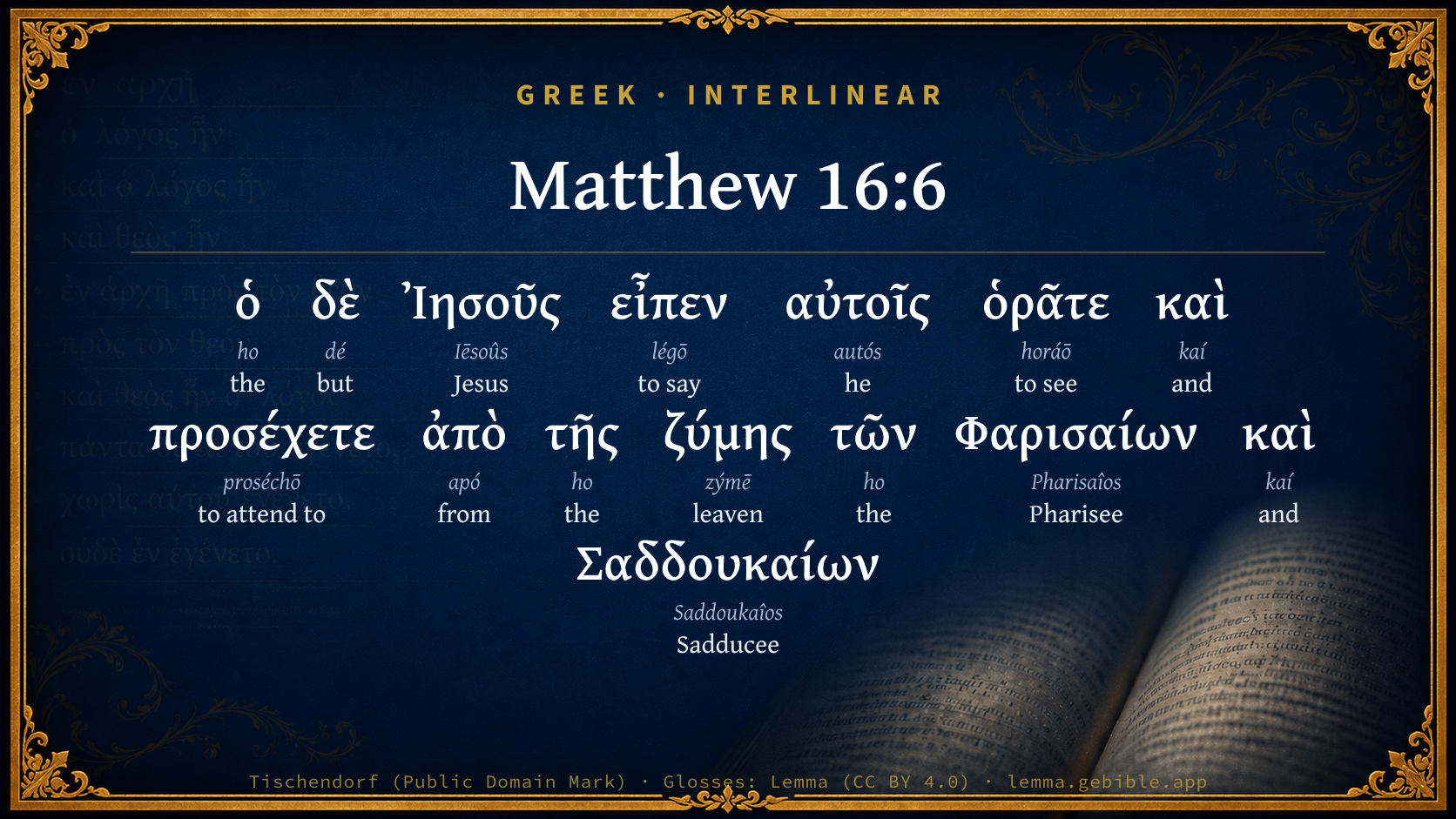
  1. ὁ ho G3588 “the” Article, Nominative, Singular, Masculine
  2. δὲ dé G1161 “but” Conjunction
  3. Ἰησοῦς Iēsoûs G2424 “Jesus” Noun, Nominative, Singular, Masculine
  4. εἶπεν légō G3004 “to say” Verb, Aorist, Active, Indicative, 3rd person, Singular
  5. αὐτοῖς autós G846 “he” Personal pronoun, Dative, Plural, Masculine
  6. ὁρᾶτε horáō G3708 “to see” Verb, Present, Active, Imperative, 2nd person, Plural
  7. καὶ kaí G2532 “and” Conjunction
  8. προσέχετε proséchō G4337 “to attend to” Verb, Present, Active, Imperative, 2nd person, Plural
  9. ἀπὸ apó G575 “from” Preposition
  10. τῆς ho G3588 “the” Article, Genitive, Singular, Feminine
  11. τῶν ho G3588 “the” Article, Genitive, Plural, Masculine
  12. Φαρισαίων Pharisaîos G5330 “Pharisee” Noun, Genitive, Plural, Masculine
  13. καὶ kaí G2532 “and” Conjunction
  14. Σαδδουκαίων Saddoukaîos G4523 “Sadducee” Noun, Genitive, Plural, Masculine

About this verse

These counts appear in no published source. They are computed here, from the morphology-tagged text and Lemma’s own curated glosses. What Lemma adds →

15
words
12
distinct lemmas
Gospels
section

Notable vocabulary

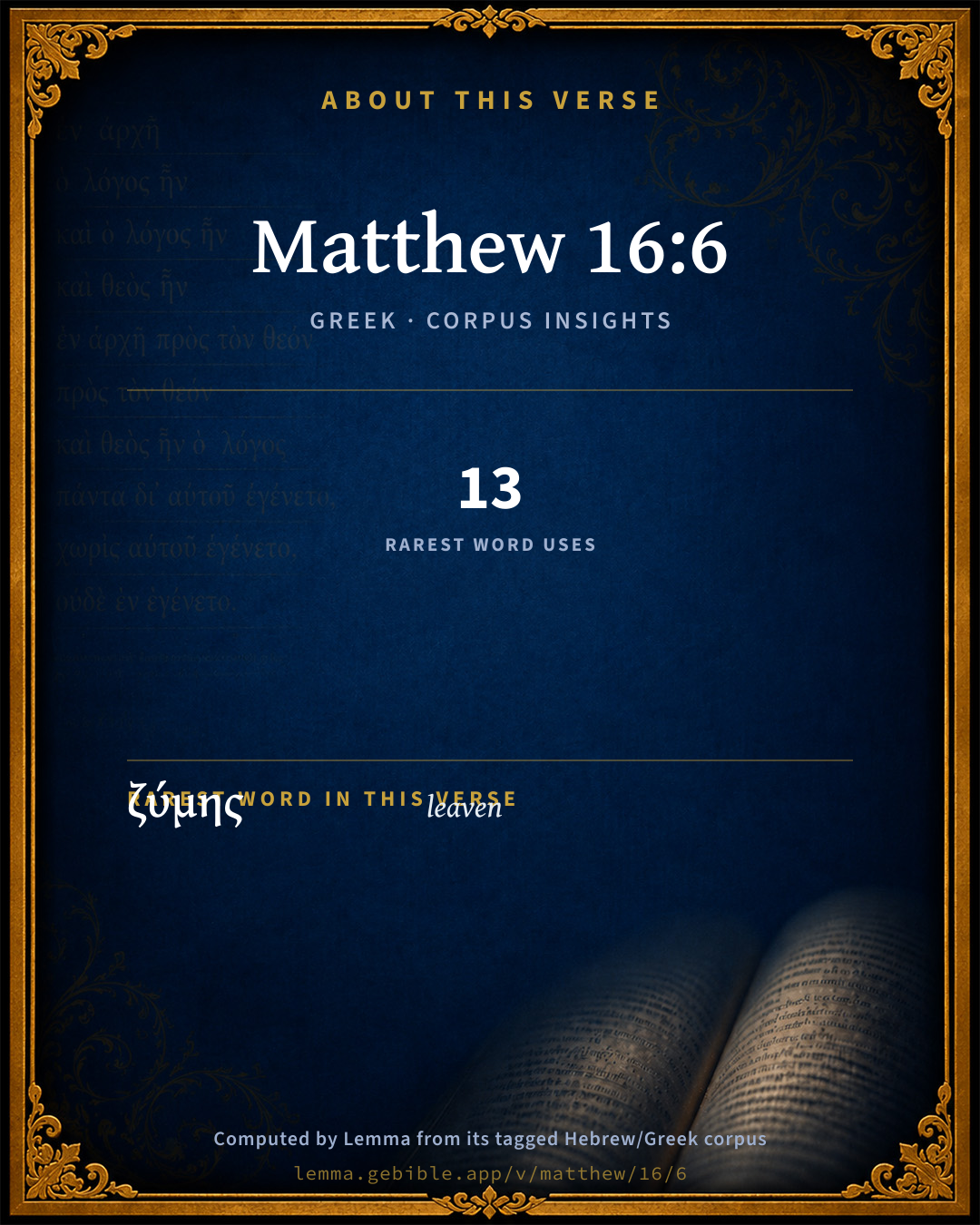
The rarest word here is ζύμης leaven G2219 — appearing just 13 times in the whole Greek New Testament.

Shared distinctive vocabulary

ζύμης leaven G2219 occurs in 11 verses of the Greek New Testament. Also found in:

Repetition

Words recur within this verse:

Cross-references

9

Topical passages linked to Matthew 16:6 in the Treasury of Scripture Knowledge — connected by theme and wording, ordered by reader-vote popularity; previews shown in the World English Bible.

  • Luke 12:1 Meanwhile, when a multitude of many thousands had gathered together, so much so that they trampled on each other, he began to tell his disciples first of all, "Beware of the yeast of the Pharisees, which is hypocrisy.
  • Matthew 16:12 Then they understood that he didn't tell them to beware of the yeast of bread, but of the teaching of the Pharisees and Sadducees.
  • Galatians 5:9 A little yeast grows through the whole lump.
  • Leviticus 2:11 "'No meal offering, which you shall offer to Yahweh, shall be made with yeast; for you shall burn no yeast, nor any honey, as an offering made by fire to Yahweh.
  • 1 Corinthians 5:6–8 Your boasting is not good. Don't you know that a little yeast leavens the whole lump?
  • Mark 8:15 He charged them, saying, "Take heed: beware of the yeast of the Pharisees and the yeast of Herod."
  • 2 Timothy 2:16–17 But shun empty chatter, for they will proceed further in ungodliness,
  • Exodus 12:15–19 Seven days shall you eat unleavened bread; even the first day you shall put away yeast out of your houses, for whoever eats leavened bread from the first day until the seventh day, that soul shall be cut off from Israel.
  • Luke 12:15 He said to them, "Beware! Keep yourselves from covetousness, for a man's life doesn't consist of the abundance of the things which he possesses."

Cross-references courtesy of OpenBible.info (CC BY 4.0).

Commentary

Notes on Matthew 16:6 from classic Christian and Jewish commentators (each source and its license shown beneath its notes). The classic Christian expositions comment on the surrounding passage and are grouped to its opening verse, so a note may address several verses; the Jewish commentaries on the Tanakh (Rashi and others) are per-verse, so they appear only where the commentator wrote on this verse.

Lemma curates 59 commentaries, every one of them public domain or Creative Commons licensed, each selected and text-cleaned for this edition rather than reprinted as found. About our sources →

The Biblical Illustrator

Joseph S. Exell

Mat_16:6; Mat_16:12

Take heed and beware of the leaven of the Pharisees and of the Sadducees.

The leaven of the Pharisees and of the Sadducees

I. The leaven of the Pharisees. The most numerous and popular sect among the Jews. Their corruptions may, for the sake of distinction, be summed up under three heads.

1. They were rigid predestinarians, or believers in what modern language calls philosophical necessity. Take heed.

2. They rejected the written Word of God as the only and sufficient standard of religious truth, and the guide of religious practice; and they observed the tradition of the elders, which often made this written law of node effect. Take heed, and beware of the very same leaven.

3. Their righteousness, though strict in its kind, was merely external; consisting chiefly in a multitude of ceremonious practices. How many are there like them? Beware!

II. The leaven of the Sadducees. Their heresy likewise may be described under three heads.-

1. They denied the fallen and depraved state of mankind; disputed the doctrine of hereditary corruption; and maintained that the will of man is, by nature, and without any special grace of God, as free to good as to evil

2. They not only rejected the traditions of the elders, but explained away much of the Old Testament, and thus rendered its teaching of none effect.

3. They denied the existence of angels and spirits, the resurrection of the dead, and a future state of rewards and punishments. Take heed, and beware! (J. Bunting, D. D.)

Erroneous doctrines are like leaven

in the following respects:-

1. They are, at first, slight and unimportant in appearance.

2. They are insinuated into the soul unawares and silently, and are difficult of detection.

3. They act gradually.

4. They act most certainly.

5. They will pervade all the soul, and bring all the faculties under their control. (A. Barnes.)

The influence of evil doctrine unperceived, yet injurious to our future welfare

Archbishop Whately has made reference to the remarkable fact that the caterpillars of moths and butterflies are often attacked by ichneumon flies, which pierce their skins and deposit their eggs in the caterpillars body. No immediate result follows, and no injury seems to have been done until the period when the caterpillar becomes a chrysalis. Instead of a beautiful moth or butterfly emerging from the latter, only the parasitic insects appear. The hidden butterfly has been silently destroyed. The Archbishops suggestive comment is-May not a man have a kind of secret enemy within-destroying his soul without interfering with his well-being during the present stage of his existence, and whose presence may never be detected till the time arrives when the last great change should take place.

The leaven of the Pharisees and Sadducees

I. In this warning, it will be observed, Pharisaic and Sadducaic tendencies are identified. Jesus speaks not of the leavens, but of one common to both sects, as if they were two species of one genus, two branches from one stem. Superficially, the two parties were diverse-the one strict, the other easy, in morals. But here extremes meet. They were all hostile to the Divine kingdom. Thus to be a Christian it is not enough to differ superficially from either Pharisees or Sadducees, but to differ radically from both. A weighty truth not yet understood. To avoid Pharisaic strictness and superstition men run into Sadducaic scepticism, both equally far horn the truth. The spirit of unbelief which ruled in Jewish society Jesus described as leaven, with special reference to its diffusiveness.

II. Jesus next found new matter for annoyance in the stupidity of friends. The disciples misunderstood the warning word. It is because we have no bread. Had they possessed more faith and spirituality they would not have put the earthly meaning into the words. How vain it is to discourse concerning Divine things to men whose minds are preoccupied with earthly cares Leaven makes them think of loaves. (A. B. Bruce, D. D.)

The Biblical Illustrator, edited by Joseph S. Exell (c. 1880s–1900s) — public domain. Text from a community e-Sword module.

Bengel's Gnomon

Johann Albrecht Bengel

Mat 16:6. Ὁρᾶτε, take heed) It is necessary to be careful of the purity of doctrine.—ζύμης, leaven) The language is metaphorical, and therefore enigmatical; and by it our Lord tries the progress of the disciples, who had already been long His hearers. The metaphor, however, alludes to the thoughts with which the mind of the disciples was then overflowing; q. d., “Do not care about the want of earthly bread, but about the perilous aliments which the hypocrites offer to your souls.” It is probable that the disciples had forgotten the loaves, because the controversy raised by the Pharisees and Sadducees (Mat 16:1) had put them into a state of anxiety and temptation. The Pharisees and Sadducees were elsewhere strongly opposed to each other, but yet on this occasion they conspire together against Jesus (see Mat 16:1); therefore He included both of them under the one title of hypocrites (Mat 16:3), and guards His disciples at once against both in this passage. And their hypocrisy itself was this leaven (Luk 12:1), induced by which, they did not acknowledge the very sufficient signs of the present time, but, on the contrary, demanded the signs of another time; whence the plural καιρῶν, times, is used in Mat 16:3.[718] The believer both believes and speaks; he who separates either of these from the other is an unbeliever, is a hypocrite; see Gnomon on ch. Mat 24:51. Neither therefore is he free from hypocrisy who has little faith; see Mat 16:8. The disciples are most opportunely admonished to beware of this leaven, as they did not yet understand it from the present signs; see Mat 16:11.[719]

[718] Nay more, every error of all sects is the one leaven, which the old man cherishes.—V. g.

[719] There is also in this a suitableness of words [His mode of address], inasmuch as the disciples, who had been present, and themselves taken a part in the proceedings, on the occasion of the divine miracles which had been twice performed in the case of bread a short time before, were feeling the need of bread, now that a sudden want of it had arisen. For that reason, they might have the more deeply been mindful of spiritual bread, and have seen clearly the need of sound doctrine.—V. g.

Bengel's Gnomon of the New Testament — English translation (T&T Clark, Edinburgh, 1860) — public domain. Text from a community e-Sword module.

Meyer's Critical & Exegetical Commentary

Heinrich August Wilhelm Meyer

Mat_16:6. The craft and malice of the Pharisees and Sadducees were still fresh in His memory, Mat_16:1-4.

ζύμην τὴν διδαχήν] ἐκάλεσεν, ὡς ὀξώδη καὶ σαπράν (Euth. Zigabenus); see Mat_16:12. The allusion is to their peculiar sectarian views, in so far as they deviated from the law. The expression is explained differently in Luk_12:1. Comp. note on Gal_5:9; 1Co_5:6. For the figurative use of שְׂאֹר by the Rabbis (as denoting the infecting influence of any one who is bad), see Buxtorf, Lex. Talm. p. 2303. Lightfoot on this passage. Used differently again in Mat_13:33.

Meyer — Critical and Exegetical Commentary on the New Testament — English translation by Peter Christie, edited by Frederick Crombie (T&T Clark, 1880) — public domain. Text from a community e-Sword module.

Expositor's Greek Testament

ed. W. Robertson Nicoll

Mat 16:6 . ὁρᾶτε καὶ προσέχετε : an abrupt, urgent admonition to look out for, in order to take heed of, a phenomenon of very sinister import; in Scottish idiom “see and beware of”. More impressive still in Mk.: ὁρᾶτε , βλέπετε , a duality giving emphasis to the command ( ἀναδίπλωσις , ἐμφαίνουσα ἐπίτασιν τῆς παραγγελίας , Euthy.). ζύμης , leaven, here conceived as an evil influence, working, however, after the same manner as the leaven in the parable (Mat 13:33 ). It Is a spirit, a zeitgeist , insinuating itself everywhere, and spreading more and more in society, which Jesus instinctively shrank from in horror, and from which He wished to guard His disciples. τῶν φαρ . καὶ Σαδ : one leaven, of two parties viewed as one, hence no article before Σαδ . Two leavens separately named in Mk., but even there juxtaposition in the warning implies affinity. The leaven of Pharisaism is made thoroughly known to us in the Gospels by detailed characterisation. Sadducaism very seldom appears on the stage, and few words of Jesus concerning it are recorded; yet enough to indicate its character as secular or “worldly”. The two classes, antagonistic at many points of belief and practice, would be at one in dislike of single-hearted devotion to truth and righteousness, whether in the Baptist (Mat 3:7 ) or in Jesus. This common action in reference to either might not be a matter of arrangement, and each might come with its own characteristic mood: the Pharisee with bitter animosity, the Sadducee with good-natured scepticism and in quest of amusement, as when they propounded the riddle about the woman married to seven brothers. Both moods revealed utter lack of appreciation, no friendship to be looked for in either quarter, both to be dreaded.

The Expositor's Greek Testament, edited by W. Robertson Nicoll (1897–1910) — public domain. Text from a community e-Sword module.

Adam Clarke's Commentary

Verse 6. Beware of the leaven] What the leaven of Pharisees and Sadducees was has been already explained, see Mt 16:1. Bad doctrines act in the soul as leaven does in meal; they assimulate the whole Spirit to their own nature. A man's particular creed has a greater influence on his tempers and conduct than most are aware of. Pride, hypocrisy, and worldly-mindedness, which constituted the leaven of the Pharisees and Sadducees, ruin the major part of the world.

Adam Clarke's Commentary on the Bible (1810–1826) — public domain. Text from a community e-Sword/MySword module.

Ellicott's Commentary for English Readers

(6) Beware of the leaven of the Pharisees.—The form of the warning was obviously determined by the fact just narrated. The Master saw the perplexed looks and heard the self reproaching or mutually accusing whispers of the disciples, and made them the text of a proverb which was a concentrated parable. As St. Mark gives the words, they stand, “Beware of the leaven of the Pharisees, and of the leaven of Herod,” and this, if we have to make our choice, we may believe to have been the form in which they were actually spoken; St. Matthew, or the report which he followed, substituting for the less known Herodians the better known Sadducees. The language of the tetrarch, as has been shown (see Note on Mat_14:2), implies that Sadduceeism had been the prevailing belief of his life, and the current of Jewish political, not to say religious, sympathies, naturally led the Sadducean priests, courting (as Caiaphas did) the favour of the Roman rulers, to fraternise with the scribes who attached themselves to the party of the tetrarch. (Comp. Act_5:17.)

A Bible Commentary for English Readers, edited by Charles John Ellicott (1878–1897) — public domain. Text from a community e-Sword module.

John Gill's Exposition

Then Jesus said unto them,.... Either taking occasion from the disciples observing that they had forgot to take bread with them, or on account of what passed between him and the Pharisees and Sadducees, he gave the following advice to his disciples;

take heed and beware of the leaven of the Pharisees and of the Sadducees. Mark, instead "of the leaven of the Sadducees", says, "the leaven of Herod"; either because Christ might caution against all three; or because the Sadducees were generally Herodians, taking Herod to be the Messiah; or were on his party, or for his government, which the Pharisees disliked; and the Herodians were generally Sadducees. By "the leaven" of these is meant their doctrine, as appears from Mat 16:12. The doctrines the Pharisees taught were the commandments and inventions of men, the traditions of the elders, free will, and justification by the works of the law: the doctrine of the Sadducees was, that there was no resurrection of the dead, nor angels, nor spirits: now because they sought secretly and artfully to infuse their notions into the minds of men; and which, when imbibed, spread their infection, and made men sour, morose, rigid, and ill natured, and swelled and puffed them up with pride and vanity, Christ compares them to leaven; and advises his disciples to look about them, to watch, and be on their guard, lest they should be infected with them.

John Gill's Exposition of the Whole Bible (1746–1763) — public domain (CC PDM 1.0). Text via the HelloAO Bible API.

Trapp's Complete Commentary

John Trapp

6 Then Jesus said unto them, Take heed and beware of the leaven of the Pharisees and of the Sadducees.

Ver. 6. Take heed and beware of the leaven] Or take knowledge of, and then take heed of, false doctrine; {a} which is fitly called leaven, because it soureth, swelleth, spreadeth, corrupteth the whole lump, and all this secretly, cunningly, easily, suddenly; neither can our eyes discern it from dough by the colour, but only our palate by the taste. Now the ear trieth words, as the mouth trieth meat, Job 34:3. Try all things before you trust anything. Those that sow false doctrine are somewhere in the Acts called λοιμοι, pests, botches, for their danger of infection, Act 24:5: some can carry their collusion so clearly, that if possible the very elect might be deceived; like serpents, they can sting without hissing; like cur-dogs, {b} suck your blood without biting. Nota est Arrii κυβεια, saith one, qua Constantini deride Nicovena elusit examen, by the cogging of a dye, by the adding of one iota, they corrupted the sense of the whole synod, {c} The Valentinians had a trick to persuade before they taught. {d} The ancient Anti-trinitarians set forth a base book of their doctrines under Cyprian’s name, and sold it dog-cheap, that men might the sooner buy it, and be led by it, as Ruffinus complains. Take heed and beware of such: ye are not ignorant of their wiles.

Of the Pharisees and of the Sadducees] Κακοι μεν θριπες, κακοι ηδε και ιπες. Never a barrel better herring. (Erasm. Adag.) Howbeit, the Sadducees affected, by their very name, to be held the only just men; haply because they held that all the reward that righteous men are to look for is here in this world. (Josephus.) The occasion of this heresy is said to be this: When Antigonus taught that we must not serve God for wages, his scholars understood him as if he had utterly denied all future rewards or recompence attending a godly life: and thence framed their heresy, denying the resurrection, world to come, angels, devils, and lived as epicures and libertines.

{a} Οραν, cognitionis est, προσεχειν, autem cautelae.

{b} A dog: now always depreciative or contemptuous; a worthless, low-bred, or snappish dog. ŒD

{c} ομοιουσιον ponentes pro ομοουσιον.

{d} Habuerunt artificium quo prius persuaderent quam docerent. Tertull.

John Trapp, A Commentary or Exposition upon All the Books of the Old and New Testament (1647–1656) — public domain. Text from a community e-Sword module.

Haydock's Catholic Bible Commentary

Beware of the leaven, &c. The disciples, not understanding the meaning of Christ’s words, supposed he was instructing them not to touch the bread of the Scribes and Pharisees. (Bible de Vence)

George Leo Haydock (1774–1849), Haydock's Catholic Family Bible and Commentary, 1859 edition — public domain. Excludes Psalms (Douay-Rheims chapter numbering differs from Protestant) and Deuterocanonical books (Catholic canon only).

Whedon's Commentary on the Bible

Daniel D. Whedon

6. Beware of the leaven of the Pharisees — The disciples doubtless were often exposed to the influence of the conversations of the Pharisees and Sadducees when our Lord was not present. In Mat_15:12-20, they had evidently come to our Lord under the influence of such a conversation. Our Lord’s refusal to grant a sign at their demand, as well as his departure, gave perhaps an air of victory to these cavillers.

Daniel D. Whedon (gen. ed.), Commentary on the Old and New Testaments (1874–1909) — public domain. Text from a community e-Sword module.

The Pulpit Commentary

The leaven. Christ"s thoughts were still fixed on the late disputants, whose powerful influence on popular opinion called for forcible warning. By "leaven" he does not here refer specially to the hypocrisy of the Pharisees and Sadducees, as in Luk_12:1, but to the evil influence which they exercised, which was diffused far and wide, and penetrated to all ranks and classes. Their unsound opinions, their inability or disinclination to enter into the spiritual sense of Scripture, vitiated their whole system, and made them dangerous teachers directly they attempted to explain or amplify the letter of Holy Writ. It was this same perverse blindness that led them to refuse to accept Jesus as Messiah in spite of all the proofs which had been brought before them. That leaven, in one aspect, was regarded as a sign of impurity and corruption, we learn from the strict rules which banished it from Divine service, and especially during the Passover season. Says St. Paul, "A little leaven leaveneth the whole lump"; (Gal_5:9) and, "Purge out the old leaven, that ye may be a new lump, even as ye are unleavened". (1Co_5:7) Elsewhere Christ makes a distinction between what these teachers taught ex cathedra, and what they put forth on their own authority or what they practised themselves. (Mat_23:2, Mat_23:3, where see note)

Dangerous leaven.

It is astonishing to us that our Lord"s disciples should have been so slow to understand the simplest metaphors employed in the teaching of their Master. When he speaks of leaven, they think of baker"s bread! The fact that the evangelists describe this singular backwardness is a strong evidence of the truthfulness of the Gospel writings; for it is not to be supposed that such humiliating circumstances would have been invented or imagined by a later generation which regarded the apostles with the greatest reverence. The backwardness itself must have been one of the trials of Christ; his efforts to meet it and overcome it reveal his wonderful patience and perseverance. By such means he succeeds in bringing his warning lesson home to the dullest comprehension (vers. 11, 12).

I THE CHURCH IS INFECTED WITH DANGEROUS LEAVEN.

1. Evil influences in her midst. The leaven is plunged into the meal; it cannot produce any effect until it is thus mixed up with what it is to influence. We have to beware, not only of entirely external dangers, but of such as are found in the very teaching and practices of Christian people.

2. Subtle influences. The leaven is almost invisible. There is at first but "a little leaven." Obscure, unobserved influences may be the causes of much serious harm.

3. Spreading influences. The growing power of the leaven, its marvellous capacity for propagating itself, makes it a serious thing to admit but a little. Sinful ideas tend to spread and permeate Christian society when once they are permitted to exist unchecked.

II THE LEAVEN OF EVIL MAY COME FROM RESPECTED AUTHORITIES, The Pharisees were the professed saints of their day; the Sadducces were the party of the priesthood and of the national council. Yet both of these were spoken of by our Lord as sources of evil influence. We can with difficulty picture to ourselves the immense significance of his words. It is as though the mediaeval Church were warned against the influence of the monks and priests; as though the Church of today were told that there was danger for her in the presence of the most pious looking of her communicants and the most respected of her ministers. Surely here is a warning against being misled by appearances in religion.

III THE LEAVEN MAY ASSUME VARIOUS FORMS. It is startling to meet this conjunction of Pharisees and Sadducees, because we know that the two parties were bitterly opposed to one another; but then we also know that they were brought into a sort o partnership in their common enmity to Jesus Christ. Now, both of them are represented as constituting the dangerous leaven.

1. Pretentious piety. This is one of the most dangerous of evil influences, because

(1) it ensnares with a show of religion, and

(2) it denies the true essence of religion. It is hypocrisy. (Luk_12:1)

2. Worldly scepticism. The doubt of the typical Sadducee was not the perplexity of the serious student of truth; it was the scoffing indifference of the man of the world who did not believe in the spiritual because his whole life was absorbed in the earthly.

IV THE DANGER OF THE LEAVEN NECESSITATES A WATCHFUL ATTITUDE. "Take heed and beware." It is not enough to cultivate Christian graces. The servant of Christ must be a soldier as well as a husbandman. He must stand as a sentry challenging all suspicious thoughts and influences. He must exercise the policeman"s office in arresting the dangerous disturbers of the peace and purity of his soul. W.F.A.

Pharisaic leaven.

In their short journeyings among the villages, and when they went east of the lake for the sake of retirement, the disciples were accustomed to carry in their little baskets sufficient food for a day or two. By some mischance the food had been forgotten on this occasion. Their minds were full of this lack of bread; and so they thought their Master"s mind must be full of the same thing. He was quite unconcerned about bodily food, and meditating on the mischievous influence, upon themselves and upon others, of the characteristic spirit and disposition of the Pharisees, of which so striking an illustration had just been given. It was an evil force, an active force, and a dangerous force.

I PHARISAIC DOCTRINE AS AN EVIL FORCE. It was the notion that a good creed will excuse an evil life; that a man may do evil that good may come; that religion is formality; that subtlety is more important than sincerity; that blind prejudice can make honest judgments. The "leaven" will go into the term "hypocrisy," or "religious insincerity;" "the unreality of a life respectable, rigid, outwardly religions, even earnest in its zeal, and yet wanting in the humility and love which are the essence of true holiness." Such hypocrisy and insincerity is a ruinous influence in character. A man cannot be noble who allows any shams. Religion a mere garb is worthless to man and dishonouring to God. Nothing roused our Lord"s indignation like the leaven of insincerity.

II PHARISAIC DOCTRINE AS AN ACTIVE FORCE. Here we find the reason for calling it leaven, which is a thing which will not keep quiet, and remain where it is and as it is. Leaven will act; it will grow ; it will push through; it will pervade. Leaven consists of plant cells, which multiply with extraordinary rapidity under favourable circumstances. A doctrine which allows licence to man"s evil passions, and hides it under a show of superior piety, is a doctrine that readily finds a sphere in man"s corrupt nature, and there it acts vigorously. A little of such leaven leaveneth the whole lump. We need to see clearly that all error is active; but all error that tends to give moral licence is, for fallen man, especially active. You can never hope to keep such error still.

III PHARISAIC DOCTRINE AS A DANGEROUS FORCE. Therefore our Lord warned his disciples against letting the Pharisaic spirit get into them unawares. It works such havoc in character. Any evil is possible to a man who once permits himself to excuse insincerity. Piety is nourished upon absolute truth and righteousness. Guile, formality, and outward show never can support it. R.T.

The Pulpit Commentary (1880–1919), ed. H.D.M. Spence-Jones & Joseph S. Exell — public domain. Text from a community e-Sword module.

John Wesley's Explanatory Notes

Beware of the leaven of the Pharisees - That is, of their false doctrine: this is elegantly so called; for it spreads in the soul, or the Church, as leaven does in meal. Luke xii, 1.

John Wesley, Explanatory Notes Upon the Whole Bible (1754–1765) — public domain. Text via the GEBible commentary corpus.

Kretzmann's Popular Commentary

Paul E. Kretzmann

The warning and its understanding:

v. 6. Then Jesus said unto them, Take heed and beware of the leaven of the Pharisees and of the Sadducees.

v. 7. And they reasoned among themselves, saying, It is because we have taken no bread.

It was on the trip across the lake that Jesus spoke to them, Mar 8:14. They were worried on account of their neglect; the single loaf of bread in the boat was on their mind. The mention of leaven, therefore, was connected in their minds with bread, and it was bread which they lacked. They argued therefore that Jesus was reproaching them for not having a sufficient number of loaves with them in the oat. It was with them as with the Christians of all times: hard for them to get away from the care of the body! They neither marked that Jesus purposely used the word "leaven," nor did they notice the emphasis upon the "Pharisees and Sadducees. " Christ’s object had been to warn them, in the form of a parabolic saying, against the doctrine of both sects, against the outward work-righteousness of the Pharisees and against the conventional, worldly bearing of the Sadducees.

Paul E. Kretzmann, Popular Commentary of the Bible (1921–1924) — public domain. Text from a community e-Sword module.

The People's New Testament

B. W. Johnson

6. Beware of the leaven of the Pharisees, etc. The teaching and influence which spreads like leaven. See verse 12. The figure of the leaven was suggested by their need of bread. Mark, instead of Sadducees, says, “of Herod.” Herod and his followers were Sadducees.

B. W. Johnson's The People's New Testament with Notes (1889–1891) — public domain. Electronic text from the Christian Classics Ethereal Library (CCEL) ThML edition.

Cambridge Greek Testament for Schools and Colleges

6. τῆς ζύμης. Teaching, which like leaven is corrupt and penetrating, cp. 1Co 5:7, ἐκκαθάρατε τὴν παλαιὰν ζύμην ἵνα ἦτε νέον φύραμα καθώς ἐστε ἄζυμοι, where the reference is to the putting away of leaven before the passover. See Schöttgen on 1Co 5:7, and cp. Hos 7:4, and note ch. Mat 13:33.

Cambridge Greek Testament for Schools and Colleges (Cambridge University Press, 1896; 21 vols, various authors incl. Carr, Maclear, Plummer, Farrar, Lumby, Moule, M. R. James, Simcox) — public domain. Text from a community e-Sword module.

Alford’s Greek Testament

Henry Alford

6. τῆς ζύμης] see beginning of note on ch. 13:33. It is from the penetrating and diffusive power of leaven that the comparison, whether for good or bad, is derived. In Luk 12:1, where the warning is given on a wholly different occasion, the leaven is explained to mean, hypocrisy; which is of all evil things the most penetrating and diffusive, and is the charge which our Lord most frequently brings against the Jewish sects.

In Mark we read, καὶ τῆς ζύμης Ἡρώδου. The Herodians were more a political than a religious sect, the dependants and supporters of the dynasty of Herod, for the most part Sadducees in religious sentiment. These, though directly opposed to the Pharisees, were yet united with them in their persecution of our Lord, see ch. 22:16: Mar 3:6. And their leaven was the same,—hypocrisy,—however it might be disguised by external difference of sentiment. They were all unbelievers at heart.

Henry Alford, The Greek Testament (1849–1861) — public domain. Text from a community e-Sword module.

International Critical Commentary

6. And Jesus said to them, Take heed, and beware of the leaven of the Pharisees and of the Sadducees.] Mk. has: “And He was charging them, saying, Take heed, beware (βλέπετε) of the leaven of the Pharisees, and of the leaven of Herod.”—προσέχετε ἀπό] see on 10:17. Luk 12:1 also has προσέχετε in this connection.—καὶ Σαδδουκαίων] Mk. has καὶ τῆς ζύμης Ἠρῴδου. It is doubtful what Mk. intended his readers to understand by the leaven of the Pharisees and of Herod. Possibly the plots of the Pharisees and the Herodians to kill Christ, cf. Mar 3:6. Mt. has understood ζύμη to mean false teaching, and therefore substitutes Σαδδουκαίων for Ἡρῴδου.

(M)

International Critical Commentary — older volumes (1896–1929), various authors — public domain. Text from a community e-Sword module.

Lesson kit

Teaching starters — assembled from the data on this page, not authored interpretation. Every prompt links to the verse data it draws on. Edit before teaching.

Matthew, in the Gospels, opens this verse with 15 words (12 distinct Greek lemmas). Its most distinctive word is zýmē (“leaven”). A historical commentator’s framing appears above. Read the whole chapter for the surrounding context.

Discussion questions

  1. The word zýmē carries the sense “leaven.” How does it shape the verse?
  2. How does Matthew 13:33, which shares the word «leaven», read alongside this verse?
  3. What does the repetition of “the” (3× in this one verse) do in this verse?
  4. The translations on this page render this verse differently — a whole-verse word diff, not a word-by-word alignment. What might account for the different wordings?
  5. Compare how The Biblical Illustrator and Bengel's Gnomon read this verse. Where do they agree or differ?

Things to notice

Reading settings

Reading text

Shown beneath each verse's original-language words.

Old Testament
Old Testament edition

Read the OT as the Masoretic Hebrew (MT) or the Greek Septuagint (LXX).

English shown for the Greek Septuagint (in the Hebrew ↔ Greek comparison).

Comparing translations? Open the Compare panel on any verse page to stack up to four side by side.