Mark 5:32

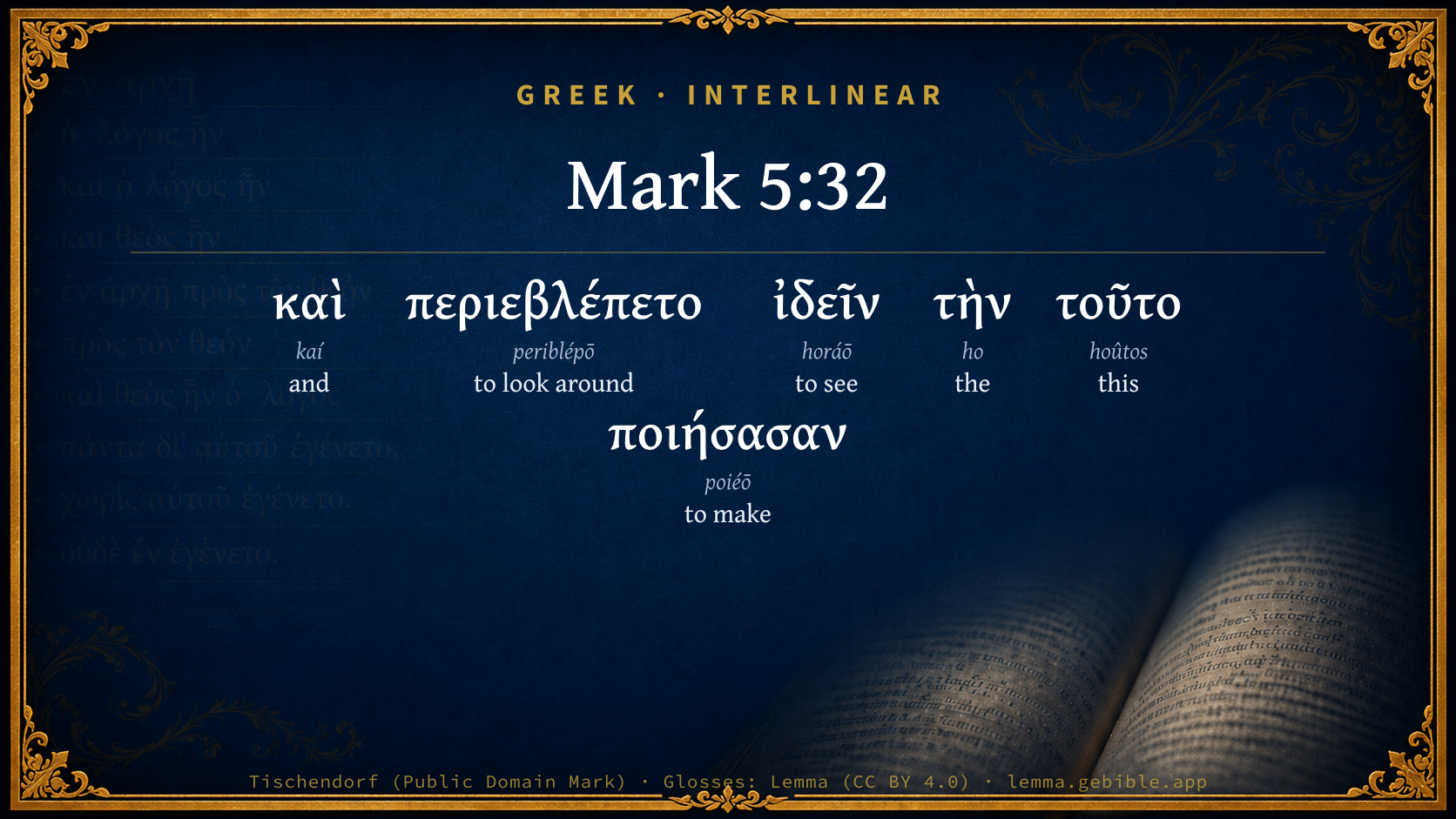
Greek (Tischendorf 8th ed.) Mark 5:32 appears in the Greek New Testament. The text above is from the Tischendorf 8th edition. Each word links to its Strong’s number and a concise gloss. Click any word for its full Thayer’s Greek Lexicon entry.
Download image
Cite this verse

Mark 5:32 (World English Bible). Public Domain. Lemma interlinear Bible study tool, https://lemma.gebible.app/v/mark/5/32.

Show BibTeX & RIS
BibTeX
RIS
English Translation
He looked around to see her who had done this thing.
World English Bible · Public Domain
Download a study sheet

One document with this verse’s original text, its word-by-word gloss line, the meaning frame, cross-references with their text, attributed commentary, and full source and license credits — printable, and it pastes into notes with its structure intact.

This verse Autodidact and up

Study sheet (.html) Plain text (.txt)

A passage Seminary Student

Up to 50 verses in one chapter. A passage sheet keeps up to 6 commentary sources and 12 cross-references per verse, in the order this page ranks them, and says so on the sheet whenever that leaves anything out. Ask for a single verse and you get the Autodidact verse sheet above.

Everything on this page stays free to read, with no account — the sheet is a download of what is already on screen, not access to it.

Want to remove ads? Support Godless Engineer
Compare translations 3

The same verse in 3 English versions, stacked beneath the original-language interlinear above. Click any original word for its lexicon entry.

Each is an independent rendering of the whole verse — the interlinear is not word-aligned to these translations.

Highlighted words mark where these versions differ — a whole-verse word diff, not a word-by-word alignment.

  • World English Bible Public Domain
    He looked around to see her who had done this thing.
  • King James Version Public Domain
    And he looked round about to see her that had done this thing.
  • unfoldingWord Literal Text CC BY-SA 4.0
    And he was looking around to see the one having done this.

unfoldingWord Literal Text — © unfoldingWord, licensed CC BY-SA 4.0. Word-aligned USFM3 via Door43 (git.door43.org/unfoldingWord/en_ult).

Versions to compare (up to 4)

3 of 4 selected

Show all 19 translations

Every available English version of this verse, each an independent rendering of the whole verse.

  • World English Bible Public Domain
    He looked around to see her who had done this thing.
  • Berean Standard Bible Public Domain
    But He kept looking around to see who had done this.
  • Majority Standard Bible Public Domain
    But He kept looking around to see who had done this.
  • King James Version Public Domain
    And he looked round about to see her that had done this thing.
  • American Standard Version (1901) Public Domain
    And he looked round about to see her that had done this thing.
  • Revised Version (1885) Public Domain
    And he looked round about to see her that had done this thing.
  • Geneva Bible (1599) Public Domain
    And he looked round about, to see her that had done that.
  • Douay-Rheims (1899) Public Domain
    And he looked about to see her who had done this.
  • Young's Literal Translation Public Domain
    And he was looking round to see her who did this,
  • Literal Standard Version CC BY-SA 4.0
    And He was looking around to see her who did this,
  • Unlocked Literal Bible CC BY-SA 4.0
    But Jesus looked around to see who had done it.
  • unfoldingWord Literal Text CC BY-SA 4.0
    And he was looking around to see the one having done this.
  • Darby Bible Public Domain
    And he looked round about to see her who had done this.
  • World Messianic Bible Public Domain
    He looked around to see her who had done this thing.
  • Webster's Bible Public Domain
    And he looked around, to see her that had done this thing.
  • Free Bible Version CC BY-SA 4.0
    But Jesus went on looking around to see who had done it.
  • Bible in Basic English Public Domain
    And on his looking round to see her who had done this thing,
  • Text-Critical English NT CC BY 4.0
    But he kept looking around to see who had done it.
  • Tyndale New Testament (1534) Public Domain
    And he loked roud about for to se her that had done that thinge.

Literal Standard Version (2020), Covenant Press — licensed CC BY-SA 4.0. Text via the HelloAO Bible API (eBible.org). Unlocked Literal Bible (unfoldingWord) — licensed CC BY-SA 4.0. Text via the HelloAO Bible API (eBible.org). unfoldingWord Literal Text — © unfoldingWord, licensed CC BY-SA 4.0. Word-aligned USFM3 via Door43 (git.door43.org/unfoldingWord/en_ult). Free Bible Version, Dr. Jonathan Gallagher — licensed CC BY-SA 4.0. Text via the HelloAO Bible API (eBible.org).

Word by word

More ways to search: Search by grammar → Find every occurrence → Compare this word →

Practice this passage: Drill this verse → Learn its vocabulary →

About this verse

These counts appear in no published source. They are computed here, from the morphology-tagged text and Lemma’s own curated glosses. What Lemma adds →

6
words
6
distinct lemmas
Gospels
section

Notable vocabulary

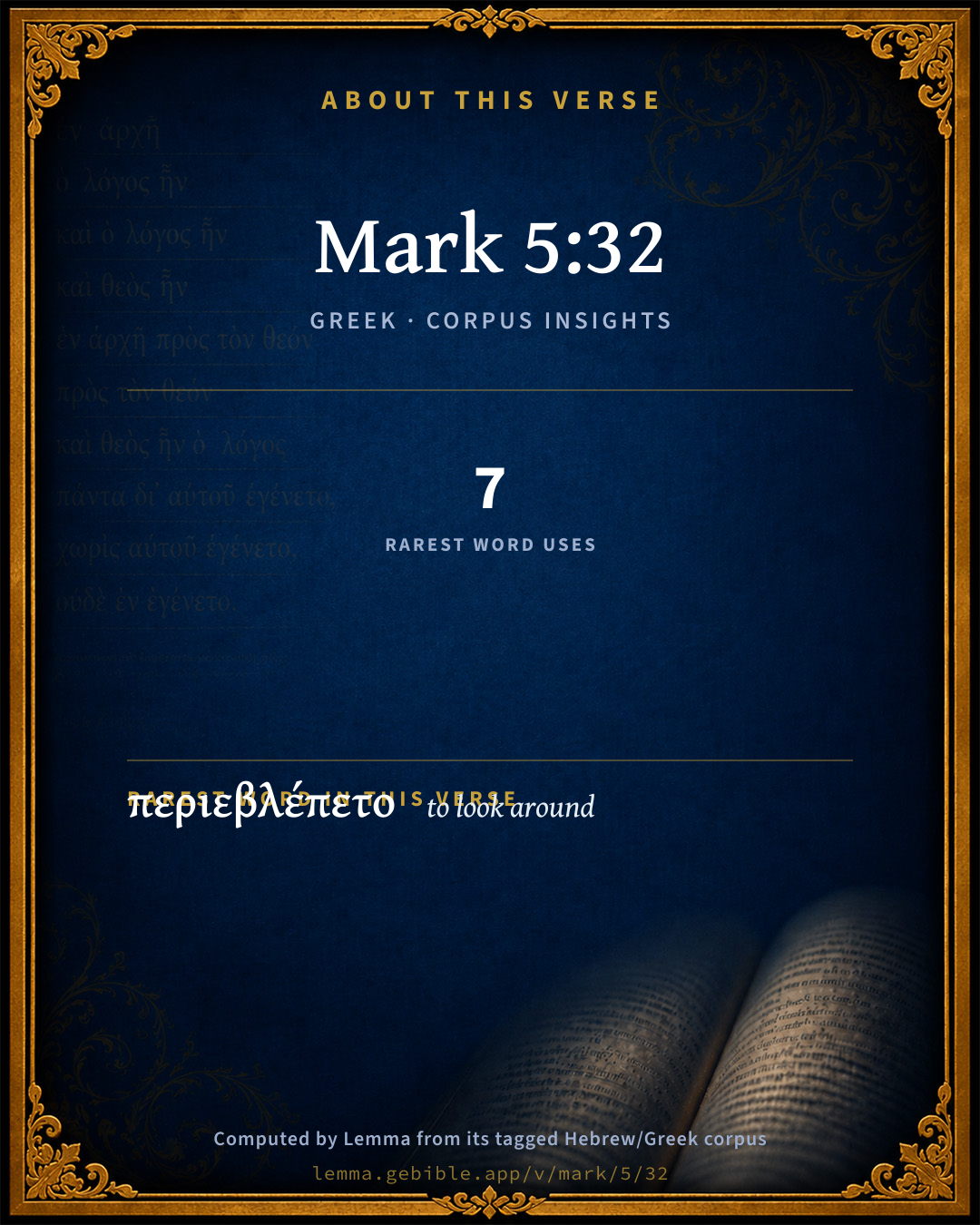
The rarest word here is περιεβλέπετο to look around G4017 — appearing just 7 times in the whole Greek New Testament.

Shared distinctive vocabulary

περιεβλέπετο to look around G4017 occurs in 7 verses of the Greek New Testament. Also found in:

Commentary

Notes on Mark 5:32 from classic Christian and Jewish commentators (each source and its license shown beneath its notes). The classic Christian expositions comment on the surrounding passage and are grouped to its opening verse, so a note may address several verses; the Jewish commentaries on the Tanakh (Rashi and others) are per-verse, so they appear only where the commentator wrote on this verse.

Lemma curates 59 commentaries, every one of them public domain or Creative Commons licensed, each selected and text-cleaned for this edition rather than reprinted as found. About our sources →

MacLaren's Expositions of Holy Scripture

Alexander MacLaren

Mark

THE LOOKS OF JESUS

Mar 5:32.

This Gospel of Mark is full of little touches that speak an eye-witness who had the gift of noting and reproducing vividly small details which make a scene live before us. Sometimes it is a word of description: ‘There was much grass in the place.’ Sometimes it is a note of Christ’s demeanour: ‘Looking up to heaven, He sighed.’ Sometimes it is the very Aramaic words He spoke: ‘Ephphatha.’ Very often the Evangelist tells us of our Lord’s looks, the gleams of pity and melting tenderness, the grave rebukes, the lofty authority that shone in them. We may well believe that on earth as in heaven, ‘His eyes were as a flame of fire,’ burning with clear light of knowledge and pure flame of love. These looks had pierced the soul, and lived for ever in the memory, of the eye-witness, whoever he was, who was the informant of Mark. Probably the old tradition is right, and it is Peter’s loving quickness of observation that we have to thank for these precious minutiae. But be that as it may, the records in this Gospel of the looks of Christ are very remarkable. My present purpose is to gather them together, and by their help to think of Him whose meek, patient ‘eye’ is ‘still upon them that fear Him,’ beholding our needs and our sins.

Taking the instances in the order of their occurrence, they are these-’He looked round on the Pharisees with anger, being grieved for the hardness of their hearts’ {Mar 3:5}. He looked on His disciples and said, ‘Behold My mother and My brethren!’ {Mar 3:32}. He looked round about to see who had touched the hem of His garment {Mar 5:32}. He turned and looked on His disciples before rebuking Peter {Mar 8:33}, He looked lovingly on the young questioner, asking what he should do to obtain eternal life {Mar 10:21}, and in the same context, He looked round about to His disciples after the youth had gone away sorrowful, and enforced the solemn lesson of His lips with the light of His eye {Mar 10:23, Mar 10:27}. Lastly, He looked round about on all things in the temple on the day of His triumphal entry into Jerusalem {Mar 11:11}. These are the instances in this Gospel. One look of Christ’s is not mentioned in it, which we might have expected-namely, that which sent Peter out from the judgment hall to break into a passion of penitent tears. Perhaps the remembrance was too sacred to be told-at all events, the Evangelist who gives us so many similar notes is silent about that look, and we have to learn of it from another.

We may throw these instances into groups according to their objects, and so bring out the many-sided impression which they produce.

I. The welcoming look of love and pity to those who seek Him.

Two of the recorded instances fall into their place here. The one is this of our text, of the woman who came behind Christ to touch His robe, and be healed: the other is that of the young ruler.

Take that first instance of the woman, wasted with disease, timid with the timidity of her sex, of her long sickness, of her many disappointments. She steals through the crowd that rudely presses on this miracle-working Rabbi, and manages somehow to stretch out a wasted arm through some gap in the barrier of people about Him, and with her pallid, trembling finger to touch the edge of His robe. The cure comes at once. It was all that she wanted, but not all that He would give her. Therefore He turns and lets His eye fall upon her. That draws her to Him. It told her that she had not been too bold. It told her that she had not surreptitiously stolen healing, but that He had knowingly given it, and that His loving pity went with it. So it confirmed the gift, and, what was far more, it revealed the Giver. She had thought to bear away a secret boon unknown to all but herself. She gets instead an open blessing, with the Giver’s heart in it.

The look that rested on her, like sunshine on some plant that had long pined and grown blanched in the shade, revealed Christ’s knowledge, sympathy, and loving power. And in all these respects it is a revelation of the Christ for all time, and for every seeking timid soul in all the crowd. Can my poor feeble hand find a cranny anywhere through which it may reach the robe? What am I, in all this great universe blazing with stars, and crowded with creatures who hang on Him, that I should be able to secure personal contact with Him? The multitude-innumerable companies from every corner of space-press upon Him and throng Him, and I-out here on the verge of the crowd-how can I get at Him?-how can my little thin cry live and be distinguishable amid that mighty storm of praise that thunders round His throne? We may silence all such hesitancies of faith, for He who knew the difference between the light touch of the hand that sought healing, and the jostling of the curious crowd, bends on us the same eye, a God’s in its perfect knowledge, a man’s in the dewy sympathy which shines in it. However imperfect may be our thoughts of His blessing, their incompleteness will not hinder our reception of His gift in the measure of our faith, and the very bestowment will teach us worthier conceptions of Him, and hearten us for bolder approaches to His grace. He still looks on trembling suppliants, though they may know their own sickness much better than they understand Him, and still His look draws us to His feet by its omniscience, pity, and assurance of help.

The other case is very different. Instead of the invalid woman, we see a young man in the full flush of his strength, rich, needing no material blessing. Pure in life, and righteous according to even a high standard of morality, he yet feels that he needs something. Having real and strong desires after ‘eternal life,’ he comes to Christ to try whether this new Teacher could say anything that would help him to the assured inward peace and spontaneous goodness for which he longed, and had not found in all the round of punctilious obedience to unloved commandments. As he kneels there before Jesus, in his eager haste, with sincere and high aspirations stamped on his young ingenuous face, Christ’s eyes turn on him, and that wonderful word stands written, ‘Jesus, beholding him, loved him.’

He reads him through and through, knowing all the imperfection of his desires after goodness and eternal life, and yet loving him with more than a brother’s love. His sympathy does not blind Jesus to the limitations and shallowness of the young man’s aspirations, but His clear knowledge of these does not harden the gaze into indifference, nor check the springing tenderness in the Saviour’s heart. And the Master’s words, though they might sound cold, and did embody a hard requirement, are beautifully represented in the story as the expression of that love. He cared for the youth too much to deceive him with smooth things. The truest kindness was to put all his eagerness to the test at once. If he accepted the conditions, the look told him what a welcome awaited him. If he started aside from them, it was best for him to find out that there were things which he loved more than eternal life. So with a gracious invitation shining in His look, Christ places the course of self-denial before him; and when he went away sorrowful, he left behind One more sorrowful than himself. We can reverently imagine with what a look Christ watched his retreating figure; and we may hope that, though he went away then, the memory of that glance of love, and of those kind, faithful words, sooner or later drew him back to his Saviour.

Is not all this too an everlasting revelation of our Lord’s attitude? We may be sure that He looks on many a heart-on many a young heart-glowing with noble wishes and half-understood longings, and that His love reaches every one who, groping for the light, asks Him what to do to inherit eternal life. His great charity ‘hopeth all things,’ and does not turn away from longings because they are too weak to lift the soul above all the weights of sense and the world. Rather He would deepen them and strengthen them, and His eternal requirements addressed to feeble wills are not meant to ‘quench the smoking flax,’ but to kindle it to decisive consecration and self-surrender. The loving look interprets the severe words. If once we meet it full, and our hearts yield to the heart that is seen in it, the cords that bind us snap, and it is no more hard to ‘count all things but loss,’ and to give up ourselves, that we may follow Him. The sad and feeble and weary who may be half despairingly seeking for alleviation of outward ills, and the young and strong and ardent whose souls are fed with high desires, have but little comprehension of one another, but Christ knows them both, and loves them both, and would draw them both to Himself.

II. The Lord’s looks of love and warning to those who have found Him.

There are three instances of this class. The first is when He looked round on His disciples and said, ‘Behold My mother and My brethren!’ {Mar 3:34}. Perhaps no moment in all Christ’s life had more of humiliation in it than that. There could be no deeper degradation than that His own family should believe Him insane. Not His brethren only, but His mother herself seems to have been shaken from her attitude of meek obedience so wonderfully expressed in her two recorded sayings, ‘Be it unto me according to Thy word,’ and ‘Whatsoever He saith unto you, do it.’ She too appears to be in the shameful conspiracy, and to have consented that her name should be used as a lure in the wily message meant to separate Him from His friends, that He might be seized and carried off as a madman. What depth of tenderness was in that slow circuit of His gaze upon the humble loving followers grouped round Him! It spoke the fullest trustfulness of them, and His rest in their sympathy, partial though it was. It went before His speech, like the flash before the report, and looked what in a moment He said, ‘Behold My mother and My brethren!’ It owned spiritual affinities as more real than family bonds, and proved that He required no more of us than He was willing to do Himself when He bid us ‘forsake father and mother, and wife and children’ for Him. We follow Him when we tread that road, hard though it be. In Him every mother may behold her son, in Him we may find more than the reality of every sweet family relationship. That same love, which identified Him with those half-enlightened followers here, still binds Him to us, and He looks down on us from amid the glory, and owns us for His true kindred.

That look of unutterable love is strangely contrasted with the next instance. We read {Mar 8:32} that Peter ‘took Him’-apart a little way, I suppose-’and began to rebuke Him.’ He turns away from the rash Apostle, will say no word to him alone, but summons the others by a glance, and then, having made sure that all were within hearing, He solemnly rebukes Peter with the sharpest words that ever fell from His lips. That look calls them to listen, not that they may be witnesses of Peter’s chastisement, but because the severe words concern them all. It bids them search themselves as they hear. They too may be ‘Satans.’ They too may shrink from the cross, and ‘mind the things that be of men.’

We may take the remaining instance along with this. It occurs immediately after the story of the young seeker, to which we have already referred. Twice within five verses {Mar 10:23 - Mar 10:27} we read that He ‘looked on His disciples,’ before He spoke the grave lessons and warnings arising from the incident. A sad gaze that would be!-full of regret and touched with warning. We may well believe that it added weight to the lesson He would teach, that surrender of all things was needed for discipleship. We see that it had been burned into the memory of one of the little group, who told long years after how He had looked upon them so solemnly, as seeming to read their hearts while He spoke. Not more searching was the light of the eyes which John in Patmos saw, ‘as a flame of fire.’ Still He looks on His disciples, and sees our inward hankerings after the things of men. All our shrinkings from the cross and cleaving to the world are known to Him. He comes to each of us with that sevenfold proclamation, ‘I know thy works,’ and from His loving lips falls on our ears the warning, emphasised by that sad, earnest gaze, ‘How hard is it for them that have riches to enter into the Kingdom of God!’ But, blessed be His name, the stooping love which claims us for His brethren shines in His regard none the less tenderly, though He reads and warns us with His eye. So, we can venture to spread all our evil before Him, and ask that He would look on it, knowing that, as the sun bleaches cloth laid in its beams, He will purge away the evil which He sees, if only we let the light of His face shine full upon us.

III. The Lord’s look of anger and pity on His opponents.

That instance occurs in the account of the healing of a man with a withered arm, which took place in the synagogue of Capernaum {Mar 3:1 - Mar 3:5}. In the vivid narrative, we can see the scribes and Pharisees, who had already questioned Him with insolent airs of authority about His breach of the Rabbinical Sabbatic rules, sitting in the synagogue, with their gleaming eyes ‘watching Him’ with hostile purpose. They hope that He will heal on the Sabbath day. Possibly they had even brought the powerless-handed man there, on the calculation that Christ could not refrain from helping him when He saw his condition. They are ready to traffic in human misery if only they can catch Him in a breach of law. The fact of a miracle if nothing. Pity for the poor man is not in them. They have neither reverence for the power of the miracle-worker, nor sympathy with His tenderness of heart. The only thing for which they have eyes is the breach of the complicated web of restrictions which they had spun across the Sabbath day. What a strange, awful power the pedantry of religious forms has of blinding the vision and hardening the heart as to the substance and spirit of religion! That Christ should heal neither made them glad nor believing, but that He should heal on the Sabbath day roused them to a deadly hatred. So there they sit, on the stretch of expectation, silently watching. He bids the man stand forth-a movement, and there the cripple stands alone in the midst of the seated congregation. Then comes the unanswerable question which cut so deep, and struck their consciences so hard that they could answer nothing, only sit and scowl at Him with a murderous light gleaming in their eyes. He fronts them with a steady gaze that travels over the whole group, and that showed to at least one who was present an unforgettable mingling of displeasure and pity. ‘He looked round about on them with anger, being grieved for the hardness of their hearts.’ In Christ’s perfect nature, anger and pity could blend in wondrous union, like the crystal and fire in the abyss before the throne.

The soul that has not the capacity for anger at evil wants something of its due perfection, and goes ‘halting’ like Jacob after Peniel. In Christ’s complete humanity, it could not but be present, but in pure and righteous form. His anger was no disorder of passion, or ‘brief madness’ that discomposed the even motion of His spirit, nor was there in it any desire for the hurt of its objects, but, on the contrary, it lay side by side with the sorrow of pity, which was intertwined with it like a golden thread. Both these two emotions are fitting to a pure manhood in the presence of evil. They heighten each other. The perfection of righteous anger is to be tempered by sympathy. The perfection of righteous pity for the evildoer is to be saved from immoral condoning of evil as if it were only calamity, by an infusion of some displeasure. We have to learn the lesson and take this look of Christ’s as our pattern in our dealings with evildoers. Perhaps our day needs more especially to remember that a righteous severity and recoil of the whole nature from sin is part of a perfect Christian character. We are so accustomed to pity transgressors, and to hear sins spoken of as if they were misfortunes mainly due to environment, or to inherited tendencies, that we are apt to forget the other truth, that they are the voluntary acts of a man who could have refrained if he had wished, and whose not having wished is worthy of blame. But we need to aim at just such a union of feeling as was revealed in that gaze of Christ’s, and neither to let our wrath dry up our pity nor our pity put out the pure flame of our indignation at evil.

That look comes to us too with a message, when we are most conscious of the evil in our own hearts. Every man who has caught even a glimpse of Christ’s great love, and has learned something of himself in the light thereof, must feel that wrath at evil sits ill on so sinful a judge as he feels himself to be. How can I fling stones at any poor creature when I am so full of sin myself? And how does that Lord look at me and all my wanderings from Him, my hardness of heart, my Pharisaism and deadness to His spiritual power and beauty? Can there be anything but displeasure in Him? The answer is not far to seek, but, familiar though it be, it often surprises a man anew with its sweetness, and meets recurring consciousness of unworthiness with a bright smile that scatters fears. In our deepest abasement we may take courage anew when we think of that wondrous blending of anger shot with pity.

IV. The look of the Lord on the profaned Temple.

On the day of Christ’s triumphal entry into Jerusalem, apparently the Sunday before His crucifixion, we find {Mar 11:11} that He went direct to the Temple, and ‘looked round about on all things.’ The King has come to His palace, the Lord has ‘suddenly come to His Temple.’ How solemn that careful, all-comprehending scrutiny of all that He found there-the bustle of the crowds come up for the Passover, the trafficking and the fraud, the heartless worship! He seems to have gazed upon all, that evening in silence, and, as the shades of night began to fall, He went back to Bethany with the Twelve. To-morrow will be time enough for the ‘whip of small cords,’ for to-day enough to have come as Lord to the temple, and with intent, all-comprehending gaze to have traversed its courts. Apparently He passed through the crowds there unnoticed, and beheld all, while Himself unrecognised.

Is not that silent, unobserved Presence, with His keen searching eye that lights on all, a solemn parable of a perpetual truth? He ‘walks amidst the seven golden candlesticks’ to-day, as in the temple of Jerusalem, and in the vision of Patmos. His eyes like a flame of fire regard and scrutinise us too. ‘I know thy works’ is still upon His lips. Silent and by many unseen, that calm, clear-eyed, loving but judging Christ walks amongst His churches to-day. Alas! what does He see there? If He came in visible form into any congregation in England to-day, would He not find merchandise in the sanctuary, formalism and unreality standing to minister, and pretence and hypocrisy bowing in worship? How much of all our service could live in the light of His felt presence? And are we never going to stir ourselves up to a truer devotion and a purer service by remembering that He is here as really as He was in the Temple of old? Our drowsy prayers, and all our conventional repetitions of devout aspirations, not felt at the moment, but inherited from our fathers, our confessions which have no penitence, our praises without gratitude, our vows which we never mean to keep, and our creeds which in no operative fashion we believe-all the hollowness of profession with no reality below it, like a great cooled bubble on a lava stream, would crash in and go to powder if once we really believed what we so glibly say-that Jesus Christ was looking at us. He keeps silence to-day, but as surely as He knows us now, so surely will He come to-morrow with a whip of small cords and purge His Temple from hypocrisy and unreality, from traffic and thieves. All the churches need the sifting. Christ has done and suffered too much for the world, to let the power of His gospel be neutralised by the sins of His professing followers, and Christ loves the imperfect friends that cleave to Him, though their service be often stained, and their consecration always incomplete, too well to suffer sin upon them. Therefore He will come to purify His Temple. Well for us, if we thankfully yield ourselves to His merciful chastisements, howsoever they may fall upon us, and believe that in them all He looks on us with love, and wishes only to separate us from that which separates us from Him! On us all that eye rests with all these emotions fused and blended in one gaze of love that passeth knowledge-a look of love and welcome whensoever we seek Him, either to help us in outward or inward blessings; a look of love and warning to us, owning us also for His brethren, and cautioning us lest we stray from His side; a look of love and displeasure at any sin that blinds us to His gracious beauty; a look of love and observance of our poor worship and spotted sacrifices.

Let us lay ourselves full in the sunshine of His gaze, and take for ours the old prayer, ‘Search me, O Christ, and know my heart!’ It is heaven on earth to feel His eye resting upon us, and know that it is love. It will be the heaven of heaven to see Him ‘face to face,’ and ‘to know even as we are known.’

Alexander MacLaren, Expositions of Holy Scripture (1904–1910) — public domain. Text from a community e-Sword module.

Expositor's Greek Testament

ed. W. Robertson Nicoll

Mar 5:32 . περιεβλέπετο : Jesus, knowing well the difference between touch and touch, regardless of what the disciples had plausibly said, kept looking around in quest of the person who had touched Him meaningfully. τὴν τ . ποιήσασαν : feminine, a woman’s touch. Did Jesus know that, or is it the evangelist choosing the gender in accordance with the now known fact? (Meyer and Weiss). The former possible, without preternatural knowledge, through extreme sensitiveness.

The Expositor's Greek Testament, edited by W. Robertson Nicoll (1897–1910) — public domain. Text from a community e-Sword module.

Ellicott's Commentary for English Readers

(32) He looked round about.—The tense of the Greek verb implies a continued looking.

A Bible Commentary for English Readers, edited by Charles John Ellicott (1878–1897) — public domain. Text from a community e-Sword module.

The Cambridge Bible for Schools and Colleges

gen. ed. J. J. S. Perowne

32. he looked round] Another proof of St Mark’s graphic power. The tense in the original is still more expressive. It denotes that He kept on looking all round, that His eyes wandered over one after the other of the many faces before Him, till they fell on her who had done this thing.

The Cambridge Bible for Schools and Colleges (gen. ed. J. J. S. Perowne; Cambridge University Press, 1878–1918) — public domain. Text from a community e-Sword module.

John Gill's Exposition

And he looked round about,.... The press and throng of people, on every side of him; though he knew very well where she stood, who had done the thing, and had received the cure:

to see her that had done this thing; how she looked, and whether her countenance, and the confusion she was thrown into by the question, would not betray her; though he himself wanted no such signs, by which to discover her. Christ, as God, being omniscient, knew who she was, and where she was; and, as man, did not want to see her to gratify his curiosity: nor was his view to chide her for what she had done, but to express his well pleasedness in her faith and actions, and to observe it to others, and the cure she had; not in an ostentatious way, to gain glory to himself, but to commend her faith, and encourage others in the exercise of it on him; and especially Jairus, the ruler of the synagogue, who was with him, and in great distress, on account of his daughter, whom Christ was going to raise from the dead.

John Gill's Exposition of the Whole Bible (1746–1763) — public domain (CC PDM 1.0). Text via the HelloAO Bible API.

Trapp's Complete Commentary

John Trapp

31 And his disciples said unto him, Thou seest the multitude thronging thee, and sayest thou, Who touched me?

32 And he looked round about to see her that had done this thing.

Ver. 32. And he looked round about] He confuted the rashness of his disciples, not with words, but looks. We may more fitly sometimes signify our dislike of sin by frowns than by speeches. As the north wind drives away rain, &c.

John Trapp, A Commentary or Exposition upon All the Books of the Old and New Testament (1647–1656) — public domain. Text from a community e-Sword module.

The Pulpit Commentary

He looked round about (perieblepeto) another favourite word of St. Mark.

The Pulpit Commentary (1880–1919), ed. H.D.M. Spence-Jones & Joseph S. Exell — public domain. Text from a community e-Sword module.

Cambridge Greek Testament for Schools and Colleges

32. περιεβλέπετο ἰδεῖν. Lk. records a reply to Peter; but it seems to be constructed out of our Mar 5:30. Here Christ makes no reply, but follows up His own question with a searching look all round (Mar 3:5; Mar 3:34, Mar 10:23, Mar 11:11); and this is more impressive. The fem. τὴν τ. ποιήσασαν may mean that He already knew who she was. But it probably merely anticipates the discovery, for the imperf. implies that He continued looking around before the ἰδεῖν (Mar 4:12) took place.

Cambridge Greek Testament for Schools and Colleges (Cambridge University Press, 1896; 21 vols, various authors incl. Carr, Maclear, Plummer, Farrar, Lumby, Moule, M. R. James, Simcox) — public domain. Text from a community e-Sword module.

Alford’s Greek Testament

Henry Alford

32.] Peculiar to Mark, and indicative of an eye-witness.

34.] καὶ ἴσθι … σου, peculiar to Mark, and inexplicable, except because the Lord really spoke the words, as a solemn ratification of the healing which she had as it were surreptitiously obtained: see note on Luke, ver. 48.

Henry Alford, The Greek Testament (1849–1861) — public domain. Text from a community e-Sword module.

International Critical Commentary

32. τὴν τοῦτο ποιήσασαν—her who did this. This is anticipating the result of his search. Jesus was ignorant who had done it, and so of course, whether it was man or woman.

International Critical Commentary — older volumes (1896–1929), various authors — public domain. Text from a community e-Sword module.

Vincent's Word Studies in the New Testament

Marvin R. Vincent

He looked round about [περιεβλεπετο] . Imperfect tense. He kept looking around for the woman, who had hidden herself in the crowd.

Marvin R. Vincent, Word Studies in the New Testament (1887–1900) — public domain. Text from a community e-Sword/MySword module.

Lesson kit

Teaching starters — assembled from the data on this page, not authored interpretation. Every prompt links to the verse data it draws on. Edit before teaching.

Mark, in the Gospels, opens this verse with 6 words (6 distinct Greek lemmas). Its most distinctive word is periblépō (“to look around”). A historical commentator’s framing appears above. Read the whole chapter for the surrounding context.

Discussion questions

  1. The word periblépō carries the sense “to look around.” How does it shape the verse?
  2. How does Mark 3:5, which shares the word «to look around», read alongside this verse?
  3. The translations on this page render this verse differently — a whole-verse word diff, not a word-by-word alignment. What might account for the different wordings?
  4. Compare how MacLaren's Expositions of Holy Scripture and Expositor's Greek Testament read this verse. Where do they agree or differ?

Things to notice

Reading settings

Reading text

Shown beneath each verse's original-language words.

Old Testament
Old Testament edition

Read the OT as the Masoretic Hebrew (MT) or the Greek Septuagint (LXX).

English shown for the Greek Septuagint (in the Hebrew ↔ Greek comparison).

Comparing translations? Open the Compare panel on any verse page to stack up to four side by side.