Mark 7:2

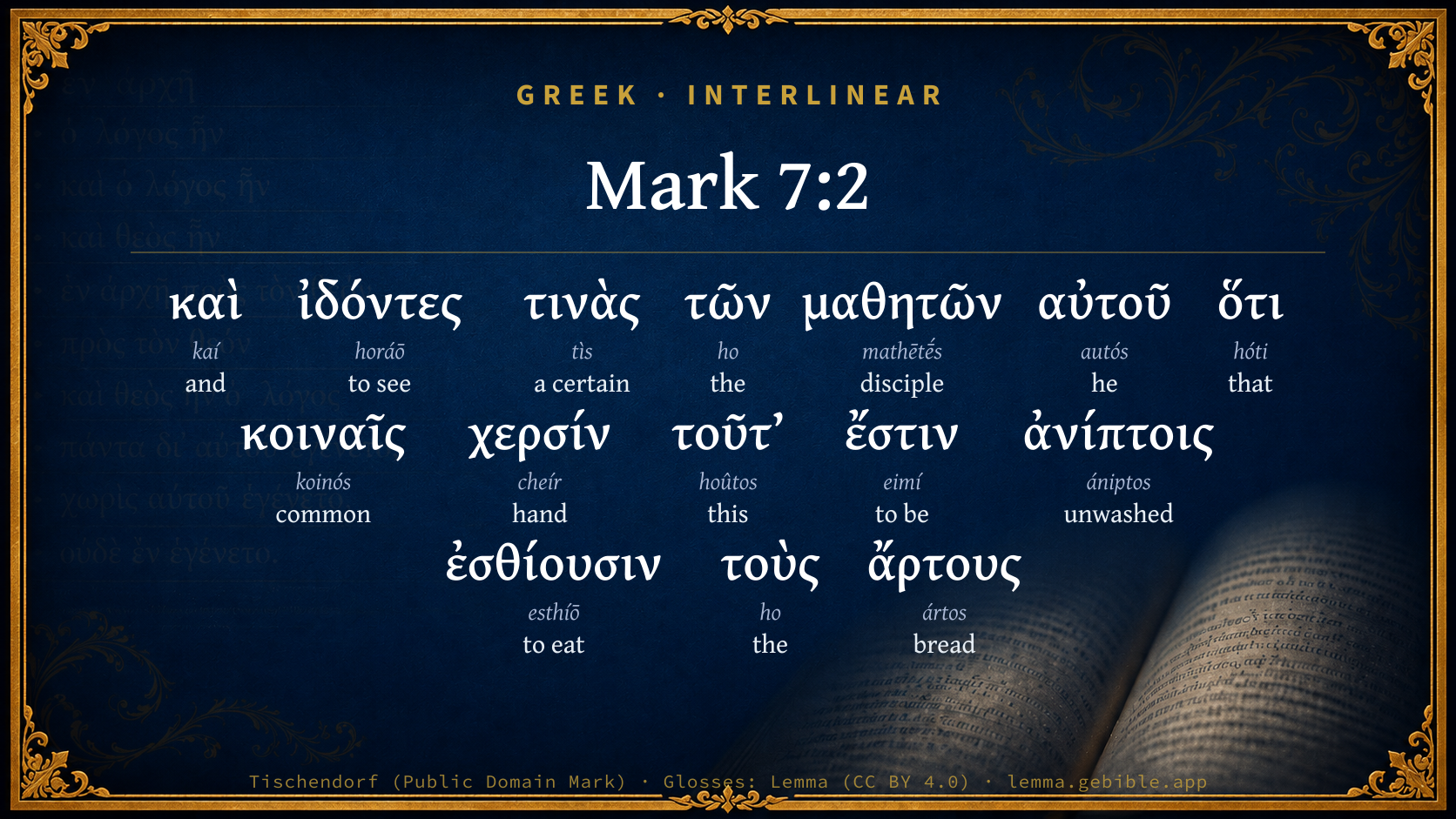
Greek (Tischendorf 8th ed.) Mark 7:2 appears in the Greek New Testament. The text above is from the Tischendorf 8th edition. Each word links to its Strong’s number and a concise gloss. Click any word for its full Thayer’s Greek Lexicon entry.
Download image
Cite this verse

Mark 7:2 (World English Bible). Public Domain. Lemma interlinear Bible study tool, https://lemma.gebible.app/v/mark/7/2.

Show BibTeX & RIS
BibTeX
RIS
English Translation
Now when they saw some of his disciples eating bread with defiled, that is, unwashed, hands, they found fault.
World English Bible · Public Domain
Highlights
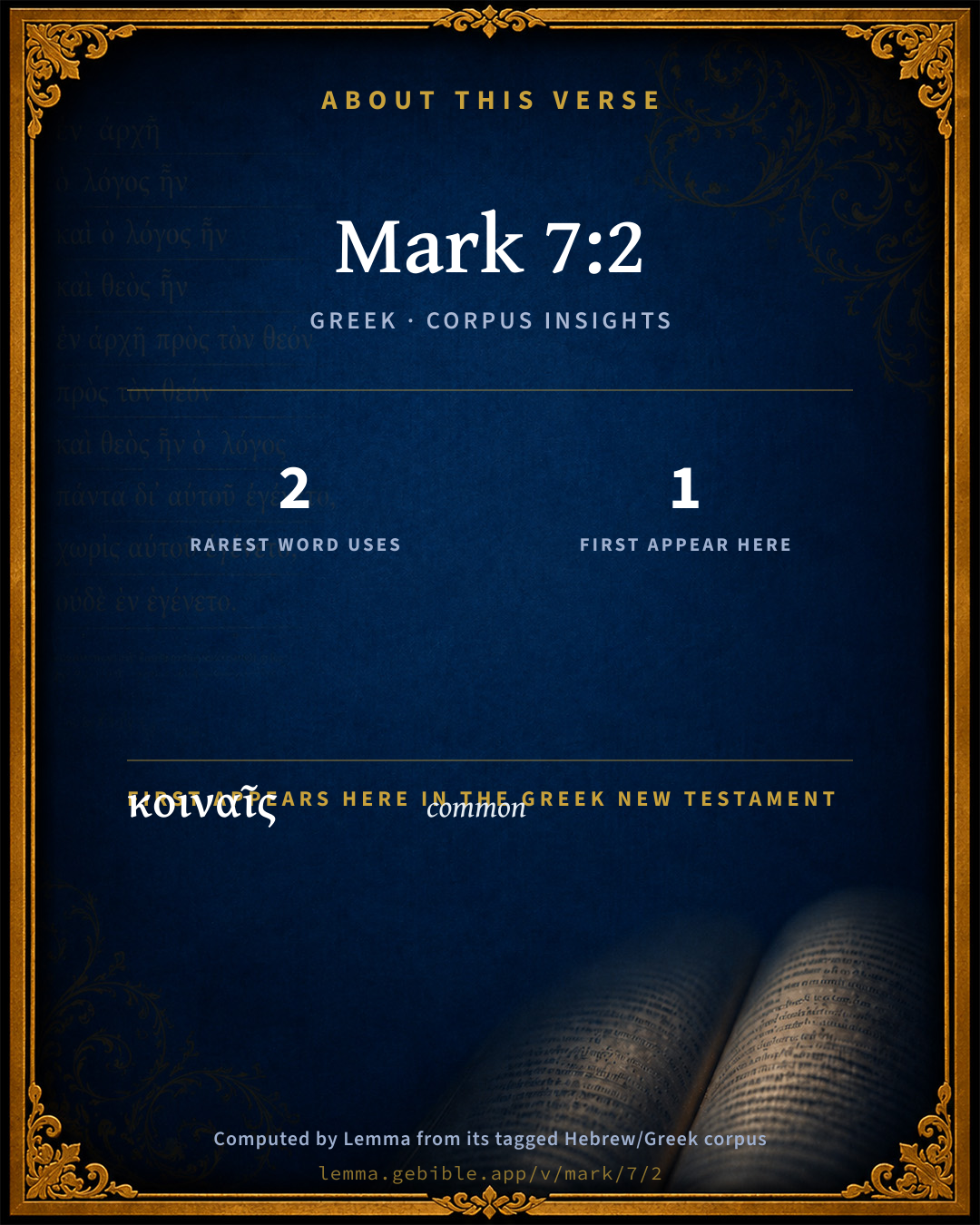
  • 1 first appearance in the Greek New Testament
Full analysis ↓
Download a study sheet

One document with this verse’s original text, its word-by-word gloss line, the meaning frame, cross-references with their text, attributed commentary, and full source and license credits — printable, and it pastes into notes with its structure intact.

This verse Autodidact and up

Study sheet (.html) Plain text (.txt)

A passage Seminary Student

Up to 50 verses in one chapter. A passage sheet keeps up to 6 commentary sources and 12 cross-references per verse, in the order this page ranks them, and says so on the sheet whenever that leaves anything out. Ask for a single verse and you get the Autodidact verse sheet above.

Everything on this page stays free to read, with no account — the sheet is a download of what is already on screen, not access to it.

Want to remove ads? Support Godless Engineer
Compare translations 3

The same verse in 3 English versions, stacked beneath the original-language interlinear above. Click any original word for its lexicon entry.

Each is an independent rendering of the whole verse — the interlinear is not word-aligned to these translations.

Highlighted words mark where these versions differ — a whole-verse word diff, not a word-by-word alignment.

  • World English Bible Public Domain
    Now when they saw some of his disciples eating bread with defiled, that is, unwashed, hands, they found fault.
  • King James Version Public Domain
    And when they saw some of his disciples eat bread with defiled, that is to say, with unwashen, hands, they found fault.
  • unfoldingWord Literal Text CC BY-SA 4.0
    And having seen some of his disciples, that they eat loaves with defiled hands, that is, unwashed—

unfoldingWord Literal Text — © unfoldingWord, licensed CC BY-SA 4.0. Word-aligned USFM3 via Door43 (git.door43.org/unfoldingWord/en_ult).

Versions to compare (up to 4)

3 of 4 selected

Show all 19 translations

Every available English version of this verse, each an independent rendering of the whole verse.

  • World English Bible Public Domain
    Now when they saw some of his disciples eating bread with defiled, that is, unwashed, hands, they found fault.
  • Berean Standard Bible Public Domain
    and they saw some of His disciples eating with hands that were defiled—that is, unwashed.
  • Majority Standard Bible Public Domain
    And seeing some of His disciples eating with hands that were defiled (that is, unwashed), they found fault.
  • King James Version Public Domain
    And when they saw some of his disciples eat bread with defiled, that is to say, with unwashen, hands, they found fault.
  • American Standard Version (1901) Public Domain
    and had seen that some of his disciples ate their bread with defiled, that is, unwashen, hands.
  • Revised Version (1885) Public Domain
    and had seen that some of his disciples ate their bread with defiled, that is, unwashen, hands.
  • Geneva Bible (1599) Public Domain
    And when they sawe some of his disciples eate meate with common hands, (that is to say, vnwashen) they complained.
  • Douay-Rheims (1899) Public Domain
    And when they had seen some of his disciples eat bread with common, that is, with unwashed hands, they found fault.
  • Young's Literal Translation Public Domain
    and having seen certain of his disciples with defiled hands -- that is, unwashed -- eating bread, they found fault;
  • Literal Standard Version CC BY-SA 4.0
    and having seen certain of His disciples with defiled hands—that is, unwashed—eating bread, they found fault;
  • Unlocked Literal Bible CC BY-SA 4.0
    They saw that some of his disciples ate bread with hands that were defiled, that is, unwashed.
  • unfoldingWord Literal Text CC BY-SA 4.0
    And having seen some of his disciples, that they eat loaves with defiled hands, that is, unwashed—
  • Darby Bible Public Domain
    and seeing some of his disciples eat bread with defiled, that is, unwashed, hands,
  • World Messianic Bible Public Domain
    Now when they saw some of his disciples eating bread with defiled, that is unwashed, hands, they found fault.
  • Webster's Bible Public Domain
    And when they saw some of his disciples eating bread with defiled (that is to say with unwashed) hands, they found fault.
  • Free Bible Version CC BY-SA 4.0
    noticed that some of his disciples ate with “unclean” (meaning unwashed) hands.
  • Bible in Basic English Public Domain
    And had seen that some of his disciples took their bread with unclean, that is, unwashed, hands.
  • Text-Critical English NT CC BY 4.0
    When they saw some of his disciples eating bread with hands that were defiled (that is, unwashed), they criticized them.
  • Tyndale New Testament (1534) Public Domain
    And when they sawe certayne of his disciples eate breed with comen hondes (that is to saye with vnwesshen hondes) they complayned.

Literal Standard Version (2020), Covenant Press — licensed CC BY-SA 4.0. Text via the HelloAO Bible API (eBible.org). Unlocked Literal Bible (unfoldingWord) — licensed CC BY-SA 4.0. Text via the HelloAO Bible API (eBible.org). unfoldingWord Literal Text — © unfoldingWord, licensed CC BY-SA 4.0. Word-aligned USFM3 via Door43 (git.door43.org/unfoldingWord/en_ult). Free Bible Version, Dr. Jonathan Gallagher — licensed CC BY-SA 4.0. Text via the HelloAO Bible API (eBible.org).

Word by word

More ways to search: Search by grammar → Find every occurrence → Compare this word →

Practice this passage: Drill this verse → Learn its vocabulary →

ἀνίπτοις
ániptos
G449
“unwashed”
Adjective, Dative, Plural, Feminine
Part of Speech
Adjective
Case
Dative
Number
Plural
Gender
Feminine
Full Thayer's Definition

Origin: from G1 (as a negative particle) and a presumed derivative of G3538

TDNT: 19:47,6

1. unwashed
  1. καὶ kaí G2532 “and” Conjunction
  2. ἰδόντες horáō G3708 “to see” Verb, Aorist, Active, Participle, Nominative, Plural, Masculine
  3. τινὰς tìs G5100 “a certain” Indefinite pronoun, Accusative, Plural, Masculine
  4. τῶν ho G3588 “the” Article, Genitive, Plural, Masculine
  5. μαθητῶν mathētḗs G3101 “disciple” Noun, Genitive, Plural, Masculine
  6. αὐτοῦ autós G846 “he” Personal pronoun, Genitive, Singular, Masculine
  7. ὅτι hóti G3754 “that” Conjunction
  8. κοιναῖς koinós G2839 “common” Adjective, Dative, Plural, Feminine
  9. χερσίν cheír G5495 “hand” Noun, Dative, Plural, Feminine
  10. τοῦτ’ hoûtos G3778 “this” Demonstrative pronoun, Nominative, Singular, Neuter
  11. ἔστιν eimí G1510 “to be” Verb, Present, Active, Indicative, 3rd person, Singular
  12. ἐσθίουσιν esthíō G2068 “to eat” Verb, Present, Active, Indicative, 3rd person, Plural
  13. τοὺς ho G3588 “the” Article, Accusative, Plural, Masculine
  14. ἄρτους ártos G740 “bread” Noun, Accusative, Plural, Masculine

About this verse

These counts appear in no published source. They are computed here, from the morphology-tagged text and Lemma’s own curated glosses. What Lemma adds →

15
words
14
distinct lemmas
Gospels
section

Notable vocabulary

The rarest word here is ἀνίπτοις unwashed G449 — appearing just 2 times in the whole Greek New Testament.

First appearance in Scripture

This word makes its first canonical appearance in the Greek New Testament here:

  • κοιναῖς common G2839

Shared distinctive vocabulary

ἀνίπτοις unwashed G449 occurs in 2 verses of the Greek New Testament. Also found in:

Repetition

A word recurs within this verse:

Cross-references

7

Topical passages linked to Mark 7:2 in the Treasury of Scripture Knowledge — connected by theme and wording, ordered by reader-vote popularity; previews shown in the World English Bible.

  • Acts 10:28 He said to them, "You yourselves know how it is an unlawful thing for a man who is a Jew to join himself or come to one of another nation, but God has shown me that I shouldn't call any man unholy or unclean.
  • Matthew 7:3–5 Why do you see the speck that is in your brother's eye, but don't consider the beam that is in your own eye?
  • Romans 14:14 I know, and am persuaded in the Lord Jesus, that nothing is unclean of itself; except that to him who considers anything to be unclean, to him it is unclean.
  • Daniel 6:4–5 Then the presidents and the satraps sought to find occasion against Daniel as touching the kingdom; but they could find no occasion nor fault, because he was faithful, neither was there any error or fault found in him.
  • Matthew 23:23–25 "Woe to you, scribes and Pharisees, hypocrites! For you tithe mint, dill, and cumin, and have left undone the weightier matters of the law: justice, mercy, and faith. But you ought to have done these, and not to have left the other undone.
  • Acts 10:14–15 But Peter said, "Not so, Lord; for I have never eaten anything that is common or unclean."
  • Acts 11:8 But I said, 'Not so, Lord, for nothing unholy or unclean has ever entered into my mouth.'

Cross-references courtesy of OpenBible.info (CC BY 4.0).

Where the printed editions differ

1 variant

Places in this verse where the major printed Greek editions disagree on the wording in a way that affects the translation — a comparison of editions, not a manuscript-by-manuscript collation. The editions are the modern critical texts (Nestlé-Aland 28/27, SBL, Westcott-Hort, Tregelles, Tyndale House) and the traditional texts behind the KJV (the Textus Receptus and the Byzantine/Majority text). It is not a claim about which reading is original.

  1. Extra text
    ἐμέμψαντο·

    “they found fault;”

    In TRByz Not in NA28NA27TynSBLWHTreg

    ἐμέμψαντο· (emempsanto) 'they found fault;' is only in traditional manuscripts (TR+Byz)

Textual data: Translators Amalgamated Greek New Testament (STEPBible TAGNT) · CC BY 4.0.

Commentary

Notes on Mark 7:2 from classic Christian and Jewish commentators (each source and its license shown beneath its notes). The classic Christian expositions comment on the surrounding passage and are grouped to its opening verse, so a note may address several verses; the Jewish commentaries on the Tanakh (Rashi and others) are per-verse, so they appear only where the commentator wrote on this verse.

Lemma curates 59 commentaries, every one of them public domain or Creative Commons licensed, each selected and text-cleaned for this edition rather than reprinted as found. About our sources →

Tyndale Open Study Notes

Tyndale Open Resources

7:2-4 Mark explains the Pharisaic practices of ritual cleansing for his non-Jewish (Gentile) readers. The ancient traditions (literally the traditions of the elders) were as yet unwritten accounts that the Pharisees believed had been given to Moses on Mount Sinai along with the written law. They were written down around AD 200 in the Mishnah, one of the key sources for understanding ancient Judaism.

Tyndale Open Study Notes — © Tyndale Open Resources, licensed CC BY-SA 4.0. Text via the HelloAO Bible API.

Bengel's Gnomon

Johann Albrecht Bengel

Mar 7:2. Τοῦτʼ ἔστι, that is to say) The Evangelist adds an interpretation, as in Mar 7:11, ch. Mar 5:41, etc.; himself not regarding unwashed hands as defiled.

Bengel's Gnomon of the New Testament — English translation (T&T Clark, Edinburgh, 1860) — public domain. Text from a community e-Sword module.

Expositor's Greek Testament

ed. W. Robertson Nicoll

Mar 7:2 . καὶ ἰδόντες : the sentence beginning with these words properly runs on to the end of Mar 7:5 , but the construction of so long a sentence overtaxes the grammatical skill of the writer, so it is broken off unfinished after the long explanatory clause about Jewish customs, Mar 7:3-4 a kind of parenthesis and a new sentence begun at Mar 7:5 = and seeing, etc. (for the Pharisees, etc.), and the Pharisees and scribes ask; instead of: they ask, etc. The sense plain enough, though grammar crude. τινὰς τ . μαθ ., some of the disciples, not all. When? On their evangelistic tour? (Weiss; Holtz., H. C.) We have here, as in Mar 1:24 , a case of attraction = seeing some that they eat ( ὅτι ἐσθίουσι , W.H [60] ), for seeing that some eat ( ὅτι τινὲς ἐσ .). ἀνίπτοις , unwashed, added to explain for Gentile readers the technical term κοιναῖς = profane ( cf. Rom 14:14 ).

[60] Westcott and Hort.

The Expositor's Greek Testament, edited by W. Robertson Nicoll (1897–1910) — public domain. Text from a community e-Sword module.

Geneva Bible (1599)

Geneva Bible translators

For the Pharisees would not eat their meat with unwashed hands, because they thought that their hands were defiled with common handling of things, Matt. 15:11, 12.

Word for word, eat bread: a kind of speech which the Hebrews use, taking bread for all kinds of food.

Geneva Bible (1599) marginal notes — public domain. Text via Bolls.life.

Adam Clarke's Commentary

Verse 2. They found fault.] This is wanting in ABEHLV, nineteen others, and several versions: Mill and Bengel approve the omission, and Griesbach rejects the word. If the 3d and 4th verses be read in a parenthesis, the 2d and 5th verses will appear to be properly connected, without the above clause.

Adam Clarke's Commentary on the Bible (1810–1826) — public domain. Text from a community e-Sword/MySword module.

Ellicott's Commentary for English Readers

(2) With defiled, that is to say, with unwashen, hands.—The first word means literally common. This came to be associated, as in Act_10:14, with what was “unclean,” and so, for Jews at all events, the word acquired a new meaning. St. Mark’s Gentile readers, however, were not likely to understand what was meant by “common hands,” and therefore he adds his explanation of “unwashed.”

A Bible Commentary for English Readers, edited by Charles John Ellicott (1878–1897) — public domain. Text from a community e-Sword module.

The Cambridge Bible for Schools and Colleges

gen. ed. J. J. S. Perowne

2. with defiled, that is to say, with unwashen, hands] Thus St Mark explains for his Roman readers, and then proceeds more fully to set forth certain Jewish usages. The Pharisees had probably crept in secretly into some of the social gatherings of the disciples.

The Cambridge Bible for Schools and Colleges (gen. ed. J. J. S. Perowne; Cambridge University Press, 1878–1918) — public domain. Text from a community e-Sword module.

John Gill's Exposition

And when they saw some of his disciples,.... An opportunity soon offered of giving them an handle against him: for observing some of his disciples to sit down to meat, they took notice that they

eat bread with defiled (that is to say, with unwashen) hands, and

they found fault; with them, and charged them with the breach of the traditions of the elders, and took an occasion from hence of quarrelling with Christ. The Jews use the same phrase the evangelist here does, and interpret it in just the same manner: so, speaking of things eaten, , "with defiled hands"; that is, says the commentator (i), it is all one as if it was said, , "without washing of hands"; which was esteemed a very great crime, and especially if done in a contemptuous way: for they say (k),

"he that despiseth washing of hands, shall be rooted out of the world; for in it is the secret of the decalogue:''

and particularly to eat with unwashed hands, was unpardonable in a disciple of a wise man; for they looked upon this to be the characteristic of one of the vulgar people, a common and illiterate man: for they ask (l),

"who is one of the people of the earth, or a plebeian? he that does not eat his common food with purity.''

By this also they distinguished a Jew from a Gentile; if he washed his hands, and blessed, he was known to be an Israelite, but if not, a Gentile (m); See Gill on Mat 15:2.

(i) Bartenora in Misn. Cholin, c. 2. sect. 5. (k) Zoharin Numb fol. 100. 3. (l) T. Bab. Gittin, fol. 61. 1. (m) Bevaidbar Rabba, fol. 228. 4.

John Gill's Exposition of the Whole Bible (1746–1763) — public domain (CC PDM 1.0). Text via the HelloAO Bible API.

Trapp's Complete Commentary

John Trapp

2 And when they saw some of his disciples eat bread with defiled, that is to say, with unwashen, hands, they found fault.

Ver. 2. With defiled] Gr. with common hands, κοιναις χερσι. Common and defiled is one and the same in Greek and other languages; to show that those that come to holy things with common affections and carriages, profane them.

They found fault] εμεμψαντο. They mumped at it, as we say; they dispraised, accused, complained. Vituperant homines quam collaudant promptius, saith one: another being demanded, what was the easiest thing in the world? answered, to find fault with another. Μωμεισθαι ραον η μιμεισθαι, saith a third; it is easier to find a fault, than to mend it.

John Trapp, A Commentary or Exposition upon All the Books of the Old and New Testament (1647–1656) — public domain. Text from a community e-Sword module.

Haydock's Catholic Bible Commentary

With common hands. It may be translated, with defiled hands; as also ver. 15; but the circumstances plainly shew the sense. (Witham)

George Leo Haydock (1774–1849), Haydock's Catholic Family Bible and Commentary, 1859 edition — public domain. Excludes Psalms (Douay-Rheims chapter numbering differs from Protestant) and Deuterocanonical books (Catholic canon only).

Whedon's Commentary on the Bible

Daniel D. Whedon

2. Unwashen hands — This was not the matter of cleanliness, but of superstitious purity. The Jews of Palestine at the present day wash, indeed, after the meal, because they have handled meat with their fingers, but they wash not, either for cleanliness or superstition, before the meal. According to the Eastern custom, they sometimes think it polite, as Dr. Thomson remarks, to present to the mouth of their guests a piece of food in fingers too dirty to be agreeable to a European taste.

Daniel D. Whedon (gen. ed.), Commentary on the Old and New Testaments (1874–1909) — public domain. Text from a community e-Sword module.

The People's New Testament

B. W. Johnson

2. Eat bread with defiled hands. Not dirty, but “unwashen.” The “tradition of the elders” required them to always wash before eating lest they might have touched something ceremonially unclean.

B. W. Johnson's The People's New Testament with Notes (1889–1891) — public domain. Electronic text from the Christian Classics Ethereal Library (CCEL) ThML edition.

unfoldingWord translationNotes

Door43 World Missions Community

General Information:

In verses verses 3 and 4, the author gives background information about the Pharisees' washing traditions in order to show why the Pharisees were bothered that Jesus' disciples did not wash their hands before eating. This information can be reordered in order to make it easier to understand, as in the UDB. (See: Background Information and Verse Bridges)

They saw

"The Pharisees and the scribes saw"

that is, unwashed

The word "unwashed" explains why the disciples' hands were defiled. It can be expressed in active form. AT: "that is, with hands that they had not washed" or "that is, that they had not washed their hands" (See: Active or Passive)

elders

Jewish elders were leaders in their communities and were also judges for the people.

copper vessels

"copper kettles" or "metal containers"

the couches upon which they eat

"benches" or "beds." At that time, the Jews would recline when eating.

translationWords

disciple

bread

defile

Pharisee

Jew

tradition

elder

unfoldingWord translationNotes — © Distant Shores Media and the Door43 World Missions Community, licensed CC BY-SA 4.0. Source: git.door43.org/Door43/en_tn.

Cambridge Greek Testament for Schools and Colleges

2. ὅτι … ἐσθίουσιν ([1368][1369][1370][1371] 33) rather than ἐσθίοντας ([1372][1373][1374][1375] etc.). [1376][1377][1378][1379][1380] 33 omit ἐμέμψαντο, which was added to complete the construction; [1381] adds κατέγνωσαν.

[1368] Codex Sinaiticus. 4th cent. Discovered by Tischendorf in 1859 at the Monastery of St Katharine on Mount Sinai. Now at St Petersburg. The whole Gospel, ending at Mar 16:8. Photographic facsimile, 1911.

[1369] Codex Vaticanus. 4th cent., but perhaps a little later than א. In the Vatican Library almost since its foundation by Pope Nicolas V., and one of its greatest treasures. The whole Gospel, ending at Mar 16:8. Photographic facsimile, 1889.

[1370] Codex Regius. 8th cent. An important witness. At Paris. Contains Mar 1:1 to Mar 10:15; Mar 10:30 to Mar 15:1; Mar 15:20 to Mar 16:20, but the shorter ending is inserted between Mar 16:8 and Mar 16:9, showing that the scribe preferred it to the longer one.

[1371] Codex Sangallensis. 9th or 10th cent. Contains the Gospels nearly complete, with an interlinear Latin translation. The text of Mark is specially good, agreeing often with CL. At St Gall.

[1372] Codex Alexandrinus. 5th cent. Brought by Cyril Lucar, Patriarch of Constantinople, from Alexandria, and afterwards presented by him to King Charles I. in 1628. In the British Museum. The whole Gospel. Photographic facsimile, 1879.

[1373] Codex Bezae. 6th cent. Has a Latin translation (d) side by side with the Greek text, and the two do not quite always agree. Presented by Beza to the University Library of Cambridge in 1581. Remarkable for its frequent divergences from other texts. Contains Mark, except Mar 16:15-20, which has been added by a later hand. Photographic facsimile, 1899.

[1374] Codex Purpureus. 6th cent. Full text in Texts and Studies v. No. 4, 1899. Contains Mar 5:20 to Mar 7:4; Mar 7:20 to Mar 8:32; Mar 9:1 to Mar 10:43; Mar 11:7 to Mar 12:19; Mar 14:25 to Mar 15:23; Mar 15:33-42. See below on Ψ.

[1375] Codex Monacensis. 10th cent. Contains Mar 6:47 to Mar 16:20. Many verses in 14, 15, 16 are defective.

[1376] Codex Sinaiticus. 4th cent. Discovered by Tischendorf in 1859 at the Monastery of St Katharine on Mount Sinai. Now at St Petersburg. The whole Gospel, ending at Mar 16:8. Photographic facsimile, 1911.

[1377] Codex Alexandrinus. 5th cent. Brought by Cyril Lucar, Patriarch of Constantinople, from Alexandria, and afterwards presented by him to King Charles I. in 1628. In the British Museum. The whole Gospel. Photographic facsimile, 1879.

[1378] Codex Vaticanus. 4th cent., but perhaps a little later than א. In the Vatican Library almost since its foundation by Pope Nicolas V., and one of its greatest treasures. The whole Gospel, ending at Mar 16:8. Photographic facsimile, 1889.

[1379] Codex Regius. 8th cent. An important witness. At Paris. Contains Mar 1:1 to Mar 10:15; Mar 10:30 to Mar 15:1; Mar 15:20 to Mar 16:20, but the shorter ending is inserted between Mar 16:8 and Mar 16:9, showing that the scribe preferred it to the longer one.

[1380] Codex Sangallensis. 9th or 10th cent. Contains the Gospels nearly complete, with an interlinear Latin translation. The text of Mark is specially good, agreeing often with CL. At St Gall.

[1381] Codex Bezae. 6th cent. Has a Latin translation (d) side by side with the Greek text, and the two do not quite always agree. Presented by Beza to the University Library of Cambridge in 1581. Remarkable for its frequent divergences from other texts. Contains Mark, except Mar 16:15-20, which has been added by a later hand. Photographic facsimile, 1899.

2. καὶ ἰδόντες. The beginning of a new sentence, which is broken by a long parenthesis (Mar 7:3-4) and left unfinished.

ὅτι κοιναῖς χερσίν. See crit. note. We have ὄτι instead of infin. Mar 11:32, Mar 12:34. Κοινός was a technical term for what was “common” to the Gentiles but ceremonially unclean to the Jews; κοινὸν καὶ ἀκάθαρτον (Act 10:14; Act 10:28; Act 11:8; cf. Rom 14:14; 1Ma 1:47; 1Ma 1:62). Cf. εἰ δέ τις αἰτίαν ἔσχε κοινοφαγίας ἤ τινος ἄλλου τοιούτου ἁμαρτήματος (Joseph. Ant. IX. viii. 7; cf. XIII. i. 1). In N.T. κοινός is opposed to καθαρός and ἅγιος (Heb 10:29). Syr-Sin. has “when they had not washed their hands.”

τοῦτʼ ἔστιν ἀνίπτοις. Added for Gentile readers.

ἐσθίουσιν τοὺς ἄρτους. “Eat their bread”; cf. Mar 4:26; Mar 4:36, Mar 6:32. In this phrase the art. and the plur. are unusual both in N.T. (Mar 3:20; Mat 15:2; Luk 14:1-2) and in LXX. (Gen 37:25; Exo 2:20; 2Sa 9:7). See crit. note.

Cambridge Greek Testament for Schools and Colleges (Cambridge University Press, 1896; 21 vols, various authors incl. Carr, Maclear, Plummer, Farrar, Lumby, Moule, M. R. James, Simcox) — public domain. Text from a community e-Sword module.

Alford’s Greek Testament

Henry Alford

2. ἰδ. τιν. τ. μαθ.] See ch. 2:16. A mark of particularity.

τουτέστιν ἀνίπ. is supposed by some to be a gloss, explaining κοιναῖς: but the explanation seems necessary to what follows, especially for Gentile readers.

Henry Alford, The Greek Testament (1849–1861) — public domain. Text from a community e-Sword module.

International Critical Commentary

2. καὶ ἰδόντες τινὰς τῶν μαθητῶν αὐτοῦ ὅτι κοιναῖς χερσί, τουτʼ ἔστιν ἀνίπτοις, ἐσθίουσιν τοὺς ἄρτους—omit ἐμέμψαντο—with this omission it reads, they gather to him, having come from Jerusalem, and having seen that certain of his disciples are eating with common hands, that is, unwashed.

ὅτι … ἐσθίουσιν, instead of ἐσθίοντας, Tisch. Treg. RV. א BL Δ 33 (Memph. Pesh.). Omit ἐμέμψαντο, found fault, Tisch. Treg. WH. RV. א ABEGHLVX ΓΔ one ms. Lat. Vet. Memph.

κοιναῖς—literally, common. In the Greek, it denotes simply what is common to several people, as common property. It is only in later Greek, that it comes to denote what is ordinary, or vulgar, or profane, as distinguished from select or sacred things. Under this general head, it comes to mean ceremonially unclean. The Pharisees did not seek by these washings to remove dirt, but the defilement produced by contact with profane things.

International Critical Commentary — older volumes (1896–1929), various authors — public domain. Text from a community e-Sword module.

Vincent's Word Studies in the New Testament

Marvin R. Vincent

Defiled [κοιναις] . Lit., common; and so Rev. in margin, Wyc., and Tynd.

That is. Added by way of explanation to Gentile readers.

Oft [πυγμη] . Rev., diligently. A word which has given critics much difficulty, and on which it is impossible to speak decisively. The Rev. gives in the margin the simplest meaning, the literal one, with the fist; that is, rubbing the uncleansed hand with the other doubled. This would be satisfactory if there were any evidence that such was the custom in washing; but there is none. Edersheim (" Life and Times of Jesus, "2, 11, note) says" the custom is not in accordance with Jewish law. "But he elsewhere says (" The Temple," 206, note), "For when water was poured upon the hands they had to be lifted, yet so that the water should neither run up above the wrist, nor back again upon the hand; best, therefore, by doubling the fingers into a fist. Hence (as Lightfoot rightly remarks) Mr 7:3, should be translated except they wash their hands with the fist." Tischendorf, in his eighth edition, retains an ancient reading, pukna, frequently or diligently, which may go to explain this translation in so man; y of the versions (Gothic, Vulgate, Syriac). Meyer, with his usual literalism gives with the fist, which I am inclined to adopt.

Holding [κρατουντες] . Strictly, holding, firmly or fast. So Heb 4:14; Rev 2:25; denoting obstinate adherence to the tradition.

Marvin R. Vincent, Word Studies in the New Testament (1887–1900) — public domain. Text from a community e-Sword/MySword module.

Lesson kit

Teaching starters — assembled from the data on this page, not authored interpretation. Every prompt links to the verse data it draws on. Edit before teaching.

Mark, in the Gospels, opens this verse with 15 words (14 distinct Greek lemmas). Its most distinctive word is ániptos (“unwashed”). A historical commentator’s framing appears above. Read the whole chapter for the surrounding context.

Discussion questions

  1. How does “unwashed” (ániptos) shape what this verse is saying?
  2. The word “common” first appears here in Scripture. What is being introduced at this debut?
  3. Matthew 15:20 shares the word «unwashed» with this verse. How do the two illuminate each other?
  4. “the” occurs 2× in this one verse. What is the effect of the repetition?
  5. The translations on this page render this verse differently — a whole-verse word diff, not a word-by-word alignment. What might account for the different wordings?
  6. Reading how Tyndale Open Study Notes and Bengel's Gnomon read this verse, where do the two commentators agree and where do they part?

Things to notice

  • 1 word makes its first canonical appearance in Scripture here.
  • These translations choose different wording for 14 words in this verse.
  • “the” occurs 2× in this single verse.
  • 14 distinct Greek lemmas span 15 words in this verse.

Reading settings

Reading text

Shown beneath each verse's original-language words.

Old Testament
Old Testament edition

Read the OT as the Masoretic Hebrew (MT) or the Greek Septuagint (LXX).

English shown for the Greek Septuagint (in the Hebrew ↔ Greek comparison).

Comparing translations? Open the Compare panel on any verse page to stack up to four side by side.