Mark 1:16

Greek (Tischendorf 8th ed.) Mark 1:16 appears in the Greek New Testament. The text above is from the Tischendorf 8th edition. Each word links to its Strong’s number and a concise gloss. Click any word for its full Thayer’s Greek Lexicon entry.

Download image
Cite this verse

Mark 1:16 (World English Bible). Public Domain. Lemma interlinear Bible study tool, https://lemma.gebible.app/v/mark/1/16.

Show BibTeX & RIS
BibTeX
RIS
English Translation
Passing along by the sea of Galilee, he saw Simon and Andrew the brother of Simon casting a net in the sea, for they were fishermen.
World English Bible · Public Domain
Download a study sheet

One document with this verse’s original text, its word-by-word gloss line, the meaning frame, cross-references with their text, attributed commentary, and full source and license credits — printable, and it pastes into notes with its structure intact.

This verse Autodidact and up

Study sheet (.html) Plain text (.txt)

A passage Seminary Student

Up to 50 verses in one chapter. A passage sheet keeps up to 6 commentary sources and 12 cross-references per verse, in the order this page ranks them, and says so on the sheet whenever that leaves anything out. Ask for a single verse and you get the Autodidact verse sheet above.

Everything on this page stays free to read, with no account — the sheet is a download of what is already on screen, not access to it.

Want to remove ads? Support Godless Engineer
Compare translations 3

The same verse in 3 English versions, stacked beneath the original-language interlinear above. Click any original word for its lexicon entry.

Each is an independent rendering of the whole verse — the interlinear is not word-aligned to these translations.

Highlighted words mark where these versions differ — a whole-verse word diff, not a word-by-word alignment.

  • World English Bible Public Domain
    Passing along by the sea of Galilee, he saw Simon and Andrew the brother of Simon casting a net in the sea, for they were fishermen.
  • King James Version Public Domain
    Now as he walked by the sea of Galilee, he saw Simon and Andrew his brother casting a net into the sea: for they were fishers.
  • unfoldingWord Literal Text CC BY-SA 4.0
    And passing beside the Sea of Galilee, he saw Simon and Andrew, the brother of Simon, net-casting into the sea, for they were fishermen.

unfoldingWord Literal Text — © unfoldingWord, licensed CC BY-SA 4.0. Word-aligned USFM3 via Door43 (git.door43.org/unfoldingWord/en_ult).

Versions to compare (up to 4)

3 of 4 selected

Show all 19 translations

Every available English version of this verse, each an independent rendering of the whole verse.

  • World English Bible Public Domain
    Passing along by the sea of Galilee, he saw Simon and Andrew the brother of Simon casting a net in the sea, for they were fishermen.
  • Berean Standard Bible Public Domain
    As Jesus was walking beside the Sea of Galilee, He saw Simon and his brother Andrew. They were casting a net into the sea, for they were fishermen.
  • Majority Standard Bible Public Domain
    As Jesus was walking beside the Sea of Galilee, He saw Simon and his brother Andrew. They were casting a net into the sea, for they were fishermen.
  • King James Version Public Domain
    Now as he walked by the sea of Galilee, he saw Simon and Andrew his brother casting a net into the sea: for they were fishers.
  • American Standard Version (1901) Public Domain
    And passing along by the sea of Galilee, he saw Simon and Andrew the brother of Simon casting a net in the sea; for they were fishers.
  • Revised Version (1885) Public Domain
    And passing along by the sea of Galilee, he saw Simon and Andrew the brother of Simon casting a net in the sea: for they were fishers.
  • Geneva Bible (1599) Public Domain
    And as he walked by the sea of Galile, he saw Simon, and Andrew his brother, casting a net into the sea, (for they were fishers.)
  • Douay-Rheims (1899) Public Domain
    And passing by the sea of Galilee, he saw Simon and Andrew his brother, casting nets into the sea (for they were fishermen).
  • Young's Literal Translation Public Domain
    And, walking by the sea of Galilee, he saw Simon, and Andrew his brother, casting a drag into the sea, for they were fishers,
  • Literal Standard Version CC BY-SA 4.0
    And walking by the Sea of Galilee, He saw Simon, and his brother Andrew, casting a drag into the sea, for they were fishers,
  • Unlocked Literal Bible CC BY-SA 4.0
    When he was walking beside the Sea of Galilee, he saw Simon and Andrew the brother of Simon casting a net in the sea, for they were fishermen.
  • unfoldingWord Literal Text CC BY-SA 4.0
    And passing beside the Sea of Galilee, he saw Simon and Andrew, the brother of Simon, net-casting into the sea, for they were fishermen.
  • Darby Bible Public Domain
    And walking by the sea of Galilee, he saw Simon, and Andrew, [Simon's] brother, casting out a net in the sea, for they were fishers.
  • World Messianic Bible Public Domain
    Passing along by the sea of Galilee, he saw Simon and Andrew, the brother of Simon, casting a net into the sea, for they were fishermen.
  • Webster's Bible Public Domain
    Now as he was walking by the sea of Galilee, he saw Simon, and Andrew his brother, casting a net into the sea: for they were fishers.
  • Free Bible Version CC BY-SA 4.0
    As he was walking beside the Sea of Galilee, Jesus saw Simon and his brother Andrew throwing a net into the water, for they made their living by fishing.
  • Bible in Basic English Public Domain
    And going by the sea of Galilee, he saw Simon, and Andrew, the brother of Simon, putting a net into the sea: for they were fishermen.
  • Text-Critical English NT CC BY 4.0
    As Jesus was walking by the Sea of Galilee, he saw Simon and Andrew his brother (that is, Simon's brother) casting a net in the sea, for they were fishermen.
  • Tyndale New Testament (1534) Public Domain
    As he walked by the see of Galile he sawe Simon and Andrew his brother castinge nettes into the see for they were fysshers.

Literal Standard Version (2020), Covenant Press — licensed CC BY-SA 4.0. Text via the HelloAO Bible API (eBible.org). Unlocked Literal Bible (unfoldingWord) — licensed CC BY-SA 4.0. Text via the HelloAO Bible API (eBible.org). unfoldingWord Literal Text — © unfoldingWord, licensed CC BY-SA 4.0. Word-aligned USFM3 via Door43 (git.door43.org/unfoldingWord/en_ult). Free Bible Version, Dr. Jonathan Gallagher — licensed CC BY-SA 4.0. Text via the HelloAO Bible API (eBible.org).

Word by word

More ways to search: Search by grammar → Find every occurrence → Compare this word →

Practice this passage: Drill this verse → Learn its vocabulary →

ἁλεεῖς
halieús
G231
“fisherman”
Noun, Nominative, Plural, Masculine
Part of Speech
Noun
Case
Nominative
Number
Plural
Gender
Masculine
Full Thayer's Definition

Origin: from G251

TDNT: None

1. a fisherman, fisher
  1. Καὶ kaí G2532 “and” Conjunction
  2. παράγων parágō G3855 “to pass by” Verb, Present, Active, Participle, Nominative, Singular, Masculine
  3. παρὰ pará G3844 “from” Preposition
  4. τὴν ho G3588 “the” Article, Accusative, Singular, Feminine
  5. θάλασσαν thálassa G2281 “sea” Noun, Accusative, Singular, Feminine
  6. τῆς ho G3588 “the” Article, Genitive, Singular, Feminine
  7. Γαλιλαίας Galilaía G1056 “Galilee” Noun, Genitive, Singular, Feminine
  8. εἶδεν horáō G3708 “to see” Verb, Aorist, Active, Indicative, 3rd person, Singular
  9. Σίμωνα Símōn G4613 “Simon” Noun, Accusative, Singular, Masculine
  10. καὶ kaí G2532 “and” Conjunction
  11. Ἀνδρέαν Andréas G406 “Andrew” Noun, Accusative, Singular, Masculine
  12. τὸν ho G3588 “the” Article, Accusative, Singular, Masculine
  13. ἀδελφὸν adelphós G80 “brother” Noun, Accusative, Singular, Masculine
  14. Σίμωνος Símōn G4613 “Simon” Noun, Genitive, Singular, Masculine
  15. ἀμφιβάλλοντας bállō G906 “to throw” Verb, Present, Active, Participle, Accusative, Plural, Masculine
  16. ἐν en G1722 “in” Preposition
  17. τῇ ho G3588 “the” Article, Dative, Singular, Feminine
  18. θαλάσσῃ thálassa G2281 “sea” Noun, Dative, Singular, Feminine
  19. ἦσαν eimí G1510 “to be” Verb, Imperfect, Active, Indicative, 3rd person, Plural
  20. γὰρ gár G1063 “for” Conjunction

About this verse

These counts appear in no published source. They are computed here, from the morphology-tagged text and Lemma’s own curated glosses. What Lemma adds →

21
words
15
distinct lemmas
Gospels
section

Notable vocabulary

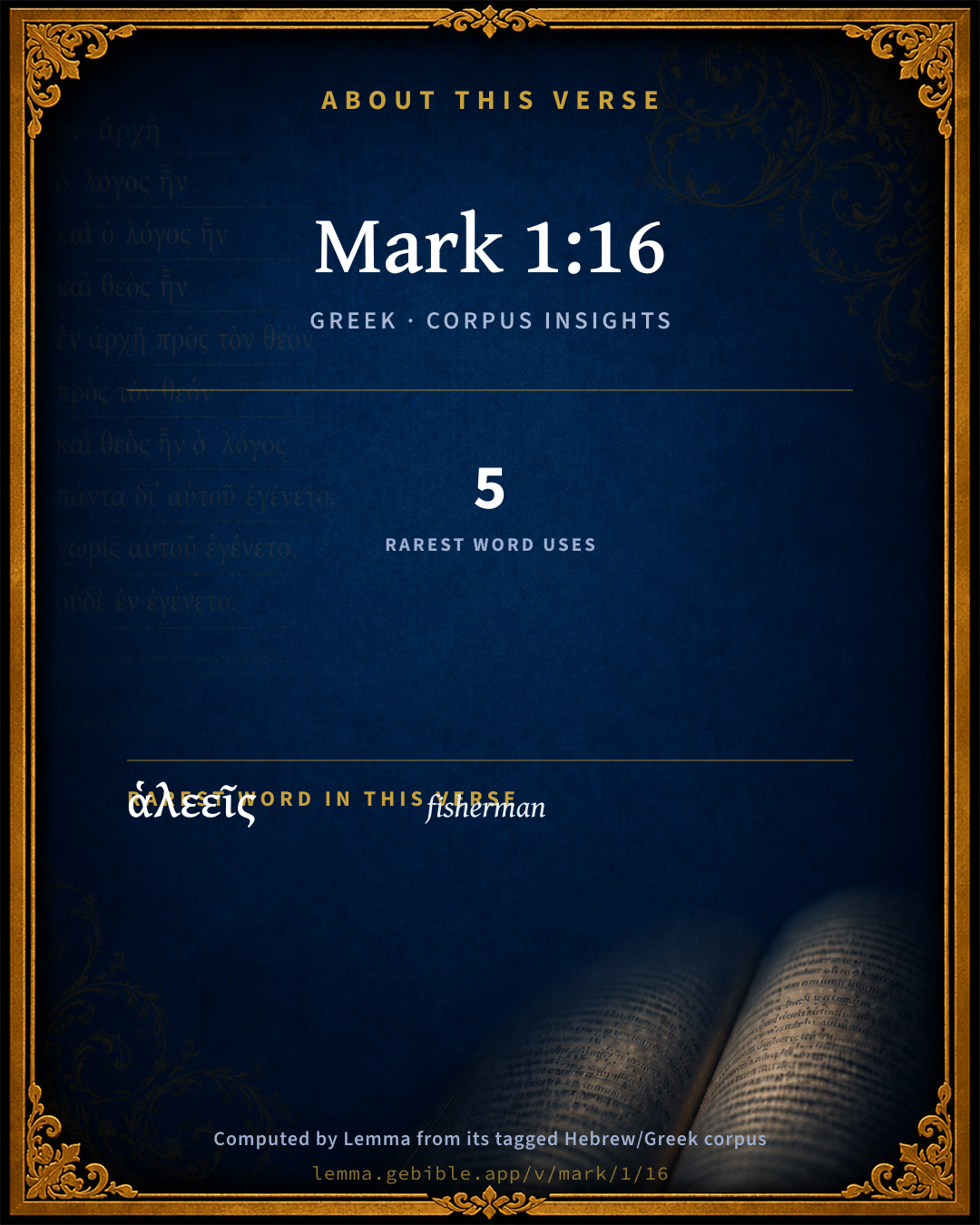
The rarest word here is ἁλεεῖς fisherman G231 — appearing just 5 times in the whole Greek New Testament.

Shared distinctive vocabulary

ἁλεεῖς fisherman G231 occurs in 5 verses of the Greek New Testament. Also found in:

Repetition

Words recur within this verse:

  • θάλασσαν sea G2281 ×2
  • Σίμωνα Simon G4613 ×2
  • τὴν the G3588 ×4
  • Καὶ and G2532 ×2

Cross-references

11

Topical passages linked to Mark 1:16 in the Treasury of Scripture Knowledge — connected by theme and wording, ordered by reader-vote popularity; previews shown in the World English Bible.

  • Matthew 4:18–22 Walking by the sea of Galilee, he saw two brothers: Simon, who is called Peter, and Andrew, his brother, casting a net into the sea; for they were fishermen.
  • John 1:40–42 One of the two who heard John, and followed him, was Andrew, Simon Peter's brother.
  • Luke 6:14 Simon, whom he also named Peter; Andrew, his brother; James; John; Philip; Bartholomew;
  • John 6:8 One of his disciples, Andrew, Simon Peter's brother, said to him,
  • Matthew 10:2 Now the names of the twelve apostles are these. The first, Simon, who is called Peter; Andrew, his brother; James the son of Zebedee; John, his brother;
  • Mark 1:16–20 Passing along by the sea of Galilee, he saw Simon and Andrew the brother of Simon casting a net in the sea, for they were fishermen.
  • Mark 3:16 Simon, to whom he gave the name Peter;
  • Mark 3:18 Andrew; Philip; Bartholomew; Matthew; Thomas; James, the son of Alphaeus; Thaddaeus; Simon the Zealot;
  • Luke 5:1–11 Now it happened, while the multitude pressed on him and heard the word of God, that he was standing by the lake of Gennesaret.
  • John 12:22 Philip came and told Andrew, and in turn, Andrew came with Philip, and they told Jesus.
  • Acts 1:13 When they had come in, they went up into the upper room, where they were staying; that is Peter, John, James, Andrew, Philip, Thomas, Bartholomew, Matthew, James the son of Alphaeus, Simon the Zealot, and Judas the son of James.

Cross-references courtesy of OpenBible.info (CC BY 4.0).

Commentary

Notes on Mark 1:16 from classic Christian and Jewish commentators (each source and its license shown beneath its notes). The classic Christian expositions comment on the surrounding passage and are grouped to its opening verse, so a note may address several verses; the Jewish commentaries on the Tanakh (Rashi and others) are per-verse, so they appear only where the commentator wrote on this verse.

Lemma curates 59 commentaries, every one of them public domain or Creative Commons licensed, each selected and text-cleaned for this edition rather than reprinted as found. About our sources →

The Biblical Illustrator

Joseph S. Exell

Mar_1:16-18

Now as He walked by the Sea of Galilee.

The call of the first apostles

The call of these men is a strange thing. It is strange that He begins with winning disciples, not working miracles. And it is more strange still that in our poor human nature He should find any fitness to aid Him in His work. You would have thought only heaven could have given the Saviour fellow workers that would be a comfort and a help to Him. But man can be a worker together with God. Several things are noteworthy in connection with this group of apostles.

I. They are not theologians. We do not need high education to fit us to do good.

II. But they had benefited by an excellent training. They came from pious homes; they had good schooling and good knowledge of the Bible; also the excellent training that lies in learning a trade requiring diligence and endurance. What special further fitness they needed for their work would come from intercourse with Christ.

III. They were found in groups. Ties of friendship may assist both consecration and power.

IV. They are enlisted gradually. In no religious matters should we act with haste. Be like the stars, hasting not, lingering not. Life is not long enough to let us postpone the discharge of duty a single day after its discovery; but it is quite long enough to give us time to reach calmly every conclusion on which we have to act. (R. Glover.)

Jesus, as Head of the kingdom, calling His helpers

Note-

I. The peremptoriness of the call-Come ye after Me.

II. The inducement to obey-I will make you, etc.

III. The promptness of their obedience-And straightway, etc.

IV. The order in which they were called-Simon Peter first.

V. The kind of men called. Not idlers. (D. C. Hughes, M. A.)

Busy men

God calls men when they are busy; Satan, when they are idle. For idleness is the hour of temptation, and an idle person the devils tennis ball, which he tosses at pleasure, and sets to work as he likes and lists. (John Trapp.)

Why should the Lord choose His foremost apostles from among fishermen

?

1. Their calling had inured them to hardship and danger-the lake on which they exercised their craft being exposed to sudden and violent storms.

2. Their calling, demanding a constant exercise of patience and watchfulness, and being very precarious besides, had made them familiar with disappointment, so that they would not be discouraged by it. Thus their worldly calling would be the best discipline for their spiritual work. They must be prepared to endure hardness, for they had no settled incomes; they must be ready to face death, for at any moment a storm of bloody persecution might arise; they must be patient, both towards churches and souls; and they must be content at times with taking a few converts in their nets, where they might have expected abundant draughts. (M. F. Sadler, M. A.)

The Lord chose

I. Unlearned and ignorant men, that His grace might be made perfect in their weakness. That the then known world should have been, in two or three centuries, subdued to the faith by such men, and by such as succeeded them, was, next to the resurrection of Christ, the greatest miracle of Christianity;

II. Religious men. They had justified God by attaching themselves to the ministry of the Baptist. But they were neither

(1) prejudiced Pharisees, who would have had a world of traditional interpretation to unlearn; nor

(2) superstitious men, or they would have shown themselves far readier to look for supernatural action from their Master. (M. F. Sadler, M. A.)

The call to service

I. Honest toil is a preparation for nobler wore.

II. Following Christ consecrates every vocation. Earthly pursuits are the pattern of the heavenly.

III. Secular partnerships are translated to a higher sphere.

IV. True obedience is prompt and practical.

V. Christs service always involves sacrifice. (D. Davies, M. A.)

The manner in which Christ attracted men to Himself by making their secular calling typical of spiritual work

I. That good men should take every opportunity for seeking the moral welfare of those with whom they are brought into incidental contact.

II. That good men in embracing every opportunity for the moral welfare of others, might with great advantage appeal to them through their secular calling, making it symbolical of religious work and truth. I will make you to become fishers of men.

1. This method of appeal is attractive.

2. It may be opportune.

3. It is effective. (Joseph S. Exell, M. A.)

Christs election of disciples

I. Whom did he choose? Not the wise and learned; they would have worried the simplicity with endless commentaries, have wrought it into intellectual puzzles, so that the shepherd on the hill could not have understood it. He did not choose the rich; they would have weighted His goodness with the cares of wealth. Did He choose religious leaders? They would dissolve His charity, mercy, in the acid of their theological hatreds. Did He choose the politicians? He would not use political craft.

II. Come, He said, I will make yea fishers of men. And they left all and followed Him. He was not wrong then in His choice. These men who gave up all at once for Him, had impulse, heart, impetuosity, love; and these were the main things He wanted for His work. It would be a hard task, and no faint-heartedness or questioning could bear its trials. It was this intensity of spirit that Christ stirred in men. When He spoke men arose from the dead. The source of His influence was partly personal; also it was weighted with infinite, Divine, ideal thoughts; He established living truths in the hearts of men. That was His real power. As life went on His thoughts grew before them. So inspired, they went forth into the world. They saw before them a vast ocean, in whose depths men were lost in ignorance and misery. (S. A. Brooke, M. A.)

Christ calling men

I. This call was imperative.

II. It is first given to two obscure men.

III. It is a spoken, not a written, call.

IV. They are commanded to follow a person, not a creed.

V. This call is abrupt.

VI. In all revolutionary movements there have been men who have heard nothing but-Follow.

VII. Those who are called are not such at first sight as might have been expected; yet on examination it will be found that they were the only persons who could have been called, in harmony with the whole ministry of Jesus Christ. (Dr. Parker.)

Forsaking all to follow Christ

It is said that the magnet will not draw in the presence of the diamond: the world cannot hold that soul that is susceptible to the superior power of Christ. The eye dazzled with the glare of the sun sees darkness everywhere else. Leather and iron money was, in the early ages, soon cast aside for gold and silver. How soon we part with lamps and candles when the sun rises. (T. Brooks.)

Heart responsive to heart

The call met a deep craving of the heart, and at once they joined Christ the man, without knowing anything of Christ the doctrine. The heart wanted a heart; life demanded life. The world had lived long enough on written promises; the cold parchment was becoming colder day by day. There was an aching at the heart of society-a great trouble-an exciting wonder. The call had a peculiar charm about it in so far as it demanded attachment to a visible person. Not a creed but a Life bade them follow. (Dr. Parker.)

The gospel as a fishing net

The net to fish for men is commonly the word truly preached; the threads are the words of persuasion; the knots the arguments of reason; the plummets are the articles and grounds of the faith. This net is to be wove with study and pains, to be let down and loosed by preaching, to be gathered up by calling men to account of what was beard, what they have done upon it; it is washed and cleansed by our tears and prayers, and spread and dried by our charity and mortified affections. And this is the net that we must let down, though it catch nothing, and at His word it is to be let down. His word is to be the length and breadth, the whole rule and measure of all our sermons, all your actions. Leave off our work we must not, because it does not answer us with success; but do our work again, and see where we erred, and mark it; find what was the occasion of our ill success, our taking nought, and avoid it. (Dr. Mark Frank.)

The estimate Jesus Christ had of humanity in contrast with all the other objects that engaged His attention

The more you study Christs life the more you will see how in comparison with the claims of man everything else was regarded as subsidiary and comparatively unimportant. For rank, for wealth, for fame, for all the pursuit of which fills men with fever and the possession of which leaves them in unrest, Christ cared not a jot. But for man He cared everything. He might be poor, despised, wretched; no matter, he was a man! And when He viewed him thus as a king, though discrowned, as an heir whose birthright was immortality, as a brother of the seraphim, though bowed in the ruin of a crushing overthrow, His whole nature went out to him in a passionate intensity of tenderness, and in His annunciation that He had come to seek and save the lost, Christ but proclaimed His estimate of the greatness of humanity. The first thing which any one of us must seek to possess as a qualification for Christian work is the same overmastering sense of the preciousness of humanity. We shall work for man in proportion as we feel that. Get this thought, then, written in your heart, fixed in your memory as with a diamond, that to consecrate your energy, to devote your might to do the work of Christ, as it bears upon the elevation and salvation of man, will do more to replenish your soul with happiness, and to crown your life with honour, than to reap a harvest of wealth or fame. To bring a little child as a lamb to the fold of the Good Shepherd, to raise the fallen out of the mire to the level of a purer life, and to bring men under the saving influences of Christs gospel, is a work which angel minds would fain engage in, and one which demands and deserves the highest devotion we can bring to bear upon it. (W. Kelynack.)

Primary and subordinate qualifications that are important to be possessed by all those who essay to do good to others

And I would remark of all knowledge the most important that must be possessed by him who seeks to influence others for good is the knowledge of man. To know books is much, to be familiar with things is well; but large wisdom in these particulars may consist with much ignorance in dealing with human nature. To know man, to work with success on man, you must know his susceptibilities as well as his aversions, his merits as well as his failings. And you must know this in order satisfactorily to deal with the question how best human nature may be approached, and how most effectually it may be converted to the uses you contemplate. To give shape to an iron bar you need a sledgehammer stroke of power. To give form to clay, you need but the deft movements of a vigorous hand. And so, in dealing with human nature; the knowledge on which I insist, leading out to the employment of the right means, is one of great moment in the success of our task. It is of no use for any one of us to go through life with a little code of action like a two-foot rule to be the measure of all character. We must deal with men according to their individual character. Some men we must approach through the medium of their hope, and some through the medium of their fear. Some we must strike, but as the bee strikes the flower when he draws the honey from its heart; and others we must shape as the sculptor shapes the block, which he strikes again and again to disemprison the angel that lies hidden in the slab. Now in this, and then in that form, Christian workers will adjust their movements, guided by the knowledge of human nature of which we are speaking, knowing that if men are sought in the right way, and at the right time, like fish you may catch them, but that if you neglect these very primary qualities, you may almost forecast failure where you should expect success. (W. Kelynack.)

The making of men catchers

Conversion is most fully displayed when it leads converts to seek the conversion of others: we most truly follow Christ when we become fishers of men. The great question is not so much what we are naturally, as what Jesus makes us by His grace: whoever we may be of ourselves, we can, by following Jesus, be made useful in His kingdom. Our desire should be to be man catchers; and the way to attain to that sacred art is to be ourselves thoroughly captured by the great Head of the college of fishermen. When Jesus draws us we shall draw men.

I. Something to be done by us-Come ye after Me.

1. We must be separated to Him, that we may pursue His object.

2. We must abide with Him, that we may catch His spirit.

3. We must obey Him, that we may learn His method.

4. We must believe Him, that we may believe true doctrine.

5. We must copy His life, that we may win His blessing from God.

II. Something to be done by Him-I will make you. Our following Jesus secures our education for soul winning.

1. By our following Jesus, He works conviction and conversion in men: He uses our example as a means to that end.

2. By our discipleship the Lord makes us fit to be used.

3. By our personal experience in following Jesus, He instructs us until we become proficient in soul-winning.

4. By inward monitions He guides us what, when, and where to speak.

5. By His Spirit He qualifies us to reach men.

6. By His secret working on mens hearts He speeds us in our work.

III. A figure instructing us-Fishers of men. A fisher is

(1) dependent and trustful;

(2) diligent and persevering;

(3) intelligent and watchful;

(4) laborious and self-denying;

(5) daring, and not afraid to venture upon a dangerous sea;

(6) successful. He is no fisher who never catches anything. (C. H. Spurgeon.)

The higher discipleship

Following Christ, if rightly understood, is the destruction of selfishness. It casts off the idols of worldly prudence and worldly maxims from the heart, and puts there instead the supreme self-sacrifice of Christ. Well might these two plain men have said, What! leave all and follow Thee? leave our nets and boats that we have bought with our few savings? ruin our worldly chances, and go forth to we know not what-all for the hope of doing good? Where is the gain, where is the advantage to ourselves? But the man who receives Christ into his heart cannot reason in that way. Tell him that he is giving up his worldly chances, that he is injuring his strength, that he is working without hope of reward on earth; and he must still reply, My aim is not the gratitude of men, but the favour of God. I am not working for the regard of men, but for the Well done of my Master. To do that which pleasure prompts, to do that which does not clash with our inclinations-even the world can go as far as that. But the true disciple is he who leaves his nets and boats at the command of Christ; the man who goes out to a foreign land, leaving kindred and home that he may preach the unsearchable riches of Christ; the Sunday school teacher who gives up the hour needed, perchance, for rest, that the ignorant may be taught, and the feet of children led into the narrow way. Christ calls us to the higher discipleship, because it is His purpose that we, under God, should bring back the world to His sway … Let us rise above the low level where we can only read the word duty, to that grander height where we can see that all Christian service is a privilege and a joy; and though heart and flesh fail sometimes, let us walk as seeing the invisible. The divinest life that ever the world knew carried its cross every step of the way, and your life will not be worth much unless you carry your cross too. Nothing great or good is ever born into the world without travail and pain. (J. H. Shakespeare, M. A.)

The ministerial office

In fishing, whether in sea or among men, there is wanted-

1. A net. The gospel.

2. Casting the net. Andrew did this first when he caught Peter his brother (Joh_1:41); Peter did this most energetically afterwards with his splendid work of preaching. In doing this, Christ directs where; otherwise we may toil all night in vain.

3. Dragging the net to land. Confessional; inquiry room, etc.

4. Mending the nets. Heretics and schismatics unite against it, and so break the net. Inside foes are the worst-the dogfish and sharks of the gospel net. Hence a mender is wanted.

5. Counting the fish (Joh_21:11).

The elect and chosen are many and great; and these do not break the nets.

The apostles change of employment a gain to them

Did those skilled fishermen gain or lose in leaving the lake, the boat, and the net, and becoming the Lords apostles? Was it to their loss or advantage that they sacrificed the wealth gathered by the net for the privilege of saving men? Ask Peter on the day of Pentecost: ask him when by his lips the gospel is first preached to the Gentiles, and He gathers the first fruits of a worldwide harvest. Ask John when, at the close of a long life, on the isle of Patmos the heavens opened to him, and the scroll of the future is unrolled, and he with rapt vision is permitted to see the triumphs of the gospel he was called to preach. Ask them now, their names having gone through the world closely associated with Christ, pillars of the Church on earth, and for eighteen centuries sharing with their Lord the glory of the Church above. (P. B. Davis.)

The minister is a fisherman

As such he must fit himself for his employment. If some fish will bite only by day, he must fish by day; if others will bite only by moonlight, he must fish for them by moonlight. (R. Cecil.)

Bait to catch fish

Mr. Jesse relates that certain fish give preference to bait that has been perfumed. When the prince of evil goes forth in quest of victims, there does not need much allurement added to the common temptations of life to make them effective. Fishers of men, however, do well to employ all the skill they can to suit the minds and tastes of those whom they seek to gain. (G. McMichael.)

Rules for fishing

I watched an old man trout fishing the other day, pulling them out one after another briskly. You manage it cleverly, old friend, I said; I have passed a good many below who dont seem to be doing anything. The old man lifted himself up, and stuck his rod in the ground. Well, you see, sir, there be three rules for trout fishing, and tis no good trying if you dont mind them. The first is, keep yourself out of sight, and the second, keep yourself further out of sight; and the third is, keep yourself further still out of sight. Then youll do it. Good for catching men, too, thought I. (Mark Guy Pearse.)

Catching fish a preparation for catching men

Every quality of mind which these fishermen had cultivated will serve the higher purpose now. Their vocation had-

I. Called out their patience.

II. Made a large demand on their inventiveness. Catching men needs sagacity.

III. Kept in lively exercise their observant watchfulness. They found it needful to study all the changes of light and shade; the aspects of sky and sea. To says souls we must be all eye.

IV. Had inured them to disappointment. (D. Davies, M. A.)

Grippers

I have known a congregation so full of kindly Christian workers that in the low neighbourhood in which they worked they got the nickname of Grippers. Lowe, hearing the name, thought it must be a new sect, but it only marked the old apostolic quality. All Christians ought to pray for this power of catching souls. It is not violence, loudness, or terror that gives it, but love, goodness, the clear and strong convictions that come from following Christ. (R. Glover.)

The Biblical Illustrator, edited by Joseph S. Exell (c. 1880s–1900s) — public domain. Text from a community e-Sword module.

Lange's Commentary on the Holy Scriptures

SECOND SECTION

CONQUEST OF THE FIRST DISCIPLES AT CAPERNAUM, VICTORY OVER THE DEMONS IN THAT CITY, AND WITHDRAWAL INTO THE WILDERNESS

Mar_1:16-35

________

1. The Authoritative word of Jesus, which calls the four first and greatest Disciples. Mar_1:16-20

(Parallels: Mat_4:18-22; Luk_5:1-11; comp. Joh_1:35-42)

16Now, as he walked7by the sea of Galilee, he saw Simon, and Andrew his brother, casting a net into the sea: for they were fishers. 17And Jesus said unto them, Come ye after me, and I will make you to become fishers of men. 18And straightway they forsook their8 nets, and followed him. 19And when he had gone a little farther thence,9 he saw James the son of Zebedee, and John his brother, who also were in the ship mending their nets. 20And straightway he called them: and they left their father Zebedee in the ship with the hired servants, and went after him.

EXEGETICAL AND CRITICAL

See on Mat_4:18 seq.

Mar_1:16. As He walked by.—The Evangelist would make prominent the apparently fortuitous character of this first vocation.

Mar_1:19. Who also were in the ship.—Both pairs of brothers were called while in the earnest prosecution of their craft. The first two were throwing their nets into new positions in the water; the two others were mending them for new draughts.

Mar_1:20. With the hired servants.—Why this addition? Paulus: It was to be made clear, how they could without impiety forsake their father. Meyer (after Grotius): It was only a proof that Zebedee did not follow his craft in a petty way, and that he probably was not without means. In any case, it also shows that Zebedee was not left helpless. That they forsook so thriving a business (Ewald), is indeed of less significance.

DOCTRINAL AND ETHICAL

1. Christ Himself is the great Fisher of men. He catches the four elect ones as it were at one draught. These are the three (Mar_9:2) and the four (Mar_13:3) confidential Apostles of after-times. Therefore there were first four fishermen called.

2. The power of Christ’s word over these souls here appears direct and immediate. We learn the mediating circumstances of this vocation from John 1. At the same time, this calling was something entirely new (see on Mat_4:19), and their following so wonderful, that they at once forsook their calling, in the very act of pursuing it. The fishing life of these men was a preparation for their higher calling, as being fidelity in that which was least.

HOMILETICAL AND PRACTICAL

The Lord knoweth His own.—The Lord and His elect quickly know each other.—The great increase of grace swiftly enters into our daily life.—Christ’s waiting by the sea apparently for relaxation, but at the same time the most noble work.—Christ’s mark in this world the heart of man.—The great Fisher of men, and His art of making human fishers.—The calling of Jesus a call to become something new.—The mighty calling of the Lord: 1. Gentler than any human request; 2. mightier than any human command; 3. unique as the victorious wooing of heavenly love.—The calling of Jesus a calling at once to one thing and to many: 1. To one thing: into His discipleship and the fellowship of His Spirit, or to the Father; 2. to many: to discipleship and mastership, to coöperation, to fellowship in suffering, and community in triumph.—The greatness of the following of the four disciples was the effect of the great grace of their calling. They broke off suddenly in the midst of a new career of their labor, as a sign of the decision of their following.—The spiritual and the worldly vocation of Christians: 1. Opposition; 2. kindredness; 3. union.—The twofold earthly companionship of the disciples a foundation for the higher: 1. Companions in fishing,—companions in fishing for men; 2. brethren after the flesh,—spiritual brethren.—Leaving all for Christ’s sake.—The Christian and ecclesiastical vocations in harmony with the sacred natural obligations of life.

Starke:—Never be idle.—Pious handicraft acceptable to God.—The calling into Christianity binds us to faith and the following of Christ; how much more the vocation to spiritual office!—A true follower of Christ forgets everything earthly.—He who follows Christ loses nothing, though he may forsake all; for he finds in Him a full sufficiency, Mat_19:29.

Lisco:—The forsaking all must be experienced inwardly by every believer; and must be fulfilled outwardly also, in particular circumstances and occasions, Mat_19:27.—Schleiermacher:—The two tendencies in the life of the Redeemer: preaching to the multitude, and the separation of individuals to Himself.—Gossner:—The Lord’s fishermen actually catch the fish; the world’s fishermen swim with the fish.—Bauer:—One glance of the Lord, and He knows the heart under its rough garment.

[7]Mar_1:16.—The expression παράγων is recommended by B., D., L., Lachmann, and Tischendorf. Instead of αὐτοῦ Lachmann and Tischendorf read Σιμῶνος.

[8]Mar_1:18.—Not “their” nets: αὐτῶν is wanting in B., C., L., Lachmann, Tischendorf.

[9]Mar_1:19.—’Εκεῖθεν is wanting in B., D., L., Tischendorf; bracketed by Lachmann. It accords with Mat_4:21.

Lange's Commentary on the Holy Scriptures (Critical, Doctrinal, and Homiletical), ed. John Peter Lange, English translation edited by Philip Schaff (1864–1880) — public domain. Text from a community e-Sword module.

Tyndale Open Study Notes

Tyndale Open Resources

1:16-20 The call of the two pairs of brothers—Simon and Andrew, James and John—followed an earlier encounter with Jesus (John 1:35-42).

Tyndale Open Study Notes — © Tyndale Open Resources, licensed CC BY-SA 4.0. Text via the HelloAO Bible API.

Bengel's Gnomon

Johann Albrecht Bengel

Mar 1:16. Σίμωνα, Simon) Mark writes of Peter in such a style, and with such fulness, that he might easily seem as if he wrote by dictation from the mouth of that apostle [comp. Mar 1:1, last note].—αὐτοῦ τοῦ Σίμωνος) Either we should read thus,[9] or only τοῦ Σίμωνος; others, only αὐτοῦ, in agreement with the parallel passages in the other Evangelists.[10] Mark sometimes repeats names, ch. Mar 3:17, Mar 5:37; sometimes he adds a relative pronoun to them, ch. Mar 2:20, Mar 3:24, etc., Mar 16:14; and decidedly, ch. Mar 6:22, ΑὐΤῆς Τῆς ἩΡΩΔΙΆΔΟς.—ἈΜΦΙΒΆΛΛΟΝΤΑς ἈΜΦΊΒΛΗΣΤΡΟΝ) So LXX., Hab 1:17: ἈΜΦΙΒΑΛΕῖ ἈΜΦΊΒΛΗΣΤΡΟΝ in the best MSS. Whence Isa 19:8, ΟἹ ἈΜΦΙΒΟΛΕῖς, the fishermen.

[9] This is preferred in the margin of both Editions of Bengel, to the omission of the reading τοῦ Σίμωνος, and is therefore marked with the sign ε; with which also the Germ. Vers, agrees on this passage.—E. B.

[10] See Mat 4:18, the Greek. This makes αὐτοῦ look like a harmonist’s reading here.—ED. ABLa have Σίμωνος (and A prefixes τοῦ). Dbc Vulg. and Rec. Text read αὐτοῦ. Only later Uncial MSS. and later Syr. Version read αὐτοῦ τοῦ Σίμωνος.—ED.

Bengel's Gnomon of the New Testament — English translation (T&T Clark, Edinburgh, 1860) — public domain. Text from a community e-Sword module.

Meyer's Critical & Exegetical Commentary

Heinrich August Wilhelm Meyer

Mar_1:16-20. See on Mat_4:18-22 (Luk_5:1 ff.). The narrative of Mark has the brevity and vividness of an original. Observe, however, how, according to all the evangelists, Jesus begins His work not with working miracles, but with teaching and collecting disciples.[54] This does not exclude the assumption that miracles essentially belonged to His daily work, and were even from the very beginning associated with His teaching, Mar_1:21 ff.

παράγων (see the critical remarks), as He passed along by the sea. This as well as ἀμφιβάλλ. ἐν τ. θαγ. (casting around) is part of the peculiar vividness of representation that Mark loves.

Mar_1:19. καὶ αὐτούς] et ipsos in nave, likewise in the ship. It does not belong to καταρτίζοντας (the usual view, in which there is assumed an imperfect comparison, which contemplates only the fishers occupation generally, comp. on Mat_15:3), but merely to ἐν τῷ πλοίῳ, so that καταρτ. κ.τ.λ. then subjoins a further circumstance. The former explanation in the sense assigned to it would only be possible, if ἀμφιβάλλ., in Mar_1:16, and καταρτ. were included under one more general idea.

Mar_1:20. μετὰ τ. μισθωτ.] peculiar to Mark. Any special purpose for this accuracy of detail is not apparent. It is an arbitrary supposition that it is intended to explain how the sons might leave their father without undutifulness (Paulus, Kuinoel, de Wette, Bleek, and others), in reference to which de Wette charges Mark with taking away from their resolution its nobleness.[55] It may, moreover, be inferred, that Zebedee carried on his business not altogether on a small scale, and perhaps was not without means. Comp. Mar_16:1; Luk_8:3; Joh_19:27; Only no comparison with the poverty of Peter (Hilgenfeld) is to be imported.

[54] Comp. Weizsäcker, p. 364. But the teaching begins with the announcement of the kingdom, which has as its presupposition the Messianic self-consciousness (Weizsäcker, p. 425). Without reason Schenkel maintains, p. 370, that Jesus could not at all have regarded Himself at the beginning of His work as the Messiah. He might do so, without sharing the political Messianic hopes. See Schleiermacher, L. J. p. 250 f.; Keim, Geschichtl. Chr. p. 44 f. But the view which makes the beginning of the teaching and miracle-working even precede the baptism (Schleiermacher) has absolutely no foundation in the N. T., not even in the history of the marriage feast at Cana. Nor yet can it be maintained, with Keim (p. 84), that the conviction of being the Messiah gained strength in Jesus gradually from His first emergence up to the decisiveness, which first makes itself manifest at Matthew 11, where He announces the present kingdom, no longer merely that which is approaching. For the approaching kingdom is throughoutonly according to a relative conception of timefrom the beginning onward to Luk_21:31 to be taken in an eschatological reference; and it presupposes, therefore, a Messianic self-certainty in the Son of man, who with this announcement takes up the preaching of the Baptist.

[55] With greater truth, because more naturally, it might be said that that trait places in so much stronger a light the resignation of those who were called, seeing that they forsook a business so successfully prosecuted. Comp. Ewald, p. 192. We may more surely affirm that it is just a mere feature of the detailed description peculiar to Mark. Comp. Weiss, l.c. p. 652.

Meyer — Critical and Exegetical Commentary on the New Testament — English translation by Peter Christie, edited by Frederick Crombie (T&T Clark, 1880) — public domain. Text from a community e-Sword module.

Expositor's Greek Testament

ed. W. Robertson Nicoll

Mar 1:16 . ἀμφιβάλλοντας , just because different from Mt.’s expression, to which the T. R. assimilates Mk.’s, is likely to be the true reading, and is very expressive: casting about (their nets understood, here only).

The Expositor's Greek Testament, edited by W. Robertson Nicoll (1897–1910) — public domain. Text from a community e-Sword module.

Geneva Bible (1599)

Geneva Bible translators

The calling of Simon and Andrew.

Geneva Bible (1599) marginal notes — public domain. Text via Bolls.life.

Adam Clarke's Commentary

Verse 16. As he walked by the sea, &c.] See Clarke on Mt 4:18-22.

Andrew his brother] Instead of the common reading, αδελφον αυτου, his brother, the best MSS. and versions have αδελφουτου σιμωνος, the brother of Simon, which should be received into the text. The most eminent critics approve of this reading.

Adam Clarke's Commentary on the Bible (1810–1826) — public domain. Text from a community e-Sword/MySword module.

Ellicott's Commentary for English Readers

(16) As he walked by the sea of Galilee.—See Notes on Mat_4:18-22. St. Mark names Simon without the addition of Peter.

A Bible Commentary for English Readers, edited by Charles John Ellicott (1878–1897) — public domain. Text from a community e-Sword module.

The Cambridge Bible for Schools and Colleges

gen. ed. J. J. S. Perowne

16–20. Call of the first Four Disciples

16. as he walked] The Saviour had come down (Luk_4:31; Joh_4:47; Joh_4:51) from the high country of Galilee, and now made His permanent abode in the deep retreat of the Sea of Galilee at Capernaum “His own city” (Mat_4:13; Luk_4:31), whence He could easily communicate, as well by land as by the Lake, with many important towns, and in the event of any threatened persecution retire into a more secure region.

the sea of Galilee] called (i) in the Old Testament “the Sea of Chinnereth” or “Cinneroth” (Num_34:11; Jos_12:3) from a town of that name which stood on or near its shore (Jos_19:35), in the New (ii) “the Sea of Galilee” from the province which bordered on its western side (Mat_4:18; Mar_7:31), (iii) “the Lake of Gennesaret” (Luk_5:1), (iv) “the Sea of Tiberias” (Joh_21:1), and sometimes (v) simply “the Sea” (Mat_4:15).

he saw Simon] whom He had already invited to His acquaintance (Joh_1:40-42); He now calls him to the Apostleship. The recent cure of the son of the officer in Herod’s court had roused much interest at Capernaum, and many pressed upon the Saviour to “hear the Word of God” (Luk_5:1). It became clear, therefore, that an opportunity was offered for an active and systematic ministry in Galilee, and four of the number afterwards known as “the Twelve” were now permanently attached to the Saviour’s Person, and invested with power to become “fishers of men.”

a net] The net here spoken of and in Mat_4:18 was a casting-net, circular in shape, “like the top of a tent,” in Latin funda or jaculum. The net spoken of in Mat_13:47-48 is the drag-net or hauling-net, the English seine or sean, sometimes half a mile in length; that alluded to in Luk_5:4-9 is the bag-net or basket-net, so constructed and worked as to enclose the fish out in deep water.

The Cambridge Bible for Schools and Colleges (gen. ed. J. J. S. Perowne; Cambridge University Press, 1878–1918) — public domain. Text from a community e-Sword module.

John Gill's Exposition

Now as he walked by the sea of Galilee,.... The same with the sea of Tiberias, Joh 6:1,

he saw Simon: whose surname was Peter, the son of Jonas:

and Andrew his brother; the brother of Simon,

casting a net into the sea; of Galilee, in order to catch fish:

for they were fishers: by occupation, this was their trade and business, by which they got their livelihood; See Gill on Mat 4:18.

John Gill's Exposition of the Whole Bible (1746–1763) — public domain (CC PDM 1.0). Text via the HelloAO Bible API.

Trapp's Complete Commentary

John Trapp

16 Now as he walked by the sea of Galilee, he saw Simon and Andrew his brother casting a net into the sea: for they were fishers.

Ver. 16. {See Trapp on "Mat 4:18"}

John Trapp, A Commentary or Exposition upon All the Books of the Old and New Testament (1647–1656) — public domain. Text from a community e-Sword module.

Albert Barnes' Notes on the Bible

See the notes at Mat 4:18-22.

Albert Barnes' Notes on the Bible (1834–1885) — public domain. Text from a community e-Sword/MySword module.

Haydock's Catholic Bible Commentary

We must observe that what St. Luke mentions, relative to the vocation of the apostles, is antecedent in point of time to what is here related by St. Mark; since it is known that these disciples on some occasions returned to their fishing, until Jesus called them to be his constant attendants. (Theophylactus)

George Leo Haydock (1774–1849), Haydock's Catholic Family Bible and Commentary, 1859 edition — public domain. Excludes Psalms (Douay-Rheims chapter numbering differs from Protestant) and Deuterocanonical books (Catholic canon only).

Matthew Poole's English Annotations

We heard of the call of these four apostles before, in Matthew.

See Poole on "Mat 4:18", and following verses to Mat 4:22, upon which may be found whatsoever is necessary for the explication of these verses, (having nothing new in them), as also the reconciling of what John saith, Joh 1:40, about the calling of Andrew and Simon, to what these two evangelists say about it.

Matthew Poole's English Annotations on the Holy Bible (1683–1685) — public domain. Text from a community e-Sword/MySword module.

The Pulpit Commentary

Now as he walked by the sea of Galilee; a better reading is (kai paragwn), and passing along. Our Lord came up from the south, passing through Samaria, till he reached Cana of Galilee. He then passed along by the seashore towards Capernaum; and on his way found the four disciples whom he had previously nominated, but who were now engaged in their calling of fishermen. St. Mark then relates the circumstances of their call in the exact words of St. Matthew, which were in all probability those of apostolical tradition ("Speaker"s Commentary"). It will be seen that St. Mark"s account, in this introductory portion of his Gospel, is very concise, and that there are many things to be supplied from the first chapter of St. John; as, for example, that after our Lord"s baptism by John, and afar his fasting and temptation in the desert, the Jews sent messengers to the Baptist, to inquire of him whether he were the Christ. John at once confessed that he was not the Christ, but that there was One even then among them, though they knew him not, who was indeed the Christ And then, the very next day after, Jesus came to him, and John then said to those around him, "Behold the Lamb of God!" Upon this two of John"s disciples at once betook-themselves to Jesus. The first was Andrew, who forthwith brought his own brother Simon, afterwards called "Peter," to our Lord. Again, the day after the, our Lord called Philip, a fellow-citizen with Andrew and Peter, of Bethsaida. Then Philip brought Nathanael. Here, then, we have some more disciples nominated, who were with Jesus at the marriage in Cana of Galilee. Then Jesus retched again into Judaea; and those disciples "nominate," as we might call them, went back for a time to their occupation of fishermen. Meanwhile our Lord, while in Judaea, wrought miracles and preached, until the envy of the scribes and Pharisees constrained him to return again into Galilee. And then it was that he solemnly called Andrew and Peter, and James and John, as recorded by St. Mark here. So that St John alone gives some account of the events of the first year of our Lord"s ministry. The three synoptic Gospels give the narrative of his public ministry, commencing from the second year. He saw Simon and Andrew, the brother of Simon casting a net in the sea. (ballontav amfiblhstron en th yalassh). Such was the text underlying the Authorized Version; but a better reading is (amfiballontav en th yalassh). St. Mark thinks it unnecessary to mention the net at all; though doubtless it was the amfiblhstron , or casting-net. When our Lord likens his gospel to a net, he uses the figure of the drag-not (saghnh), a net of a much larger size. But whether it be the casting-net or the drag-net, the comparison is a striking one. It is plain that, in the pursuit of his calling, the fisherman has no power to make any separation between the good fish and the worthless. He has little or no insight into what is going on beneath the surface of the water. So with the "fisher of men." He deals with the world spiritual and invisible; and how, then, can he be fully conscious of the results of his work? His work is preeminently a work of faith. It may be observed here that St. Mark, in this earlier part of his narrative, speaks of St. Peter as Simon, though afterwards (Mar_3:16) he calls him Peter. We may also notice here, once for all, St. Mark"s constant use of the word "straightway" (euyewv or euyuv). This word occurs no less than ten times in this chapter. In the Authorized Version the word (euyewv) is rendered indifferently by various English synonyms, as "forthwith," "immediately," etc.; whereas in the Revised Version it has been thought fit to note this peculiarity or mannerism in St. Mark"s Gospel by the use of the same English synonym, "straightway," throughout this Gospel. The Holy Spirit, while guiding the minds of those whom he moved to write these records, did not use an overpowering influence, so as to interfere with their own natural modes of expression. Each sacred writer, while guarded against error, has reserved to him his own peculiarities of style and expression.

Vers. 16-20. Fishers of men.

It was an incident of great moment in the history of Christianity and of the world this, the calling by our Lord Jesus of his followers and apostles. Christ did not mike many converts; but the few he did make made many, so that, in selecting and appointing them, he was sowing the seed of a great and eternal harvest. He probably called these four more than once first during the ministry of the forerunner, again as in the text, and a third time when he commissioned them formally to act as his apostles.

I Observe WHO THE MEN WERE WHO WERE CALLED.

1. Their position in life; they were from the industrial classes. Not only did the Son of God choose himself to be born and brought up among the labourious and comparatively poor, he selected his immediate attendants, his personal friends, the promulgators of his religion, from the same rank of life. He took the form of a servant; he was known as "the carpenter"s son;" it was asked concerning him, "Whence hath this man learning?" Luke indeed was a physician, and Paul a scholar, but the twelve seem to have been of lowly condition and surroundings.

2. Their occupation; they were fishermen. Theirs was, no doubt, a common calling among the dwellers by the shores of the Galilean lake. There may have been some moral qualities, such as reverence and simplicity, which fitted these men for their new calling and life.

3. In relationship they were united by family ties; for these four disciples were two pairs of brothers. Simon and Andrew, and likewise James and John, were not only called together, but seem to have been associated together in an evangelistic ministry, when our Lord sent his disciples forth "two and two." Natural kindred and affection were thus sanctified by community in Christian calling and service. The two pairs were friends, comrades, and associates in labour.

4. They were, at all events in some instances, specially prepared for this calling. Certainly some and probably all of these four were previously disciples of John the Baptist, who, in their hearing, had witnessed to Jesus as the Messiah. Jesus thus honored his forerunner by receiving disciples from his training.

II Regard THE CALL HERE RELATED.

1. The Caller was the Divine Christ. An inestimable privilege to hear from those lips a gracious summons such as this I It is a sacred responsibility to hear the voice of Christ speak to ourselves with words of invitation, command, or commission.

2. The manner of the call deserves attention; it was with authority. Simple and few were the words, but they were the words of One whose utterances carried with them their own authority an authority acknowledged at once by the conscience of those to whom it was addressed.

3. The import of the call was most momentous me!" This call seems to have been addressed to these men on more occasions than one. They were directed to follow Jesus that they might listen to his teaching and observe his mighty works, that they might be qualified for the solemn commission which was to be entrusted to them upon the Saviour"s ascension.

III Remark THE PROMISE GIVEN in connection with the call. These Galilean fishermen should become "fishers of men." Our Saviour here takes advantage of the deep resemblances between natural processes and human activities on the one hand, and spiritual realities on the other. The sea in which Christian ministers are called to toil is this world, is human society, with all its uncertainties, vicissitudes, and dangers. The fish they seek are human souls, oftentimes hard to find and to catch. The net which they let down at the Divine command is the gospel, fitted to include and to bring to safety all souls of men. The skill and patience and vigilance of the fishermen may well be studied and imitated by those who watch and labour for souls. To enclose within the net is to bring souls within the limits of the privileges and motives, the laws and hopes of the gospel. To land what is taken is to bring the rescued safely into the eternal security of heaven.

IV The RESPONSE TO THE CALL is deserving of our observation.

1. There was cheerful compliance. No objection, no hesitation, no condition, not even an inquiry; but willing, contented obedience to a summons felt to be authoritative and binding.

2. This compliance was immediate. So should all respond whom Christ invites to come after him. Not a moment should be lost in choosing a lot so honorable, so desirable, so happy.

3. It was self-sacrificing. They left their nets, their kindred, their occupation, readily giving up all in order that they might follow Jesus. It was a condition which the Master now and again imposed, to prove the sincerity of his people"s love, devotion, and zeal.

PRACTICAL LESSONS.

1. For preachers and teachers of the gospel. Remember what is the vocation with which you are called. Let this be the acknowledged end you set before you to be fishers of men, to gain souls.

2. For hearts of the gospel. Remember that Christ has called you and is calling you. The burden of his appeal is this ye after me!" And, when saved, seek that you may be the means of saving others.

3. For those who, hearing the voice of the Lord Christ, are disposed to obey his call. Bear in mind that he demands a complete surrender, that he will not be satisfied unless the heart is dedicated to him, unless, with the heart, all that we have is yielded to his service. There is sure to be something in the way of obeying the Divine and heavenly call. You will, like the fishermen of Galilee, have something to give up in following Christ. Be prepared for this, and count the cost. But, for your soul"s sake and for the sake of your salvation, let nothing hinder you from faith and consecration. "Count all things but loss for the excellency of the knowledge of Christ Jesus our Lord.

Vers. 16-20. The call of the disciples; or, work and higher work.

I ORDINARY WORK OF MEN AND THE EXTRAORDINARY ARE (HERE) PUT IN THE SAME LINE. It is no small presumption in favor of Christ"s divinity that he chose common men workmen for his intimate disciples. What link could there be between the transcendent task of the apostleship and that mean calling in which they were engaged? He alone saw a connection, and not a merely fanciful one. He indicated it and proceeded upon it. The idea was familiar to the prophets, (e.g. Mar_16:16) and to Greek literature (as in the "Dialogues of Lucian," etc.), but not in the same application. The resemblance he suggested is broad and deep. It was while they were working that he called them. What a practical, spiritual gain for all toilers is this revelation!

II THEY ARE SHARPLY DISTINGUISHED AND ABSOLUTELY SEPARATED. As connected by analogy, it is implied that they are separated in fact. Not by confounding the sacred with the secular calling is either benefited. That they are not the same is shown by:

1. A difference of object. "For men." The means must therefore be different, and the entire method. Luke uses a word meaning "to catch alive? The fishers of men were not to snare them, but to win them to something worthy of them; and not for selfish ends, but through love and Divine good will. So interpreted, how grand is this vocation!

2. A distinct call. Christ asks bids them "come after him. Were there any previous inner witnessings which this endorsed and strengthened? This call was no simply picturesque or accidental occurrence; it was an essential condition of their assumption of apostolic service. The difference between their new duties and their old ones was so profound that only a distinct inward voice could warrant the transition from the one to the other. Christ spoke to the heart as well as to the ear, and his word was a determining one.

3. Altered circumstances. He would take them away for a time from the associations of the fish-net. They would have to cease looking at life as "making a living." As God"s workmen, they would be his dependents. They would have to live by faith, that they might walk by faith.

4. Special preparation. "I will make." What they had done or learned would not qualify them for what they were to do. He alone could teach them the new craft; and only as they drank in his spirit could they hope to succeed in it.

III TOPASS FROM THE ONE TO THE OTHER IS ONLY POSSIBLE THROUGH OBEDIENCE, SELF-SACRIFICE, AND CLOSER FELLOWSHIP WITH CHRIST. Even as he calls them their preparation and discipline commence. It was a sharp trial, but salutary and wise.

1. Obedience. They were to go at once if at all, without question, and finally.

2. Self-sacrifice. This was begun by "leaving all and following" Christ, as Peter phrased it. The will of the flesh, "the will to live," the whole self-life, had to be renounced.

3. But their life would be a fellowship with the Master. This would compensate for every toil and trial. But it would also necessitate continual exercise of sympathy, spiritual insight, and resolute fidelity. M.

Vers. 16, 17. Christ"s call to busy men.

Simon and Andrew were just beginning their day"s work by casting their net into the sea, and at that critical moment, when, if ever, delay would seem excusable, Christ called them to follow him. But he had already won their hearts, and they were only waiting for such a summons to come, "and strait-way they forsook their nets, and followed him." In their daily work these fishermen had acquired devotion, patience, and enterprise, which were now to be consecrated to nobler service, when, as fishers of men, they would gather spoil from the restless, dreary sea of human life. A call coming to men in the midst of their daily business reminds us of the following truths:

I THAT HONEST WORK FITS FOR HIGHER DUTIES. Those who are indolent in the world are not of great use in the Church. If men are not fit for ordinary work, they seldom are fit for Christ"s service. Our Lord does not call the indolent aesthetes, who would gaze on a lily for hours in a languid rapture, but he summons men with capacity, self-rule, vigor, and tact. God has ever chosen such. If he would have a lawgiver, he calls one who is as diligent among the sheepfolds in Mid, an as he had been in the schools of Egypt. If he would tell the world of his future kingdom, he inspires a statesman like Daniel, who already has upon him the cares of a great empire. If he would speak Burning words to his people, he summons to his service the herdman who drives his cattle home in the gloaming down the hillside of Tekoa. So here, Christ calls Matthew from the receipt of custom, and these four fishers from their boats. In the daily plod, in the monotonous round of life, above the whirr of human traffic a voice speaks, saying, "Come ye after me.

II THAT DIGNITY AND BLESSING ARE TO BE FOUND IN DALLY TOIL. Toil, once a cuisse, has been transformed by Christ Jesus into work which is a source of blessing to the world. In nature we can only regain a wilderness to order and beauty by unremitting toil; and only by long labour do we repossess ourselves of rule. The exquisite flowers in the hothouse are signs of human skill as well as of God"s gift. The rich harvest-fields, which whisper of abundance, are nature"s response to work. Wherever idleness is supreme, fertile lands become the lairs of wild beasts, and man, who was appointed to regal right, starves amid profusion. Besides, work is good for society, as it was good for those disciples to be thrown together so as to share perils and successes, for thus mutual love and confidence arose. Society is most compact and stable when built upon a foundation of industry every class recognizing its dependence on another, as stones in the living temple. That home is the happiest, too, in which self-indulgence is a stranger, and where mutual sympathy is felt in the efforts of all.

III THAT IN ORDINARY OCCUPATIONS WE MAY REALIZE THE PRESENCE OF CHRIST. His sympathy with the busy none can question. He himself spent more time in ordinary work than in public teaching, tie gave his presence to his disciples (both before his resurrection and after it) when they were on the lake working for a living. Still he is to be found, not in the dreams of the mystics or in the cell of the hermit, so much as in the heart of him who must be busy with the world"s work and yet prays to be free from its spirit. Conscious of his nearness, we shall not do our work carelessly; we shall not lower the standard set Before us in his Word; we shall never shrink from rebuking wrong-doing, even when it is customary; and there will be constant joy within our hearts amidst all turmoil, so that we can say," I will bless the Lord at all times: his praise shall continually be in my mouth." Beware of going steadily on with work without any thought of Christ, as if self was your king and the world your home. You may prosper so greatly that others will envy your skill and "good luck;" but the day of reckoning will surely come; the law of retribution will not sleep. Reaping only what you have sown, your largest gain will prove your deepest loss.

IV THAT CHRIST IS CALLING ALL TO LOFTIER SERVICE. It is necessary to labour, for the supply of physical wants, but there are other and higher responsibilities resting upon us as parents, employers, teachers, and friends. With wonderful condescension our Lord describes the nature of his service, by figures drawn from the scenes with which his hearers were most familiar. If people followed him for the sake of the bread which perisheth, he spoke to them of the "Bread of life;" and if a woman was drawing water at the well, he spoke to her of "living water." He led the Magians to him by "a star;" and taught these fishermen by their fishing, telling them that hereafter they should catch men," not, indeed, for death, but for life. This was a beautiful image for all time. The sea represents the wide world, which seems dark and deep as we stand on the fringe of its mystery, wonderingly. The fish are emblematic of those lost to the sight of some in the higher world, as they wander amid oozy weeds and treacherous rocks. The net pictures the truths and warnings of the gospel, which lay hold on men, and, gathering them together, raise them into a new element, in which they can only live when they have a new life. As "fishers of men," we want patience and hope, for we know little or nothing of the result of the toil as yet. We only know that the net is cast, but the draught is not yet counted upon the shore. It is ours to "mend" the net, to have it well in hand, to cast it in a likely place, and then to wait and watch and pray.

Quote Keble"s hymn beginning"The livelong night we"ve toiled in vain; But at thy gracious word I will let down the net again: Do thou thy will, O Lord. A.R.

Vers. 16-20. Call of disciples.

I CALLING MEANS SEPARATION. We cannot prove any calling without separation. The merchant must separate himself from the easy-chair and the book, the student from society, the soldier from home. One main object is enough for most men. Few can properly pursue the ministry and business at the same time.

II THE CALLING IMPLIES A CALLER. Not our fancy, whim, passion, but Divine will. To some that will is made known clearly and directly; they cannot mistake. To some not so directly. But need any mistake, if they make it a rule to be ever fulfilling the duty of the moment? It is a mistake to think too much on the point. True thought is God realizing himself in us. True action is God willing to do in and through us. Never resist a pure impulse; never turn from a voice that speaks to what is disinterested in you.

III To TAKE TO A HIGHER WAY OF LIFE ALWAYS MEANS THE GIVING UP OF A LOWER. God confounds our avarice by his generosity. We cling to all we can hold; want to keep incompatible things to be learned but not poor; to have as much of the world as possible, yet not be worldly; to live in self-indulgence, yet earn the reputation of saints. But God teaches us that our surrenders are no less profitable than our seeming gains. The provincial fisher becomes the apostle to the world. The things that are unseen are more than all that are seen. J.

Vers. 16-20. Parallel passages: Mat_4:18-22 Luk_5:1-11. The call of the first four disciples.

I PREVIOUS AND LESS FORMAL CALL. Our Lord now calls to his side the first four disciples Andrew and John, Peter and James. With the former pair he had already made acquaintance when they were disciples of John the Baptist. The account which St. John in his Gospel gives of the matter is complementary, and throws light on it, enabling us to understand more clearly how it was that these two brethren showed such alacrity and readiness in now obeying the Saviour"s more formal call, and in following him. Andrew was one of the two disciples whose attention the Baptist directed to Jesus as "the Lamb of God," and John was in all probability the other, though, with his usual reserve, he does not name himself in the narrative. These two were privileged to spend a day with Christ, by special invitation, from ten o"clock in the morning, if we adopt the modern reckoning; otherwise from four p.m. Andrew was the means of bringing his brother Simon Peter to Christ, and John may have rendered the same signal service to his brother James. In the interval between the first and this more formal call, these disciples had returned to their daily duties, biding their time till the Master would require their more special and active services.

II THE MISSIONARY SPIRIT OF ANDREW. The Christian spirit is in its very nature missionary. As soon as Andrew, with whom in one sense the Christian Church begins, got good for his own soul, he wished to share it with others; soon as he found Christ for himself, he set about making him known to others. His charity, too, begins at home, for he does not rest satisfied with the great discovery he had been favored with, nor does he selfishly keep it to himself, he immediately goes in quest of his own brother, to communicate to him the good news. But though charity in his case began at home, it did not confine itself to such narrow domestic limits. On two other occasions we find Andrew similarly employed in bringing persons to Christ. It was he that brought the lad with the five barley loaves and the two small fishes to Christ, as we read in Joh_6:8. Not only so; it was Andrew who, in company with his townsman Philip, introduced to the Saviour those Greeks who, having come up to worship at the feast, expressed their earnest wish for that interview, saying, "Sir, we would see Jesus." And now that Andrew, in the fullness of his brotherly affection, had brought Peter to Christ, Andrew and Peter were bound together ever after, in a dearer, because a double, bond of brotherhood. Here is an example worthy of imitation, and that not only by the brethren of the same family, but by dwellers in the same neighborhood and members of the same community, who may have shared with us in the amusements of childhood or the employments of youth, or who still walk side by side with us in manhood on the journey of life. Nay, as far as in us lies, by proxy, if not in person, we must seek to be instrumental in brining our fellow-creatures of every name and clime to the foot of the cross, and in thus winning the world for Christ.

III THE EMPLOYMENT OF THESE DISCIPLES. While Andrew and Peter were brothers and joint-occupants of the same dwelling as we learn from ver. 29, owing to St. Mark"s attention, to minute details we are informed by St. Luke that James and John were partners in trade (koinwnoi), i.e. in a sort of fishing firm, with Simon, and so sharers in the general profits of the little company. They were also fellow-workers, for they are called, some verses earlier in the same chapter, sharers in the work. Diligence in business, whatever our employment may be, is an important duty, and one which God is sure to acknowledge and bless; while Satan is ever ready to find mischief for idle hands to do. Moses was keeping the flock of Jethro his father-in-law, the priest of Midian, when the angel of the Lord, appearing unto him in that bush that burned with fire and yet was not consumed, sent him to bring forth the children of Israel out of Egypt. Gideon was threshing wheat by the wine-press, to hide it, when he was summoned to save Israel from the hand of the Midianites. Saul was making search for the lost asses of his father, when he was taken by Samuel and anointed with oil to be captain over the Lord"s inheritance. David was tending a few sheep in the wilderness, when God called him to the high office of shepherd of his people Israel. Elisha was "ploughing with twelve yoke of oxen before him, and he with the twelfth," when Elijah cast his mantle upon him in token of his becoming his assistant and successor in the prophetic office.

IV THE PLACE OF THEIR WORK.

1. Name of the lake. "The Lake of Gennesaret," as St. Luke accurately calls this sheet of water so famous in sacred story, is termed" the Sea of Galilee" by St. Matthew and St. Mark, "the Sea of Tiberias" also by St. John, and in the Old Testament "the Sea of Chinnereth," i.e. harp-like in shape, of which "Gennesaret" may be a corruption, if the latter word be not derived from two Hebrew words meaning "gardens of princes" (ganne satire) or "garden of Sharon" (gan sharon); while it gets the designation "of Galilee" from the province in which it is situated and that of " Tiberias" from the Roman emperor Tiberias, in compliment to whom the town Tiberias was so named by Herod Antipas, its founder. From this, too, comes the modern name by which the lake is sometimes named Bahr-al-Tabariyeh.

2. The shape and size of the lake. We have already referred to its shape as resembling a harp. It is somewhat oval, and very like a pear in form; while its length is twelve miles and a quarter by six and three quarters in breadth at its widest part. The depression of the lake is remarkable . between six hundred and seven hundred feet below the level of the Mediterranean Sea. Its waters, reflecting the blue of the sky above, are clear, transparent, and sweet to the taste; while all sorts of fish, largely contributed by the numerous streams that enter it, abound therein.

3. Scenery and surroundings. The margin of the lake is surrounded by a level beach, here covered with smooth sand or small shells, there strewn with coarser shingle, and discernible as a white line encompassing the lake. This beach (aigialov), so often mentioned in the Gospels, while laved on one side by the bright waters of the lake, is fringed on the other side in many parts by shrubs and oleanders with their rosy-red blossoms. From this shore-line rise gradually in most places the surrounding hills, though to no considerable height, with brown outline but ever-varying tints; while away in the distance are seen in white lines along the sky the snowy peaks of Hermon; also on the eastern side the undulating table-lands commencing in Gaulonitis run southward from Caesarea Philippi down to the Yarmuck, and onward through Peraea. But coming close to the lake and commencing at Kerak, we proceed northward to the hot springs, near to which extend the ruins of Tiberias now Tabariyeh. This was the noble city where once "the Jewish pontiff fixed his throne," and where the Sanhedrin was established; where, moreover, existed for three centuries the metropolis and university of Judaism. Near this place are steep rocks and a mountain approaching the water"s edge. Further north we reach Magdala, now a miserable village called Mejdel, where Mary Magdalene had her home. It is situated at the southern extremity of the plain of Gennesaret, now called El Ghuweir, "the little hollow." Here again the mountains recede, and this plain on the north-western shore of the lake is formed; its extent is two miles and a half long and one mile broad. It is now covered with brushwood and some patches of corn, though once so celebrated for fertility and beauty. The description of it by Josephus has been often quoted; it is as follows: may call this place the ambition of nature, when it forces those plants that are naturally enemies to one another to agree together. It is a happy contention of the seasons, as if every one of them laid claim to this country; for it not only nourishes different sorts of autumnal fruits beyond man"s expectation, but preserves them a great while. It supplies man with its principal fruits, with grapes and figs continually during ten months of the year, and the rest of the fruits, as they become ripe together, through the whole year; for besides the good temperature of the air, it is watered from a most fertile fountain." The abundant waters that irrigate this plain proceed from a large round basin of antique structure, called Ain-el-Medawara, or Round Fountain; or according to others, from the fountain called Ain-et-Tabiga. At the other or northern extremity of the plain are the ruins of Khan Minyeh, marking, perhaps, the site of ancient Chinnereth, but wrongly identified by some with Capernaum Close to this is the Fountain of the Fig Tree, called Ain-et-Tin, with its rather indifferent water; and a quarter of an hour further in the same direction brings us to the little bay and great spring of Tabiga, supposed, as we have seen, by some to be that of which Josephus speaks as watering the plain of Gennesaret. A mile and a half further northward we find the ruins of Tell Hum, rightly identified, as we think, with the ancient Capernaum, Kerr-ha-hum being changed into Tell Hum by abridging the termination into hum, and substituting for Kerr, a village, Tell, a heap, when a heap of rubbish was all that remained of it. If Tell Hum be in reality Capernaum, then Kerazeh, two miles and a half from the lake, and about two miles north from Tell Hum, is Chorazin. Two miles further onward bring us to mounds and heaps of stones called Abu Zany, at the northern mouth of the Jordan, identified by the author of the " Land and the Book" with Bethsaida of Galilee the native place of Andrew and Peter and Philip; while on the opposite bank are ruins which the same writer considers to be Bethsaida Julias. With the east side of the lake we have less to do, and the very few spots on that side of any importance have less interest for us. There is the very fertile and well-watered plain of Butaiha along the north-east shore of the lake, which bears a close resemblance to the plain of Gennesaret on the north-west shore. There are besides the ruins of Khersa, the ancient Gergesa, on the left bank of the Wady Semakh; the remains of Gamala, on a hill near the Wady Fik; and the ruins of Um Keis, the ancient Gadara, a long way southward.

4. State of matters at present. In the days of our Lord and his disciples the fisheries yielded a profitable revenue, while one, perhaps two, of the villages on its shores, viz. Western and Eastern Bethsaida, "house of fish," got their names therefrom. The white sails of vessels, amounting to some thousands, were seen in its waters, from the ship of war or merchantman down to the fishing-smack or pleasure-boat. Its surface was astir with life and energy and joy. Now a single miserable bark is all that furrows its waves, and even that is sometimes difficult to procure. The noise and bustle and activities of numerous villages and towns are hushed in unbroken silence.

5. The sacredness of this district. Here indeed is holy ground. "Five little towns," says Renan, "of which humanity will speak for ever as much as of Rome and of Athens, were, at the time of our Lord, scattered over the space that extends from the village of Mejdel to Tell Hum;" the towns he refers to are Magdala, Dalmanutha, Capernaum, Bethsaida, and Chorazin. Elsewhere he says," We have a fifth Gospel, lacerated, but still legible (lacere, mais lisible encore)," in the harmony of the gospel narrative with the places therein described. It was here Jesus called his first disciples; it was here he entered into a ship, and sat in the sea; it was here from its deck he taught the pressing crowds that lined the shore; it was here he walked upon the waters; it was here he stilled the storm; it was here, after his resurrection, he was known to the disciples by the great draught of fishes; it was here he directed them to bring of the fish thus caught and "come and dine." "What," says Dr. Thomson in "The Land and the Book," "can be more interesting? A quiet ramble along the head of this sacred sea! The blessed feet of Emmanuel have hallowed every acre, and the eye of Divine love has gazed a thousand times upon this fair expanse of lake and land. Oh! it is surpassingly beautiful at this evening hour. Those western hills stretch their lengthening shadows ever it, as loving mothers drop the gauzy curtains round the cradle of their sleeping babes. Cold must be the heart that throbs not with unwonted emotion. Son of God and Saviour of the world! with thee my thankful spirit seeks communion here on the threshold of thine earthly home." Still more beautiful and touching are the verses of the sainted McCheyne on the sea of Galilee, of which, though so well known, we venture to cite the three following "How pleasant to me thy deep blue wave, O Sea of Galileo! For the glorious One who came to save Hath often stood by thee. "Graceful around thee the mountains meet, Thou calm reposing sea; But ah, far more! the beautiful feet Of Jesus walked o"er thee. "O Saviour I gone to God"s right hand! Yet the same Saviour still, Graved on thy heart is this lovely strand And every fragrant hill.

V MANNER OF THEIR WORK AND ACTUAL ENGAGEMENT WHEN CALLED, Simon and Andrew were actually engaged in fishing when the Master called them; James and John were mending, or rather preparing (katartizontav), their nets. Here we are taught the right use and proper economy of time. When not actually engaged in the labours of our calling we may do much in preparing for it, either taking necessary rest and refreshment for our bodies, and so acquiring vigor by repose, or in getting our apparatus or equipments of whatever kind in readiness for the resumption of labour. Different kinds of nets. Three kinds of nets were used by the Galilean fishermen. There was the diktuon , the most general name for any kind of net, and derived from dikw , I cast, a word akin to diskov , a quoit. It is sometimes used figuratively in the LXX, as pagiv is in the Pauline Epistle in the New Testament. Nets of this sort John and James were repairing when they were summoned by the Saviour. There was the amfiblhstron , from amfi , around, and ballw , I cast the casting-net spreading out in a circle when cast into the water, and sinking by weights attached. From its circular shape it enclosed whatever lay below it. There was also the saghnh , from sattw sesaga , I load, which was a sweep-net of wide reach, and included a wide extent of sea. Hence it is used, according to Trench, in a parable, "wherein our Lord is setting forth the wide reach and all-embracing character of his future kingdom," and where neither of the other two words would have suited as well or at all.

VI READY AND UNRESERVED COMPLIANCE. No sooner had our Lord said, "Hither, after me," as the original words literally mean, than these four brethren, James and John, as well as Simon and Andrew, at once obeyed the summons. St. Mark"s words here are very expressive they went away or off behind him and imply the completeness with which they separated themselves from previous connections and severed themselves from past pursuits, as also the entire devotion with which they joined their new Master and commenced their new calling. They do not seem to have entered into any worldly calculations as to their present maintenance or future prospects, or to have counted the cost of the sacrifice they were called to make; neither did they consult with flesh and blood, or take into account considerations such as carnal policy is apt to suggest. They left all at once and for ever. What if their boats and nets were comparatively of small value or little worth in the estimate of the rich? Still to these fishermen the sacrifice was great, for it involved their worldly all.

VII THE GOODNESS OF THE MASTER. Hardly, if ever, does Christ give us a precept that he does not add a promise to encourage us to, and help us in, the performance. If he bids us come to him, however weary and worn, sad and suffering and sorrowful we may be, he promises to give us rest; if he bids us take his yoke upon us, he assures us it will be light; if he bids us seek, he promises we shall find; if he urges us to ask, he promises we shall receive; if he presses us to knock, he pledges his word that it shall be opened to us; and so of all the rest. Thus it is here, when he summons them to forsake their humble occupation of fishermen, he gives them the appropriate and characteristic promise to make them "fishers of men.

VIII INSTRUCTIVE INCIDENT. True religion, instead of cutting the ties of kinship, as a rule consecrates them. Times of persecution, indeed, may separate us from the nearest relatives and dearest friends; for, unless we love Christ more than the nearest and dearest, we are unworthy of him. Still, such cases are exceptional. Here a beautiful circumstance is brought to our notice by St. Mark. John and James, when leaving their father Zebedee to follow their Master, were not forgetful of the claims of filial piety and natural affection. They did not leave their aged father helpless, but with "the hired servants." From this the obvious inference is "that he would be still enabled to continue his ordinary business, and pursue his usual avocation as heretofore.

IX INTERESTING INFERENCE. There is good reason to infer that, for his station in life, Zebedee was, as it is called, well to do. If not rich, he was not positively poor. He was in the happy mean which the wise man sought when he said, "Give me neither poverty nor riches; feed me with food convenient for me: lest I be full and deny thee, and say, Who is the Lord? or lest I be poor and steal, and take the name of my God in vain." The boats and nets and hired servants bespeak the possession of at least a competence for one in his humble position yet honest walk in life. J.J.G.

The Pulpit Commentary (1880–1919), ed. H.D.M. Spence-Jones & Joseph S. Exell — public domain. Text from a community e-Sword module.

John Wesley's Explanatory Notes

Matt. iv, 18; Luke v, 1.

John Wesley, Explanatory Notes Upon the Whole Bible (1754–1765) — public domain. Text via the GEBible commentary corpus.

Kretzmann's Popular Commentary

Paul E. Kretzmann

The formal call of the first disciples:

v. 16. Now as He walked by the Sea of Galilee, He saw Simon and Andrew, his brother, casting a net into the sea; for they were fishers.

v. 17. And Jesus said unto them, Come ye after Me, and I will make you to become fishers of men.

v. 18. And straightway they forsook their nets and followed Him.

v. 19. And when He had gone a little farther thence, He saw James, the son of Zebedee, and John, his brother, who also were in the ship mending their nets.

v. 20. And straightway He called them; and they left their father Zebedee in the ship with the hired servants and went after Him.

Here is an interesting feature: the prominence given to the call of Peter and his brother. Probably Peter, in the course of his Gospel-teaching, loved to dwell especially upon that fact that the Lord had seen fit to call him as one of the disciples, and thus had honored him far above his deserts. And the Holy Ghost had Mark make a note of it here to bring out all the more strongly the grace and love of Christ. It was at the Sea of Galilee, where Jesus spent a large part of the time while He lived in Capernaum. Jesus was walking along the shore, when He saw two fishermen, both of them sons of one Jonas, busy with the work of their calling, throwing out nets into the sea, casting about, now on the one side of their boat, then again on the other. The call of Jesus is explicit and unmistakable: Follow behind Me, be My disciples. His promise is comprehensive: I will make you to become fishers of men. He did not want to communicate to them by a single miracle, as He might have done, the spiritual gifts necessary for this calling, but He wanted to make them ready for their life-work by a gradual process of training. Fishers of men they were to become; their endeavors should be directed toward the souls of men, to bring them into the net of Christ, to make them members, if possible, of the communion of saints. This call decided both brothers at once. Without the slightest hesitation they left their nets and followed Him. Where the will and call of Jesus is evident at any time, there must be no hesitating, no consulting with flesh and blood: a cheerful, immediate following of Christ is demanded by the obedience of faith. In a similar manner Jesus, having gone a little farther on the shore, saw the two sons of Zebedee, one of whom He also had had in His company before. They were also busy with some work connected with their calling as fishermen, since they were mending nets. At the call of Jesus they proved themselves as willing as the sons of Jonas had been: they left their father in the boat with the hired assistants. They were not needed so badly at home but that they could heed the call of Jesus. So the Lord now had four men that had been pledged to be His regular disciples, and to be trained for the great work of preaching the Gospel throughout the world.

Paul E. Kretzmann, Popular Commentary of the Bible (1921–1924) — public domain. Text from a community e-Sword module.

Burkitt's Expository Notes on the New Testament

William Burkitt

In this history of our Saviour’s calling the four disciples, Peter and Andrew, James and John, observe these particulars. 1. The meanness of the persons whom he calls, illiterate fishermen: Christ took hereby effectual care that his gospel should be known to be the power of God, and not the wisdom and device of man; and that the instruments should not carry away the glory of the work.

Observe, 2. Christ called his apostles by couples, two and two; first Peter and Andrew, then James and John: thereby signifying to us, that the work of the ministry requires the concurrence of all hands that are called to it. All the ministers of God should join their hearts and hands, and set their shoulders as on man to this great work; and all little enough, God knows, to carry it on with advantage and success.

Observe, 3. The work which they are called from, and called to: from being fishermen, to be fishers of men; from catching fish with the labour of their tongues.

Observe, 4. Our Saviour’s command, first to follow him, before they be sent out by him: Follow me, and I will make you fishers of men. We must be Christ’s disciples before we are his ministers; his followers, before we are his ambassadors: we must learn Christ before we preach him; otherwise we may fish for a livelihood, but not for souls.

Observe, 5. The gracious promise which Christ gives his apostles for their encouragement; namely, to qualify them for, and to succeed them in, their office: I will make you fishers of men. Faithfulness and care, diligence and endeavour, is our part; but the blessing and success is Christ’s: our labour is only in the cast; Christ’s power is wholly in the draught.

Some fish cleave to the rocks, others play upon the sands, more wallow in mud; and verily we shall labour all our days and catch nothing, if Christ do not bring our fish to the net, and enclose them in it, as well as asist us in the throwing and casting of it.

Observe, 6. The apostles’ ready compliance with our Saviour’s call. Straightway they forsook their father and friends, ship and nets, and followed Jesus. Whom Christ calls, he calls effectually: and draws whom he calls and works their hearts to a ready compliance with their duty.

Observe, 7. That upon their call to the ministry they leave off their trade, they forsake their ship and nets, and lie close to their ministerial employment. Teaching us, That the ministers of the gospel should wholly give themselves up to their great work, and not encumber themselves with secular affairs and worldly business. Nothing but an indispensable necessity, in providing for a family, can excuse a minister’s incumbering himself with worldly concerns and business.

William Burkitt's Expository Notes on the New Testament (1700–1703) — public domain. Text from a community e-Sword module.

McGarvey & Pendleton's Commentaries

J. W. McGarvey

J. W. McGarvey's The Fourfold Gospel [XXX. Jesus Calls Four Fishermen].

XXX. JESUS CALLS FOUR FISHERMEN TO FOLLOW HIM. (Sea of Galilee, near Capernaum.) aMATT. IV. 18-22; bMARK I. 16-20; cLUKE V. 1-11.

a18 And walking b16 And passing along by the sea of Galilee [This lake is a pear-shaped body of water, about twelve and a half miles long and about seven miles across at its widest place. It is 682 feet below sea level; its waters are fresh, clear and abounding in fish, and it is surrounded by hills and mountains, which rise from 600 to 1,000 feet above it. Its greatest depth is about 165 feet], he [Jesus] saw atwo brethren, Simon who is called Peter, and Andrew his brother, bthe brother of Simon casting a net in ainto the sea [The New Testament speaks of three kinds of nets, viz.: the amphiblestron, which is only mentioned here; the sagene, mentioned only at Mat_13:47; and the dictua, which is mentioned in all other places. The dictua was a casting-net; the sagene, a seine or dragnet; and the amphiblestron was a drawnet, a circular bell-shaped affair, which was thrown upon the water, so that it spread out and [161] caught, by sinking, whatever was below it]; for they were fishers. [Though Simon and Andrew had been companions of Jesus on at least one journey, they did not as yet understand that his service would require all their time. The facts that Jesus now temporarily resided at Capernaum afforded them an opportunity to return to their old occupation, which they readily embraced. Fishing was then a prosperous trade on the lake of Galilee.] b17 And Jesus said ahe saith bunto them, Come ye after me, and I will make you to become fishers of men. [It was an invitation to follow, that they might be instructed by hearing his teaching and beholding his work. Jesus called them from a lower to a similar but higher labor. He calls all honest tradesmen in this manner. He invites carpenters to build his temple, servants to serve the great King, physicians to heal immortal souls, merchants to invest in pearls of great price, etc. The fisherman found many points of resemblance between the old and new calling, such as, 1, daily hardships and dangers; 2, earnest desires for the objects sought; 3, skill and wisdom in the use of means, etc. Disciples are fishers, human souls are fish, the world is the sea, the gospel is the net, and eternal life is the shore whither the catch is drawn.] a21 And going on from thence ba little further, ahe saw two other brethren, James the son of Zebedee, and John his brother, bwho also were in the boat awith Zebedee their father, mending their bthe nets. [They also, like Peter and Andrew, were at work when Jesus found them. God calls the busy to his business. For instances where God had called the busy, see cases of Moses ( Exo_3:1, Exo_3:2), Gideon ( Jdg_6:11), Saul ( 1Sa_10:1-3), David ( 1Sa_16:11-15), Elisha ( 1Ki_19:19-21), Matthew ( Mat_9:9), Saul ( Act_9:1-6). Moreover most of these were called from lowly work, for such is God's method ( 1Co_1:26-29). We should note two reasons why God chose the lowly and unlearned: 1, their minds being free from prejudice were more ready to entertain new truth; 2, the strength of the gospel was made more apparent by the [162] weakness of its ministers ( 1Co_2:3-5, 2Co_4:7, Zec_4:6). Of these two brothers, James was the first apostolic martyr and John the last survivor of the twelve. James was beheaded about A. D. 44 ( Act_12:1, Act_12:2); and John, after upwards of seventy years of Christian service, died at Ephesus about A. D. 100.] 20 And straightway he called them [From Matthew and Mark we would suppose that Jesus was alone when he called the two sets of brothers, and that with them he immediately left the lake. But we learn from Luke that he taught and worked a miracle before leaving the lake]: c1 Now it came to pass, while the multitude pressed upon him and heard the word of God, that he was standing by the lake of Gennesaret [This body of water bore many names. It was anciently called Chinnereth ( Num_34:11), or Chinneroth ( Jdg_12:3), from a fortified town ( Jos_19:35) and district ( 1Ki_15:20) in Naphtali bearing that name. It is here called Gennesaret, from a plain of that name upon its northwestern shore (which may be a corruption of the old name Chinnereth.) It received its name, Galilee, from the district to which it belongs, and in later times it bore the name Tiberias ( Joh_6:1), from the city of that name on its western shore]; 2 and he saw two boats standing by the lake: but the fishermen had gone out of them, and were washing their nets. [We may conceive of the fishermen, in answer to Jesus' call, drawing their boats together to the point where he stood upon the shore. Then, as Jesus stood teaching, they occupied themselves in the shallow water behind by washing their nets while they listened to him.] 3 And he entered into one of the boats, which was Simon's, and asked him to put out a little from the land. [He did this that he might avoid the press, and that the people might be better able both to see and to hear.] And he sat down [the usual attitude or posture of a teacher] and taught the multitudes out of the boat. 4 And when he had left speaking, he said unto Simon, Put out into the deep, and let down your nets for a [163] draught. ["Put out" is in the singular, being addressed to Simon alone; "let down" is plural, being addressed generally to those in the boat.] 5 And Simon answered and said, Master, we have toiled all the night, and took nothing: but at thy word I will let down the nets. ["Master" is a broader word than "Rabbi"; it indicates a superior, but does not confine his superiority to matters of instruction. The words of Peter show a willingness to oblige or honor Jesus, but are devoid of hope as to the thing proposed. Night was the time for fishing ( Joh_21:3); and the proper place to cast the net was near the shore; but if Jesus wished to fish by daylight in the middle of the lake, Simon was not too weary to humor the wish.] 6 And when they had done this, they inclosed a great multitude of fishes; and their nets were breaking [that is, the nets began to snap when they tried to lift them out of the water]; 7 and they beckoned unto their partners in the other boat, that they should come and help them. [This indicates that they were well out into the lake, where it was easier to beckon than to shout explanations. Some think the marvel wrought by Jesus made them speechless, but they were so engrossed in the magnitude and value of the catch that the full glory of the miracle had not yet come upon them.] And they came, and filled both the boats, so that they began to sink. [They probably ran a second net under the one which enclosed the fishes, and by thus doubling the strength of the net were able to draw the fish up between the boats. A great load thus suddenly dumped in the side of a boat will cause it to list, dip water and threaten to sink. Such appears to have been the case here until the loads were so distributed as to right the ships.] 8 But Simon Peter, when he saw it, fell down at Jesus' knees, saying, Depart from me; for I am a sinful man, O Lord. 9 For he was amazed, and all that were with him, at the draught of the fishes which they had taken [This miracle came home to the soul of Peter because it was wrought in his own boat, with his own nets, and concerned his own business. [164] Religion is only powerful as it becomes personal. Peter's request shows how deeply the miracle impressed him. It gave him that sense of the divine presence which never fails to overwhelm the hearts of men. No man can behold God in his glory and live ( Exo_33:20-23, Exo_20:18, Exo_20:19); and though there have been exceptions where men have seen God or his representatives and lived ( Exo_24:9-11, Jdg_6:21-23, Jdg_13:22, Jdg_13:23, Isa_6:1-5, Dan_10:16-19, Gen_32:30); yet no man, not even the purest, has ever stood in the presence of God or his ministers without feeling such a sense of weakness and sinfulness as to almost extinguish life-- Rev_1:17, Job_42:5, Job_42:6]; 10 and so were also James and John, sons of Zebedee, who were partners with Simon. And Jesus said unto Simon, Fear not; from henceforth thou shalt catch men. [Jesus here shows the purpose for which this miracle had been wrought. It was a prophetic type or picture which foreshadowed the triumphs of the day of Pentecost and other seasons when the apostles had great ingatherings of souls through the preaching of the gospel.] 11 And when they had brought their boats to land, they astraightway cleft all [that is to say, Peter and Andrew], bleft the nets [but James and John], aleft the boat and their father, bZebedee in the boat with the hired servants, and went after him. cfollowed him [The four partners, boats, different kinds of nets, hired servants, etc., and the fact that Salome, the wife of Zebedee, was one of those who ministered to Christ out of her substance ( Mat_27:55, Mat_27:56, Luk_8:3), all indicate a business of respectable proportions: a fact which suggests that the church of Christ would catch more souls if all its parts were in partnership. Evidently when the four men left the boats and nets Zebedee took charge of them. While the four rightly recognized that the divine call was superior to their earthly obligations, there is nothing which leads us to imply that their sudden departure discomfited Zebedee. The call of Christ here marks a change in their relationship to him. Hitherto discipleship had not materially interfered with [165] business, but this present call separated them from their occupation, and prepared them for the call to be apostles which came later, and which required them to be his constant companions-- Mar_3:14.]

[FFG 161-166]

J. W. McGarvey (with Philip Y. Pendleton), Commentaries on the New Testament (The Fourfold Gospel, 1914; Acts; and the epistles) — public domain. Text from a community e-Sword/MySword module.

The People's New Testament

B. W. Johnson

16. He saw Simon. For notes on the call of the four apostles see Matt. 4:18–22.

B. W. Johnson's The People's New Testament with Notes (1889–1891) — public domain. Electronic text from the Christian Classics Ethereal Library (CCEL) ThML edition.

unfoldingWord translationNotes

Door43 World Missions Community

he saw Simon and Andrew

"Jesus saw Simon and Andrew"

casting a net in the sea

The full meaning of this statement can be made explicit. AT: "throwing a net into the water to catch fish" (See: Assumed Knowledge and Implicit Information)

Come, follow me

"Follow me" or "Come with me"

I will make you fishers of men

This metaphor means Simon and Andrew will teach people God's true message, so others will also follow Jesus. AT: "I will teach you to gather men to me like you gather fish" (See: Metaphor)

translationWords

Sea of Galilee

Peter

Andrew

unfoldingWord translationNotes — © Distant Shores Media and the Door43 World Missions Community, licensed CC BY-SA 4.0. Source: git.door43.org/Door43/en_tn.

Cambridge Greek Testament for Schools and Colleges

16–20. THE MESSIAH CALLS HIS FIRST DISCIPLES

Mat 4:18-22. Cf. Luk 5:1-11

Here, in the fullest sense, the main portion of the Gospel begins, and the authority for it goes back to eye-witnesses, of whom St Peter may be regarded as the chief. We do not know how long an interval there is between this section and the preceding one; but the connexion in thought is close. If τὸ εὐαγγέλιον was to be proclaimed to all the world, many preachers would be required, and the Messiah at once seeks such helpers.

16. καὶ παράγων ([112][113][114][115] 33) rather than περιπατῶν δέ ([116][117][118][119]); cf. Mat 4:18. ἀμφιβάλλοντας ([120][121][122][123][124] rather than βάλλοντας ἀμφίβληστρον ([125][126][127][128]); of. Mat 4:18.

[112] Codex Sinaiticus. 4th cent. Discovered by Tischendorf in 1859 at the Monastery of St Katharine on Mount Sinai. Now at St Petersburg. The whole Gospel, ending at Mar 16:8. Photographic facsimile, 1911.

[113] Codex Vaticanus. 4th cent., but perhaps a little later than א. In the Vatican Library almost since its foundation by Pope Nicolas V., and one of its greatest treasures. The whole Gospel, ending at Mar 16:8. Photographic facsimile, 1889.

[114] Codex Bezae. 6th cent. Has a Latin translation (d) side by side with the Greek text, and the two do not quite always agree. Presented by Beza to the University Library of Cambridge in 1581. Remarkable for its frequent divergences from other texts. Contains Mark, except Mar 16:15-20, which has been added by a later hand. Photographic facsimile, 1899.

[115] Codex Regius. 8th cent. An important witness. At Paris. Contains Mar 1:1 to Mar 10:15; Mar 10:30 to Mar 15:1; Mar 15:20 to Mar 16:20, but the shorter ending is inserted between Mar 16:8 and Mar 16:9, showing that the scribe preferred it to the longer one.

[116] Codex Alexandrinus. 5th cent. Brought by Cyril Lucar, Patriarch of Constantinople, from Alexandria, and afterwards presented by him to King Charles I. in 1628. In the British Museum. The whole Gospel. Photographic facsimile, 1879.

[117] Codex Oxoniensis. 9th cent. Contains Mark, except Mar 3:35 to Mar 6:20.

[118] Codex Sangallensis. 9th or 10th cent. Contains the Gospels nearly complete, with an interlinear Latin translation. The text of Mark is specially good, agreeing often with CL. At St Gall.

[119] Codex Petropolitanus. 9th cent. Gospels almost complete. Mar 16:18-20 is in a later hand.

[120] Codex Sinaiticus. 4th cent. Discovered by Tischendorf in 1859 at the Monastery of St Katharine on Mount Sinai. Now at St Petersburg. The whole Gospel, ending at Mar 16:8. Photographic facsimile, 1911.

[121] Codex Alexandrinus. 5th cent. Brought by Cyril Lucar, Patriarch of Constantinople, from Alexandria, and afterwards presented by him to King Charles I. in 1628. In the British Museum. The whole Gospel. Photographic facsimile, 1879.

[122] Codex Vaticanus. 4th cent., but perhaps a little later than א. In the Vatican Library almost since its foundation by Pope Nicolas V., and one of its greatest treasures. The whole Gospel, ending at Mar 16:8. Photographic facsimile, 1889.

[123] Codex Bezae. 6th cent. Has a Latin translation (d) side by side with the Greek text, and the two do not quite always agree. Presented by Beza to the University Library of Cambridge in 1581. Remarkable for its frequent divergences from other texts. Contains Mark, except Mar 16:15-20, which has been added by a later hand. Photographic facsimile, 1899.

[124] Codex Basiliensis. 8th cent. At Basle.

[125] Codex Alexandrinus. 5th cent. Brought by Cyril Lucar, Patriarch of Constantinople, from Alexandria, and afterwards presented by him to King Charles I. in 1628. In the British Museum. The whole Gospel. Photographic facsimile, 1879.

[126] Codex Oxoniensis. 9th cent. Contains Mark, except Mar 3:35 to Mar 6:20.

[127] Codex Sangallensis. 9th or 10th cent. Contains the Gospels nearly complete, with an interlinear Latin translation. The text of Mark is specially good, agreeing often with CL. At St Gall.

[128] Codex Petropolitanus. 9th cent. Gospels almost complete. Mar 16:18-20 is in a later hand.

16. Καὶ παράγων. See crit. note. The intrans. use of παράγω is found in Mk (Mar 2:14, Mar 15:21), Mt., Jn, and the Pauline Epps.; also once or twice in the Psalms. In Mk and Mt. παρά c. acc. is always local. Blass, § 43. 4.

τὴν θάλασσαν τῆς Γαλιλαίας. This is its usual designation in N.T. (Mar 7:31; Mat 4:18; Mat 15:29; Joh 6:1, where “of Tiberias” is added). Lk. more accurately calls it a lake (λίμνη). But more frequently it is simply “the Sea.” Mk has θάλασσα 19 times, 17 times of the lake, and twice (Mar 9:42, Mar 11:23) of the sea. The familiar “of Gennesaret” (Luk 5:1) appears first 1Ma 11:67. In LXX., we have θάλασσα Χενέρεθ (Jos 12:3; Jos 13:27) or Χενέρα (Num 24:11). The lake is still remarkable for abundance of fish, esp. near the hot springs.

Σίμωνα. The name may be a Greek contraction of Symeon or an independent Greek name. It is very common in N.T. In the Gospels we have seven Simons; in Josephus there are twenty-five. Simon Maccabaeus may have made the name popular. As was natural, the name given to the Apostle by our Lord almost drove his original name out of use. After it was given (Mar 3:16), Mk uses “Peter” 18 times and “Simon” only in Christ’s address to him (Mar 14:37). A similar use is found in Mt., Lk. and Acts. In Jn, both “Peter” and “Simon Peter” are freq. In Gal 2:7-8, St Paul has “Peter,” but elsewhere always “Kephas.” Hort, 1 Peter, p. 151. The usage with regard to “Saul” and “Paul” is similar.

Ἀνδρέαν. A purely Greek name, but not rare among the Jews. Andrew had been a disciple of the Baptist (Joh 1:35; Joh 1:40). The repetition of Simon’s name illustrates Mk’s fulness of expression. The father, Jonas or John, is not mentioned.

ἀμφιβάλλοντας. See crit. note. The verb occurs nowhere else in N.T.: in LXX. only Hab 1:17, ἀμφιβαλεῖ τὸ ἀμφίβληστρον αὐτοῦ. See Trench, Syn. § lxiv.

Cambridge Greek Testament for Schools and Colleges (Cambridge University Press, 1896; 21 vols, various authors incl. Carr, Maclear, Plummer, Farrar, Lumby, Moule, M. R. James, Simcox) — public domain. Text from a community e-Sword module.

Alford’s Greek Testament

Henry Alford

16-20.] Calling of Peter, Andrew, James, and John. Mat 4:18-22. Almost verbatim as Matt. The variations are curious: after Σίμωνα, Mark omits τὸν λεγ. Πέτρ.:—although the name was prophetically given by our Lord before this, in Joh 1:43, it perhaps was not actually given, till the twelve became a distinct body, see ch. 3:16.

Matt. has εἰς τὴν θ., for our ἐν τ. θ., an inconceivable variation if one copied the other, as is also ἀμφιβάλλ. for βάλλ. ἀμφίβληστρον.

The παράγων παρά, and the ἀμφιβ. ἐν τ. θαλ. are noticed by Meyer as belonging to the graphic delineation which this Evangelist loves.

Henry Alford, The Greek Testament (1849–1861) — public domain. Text from a community e-Sword module.

International Critical Commentary

16. Καὶ παράγων παρὰ—And going along by.2

Καὶ παράγων, instead of, περιπατῶν δὲ, is the reading of Tisch. Treg. WH. RV. א BDL 13, 33, 69, 124, 346, Latt. Memph. Harcl. marg. etc.

τὴν θάλασσαν τῆς Γαλιλαίας—sea of Galilee. This lake was the scene of Jesus’ ministry. On its NW. shore were the towns of Capernaum, Magdala, Chorazin, and Bethsaida, referred to by Jesus himself as the district in which his mighty works were done. And its eastern shore, being uninhabited, was the place to which he used to retire to escape the multitudes. It was a lake 12 miles long, and 6 miles wide at the place of greatest width. The Jordan river enters it about 20 miles from its source. The use of θάλασσα in its name is uncommon in Greek.

In Lk., it is called commonly ἡ λίμνη the lake; once, Luk 5:1, the lake of Gennesareth, from the district on its W. shore. J. 21:1, calls it the sea of Tiberias, from the principal city on its shore. The Heb. name is יָם כִנֶּרֶת or כִנְּרוֹת sea of Chinnereth, or Chinneroth. See Num 34:11, Jos 13:27, Jos 12:8.

Σίμωνα καὶ Ἀνδρέαν τὸν ἀδελφὸν τοῦ Σίμωνος, ἀμφιβάλλοντας ἐν τῇ θαλάσσῃ—Simon and Andrew the brother of Simon casting a net in the sea.

(τοῦ) Σίμωνος instead of αὐτοῦ, Tisch. Treg. WH. RV. א BAE2LM 1, 69, Lat. Vet. (a) Memph. A number of other texts read αὐτοῦ τοῦ Σίμωνος. ἀμφιβάλλοντας without ἀμφίβληστρον, Tisch. Treg. WH. RV. א BE*FGHKLSUV.

The repetition of the noun Σίμωνος in a case like this is characteristic of Mk. ἀμφίβληστρον is a thing thrown round another, as a net about fish, clothes about a person. Hence ἀμφιβάλλοντας, used absolutely here, and suggesting the ἀμφίβληστρον, the net, as it certainly does, means to throw the net about the fish.1

International Critical Commentary — older volumes (1896–1929), various authors — public domain. Text from a community e-Sword module.

Vincent's Word Studies in the New Testament

Marvin R. Vincent

Casting a net (ἀμφιβάλλοντας)

See on Mat 4:18. Mark here uses, more graphically, only the verb, without adding net. Lit., throwing about in the sea. Probably a fisher man's phrase, like a east, a haul.

Marvin R. Vincent, Word Studies in the New Testament (1887–1900) — public domain. Text from a community e-Sword/MySword module.

Lesson kit

Teaching starters — assembled from the data on this page, not authored interpretation. Every prompt links to the verse data it draws on. Edit before teaching.

Mark, in the Gospels, opens this verse with 21 words (15 distinct Greek lemmas). Its most distinctive word is halieús (“fisherman”). A historical commentator’s framing appears above. Read the whole chapter for the surrounding context.

Discussion questions

  1. How does “fisherman” (halieús) shape what this verse is saying?
  2. How does Matthew 4:18, which shares the word «fisherman», read alongside this verse?
  3. What does the repetition of “sea” (2× in this one verse) do in this verse?
  4. These translations render this verse differently. What is at stake in choosing one wording over another?
  5. Compare how The Biblical Illustrator and Lange's Commentary on the Holy Scriptures read this verse. Where do they agree or differ?

Things to notice

Reading settings

Reading text

Shown beneath each verse's original-language words.

Old Testament
Old Testament edition

Read the OT as the Masoretic Hebrew (MT) or the Greek Septuagint (LXX).

English shown for the Greek Septuagint (in the Hebrew ↔ Greek comparison).

Comparing translations? Open the Compare panel on any verse page to stack up to four side by side.