
Mark 5:22

Greek (Tischendorf 8th ed.) Mark 5:22 appears in the Greek New Testament. The text above is from the Tischendorf 8th edition. Each word links to its Strong’s number and a concise gloss. Click any word for its full Thayer’s Greek Lexicon entry.
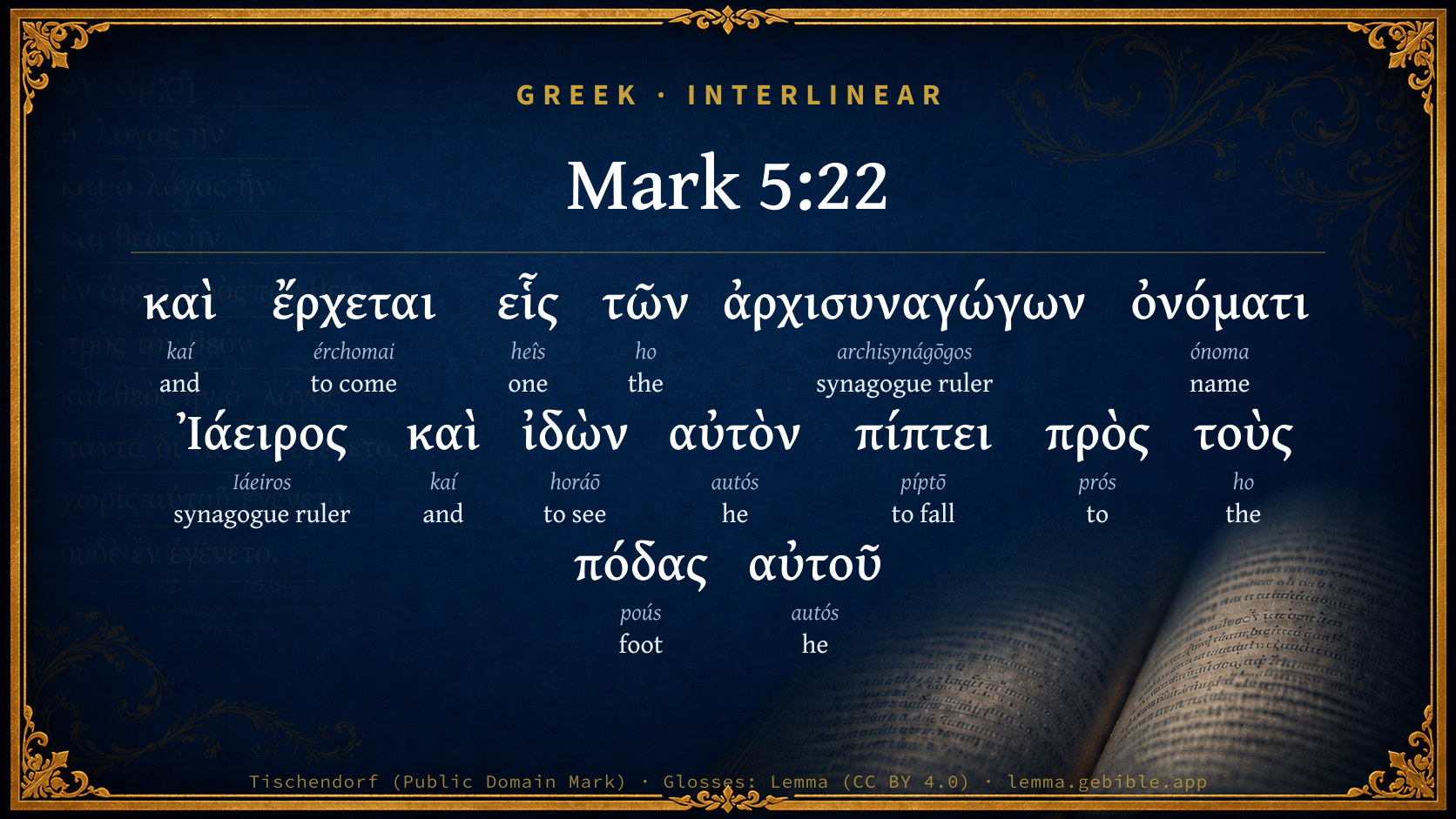
Download image
Cite this verse

Mark 5:22 (World English Bible). Public Domain. Lemma interlinear Bible study tool, https://lemma.gebible.app/v/mark/5/22.

Show BibTeX & RIS
BibTeX
RIS
English Translation
Behold, one of the rulers of the synagogue, Jairus by name, came; and seeing him, he fell at his feet,
World English Bible · Public Domain
Highlights
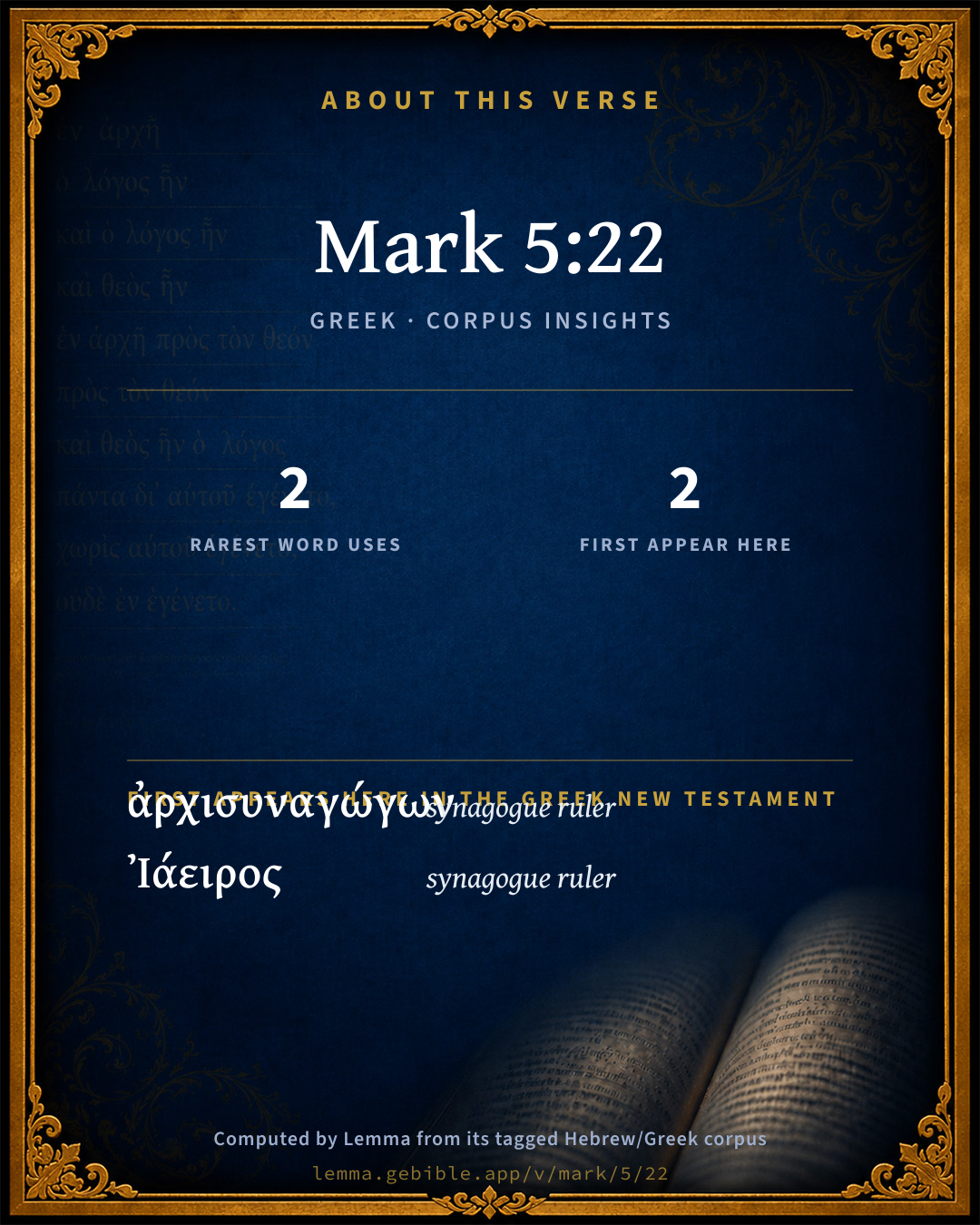
  • 2 first appearances in the Greek New Testament
Full analysis ↓
Download a study sheet

One document with this verse’s original text, its word-by-word gloss line, the meaning frame, cross-references with their text, attributed commentary, and full source and license credits — printable, and it pastes into notes with its structure intact.

This verse Autodidact and up

Study sheet (.html) Plain text (.txt)

A passage Seminary Student

Up to 50 verses in one chapter. A passage sheet keeps up to 6 commentary sources and 12 cross-references per verse, in the order this page ranks them, and says so on the sheet whenever that leaves anything out. Ask for a single verse and you get the Autodidact verse sheet above.

Everything on this page stays free to read, with no account — the sheet is a download of what is already on screen, not access to it.

Want to remove ads? Support Godless Engineer
Compare translations 3

The same verse in 3 English versions, stacked beneath the original-language interlinear above. Click any original word for its lexicon entry.

Each is an independent rendering of the whole verse — the interlinear is not word-aligned to these translations.

Highlighted words mark where these versions differ — a whole-verse word diff, not a word-by-word alignment.

  • World English Bible Public Domain
    Behold, one of the rulers of the synagogue, Jairus by name, came; and seeing him, he fell at his feet,
  • King James Version Public Domain
    And, behold, there cometh one of the rulers of the synagogue, Jairus by name; and when he saw him, he fell at his feet,
  • unfoldingWord Literal Text CC BY-SA 4.0
    And behold, one of the synagogue rulers, Jairus by name, comes, and having seen him, he falls at his feet.

unfoldingWord Literal Text — © unfoldingWord, licensed CC BY-SA 4.0. Word-aligned USFM3 via Door43 (git.door43.org/unfoldingWord/en_ult).

Versions to compare (up to 4)

3 of 4 selected

Show all 19 translations

Every available English version of this verse, each an independent rendering of the whole verse.

  • World English Bible Public Domain
    Behold, one of the rulers of the synagogue, Jairus by name, came; and seeing him, he fell at his feet,
  • Berean Standard Bible Public Domain
    A synagogue leader named Jairus arrived, and seeing Jesus, he fell at His feet
  • Majority Standard Bible Public Domain
    And behold, a synagogue leader named Jairus arrived, and seeing Jesus, he fell at His feet
  • King James Version Public Domain
    And, behold, there cometh one of the rulers of the synagogue, Jairus by name; and when he saw him, he fell at his feet,
  • American Standard Version (1901) Public Domain
    And there cometh one of the rulers of the synagogue, Jairus by name; and seeing him, he falleth at his feet,
  • Revised Version (1885) Public Domain
    And there cometh one of the rulers of the synagogue, Jairus by name; and seeing him, he falleth at his feet,
  • Geneva Bible (1599) Public Domain
    And beholde, there came one of the rulers of the Synagogue, whose name was Iairus: and when he sawe him, he fell downe at his feete,
  • Douay-Rheims (1899) Public Domain
    And there cometh one of the rulers of the synagogue named Jairus: and seeing him, falleth down at his feet.
  • Young's Literal Translation Public Domain
    and lo, there doth come one of the chiefs of the synagogue, by name Jairus, and having seen him, he doth fall at his feet,
  • Literal Standard Version CC BY-SA 4.0
    and behold, there comes one of the chiefs of the synagogue, by name Jairus, and having seen Him, he falls at His feet,
  • Unlocked Literal Bible CC BY-SA 4.0
    Then one of the leaders of the synagogue, named Jairus, came, and when he saw him, fell at his feet.
  • unfoldingWord Literal Text CC BY-SA 4.0
    And behold, one of the synagogue rulers, Jairus by name, comes, and having seen him, he falls at his feet.
  • Darby Bible Public Domain
    And [behold] there comes one of the rulers of the synagogue, by name Jairus, and seeing him, falls down at his feet;
  • World Messianic Bible Public Domain
    Behold, one of the rulers of the synagogue, Jairus by name, came; and seeing him, he fell at his feet
  • Webster's Bible Public Domain
    And behold, there cometh one of the rulers of the synagogue, Jairus by name; and when he saw him, he fell at his feet,
  • Free Bible Version CC BY-SA 4.0
    A synagogue leader, a man named Jairus, came to him. When he saw Jesus, he fell at his feet
  • Bible in Basic English Public Domain
    And one of the rulers of the Synagogue, Jairus by name, came, and seeing him, went down at his feet,
  • Text-Critical English NT CC BY 4.0
    And behold, one of the rulers of the synagogue came, whose name was Jairus. When he saw Jesus, he fell down at his feet
  • Tyndale New Testament (1534) Public Domain
    And beholde ther came one of the rulers of the Synagoge whose name was Iairus: and when he sawe him he fell doune at his fete

Literal Standard Version (2020), Covenant Press — licensed CC BY-SA 4.0. Text via the HelloAO Bible API (eBible.org). Unlocked Literal Bible (unfoldingWord) — licensed CC BY-SA 4.0. Text via the HelloAO Bible API (eBible.org). unfoldingWord Literal Text — © unfoldingWord, licensed CC BY-SA 4.0. Word-aligned USFM3 via Door43 (git.door43.org/unfoldingWord/en_ult). Free Bible Version, Dr. Jonathan Gallagher — licensed CC BY-SA 4.0. Text via the HelloAO Bible API (eBible.org).

Word by word

More ways to search: Search by grammar → Find every occurrence → Compare this word →

Practice this passage: Drill this verse → Learn its vocabulary →

Ἰάειρος
Iáeiros
G2383
“synagogue ruler”
Noun, Nominative, Singular, Masculine
Part of Speech
Noun
Case
Nominative
Number
Singular
Gender
Masculine
Full Thayer's Definition

Origin: of hebrew origin H2971

TDNT: None

Jairus = "whom God enlightens" 1. a ruler of a synagogue, probably near the western shore of the Sea of Galilee
  1. καὶ kaí G2532 “and” Conjunction
  2. ἔρχεται érchomai G2064 “to come” Verb, Present, Middle or Passive deponent, Indicative, 3rd person, Singular
  3. εἷς heîs G1520 “one” Adjective, Nominative, Singular, Masculine
  4. τῶν ho G3588 “the” Article, Genitive, Plural, Masculine
  5. ἀρχισυναγώγων archisynágōgos G752 “synagogue ruler” Noun, Genitive, Plural, Masculine
  6. ὀνόματι ónoma G3686 “name” Noun, Dative, Singular, Neuter
  7. καὶ kaí G2532 “and” Conjunction
  8. ἰδὼν horáō G3708 “to see” Verb, Aorist, Active, Participle, Nominative, Singular, Masculine
  9. αὐτὸν autós G846 “he” Personal pronoun, Accusative, Singular, Masculine
  10. πίπτει píptō G4098 “to fall” Verb, Present, Active, Indicative, 3rd person, Singular
  11. πρὸς prós G4314 “to” Preposition
  12. τοὺς ho G3588 “the” Article, Accusative, Plural, Masculine
  13. πόδας poús G4228 “foot” Noun, Accusative, Plural, Masculine
  14. αὐτοῦ autós G846 “he” Personal pronoun, Genitive, Singular, Masculine

About this verse

These counts appear in no published source. They are computed here, from the morphology-tagged text and Lemma’s own curated glosses. What Lemma adds →

15
words
12
distinct lemmas
Gospels
section

Notable vocabulary

The rarest word here is Ἰάειρος synagogue ruler G2383 — appearing just 2 times in the whole Greek New Testament.

First appearance in Scripture

These words make their first canonical appearance in the Greek New Testament here:

  • ἀρχισυναγώγων synagogue ruler G752
  • Ἰάειρος synagogue ruler G2383

Shared distinctive vocabulary

Ἰάειρος synagogue ruler G2383 occurs in 2 verses of the Greek New Testament. Also found in:
Repetition

Words recur within this verse:

  • καὶ and G2532 ×2
  • τῶν the G3588 ×2
  • αὐτὸν he G846 ×2

Cross-references

14

Topical passages linked to Mark 5:22 in the Treasury of Scripture Knowledge — connected by theme and wording, ordered by reader-vote popularity; previews shown in the World English Bible.

  • Luke 13:14 The ruler of the synagogue, being indignant because Jesus had healed on the Sabbath, said to the multitude, "There are six days in which men ought to work. Therefore come on those days and be healed, and not on the Sabbath day!"
  • Mark 5:35–36 While he was still speaking, they came from the synagogue ruler's house saying, "Your daughter is dead. Why bother the Teacher any more?"
  • Acts 13:15 After the reading of the law and the prophets, the rulers of the synagogue sent to them, saying, "Brothers, if you have any word of exhortation for the people, speak."
  • Acts 18:8 Crispus, the ruler of the synagogue, believed in the Lord with all his house. Many of the Corinthians, when they heard, believed and were baptized.
  • Acts 18:17 Then all the Greeks laid hold on Sosthenes, the ruler of the synagogue, and beat him before the judgment seat. Gallio didn't care about any of these things.
  • Matthew 9:18–26 While he told these things to them, behold, a ruler came and worshiped him, saying, "My daughter has just died, but come and lay your hand on her, and she will live."
  • Mark 5:33 But the woman, fearing and trembling, knowing what had been done to her, came and fell down before him, and told him all the truth.
  • Luke 5:8 But Simon Peter, when he saw it, fell down at Jesus' knees, saying, "Depart from me, for I am a sinful man, Lord."
  • Matthew 2:11 They came into the house and saw the young child with Mary, his mother, and they fell down and worshiped him. Opening their treasures, they offered to him gifts: gold, frankincense, and myrrh.
  • Mark 5:38 He came to the synagogue ruler's house, and he saw an uproar, weeping, and great wailing.
  • Luke 8:28 When he saw Jesus, he cried out, and fell down before him, and with a loud voice said, "What do I have to do with you, Jesus, you Son of the Most High God? I beg you, don't torment me!"
  • Luke 8:41–56 Behold, there came a man named Jairus, and he was a ruler of the synagogue. He fell down at Jesus' feet, and begged him to come into his house,
  • Revelation 22:8 Now I, John, am the one who heard and saw these things. When I heard and saw, I fell down to worship before the feet of the angel who had shown me these things.
  • Acts 10:25–26 When it happened that Peter entered, Cornelius met him, fell down at his feet, and worshiped him.

Cross-references courtesy of OpenBible.info (CC BY 4.0).

Commentary

Notes on Mark 5:22 from classic Christian and Jewish commentators (each source and its license shown beneath its notes). The classic Christian expositions comment on the surrounding passage and are grouped to its opening verse, so a note may address several verses; the Jewish commentaries on the Tanakh (Rashi and others) are per-verse, so they appear only where the commentator wrote on this verse.

Lemma curates 59 commentaries, every one of them public domain or Creative Commons licensed, each selected and text-cleaned for this edition rather than reprinted as found. About our sources →

John Gill's Exposition

And behold, there cometh one of the rulers of the synagogue,.... Having heard of his return, and where he was; See Gill on Mat 9:18.

Jairus by name; in Hebrew "Jair": and Jerom says (n), it signifies "enlightening", or "enlightened": deriving it from "to be light": and it is no doubt a Jewish name, since he was a ruler of the synagogue; and besides, it is often mentioned in the Old Testament, and particularly in Est 2:5, where, in the Septuagint, it is read, Jairus. Matthew makes no mention of his name; but both Mark and Luke do, Mar 5:22.

And when he saw him, he fell at his feet: as soon as he came into his presence; though he was a person of such authority; yet having heard much of the doctrine and miracles of Christ, and believing him to be a great prophet, and man of God; though he might not know that he was the Messiah, and truly God, threw himself at his feet; and, as Matthew says, "worshipped him", Mat 9:18; showed great reverence and respect unto him, gave him homage, at least in a civil way, though he might not adore him as God.

(n) De Hebr. Nominibus in Luc.

John Gill's Exposition of the Whole Bible (1746–1763) — public domain (CC PDM 1.0). Text via the HelloAO Bible API.

Joseph Benson's Commentary

Mar 5:22-28. There cometh one of the rulers of the synagogue — Probably that at Capernaum. The rulers of the synagogue were three persons chosen out of ten, who were obliged constantly to attend the public worship over which they presided, and determined such disputes as happened in the synagogue. For an explanation of this whole paragraph, see notes on Mat 9:18-26.

Joseph Benson's Commentary on the Old and New Testaments (1811–1818) — public domain. Text from a community e-Sword module.

Whedon's Commentary on the Bible

Daniel D. Whedon

§ 52. — CROSSING THE SEA PREVIOUS TO LEVI’S FEAST, Mar_5:21.

§ 52. — RAISING OF JAIRUS’S DAUGHTER AND HEALING THE ISSUE, Mar_5:22-43.

22. Jairus by name — The raising of Jairus’s daughter is in each of the three evangelists closely connected with the healing of the diseased woman.

Daniel D. Whedon (gen. ed.), Commentary on the Old and New Testaments (1874–1909) — public domain. Text from a community e-Sword module.

MacLaren's Expositions of Holy Scripture

Alexander MacLaren

Mark

TALITHA CUMI

Mar 5:22 - Mar 5:24, Mar 5:35 - Mar 5:43.

The scene of this miracle was probably Capernaum; its time, according to Matthew, was the feast at his house after his call. Mark’s date appears to be later, but he may have anticipated the feast in his narrative, in order to keep the whole of the incidents relating to Matthew’s apostleship together. Jairus’s knowledge of Jesus is implied in the story, and perhaps Jesus’ acquaintance with him.

I. We note, first, the agonised appeal and the immediate answer.

Desperation makes men bold. Conventionalities are burned up by the fire of agonised petitioning for help in extremity. Without apology or preliminary, Jairus bursts in, and his urgent need is sufficient excuse. Jesus never complains of scant respect when wrung hearts cry to Him. But this man was not only driven by despair, but drawn by trust. He was sure that, even though his little darling had been all but dead when he ran from his house, and was dead by this time, for all he knew, Jesus could give her life. Perhaps he had not faced the stern possibility that she might already be gone, nor defined precisely what he hoped for in that case. But he was sure of Jesus’ power, and he says nothing to show that he doubted His willingness. A beautiful trust shines through his words, based, no doubt, on what he had known and seen of Jesus’ miracles. We have more pressing and deeper needs, and we have fuller and deeper knowledge of Jesus, wherefore our approach to Him should be at least as earnest and confidential as Jairus’s was. If our Lord was at the feast when this interruption took place, His gracious, immediate answer becomes more lovely, as a sign of His willingness to bring the swiftest help. ‘While they are yet speaking, I will hear.’ Jairus had not finished asking before Jesus was on His feet to go.

The father’s impatience would be satisfied when they were on their way, but how he would chafe, and think every moment an age, while Jesus stayed, as if at entire leisure, to deal with another silent petitioner! But His help to one never interferes with His help to another, and no case is so pressing as that He cannot spare time to stay to bless some one else. The poor, sickly, shamefaced woman shall be healed, and the little girl shall not suffer.

II. We have next the extinction and rekindling of Jairus’s glimmer of hope.

Distances in Capernaum were short, and the messenger would soon find Jesus. There was little sympathy in the harsh, bald announcement of the death, or in the appended suggestion that the Rabbi need not be further troubled. The speaker evidently was thinking more of being polite to Jesus than of the poor father’s stricken heart, Jairus would feel then what most of us have felt in like circumstances,-that he had been more hopeful than he knew. Only when the last glimmer is quenched do we feel, by the blackness, how much light had lingered in our sky, But Jesus knew Jairus’s need before Jairus himself knew it, and His strong word of cheer relit the torch ere the poor father had time to speak. That loving eye reads our hearts and anticipates our dreary hopelessness by His sweet comfortings. Faith is the only victorious antagonist of fear. Jairus had every reason for abandoning hope, and his only reason for clinging to it was faith. So it is with us all. It is vain to bid us not be afraid when real dangers and miseries stare us in the face; but it is not vain to bid us ‘believe,’ and if we do that, faith, cast into the one scale, will outweigh a hundred good reasons for dread and despair cast into the other.

III. We have next the tumult of grief and the word that calms.

The hired mourners had lost no time, and in Eastern fashion were disturbing the solemnity of death with their professional shrieks and wailings. True grief is silent. Woe that weeps aloud is soon consoled.

What a contrast between the noise outside and the still death-chamber and its occupant, and what a contrast between the agitation of the sham comforters and the calmness of the true Helper! Christ’s great word was spoken for us all when our hearts are sore and our dear ones go. It dissolves the dim shape into nothing ness, or, rather, it transfigures it into a gracious, soothing form. Sleep is rest, and bears in itself the pledge of waking. So Christ has changed the ‘shadow feared of man’ into beauty, and in the strength of His great word we can meet the last enemy with ‘Welcome! friend.’ It is strange that any one reading this narrative should have been so blind to its deepest beauty as to suppose that Jesus was here saying that the child had only swooned, and was really alive. He was not denying that she was what men call ‘dead,’ but He was, in the triumphant consciousness of His own power, and in the clear vision of the realities of spiritual being, of which bodily states are but shadows, denying that what men call death deserves the name. ‘Death’ is the state of the soul separated from God, whether united to the body or no,-not the separation of body and soul, which is only a visible symbol of the more dread reality.

IV. We have finally the life-giving word and the life-preserving care.

Probably Jesus first freed His progress from the jostling crowd, and then, when arrived, made the further selection of the three apostles,-the first three of the mighty ones-and, as was becoming, of the father and mother.

With what hushed, tense expectation they would enter the chamber! Think of the mother’s eyes watching Him. The very words that He spoke were like a caress. There was infinite tenderness in that ‘Damsel!’ from His lips, and so deep an impression did it make on Peter that he repeated the very words to Mark, and used them, with the change of one letter {‘Tabitha’ for ‘Talitha’}, in raising Dorcas. The same tenderness is expressed by His taking her by the hand, as, no doubt, her mother had done, many a morning, on waking her. The father had asked Him to lay His hand on her, that she might be made whole and live. He did as He was asked,-He always does-and His doing according to our desire brings larger blessings than we had thought of. Neither the touch of His hand nor the words He spoke were the real agents of the child’s returning to life. It was His will which brought her back from whatever vasty dimness she had entered. The forth-putting of Christ’s will is sovereign, and His word runs with power through all regions of the universe. ‘The dull, cold ear of death’ hears, and ‘they that hear shall live,’ whether they are, as men say, dead, or whether they are ‘dead in trespasses and sins.’ The resurrection of a soul is a mightier act-if we can speak of degrees of might in His acts-than that of a body.

It would be calming for the child of such strange experiences to see, for the first thing that met her eyes opening again on the old familiar home as on a strange land, the bending face of Jesus, and His touch would steady her spirit and assure of His love and help. The quiet command to give her food knits the wonder with common life, and teaches precious lessons as to His economy of miraculous power, like His bidding others loosen Lazarus’s wrappings, and as to His devolution on us of duties towards those whom He raises from the death of sin. But it was given, not didactically, but lovingly. The girl was exhausted, and sustenance was necessary, and would be sweet. So He thought upon a small bodily need, and the love that gave life took care to provide what was required to support it. He gives the greatest; He will take care that we shall not lack the least.

Alexander MacLaren, Expositions of Holy Scripture (1904–1910) — public domain. Text from a community e-Sword module.

Bengel's Gnomon

Johann Albrecht Bengel

Mar 5:22.[43] Ἰάειρος, Jairus) At the time that Mark wrote this, Jairus and his daughter might still have been found in Palestine. It is a strong proof of the truth of the Gospel, that the very proper names are given in the Evangelist’s narrative.[44]—ἸΔῺΝ, when he saw) having beheld the majesty of Christ.

[43] τῶν ἀρχισυναγώγων, the rulers of the Synagogue) Who were overseers of the doctors and teachers.—V. g.

[44] And, in the case of Jairus and others, in the vicinity of the very localities where the name was a prevalent one. Comp. Num 32:41; Deu 3:14; Jdg 10:3; Jdg 10:5; 1Ch 2:22.—ED.

Bengel's Gnomon of the New Testament — English translation (T&T Clark, Edinburgh, 1860) — public domain. Text from a community e-Sword module.

Expositor's Greek Testament

ed. W. Robertson Nicoll

Mar 5:22 . εἷς τ . ἀ .: might imply a plurality of synagogues, each having its chief ruler. But in Act 13:14-15 , one syn. has its ἀρχισωνάγωζοι .

The Expositor's Greek Testament, edited by W. Robertson Nicoll (1897–1910) — public domain. Text from a community e-Sword module.

Geneva Bible (1599)

Geneva Bible translators

The whole company assembled not disorderly, but in every Synagogue there were certain men which governed the people.

Geneva Bible (1599) marginal notes — public domain. Text via Bolls.life.

Ellicott's Commentary for English Readers

(22-43) And, behold, there cometh one of the rulers.—See Notes on Mat_9:18-25, where the narrative is found in a different connection as coming immediately after the feast in St. Matthew’s house, which St. Mark has given in Mar_2:14-18.

Jairus.—The name is given by St. Mark and St. Luke only. It was a Græcised form of the Jair of Jdg_10:3, Num_32:41. It meets us in the Apocryphal portion of Esther (xi. 2) as the name of the father of Mardocheus, or Mordecai.

A Bible Commentary for English Readers, edited by Charles John Ellicott (1878–1897) — public domain. Text from a community e-Sword module.

The Cambridge Bible for Schools and Colleges

gen. ed. J. J. S. Perowne

22. the rulers of the synagogue] Each synagogue had a kind of Chapter or College of Elders, presided over by a ruler, who superintended the services, and possessed the power of excommunication. From this place, e.g., compared with Act_13:15, it would appear that some synagogues had several rulers.

Jairus by name] It is but rarely we know the names of those who were the objects of the Saviour’s mercy. He afterwards probably was one of those who came to the Lord pleading for the centurion at Capernaum (Luk_7:3). The aid he then asked for another, he now craves for himself, but under the pressure of a still greater calamity.

The Cambridge Bible for Schools and Colleges (gen. ed. J. J. S. Perowne; Cambridge University Press, 1878–1918) — public domain. Text from a community e-Sword module.

Trapp's Complete Commentary

John Trapp

22 And, behold, there cometh one of the rulers of the synagogue, Jairus by name; and when he saw him, he fell at his feet,

Ver. 22. {See Trapp "Mat 9:18"}

John Trapp, A Commentary or Exposition upon All the Books of the Old and New Testament (1647–1656) — public domain. Text from a community e-Sword module.

Albert Barnes' Notes on the Bible

See the account of the raising of Jairus’ daughter, and the healing of the woman with an issue of blood, fully explained in the notes at Mat 9:18-26.

Mar 5:23

Lieth at the point of death - Is dying; in the last agonies.

Mar 5:26

Had suffered many things - Had resorted to many things painful, by the direction of the physicians, in order to be healed.

Mar 5:27

Came in the press behind - In the crowd that pressed upon him. This was done to avoid being noticed. It was an act of faith. She was full of confidence that Jesus was able to heal, but she trembled on account of her conscious unworthiness, thus illustrating the humility and confidence of a sinner coming to God for pardon and life.

Mar 5:30

Virtue had gone out of him - Power to heal. The word in the original means power.

Who touched my clothes? - This be said, not to obtain information, for he had healed her, and must have known on whom the blessing was conferred; but he did it that the woman might herself make a confession of the whole matter, so that the power of her faith and the greatness of the miracle might be manifested to the praise of God.

Mar 5:34

Daughter - A word of kindness, tending to inspire confidence and to dissipate her fears.

Be whole - That is, continue to be whole, for she was already cured.

Of thy plague - Thy disease; literally, thy “scourge.” So a word from Jesus heals the moral malady of the sinner.

Mar 5:35, Mar 5:36

Why troublest thou ... - It seems that the people had not yet confidence that Jesus could raise the dead. He had not yet done it; and as the child was now dead, and as they supposed that his power over her was at an end, they wished no farther to trouble him. Jesus kindly set the fears of the ruler at rest, and assured him that he had equal power over the dead and the living, and could as easily raise those who had expired as those who were expiring.

Mar 5:38

The tumult - The confusion and weeping of the assembled people.

Wailed - Making inarticulate, mournful sounds; howling for the dead.

Mar 5:39

This ado - This tumult, this bustle or confusion.

And weep - Weep in this inordinate and improper manner. See the notes at Mat 9:23.

But sleepeth - See the notes at Mat 9:24.

Mar 5:41

Talitha cumi - This is the language which our Saviour commonly spoke. It is a mixture of Syriac and Chaldee, called Syro-Chaldaic. The proper translation is given by the evangelist - “Damsel, arise.”

Mar 5:43

Something should be given her to eat - “He had raised her by extraordinary power, but he willed that she should be sustained by ordinary means.” He also in this gave full evidence that she was really restored to life and health. The changes were great, sudden, and certain. There could be no illusion. So, when the Saviour had risen, he gave evidence of his own resurrection by eating with his disciples, Joh 21:1-13.

Albert Barnes' Notes on the Bible (1834–1885) — public domain. Text from a community e-Sword/MySword module.

The Pulpit Commentary

One of the rulers of the synagogue, Jairus by name. He appears to have been one of the "college of elders," who administered the affairs of the synagogue. The name Jairus, or "Ya eiros," is probably the Greek form of the Hebrew Jair, "he will illuminate." He fell at his feet, and besought him greatly; it is literally (piptei kai parekalei), he falleth at his feet, and beseecheth him. We picture him to ourselves, making his way through the crowd, and as he approached Jesus, kneeling down, and then bending his head towards him, until his forehead touched the ground. My little daughter is at the point of death. St. Matthew says, "is even now dead;" St. Luke says, "she Jay a dying." The broken sentences of the father are very true to nature. All the expressions point to the same conclusion, that she was in articulo mortis. In each narrative the ruler is represented as asking that Christ would hasten to his house. He had not reached the higher faith of the Gentile centurion, "Speak the word only.

The faith of Jairus.

Faith was the one thing which Christ demanded of every suppliant who came to him. He asked the blind man the question, "Believest thou that I am able to do this?" He said to the father of the lunatic child," All things are possible to him that believeth." Here he assured the woman in the crowd who had been healed, "Thy faith hath saved thee;" and to Jairus he said, "Be not afraid, only believe." All these are exemplifications of the words, "Without faith it is impossible to please God." Faith is the hand which the soul stretches out to receive the blessings of pardon, salvation, and peace. If two men have sinned, and are both conscious of guilt, one may walk at liberty, while the other is burdened; because, though he is grieved about his sin, and hates it, and therefore has truly repented, the latter fails to believe the assurance, "Thy sins are forgiven thee." Similarly, in trouble a Christian may exhibit a serenity which fills onlookers with wonder, not because his trouble is lighter or his sensibility less, but because he has faith to believe that God is doing good through the trouble, or that he will ultimately bring good out of it. This faith in Christ Jairus had, though imperfectly, and his peace was in proportion to his trust.

I JAIRUS"S FAITH WAS UNEXPECTED. He was "the ruler of the synagogue;" in other words, he was the president of one of the synagogues in Capernaum. It was his duty to superintend and direct its services, and to preside over its college of elders. As a pastor and professor to use modem terms be would have strong prejudices against a heretical teacher, such as our Lord was esteemed to be. We all know how difficult it is to go out of the usual course in any professional work; but although those who were associated with Jairus were hostile to our Lord, he dared to fall humbly at his feet. Sometimes the least hopeful, in human opinion, are the most richly blessed by Divine favour. Those who have often been taught and prayed for in our congregations may remain untouched, while some poor waif who has drifted in from the sea of life may find rest in Christ. Many shall come from the east and from the west. to sit down in the kingdom, while those who are favoured by circumstances and birth will be shut out.

II JAIRUS"S FAITH GERMINATED IN GRIEF. He had been shut up with his little daughter who was ill, and for a time had been cut off from ordinary duties and associations. We can picture him to ourselves sitting beside her, with her little hand in his, while her eyes would often seek his with filial love. She had heard of Christ (what child in Capernaum had not?); possibly she had seen him, and loved him, as most of the children did. And while she spoke to her father, when his heart was specially tender, he could not but drink in thoughts of the love and power of Jesus, until, daring the worst that his friends could say of him, he fell at Jesus" feet. Sometimes those who have been associated with Churches or Sunday schools remain untouched by holy influence, until, having left their old connections, they fall into sin and shame, and then, knowing not whither in the world to turn, they look to Jesus. Sometimes professing Christians feel that they are far from God, and that even in their prayers he appears vague and unreal; till trouble comes illness assails one whose life is precious, and then they pray in an agony of earnestness, as Jairus did, when he besought Jesus greatly, saying, My little daughter lieth at the point of death." Faith often springs up in the soil of trouble.

III JAIRIUS"S FAITH WAS SEVERELY TRIED. His hope was quickened when he saw Jesus rise up at once to follow him; but the crowd would not let our Lord hasten, and the poor woman meanwhile stole her blessing, and Christ delayed to speak with her and with others. Looking towards his home with ever-growing anxiety, at last Jairus saw what he dreaded seeing a messenger, who said, "Thy daughter is dead: why troublest thou the Master any further?" But he had to learn that no one in earnest was ever a "trouble" to the Lord; that when he seemed to be caring for another he was really thinking of him, and preparing him to receive a far greater blessing than any he had come to seek. Christ delayed that "the trial of this man"s faith, being much more precious than that of gold that perisheth, though it be tried with fire, might be found to God"s glory." We often find that there is delay in the coming of answers to prayer. We cry for light, and yet our way is dark, and we see not even the next step. We ask for deliverance, but the disaster comes which overwhelms us with distress. We entreat the Lord to spare some cherished life, but the dear one is taken away. Nevertheless, "let patience have her perfect work, that ye may be perfect and entire, wanting nothing.

IV JAIRUS"S FAITH WAS LOVINGLY ENCOURAGED. The storm tested this tree till its roots struck deeper; but when there appeared some risk of its falling, Christ said to the tempest, "Peace, be still." When the messengers said, "Thy daughter is dead," at once Jesus spoke; and "as soon as Jesus heard the word that was spoken, he saith,... Be not afraid, only believe." Again, when Jairus entered his house, you can imagine how the father"s heart sank as he saw the mourners for the dead already there. Till then he had been hoping against hope, as sometimes we do till we actually, enter the darkened house where the dead one lies. Again Jesus interposed, saying, The damsel is not dead, but sleepeth;" for so would he keep alive trust and hope till the blessing came, for which they were the preparation. "He will not break the bruised reed, nor quench the smoking flax. A. R.

The Pulpit Commentary (1880–1919), ed. H.D.M. Spence-Jones & Joseph S. Exell — public domain. Text from a community e-Sword module.

John Wesley's Explanatory Notes

One of the rulers of the synagogue - To regulate the affairs of every synagogue, there was a council of grave men. Over these was a president, who was termed the ruler of the synagogue. Sometimes there was no more than one ruler in a synagogue. Matt. ix, 18; Luke viii, 41.

John Wesley, Explanatory Notes Upon the Whole Bible (1754–1765) — public domain. Text via the GEBible commentary corpus.

The People's New Testament

B. W. Johnson

22. One of the rulers of the synagogue. The office of ruler in the synagogue was somewhat similar to that of elder in a Christian congregation.

B. W. Johnson's The People's New Testament with Notes (1889–1891) — public domain. Electronic text from the Christian Classics Ethereal Library (CCEL) ThML edition.

Cambridge Greek Testament for Schools and Colleges

22. [997][998][999][1000][1001] omit ἰδού.

[997] Codex Sinaiticus. 4th cent. Discovered by Tischendorf in 1859 at the Monastery of St Katharine on Mount Sinai. Now at St Petersburg. The whole Gospel, ending at Mar 16:8. Photographic facsimile, 1911.

[998] Codex Vaticanus. 4th cent., but perhaps a little later than א. In the Vatican Library almost since its foundation by Pope Nicolas V., and one of its greatest treasures. The whole Gospel, ending at Mar 16:8. Photographic facsimile, 1889.

[999] Codex Bezae. 6th cent. Has a Latin translation (d) side by side with the Greek text, and the two do not quite always agree. Presented by Beza to the University Library of Cambridge in 1581. Remarkable for its frequent divergences from other texts. Contains Mark, except Mar 16:15-20, which has been added by a later hand. Photographic facsimile, 1899.

[1000] Codex Regius. 8th cent. An important witness. At Paris. Contains Mar 1:1 to Mar 10:15; Mar 10:30 to Mar 15:1; Mar 15:20 to Mar 16:20, but the shorter ending is inserted between Mar 16:8 and Mar 16:9, showing that the scribe preferred it to the longer one.

[1001] Codex Sangallensis. 9th or 10th cent. Contains the Gospels nearly complete, with an interlinear Latin translation. The text of Mark is specially good, agreeing often with CL. At St Gall.

22. εἷς τῶν ἀρχισυναγώγων. There was usually only one to each synagogue. These officials regulated the services and perhaps had charge of the buildings.

Ἰάειρος. Usually those on whom or for whom Jesus does His mighty works are nameless. Jair (Num 32:41; Jdg 10:3) means “he will give light” rather than “he will awaken”; but even if the latter derivation were correct, it would not prove that the name was invented to match the story, nor would the invention of the name prove that the whole story was invention. As in the case of Lazarus and his sisters, the name of the leading person in this incident would be likely to be remembered. The daughter may have been a well known person, like Alexander and Rufus (Mar 15:21), when Mk wrote. Bartimaeus, Mary Magdalen, and Malchus are similar instances.

πρὸς τοὺς πόδας αὐτοῦ. In the Synoptics αὐτοῦ generally follows its substantive (Mar 5:27, Mar 6:1; Mar 6:4, etc.); in Jn it often precedes (Mar 11:32, Mar 1:27, etc.), about 16 times in all.

Cambridge Greek Testament for Schools and Colleges (Cambridge University Press, 1896; 21 vols, various authors incl. Carr, Maclear, Plummer, Farrar, Lumby, Moule, M. R. James, Simcox) — public domain. Text from a community e-Sword module.

International Critical Commentary

22. Καὶ ἔρχεται εἷς τῶν ἀρχισυναγώγων1 And there comes one of the synagogue-rulers.

Omit ἰδού before ἔρχεται, Tisch. Treg. WH. RV. א BDL Δ 102, mss. of Lat. Vet. Vulg. Memph. Pesh.

According to Schürer, the ἀρχισυνάγωγος is to be distinguished from the ἄρχων, the officer having general direction of the affairs of the synagogue; and he is not an official conducting the worship, for which no special appointment was made; but he is the officer entrusted with the care of public worship, including the appointment of readers and preachers. Mt. calls Jairus an ἄρχων, and Lk. uses the two names interchangeably, which is explained by the fact, that the two offices, though distinct, might be combined in one person. Generally, there was only one ἀρχισυνάγωγος in each synagogue, and εἷς τῶν ἀρχισυναγώγων may mean one of the class simply. S. Schürer, II. 2. 27.

International Critical Commentary — older volumes (1896–1929), various authors — public domain. Text from a community e-Sword module.

Lesson kit

Teaching starters — assembled from the data on this page, not authored interpretation. Every prompt links to the verse data it draws on. Edit before teaching.

Mark, in the Gospels, opens this verse with 15 words (12 distinct Greek lemmas). Its most distinctive word is Iáeiros (“synagogue ruler”). A historical commentator’s framing appears above. Read the whole chapter for the surrounding context.

Discussion questions

  1. What does “synagogue ruler” (Iáeiros) contribute to the verse as a whole?
  2. 2 words here appear for the first time in Scripture. What is being introduced at this debut?
  3. Luke 8:41 shares the word «synagogue ruler» with this verse. How do the two illuminate each other?
  4. “and” occurs 2× in this one verse. What is the effect of the repetition?
  5. These translations render this verse differently. What is at stake in choosing one wording over another?
  6. Reading how John Gill's Exposition and Joseph Benson's Commentary read this verse, where do the two commentators agree and where do they part?

Things to notice

  • 2 words make their first canonical appearance in Scripture here.
  • These translations choose different wording for 11 words in this verse.
  • “and” occurs 2× in this single verse.
  • 12 distinct Greek lemmas span 15 words in this verse.

Reading settings

Reading text

Shown beneath each verse's original-language words.

Old Testament
Old Testament edition

Read the OT as the Masoretic Hebrew (MT) or the Greek Septuagint (LXX).

English shown for the Greek Septuagint (in the Hebrew ↔ Greek comparison).

Comparing translations? Open the Compare panel on any verse page to stack up to four side by side.