
Matthew 11:10

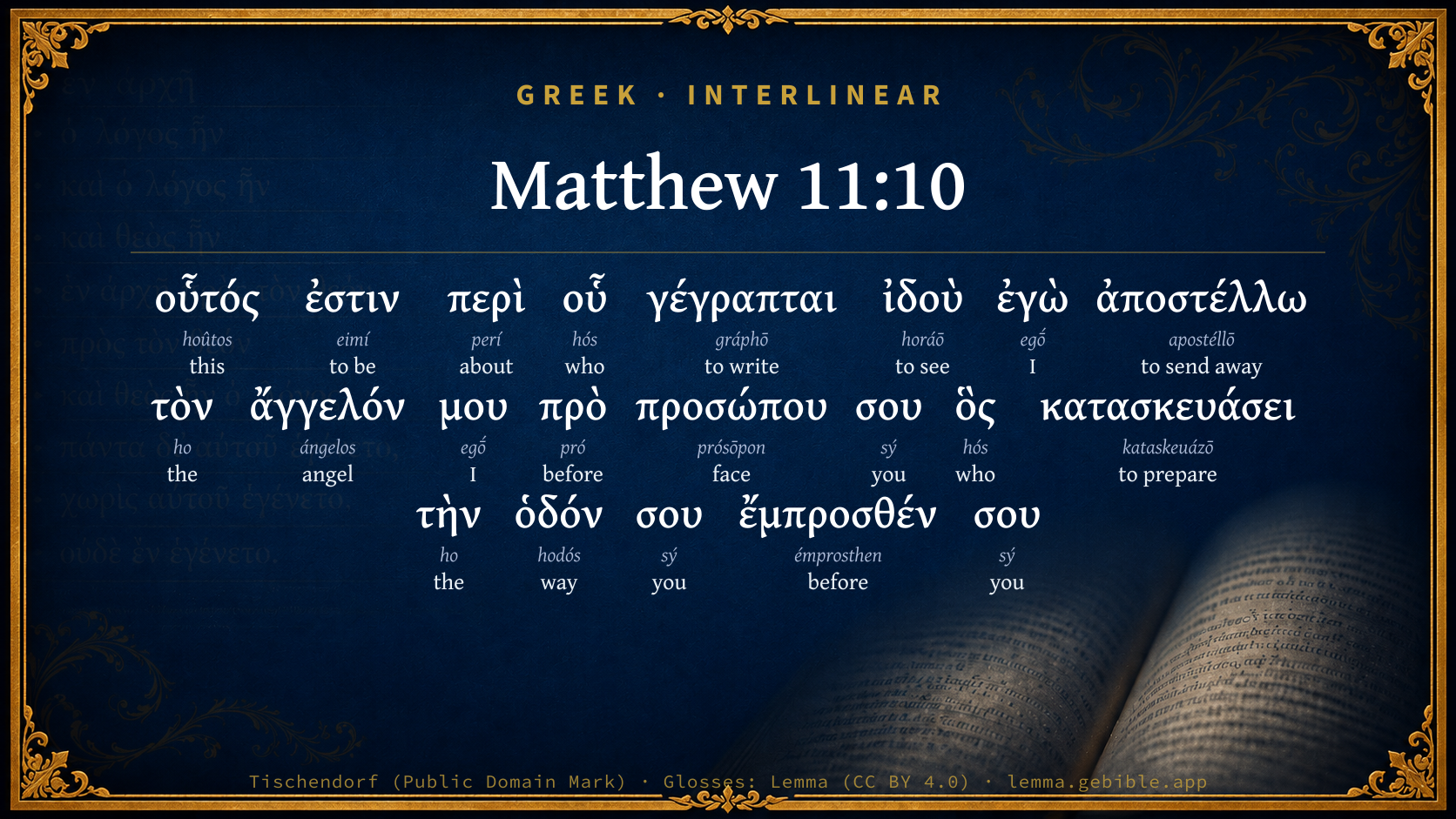
Greek (Tischendorf 8th ed.) Matthew 11:10 appears in the Greek New Testament. The text above is from the Tischendorf 8th edition. Each word links to its Strong’s number and a concise gloss. Click any word for its full Thayer’s Greek Lexicon entry.
Download image
Cite this verse

Matthew 11:10 (World English Bible). Public Domain. Lemma interlinear Bible study tool, https://lemma.gebible.app/v/matthew/11/10.

Show BibTeX & RIS
BibTeX
RIS
English Translation
For this is he, of whom it is written, 'Behold, I send my messenger before your face, who will prepare your way before you.'
World English Bible · Public Domain
Highlights
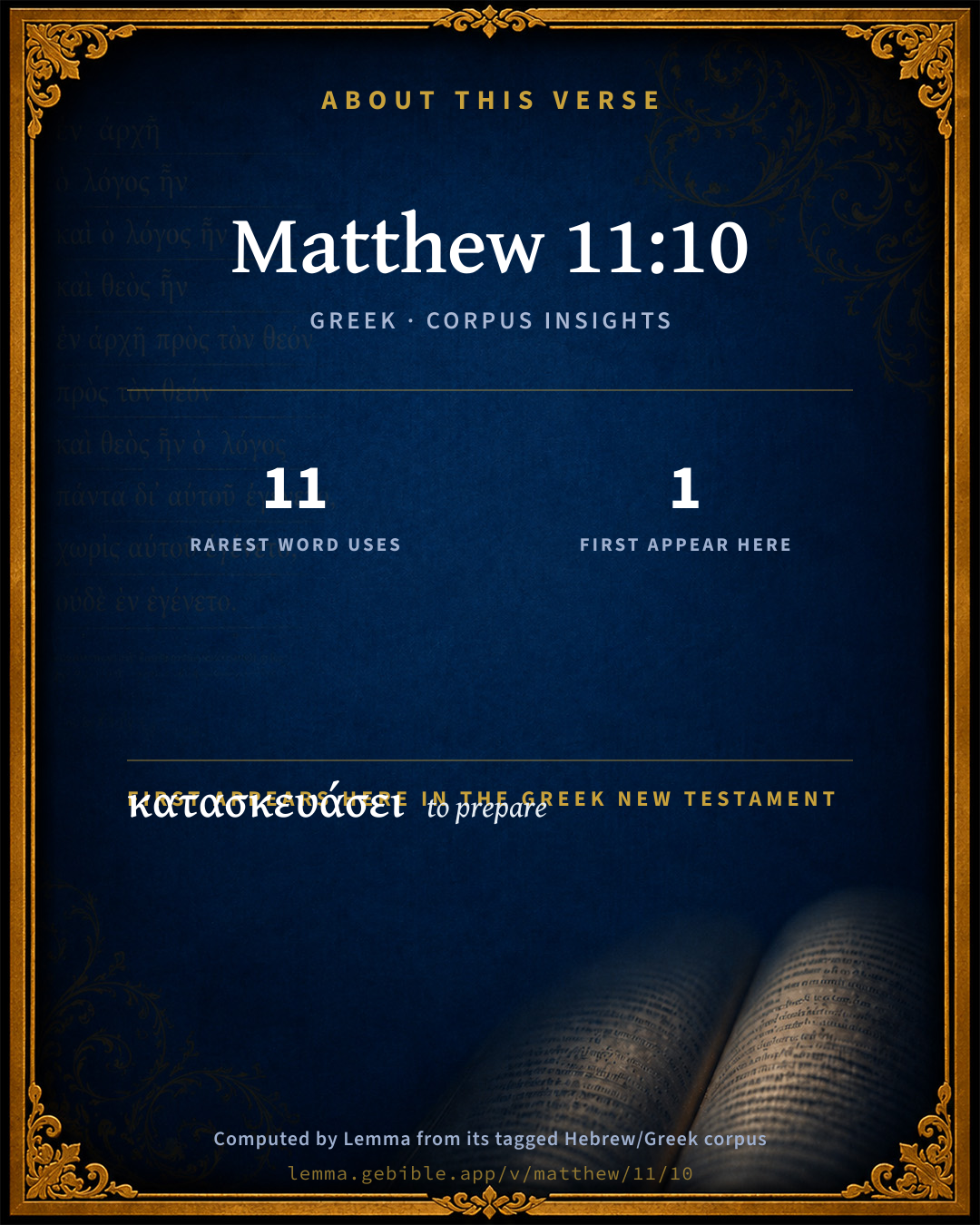
  • 1 first appearance in the Greek New Testament
Full analysis ↓
Download a study sheet

One document with this verse’s original text, its word-by-word gloss line, the meaning frame, cross-references with their text, attributed commentary, and full source and license credits — printable, and it pastes into notes with its structure intact.

This verse Autodidact and up

Study sheet (.html) Plain text (.txt)

A passage Seminary Student

Up to 50 verses in one chapter. A passage sheet keeps up to 6 commentary sources and 12 cross-references per verse, in the order this page ranks them, and says so on the sheet whenever that leaves anything out. Ask for a single verse and you get the Autodidact verse sheet above.

Everything on this page stays free to read, with no account — the sheet is a download of what is already on screen, not access to it.

Want to remove ads? Support Godless Engineer
Compare translations 3

The same verse in 3 English versions, stacked beneath the original-language interlinear above. Click any original word for its lexicon entry.

Each is an independent rendering of the whole verse — the interlinear is not word-aligned to these translations.

Highlighted words mark where these versions differ — a whole-verse word diff, not a word-by-word alignment.

  • World English Bible Public Domain
    For this is he, of whom it is written, 'Behold, I send my messenger before your face, who will prepare your way before you.'
  • King James Version Public Domain
    For this is he, of whom it is written, Behold, I send my messenger before thy face, which shall prepare thy way before thee.
  • unfoldingWord Literal Text CC BY-SA 4.0
    This is he concerning whom it is written, ‘Behold, I am sending my messenger before your face, who will prepare your way before you.’

unfoldingWord Literal Text — © unfoldingWord, licensed CC BY-SA 4.0. Word-aligned USFM3 via Door43 (git.door43.org/unfoldingWord/en_ult).

Versions to compare (up to 4)

3 of 4 selected

Show all 19 translations

Every available English version of this verse, each an independent rendering of the whole verse.

  • World English Bible Public Domain
    For this is he, of whom it is written, 'Behold, I send my messenger before your face, who will prepare your way before you.'
  • Berean Standard Bible Public Domain
    This is the one about whom it is written: ‘Behold, I will send My messenger ahead of You, who will prepare Your way before You.’
  • Majority Standard Bible Public Domain
    For this is the one about whom it is written: ‘Behold, I will send My messenger ahead of You, who will prepare Your way before You.’
  • King James Version Public Domain
    For this is he, of whom it is written, Behold, I send my messenger before thy face, which shall prepare thy way before thee.
  • American Standard Version (1901) Public Domain
    This is he, of whom it is written, Behold, I send my messenger before thy face, Who shall prepare thy way before thee.
  • Revised Version (1885) Public Domain
    This is he, of whom it is written, Behold, I send my messenger before thy face, Who shall prepare thy way before thee.
  • Geneva Bible (1599) Public Domain
    For this is he of whom it is written, Beholde, I send my messenger before thy face, which shall prepare thy way before thee.
  • Douay-Rheims (1899) Public Domain
    For this is he of whom it is written: Behold I send my angel before thy face, who shall prepare thy way before thee.
  • Young's Literal Translation Public Domain
    for this is he of whom it hath been written, Lo, I do send My messenger before thy face, who shall prepare thy way before thee.
  • Literal Standard Version CC BY-SA 4.0
    for this is he of whom it has been written: Behold, I send My messenger before Your face, who will prepare Your way before You.
  • Unlocked Literal Bible CC BY-SA 4.0
    This is he of whom it was written, 'See, I am sending my messenger before your face, who will prepare your way before you.'
  • unfoldingWord Literal Text CC BY-SA 4.0
    This is he concerning whom it is written, ‘Behold, I am sending my messenger before your face, who will prepare your way before you.’
  • Darby Bible Public Domain
    this is he of whom it is written, Behold, *I* send my messenger before thy face, who shall prepare thy way before thee.
  • World Messianic Bible Public Domain
    For this is he, of whom it is written, ‘Behold, I send my messenger before your face, who will prepare your way before you.’
  • Webster's Bible Public Domain
    For this is he concerning whom it is written, Behold, I send my messenger before thy face, who shall prepare thy way before thee.
  • Free Bible Version CC BY-SA 4.0
    He's the one this Scripture was written about: ‘I'm sending my messenger on ahead of you. He will prepare your way for you.’
  • Bible in Basic English Public Domain
    This is he of whom it has been said, See, I send my servant before your face, who will make ready your way before you.
  • Text-Critical English NT CC BY 4.0
    For this is the one of whom it is written, ‘Behold, I am sending my messenger ahead of yoʋ, who will prepare yoʋr way before yoʋ.’
  • Tyndale New Testament (1534) Public Domain
    For this is he of who it is wrytte. Beholde I sende my messenger before thy face which shall prepare thy waye before the

Literal Standard Version (2020), Covenant Press — licensed CC BY-SA 4.0. Text via the HelloAO Bible API (eBible.org). Unlocked Literal Bible (unfoldingWord) — licensed CC BY-SA 4.0. Text via the HelloAO Bible API (eBible.org). unfoldingWord Literal Text — © unfoldingWord, licensed CC BY-SA 4.0. Word-aligned USFM3 via Door43 (git.door43.org/unfoldingWord/en_ult). Free Bible Version, Dr. Jonathan Gallagher — licensed CC BY-SA 4.0. Text via the HelloAO Bible API (eBible.org).

Word by word

More ways to search: Search by grammar → Find every occurrence → Compare this word →

Practice this passage: Drill this verse → Learn its vocabulary →

κατασκευάσει
kataskeuázō
G2680
“to prepare”
Verb, Future, Active, Indicative, 3rd person, Singular
Part of Speech
Verb
Tense
Future
Voice
Active
Mood
Indicative
Person
3rd person
Number
Singular
Full Thayer's Definition

Origin: from G2596 and a derivative of G4632

TDNT: None

1. to furnish, equip, prepare, make ready a. of one who makes anything ready for a person or thing b. of builders, to construct, erect, with the included idea of adorning and equipping with all things necessary
  1. οὗτός hoûtos G3778 “this” Demonstrative pronoun, Nominative, Singular, Masculine
  2. ἐστιν eimí G1510 “to be” Verb, Present, Active, Indicative, 3rd person, Singular
  3. περὶ perí G4012 “about” Preposition
  4. οὗ hós G3739 “who” Relative pronoun, Genitive, Singular, Masculine
  5. γέγραπται gráphō G1125 “to write” Verb, Perfect, Passive, Indicative, 3rd person, Singular
  6. ἰδοὺ horáō G3708 “to see” Verb, Aorist, Middle, Imperative, 2nd person, Singular
  7. ἐγὼ egṓ G1473 “I” Personal pronoun, 1st person, Nominative, Singular
  8. ἀποστέλλω apostéllō G649 “to send away” Verb, Present, Active, Indicative, 1st person, Singular
  9. τὸν ho G3588 “the” Article, Accusative, Singular, Masculine
  10. ἄγγελόν ángelos G32 “angel” Noun, Accusative, Singular, Masculine
  11. μου egṓ G1473 “I” Personal pronoun, 1st person, Genitive, Singular
  12. πρὸ pró G4253 “before” Preposition
  13. προσώπου prósōpon G4383 “face” Noun, Genitive, Singular, Neuter
  14. σου sý G4771 “you” Personal pronoun, 2nd person, Genitive, Singular
  15. ὃς hós G3739 “who” Relative pronoun, Nominative, Singular, Masculine
  16. τὴν ho G3588 “the” Article, Accusative, Singular, Feminine
  17. ὁδόν hodós G3598 “way” Noun, Accusative, Singular, Feminine
  18. σου sý G4771 “you” Personal pronoun, 2nd person, Genitive, Singular
  19. ἔμπροσθέν émprosthen G1715 “before” Preposition
  20. σου sý G4771 “you” Personal pronoun, 2nd person, Genitive, Singular

About this verse

These counts appear in no published source. They are computed here, from the morphology-tagged text and Lemma’s own curated glosses. What Lemma adds →

21
words
16
distinct lemmas
Gospels
section

Notable vocabulary

The rarest word here is κατασκευάσει to prepare G2680 — appearing just 11 times in the whole Greek New Testament.

First appearance in Scripture

This word makes its first canonical appearance in the Greek New Testament here:

  • κατασκευάσει to prepare G2680

Shared distinctive vocabulary

κατασκευάσει to prepare G2680 occurs in 10 verses of the Greek New Testament. Also found in:
Repetition

Words recur within this verse:

Cross-references

7

Topical passages linked to Matthew 11:10 in the Treasury of Scripture Knowledge — connected by theme and wording, ordered by reader-vote popularity; previews shown in the World English Bible.

  • Malachi 3:1 "Behold, I send my messenger, and he will prepare the way before me; and the Lord, whom you seek, will suddenly come to his temple; and the messenger of the covenant, whom you desire, behold, he comes!" says Yahweh of hosts.
  • Isaiah 40:3 The voice of one who cries, Prepare you in the wilderness the way of Yahweh; make level in the desert a highway for our God.
  • Malachi 4:5 Behold, I will send you Elijah the prophet before the great and terrible day of Yahweh comes.
  • Mark 1:2 As it is written in the prophets, "Behold, I send my messenger before your face, Who will prepare your way before you.
  • Luke 7:26–27 But what did you go out to see? A prophet? Yes, I tell you, and much more than a prophet.
  • John 1:23 He said, "I am the voice of one crying in the wilderness, 'Make straight the way of the Lord,' as Isaiah the prophet said."
  • Matthew 3:3 For this is he who was spoken of by Isaiah the prophet, saying, "The voice of one crying in the wilderness, Make ready the way of the Lord, Make his paths straight."

Cross-references courtesy of OpenBible.info (CC BY 4.0).

Commentary

Notes on Matthew 11:10 from classic Christian and Jewish commentators (each source and its license shown beneath its notes). The classic Christian expositions comment on the surrounding passage and are grouped to its opening verse, so a note may address several verses; the Jewish commentaries on the Tanakh (Rashi and others) are per-verse, so they appear only where the commentator wrote on this verse.

Lemma curates 59 commentaries, every one of them public domain or Creative Commons licensed, each selected and text-cleaned for this edition rather than reprinted as found. About our sources →

Trapp's Complete Commentary

John Trapp

10 For this is he, of whom it is written, Behold, I send my messenger before thy face, which shall prepare thy way before thee.

Ver. 10. Behold, I send my messenger] Gr. τον αγγελον μου, mine angel. So Phinehas is called an angel, Jdg 2:1. The priest an angel, Ecc 5:6. Ministers of the gospel angels, 1Co 11:10. Ministers and angels have exchanged names and offices; for are they not all ministering spirits? Heb 1:14. Did not angels first preach the gospel, Luk 2:9-14, the ministration whereof is now committed to us? so that if there be a messenger, an interpreter, one among a thousand, to show unto man his righteousness, then will God be gracious unto him, &c., Job 33:23.

John Trapp, A Commentary or Exposition upon All the Books of the Old and New Testament (1647–1656) — public domain. Text from a community e-Sword module.

The Biblical Illustrator

Joseph S. Exell

Mat_11:10

Which shall prepare Thy way before Thee.

Preparations for Christs coming

God does not seem, as a rule, to allow any great truth or blessing to burst upon the world without some sort of preparation. In this case two series of preparations:

(1) Prophecy, educating religious souls among the Jews to look out for a Messiah; and

(2) St. John Baptist, to point Him out when He had come. Johns business was, first of all, to gain the ear of his countrymen, and then to say, The kingdom of heaven is at hand, and afterwards to announce Jesus as the Lamb of God which taketh away the sin of the world. Thus John was, in the kingdom of grace, like those gifted men in the world of thought, or in the world of practical life, who are always ahead of the mass of people around them; they have the inspiration not of supernatural grace, but of natural genius, which is itself a gift of God, though of a different order of value and power. They are like lofty mountains whose summit the sun has already lit up, while he has not yet poured his beams upon the plain beneath. They are alone on their watch-tower; and, if they say what they think, it is only to be smiled down as enthusiasts. Two requisites for work like that of John Baptist:

I. Courage to tear the mask from evils and abuses, and this implies

(1) a firm, definite conviction that certain things are absolutely true, worth working for, suffering for, and (if need be) dying for; and

(2) Independence, i.e., detachment from those motives of subservience which, at critical times, stay the hand and silence the tongue of ordinary men.

II. Disinterestedness. A man may be brave, and yet he may be selfish; he may work and endure, yet only for himself. John Baptist had to resist this temptation. Some of his disciples would have liked him to become the founder of a new religious school. But he himself never yielded to the temptation to make selfish capital, in the way of influence or consideration, out of his popular power. He ever regarded it as his highest work and glory to bury his own miserable self beneath the surpassing greatness of his commission from Heaven. (Canon Liddon.)

John as forerunner of Jesus.

I. Tis written in the prophets that such a messenger she,rid go before and prepare the way of the Messias.

II. St. John was the person, or he of whom this was written.

III. In what manner did he prepare the way of the Lord?

1. Not with any worldly pomp or splendour.

2. Not by calling upon the inhabitants of the earth to meet their Lord in state and magnificence.

3. It was by preaching repentance, and turning men from their sins. (Matthew Hole.)

The Biblical Illustrator, edited by Joseph S. Exell (c. 1880s–1900s) — public domain. Text from a community e-Sword module.

Bengel's Gnomon

Johann Albrecht Bengel

Mat 11:10. Οὗτος γάρ ἐστι, κ.τ.λ., for this is he, etc.) This makes John much greater than that what is spoken of[518] in Mat 11:7-8, could.—ἸΔΟῪ ἘΓῺ ἈΠΟΣΤΈΛΛΩ ΤῸΝ ἌΓΓΕΛΌΝ ΜΟΥ ΠΡῸ ΠΡΟΣΏΠΟΥ ΣΟΥ, Ὃς ΚΑΤΑΣΚΕΥΆΣΕΙ ΤῊΝ ὉΔΌΝ ΣΟΥ ἜΜΠΡΟΣΘΈΝ ΣΟΥ, behold I send my messenger before Thy face, which shall prepare Thy way before Thee) In the S. V. of Mal 3:1, we read, ἰδοὺ ἐξαποστελῶ τὸν ἄγγελόν Μου, καὶ ἐπιβλέψεται ὀδὸν πρὸ προσώπου Μου, καὶ ἐξαίφνης ἥξει, κ.τ.λ., behold I will send forth My messenger, and he shall survey the road before My face, and suddenly shall arrive, etc.—Ἐγὼ, I) The Father addressing the Son.—τὸν ἄγγελόν Μου, My messenger) John was sent by God as a messenger, after whom came the Messenger of the Covenant Himself.—πρὸ προσώπου Σου, before Thy face) Immediately before Thee. The LXX. have ἐξαίφνης (immediately) in the passage just quoted. John was not a prophet of distant events.—See Luk 1:76. The advent of the Father and of the Son are the same, and so is the language which applies to them. It is one of the strongest arguments for the divinity of Christ, that those things which are said of Christ in the New Testament are quoted from the Old Testament, where they are predicated as exclusively belonging to God.—See Gnomon on Joh 12:41; Act 2:33; Rom 9:33; Rom 14:11; 1Co 1:31; 1Co 10:9; Eph 4:8; Heb 1:6; Heb 1:8; Heb 1:10-11; Rev 1:8; Rev 1:17.

[518] viz. His being “a reed shaken by the wind,” or “a man clothed in soft raiment.”—See Gnomon in loc.—(I. B.)

Bengel's Gnomon of the New Testament — English translation (T&T Clark, Edinburgh, 1860) — public domain. Text from a community e-Sword module.

Meyer's Critical & Exegetical Commentary

Heinrich August Wilhelm Meyer

Mat_11:10 is not an interpolation by the evangelist (Weizsäcker); on the contrary, it forms the connecting link between Mat_11:9; Mat_11:11. The passage is Mal_3:1, and is a free rendering of the Hebrew and not from the LXX. In Malachi, Jehovah speaks of His messenger going before Himself; here, He addresses the Messiah; before Him will He send the messenger (not an angel). A free application without any substantial change in the contents of the passage, also without any special design in view; comp. remark on Mat_3:3.

Meyer — Critical and Exegetical Commentary on the New Testament — English translation by Peter Christie, edited by Frederick Crombie (T&T Clark, 1880) — public domain. Text from a community e-Sword module.

Expositor's Greek Testament

ed. W. Robertson Nicoll

Mat 11:10 . οὑτος … γέγραπται . The περισσότερον verified and explained by a prophetic citation. The oracle is taken from Mal 3 , altered so as to make the Messianic reference apparent μου changed into σου . By applying the oracle to John, Jesus identifies him with the messenger whom God was to send to prepare Messiah’s way. This is his distinction, περισσότερον , as compared with other prophets. But, after all, this is an external distinction, an accident, so to speak. Some prophet must be the forerunner, if Messiah is to come at all, the last in the series who foretell His coming, and John happens to be that one a matter of good fortune rather than of merit. Something more is needed to justify the περισσότερον , and make it a proper subject for eulogy. That is forthcoming in the sequel.

The Expositor's Greek Testament, edited by W. Robertson Nicoll (1897–1910) — public domain. Text from a community e-Sword module.

Adam Clarke's Commentary

Verse 10. Behold, I send my messenger] A fifth excellency of the Baptist was, his preparing the way of the Lord; being the instrument, in God's hand, of preparing the people's hearts to receive the Lord Jesus; and it was probably through his preaching that so many thousands attached themselves to Christ, immediately on his appearing as a public teacher.

Adam Clarke's Commentary on the Bible (1810–1826) — public domain. Text from a community e-Sword/MySword module.

Ellicott's Commentary for English Readers

(10) This is he, of whom it is written.—The words in the Greek are not taken from the LXX. version of Mal_3:1, but are a free translation from the Hebrew. In the original it is Jehovah Himself who speaks of His own coming: “Behold, I will send My messenger, and he shall prepare the way before Me.” In the Evangelist’s paraphrase it is Jehovah who speaks to the Christ—“shall prepare Thy way before Thee.” The reference to the prophecy of Malachi in the song of Zacharias (Luk_1:76) had from the first connected it with the Baptist’s work, and our Lord in thus adopting that reference, stamps the whole chapter with the character of a Messianic prophecy.

A Bible Commentary for English Readers, edited by Charles John Ellicott (1878–1897) — public domain. Text from a community e-Sword module.

The Cambridge Bible for Schools and Colleges

gen. ed. J. J. S. Perowne

10. Behold, I send, &c.] Quoted from the Hebrew of Mal_3:2. The LXX. rendering of the passage is different.

The Cambridge Bible for Schools and Colleges (gen. ed. J. J. S. Perowne; Cambridge University Press, 1878–1918) — public domain. Text from a community e-Sword module.

John Gill's Exposition

Verily I say unto you,.... What Christ had before said, he proved from a testimony of Scripture; what he was about to say depending on his word, he asseverates in the most solemn manner:

among them that are born of women, there hath not risen a greater than John the Baptist. The phrase, "them that are born of women", is a "periphrasis", of men born into the world by ordinary generation; see Job 14:1 and the sense is, that of all the prophets that have been in the world, since the beginning of it, Moses himself not excepted, there has not been raised up by God a greater prophet than John, the first administrator of baptism; were but considered, the uncommonness of his birth, his being filled with the Holy Ghost from his mother's womb, his exemplary life, the excellency of his doctrine; and especially, his work and office, as the harbinger of Christ, and the preparer of his ways.

Notwithstanding, he that is least in the kingdom of heaven, is greater than he; which is to be understood, not of Christ, who was younger in age, and a junior preacher, and less in the esteem of the Pharisees, being greater than he, in nature and office, nor of the saints in heaven, where he that was least, the meanest, and most abject, when on earth, is more happy than John, who was then in prison; nor of all the believers under the Gospel dispensation; but of the apostles of Christ, and the least among them, who were then the kingdom of heaven, or the visible Gospel church state. These had a better opportunity of conversing with Christ, and of seeing and hearing the things they did, than John had; they had the power of performing miracles, which John had not; were immediately sent forth by Christ, to preach the Gospel, and had a clearer insight into the truths of it, than John; especially, after the Holy Ghost was in such an extraordinary manner poured forth upon them, on the day of Pentecost; particularly after the death and resurrection of Christ, they were able to preach him, not only as come in the flesh, but as having suffered and died, and obtained eternal redemption: they could speak of his blood being shed, of his righteousness being wrought out, and of his sacrifice and satisfaction as made, which John could not; and besides, were more successful in the conversion of sinners, both Jews and Gentiles, than ever he was. The comparison does not lie so much between their persons, as their several different degrees of light and doctrine.

John Gill's Exposition of the Whole Bible (1746–1763) — public domain (CC PDM 1.0). Text via the HelloAO Bible API.

Albert Barnes' Notes on the Bible

For this is he ... - The passage of Scripture here quoted is found in Mal 3:1. The substance of it is contained also in Isa 40:3.

Prepare thy way - That is, to prepare “the people;” to make them ready, by proper instructions, to receive the Messiah.

Albert Barnes' Notes on the Bible (1834–1885) — public domain. Text from a community e-Sword/MySword module.

Matthew Poole's English Annotations

St. Luke hath the same, Luk 7:27,28, only he saith, there is not a greater prophet than John the Baptist. It was written, Mal 3:1, Behold, I will send my messenger, and he shall prepare the way before me: and the Lord, whom ye seek, shall suddenly come to his temple, even the messenger of the covenant, whom ye delight in: behold, he shall come, saith the Lord of hosts. The latter part was a prophecy of Christ. The former part a prophecy of John the Baptist, and applied to him not in this text only, but Mar 1:2; Luk 1:76; 7:27. Christ is set out as a great Prince, who sends his harbingers before him to prepare his way, and by John’s preaching we may learn the ministers’ duty, who are to prepare Christ’s way to people’s souls, viz. to preach repentance and faith in Christ.

Verily I say unto you, Among those that are born of women there hath not risen a greater; that is, (as Luke expounds it), a greater prophet; i.e. amongst all the prophets of the Old Testament, God raised up none greater than John.

Notwithstanding he that is least in the kingdom of heaven is greater than he. Mr. Calvin and many others think that by this phrase is to be understood, the least of those who shall preach the gospel after my resurrection will be greater than he, that is, as to their doctrine. John could only declare me to be come. They shall preach me, as having died for my people’s sins, and risen again for their justification, Rom 4:25. The death and the resurrection of Christ were indeed great points of the gospel, which John could only prophesy of, not preach of, and declare us things in his time accomplished.

Matthew Poole's English Annotations on the Holy Bible (1683–1685) — public domain. Text from a community e-Sword/MySword module.

Whedon's Commentary on the Bible

Daniel D. Whedon

10. Behold, I send my messenger — John is more than a prophet; he is a messenger; nay, even THE messenger before the Messiah’s face. Our Saviour here quotes Mal_3:1.

Daniel D. Whedon (gen. ed.), Commentary on the Old and New Testaments (1874–1909) — public domain. Text from a community e-Sword module.

The Pulpit Commentary

For. Omitted in the Revised Version. It is here an explanatory gloss, though genuine in Mat_3:3. This is he, of whom it is written. Our Lord justifies his assertion of John"s unique position. Behold, I send my messenger before thy face, which shall prepare thy way before thee. Mal_3:1, not from the LXX, but freely from the Hebrew, which runs, "Behold, I send my messenger, and he shall prepare the way before me. " Observe in Matthew

(1) thy way

(2) before thee," instead of before me;

(3) the first clause is made to end with nearly the same phrase as the second, Matthew"s form is the more rhythmical, perhaps because of oral repetition (cf. Introduction, p. 10). Luke, (Luk_7:27) save for the omission of egw , is the same; Mark (Mar_1:2) only omits egw and "before thee." Christ does not hesitate to apply to himself a prophecy of the coming of God, nor did the early Church shrink from recording this of him. Such an application of an Old Testament passage Bengel calls "luclentissimum argumentum Deitatis Christi." (On this subject, of. Bishop Westcott, Add. Note on Heb_3:7)

The Pulpit Commentary (1880–1919), ed. H.D.M. Spence-Jones & Joseph S. Exell — public domain. Text from a community e-Sword module.

John Wesley's Explanatory Notes

Mal. iii, 1.

John Wesley, Explanatory Notes Upon the Whole Bible (1754–1765) — public domain. Text via the GEBible commentary corpus.

The People's New Testament

B. W. Johnson

10. This is he, of whom it is written. Of whom Malachi and Isaiah prophesied. See note on Matt. 3:3.

B. W. Johnson's The People's New Testament with Notes (1889–1891) — public domain. Electronic text from the Christian Classics Ethereal Library (CCEL) ThML edition.

Cambridge Greek Testament for Schools and Colleges

10. γέγραπται. See note ch. Mat 2:5.

ἰδοὺ ἐγὼ ἀποστέλλω κ.τ.λ. Mal 3:1. The quotation is nearly a literal translation of the Hebrew, except that for the second person, ἔμπροσθέν σου, the Hebrew has the first person, ‘before me.’ The same change is made in the parallel passage Luk 7:27, and where the words are cited by St Mar 1:2. By such change the Lord quotes the prophecy as addressed to Himself. The σου of the N.T. represents the μου of the O.T. Possibly the reading is due to the Aramaic Version of the Scriptures familiar to the contemporaries of Christ. But in any case only the divine Son of God could apply to Himself what was spoken of Jehovah.

Cambridge Greek Testament for Schools and Colleges (Cambridge University Press, 1896; 21 vols, various authors incl. Carr, Maclear, Plummer, Farrar, Lumby, Moule, M. R. James, Simcox) — public domain. Text from a community e-Sword module.

Alford’s Greek Testament

Henry Alford

10. σου] Our Lord here changes the person of the original prophecy, which is μου. And that He does so, making that which is said by Jehovah of Himself, to be addressed to the Messiah, is, if such were needed (compare also Luk 1:16, Luk 1:17, and 76), no mean indication of His own eternal and co-equal Godhead. It is worthy of remark that all three Evangelists quote this prophecy similarly changed, although St. Mark has it in an entirely different place. The student should compare the passage in the LXX with the three citations,—h. l., Mar 1:2, and Luk 7:27. Also, that the high dignity and honour which our Lord here predicates of the Baptist, has a further reference: He was thus great above all others, because he was the forerunner of Christ. How great then above all others and him, must HE be.

Henry Alford, The Greek Testament (1849–1861) — public domain. Text from a community e-Sword module.

International Critical Commentary

(L) 10. This is he, of whom it stands written, Behold, I send My messenger before Thy face, who shall prepare Thy way before Thee.]

“For John is he whom the Scripture predicted as the messenger who should prepare the way for the Messiah.” The quotation comes from Mal 3:1, where the LXX. has ἰδοὺ (ἐγὼ, אc Α Q Γ) ἐξαποστέλλω τὸν ἄγγελόν μου, καὶ ἐπιβλέψεται ὁδόν πρὸ προσώπου μου. Mt., Mar 1:2, and Luk 7:27 agree against the LXX.—(a) in ἀποστέλλω for ἐξαποστέλλω; (b) in πρὸ προσώπου σου after “My messenger”; (c) in ὅς for καί; (d) to κατασκεύασει for ἐπιβλέψεται, and Mt. and Lk. agree; (e) in ἔμπροσθέν σου for πρὸ προσώπου σου after “way.” Both Mt. and Lk. omit in their parallels to Mar 1:2 It seems clear that the quotation was current in Christian circles in a form slightly different from the LXX. πρὸ προσώπου μου after “My messenger,” may be due to assimilation to Exo 23:20.

International Critical Commentary — older volumes (1896–1929), various authors — public domain. Text from a community e-Sword module.

Lesson kit

Teaching starters — assembled from the data on this page, not authored interpretation. Every prompt links to the verse data it draws on. Edit before teaching.

Matthew, in the Gospels, opens this verse with 21 words (16 distinct Greek lemmas). Its most distinctive word is kataskeuázō (“to prepare”). A historical commentator’s framing appears above. Read the whole chapter for the surrounding context.

Discussion questions

  1. The word kataskeuázō carries the sense “to prepare.” How does it shape the verse?
  2. This is the first place “to prepare” appears in Scripture (first appears here). What does its debut here establish?
  3. How does Mark 1:2, which shares the word «to prepare», read alongside this verse?
  4. What does the repetition of “you” (3× in this one verse) do in this verse?
  5. These translations render this verse differently; the difference is in the English rendering, not the original. What questions does that raise?
  6. Compare how Trapp's Complete Commentary and The Biblical Illustrator read this verse. Where do they agree or differ?

Things to notice

  • 1 word makes its first canonical appearance in Scripture here.
  • These translations choose different wording for 9 words in this verse.
  • “you” occurs 3× in this single verse.
  • 16 distinct Greek lemmas span 21 words in this verse.

Reading settings

Reading text

Shown beneath each verse's original-language words.

Old Testament
Old Testament edition

Read the OT as the Masoretic Hebrew (MT) or the Greek Septuagint (LXX).

English shown for the Greek Septuagint (in the Hebrew ↔ Greek comparison).

Comparing translations? Open the Compare panel on any verse page to stack up to four side by side.