Mark 16:5

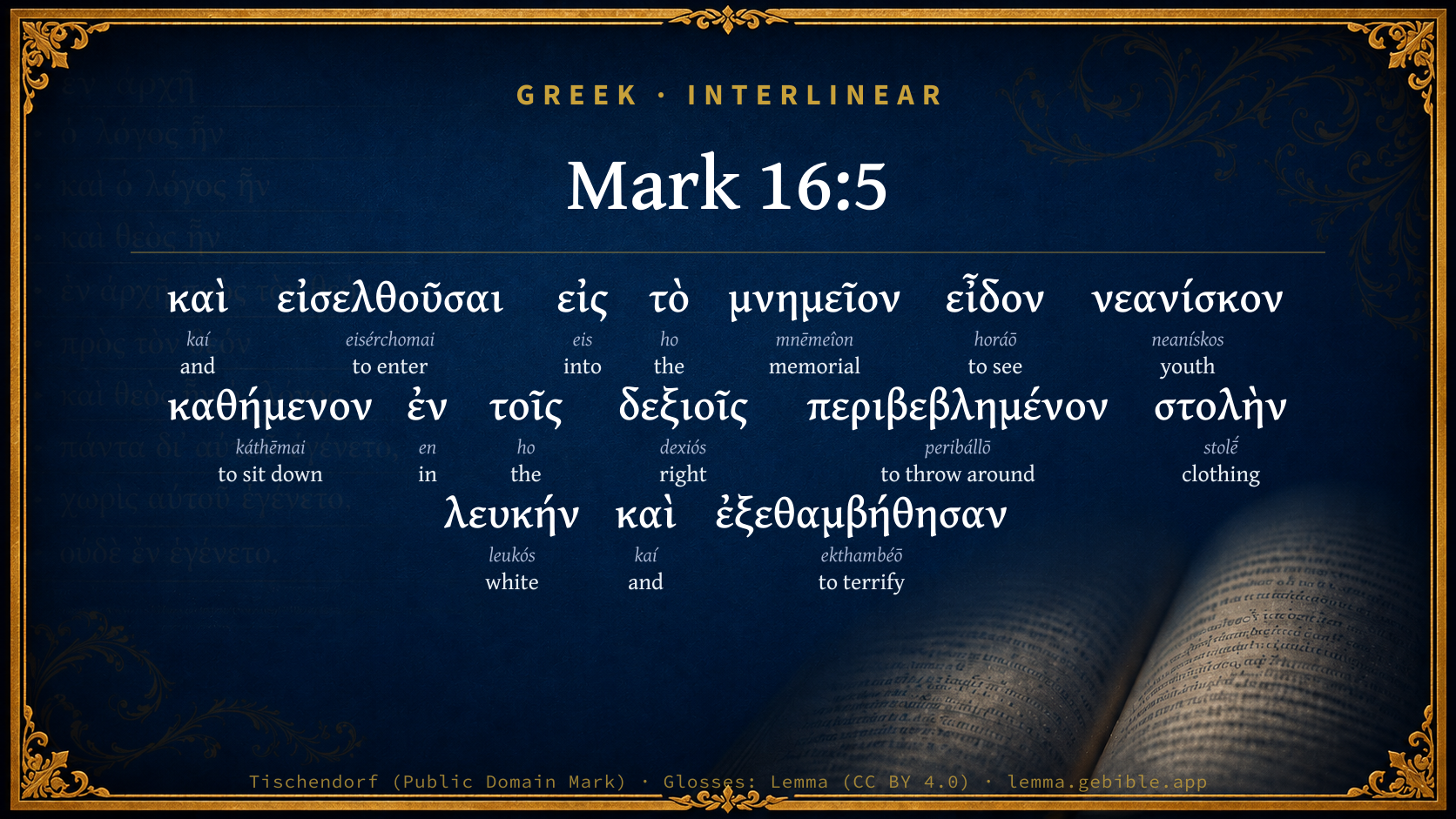
Greek (Tischendorf 8th ed.) Mark 16:5 appears in the Greek New Testament. The text above is from the Tischendorf 8th edition. Each word links to its Strong’s number and a concise gloss. Click any word for its full Thayer’s Greek Lexicon entry.
Download image
Cite this verse

Mark 16:5 (World English Bible). Public Domain. Lemma interlinear Bible study tool, https://lemma.gebible.app/v/mark/16/5.

Show BibTeX & RIS
BibTeX
RIS
English Translation
Entering into the tomb, they saw a young man sitting on the right side, dressed in a white robe, and they were amazed.
World English Bible · Public Domain
Download a study sheet

One document with this verse’s original text, its word-by-word gloss line, the meaning frame, cross-references with their text, attributed commentary, and full source and license credits — printable, and it pastes into notes with its structure intact.

This verse Autodidact and up

Study sheet (.html) Plain text (.txt)

A passage Seminary Student

Up to 50 verses in one chapter. A passage sheet keeps up to 6 commentary sources and 12 cross-references per verse, in the order this page ranks them, and says so on the sheet whenever that leaves anything out. Ask for a single verse and you get the Autodidact verse sheet above.

Everything on this page stays free to read, with no account — the sheet is a download of what is already on screen, not access to it.

Want to remove ads? Support Godless Engineer
Compare translations 3

The same verse in 3 English versions, stacked beneath the original-language interlinear above. Click any original word for its lexicon entry.

Each is an independent rendering of the whole verse — the interlinear is not word-aligned to these translations.

Highlighted words mark where these versions differ — a whole-verse word diff, not a word-by-word alignment.

  • World English Bible Public Domain
    Entering into the tomb, they saw a young man sitting on the right side, dressed in a white robe, and they were amazed.
  • King James Version Public Domain
    And entering into the sepulchre, they saw a young man sitting on the right side, clothed in a long white garment; and they were affrighted.
  • unfoldingWord Literal Text CC BY-SA 4.0
    And having entered into the tomb, they saw a young man sitting on the right side, dressed in a white robe, and they were alarmed.

unfoldingWord Literal Text — © unfoldingWord, licensed CC BY-SA 4.0. Word-aligned USFM3 via Door43 (git.door43.org/unfoldingWord/en_ult).

Versions to compare (up to 4)

3 of 4 selected

Show all 19 translations

Every available English version of this verse, each an independent rendering of the whole verse.

  • World English Bible Public Domain
    Entering into the tomb, they saw a young man sitting on the right side, dressed in a white robe, and they were amazed.
  • Berean Standard Bible Public Domain
    When they entered the tomb, they saw a young man dressed in a white robe sitting on the right side, and they were alarmed.
  • Majority Standard Bible Public Domain
    When they entered the tomb, they saw a young man dressed in a white robe sitting on the right side, and they were alarmed.
  • King James Version Public Domain
    And entering into the sepulchre, they saw a young man sitting on the right side, clothed in a long white garment; and they were affrighted.
  • American Standard Version (1901) Public Domain
    And entering into the tomb, they saw a young man sitting on the right side, arrayed in a white robe; and they were amazed.
  • Revised Version (1885) Public Domain
    And entering into the tomb, they saw a young man sitting on the right side, arrayed in a white robe; and they were amazed.
  • Geneva Bible (1599) Public Domain
    So they went into the sepulchre, and saw a yong man sitting at the right side, clothed in a long white robe: and they were sore troubled.
  • Douay-Rheims (1899) Public Domain
    And entering into the sepulchre, they saw a young man sitting on the right side, clothed with a white robe: and they were astonished.
  • Young's Literal Translation Public Domain
    and having entered into the sepulchre, they saw a young man sitting on the right hand, arrayed in a long white robe, and they were amazed.
  • Literal Standard Version CC BY-SA 4.0
    and having entered into the tomb, they saw a young man sitting on the right hand, clothed in a long white robe, and they were amazed.
  • Unlocked Literal Bible CC BY-SA 4.0
    They entered the tomb and saw a young man dressed in a white robe, sitting on the right side, and they were alarmed.
  • unfoldingWord Literal Text CC BY-SA 4.0
    And having entered into the tomb, they saw a young man sitting on the right side, dressed in a white robe, and they were alarmed.
  • Darby Bible Public Domain
    And entering into the sepulchre, they saw a young man sitting on the right, clothed in a white robe, and they were amazed and alarmed;
  • World Messianic Bible Public Domain
    Entering into the tomb, they saw a young man sitting on the right side, dressed in a white robe; and they were amazed.
  • Webster's Bible Public Domain
    And entering into the sepulcher, they saw a young man sitting on the right side, clothed in a long white garment; and they were frightened.
  • Free Bible Version CC BY-SA 4.0
    When they went into the tomb, they saw a young man sitting on the right, wearing a long white robe. They became very frightened.
  • Bible in Basic English Public Domain
    And when they went in, they saw a young man seated on the right side, dressed in a white robe; and they were full of wonder.
  • Text-Critical English NT CC BY 4.0
    As they went into the tomb, they saw a young man sitting on the right side, clothed in a long white robe, and they were alarmed.
  • Tyndale New Testament (1534) Public Domain
    And they went into the sepulcre and sawe a yonge man syttinge on the ryght syde cloothed in a longe whyte garmet and they were abasshed.

Literal Standard Version (2020), Covenant Press — licensed CC BY-SA 4.0. Text via the HelloAO Bible API (eBible.org). Unlocked Literal Bible (unfoldingWord) — licensed CC BY-SA 4.0. Text via the HelloAO Bible API (eBible.org). unfoldingWord Literal Text — © unfoldingWord, licensed CC BY-SA 4.0. Word-aligned USFM3 via Door43 (git.door43.org/unfoldingWord/en_ult). Free Bible Version, Dr. Jonathan Gallagher — licensed CC BY-SA 4.0. Text via the HelloAO Bible API (eBible.org).

Word by word

More ways to search: Search by grammar → Find every occurrence → Compare this word →

Practice this passage: Drill this verse → Learn its vocabulary →

ἐξεθαμβήθησαν
ekthambéō
G1568
“to terrify”
Verb, Aorist, Passive, Indicative, 3rd person, Plural
Part of Speech
Verb
Tense
Aorist
Voice
Passive
Mood
Indicative
Person
3rd person
Number
Plural
Full Thayer's Definition

Origin: from G1569

TDNT: 3:4,*

1. to throw into terror or amazement a. to alarm thoroughly, to terrify 2. to be struck with amazement a. to be thoroughly amazed, astounded b. to be struck with terror
  1. καὶ kaí G2532 “and” Conjunction
  2. εἰσελθοῦσαι eisérchomai G1525 “to enter” Verb, Aorist, Active, Participle, Nominative, Plural, Feminine
  3. εἰς eis G1519 “into” Preposition
  4. τὸ ho G3588 “the” Article, Accusative, Singular, Neuter
  5. μνημεῖον mnēmeîon G3419 “memorial” Noun, Accusative, Singular, Neuter
  6. εἶδον horáō G3708 “to see” Verb, Aorist, Active, Indicative, 3rd person, Plural
  7. νεανίσκον neanískos G3495 “youth” Noun, Accusative, Singular, Masculine
  8. καθήμενον káthēmai G2521 “to sit down” Verb, Present, Middle or Passive deponent, Participle, Accusative, Singular, Masculine
  9. ἐν en G1722 “in” Preposition
  10. τοῖς ho G3588 “the” Article, Dative, Plural, Neuter
  11. δεξιοῖς dexiós G1188 “right” Adjective, Dative, Plural, Neuter
  12. περιβεβλημένον peribállō G4016 “to throw around” Verb, Perfect, Passive, Participle, Accusative, Singular, Masculine
  13. στολὴν stolḗ G4749 “clothing” Noun, Accusative, Singular, Feminine
  14. λευκήν leukós G3022 “white” Adjective, Accusative, Singular, Feminine
  15. καὶ kaí G2532 “and” Conjunction

About this verse

These counts appear in no published source. They are computed here, from the morphology-tagged text and Lemma’s own curated glosses. What Lemma adds →

16
words
14
distinct lemmas
Gospels
section

Notable vocabulary

The rarest word here is ἐξεθαμβήθησαν to terrify G1568 — appearing just 4 times in the whole Greek New Testament.

Shared distinctive vocabulary

ἐξεθαμβήθησαν to terrify G1568 occurs in 4 verses of the Greek New Testament. Also found in:

Repetition

Words recur within this verse:

Cross-references

10

Topical passages linked to Mark 16:5 in the Treasury of Scripture Knowledge — connected by theme and wording, ordered by reader-vote popularity; previews shown in the World English Bible.

  • John 20:11–12 But Mary was standing outside at the tomb weeping. So, as she wept, she stooped and looked into the tomb,
  • Matthew 28:3 His appearance was like lightning, and his clothing white as snow.
  • Luke 24:3–5 They entered in, and didn't find the Lord Jesus' body.
  • John 20:8 So then the other disciple who came first to the tomb also entered in, and he saw and believed.
  • Luke 1:29–30 But when she saw him, she was greatly troubled at the saying, and considered what kind of salutation this might be.
  • Mark 6:49–50 but they, when they saw him walking on the sea, supposed that it was a ghost, and cried out;
  • Mark 9:15 Immediately all the multitude, when they saw him, were greatly amazed, and running to him greeted him.
  • Luke 1:12 Zacharias was troubled when he saw him, and fear fell upon him.
  • Daniel 8:17 So he came near where I stood; and when he came, I was frightened, and fell on my face: but he said to me, Understand, son of man; for the vision belongs to the time of the end.
  • Daniel 10:5–9 I lifted up my eyes, and looked, and, behold, a man clothed in linen, whose loins were girded with pure gold of Uphaz:

Cross-references courtesy of OpenBible.info (CC BY 4.0).

Commentary

Notes on Mark 16:5 from classic Christian and Jewish commentators (each source and its license shown beneath its notes). The classic Christian expositions comment on the surrounding passage and are grouped to its opening verse, so a note may address several verses; the Jewish commentaries on the Tanakh (Rashi and others) are per-verse, so they appear only where the commentator wrote on this verse.

Lemma curates 59 commentaries, every one of them public domain or Creative Commons licensed, each selected and text-cleaned for this edition rather than reprinted as found. About our sources →

The Biblical Illustrator

Joseph S. Exell

Mar_16:5

They saw a young man sitting on the right side.

Perpetual youth

Very remarkable that this super-human being should be described as a young man. Immortal youth, with buoyant energy and fresh power, belongs to angelic beings, and to the children of the resurrection, who are to be equal unto the angels. No waste decays their strength, no change robs them of forces which have ceased to increase. Age cannot wither them.

I. The life of the faithful dead is eternal progress towards infinite perfection. Their being never reaches its climax; it is ever but entering on its glory. Their goal is the likeness of God in Christ-all His wisdom, His love, His holiness. He is all theirs, and all that He is is to be transfused into their growing greatness. They rise like the song bird, aspiring to the heavens, circling round, and ever higher, up and up through the steadfast blue to the sun! They shall lose the marks of age as they grow in eternity, and they who have stood before the throne the longest shall be likest him who sat in the sepulchre young with immortal strength, radiant with unwithering beauty.

II. The life of the faithful dead recovers and retains the best characteristics of youth.

1. Hope. No more disappointments; a boundless future of blessedness.

2. Keenness of relish. The pleasures of heaven always satisfy, but never cloy.

3. Fervour of love. Zeal such as that of the seraphs, that have burned before the throne unconsumed and undecaying for unknown ages.

4. Buoyant energy. All that maturity and old age took away, is given back in nobler form. All the limitation and weakness which they brought, the coldness, monotony, torpor, weariness, will drop away; but we shall keep all the precious gifts they brought-calm wisdom, ripened knowledge, full-summed experience, powers of service acquired in lifes long apprenticeship. The perfect man in the heavens will include the graces of childhood, the energies of youth, the steadfastness of manhood, the calmness of old age; as on some tropical trees you may see at once bud, blossom, fruit-the expectancy of spring, the maturing promise of summer, and the fulfilled fruition of autumn-hanging together on the unexhausted bough.

III. The faithful dead shall live in a body that cannot grow old. No weariness. Needing no repose. No death (1Co_15:42-44; 2Co_5:1-4; Rev_7:13-17). (A. Maclaren, D. D.)

Youth in heaven

If all this be true, that glorious and undecaying body shall then be the equal and fit instrument of the perfected spirit, not, as it is now, the adequate instrument only of the natural life. The deepest emotions then will be capable of expression-nor, as now, like some rushing tide, choke the floodgates through whose narrow aperture they try to press, and be all tossed into foam in the attempt, All outward things shall then be fully and clearly communicated to the spirit; that glorious body will be a perfect instrument of knowledge. All that we desire to do we shall then do, nor be longer tortured with tremulous hands that can never draw the perfect circle we plan, and stammering lips that will not obey the heart, and throbbing brain that will ache when we would have it clear. The young spirit shall have for true yokefellow a body that cannot tire, nor grow old, nor die. The aged saints of God shall rise then in youthful beauty, More than the long-vanished comeliness shall then rest on faces that were here haggard with anxiety, and pinched with penury and years. No more palsied hands, no more scattered grey hairs, no more dim and horny eyes, no more stiffened muscles and slow-throbbing hearts. It is sown in weakness; it is raised in power. It is sown in decaying old age; it is raised in immortal youth. His servants shall stand in that day among the young-eyed cherubim, and be like them forever. (A. Maclaren, D. D.)

The presence of the angel

Here is one keeper more than the Jews looked for about our Saviours sepulchre, on more than Pilate appointed. One mighty prince of that supernal host, whose countenance was able to daunt a legion of the best Roman soldiers; perhaps there was a multitude with him to celebrate the resurrection, as there was a multitude that appeared in the fields of Bethlehem to rejoice at Christs Nativity. But this angel, I may say determinately, was one of the most royal spirits that stand before the face of God forever. How sweetly the eternal wisdom did dispose to let an angel show himself openly at this place of the grave, and upon the celebration of this great day!

1. Those ministering spirits had been attendants upon all the parts of our Saviours humility; good reason they should be occupied upon all occasions of His exaltation and glory.

2. The women came out with confidence to embalm Christs body, without considering how many difficulties were in their way; such difficulties as could never have been mastered if the angel had not been sent to facilitate all things for them.

3. The presence of the angel showed that He who had been buried there was God as well as man; for angels were as officious at the sepulchre as they use to be in heaven, which is the throne of God.

4. If not an angel, who else would be believed in so great a matter as this? Tell me, who could give testimony beside that would be credited? The disciples were never so tardy to conceive, never so unapprehensive in anything else as in this! They knew not as yet what the rising from the dead did mean.

5. It is in effect a promise that we shall be exalted after death to the society of angels.

6. Angels desire to be present at everything wherein mankind is benefited, that they may rejoice with us. No envy, no malignity in them, that we shall be made perfect in both parts of nature, both in body and soul, and so in that respect exceed them who are only spiritual substances. (Bishop Hacker.)

The Biblical Illustrator, edited by Joseph S. Exell (c. 1880s–1900s) — public domain. Text from a community e-Sword module.

MacLaren's Expositions of Holy Scripture

Alexander MacLaren

Mark

THE INCREDULOUS DISCIPLES

THE ANGEL IN THE TOMB

PERPETUAL YOUTH

Mar 16:5.

Many great truths concerning Christ’s death, and its worth to higher orders of being, are taught by the presence of that angel form, clad in the whiteness of his own God-given purity, sitting in restful contemplation in the dark house where the body of Jesus had lain. ‘Which things the angels desire to look into.’ Many precious lessons of consolation and hope, too, lie in the wonderful words which he spake from his Lord and theirs to the weeping waiting women. But to touch upon these ever so slightly would lead us too far from our more immediate purpose.

It strikes one as very remarkable that this superhuman being should be described as a ‘young man.’ Immortal youth, with all of buoyant energy and fresh power which that attribute suggests, belongs to those beings whom Scripture faintly shows as our elder brethren. No waste decays their strength, no change robs them of forces which have ceased to increase. For them there never comes a period when memory is more than hope. Age cannot wither them. As one of our modern mystics has said, hiding imaginative spiritualism under a crust of hard, dry matter-of-fact, ‘In heaven the oldest angels are the youngest.’

What is true of them is true of God’s children, who are ‘accounted worthy to obtain that world and the resurrection from the dead,’ for ‘they are equal unto the angels.’ For believing and loving souls, death too is a birth. All who pass through it to God, shall, in deeper meaning than lay in the words at first, ‘return unto the days of their youth’; and when the end comes, and they are ‘clothed with their house from heaven,’ they shall stand by the throne, like him who sat in the sepulchre, clothed with lustrous light and radiant with unchanging youth.

Such a conception of the condition of the dead in Christ may be followed out in detail into many very elevating and strengthening thoughts. Let me attempt to set forth some of these now.

I. The life of the faithful dead is eternal progress towards infinite perfection.

For body and for spirit the life of earth is a definite whole, with distinct stages, which succeed each other in a well-marked order. There are youth, and maturity, and decay-the slow climbing to the narrow summit, a brief moment there in the streaming sunshine, and then a sure and gradual descent into the shadows beneath. The same equable and constant motion urges the orb of our lives from morning to noon, and from noon to evening. The glory of the dawning day, with its golden clouds and its dewy freshness, its new awakened hopes and its unworn vigour, climbs by silent, inevitable stages to the hot noon. But its ardours flame but for a moment; but for a moment does the sun poise itself on the meridian line, and the short shadow point to the pole. The inexorable revolution goes on, and in due time come the mists and dying purples of evening and the blackness of night. The same progress which brings April’s perfumes burns them in the censer of the hot summer, and buries summer beneath the falling leaves, and covers its grave with winter’s snow.

‘Everything that grows

Holds in perfection but a little moment.’

So the life of man, being under the law of growth, is, in all its parts, subject to the consequent necessity of decline. And very swiftly does the direction change from ascending to descending. At first, and for a little while, the motion of the dancing stream, which broadens as it runs, and bears us past fields each brighter and more enamelled with flowers than the one before it, is joyous; but the slow current becomes awful as we are swept along when we would fain moor and land-and to some of us it comes to be tragic and dreadful at last, as we sit helpless, and see the shore rush past and hear the roar of the falls in our ears, like some poor wretch caught in the glassy smoothness above Niagara, who has flung down the oars, and, clutching the gunwale with idle hands, sits effortless and breathless till the plunge comes. Many a despairing voice has prayed as the sands ran out, and joys fled, ‘Sun, stand thou still on Gibeon; and thou, Moon, in the valley of Ajalon,’ but in vain. Once the wish was answered; but, for all other fighters, the twelve hours of the day must suffice for victory and for joy. Time devours his own children. The morning hours come to us with full hands and give, the evening hours come with empty hands and take; so that at the last ‘naked shall he return to go as he came.’ Our earthly life runs through its successive stages, and for it, in body and mind, old age is the child of youth.

But the perfect life of the dead in Christ has but one phase, youth. It is growth without a limit and without decline. To say that they are ever young is the same thing as to say that their being never reaches its climax, that it is ever but entering on its glory; that is, as we have said, that the true conception of their life is that of eternal progress towards infinite perfection.

For what is the goal to which they tend? The likeness of God in Christ-all His wisdom, His love, His holiness. He is all theirs, and His whole perfection is to be transfused into their growing greatness. ‘He is made unto them of God. wisdom, and righteousness, and salvation and redemption,’ nor can they cease to grow till they have outgrown Jesus and exhausted God. On the one hand is infinite perfection, destined to be imparted to the redeemed spirit. On the other hand is a capability of indefinite assimilation to, by reception of, that infinite perfection. We have no reason to set bounds to the possible expansion of the human spirit. If only there be fitting circumstances and an adequate impulse, it may have an endless growth. Such circumstances and such impulse are given in the loving presence of Christ in glory. Therefore we look for an eternal life which shall never reach a point beyond which no advance is possible. ‘The path of the just’ in that higher state ‘shineth more and more,’ and never touches the zenith. Here we float upon a landlocked lake, and on every side soon reach the bounding land; but there we are on a shoreless ocean, and never hear any voice that says, ‘Hitherto shalt thou come, and no farther.’ Christ will be ever before us, the yet unattained end of our desires; Christ will be ever above us, fairer, wiser, holier, than we; after unsummed eternities of advance there will yet stretch before us a shining way that leads to Him. The language, which was often breathed by us on earth in tones of plaintive confession, will be spoken in heaven in gladness, ‘Not as though I had attained, either were perfect, but I follow after,’ The promise that was spoken by Him in regard to our mortality will be repeated by Him in respect to our celestial being, ‘I am come that they might have life, and that they might have it more abundantly.’ And as this advance has no natural limit, either in regard to our Pattern or to ourselves, there will be no reverse direction to ensue. Here the one process has its two opposite parts; the same impulse carries up to the summit and forces down from it. But it is not so then. There growth will never merge into decay, nor exacting hours come to recall the gifts, which their free-handed sisters gave.

They who live in Christ, beyond the grave, begin with a relative perfection. They are thereby rendered capable of more complete Christ-likeness. The eye, by gazing into the day, becomes more recipient of more light; the spirit cleaves closer to a Christ more fully apprehended and more deeply loved; the whole being, like a plant reaching up to the sunlight, grows by its yearning towards the light, and by the light towards which it yearns-lifts a stronger stem and spreads a broader leaf, and opens into immortal flowers tinted by the sunlight with its own colours. This blessed and eternal growth towards Him whom we possess, to begin with, and never can exhaust, is the perpetual youth of God’s redeemed.

We ought not to think of those whom we have loved and lost as if they had gone, carrying with them declining powers, and still bearing the marks of this inevitable law of stagnation, and then of decay, under which they groaned here. Think of them rather as having, if they sleep in Jesus, reversed all this, as having carried with them, indeed, all the gifts of matured experience and ripened wisdom which the slow years bring, but likewise as having left behind all the weariness of accomplished aims, the monotony of a formed character, the rigidity of limbs that have ceased to grow. Think of them as receiving again from the hands of Christ much of which they were robbed by the lapse of years. Think of them as then crowned with loving-kindness and satisfied with good, so that ‘their youth is renewed like the eagle’s.’ Think of them as again joyous, with the joy of beginning a career, which has no term but the sum of all perfection in the likeness of the infinite God. They rise like the song-bird, aspiring to the heavens, circling round, and ever higher, which ‘singing still doth soar, and soaring ever singeth’-up and up through the steadfast blue to the sun! ‘Even the youths shall faint and be weary, and the young men shall utterly fall; but they that wait upon the Lord shall renew their strength.’ They shall lose the marks of age as they grow in eternity, and they who have stood before the throne the longest shall be likest him who sat in the sepulchre young with immortal strength, radiant with unwithering beauty.

II. The life of the faithful dead recovers and retains the best characteristics of youth.

Each stage of our earthly course has its own peculiar characteristics, as each zone of the world has its own vegetation and animal life. And, for the most part, these characteristics cannot be anticipated in the preceding stage, nor prolonged into the succeeding. To some small extent they will bear transplanting, and he is nearest a perfect man who carries into each period of his life some trace of the special beauty of that which went before, making ‘the child the father of the man,’ and carrying deep into old age the simple self-forgetfulness of the child and the energy of the youth. But this can only be partially done by any effort; and even those whose happily constituted temperaments make it comparatively easy for them, do often carry the weakness rather than the strength of the earlier into the later epochs. It is easier to be always childish than to be always childlike. The immaturity and heedlessness of youth bear carriage better than the more precious vintages of that sunny land-its freshness of eye and heart, its openness of mind, its energy of hand. Even when these are in any measure retained-beautiful as they are in old age-they are but too apt to be associated with an absence of the excellences more proper to the later stages of life, and to involve a want of patient judgment, of sagacious discrimination, of rooted affections, of prudent, persistent action. Beautiful indeed it is when the grace of the child and the strength of the young man live on in the fathers, and when the last of life encloses all that was good in all that went before. But miserable it is, and quite as frequent a case, when grey hairs cover a childish brain, and an aged heart throbs with the feverish passion of youthful blood. So for this life it is difficult, and often not well, that youth should be prolonged into manhood and old age.

But the thought is none the less true, that the perfection of our being requires the reappearance and the continuance of all that was good in each successive stage of it in the past. The brightest aspects of youth will return to all who live in Jesus, beyond the grave, and will be theirs for ever. Such a consideration branches out into many happy anticipations, which we can but very cursorily touch on here.

For instance-Youth is the time for hope. The world then lies all before us, fair and untried. We have not learnt our own weakness by many failures, nor the dread possibilities that lie in every future. The past is too brief to occupy us long, and its furthest point too near to be clothed in the airy purple, which draws the eye and stirs the heart. We are conscious of increasing powers which crave for occupation. It seems impossible but that success and joy shall be ours. So we live for a little while in a golden haze; we look down from our peak upon the virgin forests of a new world, that roll away to the shining waters in the west, and then we plunge into their mazes to hew out a path for ourselves, to slay the wild beasts, and to find and conquer rich lands. But soon we discover what hard work the march is, and what monsters lurk in the leafy coverts, and what diseases hover among the marshes, and how short a distance ahead we can see, and how far off it is to the treasure-cities that we dreamed of; and if at last we gain some cleared spot whence we can look forward, our weary eyes are searching at most for a place to rest, and all our hopes have dwindled to hopes of safety and repose. The day brings too much toil to leave us leisure for much anticipation. The journey has had too many failures, too many wounds, too many of our comrades left to die in the forest glades, to allow of our expecting much. We plod on, sometimes ready to faint, sometimes with lighter hearts, but not any more winged by hope as in the golden prime,-unless indeed for those of us who have fixed our hopes on God, and so get through the march better, because, be it rough or smooth, long or short, He moves before us to guide, and all our ways lead to Him. But even for these there comes, before very long, a time when they are weary of hoping for much more here, and when the light of youth fades into common day. Be it so! They will get the faculty and the use of it back again in far nobler fashion, when death has taken them away from all that is transient, and faith has through death given for their possession and their expectation, the certitudes of eternity. It will be worth while to look forward again, when we are again standing at the beginning of a life. It will be possible once more to hope, when disappointments are all past. A boundless future stretching before us, of which we know that it is all blessed, and that we shall reach all its blessedness, will give back to hearts that have long ceased to drink of the delusive cup which earthly hope offered to their lips, the joy of living in a present, made bright by the certain anticipation of a yet brighter future. Losing nothing by our constant progress, and certain to gain all which we foresee, we shall remember and be glad, we shall hope and be confident. With ‘the past unsighed for, and the future sure,’ we shall have that magic gift, which earth’s disappointments dulled, quickened by the sure mercies of the heavens.

Again, youth has mostly a certain keenness of relish for life which vanishes only too soon. There are plenty of our young men and women too, of this day, no doubt, who are as blasé and wearied before they are out of their ‘teens as if they were fifty. So much the sadder for them, so much the worse for the social state which breeds such monsters. For monsters they are: there ought to be in youth a sense of fresh wonder undimmed by familiarity, the absence of satiety, a joy in joyful things because they are new as well as gladsome. The poignancy of these early delights cannot long survive. Custom stales them all, and wraps everything in its robe of ashen grey. We get used to what was once so fresh and wonderful, and do not care very much about anything any more. We smile pitying smiles-sadder than any tears-at ‘boyish enthusiasm,’ and sometimes plume ourselves on having come to ‘years which bring the philosophic mind’; and all the while we know that we have lost a great gift, which here can never come back any more.

But what if that eager freshness of delight may yet be ours once again? What if the eternal youth of the heavens means, amongst other things, that there are pleasures which always satisfy but never cloy? What if, in perpetual advance, we find and keep for ever that ever new gladness, which here we vainly seek in perpetual distraction? What if constant new influxes of divine blessedness, and constant new visions of God, keep in constant exercise that sense of wonder, which makes so great a part of the power of youth? What if, after all that we have learned and all that we have received, we still have to say, ‘It doth not yet appear what we shall be’? Then, I think, in very profound and blessed sense, heaven would be perpetual youth.

I need not pause to speak of other characteristics of that period of life-such as its enthusiasm, its life by impulse rather than by reason, its buoyant energy and delight in action. All these gifts, so little cared for when possessed, so often misused, so irrevocably gone with a few brief years, so bitterly bewailed, will surely be found again, where God keeps all the treasures that He gives and we let fall. For transient enthusiasm, heaven will give us back a fervour of love like that of the seraphs, that have burned before His throne unconsumed and undecaying for unknown ages. For a life of instinctive impulse, we shall titan receive a life in which impulse is ever parallel with the highest law, and, doing only what we would, we shall do only what we ought. For energy which wanes as the years wax, and delight in action which is soon worn down into mechanical routine of toil, there will be bestowed strength akin to His ‘who fainteth not, neither is weary.’ All of which maturity and old age robbed us is given back in nobler form. All the limitation and weakness which they brought, the coldness, the monotony, the torpor, the weariness, will drop away. But we shall keep all the precious things which they brought us. None of the calm wisdom, the ripened knowledge, the full-summed experience, the powers of service acquired in life’s long apprenticeship, will be taken from us.

All will be changed indeed. All will be cleansed of the impurity which attaches to all. All will be accepted and crowned, not by reason of its goodness, but by reason of Christ’s sacrifice, which is the channel of God’s mercy. Though in themselves unworthy, and having nothing fit for the heavens, yet the souls that trust in Jesus, the Lord of Life, shall bear into their glory the characters which by His grace they wrought out here on earth, transfigured and perfected, but still the same. And to make up that full-summed completeness, will be given to them at once the perfection of all the various stages through which they passed on earth. The perfect man in the heavens will include the graces of childhood, the energies of youth, the steadfastness of manhood, the calmness of old age; as on some tropical trees, blooming in more fertile soil and quickened by a hotter sun than ours, you may see at once bud, blossom, and fruit-the expectancy of spring, and the maturing promise of summer, and the fulfilled fruition of autumn-hanging together on the unexhausted bough.

III. The faithful dead shall live in a body that cannot grow old.

Scripture assures us, I believe, that the dead in Christ are now in full, conscious enjoyment of His presence, and of all the blessedness that to dwell in Christ can bring to a spirit. All, then, which we have been saying applies to the present condition of those who sleep in Jesus. As concerning toil and trouble they take rest in sleep, as concerning contact with an outer world they slumber untroubled by its noise; but as concerning their communion with their Lord they, like us, ‘whether we wake or sleep, live together with Him.’ But we know too, from Scripture, that the dead in Christ wait for the resurrection of the body, without which they cannot be perfected, nor restored to full activity of outward life in connection with an external creation.

The lesson which we venture to draw from this text enforces the familiar teaching of Scripture as to that body of glory-that it cannot decay, nor grow old. In this respect, too, eternal youth may be ours. Here we have a bodily organisation which, like all other living bodies, goes through its appointed series of changes, wastes in effort, and so needs reparation by food and rest, dies in growing, and finally waxes old and dissolves. In such a house, a man cannot be ever young. The dim eye and shaking hand, the wrinkled face and thin grey hairs cannot but age the spirit, since they weaken its instruments.

If the redeemed of the Lord are to be always young in spirit, they must have a body which knows no weariness, which needs no repose, which has no necessity of dying impressed upon it. And such a body Scripture plainly tells us will belong to those who are Christ’s, at His coming. Our present acquaintance with the conditions of life makes that great promise seem impossible to many learned men amongst us. And I know not that anything but acquaintance with the sure word of God and with a risen Lord will make that seeming impossibility again a great promise for us. If we believe it at all, I think we must believe it because the resurrection of Jesus Christ says so, and because the Scriptures put it into articulate words as the promise of His resurrection. ‘Ye do err,’ said Christ long ago, to those who denied a resurrection, ‘not knowing the Scriptures nor the power of God.’ Then knowledge of the Scriptures leads to belief in the resurrection of the dead, and the remembrance of our ignorance of the power of God disposes of all the doubts which are raised on the supposition that His present works are the pattern of His future ones, or the limits of His unexhausted energy.

We are content then to fall back on Scripture words, and to believe in the resurrection of the dead simply because it is, as we believe, told us from God.

For all who accept the message, this hope shines clear, of a building of God imperishable and solid, when contrasted with the tent in which we dwell here-of a body ‘raised in incorruption,’ ‘clothed with immortality,’ and so, as in many another phrase, declared to be exempt from decay, and therefore vigorous with unchanging youth. How that comes we cannot tell. Whether because that body of glory has no proclivity to mutation and decay, or whether the perpetual volition and power of God counteract such tendency and give, as the Book of Revelation says,’ to eat of the tree of life which is in the midst of the paradise of God’-matters not at all. The truth of the promise remains, though we have no means of knowing more than the fact, that we shall receive a body, fashioned like His who dieth no more. There shall be no weariness nor consequent need for repose- ‘they rest not day nor night.’ There shall be no faintness nor consequent craving for sustenance-’they shall hunger no more neither thirst any more.’ There shall be no disease-’the inhabitant thereof shall no more say, I am sick,’ ‘neither can they die any more, for they are equal unto the angels.’

And if all this is true, that glorious and undecaying body will then be the equal and fit instrument of the perfected spirit, not, as it is now, the adequate instrument only of the natural life. The deepest emotions then will be capable of expression, nor as now, like some rushing tide, choke the floodgates through whose narrow aperture they try to press, and be all tossed into foam in the attempt. We shall then seem what we are, as we shall also be what we ought. All outward things will then be fully and clearly communicated to the spirit, for that glorious body will be a perfect instrument of knowledge. All that we desire to do we shall then do, nor be longer tortured with tremulous hands which can never draw the perfect circle that we plan, and stammering lips that will not obey the heart, and throbbing brain that will ache when we would have it clear. The ever-young spirit will have for true yokefellow a body that cannot tire, nor grow old, nor die.

The aged saints of God shall rise then in youthful beauty. More than the long-vanished comeliness shall on that day rest on faces that were here haggard with anxiety, and pinched with penury and years. There will be no more palsied hands, no more scattered grey hairs, no more dim and horny eyes, no more stiffened muscles and slow throbbing hearts. ‘It is sown in weakness, it is raised in power.’ It is sown in decaying old age, it is raised in immortal youth. His servants shall stand in that day among ‘the young-eyed cherubim,’ and be like them for ever. So we may think of the dead in Christ.

But do not forget that Christian faith may largely do for us here what God’s grace and power will do for us in heaven, and that even now we may possess much of this great gift of perpetual youth. If we live for Christ by faith in Him, then may we carry with us all our days the energy, the hope, the joy of the morning tide, and be children in evil while men in understanding. With unworn and fresh heart we may ‘bring forth fruit in old age,’ and have the crocus in the autumnal fields as well as in the spring-time of our lives. So blessed, we may pass to a peaceful end, because we hold His hand who makes the path smooth and the heart quiet. Trust yourselves, my brethren, to the immortal love and perfect work of the Divine Saviour, and by His dear might your days will advance by peaceful stages, whereof each gathers up and carries forward the blessings of all that went before, to a death which shall be a birth. Its chill waters will be as a fountain of youth from which you will rise, beautiful and strong, to begin an immortality of growing power. A Christian life on earth solves partly, a Christian life in heaven solves completely, the problem of perpetual youth. For those who die in His faith and fear, ‘better is the end than the beginning, and the day of one’s death than the day of one’s birth.’ Christ keeps the good wine until the close of the feast.

‘Such is Thy banquet, dearest Lord;

O give us grace, to cast

Our lot with Thine, to trust Thy word,

And keep our best till last.’

Alexander MacLaren, Expositions of Holy Scripture (1904–1910) — public domain. Text from a community e-Sword module.

Godbey's Commentary on the New Testament

William B. Godbey

ANGELS AT THE SEPULCHER

Mat 28:5-7; Luk 24:4-8; Mar 16:5-7 : “Having come to the sepulcher, they saw a young man sitting on the right, clothed with a white robe; and they were affrighted. And he says to them, Be not alarmed; you are seeking Jesus the Nazarene, who was crucified; He is risen; He is not here; behold the place where they laid Him. But go tell His disciples, and Peter, that He goes before you into Galilee; and there you shall see Him, as He said to you.” Luke: “And it came to pass, while they were at a loss concerning Him, and two men stood before them in shining apparel, they being afraid, and inclining their face toward the ground, he said to them, Why seek ye the living among the dead? He is not here, but is risen. Remember how He spoke to you, being yet in Galilee, saying that it behooves the Son of man to be delivered into the hands of sinful men, and to be crucified, and to arise the third day; and they remembered His words.” These were angels in human form, and it is highly probable that Gabriel, who announced His conception, was one of them. We see here that these holy women were much alarmed, as in all ages it has been very trying to mortal nerves to meet glorified spirits. In this there is nothing condemnatory, but a demonstration of the simple fact of decisive, angelic superiority, so that their presence, when seen with mortal eyes, inundates us with the realization that we are actually in contact with the eternal world, and hence overawed, and even panic-stricken, by the certainty of the heavenly inhabitants literally present and looking us in the face. Here we observe an especial message sent to Peter, doubtless from the fact of the unhappy notoriety he gave himself by denying the Lord while under prosecution.

William B. Godbey, Commentary on the New Testament (1896–1900) — public domain. Text from a community e-Sword module.

Bengel's Gnomon

Johann Albrecht Bengel

Mar 16:5. Νεανίσκον, a young man) A style of appearance appropriate to angels. For the most part, they appeared in the form of a man, and that a youthful human form in this case [Mat 28:2].—ἐν τοῖς δεξίοις, on the right side) The minister [attendant angel] is thus ready at hand to his Lord, fitly ministering to Him.

Bengel's Gnomon of the New Testament — English translation (T&T Clark, Edinburgh, 1860) — public domain. Text from a community e-Sword module.

Expositor's Greek Testament

ed. W. Robertson Nicoll

Mar 16:5-8 . The women enter into the tomb through the open door, and experience a greater surprise . νεανίσκον , a young man. In Mt.’s account it is an angel, and his position is not within the tomb, as here, but sitting on the stone without. Lk. has two men in shining apparel. στολὴν λευκήν , in a white long robe, implying what is not said, that the youth is an angel. No such robe worn by young men on earth.

The Expositor's Greek Testament, edited by W. Robertson Nicoll (1897–1910) — public domain. Text from a community e-Sword module.

Geneva Bible (1599)

Geneva Bible translators

Into the cave out where the sepulchre was cut out.

Geneva Bible (1599) marginal notes — public domain. Text via Bolls.life.

Ellicott's Commentary for English Readers

(5) A young man sitting on the right side.—So St. Mark describes the form which St. Matthew (Mat_28:1) simply calls an “angel of the Lord.”

A Bible Commentary for English Readers, edited by Charles John Ellicott (1878–1897) — public domain. Text from a community e-Sword module.

The Cambridge Bible for Schools and Colleges

gen. ed. J. J. S. Perowne

5. And entering into the sepulchre] This emboldened them all to enter into the tomb, except Mary of Magdala, who, seeing in the rolling away of the stone the confirmation of her worst fears, fled away to the Apostles Peter and John; and there they saw

a young man] or as some of them may have specified, two (Luk_24:4), sitting on the right hand. (Comp. Luk_1:11.)

clothed in a long white garment] white or “glistering” (Luk_24:4); “hilid with a whit stoole,” Wyclif. Note the word “hilid” here, from “hélan” to “cover,” whence our word “hell” = “the covered place.”

and they were affrighted] On the force of the Greek word thus rendered, see above, ch. Mar_9:15. The sight of the heavenly visitants (Luk_24:4) filled them with the utmost terror and amazement, “olei weren abaist,” Wyclif.

The Cambridge Bible for Schools and Colleges (gen. ed. J. J. S. Perowne; Cambridge University Press, 1878–1918) — public domain. Text from a community e-Sword module.

John Gill's Exposition

And entering into the sepulchre,.... For the sepulchres of the Jews were made so large, that persons might go into them: the rule for making them is this (k);

"he that sells ground to his neighbour to make a burying place, or that receives of his neighbour to make a burying place, must make the inside of the cave four cubits by six, and open in it eight graves; three here, and three there, and two over against them: and the graves must be four cubits long, and seven high, and six broad. R. Simeon says, he must take the inside of the cave six cubits by eight, and open within thirteen graves: four here, and four there, and three over against them; and one on the right hand of the door, and one on the left; and he must make, "a court", at the mouth of the cave, six by six, according to the bier, and those that bury; and he must open in the midst of it two caves, one here and another there. R. Simeon says, four at the four sides; R. Simeon ben Gamaliel says, all is according to the nature of the rock.''

Now it was in the court that the women entered, where the bier was to be put down by the bearers; and where they could look into the sepulchre, and the several caves and graves in it, and what were in them. So Maimonides says (l),

"they dig caves in the earth, and make a grave on, the side of the cave, and bury in; it.''

And there being a door into one of these caves, persons might enter in, and see where the graves were, and the bodies lay.

They saw a young man; an angel; as angels used to appear in the form of men: nor is this any contradiction to John's account, who says there were two angels, one at the head, and another at the feet, Joh 20:12; since Mark does not say there was no more than one; besides, John relates what Mary Magdalene saw, when alone, and Mark what all the women saw:

sitting on the right side; from whence we learn, on what side of the door of the sepulchre Christ was laid, according to the above description of one:

clothed long white garment: See Gill on Mat 28:3; which was as white as snow:

and they were affrighted; at the sight of him; not expecting such a vision, but to have seen, the body of their Lord.

(k) Misn. Bava Bathra, c. 6. sect. 8. (l) Maimon. Hilch. Ebel, c. 4. sect. 4.

John Gill's Exposition of the Whole Bible (1746–1763) — public domain (CC PDM 1.0). Text via the HelloAO Bible API.

Haydock's Catholic Bible Commentary

St. Matthew says the angel was sitting on the stone, whilst St. Mark says that they saw him sitting on the right side of the sepulchre. This must not surprise us; for the angel which first appeared sitting upon the stone, might have been afterwards seen by him sitting on the right side of the sepulchre. (Theophylactus) --- Perhaps the angel mentioned by St. Matthew is different from the one mentioned by St. Mark. Or it may be understood, that the women entering the monument, which may mean the enclosure of it, saw the angel sitting on the stone, which was placed on the right side of the sepulchre. (St. Augustine)

George Leo Haydock (1774–1849), Haydock's Catholic Family Bible and Commentary, 1859 edition — public domain. Excludes Psalms (Douay-Rheims chapter numbering differs from Protestant) and Deuterocanonical books (Catholic canon only).

Matthew Poole's English Annotations

Both Luke and John mention two angels in the habit of young men. Matthew speaks of one sitting upon the stone. They might see him sitting upon the stone, and yet find him within also, the motions of angels are quick and undiscernible to our sense, or the stone might be rolled inward. That they were affrighted is no wonder, considering how apt we are to be frightened by any apparitions. Concerning what the angel said to these women, See Poole on "Mat 28:5", and following verses to Mat 28:8. They presently flee from the sepulchre amazed, saying nothing to any till they came into the city, where they tell it to the disciples.

Matthew Poole's English Annotations on the Holy Bible (1683–1685) — public domain. Text from a community e-Sword/MySword module.

Whedon's Commentary on the Bible

Daniel D. Whedon

5. Entering into the sepulchre — The sepulchres of the ancient Jews were often hewn in the solid rock, and consisted usually of two or more apartments. Entering its front door, you find its first and largest apartment to be a room several feet square. From this a low door opens into another apartment, into which you descend by a flight of steps. This is the sepulchre, or place where the corpse is deposited, either in cells cut into the wall, extending lengthwise to the distance of six or seven feet, or shelves cut parallel to the room, so that the entire length of the corpse would be visible. It is probable that the sepulchre in which our Lord was deposited was of this latter kind, for the two angels seen by Mary Magdalene stood one at the head and the other at the foot, where the body of Jesus had lain. Joh_20:12. We may suppose then that the women entered the first apartment (sometimes called the court) and saw the young man at the right hand, near or within the sepulchre, at which place he could easily invite them to see where the Lord had lain. Whether the whole train of women entered or not is not certain, but probably Mary, Salome, and Joanna did enter the first apartment. Nor is it certain whether any of them complied with the invitation to enter the sepulchre to see the shelf on which the sacred body had been deposited.

Young man — A man in form but an angel in nature. It would seem that angelic beings can assume different forms, and invest themselves with apparent habiliments, and present or withdraw themselves from sight as they please. So our Lord in his resurrection body could make himself more or less known, as he chose, to his disciples. And this answers the very foolish question which some have asked: Whence did Jesus procure his resurrection garments? Sitting on the right side — At their right hand as they entered the inner chamber.

Daniel D. Whedon (gen. ed.), Commentary on the Old and New Testaments (1874–1909) — public domain. Text from a community e-Sword module.

The Pulpit Commentary

And entering into the tomb, they saw a young man sitting on the right side, arrayed in a white robe; and they were amazed. They enter the tomb, the expression "tomb" including the ante-chamber They see that the stone has been rolled back, so as to expose the entrance into the place where Jesus had lain. On that stone a young man was sitting. The angel appeared in the form of a young man, because youth indicates the vigor, the beauty, and the strength of angels. The good angels always appear in beauty and comeliness of form. There will be no deformity in heaven. The angel appeared as arrayed in a white robe. This white robe, or talar indicated a heavenly spiritual being. St. Matthew (Mat_28:3) says that "his countenance was like lightning," flashing with splendor, and his raiment was as white as snow. It may be that he appeared more terrible to the keepers, (Mat_28:4) and that he abated something of his dazzling brightness when he appeared to the women; but "they were affrighted" (exeyambhyhsan); literally, they were amazed. Amazement was the dominant feeling, though probably not unmingled with fear.

The Pulpit Commentary (1880–1919), ed. H.D.M. Spence-Jones & Joseph S. Exell — public domain. Text from a community e-Sword module.

Kretzmann's Popular Commentary

Paul E. Kretzmann

The message of the risen Lord:

v. 5. And entering into the sepulcher, they saw a young man sitting on the right side, clothed in a long white garment; and they were affrighted.

v. 6. And he saith unto them, Be not affrighted; Ye seek Jesus of Nazareth, which was crucified; He is risen; He is not here; behold the place where they laid Him.

v. 7. But go your way, tell His disciples and Peter that He goeth before you into Galilee; there shall ye see Him, as He said unto you.

v. 8. And they went out quickly, and fled from the sepulcher; for they trembled and were amazed; neither said they anything to any man, for they were afraid.

While Mary Magdalene was hurrying back to the city, the other Mary and Salome, impelled by interested curiosity, went into the tomb through the open door. But here they received a great surprise, for they saw what appeared to them a young man clothed in a long white garment sitting on the right hand side. The presence of various angels on this Easter morning, at various times and in various positions, need not cause surprise. There must have been multitudes of them present, though only a few of them or a single one may have been visible at any one time, such as had been specially delegated, as at the birth of Christ, to bring the Lord’s message. But the appearance of this angel in the tomb greatly terrified the women. The reflection of the glorious light of heaven shone from the messenger’s face and garment, and poor, sinful human beings cannot endure that splendor without flinching and becoming terrified. But the angel’s message was intended to allay all fear: Be not terrified! As at the birth of the Savior the first words of the heavenly preacher were: Fear not, so the cheering cry went out at this time. The poor weak heart is inclined always to tremble, feeling the weight and the guilt of its sin. But there is no longer need of such trembling, there is no longer reason for fearing, since full and certain redemption lies before all men in the empty grave. The angel speaks of the Lord by the name which had been given Him to heap shame and reproach upon Him. But Jesus of Nazareth is now the name of which He Himself and all His followers are justly proud. As Jesus of Nazareth He hung on the cross, but as Jesus of Nazareth He also rose from the dead. The place where He lay is still there, the evidences of His having been buried are still to be seen; but He is risen from the dead. Mark the short, vivid method of speaking: He is risen, not is He here; see the place where they laid Him. All is joyful emotion, exultation which struggles for utterance. And the message is not for them alone, the kingdom of God cannot wait, there is work to be done in His interest, the news must be spread. They should tell His disciples and Peter the glorious tidings. And Peter: a direct mention of his name; Peter that had fallen so deeply, but who, as the Lord knew, had deeply repented of his sin; Peter who felt himself so utterly unworthy at this time, but who would yet feel the forgiving love of his resurrected Lord. As Jesus had told them, chapter 14:28, He was now preparing to go, to precede them into Galilee; for there, at a place which He had designated to them, He wanted to speak to them. The effect of the angel’s appearance and message upon the two women was overwhelming; the event was too much for them. They left the tomb, they fled away from the scene of such miracles; trembling and stupor, a kind of ecstasy bordering on hysteria, had taken hold of them. So great was their fear on that morning that for the present they said nothing to anyone. After their fears had been somewhat allayed, after they had heard that others had also received revelations independent of their testimony, they no longer were quiet about the wonderful things they had Been and heard at the tomb.

Paul E. Kretzmann, Popular Commentary of the Bible (1921–1924) — public domain. Text from a community e-Sword module.

The People's New Testament

B. W. Johnson

5. And entering into the sepulchre. Mary Magdalene, seeing the stone rolled away, and supposing the body had been removed by the Jews, runs to find Peter and John (John 20:1, 2). The other women proceed to the sepulcher, and enter. Saw a young man. Matthew calls him an angel. Luke says that there were two who “stood;” i. e., appeared suddenly. Besides, they might easily have both sat and stood during the interview; might have been both outside and inside at different moments, and they might have been seen both singly and together in the sudden and shifting apparition.—Jacobus.

B. W. Johnson's The People's New Testament with Notes (1889–1891) — public domain. Electronic text from the Christian Classics Ethereal Library (CCEL) ThML edition.

unfoldingWord translationNotes

Door43 World Missions Community

He is risen!

The angel is emphatically stating that Jesus has risen from the dead. This can be translated in active form. AT: "He arose!" or "God raised him from the dead!" or "He raised himself from the dead!" (See: Active or Passive)

translationWords

Nazareth

crucify

raise

disciple

Peter

Galilee

unfoldingWord translationNotes — © Distant Shores Media and the Door43 World Missions Community, licensed CC BY-SA 4.0. Source: git.door43.org/Door43/en_tn.

Cambridge Greek Testament for Schools and Colleges

5. νεανίσκον. Mk leaves us to infer that this was an Angel. The sobriety of all four narratives is in marked contrast to the grotesque story in the Gospel of Peter, and it leaves us with the impression that there is a basis of solid fact. Cf. 2Ma 3:26; 2Ma 3:33; 2Ma 10:29; 2Ma 11:8. We must allow (1) for the intense excitement of the women at finding the sepulchre open and empty, (2) for the diversity of the impressions which each of them received, and (3) for the difficulty which each of them would have in describing her own experiences. We must also allow (4) for the unintentional inaccuracy with which those to whom they told their experiences would repeat what they had been told. It is more reasonable to believe that facts have been misunderstood and misreported, than to believe that there are no facts, but that all the narratives are the outcome of delusion or deliberate fiction. The substantial facts, common to all the narratives, are that early on Sunday morning women went to the tomb to see the Body which had been placed there, and that what they sought was not found; the tomb was empty. The explanation, slowly grasped at the time and confirmed afterwards, was that He had risen. All this is more like sober history than myth.

στολὴν λευκήν. See on Mar 12:38.

ἐξεθαμβήθησαν. See on Mar 9:15. They were amazed (R.V.), but no doubt something of fright (A.V.) was mingled with their astonishment.

Cambridge Greek Testament for Schools and Colleges (Cambridge University Press, 1896; 21 vols, various authors incl. Carr, Maclear, Plummer, Farrar, Lumby, Moule, M. R. James, Simcox) — public domain. Text from a community e-Sword module.

Alford’s Greek Testament

Henry Alford

5.] In Matt.,—an angel, sitting on the stone which he had rolled away. Here he is described as he appeared, and we are left to infer what he was. In Luke,—two angels ἐπέστησαν αὐταῖς in the tomb. The incident to which these accounts point, must be distinct from that related Joh 20:11, which was after Mary Magdalene returned from the city. It is not worth while to detail the attempts which have been made to reconcile these various reports of the incident: they present curious examples of the ingenuity, and (probably unconscious) disingenuousness, of the Harmonists. I may mention that Greswell supposes the angels in Matt. and Mark to be distinct, and accounts for the ἐξεθαμβήθησαν in our text thus: ‘After seeing one angel without already, they were probably less prepared than before to see another so soon after within’ (Dissert, vol. iii. p. 187).

Henry Alford, The Greek Testament (1849–1861) — public domain. Text from a community e-Sword module.

International Critical Commentary

5. εἰσελθοῦσαι εἰς τ. μνημεῖον—having entered into the tomb. Mt. says that the angel was sitting on the stone outside.1 Lk., that there were two angels, who appeared to the women, not on their first entrance into the tomb, but in the midst of their perplexity at not finding the body of Jesus.2 J. speaks of only one woman, Mary Magdalene, who came to the sepulchre, and got no farther than to see the stone rolled away, when she turned back and told Peter and John, who came immediately and found the tomb empty. Mary meantime had returned and saw two angels in the sepulchre, and then Jesus himself.3

νεανίσκον—a young man. This is the form which the angel took. ἐξεθαμβήθησαν—they were utterly amazed. ἐκ in composition means utterly, out and out.

International Critical Commentary — older volumes (1896–1929), various authors — public domain. Text from a community e-Sword module.

Vincent's Word Studies in the New Testament

Marvin R. Vincent

Affrighted. See Mr 9:15, and Introduction. Rev., better, amazed. It was wonder rather than fright.

Marvin R. Vincent, Word Studies in the New Testament (1887–1900) — public domain. Text from a community e-Sword/MySword module.

Lesson kit

Teaching starters — assembled from the data on this page, not authored interpretation. Every prompt links to the verse data it draws on. Edit before teaching.

Mark, in the Gospels, opens this verse with 16 words (14 distinct Greek lemmas). Its most distinctive word is ekthambéō (“to terrify”). A historical commentator’s framing appears above. Read the whole chapter for the surrounding context.

Discussion questions

  1. The word ekthambéō carries the sense “to terrify.” How does it shape the verse?
  2. How does Mark 9:15, which shares the word «to terrify», read alongside this verse?
  3. What does the repetition of “and” (2× in this one verse) do in this verse?
  4. The translations on this page render this verse differently — a whole-verse word diff, not a word-by-word alignment. What might account for the different wordings?
  5. Compare how The Biblical Illustrator and MacLaren's Expositions of Holy Scripture read this verse. Where do they agree or differ?

Things to notice

Reading settings

Reading text

Shown beneath each verse's original-language words.

Old Testament
Old Testament edition

Read the OT as the Masoretic Hebrew (MT) or the Greek Septuagint (LXX).

English shown for the Greek Septuagint (in the Hebrew ↔ Greek comparison).

Comparing translations? Open the Compare panel on any verse page to stack up to four side by side.