
Genesis 6:12

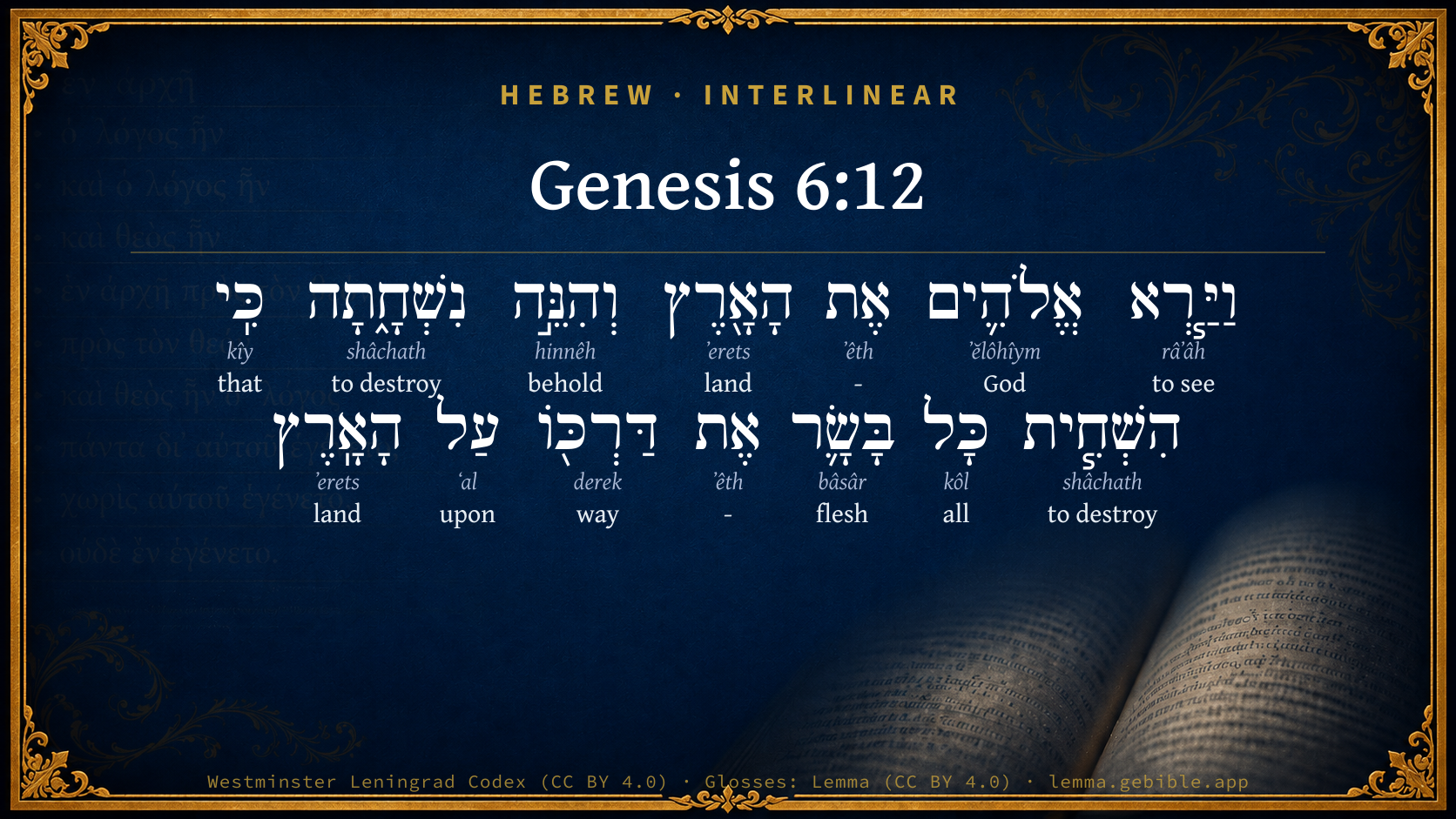
Hebrew (Westminster Leningrad Codex) Genesis 6:12 appears in the Hebrew Old Testament. The text above is from the Westminster Leningrad Codex. Each word links to its Strong’s number, a concise gloss, and parsing drawn from the Open Scriptures Hebrew Bible morphology. Click any word for its full Brown-Driver-Briggs (BDB) entry.
Download image
Cite this verse

Genesis 6:12 (World English Bible). Public Domain. Lemma interlinear Bible study tool, https://lemma.gebible.app/v/genesis/6/12.

Show BibTeX & RIS
BibTeX
RIS
English Translation
God saw the earth, and saw that it was corrupt, for all flesh had corrupted their way on the earth.
World English Bible · Public Domain
Download a study sheet

One document with this verse’s original text, its word-by-word gloss line, the meaning frame, cross-references with their text, attributed commentary, and full source and license credits — printable, and it pastes into notes with its structure intact.

This verse Autodidact and up

Study sheet (.html) Plain text (.txt)

A passage Seminary Student

Up to 50 verses in one chapter. A passage sheet keeps up to 6 commentary sources and 12 cross-references per verse, in the order this page ranks them, and says so on the sheet whenever that leaves anything out. Ask for a single verse and you get the Autodidact verse sheet above.

Everything on this page stays free to read, with no account — the sheet is a download of what is already on screen, not access to it.

Want to remove ads? Support Godless Engineer
Compare translations 3

The same verse in 3 English versions, stacked beneath the original-language interlinear above. Click any original word for its lexicon entry.

Each is an independent rendering of the whole verse — the interlinear is not word-aligned to these translations.

Highlighted words mark where these versions differ — a whole-verse word diff, not a word-by-word alignment.

  • World English Bible Public Domain
    God saw the earth, and saw that it was corrupt, for all flesh had corrupted their way on the earth.
  • King James Version Public Domain
    And God looked upon the earth, and, behold, it was corrupt; for all flesh had corrupted his way upon the earth.
  • unfoldingWord Literal Text CC BY-SA 4.0
    And God saw the earth, and behold, it was corrupted, because all flesh on the earth had corrupted its way.

unfoldingWord Literal Text — © unfoldingWord, licensed CC BY-SA 4.0. Word-aligned USFM3 via Door43 (git.door43.org/unfoldingWord/en_ult).

Versions to compare (up to 4)

3 of 4 selected

Show all 18 translations

Every available English version of this verse, each an independent rendering of the whole verse.

  • World English Bible Public Domain
    God saw the earth, and saw that it was corrupt, for all flesh had corrupted their way on the earth.
  • Berean Standard Bible Public Domain
    And God looked upon the earth and saw that it was corrupt; for all living creatures on the earth had corrupted their ways.
  • Majority Standard Bible Public Domain
    And God looked upon the earth and saw that it was corrupt; for all living creatures on the earth had corrupted their ways.
  • King James Version Public Domain
    And God looked upon the earth, and, behold, it was corrupt; for all flesh had corrupted his way upon the earth.
  • American Standard Version (1901) Public Domain
    And God saw the earth, and, behold, it was corrupt; for all flesh had corrupted their way upon the earth.
  • Revised Version (1885) Public Domain
    And God saw the earth, and, behold, it was corrupt; for all flesh had corrupted his way upon the earth.
  • Geneva Bible (1599) Public Domain
    Then God looked vpon the earth, and beholde, it was corrupt: for all flesh had corrupt his way vpon the earth.
  • Douay-Rheims (1899) Public Domain
    And when God had seen that the earth was corrupted (for all flesh had corrupted its way upon the earth,)
  • Young's Literal Translation Public Domain
    And God seeth the earth, and lo, it hath been corrupted, for all flesh hath corrupted its way on the earth.
  • Literal Standard Version CC BY-SA 4.0
    And God sees the earth, and behold, it has been corrupted, for all flesh has corrupted its way on the earth.
  • Unlocked Literal Bible CC BY-SA 4.0
    God saw the earth; behold, it was corrupt, for all flesh had corrupted their way upon the earth.
  • unfoldingWord Literal Text CC BY-SA 4.0
    And God saw the earth, and behold, it was corrupted, because all flesh on the earth had corrupted its way.
  • Darby Bible Public Domain
    And God looked upon the earth, and behold, it was corrupt; for all flesh had corrupted its way on the earth.
  • World Messianic Bible Public Domain
    God saw the earth, and saw that it was corrupt, for all flesh had corrupted their way on the earth.
  • Webster's Bible Public Domain
    And God looked upon the earth, and behold, it was corrupt: for all flesh had corrupted his way upon the earth.
  • Free Bible Version CC BY-SA 4.0
    God recognized that the corruption in the world was due to everyone on earth living corrupt lives.
  • Bible in Basic English Public Domain
    And God, looking on the earth, saw that it was evil: for the way of all flesh had become evil on the earth.
  • JPS Tanakh (1917) Public Domain
    And God saw the earth, and, behold, it was corrupt; for all flesh had corrupted their way upon the earth.

Literal Standard Version (2020), Covenant Press — licensed CC BY-SA 4.0. Text via the HelloAO Bible API (eBible.org). Unlocked Literal Bible (unfoldingWord) — licensed CC BY-SA 4.0. Text via the HelloAO Bible API (eBible.org). unfoldingWord Literal Text — © unfoldingWord, licensed CC BY-SA 4.0. Word-aligned USFM3 via Door43 (git.door43.org/unfoldingWord/en_ult). Free Bible Version, Dr. Jonathan Gallagher — licensed CC BY-SA 4.0. Text via the HelloAO Bible API (eBible.org).

Word by word

More ways to search: Search by grammar → Find every occurrence → Compare this word →

Practice this passage: Drill this verse → Learn its vocabulary →

נִשְׁחָ֑תָה
shâchath
H7843
“to destroy”
Verb, Niphal, Perfect, 3rd Person, Feminine, Singular
Part of Speech
Verb
Stem
Niphal
Form
Perfect
Person
3rd Person
Gender
Feminine
Number
Singular
Full BDB Definition

Origin: a primitive root

TWOT: 2370

to destroy, corrupt, go to ruin, decay - (Niphal) to be marred, be spoiled, be corrupted, be corrupt, be injured, be ruined, be rotted - (Piel) - to spoil, ruin - to pervert, corrupt, deal corruptly (morally) - (Hiphil) - to spoil, ruin, destroy - to pervert, corrupt (morally) - destroyer (participle) - (Hophal) spoiled, ruined (participle)
  1. וַיַּ֧רְא râʼâh H7200 “and · to see” Conjunction + Verb, Qal, Sequential Imperfect, 3rd Person, Masculine, Singular
  2. אֱלֹהִ֛ים ʼĕlôhîym H430 “God(s)” Noun, Common, Masculine, Plural, Absolute
  3. אֶת ʼêth H853 “-” Particle, Direct Object
  4. הָאָ֖רֶץ ʼerets H776 “the · land” Particle, Definite Article + Noun, Common, Both, Singular, Absolute
  5. וְהִנֵּ֣ה hinnêh H2009 “and · behold” Conjunction + Particle, Demonstrative
  6. כִּֽי kîy H3588 “that” Conjunction
  7. הִשְׁחִ֧ית shâchath H7843 “to destroy” Verb, Hiphil, Perfect, 3rd Person, Masculine, Singular
  8. כָּל kôl H3605 “all of” Noun, Common, Masculine, Singular, Construct
  9. בָּשָׂ֛ר bâsâr H1320 “flesh” Noun, Common, Masculine, Singular, Absolute
  10. אֶת ʼêth H853 “-” Particle, Direct Object
  11. דַּרְכּ֖וֹ derek H1870 “way · his” Noun, Common, Both, Singular, Construct + Suffix, Personal, 3rd Person, Masculine, Singular
  12. עַל ʻal H5921 “upon” Preposition
  13. הָאָֽרֶץ ʼerets H776 “the · land” Particle, Definite Article + Noun, Common, Both, Singular, Absolute

About this verse

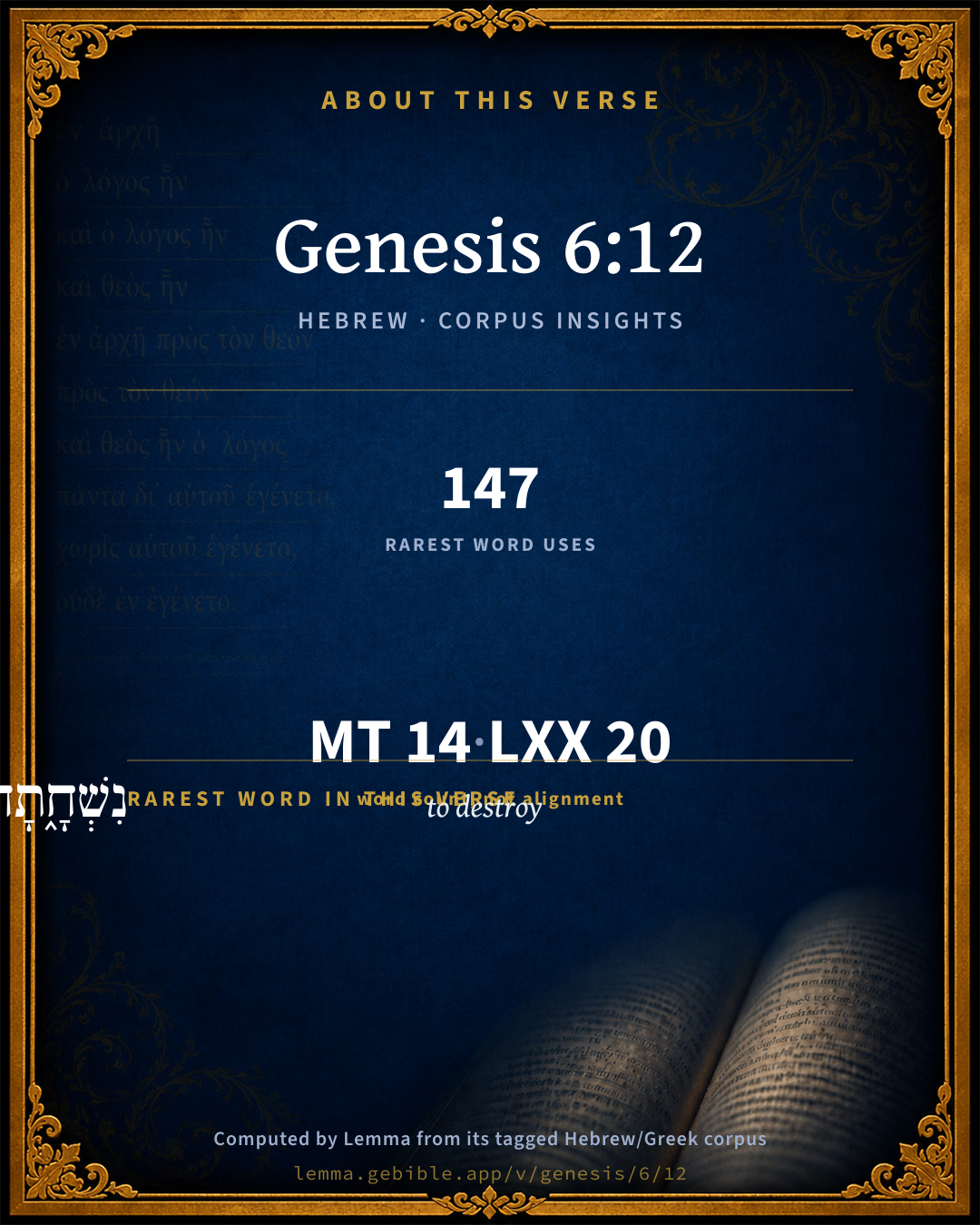
These counts appear in no published source. They are computed here, from the morphology-tagged text and Lemma’s own curated glosses. What Lemma adds →

14
words
11
distinct lemmas
Pentateuch
section

Grammatical profile

  • 3 verbs
  • 6 nouns
  • 1 preposition
  • 1 conjunction
  • 3 particles

Verb forms

  • וַיַּ֧רְא Qal · Sequential Imperfect
  • נִשְׁחָ֑תָה Niphal · Perfect
  • הִשְׁחִ֧ית Hiphil · Perfect

Repetition

Words recur within this verse — often emphatic in Hebrew:

  • הָאָ֖רֶץ land H776 ×2
  • נִשְׁחָ֑תָה to destroy H7843 ×2

Hebrew & Septuagint length

In English translation the verse runs 20 words from the Hebrew and 21 from the Septuagint (LXX English) — closely comparable.

A rough comparison of the two English renderings, which tokenize alike — not a word-level alignment.

Word counts can differ between the Hebrew and the Greek without any difference in meaning — e.g. the Hebrew direct-object marker אֵת has no separate Greek word, and Greek often adds the article ὁ.

In the original languages it is 14 Hebrew tokens and 20 Greek tokens — but the two are counted differently (Hebrew bundles its prefixes and suffixes into one token; the Greek is in lemma form), so that isn’t a like-for-like length.

Cross-references

16

Topical passages linked to Genesis 6:12 in the Treasury of Scripture Knowledge — connected by theme and wording, ordered by reader-vote popularity; previews shown in the World English Bible.

  • Psalms 53:2–3 God looks down from heaven on the children of men, To see if there are any who understood, Who seek after God.
  • Proverbs 15:3 Yahweh's eyes are everywhere, Keeping watch on the evil and the good.
  • Psalms 14:1–3 The fool has said in his heart, "There is no God." They are corrupt. They have done abominable works. There is none who does good.
  • Job 22:15–17 Will you keep the old way Which wicked men have trodden,
  • 2 Peter 2:5 and didn't spare the ancient world, but preserved Noah with seven others, a preacher of righteousness, when he brought a flood on the world of the ungodly;
  • Genesis 6:4–5 The Nephilim were in the earth in those days, and also after that, when God's sons came to men's daughters. They bore children to them: the same were the mighty men who were of old, men of renown.
  • Genesis 6:8 But Noah found favor in Yahweh's eyes.
  • Genesis 7:1 Yahweh said to Noah, "Come with all of your household into the ark, for I have seen your righteousness before me in this generation.
  • Job 33:27 He sings before men, and says, 'I have sinned, and perverted that which was right, And it didn't profit me.
  • Psalms 33:13–14 Yahweh looks from heaven. He sees all the sons of men.
  • 1 Peter 3:19–20 in which he also went and preached to the spirits in prison,
  • Genesis 7:21 All flesh died that moved on the earth, including birds, cattle, animals, every creeping thing that creeps on the earth, and every man.
  • Genesis 9:12 God said, "This is the token of the covenant which I make between me and you and every living creature that is with you, for perpetual generations:
  • Genesis 9:16–17 The rainbow will be in the cloud. I will look at it, that I may remember the everlasting covenant between God and every living creature of all flesh that is on the earth."
  • Genesis 18:21 I will go down now, and see whether they have done altogether according to the cry of it, which is come to me. If not, I will know."
  • Luke 3:6 All flesh will see God's salvation.'"

Cross-references courtesy of OpenBible.info (CC BY 4.0).

Hebrew and Greek witnesses Masoretic Hebrew ↔ Greek Septuagint

The same verse in the two great witnesses to the Old Testament, shown verse-for-verse.

These are two independent witnesses, not word-aligned to each other, and the Septuagint is shown in lemma (dictionary) form.

Hebrew Genesis 6:12 Masoretic · Westminster Leningrad Codex

וַיַּ֧רְא אֱלֹהִ֛ים אֶת הָאָ֖רֶץ וְהִנֵּ֣ה נִשְׁחָ֑תָה כִּֽי הִשְׁחִ֧ית כָּל בָּשָׂ֛ר אֶת דַּרְכּ֖וֹ עַל הָאָֽרֶץ

God saw the earth, and saw that it was corrupt, for all flesh had corrupted their way on the earth.

World English Bible · Public Domain

Greek LXX Genesis 6:12 Septuagint · lemma form

καί ὁράω κύριος ὁ θεός ὁ γῆ καί εἰμί καταφθείρω ὅτι καταφθείρω πᾶς σάρξ ὁ ὁδός αὐτός ἐπί ὁ γῆ

And the Lord God saw the earth, and it was corrupted; because all flesh had corrupted its way upon the earth.

LXX2012 (modern English Septuagint) · Public Domain

On this verse, The Pulpit Commentary discusses the Septuagint’s reading. Read the note in Commentary ↓

Hebrew: Westminster Leningrad Codex (CC BY 4.0). Greek: Septuagint (public domain); English from LXX2012 (modern English Septuagint) (Public Domain). How the Septuagint differs from the Hebrew →

Targum (Aramaic paraphrase)

2

The Targum is the ancient Jewish Aramaic paraphrase of the Hebrew Scriptures — an interpretive translation, not the Hebrew text itself. Onkelos (literal) and Pseudo-Jonathan (expansive) render the Torah, and Jonathan the Prophets. Coverage is partial: where no permissively-licensed English translation exists for a verse, only the Aramaic is shown. This is verse-level text, not a word-by-word alignment to the Hebrew.

  1. Targum Onkelos Torah (Genesis–Deuteronomy)
    וַחֲזָא יְיָ יָת אַרְעָא וְהָא אִתְחַבָּלַת אֲרֵי חַבִּילוּ כָּל בִּסְרָא אֱנַשׁ יָת אָרְחֵהּ עַל אַרְעָא

    And the Lord saw the earth, and, behold, it was corrupt, because all flesh had corrupted, each one, his way upon the earth.

    Targum Onkelos — Aramaic: “Onkelos Genesis” (public domain); “Onkelos Exodus” (public domain); “Onkelos Leviticus” (public domain); “Onkelos Numbers” (public domain); “Onkelos Deuteronomy” (public domain). English: “Sefaria Community Translation” (CC0 1.0 (public-domain dedication)); “J.W. Etheridge. The Targums of Onkelos and Jonathan Ben Uzziel on the Pentateuch. London: Longmans, Green, 1862” (public domain). Text via Sefaria.

  2. Targum Pseudo-Jonathan Torah (Genesis–Deuteronomy)
    וַחֲמָא יְיָ יַת אַרְעָא וְהָא אִתְחַבָּלַת אֲרוּם חַבִּילוּ כָּל בִּשְרָא כָּל חַד וְחַד יַת אוֹרְחֵיהּ עַל אַרְעָא

    And the Lord beheld the earth; and, lo, it was corrupt; for all flesh had every one corrupted his way upon the earth.

    Targum Pseudo-Jonathan — Aramaic: “Targum Jonathan on Genesis” (public domain); “Targum Jonathan on Exodus” (public domain); “Targum Jonathan on Leviticus” (public domain); “Targum Jonathan on Numbers” (public domain); “Targum Jonathan on Deuteronomy” (public domain). English: “The Targum of Jonathan ben Uzziel, trans. J. W. Etheridge, London, 1862” (public domain). Text via Sefaria.

Commentary

Notes on Genesis 6:12 from classic Christian and Jewish commentators (each source and its license shown beneath its notes). The classic Christian expositions comment on the surrounding passage and are grouped to its opening verse, so a note may address several verses; the Jewish commentaries on the Tanakh (Rashi and others) are per-verse, so they appear only where the commentator wrote on this verse.

Lemma curates 59 commentaries, every one of them public domain or Creative Commons licensed, each selected and text-cleaned for this edition rather than reprinted as found. About our sources →

Trapp's Complete Commentary

John Trapp

Gen 6:12 And God looked upon the earth, and, behold, it was corrupt; for all flesh had corrupted his way upon the earth.

Ver. 12. All flesh had corrupted his way.] General defection precedes general destruction; as here all sorts and sexes were fallen from God. All kinds of sins were common among them. In the family, promiscuous lusts, unlawful marriages, &c. In the state, tyranny, violence, injustice. In the Church, contempt of God’s word; abuse of his patience to presumption; of his bounty to security in sin. For they ate, they drank, they married, they planted, they builded, &c. And all this they did constantly and pleasantly, passing from eating to drinking; from drinking to marrying (for, Venus in vinis , and gluttony, is the gallery that wantonness walks through); from marrying to planting, for the use of posterity, as St Luke sweetly sets forth by an elegant rhetorical figure {a} All this they did, and God was silent, {Psa 22:2} therefore their hearts grew fat as brawn, and they knew nothing, saith our Saviour, nor would know, till the very day that the flood came. Into such a dead lethargy were they cast by their sins; which were therefore grown ripe, and ready for the sickle.

{a} ησθιον, επινον, εγαμουν, &c. - Luk 17:27

John Trapp, A Commentary or Exposition upon All the Books of the Old and New Testament (1647–1656) — public domain. Text from a community e-Sword module.

Ellicott's Commentary for English Readers

(12) All flesh had corrupted his way upon the earth.—These material things were incapable alike of moral good or evil, but man had made them the instruments of working his carnal will, and because of the associations connected with them they must be effaced, or rubbed out. (See Note on Gen_6:7.)

A Bible Commentary for English Readers, edited by Charles John Ellicott (1878–1897) — public domain. Text from a community e-Sword module.

The Cambridge Bible for Schools and Colleges

gen. ed. J. J. S. Perowne

12. all flesh] Used here for “all the human race.” The phrase, which is found 13 times in the Story of the Flood, is a characteristic of P.

had corrupted his way] This expression seems to be used with the object of shewing that man was a free agent, and that his corruption was not the result of blind fate, or of any external malign influence.

The Cambridge Bible for Schools and Colleges (gen. ed. J. J. S. Perowne; Cambridge University Press, 1878–1918) — public domain. Text from a community e-Sword module.

John Gill's Exposition

Make thee an ark of Gopher wood,.... It is not called a ship, for it was not made for sailing to any distant parts, but an ark or chest, being like one, flat bottomed, and ridged and sloping upwards, and was made for floating on the waters for a little way. So Lucian (c), and other Heathen writers, call it "an ark" or "chest": this was made of "Gopher wood", which all the Targums, and the more ancient Rabbins, understand of cedar wood; some the box tree, as the Arabic version; others, the pine; others, fir; the Mahometans say it was the Indian plane tree; and others, the turpentine tree: but the cypress tree bids fairest to be the wood of which, the ark was made, as Fuller (d), Bochart (e), and others (f) have shown; that being nearest to "Gopher" in sound, and being a wood very durable and incorruptible, and fit for shipping. Alexander made a navy of cypress trees in the groves and gardens about Babylon, as Strabo (g) relates: where this ark was made, is not easy to say: some think in Palestine; others, near Mount Caucasus, on the borders of India; others, in China: but it is most likely it was near the garden of Eden, where Noah lived, and not far from Ararat, where the ark rested. Bochart (h) conjectures, that "Gopher" is the name of the place where it was made, as well as of the wood of which it was made; and that it might be Cupressetum or Cyparisson, which Strabo (i) places in Assyria. How long Noah was building the ark is variously conjectured: a Jewish (k) writer says fifty two years; and an Arabic writer (l) an hundred years; others think Noah was building it the whole one hundred and twenty years (m), the time of God's longsuffering and forbearance, which some conclude from Pe1 3:20 but though it would require not a few years to build such a vessel, and prepare everything necessary for the use of it, yet one would think it should not take so many years as the least account gives unto it: it may be observed, the order is, "make thou", or "for thyself" (n); for thy use and benefit, for the saving of thyself and family, as well as for the preservation of the several creatures which were for the service of him and his posterity:

rooms shalt thou make in the ark; or "nests" (o); little apartments, and many of them for the several creatures, and for their provisions, as well as for Noah and his family. The Targum of Jonathan gives us the number of them, paraphrasing the words thus,"one hundred and fifty cells shalt thou make for the ark on the left hand, and ten apartments in the middle to put food in, and five cabins on the right, and five on the left:"

and shalt pitch it within and without with pitch; it was pitched without to keep out the waters, and that they might more easily slide off, and to preserve the ark from being eat with worms, or hurt with the wind and sun; and it was pitched within, to take off the ill smell that might arise from the several creatures, as well as for the better security of the ark. Some take it to be bitumen, a sort of clay or slime like pitch, such as was used at the building of Babel, and of the walls of Babylon. De Dieu conjectures it was that kind of bitumen which the Arabs calls Kaphura, which agrees in sound with the word here used; but why not the pitch of the pine tree, or the rosin of the cypress tree, and especially the latter, if the ark was made of the wood of it (p)?

(c) De Dea Syria. (d) Miscellan. Sacr. l. 4. c. 5. (e) Phaleg. l. 1. c. 4. col. 22, 23. (f) Vid. Scheuchzer. Physic. Sacr. vol. 1. p. 35. (g) Geograph, l. 16. p. 510. (h) Ut supra. (Phaleg. l. 1. c. 4. col. 22, 23.) (i) Ib. p. 508. (k) Pirke Eliezer, c. 23. (l) Elmacinus, p. 11. apud Hottinger, Smegma, l. 1. c. 8. p. 249. (m) Shalshalet Hakabala, fol. 1, 2. (n) "tibi", Pagninus, Montanus, &c. (o) "nidos", Pagninus, Montanus. (p) Vid. Scheuchzer. p. 35.

John Gill's Exposition of the Whole Bible (1746–1763) — public domain (CC PDM 1.0). Text via the HelloAO Bible API.

Haydock's Catholic Bible Commentary

Its way, being abandoned to the most shameful and unnatural sins. (Liranus)

George Leo Haydock (1774–1849), Haydock's Catholic Family Bible and Commentary, 1859 edition — public domain. Excludes Psalms (Douay-Rheims chapter numbering differs from Protestant) and Deuterocanonical books (Catholic canon only).

Matthew Poole's English Annotations

All men, as the word flesh is taken, Psa 78:39; Isa 40:5, and oft elsewhere,

had corrupted his way; either,

1. God’s way, his precepts concerning religion and righteousness; or,

2. Their own way or manner of living.

Matthew Poole's English Annotations on the Holy Bible (1683–1685) — public domain. Text from a community e-Sword/MySword module.

The Pulpit Commentary

And God looked upon the earth. "God knows at all times what is doing in our world, but his looking upon the earth denotes a special observance of it, as though he had instituted an inquiry into its real condition" (Bush; cf. Psa_14:2 Psa_33:13, 14 80:2, 3) And, behold, it was corrupt. "Everything stood in sharpest contradiction with that good state which God the Creator had established" (Delitzsch, quoted by Lange). The nature of this corruption is further indicated. For all flesh, i.e. the human race, who are so characterized here not so much for their frailty (Isa_40:5, Isa_40:6) as for their moral and spiritual degeneracy (Gen_6:3, q.v.) had corrupted skachath (katafqeirw, LXX); literally, had destroyed, wrecked, and ruined, wholly subverted and overthrownhis wayderech (from darach, to tread with the feet), a going; hence a journey, a way; e.g.

(1) of living or acting (Pro_12:15; 1Sa 18:44)

(2) of worshipping God ojdov, (Act_19:9, 23 Psa_139:24; Amo_8:14) Here it signifies the entire plan and course of life in all its ethical and religious aspects as designed for man by God (cf. Psa_119:9; and contrast "the way of Cain," Jud_1:11; "the way of Balaam," 2Pe_2:15) upon the earth.

The Pulpit Commentary (1880–1919), ed. H.D.M. Spence-Jones & Joseph S. Exell — public domain. Text from a community e-Sword module.

John Wesley's Explanatory Notes

God looked upon the earth - And was himself an eye-witness of the corruption that was in it, for all flesh had corrupted his way - It was not some particular nations that were thus wicked, but the whole world so; there was none good beside Noah.

John Wesley, Explanatory Notes Upon the Whole Bible (1754–1765) — public domain. Text via the GEBible commentary corpus.

Rashi

Rabbi Shlomo Yitzchaki (Rashi)

כי השחית כל בשר FOR ALL FLESH HAD CORRUPTED — even cattle, beasts and fowl did not consort with their own species (Genesis Rabbah 28:8).

Rashi on the Tanakh — English translations: “The Judaica Press complete Tanach with Rashi, translated by A. J. Rosenberg” (CC BY 4.0); “Pentateuch with Rashi's commentary by M. Rosenbaum and A.M. Silbermann, 1929-1934” (public domain); “The Metsudah Tanach series, Lakewood, N.J” (CC BY 4.0); and “The Book of Joshua, Metsudah Publications, 1997” (CC BY 4.0). Text via Sefaria.

Ramban (Nachmanides)

Rabbi Moshe ben Nachman (Ramban / Nachmanides)

FOR ALL FLESH HAD CORRUPTED THEIR WAY. If we were to explain all flesh in its usual sense and thus say that even cattle, beasts and fowl corrupted their way by consorting with other species, as Rashi has explained, we must then say that the expression, for the earth is filled with violence through them, does not mean “because of all of them” but only because of some of them [since “violence” does not apply to beasts and cattle], and Scripture tells of the punishment of man alone [even though all flesh corrupted their way]. Or we may say that the cattle, beasts, and fowl also did not follow their natural instincts, and all cattle seized prey and all fowl became birds of prey; thus they too committed violence.By way of the simple meaning of Scripture, all flesh means “all men.” Further on Scripture says explicitly: all flesh wherein is the breath of life; and of every living thing of all flesh, 6:19. meaning all living bodies. But here it says all flesh, meaning all people. Similarly [we find the verses]: All flesh shall come to worship before Me, [meaning “all people”]; Or when the flesh hath in the skin thereof, [where again reference is only to people].

Ramban (Nachmanides) on the Tanakh — English translation: “Commentary on the Torah by Ramban (Nachmanides). Translated and annotated by Charles B. Chavel. New York, Shilo Pub. House, 1971-1976” (CC BY 4.0). Text via Sefaria.

Radak

Rabbi David Kimhi (Radak)

וירא, a continuation of the words לפני האלוקים in the last verse. כי השחית, the same as והנה נשחתה, i.e. a passive not a transitive hiphil. כל בשר, all of mankind. We find the same expression in Psalms 145,21 ויברך כל בשר, as referring not to all that lives, but to all of mankind. The same expression also appears in this sense in Isaiah 66,23 יבא כל בשר, “all of mankind will come, etc.”

את דרכו, its norms as established at the time of creation. Just as man cleaving to his wife (only) is described as a norm in Genesis 2,24, so there were other norms all of which were violated by the generation of the deluge. In retribution, G’d now violates the norms that applied to the conditions prevailing on our planet.

Radak on the Tanakh — English translations: “Sefaria Community Translation” (CC0 1.0 (public-domain dedication)); “Eliyahu Munk, HaChut Hameshulash” (CC BY 4.0); “Rabbi Mike Feuer, Jerusalem Anthology” (CC BY 4.0); and “R. David Kimhi on the first book of Psalms, Translated by R.G. Finch, London, 1919” (public domain). Text via Sefaria.

Lesson kit

Teaching starters — assembled from the data on this page, not authored interpretation. Every prompt links to the verse data it draws on. Edit before teaching.

Genesis, in the Pentateuch, opens this verse with 14 words (11 distinct Hebrew lemmas). Its most distinctive word is shâchath (“to destroy”). A historical commentator’s framing appears above. Read the whole chapter for the surrounding context.

Discussion questions

  1. How does “to destroy” (shâchath) shape what this verse is saying?
  2. How does Psalms 53:2–3, which shares this passage’s theme, read alongside this verse?
  3. What does the repetition of “land” (2× in this one verse) do in this verse?
  4. The translations on this page render this verse differently — a whole-verse word diff, not a word-by-word alignment. What might account for the different wordings?
  5. «וַיַּ֧רְא» is a Qal Sequential Imperfect verb. How does that grammatical form shape the action described?
  6. Compare how Trapp's Complete Commentary and Ellicott's Commentary for English Readers read this verse. Where do they agree or differ?

Things to notice

Reading settings

Reading text

Shown beneath each verse's original-language words.

Old Testament
Old Testament edition

Read the OT as the Masoretic Hebrew (MT) or the Greek Septuagint (LXX).

English shown for the Greek Septuagint (in the Hebrew ↔ Greek comparison).

Comparing translations? Open the Compare panel on any verse page to stack up to four side by side.