Matthew 23:38

Greek (Tischendorf 8th ed.) Matthew 23:38 appears in the Greek New Testament. The text above is from the Tischendorf 8th edition. Each word links to its Strong’s number and a concise gloss. Click any word for its full Thayer’s Greek Lexicon entry.
Download image
Cite this verse

Matthew 23:38 (World English Bible). Public Domain. Lemma interlinear Bible study tool, https://lemma.gebible.app/v/matthew/23/38.

Show BibTeX & RIS
BibTeX
RIS
English Translation
Behold, your house is left to you desolate.
World English Bible · Public Domain
Download a study sheet

One document with this verse’s original text, its word-by-word gloss line, the meaning frame, cross-references with their text, attributed commentary, and full source and license credits — printable, and it pastes into notes with its structure intact.

This verse Autodidact and up

Study sheet (.html) Plain text (.txt)

A passage Seminary Student

Up to 50 verses in one chapter. A passage sheet keeps up to 6 commentary sources and 12 cross-references per verse, in the order this page ranks them, and says so on the sheet whenever that leaves anything out. Ask for a single verse and you get the Autodidact verse sheet above.

Everything on this page stays free to read, with no account — the sheet is a download of what is already on screen, not access to it.

Want to remove ads? Support Godless Engineer
Compare translations 3

The same verse in 3 English versions, stacked beneath the original-language interlinear above. Click any original word for its lexicon entry.

Each is an independent rendering of the whole verse — the interlinear is not word-aligned to these translations.

Highlighted words mark where these versions differ — a whole-verse word diff, not a word-by-word alignment.

  • World English Bible Public Domain
    Behold, your house is left to you desolate.
  • King James Version Public Domain
    Behold, your house is left unto you desolate.
  • unfoldingWord Literal Text CC BY-SA 4.0
    Behold, your house is left to you desolate.

unfoldingWord Literal Text — © unfoldingWord, licensed CC BY-SA 4.0. Word-aligned USFM3 via Door43 (git.door43.org/unfoldingWord/en_ult).

Versions to compare (up to 4)

3 of 4 selected

Show all 19 translations

Every available English version of this verse, each an independent rendering of the whole verse.

  • World English Bible Public Domain
    Behold, your house is left to you desolate.
  • Berean Standard Bible Public Domain
    Look, your house is left to you desolate.
  • Majority Standard Bible Public Domain
    Look, your house is left to you desolate.
  • King James Version Public Domain
    Behold, your house is left unto you desolate.
  • American Standard Version (1901) Public Domain
    Behold, your house is left unto you desolate.
  • Revised Version (1885) Public Domain
    Behold, your house is left unto you desolate.
  • Geneva Bible (1599) Public Domain
    Beholde, your habitation shalbe left vnto you desolate,
  • Douay-Rheims (1899) Public Domain
    Behold, you house shall be left to you, desolate.
  • Young's Literal Translation Public Domain
    Lo, left desolate to you is your house;
  • Literal Standard Version CC BY-SA 4.0
    Behold, your house is left to you desolate;
  • Unlocked Literal Bible CC BY-SA 4.0
    See, your house is left to you desolate.
  • unfoldingWord Literal Text CC BY-SA 4.0
    Behold, your house is left to you desolate.
  • Darby Bible Public Domain
    Behold, your house is left unto you desolate;
  • World Messianic Bible Public Domain
    Behold, your house is left to you desolate.
  • Webster's Bible Public Domain
    Behold, your house is left to you desolate.
  • Free Bible Version CC BY-SA 4.0
    Now look—your house is left abandoned, totally empty.
  • Bible in Basic English Public Domain
    See, your house is made waste.
  • Text-Critical English NT CC BY 4.0
    Behold, your house is left to you desolate.
  • Tyndale New Testament (1534) Public Domain
    Beholde youre habitacion shalbe lefte vnto you desolate.

Literal Standard Version (2020), Covenant Press — licensed CC BY-SA 4.0. Text via the HelloAO Bible API (eBible.org). Unlocked Literal Bible (unfoldingWord) — licensed CC BY-SA 4.0. Text via the HelloAO Bible API (eBible.org). unfoldingWord Literal Text — © unfoldingWord, licensed CC BY-SA 4.0. Word-aligned USFM3 via Door43 (git.door43.org/unfoldingWord/en_ult). Free Bible Version, Dr. Jonathan Gallagher — licensed CC BY-SA 4.0. Text via the HelloAO Bible API (eBible.org).

Word by word

More ways to search: Search by grammar → Find every occurrence → Compare this word →

Practice this passage: Drill this verse → Learn its vocabulary →

ἔρημος
érēmos
G2048
“desolate”
Adjective, Nominative, Singular, Masculine
Part of Speech
Adjective
Case
Nominative
Number
Singular
Gender
Masculine
Full Thayer's Definition

Origin: of uncertain affinity

TDNT: 12:57,3

1. solitary, lonely, desolate, uninhabited a. used of places 1. a desert, wilderness 2. deserted places, lonely regions 3. an uncultivated region fit for pasturage b. used of persons 1. deserted by others 2. deprived of the aid and protection of others, especially of friends, acquaintances, kindred 3. bereft 1b c. of a flock deserted by the shepherd 1b d. of a woman neglected by her husband, from whom the husband withholds himself
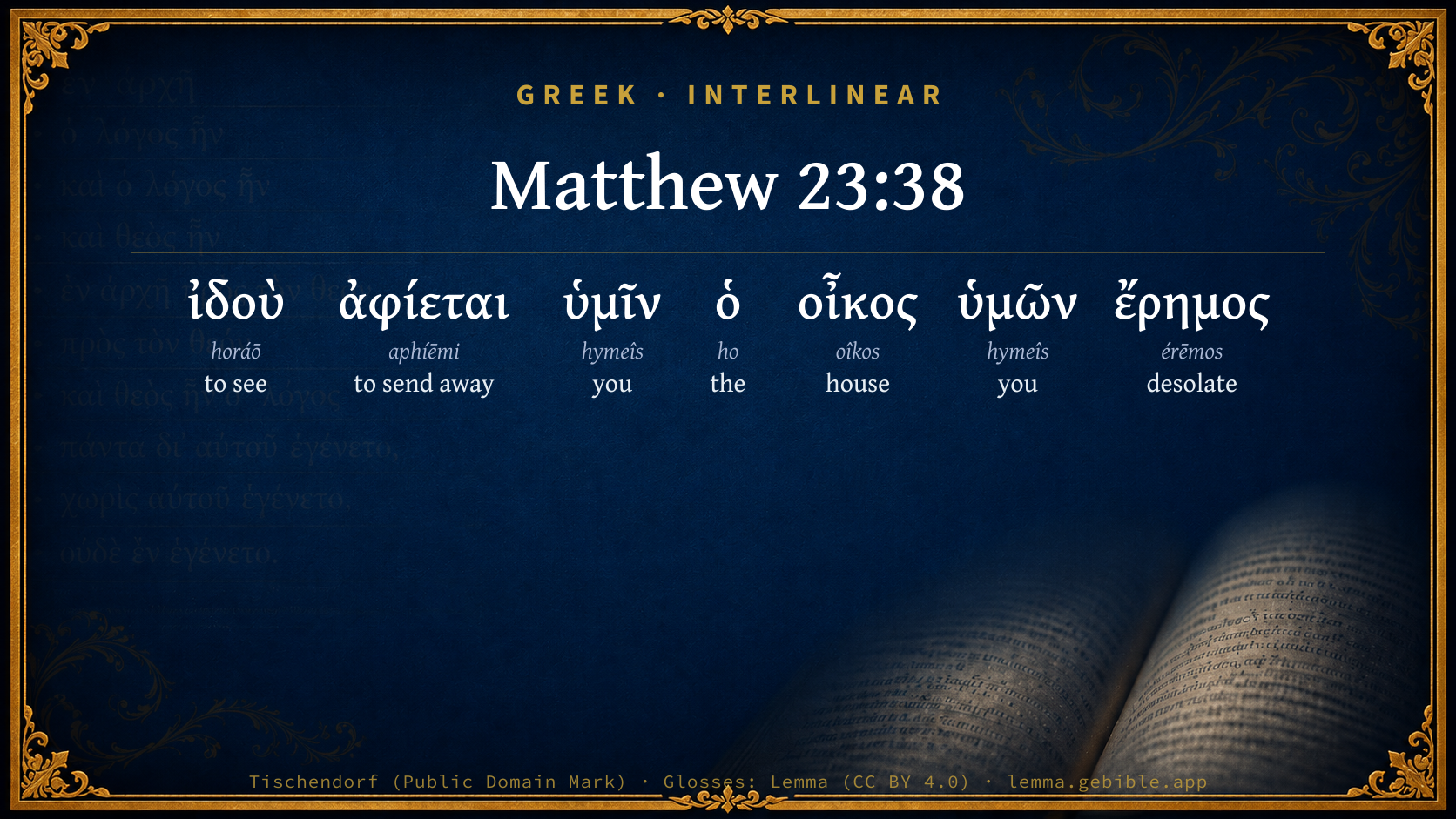
  1. ἰδοὺ horáō G3708 “to see” Verb, Aorist, Middle, Imperative, 2nd person, Singular
  2. ἀφίεται aphíēmi G863 “to send away” Verb, Present, Passive, Indicative, 3rd person, Singular
  3. ὑμῖν hymeîs G5210 “you” Personal pronoun, 2nd person, Dative, Plural
  4. ὁ ho G3588 “the” Article, Nominative, Singular, Masculine
  5. οἶκος oîkos G3624 “house” Noun, Nominative, Singular, Masculine
  6. ὑμῶν hymeîs G5210 “you” Personal pronoun, 2nd person, Genitive, Plural

About this verse

These counts appear in no published source. They are computed here, from the morphology-tagged text and Lemma’s own curated glosses. What Lemma adds →

7
words
6
distinct lemmas
Gospels
section

Shared distinctive vocabulary

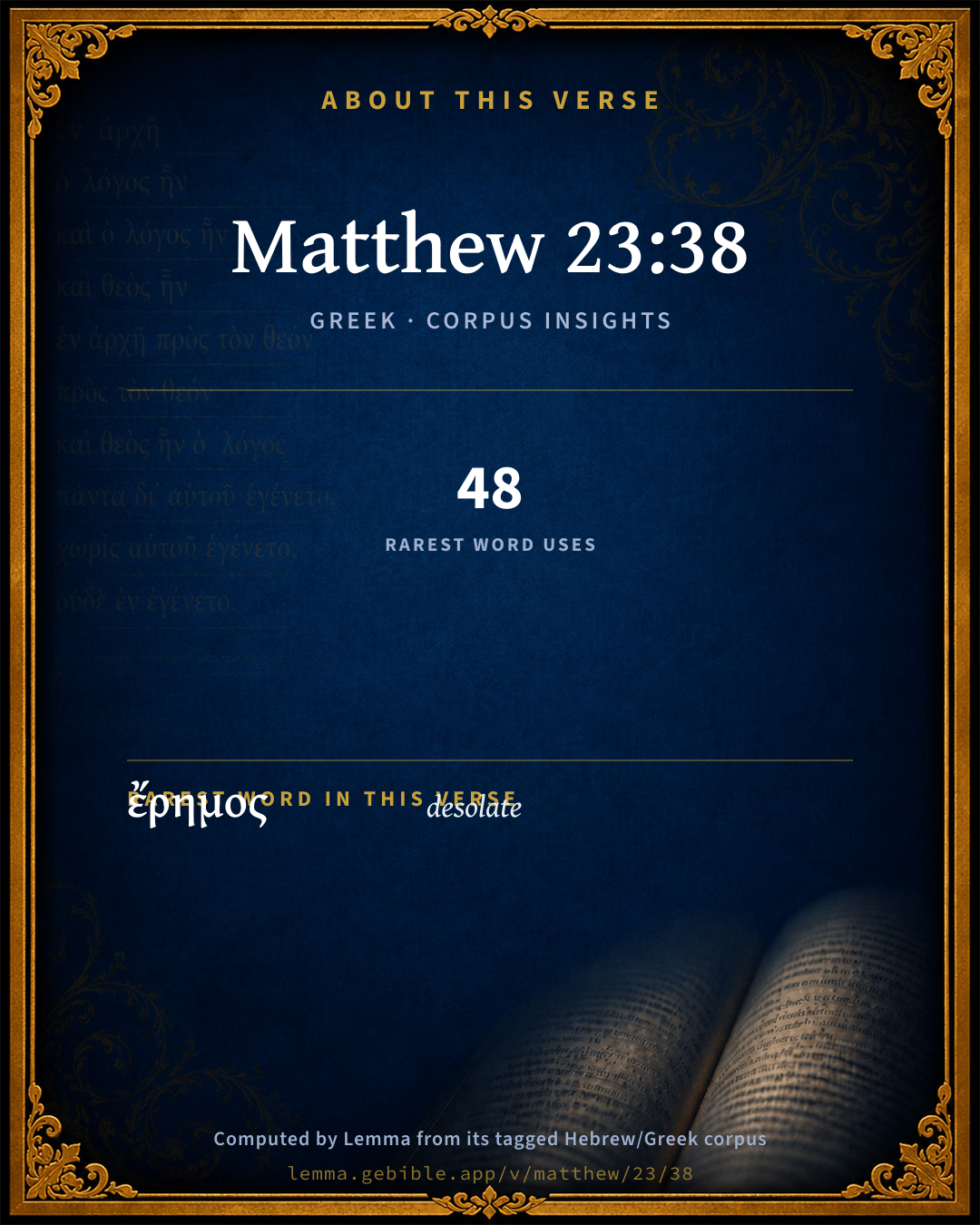
ἔρημος desolate G2048 occurs in 48 verses of the Greek New Testament. Also found in:

Repetition

A word recurs within this verse:

  • ὑμῖν you G5210 ×2

Cross-references

18

Topical passages linked to Matthew 23:38 in the Treasury of Scripture Knowledge — connected by theme and wording, ordered by reader-vote popularity; previews shown in the World English Bible.

  • Jeremiah 22:5 But if you will not hear these words, I swear by myself, says Yahweh, that this house shall become a desolation.
  • Luke 13:35 Behold, your house is left to you desolate. I tell you, you will not see me, until you say, 'Blessed is he who comes in the name of the Lord!'"
  • Luke 21:24 They will fall by the edge of the sword, and will be led captive into all the nations. Jerusalem will be trampled down by the Gentiles, until the times of the Gentiles are fulfilled.
  • 1 Kings 9:7 then will I cut off Israel out of the land which I have given them; and this house, which I have made holy for my name, will I cast out of my sight; and Israel shall be a proverb and a byword among all peoples.
  • Luke 19:43–44 For the days will come on you, when your enemies will throw up a barricade against you, surround you, hem you in on every side,
  • Luke 21:6 "As for these things which you see, the days will come, in which there will not be left here one stone on another that will not be thrown down."
  • Luke 21:20 "But when you see Jerusalem surrounded by armies, then know that its desolation is at hand.
  • Acts 6:13–14 and set up false witnesses who said, "This man never stops speaking blasphemous words against this holy place and the law.
  • Mark 13:14 But when you see the abomination of desolation, spoken of by Daniel the prophet, standing where it ought not (let the reader understand), then let those who are in Judea flee to the mountains,
  • 2 Chronicles 7:20–21 then will I pluck them up by the roots out of my land which I have given them; and this house, which I have made holy for my name, will I cast out of my sight, and I will make it a proverb and a byword among all peoples.
  • Psalms 69:24 Pour out your indignation on them. Let the fierceness of your anger overtake them.
  • Isaiah 64:10–12 Your holy cities are become a wilderness, Zion is become a wilderness, Jerusalem a desolation.
  • Jeremiah 7:9–14 Will you steal, murder, and commit adultery, and swear falsely, and burn incense to Baal, and walk after other gods that you have not known,
  • Daniel 9:26 After the sixty-two weeks the Anointed One shall be cut off, and shall have nothing: and the people of the prince who shall come shall destroy the city and the sanctuary; and the end of it shall be with a flood, and even to the end shall be war; desolations are determined.
  • Zechariah 11:1–2 Open your doors, Lebanon, That the fire may devour your cedars.
  • Zechariah 11:6 For I will no more pity the inhabitants of the land," says Yahweh; "but, behold, I will deliver the men everyone into his neighbor's hand, and into the hand of his king. They will strike the land, and out of their hand I will not deliver them."
  • Zechariah 14:1–2 Behold, a day of Yahweh comes, when your spoil will be divided in your midst.
  • Matthew 24:2 But he answered them, "Don't you see all of these things? Most assuredly I tell you, there will not be left here one stone on another, that will not be thrown down."

Cross-references courtesy of OpenBible.info (CC BY 4.0).

Commentary

Notes on Matthew 23:38 from classic Christian and Jewish commentators (each source and its license shown beneath its notes). The classic Christian expositions comment on the surrounding passage and are grouped to its opening verse, so a note may address several verses; the Jewish commentaries on the Tanakh (Rashi and others) are per-verse, so they appear only where the commentator wrote on this verse.

Lemma curates 59 commentaries, every one of them public domain or Creative Commons licensed, each selected and text-cleaned for this edition rather than reprinted as found. About our sources →

Joseph Benson's Commentary

Mat 23:38-39. Behold, your house — The temple, which is now your house, not God’s; is left unto you desolate — Forsaken of God and his Christ, and sentenced to utter destruction. Our Lord spake this as he was going out of it for the last time. For I say unto you — Ye Jews in general, ye men of Jerusalem in particular; shall not see me henceforth — Απ’ αρτι, hereafter, as the words signify, Mat 26:64; till — After a long interval of desolation and misery, Ye shall say, Blessed, &c. — Till ye receive me with joyful and thankful hearts; that is, till your nation is converted: for the state of the nation, and not of a few individuals, is here spoken of, as it is also in the parables of the vineyard and marriage-supper. Blessed is he that cometh in the name of the Lord, was the cry of the believing multitude when Jesus made his public entry into Jerusalem a few days before. Hence, in predicting their future conversion, he very properly alluded to that exclamation by which so many had expressed their faith in him as the Messiah. This was the last discourse Jesus pronounced in public, and with it his ministry ended. From that moment he abandoned the Jewish nation, gave them over to walk in their own counsels, and devoted them to destruction. Nor were they ever after to be the objects of his care, till the period of their conversion to Christianity should come, which he now foretold, and which also shall be accomplished in its season.

Joseph Benson's Commentary on the Old and New Testaments (1811–1818) — public domain. Text from a community e-Sword module.

Tyndale Open Study Notes

Tyndale Open Resources

23:38 your house is abandoned and desolate: God would withdraw his presence from the Temple (Ezek 10:18-19; 11:22-23; cp. Matt 1:23), and both the Temple and Jerusalem would be destroyed.

Tyndale Open Study Notes — © Tyndale Open Resources, licensed CC BY-SA 4.0. Text via the HelloAO Bible API.

Bengel's Gnomon

Johann Albrecht Bengel

Mat 23:38. Ἰδοὺ, ἀφίεται, Behold [your house] is left) The present tense twice expressed.[1020] He uttered these words as He was going out of the Temple. See ch. Mat 24:1, and cf. Joh 12:36.—Ὁ ΟἾΚΟς ὙΜῶΝ, your house) which is otherwise called the house of the Lord. Thus, in Exo 32:7, God says to Moses, thy people.[1021]—ἔρημος, desolate, or desert) sc. as being left by the Messiah.[1022] Even after His ascension, Christ employed the Temple in a remarkable manner with His disciples. But with regard to Judaism, the Temple now ceased to be what it had been, and for this reason was at length destroyed; see Mat 23:36. The word ἜΡΗΜΟς is often employed with a particular reference.[1023] Thus the Forum is said to be ἜΡΗΜΟΝ, when no judicial proceedings are being carried on in it.

[1020] This refers to ἀποστέλλω in Mat 23:34.—(I. B.)

[1021] Though on other occasions God said of them, “My people.”—ED.

[1022] For when the Messiah is absent, there is nothing that is not desolate and deserted.—V. g.

[1023] i.e. To denote the absence of that which constituted the characteristic or excellence of the object under consideration.—(I. B.)

Bengel's Gnomon of the New Testament — English translation (T&T Clark, Edinburgh, 1860) — public domain. Text from a community e-Sword module.

Meyer's Critical & Exegetical Commentary

Heinrich August Wilhelm Meyer

Mat_23:38 f. Ἀφίεται ὑμῖν ὁ οἶκος ὑμ.] your house is abandoned to your own disposal; the time for divine help and protection for your city is now gone by! For the meaning, comp. Joseph. Antt. xx. 8. 5. The present implies the tragic and decisive ultimatum. The ἔρημος, which is to be retained on critical grounds (see critical notes), intimates what is to be the final result of this abandonment, viz. the destruction of Jerusalem (ἐρήμωσις, Mat_24:45; Luk_21:20); on the proleptic use of the adjective, comp. on Mat_12:13, and Kühner, II. 1, p. 236. According to the context, ὁ οἶκος ὑμῶν can only mean Ἱερουσαλήμ, Mat_23:37 (Bleek), in which their children dwell; not the city and the country at large (de Wette and earlier expositors, in accordance with Psa_69:25), nor the whole body of the Jewish people (Keim), nor the temple (Jerome, Theophylact, Euthymius Zigabenus, Calvin, Olearius, Wolf, Michaelis, Kuinoel, Neander, Baumeister in Klaibers Stud. II. p. 67 f.; Hofmann, Schriftbew. II. 2, p. 92; Ewald).

Mat_23:39 proceeds to account for this ἀφίεται ὑμῖν, κ.τ.λ. Were your city any longer to be shielded by the divine protection, I would still linger among you; but I now leave you, and it is certain that henceforth (His presence among them, as He knows, being about to cease with His death, comp. Mat_26:64) you will not see me again until my second coming (not: in the destruction of Jerusalem, Wetstein), when I shall appear in the glory of the Messiah, and when, at my approach, you will have saluted (εἴπητε, dixeritis) me, whom you have been rejecting, with the Messianic confession εὐλογημένος, κ.τ.λ. (Mat_21:9). This is not to be understood of the conversion of Israel (Romans 11; Revelation 11) in its development down to the second coming (Bengel, Köstlin, Hofmann, Lange, Schegg, Auberlen, Ewald); for Jesus is addressing Jerusalem, and threatening it with the withdrawal of Gods superintending care, and that until the second appearing of Messiah (ὁ ἐρχόμενος), and hence He cannot have had in view an intervening μετάνοια and regeneration of the city. No; the abandonment of the city on the part of God, which Jesus here announces, is ultimately to lead to her destruction; and then, at His second appearing, which will follow immediately upon the ruin of the city (Mat_24:29), His obstinate enemies will be constrained to join in the loyal greeting with which the Messiah will be welcomed (Mat_21:9), for the manifestation of His glory will sweep away all doubt and opposition, and force them at last to acknowledge and confess Him to be their Deliverer. A truly tragic feature at the close of this moving address in which Jesus bids farewell to Jerusalem, not with a hope, but with the certainty of ultimate, though sorrowful, victory. Euthymius Zigabenus very justly observes in connection with ἕως ἂν εἴπητε, κ.τ.λ.: καὶ πότε τοῦτο εἴπωσιν; ἑκόντες μὲν οὐδέποτε· ἄκοντες δὲ κατὰ τὸν καιρὸν τῆς δευτέρας αὐτοῦ παρουσίας, ὅταν ἥξει μετὰ δυνάμεως καὶ δόξης πολλῆς, ὅταν οὐδὲν αὐτοῖς ὄφελος τῆς ἐπιγνώσεως. Comp. Theophylact, Calvin, Gerhard, Calovius. Wieseler, p. 322, despairing of making sense of the passage, has gone the length of maintaining that some ancient reader of Matthew has inserted it from Luke. This view might seem, no doubt, to be favoured by the use, in the present instance, of Ἱερουσαλήμ, Mat_23:37, the form in which the word regularly appears in Luke, and for which, on every other occasion, Matthew has Ἱεροσόλυμα; but it might very easily happen that, in connection with an utterance by Jesus of so remarkable and special a nature, the form given to the name of the city in the fatal words addressed to her would become so stereotyped in the Greek version of the evangelic tradition, that here, in particular, the Greek translator of Matthew would make a point of not altering the form Ἱερουσαλήμ, which had come to acquire so fixed a character as part of the utterance before us.

REMARK.

It is fair to assume that Christs exclamation over Jerusalem presupposes that the capital had repeatedly been the scene of His ministrations, which coincides with the visits on festival occasions recorded by John. Comp. Act_10:39, and see Holtzmann, p. 440 f.; Weizsäcker, p. 310. Those who deny this (among them being Hilgenfeld, Keim) must assume, with Eusebius in the Theophan. (Nova bibl. patr. iv. 127), that by the children of Jerusalem are meant the Jews in general, inasmuch as the capital formed the centre of the nation; comp. Gal_4:25. Baur himself (p. 127) cannot help seeing the far-fetched character of this latter supposition, and consequently has recourse to the unwarrantable view that we have before us the words of a prophet speaking in the name of God,words which were first put into the mouth of Jesus in their present form, so that, when they were uttered, ποσάκις would be intended to refer to the whole series of prophets and messengers, who had come in Gods name; just as Origen had already referred them to Moses and the prophets as well, in whom Christ was supposed to have been substantially present; comp. Strauss in Hilgenfelds Zeitschr. 1863, p. 90.

Meyer — Critical and Exegetical Commentary on the New Testament — English translation by Peter Christie, edited by Frederick Crombie (T&T Clark, 1880) — public domain. Text from a community e-Sword module.

Expositor's Greek Testament

ed. W. Robertson Nicoll

Mat 23:38 . ἰδοὺ , etc., solemn, sorrowful abandonment of the city to its fate. ἀφίεται ὑμῖν , spoken to the inhabitants of Israel. ὁ οἶκος ὑ ., your house, i.e. , the city, not the temple; the people are conceived of as one family. ἔρημος , wanting in [129] [130] , and omitted by W.H [131] , is not necessary to the sense. The sentence is, indeed, more impressive without it: “Behold your house is abandoned to your care: those who would have saved you giving up further effort”. What will happen left to be imagined; just what ἔρημος expresses desolation.

[129] Codex Vaticanus (sæc. iv.), published in photographic facsimile in 1889 under the care of the Abbate Cozza-Luzi.

[130] Codex Regius--eighth century, represents an ancient text, and is often in agreement with א and B.

[131] Westcott and Hort.

The Expositor's Greek Testament, edited by W. Robertson Nicoll (1897–1910) — public domain. Text from a community e-Sword module.

Jamieson, Fausset & Brown

Robert Jamieson, A. R. Fausset & David Brown

Behold, your house--the temple, beyond all doubt; but their house now, not the Lord's. See on Mat 22:7.

is left unto you desolate--deserted, that is, of its Divine Inhabitant. But who is that? Hear the next words:

Jamieson, Fausset & Brown — Commentary Critical and Explanatory on the Whole Bible (1871) — public domain (CC PDM 1.0). Text via the HelloAO Bible API.

Adam Clarke's Commentary

Verse 38. Behold, your house] Ο οικος, the temple: - this is certainly what is meant. It was once the Lord's temple, God's OWN house; but now he says, YOUR temple or house - to intimate that God had abandoned it. See Clarke on Mt 23:21; see also Clarke on "Lu 13:35".

Adam Clarke's Commentary on the Bible (1810–1826) — public domain. Text from a community e-Sword/MySword module.

Ellicott's Commentary for English Readers

(38) Your house.—The word “desolate” is omitted in some of the best MSS. The words “your house” may refer either generally to the whole polity of Israel, or more specifically to the “house” in which they gloried, the Temple, which was the joy of their hearts. It had been the house of God, but He, as represented by His Son, was now leaving it for ever. It was their house now, not His. We must remember that the words were spoken as our Lord was “departing from the Temple” (Mat_24:1), never to reappear there.

A Bible Commentary for English Readers, edited by Charles John Ellicott (1878–1897) — public domain. Text from a community e-Sword module.

The Cambridge Bible for Schools and Colleges

gen. ed. J. J. S. Perowne

38. your house] i. e. Jerusalem, rather than the Temple.

desolate] Omitted in the Vatican Codex, but too strongly supported to be removed from the text.

The Cambridge Bible for Schools and Colleges (gen. ed. J. J. S. Perowne; Cambridge University Press, 1878–1918) — public domain. Text from a community e-Sword module.

John Gill's Exposition

For I say unto you, ye shall not see me henceforth,.... Meaning in a very little time after the passover, from the time of his crucifixion and death; otherwise they saw him many times after this, as in the palace of the high priest, in Pilate's judgment hall, and on the cross; but not after his resurrection. This shows the reason of their house being desolate, and in what sense it should be so, and immediately became so; namely, by being then directly, and ever after, destitute of his presence: and though they might afterwards seek for, and expect the Messiah in it, yet they would never be able to see him, nor throughout their long captivity: till ye shall say, blessed is he that cometh in the name of the Lord; that is, until the time comes, that the fulness of the Gentiles shall be brought in, and all Israel shall be saved, the Jews shall be converted, and seek the Lord their God, and David their king; when they shall readily and cheerfully say these words to Christ, who will then appear in his glory; which they were now displeased at in the multitude that followed him, and the children in the temple. Though some think this is said by way of threatening, since the rest that is spoken to them by Christ is of that sort, and regards the men of that generation; and is given as a reason of their house being left desolate: and the sense is, that they should never see him with joy and pleasure; since, though they would be obliged to confess that he was Lord and Christ, they would never say the above words to him in faith, and holy reverence of him. The Cambridge exemplar of Beza's, and the Persic versions, read, "in the name of God."

Next: Matthew Chapter 24

John Gill's Exposition of the Whole Bible (1746–1763) — public domain (CC PDM 1.0). Text via the HelloAO Bible API.

Trapp's Complete Commentary

John Trapp

38 Behold, your house is left unto you desolate.

Ver. 38. Behold, your house is left, &c.] City and temple both. God will not always stand men for a sinning stock. They that will not hear his word, shall hear his rod, and feel his sword too. Elisha hath his sword as well as Jehu and Hazael, 1Ki 19:17, and the one usually precedes the other. They therefore that say, Following of sermons will make men beggars, forget that to take away the gospel from Jerusalem was to leave their houses as well as God’s house desolate.

John Trapp, A Commentary or Exposition upon All the Books of the Old and New Testament (1647–1656) — public domain. Text from a community e-Sword module.

Albert Barnes' Notes on the Bible

Your house - The temple. The house of worship of the Jews. The chief ornament of Jerusalem.

Desolate - About to be desolate or destroyed. To be forsaken as a place of worship, and delivered into the hands of the Romans, and destroyed. See the notes at Matt. 24.

Albert Barnes' Notes on the Bible (1834–1885) — public domain. Text from a community e-Sword/MySword module.

Haydock's Catholic Bible Commentary

Behold, your house. Their house shall be deprived of the protection of the God of heaven. He it was that had hitherto preserved them, and he also would inflict upon them those very severe judgments they so much dreaded. (St. John Chrysostom, hom. lxxv.)

George Leo Haydock (1774–1849), Haydock's Catholic Family Bible and Commentary, 1859 edition — public domain. Excludes Psalms (Douay-Rheims chapter numbering differs from Protestant) and Deuterocanonical books (Catholic canon only).

Whedon's Commentary on the Bible

Daniel D. Whedon

38. Your house is left… desolate — Jerusalem is pictured as a person whose habitation has been completely desolated and abandoned to the pillager. The house may be an allusion to the temple, in which indeed Jesus uttered the words. It is now not God’s house, but your house.

Daniel D. Whedon (gen. ed.), Commentary on the Old and New Testaments (1874–1909) — public domain. Text from a community e-Sword module.

The Pulpit Commentary

Your house. The temple or Jerusalem, no longer God"s habitation. This betokens not only Christ"s solemn departure from the sacred precincts; but the withdrawal of God"s Spirit from the Jewish Church and nation. Unto you. Henceforward ye shall have it all to yourselves; my Father and I forsake it; we give it up altogether to you. Desolate. The word is omitted by some few uncials, but retained by a, C, D, etc., most cursives, the Vulgate, etc. The protecting wing is withdrawn, the Divine presence removed, and the house is indeed deserted (erhmov); (comp. Psa_59:2-5 Jer_12:7)

The Pulpit Commentary (1880–1919), ed. H.D.M. Spence-Jones & Joseph S. Exell — public domain. Text from a community e-Sword module.

John Wesley's Explanatory Notes

Behold your house - The temple, which is now your house, not God's: Is left unto you - Our Lord spake this as he was going out of it for the last time: Desolate - Forsaken of God and his Christ, and sentenced to utter destruction.

John Wesley, Explanatory Notes Upon the Whole Bible (1754–1765) — public domain. Text via the GEBible commentary corpus.

The People's New Testament

B. W. Johnson

38. Behold, your house is left unto you desolate. This was the consequence of refusing to come to Christ. The temple is the house meant. God will abandon it and leave it desolate. He will no longer accept its worship.

B. W. Johnson's The People's New Testament with Notes (1889–1891) — public domain. Electronic text from the Christian Classics Ethereal Library (CCEL) ThML edition.

Cambridge Greek Testament for Schools and Colleges

38. ὁ οἶκος ὑμῶν, i.e. Jerusalem, rather than the Temple. ὑμῶν, ‘yours,’ no longer God’s.

ἔρημος. Omitted in the Vatican Codex, but too strongly supported to be removed from the text.

Cambridge Greek Testament for Schools and Colleges (Cambridge University Press, 1896; 21 vols, various authors incl. Carr, Maclear, Plummer, Farrar, Lumby, Moule, M. R. James, Simcox) — public domain. Text from a community e-Sword module.

International Critical Commentary

38. Behold your house is left to you.] So Luk 13:35.

(L)

38. ὁ οἶκος ὑμῶν] א C D al add ἓρημος; cf. Jer 22:5 εἰς ἐρήμωσιν ἕσται ὁ οἶκος οὖτος. Omit B. L ff2 S1.

ἀφίεται ὑμῖν ὁ οἶκος ὑμῶν] ὁ οἶκος may mean either the city or the temple. For the latter, cf. Jer 26:6 “Them will I make this house” (cf. v. 3 “the court of the Lord’s house”) “like Shiloh;” Apoc. Bar 8:2 “He who kept the house” (cf. 1 “from the interior of the temple”) “has forsaken it.” For the former, cf. Jer 12:7 “I have forsaken My house”; 22:5 “This house shall become a desolation. For thus saith the Lord concerning the house of the King of Judah.” Enoch 8950., 51, “they forsook that their house”; 55 “He forsook that their house and tower.” See Charles’ note on 50. The two meanings seem here to be combined, “Your city and Temple are abandoned by God, and given up to desolation.” For the idea of the abandonment of a doomed city by the divine power which protected it, cf. the story told in Jos. Wars, vi. 299, of the priests who, before the capture of the city by Titus, heard a sound as of a multitude, saying, “Let us go hence.” Cf. also Apoc. Bar 8:1, 2, and Tacitus, Hist. v. 13.

E editorial passages.

L the Matthæan Logia.

B. Babylonian Talmud.

DB. Dictionary of the Bible (Hastings).

M the Second Gospel.

Dalm. Dalman.

al i.e. with other uncial MSS.

S Syriac version: Sinaitic MS.

S Syriac version: Curetonian.

1 Rel. Beweg. pp. 32 f.

Jos. Josephus.

Exp. Times Expository Times.

O quotations from the Old Testament borrowed from a collection of Messianic prophecies. See pp.61 f.

1 If this be so, the thought here is much the same as that which Mt. (15:10-20) has read into Mar 7:14-23. There it is “Eating meat with unwashen hands will not defile you if you are morally clean”; here it is if “Eating from vessels which are ceremonially unclean will not defile you, if the food has been honestly obtained.”

Bab. Babylonian Talmud.

LXX. The Septuagint Version.

International Critical Commentary — older volumes (1896–1929), various authors — public domain. Text from a community e-Sword module.

Lesson kit

Teaching starters — assembled from the data on this page, not authored interpretation. Every prompt links to the verse data it draws on. Edit before teaching.

Matthew, in the Gospels, opens this verse with 7 words (6 distinct Greek lemmas). Its most distinctive word is érēmos (“desolate”). A historical commentator’s framing appears above. Read the whole chapter for the surrounding context.

Discussion questions

  1. How does “desolate” (érēmos) shape what this verse is saying?
  2. Matthew 3:1 shares the word «desolate» with this verse. How do the two illuminate each other?
  3. “you” occurs 2× in this one verse. What is the effect of the repetition?
  4. Reading how Joseph Benson's Commentary and Tyndale Open Study Notes read this verse, where do the two commentators agree and where do they part?

Things to notice

Reading settings

Reading text

Shown beneath each verse's original-language words.

Old Testament
Old Testament edition

Read the OT as the Masoretic Hebrew (MT) or the Greek Septuagint (LXX).

English shown for the Greek Septuagint (in the Hebrew ↔ Greek comparison).

Comparing translations? Open the Compare panel on any verse page to stack up to four side by side.