John 8:57

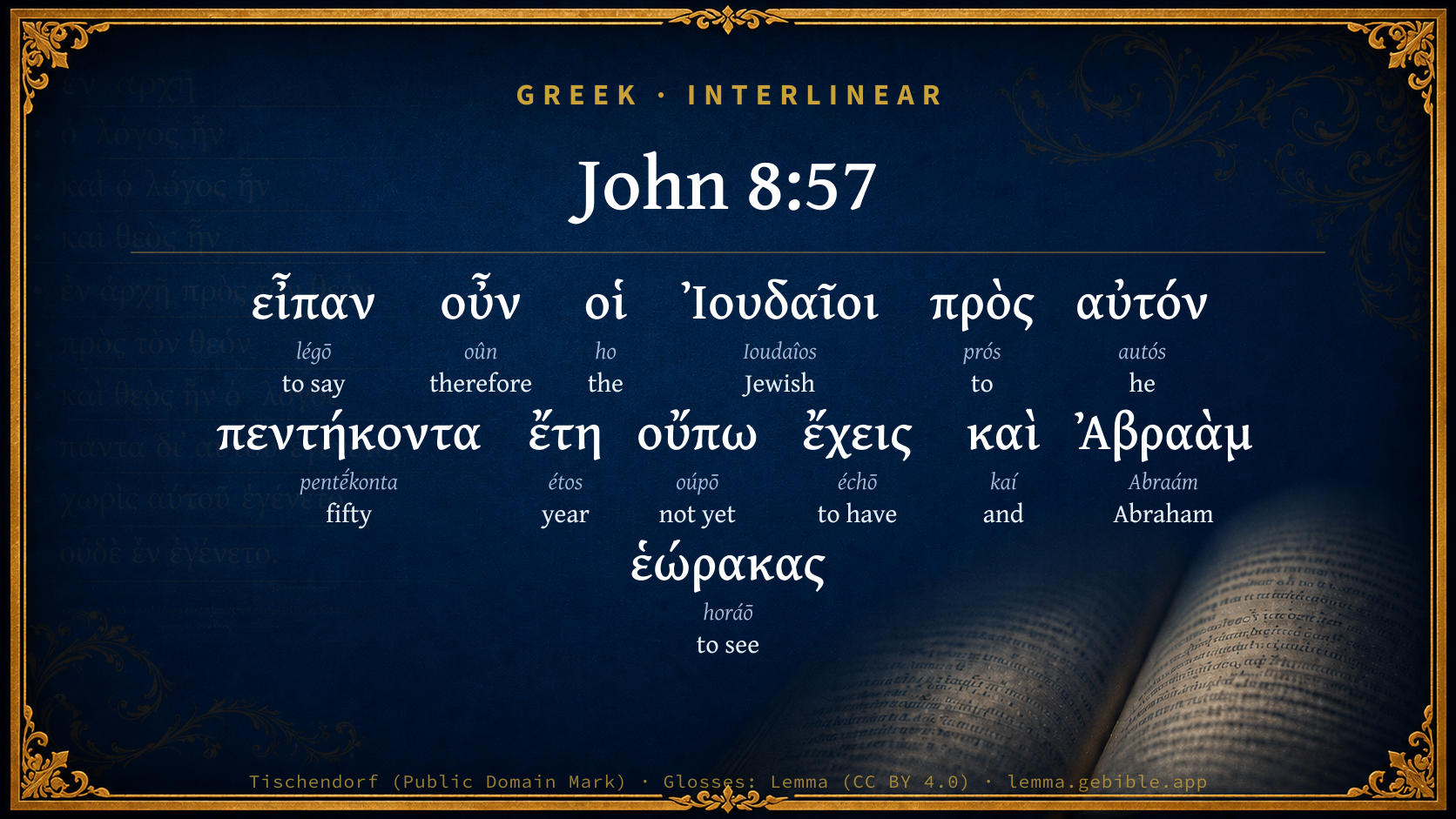
Greek (Tischendorf 8th ed.) John 8:57 appears in the Greek New Testament. The text above is from the Tischendorf 8th edition. Each word links to its Strong’s number and a concise gloss. Click any word for its full Thayer’s Greek Lexicon entry.
Download image
Cite this verse

John 8:57 (World English Bible). Public Domain. Lemma interlinear Bible study tool, https://lemma.gebible.app/v/john/8/57.

Show BibTeX & RIS
BibTeX
RIS
English Translation
The Jews therefore said to him, "You are not yet fifty years old, and have you seen Abraham?"
World English Bible · Public Domain
Download a study sheet

One document with this verse’s original text, its word-by-word gloss line, the meaning frame, cross-references with their text, attributed commentary, and full source and license credits — printable, and it pastes into notes with its structure intact.

This verse Autodidact and up

Study sheet (.html) Plain text (.txt)

A passage Seminary Student

Up to 50 verses in one chapter. A passage sheet keeps up to 6 commentary sources and 12 cross-references per verse, in the order this page ranks them, and says so on the sheet whenever that leaves anything out. Ask for a single verse and you get the Autodidact verse sheet above.

Everything on this page stays free to read, with no account — the sheet is a download of what is already on screen, not access to it.

Want to remove ads? Support Godless Engineer
Compare translations 3

The same verse in 3 English versions, stacked beneath the original-language interlinear above. Click any original word for its lexicon entry.

Each is an independent rendering of the whole verse — the interlinear is not word-aligned to these translations.

Highlighted words mark where these versions differ — a whole-verse word diff, not a word-by-word alignment.

  • World English Bible Public Domain
    The Jews therefore said to him, "You are not yet fifty years old, and have you seen Abraham?"
  • King James Version Public Domain
    Then said the Jews unto him, Thou art not yet fifty years old, and hast thou seen Abraham?
  • unfoldingWord Literal Text CC BY-SA 4.0
    Therefore the Jews said to him, “You do not yet have 50 years, and you have seen Abraham?”

unfoldingWord Literal Text — © unfoldingWord, licensed CC BY-SA 4.0. Word-aligned USFM3 via Door43 (git.door43.org/unfoldingWord/en_ult).

Versions to compare (up to 4)

3 of 4 selected

Show all 19 translations

Every available English version of this verse, each an independent rendering of the whole verse.

  • World English Bible Public Domain
    The Jews therefore said to him, "You are not yet fifty years old, and have you seen Abraham?"
  • Berean Standard Bible Public Domain
    Then the Jews said to Him, “You are not yet fifty years old, and You have seen Abraham?”
  • Majority Standard Bible Public Domain
    Then the Jews said to Him, “You are not yet fifty years old, and You have seen Abraham?”
  • King James Version Public Domain
    Then said the Jews unto him, Thou art not yet fifty years old, and hast thou seen Abraham?
  • American Standard Version (1901) Public Domain
    The Jews therefore said unto him, Thou art not yet fifty years old, and hast thou seen Abraham?
  • Revised Version (1885) Public Domain
    The Jews therefore said unto him, Thou art not yet fifty years old, and hast thou seen Abraham?
  • Geneva Bible (1599) Public Domain
    Then sayd ye Iewes vnto him, Thou art not yet fiftie yeere olde, and hast thou seene Abraham?
  • Douay-Rheims (1899) Public Domain
    The Jews therefore said to him: Thou art not yet fifty years old, and hast thou seen Abraham?
  • Young's Literal Translation Public Domain
    The Jews, therefore, said unto him, `Thou art not yet fifty years old, and Abraham hast thou seen?'
  • Literal Standard Version CC BY-SA 4.0
    The Jews, therefore, said to Him, “You are not yet fifty years old, and You have seen Abraham?”
  • Unlocked Literal Bible CC BY-SA 4.0
    The Jews said to him, “You are not yet fifty years old, and you have seen Abraham?”
  • unfoldingWord Literal Text CC BY-SA 4.0
    Therefore the Jews said to him, “You do not yet have 50 years, and you have seen Abraham?”
  • Darby Bible Public Domain
    The Jews therefore said to him, Thou hast not yet fifty years, and hast thou seen Abraham?
  • World Messianic Bible Public Domain
    The Judeans therefore said to him, “You are not yet fifty years old! Have you seen Abraham?”
  • Webster's Bible Public Domain
    Then said the Jews to him, Thou art not yet fifty years old, and hast thou seen Abraham?
  • Free Bible Version CC BY-SA 4.0
    The Jews replied, “You're not even fifty years old, and you've seen Abraham?”
  • Bible in Basic English Public Domain
    Then the Jews said to him, You are not fifty years old; have you seen Abraham?
  • Text-Critical English NT CC BY 4.0
    Then the Jews said to him, “Yoʋ are not yet fifty years old, and yoʋ have seen Abraham?”
  • Tyndale New Testament (1534) Public Domain
    Then sayde the Iewes vnto him: thou arte not yet.l. yere olde and hast thou sene Abraham?

Literal Standard Version (2020), Covenant Press — licensed CC BY-SA 4.0. Text via the HelloAO Bible API (eBible.org). Unlocked Literal Bible (unfoldingWord) — licensed CC BY-SA 4.0. Text via the HelloAO Bible API (eBible.org). unfoldingWord Literal Text — © unfoldingWord, licensed CC BY-SA 4.0. Word-aligned USFM3 via Door43 (git.door43.org/unfoldingWord/en_ult). Free Bible Version, Dr. Jonathan Gallagher — licensed CC BY-SA 4.0. Text via the HelloAO Bible API (eBible.org).

Word by word

More ways to search: Search by grammar → Find every occurrence → Compare this word →

Practice this passage: Drill this verse → Learn its vocabulary →

About this verse

These counts appear in no published source. They are computed here, from the morphology-tagged text and Lemma’s own curated glosses. What Lemma adds →

13
words
13
distinct lemmas
Gospels
section

Notable vocabulary

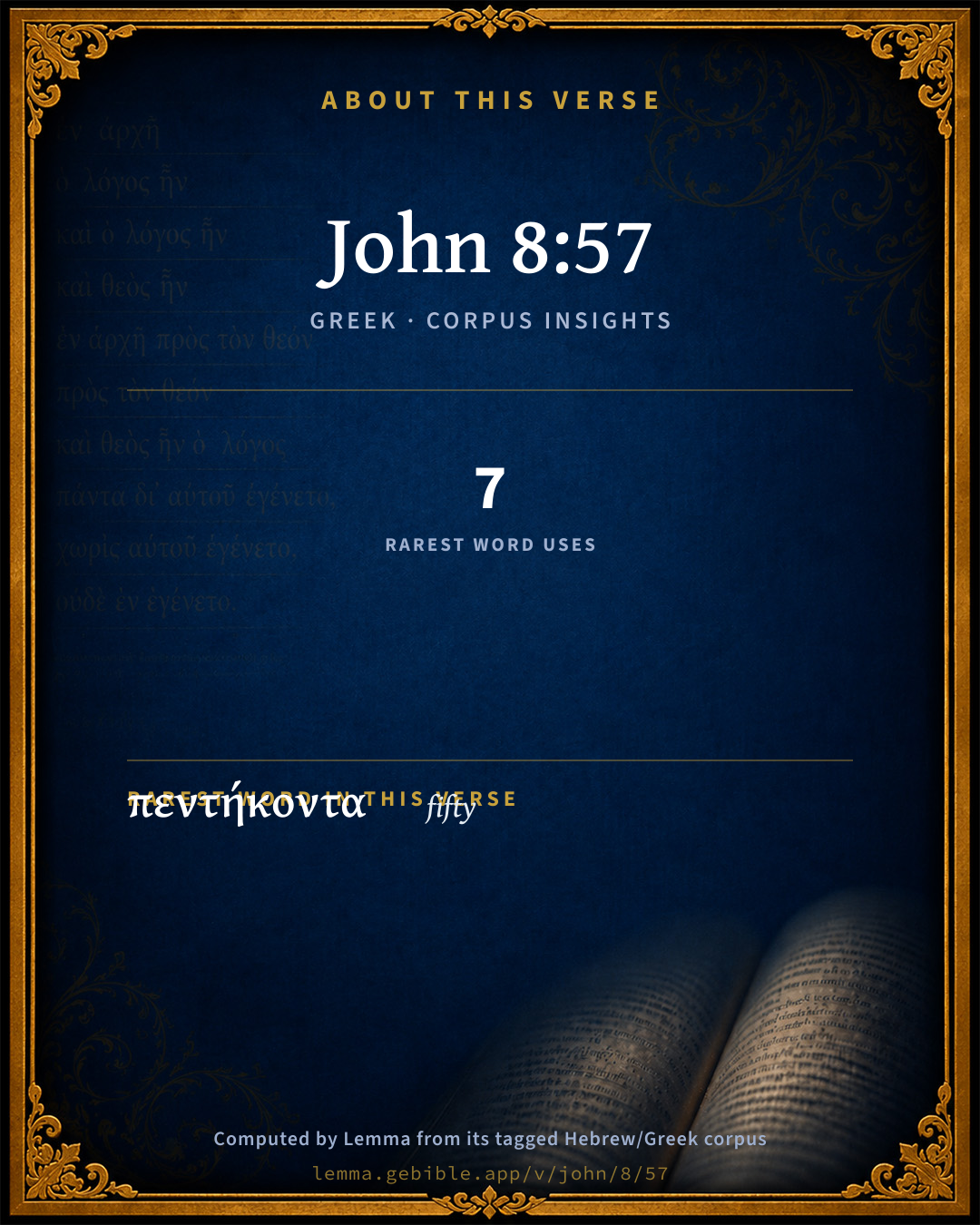
The rarest word here is πεντήκοντα fifty G4004 — appearing just 7 times in the whole Greek New Testament.

Shared distinctive vocabulary

πεντήκοντα fifty G4004 occurs in 7 verses of the Greek New Testament. Also found in:

Commentary

Notes on John 8:57 from classic Christian and Jewish commentators (each source and its license shown beneath its notes). The classic Christian expositions comment on the surrounding passage and are grouped to its opening verse, so a note may address several verses; the Jewish commentaries on the Tanakh (Rashi and others) are per-verse, so they appear only where the commentator wrote on this verse.

Lemma curates 59 commentaries, every one of them public domain or Creative Commons licensed, each selected and text-cleaned for this edition rather than reprinted as found. About our sources →

Tyndale Open Study Notes

Tyndale Open Resources

8:57 You aren’t even fifty years old: The Jewish leaders misunderstood Jesus: He was talking about his divine pre-existence, not his physical age.

Tyndale Open Study Notes — © Tyndale Open Resources, licensed CC BY-SA 4.0. Text via the HelloAO Bible API.

Bengel's Gnomon

Johann Albrecht Bengel

Joh 8:57. Πεντήκοντα, fifty) For contention’s sake they exaggerate the number. But, had they not been altogether forgetful of His nativity at Bethlehem, they would have said, Thirty years old, and not much more. As it is, they imply this by their words, Thou hast not yet reached a half century, in other words, the year of superannuation; Num 4:3, The term of the Levite service, “From thirty years old and upward, even until fifty years old,” as Lightfoot observes; whence it seems, the expression is not unlike an adage. It is not likely, that Jesus by reason of sorrows had contracted a premature appearance of old age. Heb 1:9, “God, even thy God, hath anointed thee with the oil of gladness above they fellows:” Mat 9:15, “Can the children of the bride-chamber mourn, as long as the bridegroom is with them?” ch. Joh 11:19, “The Son of Man came eating and drinking.”—Ἀβραάμ, Abraham) He had died 1850 years before this colloquy.—ἑώρακας, hast thou seen) They speak (and rightly so, indeed; comp. ch. Joh 16:16; Joh 16:22, “A little while, and ye shall not see Me, and again, a little while and ye shall see Me,” etc.: “Ye now have sorrow, but I will see you again,”) by the force of correlatives. Since Abraham saw Thy day; Thou hast seen Abraham.

Bengel's Gnomon of the New Testament — English translation (T&T Clark, Edinburgh, 1860) — public domain. Text from a community e-Sword module.

Meyer's Critical & Exegetical Commentary

Heinrich August Wilhelm Meyer

Joh_8:57. The Jews, referring κ. εἶδε κ. ἐχάρη to the earthly life of Abraham, imagine the assertion of Jesus to imply that He had lived in the days of the patriarch, and professed to have been personally acquainted with him! How absurd is this!

πεντήκοντα] Placed first to indicate emphasis, corresponding to the position afterwards assigned to the word Ἀβρ. Fifty years are specified as the period when a man attains his full growth (comp. Num_4:3; Num_4:39; Num_8:24 f.; Lightfoot, p. 1046 f.): thou hast not yet passed the full age of manhood! Consequently, neither the reading τεσσαράκοντα is to be preferred (Ebrard), nor need we conclude either that Jesus was above forty years of age (the Presbyters of Asia Minor in Iren. II. 22. 5); or that He was taken to be so old διὰ τὴν πολυπειρίαν αὐτοῦ (Euth. Zigabenus); or that He looked so old (Lampe, Heumann, Paulus); or that they confounded the intensity of the devotion of His soul as it showed itself in His person, with the traces of age (Lange, Life of Jesus). In the act of instituting a comparison with the two thousand years that had elapsed since Abrahams day, they could not well care about determining very precisely the age of Christ. In answer to E. v. Bunsen (The Hidden Wisdom of Christ, etc., Lond. 1865, II. p. 461 ff.), who seeks to establish the correctness of the statement in Irenaeus, see Rösch in Die Jahrb. für deutsche Theol. 1866, p. 4 f. Without the slightest reason, Bunsen finds in the forty-six years of chap. Joh_4:2, the age of Christ. But even Keim is not opposed to the idea of Christ being forty years of age (Gesch. Jes. I. p. 469; comp. his Geschichtl. Chr. p. 235).

Meyer — Critical and Exegetical Commentary on the New Testament — English translation by Peter Christie, edited by Frederick Crombie (T&T Clark, 1880) — public domain. Text from a community e-Sword module.

Expositor's Greek Testament

ed. W. Robertson Nicoll

Joh 8:57 . This, however, the Jews completely misunderstand. They think that by asserting that Abraham saw His day, Jesus means to say that His day and the life of Abraham on earth were contemporaneous. Πεντήκοντα … ἑώρακας ; “Fifty years” may be used as a round number, sufficiently exact for their purpose and with no intention to determine the age of Jesus. But Lightfoot ( Hor. Heb. , 1046) thinks the saying is ruled by the age when Levites retired, see Num 4:3 ; Num 4:39 : “Tu non adhuc pervenisti ad vulgarem annum superannuationis, et tune vidisti Abrahamum?” Irenaeus (ii. 22, 5) records that the Gospel (presumably this passage) and the Presbyters of Asia Minor who had known John, testified that Jesus taught till He was forty or fifty. This idea is upheld by E. v. Bunsen ( Hidden Wisdom of Christ ), and even Keim is of opinion that Jesus may have lived to His fortieth year.

The Expositor's Greek Testament, edited by W. Robertson Nicoll (1897–1910) — public domain. Text from a community e-Sword module.

Jamieson, Fausset & Brown

Robert Jamieson, A. R. Fausset & David Brown

Then said the Jews unto him, Thou art not yet fifty years old--"No inference can be drawn from this as to the age of our Lord at the time as man. Fifty years was with the Jews the completion of manhood" [ALFORD].

and hast thou seen Abraham?--He had said Abraham saw Him, as being his peculiar privilege. They give the opposite turn to it--"Hast Thou seen Abraham?" as an honor too great for Him to pretend to.

Jamieson, Fausset & Brown — Commentary Critical and Explanatory on the Whole Bible (1871) — public domain (CC PDM 1.0). Text via the HelloAO Bible API.

Adam Clarke's Commentary

Verse 57. Thou art not yet fifty years old] Some MSS. read forty. The age of our blessed Lord has never been properly determined. Some of the primitive fathers believed that he was fifty years old when he was crucified; but their foundation, which is no other than these words of the Jews, is but a very uncertain one. Calmet thinks that our Lord was at this time about thirty-four years and ten months old, and that he was crucified about the middle of his thirty-sixth year; and asserts that the vulgar era is three years too late. On the other hand, some allow him to have been but thirty-one years old, and that his ministry had lasted but one year. Many opinions on this subject, which are scarcely worthy of being copied, may be found in Calmet.

Adam Clarke's Commentary on the Bible (1810–1826) — public domain. Text from a community e-Sword/MySword module.

John Calvin's Commentaries

57. Thou art not yet fifty years old. They endeavor to refute Christ’s saying, by showing that he had asserted what was impossible, when he who was not yet fifty years of age makes himself equal to Abraham, who died many centuries before. Though Christ was not yet thirty-four years of age, yet they allow him to be somewhat older, that they may not appear to be too rigid and exact in dealing with him; as if they had said, “Thou certainly wilt not make thyself so old, though thou wert to boast that thou art already fifty years of age.” Consequently, those who conjecture that he looked older than he actually was, or that the years mentioned in this passage are not solar years, in either case labor to no purpose. The notion of Papias, who says that Christ lived more than forty years, cannot at all be admitted.

John Calvin's Commentaries (1540-1563) — public domain. Text from the Calvin Translation Society English edition (1840s-50s) via the Christian Classics Ethereal Library (ccel.org). Calvin's coverage is partial (roughly two-thirds of the Bible); uncommented books and verses are honest gaps, never fabricated. The 19th-century editor's footnotes and remarks are omitted so the notes are faithfully Calvin's own voice.

Ellicott's Commentary for English Readers

(57) Thou art not yet fifty years old.—There is no reason to doubt that we have the correct reading here, though some, from Chrysostom downward, have sought to avoid what seemed to them a difficulty, by substituting “forty” for “fifty.” Others, and among them were the “Elders who in Asia conferred with John, the Lord’s disciple,” have held that our Lord was between forty and fifty years of age at the time of his public ministry. We know this from the testimony of Irenaeus, who appears to have this very passage in his mind, for he says, “As the gospel and all the Elders witness” (Lib. 2 chap. 22 § 5; Oxford Translation, p. 160). But “fifty years” was the period of full manhood (Num_4:3; Num_4:39; Num_8:24). This is expressed in round numbers, and there is no care to be more exact in comparison with the two thousand years which had passed since the close of Abraham’s earthly life. The thought is, “Thou art still a young man, and hast thou seen Abraham who died twenty centuries ago?”

A Bible Commentary for English Readers, edited by Charles John Ellicott (1878–1897) — public domain. Text from a community e-Sword module.

The Cambridge Bible for Schools and Colleges

gen. ed. J. J. S. Perowne

57. Then said the Jews] Better. Therefore said the Jews.

Thou art not yet fifty years old] The reading, ‘forty years,’ which Chrysostom and a few authorities give, is no doubt incorrect. It has arisen from a wish to make the number less wide of the mark; for our Lord was probably not yet thirty-five, although Irenaeus preserves a tradition that He taught at a much later age. He says (ii. xxii. 5), a quadrigesimo autem et quinquagesimo anno declinat jam in aetatem seniorem, quam habens Dominus noster docebat, sicut evangelium et omnes seniores testantur qui in Asia apud Joannem discipulum Domini convenerunt. By ‘evangelium’ he probably means this passage. But ‘fifty years’ is a round number, the Jewish traditional age of full manhood (Num_4:3; Num_4:39; Num_8:24-25). There is no reason to suppose that Jesus was nearly fifty, or looked nearly fifty. In comparing His age with the 2000 years since Abraham the Jews would not care to be precise so long as they were within the mark.

The Cambridge Bible for Schools and Colleges (gen. ed. J. J. S. Perowne; Cambridge University Press, 1878–1918) — public domain. Text from a community e-Sword module.

Trapp's Complete Commentary

John Trapp

57 Then said the Jews unto him, Thou art not yet fifty years old, and hast thou seen Abraham?

Ver. 57. Thou art not yet fifty] No, nor much past thirty; and yet he had so spent himself in winning souls and weeping over the hardness of men’s hearts, that he seemed to the Jews to be much older than he was, as some conceive. Sure it is that Mr John Fox, the martyrologue, by the infinite pains that he took in compiling that elaborate work (which he finished in eleven years without the help of any other man), grew so lean and withered that his friends knew him not.

John Trapp, A Commentary or Exposition upon All the Books of the Old and New Testament (1647–1656) — public domain. Text from a community e-Sword module.

Albert Barnes' Notes on the Bible

Fifty years old - Jesus is supposed to have been at this time about the age of 33. It is remarkable that when he was so young they should have mentioned the number 50, but they probably designed to prevent the possibility of a reply. Had they said 40 they might have apprehended a reply, or could not be so certain that they were correct.

Hast thou seen Abraham? - It is remarkable, also, that they perverted his words. His affirmation was not that he had seen Abraham, but that Abraham had seen his day. The design of Jesus was to show that he was greater than Abraham, Joh 8:53. To do this, he says that Abraham, great as he was, earnestly desired to see his time, thus acknowledging his inferiority to the Messiah. The Jews perverted this, and affirmed that it was impossible that he and Abraham should have seen each other.

Albert Barnes' Notes on the Bible (1834–1885) — public domain. Text from a community e-Sword/MySword module.

Matthew Poole's English Annotations

Christ was at this time but three and thirty years old, and upward: they dream of Abraham’s seeing him, and his seeing Abraham, with bodily eyes, of which Christ said nothing; that indeed had been a thing impossible, for Abraham was dead many hundred years before Christ appeared in the flesh to the world: neither doth our Saviour say, that he had seen Abraham, or that Abraham had seen him; but that he had seen his day, his coming in the flesh, his death, which Abraham had seen, not with bodily eyes, but with the eye of faith.

Matthew Poole's English Annotations on the Holy Bible (1683–1685) — public domain. Text from a community e-Sword/MySword module.

Whedon's Commentary on the Bible

Daniel D. Whedon

57. Fifty years old—Thou hast not seen half a century; much less seventeen centuries. From these words Irenaeus inferred that Jesus was near fifty years old. Others have inferred that he seemed prematurely old, either from the marks of enduring sorrow in his features, or from his apparent precocious maturity of mind. He was not yet thirty-three; and the fifty here named is simply an even sum to measure off the intervening centuries.

Seen Abraham—Jesus had not said that he had seen Abraham, or that Abraham had seen him, but simply that Abraham had seen his day. They, however, in trying to exaggerate his words into absurdity, really elevate them into a higher truth. Jesus, as he will soon declare, had seen Abraham.

Daniel D. Whedon (gen. ed.), Commentary on the Old and New Testaments (1874–1909) — public domain. Text from a community e-Sword module.

The Pulpit Commentary

The Jews, therefore, said unto him once more misinterpreting his words, and giving a materialistic tone to his Divine hintThou hast not yet fifty years art not fifty years oldand hast thou seen Abraham? Christ did not say that be had seen Abraham, but that Abraham had seen and rejoiced in his day. The Jews chose to regard the language of Jesus as adding another immense improbability, if not falsehood, to his previous claims, viz. that he had actually lived to twice the age of Methuselah already. The "fifty years old" may have been simply used in round numbers for the age of man"s prime and completed. (Num_4:3, 39 8:24) There may have been, even if our Lord was only thirty-three years of age at the time of his Passion, that which apparently added to his years. A tradition is mentioned (Irenaeus, 100, 2, 22. 5) of the more advanced age of Jesus which the Ephesian presbyters preserved, and which Irenaeus regards as between the forty-fifth and fiftieth years. Ernest de Bunsen vainly finds a reference to Christ"s age (Joh_2:20) in the forty-six years of the temple; but it is strange that, with the exception of the statement in Luk_3:23, there is nothing in the extraneous chronological data, e.g. the death of Herod and recall of Pontius Pilate, which need positively compress our Lord"s life within fifty years (Westcott). And Keim has made the suggestion that our Lord did carry on his ministry for a much longer period than is commonly supposed. It is far more probable, however, that the Jews were using an expression for the term of a completed life, and were supplying no chronological data whatever.

The Pulpit Commentary (1880–1919), ed. H.D.M. Spence-Jones & Joseph S. Exell — public domain. Text from a community e-Sword module.

John Wesley's Explanatory Notes

Thou art not yet fifty years old - At the most. Perhaps the gravity of our Lord's countenance, together with his afflictions and labours, might make him appear older than he really was. Hast thou seen Abraham - Which they justly supposed must have been, if Abraham had seen him.

John Wesley, Explanatory Notes Upon the Whole Bible (1754–1765) — public domain. Text via the GEBible commentary corpus.

Burkitt's Expository Notes on the New Testament

William Burkitt

Observe here, 1. What a false and ridiculous construction the Jews make of our Saviour’s words, as if he had affirmed that he had seen Abraham, and Abraham him, with bodily eyes: whereas Christ only asserted, that Abraham had seen his day: that is, he foresaw by faith the day of his incarnation, and coming in the flesh.

Observe, 2. Our Saviour’s positive asserting of his divinity, or that he had a being as God from all eternity: for, says he, Before Abraham was, I am.

Where note, That Christ does not say, Before Abraham was, I was: but, before Abraham was, I am; which is the proper name of God, thereby is signified the eternal duration and permanency of his being. The adversaries of Christ’s divinity say, that before Abraham was, Christ was: that is, in God’s fore-knowledge or decree; but this may be said of any other person as well as Chirst, that he was in the fore-knowledge of God before Abraham was born. Whereas undoubtedly it was Christ’s design in these words, to give himself some preference and advantage above Abraham, which this interpretation doth not in the least do.

Observe lastly, how the Jews looking upon Christ as a blasphemer, for making himself equal with God, and for asserting his eternal existence, they make a furious attempt upon his life, by taking up stones to cast at him, as the Jews used to deal with blasphemers: but our Saviour delivers himself miraculously from their fury, and escapes untouched.

Hence learn, That when arguments fail, the enemies of truth betake themselves to force and violence: They took up stones to cast at him.

2. That as Christ disappointed his own persecutors, so he can and will deliver his people in their greatest extremity from their persecutor’s rage and fury. The Lord knoweth how to deliver the godly out of temptation, and to reserve the unjust to the day of judgment to be punished. 2Pe 2:9

William Burkitt's Expository Notes on the New Testament (1700–1703) — public domain. Text from a community e-Sword module.

The People's New Testament

B. W. Johnson

57. Thou art not yet fifty years old, and hast thou seen Abraham? It had been about 2,000 years since the time of Abraham. Jesus did not say he had seen Abraham, but they pervert his words.

B. W. Johnson's The People's New Testament with Notes (1889–1891) — public domain. Electronic text from the Christian Classics Ethereal Library (CCEL) ThML edition.

unfoldingWord translationNotes

Door43 World Missions Community

Connecting Statement:

This is the end of the part of the story about Jesus speaking with the Jews in the temple, which began in John 8:12.

The Jews said to him

Here the "Jews" is a synecdoche for the "Jewish leaders" who opposed Jesus. AT: "The Jewish leaders said to him" (See: Synecdoche)

You are not yet fifty years old, and you have seen Abraham?

The Jewish leaders use this question to express their shock that Jesus claims to have seen Abraham. AT: "You are less than fifty years old. You could not have seen Abraham!" (See: Rhetorical Question)

Truly, truly

See how you translated this in John 1:51.

before Abraham was, I AM

As God the Son, Jesus knows God the Father unlike anyone else. Possible meanings are 1) Jesus was identifying himself as Yahweh by saying, "I am God" or 2) Jesus was saying, "before Abraham existed, I existed."

Then they picked up stones to throw at him

The Jewish leaders are outraged at what Jesus has said. Here it is implied that they wanted to kill him because he had made himself equal to God. AT: "Then they picked up stones to kill him because he claimed to be equal with God" (See: Assumed Knowledge and Implicit Information)

translationWords

Jew

temple

unfoldingWord translationNotes — © Distant Shores Media and the Door43 World Missions Community, licensed CC BY-SA 4.0. Source: git.door43.org/Door43/en_tn.

Cambridge Greek Testament for Schools and Colleges

57. πεντήκοντα ἔτη. The reading τεσσαράκοντα which Chrysostom and a few authorities give, is no doubt incorrect. It has arisen from a wish to make the number less wide of the mark; for our Lord was probably not yet thirty-five, although Irenaeus preserves a tradition that He taught at a much later age. He says (II. 22:5), a quadrigesimo autem et quinquagesimo anno declinat jam in aetatem seniorem, quam habens Dominus noster docebat, sicut evangelium et omnes seniores testantur qui in Asia apud Joannem discipulum Domini convenerunt. By ‘evangelium’ he probably means this passage. But ‘fifty years’ is a round number, the Jewish traditional age of full manhood (Num 4:3; Num 4:39; Num 8:24-25). There is no reason to suppose that Jesus was nearly fifty, or looked nearly fifty. In comparing His age with the 2000 years since Abraham the Jews would not care to be precise so long as they were within the mark.

ἑώρακας. see on Joh 1:18. They again misunderstand and misquote His words. Abraham’s seeing Christ’s day was not the same as Christ seeing Abraham.

Cambridge Greek Testament for Schools and Colleges (Cambridge University Press, 1896; 21 vols, various authors incl. Carr, Maclear, Plummer, Farrar, Lumby, Moule, M. R. James, Simcox) — public domain. Text from a community e-Sword module.

Alford’s Greek Testament

Henry Alford

57.] No inference can be drawn from this verse as to the age of our Lord at the time, according to the flesh. Fifty years was with the Jews the completion of manhood. The reading τεσσαράκοντα—found in Cod. , and read by Chrys., of which Euthym. says, ὅπερ δοκεῖ ἀκριβέστερον,—has probably been introduced for that very reason.

Henry Alford, The Greek Testament (1849–1861) — public domain. Text from a community e-Sword module.

International Critical Commentary

57. καὶ Ἀβραὰμ ἑώρακέ σε; The Jewish objectors are represented as interpreting the reply of Jesus to mean that Abraham, while alive on earth, had seen Him. The rec. καὶ Ἀβραὰμ ἑώρακας; is strongly supported, being read by אcACDN; but the true reading seems to be καὶ Ἀβραὰμ ἑώρακέ σε; “And did Abraham see thee?” This is read by א* and supported by Syr. sin. and the Coptic vss. (including Q). BWΘ have ἑώρακες. The reading ἑώρακέ σε· εἶπεν would be in uncials εωρακεχεειττεν, which by dropping one ε would become εωρακεχειττεν or ἑώρακες· εἶπεν, and then ἑώρακες was corrected into ἑώρακας, the rec. reading. In v. 56 Jesus had not said that He had seen Abraham, but that Abraham has seen Him, or His day; and there is no reason to suppose that the Jews are represented as misquoting His words, as we must assume if the received text be followed.

πεντήκοντα ἔτη οὔπω ἔχεις. Chrysostom reads τεσσαράκοντα, but this is plainly due to an attempt to reconcile the statement with such passages as Luk 3:23. At fifty years of age, the Levites were superannuated from further service (Num 4:3), and all that the sentence means is, “You are not yet an old man.” Irenæus, however, resting his argument on this passage, concludes that Jesus was not far short of fifty years of age at the conclusion of His earthly ministry (Hær. II. xxii. 6), and that therefore its duration exceeded the single year which the Synoptists suggest.

International Critical Commentary — older volumes (1896–1929), various authors — public domain. Text from a community e-Sword module.

Vincent's Word Studies in the New Testament

Marvin R. Vincent

Thou art not yet fifty years old [πεντηκοντα ετη ουπω εχεις] . Literally, thou hast not yet fifty years. The age of completed manhood. Hast thou seen. Again misquoting the Lord 's words.

Marvin R. Vincent, Word Studies in the New Testament (1887–1900) — public domain. Text from a community e-Sword/MySword module.

Godet's Commentaries

Frédéric Louis Godet

Vv. 57, 58. “Whereupon the Jews said to him, Thou art not yet fifty years old, and thou hast seen Abraham!58. Jesus said to them, Verily, verily I say unto you, Before Abraham came into being, I am.”

From the fact that Abraham had seen Jesus, it seemed to follow that Jesus must have seen Abraham. The question of the Jews is the expression of indignant surprise. The number fifty is a round number; fifty years designates the close of the age of manhood. The meaning is: “Thou art not yet an old man.” No inference is to be drawn from this as to the real age of Jesus, since ten or twenty years more, in this case, would be of no consequence. “I am not only his contemporary,” Jesus replies, “but I existed even before him.” The formula, amen, amen, announces the greatness of this revelation respecting His person. By the terms γενέσθαι, became, and εἰμί, I am, Jesus, as Weiss says, contrasts His eternal existence with the historical beginning of the existence of Abraham. To become is to pass from nothingness to existence; I amdesignates a mode of existence which is not due to such a transition. Jesus goes still further; He says, not I was, but I am, Thereby He attributes to Himself, not a simple priority as related to Abraham, which would still be compatible with the Arian view of the Person of Christ, but existence in the absolute, eternal, Divine order. This expression recalls that of Psa 90:2 :

“Before the mountains were brought forth and thou hadst founded the earth, from eternity to eternity, THOU ART,O God!” No doubt, eternity must not be considered as strictly anterior to time. This term πρίν, before, is a symbolic form, derived from the human consciousness of Jesus, to express the relation of dependence of time on eternity in the only way in which the mind of man can conceive of it, that is, under the form of succession. There is no longer any thought, at the present day, of having recourse to the forced explanations which were formerly proposed by different commentators: that of Socinus and Paulus: “I am, as the Messiah promised, anterior to Abraham,” or that of the Socinian catechism: Before Abraham could justify His name of Abraham (father of a multitude, by reason of the multitude of heathen who shall one day be converted) I am your Messiah, for you Jews. Scholten himself acknowledges (p. 97f.) the insufficiency of these exegetical attempts. According to him, we must supply a predicate of εἰμί; this would be ὁ χριστός, the Messiah. But the antithesis of εἶναι andγίνεσθαι (be and become) does not allow us to give to the first of these terms another sense than that of existing. Besides, the point in hand is a reply to the question: “Hast thou then seen Abraham?” The reply, if understood asScholten would have it, would be unsuitable to this question. The Socinian Crell and de Wette understand: “I exist in the divine intelligence or plan.”

Beyschlag goes a little farther still. According to him, Jesus means that there is realized in Himself here below an eternal, divine, but impersonal principle, the image of God. But as this impersonal image of God cannot exist except in the divine intelligence, this comes back in reality to the explanation of de Wette.This explanation of an impersonal ideal is opposed by three considerations: 1. The ἐγώ, I, which proves that this eternal being is personal; 2, the parallel with Abraham. An impersonal principle cannot be placed in parallelism with a person, especially when the question is of a relation of priority. Finally, 3. How could a Jesus conceived of as an impersonal principle have answered the objection of the Jews: Thou hast then seen Abraham? And yet if this word did not satisfy the demand of the Jews, it would be nothing more than a ridiculous boast. This declaration has the character of the most elevated solemnity. It is certainly one of those from which John derived the fundamental idea of the first verses of the Prologue. It bears in itself the guaranty of its authenticity, first by its striking conciseness, and then by its very meaning. What historian would gratuitously ascribe to his hero a saying which was fitted to bring upon him the charge of being mad? It will be asked, no doubt, how Jesus can derive from His human consciousness an expression which so absolutely transcends it. This conception was derived by Him from the revelation of His Father, when He said to Him: “Thou art my beloved Son, in whom I am well pleased.” There is a fact here which is analogous to that which is accomplished in the conscience of the believer when he through the Spirit receives the testimony that he is a child of God (Rom 8:16).

Frédéric Louis Godet — Commentaries on Luke, John, Romans, and 1 Corinthians — English translation (T&T Clark, Edinburgh, 1870s–1890s) — public domain. Text from a community e-Sword module.

Lesson kit

Teaching starters — assembled from the data on this page, not authored interpretation. Every prompt links to the verse data it draws on. Edit before teaching.

John, in the Gospels, opens this verse with 13 words (13 distinct Greek lemmas). Its most distinctive word is pentḗkonta (“fifty”). A historical commentator’s framing appears above. Read the whole chapter for the surrounding context.

Discussion questions

  1. What does “fifty” (pentḗkonta) contribute to the verse as a whole?
  2. How does Mark 6:40, which shares the word «fifty», read alongside this verse?
  3. These translations render this verse differently. What is at stake in choosing one wording over another?
  4. Compare how Tyndale Open Study Notes and Bengel's Gnomon read this verse. Where do they agree or differ?

Things to notice

Reading settings

Reading text

Shown beneath each verse's original-language words.

Old Testament
Old Testament edition

Read the OT as the Masoretic Hebrew (MT) or the Greek Septuagint (LXX).

English shown for the Greek Septuagint (in the Hebrew ↔ Greek comparison).

Comparing translations? Open the Compare panel on any verse page to stack up to four side by side.