Genesis 21:19

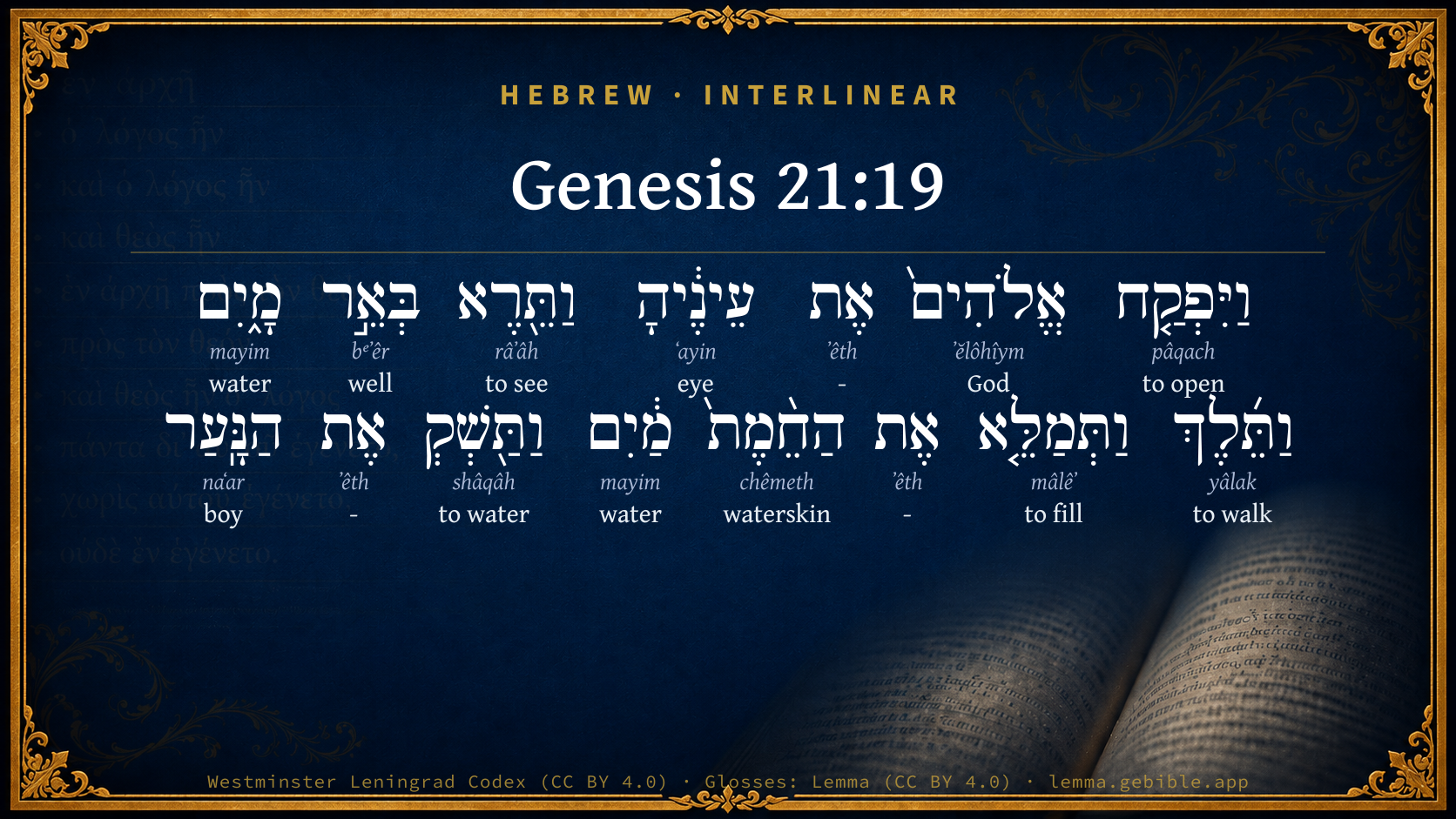
Hebrew (Westminster Leningrad Codex) Genesis 21:19 appears in the Hebrew Old Testament. The text above is from the Westminster Leningrad Codex. Each word links to its Strong’s number, a concise gloss, and parsing drawn from the Open Scriptures Hebrew Bible morphology. Click any word for its full Brown-Driver-Briggs (BDB) entry.
Download image
Cite this verse

Genesis 21:19 (World English Bible). Public Domain. Lemma interlinear Bible study tool, https://lemma.gebible.app/v/genesis/21/19.

Show BibTeX & RIS
BibTeX
RIS
English Translation
God opened her eyes, and she saw a well of water. She went, filled the bottle with water, and gave the boy drink.
World English Bible · Public Domain
Download a study sheet

One document with this verse’s original text, its word-by-word gloss line, the meaning frame, cross-references with their text, attributed commentary, and full source and license credits — printable, and it pastes into notes with its structure intact.

This verse Autodidact and up

Study sheet (.html) Plain text (.txt)

A passage Seminary Student

Up to 50 verses in one chapter. A passage sheet keeps up to 6 commentary sources and 12 cross-references per verse, in the order this page ranks them, and says so on the sheet whenever that leaves anything out. Ask for a single verse and you get the Autodidact verse sheet above.

Everything on this page stays free to read, with no account — the sheet is a download of what is already on screen, not access to it.

Want to remove ads? Support Godless Engineer
Compare translations 3

The same verse in 3 English versions, stacked beneath the original-language interlinear above. Click any original word for its lexicon entry.

Each is an independent rendering of the whole verse — the interlinear is not word-aligned to these translations.

Highlighted words mark where these versions differ — a whole-verse word diff, not a word-by-word alignment.

  • World English Bible Public Domain
    God opened her eyes, and she saw a well of water. She went, filled the bottle with water, and gave the boy drink.
  • King James Version Public Domain
    And God opened her eyes, and she saw a well of water; and she went, and filled the bottle with water, and gave the lad drink.
  • unfoldingWord Literal Text CC BY-SA 4.0
    Then God opened her eyes and she saw a well of water. So she went and filled the skin water and gave the boy a drink.

unfoldingWord Literal Text — © unfoldingWord, licensed CC BY-SA 4.0. Word-aligned USFM3 via Door43 (git.door43.org/unfoldingWord/en_ult).

Versions to compare (up to 4)

3 of 4 selected

Show all 18 translations

Every available English version of this verse, each an independent rendering of the whole verse.

  • World English Bible Public Domain
    God opened her eyes, and she saw a well of water. She went, filled the bottle with water, and gave the boy drink.
  • Berean Standard Bible Public Domain
    Then God opened her eyes, and she saw a well of water. So she went and filled the skin with water and gave the boy a drink.
  • Majority Standard Bible Public Domain
    Then God opened her eyes, and she saw a well of water. So she went and filled the skin with water and gave the boy a drink.
  • King James Version Public Domain
    And God opened her eyes, and she saw a well of water; and she went, and filled the bottle with water, and gave the lad drink.
  • American Standard Version (1901) Public Domain
    And God opened her eyes, and she saw a well of water. And she went, and filled the bottle with water, and gave the lad drink.
  • Revised Version (1885) Public Domain
    And God opened her eyes, and she saw a well of water; and she went, and filled the bottle with water, and gave the lad drink.
  • Geneva Bible (1599) Public Domain
    And God opened her eyes, and she sawe a well of water. so she went and filled the bottell with water, and gaue the boy drinke.
  • Douay-Rheims (1899) Public Domain
    And God opened her eyes: and she saw a well of water, and went and filled the bottle, and gave the boy to drink.
  • Young's Literal Translation Public Domain
    And God openeth her eyes, and she seeth a well of water, and she goeth and filleth the bottle `with' water, and causeth the youth to drink;
  • Literal Standard Version CC BY-SA 4.0
    And God opens her eyes, and she sees a well of water, and she goes and fills the bottle [with] water, and causes the youth to drink;
  • Unlocked Literal Bible CC BY-SA 4.0
    Then God opened her eyes, and she saw a well of water. She went and filled the skin with water, and gave the lad a drink.
  • unfoldingWord Literal Text CC BY-SA 4.0
    Then God opened her eyes and she saw a well of water. So she went and filled the skin water and gave the boy a drink.
  • Darby Bible Public Domain
    And God opened her eyes, and she saw a well of water; and she went and filled the flask with water, and gave the lad drink.
  • World Messianic Bible Public Domain
    God opened her eyes, and she saw a well of water. She went, filled the container with water, and gave the boy a drink.
  • Webster's Bible Public Domain
    And God opened her eyes, and she saw a well of water: and she went, and filled the bottle with water, and gave the lad drink.
  • Free Bible Version CC BY-SA 4.0
    God opened her eyes and she saw a well nearby. She went and filled the skin with water and gave the boy a drink.
  • Bible in Basic English Public Domain
    Then God made her eyes open, and she saw a water-spring, and she got water in the skin and gave the boy a drink.
  • JPS Tanakh (1917) Public Domain
    And God opened her eyes, and she saw a well of water; and she went, and filled the bottle with water, and gave the lad drink.

Literal Standard Version (2020), Covenant Press — licensed CC BY-SA 4.0. Text via the HelloAO Bible API (eBible.org). Unlocked Literal Bible (unfoldingWord) — licensed CC BY-SA 4.0. Text via the HelloAO Bible API (eBible.org). unfoldingWord Literal Text — © unfoldingWord, licensed CC BY-SA 4.0. Word-aligned USFM3 via Door43 (git.door43.org/unfoldingWord/en_ult). Free Bible Version, Dr. Jonathan Gallagher — licensed CC BY-SA 4.0. Text via the HelloAO Bible API (eBible.org).

Word by word

More ways to search: Search by grammar → Find every occurrence → Compare this word →

Practice this passage: Drill this verse → Learn its vocabulary →

הַחֵ֨מֶת֙
chêmeth
H2573
“the · waterskin”
Particle, Definite Article + Noun, Common, Feminine, Singular, Absolute
Part of Speech
Particle + Noun
Type
Common
Gender
Feminine
Number
Singular
State
Absolute
Full BDB Definition

Origin: from the same as H2346

TWOT: TWOT- 689a

bottle, waterskin
  1. וַיִּפְקַ֤ח pâqach H6491 “and · to open” Conjunction + Verb, Qal, Sequential Imperfect, 3rd Person, Masculine, Singular
  2. אֱלֹהִים֙ ʼĕlôhîym H430 “God(s)” Noun, Common, Masculine, Plural, Absolute
  3. אֶת ʼêth H853 “-” Particle, Direct Object
  4. עֵינֶ֔יהָ ʻayin H5869 “eyes · her” Noun, Common, Both, Dual, Construct + Suffix, Personal, 3rd Person, Feminine, Singular
  5. וַתֵּ֖רֶא râʼâh H7200 “and · to see” Conjunction + Verb, Qal, Sequential Imperfect, 3rd Person, Feminine, Singular
  6. בְּאֵ֣ר bᵉʼêr H875 “well of” Noun, Common, Feminine, Singular, Construct
  7. מָ֑יִם mayim H4325 “water(s)” Noun, Common, Masculine, Plural, Absolute
  8. וַתֵּ֜לֶךְ yâlak H3212 “and · to walk” Conjunction + Verb, Qal, Sequential Imperfect, 3rd Person, Feminine, Singular
  9. וַתְּמַלֵּ֤א mâlêʼ H4390 “and · to fill” Conjunction + Verb, Piel, Sequential Imperfect, 3rd Person, Feminine, Singular
  10. אֶת ʼêth H853 “-” Particle, Direct Object
  11. מַ֔יִם mayim H4325 “water(s)” Noun, Common, Masculine, Plural, Absolute
  12. וַתַּ֖שְׁקְ shâqâh H8248 “and · to water” Conjunction + Verb, Hiphil, Sequential Imperfect, 3rd Person, Feminine, Singular
  13. אֶת ʼêth H853 “-” Particle, Direct Object
  14. הַנָּֽעַר naʻar H5288 “the · boy” Particle, Definite Article + Noun, Common, Masculine, Singular, Absolute

About this verse

These counts appear in no published source. They are computed here, from the morphology-tagged text and Lemma’s own curated glosses. What Lemma adds →

15
words
12
distinct lemmas
Pentateuch
section

Notable vocabulary

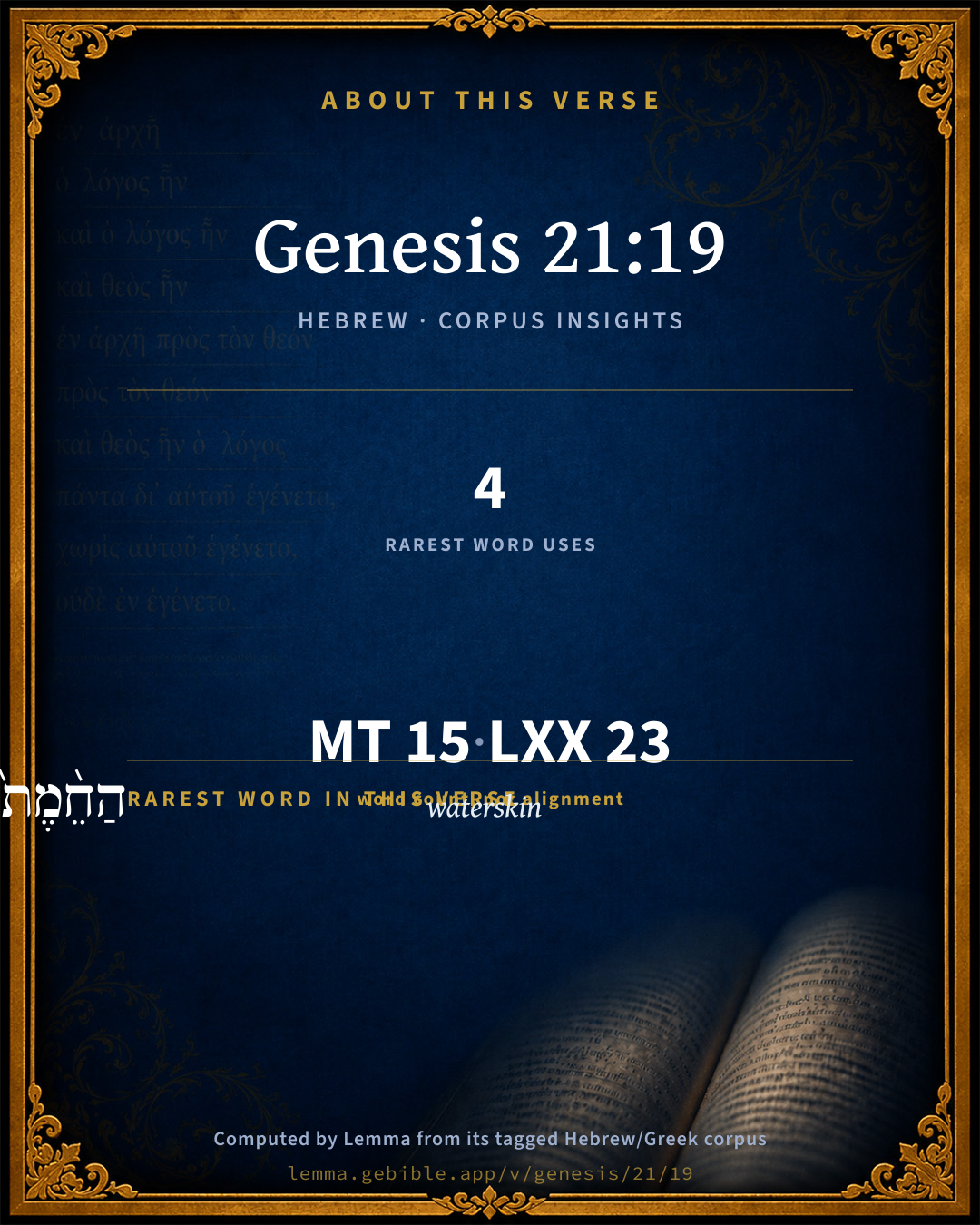
The rarest word here is הַחֵ֨מֶת֙ waterskin H2573 — appearing just 4 times in the whole Hebrew Bible.

Shared distinctive vocabulary

הַחֵ֨מֶת֙ waterskin H2573 occurs in 4 verses of the Hebrew Bible. Also found in:

Grammatical profile

  • 5 verbs
  • 7 nouns
  • 3 particles

Verb forms

  • וַיִּפְקַ֤ח Qal · Sequential Imperfect
  • וַתֵּ֖רֶא Qal · Sequential Imperfect
  • וַתֵּ֜לֶךְ Qal · Sequential Imperfect
  • וַתְּמַלֵּ֤א Piel · Sequential Imperfect
  • וַתַּ֖שְׁקְ Hiphil · Sequential Imperfect

Repetition

A word recurs within this verse — often emphatic in Hebrew:

  • מָ֑יִם water H4325 ×2

Hebrew & Septuagint length

In English translation the verse runs 23 words from the Hebrew and 27 from the Septuagint (LXX English) — closely comparable.

A rough comparison of the two English renderings, which tokenize alike — not a word-level alignment.

Word counts can differ between the Hebrew and the Greek without any difference in meaning — e.g. the Hebrew direct-object marker אֵת has no separate Greek word, and Greek often adds the article ὁ.

In the original languages it is 15 Hebrew tokens and 23 Greek tokens — but the two are counted differently (Hebrew bundles its prefixes and suffixes into one token; the Greek is in lemma form), so that isn’t a like-for-like length.

Cross-references

4

Topical passages linked to Genesis 21:19 in the Treasury of Scripture Knowledge — connected by theme and wording, ordered by reader-vote popularity; previews shown in the World English Bible.

  • Numbers 22:31 Then Yahweh opened the eyes of Balaam, and he saw the angel of Yahweh standing in the way, with his sword drawn in his hand; and he bowed his head, and fell on his face.
  • 2 Kings 6:17–20 Elisha prayed, and said, Yahweh, Please open his eyes, that he may see. Yahweh opened the eyes of the young man; and he saw: and, behold, the mountain was full of horses and chariots of fire round about Elisha.
  • Isaiah 35:5–6 Then the eyes of the blind shall be opened, and the ears of the deaf shall be unstopped.
  • Luke 24:16–31 But their eyes were kept from recognizing him.

Cross-references courtesy of OpenBible.info (CC BY 4.0).

Hebrew and Greek witnesses Masoretic Hebrew ↔ Greek Septuagint

The same verse in the two great witnesses to the Old Testament, shown verse-for-verse.

These are two independent witnesses, not word-aligned to each other, and the Septuagint is shown in lemma (dictionary) form.

Hebrew Genesis 21:19 Masoretic · Westminster Leningrad Codex

וַיִּפְקַ֤ח אֱלֹהִים֙ אֶת עֵינֶ֔יהָ וַתֵּ֖רֶא בְּאֵ֣ר מָ֑יִם וַתֵּ֜לֶךְ וַתְּמַלֵּ֤א אֶת הַחֵ֨מֶת֙ מַ֔יִם וַתַּ֖שְׁקְ אֶת הַנָּֽעַר

God opened her eyes, and she saw a well of water. She went, filled the bottle with water, and gave the boy drink.

World English Bible · Public Domain

Greek LXX Genesis 21:19 Septuagint · lemma form

καί ἀναοἴγω ὁ θεός ὁ ὀφθαλμός αὐτός καί ὁράω φρέαρ ὕδωρ ζάω καί πορεύομαι καί πίμπλημι ὁ ἀσκός ὕδωρ καί ποτίζω ὁ παιδίον

And God opened her eyes, and she saw a well of springing water; and she went and filled the skin with water, and gave the child drink.

LXX2012 (modern English Septuagint) · Public Domain

On this verse, The Cambridge Bible for Schools and Colleges discusses the Septuagint’s reading. Read the note in Commentary ↓

Hebrew: Westminster Leningrad Codex (CC BY 4.0). Greek: Septuagint (public domain); English from LXX2012 (modern English Septuagint) (Public Domain). How the Septuagint differs from the Hebrew →

Targum (Aramaic paraphrase)

2

The Targum is the ancient Jewish Aramaic paraphrase of the Hebrew Scriptures — an interpretive translation, not the Hebrew text itself. Onkelos (literal) and Pseudo-Jonathan (expansive) render the Torah, and Jonathan the Prophets. Coverage is partial: where no permissively-licensed English translation exists for a verse, only the Aramaic is shown. This is verse-level text, not a word-by-word alignment to the Hebrew.

  1. Targum Onkelos Torah (Genesis–Deuteronomy)
    וּגְלָא יְיָ יָת עֵינָהַהּ וַחֲזַת בֵּירָא דְמַיָּא וַאֲזָלַת וּמְלַת יָת רָקְבָּא מַיָּא וְאַשְׁקִיאַת יָת רַבְיָא

    (no public-domain English translation for this verse)

    Targum Onkelos — Aramaic: “Onkelos Genesis” (public domain); “Onkelos Exodus” (public domain); “Onkelos Leviticus” (public domain); “Onkelos Numbers” (public domain); “Onkelos Deuteronomy” (public domain). English: “Sefaria Community Translation” (CC0 1.0 (public-domain dedication)); “J.W. Etheridge. The Targums of Onkelos and Jonathan Ben Uzziel on the Pentateuch. London: Longmans, Green, 1862” (public domain). Text via Sefaria.

  2. Targum Pseudo-Jonathan Torah (Genesis–Deuteronomy)
    וְגַלֵי יְיָ יַת עֵינָהָא וְאִתְגְלֵי לָהּ בֵּרָא דְמַיָא וְאָזְלַת וּמְלַת יַת קִרְוָא מַיָא וְאַשְׁקִיַית יַת טַלְיָיא

    And the Lord opened her eyes, and showed her a well of water, and she went and filled the cruse with water, and gave the youth to drink.

    Targum Pseudo-Jonathan — Aramaic: “Targum Jonathan on Genesis” (public domain); “Targum Jonathan on Exodus” (public domain); “Targum Jonathan on Leviticus” (public domain); “Targum Jonathan on Numbers” (public domain); “Targum Jonathan on Deuteronomy” (public domain). English: “The Targum of Jonathan ben Uzziel, trans. J. W. Etheridge, London, 1862” (public domain). Text via Sefaria.

Commentary

Notes on Genesis 21:19 from classic Christian and Jewish commentators (each source and its license shown beneath its notes). The classic Christian expositions comment on the surrounding passage and are grouped to its opening verse, so a note may address several verses; the Jewish commentaries on the Tanakh (Rashi and others) are per-verse, so they appear only where the commentator wrote on this verse.

Lemma curates 59 commentaries, every one of them public domain or Creative Commons licensed, each selected and text-cleaned for this edition rather than reprinted as found. About our sources →

Trapp's Complete Commentary

John Trapp

Gen 21:19 And God opened her eyes, and she saw a well of water; and she went, and filled the bottle with water, and gave the lad drink.

Ver. 19. God opened her eyes, &c.] The well was there before, but she saw it not till her eyes were opened. So, till God irradiate both the organ and the object, we neither see nor suck those "breasts of consolation". {Isa 66:11} We turn the back, and not the palm of the hand, to the staff of the promises.

John Trapp, A Commentary or Exposition upon All the Books of the Old and New Testament (1647–1656) — public domain. Text from a community e-Sword module.

The Biblical Illustrator

Joseph S. Exell

Gen_21:19

God opened her eyes, and she saw a well of water

The hidden well discovered

In this hidden well, which Ishmaels prayer uncovered, lies many a true lesson, if only we have the right sort of pitcher to dip and draw.

I. How CAME THE WELL TO BE THERE, JUST WHERE AND WHEN IT WAS WANTED? The Arab shepherds who dug it never meant it for wandering travellers, but for their own flocks. God guided the steps of Hagar to it. Life is full of hidden wells--stored-up blessings, ready at the right moment to supply the answer to prayer. God foresees our prayers as well as our necessities.

II. OUR ENCOURAGEMENT TO PRAY IS NOT OUR OWN GOODNESS, BUT GODS. We plead not the name of Abraham, or of any earthly parent or friend, but the name of Jesus, Gods own dear Son.

III. Learn from this story NOT TO THINK LITTLE THINGS OF NO IMPORTANCE, and not to be afraid to pray to God about little things as well as great. There are two reasons which prove that God does not disdain to attend little things:

(1) He has made many more little things than great, and has made the greatest things to depend on the least;

(2) God is so great, that the difference between what we call great and little is to Him as nothing; and He is so wise, that nothing--not a thought or atom--is small enough to escape His eye.

IV. Prayer itself is a hidden well; a secret source of strength,and joy, and wisdom, not only in times of trouble, but always. (E. R. Conder, D. D.)

Christian culture

I. HUMANITY SEEDS LIGHT.

1. Physical

2. Intellectual.

3. Spiritual.

II. GOD GIVES THE LIGHT.

1. Creator.

2. Providence.

3. Conscience.

4. Revelation.

5. Redemption.

III. LIGHT IS BENEFICENT. (The Homiletic Review.)

Hagar in the wilderness

I. THE CIRCUMSTANCES WHICH BROUGHT HER INTO THIS SITUATION,

II. THE EFFECT PRODUCED ON HER BY THE DESOLATE SITUATION INTO WHICH SHE IS BROUGHT.

1. It was despair in opposition to Gods plain promises. Let me not see the death of the child, she says. Why, the Lord Himself had spoken to her from heaven years ago, and told her that that very child should live to be a man and a powerful and great one. And this promise He had renewed but a short time before to Abraham, who would naturally mention the renewal of it to her. But in this hour of seeming danger, Jehovahs words are nothing to her; she either does not think of or she disbelieves them. My child must die, she says, and east him down to die. How like ourselves in some of our trials!

2. The despair of Hagar was despair in opposition to her own experience. This was not the first time she had been in a desert (see Gen_16:1-16). And there, we might have expected, the Lord would have left her to reap the fruit of her rashness; but not so. He is observant of her there. In admiration of the Lords goodness, she calls the place where she had experienced it by a name implying, Thou God seest me. But this is now clean forgotten. Ourselves again, brethren. I know whom I have believed. The experience I myself have had in days past of my Saviours love and faithfulness encourages me, nay, compels me, to trust Him now. The Lord brings us into a desert and appears for us there. I can never forget this, we say. The remembrance of this mercy will be a stay to me all my life long. But we get into the desert again, and what do we say then? All the many proofs we have had of the Lords power and faithfulness, are as much out of our thoughts as though we had never had one of them.

3. Hagars despair was despair in opposition to fact also. It was despair in the very midst of abundance.

III. Let us look now at THE INTERPOSITION OF GOD IN BEHALF OF THIS DESPAIRING WOMAN, the mercy He showed her. It consisted, you observe, in this one simple thing, He opened her eyes. He did no more for her, for no more was needed. Wondering, happy woman! we say; but not more wondering or more happy than many a despairing sinner has been, when the Lord has opened his eyes and discovered to him His great salvation, His abounding mercy, the fountain of living waters He has provided for him in Jesus Christ. (C. Bradley, M. A.)

Providence timely

We find a multitude of Providences so timed to a minute, that, had they fallen out ever so little sooner or later, they had signified but little in comparison of what they now do. Certainly, it cannot be casualty, but counsel, that so exactly nicks the opportunity. Contingencies keep no rules. How remarkable to this purpose was the tidings brought to Saul, that the Philistines had invaded the land just as he was ready to grasp the prey (1Sa_23:27). The angel calls to Abraham, and shows him another sacrifice, just when his hand was giving the fatal stroke to Isaac (Gen_22:10-11). A well of water is discovered to Hagar just when she had left the child as not able to see its Gen_21:16-19). Rabshakeh meets with blasting providence, hears a rumour that frustrated his design, just when ready to give the shock against Jerusalem (Isa_37:7-8). So when Hamans plot against the Jews was ripe, and all things ready for execution, On that night could not the king sleep (Est_6:1). When the horns are ready to gore Judah, immediately carpenters are prepared to fray them away (Zec_1:18-21). How remarkable was the relief of Rochelle by a shoal of fish that came into the harbour when they were ready to perish with hunger, such as they never observed either before or after that time. Mr. Dodd could not go to bed one night, but feels a strong impulse to visit (though unreasonable) a neighbouring gentleman, and just as he came he meets him at his door, with a halter in his pocket, just going to hang himself. Dr. Tare and his wife, in the Irish rebellion, flying through the woods with a sucking child, which was just ready to expire, the mother, going to rest it upon a rock, puts her hand upon a bottle of warm milk, by which it was preserved. A good woman, from whose mouth I received it, being driven to a great extremity, all supplies failing, was exceedingly plunged into unbelieving doubts and fears, not seing whence supplies would come; when lo! in the nick of time, turning some things in a chest, she unexpectedly lights upon a piece of gold, which supplied her present wants till God opened another door of supply. If these things fall out casually, how is it that they observe the very juncture of time so exactly? This is become proverbial in Scripture. In the mount of the Lord it shall be seen (Gen_22:14). (J. Flavel.)

Strange providences

Suppose you were in a smiths shop, and there should see several sorts of tools, some crooked, some bowed, others hooked, would you, asks Spencer, condemn all these things for nought because they do not look handsome? The smith makes use of them all for the doing of his work. Thus it is with the providences of God: they seem to us to be very crooked and strange, yet they all carry on Gods work.

Eyes opened

I. Taking HAGARS CASE first, I shall address myself to certain unconverted ones who are in a hopeful condition.

1. Taking Hagars case as the model to work upon, we may see in her and in many like her a preparedness for mercy. In many respects she was in a fit state to become an object of mercys help. She had a strong sense of need. The water was spent in the bottle, she herself was ready to faint, and her child lay at deaths door; and this sense of need was attended by vehement desires. It is quite certain that, in Hagars case, the will was right enough with reference to the water. It would have been preposterous indeed to say to Hagar, If there be water, are you willing to drink? Willing? she would say; look at my parched lips, hear my dolorous cries, look at my poor punting, dying child! And so with you; if I were to propose to you the question, Are you willing to be saved? you might look at me in the face and say, Willing! oh, sir, I have long passed beyond that stage I am punting, groaning, thirsting, fainting, dying to find Christ. All this is hopeful, but I must again remind you that to will to be rich does not make a man rich, and that to will to be saved cannot in itself save you.

2. In the second place, mercy was prepared for Hagar, and is prepared for those in a like state. The water was near to Hagar; and so is Christ near to you, my dear friend, this morning. The mercy of God is not a thing to be sought for up yonder among the stars, nor to be discovered in the depths; it is nigh thee, it is even in thy mouth and in thy heart.

3. We pass on, then, in the third place, to notice that although Hagar was prepared and mercy was prepared, yet there was an impediment in the way, for she could not see the water. There is also an impediment in your way. Hagar had a pair of bright beaming eyes, I will be bound to say, and yet she could not see the water; and men may have first-rate understandings, but not understand that simple thing--faith in the Lord Jesus Christ. Simple trust in Jesus has this difficulty in it, that it is not difficult, and therefore the human mind refuses to believe that God can intend to save us by so simple a plan. What blindness is this! So foolish and so fatal. The main reason I think, however, why some do not attain early to peace is because they are looking for more than they will get, and thus their eyes are dazzled with fancies. Again, I am afraid some persons, with the water at their feet, do not drink it because of the bad directions that are given by ministers.

4. I feel certain that there are some here upon whom the Lord intends to work this morning; so we will speak, in the fourth place, upon the divine removal of the impediment. Hagars blindness was removed by God. No one else could have removed it. God must open a mans eyes to understand practically what belief in Jesus Christ is. But while this was divinely removed, it was removed instrumentally. An angel spake out of heaven to Hagar. It matters little whether it be an angel or a man, it is the Word of God which removes this difficulty.

II. Oh that the Spirit of God would give me power from on high while I try to talk to the saints from THE SECOND CASE, viz., that of the apostles in Luk_24:31. This is no Hagar, but Cleopas and another disciple. They ought to have known Jesus for these reasons.

1. They were acquainted with Him, they had been with Him for years in public and in private, they had heard His voice so often that they ought to have recollected its tones.

2. They ought to have known Him, because He was close to them; He was walking with them along the same road, He was not up on a mountain at a distance.

3. They ought to have seen Him, because they had the Scriptures to reflect His image, and yet how possible it is for us to open that precious Book and turn over page after page of it and not see Christ.

4. What is more, these disciples ought to have seen Jesus, for they had the Scriptures opened to them.

5. There was another reason why the disciples ought to have seen Him, namely, that they had received testimonies from others about Him. Now what is the reason for this? Why do we not see Him? I think it must be ascribed in our case to the same as in theirs, namely, our unbelief. They evidently did not expect to see Him, and therefore they did not discover Him. (C. H. Spurgeon.)

A welcome discovery

I. It often happens that when we are in trouble and distress, THE SUPPLY OF OUR NEED, AND THE CONSOLATION FOR OUR SORROW ARE VERY NEAR AT HAND. There is a well close to us at our feet, if we could but see it.

1. How true this often is in providence with Christian people. We have known them to be in sore alarm at some approaching ill, or in the most fearless distress on account of some troublous circumstances which already surround them. They have said, We dont know what we shall do to-morrow. They have inquired, Who shall roll us away the stone? They wot not that God has already provided for to-morrow, and has rolled the stone away. If they knew all, they would understand that their trial is purely imaginary. They are making it by their unbelief. It has no other existence than that which their distrust of God gives to it.

2. Though this is true of providence, I prefer rather to deal with the matter of spiritual blessings. It often happens that souls are disturbed in spiritual matters about things that ought not to disturb them. For instance, a large proportion of spiritual distresses are occasioned by a forgetfulness or an ignorance of the doctrines of the Bible. Sometimes, holy Scripture has its well near to the troubled heart, not so much in the form of doctrine, as in the form of promise. There was never a trouble yet in human experience among Gods people, but what there was a promise to meet it. At other times the well appears in the form neither of a doctrine nor of a promise, but in the shape of an experience of some one else. Perhaps nothing more effectually comforts, under the blessing of God, than the discovery that some undoubtedly good man has passed through the same state of heart in which we are found. And, beloved, sometimes it pleases the Holy Spirit to open a well of living waters for us in the person, and work, and life, and sympathy, and love, of our Well-beloved, the Lord Jesus Christ. Jesus suffers with thee, O thou child of God,--suffers in thee. Thou art a member of His body, and therefore He endures in thee. Thou art making up that which is behind of the sufferings of Christ for His bodys sake, which is the Church. Besides, once more, our sorrows often arise from our not observing the Holy Spirit.

II. I think I hear some one say, I have no doubt, sir, that God has provided a supply for necessities, but may I partake of that supply? may I participate in the provisions of Divine love? I will answer thee by saying, in the second place, that THIS SUPPLY IS FOR YOU.

III. Now to our last point. IT IS AVAILABLE WITHOUT ANY EXTRAORDINARY EXERTION. Hagar went and filled her bottle with water, and she gave her child to drink. No hydraulic inventions were required; no exceedingly difficult pumping, no mechanical contrivances to obtain the water when the spring was perceived. She did a very simple thing: she held her bottle in the water till it was full, poured out into the childs mouth, and the dilemma which had perilled life was over. Now, the way by which we get a hold of Christ is faith. (C. H. Spurgeon.)

Eyes opened

I. Our first head shall be that IF OUR EYES WERE FURTHER OPENED THE RESULT TO ANY ONE OF US WOULD BE VERY REMARKABLE. We are at present limited in our range of sight. This is true of our natural or physical vision, of our mental vision, and of our spiritual vision; and in each case when the range of sight is enlarged very remarkable discoveries are made. God has been pleased to open the natural eyes of mankind by the invention optical instruments. What a discovery it was when first of all certain pieces of glass were arranged in connection with each other, and men began to peer into the stars! Equally marvellous was the effect upon human knowledge when the microscope was invented. We could never have imagined what wonders of skill and taste would be revealed by the magnifying-glass, and what marvels of beauty would be found compassed within a space too small to measure. Our physical eyes thus opened by either glass reveal strange marvels, and we may infer from this fact that the opening of our mental and spiritual eyes will discover to us equal wonders in other domains, and thus increase our reverence and love towards God.

1. Suppose, that our eyes could be opened as to all our past lives. Our childhood--how different that period would now appear with Gods light upon it. Our vision will be strengthened one day, so that we shall see the end from the beginning, and then we shall understand that the Lord maketh all things work together for good to them that love Him.

2. And now suppose, again, our eyes should be opened upon the future. Ay, would you not like to spy into destiny? Ah, if your eyes could be opened as to all that is to happen, what would you do? If you were wise, and knew your future, you would commit it unto God; commit it to Him though you do not know it.

3. If our eyes were opened, again, on another point, as to the existence of angels, we should see marvels. If the Lord opened the eyes of His greatly beloved servants to see how many of these mighty intelligences are silently guarding then., they would cease to complain of loneliness while in the midst of such a thronging ministry of willing friends.

4. And what, once more, if your eyes could be opened to look into heaven?

II. IN SOME THINGS OUR EYES MUST BE OPENED. Those I have spoken about are desirable in a measure, but these are absolutely necessary. For instance, as to the divine salvation, our eyes must be opened.

III. IN OUR PRESENT CASE IT IS VERY DESIRABLE THAT OUR EYES SHOULD BE OPENED. To many it is imperatively needful at this moment, for if not now recovered from their blindness they will die in their sins.

1. First, we would have opened eyes that we may see Jesus to be very near us. Do not think of Him just now as if He were far away in heaven. He is there in his glorious personality, but His spiritual presence is here also.

2. We desire that you may have your eyes opened to see what you are in Christ. You complain that you are black in yourselves; but you are most fair in Him.

3. Lastly, may the Lord open your eyes to see what you will be in Him. Certain of us are nearer heaven than we think. Let our hearts dance for joy at the bare thought of such speedy felicity. Let us go on our way blessing and magnifying Him who has opened our eyes to see the glory which He has prepared for them that love Him, which shall be ours ere long. (C. H.Spurgeon.)

Wells in unexpected places

It is wonderful how God provides for the needs of His creatures in strange places and in unlikely ways. All living things must have water or die; and so water is often found stored up in remarkable and unexpected places. In the heart of Africa, where all is drought and barrenness, it is said that there is sometimes found in the soil a little stem of a plant, and by digging down to the bottom of it, a bulb is discovered which contains a quantity of pure, sweet water. Melons, which are full of water, grow best on light, dry, sandy soil; and sometimes, where water cannot easily be found, certain trees afford a most nourishing and refreshing beverage. There is a vast amount of water in the air, even when no clouds are seen. In a summer day how quickly the outside of a pitcher of cold water will be covered with moisture, which is drawn from the air. So while some plants draw up water from the earth by their roots, others, called air plants, hang upon trees, and, without touching the ground, draw nourishment and moisture from the air. A writer tells of a surveying party who were resting at noon in Florida, when one of the chainmen exclaimed: I would give fifty cents a swallow for all the water I could drink. He expressed the sentiment of the others; all were very thirsty, and there was not a spring or a stream of water anywhere in the vicinity. While the men were thus talking, the surveyor saw a crow put his bill into a cluster of broad, long leaves, growing on the side of a tall cypress. The leaves were those of a peculiar air-plant, they were green, and bulged out at the bottom, forming an inverted bell. The smaller end was held to the tree by roots grappling the bark. Feeding on the air and water that it catches and holds, the air-plant becomes a sort of cistern. The surveyor sprang to his feet with a laugh. Boys, he said, that old crow is wiser than every one of us. How so? they asked. Why, he knows that there are a hundred thousand water-tanks in this forest. Where? they demanded, in amazement. The surveyor cut an air-plant in two, and drained nearly a pint of pure cold water from it. The men did not suffer for water after that, for every tree in the forest had at least one air-plant, and almost every air plant contained a drink of water. So God satisfies the longings of thirsty men. Even amid the deserts glowing sands, the smitten rock poured forth the life-giving flood. And God also provides living water for thirsty souls; and those who feel in their hearts longings such as earth can never satisfy, may hear amid the restlessness of unsatisfied desire, the voice of Him who stood in the Temple and cried, If any man thirst, let him come unto Me and drink!

The Biblical Illustrator, edited by Joseph S. Exell (c. 1880s–1900s) — public domain. Text from a community e-Sword module.

Geneva Bible (1599)

Geneva Bible translators

Except God open our eyes, we can neither see, nor use the means which are before us.

Geneva Bible (1599) marginal notes — public domain. Text via Bolls.life.

Jamieson, Fausset & Brown

Robert Jamieson, A. R. Fausset & David Brown

God opened her eyes--Had she forgotten the promise (Gen 16:11)? Whether she looked to God or not, He regarded her and directed her to a fountain close beside her, but probably hid amid brushwood, by the waters of which her almost expiring son was revived.

Jamieson, Fausset & Brown — Commentary Critical and Explanatory on the Whole Bible (1871) — public domain (CC PDM 1.0). Text via the HelloAO Bible API.

Adam Clarke's Commentary

Verse 19. God opened her eyes] These words appear to me to mean no more than that God directed her to a well, which probably was at no great distance from the place in which she then was; and therefore she is commanded, Ge 21:18, to support the lad, literally, to make her hand strong in his behalf-namely, that he might reach the well and quench his thirst.

Adam Clarke's Commentary on the Bible (1810–1826) — public domain. Text from a community e-Sword/MySword module.

Ellicott's Commentary for English Readers

(19) A well of water.—Not a cistern, but a spring of living water. The mirage in the desert so wearies the traveller, that at last he turns in despair from what may be more truthful signs. But after her outburst of grief, Hagar would grow more calm, and, encouraged by the angel’s voice, she renews her search, and finds. As Abravanel notices, the well already existed, and was not created for Hagar’s use; for God, it is said, opened her eyes, that is, enabled her to see something that indicated the existence of water: trees probably rising round the spring, or some vegetable upgrowth.

A Bible Commentary for English Readers, edited by Charles John Ellicott (1878–1897) — public domain. Text from a community e-Sword module.

The Cambridge Bible for Schools and Colleges

gen. ed. J. J. S. Perowne

19. opened her eyes] What she had not seen before, Hagar suddenly received power to see. Cf. Num_22:31; 2Ki_6:17; Luk_24:16; Luk_24:31. LXX φρέαρ ὕδατος ζῶντος, “a spring of living water,” in the desert.

The Cambridge Bible for Schools and Colleges (gen. ed. J. J. S. Perowne; Cambridge University Press, 1878–1918) — public domain. Text from a community e-Sword module.

John Gill's Exposition

And God was with the lad,.... To confirm his health, to provide for him the necessaries of life, to protect him from danger in the wilderness where he was, and to prosper and succeed him in temporal things; all which is owing to the providential goodness of God:

and he grew; increased in bodily stature, and arrived to manhood; or, "he became great", in riches and in substance, as Ben Melech interprets it:

and dwelt in the wilderness; of Beersheba, where he now was, or of Paran after mentioned, a fit place for a wild man to dwell in, as it was said he should be; and by this means the oracle was fulfilled, Gen 16:12,

and became an archer; skilful in the use of the bow and arrow, both for hunting and slaying of wild beasts, on whose flesh he lived, and for lighting with men, against whom his hand would be: the Jewish writers (l) say he was born with a bow, and brought up with one, and that he shot an arrow at his brother Isaac, with an intention to kill him, while he was in Abraham's house; but it does not appear that he had any knowledge or use of the bow until he was in the wilderness and was grown up, by which he lived and defended himself; and so his posterity the Kedarenes, who sprung from his son Kedar, were famous for archery, Isa 21:17; and the Ituraeans, from Jetur, another of his sons, Gen 25:15, were remarkable for their bows, of which Virgil (m) speaks; and so the Arabians that live in the deserts and round about them, called Nabathees, from Nabaioth, another son of Ishmael, are now extraordinary marksmen for bows and arrows, and to sling darts which are made of cane (n): the Saracens got their living not by the plough, but chiefly by the bow, and were all of them warriors, and lived upon wild flesh, and as rapacious as kites (o); and now the troops of the governor of Mecca, whereabout Ishmael, by the Arabs, is supposed to live, which are only infantry, are called Al-Harrabah, that is, archers, or dart men (p).

(l) Pirke, c. 30. Ammian. Marcellin. Hist. l. 14. (m) "Ithyraeos taxi curvantur in arcus". Georgic. l. 2. ver. 448. (n) Rauwolff's Travels, par. 2. ch. 4. p. 118. by Ray. (o) Ammian. Marcellin. l. 14. p. 8. Ed. Vales. (p) Sharif al Edrisi, apud Pocock. Specim. Arab. Hist. p. 122, 124.

John Gill's Exposition of the Whole Bible (1746–1763) — public domain (CC PDM 1.0). Text via the HelloAO Bible API.

Matthew Poole's English Annotations

Not that her eyes were shut or blind before, but she saw not the well before; either because it was at some distance, or because her eyes were full of tears, and her mind distracted and heedless through excessive grief and fear; or because God withheld her eyes that she might not see it without his information. Compare Num 22:31; Luk 24:16.

Matthew Poole's English Annotations on the Holy Bible (1683–1685) — public domain. Text from a community e-Sword/MySword module.

Whedon's Commentary on the Bible

Daniel D. Whedon

19. Opened her eyes — Enabling her now to discover what, in weariness and despair, she had failed to notice.

Daniel D. Whedon (gen. ed.), Commentary on the Old and New Testaments (1874–1909) — public domain. Text from a community e-Sword module.

The Pulpit Commentary

And God opened her eyes. Not necessarily by miraculous operation; perhaps simply by providentially guiding her search for water, after the administered consolation had revived her spirit and roused her energies. And she saw a well of water, raeB, as distinguished from rwOB, a pit or cistern, meant a fountain or spring of living water (cf. Gen_24:11, 20 26:19, 20, 21) It had not been previously observed by Hagar, either because of her mental agitation (dolors quasi caeca. Rosenm or because, as was customary, the mouth of the well was coveredand she went, and filled the bottle with water, and gave the lad drink which was certainly the first of the youth"s necessities, being needful to the preservation of his life and the reviving of his spirits.

HOMILIES BY J.F. MONTGOMERY Ver. 19.

Hagar in the wilderness.

God opened her eyes, and she saw a well of water." Hagar in the wilderness. Why? She had no pleasure in her home; would not accept her position there. Hence Ishmael"s mocking. Compare working of pride in Eden shall be as gods;" and its result Adam and Eve driven out.

Observe a soul despising the position of a child of God is driven into the wilderness by its own act. Pride rebels against terms of salvation (Rom_10:3) a free gift to sinners seeking it as such. (Mar_2:17) Hagar felt her misery, like many who find no peace. "All is vanity." She sat down and wept. Did she cry to God? He had met her there before. Past mercies should move to trust. (Psa_42:6) But pride and unbelief hinder prayer. (Exo_17:3-6) But God had not forgotten her (cf. Mat_18:11) "What aileth thee?" Compare our Lord"s dealing with those he helped.

1. Himself taking the first step.

2. Requiring a confession of their want.

3. Rousing expectation. (Joh_4:14 Joh_7:37)

I THE WELL WAS NEAR HER, BUT SHE SAW IT NOT. So is it with the water of life. Why are so many without peace? The well is beside them; the sound of the gospel is familiar to them. The Bible is read in their hearing, but it speaks nothing to them. (2Co_3:15) Christ died for all. (2Co_5:14) His blood the ransom for all. (1Jn_1:7) We have not to go to seek a Savior. (Rom_10:6-8) No sin too deep for cleansing, no sorrow too great for comfort; nothing required to give a right to trust him. (Isa_55:1; Luk_15:2) Why without peace? The eyes are closed to the truth. (1Co_2:14) Human teaching cannot give life. (Eze_37:8) What is wanted is not a new fountain, but opened eyes. And it is disbelief of this that keeps so many in anxiety. To them the well is not there; they want God to give it. They look for something they are to do to find a Savior. Important to know what is wanted spiritual discernment. To many this seems a mere fancy; but they whose eyes are opened know it to be a passing from darkness to light. (2Ti_1:10) Words often read become full of new meaning.

II GOD OPENED HER EYES. It is blindness that causes trouble; but as blind cannot see by his own will, so neither can the unspiritual. The way of salvation is before him, but while it commends itself to his reason it brings him no joy. Are we then without effort to sit still? No; all is ready on God"s part. "Wilt thou be made whole?" Want of will alone hinders. Often men would like to drink, but not at God"s fountain. Make an effort to believe, and power will be given.

III WHAT SHE SAW. The well of life; the revelation of Jesus Christ to the soul this is peace. Not our own powers or wisdom, not our own holiness or advance in grace; but trust in him. No more fears. True, the wilderness is there; the work has to be done, temptations overcome, sorrows borne, graces cultivated; but we can do all through Christ. Now troubles become helps, (Psa_84:6) for they make us flee to Christ. (2Co_12:9) And who can count the blessings revealed to him whose eyes are opened? A Father in everything protection, teaching, guidance. Everything surrounding him, every event that happens to him, are inlets of ever increasing knowledge of God, whom to know is life eternal. M.

The Pulpit Commentary (1880–1919), ed. H.D.M. Spence-Jones & Joseph S. Exell — public domain. Text from a community e-Sword module.

unfoldingWord translationNotes

Door43 World Missions Community

God opened her eyes, and she saw

God making Hagar aware of the well is spoken of as if he literally opened her eyes. AT: "God caused Hagar to see" or "God showed her" (See: Metaphor)

the skin

"the container made of skin" or "the bag"

the lad

"the boy" or "Ishmael"

God was with the lad

Here the phrase "was with" is an idiom that means God helped or blessed the boy. AT: "God guided the boy" or "God blessed the boy" (See: Idiom)

became an archer

"became very skilled at using a bow and arrows"

got a wife

"found a wife"

translationWords

God

cistern

desert

archer

Paran

Egypt

unfoldingWord translationNotes — © Distant Shores Media and the Door43 World Missions Community, licensed CC BY-SA 4.0. Source: git.door43.org/Door43/en_tn.

Radak

Rabbi David Kimhi (Radak)

ויפקח אלוקים את עיניה, perhaps the well had been there all the time but its top had been covered with some material which made no one assume that a well hid underneath such a covering. Alternatively, it was some distance away.

ותלך ותמלא את החמת, G’d expanded her range of vision so that she now saw the contours of a well she had not previously been able to see. Perhaps that well had not existed and G’d had provided it at this time on a temporary basis to keep Ishmael alive. The matter may have been similar to an experience Shimshon had in Judges 15,19 when G’d split the depression in the jawbone and produced sufficient water to quench Shimshon’s thirst.

ותשק את הנער, the sequence sounds misleading, as she had drunk herself when she saw the well, then she had filled the hose and brought it to her son to drink, after which she had filled the hose again to continue on her way. The positioning of the letters ו such as ותלך, ותמלא.ותשק is not at all unusual. Examples of such constructions may be found in Isaiah 64,4; Exodus 14,21; Exodus 15,20, et al. An alternative meaning could be that she drew water from the well with the hose being used as a pail, and carried it to where Ishmael was lying, giving him to drink there.

Radak on the Tanakh — English translations: “Sefaria Community Translation” (CC0 1.0 (public-domain dedication)); “Eliyahu Munk, HaChut Hameshulash” (CC BY 4.0); “Rabbi Mike Feuer, Jerusalem Anthology” (CC BY 4.0); and “R. David Kimhi on the first book of Psalms, Translated by R.G. Finch, London, 1919” (public domain). Text via Sefaria.

Lesson kit

Teaching starters — assembled from the data on this page, not authored interpretation. Every prompt links to the verse data it draws on. Edit before teaching.

Genesis, in the Pentateuch, opens this verse with 15 words (12 distinct Hebrew lemmas). Its most distinctive word is chêmeth (“waterskin”). A historical commentator’s framing appears above. Read the whole chapter for the surrounding context.

Discussion questions

  1. What does “waterskin” (chêmeth) contribute to the verse as a whole?
  2. How does Genesis 21:14, which shares the word «waterskin», read alongside this verse?
  3. What does the repetition of “water” (2× in this one verse) do in this verse?
  4. These translations render this verse differently; the difference is in the English rendering, not the original. What questions does that raise?
  5. «וַיִּפְקַ֤ח» is a Qal Sequential Imperfect verb. How does that grammatical form shape the action described?
  6. Compare how Trapp's Complete Commentary and The Biblical Illustrator read this verse. Where do they agree or differ?

Things to notice

Reading settings

Reading text

Shown beneath each verse's original-language words.

Old Testament
Old Testament edition

Read the OT as the Masoretic Hebrew (MT) or the Greek Septuagint (LXX).

English shown for the Greek Septuagint (in the Hebrew ↔ Greek comparison).

Comparing translations? Open the Compare panel on any verse page to stack up to four side by side.